







Abstract
We estimate the causal effects of infants’ exposure to opioids in utero on their health at birth and on the likelihood that their parents will be the subjects of subsequent reports to child protective services. We use administrative data on 259,723 infants born to 176,224 mothers enrolled in Medicaid between 2010 and 2019. Results suggest that an infant experiencing withdrawal symptoms after birth or needing admission to intensive care is strongly associated with prenatal opioid exposure, and that this effect is concentrated among those whose mothers used illicit opioids or were undergoing medication-assisted opioid treatments in their first and third trimesters. Prenatal opioid exposure is also associated with referrals of parents to child protective services and with being born preterm, low birthweight, or small for gestational age. We find smaller effects among infants exposed to prescription opioids, but these effects are not trivial, supporting current recommendations to balance the potential for infant adverse effects with the benefits of pain management during pregnancy.
Keywords
The U.S. is witnessing an increase in opioid use among pregnant people, 1 as evidenced by an 83 percent increase in neonatal abstinence syndrome (NAS) between 2010 and 2017 (Hirai et al. 2021). NAS is a condition in which a newborn exhibits withdrawal symptoms after birth, and it is often associated with substance use (typically opioid use) during pregnancy. In 2019, estimates suggest that 7 percent of women were prescribed opioids during pregnancy and that 21 percent of them indicated misuse of those opioids during pregnancy (Ko et al. 2020). Moreover, diagnoses of opioid use disorder (OUD) among mothers at delivery increased by 131 percent between 2010 and 2017. A large and growing body of economic literature has identified the disparate health effects of opioid use on adults, but, for the most part, this literature does not attend to the effects of opioid exposure among infants and children. Most of the evidence from the medical literature documenting the short-term physical and neurological effects of in utero opioid exposure among children is correlational in nature (Corsi et al. 2020; Jantzie et al. 2020). Although these estimated effects are consistent, the causal effect of in utero opioid exposure on short- and long-term health and well-being remains unknown. Given the mounting empirical evidence demonstrating that adulthood health and well-being are determined in part by the fetal environment and health at birth (Almond and Currie 2011; Almond, Currie, and Duque 2018), researchers anticipate that any short-term causal effects might translate into disparities in health and human capital later in life (Nygaard et al. 2015; Odegaard, Pendyala, and Yelamanchili 2021).
The aim of this study is to investigate the causal impact of in utero opioid exposure on infant health and well-being at birth. Specifically, we investigate whether there are causal effects of opioid exposure during critical periods of pregnancy on infant health at birth, including the diagnosis of NAS, birthweight, gestational age, APGAR (Appearance, Pulse, Grimace, Activity, and Respiration) score, admissions of newborns to neonatal intensive care units (NICUs), and reports to child protective services (CPS) within seven days of birth. To perform these analyses, we use linked administrative data from birth records, Medicaid claims, and CPS for Medicaid-covered births in Wisconsin between 2010 and 2019. We leverage within-mother/across-sibling variation in the timing and intensity of narrowly defined exposures to prescribed opioids, including both medication-assisted treatment (MAT) used in treatment of OUD, and non-MAT opioid analgesics, as well as an innovative measure to approximate illicit opioid use.
The opioid epidemic generates massive societal costs. One estimate is that the costs reached $1 trillion in 2017 (Maclean et al. 2021), and another study suggests that such costs are likely underestimated (Bifulco and Shybalkina, this volume). It is likely that external, supply-side factors gave rise to the initial surges in widespread opioid use, but mounting evidence suggests that physician prescribing behavior has fueled the epidemic (Alpert et al. 2019; Arteaga and Barone 2021; Currie and Schwandt 2021). MAT and non-MAT opioids are Food and Drug Administration (FDA)–approved for use during pregnancy. Yet medical research has documented correlations between fetal opioid exposure and diminished health at birth in both animal and human studies (Brogly et al. 2021; Ko et al. 2021; Nørgaard, Nielsson, and Heide-Jørgensen 2015; Reddy et al. 2017; Yazdy, Desai, and Brogly 2015). A central challenge is that opioid use is not random. Women who use opioids during pregnancy might be more likely than those without opioid use to live in highly polluted areas, to delay prenatal care, or to experience higher rates of stress (Conradt, Crowell, and Lester 2018). As these factors similarly affect health at birth (Aizer, Stroud, and Buka 2015; Nilsson 2017) and are likely correlated with opioid use, failure to observe and account for them will plausibly overstate the estimated effects of opioids in utero.
This study is motivated by the paucity of causal evidence that rigorously accounts for differences across mothers and infants, including those that may not be observed in existing data. Prior economic work identifies the probability of any exposure to opioids during the entire pregnancy period, making comparisons across women in either counties or states with varying levels of predicted exposure. To the extent that individual-level controls fully capture confounding factors vis-à-vis variation in opioid use and birth outcomes, the resulting estimates can be suggestive of causal effects. However, this is a strong assertion. We find that, including mother fixed effects in regression models (comparing siblings) results in attenuating cross-mother comparisons by 55 to 80 percent. This suggests that unobserved heterogeneity in maternal characteristics, health, or human capital endowments is spatially correlated with birth outcomes. In this study, we improve on the existing literature by adopting narrowly defined measures of opioid exposure by type (MAT, non-MAT, and illicit) during critical periods in pregnancy. By making comparisons in opioid exposure effects across siblings in maternal fixed-effects estimations, our estimates are less prone to bias due to unobserved heterogeneity between mothers.
Existing Research and the Aims of Our Study
Opioid use has long been associated with economic disadvantage (Case and Deaton 2017). However, findings from a growing body of literature suggest that “demand-side” economic disadvantage (e.g., unemployment or macroeconomic conditions) is not the key driver of the opioid epidemic. That is, patterns of opioid use and dependency demonstrate a weak overall association with fluctuations in macroeconomic forces and individual job loss over time (Ruhm 2019). Moreover, efforts to alleviate financial and material hardships appear weakly associated with opioid use. For this reason, an economic literature has been devoted to identifying the “root causes” of the epidemic.
Strikingly, mounting evidence suggests that “supply-side” factors began and continue to fuel opioid use concentrated in economically disadvantaged areas (Alpert, Powell, and Pacula 2018; Buckles, Evans, and Lieber 2020; Powell 2021). With evidence suggesting the importance of addressing the prescribing behavior of physicians through increased advanced education and training (Schnell and Currie 2018) and behavioral interventions to deter prescribing behavior (Doctor et al. 2018), physicians have become a central focus for patient-centered interventions to both curb and prevent opioid dependence.
Opioid exposure can affect health at birth in a variety of ways. A large body of medical literature has consistently demonstrated first-order effects of in utero opioid exposure on the incidence of NAS diagnosis, characterized by withdrawal symptoms from late trimester opioid use (Desai et al. 2015). NAS can result from use of MAT opioids, prescription opioids (non-MAT), and illicit opioids; and some nonopioids such as antidepressants or benzodiazepines. The standard approach to treating opioid use disorder in pregnancy, as recommended by the American College of Obstetricians and Gynecologists (2017), is treatment with MAT using methadone or buprenorphine, rather than medically supervised withdrawal. While MAT can also result in NAS, studies have found that MAT may lead to less severe outcomes relative to cycling on and off opioids, and that buprenorphine- as opposed to methadone-treated mothers may have infants with less severe NAS as indicated by shorter NICU stays and a lower likelihood of medication to treat NAS (Nørgaard, Nielsson, and Heide-Jørgensen 2015). Opioid exposed infants, both with and without a NAS diagnosis (or a neonatal opioid withdrawal syndrome [NOWS] diagnosis) have demonstrated higher rates of preterm birth and lower birth weight and are generally small for gestational age (Brogly et al. 2021; Reddy et al. 2017). Moreover, studies using neuroimaging methods have identified both structural and functional changes in the brains of opioid exposed infants, representing a pathway through which fetal opioid exposure might affect later cognitive functioning and mental distress (Schlagal et al. 2021).
A major limitation to many medical studies is the omission of characteristics that are correlated with both maternal opioid use and poor outcomes for children, such that estimates generated by comparing individuals across opioid use status likely reflect differences in other factors that are correlated with poor birth outcomes. One particularly strong study harnesses a propensity score matching method to create a control group of unexposed mothers in Canada (Corsi et al. 2020). The authors estimated that self-reported opioid exposure is associated with a 63 percent greater risk of preterm birth and a 191 percent greater likelihood of NICU admission. Despite the known limitations of matching methods, most notably that they are subject to omitted variable bias, that the authors matched on other forms of self-reported substance misuse is notable. An additional study, also based on self-reported opioid use but estimated using an unmatched sample, found opioid use in utero to be associated with a 50 percent increase in preterm birth and an 87 percent increase in small-for-gestational age (SGA) birth, an outcome that was insignificant in the former study (Azuine et al. 2019).
Medical literature sheds light on the many potential neurobiological effects on infant health at birth resulting from opioid exposure. However, many of these outcomes closely resemble those associated with other substances and exposures, inhibiting estimates of long-term effects on adult health and human capital (wages, earnings, skills, productivity). The fetal origins of adult diseases hypothesis asserts that adulthood disease originates in fetal exposures to maternal disease and nutrition (Barker 1995); it is supported by an evidence base devoted to disentangling the many fetal exposures affecting health at birth (Almond, Currie, and Duque 2018). Several recent economic studies build on this literature to link an exogenous (external) shock in opioid exposure to the birth outcomes we examine here. One study harnessed the reduction in opioid use due to the adoption of prescription drug monitoring programs (PDMPs) to estimate second-order effects on infant health at birth (Gihleb, Giuntella, and Zhang 2020). Though the authors detect a 10 percent reduction in NAS incidence following PDMP implementation, they fail to detect changes in health at birth or infant mortality. Conversely, a more recent study estimates that a 10 to 40 percent reduction in prescription opioid sales due to PDMPs and “pill mill” legislation increased infant birthweight by 35 grams and reduced low birth weight incidence by 0.5 percentage points (Ziedan and Kaestner 2020). Another recent working paper finds that counties at the 75th percentile in county-level opioid prescriptions exhibit, on average, 0.7 percent lower average birth weights and 0.9 percent poorer APGAR scores than those at the to the 25th percentile of opioid prescriptions (Arteaga and Barone 2021). None of these studies observe actual maternal opioid use, however, representing an important gap the current study aims to fill.
In addition to effects on newborn health, maternal opioid use during pregnancy (and in the postpartum period) is associated with CPS involvement. In 2019, a survey of state child welfare agencies revealed that forty-four states include prenatal exposure to drugs or alcohol in their statutory definition of abuse or neglect, twenty-three of which include fetal drug exposure alone. 2 In Wisconsin (the focus of our study), a positive drug screen is enough to prompt a report to CPS on the grounds that exposure is harmful to the developing fetus. Wisconsin requires reporting of prenatal substance use, equates prenatal substance use with child abuse, and considers prenatal substance use grounds for civil commitment of the mother during pregnancy. 3 Several economic studies point to a complex relationship between opioid use policies and CPS involvement. In addition to evidence of a strong correlation between opioid deaths and CPS reports over time (Chapman, this volume), one study found that PDMPs reduced CPS reports (Bruzelius et al. 2021). Another particularly well-designed study found that the opening of opioid treatment programs is associated with a 22 percent decline in foster care placements, suggesting that treatment might yield protective effects on families and children (Bullinger, Wang, and Feder, this volume). A related literature demonstrates that punitive substance abuse policies increase CPS involvement and foster care entry while failing to reduce infant rates of NAS (Atkins and Durrance 2020).
Our contribution is threefold. First, using precisely defined measures of prescription maternal opioid exposure, our approach identifies the effects that accrue due to both the timing and intensity of maternal opioid use. Second, we estimate the independent and combined effects of MAT, non-MAT, and approximated illicit opioid exposure. Third, we use a rigorous maternal fixed-effects approach to compare siblings with and without indication of prenatal exposure while adjusting for stable observed and unobserved family characteristics that may be associated with selection into opioid use and child outcomes. Finally, we use administrative data of the census of Medicaid births in the State of Wisconsin, rather than self-reported substance use data for a more select sample.
Data
We leverage linked administrative data that longitudinally capture detailed health, CPS involvement, employment, earnings, and benefit enrollment records for 259,723 Medicaid-covered births between 2010 and 2019. Administrative records come from the Wisconsin Administrative Data Core (WADC) consisting of an integrated data system on nearly eight million unique individuals (for detailed description of the WADC, see Brown et al. 2020). Mothers and infants identified in live birth certificates were linked to WADC, which includes diagnosis and procedure claims for Medicaid/S-CHIP (State Children’s Health Insurance Program)–covered women and children as part of the Big Data for Little Kids (BD4LK) project. The data used for our analyses include birth certificate, CPS reports, and Medicaid/S-CHIP records for the focal child, their family and, in some cases, for previous generations. We identify all Medicaid deliveries among WADC mothers using the common set of Current Procedural Technology (CPT) procedure codes that occurred within 15 days before or after delivery date reported on the birth certificate (59400, 59409, 59410, 59510, 59514, 59515, 59610, 59612, 59614, 59618, 59620, 59622). NAS is captured following the conventional International Classification of Diseases (ICD)-9 and ICD-10 codes (779.5x and P96.1, respectively). We also test an alternative measure of “suspected” NAS that includes the set of related conditions that are suggestive of NAS, including maternal use of drugs during pregnancy, P04.49 in ICD-10 and 655.5 in ICD-9. We exclude from the NAS diagnosis those with a co-occurring low birthweight diagnosis in ICD-9 as these might be indicative of iatrogenic cases (765.00-765.05, 770.7, 772.10-772.14, 777.50-777.53, 777.6, and 779.7). 4
We identify prescription non-MAT opioids using the National Drug Codes (NDC) in prescription claims as inclusive of any of the following drug classes of opioids (including drugs with generic names): Codeine, Dihydrocodeine, Fentanyl, Hydrocodone, Hydromorphone, Oxycodone, Meperidine, Morphine, Nalbuphine, Opium, Oxymorphone, Propoxyphene, Tapentadol, Tramadol, Pentazocine, and Butorphanol. We classify Methadone and Buprenorphine-containing opioids as MAT. We note that Methadone claims are not filled through retail pharmacies, but through opioid treatment programs (OTPs) or other narcotic treatment centers (~ 90 percent in our sample), while Buprenorphine is commonly administered through retail pharmacies through a physician’s office-based prescription (~94 percent in our sample). Fortunately, we can observe both regardless of provider type, as long as Medicaid is billed by the provider.
Using information about the prescription filled date and number of days’ supply of each prescription observed in the Medicaid prescription claims, we constructed a daily exposure calendar indicating whether the mother held a prescription for either MAT or non-MAT opioids on each day in pregnancy. We then aggregate these data to capture the number of exposed days in each trimester or in the entire pregnancy period for non-MAT and MAT opioids separately. We also compute exposure based on the proportion of days covered by trimester or in the entire pregnancy, adjusting for differences in third trimester length based on birth timing. We transform the coefficient to interpret a10-percentage-point increase in the fraction of pregnancy exposed, as this is equivalent to around 30 days relative to the mean in the full sample. We test this measure against a single indicator for exposure in each critical period and across the entire pregnancy to compare our results to prior literature.
Among the mothers with OUD diagnosis identified using ICD codes, 2,590 did not have more than seven days with MAT or non-MAT prescription claims in the period prior to treatment. We use this sample to approximate illicit exposure, which we define here as both illicit opioid use and illicitly obtained prescription opioid use, as we are unable to differentiate the two. Specifically, we assume that, in the period prior to an OUD diagnosis and MAT use, or between MAT prescriptions, the absence of prescription opioids is suggestive of illicit use. This period might be followed by non-MAT use, in which case the period is considered non-MAT exposed.
We similarly use data from birth records to construct indicators for preterm birth (<37 weeks), low birthweight (<2,500 grams), small for gestational age (<10th percentile in weight-for-age), low five-minute APGAR score (<7), and NICU stay. An NAS diagnosis within 30 days (narrow NAS), and suspected NAS diagnosis within 30 days (broad NAS), are identified using infant Medicaid claims. Finally, we harness administrative CPS records from the Wisconsin Department of Children and Families to capture maltreatment allegations for any reason generated within seven days of the child’s date of birth given that such reports are highly likely to reflect suspected maternal substance use.
As shown in Table A1 in the appendix, Wisconsin residents are generally comparable to those in the balance of the U.S., though there are some notable differences. Wisconsin is generally less diverse, having more White non-Hispanic (NH) residents on average than the U.S. as a whole and fewer foreign-born residents. Wisconsin residents are less likely to be without health insurance and exhibit slightly lower poverty rates. Yet the opioid epidemic has been especially detrimental for Wisconsin residents. Though opioid-related deaths in Wisconsin generally follow the same trends as those in the U.S. (Monnat, this volume), as shown in Figure A1 in the appendix, deaths in Wisconsin rose more rapidly between 2010 and 2018 versus the U.S. During this same period, between 2009 and 2014, prenatal opioid exposure in Wisconsin increased threefold (Vivolo-Kantor et al. 2018). Access to treatment programs has not kept pace, with only four OTPs added between 2016 and 2020 according to reports from the Wisconsin Department of Health Services, shouldering a 132 percent increase in caseload. 5 Like much of the U.S., access to treatment centers in rural counties is especially disparate.
Our Analytical Approach
An established medical literature has identified the neurobiological and physiological pathways through which in utero opioid exposure might impact fetal development and subsequent health at birth. To build on this literature, the primary aim of the present analyses is to establish whether these relationships are causal in nature and to assess the direction and magnitude of the plausibly causal effects. To assess the effects of in utero exposure to opioids, a simple linear probability model (LPM) comparison across opioid exposure status would take the following form:

where infant health or well-being outcomes Y are regressed on in utero opioid exposure, with i indexing the child and m the mother at time t. We measure exposure,
One limitation of this approach is that the error term could be correlated with other unobserved factors, yielding biased estimates of opioid exposure. To attenuate the bias stemming from these concerns, our preferred specification fits equation (1) with maternal fixed effects without mother-invariant covariates across children. This approach enables us to account for any unobserved variation across mothers in health and behaviors before and during pregnancy by making within-mother/across-sibling comparisons. While this method is commonly adopted in the fetal origins hypothesis literature (see, e.g., Aizer, Stroud, and Buka 2015; Rosales-Rueda 2014) and in health economics, more generally, it has not been used to estimate the effects of opioid exposure during pregnancy on health and well-being outcomes at birth, to the best of our knowledge. It is not, however, without limitations. First, maternal fixed-effects estimates are limited to families with more than one child in our sample. Further, our maternal fixed-effects sample is limited to mothers who were covered by Medicaid for multiple births, suggesting that our sample of mothers might be more disadvantaged than those who are enrolled for a single birth who are retained in only LPM estimates. 6 If our maternal fixed-effects sample is negatively selected, our estimates would be biased toward zero, as mothers with only one Medicaid birth might have lost eligibility (e.g., due to increased earnings) between births. Sibling spillover effects might similarly threaten the internal validity of our estimates if for example one sibling reported to CPS mechanically “flags” the following sibling for later surveillance, or if poor maternal health in one pregnancy affects the risk of health problems in future pregnancies. Spillover effects are less concerning regarding CPS involvement than maternal health, as adverse outcomes in one pregnancy might systematically affect later fertility and, by extension, sample selection (e.g., Persson & Rossin-Slater, 2018). We therefore include birth order controls and other observed measures of maternal health during pregnancy. While we are unable to account for endogenous fertility, we are less concerned given the advantages gained from our narrowly defined exposure variable and careful accounting for cross-mother differences.
A central criticism of fixed-effects models is the exacerbation of random measurement error. Put differently, unobserved differences between pregnancies (siblings) might be systematic, meaning that maternal opioid use could be related to child characteristics (e.g., an SGA diagnosis, a terminal or chronic health condition) or external factors such as maternal mental health or relationship stability. To the extent that these factors are correlated with our covariates, any remaining variation is of much less concern.
Results
Descriptive statistics are shown in Table 1. In our full sample (n = 259,723), roughly 1.6 and 3.4 percent of infants received a narrow or broad NAS diagnosis, respectively, about half the rate observed in our sibling-only sample (n = 45,452), 4.7 and 8.0 percent, respectively. Critically, our sibling sample appears to be relatively negatively selected along this and nearly all other parameters as indicated by the statistically significant t-tests shown in the “sibling” column, including higher rates of CPS involvement, diminished health at birth, and higher rates of NICU admission. Other notable differences include lower rates of firstborn births and a larger fraction of plural births in the sibling sample; mothers in the sibling sample are also younger, less likely to have graduated from high school and to report being married at the birth, and more likely to report maternal smoking during pregnancy.
Descriptive Statistics
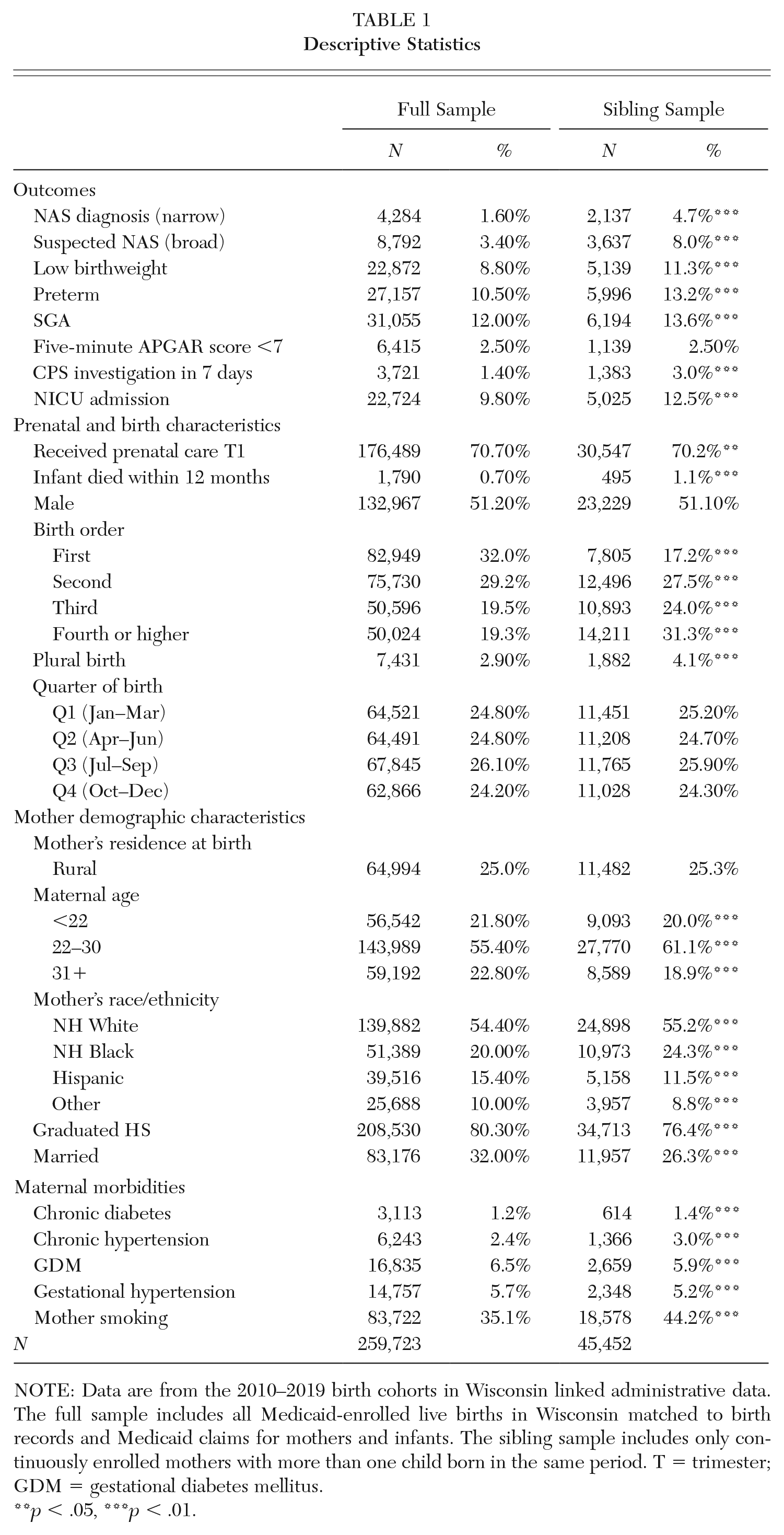
NOTE: Data are from the 2010–2019 birth cohorts in Wisconsin linked administrative data. The full sample includes all Medicaid-enrolled live births in Wisconsin matched to birth records and Medicaid claims for mothers and infants. The sibling sample includes only continuously enrolled mothers with more than one child born in the same period. T = trimester; GDM = gestational diabetes mellitus.
p < .05, ***p < .01.
Table 2 summarizes rates of opioid exposure during pregnancy using the three exposure measures for MAT, non-MAT, and illicit opioids in both the full and sibling samples overall (panel A) and among those with any exposure (panel B). Overall, we observe 6.256 days of exposure to any opioid in the full sample versus 21.054 in the sibling sample. Note that the full and sibling sample exhibit statistically different levels of exposure across all opioid exposure types and time periods, bolstering the assertion that mothers in the sibling sample are negatively selected. Among those with any type of opioid exposure during pregnancy (panel B), non-MAT prescriptions occur at the highest rate, followed by MAT and illicit opioids. The fractional and binary measures follow the same patterns, though we prefer the fractional measure as it is less prone to measurement error because it accounts for left censoring in the first trimester due to erroneous dating and truncation in the third due to variable pregnancy lengths.
Average Opioid Exposure Rates among Full Sample (Panel A) and Exposed Sample (Panel B)
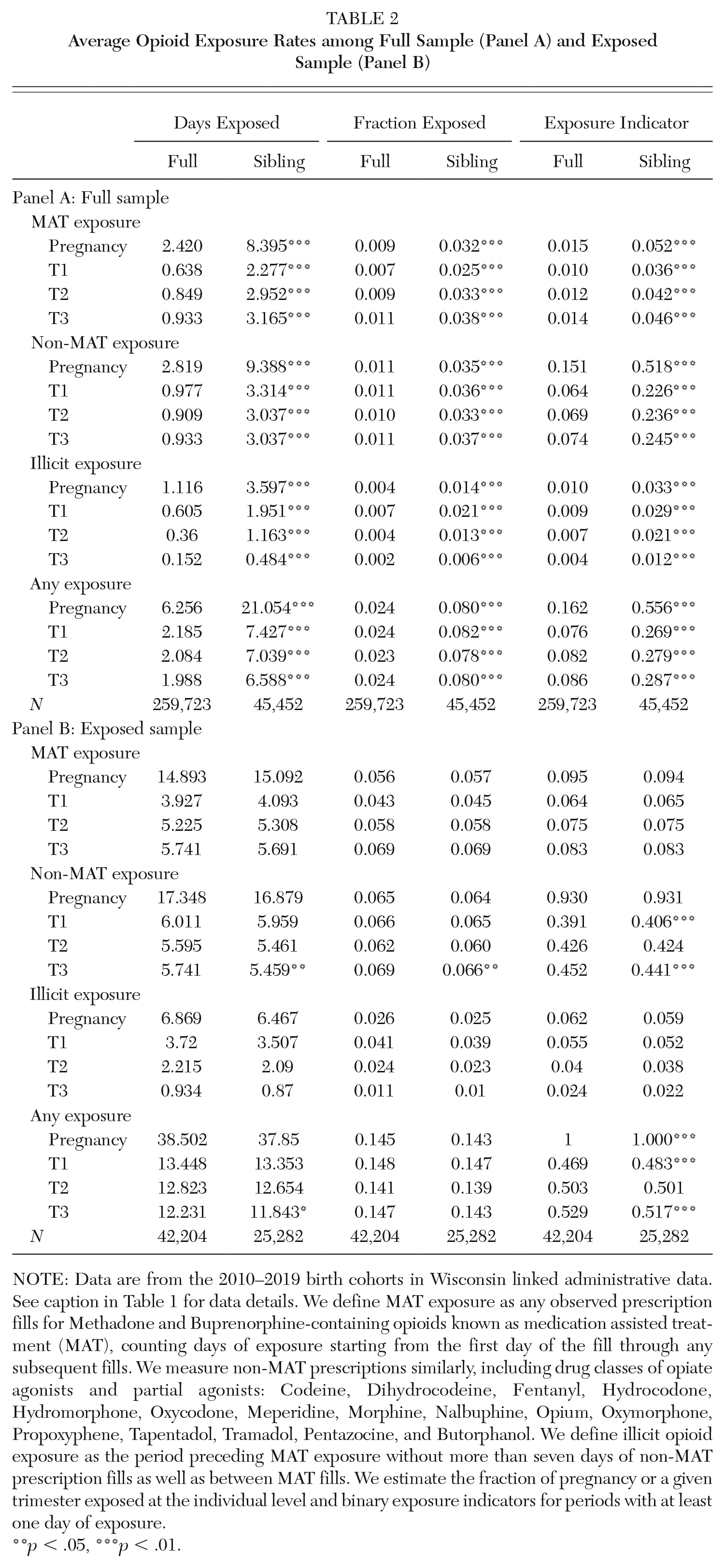
NOTE: Data are from the 2010–2019 birth cohorts in Wisconsin linked administrative data. See caption in Table 1 for data details. We define MAT exposure as any observed prescription fills for Methadone and Buprenorphine-containing opioids known as medication assisted treatment (MAT), counting days of exposure starting from the first day of the fill through any subsequent fills. We measure non-MAT prescriptions similarly, including drug classes of opiate agonists and partial agonists: Codeine, Dihydrocodeine, Fentanyl, Hydrocodone, Hydromorphone, Oxycodone, Meperidine, Morphine, Nalbuphine, Opium, Oxymorphone, Propoxyphene, Tapentadol, Tramadol, Pentazocine, and Butorphanol. We define illicit opioid exposure as the period preceding MAT exposure without more than seven days of non-MAT prescription fills as well as between MAT fills. We estimate the fraction of pregnancy or a given trimester exposed at the individual level and binary exposure indicators for periods with at least one day of exposure.
p < .05, ***p < .01.
Table 3 presents our estimated effects of in utero opioid exposure on all eight measures of infant health and well-being for both intensive and extensive margin exposure measures during pregnancy estimated following equation (1), with the full sample and the sibling sample, as well as maternal fixed effects, our preferred specification. The point estimates using the fractional exposure measure imply that a 10-percentage-point increase in the fraction of pregnancy exposed to any opioid (around 30 additional days) is associated with a 355.0 percent increase in NAS diagnosis, attenuating to 86.0 percent when maternal fixed effects are included. The estimated effects using the exposure indicator, or on the extensive margin, are considerably lower, at 45.2, 13.3, and 4.7 percent, respectively. Our estimates of suspected (broad) NAS, which include cases for which the type of substance was unknown, or where the diagnosis was not later confirmed through toxicology screens, are attenuated slightly relative to narrow NAS, although following the same general pattern. For the remaining outcomes using the fractional exposure measure, the inclusion of maternal fixed effects attenuates the estimated effects of opioid exposure by 55 to 80 percent with the exception of preterm birth and APGAR score, for which maternal fixed effects estimates diminish statistical significance. All remaining health outcomes retain some degree of significance, with the incidence of small for gestational age and low birthweight increasing by 4.6 to 4.8 percent. Further, in our preferred maternal fixed-effects specification, we find that a 10-percentage-point increase in any opioid exposure during pregnancy is associated with a 14.6 percent increase in NICU admission and a 19.7 percent increase in the likelihood of a CPS report, an effect that is four times larger than the effects on low birthweight and small for gestational age.
Estimated Effects of Any Opioid Exposure during Pregnancy on Infant Health and Well-Being
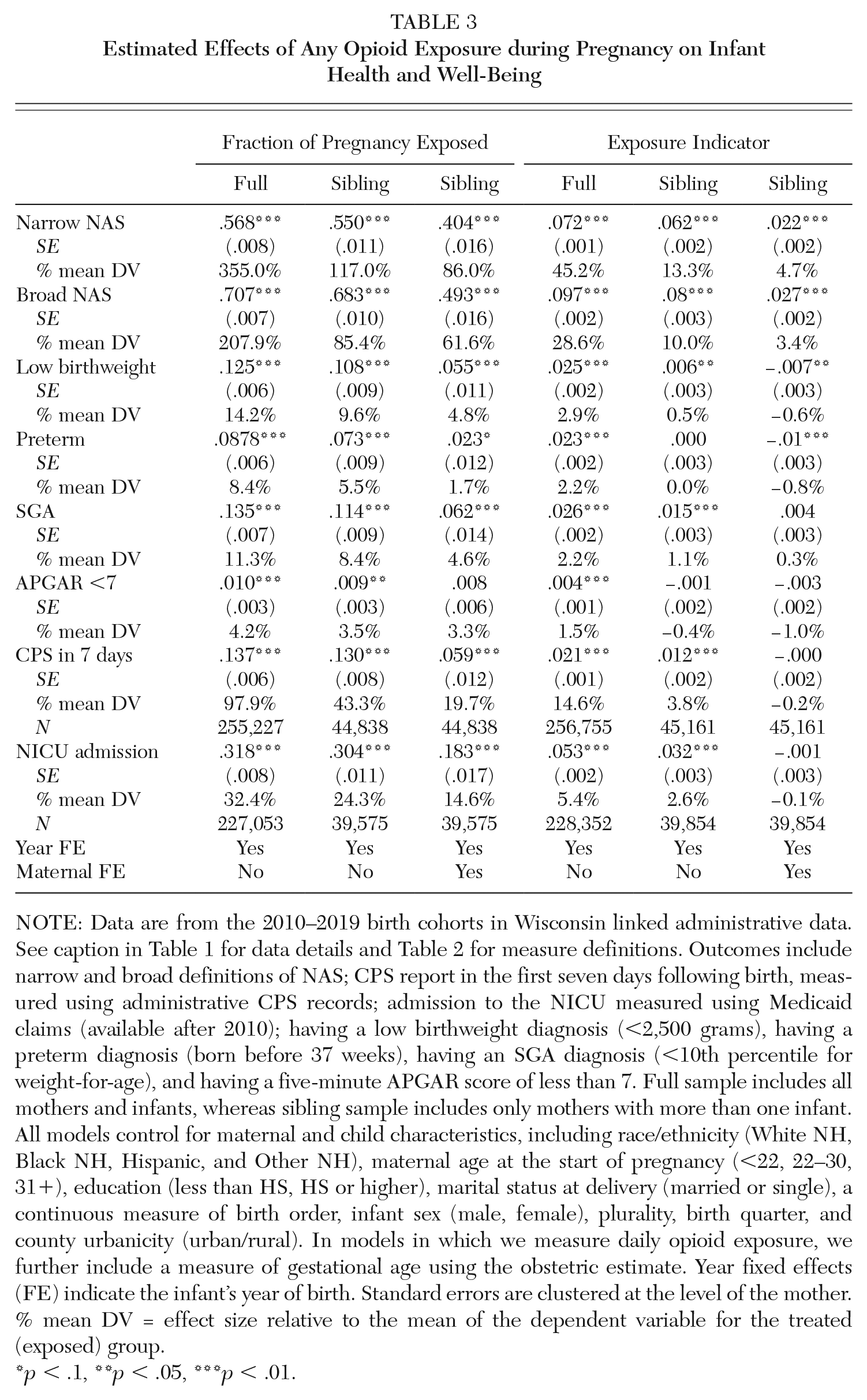
NOTE: Data are from the 2010–2019 birth cohorts in Wisconsin linked administrative data. See caption in Table 1 for data details and Table 2 for measure definitions. Outcomes include narrow and broad definitions of NAS; CPS report in the first seven days following birth, measured using administrative CPS records; admission to the NICU measured using Medicaid claims (available after 2010); having a low birthweight diagnosis (<2,500 grams), having a preterm diagnosis (born before 37 weeks), having an SGA diagnosis (<10th percentile for weight-for-age), and having a five-minute APGAR score of less than 7. Full sample includes all mothers and infants, whereas sibling sample includes only mothers with more than one infant. All models control for maternal and child characteristics, including race/ethnicity (White NH, Black NH, Hispanic, and Other NH), maternal age at the start of pregnancy (<22, 22–30, 31+), education (less than HS, HS or higher), marital status at delivery (married or single), a continuous measure of birth order, infant sex (male, female), plurality, birth quarter, and county urbanicity (urban/rural). In models in which we measure daily opioid exposure, we further include a measure of gestational age using the obstetric estimate. Year fixed effects (FE) indicate the infant’s year of birth. Standard errors are clustered at the level of the mother. % mean DV = effect size relative to the mean of the dependent variable for the treated (exposed) group.
p < .1, **p < .05, ***p < .01.
The results shown in Table 4 disaggregate opioid exposure during pregnancy by type. Our estimates suggest that NAS bears strong and consistent associations with all three exposure types, though the coefficients for MAT and illicit exposure are at least three times larger than that of non-MAT exposure. Specifically, we find in maternal fixed effects models that a 10-percentage-point increase in the fraction of a pregnancy exposed to MAT is associated with a 110.0 percent increase in NAS diagnosis (narrow), illicit exposure with a 94.0 percent increase in NAS diagnosis, and non-MAT exposure with a 32.1 percent increase in NAS diagnosis. Our estimates also suggest that MAT and illicit exposure are associated with a 4.5 to 5.3 percent increase in low birthweight, a 5.0 to 5.9 percent increase in SGA diagnosis, and a 16.9 to 19.0 percent increase in NICU admissions, respectively. Preterm birth and APGAR score only retain marginal statistical significance for MAT exposure, at 2.7 and 6.4 percent, respectively. We detect the largest effects of MAT and illicit exposure on CPS reports at seven days, at 24.0 and 30.7 percent, respectively. Estimates using the binary exposure indicator generally follow the same pattern as the fractional exposure estimates, with the exception of several models yielding negative effects for illicit and non-MAT exposure likely due to measurement error.
Estimated Effects of Any Opioid Exposure during Pregnancy on Infant Health and Well-Being, by Type of Exposure
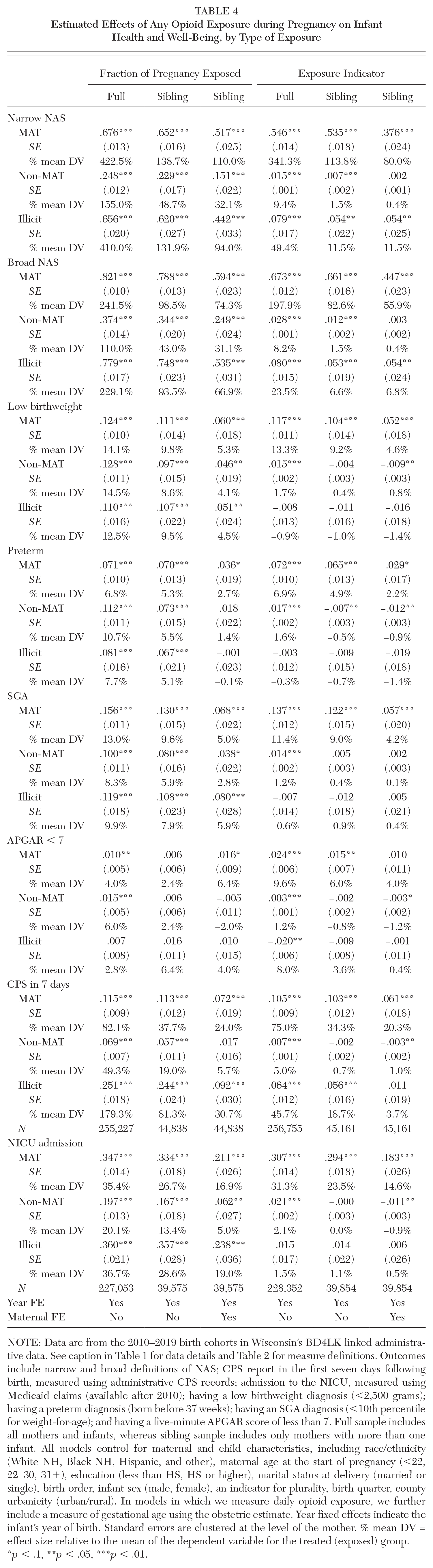
NOTE: Data are from the 2010–2019 birth cohorts in Wisconsin’s BD4LK linked administrative data. See caption in Table 1 for data details and Table 2 for measure definitions. Outcomes include narrow and broad definitions of NAS; CPS report in the first seven days following birth, measured using administrative CPS records; admission to the NICU, measured using Medicaid claims (available after 2010); having a low birthweight diagnosis (<2,500 grams); having a preterm diagnosis (born before 37 weeks); having an SGA diagnosis (<10th percentile for weight-for-age); and having a five-minute APGAR score of less than 7. Full sample includes all mothers and infants, whereas sibling sample includes only mothers with more than one infant. All models control for maternal and child characteristics, including race/ethnicity (White NH, Black NH, Hispanic, and other), maternal age at the start of pregnancy (<22, 22–30, 31+), education (less than HS, HS or higher), marital status at delivery (married or single), birth order, infant sex (male, female), an indicator for plurality, birth quarter, county urbanicity (urban/rural). In models in which we measure daily opioid exposure, we further include a measure of gestational age using the obstetric estimate. Year fixed effects indicate the infant’s year of birth. Standard errors are clustered at the level of the mother. % mean DV = effect size relative to the mean of the dependent variable for the treated (exposed) group.
p < .1, **p < .05, ***p < .01.
Across all outcomes, non-MAT exposure yields either null effects or those that are smaller in magnitude than the other types of exposure. These effects are not trivial, though substantially smaller than estimates in prior work, giving credence to the “supply-side” argument that prescribing behavior is partially responsible for the opioid epidemic. Indeed, we find that non-MAT exposure is associated with a 4.1 percent increase in low birthweight, a 2.8 percent increase in SGA, and a 5.0 percent increase in NICU admission. Prior estimates are substantially larger for all outcomes, ranging from 15 percent to 191 percent (Azuine et al. 2019; Corsi et al. 2020), though these and other studies detect statistically significant increases in the incidence of preterm birth and APGAR score as well, which closely resemble our LPM estimates for the full sample rather than maternal fixed-effects estimates (Brogly et al. 2021; Nørgaard, Nielsson, and Heide-Jørgensen 2015).
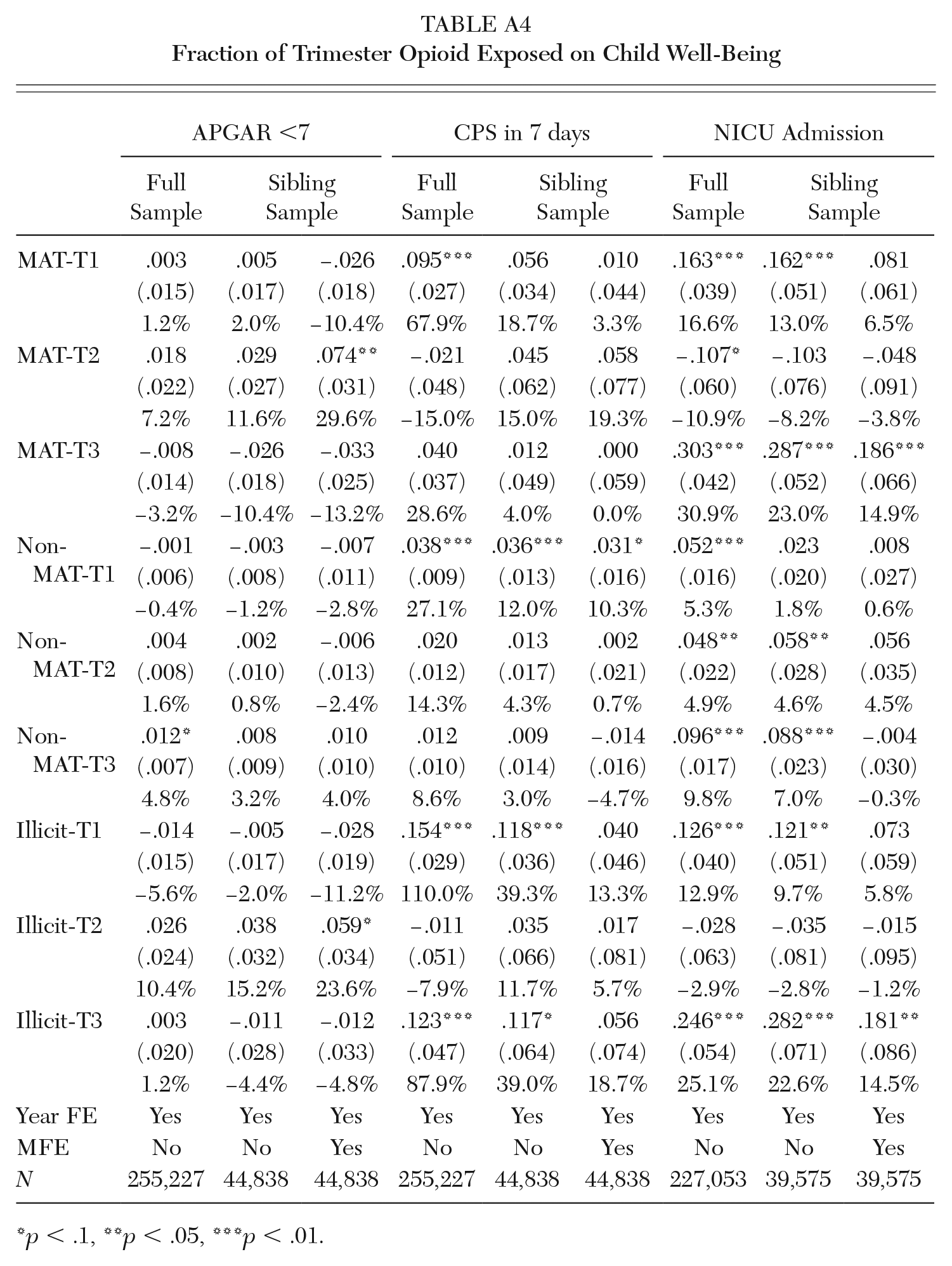
Figures 1 through 4 present the percentage increase or decrease in the same outcomes shown above, though with opioid exposure measured at the level of the trimester. The associated tables are shown in the appendix (Tables A1–A3). Figure 1 presents our estimation of the effect of in utero opioid exposure on both narrow and broad NAS diagnosis, including LPM with both the full and sibling samples, as well as that with maternal fixed effects. Models with maternal fixed effects imply that a 10-percentage-point increase in opioid exposure due to non-MAT prescriptions (notated as “Rx”) is associated with an increase in NAS diagnosis during the first, second, and third trimesters by 13.2, 11.7, and 6.2 percent, respectively. MAT and illicit exposure appear to increase NAS rates by 22.1 and 17.9 percent in the first trimester and 60.6 and 53.0 percent in the third, implying that transitioning from illicit use to treatment in either period could increase the risk of NAS, but that those who begin treatment in the first trimester likely experience the lowest absolute rates of NAS diagnosis. Estimates using the broad NAS diagnosis definition are smaller but follow similar patterns.
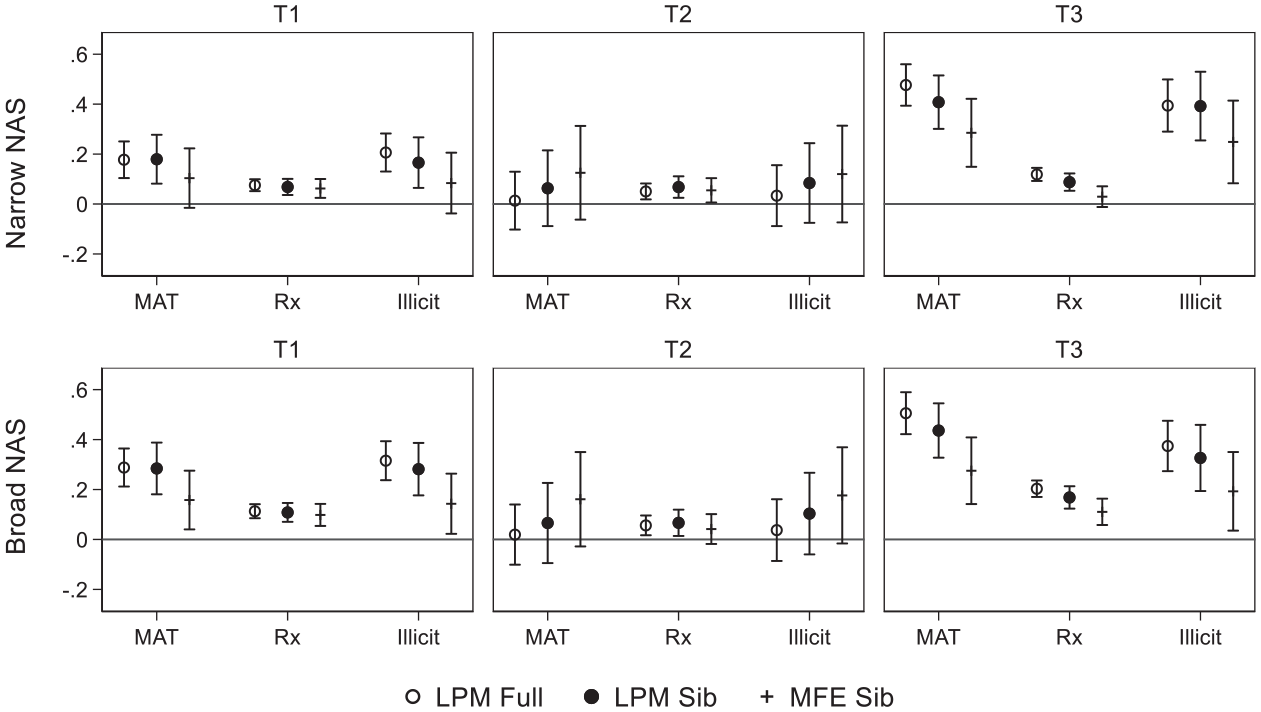
Estimated Effects of the Fraction of Trimesters Opioid Exposed on NAS
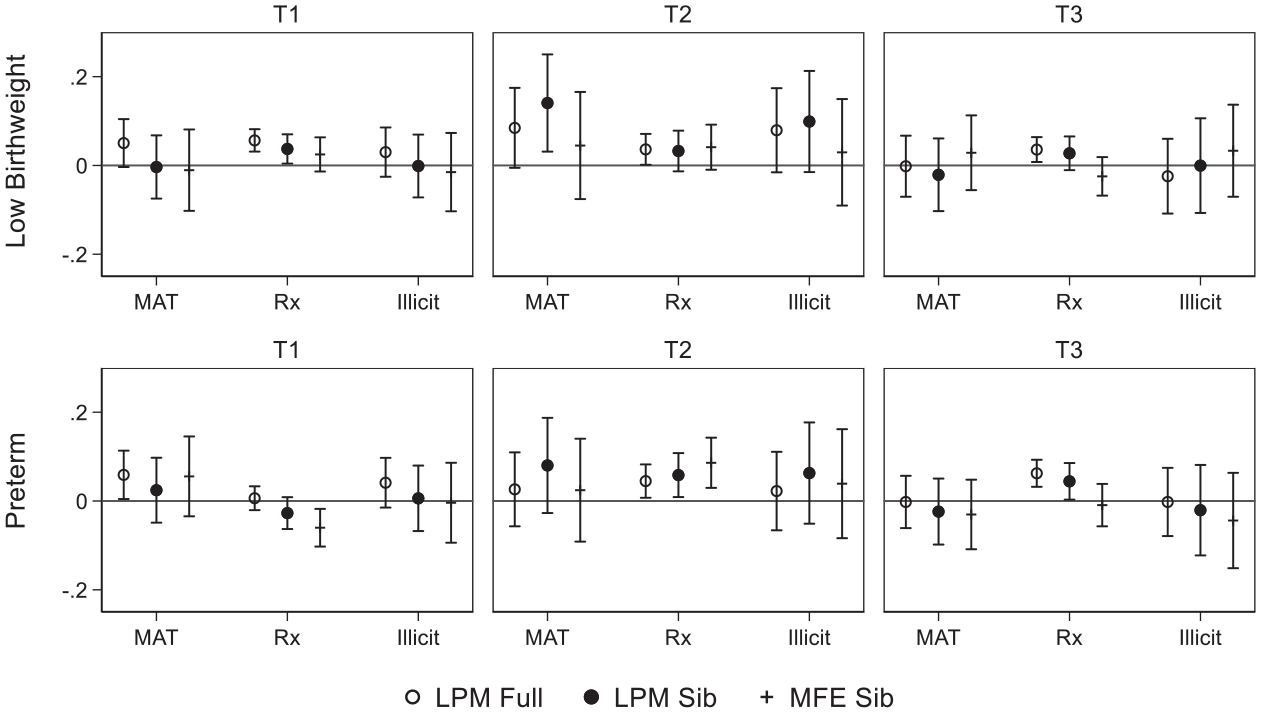
Estimated Effects of the Fraction of Trimesters Opioid Exposed on Birthweight and Gestational Age
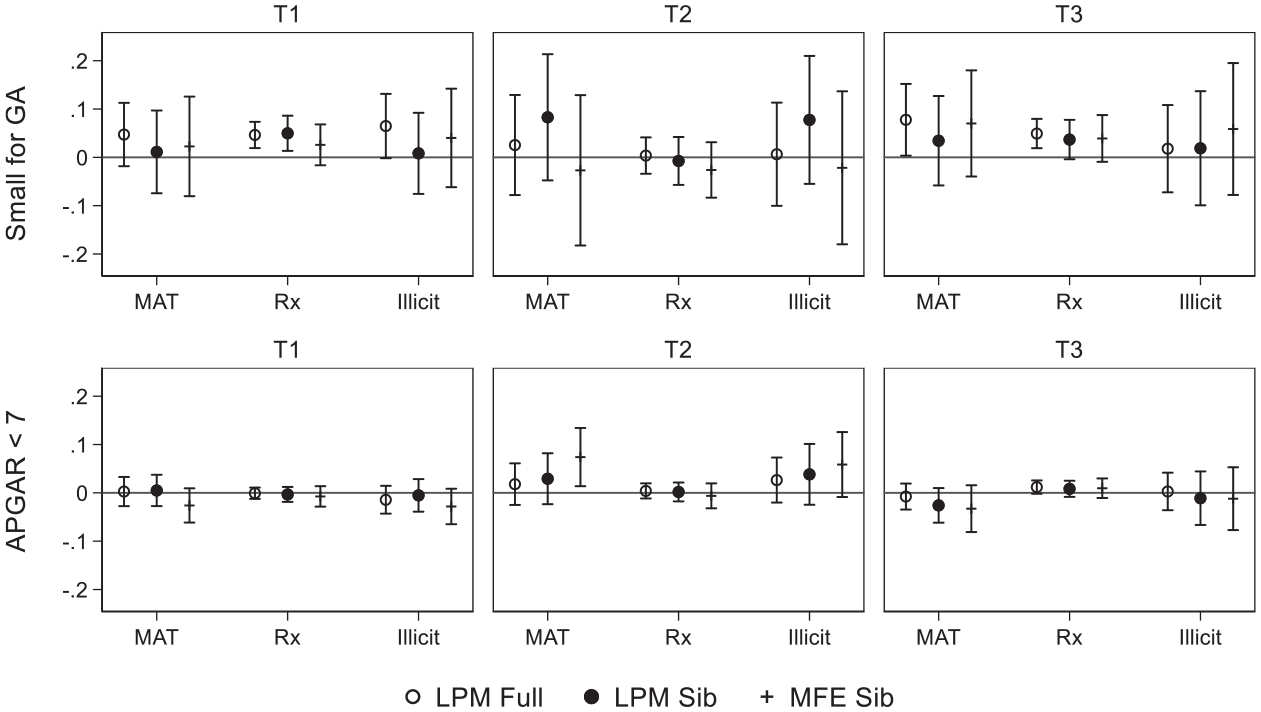
Estimated Effects of the Fraction of Trimesters Opioid Exposed on Health at Birth
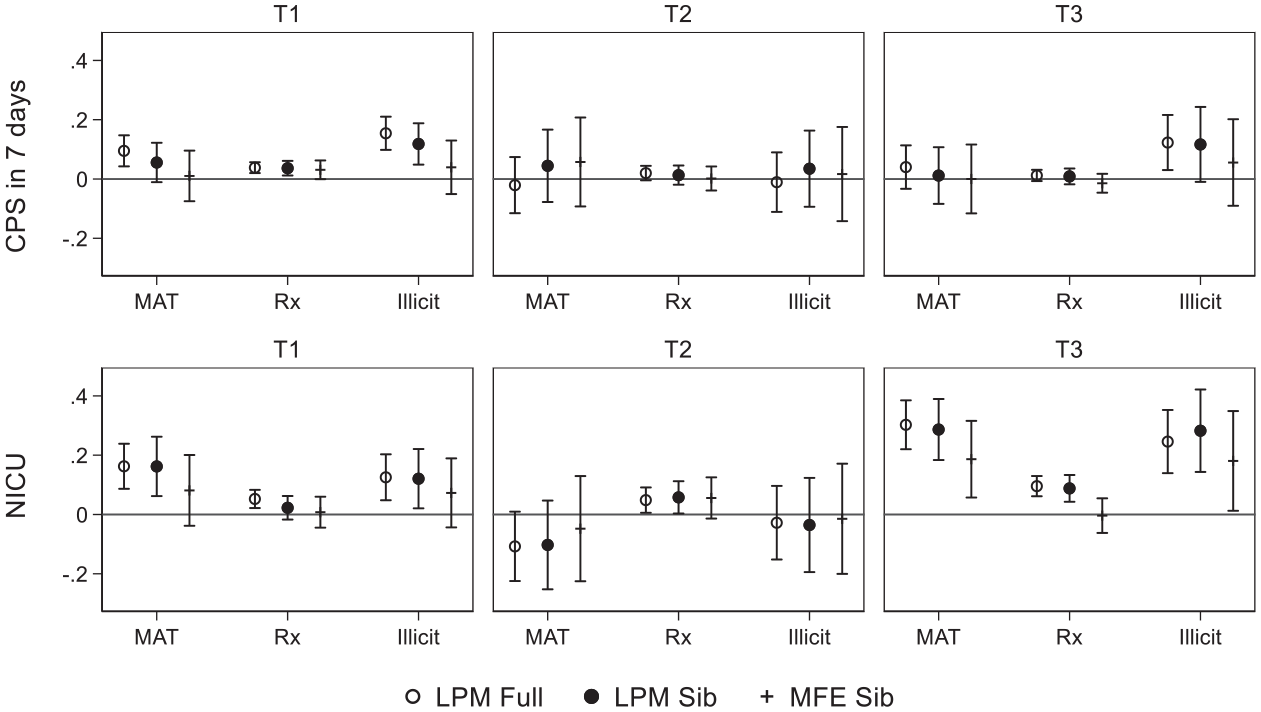
Estimated Effects of the Fraction of Trimesters Opioid Exposed on Measures of Child Well-Being
An important caveat to our interpretation is that the variation in standard errors imply that our measures for MAT and illicit exposure are more prone to error than non-MAT (Rx) exposure. Though MAT use is measured (and observed) directly through prescription claims, like non-MAT exposure, MAT exposure appears to cycle on and off throughout pregnancy. Based on feedback from practitioners, we code these gaps in MAT exposure as “illicit” to account for plausible opioid use during these periods. As a result, the MAT and illicit measures could be easily conflated if they are observed for equal lengths of time in a single trimester or over pregnancy.
Figures 2 through 4 employ the same models for other measures of child health and well-being. In Figure 2, we observe relatively small effects on low birthweight and preterm birth when employing the LPM on the full and sibling sample, which are attenuated for all types of exposures and periods by the inclusion of maternal fixed effects except for second trimester exposure to non-MAT opioids. In contrast to the pregnancy-level models shown in Table 4, in which we detected negative birthweight effects for all types of exposures ranging from 4.1 to 5.3 percent, null trimester level effects imply that pregnancy-level measures might either capture other forms of substance abuse or indicate that our pregnancy exposure measure captures consistent use throughout pregnancy, which might be more detrimental than use in one trimester. We observe the same general pattern in Figure 3. Figure 4 presents the estimated effects of increased opioid exposure on CPS reports and NICU admission. CPS reports in the full and sibling samples estimated without maternal fixed effects, the inclusion of which attenuates our estimates in all except for first trimester non-MAT use. We observe the same pattern for NICU admission except for MAT and illicit use in the third trimester, for which we observe a 14.5 to 14.9 percent increase in our preferred maternal fixed-effects models.
In summary, our preferred estimates imply that exposure to all three types of opioids during pregnancy is associated with increased risk of NAS, low birthweight, SGA, NICU admission, and CPS reports within seven days; we find the strongest associations with NAS. However, when we estimate fractional exposure at the trimester level, MAT and illicit exposure appear to drive NICU admissions in the third trimester and NAS in the first and third trimesters. Interestingly, preterm birth and APGAR score are insignificant in the pregnancy level models yet gain statistical significance in trimester-level models with effects concentrated in trimester 2. While exposure at the extensive margin is somewhat less consistent than estimates from fractional exposure measures, that we detect consistent effects from MAT exposures suggests that siblings exposed to MAT exhibited poorer health and a higher risk of CPS involvement at birth, relative to their sibling without MAT exposure.
Robustness Checks
While maternal fixed effects control for unobserved differences across pregnancies, a central criticism is that pregnancy characteristics might be endogenous to birth order. Accordingly, we test for the robustness of inclusion of possibly endogenous controls, including trimester prenatal care began, smoking during pregnancy, and chronic/gestational diabetes and hypertension. As these measures might also be a function of substance use, their inclusion might bias the estimated effects of exposure on birth outcomes. However, the estimated effects of prenatal opioid exposure (not shown) are nearly identical to the effects we report here, suggesting that maternal fixed effects indeed absorb the cross-pregnancy variation in outcomes due to maternal health and “high-risk” pregnancies. 7
Further, we examine the heterogeneity of our estimated opioid exposure effects by stratifying models by maternal age (<21, 22–30, and 31+), education (less than HS, HS, some college, and bachelor degree or higher), geographic characteristics (rural versus urban), and race/ethnicity (White NH, Black NH, Hispanic, and Other NH). The plots presented in Figures A2 through A5 in the appendix show the percentage estimates for the fraction of pregnancy exposed to any opioid type, estimated using maternal fixed effects (akin to those shown in Table 3). All subgroups exhibit large positive effects of opioid exposure on NAS diagnosis, though estimates for Black NH mothers and those age 31 or older are nominally smaller than the others. In terms of health measures, all effects are smaller in magnitude and closer to zero with few instances of meaningfully heterogeneous effects when confidence intervals are accounted for. The two exceptions are mothers of Hispanic ethnicity and those in urban counties, who exhibit larger effects on low birthweight, SGA, and CPS reports within seven days. Finally, NICU admission estimates are generally larger in magnitude and consistently significant, though we detect little heterogeneity across subgroups except for nominally larger effects among those with less than a high school degree.
Discussion and Conclusion
In this study, we used timing- and type-specific opioid exposure measures during pregnancy combined with maternal fixed-effects models to estimate the effect of in utero exposure to opioids on a range of health and wellbeing outcomes at birth. Our estimates reveal three key findings.
First, we find that all three types of exposure (MAT, non-MAT, illicit), at any time during a pregnancy, are strongly predictive of both narrow and broad measures of NAS. Though our estimates are similar in direction and significance to prior studies, our estimates are generally smaller in magnitude. This is in part because we proxy for illicit exposure using a novel method to characterize illicit use in reference to observed MAT and non-MAT use, plausibly capturing the timing and extent of all three types of prenatal opioid use in ways the existing literature has been unable to do. Our results show that a 10-percentage-point increase in the fraction of the pregnancy exposed opioids is associated with an 86 percent increase in NAS diagnosis, driven by MAT and illicit exposure particularly in the third trimester, suggesting that that exposure closer to birth is more meaningful. Said differently, a 30-day increase in the number of pregnancy days exposed is associated with an 86 percent increase in the risk of NAS diagnosis. We also find that while non-MAT use is associated with NAS diagnosis, these effects are much smaller in magnitude and concentrated in the first two trimesters.
Second, we detect relatively modest effects of opioid exposure on all infant health measures except for NICU admission. When we examine any opioid exposure without consideration of exposure timing or intensity, we find substantially smaller effects for low birth weight and SGA relative to prior literature, around a 5 percent increase for every 10-percentage-point increase in exposure overall, and for each type of opioid exposure, but with little variation with respect to timing. In contrast, we find that NICU admission appears to be driven by third trimester exposure to MAT and illicit opioids. Similarly, our estimates suggest that the likelihood of CPS involvement increases by 19.7 percent for every 10-percentage-point increase in the fraction of the pregnancy opioid exposed; this is largely driven by MAT and illicit opioids with little variation by trimester. On the extensive margin, our estimates indicate that, for every one hundred women who use MAT during pregnancy, around twenty infants will be subject to a CPS report in the first seven days after birth. In other words, the effects of in utero opioid exposure are around four times larger for CPS involvement than for all measures of infant health at birth except for NICU admission, possibly indicating other more serious health consequences. By estimating effects across type and timing of opioid exposure on both extensive and intensive margins, our results are better able to estimate critical periods during pregnancy that may be best suited for intervention.
Third, our findings highlight the importance of increasing access to maternal opioid use treatment rather than expanding punitive policies that count maternal substance use as reportable to CPS. Failure to update treatment-deterring policies could cause history to repeat itself. Indeed, scores of children were permanently removed from their mothers (via termination of parental rights) during the crack cocaine epidemic of the 1990s, when fetal cocaine exposure was broadly considered a form of child abuse. Though initial claims of adverse birth effects were later shown to be unfounded, the irreparable damage exacted upon children and families only further aggravated class and racial divisions. 8 Prior work has shown that supply-side solutions, such as PDMPs, might directly reduce CPS involvement (Bruzelius et al. 2021; Evans, Harris, and Kessler 2020; Gihleb, Giuntella, and Zhang 2018). To the extent that other measures of child health follow the same pattern, as ours and prior studies demonstrate (Arteaga and Barone 2021; Gihleb et al. 2020; Ziedan and Kaestner 2020), efforts to curb prescriptions should be met with other supportive interventions for mothers experiencing chronic pain.
We have shown that the effects of opioid exposure on infant health differ by timing and exposure type, with the largest and most consistent effects detected among illicit and MAT exposure overall, and especially during the third trimester. Two key questions remain. First, our specification implicitly assumes that exposure is linearly related to the outcomes we examine here. Therefore, future work should test this assumption, enabling low-supply fills to have plausibly different effects than high-supply fills. A related concern is that “exposure days” might not capture the intensity of exposure (dosage effects). A second question is whether the effects we observe exact a toll on health and cognition throughout childhood and adulthood. Future work should explore whether the timing and intensity of opioids in utero bear any long-term, causal consequences on children’s physical or mental health, cognitive ability, or behaviors as evidenced by several observational studies (Nygaard et al. 2020; Odegaard, Pendyala, and Yelamanchili 2021). If, on one hand, the estimated effects of in utero exposure are indeed inflated at birth and fade later in life, we might conclude that when chronic opioid use is indicated, the benefits to the mother might outweigh the short-lived risks to infants, such as NAS and encounters with the child welfare system. On the other hand, if opioid exposure exacts a negative causal effect on health at birth, particularly with potential ongoing consequences, current recommendations to consider safer alternatives to opioids during are warranted.
Footnotes
Appendix
Fraction of Trimester Opioid Exposed on Child Well-Being
| APGAR <7 |
CPS in 7 days |
NICU Admission |
|||||||
|---|---|---|---|---|---|---|---|---|---|
| Full Sample | Sibling Sample | Full Sample | Sibling Sample | Full Sample | Sibling Sample | ||||
| MAT-T1 | .003 | .005 | −.026 | .095*** | .056 | .010 | .163*** | .162*** | .081 |
| (.015) | (.017) | (.018) | (.027) | (.034) | (.044) | (.039) | (.051) | (.061) | |
| 1.2% | 2.0% | −10.4% | 67.9% | 18.7% | 3.3% | 16.6% | 13.0% | 6.5% | |
| MAT-T2 | .018 | .029 | .074** | −.021 | .045 | .058 | −.107* | −.103 | −.048 |
| (.022) | (.027) | (.031) | (.048) | (.062) | (.077) | (.060) | (.076) | (.091) | |
| 7.2% | 11.6% | 29.6% | −15.0% | 15.0% | 19.3% | −10.9% | −8.2% | −3.8% | |
| MAT-T3 | −.008 | −.026 | −.033 | .040 | .012 | .000 | .303*** | .287*** | .186*** |
| (.014) | (.018) | (.025) | (.037) | (.049) | (.059) | (.042) | (.052) | (.066) | |
| −3.2% | −10.4% | −13.2% | 28.6% | 4.0% | 0.0% | 30.9% | 23.0% | 14.9% | |
| Non-MAT-T1 | −.001 | −.003 | −.007 | .038*** | .036*** | .031* | .052*** | .023 | .008 |
| (.006) | (.008) | (.011) | (.009) | (.013) | (.016) | (.016) | (.020) | (.027) | |
| −0.4% | −1.2% | −2.8% | 27.1% | 12.0% | 10.3% | 5.3% | 1.8% | 0.6% | |
| Non-MAT-T2 | .004 | .002 | −.006 | .020 | .013 | .002 | .048** | .058** | .056 |
| (.008) | (.010) | (.013) | (.012) | (.017) | (.021) | (.022) | (.028) | (.035) | |
| 1.6% | 0.8% | −2.4% | 14.3% | 4.3% | 0.7% | 4.9% | 4.6% | 4.5% | |
| Non-MAT-T3 | .012* | .008 | .010 | .012 | .009 | −.014 | .096*** | .088*** | −.004 |
| (.007) | (.009) | (.010) | (.010) | (.014) | (.016) | (.017) | (.023) | (.030) | |
| 4.8% | 3.2% | 4.0% | 8.6% | 3.0% | −4.7% | 9.8% | 7.0% | −0.3% | |
| Illicit-T1 | −.014 | −.005 | −.028 | .154*** | .118*** | .040 | .126*** | .121** | .073 |
| (.015) | (.017) | (.019) | (.029) | (.036) | (.046) | (.040) | (.051) | (.059) | |
| −5.6% | −2.0% | −11.2% | 110.0% | 39.3% | 13.3% | 12.9% | 9.7% | 5.8% | |
| Illicit-T2 | .026 | .038 | .059* | −.011 | .035 | .017 | −.028 | −.035 | −.015 |
| (.024) | (.032) | (.034) | (.051) | (.066) | (.081) | (.063) | (.081) | (.095) | |
| 10.4% | 15.2% | 23.6% | −7.9% | 11.7% | 5.7% | −2.9% | −2.8% | −1.2% | |
| Illicit-T3 | .003 | −.011 | −.012 | .123*** | .117* | .056 | .246*** | .282*** | .181** |
| (.020) | (.028) | (.033) | (.047) | (.064) | (.074) | (.054) | (.071) | (.086) | |
| 1.2% | −4.4% | −4.8% | 87.9% | 39.0% | 18.7% | 25.1% | 22.6% | 14.5% | |
| Year FE | Yes | Yes | Yes | Yes | Yes | Yes | Yes | Yes | Yes |
| MFE | No | No | Yes | No | No | Yes | No | No | Yes |
| N | 255,227 | 44,838 | 44,838 | 255,227 | 44,838 | 44,838 | 227,053 | 39,575 | 39,575 |
p < .1, **p < .05, ***p < .01.
NOTE: We thank HeeJin Kim for excellent research assistance. Jessica Pac was lead author on this article. The other three authors contributed equally to all aspects of the article. The authors of this article are solely responsible for the content therein. The authors would like to thank the Wisconsin Department of Health Services and the Wisconsin Department of Children and Families for the use of data for this analysis, but these agencies do not certify the accuracy of the analyses presented. We gratefully acknowledge National Institutes of Health (NIH) support to complete this work (NIH R01 #HD102125-01, MPIs Berger and Ehrenthal) and the institutional support provided by the Institute for Research on Poverty and the Social Science Research Institute at the Pennsylvania State University.
Notes
Jessica Pac is an assistant professor at the University of Wisconsin–Madison Sandra Rosenbaum School of Social Work. Jessica’s research examines the impact of public policies on child maltreatment and other forms of domestic violence, infant and maternal health, and human capital. Jessica holds a PhD with concentrations in economics and social policy from Columbia University School of Social Work and a master’s degree in public administration with a concentration in social policy from Cornell University.
Christine Durrance is an associate professor in the La Follette School of Public Affairs at the University of Wisconsin–Madison. She is the research colead for the Collaborative for Reproductive Equity and an affiliate at the Institute for Research on Poverty. An economist by training, her work is concentrated in health economics and policy, with focal areas in substance use; maternal, infant, and reproductive health; and competition policy.
Lawrence Berger is associate vice chancellor for research in the social sciences, Vilas Distinguished Achievement Professor in the Sandra Rosenbaum School of Social Work, and past director of the Institute for Research on Poverty at the University of Wisconsin–Madison. His research focuses on the ways in which economic resources, sociodemographic characteristics, and public policies affect parental behaviors and child and family well-being.
Deborah B. Ehrenthal is director of the Social Science Research Institute and professor of Biobehavioral Health at Pennsylvania State University. She was the founding director of the University of Wisconsin–Madison Prevention Research Center, focused on improving the health of low-income women, infants, and families. Her research is focused on the social and healthcare factors that shape health of over the life course.