







Abstract
Mass shootings in the U.S. elicit strong reactions and often are followed by demands for preventive or ameliorative policy action. Often, however, little change is made to policy, and the cycle of tragedy and passionate discourse is left to start anew. We assess the efficacy of a range of specific policies that may help to prevent mass shootings or mitigate their harms: we review empirical evidence on their effectiveness and consider arguments that both proponents and opponents of these policies bring to bear on the public discourse. We conclude that extant evidence and policy ideas that are on the table now can, in fact, point to a productive way forward: we argue for a proactive, layered approach to policy implementation that minimizes risks and impacts and capitalizes on effective interventions that enjoy broad public support.
Since the 1999 attack at Columbine High School in Jefferson County, Colorado, that killed twelve students and a teacher and left twenty-four others injured, mass shootings in the United States have been a cause for concern among both the public and policy-makers. The attention devoted to mass shootings, particularly by the media, often is disproportional to their actual occurrence (Schildkraut, Elsass, and Stafford 2015). Homicides, of which approximately 80 percent are perpetrated with a firearm (Centers for Disease Control and Prevention 2022), account for 0.1 percent of all offenses known to law enforcement, and an even smaller fraction of these cases are mass shootings (Schildkraut, Elsass, and Meredith 2018). Despite their statistical rarity, however, these events generate widespread concern and often are accompanied by demands to “do something” to prevent the next attack.
In this article, we examine different policies and proposals that have been offered by stakeholders, including legislators, in the wake of these tragedies as potential solutions to address the broad issue of mass shootings. We organize the policy responses into two categories: those that are designed to prevent mass shootings from occurring and those that serve to mitigate the potential harms if they do occur (for an overview of policies reviewed, see Table 1). We include both as there is no one single policy or program that can sufficiently address the “perfect storm” of factors that converge and result in mass shootings; different options are necessary to provide a layered approach to minimize the risks and impacts. We conclude by offering key takeaways and directions for further research and policy efforts.
Summary of Main Policy Responses
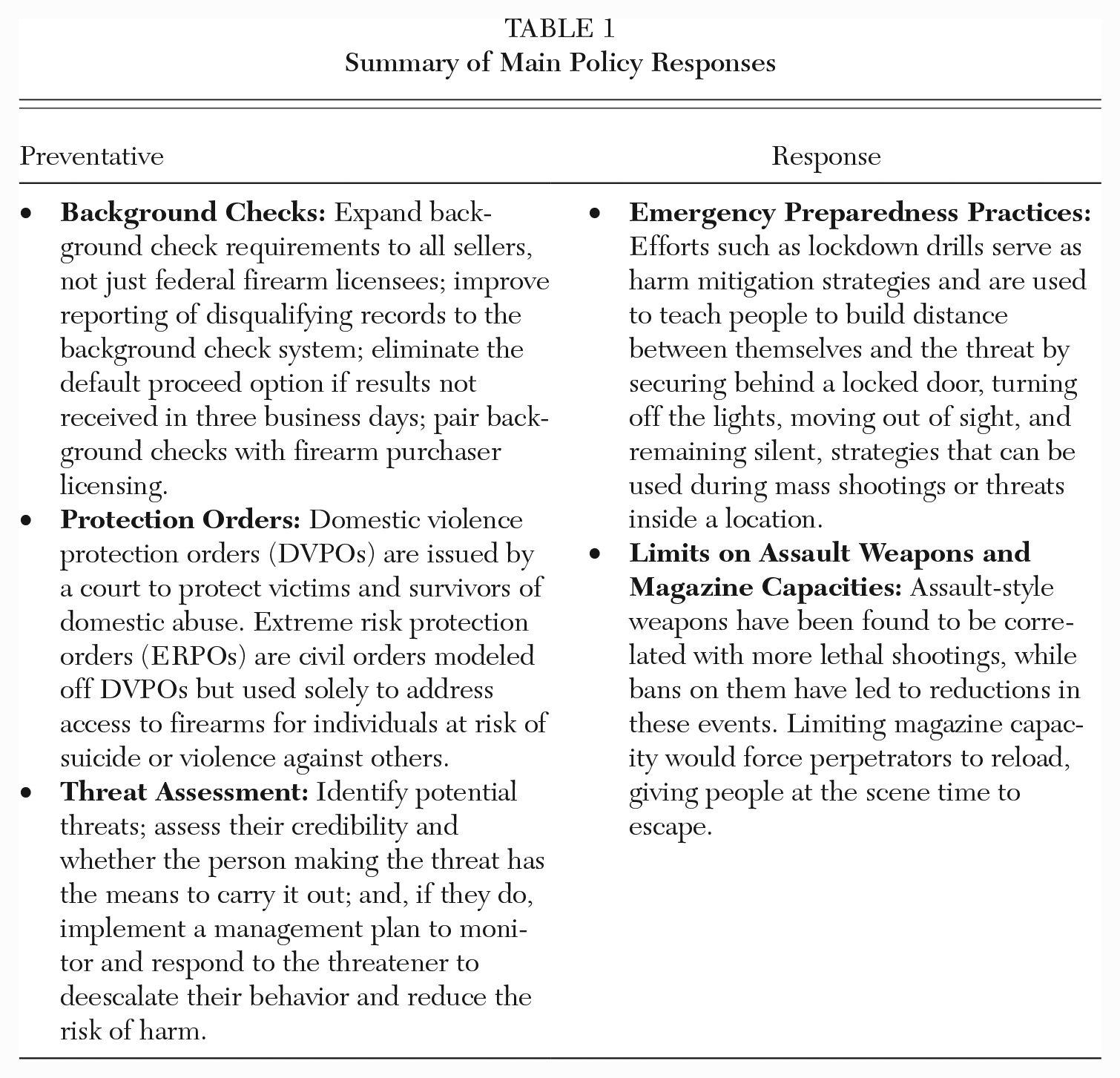
One challenge for responding to the phenomenon of mass shootings is a lack of context about the prevalence of the problem, which stems from the absences of both a universally accepted definition, including how to operationalize “mass,” and corresponding data source (Freilich, Chermak, and Klein 2020). Some widely cited sources (e.g., Berkowitz and Alcantara 2021; Fox 2021) include only those shootings in which four or more people are killed, which can skew the data towards the more lethal cases and omit high-casualty cases where many are injured but few are killed (Bjelopera et al. 2013), while others use a lower fatality limit (e.g., Follman, Aronsen, and Pan 2022). Certain sources may employ broader parameters, such as using a threshold of four or more people who are shot (Gun Violence Archive n.d.), while others may use criteria to narrow cases to a specific subset, like mass public shootings (e.g., Schildkraut and Elsass 2016). Whether a shooting is included also may be affected by whether (Krouse and Richardson 2015) or not (Bjelopera et al. 2013) the perpetrator is included in the fatality count. As a result, estimates of the number of mass shootings that occur each year in the U.S. range from an average to one per month to one or more per day (Booty et al. 2019).
Although mass shootings can happen anywhere, most of the focus is on those events that take place in public locations, primarily schools and workplaces, and several noteworthy trends have emerged (Schildkraut 2021). The perpetrators of these events are overwhelmingly males who typically act on their own (95 percent), a majority of the perpetrators are White (55 percent—one in four are Black); and although mass shooting offenders have ranged in age from 11 to 88, the average age is 33 (Schildkraut 2021). They also often engage in considerable planning ahead of their attacks (Silver, Simons, and Craun 2018), which can provide important opportunities for intervention and prevention. Despite misperceptions about semiautomatic assault-style rifles being the weapon of choice for mass shooters, handguns are used three times as frequently in these events (Schildkraut 2021). Moreover, mass shootings continue to increase in lethality (Lankford and Silver 2020) and frequency (Schildkraut 2021) over time. Much remains unknown about the broader phenomenon of mass shootings, particularly about those that are spontaneous rather than premeditated when they occur in private spaces, and those that occur during the commission of a felony in circumstances of gang or community violence.
Public opinion about how best to prevent mass shootings often is split, particularly in the context of firearm regulation versus ownership (Galston and Hendrickson 2019; Roper Center for Public Opinion Research n.d.), yet the demand for something to be done persists. After a mass shooting occurs, particularly if highly lethal, there often is a flurry of legislative activity at both the state and federal level. Federal legislative activity typically includes renewed efforts to ban assault weapons and expand background checks, which as of this writing have yet to pass both chambers in Congress (Schildkraut and Carr 2020). In 2022, following two high-profile mass shootings in Buffalo, New York, and Uvalde, Texas, Congress passed, and President Biden signed, the Bipartisan Safer Communities Act (Bipartisan Safer Communities Act 2022). Though this legislation did not include highly popular components, such as bans on assault weapons and large-capacity magazines (LCMs) or universal background checks, it did allocate millions of dollars to implement crisis intervention orders, including extreme risk protection orders (ERPOs), provide funding for community violence prevention, and strengthen protections for survivors of domestic violence (DV). At the state level, mass shootings correspond to a 15 percent increase in the number of bills introduced in the year following an attack, with less than 16 percent, on average, successfully enacted (Luca, Malhotra, and Poliquin 2020). Still, the question remains as to what policies are needed to reduce the impact of mass shootings on citizens and communities throughout the U.S.
Contemporary Approaches to the Prevention of Mass Shootings
The overarching goal of preventative policy and programmatic approaches to mass shootings is to minimize the number of would-be mass shooters who are able to purchase and possess firearms. A challenge of meeting this goal, however, is that there are policy gaps at the federal level, such as the absence of firearm purchaser licensing laws, domestic violence protection orders (DVPOs) with strong firearm removal requirements, and ERPOs, though some of these gaps have been addressed at the state level (see also Zeoli et al., this volume). Even still, some efforts, like threat identification, assessment, and management, are more successful at the community level.
Background checks on firearm transactions
Universal background checks require that a background check be run for every gun sale. Though universal background checks alone are not associated with significant reductions in gun violence, they are the foundation upon which all other gun violence prevention policies are built. Current federal law (18 U.S.C. § 921(a)(21)), however, only requires federally licensed firearms dealers to run a background check for each gun sale. This means that individuals buying a gun from an “unlicensed” dealer (e.g., through a private sale) can forgo a background check. This loophole often is referred to as the “gun show loophole,” though these private sales occur in places other than gun shows (Giffords Law Center to Prevent Gun Violence [Giffords] n.d.-c). Twenty-one states and the District of Columbia (D.C.) have more comprehensive background checks than are required by federal law as of February 2023, and sixteen of these states and D.C. require background checks for all gun sales (Giffords n.d.-c). Notably, the Columbine shooting perpetrators acquired the firearms used in the shooting through private sellers at a gun show who specifically did not run background checks, as the friend purchasing the weapons on their behalf (as they were under 18 at the time; this also is known as a straw purchase) did not want to submit her information (Schildkraut and Muschert 2019).
Additionally, the Federal Bureau of Investigation’s (FBI’s) National Instant Criminal Background Check System (NICS) is missing millions of records for individuals who should be prohibited from purchasing firearms under federal law. Following the 2007 shooting at Virginia Tech, which left thirty-two dead and seventeen others with nonfatal injuries, court documents revealed that a judge had declared the shooter to be “mentally ill,” which would have made him a prohibited purchaser; the court also declared that he was an “imminent danger to himself and others” (Virginia Tech Review Panel 2007). Virginia, however, did not share that information with NICS, and the perpetrator was not flagged when two handguns were purchased in separate transactions, accounting for the state’s mandated 30-day waiting period.
In the shooting’s aftermath, attempts were made at both the state and federal level to address issues with the background check system. At the state level, Virginia Governor Tim Kaine signed an executive order designed to prohibit individuals deemed “dangerous” from buying guns and requiring them to undergo involuntary mental health treatment (Urbina 2007). At the federal level, President George W. Bush signed the NICS Improvements Amendments Act into law in 2008, which sought to address the gaps in the background check system that allowed the Virginia Tech perpetrator to access firearms. While $1.3 billion in federal funding originally was allocated to improve the background check system, only about $50 million was appropriated between the law’s enactment and the Sandy Hook Elementary School shooting in December 2012 (Schildkraut and Carr 2020). Ten years after the Virginia Tech shooting, in 2017, an Air Force veteran with a history of DV killed twenty-six people and injured twenty-two others before taking his own life in Sutherland Springs, Texas. The Air Force never shared his DV conviction with NICS, and he therefore was not barred from purchasing firearms (U.S. Department of Defense 2018).
Another loophole in the background check system is known as “default proceed,” sometimes referred to as the Charleston loophole. If a federally licensed dealer does not receive a response from the FBI about a background check within three business days, they can proceed with the gun sale (see 18 U.S.C. § 922(t)). Though most background checks take just minutes to complete, there are certain situations, like when there are incomplete criminal history records, in which more time is needed to provide a thorough check (U.S. Department of Justice 2020). In 2015, the default proceed loophole permitted a White nationalist gunman to buy a firearm used to kill nine people at the Emanuel African Methodist Episcopal Church in Charleston, South Carolina (Educational Fund to Stop Gun Violence [EFSGV] 2020b). He was prohibited from purchasing and possessing firearms due to a drug possession charge, but the FBI did not have adequate time to conduct the background check that would have prohibited the sale (Schmidt 2015), an issue that would be remedied by closing this loophole.
Data show that universal background checks are most effective when conducted in conjunction with a firearm purchaser licensing law (Center for Gun Violence Solutions n.d.). Firearm purchaser licensing laws, also called permit-to-purchase laws, require anyone seeking to purchase a gun to apply for, and obtain, a license at their local law enforcement agency (Center for Gun Violence Solutions n.d.). Firearm purchaser licensing laws vary by state (see EFSGV 2021b), but they generally include a comprehensive background check with a waiting period, fingerprinting, in-person application filing requirements, and the completion of a firearms safety course. Data show that states with handgun purchaser licensing laws that included an in-person application with law enforcement or fingerprinting experience, on average, 56 percent fewer mass shooting incidents than states without this law (Webster et al. 2020), while licensing laws in general are associated with 60 percent lower odds of a mass public shooting (Rocque et al. 2021). Firearm purchaser licensing laws also are correlated with overall reductions in firearm homicide and suicide rates and are considered one of the most effective policies in preventing gun violence (Crifasi et al. 2015, 2018; McCourt et al. 2020).
Protection orders
Policy options to prevent mass shootings also include protection orders. DVPOs, also called domestic violence restraining orders, are court-issued orders to protect victims and survivors of domestic abuse. DVPO legislation was first implemented in the 1970s, and by 1989, all fifty states and D.C. had such laws on the books (Benitez, McNiel, and Binder 2010). State DVPOs, however, differ significantly in the strength of DV protections offered (WomensLaw.org n.d.). For example, protection orders may include stay-away orders (requiring an abuser to stay away from a victim or survivor of DV), no-contact orders (prohibiting all contact with a DV victim or survivor), and/or firearm relinquishment requirements (mandating that an abuser turn over any guns and ammunition in their possession).
The connection between DV and gun violence is well established, with data showing that one in four homicides is related to DV (Kivisto and Porter 2020). Research shows that the presence of a firearm in an abusive relationship increases the risk of homicide by 400 percent (Campbell et al. 2003) and that, when a male uses a firearm to perpetrate a DV homicide, he is twice as likely to kill at least one more person compared to a male perpetrator who did not use a firearm (Kivisto and Porter 2020). Several studies have found that intimate partner violence events can result in multiple victims (Kivisto and Porter 2020; Smith, Fowler, and Niolon 2014; Smucker, Kerber, and Cook 2018; Zeoli 2018). Data show that in nearly 70 percent of mass shootings from 2014 through 2019, the perpetrator either killed family or intimate partners or had a known history of DV (Geller, Booty, and Crifasi 2021). Further, research on 10 years of intimate partner homicides (IPHs) in North Carolina finds a connection between IPHs by firearm and perpetrator suicide, underscoring the potential to prevent multiple forms of gun violence by disarming domestic abusers (Smucker, Kerber, and Cook 2018).
Given the relationship between DV and mass shootings, policies designed to disarm domestic abusers should be central to the policy response to mass shootings. Research by Zeoli and Paruk (2020) found that 61 percent of mass shooters who had suspected histories of DV had been involved in the criminal justice system for DV-related offenses. Indeed, there are many existing gaps in the criminal justice system that allow for potential mass shooters with histories of DV to fall through the cracks and obtain firearms (Zeoli and Paruk 2020). More robust implementation of existing domestic violence firearm restrictions—including ensuring that a firearm prohibition is submitted to NICS—has the potential to prevent would-be mass shooting perpetrators from accessing firearms.
Further, there are many gaps in federal law that make it difficult to disarm abusers. While, in June 2022, Congress passed a partial and temporary closure of the dating partner loophole—which previously allowed dating partners who have not been married to, lived with, or shared a child with a victim or survivor of DV to keep their guns (Geller 2019)—a complete closure of this loophole is required to protect victims and survivors of DV (Bipartisan Safer Communities Act 2022; Rummler 2022). This partial and temporary closure of the law allows first-time offenders of dating violence to regain access to firearms after five years, assuming that they have not been convicted of another misdemeanor (Rummler 2022). Further, the law will not apply to abusers who are subject to final protection order (Rummler 2022). As such, robust state laws must exist to fill those gaps. Moreover, research shows that reductions in intimate partner homicide (by firearm and other means) are greatest when a DVPO closes the dating partner loophole, when temporary (ex parte) orders, and not just final orders, are firearm prohibitory, and when DVPOs explicitly require firearm relinquishment (Zeoli et al. 2018).
ERPOs, also called extreme risk laws, are civil orders modeled from DVPOs. While DVPOs offer numerous protections, including stay-away provisions and no contact orders, ERPOs are solely focused on firearms (Bloomberg American Health Initiative n.d.). As of February 2023, nineteen states and D.C. have an ERPO law in effect (Bloomberg American Health Initiative n.d.). ERPOs empower law enforcement and, depending on the state, family, household members, healthcare providers, and others to work with courts to temporarily remove firearms from individuals at risk of suicide or violence towards others and can be used to temporarily disarm an individual before a tragedy occurs. ERPOs should be based on behavioral risk factors for violence, including recent acts or threats of violence, recent violations of protection orders, and a history of or current risky alcohol use, rather than a mental health diagnosis.
Most states with an ERPO law passed it after the 2018 mass shooting in Parkland, Florida (EFSGV 2021a). Indeed, the Parkland shooting was an example of where, had an ERPO law existed, it could have been used to prevent the shooting. While the perpetrator did not have a criminal history, he was known to law enforcement and had made numerous threats of violence, including repeated statements that he intended to commit a school shooting (Pallin et al. 2021; Schildkraut, Cowan, and Mosher 2022). The perpetrator also had a history of suicidal ideation and attempts, homicidal ideation, and a fascination with firearms, all of which were warning signs that he may commit a violent act (Schildkraut, Cowan, and Mosher 2022). Without an ERPO law, however, there was no legal mechanism in Florida to prevent him from purchasing or possessing firearms.
California was the first state to pass a modern-day version of extreme risk-style law (2014), though other states such as Connecticut (1999) and Indiana (2005) had previously enacted similar legislation. In April 2021, a gunman with a history of violence killed eight people and himself at a FedEx facility in Indianapolis. Although Indiana had an extreme risk-style law on the books and a firearm was removed by law enforcement at the request of the perpetrator’s mother over a month before the shooting, no petition was filed (Associated Press 2021; Sheridan 2021). As such, the perpetrator still was able to purchase guns. As one former prosecutor in the Indianapolis area noted, “Any law is only as good as the people that are enforcing it” (Robertson, Watkins, and Martínez 2021). The FedEx mass shooting is an example of how robust implementation and changes to the law—including adding additional petitioners besides law enforcement and ensuring that firearms are immediately removed upon issuance of a temporary order—are necessary for ERPOs to work as intended.
Research has shown how ERPOs have been used in efforts to prevent mass shootings (Wintemute 2018; Wintemute et al. 2019; Zeoli et al. 2022). An analysis of court records for 159 gun violence restraining orders (California’s equivalent of an ERPO) between 2016 and 2018 found that they were used as a tool to help prevent at least twenty-one mass shootings based on evidence where the respondent showed a clear intent to commit such an attack (Wintemute et al. 2019). With the issuance of these orders, none of the respondents went on to commit mass shootings; nor did they perpetrate other homicides or suicides. There also are case studies from other states with ERPOs showing how they have been used to prevent mass shootings (CBS News and Associated Press 2018; Hutton 2019; Julig 2020; Lindsay 2019). While these cases provide initial evidence for the potential benefits of ERPOs, more time and research are needed to further evaluate their effectiveness.
Identify, assessing, and managing threats
Given their statistical rarity, mass shootings present a low base rate of events that makes it difficult (if not impossible) to predict where such events will occur and who will perpetrate them (Rocque 2012). Perpetrators do share certain commonalities including histories of DV (Geller, Booty, and Crifasi 2021; Zeoli and Paruk 2020), suicidality (Lankford 2015, 2018), far-right or jihadi ideologies (Byman 2019; Dickey 2016; Lewis 2019), and other precipitative factors such as job loss, relationship problems, or other adverse childhood experiences (Dowdell et al. 2022; Fowler et al. 2021; Kowalski et al. 2021). Many mass shooting perpetrators also struggle with mental health issues (Metzl, Piemonte, and McKay 2021), though individuals living with mental illness are more likely to be the victims rather than the perpetrators of violence (Choe, Teplin, and Abram 2008; Swanson et al. 2015).
While there is variability in who perpetrates mass shootings or what factors their backgrounds entail, these individuals often follow a similarly clear and discernible pathway towards violence (Calhoun and Weston 2003). Figure 1 outlines the six progressive stages of the Path to Intended Violence model that perpetrators travel along as they advance from a grievance to the shooting itself. By identifying the warning behaviors that often predate a mass shooting, it provides the opportunity for greater identification, assessment, and management of the threat, which subsequently minimizes the opportunity for the attack to occur (Fein and Vossekuil 1997; Pollack, Modzeleski, and Rooney 2008). Importantly, while perpetrators often display numerous warning behaviors that reflect these different stages (U.S. Department of Justice 2017; Vossekuil et al. 2004), their progression on the pathway may not necessarily be linear and they may even skip certain stages or retreat to earlier ones (Calhoun and Weston 2003).
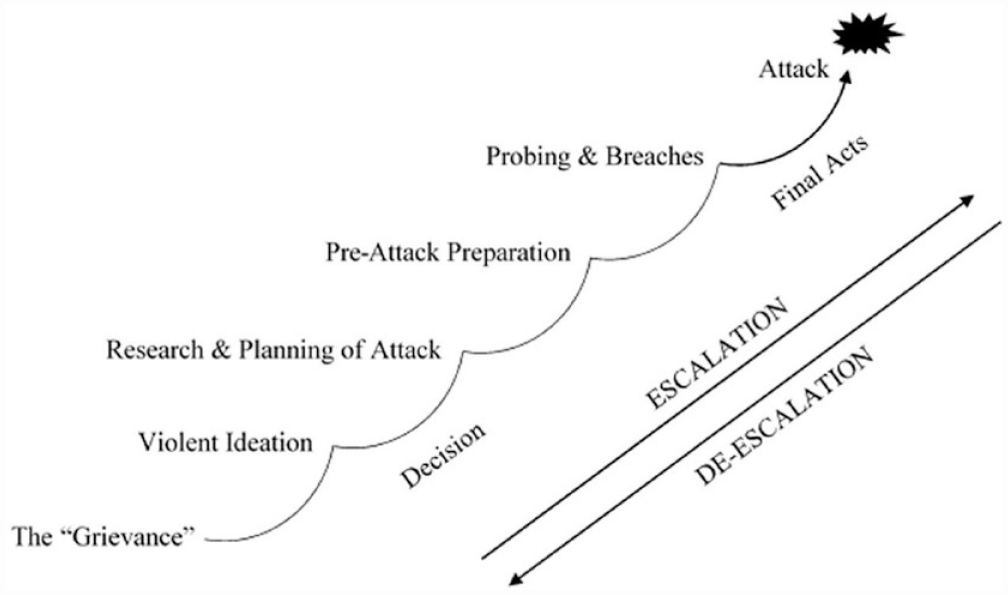
The Path to Intended Violence Model
Although many people experience grievances and stressors in their lives, either real or perceived (e.g., job loss, relationships ending, financial problems, feeling bullied or persecuted), and some even may fantasize about responding to these strains violently, most will not make the conscious decision to do so (Calhoun and Weston 2003). Once that decision is made, however, the individual begins to prepare for their attack—researching previous attacks, acquiring weapons, determining the logistics of how they will carry out their plan, and crafting legacy tokens like manifestos. They also may engage in dry runs of their attack to probe or test security and other potential obstructions. Left uninterrupted, the individual may carry out their attack.
Throughout their time on the pathway, individuals often are overly consumed with their violent thoughts and plans (Kaiser 2012) and share these with other people through a process known as leakage (Meloy and O’Toole 2011). This overt warning sign may take different forms, including verbal communications, social media posts, journals, or letters to other people. While the channel may differ, nearly all mass and school shooters leak their intentions to at least one other person, but often to multiple individuals, prior to their attack (National Threat Assessment Center 2021; Vossekuil et al. 2004). Despite others having knowledge of the individuals’ plans, many do not come forward—a result of what is known as the bystander effect (Latané and Darley 1970). Mechanisms, such as anonymous tip lines, have been introduced to encourage reporting, but despite seemingly widespread use (these platforms are available in more than half of public middle and high schools nationwide; see Planty et al. 2020), research suggests that they are not being used to their fullest capabilities. In some cases, individuals may not know how to use them or be aware they exist (Planty et al. 2018); in others, they may fear repercussions for “snitching” that may discourage reporting, which creates an important opportunity to educate on the benefits of “helping” others in crisis (Daniels and Page 2013).
When information about a potential threat is brought to the attention of individuals in charge (e.g., school administrators, workplace managers), assessment into the credibility of that threat must be conducted. Threat assessment involves evaluating an individual for the level of risk they pose by assessing their motive, their planned method, and whether they have the means (e.g., access to weapons) to carry it out (Twemlow et al. 2002). The teams responsible for threat assessment may be internal to the location or may be community based, but they should always be interdisciplinary and involve individuals including (but not limited to) psychiatrists and law enforcement to address both the mental health and legal components (Barnhorst and Rozel 2021). Once the team determines the level of risk posed by the threat, they then can put a plan into place to manage it both in the short and long term.
One considerable challenge to threat assessment and management is the issue of “information silos” (Schildkraut, Cowan, and Mosher 2022), whereby critical information necessary to identifying, assessing, and managing the threat is not shared among vested stakeholders. This has led to the failure of some mass shootings, such as Parkland, to be prevented even in cases where individuals who had knowledge of the warning signs (e.g., leakage) came forward and reported it. Accordingly, policy efforts focused on overcoming these challenges must work to break down these silos and promote more information sharing. There also need to be mechanisms not only for reporting threats but also for following up through the assessment and management processes to ensure no individual falls through the cracks.
Policies Focused on Responding to Mass Shootings
Even with appropriate preventative measures in place, not all mass shootings will be averted. Consequently, response practices and harm mitigation should be available for instances where a shooting comes to fruition. Steps have been taken to achieve this end through efforts like target hardening (e.g., entry control and screening) and increasing both natural (e.g., window placement to improve lines of sight) and formal (e.g., police, school resource officers) surveillance (see, generally, Schildkraut, Cowan, and Mosher 2022). Importantly, such efforts must be tailored based on the type of location as they will have different needs as well as environmental challenges.
In this section, we focus on a policy designed to reduce harm in school shootings that has received considerable attention in both the public and policy spaces: emergency preparedness drills. We also discuss how this policy can have practical implications for location types beyond schools, including workplaces and other public spaces. We further consider the role of bans on assault-style weapons and LCMs.
Emergency preparedness practices
Although schools have been practicing for humanmade and natural disasters for years, it was not until Columbine that these efforts shifted to preparing to respond to mass shootings (Schildkraut and Nickerson 2022). While the school did not have a formalized plan on the day of the attack, the Columbine Review Commission (2001) credited students and educators engaging in a lockdown for saving hundreds of lives during the nearly 50-minute rampage. Among the recommendations offered by the commission was to incorporate practicing for active shooters into the existing lineup of crisis drills (e.g., fire, tornado, and earthquake drills) that were being used in schools at the time. By 2016, the first year that the National Center for Education Statistics began tracking the use of lockdown drills, 95 percent of public K–12 schools nationwide were conducting these practices (Musu et al. 2019). As of February 2023, there is no national standard for what protocol should be used or how frequently drills should be conducted; with decisions then left to the states and sometimes even school districts, there is considerable variability in these practices across the nation (Schildkraut and Nickerson 2022).
The premise behind lockdowns is that during an active shooter event, survivability is increased by creating barriers between the perpetrators and their intended targets. Securing behind a locked door is the primary way to achieve this as it not only creates physical distance but also a time barrier—with most active shooter incidents over in five minutes or less (Blair et al. 2013), the perpetrator does not have time to defeat the lock before police arrive on scene and end the attack. Further, people have been killed behind a locked door in only three school shootings, and the door lock failed in none of these instances—in one case, the perpetrator was barricaded in the room with the student he killed, and in the other two, shots were fired through the doors and adjacent windows, striking students who were inside the rooms (Schildkraut and Muschert 2019). For these reasons, the Sandy Hook Advisory Commission (2015) highlighted door locks as the most successful lifesaving device during such incidents (see also Martaindale, Sandel, and Blair 2017).
Lockdown and active shooter drills—terms often erroneously used interchangeably despite important differences—have drawn considerable criticism, regardless of their potential to minimize both fatalities and injuries. Organizations, such as Everytown for Gun Safety (2020), the American Federation of Teachers, and the National Education Association, as well as politicians like Andrew Yang (Fearnow 2019), have called for the end of the use of active shooter drills. At the core of this pushback is news stories of drills gone wrong, including teachers being shot with pellet guns (Zraick 2019) and students being exposed to sounds of simulated gunfire (Richter 2019), prop weapons (Aronowitz 2014), and crisis actors posing as mock shooters or victims (Pierpoint 2019). Subsequently, concerns exist that students experience adverse outcomes stemming from participation in these drills including, but not limited to, anxiety; depression; posttraumatic stress disorder; impaired academic performance; and social, emotional, and behavioral problems (Rygg 2015).
Yet scientific research on the impact of lockdown drills on students is mixed. Studies assessing students’ self-reported state (temporary) anxiety has found this to be either the same (Zhe and Nickerson 2007) or even lower (Nickerson and Schildkraut 2021) after participating in a drill as compared to before it. Researchers also have found that participating in lockdown drills, particularly when paired with training, leads students as well as their educators to feel more prepared to respond in an emergency (Schildkraut and Nickerson 2020). Perceived school safety among students decreased slightly following participation in lockdown drills and training, though this may be sensitive to different factors, such as ongoing exposure to community violence or potential increases in perceived risk of vulnerability (Schildkraut, Nickerson, and Ristoff 2020). In line with Protection Motivation Theory (Floyd, Prentice-Dunn, and Rogers 2000), this decrease in perceived safety also may be a tradeoff for the gains in emergency preparedness—for people to actively engage in protective behavior, they must perceive there to be a danger to them, no matter how minimal or significant (Schildkraut and Nickerson 2022). Perceived safety among educators in this same context has been found to be high and remain unaffected by participating in drills (Schildkraut, Nickerson, and Klingaman 2022).
For any emergency preparedness practice, including lockdowns, the purpose of conducting drills is to build muscle memory, which conditions an individual to respond a certain way in a particular situation (Shusterman 2011). This is important because even in stressful situations, like an active shooter event, where a person’s cognitive functioning may be impaired, the body will still respond the way it was trained to (Di Nota and Huhta 2019). As noted, lockdown procedures involve specific steps to help keep individuals out of harm’s way, so assessing compliance on these is key to determining whether this muscle memory is being built. Although few research studies assess the actual procedural integrity of lockdown drills, the results are consistent—repeated practice helps to improve the correct completion of the associate steps (Dickson and Vargo 2017; Zhe and Nickerson 2007), and skill mastery can be further developed by pairing instructional training with the drills (Schildkraut and Nickerson 2020).
The drills gone wrong at the center of the lockdown debate were not conducted in accordance with best practices from groups like the National Association of School Psychologists, National Association of School Resource Officers, and Safe and Sound Schools (2021), which include actionable steps to help schools mitigate the negative effects of drills for those who participate in them. Research studies employing this guidance, however, have found that drills conducted in accordance with best practices actually may be an empowering rather than harmful experience, especially for students. As the debate continues, researchers must continue to assess the impacts of these drills, particularly related to different protocols and delivery methods (e.g., actual drills versus tabletop exercises).
Further, it is important that researchers expand their evaluation to nonschool settings, which are notably absent from the scholarly literature. While different protocols may be better suited for certain locations (e.g., open spaces like malls or concern venues), the general principle of putting time and space between the perpetrator and their intended targets is the same. As such, identifying how these practices translate to settings beyond schools is critical to understanding their role in saving lives.
Limits on assault weapons and magazine capacities
Although, as noted earlier, most mass shooting perpetrators use handguns during their attacks, a considerable amount of attention has been paid by both policy-makers and the public to assault-style weapons (e.g., AR-15s, AK-47s) and LCMs. Assault weapons, as defined by the Federal Assault Weapons Ban (FAWB) legislation enacted in 1994, are semiautomatic rifles that accept detachable magazines and are fitted with two or more features from a predetermined list including a pistol grip, folding or telescopic stock, flash suppressor, threaded barrel, grenade launcher, or bayonet mount (Schildkraut and Carr 2020). While the FAWB largely focused on semiautomatic rifles in its prohibitions, certain semiautomatic pistols—like the Intratec TEC-DC9 used by one of the Columbine perpetrators (while, notably, the FAWB was in effect)—also were banned. LCMs are magazines used in a firearm that have the capacity to accept more than ten rounds of ammunition. These, too, were prohibited under the FAWB.
When the FAWB was enacted, the U.S. was experiencing increasing violent crime rates, due in part to increases in drug-related crimes (Boggess and Bounds 1993), and the new law was designed to combat this. A key feature of the law, however, was a sunset provision that made the ban good for only 10 years before it would have to be renewed. In 2004, following Congress’s failed renewal, the FAWB lapsed. Subsequent attempts to reinstate it or pass similar legislation also have failed (Schildkraut and Carr 2020), meaning that, at the federal level, there have been no regulations on assault weapons or LCMs in nearly 20 years. Prior to the lapse of the FAWB, seven states (California, Connecticut, Hawaii [pistols only], Maryland, Massachusetts, New Jersey, and New York) and D.C. had an assault weapon ban in place; and Minnesota and Virginia have certain regulations in place for these types of firearms (Giffords n.d.-a). These same seven states, as well as Colorado, Vermont, and D.C., also have LCM bans in place (Giffords n.d.-b). In June 2022, following the high-profile mass shootings in Buffalo, New York, and Uvalde, Texas, Delaware also passed both an assault weapons ban and a prohibition on LCMs (The White House 2022).
Research examining the use of assault weapons in mass shootings has yielded several noteworthy findings related to their impact both during and outside of bans. Of the ten most lethal mass shootings since 1966, none of which occurred when the FAWB was in place, assault-style rifles have been used in eight of them (Schildkraut 2021). Although still rare compared to handguns, assault weapons are being used more frequently by mass-shooting perpetrators, particularly after the lapse of the FAWB (Koper 2020), and are correlated with higher-lethality attacks and more injuries overall (de Jager et al. 2018; Schildkraut 2021; Towers, Wallace, and Hemenway 2019). One study examining mass public shootings found that over 85 percent of these deaths were attributable to assault rifles (DiMaggio et al. 2019). This same study also found that mass shooting-related fatalities were 70 percent lower during the 10-year period the FAWB was in effect, while a separate study (Gius 2015) determined that state-level assault weapons bans are similarly correlated with fewer deaths.
There also is a growing body of research indicating the effectiveness of LCM bans on reducing the lethality of mass shootings (Klarevas, Conner, and Hemenway 2019; Rocque et al. 2021; Webster et al. 2020). Studies indicate that the majority of the deadliest mass shootings in U.S. history involved the use of LCMs (Klarevas 2016; Klarevas, Conner, and Hemenway 2019) and that the frequency of their use is increasing over time (Towers, Wallace, and Hemenway 2019). Moreover, even beyond those shootings that are the most lethal, research has found that the use of LCMs by perpetrators increases both the number of fatalities as well as the total number of people shot during these attacks (Towers, Wallace, and Hemenway 2019). When bans on LCMs are in place, however, there were fewer high-fatality mass shootings and less people killed in these attacks (Klarevas, Conner, and Hemenway 2019).
Collectively, these statistics illustrate how bans on both assault weapons and LCMs can reduce the harms caused by mass shootings. There also are practical considerations that lend further support to the efficacy of such policies. Proponents of banning assault weapons point to the differences in wound patterns and damages between these and other types of firearms. Wounds from handguns follow a linear path through the victim, leaving small entry and exit wounds, and are largely survivable provided a crucial organ (e.g., heart) or artery is not hit; by comparison, bullets fired at a higher velocity from an assault weapon leave considerably larger exit wounds, can eviscerate organs, and can cause massive internal bleeding as a function of tissue damage without ever hitting a major organ or artery (Sher 2018).
Similarly, proponents of limiting magazine capacity point to the time needed for perpetrators to reload their weapons and how this creates opportunities for others present at the scene to escape. They often point to the 2011 shooting in Tucson, Arizona, which left six dead and thirteen others, including Congresswoman Gabrielle Giffords, injured: when the perpetrator stopped to reload his firearm, bystanders were able to disarm him and hold him until police arrived (Witte 2019). Similarly, students in Parkland were able to flee the building to safety when the perpetrator reloaded (Marjory Stoneman Douglas High School Public Safety Commission 2019). Conversely, however, the use of a 100-round drum magazine by the perpetrator of the 2019 shooting at a bar in Dayton, Ohio, enabled him to fire more than 40 rounds in 30 seconds, killing nine and wounding twenty-six others (Yan, Johnston, and Sandoval 2019). Thus, by banning assault weapons and LCMs, proponents argue that more lives will be saved.
A Way Forward
Although rare, mass shootings are a phenomenon that generate considerable concern and a call from the public to do something to minimize their occurrence and impact. This leaves policy-makers with the important task of identifying and implementing strategies to satisfy these demands. Ultimately, there is no one-size-fits-all solution that will be able to address the complex, multifaceted nature of mass shootings. Rather, the best available evidence suggests that a layered approach to policymaking (one that combines proven preventative and harm reduction measures) will yield both fewer mass shootings and fewer deaths when mass shootings do occur.
While there may not be a single solution to eradicate mass shootings, there are policies that we know can work to prevent them from happening or, if they do, minimize the loss of life. Passing universal background checks—a proposal that is supported by nearly 90 percent of Americans, regardless of sex, political affiliation, National Rifle Association (NRA) membership, or gun ownership status (Monmouth University Polling Institute 2018)—can make it more difficult for otherwise-prohibited persons intent on committing a mass shooting to acquire their weapons through legal channels. Firearm purchaser licensing laws, which enhance the universal background check process, are an effective measure to reduce both the number of mass shootings and the number of casualties. In such situations where the person has access to, or is likely to access, a firearm, and is at risk of interpersonal violence and/or suicide, ERPOs can be used to temporarily remove the weapon to allow time to de-escalate the threat and work with community-based partners to provide services to the individual. Victims and survivors of domestic gun violence may benefit from an ERPO or from a DVPO if the state law includes firearm removal components.
Moreover, mass shootings have been averted when the plots were detected in advance. Between 2000 and 2009, for instance, nearly 200 plots to commit school shootings were averted, largely because someone with information reported the threat (Madfis 2020). Providing mechanisms for reporting, like tip lines, and improving communication and coordination among various stakeholders and community resources (e.g., law enforcement, mental health) can ensure that threats are not only identified but also assessed and managed.
If a mass shooting still does occur, there are ways to reduce its impact and mitigate the loss of life. Limiting the number of rounds that can be held in a magazine forces the perpetrator to reload more often, which can put precious seconds back on the clock for those he or she is seeking to harm. Lockdown practices, which teach people to build physical distance between themselves and the threat, have saved countless lives during mass shootings both in and out of schools: their use was found to correspond to a 36 to 59 percent reduction in fatalities (depending on location type; see Schildkraut et al. 2023). More research still is needed to weigh the pros and cons of such programs regarding student mental health, but what is available shows promise for drills conducted in accordance with best practices (Schildkraut and Nickerson 2022).
While each day brings us more information about mass shootings, there is still much we do not know. To date, most research has focused on those events that occur in public spaces (and often are planned well in advance), with little attention given to those that take place in private (e.g., residential) areas, those that occur more spontaneously, or those that are linked to other criminal activity (e.g., gangs, felony shootings). Yet understanding the full phenomenon of mass shootings to guide policy decisions requires a broader look that accounts for all cases, even when taking contextual factors into account. It also requires that barriers to conducting such research, including the lack of uniform data and funding, be overcome (see also Smart et al. 2020).
Finally, from a policy perspective, our country often takes a reactive approach, introducing new legislation in the aftermath of a mass shooting. A key starting point is to shift to a more proactive approach—taking the knowledge and evidence we have acquired and planning now about how best to prevent tomorrow’s tragedy. Utilizing a public health framework as a guiding focus can aid in this effort, particularly as this approach has been used to help minimize deaths from other causes like smoking and car crashes (EFSGV 2020a). Moreover, although most legislation following mass shootings is concentrated on firearms, and many of the proposals discussed here (e.g., firearm purchaser licensing laws, universal background checks, ERPOs, LCM bans) have widespread public support (see, generally, Barry et al. 2019) that should facilitate their passage, this focus needs to be broadened as a singular approach will not effectively address all contributing factors. Mass shootings represent a perfect storm of factors that converge in tragedy. Our efforts must be as multifaceted as the problem we are trying to solve.
Footnotes
Jaclyn Schildkraut is the executive director of the Regional Gun Violence Research Consortium at the Rockefeller Institute of Government. Her research focuses on school and mass shootings, school safety, homicide and gun violence trends, and mediatization effects. Dr. Schildkraut’s work has been published in more than fifty books and journals.
Lisa B. Geller is a researcher at the Johns Hopkins Center for Gun Violence Solutions at the Bloomberg School of Public Health. Her work focuses on research, advocacy, and implementation of evidence-based gun violence prevention policies, including extreme risk protection orders and domestic violence protective orders.