







Abstract
Most families with young children in the U.S. need reliable, high-quality early care and education (ECE) programs that help adults support their families while supporting children’s development. Yet the fragmented nature of public investments in ECE has led to a complex system that is difficult for families to navigate. We describe how families struggle to access publicly funded ECE programs because they face challenges in finding information about options and in surmounting administrative barriers to enrollment. We highlight how these problems are exacerbated by the lack of coordination across publicly funded programs and present promising approaches that states and localities have taken to support families and reduce fragmentation within the ECE system. We conclude by discussing implications for policymakers and researchers who seek to build ECE systems that streamline services in service of families.
Keywords
Early care and education (ECE) programs play a critical role in the lives of many families. They enrich children’s learning in ways that can have lasting impacts on their life trajectories, including supporting kindergarten readiness, improving high school graduation rates and degree attainment, and increasing future earnings (Chaudry et al. 2021; Gray-Lobe, Pathak, and Walters 2023; Heckman 2006). ECE programs have also contributed to a rising labor force participation rate, as they provide families with the childcare needed to work or attend school (Malik 2018).
In the U.S., 59 percent of young children ages birth through five but not yet in kindergarten regularly attend some form of nonparental ECE arrangement (Cui, Natzke, and Grady 2021). Given the well-documented benefits of ECE, both for families and for society more broadly (Gray-Lobe, Pathak, and Walters 2023; Heckman 2006), federal, state, and local governments have made significant public investments in ECE over the past several decades (Friedman-Krauss et al. 2021; Magnuson, Meyers, and Waldfogel 2007). This public funding is meant to increase the accessibility of ECE opportunities for families, especially those who might otherwise be unable to afford the cost of ECE enrollment.
Despite growing public interest and investment, the U.S. lacks a cohesive ECE system that sufficiently meets families’ needs. The number of eligible children—especially infants and toddlers—substantially exceeds the number of public slots (Chaudry and Sandstrom 2020; Jessen-Howard, Malik, and Falgout 2020; Jessen-Howard et al. 2018). Many public programs have long waitlists (Fetterman 2018; Malik and Hamm 2017), and there are growing calls for greater public investments to expand access to high-quality ECE options for children birth through five (The White House 2021).
Furthermore, publicly available ECE options are organized in a way that is difficult for families to navigate. In the U.S., publicly funded ECE is provided primarily through three sectors: state- and/or locally funded prekindergarten (or public pre-K), subsidized childcare (in either center- or home-based settings), and Head Start (including Early Head Start). 1 All sectors provide care and education to young children and can be beneficial to both children and families. However, families face a unique set of challenges with each of these sectors, due to limited slots, hours that do not align with families’ needs, and/or administrative barriers to enrollment (Meyers and Jordan 2006; Weixler et al. 2020).
Few supports are available to help families figure out which public programs best meet their needs and have openings for their child; and as a result, the program a child ultimately enrolls in is often determined less by informed decision-making and more by chance or choices based on limited information (Bassok, Magouirk, et al. 2018; Forry et al. 2013; Sandstrom and Chaudry 2012). This situation is particularly concerning given that families’ experiences with ECE vary greatly across sectors with respect to key features, such as cost, quality, and hours (Bassok, Fitzpatrick, et al. 2016; Coley et al. 2016).
While navigating any one of the individual public ECE sectors can be complex, many families must also navigate multiple sectors. Some shift sectors over time (e.g., use subsidized childcare for their infant or toddler and then later move to public pre-K). Others manage several sectors simultaneously to meet the needs of multiple children or to piece together the supports they need for one child’s full care and education needs. However, the sectors differ considerably with respect to their historical goals, their access to public funding, their eligibility criteria, and the services they provide (K. E. Brown 2014; Kagan and Cohen 1997). These differences and the lack of coordination across programs have led to a complex “nonsystem” (Kagan and Cohen 1997) in which families face challenges finding programs that meet their needs and young children’s early learning experiences are impacted. Typically, there are no centralized ways for families to learn which programs exist, where slots are available, and whether they are eligible to enroll. The applications for each sector vary, requiring different documentation and administrative steps. Particularly for families with low incomes, who are often facing challenges and stressors in other aspects of their lives, navigating the complexity of this uncoordinated process can be confusing, frustrating, and inefficient.
The fragmentation of ECE also makes it difficult for policymakers to effectively support families and children. In most cases, separate state or local agencies administer each ECE sector (e.g., a department of education administers pre-kindergarten while a department of health and human services oversees the childcare subsidy program). Cross-agency collaboration is usually limited, making it difficult to identify, much less facilitate, opportunities for coordination. Separate data systems across agencies makes it difficult to obtain even basic information about the extent to which young children in a state or locality have access to public ECE.
This article describes how the current fragmented ECE system creates challenges for families. It then explores strategies to enhance families’ ECE experiences. We focus on two types of promising actions: (1) efforts to reduce existing frictions within individual sectors, thus improving families’ experiences with the current ECE system; and (2) efforts that build cohesion across sectors, allowing for better program alignment and stronger infrastructure that promotes integration of sectors.
Making structural changes toward systemic cohesion is an especially promising option, but doing so requires political will and careful implementation; thus, they have not been as commonly enacted and studied as the more targeted, within-sector changes. We emphasize here the importance of pursuing both options to help the current system work better for families in the short term and build toward a family-friendly system over the long run.
In what follows, we first describe the three primary, publicly funded ECE sectors in the U.S. and highlight their similarities and differences. We explain how each sector can be difficult to navigate and how they can fall short of fully meeting many families’ needs, noting how a lack of coordination across sectors further exacerbates challenges for families. We then describe recent efforts states and localities have undertaken to create ECE systems that better meet families’ needs, either by making individual sectors more manageable or by undertaking system-building efforts to increase cohesion. We conclude with potential opportunities and challenges for policymakers.
The Fragmented Early Care and Education Landscape Faced by Families
Unlike for grades K–12, the U.S. has no universally available public early education system for children birth through five: nationally, about half of families using ECE report paying at least some portion of the program cost (Hardy and Park 2022), and families with low incomes rely on limited public investments to access ECE opportunities.
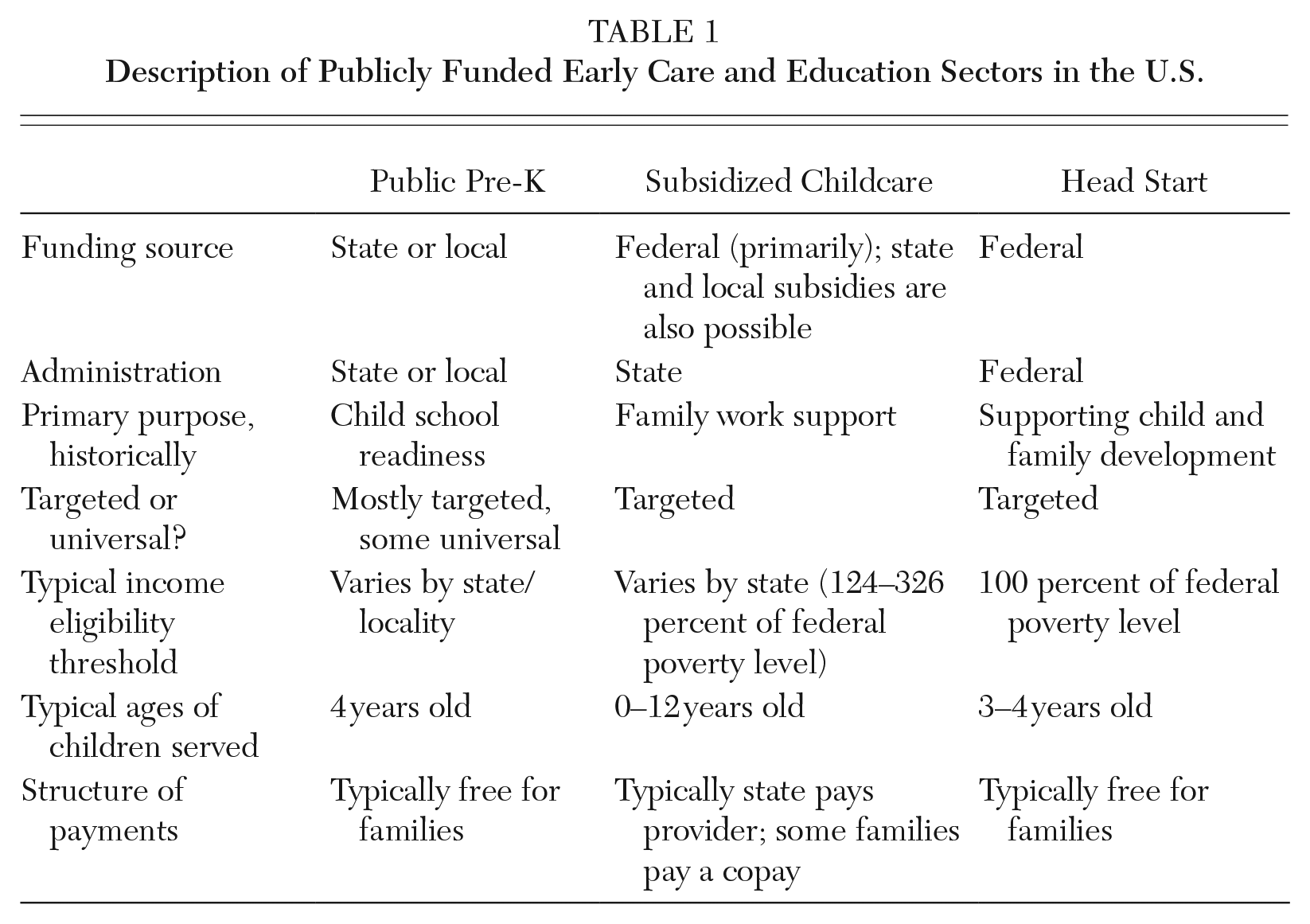
These public supports exist largely in three sectors: public pre-K, subsidized childcare, and Head Start. All three sectors are similar in that they provide either free or subsidized care for young children. When done well, they all also provide engaging activities that are likely to have lasting benefits (Phillips et al. 2017). However, they differ in key ways—including eligibility, historic goals, available resources, and other characteristics—that may not be immediately evident to families and that can make it challenging for families to access needed supports (Adams and Matthews 2013). Below we describe each of these three publicly funded ECE sectors in more detail. Table 1 provides a summary.
Description of Publicly Funded Early Care and Education Sectors in the U.S.
Public pre-K
Public pre-K is funded and administered by either state or local governments and provides ECE in school-based settings and/or in community-based centers. In many cases, these programs were created in response to growing evidence about the power of early interventions for shaping young children’s development (Institute of Medicine and National Research Council 2000). This knowledge—coupled with the rise of accountability reforms in K–12 education and the growing pressure to address achievement gaps—prompted leaders to invest in early education as a way to mitigate opportunity gaps (Bassok and Loeb 2015).
As of 2020, 44 states had a public pre-K program, and 34 percent of four-year-olds in the U.S. were enrolled. In some states, three-year-olds could participate as well (Friedman-Krauss et al. 2021). Typically, they participate at far lower rates, though in Washington, DC, universal preschool is available to three-year-olds, and other cities are expanding similar programs. Because states and localities oversee their own programs, there is considerable variation across the country in how programs are structured, where they are located, and who is eligible.
Still, most public pre-K programs share key characteristics. They are free to families and are focused on improving children’s “school readiness” as they aim to support children’s development across multiple domains (e.g., cognitive, socioemotional) in the year before kindergarten. In many states, public pre-K is primarily administered directly through school districts and functions as an additional year in the public school system. Public pre-K teachers working in the public schools are often required to hold the same credentials as K–12 teachers. In some cases, they receive similar compensation and have access to similar curricular and professional development supports as K–12 teachers. A large body of research suggests these programs do create learning opportunities that benefit young children’s learning and can yield long-standing benefits (Gray-Lobe, Pathak, and Walters 2023; Phillips et al. 2017; Weiland et al. 2022).
At the same time, most pre-K programs are not well aligned with families’ need for childcare as a work support. Pre-K programs typically operate only during the school year, and they do not provide enough hours of care to meet the needs of most working families. Most public pre-K programs are structured as half-day programs. Full-day pre-K is becoming more common (Atteberry, Bassok, and Wong 2019), offering more instructional time for enrolled children and more hours of childcare for working families. Yet even full-day pre-K, which often covers five or six hours, does not cover many families’ full workdays.
Moreover, in most cases, children are not guaranteed slots in their local public school pre-K class in the same way they are for the K–12 grades. Most public pre-K programs have income or other eligibility requirements and may not have seats available even for all children who meet those requirements. Universal pre-K (i.e., programs that offer ECE to all age-eligible children) is available in some states (e.g., Oklahoma) and becoming increasingly prevalent in cities (e.g., New York City, Washington, DC). Even in these cases, families still face programs with limited availability and usually end up applying to multiple schools or rank-ordering options to ensure their odds of receiving a placement.
Subsidized childcare
Childcare subsidies are financed by the federal Child Care and Development Fund (CCDF) but administered by states and localities. The CCDF was first established as part of the Clinton administration’s early 1990s’ welfare reform legislation, which paired public support for families with low incomes with strong incentives or requirements for employment. Accordingly, whereas public pre-K investments have been framed as a way to support young children’s learning and development, the CCDF was designed primarily as a work-promoting welfare program (Johnson-Staub 2017).
Relative to public pre-K, subsidized childcare can provide full-day, full-year coverage as well as services that are better aligned with working families’ needs. For instance, childcare—especially home-based childcare—is far more likely to be open during nontraditional work hours (e.g., early morning, late evenings, overnight, or weekends). Families can choose any approved provider, including home-based options, to align with their preferences, home language, or culture. Beyond offering greater flexibility, subsidized childcare is also the main publicly available option for infants and toddlers.
However, this greater coverage is coupled with important trade-offs both with respect to young children’s early learning experiences and the complexity families face. Whereas the focus in public pre-K is on creating strong early learning opportunities for young children, the work-support focus of childcare subsidies has meant lower per-child funding levels and quality regulations aimed primarily at ensuring minimally safe childcare options (Bassok, Fitzpatrick, et al. 2016; Coley et al. 2016; Doromal, Bassok, and Wong 2018; Markowitz, Sadowski, and Hamre 2021). Childcare teachers, on average, have far lower educational attainment, pay, and benefits than their counterparts in the other sectors; and they have far higher rates of teacher turnover (Bassok, Markowitz, et al. 2021; Doromal et al. 2022; Phillips et al. 2019; Whitebook, Phillips, and Howes 2014). Childcare settings tend to offer less explicit focus on learning and are, on average, rated lower with respect to the quality of teacher-child interactions (Bassok, Fitzpatrick, et al. 2016; Bassok, Magouirk, and Markowitz 2021).
Beyond these differences in the early learning environment, accessing and using childcare subsidies can be a burdensome experience for families. Typically, families face a two-step process: applying for subsidies and finding a program that is approved to accept them and has available slots. Both steps create barriers. Applying and proving eligibility for subsidies is an administratively complex process (Adams and Matthews 2013). In many states, funding for subsidies is insufficient to cover all eligible families. Estimates suggest that only about one in seven families who are eligible for childcare subsidies actually receives them (Herbst 2008). Even families who receive subsidies often cannot find openings at programs that meet their needs (Barnes 2021). In addition, subsidies usually do not cover the full cost of care. About 75 percent of families make copayments alongside using their subsidy (Office of Child Care n.d.). Finally, in most cases, families face strict eligibility rules that require them to be employed or pursuing education for a certain number of hours per week, with earnings under set thresholds, in order to receive assistance and maintain eligibility (Dwyer et al. 2020). Families must redetermine eligibility over time, and this process perpetuates the administrative burdens and creates disruptions for children and families (Davis, Krafft, and Forry 2017; Ha and Meyer 2010; Jenkins and Nguyen 2022).
Head Start
Considered the federal flagship investment in ECE, Head Start emerged in the 1960s as part of the War on Poverty. Federal funds flow directly to local grantees, with some coordination via regional offices designated by each state. In 2021, nearly 750,000 children were served through Head Start programs, although closer to 1 million children were served in the years prior to the COVID-19 pandemic (KIDS COUNT 2022).
Historically, Head Start has explicitly focused both on the developmental role of ECE in shaping young children’s developmental trajectories and on the ways ECE programs can support low-income families or those facing other challenges. Head Start has a stringent set of regulations surrounding children’s learning experiences. For instance, when the Head Start Act was most recently reauthorized in 2007, it set a requirement for all Head Start center-based teachers to have earned a BA or higher in early childhood education by 2013. By 2015, 73 percent of teachers had received these credentials (Barnett and Friedman-Krauss 2016). The reauthorization also emphasized the quality of teacher-child interactions, including the use of a classroom observation tool to measure and support teachers’ skills (Derrick-Mills et al. 2016). Head Start often also offers families access to social workers, job training, and health screenings to support their work and education (Sabol and Chase-Lansdale 2015). Both half- and full-day options are available, though full-day arrangements require that families are either working or in school.
However, the program has insufficient capacity to serve all eligible children, particularly in the Early Head Start program, which serves children under age three (First Five Years Fund, n.d.; Matthews 2013). For instance, in 2019, roughly 13 percent of children birth through two years old living in poverty were served (KIDS COUNT 2020a). Further, Head Start only serves families with very low incomes and families whose children have special needs. In 2022, the annual income threshold for a household of four was $27,750 (Office of the Assistant Secretary for Planning and Evaluation 2022). Its targeted nature ensures access for those families least likely to have access to ECE otherwise but can leave families just above the income eligibility thresholds without support.
Families’ Challenges Navigating the Current ECE System
In the U.S., most young children (70 percent) live in households where all adults work (KIDS COUNT 2020b). Families need reliable childcare to facilitate their work schedules; and young children benefit from stable, high-quality early learning opportunities. The current ECE system fails to adequately meet these needs. As described above, each of the three sectors falls far short of serving all eligible children; and even when combined, many eligible children cannot access ECE options that meet their families’ needs (Fetterman 2018; Malik and Hamm 2017; Matthews 2013).
Empirical evidence on how families navigate the ECE system, why they do and do not access publicly funded ECE, and which families sort into specific sectors is growing but limited. For instance, we do not have strong evidence on why families who are eligible for childcare subsidies do not use them or why families may choose Head Start versus pre-K.
Most families with low incomes report that they want high-quality and affordable care for their children (Chaudry et al. 2011; Forry et al. 2013; Harvard T.H. Chan School of Public Health 2016). Most are seeking programs that meet their logistical needs (e.g., hours that align with employment schedules or programs close to their home or place of work) and have warm, experienced educators who are kind and create safe, engaging learning environments (Sandstrom and Chaudry 2012; Sandstrom, Giesen, and Chaudry 2012; Speirs, Vesely, and Roy 2015).
However, families with low incomes face a number of challenges that influence whether they access any publicly funded ECE as well as which sectors and programs they use. While the lack of affordable options is the most salient, issues of limited supply are outside the scope of the current review. Here we focus on aspects of the existing ECE landscape that make it difficult for families to access even the available public slots that do exist. Two in particular are the lack of clear information about families’ options and the complex administrative steps needed to enroll in publicly funded programs. We also highlight how these problems, which are present within all three ECE sectors, are exacerbated by the lack of coordination across sectors.
Families lack necessary information to make informed decisions
The first hurdle families face in finding publicly funded ECE is identifying the programs from which they can choose. In the typical K–12 public school system, children are guaranteed a spot in their local school; and where school choice is available, families receive information about the various options and how to apply. In most of the U.S., no analogue exists for ECE. Historically, there has been no centralized source of information for families to identify or evaluate existing ECE options (much less what services they provide, when they are open, whether they have slots available, or if their child is eligible). Families may not be aware of programs for which they are eligible and that could meet their needs. Consequently, many families of all incomes report having a difficult time finding care and feeling that they have limited options (Harvard T.H. Chan School of Public Health 2016).
In the absence of centralized and easy-to-access information, families usually rely on more informal, trusted sources, such as families and friends, to begin a search process (Chaudry et al. 2011; Layzer, Goodson, and Brown-Lyons 2007). Research shows families’ search processes are often short: one study found that 41 percent of families with low incomes choose a program in less than a day (Forry et al. 2013; Layzer, Goodson, and Brown-Lyons 2007). A short search might imply either that families were able to easily identify options that met their needs or that the program they selected was the only option available. However, research on families with low incomes suggests that even when there is a broader set of options, many do not engage in comparison shopping, do not consider multiple sectors, and some do not even consider more than one program (Anderson, Ramsburg, and Rothbaum 2005; Bassok, Magouirk, et al. 2018; Layzer, Goodson, and Brown-Lyons 2007).
One study in Louisiana showed that within families with low incomes, those who enrolled their children in a childcare center reported having a more difficult time with the search process than families who enrolled their children in a Head Start or pre-K program: they considered more options but were less satisfied with their choices (Bassok, Magouirk, et al. 2018). It may be that these families were not eligible for Head Start or public pre-K and that finding available and affordable childcare centers was particularly tricky. It may also be that these families did not know about the free options available through Head Start or pre-K. Similarly, other families may lack critical information on free or subsidized childcare programs, thus making them unlikely to access funds that were designed to meet their needs (Chaudry et al. 2011; Ward, Oldham LaChance, and Atkins 2011).
In addition, families often have misconceptions about the services programs provide and their own eligibility. In one study of subsidy-eligible families (Shlay et al. 2004), about half believed that they were not eligible, and three-quarters incorrectly believed they could not use subsidies with home-based friend and neighbor care. This misconception was more common among families that were not participating in the subsidy program and suggests that they may have participated in the program had they known about this care option.
Finally, even when families do know about their options and understand their eligibility, they often lack information to evaluate their options. Families value ECE program quality but have a hard time assessing the quality of their options (Bassok, Markowitz, et al. 2018). Despite the fact that most ECE programs offer low- to adequate-quality care, (Chaudry et al. 2021; National Institute of Child Health and Human Development 2006), most families’ assessments of program features are quite high and weakly correlated with expert metrics of program quality (Bassok, Markowitz, et al. 2018; Harvard T.H. Chan School of Public Health 2016). However, studies show that over the years, families have put increasing importance on standardized program quality information—a finding that reflects the value that information provision could have in families’ decision-making processes (Chase and Valorose 2010; Elicker et al. 2011). Without publicized and accessible quality metrics, families struggle to make informed decisions about potential trade-offs they may be making.
Application and enrollment processes are rife with administrative hurdles
A second challenge is that, even should families successfully identify potential programs, ECE applications are typically decentralized and specific to sectors or even individual programs. As with information gathering, applying for ECE programs can be complex and confusing to navigate. A large body of evidence across social programs illustrates the challenges families, particularly those with low incomes, face with procuring government services and the ways that administrative burden (e.g., filling out forms, procuring and submitting documentation, scheduling and attending appointments) can discourage eligible families from completing application processes (Moynihan, Herd, and Harvey 2015; Schanzenbach 2009). These barriers may be particularly pronounced for some families, such as those who do not speak English or have literacy limitations (Adams and McDaniel 2012; Greenberg, Michie, and Adams 2018).
Families applying to any of the three ECE sectors likely face some administrative burdens, though the extent of these challenges differs. The process of applying to Head Start or public pre-K programs varies in complexity, and families experience different levels of difficulty with the necessary steps (Shapiro et al. 2019). Usually, these programs have set enrollment periods for the upcoming school year. Families fill out applications and, unless the program is universal, submit documentation proving their eligibility (most commonly, establishing residency and household income below the threshold). Because families are typically not guaranteed slots at any one program, they often must apply to (or rank order) multiple programs, which requires additional time and understanding of the allocation processes.
Applying for subsidies carries far more administrative burden because, in most cases, families must both complete the subsidy approval process at a local office and identify and submit applications to each individual ECE program they wish to enroll in (Barnes 2021). Each step poses challenges. For instance, due to the program’s origin as a work-promoting welfare program, the subsidy approval process typically involves in-person appointments and employment verification (Johnson-Staub 2017). Qualitative evidence collected across the country suggests that families are routinely challenged by several elements of subsidy application: leaving work for appointments; hours-long wait times at subsidy offices, even for scheduled appointments; ill-trained and unresponsive caseworkers; and struggles in obtaining verification documents from their own employers (Adams, Snyder, and Sandfort 2002; Sandstrom, Grazi, and Henly 2015). Redeeming the benefit of a subsidy can also be challenging because families must first find programs that will accept the subsidy, and each program may have its own application and processes for completing enrollment. Finally, many states require that families routinely demonstrate their continued eligibility for subsidies, and the more frequently families must undergo these hassles, the more they may decide the benefits are not worth the costs (Jenkins and Nguyen 2022; Moynihan, Herd, and Harvey 2015).
Fragmentation Exacerbates Families’ Challenges within the ECE System
While some families may only ever consider, apply to, and enroll in one ECE sector, many interact with multiple sectors either simultaneously or over time to meet their families’ needs (e.g., finding wraparound care or care for multiple children in different programs). For these families, the fragmented nature of the ECE system exacerbates the challenges of each individual sector.
Fragmentation compounds information and administrative hurdles
Accessing information across sectors is often more difficult than navigating a single sector. If they are lucky, families might find one website about public pre-K options and another about Head Start. And while many regions have childcare resource and referral agencies that collect information about childcare options, they typically do not include other publicly funded options (Child Care Aware of America 2022). Most families lack “one-stop” websites or in-person supports that provide clear cross-sector information about available options. Basic information (e.g., hours, eligibility criteria, and quality) is usually not defined, collected, or publicized consistently across sectors.
Differences in application timelines across sectors can create challenges for families. For instance, applications for public pre-K usually happen on set timelines, with families applying months in advance for the next school year. Applications for childcare, on the other hand, often are accepted throughout the year, and children are accepted as spots become available. When spots are not guaranteed, many low-income families apply to multiple programs in the hopes of securing at least one spot. Given scarce slots, families may feel pressure to commit to the first program with availability rather than taking a risk on waiting for spot at a program that may be better aligned with their needs.
In addition, managing multiple application processes can be cognitively taxing and could deter families from applying altogether (Chaudry et al. 2011; Weixler et al. 2020). This is especially the case across sectors, as each sector varies with respect to eligibility criteria, documents needed to verify eligibility, and other requirements, such as in-person visits. For instance, prior to the COVID-19 pandemic, families applying for public pre-K in New Orleans were required to physically deliver documents, such as their child’s birth certificate, proof of residency, and proof of household income, to verify their eligibility for programs. If they also submitted an application for Head Start, they needed to verify eligibility at a different building, bring different documentation, and complete an in-person interview (Weixler et al. 2020).
Fragmentation reduces opportunities for effective policy solutions
The complexity of finding necessary information, navigating separate timelines, and managing distinct and burdensome application requirements across disparate systems can be overwhelming for families. Moreover, improving the ECE system to make it more user-friendly for families is difficult when multiple agencies administer publicly funded programs with limited coordination, little shared governance, and competing priorities. Finding inefficiencies, strategically combining resources, aligning regulations, and expanding access are all more challenging because of fragmentation (Regenstein 2020).
In fact, a salient feature of uncoordinated systems is that, even though agencies administering publicly funded ECE may all be interested in improving families’ experiences navigating the systems, efforts to do so in one sector sometimes have unintended consequences in other sectors that may well reduce overall access and quality. For example, an investment in expanding public pre-K may decrease four-year-olds’ enrollment in childcare centers, thus negatively impacting their financial stability (Bassok, Miller, and Galdo 2016; J. H. Brown 2018).
Not only is solving problems difficult in a fragmented system, so is understanding them. Without coordination across sectors, determining how many children are receiving services or identifying areas where availability is particularly low can prove difficult. The challenge arises because most states lack robust data systems even within sectors, and fragmentation means that few states have data systems that capture the full universe of publicly funded providers. In the K–12 education system, longitudinal data systems have made it possible to track children over time within a state. These data systems also provide longitudinal information on teachers and schools and allow policymakers, practitioners, and researchers to better understand issues related to access, equity, and other outcomes. There is no analogue in early childhood.
As one example, more than half of children under age five are in more than one ECE setting, and about 25 percent use at least three different arrangements (Malik 2019). But in a fragmented system and without data across sectors, policymakers cannot ascertain the extent of child duplication (i.e., counting a child twice because they are enrolled in multiple settings) and therefore cannot accurately assess how well they are meeting children’s needs. Further, lack of systemwide data makes it difficult to track progress over time (Whitebook, McLean, and Austin 2018).
Improving Families’ Experiences with ECE Systems
In recent years, policymakers have implemented a variety of strategies aimed at supporting families in navigating the ECE system. This section highlights promising strategies, starting with efforts intended to make processes within individual sectors more manageable (e.g., making it easier to access information, reducing administrative hurdles). We also describe broader, more structural efforts to tackle the lack of coordination across sectors and build more family-centered ECE systems.
Within-sector improvements
Providing and streamlining information
K–12 research has shown that providing parents clear information about schooling options for their children can impact their choices and lead them to select higher-quality schools (Corcoran et al. 2018; Hastings and Weinstein 2008; Valant and Weixler 2020). Providing information to families may be even more beneficial in ECE given the more decentralized context. Without a central listing of programs, families are left to consider only those programs they know about, either through a limited search, by word of mouth, or by happenstance.
Lists or portals have become more common in the past decade. For instance, the 2014 reauthorization of the Child Care and Development Block Grant (CCDBG) required states to improve consumer information to ensure families could make better decisions (Matthews et al. 2015). States were required to provide online lists of all licensed childcare providers, including information about program quality (where available) and the results of all inspections and safety-monitoring reports. All states now maintain online listings of programs, and a handful have built portals to allow for customized searches. Many cities (e.g., Chicago, New York) have built similar web portals where families can learn about all public pre-K options in the city, including program characteristics such as quality ratings.
States and localities vary in the amount of information they provide about ECE programs and in how information is presented. Even just providing a centralized list of programs can both reduce the number of separate searches families must undertake and ensure they know about all options available to them. Some portals also include program location, hours of operation, ages served, and program costs, among other characteristics; and some allow families to filter on key program characteristics (e.g., distance from home). These features can streamline families’ search processes and ensure they are considering programs for which they are eligible and that would meet their preferences.
The evidence on the impact of these types of information efforts in early childhood contexts is limited but encouraging. For instance, Chicago Public Schools (CPS) aimed to increase full-day school-based pre-K enrollment among students of color, low-income students, and non-English speakers. Policymakers created a web portal that included detailed information about eligibility requirements, programs with full- and half-day classrooms, and program quality. This portal was just one in a set of several levers Chicago policymakers used to increase program take-up; evaluation showed the efforts as a whole did lead to meaningful increases in pre-K enrollment (Ehrlich et al. 2020). Likewise, recent quasi-experimental evidence from North Carolina showed that enrollment dropped in ECE programs that received lower ratings (Bassok, Dee, and Latham 2019)—an outcome consistent with the hypothesis that parents are responsive to quality information when making care choices.
A few communities have tried giving families personalized information to inform their childcare decisions. Studies that evaluated whether these interventions led families to choose higher-quality programs have yielded mixed results. For instance, one experiment in Indiana tested the impact of giving families customized information about childcare providers in their local area, the quality of these programs, and suggested questions to ask during program visits (Dechausay and Anzelone 2016). Findings showed that families who received this information, coupled with follow-up phone calls from a childcare resource and referral agency, were more likely to choose a provider with a higher rating than the control group that did not receive customized information or phone calls. In contrast, Valant and Weixler (2020) found that giving New Orleans families information about the quality of their pre-K options did not lead them to choose programs with higher program quality, even though a similar intervention for families of ninth-graders in the same school district did show benefits. More research is needed to better understand the potential of information efforts in other contexts.
Reducing administrative burdens and streamlining application requirements
In addition to improving access to information, policymakers have sought ways to help families navigate administrative hurdles. In other educational contexts (such as higher education admissions [e.g., Castleman and Page 2015]), as well as in a range of government programs (such as the Supplemental Nutrition Assistance Program [SNAP]) and housing vouchers (e.g., Office of Management and Budget 2021; Schanzenbach 2009), streamlining requirements, reducing logistical hurdles, and improving communication have proved effective. Efforts to reduce administrative hurdles—which include simplifying and translating instructions and forms, providing individualized staff support throughout the application process, reducing the number of required verification documents, allowing both physical and virtual submissions, and increasing communication frequency (Office of Management and Budget 2021)—could have similar positive impacts on families’ ability to navigate and complete ECE application and enrollment processes.
A number of qualitative studies have examined these types of efforts in the context of childcare subsidy eligibility and redetermination. These studies have highlighted the benefits of granting families more flexibility in the application process, for example, by streamlining requirements, allowing for eligibility documents to be submitted online, and expediting subsidy approval prior to verifying families’ documents (Adams and Matthews 2013; Adams, Snyder, and Sandfort 2002). These efforts reduce staff caseloads and increase the length of families’ subsidy eligibility so they do not need to recertify and reengage in a complex process as frequently (Adams, Snyder, and Sandfort 2002).
Personalized supports help families overcome administrative hurdles above and beyond broader efforts to streamline application requirements. For example, as one of several levers aimed to increase public pre-K enrollment in CPS, the City of Chicago collaborated with local nonprofits to provide application assistance, including home visits, an application support hotline, and financial assistance to families who had to travel to application centers to submit their applications (Ehrlich et al. 2020). As noted above, pre-K enrollment increased in CPS, although the impacts of this application assistance were not studied in isolation from other activities occurring during the same period.
Recent experimental evidence also suggests these types of personalized supports can be effective for helping families navigate complex, multistep application processes (Weixler et al. 2020). As one strategy to reduce burden for families, New Orleans introduced a centralized application system to allow families to apply for ECE programs online. However, families still needed to verify their eligibility (i.e., by bringing in needed documents) in person. Over a third (35 percent) of families who completed the online application failed to finish that step, thereby effectively forfeiting their opportunity to enroll in publicly funded ECE. Families randomly assigned to receive text messages explaining the verification process and reminding parents of needed steps were 7 percentage points more likely to complete the process and also more likely to enroll. The confusion that these text message exchanges revealed—around application steps and the types of documents required to demonstrate eligibility—highlight the need for rapid and clear supports to help families navigate program complexity.
In addition to efforts aimed at supporting families as they navigate complex administrative processes, other strategies could reduce or eliminate administrative hurdles altogether. Several studies demonstrate that efforts to reduce administrative burdens for families using childcare subsidies (e.g., by minimizing how often families must recertify eligibility) can have positive benefits, including more stable care spells (Davis, Krafft, and Forry 2017; Jenkins and Nguyen 2022; Michalopoulos, Lundquist, and Castells 2010). The 2014 CCDBG reauthorization introduced a variety of requirements aimed at eliminating reporting burdens for families (Matthews et al. 2015; Office of Child Care 2014). For instance, states had to allow families to remain eligible for childcare assistance for a minimum of 12 months, regardless of temporary changes in parental employment or changes in income (as long as it remained below 85 percent of state median income). The reauthorization also directed states to limit reporting requirements within the year to ensure a more continuous eligibility period. For many states, the reauthorization led to notable reductions in administrative burden. For instance, thirteen states increased their subsidy eligibility periods from six to 12 months (Schulman 2017). One new study shows that when states switch to a 12-month redetermination period, the median childcare spell length increases by 30 percent, while having other reporting requirements (e.g., requiring families to report all income changes) decreases spell length by 7 percent (Jenkins and Nguyen 2022).
Cross-Sector Alignment and Coordination Efforts
Some states and localities have made considerable progress in lessening the barriers families face when finding, applying for, and remaining eligible for publicly funded ECE options. Providing families with centralized, searchable portals; better support for complex, multistep processes; and policies that reduce requirements all show promise. But while these efforts likely yield improvements for families’ experiences within the current system, they do not tackle that system’s underlying fragmentation issues. Families engaging across disparate sectors still face many challenges due to the lack of coordination across sectors.
An emerging set of efforts work to build cohesion across sectors and thereby address root issues more explicitly. This section describes promising strategies—ranging from efforts that substantially increase coordination across existing, separate sectors to those that pool resources across sectors—that aim to align or coordinate sectors in ways that lead to a more family-centered and more truly unified ECE system.
Coordinated enrollment systems
Above, we described a variety of ways states and localities have aimed to make the process of finding and enrolling in specific ECE sectors easier for parents (e.g., websites that show all public pre-K options, policies that reduce administrative hurdles). Coordinated enrollment systems move a step beyond these within-sector efforts to streamline search and enrollment processes across sectors. In most communities, families do not have a centralized source from which to learn about and apply to nearby early childhood programs. Once they learn programs exist, they often must visit multiple ECE programs and government offices to determine if they are eligible for a program and apply to it. Coordinated enrollment systems aim to rectify these challenges by, at a minimum, creating a centralized place where families can find information about the full set of publicly funded ECE programs in their community, as described above. Beyond centralized lists, more advanced coordinated enrollment efforts can involve families using a single application to apply for programs across sectors. These types of shared applications can also streamline how children are assigned to seats across a locality, so that providers are offering seats to families based on “match” to their preferences while also reducing inefficiencies resulting from families applying to and/or being offered several slots (Cannon, Meyers, and Kaufman 2019).
Louisiana’s response to the 2012 Early Childhood Education Act (Act 3) provides a sense of the range that coordination efforts can take. Act 3 required localities to establish coordinated enrollment systems, and Louisiana’s parishes responded to this requirement in different ways. In some parishes, particularly those with less existing infrastructure, local early childhood leaders organized open houses that gave families an opportunity to learn about various options in their community: these initiatives centralized information across sectors but did not establish a single ECE application or attempt to match families to programs. New Orleans, though, already had a robust K–12 school choice centralized application, and leaders there were able to extend the existing system to include publicly funded ECE, allowing families to learn about available options online, apply using a single application, and rank order programs that best meet their needs.
Coordinated enrollment initiatives have become more widespread in recent years, particularly through the Preschool Development Grant–Birth through Five (PDG B-5) awards, which incentivized this work (Chen, Zamora, and Grimm 2021). Many state recipients of the 2019 PDG B-5 awards proposed coordinated application and enrollment as a way to better meet families’ preferences and needs (Poppe, Thorman, and Weyer 2020); and many states have moved towards implementing these efforts, including Virginia with its community pilots (Virginia Early Childhood Foundation 2020) and Oregon with its Early Learning Hubs (Oregon Early Learning Division and the Early Learning Council 2022).
To date, no research we are aware of has documented the impact of these coordinated enrollment initiatives on families’ decision-making or child outcomes. However, existing evidence suggests they have been well received. In Oregon, families experiencing the state’s coordinated enrollment system found it “easy to complete the [online] application” and were “extremely satisfied” with the coordinated enrollment system and where they ultimately enrolled their children (Oregon Early Learning Division and the Early Learning Council 2022). In Louisiana, early childhood program leaders reported that coordinated enrollment has made it easier for families to know about their program options (Cannon, Meyers, and Kaufman 2019).
Building coordinated enrollment systems can be difficult. One challenge is lack of trust or the sense that sectors are competing with one another for families. For instance, in some Louisiana parishes, childcare leaders worried these coordinated efforts might make it more difficult for them to fill their slots by driving more families to public pre-K or Head Start (Michie et al. 2021). Even when all sectors are willing to engage, differences in timelines can make a single point of entry difficult to manage: a single application that must be submitted during a specific window of time may not work for childcare programs that enroll children year-round and wish to fill vacancies as they become available. Similarly, differences in eligibility requirements, such as Head Start’s federally set rules, can make it challenging to design a single application.
Aligning and coordinating eligibility requirements
Creating coordinated enrollment, and particularly shared applications across sectors, would be more manageable if eligibility criteria were better aligned across sectors or if eligibility for one sector guaranteed eligibility for another. For instance, theoretically, a child who has been verified as eligible for Head Start (which generally has the most restrictive eligibility requirements) could automatically be eligible for childcare subsidies or pre-K. For families applying across sectors, such alignment could simplify understanding the process (i.e., they would only need to understand one set of requirements) and, if programs could share verification systems, reduce duplicative efforts in providing documentation.
In practice, however, few examples of this type of eligibility efficiency exist, in part because changing eligibility rules can be challenging. Sectors are governed by different regulatory bodies, and in many cases program eligibility requirements are written into law. While states and localities set eligibility policies for their pre-K programs, Head Start rules are set federally and are restrictive. Childcare subsidies fall somewhere in the middle: fundamental eligibility requirements are regulations set at the federal level, but states have discretion on some key rules (Adams and Matthews 2013). Given that only 61 percent of children across the country who are eligible under federal rules are also eligible under their state’s rules (Smith et al. 2018), states may have room to make their subsidy eligibility rules less stringent.
While eligibility coordination across ECE sectors is not yet common, there are examples of coordinating eligibility between childcare and other social services. For instance, as part of a foundation-funded pilot program to help low-income families secure and retain needed benefits, six states attempted to align subsidy eligibility policies with those of other social programs (Adams and Matthews 2013). Focusing on the most similar programs in terms of eligibility and application processes—SNAP and Medicaid—they created cross-program rule comparison matrices that tackled the minutiae of reconciling different definitions of key terms, such as family units, countable income, and approved work activities (Hahn, Rohacek, and Isaacs 2018). Idaho and North Carolina succeeded in aligning SNAP and subsidy income thresholds (Hahn, Rohacek, and Isaacs 2018). Other states, like Rhode Island, have allowed for categorical eligibility; that is, families approved for Temporary Assistance for Needy Families (TANF) funds are automatically eligible for childcare subsidies. As mentioned above, employing similar efforts within the ECE system—for example, by aligning public pre-K and/or subsidy eligibility with Head Start—is a promising but largely untested approach.
Establishing systemwide, cross-sector data systems
Efforts to improve access to high-quality ECE options for families can be informed by better data systems. Without comprehensive data, it is impossible to assess gaps in access, understand key issues about the ECE workforce, or track returns on improvement efforts. In recent years, aided by federal funds like the Race to the Top Early Learning Challenge and the PDG B-5, more states have worked to develop early childhood data systems, which combine information from multiple sectors and include data on children, teachers, and programs. For instance, in 2010, Georgia integrated data from all ECE sectors in the Cross Agency Child Data System; and in the past few years, Virginia has been developing LinkB5, a data portal that will capture detailed information about the full range of ECE programs across the state, their quality, the employees at these programs, and the children served (LinkB5 2022). Still, as of 2018, fewer than half of states had linked any of their early childhood data across sectors.
Although not explicitly developed as integrated data systems, states’ quality rating and improvement systems, which are accountability systems that collect and publicize information about ECE program quality across sectors, have in some cases created rich, systemwide data on enrollment, quality, and the workforce. These data have allowed researchers to describe key aspects of ECE systems that previously could not be examined, including systemwide trends in program improvement (Bassok, Magouirk, and Markowitz 2021), access and supply issues (Hatfield et al. 2015), and detailed cross-sector analysis of teacher mobility and attrition (Bassok, Markowitz, et al. 2021).
Pooling resources
Beyond efforts to better understand the fragmented ECE system and to ease families’ experiences navigating it, states and localities have increasingly created policies aimed at pooling resources across sectors. Combining funding streams can reduce inefficiencies and better meet families’ needs by increasing access, creating full-day or wraparound services, or improving the quality of ECE services (Gonzalez and Caronongan 2021).
Finding ways to do this across sectors can be challenging since each sector faces different funding regulations, eligibility rules, and standards. Most funding sources require detailed reporting on spending. Frequently, individual programs are left trying to combine or “braid” funds in order provide high-quality care while still meeting each funding source’s requirements (Fonseca 2017). Although this type of ad hoc effort is the most common way funds are pooled, states, localities, and individual programs have found other strategic ways to integrate funds in order to build more efficient and effective programs. These tactics include “blending,” which refers to pooling revenue from different sources into one general-use pot; and “layering,” which means supplementing existing funds with additional resources, often to provide comprehensive care such as health screenings (Wallen and Hubbard 2013).
For example, Pennsylvania and West Virginia encourage and provide guidance for localities to braid funding, particularly by combining pre-K and childcare subsidy resources to provide families with full-day care (Morris and Smith 2021). Since 2012, New York City has used braided funding from Head Start, public pre-K, and childcare subsidies to drastically expand its universal pre-K program, thereby reaching more children than public school buildings alone may have been able to serve (Gelatt and Sandstrom 2014).
Strengthening local infrastructure and coordination efforts
Coordinating across sectors requires significant investments of time and effort, and ECE program leaders often do not have the capacity to engage in this work. Infrastructure, in the form of guidance, human capital, and resources, is crucial. Because of both the existing piecemeal structure of the ECE landscape and the diversity of families’ needs, creating structures at a local level can be a key strategy for improving coordination.
States have been leading these efforts. In Louisiana and Virginia, for example, the state governments created systems of regional organizations (called Ready Start Networks and Ready Regions, respectively) that are charged with fostering communication, collaboration, and improvement in ECE access and quality within their geographic areas (Leiberman 2018; Virginia Department of Education 2022). These regional groups act as intermediary conveners and governing entities, receiving support from the state and shepherding the work of local systems. North Carolina’s similar regional Smart Start networks are additionally tasked with operating a shared governance at the local level for childcare subsidies; the state’s pre-K program; and a variety of other early childhood services, such as home visiting (Morris and Smith 2021; North Carolina Department of Health and Human Services 2020).
ECE governance models
One major reason many of the above solutions have seldom been implemented is that ECE programs are typically administered by different government entities. For instance, 17 states had different parent agencies overseeing Head Start and pre-K in 2020 (Education Commission of the States 2021). Even with an intention to coordinate across sectors, the presence of multiple governing agencies presents logistical challenges. As one example, creating a data system that integrates all ECE sectors is far more difficult when different agencies are maintaining their own individual data systems that were never created with the intention of linking across multiple systems.
In recent years, there has been a rising interest in governance models in which ECE programs are administered by the same agency rather than by separate ones. In fact, in 2016, the U.S. Department of Health and Human Services and the U.S. Department of Agriculture released a joint policy statement that recommended states “examine the governance structure of early care and education programs to foster greater coordination, collaboration, and policy alignment” (U.S. Department of Health and Human Services and U.S. Department of Agriculture 2016). Since then, at least 36 states have introduced bills that would impact their ECE governance structure (Education Commission of the States 2021). Changes to states’ ECE governance fall into three types of models: (1) coordinated governance in which multiple agencies must coordinate across ECE programs, (2) consolidated governance in which one agency takes over the responsibilities and coordination of ECE programs from other agencies, and (3) creation of a new government agency responsible for all ECE programs.
Coordinated governance is the most commonly pursued model, perhaps because it requires the least amount of structural change and cultural shift: the onus is still on individual agencies to ensure coordination of services, check for duplicated efforts, and ensure efficiency. But although there are far fewer examples of the latter two models—consolidated and created governance—they may also have the greatest potential for reducing fragmentation. Virginia provides a recent example of consolidated governance. As of summer 2021, all childcare and early education programs (including licensing, the childcare subsidy program, and professional development) that were previously under the Department of Social Services now fall under the Department of Education. As a result, the state will be able to apply their unified measurement and improvement system across all publicly funded programs, support the creation of more locally coordinated enrollment, expand eligibility for the childcare subsidy program, and continue to fund their successful financial incentive program for early childhood educators (Virginia Early Childhood Foundation 2020). New Mexico offers an example of the third model: an entirely new state department, the Early Childhood Education and Care Department, was established to oversee ECE programs. Within the department’s first year, the state had increased access to full-day pre-K; launched its web portal, where families can learn about all publicly funded childcare options and supports; and implemented a wage supplement program for educators (New Mexico Early Childhood Education & Care Department 2021).
Conclusion
The U.S. lacks a universal, publicly funded early care and education system. All three of the main publicly funded ECE sectors—public pre-K, subsidized childcare, and Head Start—fail to serve many eligible children, with options for infants and toddlers particularly lacking. Our failure to provide access to these programs for many children and families is, for the most part, a consequence of insufficient public funding for enrollment across sectors; but even the publicly funded slots that do exist can be difficult for families to access because of insufficient information and large administrative hurdles. These challenges are compounded because programs are administered by separate agencies with different goals, regulations, and funding streams and usually little coordination or cooperation. In this article, we have highlighted ways in which policymakers have tried to move, in small and large ways, towards a more family-centered system. Their initiatives have included sector-specific efforts to make information more accessible, efforts to support families as they managed the complexity of administrative hurdles, and efforts to reduce requirements and rules altogether.
We have also considered strategies to foster enhanced coordination across sectors and to facilitate cross-sector collaboration (e.g., by more efficiently leveraging funds, creating data systems that incorporate all sectors, strengthening local structures, and rethinking governance models). These types of changes can help reduce the fragmentation that permeates the ECE system and exacerbates the numerous challenges families face. Importantly, other forms of alignment, not covered here, focus on other aspects of ECE systems, such as quality standards and teacher qualifications or pay; while these do not directly streamline enrollment processes, they are still likely to foster overall coordination and equitably improve outcomes for families.
Alignment efforts can be delicate to navigate and are often obstructed by fundamental program differences and political contexts. Moreover, creating a coordinated system may well require unlikely, time-consuming legislative action. Yet because these more substantive initiatives most explicitly tackle fragmentation in ECE systems, we see them as particularly promising strategies. Building more cohesive early childhood systems that focus investments on providing work support and fostering child development for currently served families is a necessary first step. Although much larger financial investments will most certainly be needed to ensure equitable access to high-quality ECE options, building more cohesive systems is a necessary step to providing more effective and family-centered ECE childcare.
Footnotes
Justin B. Doromal is a research associate at the Urban Institute. He started on this project while at Brown University as a postdoctoral research associate.
Molly Michie is a senior research specialist at the University of Virginia.
Grace Kegley is a research specialist at the University of Virginia.
Daphna Bassok is a professor of education and public policy at the University of Virginia.