







Abstract
The present is not the only time in American history that American democracy has been at serious risk of backsliding. When we place recent developments in a broader historical and comparative context, we discover that any of four known threats to democracy can weaken it and lead to backsliding. These include political polarization, conflict over who belongs in the political community, high and rising economic inequality, and executive aggrandizement. American democracy has often been fragile, and each past episode of democratic fragility was characterized by some configuration of these four. Now, for the first time in our nation’s history, we face the confluence of all four threats at once. Analyzed through this framework, the January 6, 2021, attack on the U.S. Capitol was not a surprise. Although the attempts to overturn the 2020 election failed, the threats remain with us.
On January 6, 2021, an insurrectionary mob assaulted the U.S. Capitol, provoked by the president as the culmination of a deliberate strategy to cling to power after losing his bid for reelection. After overwhelming the U.S. Capitol Police and storming the flimsy barricades that ringed the building, the crowd came within feet of capturing the fleeing vice president, who had been presiding over the congressional session to certify the presidential vote, as required by the Constitution. Although the insurrection failed in its immediate object—the election was certified that very night, and the duly elected successor was inaugurated on schedule—its impact lingers. Most of the Republican members of Congress who dared to suggest that a president who tried to mount a coup d’état deserved to be impeached lost their seats. A majority of the former president’s party continues to believe his “Big Lie”: that the election was stolen and the current president is fraudulent (Blake 2024). The country’s election infrastructure, which proved extremely resilient under historically stressful conditions in 2020, has come under sustained assault; numerous states have sought to adopt newly restrictive voting rules and to politicize election administration, thereby softening the basic presumption of free and fair elections that underlies contemporary American democracy (Bateman, Lieberman, and Childree, forthcoming; Jacobs and Choate 2022). It is tempting to dismiss January 6th as a singular event without precedent in American political history and to fall back on its aftermath: a transfer of power continuing an unbroken string stretching back nearly two and a half centuries. But to dismiss the lingering and very real dangers to American democracy would be a grave mistake, because the unprecedented confluence of forces that threaten it has not abated since 2021 and, if anything, has intensified.
Over three decades, we have watched American politics change dramatically, shifting from a system characterized largely by negotiation, compromise, and moderation to one that features increasingly direct and intense conflict between political leaders and among citizens. By the 2016 election, even long-established democratic norms—such as the legitimacy of elections and the freedom of the press—began to seem fragile. These circumstances raised critical questions that contemporary observers of American politics have rarely, if ever, had to face: whether we could continue to presume that the U.S. was a stable democratic regime and whether American democracy was seriously at risk. Like many scholars of American politics, we felt ill-equipped to grapple with these questions using our own field’s existing analytical frameworks. For insight, we sought analytical perspectives that would enable us to place contemporary American developments in a broader context and help us better understand the conditions that made the travails of American democracy possible. Here, we draw on knowledge produced by scholars (including those in our own subfield of American political development) who study democratization and democratic deterioration both in the U.S. and abroad. Doing so gives us insight from some who have often cast a more skeptical eye on claims about the stability and inevitable progress of American democracy (Bateman 2018; King et al. 2009; Mickey 2015; Valelly 2004).
The recent past is not the only time in American history that its democracy has been at serious risk of backsliding; nor, of course, is the U.S. the only democratic regime to have experienced democratic instability (Lieberman et al. 2019). When we place recent developments in a broader historical and comparative context, we discover that any of four known threats to democracy can weaken it and lead to backsliding. 1 These include political polarization, conflict over who belongs in the political community, high and rising economic inequality, and executive aggrandizement. We then examine the presence of these threats in each of five earlier periods in U.S. history when many Americans worried that democracy stood in danger of deteriorating. To determine whether such backsliding occurred, we assessed whether four pillars of democracy remained intact or were crumbling: free and fair elections, the rule of law, the legitimacy of the political opposition, and the integrity of rights.
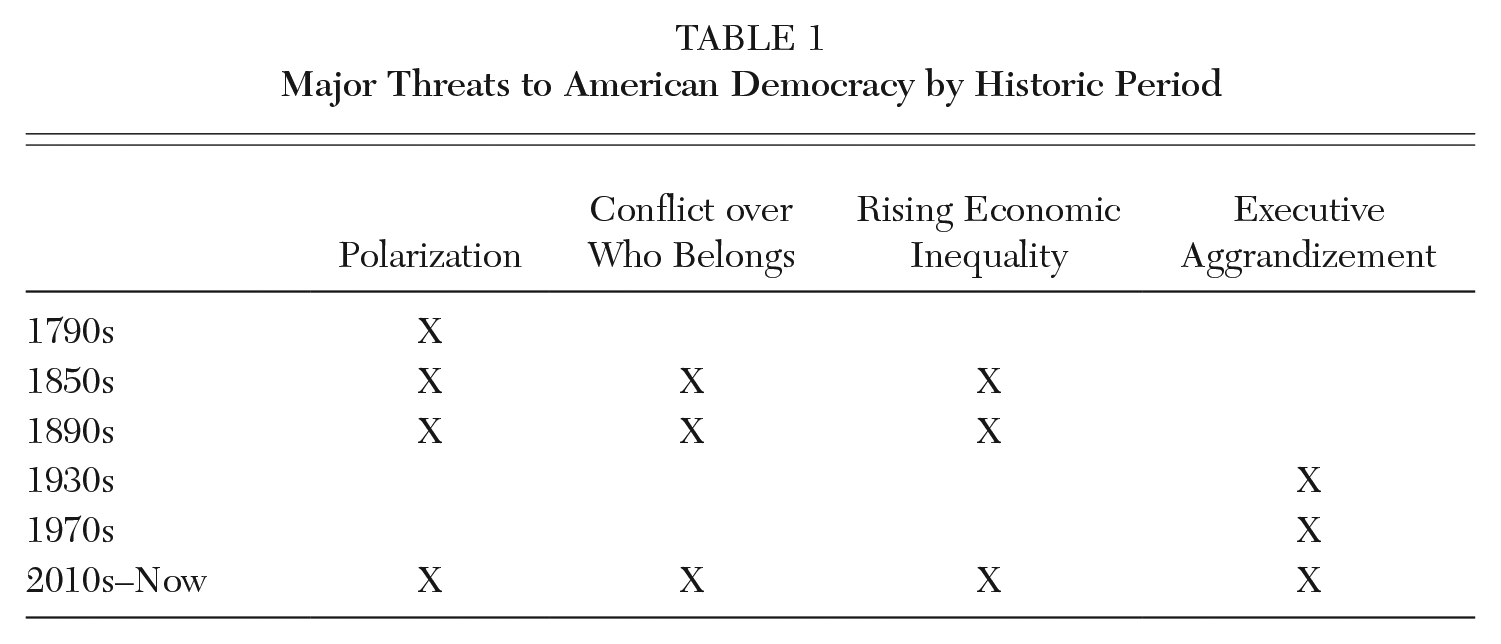
What this analysis reveals is that American democracy has often been fragile and that each past episode of democratic fragility was characterized by some configuration of these four threats. In the 1790s, one threat alone, political polarization, was nearly enough to lead to the demise of the young nation, and its early democratic features narrowly escaped intact. In the 1850s, the combination of the first three threats engendered secession and civil war; and in the 1890s, the confluence of those same three threats produced major backsliding in the form of the disenfranchisement of millions of African American men. This damage to democracy lasted for 60 years. What is especially striking is that confluences of threats, interacting with and amplifying each other, are associated with the eras that we generally consider the most serious and far-reaching episodes of democratic vulnerability: the Civil War and post-Reconstruction backsliding.
Now, for the first time in our nation’s history, we face the confluence of all four threats at once, as shown in Table 1 (Mettler and Lieberman 2020, 26). These threats are combining with each other in ways that exacerbate the danger to a political system in which the people rule through institutions of representative government. 2 Analyzed through this framework, the January 6, 2021, attack on the U.S. Capitol was not a surprise. And even though the concerted attempts to overturn the 2020 election failed, these threats remain with us, suggesting that the political system is likely to encounter continued damage in the coming years unless democracy can be protected and strengthened.
Major Threats to American Democracy by Historic Period
Four Threats to Democracy
Polarization
Polarization in democratic societies can take multiple forms: ideological and issue-based divergence among parties and partisans, social sorting among citizens into distinct and nonoverlapping partisan groups, or strategic partisan division in response to heightened competitiveness (Lieberman, Mettler, and Roberts 2022; McCarty 2019). Democracy provides a means for societies to manage various kinds of difference without resorting to violence, and it works well when society and politics abound with “cross-cutting cleavages” or overlapping affiliations (see the discussion in Lee 2022). Each of us has many different social characteristics: ethnicity, race, income group, and political party, to name a few. When we regularly affiliate with people from different groups—at work, school, or church or in our neighborhoods and civic associations—we tend to be more capable of practicing democracy. A key component of doing so means accepting the basic idea of democracy: that our side might lose an election and the other side might take power, for a time. Under these conditions, democratic politics can foster peaceful accommodation, compromise, and accountability of those in power to the public.
But when we sort ourselves so that we associate only with those with the same social identities and partisan leanings, society and politics can take on the characteristics of “us versus them” (see Lijphart 1999). Such social and political sorting fosters anger and resentment toward those in the other party. Citizens become more strongly motivated by “negative partisanship” (i.e., antipathy to those in the other party and its candidates), which may motivate them even more strongly than their ties to their own party do (Abramowitz and Webster 2018). Partisans increasingly think of each other not as fellow citizens but as enemies. When politics takes on these characteristics, political leaders lose their willingness to negotiate and compromise; they and their supporters treat each election and policy battle as an existential crisis and may increasingly believe that they must win at all costs because to allow the other side to do so would risk grievous harm to the country. They may consider the need for their party to gain or retain power as worth any damage to democracy that may ensue in the process of doing so (Kinder and Kam 2010; Mason 2018; McCoy and Somer 2019). And partisan voters are willing to overlook, or even reward, antidemocratic behavior by their copartisans (Graham and Svolik 2020).
The framers of the U.S. Constitution designed the government so that power would be dispersed through mechanisms that are intended to provide both “horizontal accountability” (a system of checks and balances in which different government institutions are able to challenge and restrain each other) and “vertical accountability” (mechanisms, such as elections, that enable citizens to hold their representatives to account [O’Donnell 1994]). “You must first enable the government to control the governed,” explained Madison (1788 [1961], 322) in Federalist No. 51, “and in the next place oblige it to control itself. A dependence on the people is, no doubt, the primary control on the government; but experience has taught mankind the necessity of auxiliary precautions.” The Constitution’s institutional design was thus supposed to make it hard for a single group to control every lever of governmental power.
What the framers did not imagine, however, was that almost immediately, Americans and their elected leaders would sort themselves out into two competing and mutually antagonistic factions, the precursors of modern political parties, that would seek exactly what the framers feared: complete control of government power. In the first decade of governance under the new Constitution, each side in this dispute—Washington and Hamilton’s Federalists and Jefferson and Madison’s Democratic-Republicans—believed that their view of what the new nation should become was correct and that the opposition’s approach would lead to ruin. The idea of organized, legitimate opposition to the government was still in its infancy, and the result was intense political polarization that quickly took on an existential “us versus them” character. The nation lurched from one democratic crisis to another, and the period was punctuated by violent conflict. The Whiskey Rebellion of the early 1790s, a tax revolt in western Pennsylvania, involved violent insurrection and was met with an armed response by the federal government. The Alien and Sedition Acts of 1798 criminalized opposition to the Adams administration’s policies and sharply curtailed civil liberties. The presidential election of 1800 produced an inconclusive outcome and had to be thrown into the House of Representatives, with militias for both sides standing by in case of perceived malfeasance; only when the deadlock was finally broken and Jefferson was elected did the two sides stand down. For the first time, the U.S. experienced a transition of presidential power from one party to another, and it occurred peacefully and successfully, although it was a close-run outcome. But polarization, acting as a lone threat, had brought the nation perilously close to civil war or secession.
Polarization proceeded to rise and fall throughout U.S. history, and in the middle of the 20th century, it reached a low ebb. The nation’s two political parties at the time each contained both liberals and conservatives of various stripes and were each characterized by regional and even state-level diversity. This facilitated the “cross-cutting cleavages” mentioned above. Since then, Americans have gradually sorted themselves in such a way that social and partisan identities increasingly stack onto each other rather than overlapping. The two parties have become ideologically distinct, with conservatives identifying as Republicans and liberals as Democrats (Abramowitz 2018, 51). The Republican Party increasingly attracts the support of both rural Americans nationwide and those who attend church more regularly, with urban dwellers and infrequent churchgoers supporting the Democratic Party (Brown, Mettler, and Puzzi 2021). As the nation has grown more racially and ethnically diverse, the Democratic Party has gained the support of a broad cross-section of the population, while support for the Republican Party remains disproportionately white: in the 2020 presidential election, for instance, Black, Hispanic, Asian, and other non-white voters made up 39 percent of Biden’s support but only 15 percent of Trump’s (Igielnik, Keeter, and Hartig 2021). Moreover, the lines of partisan conflict, which once varied substantially by region and state, have increasingly converged nationally; as a consequence, partisan challenges to democracy that were once associated specifically with the South are now liable to occur in states around the country (Grumbach 2022; Mickey 2022). These numerous distinctions between the parties further “affective polarization” and the animosity that flows from it.
Polarization has also intensified due to partisan competition. From the 1930s to the 1980s, the Democrats were the nation’s clear majority party. But since around 1980, both parties have stood to win control of Congress in most every election, and party leaders have responded by amplifying and projecting partisan differences and playing up partisan antagonism, to the detriment of shared efforts at policymaking (Lee 2016). In this partisan context, the imperative of winning often takes precedence over the demands of governing; representative government becomes less accountable, and democracy suffers.
Conflict over who belongs
Democracy works well when members of a political community share broad agreement on who is included among them and how members’ status is defined; Rustow (1970) argued that societal consensus on this question, rather than the typical precursors cited by modernization theorists (such as economic development or urbanization), is the essential prerequisite of democratization. Conversely, when citizens disagree fundamentally on these questions, democracy can be endangered because the claims of some people for full inclusion may be met with defensive and even violent reactions from those who seek to defend an existing status hierarchy. When this occurs, the broad inclusivity that is a foundational value of democracy (Dahl 1971) is threatened.
In the U.S., this dynamic has consistently recurred over race. The defense of racial hierarchy, implicit in the Constitution’s sanctioning of the enslavement of African Americans, has repeatedly limited and imperiled American democracy, even long after the demise of slavery in the 19th century and the dismantling of Jim Crow segregation in the 20th (Weaver and Prowse 2020). In some periods—such as the 1790s through the first half of the 19th century—whites with political power left racial hierarchy intact by keeping conflict over it off the agenda, protecting in essence a “white man’s democracy” (Bateman 2018). In other periods, such as the 1850s and 1890s, one party took up the cause of democratization and sought greater inclusion of Black Americans in the promises of citizenship, while the other side tried to protect existing status hierarchies founded on white supremacy. Conflict over who belongs can also emerge over the status of immigrants, women, and other groups. If Americans who oppose change place the preservation of what is often termed “our culture” or “our way of life” above adherence to basic democratic rules and procedures, backsliding may ensue.
Conflict over who belongs, particularly as fueled by racism, has persisted like an underground stream that perpetually flows beneath the surface of American politics, ready to be tapped and brought into the open once again even years after it might have seemed to have been receding. Occasionally, in the absence of intense polarization, cross-partisan cooperation can help overcome this kind of conflict and advance the cause of democracy. As a case in point, the struggle for racial equality in the mid-20th century occurred when political polarization had diminished, and the landmark Civil Rights Act of 1964 and Voting Rights Act of 1965 were both enacted with bipartisan support. As the decades passed, in many respects the U.S. became more diverse and inclusive, with the first Black president elected; the first Black and Hispanic members of the Supreme Court confirmed; and gender, racial, and ethnic diversity increasing in the U.S. Congress, although this diversity is not evenly divided between the parties (Lee 2022).
But in a time of high political polarization, enterprising political leaders seeking to attract supporters may deliberately tap into conflict over who belongs. This combination of political polarization and conflict over who belongs can be particularly threatening to democracy because it tends to activate long-standing “formative rifts” over national identity and citizenship that can provoke antidemocratic behavior (McCoy and Somer 2022; see also Kreiss and McGregor 2024). Over the past few decades, as the two parties diverged ideologically, they also grew more distinct in their policy stands on racial equality and immigration. In the immediate aftermath of the bipartisan civil rights coalition of the 1960s, this divergence was more subtle than explicit, since overt racism or ethnonationalism had become taboo. Instead, Republicans used more covertly racially coded messages, an approach initiated by Barry Goldwater and Richard Nixon. In 1980, for example, Ronald Reagan held his first campaign appearance after winning the Republican nomination at the Neshoba County, Mississippi, Fair—just miles away from the place where three civil rights workers had been murdered by members of the Ku Klux Klan in 1964. In his speech, Reagan celebrated “states’ rights,” a reference that evoked earlier support for slavery and opposition to civil rights (Cowie 2022; Crespino 2007, 1–3). Reagan’s successor, George H.W. Bush, was the heir to a more establishment Republican tradition, but even he exploited the symbolic politics of race in his own 1988 presidential campaign with his Willie Horton ad, which used an image of an African American criminal to activate implicit racial bias among white voters (Mendelberg 2001). Examples of this trend would multiply.
The culmination of this historical drift has been not only a growing partisan divide over racial issues but an alarming reorientation of the axis of racial division in American politics. As King and Smith (2011) have shown, American politics has long been structured by a fundamental conflict between competing “color-blind” and “race-conscious” alliances. While these perspectives were increasingly aligned with the two parties, importantly, as King and Smith (2011, 9) note, “both sides of this debate have long presented themselves as the true heirs of the preceding, triumphant civil rights movement.” In fact, the color-blind framework that animated many racial conservatives during this era relied on repurposed rhetoric from an earlier generation of pro–civil rights advocates who promoted color blindness as an antidote to the explicit segregation and white supremacy of the Jim Crow era (Skowronek 2006).
More recently, however, color blindness has given way to what Smith and King (2021, 2024) call “white protectionism,” an approach that considers white Americans as victims of race-conscious policies and calls for policies explicitly designed to protect whites rather than promote equality. This approach was a particular hallmark of the Trump presidency, but Smith and King have also identified white protectionism as a key foundation of a new system of racial alliances that is both more polarized and more clearly partisan than in previous eras.
The racial beliefs of rank-and-file Republicans and Democrats have also begun to diverge dramatically, as indicated by “racial resentment” measures gleaned from a standard battery of survey questions that indicates whether respondents think the persistence of racial inequality is largely attributable to historic and present public policies or primarily to personal characteristics, such as work ethic. In the 1980s, white non-Hispanic Democrats and Republicans resembled each other on these views; but since then, Republicans have adopted more racially resentful attitudes, while Democrats have shifted to support less racially resentful ones (Mettler and Lieberman 2020, 224–26). As the Democratic Party embraces policy positions aiming to ensure greater racial equality in American society, the Republican Party has grown more adamant in its quest to protect existing arrangements or to restore those of past decades. This is epitomized by the Trump campaign slogan “Make America Great Again” and the recent movement to restrict the teaching of American history in such a way that it downplays the role of racial inequality in shaping American politics and society.
Economic inequality
Nations where economic inequality is high and rising are more likely to experience democratic weakening than are those where it is lower—not, as one might suppose, because of the risk of revolt by the numerically stronger have-nots but because of the greater likelihood of repression by the haves. Scholars observe that as income and wealth grow more unequal, the rich grow increasingly wary of a shift in political power that would lead to higher taxes and stricter business regulations. To protect their resource advantages, therefore, they are willing to support politicians who will do their bidding at all costs, regardless of what happens to democracy in the process.
Economic inequality escalated sharply in the U.S. during the Gilded Age of the late 19th century and led to the emergence of challenges to dominant political elites by both agrarian insurgents and industrial labor. By the 1890s, these trends, especially the populist challenge, rendered political elites in both parties willing to sanction the mass disenfranchisement of African American men after decades of Black voting and officeholding in Southern states. The white elites who ran the Democratic Party in the South and who engineered the process were thus able to regain political power and protect their economic status. Meanwhile, Republicans, who had supported voting rights for Blacks in earlier decades, abandoned the cause as their party found that, as its political fortunes became more aligned with those of industrialists in the Northeast and Midwest and farmers in the West, it could win national elections without being competitive in the South.
The U.S. grew more egalitarian in the middle of the 20th century, a period known as the “Great Compression” since the distance between the rich and the poor decreased and the middle class swelled. Since the 1970s, however, inequality has soared, owing partly to economic trends such as globalization and technological development but also to public policy changes that have promoted those trends and failed to mitigate their consequences for displaced industries and workers (Hacker and Pierson 2010). As a result, the U.S. today features far greater economic inequality than does any other long-standing democratic nation. With rising economic inequality comes the growing concentration of political power among the wealthy, owing to ambitious organization as well as campaign contributions and lobbying investments that make policymakers more responsive to their demands (Bartels 2008; Gilens 2014; Page, Seawright, and Lacombe 2019; Skocpol and Hertel-Fernandez 2016). Through this process, the rich gain greater capacity to protect their advantages, regardless of the cost to democracy.
Executive aggrandizement
The fourth and final threat to democracy involves the growth of power of the nation’s top leader, which threatens to upset the balance of horizontal accountability; as the executive gains more authority relative to the legislature and develops a seemingly personal relationship to citizens, particularly through innovative new types of media, the potential for concentrated power and, ultimately, checks on would-be autocrats wither and tyranny grows (Ahmed 2023).
In the U.S., the presidency was traditionally a relatively restrained component of the political system, but executive power has grown from the 1930s to the present, particularly in recent highly polarized decades as presidents have found it increasingly difficult to pursue their policy agendas. Presidents of both political parties have expanded the powers of the office, typically to increase their ability to deliver on promises to the American people or to strengthen their role in national security. Such increased power carries with it the potential, however, that presidents will use it for their own personal gain or to advantage their political party.
Twice in the 20th century, the growth of executive power threatened to put democracy at risk. During the Great Depression and World War II, President Franklin D. Roosevelt used expanded executive power to respond to both crises. Some Americans, watching the rise of Nazism and fascism abroad, feared that the U.S. would also dissolve into authoritarianism. Certainly, the mass incarceration of Japanese Americans during World War II resembled the tyrannical governance and violation of human rights that the nation was fighting abroad. Similar to the 1790s, furthermore, this period involved a tacit agreement among political leaders to leave the existing racial hierarchy intact. In other respects, Roosevelt managed to navigate the nation through domestic crises and war in a manner that salvaged the economy and saved democracy. The fact that the first three threats remained at a low ebb likely helped to ensure this outcome, although it came at the cost of perpetuating the antidemocratic exclusion of most African Americans from full membership in the political community.
In the 1970s, President Richard Nixon deliberately used the enlarged executive powers that had emerged during the New Deal, World War II, and the Cold War (especially the permanent and secretive national security apparatus) to further his own personal and political interests. Remarkably, other actors in the political system, including members of both parties in Congress, each played their constitutionally appointed roles to check executive power, and the political system emerged unscathed. Again, the fact that the first three threats were muted helped contain the crisis and permitted a bipartisan congressional committee to enact long-lasting reforms.
For years now, all four threats have been on the rise. When Donald Trump entered the presidential race in 2015, it was the presence of these forces that helped to make him a viable candidate; his rise was a symptom rather than a cause of a democracy in crisis. Once on the campaign trail and then in the White House, he stoked all four threats. As both candidate and president, Trump was polarization personified, utterly dismissive of opponents and vicious toward all antagonists. He repeatedly stoked racial antagonism and nativism, from the opening salvo of his campaign about Mexican rapists to his “both sides” remark about the Unite the Right rally in Charlottesville, Virginia, to cite only a few examples. Despite the populist atmospherics of his public presentation, his approach to governing was decidedly plutocratic and not redistributive and delivered robust benefits such as tax cuts and deregulation to the wealthy and business interests. And more than any president since Nixon, he saw the presidency as his personal domain and wielded its tools as weapons to promote his personal interests—both political and financial—at the expense of democratic accountability. Throughout his presidency, all four threats continued to advance, creating a combustible mix, particularly as the 2020 election approached. Even before Joe Biden was declared the winner, Trump and his supporters began to plot ways to reverse the results so that he could remain in office (January 6th Report 2022). Trump’s insistence through the 2020 campaign and in its aftermath that his opponent’s victory was illegitimate, followed by his administration’s resort to legally dubious, clumsy, and ultimately violent tactics to nullify his defeat, are consistent with the conditions that gave rise to his presidency in the first place. With the four threats at high tide, these actions led to the attack on the Capitol on January 6, 2021.
Comparing November 10, 1898, and January 6, 2021
On January 6, 2021, as each of us watched our television screens in horror, we were reminded of another day in American history: November 10, 1898. In contrast to January 6th, that day, in Wilmington, North Carolina, saw a successful coup d’état that initiated severe democratic backsliding that endured for decades. Although the 2021 insurrection on the U.S. Capitol was unsuccessful, in other respects both the parallels and the differences between the two events are alarming.
Rolling back democracy in 1898 3
In the latter decades of the 19th century, American democracy appeared in many respects to be on the rise. Elections generated lively political participation and high voter turnout, including among African American men in the South, who had gained voting rights just after the Civil War. Black voter turnout remained high in most states long after the end of Reconstruction, because the Supreme Court continued to enforce the 15th Amendment. Vibrant political parties competed for support, including not only the Democratic and Republican parties but also the agrarian People’s Party (known as the Populists), which attracted the support of many low- and middle-income white voters. In some Southern states, Black Republicans and Populists realized that if they joined forces and ran candidates on a “fusion” ticket, they might have a chance of beating the Democrats, the party run at that time by white elites. In North Carolina, the fusion proponents enjoyed dramatic victories in 1894 and 1896, managing to win the majority of seats in the state legislature, several congressional seats, a U.S. Senate seat, and the governorship.
It was at that very juncture that Democratic Party leaders in North Carolina decided it was time to fight back and shut down the opposition permanently. As they plotted to reclaim power in the state, they set their sights on the coastal city of Wilmington, which featured a politically empowered and growing Black middle class. African Americans owned many businesses in the city, including restaurants frequented by Blacks and whites alike, and they held several seats on the Board of Aldermen. The Wilmington Daily Record was a Black-owned newspaper and one of the only ones in the nation that published a new edition daily. Democrats developed a multipronged strategy to win back the majority in the state legislature in the November 1898 election. They organized two white supremacist groups, the White Government Union (WGU) and the paramilitary Red Shirts, to roam the streets and intimidate Black voters so that they would stay away from the polls. The strategy worked. Then they sought to take control of Wilmington.
On the morning of November 10, 1898, 2,000 men from the Red Shirts and WGU, brandishing rifles and pistols, gathered at the city armory. They burned down the office of the Daily Record. They then advanced through Black neighborhoods and killed hundreds of residents as the day wore on. They dragged prominent community members from their homes, marched them to the train station, and forced them to leave town. Before the day was out, the Democrats had forced—at gunpoint—the resignations of the members of the biracial, fusionist city government and installed their own in its place.
In the months that followed, the Democrats took action at the state level to make their power permanent. Within a few months, they had secured a new constitutional amendment that imposed poll taxes, literacy tests, and other measures that would disenfranchise almost all African Americans and many poor whites for nearly 70 years to come. The coup d’état in North Carolina brought out into the open what proceeded to happen more quietly in states throughout the South, as Democrats across the region replicated the disenfranchisement efforts. The establishment of racial segregation in all aspects of social life—American apartheid—followed. The multiracial democracy that had been on the rise was vanquished, replaced by white supremacist, authoritarian rule.
Similarities and differences
We are struck by several similarities between the events of November 10, 1898, and January 6, 2021 (January 6th Report 2022). In both instances, ordinary people—mostly men—occupied the most visible roles in the insurrection. They included members of groups, from the Red Shirts to the Proud Boys and Oath Keepers, that embraced white supremacy and the use of violence. In each instance, political party leaders themselves actually coordinated and promoted the events as a means to try to reclaim power they felt was rightfully theirs. After the day’s events, furthermore, these same individuals took action to change the rules and procedures governing elections in order to ensure that they would prevail in the future and the opposition would not have a chance. Specifically, efforts by Republicans since early in 2021 to politicize election administration in numerous states remind us of the changes wrought by Democrats in North Carolina and other Southern states in the 1890s (Bateman, Lieberman, and Childree, forthcoming).
More broadly, what motivated both insurrections—the successful coup in 1898 and the unsuccessful autogolpe, or self-coup (meaning an attempt to stay in power) in 2021—was that partisans were unwilling to accept the outcome of elections. Elections are the most fundamental feature of democracies, the essential component that all theorists agree must be present, and they must be free and fair, and participants need to respect the outcome. Przeworski (1991, 10) defines democracy simply as “a system in which parties lose elections.” Democrats in North Carolina in the 1890s could not accept losing, and they sought to regain power by violating all the rules of democratic political competition and resorting instead to the tools of authoritarians. Republicans in 2020 could not accept Trump’s loss, despite the lack of any evidence produced by election administrators in any state that suggested a different outcome. They resorted to an attack on Congress and the democratic process in an attempt to overturn the decisions of the people of various states and reverse the outcome for the nation as a whole.
We are also struck by crucial and sobering differences between these two events. While the first three threats combined to fuel antidemocratic politics in 1898, in our own times those three are joined by the fourth: executive aggrandizement. This time, the president himself stood at the center of the effort, aiming to stay in power and using the power and influence of his office to try to do so. The 1898 coup occurred at the level of subnational government—in an individual state—and while national political leaders sanctioned it by refusing to intervene, they did not themselves help coordinate it. Democracy died within one state and, subsequently, throughout an entire region. In 2021, by contrast, national political leaders—Trump and some in his White House staff and Republicans in Congress—tried to maintain control of the presidency itself through illegitimate means. Democracy for the entire nation stood on the brink, and while the legitimate results of the election were upheld and democracy survived the episode, the conditions that led us to the edge of the abyss remain with us.
Protecting Democracy
The historical record reveals that on many occasions in the American past, elections involved malfeasance, as partisans attempted to intimidate potential voters, stuff ballot boxes, rig vote counts, or otherwise alter outcomes. Scholars who study election administration find that by contrast, elections in the contemporary U.S. are very well run. Numerous studies over the past several years find negligible instances of fraud (Cassidy 2021; Kamarck and Stenglein 2020; Minnite 2010). Indeed, Americans should feel proud of their system of elections (Jacobs and Choate 2022).
Yet ambitious politicians have stoked doubt in the nation’s elections as a means to further their own political power. Although Americans’ confidence in our elections remains high overall, it is increasingly partisan; people express less confidence in the integrity of their elections when their party loses. This partisan divide reached alarming levels in the aftermath of the 2020 election; not only are people who voted for Donald Trump more likely to express doubt in the integrity of the election than are Biden voters, but a majority of Republicans also continue to believe, without evidence, that the election was fraudulent and the current president illegitimate (MIT Election Data and Science Lab 2021; Pew Research Center 2022). If Americans do not have confidence—win or lose—in the legitimacy of elections, democracy may well become increasingly unstable as partisans are willing to resort to undemocratic, and even violent, tactics to ensure that their side will win.
A full-fledged effort needs to be made to reverse these trends. While this broader agenda lies beyond our scope here, part of this agenda has already been achieved through the successful revision in 2022 of the dangerously ambiguous Electoral Count Act of 1887. The new law makes it clear that Congress’s role is to certify the electoral votes duly reported by the states and makes it harder for members of Congress to object to electors, both by raising the number of members required to lodge an objection and by narrowing the grounds on which electors may be challenged. And finally, it clarifies that the vice president’s role is ministerial and largely ceremonial, not to intervene in vote counting. Beyond this welcome reform, the passage of legislation such as the Freedom to Vote Act would further secure the integrity of American elections by promoting uniform ballot access for all Americans, regardless of party, and by inhibiting partisan interference in the electoral process.
The four threats that made American democracy vulnerable in the past have converged, for the first time in U.S. history, and they coalesced to fuel the January 6, 2021, attack on the U.S. Capitol. Unless we act now to fortify democracy, the U.S. risks backsliding toward authoritarianism.
Footnotes
Note:
Thanks to Jamie Druckman, Don Green, Jamila Michener, and the participants in the Keeping the Republic conference at the University of Notre Dame for very helpful and perceptive comments.
Notes
Robert C. Lieberman is Krieger-Eisenhower Professor of Political Science at Johns Hopkins University. He is the coauthor of Four Threats: The Recurring Crises of American Democracy (with Suzanne Mettler) and the coeditor of Democratic Resilience: Can the United States Withstand Rising Polarization? (with Suzanne Mettler and Kenneth M. Roberts).
Suzanne Mettler is John L. Senior Professor of American Institutions at Cornell University. She has written six books on American politics and public policy. Most recently, she and Robert C. Lieberman coauthored Four Threats: The Recurring Crises of American Democracy.