







Abstract
After 25 years of successful experience with democracy, Benin entered a phase of democratic backsliding after President Patrice Talon came to power in 2016. According to multiple measures, Benin’s democracy declined continuously between 2016 and 2023. This article highlights how the complacency and weakness of elites in Benin created an environment in which democracy deteriorated. Notably, the influence—or lack of influence—of elites resulted in limited competitiveness of the electoral process and worsening freedom of expression and assembly. Better cooperation of opposition forces in 2023 has helped to halt further backsliding, but it has not reversed the decline.
After 25 years of successful experience with democracy, Benin entered a phase of democratic backsliding in 2016 when President Patrice Talon was elected. Between 2016 and 2023, democracy precipitately deteriorated in an environment characterized by complacency, complicity, and weakness of the country’s intellectual elites, including political parties, the judiciary, and the media. Notably, this elite collusion—a situation in which elites, whether passively or actively, fail to counterbalance the incumbent and allow him to centralize power—resulted in limited competitiveness of the electoral process and worsening freedoms of expression and assembly. Better cooperation of opposition forces in 2023 helped halt further backsliding but has not reversed the decline.
In the early 1990s, Benin was a poster child for successful democratization in Africa. The country not only experienced meaningful political reforms itself but also became a template for other African countries, gaining praise across the continent and beyond. Following extensive protests by students and civil servants in the late 1980s, Benin’s Marxist dictator, Mathieu Kérékou, made significant concessions that paved the way for an eventual transition to democracy. In late 1989, he conceded that Benin would move away from one-party rule and allow multiparty competition. Under pressure for reform, Kérékou convened the National Conference of Active Forces (Conférence Nationale des Forces Vives du Bénin) to discuss the country’s political future. The conference—which included major representatives of civil society, such as trade union leaders and religious leaders—discarded the country’s authoritarian constitution; drafted a new one, later overwhelmingly endorsed by Beninese citizens; and set the groundwork for the country’s first free and fair multiparty elections in decades. The March 1991 presidential election brought about Kérékou’s defeat to Nicéphore Soglo. After the defeated president conceded, Benin became the first mainland African country where a sitting president had been peacefully replaced through the electoral process (Bratton and van de Walle 1997, 7). Being the first case of the successful transfer of power, Benin became a model for other countries on the continent. Indeed, several other African countries copied its national convention, though with mixed success.
In the following years, Benin continued holding competitive, free and fair multiparty elections 1 that led to further alternations in power. When Soglo lost his reelection bid in 1996, the country experienced its second peaceful transfer of power, further establishing its democratic credentials. The ability of Beninese citizens to vote their presidents out of office, in contrast to those of many other African countries, was a mark of a functioning democracy. Indeed, some measures of democracy use two successful instances of alternation of power as a precondition for coding that country as a democracy (Przeworski et al. 2000). Benin experienced further such alternations in 2006 and 2016, along with the frequent turnover in parliament. All of Benin’s presidents respected term limits, even though President Thomas Boni Yayi came close to attempting to run for a third term in 2016. The endurance of term limits at a time when many other African countries have undermined them can be considered a further democratic achievement.
In April 2016, after its fourth successful alternation in power, when Talon assumed the presidency from Yayi, Benin’s democratic credentials began to suffer. This development was both unsettling and surprising since, after 25 years of democratic practice, democracy had seemed secure. As one observer noted, given that Benin had been considered one of West Africa’s strongest democracies when Talon became president in 2016, “few predicted that the country’s democracy would be on the verge of collapse just five years later” (Hirschel-Burns 2021). Yet, during his time in office, President Talon turned a “former model democracy” toward “democratic tragedy” (Burdin 2021).
In 2021, Freedom House labeled Benin as the country with the steepest democratic decline, after years as one of the most stable democracies in sub-Saharan Africa. According to Freedom House, Benin’s democratic rating dropped from 82 points out of 100 in 2017 to 65 in 2021, with most of the decline happening on the eve of, and following, Talon’s reelection in 2021 and continuing to dip with the most recently released Freedom House rating (2022), falling to 59 (Freedom House 2022). Measures developed by the Varieties of Democracy Institute (V-Dem) reveal a similar pattern. V-Dem’s electoral democracy index recorded a decline from 0.7 in 2017 to 0.5 in 2019 (Coppedge et al. 2024). V-Dem’s liberal democracy index also shows visible deterioration; while the score oscillated between 0.5 and 0.6 between 1992 and 2016, it fell dramatically to 0.29 by 2020 and has remained around that level ever since (see Figure 1).
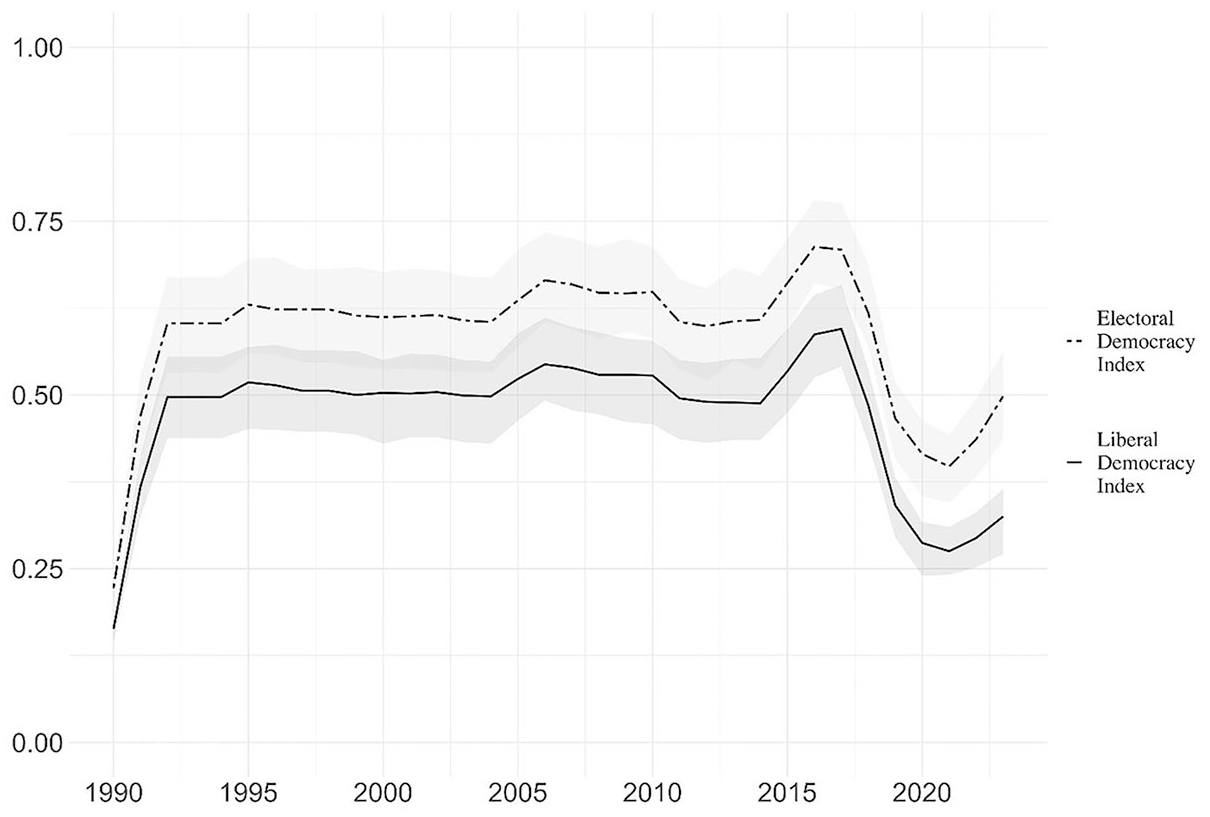
Benin’s Liberal and Electoral Democracy Index, 1990–2023
This democratic erosion happened while President Talon benefited from an enabling environment during his first term in office. After winning the presidency decisively in 2016, he claimed a popular mandate and benefited from initially high popular support and weak and disorganized opposition. There were no strong prior indications that President Talon would constrain democratic institutions, and many civil society and political actors, as well as the broader electorate, were caught off guard. The weakness of parties and institutions made elites incapable of stopping the incumbent from consolidating excessive power. After the restoration of multiparty elections in 1991, Beninese elites exhibited collusive behavior, shifting alliances to best suit their interests and remain close to power instead of taking principled stances. Thus, a precedent has been set for making politically expedient calculations across different branches of government, including the legislature and the judiciary. This history of elite collusion has numbed the electorate, leaving it distrustful of perpetually “recycled” political elites; it has further damaged the reputation of career politicians and hindered their ability to speak against excessive concentration of power in the executive.
Within this context, Talon managed to weaken, or almost eliminate, political competition, primarily through electoral reforms during his first term, which significantly raised barriers to running for office. Opposition figures were harassed and persecuted, or became subjects of politically motivated judicial proceedings, including through the new Court for the Repression of Economic and Terrorism Infractions. State institutions under the Talon administration have used a new digital law to increase scrutiny and restrictions on media outlets. Consequently, freedom of expression has greatly deteriorated. During this period, Beninese judicial institutions have lost some of their independence, notably as a result of Talon’s nominations and the political pressure he has placed on judges. These different strategies reflect Talon’s general penchant for centralization and concentration of power; he appears to view checks and balances as an obstacle to “managerial” development strategies and has willingly sacrificed them for the increased ability to act decisively. Before becoming president, Talon was a businessman, popularly known as the “king of cotton,” 2 and used his economic power to bankroll his campaign, fund his political supporters, and justify his approach to concentrating control with little horizontal accountability. With no prior experience in the legislature or any other state institutions, Talon expresses little appreciation for the country’s institutions.
Both the electoral reforms and harassment of opposition figures have resulted in noncompetitive elections with weak voter turnout. During the 2019 legislative elections, with only two parties allowed to compete, voter turnout plummeted to 23 percent, from 66 percent in the previous legislative election (Hirschel-Burns 2021), and the electoral contest itself was deemed neither free nor fair (Freedom House 2022). The 2021 presidential election, with significantly higher barriers to compete resulting in only two challengers, was marked by low turnout, with some polling stations seemingly empty and some voters describing the election as “electoral parody” (Vidjingninou 2021). Furthermore, the 2021 presidential election was marred by electoral irregularities, including intimidation and threats. Some polling stations, including in the former president’s hometown, failed to open (Vidjingninou 2021). Freedom House also reported that “serious irregularities during the 2021 presidential election undermined the democratic legitimacy of the incumbent” (Freedom House 2022).
In contrast, with better-organized opposition and greater international attention, the most recent legislative election of January 8, 2023, marked the return of opposition to political competition and to parliament, albeit in small numbers. The election was considerably better run, with seven parties allowed to compete. It is too early to say if this shift will reverse democratic decline in Benin, but it is a positive development. As further discussion will highlight, this more competitive election can be attributed to an important judicial decision that allowed opposition parties to contest the election. Opposition parties were also better prepared, better organized, and more consolidated, an important factor given the high barriers to entry imposed by President Talon’s reforms. Counterintuitively, the very reforms that a collusive legislature and judiciary enacted to weaken the opposition in the short term ended up galvanizing and uniting remaining opposition forces in later rounds of competition.
Processes of Democratic Backsliding
Democratic decline happened relatively quickly in Benin, in a span of a few years since 2016, though warning signs about democratic weakness were visible earlier (Banégas 2014). Complacent elites created an environment in which the incumbent president was able to “defang” any institution that could exercise accountability and constrain the executive. Elite collusion entails the incumbent and his allies working within, and exploiting, the legal framework to centralize power (Riedl et al. 2024). The weakness of institutions and of the elites allowed the passage of laws and reforms that dangerously undermined elections and the freedom of expression and assembly in Benin, thereby eroding its democracy. While some members of the legislative and judicial branches actively facilitated the president’s centralization of power, many political actors in Benin appear to have been caught off guard by the sudden change and were thus not prepared to stop the excessive concentration of power in the person of the president. The media, which have been mostly ineffective in preventing democratic erosion, have become a target of repression, and the judiciary and the legislature have been the principal institutions used by the president and conspiring allies to push through backsliding reforms.
The institutions with the greatest impact on the state of democracy in Benin are the courts, which for most of the period since 2016 have contributed to democratic backsliding. In several instances, they have approved controversial measures, such as reforms of the electoral system, elections without meaningful opposition, or the persecution of journalists. Most notably, during the 2019 presidential election, the courts allowed elections to proceed without true opposition. This ruling was ratified and validated by the Constitutional Court, the independence of which had been undermined when Talon appointed Joseph Djogbénou, his personal lawyer and friend, as its president.
Talon has used the court’s complicity to persecute his political opponents. Opposition figures have been harassed, often becoming subjects of politically motivated judicial proceedings. The most high-profile example is that of Reckya Madougou, a former minister who sought to challenge President Talon as a candidate in the 2021 election but ended up in jail on terrorism charges. Investigation into Madougou’s alleged wrongdoing was launched by the Court for the Repression of Economic and Terrorism Infractions (CRIET), a new court created during Talon’s first term. The case against Madougou is widely viewed as spurious and politically motivated; indeed, a judge on her case fled to France, decrying the charges as “phony” (Paquette 2021). The list of persecuted political rivals is much longer. Talon’s government has either jailed or forced into exile most viable rivals (Freedom House 2022), including both the second- and third-place finishers from the 2016 election, Lionel Zinsou and Sébastien Ajavon, respectively. Zinsou has been banned from campaigning for five years, and Ajavon fled to France after being sentenced by CRIET to 20 years in prison on drug charges (Paquette 2021). The African Court on Human and Peoples’ Rights later ruled in Ajavon’s case that Benin had violated its human rights obligations (Freedom House 2022).
Courts have also played a negative role in the democratic process by supporting the enforcement of laws that target journalists, most notably by using the newly created digital law to charge them with crimes of disinformation. In the high-profile case of Ignace Sossou, the journalist was charged and convicted of “harassment by means of electronic communications.” Sossou’s conviction was further supported by the appeals court in Cotonou in May 2020 and a couple months later by the Supreme Court, which concluded that Benin’s laws had been correctly applied. In this respect, the courts upheld and supported the use, and abuse, of repressive legislation passed by the National Assembly. Reporters Without Borders (known by the French acronym RSF) has issued a blistering critique of the ruling, calling it “an unprecedented setback for the freedom to inform in Benin” (Reporters Without Borders 2021) The Supreme Court ruling upholding Sossou’s conviction runs counter to the decision by the UN Working Group on Arbitrary Detention, which concluded that Sossou did not get a fair trial, that his conviction had no legal basis, and that his imprisonment was arbitrary. RSF has unsuccessfully urged the government to amend the digital law to avoid it being used to detain journalists arbitrarily.
The Beninese legislature has also been a site of democratic backsliding, and its complicity has also weakened the democratic space. While the Beninese parliament has been historically weak and Beninese parties are weakly institutionalized (Riedl 2014), in recent years the legislature has been dominated by pro-government forces and exercised few checks and balances. Seeking access to public and private resources controlled by Talon, elites colluding with the executive have created a dominant pro-executive majority in the legislature and allowed the government to push through reforms, such as those of the electoral code, that have further weakened opposition.
The most consequential backsliding institutional reforms have been changes made to Benin’s electoral laws, which were passed by the legislature and enacted in 2018 and 2019. A new charter for political parties has increased the minimum requirement of members attending the founding general assembly of a given party from 120 to 1,555 (Hassan 2023). This costly and onerous requirement effectively limits party formation. Electoral reforms also increased filing fees from CFA 15 million to CFA 250 million and increased the number of “sponsors”; in order to contest presidential election, candidates need endorsements of at least 19 parliamentarians or mayors. Because of the limitations to opposition participation in the 2019 legislative and 2020 local elections, parliamentarians and mayors belong overwhelmingly to the ruling coalition, thus making it difficult for opposition candidates to secure “sponsors.” Furthermore, failure to win 10 percent of the vote causes a party to lose its deposit. The effects of these reforms on political participation have been clear as only two parties participated in the 2019 legislative elections, down from around 150 in 2016. Only two candidates, apart from the president, managed to get on the ballot for the 2021 presidential election. The 10 percent threshold for parties to sit on municipal councils has reduced competitiveness, even at the local level. The impact of these reforms, which has been both dramatic and sudden, has limited the political space in a very short period of time.
Before the courts cemented the reforms that have contributed to democratic backsliding in Benin, the legislature had to pass them. In the 2019–2023 legislative sessions, there was no real opposition voice in parliament, allowing the government to pass laws with little contestation. The January 2023 legislative election brought opposition back into parliament, though in limited numbers. The main opposition party, the Democrats, holds 28 seats out of 109, while pro-Talon parties continue to have a supermajority. In the coming years, the presence of opposition, however limited, might at least create a possibility of more robust debate, even though the opposition will not have sufficient votes to block any legislation.
Beninese media have been unable to prevent democratic decline, and indeed the situation for Beninese journalists over the past few years has deteriorated. RSF notes a marked decline in press freedom in Benin; since 2016, Benin has fallen 43 places in RSF’s index of 180 countries, with the absolute score falling from 61.82 to 48.39. One of the limitations for the media is a lack of financial independence, which leads many media outlets to adopt a pro-government stance and avoid raising tough questions. Apart from their financial challenges, Beninese media have been constrained by the digital law, which has been used to intimidate journalists. Apart from Ignace Sossou, whose case is the best-known, at least two other journalists—Casimir Kpédjo and Aristide Hounkpèvi—have been arbitrarily detained and spent days in police custody for allegedly disseminating false information online (Reporters Without Borders 2021).
In some instances, media outlets have been ordered to close, seemingly in an effort to censor journalists. Benin’s media regulator, the High Authority for Broadcasting and Communication (HAAC), has ordered the immediate closure of all “unauthorized” online media outlets. Soleil FM, a radio station owned by government opponent Sébastien Adjavon, was forced to stop broadcasting when the HAAC refused to renew its license. (Its signal had previously been disconnected during the 2019 parliamentary elections.) The HAAC closed La Nouvelle Tribune, an opposition newspaper, in May 2018 on the grounds that it had insulted President Talon, and it closed four opposition media outlets in December 2016. Three of them resumed broadcasting, but one, Sikka TV, also owned by Adjavon, has been unable to resume broadcasting, despite a May 2017 court ruling ordering its reopening (Reporters Without Borders 2020).
Strategies of Resistance and Their Limitations
Although democratic erosion in Benin has not been reversed, it does appear to have been halted. While uncompetitive elections with little opposition participation have been one of the factors contributing to democratic backsliding, the January 2023 legislative election represents a step in the right direction, offering hope for greater accountability through the electoral process. After being largely prevented from competing in 2019 legislative elections, 2020 local elections (with the limited exceptions), and 2021 presidential elections, the opposition was able to compete in the 2023 legislative elections, resulting in a less pro-incumbent legislature and the potential of greater accountability. This positive development offers an opportunity to examine which strategies and arenas of contestation contributed to this very modest success and also to acknowledge the limitations of the existing strategies and the continued obstacles to democratic revival.
First, the Constitutional Court has regained some of its lost independence and played a more positive role in the lead-up to the 2023 legislative election. After the National Autonomous Electoral Commission (CENA) rejected the candidacies of the opposition party—the Democrats—the Constitutional Court sided with the opposition’s appeal and instructed CENA to accept their candidate list. To some extent, this decision reflected fluctuations in the positioning of the president’s strongest allies; the Constitutional Court made this important decision after its president, and Talon’s friend, Joseph Djogbénou, resigned to pursue a political career. The ensuing ruling was instrumental in restoring a sense of political competition in Benin since the Democrats are the strongest opposition party. Had they not been allowed to participate, there would have been very little opposition representation in parliament.
Second, better-coordinated opposition strategies have played an important role. The strongest opposition was fielded by a relatively new party, the Democrats, created in 2019 with the former President Yayi as its de facto leader. Campaigning across the country, Yayi drove up enthusiasm for the party. The Democrats won 28 seats out of 109 in the legislature, the strongest showing for Beninese opposition in several years. Counterintuitively, tough election laws introduced under Talon might have galvanized the opposition into creating a more structured coalition and cohesive strategy. The constitutional provision that requires any political party that does not participate in two consecutive elections to dissolve (Hassan 2023) virtually forced the opposition to compete. Despite concerns about the fairness of the electoral protest, it could not afford to boycott the election.
Following the January 2023 legislative election, the Democrats filed a complaint with the Constitutional Court concerning electoral irregularities, including ballot stuffing, political corruption, and vote counting, but they have asked their supporters for calm. The party has taken up its seats in parliament, where it can exercise some accountability and oversight, within limits, given that pro-Talon parties hold the majority. Party members have publicly stated that stopping, if not reversing, democratic decline is one of their top priorities. Eric Houndété, the party president, claims that the party has the goal to “restore” democracy. More specifically, he would like to see a revision of the electoral code and increased freedom of expression (Vidjingninou 2023). The Democrats are also pushing for an amnesty law to liberate political prisoners and allow those in exile to return to Benin. The party’s vice president, Eugène Azatassou, wants voters to get more involved and is working to convince them that if they turn out in higher numbers, it will be more difficult for the regime to cheat (Laplace 2023). The Democrats’ campaign narrative to restore democracy and prevent a further slide into authoritarianism has had mixed effects, and Azatassou admits that there is a lot more work to do to convince the electorate that his party is capable of revitalizing democracy. Although its power is clearly limited, the party is at least in a position to shape debate and draw attention to issues of democracy. But while the Democrats represent a more united—and therefore more capable—opposition, they have not united all the opposition forces and suffer from some credibility problems of their own; former President Yayi, the Democrats’ de facto leader, remains popular, but his previous attempt to run for a third term has harmed his democratic credentials.
Third, civil society organizations have spread prodemocracy messages even as they operate within a constrained environment that limits their effectiveness. Both public opinion and civil society messaging indicate that Beninese citizens are strongly attached to democracy, despite its challenges. Religious authorities issued early warnings about the 2023 legislative elections and demanded peaceful elections. In 2020, Catholic bishops issued formal statements unsuccessfully asking the government to abolish the sponsorship law, one of the electoral reforms crippling political competition ahead of the 2021 presidential election (Kahiu 2020). Civil society organizations are fighting against electoral corruption and educating voters about electoral laws and voting without undue pressure. Close to 200 organizations have deployed more than 700 election observers (Konrad Adenauer Stiftung 2023), and the Konrad Adenauer Foundation trained 30 journalists ahead of the April 2021 presidential election on how to cover the election and retain journalistic independence.
However, clear constraints on civil society remain in Benin and affect the degree to which civil society can act to protect the democratic space. Civil society actors are clearly not free to operate unencumbered as many activists were subjected to mass arrests during the 2021 presidential election (Freedom House 2022). During the 2019 legislative elections, police often used disproportionate force to disperse protesters (U.S. Department of State 2023). There is a general sentiment that civil society actors’ fear of government reprisals adversely affects their independence. Moreover, some civil society actors have aligned themselves with the government, either as a result of co-optation or coercion. And although the situation for civil society has clearly deteriorated under Talon, the limitations on civil society organization in the country have always been at issue; among the challenges are friction or lack of coordination between umbrella organizations and local branches, conflicts of interest, weak technical capacity, distrust, lack of transparency, and politicization and a potential lack of independence as NGOs are overseen by a ministry in charge of civil society. In addition, the organizations can struggle to sustain a constant level of engagement. While they have organized successfully at crucial moments in Benin’s history, most notably during the transition to democracy, they have not operated at that heightened level of mobilization consistently over time and require new causes or events to reenergize their networks.
Despite Benin’s dependence on foreign donors, foreign countries did not prevent democratic erosion during the rapid backsliding stages. President Talon’s reforms, which are at the root of the democratic decline, have received bad press both from regional bodies, such as the Economic Community of West African States (ECOWAS), and from Western countries, but this criticism has been insufficient, especially early in Talon’s term, to effect change. It is possible that the cumulative effect of years’ worth of criticism might be beginning to add pressure. Indeed, international attention to the January 2023 legislative elections was helpful in contributing to a better political climate, less intimidation, and higher-quality elections. After the election, the statement issued by the U.S., Swiss, Japanese, Canadian, and European Union ambassadors expressed relief that the election took place without violence or major problems and showed the heightened vigilance of foreign actors (Delegation of the European Union to Benin 2023).
The Beninese electorate also provides a mixed picture. Even though somewhat disillusioned, cynical, and mistrustful of politicians, the electorate expresses a great appetite for democracy and rejection of antidemocratic measures. For example, a large majority of the public expressed disapproval of President Talon’s electoral reforms (Afrobarometer 2018). Yet, many Beninese view the entire political class negatively and seem skeptical that the opposition, led by figures who have been in politics for many years, will bring positive changes. Elite collusion and the successive switching of politicians from one presidential coalition to another following each transition has contributed to this sentiment. The continued low turnout in 2023 is one manifestation of this disillusionment. Positive messaging from civil society around the 2023 elections might have contributed to a higher turnout than in 2019, but even though 10 percentage points higher, it was still very low at 38.7 percent—especially when compared to the high levels of turnout (above 50 percent) in the founding elections of the 1990s. Civil society groups have not managed to galvanize the voting public to challenge the ruling party’s grip on power.
Conclusion
The steep democratic decline that occurred in Benin starting in 2016 can be attributed largely to reforms initiated by President Talon; these reforms, which weakened political competition and freedom of expression, resulted in a parliament dominated by pro-government forces that further limited the opposition’s ability to counterbalance those in power. These reforms happened within the context of elite collusion, with key political actors complacent, complicit, or otherwise unable to stop the president’s antidemocratic measures. Beninese courts have been to a large degree complicit in this process by allowing controversial reforms, passed by the pro-Talon supermajority in the legislature and designed to enable politically based attacks on individuals, including journalists and opposition candidates. Benin’s press and civil society, while diverse and varied, have been unable to effectively prevent democratic decline. Their weak resource base contributes to their lack of autonomy and undermines their ability to hold the government accountable and express criticism freely. While some opposition in the legislature provides limited hope that further democratic decline can be prevented, the concentration of power in the executive facilitated by elite collusion means that Benin’s democratic accountability continues to suffer.
Footnotes
NOTE: The author would like to thank Jean-Baptiste Hounkpe for valuable research assistance.
Notes
Dominika Koter is an associate professor of political science at Colgate University. She is the author of Beyond Ethnic Politics in Africa (Cambridge University Press 2016), as well as several articles on electoral competition, ethnic politics, and nationalism in Africa.