







Abstract
We examine how Malawi’s presidents have attempted to undermine the nation’s democracy between 2000 and 2022, analyzing the ways in which key institutions and actors have resisted executive overreach and power grabs. After a long history of authoritarian rule, Malawi’s 1994 constitution envisioned a robust separation of powers, yet power remains concentrated in the presidency. Presidents have repeatedly attempted to consolidate power but have been rebuffed at crucial moments. Presidents have attempted to constrain political opposition through personalist ties, the bureaucracy, control over executive appointments, regulation, and coercion. But the courts and civil society have been key actors in countering executive overreach, exemplified by the Constitutional Court’s annulment of the 2019 presidential election. Despite recent legal reforms, Malawi’s parliament, opposition parties, and other political institutions still struggle to check the executive.
Keywords
The democratic history of Malawi has been dynamic, with episodes of erosion and resilience. Malawi’s experiences with democratic backsliding after democratization in 1994 proceeded along an institutional pathway, primarily through executive power grabs. While most Malawian presidents since 1994 have tried to encroach into the democratic space and centralize power, the Malawi case suggests that even for a relatively new and emerging democracy, equally influential forces can stand up to defend the democratic order. In this article, we highlight the attempts to erode Malawi’s democracy and the contributions of the actors who have defended democracy between 2000 and 2022.
Freedom House, which scores countries’ political rights and civil liberties, ranked Malawi “free” for five years following the reintroduction of multiparty competition, and “partly free” thereafter. The Varieties of Democracy (V-Dem) project’s liberal democracy index paints a similarly stable picture of Malawi over the 2000–2022 period with a recent uptick in 2020 (see Figure 1 [Coppedge et al. 2024]), as does the Ibrahim Index of Africa Governance. These indices obscure the multiple attempts that have threatened Malawi’s democratic experiment. For example, after initially coming to power as a champion of democracy in 1994, Bakili Muluzi (1994–2004) sought to centralize power in the executive during his second term as president. Muluzi and his party, the United Democratic Front (UDF), introduced constitutional amendments that empowered the president to appoint a second vice president, impeached three high court judges without affording them an opportunity to be heard, and proposed allowing the president to appoint 20 members of Parliament (Dulani and van Donge 2005). Muluzi tried but failed in 2002–2003 to amend the constitution to seek a third term in office, as he lacked sufficient parliamentary support and cohesion among elites; a galvanized civil society also protested attempts to change the constitution (Dulani 2011). Muluzi’s hand-picked successor Bingu wa Mutharika (2004–2012) repeatedly sought to consolidate executive power before he died in office in 2012 (Cammack 2012; Dionne and Dulani 2013; VonDoepp 2012; Wroe 2012). The apex of Mutharika’s autocratization attempt was the violent repression of anti-government protests in July 2011, in which at least 19 protesters were killed and scores more were injured (Wroe 2012). Despite these clear autocratic efforts in 2002 and 2011, we see no downward trend in V-Dem’s measure of liberal democracy in Malawi.
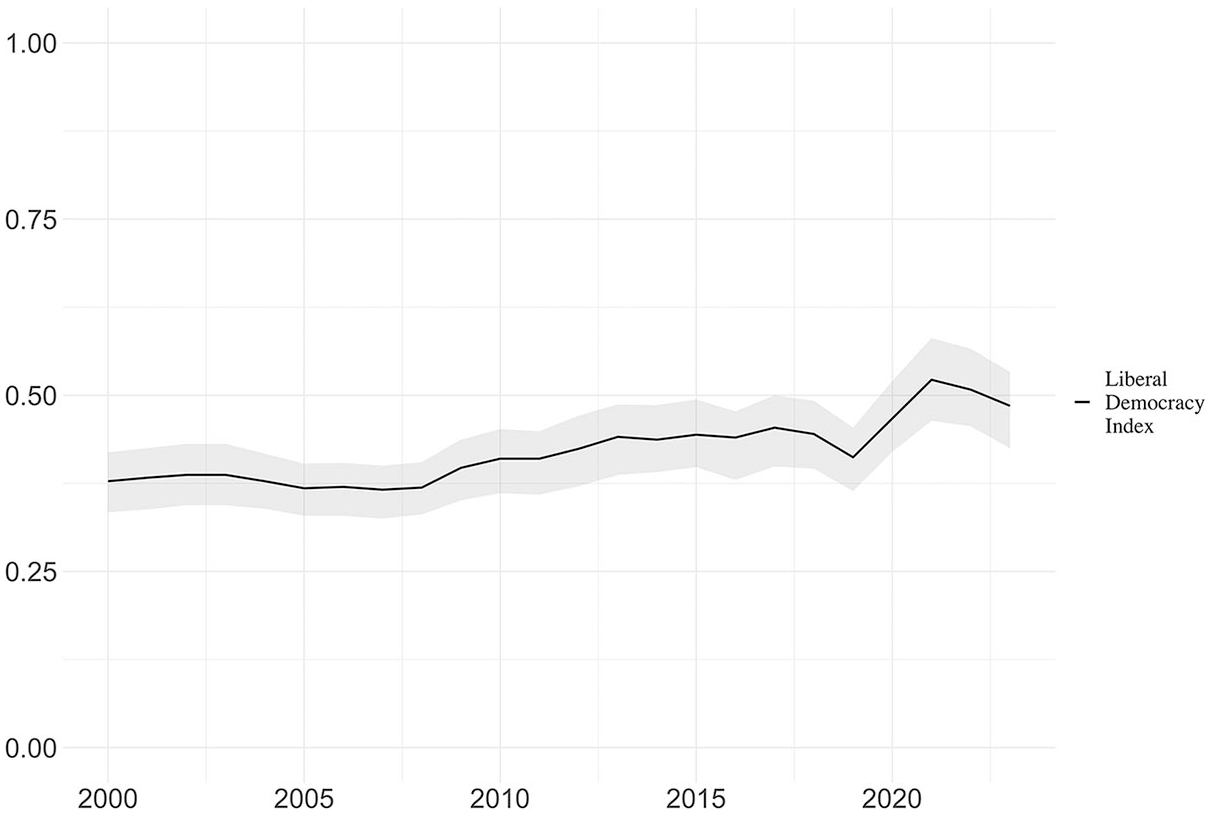
Malawi’s V-Dem Liberal Democracy Index, 2000–2023
The key actors resisting democratic backsliding have been the courts and civil society, which together have stopped powerful Malawian presidents from entrenching their power and extraconstitutionally extending their tenure (VonDoepp 2020; Dionne 2024). Malawi’s military, mainstream religious groups, media, and legislature have also played important, but limited, roles during periods of political crisis. A primary condition favoring resistance, unfortunately, is a poor economy. Civil society engagement and court independence seem strongest when presidents are unpopular (VonDoepp 2005)—which is more likely during poor economic conditions. The remainder of this article examines Malawi’s experience with democratic backsliding and resistance in different arenas of political contestation: institutions, elections, and civil society and contentious politics.
Institutional Pathways to Backsliding and Institutional Resilience
Malawi’s 1994 constitution envisioned a robust separation of powers, yet significant power continues to reside in the presidency. And it is the presidency, in fact, that poses the greatest challenge to Malawi’s democracy. The presidency is aptly characterized by Svåsand (2014) as “by far the most important political institution upon which party leaders or ambitious politicians have their eyes.” This is a legacy of the authoritarian era when Malawi’s first president Hastings Kamuzu Banda (1964–1994) ruled with an iron fist, running the country as his personal estate (Hodder-Williams 1973). Malawi’s politics are driven by the centralized power of the executive and the leadership fixation of (weak) political parties (Rakner et al. 2007; Resnick 2013). A recent historic court ruling indicated a new legal interpretation of the constitution as requiring a majority rather than a simple plurality to win the presidency—a change that may initiate some shift toward greater inter-institutional balance (Dionne and Dulani 2020; Kainja 2020). The first presidential elections held following the court ruling showed parties more willing to form pre-electoral coalitions, but no meaningful implications for party strength are yet apparent. The new majority requirement, combined with a 2018 law regulating political parties, could facilitate consolidation in Malawi. The 2018 law requires deregistration of parties that do not hold a convention within five years and fail to win one parliamentary seat, win at least two local government seats, or garner 5 percent of national parliamentary votes. 1 While the new majority rule encourages pre-electoral coalitions, it risks deregistering small parties that may not meet the law’s requirements.
Malawi’s parliament has limited power to check the presidency, as it lacks control over the budget and agenda (Svåsand 2011; Patel 2016). This notwithstanding, Malawi’s legislature has occasionally challenged the president, most notably in 2002, when Parliament rejected Bakili Muluzi’s proposal to remove presidential term limits from the constitution (Dulani and van Donge 2005). A similar standoff between Parliament and the executive occurred during Bingu wa Mutharika’s first term, after he defected from the party that had sponsored his 2004 campaign. His defection from the UDF and creation of a new party left him with only six MPs (out of 193). The legislature attempted to check his power through battles over legislative rules, an impeachment plot, and a budget standoff. Buoyed by favorable food security and economic conditions, Mutharika managed to keep the upper hand against a parliament the public viewed as dysfunctional (Chinsinga 2009). At multiple times, legislators have been used by the president. For example, when presidents want parliamentary support of controversial bills, they inflate their cabinets with coopted MPs (Chinsinga 2009; Patel 2016).
Malawi’s bureaucracy has not challenged authoritarian tendencies nor pushed for democratic reforms. Political favoritism and nepotism dominate in recruitment to civil service jobs, with presidentially appointed ministers directing top-level civil servants to favor their relatives and friends in hiring for ministry positions (Dzimbiri 2016). Additionally, despite the formal articulation of “fiscal decentralization,” Malawi’s central government retains substantial control over spending on local-level development and capital investments; legislators control both local development funds and constituency development funds, both of which they use to finance pet projects in return for electoral support (Chiweza 2016). Thus, the bureaucracy can serve as an easy channel through which the executive can usurp power—and even bypass other institutions of horizontal accountability—through the control over funding and appointments.
Subnational institutions have done little to constrain executive power. Although local government elections are constitutionally required, Bingu wa Mutharika’s administration suspended local government elections in 2005. He claimed the need to reduce government expenditures (Chiweza et al. 2021) but more likely feared that his newly formed Democratic Progressive Party (DPP) would perform poorly (Chinsinga 2009). Thus, during the period that followed, district-level decisions were driven by district commissioners appointed by the president. Following the reintroduction of local elections in 2014, Malawi’s government launched decentralization initiatives supported by international donors to build capacity for service delivery though local governments. Those efforts have not yet proven fruitful and may be repeating earlier, failed decentralization initiatives (Dionne 2021; Chinsinga 2008). Because there has been no meaningful devolution, especially because of insufficient revenue generation at the local level, district councils remain dependent on central government transfers. Chiweza (2016) characterizes Malawi’s district councils as empty shells lacking substantive decision-making powers to drive effective service delivery. Traditional leaders hold significant power locally, especially in rural Malawi; for more than two decades, Afrobarometer surveys 2 have shown that most Malawians have “a lot” of trust in traditional leaders. During Bingu wa Mutharika’s presidency, he increased traditional leaders’ remuneration and, in return, tasked them with promoting the government’s development agenda (Svåsand 2011). Mutharika revered chiefs and elevated many to higher ranks, relying on them for support later (Cammack 2017). Subsequent presidents—Joyce Banda (2012–2014), Peter Mutharika (2014–2020), and Lazarus Chakwera (2020–present)—have followed suit, elevating chiefs and thus entrenching their powers as custodians of customary lands (Power 2020).
Enforcement agencies like the police and Malawi’s Anti-Corruption Bureau (ACB) have had little impact in challenging executive power. Rather, Malawi’s police often serve as a tool of presidents and ruling parties, thus continuing their legacy of suppressing freedoms during pre-1994 authoritarian rule (Chunga and Manthalu 2022). As they clamp down on the opposition, the police are seen as being aligned with the ruling party and shrinking the democratic space (Svåsand 2011). Trust in police is low, with many Malawians perceiving them as corrupt (Chunga and Manthalu 2022). As for the ACB, it has had limited impact in curtailing corruption or holding senior politicians accountable, not least because of inadequate funding and politicized appointments (Dulani 2019; Cammack 2009). Vice President Saulos Chilima’s arrest in November 2022 for alleged bribery raised hopes for stronger ACB engagement. His arrest followed the arrests of other senior administration officials, including three ministers and a close presidential aide. To be sure, elites are politicizing the ACB’s actions: The Bureau’s Director General, Martha Chizuma, is demonized by some and lionized by others, and her assertiveness led to her politically motivated arrest (Africa Confidential 2023). Amid popular calls for accountability after corruption scandals, donors and the judiciary—key agents in resisting autocratization in Malawi—backed Chizuma’s work at the ACB (Chunga and Nedi 2022; Africa Confidential 2023).
Among the institutions resisting autocratization in Malawi, the courts have been particularly important in constraining executive power. Malawi’s judiciary is noted for its relative independence, and courts have ruled against sitting incumbents, especially when public opinion is supportive (VonDoepp 2006; Dionne and Dulani 2013; Dionne 2024). The judiciary played an important role in the 2012 transition following the president’s death in office and have generally been reliable in seeking to uphold the rule of law, even if their rulings are sometimes ignored (Dionne and Dulani 2013; Svåsand 2014). Kanyongolo (2009) likens Malawi’s courts to safety valves for losing candidates to seek arbitration rather than expressing grievances through violence or other extrajudicial means. The High Court decision to nullify the 2019 presidential election on account of serious irregularities and the Supreme Court of Appeal’s affirmation of the High Court’s decision are recent illustrations of how Malawi’s judiciary has served as a democratic safety valve (Nkhata et al. 2021; Dionne 2024).
In addition, Malawi’s military has played a limited but important role in constraining authoritarianism at critical moments (Nundwe et al. 2023). During the democratic transition in the early 1990s, the Malawi Defence Force (MDF) disarmed the Malawi Young Pioneers, a paramilitary wing of Kamuzu Banda’s Malawi Congress Party, limiting his ability to suppress prodemocracy groups (Chirambo 2004). The MDF also safeguarded democracy after Bingu wa Mutharika’s death in 2012 during the succession battle between Vice President Joyce Banda, the constitutional successor, and Foreign Affairs Minister Peter Mutharika, the late president’s brother (Dionne and Dulani 2013). Both the Banda and Mutharika camps reached out to the MDF commander, General Henry Odillo, to get the army’s support (Nundwe et al. 2023). By pledging his and the army’s loyalty to Banda, Odillo effectively shifted the balance of power from Mutharika to Banda, who was inaugurated shortly thereafter. By refraining from asserting power beyond its mandate and supporting civilian rule, Malawi’s military enjoys high public trust. After the disputed 2019 elections, the MDF upheld Malawians’ right to protest, ignoring President Mutharika’s orders to shoot at protesters and instead deploying soldiers for security during demonstrations (Nundwe et al. 2023).
Elections
Elections serve a vital role for democratization—and also for autocratization. For example, incumbents uncertain about their reelection chances may attempt to change the rules to stay in office (Rakner 2021). Even so, only one Malawian president—Muluzi in 2002—has attempted to remove term limits. When his efforts failed, he persisted in vying for power by handpicking a successor he thought he could control from behind the scenes (which he could not).
Malawi has also had an apparently successful record of presidential transitions. Three incumbent presidents have lost elections—Kamuzu Banda in 1994, Joyce Banda in 2014, and Peter Mutharika in 2020—and all three transitions were peaceful. Nonetheless, the extraconstitutional maneuvers during the Muluzi and Bingu wa Mutharika presidencies tested the democratic commitment of some of Malawi’s ruling elites and suggest they may have a latent appetite for autocratization. For example, the president and the ruling parties routinely use upcoming elections to consolidate power by monopolizing media coverage and courting contributions from government agencies for campaign funds (Dulani 2019).
Afrobarometer surveys consistently show strong public opposition to autocratic modes of government among Malawians. In Afrobarometer’s 2022 survey, for example, 87 percent of Malawians were opposed to one-man dictatorship; a further 75 percent expressed opposition to military rule while 69 percent said they were against one-party rule (Chunga and Tsoka 2022).
The Malawi Electoral Commission (MEC) administers Malawi’s elections, and while the MEC is technically independent, presidents can wield significant influence on its work. Political parties that secure at least one-tenth of the national parliamentary vote nominate MEC commissioners, but it is the president who ultimately appoints them. 3 Bingu wa Mutharika delayed making appointments to the MEC, postponed local elections, and then subverted the norms of aligning MEC appointments to party representation in Parliament—all to minimize disadvantages to his newly created political party (Rakner 2009). Additionally, delays in recruitment and hiring—a typical occurrence in Malawi’s civil service—compromised its capacity to carry out its duties (Duncan 2009).
During election campaigns, presidential contenders regularly pledge to change the status quo by trimming presidential powers but, once in office, rarely follow through (Meki 2022). Reflecting a carryover from the authoritarian era under the life presidency of Kamuzu Banda, Malawi’s politics is largely personalized, with an unstable and fragmented party system as politicians regularly defect to form new parties (Svåsand 2014).
In many democracies, effective electoral resistance against authoritarianism often relies on the strength of the opposition parties. In Malawi, however, democratization produced “more but not better political parties,” with parties serving as vehicles for accessing state power rather than advancing ideological goals (Chinsinga 2009). Because elites join parties based on loyalty to the founder rather than ideology (Cammack 2009), parties are fractured and lack internal mechanisms of democracy (Svåsand 2011). Parties like the DPP and People’s Party were “top-down” creations of a president and vice president, respectively, initially without local structures (Svåsand 2014). Today, only the DPP remains viable, but its future is uncertain under its aging leader, Peter Mutharika, the late founder’s brother. In these highly personalized parties, power is centralized. For instance, when the DPP was in power, President Peter Mutharika was the sole signatory for the its bank account (Dulani 2019). This centralization fuels uncertainty, and the lack of credible, institutionalized mechanisms for succession encourages “never-ending” internal squabbles (Chinsinga 2009). In sum, Malawi’s political parties, themselves subject to personalized rule, both reflect and contribute to the concentration of power in the executive. Thus, it should come as no surprise that public opinion surveys show that the parties are irrelevant for ordinary citizens (Chunga 2014).
Civil Society and Contentious Politics Challenge Malawi’s Presidents
The legacy of Malawi’s prodemocracy movements provided a mobilizing structure for contemporary civil society, and civil society’s relative autonomy has been key to the country’s resilience to autocratization (Rakner 2021). Since Malawian civil society organizations’ (CSOs’) fight for democracy in the early 1990s, they have taken it as their duty to defend the democratic order, especially when facing threats (Dulani 2009, 2011). Examples include CSOs advocating against Bakili Muluzi’s quest for a third term between 2001 and 2004, their resistance to Bingu wa Mutharika’s authoritarianism between 2009 and 2012, and their protests against electoral manipulation by the DPP government in 2019 (Dionne 2024). Even when civil society leaders have been susceptible to threats and cooptation, their capacity to call for mass protests—as they did when facing poor economic and political governance in 2011—is a powerful check on presidential power (Wroe 2012; Dionne 2024). Such popular resistance can trigger a broader challenge to government (VonDoepp 2020). However, the capacity of Malawian CSOs to safeguard the democratic space is threatened by challenges related to funding and governmental cooptation (USAID 2022).
Centrally important in the civil society arena are Malawi’s churches and faith leaders. Religious leaders hold the public’s trust, especially when compared to elected officials. More than half of the Malawians surveyed by Afrobarometer in 2022 reported putting “a lot” of trust in religious leaders. This compares to the 13 percent who reported having a lot of trust in the president, 15 percent who had a lot of trust in Parliament, and 37 percent who reported having a lot of trust in traditional leaders (Chunga and Tsoka 2022). Malawi’s churches and religious leaders played a critical role in the transition away from Kamuzu Banda’s autocratic rule in the early 1990s and since then have regarded themselves as custodians of democracy (Ross 2004).
The Malawian media has also constrained executive power, largely through its watchdog role. During Muluzi’s 2002 bid to remove presidential term limits from the constitution, constant media coverage helped keep the issue salient among the public (Manda 2007). The media has time and again broken news about government corruption scandals—the most notable being Cashgate, which broke in 2013 and ultimately kept Joyce Banda from being returned to office in the 2014 elections. Likewise, the media provided evidence connecting President Peter Mutharika to fund withdrawals from an account supported by a Malawian company with a government contract to supply the Malawi Police Services (Dulani 2019). Investigative journalists have played a major role in exposing corruption in the current Lazarus Chakwera administration. The Platform for Investigative Journalism, an online media house, exposed corruption involving bribes paid to senior officials in the Chakwera administration in exchange for government contracts.
Of course, there are important limits to the media’s power. Kainja (2022) clarifies that media freedoms in Malawi are largely de jure, not de facto. Some were not codified until 2020, and some laws even restrict media freedom. Malawi’s political economy makes media less of a public priority and challenges journalists’ capacity to be unbiased reporters. Several major media houses—notably the Times Group and Nation Newspapers, which publish Malawi’s only two daily papers—are owned by politically connected families, which sometimes limits their ability to play a full oversight role (Gunde 2016). Furthermore, the government has significant influence on the media through its power as the country’s major advertiser in daily newspapers and on electronic media platforms (Kainja 2022).
State influence on the media is also a concern, particularly during election campaigns. Elections consistently reveal differences in de jure and de facto media regulations: While the state-run Malawi Broadcasting Corporation is legally required to maintain neutrality in campaign reporting, observer reports indicate that, except in the 1994 elections, the Malawi Broadcasting Corporation has not provided a level playing field (Svåsand 2014). However, independent media stations have provided balanced coverage, and some stations have increased transmitter coverage to extend the independent media’s reach to rural Malawians (Chiyamwaka 2009). While private media are gaining share in media consumption, the public broadcaster remains the primary news source for most Malawians due to its national footprint. Most Malawians (70 percent) get their news from the radio at least a few times a month. Championed for its potential to level the playing field, social media has not yet displaced traditional media in controlling information flows and content in Malawi. A majority (73 percent) of Malawians report never getting their news on social media, but social media usage has been increasing over time; only 3 percent reported daily use of social media to access news in 2014, but 12 percent reported doing so in 2022 (Chunga and Tsoka 2014, 2022).
Malawi’s universities have long been sites of opposition to authoritarianism. Students and faculty from the University of Malawi Zomba and Blantyre campuses, for example, were at the forefront of agitating for multiparty democratic politics in the early 1990s (van Donge 1995). In subsequent years, university students and faculty have been key players in safeguarding democracy, most notably when University of Malawi students joined CSOs to protest against Bakili Muluzi’s attempts to remove presidential term limits (Gondwe 2010). Meanwhile, threats to academic freedom by the Bingu wa Mutharika government led to protests at the Zomba campus of the University of Malawi and inspired broader, nationwide protest actions in July 2011 (Cammack 2012).
What does contentious politics and support for democracy look like at the individual level? Public support for democracy has fluctuated over the years but has never been eclipsed by a preference for nondemocratic rule in the two decades that Afrobarometer has collected survey data in Malawi (see Figure 2). The strong public support for democracy serves as an additional barrier to political leaders’ seeking to erode Malawi’s democratic attributes. It is no wonder that, time and time again, Malawians have proven willing to stand up and protest the more egregious attempts of its country’s leaders to undermine democracy (Dionne and Dulani 2013).
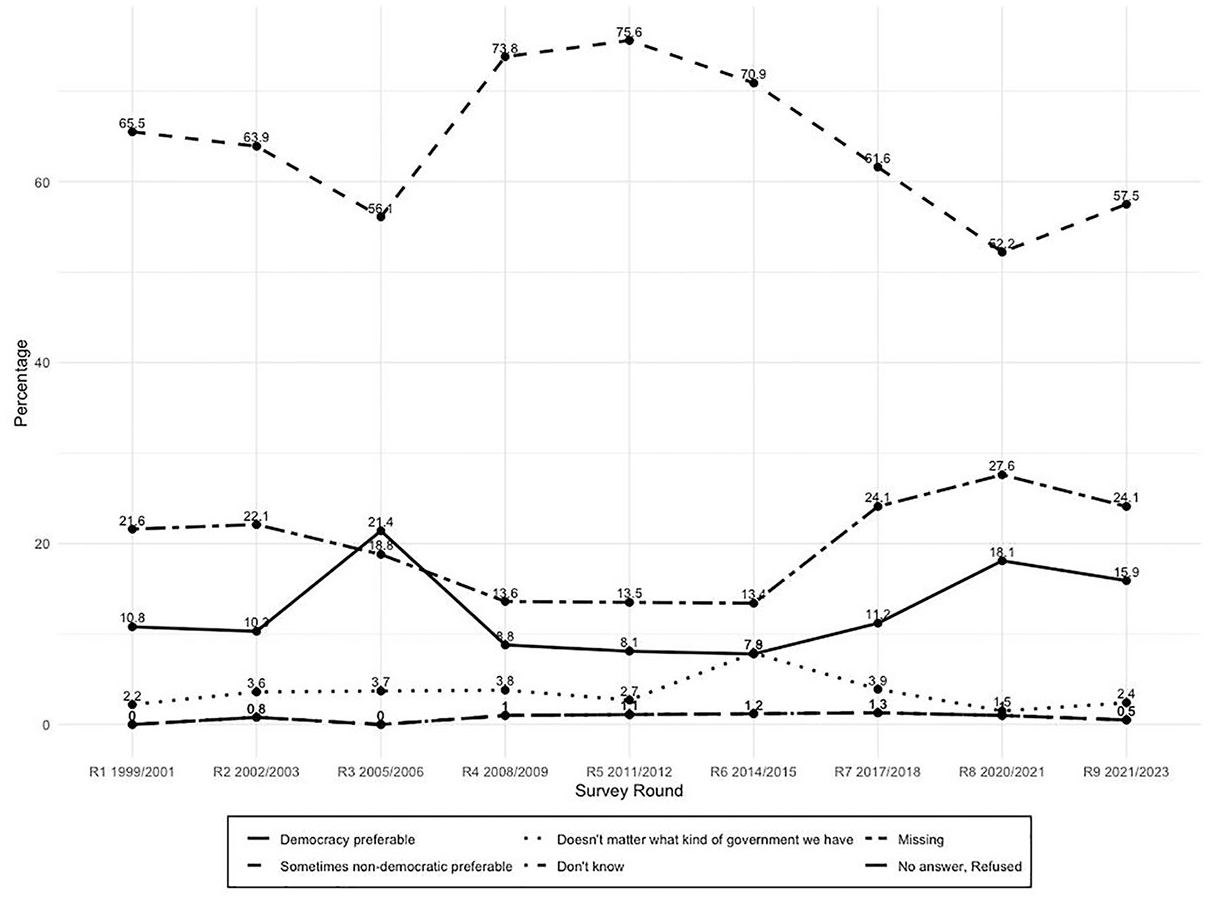
Support for Democracy in Malawi, 1999–2023
Conclusion
We have shown how incumbent presidents, aided by supporting casts of political party activists, have sought to undermine the legal provisions that are in place to safeguard Malawi’s democracy. We highlighted the key actors defending Malawi’s democracy, including civil society, the judiciary, the media, and the military. They defended democracy during periods of economic hardship and presidential unpopularity. Resistant courts and civil society, even if not working together, may both be necessary for Malawi’s continued resilience against autocratization. Malawi’s courts may still act independently without civil society’s engagement, but recent history shows no such cases. It remains unclear if these actors and conditions can lead to further democratic consolidation.
Absent in our analysis is meaningful engagement about the role of external actors in threatening or safeguarding Malawi’s democracy. Malawi is heavily dependent on foreign aid. Development assistance is so important to Malawi that aid withdrawal and suspensions interrupt service delivery and weaken the government’s ability to provide for citizens (Dionne and Dulani 2013; Svåsand 2011; Banik and Chasukwa 2016). Dependence on the international community for aid—especially governance aid designed to strengthen parties and the party system—can constrain domestic political actors (Svåsand 2011). International donors are thus important veto players that help limit democratic reversal—although the threat of losing aid and its actual loss have not always prevented Malawian presidents from attempting to undermine democratic institutions (Dulani 2016). Nevertheless, key institutions for democratic consolidation have been supported by the international community, with funds directed toward election administration, the construction of a new parliament building, and civil society (Resnick 2013; Svåsand 2011). Donors’ influence in checking Malawi’s presidents, however, depends at least in part on general economic conditions; under poor economic conditions, donors have more leverage (Resnick 2013; VonDoepp 2020). Malawian leaders have also proven adept at playing the donor game; when one door closes, they have somehow found a way to other options (Chasukwa et al. 2014). For example, when Bakili Muluzi faced withdrawal of donor aid due to his bid for a third term, he courted new donors from the Middle East. Similarly, when Bingu wa Mutharika fell out with Western donors over his increasing authoritarianism, he turned to China. The influence of international aid, therefore, depends on where it is directed: While it can go toward protecting institutions and actors and even bolstering democracy, it can also help incumbents usurp and consolidate power.
Footnotes

Notes