







Abstract
Guatemala is a case study in democratic backsliding led not by an aggrandized executive, but by a coalition of elites who collude to maximize and protect their collective power. Beginning in the mid-2010s, a decentralized but deeply entrenched network of elites dismantled democracy when anticorruption efforts threatened their common interests. The 2023 election was widely expected to consolidate this authoritarian turn but, instead, delivered an unexpected democratic resurgence when a moderate anticorruption reformer secured a shocking victory and then successfully resisted a “slow-motion coup” aimed at preventing the transfer of power. The Guatemalan case suggests that, under elite collusion, elites can be more prone to splits and strategic errors than in other authoritarian settings. These missteps provide unexpected opportunities to reverse backsliding, but democrats must be prepared to capitalize on regime errors and repel authoritarian counteroffensives by building broad coalitions that work simultaneously across multiple arenas of democratic contestation.
Guatemala illustrates an important but understudied pathway to democratic backsliding: elite collusion. Under elite collusion, no single ruler or party leads the backsliding process. Instead, a diverse coalition of elites conspires to capture state institutions, exclude or co-opt rivals, and entrench its collective power. Crucially, unlike in other democratic backsliding pathways, the collective nature of elite collusion “serves as a potential constraint on any single autocratic ruler” (Riedl, Friesen, et al. 2024, 14). Elites work together to expand and retain their collective power, but power tends to remain decentralized within the elite coalition. In addition to Guatemala, Riedl, McCoy, et al. (this volume) identify Benin, Indonesia, and Nicaragua as cases of backsliding by elite collusion. 1
In Guatemala, a decentralized but deeply entrenched network of political, economic, and military elites colluded to undermine democracy beginning around 2017 (see Figure 1). When their shared vital interests were threatened by a sweeping, internationally backed anticorruption effort, elites responded by capturing key judicial institutions, including the courts, the electoral authority, and the public prosecutor’s office. With the support of presidents Jimmy Morales (2016–2020) and Alejandro Giammattei (2020–2024), the authoritarian coalition used these institutions to protect its impunity, criminalize anticorruption prosecutors and activists, crack down on civil liberties, co-opt politicians, and exclude unwanted candidates from elections. The result was an authoritarian regime “forged and buttressed” not by a personalistic leader, a powerful party, or a politicized military, but rather by “a ghost alliance of . . . actors that work[ed] behind the scenes” to protect their common vital interests (Sanchez-Sibony 2023, 358–359).
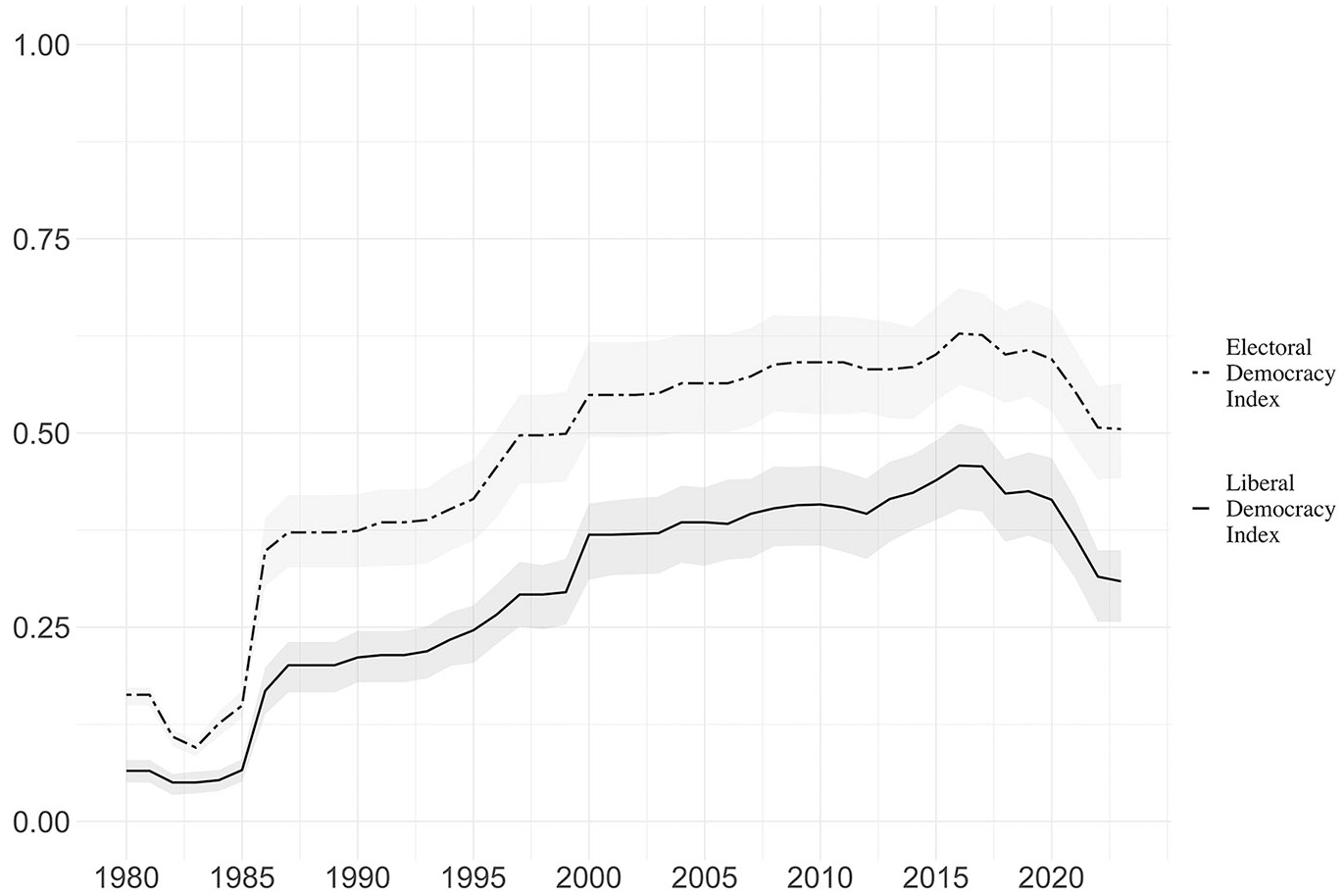
V-Dem Electoral and Liberal Democracy Indices for Guatemala, 1980–2023
But if Guatemala exemplifies democratic backsliding by elite collusion, it also provides a particularly instructive case of (partial) democratic recovery. In 2023, little-known anticorruption reformer Bernardo Arévalo won the presidency—and did so despite persistent and increasingly radical efforts by the authoritarian coalition to “consolidate authoritarianism through electoral means” (Schwartz 2024a, 327). Arévalo’s victory triggered an authoritarian counteroffensive to interrupt the transfer of power (Schwartz and Isaacs 2023, 27–28), but democrats prevailed by building a broad coalition that mobilized across all available arenas of contestation.
In this article, we describe the process of democratic backsliding and tentative recovery in Guatemala. 2 We highlight two sets of lessons about backsliding—and opportunities for democratic resistance—under elite collusion.
The first set of lessons concerns the nature of elite collusion. Elite cohesion—the extent to which regime elites (1) are able to coordinate around common goals and (2) are willing to “stick with the regime” even during moments of crisis—is critical for the durability of authoritarian regimes (Brownlee 2007; Geddes 1999; Levitsky and Way 2010, 2022; O’Donnell and Schmitter 1986; Slater 2010). But under elite collusion, regime elites often lack access to a strong ruling party, a dominant leader, a shared ideology, or other traditional sources of authoritarian cohesion. Instead, colluding elites draw much of their cohesion from informal norms and a common interest in co-opting the state for personal gain—comparatively weak sources of cohesion that can lead to internal factionalism and competition.
This scenario has two crucial implications. First, under elite collusion, authoritarian elites are more prone to strategic errors and miscalculations—and authoritarian mistakes often provide crucial opportunities for (re)democratization (Treisman 2020). In Guatemala, for example, elites left themselves vulnerable to a surprise defeat by splitting their resources among too many electoral vehicles and by failing to address important flaws in their strategy to sideline antiregime candidates. Second, exogenous threats, and in particular international forces, can have an outsized impact on elite cohesion—and, by extension, on the trajectory of elite collusion. When outside pressures help align the incentives of colluding elites, they can trigger or exacerbate democratic backsliding. But when they instead cause division within the elite coalition, international forces help to slow or even reverse democratic backsliding. Thus, as we describe below, international efforts to strengthen democracy in Guatemala have, at different times, provided either an impetus for backsliding or a crucial line of defense against authoritarian power grabs.
The second set of lessons concerns how democratic actors can counter backsliding by elite collusion. The Guatemalan experience suggests that democratic oppositions in these contexts should pursue multidimensional resistance strategies that take advantage of any and all arenas of contestation that remain open—even when those arenas are dominated by authoritarian elites and the odds of success appear vanishingly small. Because, under elite collusion, authoritarian coalitions are prone to unforeseen errors and sudden divisions, opportunities for democratic reopening can materialize quickly and unexpectedly. Democratic actors must be prepared to take advantage of those opportunities and to resist authoritarian counteroffensives. In Guatemala, the democratic movement succeeded because it drew on electoral, institutional, and contentious strategies simultaneously, along with strong international support.
Background: Democratization and Impunity
Guatemala experienced two major transformations in the 1980s and 1990s. In 1985, democratic elections marked the return of elected civilian rule for the first time since the 1950s. And, in 1996, a landmark peace agreement brought an end to the country’s bloody, decades-long civil war.
Corruption posed a central challenge for Guatemala’s nascent democracy (Schwartz 2023). Three decades of authoritarianism, military rule, and civil war had given rise to a sprawling system of corruption in which military officers, business elites, and corrupt officials colluded to plunder the state and enhance their private wealth. These elites soon discovered that they could adapt, evolve, and continue to thrive under democracy. The rule of law remained weak—and institutions like courts and law enforcement agencies easy to capture (Schwartz 2021, 2023). Moreover, from their privileged position, elites could easily win elections (or co-opt those who did) to preserve direct access to the state and all its perks. Thus, despite democratization, Guatemalan politics continued to be dominated by a loose coalition of entrenched elites. As Sanchez-Sibony (2023, 358) notes, over time this coalition evolved to include elected officials at all levels of government; business elites, business associations, and other (licit and illicit) business interests; bureaucrats, judges, and prosecutors; many active and retired members of the military; and evangelical leaders.
From the outset, this elite coalition was characterized by a distinctive mix of internal cohesion and competition. On the one hand, the elite coalition drew significant cohesion from its members’ shared interest in looting the state for personal enrichment. The pursuit of this common objective fostered coordination among elites because it required actors from various realms—including multiple levels of the state, the private sector, and, in some cases, drug-trafficking groups and other criminal organizations—to collude in order to successfully extract rents and circumvent the rule of law. Looting the state bound the elite coalition together, and its members often mobilized to protect their shared impunity.
On the other hand, there was significant competition among elite factions, particularly in the electoral arena. Guatemala’s party system was born (and remains) weak, fragmented, and volatile (Navia et al. 2022). This fragmentation had two important consequences. First, because leftist and reformist parties were chronically weak and inchoate, elites did not perceive elections as posing a major threat to the status quo. Second, because of their privileged access to state spoils and other sources of influence and wealth, even small groups of elites were well positioned to exploit Guatemala’s dysfunctional electoral market. Different elite factions thus had few incentives to join forces under a single electoral vehicle—and compelling reasons to compete for control over municipal governments, congressional seats, and the presidency. Indeed, meaningful electoral competition occurred primarily within the ranks of the elite coalition, and outside challengers faced an uphill battle against deep pockets and well-funded clientelistic machines.
Thus, for the better part of three decades, Guatemalan democracy hinged on a series of delicate balances. State weakness and party system fragmentation limited representation and fueled corruption—but, in so doing, persuaded entrenched elites to coexist with the democratic rules of the game. Meaningful electoral competition occurred primarily among these entrenched elites—but competition among elites prevented the emergence, from their ranks, of a dominant leader or faction that could concentrate power and upend the system. Paradoxically, then, between the mid-1980s and the early twenty-first century, Guatemalan democracy survived both despite and because of its shortcomings.
Backlash and Backsliding: The CICIG Era and Its Aftermath
Guatemala’s delicate balance was upended when elites’ shared vital interests were jeopardized by a common external threat: a UN-backed anticorruption effort.
In 2006, amid strong public pressure, President Óscar Berger asked the United Nations to deploy a commission that could aid local institutions in “investigating, prosecuting, and ultimately dismantling” (WOLA 2019) Guatemala’s powerful networks of corruption. The move led to the establishment of the International Commission Against Impunity in Guatemala (CICIG) in 2007.
Despite setbacks and false starts, the CICIG and its local counterparts soon achieved unprecedented gains in fighting corruption. With the commission’s backing, the attorney general’s office (Ministero Público, MP) and a cohort of anticorruption judges began to unveil and prosecute illicit schemes involving some of the country’s most powerful political and economic actors.
Then, in April 2015, the CICIG helped unveil a massive customs fraud operation known as La Línea (Ahmed 2015). The case exposed the extent to which corruption had infiltrated the Guatemalan state, including at the highest echelons of power: President Otto Pérez Molina, Vice President Roxana Baldetti, and their inner circle played a key role in administering the multimillion-dollar scheme. These revelations gave rise to a mass anticorruption movement and immediately triggered one of the largest waves of social mobilization in Guatemalan history. After four months of unrelenting public pressure, and facing impeachment, Pérez Molina resigned on September 2—four days before Guatemalans headed to the polls for general elections.
The mass anticorruption movement was largely leaderless and decentralized (Freeman and Perelló 2023). Its grassroots nature and blanket repudiation of the political class lent it legitimacy, cohesion, and numbers but left the movement without an institutional counterpart through which to channel this strength into the electoral arena. Instead, it was Jimmy Morales—a comedian and political outsider—who seized the moment. Under the slogan “Neither corrupt nor thief,” Morales positioned himself as a fiercely anticorruption, antiestablishment candidate, vowing to strengthen the government’s collaboration with the CICIG and publicly inviting prosecutors to investigate his campaign finances (Malkin 2017). The message resonated powerfully with voters, and Morales won the presidential runoff with 67 percent of the vote.
The CICIG-inspired anticorruption movement thus appeared to achieve an important double victory for democracy: It set a powerful precedent by forcing the resignation of a corrupt president, and then it helped elect a successor who vowed to deepen anticorruption efforts.
But Morales’s relationship with the CICIG quickly soured. Before the end of his first year in office, the CICIG and the MP were investigating Morales and his inner circle on multiple fronts (Malkin 2019). In January 2017, Morales’s brother and son were arrested on money-laundering charges. And by September, Morales, himself under investigation for illicit campaign finance, faced impeachment proceedings (Ahmed 2015; Malkin 2017).
The CICIG and MP had overplayed their hand. Now in lockstep with the entrenched elites who had long campaigned to end the anticorruption crusade, Morales declared war on the CICIG. The ensuing showdown threatened to spill over into a constitutional crisis, pitting the high courts (who generally protected the CICIG and backed its efforts to lift Morales’s immunity) against Congress (where legislators—a fifth of whom were under investigation—generally shielded the president and supported his attempts to end the CICIG). Morales ultimately prevailed. In January 2019, the Guatemalan government gave the CICIG 24 hours to leave the country. By September, the commission had ceased all its operations.
The authoritarian coalition also moved to recapture the CICIG’s domestic counterparts (Schwartz 2024b). Elites appointed María Consuelo Porras, a loyalist, as the new attorney general, and Porras quickly purged the MP. The authoritarian coalition also led a takeover of the electoral authority (TSE) and the courts. Entrenched elites leveraged their newly reestablished control over key institutions to disqualify two leading candidates from the 2019 election—Thelma Aldana (a former attorney general who had overseen many of the CICIG-era’s landmark anticorruption probes) and Zury Ríos (an establishment figure who had nonetheless made enemies within the authoritarian coalition)—thus clearing the path for their preferred candidate, Alejandro Giammattei.
Under Giammattei, backsliding accelerated. Captured institutions became “weapons to intimidate and prosecute journalists, judges, assorted politicians, and members of civil society” (Sanchez-Sibony 2023, 358). The MP routinely harassed regime opponents with spurious prosecutions. Freedom of the press came under attack, best evidenced by the 2022 arrest of prominent journalist José Rubén Zamora (Rodríguez Mega and García 2023). By the final year of Giammattei’s term, elites had colluded not only to regain full control of the state, but also to undo more than two decades of democratic progress (see Figure 1).
An Unexpected Democratic Reopening: The 2023 Election
Against this backdrop, Guatemala’s 2023 general election was widely expected to mark the consolidation of the new authoritarian regime (Schwartz 2024a; Schwartz and Isaacs 2023). Seeking to replicate the success of 2019, the regime pursued a two-pronged strategy: (1) excluding major antiregime candidates while (2) allowing significant electoral competition within the authoritarian coalition.
In the early stages of the campaign, elites again relied on co-opted institutions to disqualify two major antiregime candidates from the race: indigenous leader Thelma Cabrera and Roberto Arzú, a scion of the establishment who had nonetheless “antagonized the traditional private sector” (Schwartz and Isaacs 2023, 27). The most brazen episode, however, involved businessman and firebrand populist Carlos Pineda. On May 2, Pineda—who built his campaign primarily on TikTok and promised to lead an “electoral revolution” (García 2023)—catapulted to the top of the polls. Three days later, an administrative court reopened an investigation into whether Pineda’s party had violated Guatemala’s convoluted electoral code. Pineda’s candidacy was thrown out on May 26—31 days before the election (García 2023).
The only viable candidates remaining were widely viewed as members, representatives, or allies of the authoritarian coalition (Papadovassilakis and Voss 2023). These candidates and their parties engaged in real competition, sometimes even resorting to pointed barbs and underhanded tactics (Kestler et al. 2023). But, by limiting meaningful competition to only proregime candidates, the authoritarian coalition could be confident that its shared vital interests would remain safe no matter who prevailed—all while “preserving the façade of democratic contestation” (Schwartz 2024a, 328).
Yet the regime’s strategy failed. In a stunning upset, Bernardo Arévalo, a moderate and little-known anticorruption reformer, won second place in the June 25 election and advanced to a runoff against former first lady and three-time candidate Sandra Torres of the National Unity of Hope party (Meléndez-Sánchez and Perelló 2023). Meanwhile, Arévalo’s party, Semilla, won 23 of the legislature’s 160 seats (outperformed only by Giammattei’s Vamos, with 39 seats, and Torres’s National Unity of Hope, with 28). Arévalo and Semilla ran on an anticorruption, antiregime platform. They promised to end impunity, rehabilitate democratic institutions, and stamp out the “pact of the corrupt.” And, crucially, Arévalo was instantly regarded as the overwhelming favorite to win the August 20 runoff (Sanz 2023). In other words, the June 25 election delivered precisely the sort of outcome that the authoritarian coalition had taken extensive measures to prevent.
Why did the authoritarian coalition’s electoral strategy fail? We highlight three related factors.
First, the authoritarian coalition was too fragmented. Confident in their collective ability to neutralize any serious challenge to the regime, elites viewed the election primarily as an opportunity to strengthen their position within the authoritarian coalition. Different elite factions thus set out to maximize the number of mayors, legislative seats, and presidential votes they controlled. As in the pre-CICIG era, as long as meaningful electoral competition could be limited to the authoritarian coalition, elite factions had strong incentives to compete against each other instead of joining forces. These calculations were compounded by a mix of personal rivalries, individual ambition, mutual distrust, and hubris to prevent greater electoral coordination among elites. In the end, by splitting its resources, the regime left itself vulnerable to an even moderately popular challenger—Arévalo, after all, reached the runoff with only 15 percent of the vote.
Second, the strategy of selectively disqualifying antiregime candidates hinged on a risky gamble that ultimately backfired. By removing Arzú, Cabrera, and Pineda from the race, elites successfully neutralized major threats. But, in so doing, they also significantly reduced the number of candidates competing for antiregime votes, potentially helping unify these voters around one of the remaining opposition candidates. Elites accepted this bargain because they concluded that the remaining opposition candidates lacked the resources, organization, and popular appeal required to capitalize on it. In particular, Semilla—cash-strapped, languishing in the polls, and virtually unknown outside of Guatemala City—was never viewed as a serious contender (Perelló 2024). Ironically, then, Arévalo and Semilla set themselves up to deliver a major blow to the regime precisely because they appeared far too weak to do so. As Schwartz (2024a, 330) notes, it was only by “flying under the radar” that Arévalo “dodged the legal persecution faced by the more well-known candidates.”
Finally, Semilla, for all its apparent weaknesses, was nonetheless well equipped to capitalize on this unexpected opportunity. Originally conceived as an academic “analysis group,” Semilla made the decision to reinvent itself as a political party as a result of the 2015 anticorruption movement—and it was from this movement that the party drew much of its ethos, platform, leadership, and internal cohesion (Milián Lemus and Masek 2023; Pradilla 2018). Tellingly, in 2019, Semilla chose Aldana—the emblematic CICIG-era attorney-general—as its first-ever presidential candidate. Even after Aldana was disqualified from the race, Semilla was able to elect Arévalo and six other lawmakers. Over the next four years, this small but vocal band of legislators carved out a niche as “a loyal opposition force, using social media to broadcast the ruling coalition’s inaction and malfeasance” (Schwartz 2024a, 330). It all meant that, in the final weeks of the 2023 campaign, as voters tired of the status quo considered the options that remained on the ballot, a critical mass of them gravitated toward Arévalo and Semilla.
Securing the Transfer of Power: A Failed “Coup in Slow Motion”
The result of the first round sent elites into a state of panic. Even before the June 25 election, it was widely expected that Sandra Torres—deeply unpopular and dependent on clientelist networks—would both reach and lose the runoff (McFarland 2024). After Arévalo’s first-round surprise, the authoritarian coalition thus stood on the verge of losing its grip on the presidency—a major, and potentially fatal, blow to the regime.
Faced with this new reality, elites largely abandoned the electoral route and turned instead to co-opted institutions. Their months-long effort to stop Arévalo from reaching the presidency—a “coup in slow motion,” as Arévalo described it (Peralta 2023)—began while the first-round votes were still being counted and persisted until hours before the new government was sworn in. Elites first focused on demanding a recount of the June 25 election. When a ballot review failed to change the outcome, the MP undusted an old probe into Semilla, claiming that the party had falsified signatures during its registration process and accusing its leaders—including Arévalo—of money laundering. The announcement marked the beginning of a series of increasingly brazen legal moves to disband and disqualify Semilla, prosecute Arévalo and his allies, and intimidate potential regime defectors. 3
Yet Arévalo and Semilla endured. Despite the authoritarian coalition’s best efforts, Arévalo reached and easily won the August 20 runoff. Four months later, he was sworn in as president. Guatemalan democrats beat back the fierce “authoritarian counteroffensive” (Schwartz and Isaacs 2023, 27) by deploying four complementary strategies, each operating through a different arena of democratic resistance.
Electoral arena
The first strategy was electoral. To reach the runoff, Semilla relied overwhelmingly on support from young urban voters. But ahead of the second round of voting, Arévalo and Semilla campaigned intensively outside of Guatemala City, including in rural areas where clientelist networks traditionally guaranteed National Unity of Hope and other elite parties an electoral stronghold (Freeman and Perelló 2023). The Semilla candidate was likely to win the runoff even without this outreach, but building the largest possible support base helped Arévalo survive the authoritarian coalition’s broader strategy in two ways. First, it helped him not only win the runoff, but to do so by a wide and unambiguous margin: 61 percent of the vote, including majorities in 17 of the country’s 22 departments, plus the capital district. This landslide result helped eliminate any doubt both domestically and—crucially, as we describe below—abroad that Arévalo was the rightfully elected president of Guatemala. Second, Semilla’s groundwork ahead of the runoff helped the party establish or deepen ties with constituencies and civil society organizations from across the country that would soon play a key role in averting the slow-motion coup.
Institutional arena
Semilla’s second strategy was institutional. Despite having scant resources and little faith in the country’s captured courts, the party relentlessly countered and appealed each of the authoritarian coalition’s legal maneuvers. In so doing, they helped evidence elite overreach, delayed these efforts, and, importantly, gave key actors—including the courts and the TSE—numerous opportunities to defect from the authoritarian coalition.
Contentious politics
A third strategy involved contentious politics. On September 30, the country’s largest indigenous organizations declared a national strike in defense of democracy. The announcement set off the largest wave of mass mobilization in Guatemala since the 2015 protests. Within days, the indigenous groups, now joined by other civil society groups and thousands of Guatemalans, were staging over a hundred roadblocks across the country, along with regular marches, rallies, and sit-ins. For three weeks, protests “brought Guatemala to a halt” (Meléndez-Sánchez and Gamboa 2023). Contentious politics strengthened Semilla’s hand by unifying prodemocracy actors, slowing down authoritarian maneuvers, keeping international attention on Guatemala, and pressuring several elites to abandon the authoritarian coalition. 4
International pressure
Finally, international pressure played a crucial role in foiling authoritarian efforts. Heeding calls from Arévalo, Semilla, and other democratic actors, the United States, the Organization of American States, and the European Union used nearly every diplomatic tool at their disposal to protect Guatemalan democracy. All publicly, firmly, and persistently recognized the election results, condemned efforts to overturn them, and called for an orderly transfer of power. The U.S. also imposed individual sanctions at key junctures to punish authoritarian actors and deter elite bandwagoning (Salomon 2023; Schwartz 2024a, 339). These and other actions helped fracture the authoritarian coalition, in part by driving a wedge between economic elites—who soon realized that the “reputational and economic fallout abroad from too blatant a subversion of democracy promised to be worse than [they] could bear” (Schwartz and Isaacs 2023, 29)—and other members of the authoritarian cabal.
Together, these four strategies stymied the “coup in slow motion” by sowing disorder and division within the authoritarian coalition. The TSE, in particular, quickly emerged as an unlikely line of defense against attempts to overturn Arévalo’s election (Montepeque 2023). But many judges, business elites, and politicians also withdrew—or, at the very least, tempered—their support for these increasingly brazen efforts.
Thus, Guatemala’s democratic resurgence was created by regime errors and by Semilla’s hard-earned ability to capitalize on them, but it endured because a broad prodemocracy coalition (including indigenous movements, civil society organizations, international actors, ordinary Guatemalans, and, ultimately, regime defectors) worked across every available arena—electoral, institutional, contentious, and international—to resist the authoritarian coalition’s counteroffensive.
Conclusion
Bernardo Arévalo took the oath of office in the early hours of January 15, 2024—a day behind schedule, after foiling a dramatic last-ditch effort by legislators to obstruct his inauguration. The moment marked the culmination of an extraordinary and unlikely democratic resurgence.
But, as political scientists have long observed (e.g., O’Donnell and Schmitter 1986), the fate of democratic transitions often hinges on what happens after authoritarians leave office. In Guatemala, the authoritarian coalition continues to exercise significant power through its allies in congress, the judiciary, local governments, the bureaucracy, and the private sector. The MP and the courts have become dangerous authoritarian enclaves. During the first nine months of the new administration, Porras and her collaborators doubled down on efforts to obstruct and prosecute Arévalo. They succeeded in suspending Semilla’s legal status, a move that hamstrung the party’s lawmakers and weakened the president’s ability to negotiate with Congress—where Semilla holds less than 15 percent of seats. At the time of writing (October 2024), the threat of a new authoritarian reversal continues to loom over Guatemala.
Regardless of its future trajectory, Guatemala’s democratic resurgence offers valuable lessons for how to counter backsliding by elite collusion. 5 These elites can be more prone to errors and divisions than their counterparts in other authoritarian contexts. Their blunders can give democratic actors an opening to slow or even reverse the march of authoritarianism. But to capitalize on these opportunities, democrats need to be ready: They must do the hard work of organizing and developing their democratic credentials before opportunity strikes, even if they have to do so in the proverbial wilderness. Once they are faced with a regime crisis, elites are likely to close ranks and launch a fierce counteroffensive. Democrats can defeat these efforts by building broad coalitions and mobilizing across all available arenas of contestation.
Footnotes

Notes
Manuel Meléndez-Sánchez is a doctoral candidate in political science at Harvard University. His research examines democratic resilience, backsliding, and breakdown, with a focus on Latin America.
Lucas Perelló is an assistant professor of political science at Florida Atlantic University. His research focuses on democracy, elections, political parties, and public opinion in Latin America and the Caribbean.