







Abstract
The U.S. Supreme Court’s ruling abrogating women’s long-established right to abortion affords an opportunity to better understand how people update their attitudes toward the court. The data analyzed here reinforce evidence from earlier studies that the Dobbs ruling produced a substantial hit to the court’s institutional legitimacy. Why and how did this occur? A dominant model of attitude change posits that short-term evaluations of the court’s performance are informed by individual rulings and readily evolve but that institutional loyalty originates from different sources and is resistant to change. Loyalty is not entirely impervious to change, however: This research suggests that controversial decisions can cause a realignment of both types of court attitudes and that this seems to have happened with Dobbs. But, as I show via an experiment, evaluations typically change first, and under some (but perhaps extraordinary) circumstances, changed evaluations can undermine institutional loyalty.
Keywords
There can be no doubt that the U.S. Supreme Court’s ruling in the Dobbs case abrogating women’s long-established right to abortion has changed American politics in numerous important ways. 1 Among these changes, research has shown that the ruling had an important impact on the public’s views and evaluations of the U.S. Supreme Court. I have reported elsewhere (Gibson 2024b) that the decision may have produced the largest knock on court legitimacy that has ever been documented. 2 In a later article (Gibson 2025), I produced evidence that the consequences of the ruling for support of the court as an institution seems to have persisted. And Levendusky et al. (2024) report that views of the Supreme Court’s legitimacy have become polarized by political party to an unmatched degree. The post-Dobbs era seems to be one in which the U.S. Supreme Court faces threats to its legitimacy that it has not seen since the days of the FDR court-packing scheme in the 1930s (see Badas 2019).
Scholars understand little, however, about the mechanisms by which people update their views of politics and political institutions. This may be related in part to the well-established finding that public opinion on many if not most issues changes little and that updating of opinions and attitudes is fairly rare. Nevertheless, public opinion does sometimes change (e.g., gay rights), and events like the Dobbs ruling show that institutional attitudes are not quite as resistant to change as is typically assumed (e.g., Nelson and Tucker 2021).
Indeed, there are several instances in which attitudes toward courts have evolved, and changes in attitudes toward the U.S. Supreme Court have been among them. Scholars studying “diffuse support” for the Supreme Court (views of the court’s legitimacy) have unearthed a number of contexts in which people seem to alter their loyalty toward the institution, including: (1) repeated policy dissatisfaction (Gibson and Caldeira 1992), (2) politicized confirmation processes (Gibson and Caldeira 2009; Krewson 2023), (3) unwelcomed rulings (Bartels and Johnston 2013, 2020; Christenson and Glick 2015, 2019), (4) scandals and controversies involving the justices (Badas and Justus 2024; Carrington and French 2021), (5) elite attacks on the institution (Kromphardt and Salamone 2021; Nelson and Gibson 2019; but see Armaly 2018), (6) presentations by cable news hosts (Boddery et al. 2023), and many other miscellaneous events that penetrate public consciousness (e.g., the leaking of draft court opinions—see Carrington and Strother 2023). Attitude change is often small and evidence that it persists is woefully inadequate, but it is clear that at least in some instances court evaluations do in fact change (Gibson 2024b) and, sometimes, the change persists (Gibson 2025).
Even within the context of legal attitudes, however, models of change are underdeveloped, especially with regard to whether short-term perturbations convert to stable new attitudes. Indeed, much of this earlier research is based on fairly simple views of the attitude updating process. Most scholars assume that positive attitudes toward institutions are inculcated through childhood socialization processes that create a “positivity bias” as a form of motivated reasoning in judging institutions during adulthood; that these positive orientations are not challenged or reversed easily; and that even when institutional support takes a knock, there are processes that tend to regenerate support (“values-based regeneration”). With such powerful and variegated forces creating and sustaining positive support, many institutions come to rely upon a relatively obdurate “reservoir of goodwill.”
Some understandings of how attitudes toward courts are updated posit processes involving an intermediary variable as an antecedent to diffuse support change. For instance, according to Bartels and Johnston (2013), people observe a Supreme Court decision, evaluate it, then redraw conclusions about the ideological location of the court making the ruling, update their ideological proximity to the court, and only then adjust their institutional support accordingly. 3 Others posit fewer moving parts in the model. For instance, for Strother and Gadarian (2022), the updating is simply to beliefs about whether the court is a fair and impartial institution or whether it is a “political” one. And still others rely on Easton’s (1965) original formulation of the theory of institutional support and contend that performance evaluations (“specific support”) update when events become salient and that, over time, these performance evaluations can sometimes lead to adjustments in diffuse support (e.g., Boston and Krewson 2024; Haglin et al. 2021). I offer an analysis of reactions to the Dobbs decision abrogating abortion rights as an example of this process (Gibson 2025).
The purpose of this article is to reexamine the processes by which institutional attitudes are updated when the Supreme Court issues a highly salient and controversial decision. I focus on what was (at the time of the survey) a hypothetical U.S. Supreme Court decision: either to legalize or outlaw “abortions in nearly all circumstances throughout the United States.” This is a ruling that goes well beyond the 2022 Dobbs decision, which left the matter of abortion regulations up to the individual states.
More specifically, I investigate the mechanisms of updating in this article and focus in particular on whether and how specific and diffuse support are updated by exposure to a Supreme Court decision and how the connections among specific support, democratic values, and diffuse support are (or are not) disrupted by new information. My analysis takes two forms. First, in hopes of gaining some insights into how the structure of diffuse support might have evolved, I consider how the predictors of diffuse support changed from before the Dobbs decision to afterwards. Second, I report on an experiment designed to assess whether and how specific and diffuse support change in response to a new court ruling.
My most important findings are that diffuse support is little affected by even an unwanted court ruling—as predicted by the theory of institutional legitimacy—whereas specific support is significantly altered. Moreover, from before the Dobbs ruling to afterwards, the connection between specific and diffuse support became much stronger. The strengthened alignment likely occurred because changes in specific support built and eventually produced changes in diffuse support, making diffuse and specific support more closely interconnected.
In the concluding section, I suggest that these findings could apply to attitudes about institutions beyond the Supreme Court—for example, to party identifications. More academic work on the modeling of public opinion change will be necessary if we are to fully understand whether and how people update their political views.
A Simple Model of How Public Opinion Updates
The distinction between “specific” and “diffuse” support for institutions is critical to all models that aim to understand the updating of attitudes. The former type of support refers to performance evaluations; they are judgments about how well the institution is doing its job (Nelson and Gibson 2020). Those judgments may be based on various factors, including policy outputs, procedural factors, and even assessments of incumbents in the institution. Consequently, specific support can (and does) vary substantially over time in response to positive and negative news about the institution (Boston and Krewson 2024; Haglin et al. 2021; Ansolabehere and White 2020). 4
Diffuse support, on the other hand, tends to be relatively stable because it is a form of loyalty to the institution. Loyalty is built up over time and is not necessarily responsive in the short term to individual actions or policy outputs, even if repeated actions can accumulate to change levels of loyalty (Gibson and Caldeira 1992). Consequently, the relationship between specific and diffuse support can vary over time.
But diffuse support can sometimes change, and evidence suggests that changes happen when people become aware of particular events that cause them to reassess their specific evaluations of institutional performance (see, for example, Armaly et al. 2024; Scherer and Curry 2010). This updated specific support does not immediately cause them to update their institutional loyalty, because diffuse support is “sticky” and responds to new events only slowly—it is a reservoir of goodwill that is not easily or quickly drained. Over time, though, accumulated dissatisfactions with specific instances of institutional performance can become pernicious and chip away at institutional loyalty. Then new blockbuster events come along and push dissatisfied citizens over the cliff, perhaps causing them to reconsider their fundamental attitudes toward the institution. After time, it is even possible (if not likely) that the reasons for updating one’s running tally of institutional performance assessments are forgotten even though the residue of the events (the updated running tally) remains in place. 5 When an event is still fresh in the minds of people, assessments can affect institutional support; over time, however, the effects of the event get filtered through specific support. Of course, diffuse support is shaped by other factors (e.g., democratic values) as well (Caldeira and Gibson 1992), but the effects of short-term events are captured by measures of awareness and assessments of those events, and the cumulative effects of events are captured by updated specific support. 6
However, there is a bit more to this model of updating. The direct effects of displeasing decisions often get mitigated by values-based regeneration of diffuse support (Mondak and Smithey 1997), a process that, over time, should weaken the relationship between specific and diffuse support. This is a dynamic process in which unwanted decisions can influence institutional support in the short term; over the longer term, the effects of displeasing decisions are routed largely through specific support, which can then drive down diffuse support until that loyalty is resuscitated by individuals’ psychological need for consistency between general democratic values and attitudes toward an important democratic institution. Many significant decisions may temporarily undermine the court’s legitimacy, but only a small handful (if any) will do so in the long term. Legitimacy often seems to bounce back.
Undoubtedly, testing all the moving parts in this model is challenging—to say the least. Nevertheless, the model leads to a handful of testable hypotheses about updating, including:
H1: Because specific support is tied more closely to current events than diffuse support is, specific support changes more readily and before diffuse support changes. Diffuse support rarely changes unless specific support has already changed.
H2: The interrelationship of diffuse and specific support evolves over time. As satisfactions/dissatisfactions change and build up, the connection between specific and diffuse support weakens. Major, highly salient events can reconnect specific and diffuse support, in part because significantly altered specific support can cause an adjustment in diffuse support.
H3: In general, variation in diffuse support is a function of contemporaneous and historical influences, with the primary historical influence being attitudes toward various democratic values. The relative influence of both sorts of determinants varies over time. While contemporaneous factors may dominate at a particular point in time, historical influences will tend to reassert themselves, perhaps causing the connection of specific and diffuse support to weaken.
Analytical strategy
In my goal of trying to understand updating processes better, I pursue two separate but complementary analytical strategies. First, I consider whether the correlates of diffuse support change from before a momentous decision to after it—an obvious opportunity for updating. My general expectation is that the connection between specific and diffuse support should strengthen. Second, based on an experimental intervention in a separate survey, I test the hypothesis that specific support updating takes place more readily than diffuse support updating, because the latter only changes slowly over time, whereas the former is, by definition, responsive to short-term happenings.
Research Design and Measurement
For the first portion of my analysis, I rely upon nationally representative surveys conducted in 2020 and 2023. The former was fielded by NORC in July 2020 as part of its AmeriSpeak® panel, while the latter was fielded by Verasight in October 2023 (see online Appendix A for details). I begin the analysis with an examination of the indicators of diffuse support.
Measuring diffuse support
Based on my colleagues’ and my prior work (e.g., Gibson et al. 1998), both surveys included six standard indicators of diffuse support (see online Appendix B for the wording of all measures). The measures used are:
If the U.S. Supreme Court started making a lot of decisions that most people disagree with, it might be better to do away the Supreme Court altogether. The right of the Supreme Court to decide certain types of controversial issues should be reduced. The U.S. Supreme Court gets too mixed up in politics. Judges on the U.S. Supreme Court who consistently make decisions at odds with what a majority of the people want should be removed from their position as judge. The U.S. Supreme Court ought to be made less independent so that it listens a lot more to what the people want. It is inevitable that the U.S. Supreme Court gets mixed up in politics; therefore, we ought to have stronger means of controlling the actions of the U.S. Supreme Court.
As an indicator of the latent construct “Supreme Court Legitimacy,” I created an index that is the average response to the six items and scored it to range from 0 to 1. The item-set has very strong psychometric properties. Fully 46.0 percent of the respondents gave no supportive replies to the six items; only 7.2 percent of respondents gave six supportive replies. The same measures and methodology were used with the data from the 2020 nationally representative survey (see online Appendix A), with similarly impressive psychometric properties (Gibson 2024b).
The first step in this analysis requires that evidence of updating of diffuse support be considered. Using the reported results (Gibson 2024b, 2025), I have added the new 2023 data to the analysis. Figure 1 shows the average number of legitimacy-affirming responses, of three, from six surveys from July 2020 to October 2023. 7
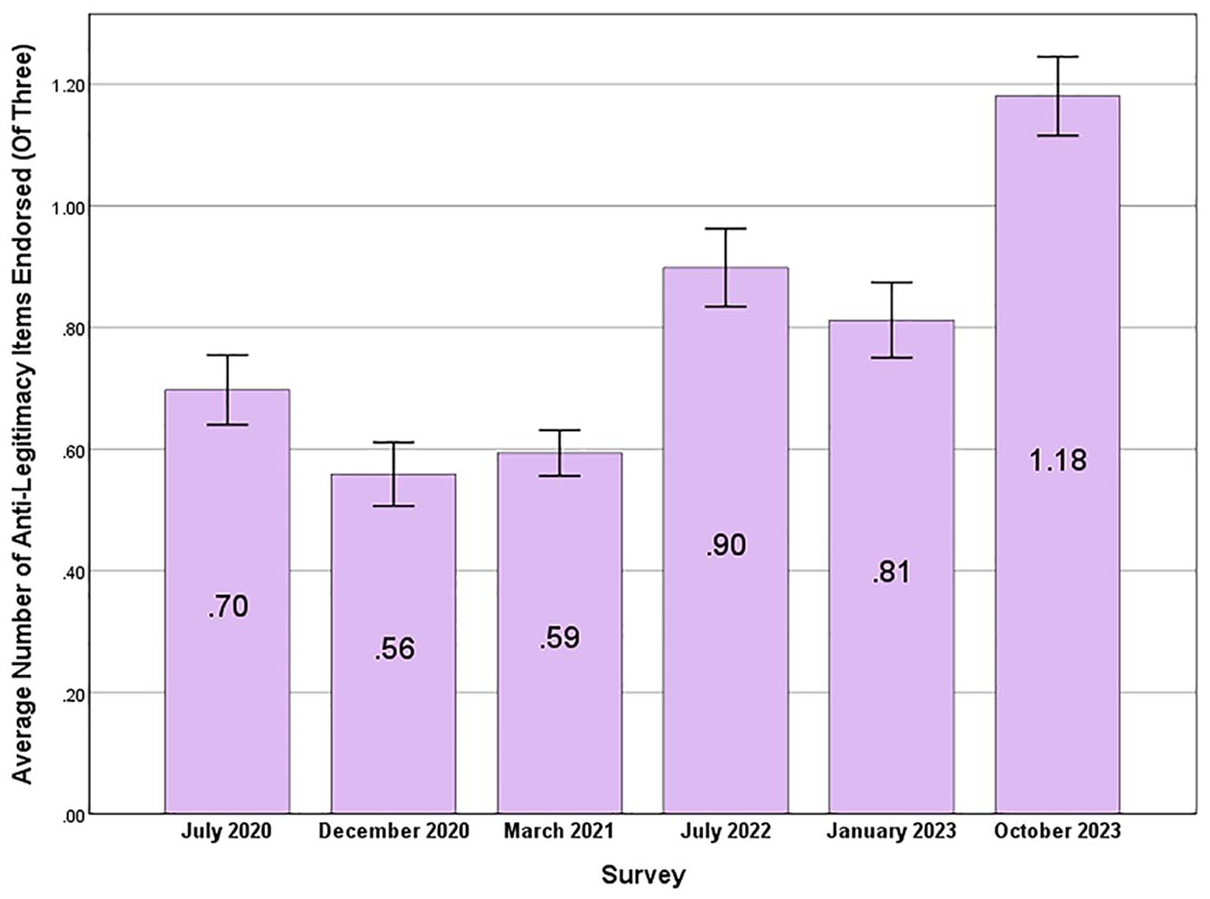
Change in Supreme Court Legitimacy, Pre- and Post-Dobbs
The conclusion from the data reported in this figure is obvious: The Dobbs decision is associated with a rather dramatic decline in institutional legitimacy, a decline that persisted through the October 2023 survey. Indeed, it even appears that in October 2023, diffuse support for the U.S. Supreme Court hit a new low, considerably lower than any of the other post-Dobbs surveys. Clearly, diffuse support updating took place for many Americans.
Change in the correlates of institutional support
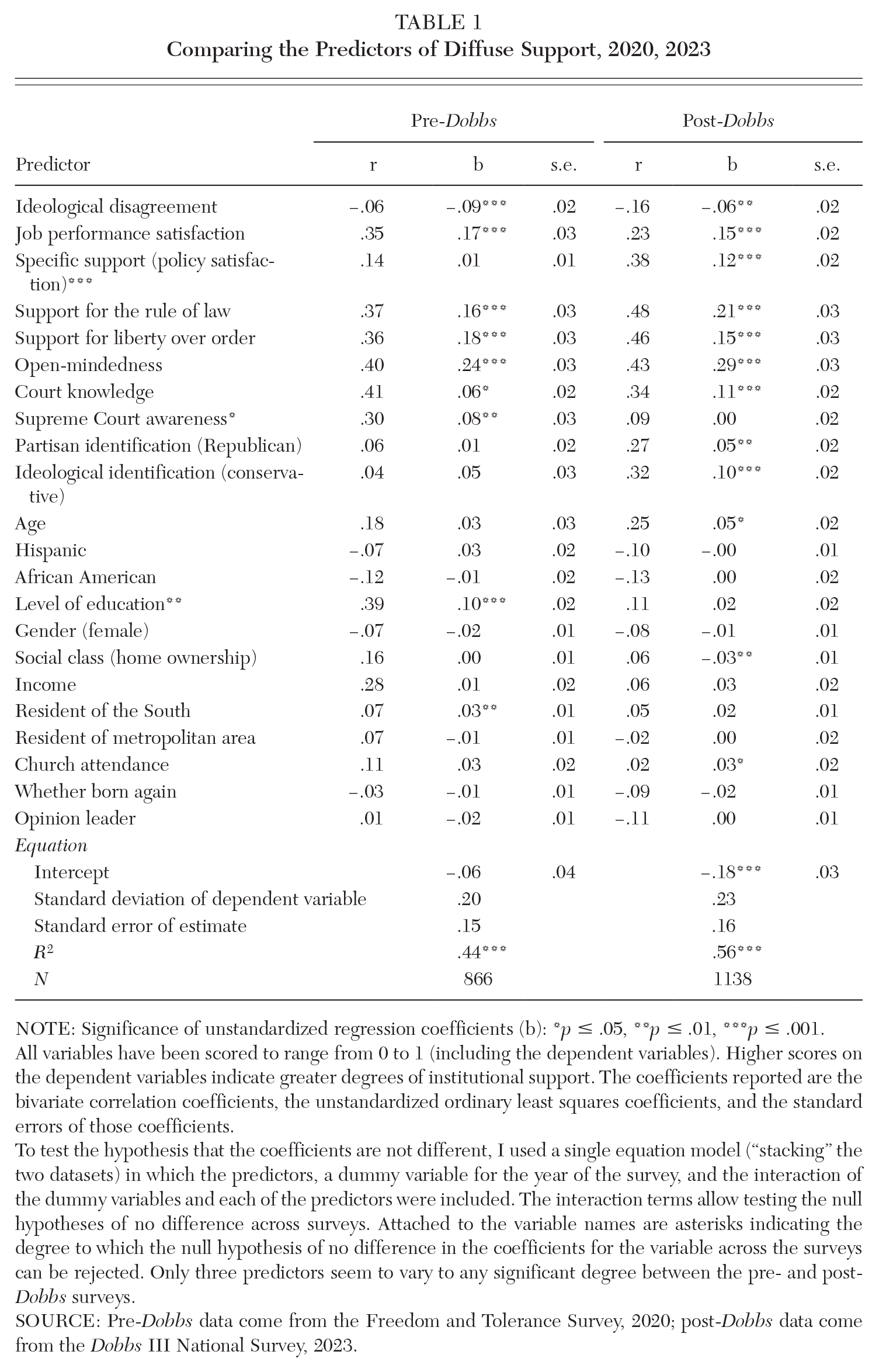
The first step in this analysis is to compare the correlates of diffuse support before and after the Dobbs ruling. Based on a long line of research, scholars have developed a reasonably complete model of the relevant predictors of diffuse support (e.g., Caldeira and Gibson 1992; Gibson and Nelson 2015, 2017; Nelson and Gibson 2019). 8 Fortunately, these variables, with only a single exception, are available in the pre- and post-Dobbs survey datasets. The exception is political tolerance, one of the democratic values (which does in fact turn out to be a useful predictor in the 2020 data). In order to ensure strict comparability between the 2020 and 2023 results, I have excluded that variable from the 2020 equation (although I report the findings including the measure in online Appendix C). Table 1 shows the results of the two regression equations, one from 2020 and the other from 2023. 9
Comparing the Predictors of Diffuse Support, 2020, 2023
NOTE: Significance of unstandardized regression coefficients (b): *p ≤ .05, **p ≤ .01, ***p ≤ .001.
All variables have been scored to range from 0 to 1 (including the dependent variables). Higher scores on the dependent variables indicate greater degrees of institutional support. The coefficients reported are the bivariate correlation coefficients, the unstandardized ordinary least squares coefficients, and the standard errors of those coefficients.
To test the hypothesis that the coefficients are not different, I used a single equation model (“stacking” the two datasets) in which the predictors, a dummy variable for the year of the survey, and the interaction of the dummy variables and each of the predictors were included. The interaction terms allow testing the null hypotheses of no difference across surveys. Attached to the variable names are asterisks indicating the degree to which the null hypothesis of no difference in the coefficients for the variable across the surveys can be rejected. Only three predictors seem to vary to any significant degree between the pre- and post-Dobbs surveys.
SOURCE: Pre-Dobbs data come from the Freedom and Tolerance Survey, 2020; post-Dobbs data come from the Dobbs III National Survey, 2023.
With a handful of important exceptions, this analysis reveals a remarkable degree of similarity between the two time periods in the correlates of diffuse support. Consider first the three measures of performance evaluations. The coefficients for ideological disagreement and job performance satisfaction from the two surveys are extremely similar, with performance satisfaction being moderately related to increased support, and ideological disagreement weakly related to decreased support. The policy satisfaction measure, however, reveals a significant difference between the two time periods, with satisfaction exhibiting a much closer connection to diffuse support in the post-Dobbs survey than in the pre-Dobbs survey.
For the democratic values measures, the analysis reveals that the connection between values and institutional support remained essentially the same between the pre-Dobbs and post-Dobbs surveys. Just as in earlier research, democratic values and court support are strongly connected, before and after the decision.
The single most significant change in the correlates of diffuse support has to do with its relationship to specific support (policy satisfaction). Not only do the multivariate coefficients differ across surveys (at p < .001), but the difference in the bivariate correlations is greater for this relationship than for any of the other predictors. It is perhaps useful to have a closer look at this changing relationship.
Figure 2 shows clearly how the relationship between specific and diffuse support changed over time. In 2020, the correlation of the two types of support was weak; by 2023, that relationship had strengthened considerably, largely because the dissatisfied withdrew support from the court. The intervening unpopular court decision appears to have strengthened the connection between diffuse and specific support significantly.
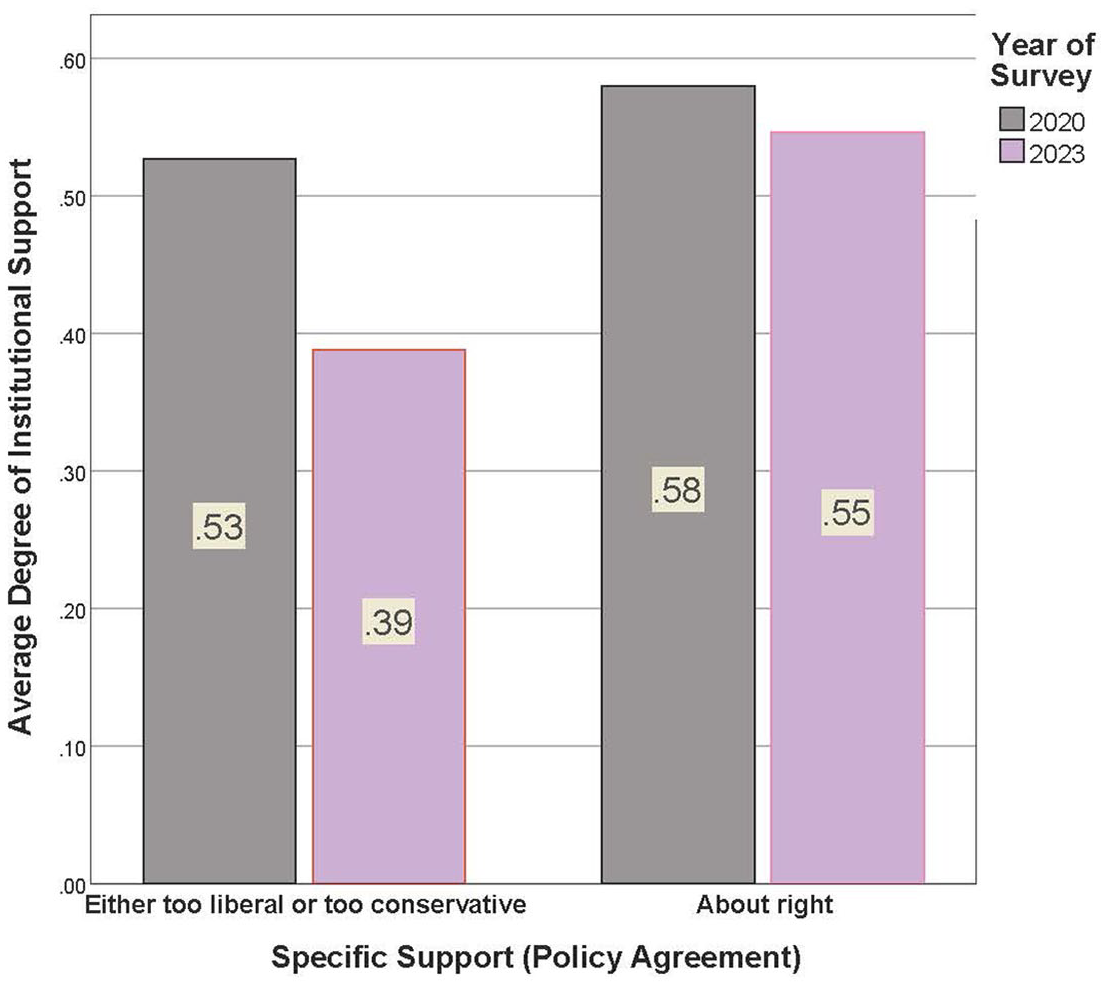
The Relationship Between Diffuse and Specific Support, Pre- and Post-Dobbs
Two other predictors seem to differ at least a little in their connections with diffuse support before and after the ruling. The importance of education for diffuse support diminished nearly completely, as did the importance of court awareness. This may indicate that these “background” factors were drowned out by the influence of contemporaneous factors. It may also indicate that, given the intense and highly salient controversy over Dobbs, variability in attentiveness to the court became unimportant because attentiveness was so widespread.
The most general conclusion I draw from this analysis is that few of the correlates of institutional support for the Supreme Court changed very much from the pre-Dobbs era to the post-Dobbs era. The most important exception is that specific and diffuse support are considerably more closely connected after the ruling.
While it is certainly risky to draw very many substantive conclusions from analyses such as these, perhaps what the data are trying to tell us is that support for the court is always a mixture of more general and fundamental attitudes and contemporaneous performance assessments, but that the relative influence of the two sets of factors can vary over time. Certainly, that is a hypothesis worthy of additional consideration.
The Updating Experiment
The analysis of the change in the correlates of diffuse support—especially the strengthened relationship of specific and diffuse support—suggests the following mechanism: A controversial ruling is issued; people become aware of the issue, with some approving, others not; people then update their performance evaluations of the institution and their satisfaction with its outputs; depending upon the history of disappointments in the institution (e.g., many, consistent, recent), some respondents adjust their loyalty toward the institution. For others, however, the disappointment is not sufficient to alter their loyalty; the reservoir of goodwill protects the institution from being reconsidered. An important consequence of this understanding is that specific support (“what have you done for me lately”) changes more readily than diffuse support. As I have argued, diffuse support is “sticky,” with change in loyalty occurring far less commonly, even if it does change under extraordinary circumstances.
This process is, of course, quite difficult to examine, in part because it unfolds over time. However, using an experimental design, it is possible to determine whether diffuse and specific support change at the same rate. That is the purpose of the next portion of this article.
The overall design of this experiment involves (1) measuring Supreme Court attitudes, (2) measuring abortion preferences, (3) presenting the respondents with a new Supreme Court decision either consonant or dissonant (randomly assigned) with their abortion preferences, and then (4) remeasuring Supreme Court attitudes. The dependent variables for the analysis are measures of change in both diffuse and specific support from prior to the intervention to after it. More specifically, measures of change from before the court ruling was announced to after it was announced were created for four concepts: (1) diffuse support, (2) the ideological distance between the respondent and the court, (3) job performance, and (4) satisfaction with the court’s policy outputs, the traditional measure of specific support (e.g., Nelson and Gibson 2020). Standard indicators of all concepts were employed (see online Appendix B for the wording of these questions).
Respondents were randomly assigned to hear either a pro-abortion or an anti-abortion court decision, conditional on their previously stated abortion attitudes. The court rulings presented to the respondents are:
Pro-Abortion: Please suppose that the U.S. Supreme Court issues a new ruling legalizing abortions in nearly all circumstances throughout the United States. All in all, to what extent would you approve or disapprove of a Supreme Court decision legalizing nearly all abortions? Strongly approve Somewhat approve Somewhat disapprove Strongly disapprove
Or
Anti-Abortion: Please suppose that the U.S. Supreme Court issues a new ruling outlawing abortions in nearly all circumstances throughout the United States. All in all, to what extent would you approve or disapprove of a Supreme Court decision outlawing nearly all abortions? Strongly approve Somewhat approve Somewhat disapprove Strongly disapprove
Thus, some respondents were told of a Supreme Court decision of which they were highly likely to approve, while others were told of a decision of which they were highly likely to disapprove—based on their responses to an earlier abortion legalization preference question.
The dependent variables
For the 2023 survey, the analysis reported above (e.g., Table 1) uses a six-item index of institutional support. The same six items were re-asked after the respondents were exposed to the hypothetical court ruling on abortion. The items were also subjected to psychometric analysis, with the results indicating that the item-set is strongly unidimensional and highly reliable. 10 An index of post-decision diffuse support was created as the average response to the items. This index is directly comparable to the pre-decision diffuse support measure; the two indices are correlated at .88. Standard measures of the model’s intermediate variables were also asked before and after the introduction of the Supreme Court decision.
Change in court attitudes
Given the strong correlation between diffuse support prior to the decision and after the decision, it is not surprising that change was limited. Using a measure that is simply the difference between the t2 and t1 scores, the average change in support is .01 (standard deviation = .12, n = 1,194). In terms of the number of pro-legitimacy items endorsed, 58.4 percent of the respondents gave the same replies after they were told about the court’s decision as they gave prior to being told.
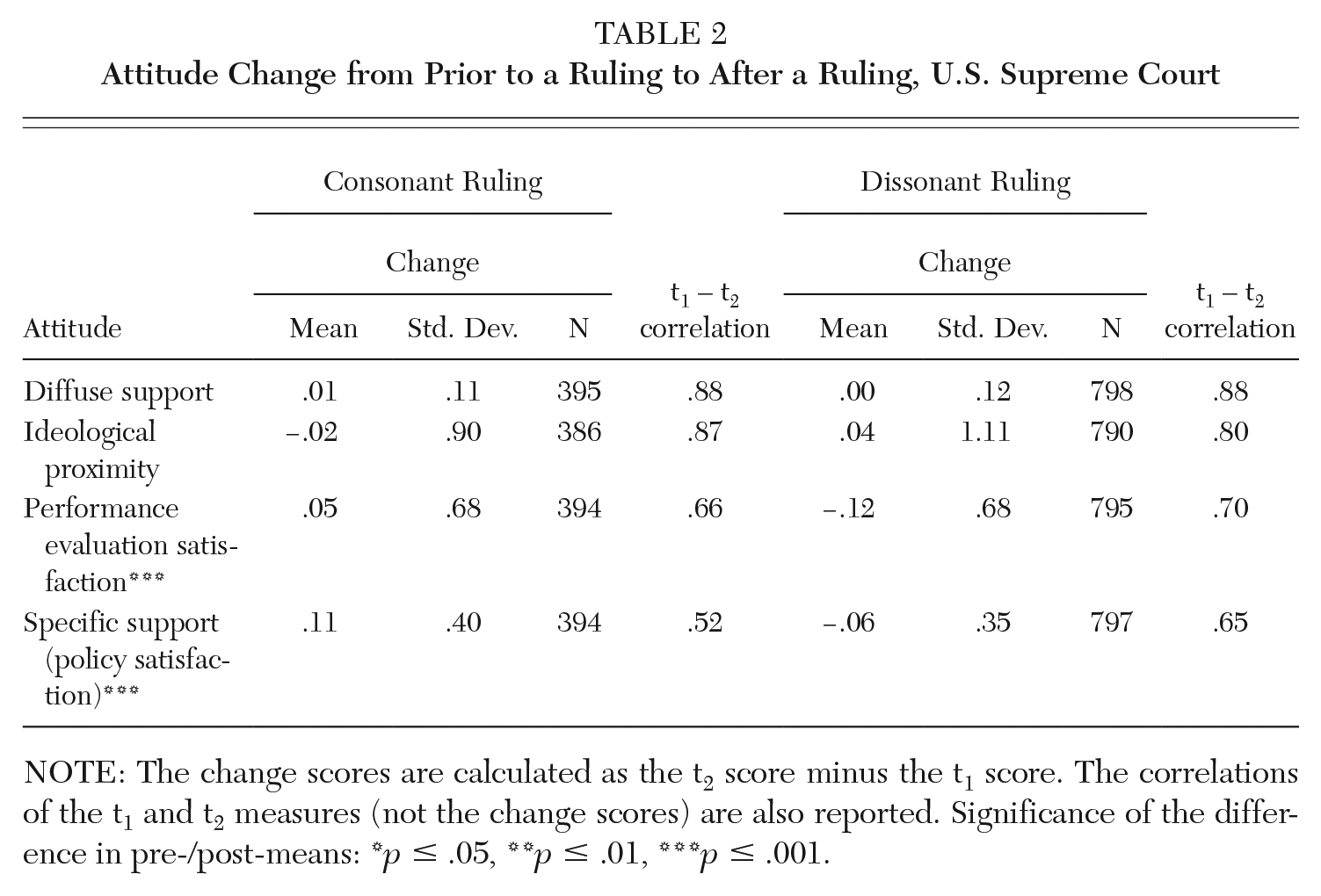
Care must be taken with the change measures, however, because about one-third of the respondents learned about a decision of which they were expected to approve while two-thirds learned about a decision of which they were expected to disapprove. Table 2 reports the basic pre-/post-results.
Attitude Change from Prior to a Ruling to After a Ruling, U.S. Supreme Court
NOTE: The change scores are calculated as the t2 score minus the t1 score. The correlations of the t1 and t2 measures (not the change scores) are also reported. Significance of the difference in pre-/post-means: *p ≤ .05, **p ≤ .01, ***p ≤ .001.
Notably, at the bivariate level, no difference in diffuse support exists between those hearing about a favorable or unfavorable decision: The change score for those given a favorable decision is .01, for those given an unfavorable decision, the score is .00 (p > .05). From this evidence, it seems that the announcement of a new Supreme Court decision on abortion, whether liked or disliked, had practically no consequences for the court’s institutional legitimacy.
Exactly the same sort of change scores (pre- and post-decision) were constructed for the specific support measures and for ideological updating. These are also reported in Table 2.
Recall that a central hypothesis of this research is that specific support is more readily updated than diffuse support. That hypothesis receives considerable but not perfect support from the data. For both job and policy satisfaction, a significant difference in change scores was observed according to whether the respondents heard about a favorable or an unfavorable decision (p < .001, in both instances). Hearing about an unfavorable decision resulted in a significant decline in specific support. For diffuse support and for ideological distance, however, the results are decidedly not significant (p > .05). That is, the type of decision did not result in greater or lesser diffuse support or greater or lesser ideological distance from the court. Even while recognizing some skepticism about the entire ideological updating theory (e.g., Gibson et al. 2017), the evidence of this experiment is clear that specific support updates more readily than diffuse support (see also Haglin et al. 2021).
A related way to address the hypothesis is to examine the correlation of measures taken prior to the decision with the same measures after the decision (i.e., the components of the change measures discussed in the preceding paragraph, also reported in Table 2). What these correlations indicate is that the two measures of specific support are much more volatile from pre- to post-decision, while diffuse support is relatively stable: indeed, even as stable as ideological self-identifications. 11
Thus, these data support several important conclusions. First, institutional support fails to update significantly with the introduction of information about a new decision (of which the respondents could not have previously heard), and that conclusion pertains to both those hearing a decision consonant or dissonant with their prior policy preferences. Diffuse support seems to be quite stable.
The second important conclusion is that specific support is much less stable, and there is little difference between those exposed to a welcomed decision and those exposed to an unwelcomed decision. If anything, those hearing about a dissonant ruling were slightly more stable in their assessments of the court than those hearing about a consonant ruling (although the difference is small).
Third, for both performance evaluations and specific support, the difference in attitudes between those exposed to a consonant decision and those exposed to a dissonant decision is .17 units. However, in the consonant condition, specific support rises slightly, while performance evaluations remain almost constant. In the dissonant condition, the change in the two variables is reversed: Specific support declines very, very slightly, while performance evaluations decline somewhat more. Considering both variables, no clear evidence emerges of a “positivity” or “negativity” bias. In general, favorable decisions increase specific support just a bit, just as unfavorable decisions decrease support just a bit.
Experiments such as this certainly are limited in what they can tell us about how people react to actual court decisions. Not the least of such external validity concerns is that all respondents become aware of a decision (because I told everyone about a decision). But what these data seem to suggest is that specific support is more easily updated than diffuse support, which seems to corroborate at least part of the updating model undergirding this research.
Discussion and Concluding Comments
Why and how our attitudes change is not easy to understand. Scholars have identified two major impediments to change—lack of awareness of events and motivated reasoning—that help us to understand why change is more exceptional than routine. But change does occur, even if social scientists have not been able to produce anywhere near a single integrated theory of attitude change.
Scholars of judicial attitudes have provided a useful basic model of change in court support. The distinction between specific and diffuse support, first proposed decades ago by David Easton (1965), turns out to be the bedrock of an attitude change model. People evaluate events all the time (assuming they become aware of them), and they make assessments, with presidential popularity and “confidence” in the Supreme Court being fine examples. Specific support is volatile, often responding to the events of the day.
But there is more to attitudes than fleeting satisfactions and dissatisfactions. Like party identifications, people develop loyalties toward political institutions that are resistant to change in the short term. These loyalties are similar to interpersonal loyalty. Democrats may be disappointed in a candidate or a policy or a scandal, but they usually do not abandon the Democratic Party (e.g., “yellow-dog Democrats”). While institutions such as the U.S. Supreme Court are not as visible and salient as a political party, people learn general orientations toward institutions like the court early in life—orientations that are often reinforced by the symbols of judicial legitimacy and that become resistant to change. But sometimes they do change (e.g., partisan realignments), and it is important for us to try to understand the mechanisms of that change.
A court decision overturning a generations-old grant of a right to privacy that includes the right to decide whether to have an abortion or not is a decision presenting great opportunities for understanding attitude change. That has been the purpose and context of this article.
I have discovered that the connection between specific and diffuse support changed significantly from before the Dobbs ruling to afterwards, with the two forms of support becoming more closely aligned after the decision. It may be that, over time, the connection between the two attitudes typically oscillates but generally weakens, in part because specific support is more responsive to external events than is diffuse support. Major events can cause a realignment that strengthens the relationship between the two forms of support. Perhaps not all events are capable of producing this realignment, but it is also perhaps not surprising that Dobbs appeared to do so.
In the second part of my analysis, I discovered that specific support seems to react more directly to exposure to a new decision than does diffuse support, as hypothesized. Specific support is relatively easy to change because it is about performance evaluations. In my experiment, diffuse support did not change at all with exposure to a new court decision, and the finding of stasis pertains to those happy about the new decision just as it does to those unhappy about it. Of course, experiments like this suffer from many limits of external validity, including the fact that all respondents in the survey were exposed to the ruling, change was measured over the course of minutes (from the beginning to the end of the interview), and semiprofessional survey takers are not necessarily equivalent to ordinary people. Despite these limitations, the fact that the experiment was able to induce change in specific support but not in diffuse support is a finding crucially important for the model of updating that has been advanced.
It may be that this finding is a function of the context of the survey. That is, it may be that the effect of the court’s actual abortion ruling in Dobbs was felt quickly and persisted for a period of time, but further rulings on the issue may produce no incremental effect on court attitudes. In this sense, issues may not have continuing effects except insofar as they cause a “running tally” to be reset. The issue cannot cause further change in the running tally once set, especially in the context of ever-changing and heterogeneous news about the court, its justices, and its activities and rulings. In this sense, rulings have a limited “shelf-life”; their ability to influence court attitudes is limited to an “open window,” which is most likely a relatively short period of time. On the other hand, the “window” for change in specific support seems always to be open.
My analysis has produced a number of important although perhaps less theoretically fecund findings. For example, while diffuse support changed from prior to the Dobbs ruling to afterwards, its relationship to democratic values did not change. Although this may reflect so-called values-based regeneration of support, the 2023 survey was fielded too long after the Dobbs decision to be sure (and no survey with measures of democratic values are available immediately after the decision). In addition, updating the ideological distance between a person and the court seems not to be very important for court support (in part because it is so difficult to accomplish).
How generalizable are the conclusions from this research? The first answer is surely “not very,” because events capable of producing significant change in court attitudes do not come along very often, so by definition, cases such as Dobbs are atypical. Dobbs is one of the most widely publicized, discussed, and criticized decisions the Supreme Court has made in recent times. Moreover, I have argued elsewhere (Gibson 2024b) that it was not only that the attributes of the ruling itself that made diffuse support weaken so significantly but also that the decision was issued at a time when the court had moved dramatically and, more important, consistently to the right. Finally, if Gibson (2025) is correct, Dobbs may be unusual in that its effects seem to have lingered across a fairly substantial period of time (as also reconfirmed by this article’s 2023 survey).
In the end, the complexities of attitude change are sufficiently great that no single project can do anything more than to shine a bit of light on some of the hypothesized linkages. That some attitudes are relatively ephemeral (e.g., specific support) while others are more obdurate (e.g., diffuse support) seems certain, but how these two attitude types connect and reconnect is much more difficult (albeit necessary) to understand. Future research should undoubtedly be devoted to exploring these mechanisms in greater detail and with greater theoretical and empirical sophistication.
Supplemental Material
sj-docx-1-ann-10.1177_00027162251334522 – Supplemental material for The U.S. Supreme Court’s Legitimacy: How Public Opinion Updates
Supplemental material, sj-docx-1-ann-10.1177_00027162251334522 for The U.S. Supreme Court’s Legitimacy: How Public Opinion Updates by James L. Gibson in The ANNALS of the American Academy of Political and Social Science
Footnotes
NOTES: This is a revised version of a paper presented at the authors’ conference for the volume on Donald J. Trump, the Supreme Court, and American constitutionalism for The ANNALS of the American Academy of Political and Social Science, Annenberg Public Policy Center, University of Pennsylvania, September 9–10, 2024. I am very much indebted for support for this research to the Weidenbaum Center at Washington University in St. Louis and its director, Andrew Reeves. I am also grateful for the efforts of the entire survey team at Verasight, including Peter Enns, Jake Rothchild, and Amelia Goranson. I appreciate the advice of Michael J. Nelson on all aspects of this project. Lee Epstein made invaluable comments on an earlier version of this article.
Supplemental Material
Supplemental material for this article is available online.
Notes
James L. Gibson is Sidney W. Souers Professor of Government in the department of political science at Washington University in St. Louis and Professor Extraordinary in political science at Stellenbosch University (South Africa). In 2021, Gibson was elected as an honorary foreign associate of the Academy of Science of South Africa.
References
Supplementary Material
Please find the following supplemental material available below.
For Open Access articles published under a Creative Commons License, all supplemental material carries the same license as the article it is associated with.
For non-Open Access articles published, all supplemental material carries a non-exclusive license, and permission requests for re-use of supplemental material or any part of supplemental material shall be sent directly to the copyright owner as specified in the copyright notice associated with the article.
