






Abstract
Meritocracy is often seen as a hallmark of modern societies, yet the belief that those best suited to the task should govern dates back to classical antiquity. This article provides a historical perspective on meritocracy by examining the long preindustrial era, exploring both continuities and differences between past and present understandings of the concept and its practical applications. I outline the intellectual origins of the idea that “the best” should rule, tracing its development from ancient Greece to the Italian Renaissance. My analysis explores “pockets of meritocracy” that existed in medieval and early modern periods, showing that republican polities were, at least in principle, more open to the political advancement of commoners and that advancement based on merit was relatively more accessible in some specific groups and institutions—state administrations and the church. I conclude by suggesting the ways in which historical experience can shed light on contemporary debates and concerns surrounding meritocracy.
Keywords
When we think about Western preindustrial societies prior to the Age of Revolution, which began in the late eighteenth century, we definitely do not imagine them as polities ruled by those who had “merited” a leading position—that is, we do not think of meritocracies. The word itself, after all, is modern, having been introduced in 1958 by British sociologist and social activist Michael Young in a satirical book (Hankins 2023, 11; Young 1958). And yet, the idea that a well-organized society should be led by those among its members who appear to be better suited to the task, because of their moral characteristics as well as their competences, is definitely not new. Rather, it is rooted in a tradition of thought that dates back to classical antiquity. Practice, however, rarely matched theory (and when it did, it was not for very long); that pattern is clearly revealed by the historical experience of medieval and early modern Europe, which was governed mostly by individuals who occupied their apical position primarily due to their birth into a ruling dynasty, rather than because of their personal merits. 1 And yet, most hereditary rulers understood the necessity of picking competent people to help manage their domains; thus, even in the context of the most rigid feudal system, some opportunities for personal advancement remained open even for humble commoners (stipulating, of course, that those in the lower and poorer parts of society had little chance of advancement).
This article offers a historical perspective on meritocracy. Based on the notion that the experience of history can help us better understand our own world, I focus on the continuities and discontinuities between the preindustrial period and today in the understanding of the idea of meritocracy and its application in practice. I begin with a brief overview of the historical origins of the conviction that “the best” should rule, from ancient Greece to the Italian Renaissance. I then examine the “pockets of meritocracy” that existed in medieval and early modern times in two realms: the republican polities that, at least in principle, were more open to the rise of commoners to positions of power and the groups (notably the state administration and the church) within which advancement through merit was easier and more frequent. The concluding section provides reflections on what history might teach us about some current concerns.
Before I proceed, though, a clarification: This article focuses on political meritocracy (meritocracy among those who govern) for two main reasons. First, political thinkers were the first to discuss (more or less explicitly) the conditions under which the worthy could enjoy success by ascending to government positions, independent of their ascribed characteristics. Additionally, in a preindustrial context, it was the political-institutional framework that arguably played a key role in allowing for advancement by merit in at least some sectors of society and the economy: Despite their obvious connections to the political system, it was mostly public administrations that allowed for potential advancement by merit in spheres that were outside of politics.
The Historical Antecedents of the Meritocratic Ideal
“Meritocracy,” as seen above, is a modern word, and yet the idea that “the best” should rule is not new. In the fourth century BCE, Aristotle argued in his Politics that the rule of the best, that is, those who are possessed of greater moral and intellectual virtue and who are willing to pursue the common good, is one of the most desirable forms of government. This ideal form of government was the “aristocracy” (in classical Greek, οἱ ἄριστοι means “the best men”); importantly, an aristocracy of this kind was not defined by birth (as we would now assume based on modern usage), but solely by personal virtue. Aristotle himself was well aware that the government of “the best” in the interest of all could easily become a government of “the few” serving their own interests—what he called an “oligarchy.” And yet, degeneration of this kind could also afflict the government of “the many”; in fact, the corrupted form of government of the many is what Aristotle called a “democracy.”
Aristotle’s concept of aristocracy is modeled upon that of his teacher, Plato, who was even more explicit in arguing that an ideal republic should be ruled by the best. To achieve this goal, the republic itself should make all efforts to ensure that everybody has enjoyed equality of opportunities, notwithstanding the family into which they were born; the communal rearing of all promising children and public education would enable the best individuals in each generation to grow up to their full potential and provide them with the right mindset for selflessly pursuing the common interest. 2 As is well known, Plato has been criticized for being too ready to sacrifice individual freedom in order to achieve his ideal government (Popper [1945] 2012), although in recent years he has also been lauded for having provided an early warning about the dangers of populism (Wooldridge 2023, 71). Both modern critics and apologists, however, would probably agree that his work has been vastly influential, and the same is obviously true for Aristotle’s.
In Western culture, Roman political thinkers played a key role in transmitting to posterity the view of the Greek philosophers that, ideally, the best citizens should rule. The great politician and orator Cicero, for example, believed that the optimates (the “best men”) should play a particularly important role in governing the republic, through a dominant position in the Senate, as they supposedly were better suited to ensure the stability of the state and to preserve its key institutions. In Aristotelian terms, Cicero’s optimates represented the aristocratic component in a well-organized republic; according to Cicero, their power should be kept in check by a popular component, the populares. (Technically what he proposed was, again in Aristotelian terms, a “mixed constitution” in which “the best” ruled, but not alone.) Although optimates and populares did not constitute political parties in the modern sense, their existence evinced an important political divide in the late Roman Republic (Yakobson 2017); Cicero’s views were thus clearly connected to a specific, real-world political system, one that needed to be preserved and improved, not overturned. After all, as noted by Hankins (2021), “the Romans’ contribution to Western meritocracy was more in the realm of practice than of theory. Their governing principles emphasized experience of affairs and the moral standing of leaders (dignitas) rather than Plato’s pursuit of philosophical illumination or Aristotle’s ingenious constitutional tinkering.”
Cicero, himself a “new man” (homo novus), was acutely aware that, without checks on its political power, the aristocratic component of government could easily become self-serving. A popular component was thus necessary, but fearing the potential disruptive power of the populares, he argued that this bloc had to be monitored even more closely than the optimates. As will be seen, this advocacy of a mixed constitution also characterized the thinking of late medieval and early modern political figures. Interestingly, Cicero’s pragmatism is also evident in his acceptance of the use of personal wealth to build a successful political career. More precisely, he believed that, because this method of accruing political influence was inevitable, it should be practiced with moderation. Moreover, he argued that, ideally, it should be directed toward projects of public utility (e.g., the building of infrastructures, such as walls, docks, or aqueducts) rather than to games or gladiatorial shows organized to appease the most basic desires of the populace (Alfani 2023, 240). After all, it is clear that, in the classical age, the aristocratic political component was also a wealthy component (though not necessarily super-wealthy): As noted by Aristotle, to be engaged in political activity requires spare time, and only those affluent enough that they don’t need to devote themselves to full-time work have time to spare (Alfani 2023, 273–274). To be clear, neither Aristotle nor Cicero believed that a government of the wealthy was automatically a government of the best; the virtues required of a good ruler or politician were much more expansive than the ability to make money, and (following Plato’s lead) they believed that those virtues had to be nurtured in the younger generations by means of a proper education.
In the late medieval and early modern period, the complicated connection between wealth and politics would become a critical issue—both in the theoretical speculations of the time and in actual historical developments. Before proceeding, however, I must note that early reflections on what we could call “meritocracy” were not exclusive to the West. For example, even before Plato, the teachings of the great Chinese sage and philosopher Confucius were setting the stage for the development of an imperial administration based on merit, one ruled by scholar-bureaucrats recruited through highly selective public examinations. 3 To ensure that the best could truly gain access to high offices, Confucius advocated universal education and opposed hereditary offices (Brown 2021, 176; Wooldridge 2023). Of course, the meritocratic component of appointment to high office varied over time. During the Tang dynasty (618–907), most imperial jobs, including the most important ones, went to large landowners or to relations of previous officeholders, with only 10 percent assigned through public examinations. The Song dynasty (960–1279) further strengthened the system by introducing three levels of progressively more selective examinations that, in some form, would survive until the twentieth century (Wooldridge 2023, 77–78). In the mid-eighteenth century, under the Qing dynasty (1644–1912), more than 70 percent of public officials had obtained their post through the examinations, just over 1 percent had inherited the position (as sons of high officials), and about one-fifth had purchased their appointments (Elman 2013, 247). 4 Importantly, beyond ensuring that the administration could recruit from among the best candidates, the Chinese examination system also served the purpose of co-opting the provincial elite into the management of the empire (Wooldridge 2023, 79). 5
There were, of course, imperfections in the Chinese system, with fluctuations and even interruptions in the allocation of jobs through the examination procedure. Nonetheless, the persistence over time of merit-based recruitment into the high administration of the Chinese state is truly impressive when considered from a European perspective. In the West, the ideal of meritocracy (always imperfectly applied in the classical age) was largely lost during the Middle Ages, when the feudal system was established; in its fully developed form, that system relied on descent and inheritance as the basic way of identifying rulers. Of course, in China as well, the right of the emperor to rule went unquestioned, while in Europe, the wise ruling noble sought the advice and help of the most capable from among the commoners. But the fact remains that across the long preindustrial period nothing like the official examination system that had developed in China could be found in the West. Indeed, Western visitors, such as the Italian Jesuit missionary Matteo Ricci, who established himself in the imperial capital of Beijing at the very beginning of the seventeenth century, were surprised to observe a system of recruitment that favored knowledge and intellect over wealth, descent, and political connections. To Ricci, early modern China resembled the Platonic utopia of a country ruled by philosophers (Hankins 2019, 496).
Ricci might have been somewhat less surprised by the (relatively) meritocratic Chinese society had he been born a few centuries earlier, when republicanism had a much stronger presence in Europe (e.g., in central-northern Italy, among other areas) and when considerations of who was fit to rule were central to the thought of philosophers and political thinkers. And yet, observing how rarely rule by merit was realized in contemporary practice (as opposed to an idealized past), Renaissance scholars continued to reflect on the issue; in this, they followed the Roman tradition of addressing practical rather than theoretical problems: “For Renaissance literati the greatest obstacle to full flourishing in political communities was the corruption of human nature and culture that had occurred after the fall of ancient Rome. In decayed modern times, power was too often found in the hands of persons driven by lust for wealth and status, men who abused their inherited power or diverted the shared resources of the community to benefit themselves at the expense of their fellow citizens” (Hankins 2023, 4).
Wealth (or more precisely, wealth inequality) and inheritance (of rulership and political offices) were responsible for making a republican political system drift away from the ideal condition of a polity in which the best could truly rise. Medieval translators of the philosophers of the classical age commented on ancient texts with an eye to their own time. This is surely the case for the fourteenth-century French philosopher and political thinker Nicolas Oresme who, translating Aristotle’s Politics, argued that in a democratic polity, the superrich (superabundantes) would “overcome the others regarding their political power so much that it is reasonable to think that they are among the others as God is among men” (Menut et al. 1970, 142; translation mine). 6 And how would one punish or just constrain these “gods” once they had acquired the means to control the community politically? Like Aristotle, Oresme was not a strong supporter of democracy, and although he condemned oligarchy, he reserved his praise for monarchy—not a surprise as he served as trusted counselor of the French king. But for Oresme, the real problem was social stability. In this, he clearly had in mind the republican city-states of his time, which were subject to frequent violent popular rebellions against self-serving rulers who had captured the institutions of the state. Consequently, to preserve social stability in a “democratic” context, Oresme offered two possible solutions: either to banish the superrich from the state, as Aristotle had already advised to do (though this, for Oresme, was dangerous), or—and there is no antecedent for this in Aristotle—to prevent the problem from arising by making an excessive concentration of wealth impossible. To this end, Oresme argued, a law would be “just” if it capped the maximum wealth that any individual could possess; in a related point, he argued that the maximum size of inheritances should be regulated, with the excess above a fixed amount to be given to other members of the same lineage, confiscated, or somehow redistributed across the community (Alfani 2023, 216–217).
There is no doubt, when looking closely at the history of medieval Europe, that in many republican settings popular components protested (often violently) against the tendency of families belonging to relatively small political elites to strengthen their exclusive control over political institutions, and there is also no doubt that those families were usually very wealthy. But exactly how wealthy were they, and when did their fortunes originate? Indeed, in the thirteenth and early fourteenth century, the fight had been against the political preeminence of the great families that had risen in previous generations: This group, called the magnati (magnates) in Italy, only rarely belonged to ancient nobility and often stood out for their enormous wealth, often accumulated through long-range trade. Instead of resorting to the outright expulsion of the magnates, some Italian cities limited their political activities by law (for example, Bologna in 1282). Opting for a more radical approach, in 1293, Florence established the Ordinamenti di Giustizia (“Regulations about Justice”), which forbade the magnates outright from holding the most important public positions (Pampaloni 1971). The same concerns arose in other parts of Europe, wherever communal governments had been captured by wealthy oligarchies: “In France and the German-speaking territories, revolts [in the late thirteenth century] . . . were usually carried out by a conglomeration of social groups, with the common programme being collective resistance against abuses of power by urban regimes led by closed patrician elites” (Dumolyn and Haemers 2015, 161). In this struggle, the popular elements of society were often supported by “new-wealth” families that the “old-wealth” families of magnati were actively trying to keep out of the government. When new-wealth families came into power, however, they proved even keener than old-wealth families to manipulate the political system to their own ends. The rise of the Medici family in Florence is possibly the most egregious example of this dynamic (Alfani 2023, 129–132, 161–163).
If we are to fully understand the Renaissance philosophical-political discourse about meritocracy, we have to keep in mind this real-world situation. During the commercial revolution of the eleventh and twelfth centuries, massive fortunes were amassed by commoners—both those who took advantage of long-range trade routes (some newly created, others reestablished) and those providing the financial services that supported the trade. The emergence of these fortunes, much larger than any previously seen, posed a challenge both to theologians (who struggled to conceptualize commoners’ wealth accumulation as the product of anything but sin pure and simple) and to communal political institutions (Alfani 2023). Quite clearly, possessing wealth alone was not the same as possessing the virtues desirable in a ruler. This is why, at least in Italy, where this new way of accumulating extreme wealth first emerged, scholars began to reflect on how to educate the young in order to improve the character and the competences of the elite. A key contributor to this debate (and one of the founding fathers of the humanist movement) was the fourteenth-century poet and philosopher Francesco Petrarca, who argued that “true nobility” 7 (and hence, true legitimacy to rule over others) does not come from one’s lineage, but rather from one’s virtue and moral and intellectual excellence. True nobility has to be earned and is not automatically possessed by those who have simply inherited a privileged status (Hankins 2019, 158–159; 2023, 11).
Notwithstanding Petrarca’s vast influence, arguably the man who most fully developed a political theory of meritocracy was the fifteenth-century writer and politician Francesco Patrizi of Siena. Famous and highly influential in the late Renaissance but little known today, Patrizi’s work has attracted more attention in recent years, mostly thanks to an excellent book by James Hankins, Political Meritocracy in Renaissance Italy (2023), which portrays Patrizi as “the most substantive theoretician of humanist meritocracy” (Hankins 2023, 7). Indebted to Petrarca’s tradition (which was itself indebted to the tradition of the classical age), Patrizi believed in the transformative power of education; he advocated universal basic education for all citizens, with provision to be shared between families and the state. For Patrizi, basic education was a necessary condition for opening up some degree of participation in public office to all citizens. He did not limit himself to advocating generic meritocratic principles, but “[he] was the first to devise institutional measures to elevate the worthy. He laid out specific procedures for discovering and promoting merit in the citizen body and for insulating the order of magistrates from the power of wealthy individuals of high status” (Hankins 2023, 5). Patrizi was acutely aware of the difficulties that would be encountered in fostering meritocracy in the real-world republics of his time and, for this reason, argued for removing the main obstacle: large wealth inequalities among citizens. Exactly like Oresme a century earlier, Patrizi argued that a republican city should enforce a limit on the wealth of any single citizen and regulate (and moderate) mercantile and financial gain (Hankins 2023, 6). Somewhat more naively, he also argued that merchants and bankers should be taught to disdain greed and luxury and to act in a frugal and generous way—something that generations of Christian theologians had tried, and failed, to achieve (Alfani 2023). Patrizi thought that, of all the numerous small republics that existed in his time, Venice was the best, in part because of its procedures for preventing the wealthy from buying political power (Hankins 2023, 131). As will be seen in the next section, over time these procedures would fail, and Venice would develop a strong plutocratic character.
From Theory to Practice: Pockets of Meritocracy?
Interest in the work of Francesco Patrizi, arguably the main theorist of “meritocracy” during the Italian Renaissance, dried up after 1610, and his books ceased to be republished, translated into other vernacular languages, and cited. According to Hankins (2023, 9), “[Patrizi’s] form of virtue-based meritocracy was less relevant in a world where states increasingly sought to base their legitimacy and their principles of public order directly on religious doctrine.” It might seem strange to argue that early modern Europe looked more to religious doctrine to ground legitimacy than medieval Europe did, given that the latter’s entire system of justification of political power depended ultimately upon divine authority. However, the seventeenth century saw the rise of the so-called “absolute” monarchies, and absolute monarchs asserted that their right to rule came directly from God, toward whom they were primarily responsible. At the same time, republics had become much rarer than they had been in the Middle Ages, either because republican governments had evolved into seignories (as in Florence after the rise of the Medici) or because they had been conquered or otherwise absorbed by larger polities, including by other republics. As a matter of fact, in the seventeenth century, only three main republics remained in the whole of the continent: the Republic of Venice, the Republic of Genoa, and the Dutch Republic. (Minor ones, like the Republic of Lucca in Italy, may be added to this list, as may the failed republican experiment in England of 1649–1660.)
For the purposes of this article, focusing on early modern republics is important not only because, in previous centuries, it had been with respect to this form of government that the ideal of meritocracy had been debated, but also because it was in these republics that, at least in theory, we could look for “pockets of meritocracy” surviving into an age that was no longer very interested in the concept. After all, Patrizi himself had lauded the Venetian Republic as being the closest to a truly meritocratic polity. The problem, however, is that the republican form of government is not necessarily meritocratic, as it can occupy any point along a spectrum ranging from a democracy “ruled by the multitude,” where recruitment into office might depend on merit, to an oligarchy “ruled by the few,” where at most the best from among a restricted elite are selected for high office (but also where, more often than not, either the descendants of those who had wielded power in the past, or the wealthiest, or some combination of the two, hold sway). Indeed, a republic may, in the course of its historical development, move along this spectrum while maintaining an impressive degree of stability in its formal institutions. The case of Venice serves to elucidate this point.
One reason why, in the Middle Ages, republics could flourish in much of central-northern Italy—and most definitely in Venice—is that, in this area, the feudal nobility were relatively weak. However, even in the absence of a traditional nobility, the temptation to restrict power to a well-defined ruling elite could eventually emerge. In Venice, the turning point is usually placed in 1297, when the city decided to reserve access to the main political body of the Republic, the Maggior Consiglio (“Great Council”) to the members of a well-defined group of “patrician” families. Lists of those eligible for the Maggior Consiglio were drafted, and from 1323 on, it was clearly established that eligibility was to be inherited; at the same time, only the descendants of previous members of the council could be admitted to it (Lane 1973, 112–114, 252–253).
This oligarchic component of the Venetian constitution does not seem to have particularly troubled observers such as Patrizi, presumably because of the pragmatic tradition that had imbued Western political thought since Roman times. It was one thing to advocate, in principle, the recruitment of the best from among the entire body of citizens (after providing them some basic education, of course) and quite another to pretend that all citizens, including the uneducated and those deemed unworthy for whatever reason, should be given equal access to government. As has already been observed, for Patrizi, the crucial point in allowing for merit-based appointments was to avoid the capture of elections by great wealth—an objective that, it seems, was easier to achieve when all the electors were very wealthy (as was the case, by and large, with the original members of the Maggior Consiglio). After all, Venice was not only a republic, but a mercantile republic, a polity ruled—by definition—by its economic elite.
From this perspective, it should come as no surprise that the theoretically highly restrictive rules, specifically those preventing new families from joining the patriciate and, as a result, acquiring the right to sit in the main political bodies, were systematically circumvented in order to allow the occasional inclusion of new members. And this workaround held true not only in Venice but in all Italian polities where an urban patriciate with similar functions existed. For example, it has been argued that in Milan (which, although incorporated into the Spanish Empire, remained the capital of its own “state” and managed to maintain its Senate with substantial prerogatives), barriers to entering the patriciate were frequently breached by individuals who shared just one characteristic: great wealth (Mocarelli 2009, 118). Entering the Venetian patriciate was more difficult, surely in part due to the loftier consequences that it entailed; the patricians of Venice, after all, ruled an empire. However, the most important difference between the two cities was the higher admission cost in Venice, which at some point came to be precisely defined: In 1646, as part of an effort to raise funds to finance the War of Candia (1645–1669) against the Ottoman Empire, the admission fee required from those who sought to join the patriciate was set at 100,000 ducats. To grasp the size of the investment required, consider that it is estimated to be the rough equivalent of $67 million (in 2020 dollars) 8 : a fortune, surely, but one that the superrich of the time could afford to pay, especially considering that, once acquired, patrician status became hereditary.
A patrician republic, like Venice, that is led by the richest is not necessarily very far from being an aristocracy in the Greek sense, at least during periods when wealth is still relatively young and patrician families continue to take an entrepreneurial approach to personal and public matters and pursue the public good alongside their own advantage. Over time, however, two factors contributed to the Republic of Venice’s ever-more-clear divergence from a meritocratic state. First, the patricians themselves became more unequal because of the emergence of the so-called barnabotti, who were members of ancient, but now impoverished patrician families. With no significant patrimony left, but retaining their seats in the Maggior Consiglio, many barnabotti resorted to selling their votes. Obviously, this practice enabled the wealthiest patricians to capture the highest offices in the government, without consideration of their competence or, in general, their “merit.” And when the barnabotti did manage to get themselves elected to some lower office (possibly as compensation for their support in other elections), they carried out their duties with an eye toward filling their own pockets (Lane 1973, 264; Del Negro 1998, 18–20; Harivel 2019, 131).
The problems posed by the barnabotti, already recognized in Venice at least from the late fifteenth century, grew in early modern times and became particularly pressing when, in the mid-seventeenth century, the republic lost Candia (Crete) and, in the early eighteenth century, the Morea (Peloponnesus), both of which were conquered by the Ottomans. With these losses, the poorest component of the patriciate was further deprived of useful occupations in managing and defending the empire in the eastern Mediterranean. According to Nicolò Donà, an eighteenth-century patrician and political writer, after the loss of these domains impoverished patricians roamed the halls of the Maggior Consiglio, “idle and in a very needy condition,” in the hope of getting some, increasingly rare, “lucrative occupation” (quoted in Del Negro 1998, 19; translation mine). In early modern times, the problem of the impoverished patricians was not unique to Venice—the Republic of Genoa, for example, experienced it as well—and can be considered a structural problem that developed over time wherever (and whenever) seats in the main political bodies were made hereditary within a well-defined group, permeable only to the wealthiest.
The second factor that made Venice and other republics stray ever more clearly from the ideal of meritocracy was the changing behavior and objectives of patricians whenever expectations for future economic opportunities worsened. This process is, in fact, a general one, not limited to those ruling the state but also affecting local governments. One of the first indicators of this development can be detected in the introduction of legal barriers preventing “new” families from joining local councils; as a general phenomenon, it began in the late fifteenth century and became particularly intense during the sixteenth (Leverotti 2005). Importantly, this practice not only served political objectives but also had clear economic motivations, as it ensured privileged access to community resources (Di Tullio 2014). But formal norms can be misleading indicators of social and political openness—as they could be circumvented and were themselves usually established in periods of intense upward mobility (Cattini 1984; Mocarelli 2009). More relevant to our discussion, then, are measures of actual rates of change in the group of families able to secure representation in local councils. Several studies have reported that, in communities in various regions of northern Italy, a pattern of political closure emerged from the early seventeenth century and typically intensified in the eighteenth (Cattini 1984; Cattini and Romani 2004; Alfani 2025).
The timing of this closure mirrors the worsening expectations of the Italian economic (and political) elites for the future: By the early seventeenth century, the so-called Little Divergence—that is, the process through which the center of the European economy shifted from the south, and particularly from central-northern Italy where it had been located since Roman times, to the north, beginning with the Dutch Republic—was beginning to be felt even in the most advanced southern economies, such as the Republic of Venice (Alfani 2013). To understand the choices made by the Venetian elites, we must consider this backdrop of anticipated difficulties; throughout northern Italy, the situation was exacerbated by the terrible plague of 1630–1631 that killed about one-third of the total population and was compounded, in the Republic of Venice, by the negative consequences of the War of Candia (Alfani and Percoco 2019). In other words, the Venetian (and more generally, the southern European) elites reacted to the worsening economic scenario by choosing to become more “predatory,” maximizing their immediate revenues even at the risk of damaging the long-term development opportunities of society as a whole—a kind of behavior neatly described by some well-known studies (Acemoglu et al. 2006; Acemoglu and Robinson 2012).
Beyond running contrary to any meritocratic principle, this behavior also stifled overall socioeconomic mobility. Moreover, along with this capture of public resources, investment was shifting away from those sectors most vulnerable to competition from northern Europe—and toward land. This shift further increased wealth inequality and introduced an additional element of rigidity in socioeconomic structures: “When capital-rich families decided to divert their ample resources from industry and trade to real estate, often profiting from times of crisis and particularly from famines when starving small-owners were forced to sell their properties at an unfavourable price, they established a distributive condition that tended to lock the lowest strata into a disadvantaged economic (and political) situation” (Alfani 2023, 115). With this development came the continued growth of wealth inequality in the Republic of Venice (and elsewhere) and the continued growth of poverty (Figure 1).
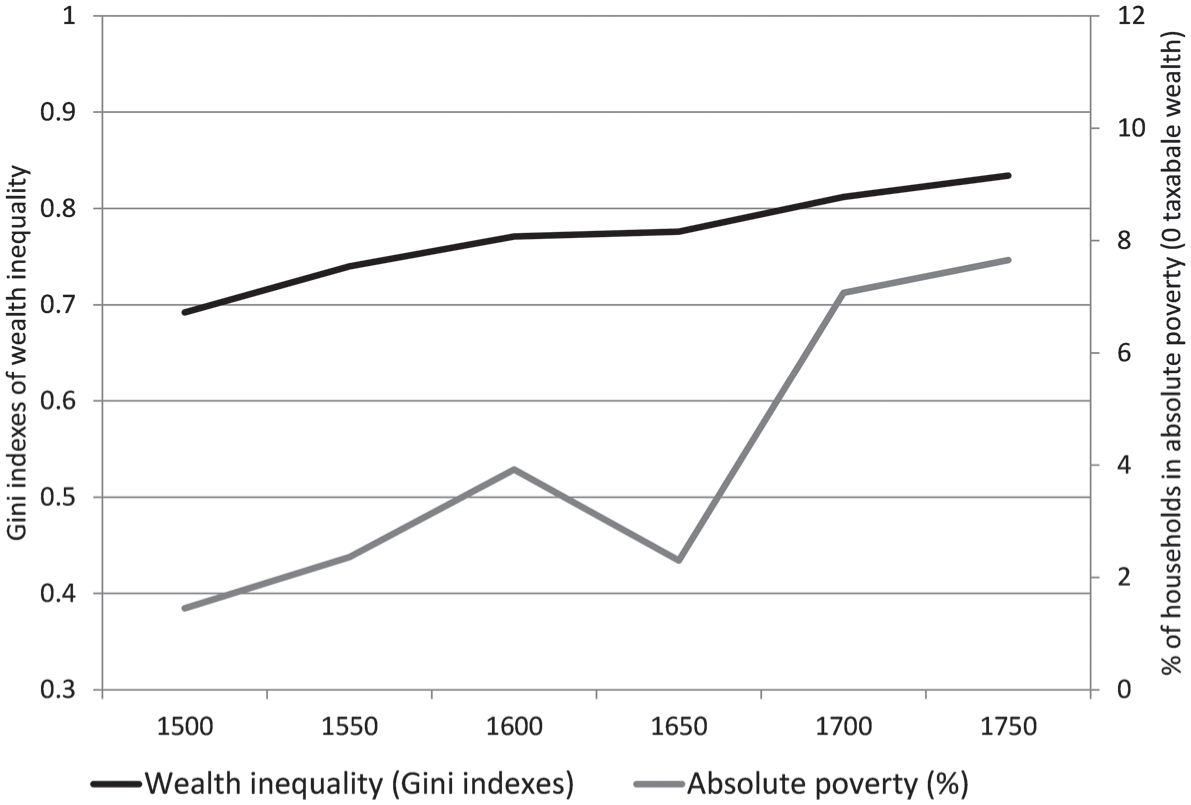
Wealth Inequality and Poverty in the Republic of Venice, 1500–1750
Before further discussing the implications of secular trends in socioeconomic mobility for our general argument, I would point out that the closure of political and economic elites in response to declining prospects did not affect only southern Europe. Consider the Dutch Republic toward the end of the seventeenth century: When competition with England over the dominance of the seas and over colonial spheres of influence intensified, it made perfect economic sense for Dutch families that had already accumulated considerable wealth to avoid the high personal and financial risks inherent in the Atlantic trade and to focus on other activities, including participation in government. But what makes sense at the individual level can have dire collective consequences. The regents (regenten), a category that encompassed all kinds of rulers of the Dutch Republic (including city leaders and heads of organizations) and whose members originally came from each locality’s richest and most successful merchant families, became an increasingly specialized class, anxious to preserve its position. By the early eighteenth century, 83 percent of the newly appointed city councilors of Rotterdam and 79 percent those of Hoorn were close relatives of another councilor. At the same time, members of the regent class became progressively less active in trade and other sectors of the economy and adopted more pronounced aristocratic features (de Vries and van der Woude 1997, 586–596; Prak 2005, 126–127; Prak and van Zanden 2022, 184–186).
During this period, the highest and most remunerative offices were increasingly reserved for an elite ever more closed in upon itself and increasingly less involved in other economic activities where they might have developed useful competences to transfer to government. And it seems reasonable to assume that these changes in how new members were recruited into city and state administrations went hand in hand with a waning of the meritocratic component in the Dutch political system. Once again, the dangers of handing the reins of the state to the wealthiest (a danger that was clear to the minds of Renaissance political thinkers) are confirmed by actual historical developments: Over the passing of generations, and with new wealth inexorably becoming old wealth, at some point the temptation to capture the state in order to control public resources and preserve one’s position at the top of the socioeconomic ladder appears to become irresistible.
As I have argued elsewhere (Alfani 2025, 16), by adopting this behavior, the European political and economic elites of the early modern period acted as real “enemies of mobility”; this kind of status protection requires minimizing the chances for potential challengers to rise. Indeed, if we look at the (still limited, but growing) evidence on levels of socioeconomic mobility in various early modern polities, we see a clear correlation between phases of capture of political institutions by the economic elites and subsequent decline in overall mobility levels. This dynamic, however, needs to be understood in connection with another aspect of European history that is worth exploring here. In fact, we must look beyond these rare republican governments to other contexts where pockets of meritocracy existed in early modern Europe—that is, not in polities of a specific kind but rather in the segments of society where upward mobility was relatively easier. Indeed, in preindustrial Europe opportunities for upward social mobility may have been, overall, more widespread than is generally believed (Poussou 2004; Mocarelli 2009; Alfani 2025).
First, in all those contexts that required the kind of high skills attainable only through long periods of training or study, the principle of merit was applied. Artists, engineers, scholars, and scientists all rose, by and large, according to their merit, and the top positions they acquired in their field of expertise were generally defended successfully against those less qualified or less competent. Some members of this high-skills elite were also able to acquire high social status and accumulate large fortunes. Beyond this, advancement by merit was common in some highly specialized sectors of the economy, particularly in large-scale and long-distance trade and finance. However, it is also true that in such high-stakes sectors, a strong dynastic or “familistic” component was invariably present; a family business served to address legitimate concerns (for example, the difficulty of establishing trust between business partners in a context of limited, difficult, and costly access to information) but nevertheless ran contrary to the ideal of allowing the best, whoever they might be, to rise within the firm.
Second, the church offered lowborn individuals the opportunity to climb the social ladder: Although, as is well known, many appointments to top ecclesiastical offices went to members of the nobility or very affluent families, the fact remains that the church, as an institution, was much more open to the principle of advancement by merit than was the army, where men rising from the ranks were rare and officer status, with the opportunities for personal enrichment that it entailed, was almost an exclusive preserve of the nobility (Poussou 2004).
Finally, advancement by merit was also practiced in liberal professions and state administration. Importantly, the latter, with bureaucracies that expanded rapidly throughout the early modern period, were always hungry for relatively rare skills (particularly those that the educational system of the time struggled to produce because of its structural constraints). This pattern held true in some of the most “absolute” monarchies. Somewhat paradoxically, in some respects, it might have been easier for the political elite to acquire tight control over lucrative administrative offices in a republican setting, compared to a monarchic one—even though it was always the case that the latter reserved many of the top offices for nobles. This situation appears less paradoxical if we remember that, in the context of an early modern European monarchy arising from the medieval feudal system, a substantial split divided the group that controlled political resources (the nobility) and the group that controlled an increasing share of overall economic resources (the bourgeoisie). In line with arguments made by the great German sociologist Max Weber ([1956] 1978), I would argue that this split tended to act as a brake on the concentration of all resources in the same hands. But in an early modern patrician republic arising from a medieval merchant republic, there was no such constraint on the ability of the ruling elite to control all kinds of resources (political, economic, relational). It is in a republican context, then, and not in a monarchic one, that inequality could rise to the highest levels, and meritocracy, in the end, fall to its lowest—a sobering thought and one that invites reflections on what the historical experience of preindustrial Europe has to teach us about the current situation.
Concluding Remarks: Warnings from the Past
The Age of Revolution, which began in the late eighteenth century, permanently transformed the way in which Western societies understand political legitimacy, linking it to the principle of popular sovereignty. 9 The disdain with which the French revolutionary armies, led by Napoleon, rejected not only the claim of neutrality of the Republic of Venice, but also its claim of being a sister polity of the new French Republic, is telling. And the French revolutionaries were entirely right in this matter as, by the time Napoleon finally put an end to its long history, Venice had become an oligarchy in the hands of the superrich, beginning with the doge at that time, Lodovico Manin, the richest of all Venetians. (His election, in 1789, had made many old-blood patricians frown, as they considered him a parvenu, given that his forebears had only bought their place in the Maggior Consiglio in 1651 [Alfani 2023, 264–265].)
Despite the deep transformations that have affected Western societies and their political systems since the medieval and early modern era, our brief overview of how the idea of merit was conceptualized and practiced (or not) in the past seems to resonate with many present-day concerns. A clear trait d’union can be found in the apparent incompatibility between high levels of economic inequality and meritocracy. In recent times, this point has been made particularly clear by Thomas Piketty (2014, 34), who argues that, as inherited wealth dominates total wealth, the result is a situation of extremely high concentration of capital, up to “levels potentially incompatible with the meritocratic values and principles of social justice fundamental to modern democratic societies.” But many centuries before Piketty, medieval philosophers like Oresme and Renaissance political theorists like Patrizi had already made that point. As argued by Oresme, building upon Aristotle, the presence of superrich individuals within a democratic polity means that some citizens will be among the others as gods are among men—and that such a polity will simply cease to function as a democracy, even without any change to its formal constitution (see Alfani [2023] for an in-depth discussion of this point). The relevance of this insight for today’s debates about the involution of Western democracies (some more than others, arguably, but all experiencing, to some degree, the growing political influence of the superrich) is so obvious that it seems unnecessary to elucidate it any further.
This said, the idea that wealth inequality is inimical to democracy seems to fit better with preindustrial societies than with current Western societies since the former were, yes, structurally unequal (being divided into various orders, each with different prerogatives), but at the same time highly suspicious of the enrichment of the “bourgeoisie” (the new very wealthy commoners residing in “burghs,” or cities). Especially since the late 1990s, the idea seems to have spread across the West that growing wealth inequalities simply reflect differences in capabilities and are therefore the result of “merit.” But this idea is blatantly at odds with the perception of inequality as inimical to meritocracy, a perception that, as argued above, remains commonplace today. The reason that our societies are able to accept these two contrasting positions at the same time seems to lie in our basic inability, or unwillingness, to look directly at another, related problem that our ancestors had very clearly identified: inheritance.
Medieval and Renaissance thinkers understood wealth inequality as a condition unfavorable to a government of the best because, although merit might explain the emergence of inequalities within a generation, the process of inheritance ensures that wealth inequality survives across generations, independent of individuals’ virtues. But they also went further, identifying inheritance as the mechanism through which wealth inequality within a community could become excessive (so egregious that it corrupts republican institutions, disrupts “democratic” processes of decision-making, and frustrates any hope of upholding truly meritocratic ideals). In the first part of the twentieth century, the prevailing view was that inheritances should be taxed, both to moderate wealth inequality and to ensure a more level playing field for new generations—a view that used to be considered a precondition for individuals to rise according to their merit. Today, after decades of rejecting that view, taxation of inheritance across Western nations has fallen to historically very low levels (OECD 2021, 77–78). In its turn, according to many, that change has fueled further growth in wealth inequality—a general process in which the United States, once the most egalitarian among Western states (Alfani 2023, 48–49), stands out for the sheer extent of the transformation. 10
Medieval and early modern political thinkers had already, and correctly, predicted that the growing prevalence of inherited wealth would lead to higher wealth inequality. They also made another prediction: that growing wealth inequality would tend to transform democratic polities into oligarchic, unmeritocratic republics ruled by the wealthiest. This is precisely what came to pass in early modern Europe, and we can only hope that this prediction, at least, will not stand the test of time.
