







Abstract
One way to assess whether governments and industry (at any level) learn from their disaster experience is to examine two similar events at different points in time. The authors investigate and compare the 1989 Exxon Valdez oil spill disaster with the 2010 BP Deepwater Horizon oil spill disaster to determine whether oil spill prevention and oil spill risk management have advanced over time. The study recounts facts, analyzes features of both incidents, and offers an intergovernmental interpretation of changes in policy and practice over four decades of oil spill management informed by theories of nested sets, distributed cognition, and socio-technical systems.
Keywords
Disaster Risk
Developing effective policies and practices for management of risk represents a critical function both for government and industry. Yet, risk management is highly controversial. This is particularly so when the decision-making environment manifests acute danger, immense stress, high stakes, urgency for action, and the assumption that complex technologies will function as expected. Government and corporate response to crisis reveals human and organizational capacity to learn about, and adapt to, changing technological and environmental conditions.
One way to assess whether governments and corporations learn from their experiences is to examine and compare their respective performance in two similar events at different points in time. This study compares responses to the 1989 Exxon Valdez oil spill disaster with responses to the 2010 BP Deepwater Horizon oil spill disaster to determine the extent to which governmental policy and corporate practices have advanced in managing oil spills in coastal waters. This analysis considers what government and corporate officials need to know to ensure continuity and adaptation of their organizations.
Several middle-range theories provide guidance in this assessment. The theories of nested sets, distributed cognition, socio-technical systems, and the concept of “normal accidents” are useful as tools for generalization and comparative insight.
Interorganizational and Interjurisdictional Learning
When well-intended efforts to prevent and plan for extreme events fail to avert a disaster, what are the methods of coping with a disaster’s negative consequences? Do governments and corporations learn lessons from their experiences? Do public policy makers look for and correct gaps and deficiencies in government regulation over time? In disaster mitigation and preparedness efforts, are policy makers and policy implementers vigilant, dynamic, and adaptive? Do major corporations working in the same lines of business learn from the experiences of their competitors? Can organization theory and the study of socio-technical systems help in answering these questions? Four streams of thought offer insight into these problems.
Nested Sets
The concept of “nested sets” captures the interdependence among levels of government in ways that illustrate the dynamic effects of action by one level of government upon another and the ricocheting consequences of action or inaction taken in response. The concept has been used by theorists in different fields. Haas (1990) referred to “nested sets” in his characterization of international organizations composed of nation states that in turn encompassed substate structures ordered in declining scale. By inference from Haas, nations encompassed states or provinces that were subdivided into counties that in turn included municipalities and districts. Ostrom (2005), a 2009 Nobel Laureate, used the concept of nested sets in presenting her Institutional Analysis and Development (IAD) framework. Ostrom used this concept to identify interactions among participants at different scales of authority and action that are engaged in a common endeavor. Acting in reference to a given condition at one level of operation creates a reactive response at second and third levels that may not have been anticipated, but which may significantly alter the interactions among the participants. The concept is integral to the wider theory of complex adaptive systems.
Intergovernmental relations (IGR) in the United States function much like nested sets. The federal system in the United States operates as a general framework for governance, with states acting as subsystems within that framework, counties acting as sub-subsystems within states, and municipalities acting as sub-sub-subsystems within counties. Moreover, intergovernmental relations are not exclusively limited to governments because IGR often includes for-profit and nonprofit organizations (Wright, 1988). Governments are not the only parties engaged in disaster management, so too are private businesses and nonprofit firms. Sometimes businesses and nonprofits provide in-kind production and services to governments through pre-disaster contracts.
Although the legal structure of governmental organization in this multijurisdictional system is hierarchical by design, in practice the performance of interacting governments functions most effectively through “informed choice.” Actions taken at one level constrain choices made at the next level, and choices made at that level further constrain the next set of choices made at the first. The process is interactive, with exchanges made, unmade, and remade in a continuing effort to find the best “fit” of resources to demands, using the skills and technologies available to the actors. IGR-informed choice takes place horizontally as well as vertically. Many governments, corporations, and nonprofits operating at a common level may establish and use pre-disaster agreements of various types as methods for facilitating interorganizational coordination, mutual aid, and efficiency. Nested sets may be found in the interaction of players operating across particular spatial and hierarchic levels.
Distributed Cognition 1
A key insight into the performance of complex systems is that no single agency or individual possesses all of the information, skills, or resources needed to manage large-scale threats alone. Instead, effective interorganizational response involves a detailed effort to exchange timely, valid information among a range of actors, each of which has different skills, expertise, and resources that are essential for resolving the problem. Coordinated action among multiple actors, agencies, and jurisdictions depends upon the capacity of actors to create a shared knowledge base, or in the vernacular of emergency services personnel, a “common operating picture,” as the basis for action. Hutchins (1995, p. xiv) terms this form of cognition as fundamentally a “social and cultural process.”
Hutchins (1995) extends the process of cognition beyond the boundaries of the individual, examining the interactions with other individuals, organizations, and instruments that are used to support reasoning. In this context, cognition is a form of mental computation that involves both individual and organizational learning. It represents the creation of a novel system of individuals and organizations seeking to achieve a shared goal and interacting in structured ways that can be observed, studied, and understood.
Hutchins (1995) adds a set of key perspectives that inform this broader concept of cognition. Cognition is essentially a process of structuring information to aid comprehension of the context for action, and it evolves as the product of interactions among participants in a wider system. Consequently, it can be designed to focus on a desired goal and to enhance preferred outcomes. Design, guided by intent, shapes actions and generates a learning process, as the act itself stimulates information processing that creates a memory trace and influences future actions. Such action differs from unguided evolutionary processes as it can be traced systematically and compared at successive steps to the intended outcome, although Hutchins acknowledges that interactions lead to reciprocal adjustments among the participants. The conduct of design involves specifying the key tasks that each actor performs in the complex set of interactions undertaken, the sequence in which these tasks are performed, the instruments and methods that are used in producing the information shared for decision making by the participants in the system, as well as identification of error and revisions that occurred in producing the actual outcome.
Distributed cognition enables actors to create new mental structures that enhance their ability to search, store, access, and exchange information about tasks and performance. Importantly, shared task performance builds a common base of knowledge and enhances the capacity of participants in the system to learn. Examining this process of collaborative learning requires exploring the logical relationships among environmental conditions, participants, methods, and instruments used in task performance and interactions among agents over time in dynamic environments. Distributed cognition is complicated by matters of access, authority relationships, and scientific and technical expertise versus political, legal, and public accountability.
Socio-Technical Systems
Developing a common knowledge base among geographically distributed organizations, especially under the tight time constraints of a rapidly evolving disaster, requires integration of well-designed information technology into plans for operational response and recovery. This task becomes part of the process of mitigating hazards since to be effective in supporting timely operations during response to an extreme event, the information infrastructure, as well as a baseline of knowledge, need to be constructed and operational before the event.
In this respect, planning for disasters in regions of risk necessarily involves an assessment of large-scale technical systems that provide critical functions to the state or city, such as transportation, telecommunications, and water, power, gas, and sewage distribution systems. While these are classic functions considered in any state, urban, or metropolitan planning process, such plans often assume that once in place, these systems will continue to function without interruption. However, the consequences of managing a jurisdiction without electrical power or water are often not fully considered, escalating the vulnerability of a jurisdiction and its population when such systems fail under an extreme event.
Designing appropriate information technology to support a multi-organizational, multi-jurisdictional network in planning, response, and recovery operations is not trivial. Current software programs in practice include: HAZUS (http://www.fema.gov/plan/prevent/hazus/), developed and upgraded by FEMA; WebEOC (http://esi911.com/esi/index.phi), currently adopted by several state emergency management offices, including Louisiana; and JIISIS, a prototype system under development at the University of Pittsburgh (www.cdm.pitt.edu). While none of these systems currently meet all of the needs of emergency services personnel and policy makers in managing the risk of extreme events, they represent a marked shift in recognizing that the organization of knowledge to support coordinated response to complex threats requires technical support to facilitate timely organizational action (Coakes, Willis, & Clarke, 2002). Yet, issues of reliability and robustness under damaging conditions of disaster continue to limit the performance of computational systems, despite substantive successes (Rochlin, 2000). In turn, the fragility of technical systems requires organizational support to maintain their functionality under stress.
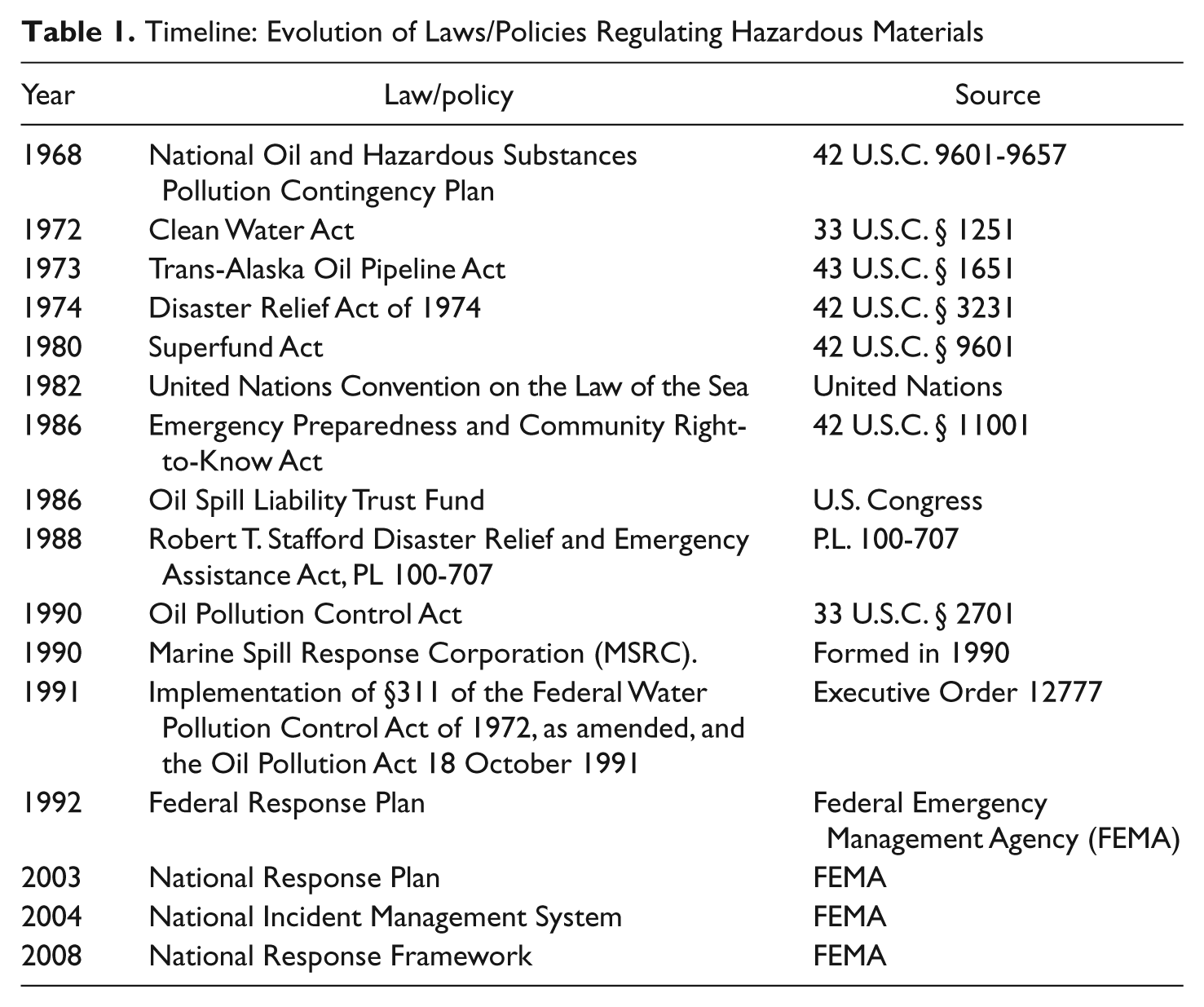
Large, and often multinational, corporations engaged in high-risk, large-scale, capital-intensive endeavors rely on socio-technical systems to both manage risk and prepare for disruptions caused by natural or human forces. In the United States, the federal government has engaged in disaster planning, first across federal agencies (through the Federal Response Plan), then later across the nation as a whole through the National Response Plan, and since 2007 through a more state- and local-friendly National Response Framework (see Table 1 timeline). Planning across levels of government, and among governments on the same level, is daunting. Such activity seeks to limit top-down command and control problems within the system and conversely, to maintain organized and effective performance on each level of operations.
Timeline: Evolution of Laws/Policies Regulating Hazardous Materials
Perrow (1984) illustrates the risks of socio-technical systems in his book Normal Accidents, a study that explores human and technological problems encountered in managing extremely complex, high-risk, tightly linked technologies (i.e., high-reliability technologies and organizations). He claims that production pressures and overconfidence in safety or warning technologies often encourage people, including decision makers in corporate settings, to take unwise risks. Perrow maintains that too often blame is attributed to “operator error” in major accidents, when instead, poor regulatory and safety oversight, mechanical failures, and multiple system failures are the true causes of disaster.
He posits that tightly coupled systems with the potential to cause high-consequence calamities fail more often than many suspect, owing to an overconfidence in both human judgment and technological safeguards. In many respects, Perrow (1984) is both a supporter and critic of human factor analysis: the search for an optimum interface of humans with machines and with machine instrumentation. Perrow’s claims have credence in explaining aspects of the 1989 Exxon Valdez case and the 2010 BP Deepwater Horizon case. Perrow’s early analysis illustrates the socio-technical aspects of oil spill accident vulnerability, prevention challenges, and risk management.
Oil Spill Emergency Management Practice and Policy
Oil spills are a fact of life. Sylves (1998) observes, “How damaging an oil spill is depends in part on the degree of emergency preparedness in place before the event, the speed of response, and the effectiveness of recovery operations once a spill has occurred” (p. 13).
Emergency management embodies four simple assumptions. First, emergencies or disasters will occur. Second, it is better to be prepared for these events than to be unprepared. Third, good preparation involves emergency preparedness and response planning. Fourth, good emergency management is more than a paperwork exercise. Sylves (1998) maintains,
It requires the participation and consultation of emergency responders; it entails pre-disaster inter-agency and intergovernmental understandings regarding who is to do what, who is in authority, and who is to provide labor and resources; finally, it calls for maintaining a state of readiness and response specified in the plan, even in normal, non-emergency periods. (pp. 15-16)
Disaster mitigation means deciding what to do to reduce an identified risk to health, safety, and welfare of society and then carrying out that risk-reducing action. For example, oil spill mitigation involves improving marine and refinery technology and managing human factors likely to precipitate accidents. Mitigation can be advanced through government regulation, particularly when private businesses are unable or unwilling to manage hazards and disaster risks in a responsible manner (Sylves, 1998).
Oil spill preparedness includes operating and maintaining oil skimmers, making arrangements for mobilizing oil cleanup contractors, keeping inventories of available cleanup equipment, conducting practice drills and exercises, training responders, identifying resources at risk, establishing improved communication networks, plus drafting and revising oil spill cleanup plans. (Sylves, 1998, p. 15)
Response means providing emergency aid and assistance, reducing the probability of secondary damage, and minimizing problems for recovery operations. Among elements of response are provisions for search and rescue, evacuation, and sheltering. Response, within the context of a major oil spill, also includes protection of the environment, particularly fish, and other marine creatures, wildlife interacting with surface waters, and shorelines (especially marsh and wetland areas). Other standard elements of oil spill emergency response include: arresting continued oil spillage, assessing hull damage (if the spill is from a vessel), determining whether marine aids to navigation are functioning properly, identifying the responsible party (the firm to be held accountable for spill damage), establishing a command post from which to direct cleanup activities in the field, projecting the future path of the spilled oil, warning other vessel operators of the incident (which sometimes requires prohibiting vessel transit in the area of a spill), assessing ecological damage, booming off tributaries, waterways, and shorelines that might be threatened by oil, and more (Sylves, 1998). Not to be overlooked is the need for public warning about where oil spill damage is likely and public education about the health and environmental dangers of contact and handling of oil and oily debris.
Recovery includes providing immediate support during the early post-disaster period to return vital life support systems to minimum operation 1evels. This support should continue until the community returns to normal (Petak, 1985). A key component of recovery is reconstruction and/or repair. In oil spill emergency management, recovery activities are linked to mitigation. What is learned in addressing a major oil spill may help prevent a recurrence of the same incident or prepare responders to better address future oil spills. Also embedded in oil spill recovery activity is deciding liability and compensation for the cost of cleanup and repair of environmental damage. No less important in oil spill recovery is restoration of the natural environment (Sylves, 1998). Determining the degree of damage to the natural environment and restoring its previous capacity to provide economic resources and environmental renewal to a region is a long-term policy task that requires systematic monitoring and measurement over time. This effort again becomes a socio-technical task as it requires new means of monitoring ocean environments to assess the rate of change in the environment. 2
The Political Geography of Oil Spills
U.S. local governments have almost no authority to regulate off-shore industrial operations, unless those operations have on-shore facilities within their jurisdiction. Most states have jurisdiction in coastal waters out to 3 miles, with Texas and the Gulf Coast of Florida having federal permission to exercise jurisdiction out to 9 nautical miles (6,076 feet in a nautical mile) (Primer on Ocean Jurisdictions, 2011). State governments generally concern themselves with regulating private coastal industrial operations, coastal land use, port management, coastal utilities that have on-shore facilities, and more.
The federal government possesses the lion’s share of maritime jurisdiction. Through a host of federal laws deemed constitutional by the national government’s authority to regulate interstate commerce, and by international treaty authority to manage seas and sub-sea lands out to 200 miles within its Economic Enterprise Zone, the federal government has authority to supervise, regulate, protect, and steward the nation’s maritime resources. In the case of coastal lands and resources, these duties are performed by the federal government as well as by state and local governments.
Major oils spills hold the potential to affect the seas and coastal areas of other nations. Thus, the United States participates in the International Maritime Organization. While the United States has yet to sign the United Nations Convention on Law of the Sea, the nation does generally subscribe to, and comply with, the provisions of the measure. However, federal law allows states to variously set forth their own laws and rules of oil spill liability rather than rely on a uniform set of international liability rules.
The Cases Introduced: Exxon Valdez Disaster
The Exxon Valdez oil spill into Prince William Sound, Alaska, in March 1989 profoundly changed America’s oil spill disaster management and preparedness. The Exxon Valdez, a supertanker, departed from the Valdez oil terminal in Alaska at 9:12 p.m., March 23, bound for Long Beach, California. Captain Hazelwood, master of the vessel, departed the wheel house and went to his stateroom. Following maneuvers to avoid icebergs, he left a third mate in charge of the wheel house and a watchman at the helm, both of whom were not given the mandatory 6 hours off duty before their 12-hour shift had begun.
The ship was operating on autopilot. The vessel master received permission from the Coast Guard to go out through the inbound lane, since the outbound lane was covered with icebergs. The Coast Guard was given the task of ensuring safe passage through the shipping lane, but failed to keep watch over the supertanker. At approximately 12:04 a.m., March 24, the ship struck Bligh Reef. The vessel spilled an estimated 10.8 million U.S. gallons of crude oil, or 257,000 barrels, out of its total 53 million gallons (1.26 million barrels). Some 1,300 miles of shoreline sustained oil contamination to some degree and the spill stretched to about 460 miles (Trustee Council, 2010). The main impact of the spill was environmental and ultimately economic. Billions of salmon and herring were lost, as were an estimated 250,000 seabirds, 2,800 sea otters, 300 harbor seals, 250 bald eagles, and 22 killer whales (Trustee Council, 2010).
Alaskan fishers and seafood processors around Prince William Sound faced major economic problems in 1989. Fisheries were closed for considerable periods and many owners of small fishing vessels were not retained by Exxon to help skim oil from the sea surface and faced bankruptcy if they were not compensated for their losses. For the fishing and tourism industries, oil spills are a great hazard risk and generate socioeconomic vulnerability.
The Cases Introduced: BP Deepwater Horizon Incident
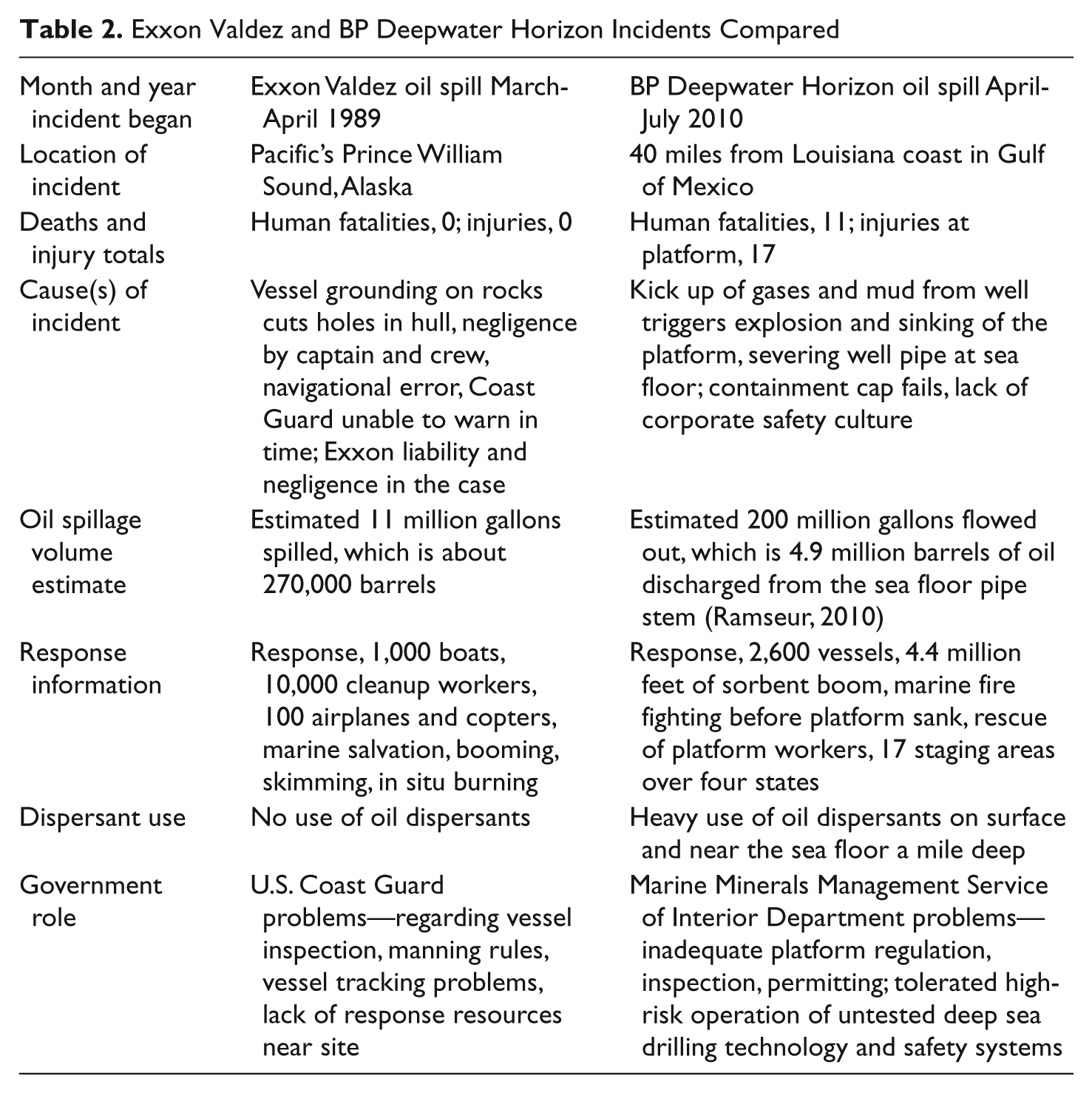
Twenty-one years after the Exxon Valdez disaster, on April 20, 2010, the 5,000-foot-deep Macondo Mississippi Canyon Block 252 (MC252) well erupted after a blowout caused a catastrophic explosion and fire aboard the BP PLC-leased Deepwater Horizon offshore oil drilling platform. The platform was owned by Transocean Ltd. and located about 40 miles (64 km) southeast of the Louisiana coast. When the Deepwater Horizon exploded, 11 platform workers were killed and 17 others injured. Owing to the explosion and ensuing conflagration, the entire platform sank to the bottom of the sea 2 days later. A damaged wellhead on the sea floor, which had been truncated by the failure of the platform, plus the malfunction of the blowout prevention system, opened a path for discharge of crude oil at rates of up to 9,000 barrels (798,000 gallons) a day into the Gulf of Mexico, according to federal estimates (Levy & Kopalakrishnan, 2010). Table 2 presents a comparison of the two events.
Exxon Valdez and BP Deepwater Horizon Incidents Compared
Louisiana seafood accounts for 30% of U.S. seafood production, and commercial fishermen in the Gulf harvested more than 1 billion pounds of fish and shellfish in 2008 (Schmit, 2010). In addition, there are approximately 5.7 million recreational fishermen in the Gulf of Mexico region who took 25 million fishing trips in 2008. Robert Barham, Secretary of the Louisiana Department of Wildlife and Fisheries, and other state officials highlighted in a letter to BP that “the future of this industry is in peril” (Schmit, 2010). While wide-scale government efforts were in place to reduce the risk of seafood tainted with oil from getting to market, Gulf Coast seafood processors were adversely affected by the spill; they reportedly cancelled orders and restaurants then informed patrons that they do not use Gulf seafood. Unfortunately, even though fishing waters were declared clean a month after Hurricane Katrina, fish buyers’ alarmist perceptions may linger for several years (Levy & Kopalakrishnan, 2010).
On a separate front, the U.S. Small Business Administration approved business loans for affected parties and allowed deferrals of existing loan payments. In addition to impacting workers that directly rely on the Gulf to ply their trade, including oyster harvesters, crabbers, shrimpers, fishermen, and charter-boat operators, the ripple effect of the crisis is significant. For example, there is less work for those who maintain commercial fishing vessels and distribute their catch (Clifford, 2010). Gulf Coast vacation rentals and other businesses have been affected by the lack of tourists during the prime tourist season.
The environmental damage caused by the 2010 Deepwater Horizon oil spill was reported to have severely affected the intricate and sensitive ecosystems of the region. The fragmented, far-flung oil slick has been coming ashore from the marshes of Louisiana to the beaches of Florida, coating plants, killing wildlife, and threatening wetlands. Hundreds of birds, turtles, and dolphins have been found dead in regions affected by the oil, and brown pelicans and other species remain covered in oil that gathers in pools (Levy & Kopalakrishnan, 2010).
While hundreds of species of animals and plants are at risk, the wildlife death toll remains relatively modest since most of the oil has stayed in the open sea. Louisiana has already lost large swaths of coastal wetlands in recent decades and the oil is polluting marsh cane and other plants that hold the marshes together. If the plants’ roots survive, they may be able to survive the oil spill. However, the sieve-like marshes are susceptible to the oil, and should they die, long-term ecological viability would be threatened, the water would become deeper, and communities would have less of a buffer against hurricanes, increasing the amount of potential inland surge (Levy & Kopalakrishnan, 2010).
The ecological importance of the Gulf is much larger than its physical area: Millions of migrating creatures “funnel into, breed in, migrate through and then fan out of it to populate an enormous area of the continents and coasts” (Safina, 2010). The spill is particularly hazardous for bird populations because it coincides with the beginning of the breeding season: As many as 25 million migratory birds a day pass through Louisiana during the period of northern migration and more than 70% of U.S. waterfowl spend time in the Gulf’s waters (Cart, 2010). Even a slight oiling can cause some birds to die on their route north because they lack the energy to withstand the additional burden of sticking feathers and inefficient long-distance flight.
The Cases Compared
Both cases illustrate the interdependencies among federal, state, and municipal authorities as they conducted response operations for their respective spills. Both cases also demonstrate the complexity introduced into managing response operations when government and corporate actors possess different types and degrees of knowledge and skills (distributed cognition). Furthermore, both cases demonstrate the interaction between lapses in human judgment and massive consequences from the breakdown of large-scale technical systems, illustrating Perrow’s (1984) thesis regarding “normal accidents.”
Table 2 compares the incidents in terms of time of occurrence, location, deaths and injuries, cause, oil spillage volume, response operations (people and equipment), government role, and use of oil dispersants.
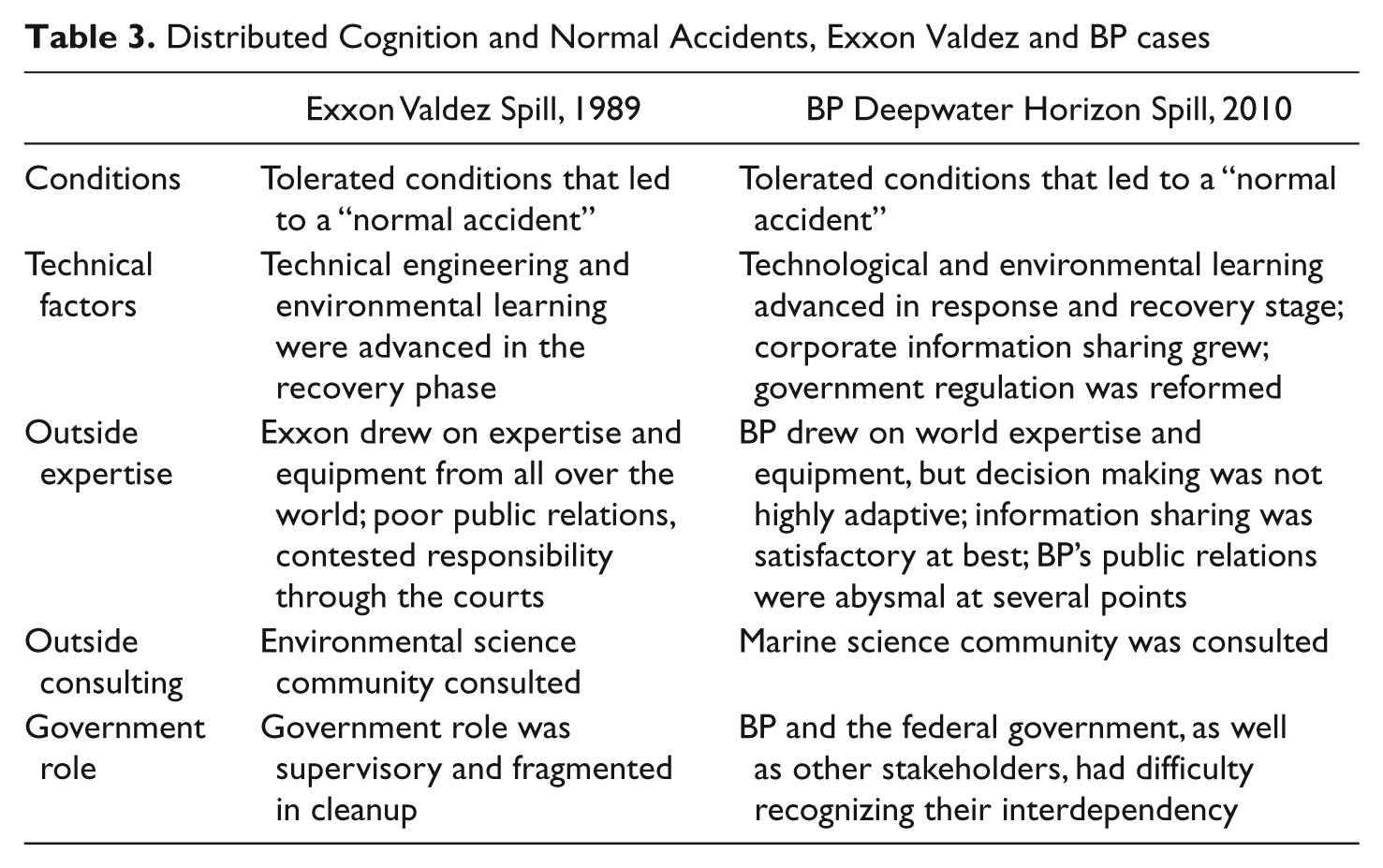
Table 3 arrays general points of comparison and contrast within the realm of distributed cognition and in terms of normal accident theory. Both cases evidenced tolerance of normal accident conditions; each case triggered reforms in law, policy, and regulation; each case impacted the oil industry, but lapses in safety culture owing to the drive to meet production schedules; public relations by the major corporations alleged to be responsible parties was poor to abysmal. A distinctive difference was that Exxon’s spill cleanup fund was imposed on them as a requirement, while BP took the initiative after meeting with President Obama and established a spill fund in advance of how litigation of liability played out.
Distributed Cognition and Normal Accidents, Exxon Valdez and BP cases
The BP Deepwater Horizon oil drilling platform explosion and ensuing catastrophic oil spill into the Gulf of Mexico has and will reshape oil spill disaster management and preparedness. The spill again revealed in stark terms the inadequate condition of U.S. coastal disaster mitigation and preparedness. The mile-deep discharge of oil into the Gulf of Mexico was arguably one of the worst oil spill disasters in U.S. history and the largest oil spill in U.S. territorial waters.
Just as in the Exxon Valdez case, the Deepwater Horizon disaster is generating major long- and short-term social, economic, and environmental effects. The BP disaster, like the Exxon spill of 1989, revisits disaster response and recovery issues. To what degree were political and corporate officials of 2010 informed by the experiences of their predecessors in 1989? Although substantive legal requirements were introduced to manage the environmental and economic losses after the 1989 spill, new issues of scale, technology, and responsibility arose in the 2010 spill. These issues brought into serious question whether or not lessons were learned by both corporate and government officials responsible for managing risk in this highly technical enterprise. Did they learn lessons that would protect them from future economic, political, and environmental harms posed by vast oil discharges into coastal waters? What lessons, if any, were learned?
Table 4 summarizes issues involving nested sets as the theory applies for each incident. Ironically, mobilization and spill cleanup posed interesting differences and parallels. Owing to Alaska’s remote location and the assumption that major spills would be most likely near the Port of Valdez oil terminus, little provision had been made to prepare for spills further out in Prince William Sound. The great concentration of oil platforms along the middle and western Gulf Coast convinced corporate and government authorities to prepare for possible oil spill cleanups. But few anticipated a 3-month discharge of oil at prodigious rates from a mile beneath the surface. Government planning for response and cleanup entrusted, just as in 1989, much to the corporate spiller. Government in 1989 had limited expertise in supervising a massive oil spill in a remote and environmentally sensitive location. Governments in 2010 had little expertise to reason how to halt to a sea floor laceration discharging oil at daily rates that exceeded those of many oil-producing U.S. states.
Comparison of Issues Involving Nested Sets, Exxon Valdez and BP cases

As Table 2 shows, some 2,600 vessels were reported to have been involved with the BP spill cleanup. By early June 2010, these vessels had deployed an estimated 4.4 million feet of sorbent and containment boom (with another 2.9 million feet of boom available). In addition, over 1 million gallons of oil dispersant have been used. Some 17 staging areas across Louisiana, Mississippi, Alabama, and Florida were rapidly created to defend sensitive shorelines. In all, some 20,000 people were working, some around the clock, to protect Gulf Coast waters and coastlines. In contrast, during the peak of the Exxon Valdez cleanup in the spring of 1989, 10,000 workers, 1,000 boats, and 100 airplanes and helicopters were involved (Levy & Kopalakrishnan, 2010). The scale of response in each case was massive. In many respects, from 1990 to the present, advances in oil discovery and oil drilling technology have significantly outpaced government’s capacity, or willingness, to oversee and regulate the industry.
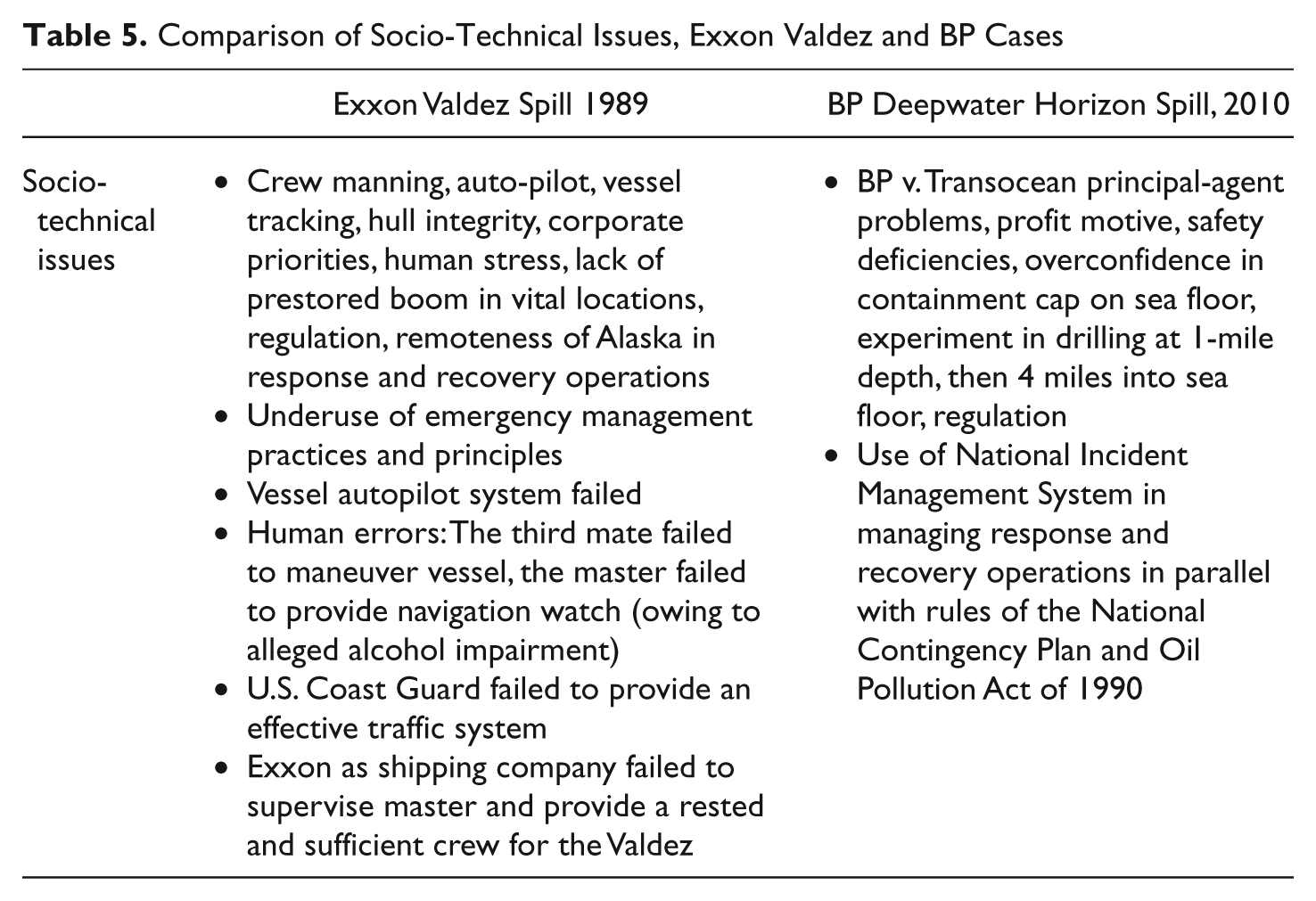
Table 5 presents socio-technical issues that pertain to each case. The Exxon Valdez grounding and ensuing spill emanated from human error, mismanagement, and perhaps an overconfidence in vessel auto-navigation. The BP Deepwater Horizon explosion and ensuing sea floor oil discharge represented a high-risk engineering decision manifesting poor safety culture and overconfidence in a blowout preventer used at extreme depths and under unanticipated horrific conditions (explosion and sinking of its overhead platform).
Comparison of Socio-Technical Issues, Exxon Valdez and BP Cases
Both cases illustrate the interdependencies among federal, state, and municipal authorities as they conducted response operations for the spill. Both cases also demonstrate the complexity introduced into managing response operations when government and corporate actors possess different types and degrees of knowledge and skills (distributed cognition). Furthermore, both cases demonstrate the interaction between lapses in human judgment and massive consequences from the breakdown of large-scale technical systems, illustrating Perrow’s (1984) thesis regarding “normal accidents.”
The National Contingency Plan
U.S. oil spill disaster preparedness is very much a function of massive and yet detailed planning. These plans are repositories of information that assign certain organizations specific duties, but also set out a template for organizational coordination, outline expected flows of information, array best practice knowledge, chart authority and accountability relationships, and embody law and policy.
The National Oil and Hazardous Substances Pollution Contingency Plan (NCP) was enacted in 1968 in response to a massive oil spill from the oil tanker Torrey Canyon (U.S. Coast Guard, 1989). The NCP sets forth the organizational structure and procedures for preparing for, and responding to, discharges of oil and releases of hazardous substances, pollutants, and contaminants. 3 In 1991, through Executive Order 12777, President G.H.W. Bush delegated to the Environmental Protection Agency (EPA) the responsibility for the amendment of the NCP. 4
The NCP is relevant here because it applied in the government and corporate responses to the Exxon Valdez disaster (1989) and the BP Deepwater Horizon disaster (2010). The NCP for an oil spill depends on the spill location, federal statutory requirements, local regulations, and procedures of the federal response authorities who work with regional, state, and local response officials. The NCP sets forth responder training and expertise requirements. It also describes equipment, logistics, administrative needs, and funding systems and offers response guidance. The NCP defines the roles and responsibilities of the oil spill On-Scene Coordinator. 5
Since 1989, changes have been made to the NCP, regulations added or revised, new elements added, and reforms made as advances in socio-technical systems of oil production and oil regulation necessitated. However, federal, state, local, and BP management of the 2010 Deepwater Horizon oil discharge was shaped by the NCP just as it was for government and Exxon Corporation management of the Exxon Valdez spill.
The Oil Pollution Act of 1990
The Exxon Valdez spill impelled congressional enactment of the Oil Pollution Act of 1990 (OPA-90) and motivated the oil industry to create a Marine Spill Response Organization. OPA-90 redefined the roles of federal and state officials in oil spill emergencies (Sylves, 1998). The Exxon Valdez disaster also generated major long- and short-term social, economic, and environmental effects.
The Oil Pollution Act of 1990 (see Table 6) was signed into law by President G.H.W. Bush as P.L. 101-380 on August 18, 1990, about a year after the Exxon Valdez spill. The measure represented the most ambitious regulation of the oil transport industry ever undertaken (see Table 6).
Major Headings of the Oil Pollution Act of 1990
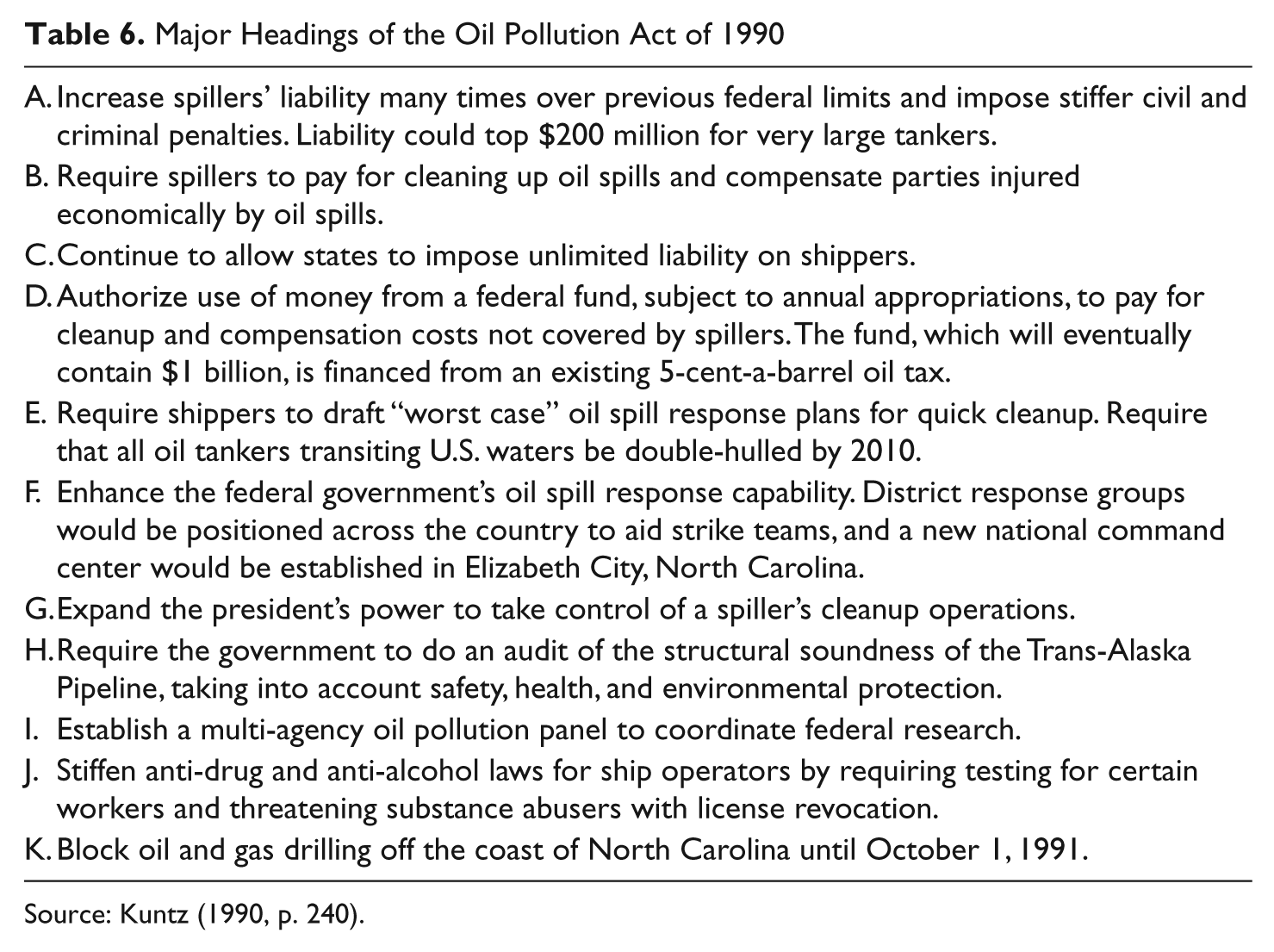
Source: Kuntz (1990, p. 240).
Congress had considered the possibility of a catastrophic oil spill before 1989. Legislators had attempted to pass oil spill reform measures for years, but there was no sense of immediacy that prompted agreement. After the Exxon Valdez spill, the pressure to respond quickly and decisively “ended a nearly 14-year deadlock over how to streamline and strengthen federal oil pollution control laws” (Birkland, 1997, p. 74).
The Exxon Valdez oil spill was a focusing event and revealed the inadequacy of previous regulations. There had been earlier federal laws; one imposed taxes on oil companies, the proceeds of which went to a fund to pay for cleanup of oil spills. Disputes over the liability to individual states as opposed to national liability were a tedious area that Congress had been reluctant to broach (Birkland, 1997). After the spill, when environmentalists tried to invoke a liability provision under the Trans-Alaska Pipeline Authorization Act of 1973, the shortcomings of existing law were revealed. The recovery provision was never successfully enforced, and even if it had been, the $100 million liability cap for spillers would have been woefully inadequate to pay for the Exxon Valdez cleanup (Birkland, 1997).
The passage of OPA was a major legislative accomplishment, especially owing to the amount of money that the fund eventually accrued. In addition, it “required companies to submit contingency plans to the Coast Guard and the EPA. Vessel operators were required to train their employees in oil spill response” (Kraft, 2004, p. 179). Public outrage, and media coverage critical of Exxon, impelled Congress to act. It forced petroleum companies operating in the United States to prepare for future oil spills. The true test of the legislation would be in the aftermath of another catastrophic spill, an event that transpired in 2010.
Under OPA-90, the intent was that all tankers plying U.S. waters would be “double hulled” by the year 2010. Double-hulling an oil tanker is a technological and structural type of mitigation. More unannounced inspections of tanker vessels by the U.S. Coast Guard to determine whether these vessels are being properly staffed and operated represent a human monitoring of technical performance essential to mitigate failure in large-scale socio-technical systems.
Yet, OPA-90 did not resolve all problems. For years, controversy swirled around such concerns as spill liability, the role of citizen advisory committees, availability of rapid-response oil spill cleanup contractors, disputed environmental cleanup methods, slow conversion to double-hulled tankers, determination of oil spill presidential disaster declarations, the emergence of single-vessel ownership companies (which exploit the law by declaring bankruptcy immediately after their vessel causes a major oil spill), and variable state oil shipping rules. These issues continued to pose complications and vulnerabilities long after enactment of the law (Sylves, 1998).
Regrettably, OPA-90 chiefly targeted oil spills emanating from oil conveying water freight more than it did oil spills caused by oil drilling platforms. However, the law advanced emergency preparedness and response for oil spills regardless of source. Yet, its disaster mitigation provisions largely failed to address the possibility that a catastrophic oil spill might be precipitated by a drilling platform disaster.
Moreover, federal regulation of oil drilling practices and procedures at sea was, until recently, assigned to a little known Department of the Interior (DOI) agency that was not vigilant with respect to oil spill prevention and that approached its jurisdiction as one of energy resource development and facilitation. DOI’s Minerals Management Service (MMS) has been pilloried by the news media for being “captured” by the interests it was assigned to regulate. The agency routinely rubberstamped oil industry requests for permits and imposed regulation in a lackluster manner. Disaster mitigation was a low priority for MMS.
Had the Coast Guard’s system of oversight, inspection, and enforcement, in conjunction with its emergency management approach to regulation, been applied to oil platforms as it was to water freight and oil tankers, perhaps BP and Transocean (the drilling platform owner and operator) might not have taken some of the drilling risks that they reportedly did:
Under President George W. Bush the Minerals Management Service (MMS), which has responsibility of monitoring oil rigs, was rendered ineffective and the opinions of scientists were downplayed. Specifically, the oil industry pressured the GW Bush administration to promote a strategy of industrial deregulation. MMS officials reportedly did a poor job in regulating the oil and gas industry and at times operated in an incompetent and corrupt manner by allowing industry officials to complete their own inspection sheets and by accepting gifts from the companies they were supposed to be monitoring. (Levy & Kopalakrishnan, 2010, p. 310)
The OPA-90 governs federal response in the BP oil spill case. The measure explicitly places the burden of cleaning up a spill on the company that caused it but vests the president with the authority to employ federal or state assets (e.g., the Navy and National Guard) in order to contain, burn, disperse, and remove the oil. Under this provision, more than 2,600 vessels worked the zone of the BP Deepwater Horizon oil discharge under supervision of the Coast Guard.
The responsible party—BP in this instance—is not protected by OPA’s $75 million cap on economic damages even though OPA limits the liability of the responsible party to this amount. BP executives conceded early that the firm would assume 100% of federal and state cleanup expenses, which had already approached $1 billion as of early June 2010. In addition, BP agreed to dredge up walls of sand off the coast of Louisiana at a cost of another $360 million. Hence, while OPA limits the liability of the responsible party to $75 million, BP’s tacit admission of liability and willingness to pay make the issue of the $75 million liability cap moot (Parloff, 2010).
Moreover the $75 million OPA limit does not apply if the responsible party—or any of its contractors, such as rig-owner Transocean Ltd., cement contractor Halliburton Energy Services, or the blowout preventer manufacturer Cameron International—can be proven to have acted with gross negligence or are shown to have violated safety laws and regulations. If either BP or a contractor violated a federal law or regulation on these grounds, liability would be limited only by the total amount of claims payouts, including total reimbursement of governments (all levels) incurring expenses for the cleanup (Levy & Kopalakrishnan, 2010).
Presidential Role in Oil Spills
Since 1951, presidents have had the authority to issue declarations of major disaster to states and their localities. In addition, the president has long held authority under the National Contingency Plan for Oil Spills to mobilize a federal response, launch investigations and prosecutions of responsible parties, and provide for some of the needs of the affected publics. President George H.W. Bush, advised by Coast Guard officials supervising the cleanup of oil discharged from the Exxon Valdez, was reluctant to recommend federalization of that spill because he assumed Exxon Corp. had the money, expertise, and resources to manage the cleanup.
There was also some suspicion that President G.H.W. Bush did not want to direct any more “borrowed federal monies” to clean up the spill than was minimally necessary. Better Exxon should pay as much of the cost as possible conducting the cleanup under Coast Guard supervision (Sylves, 1998, p. 25). The governor of Alaska in 1989 asked President G.H.W. Bush for a declaration of major disaster twice and the president denied his request each time. The same rationale applied in the BP Deepwater Horizon case. In spring 2010, President Barrack Obama confronted the same dilemma that President G.H.W. Bush had in 1989: whether to issue a presidential declaration of major disaster for an oil spill. In 2010, for similar reasons, the OPA-90 dissuaded President Obama from declaring a major disaster (authorized under the Stafford Act of 1988), although the president could have effectively federalized the spill under OPA-90 if he chose. Officials of the Obama administration, like the G.H.W. Bush administration before, believed that the oil company in question was both culpable and financially responsible. Had Obama imposed his authority under OPA-90 by federalizing the BP spill, and if instead had he issued major disaster declarations under the Stafford Act of 1988 to governors of the spill-affected states, he would have risked transferring a major portion of oil spill response and recovery costs to the U.S. taxpayers owing to the litigation surrounding spill causality.
While the Stafford Act of 1988 does permit subrogation (reimbursement) of federal disaster costs via charging the responsible party, the act holds that this is legal only if the federal government can show that the responsible party created the disaster intentionally or through negligence. Disasters attributable to “accident” close the door to reimbursement of federal costs by the responsible party.
Under OPA-90 (see item G of Table 6), the president is granted more authority to take control of disaster management in the event of an oil spill. President Obama engaged this authority, not by federalizing the spill, but by employing the National Incident Management System (NIMS) to work jointly with BP in managing spill response. Obama called out a host of government officials, including heads of cabinet-level agencies. He designated former Coast Guard Commandant, Admiral Thad Allen, as the federal incident commander of the spill response and recovery.
Unlike G.H.W. Bush, Obama assumed responsibility for spill management, even though the oil discharge was caused by private sector corporations. President Obama invoked OPA-90 to ensure BP was held liable and responsible for cleanup and spill containment. Moreover, once BP established a $20 billion Oil Spill Liability Fund through which to pay claims of parties that could prove they were damaged by the spill, Obama White House officials did not think it necessary that spill-damaged Gulf States petition the president for declarations of major disaster under the Stafford Act. Instead, states, localities, and private parties were free to apply to BP’s fund to cover their direct losses and oil spill response costs. However, “to receive a Final Payment, a claimant will be required to sign a release precluding the claimant from seeking further compensation from the Gulf Coast Claims Facility (GCCF), the Coast Guard, or in court from either BP or any other defendant companies allegedly responsible for the Oil Spill.” 6 An interesting twist is that President Obama mobilized the federal response to the spill under the National Incident Management System (see Table 1 for NIMS origin), something associated more with Stafford Act than OPA-90. Nevertheless, the Oil Spill National Contingency Plan was the template for federal emergency management, for federal relations with the responsible party, and for setting legal liability rules and cost reimbursement.
There are lessons here for both corporate and government officials. Both cases demonstrate that federal oil spill policy is complex and subject to interpretation by the presidents. Also, presidential decision making in both cases manifested features of socio-technical systems through which the president was constantly informed, advised, and counseled as each respective spill incident transpired. Also, President Obama’s activation of NIMS meant that distributed cognition and the intergovernmental processing of information via nested sets characterized the response to the BP incident. Oil spill management has become an ever-more sophisticated type of socio-technical system.
More About Liability for Oil Spill Damage and Recovery
Despite new authority in 1990 to federalize oil spills and despite availability of an Oil Spill Liability Trust Fund, ambivalence emerged in the 2010 oil spill. In fact, the United States still relies on the private sector to provide the bulk of the resources and expertise to clean up a major oil spill. Despite having improved in-house oil spill cleanup capabilities, the Coast Guard cannot bear the complete burden of major oil spill cleanup independent of private contractors, spill cooperatives, and perhaps the Marine Spill Response Corporation (MSRC). The MSRC was established by private oil companies in the wake of the Exxon Valdez disaster (Sylves, 1998). It continues to this day and was engaged in the 2010 Gulf oil spill response, though MSRC never grew to the dimensions anticipated at its founding.
The BP Deepwater Horizon oil spill case may or may not involve application of Gulf state oil spill liability law. It may not involve application of state liability punishment of BP and other responsible parties if BP’s Oil Spill Compensation Trust Fund ultimately pays for damages. Conversely, state oil spill liability laws may come into play if all damage and claimants are not satisfactorily compensated in the affected Gulf States. As “a responsible party” in the spill, BP is required to pay out three different types of claims: bodily injury or illness, property damage, and loss of income claims, with the greatest demand for claims coming from the latter category. BP has hundreds of claims adjusters staffing 22 centers across the four affected Gulf States, and they are processing claims for the thousands of businesses and workers whose livelihoods have been directly affected by the disaster (Levy & Kopalakrishnan, 2010).
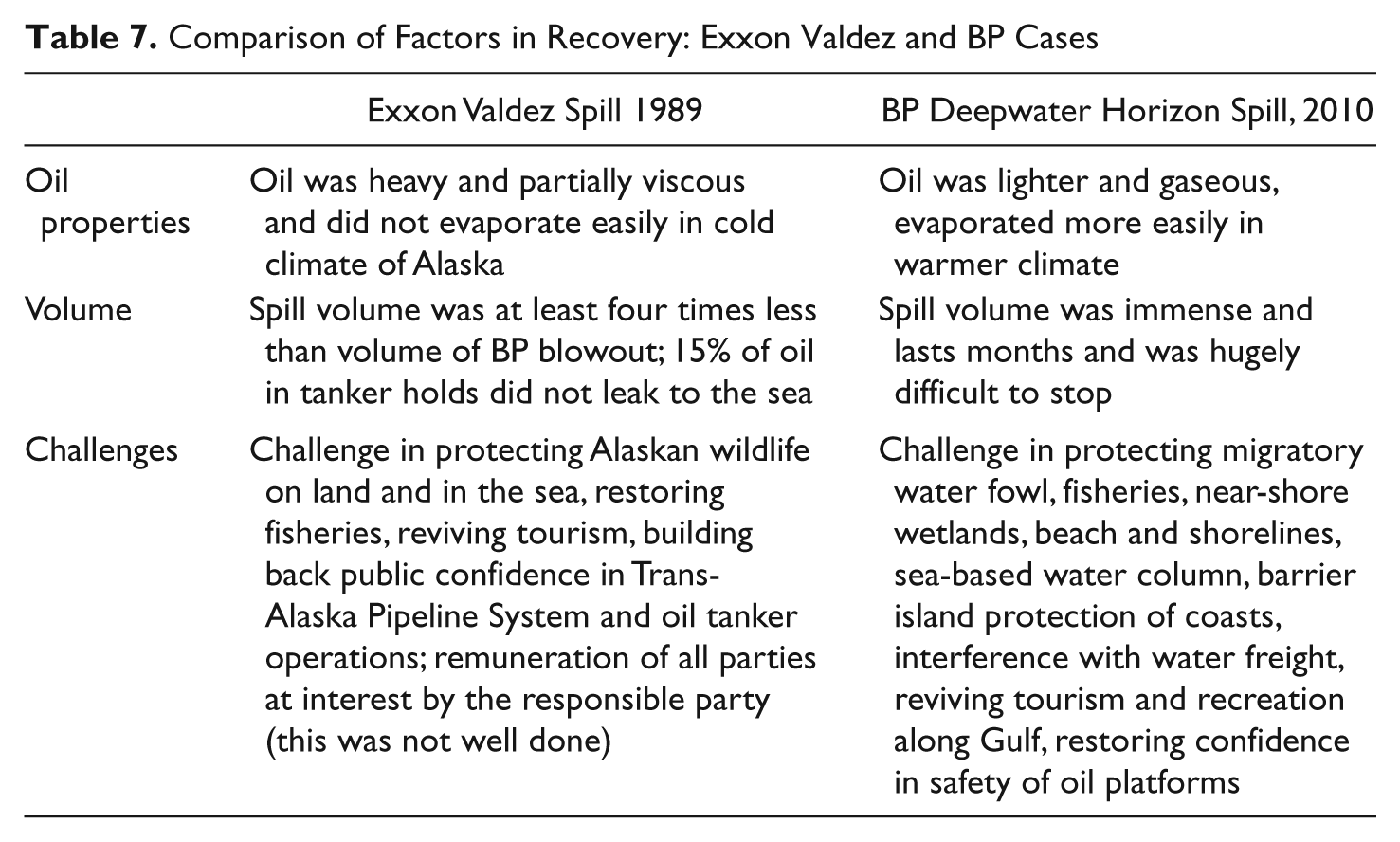
Table 7 outlines major factors affecting disaster recovery for each case. While Alaska’s environment was arguably more environmentally sensitive to oil spill damage, the Gulf Coast environment faced a much higher volume of oil discharge. It took decades of scientific analysis, some of it still ongoing, to assess all manifestations of Exxon Valdez oil spill damage. However, the mass of the spill’s effects in Alaska were near or on the surface of the water. In contrast, the BP Deepwater Horizon spill caused damage through a mile-deep water column, as well as on the surface. Location differences, climate differences, and oil volume, weight, and viscosity differences make recovery management challenges different, though in each case daunting.
Comparison of Factors in Recovery: Exxon Valdez and BP Cases
Oil Spill Cleanup and Remediation
Oil spill cleanup technology continues to advance, albeit slowly, but selecting the most appropriate technology remains a problem. There are a variety of mechanical recovery techniques. How successful any technique is depends on atmospheric and sea conditions, the character of the oil spilled, the quantity of the oil spilled, the location of the spill, and other factors. On-Scene Coordinators need to know in advance which techniques to apply, and they need to act quickly (Sylves, 1998).
A continuing controversy surrounds the twin problems of environmental damage assessment and methods of bioremediation for oil-damaged resources. Studies of the long-term impact of major oil spills on the water column and the food chain were needed after the Exxon Valdez disaster. Such studies would undoubtedly be time-consuming, expensive, and perhaps subject to challenge. However, true damage assessment could not be achieved in the absence of such studies. Also, prescriptions for appropriate bioremediation approaches cannot be reasonably put forward without a good scientific foundation (Sylves, 1998). The question is whether environmental assessment and environmental bioremediation have advanced far enough since 1989 to encompass and address the full range and scope of problems presented by the Deepwater Horizon oil spill catastrophe.
Moreover, questions and reservations pertaining to use of dispersants continue to plague the oil spill cleanup regulatory community. Dispersion is the tendency of crude oil to break up into droplets within water. This increases the surface area and allows further dissolution and evaporation of the light end of the hydrocarbons (Keeble, 1991). It is possible to spray various chemicals over an oil slick to promote this process.
However, many chemical dispersants and the dispersed oil itself contain toxins damaging to organisms and the food web. This makes dispersant use environmentally controversial. Many private oil industry and transport officials believe dispersants can be used effectively, and many even maintain a quantity of dispersant at their facilities. However, up until the Deepwater Horizon oil spill, wholesale use of dispersants was rarely approved by U.S. authorities in the aftermath of oil spills.
Nonetheless, the scale and magnitude of damage produced by the massive discharge of oil from the sea floor in the BP Deepwater Horizon case produced an air of desperation both on the part of industry and the part of government. BP engaged in huge sea surface dispersant spraying activities and with a type of dispersant not fully authorized by the U.S. EPA. Moreover, BP, with federal approval, engaged in injecting dispersant directly into the oil and gas stream from the sea floor, something never attempted before.
The Obama administration demanded that BP use more environmentally friendly dispersants to break up oil slicks. Moreover, dispersants pollute the entire water column and allow the toxic chemicals to remain dissolved in the water where they kill planktonic species and pass across gills and into digestive systems (since the dispersants prevent toxic chemicals from evaporating). The dispersant used by BP, Corexit 9500, is currently banned in British waters and poses risks to cleanup workers (Levy & Kopalakrishnan, 2010).
It is ironic that some 21 years after the Exxon Valdez oil spill, controversy reemerged over where, when, which type, and how much dispersant to use on the spill. However, in the Exxon Valdez case, U.S. authorities ruled against using dispersant owing to negative environmental effects as well as to the condition of the spill at the time. Scientific research has yet to draw conclusions about the massive surface and subsurface use of oil dispersants in the BP spill case.
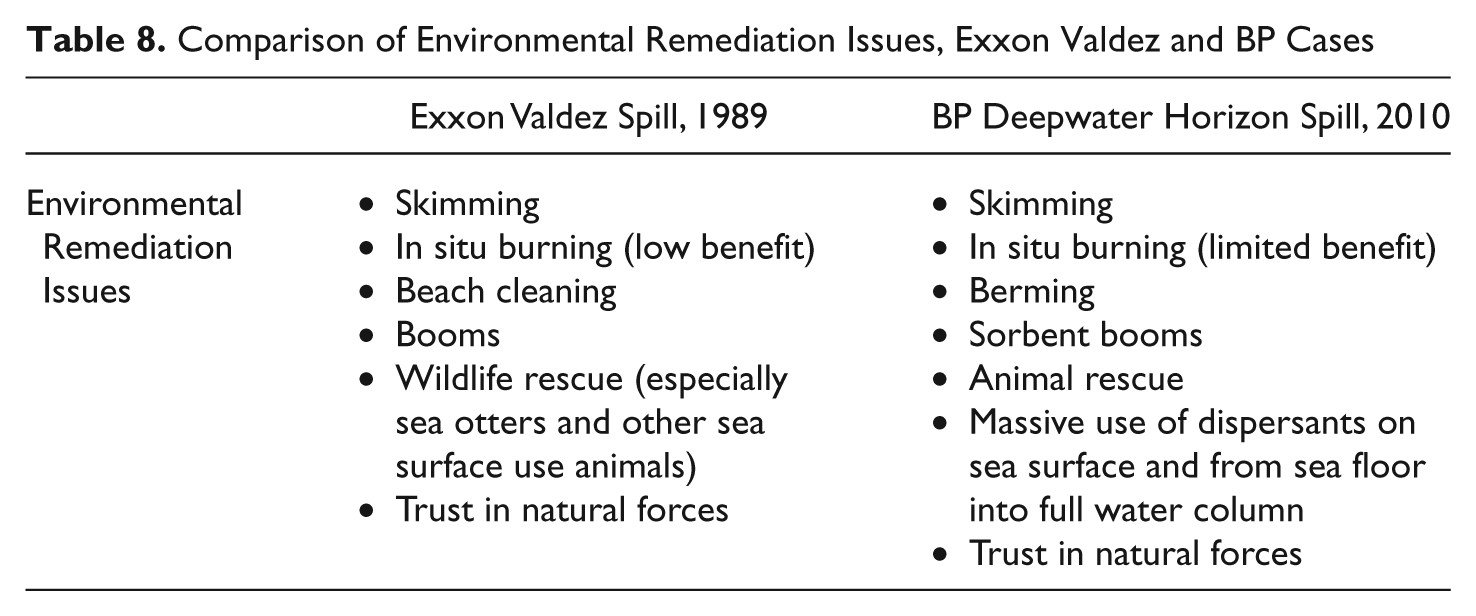
Table 8 compares several, though not all, environmental remediation issues relevant to each case. Selecting appropriate oil skimming devices and technologies, a job entrusted to the U.S. Coast Guard, was a challenge in both spills. In both cases proposals were made to burn surface oils and in both cases these proposals were deemed ineffective. More concerning are disputes about proper use of oil dispersants in 1989 and again in 2010.
Comparison of Environmental Remediation Issues, Exxon Valdez and BP Cases
Crosscutting Policies That Impede Organizational Learning
Offshore drilling in the Gulf produces 30% of all U.S. oil and natural gas. Oil tankers plying U.S. coastal waters provide an essential flow of crude oil and refined petroleum products for American industrial, utility, commercial, and residential uses.
Not long after the oil discharge from the Gulf sea floor was arrested, Louisiana Governor Bobby Jindal and Mississippi Governor Haley Barbour spoke out against President Barack Obama’s moratorium on new deepwater drilling projects, which had idled 33 deepwater rigs in the Gulf of Mexico. It was projected that the moratorium would cause rigs to be moved to oil fields outside the United States (further delaying the resumption of offshore Gulf drilling) and costing as many as 6,000 jobs immediately and 20,000 by the end of 2011 (Urbina, 2010a).
Despite President Obama’s temporary moratorium on new drilling permits and environmental waivers since the April 20, 2010, explosion, “federal regulators have granted at least 19 environmental waivers for Gulf drilling projects and at least 17 drilling permits” (Urbina, 2010a). The conflict of energy policy and environmental policy has created, as is often the case, a dilemma for the president and Congress. Preventing future oil spill disasters comes at the price of the nation’s need for prodigious amounts of oil and local oil industry employment in the central Gulf Coast area.
The Exxon Valdez disaster produced a somewhat comparable dilemma. The nation could not afford to stanch the tanker-conveyed flow of oil from the Port of Valdez. Tank farm capacity at that port was insufficient to accommodate more than a 5-day supply of Trans-Alaska pipeline system oil (TAPS). TAPS must be kept under constant flow or otherwise oil in the line congeals into a semi-solid that cannot be propelled through the pipeline. The nation could not forgo tanker conveyed oil while it waited for all oil tankers to be converted to double hulls. The nation was also poorly prepared to address the massive environmental consequences of the oil spill despite the fact that oil spills had a long history in the United States.
Conclusion
Do governments learn lessons from their experiences? Weick (1998; see also Weick and Sutcliffe, 2001) has focused the need for high-reliability organizations to anticipate and manage the unexpected. Weick and Sutcliffe (2001) use the term mindfulness to describe the ability of organizations to organize themselves and to create an organizational culture that enables them to detect and react to the unexpected. They assert that “a well developed capability for mindfulness catches the unexpected earlier, when it is smaller, comprehends its potential importance despite the small size of the disruption and removes, contains or rebounds from the effects of the unexpected” (p. 17). A primary objective of training and preparedness is to facilitate the ability to detect and manage the unexpected. The resulting awareness and ability to improvise enables organizations to focus on “the interval between anticipation and resilience during which the unexpected is detected more or less swiftly and managed more or less successfully” (Weick and Sutcliffe, 2001, p. 159; see also Harrald, 2006).
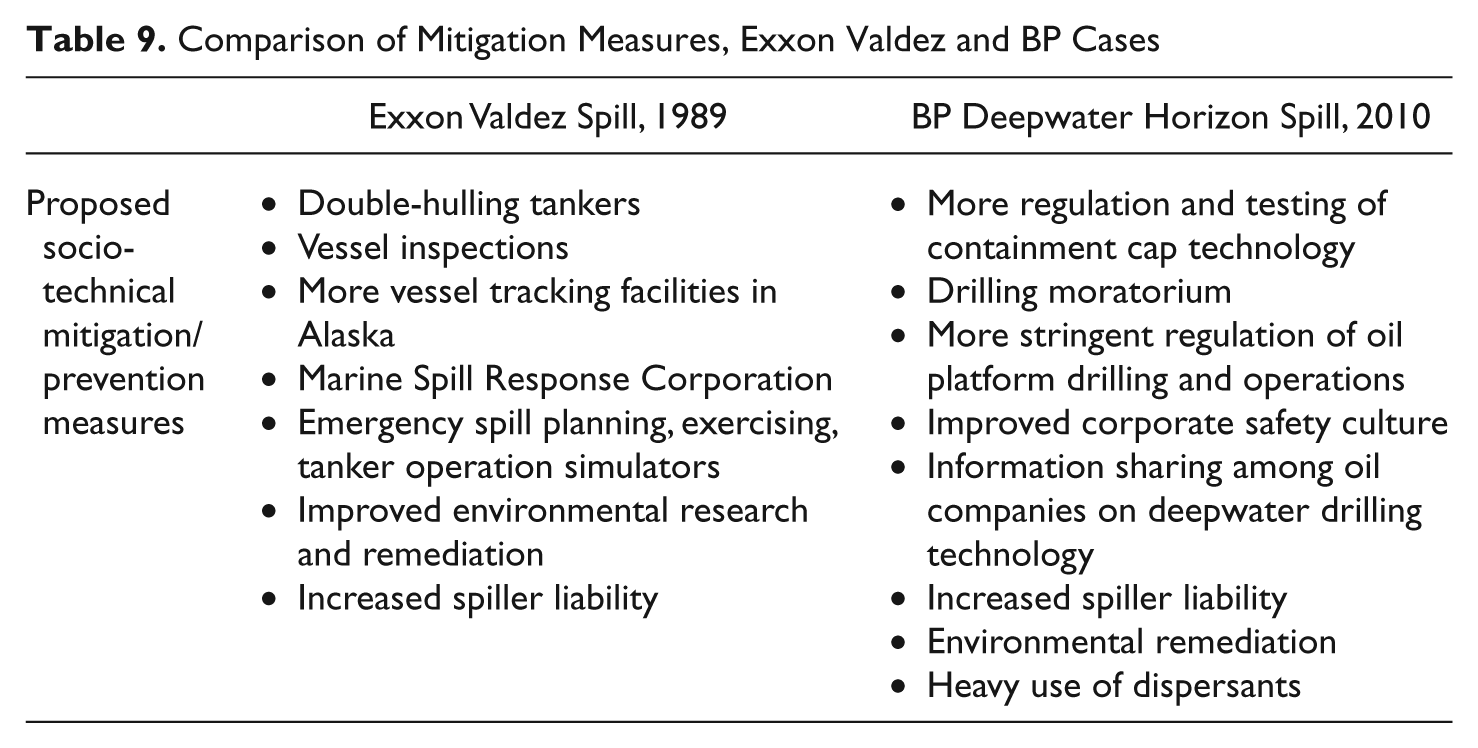
Table 9 lists mitigation measures proposed or required after each incident. While government regulation increased to address identified causes of each incident, the oil industry finds ways to adapt or conform to these requirements while continuing operations. Oil spill risk management is always balanced against the need to compete and produce profits as an oil business. Moreover, government regulation of all types has a tendency to vacillate between stringency and cooptation over time.
Comparison of Mitigation Measures, Exxon Valdez and BP Cases
Do public policy makers look for and correct gaps and deficiencies in government regulation over time? Are policy makers and policy implementers vigilant, dynamic, and adaptive when it comes to disaster preparedness, response, and mitigation? Ironically, huge advances in mass communication, information processing, online web-based tutors (wikis), and the creation of massive web-based socio-technical systems of the type characterized by NIMS and the National Response Framework make it possible for policy implementers and policy makers to be informed and expertly advised. Regrettably, the dominant political-social paradigm is to respond robustly and relatively more quickly, but to discount known hazard risks and the possibility of “black swans” (no pun intended). 7
Can organization theory and the study of socio-technical disasters help in answering these questions? The answer to the latter is a qualified yes. Both the Exxon Valdez and the BP spills were caused by a confluence of untoward incidents in an unforgiving environment. Both cases demonstrate a lack of coordination and government oversight before the fact. The different companies operating on the Deepwater BP platform often had conflicting priorities; human factors of the type examined in Perrow’s (1984) “normal accidents” played a significant role in this disaster, due to the complexities of operating the complex drilling system. In addition, governmental oversight agencies granted exceptions and allowed hazards to accumulate. In particular, the Mississippi Canyon Block 252 project was over budget and had encountered “gas kicks” (where drillers failed to keep gas from surging up the well) and other problems (Urbina, 2010b). The Exxon Valdez incident manifested many similar “normal accident” characteristics—entrusting the helm to a poorly qualified officer as a punishment, disregarding obvious navigational warnings, and inadequate governmental supervision of sea lanes in the area.
Interorganizational and interjurisdictional learning is necessary in both these cases. Nested sets connote the interdependence of levels of government in the United States. It trumpets the fact that the decisions at one level of government have dynamic and interactive effects on other levels of government. Subnational governments reside within or overlap the subsystems of both peer and overhead governments. Intergovernmental relations by definition draw corporations and governance institutions into the mix. Distributed cognition introduces the human element of achieving a “common operating picture” as a basis for action. Emergency management has made great strides in seeking to build and maintain distributed cognition through the NRP and NIMS, although not always with complete success. Distinctions between the private and public sectors complicate achievement of full situational awareness and informed choice.
Socio-technical systems may be one of the most difficult “nuts to crack.” Dependence on large-scale technical systems has increased geometrically over the past two decades, owing to computerization, development of the Internet and the World Wide Web, an explosion of telephonic and video information transmission through social media, digital-wireless-portable phones, fiber optic cables, and new video technologies.
Major disasters are large, complex, multiscalar, urgent events, of great size, scale, and complexity that demand heterogeneity in response operations to meet different levels and types of need. Such events exceed the management capacity of most governmental agencies and single corporations. This condition was apparent in the early response to the BP Deepwater Horizon oil blowout of 2010 as Gulf Coast officials joined with a host of federal and corporate representatives and responders in confronting the spill and its ongoing effects. The early response to the Exxon Valdez oil spill paralleled this condition on a smaller scale. One final similarity of the two oil spill cases is that even though principles of emergency management were followed and employed in each case, particularly in handling the BP Deepwater Horizon spill, the U.S. Federal Emergency Management Agency played no significant role in either incident. Neither President G.H.W. Bush nor President Obama elected to invite or encourage governors whose states were affected to request presidential declarations of major disaster for the respective spills. Instead, President G.H.W. Bush turned down Alaska Governor Cowper’s request twice. President Obama, fearing potential U.S. taxpayer involvement in paying for spill damage, may have convinced several Southern governors to refrain from requesting presidential disaster declarations because those governors, aided by their respective attorneys general, could make claims on the BP Oil Spill Fund without waiving their right to sue BP later on even if their states had received money from the fund. Nonetheless, given the list of legislation and policies enacted in reference to hazardous materials and oil spill management over the past four decades (see Table 1), it is clear that slowly, most often after a damaging event, governments learn from disaster events. The continuing challenge in oil spill management lies in the implementation and oversight of these large-scale, complex, socio-technical systems.
Footnotes
Portions of this article were prepared for delivery at the 2010 Meetings of the American Political Science Association, Washington, D.C., Panel 39-3 Urban Sustainability in a Changing Climate, September 5.
The author(s) declared no potential conflicts of interest with respect to the research, authorship, and/or publication of this article.
The author(s) received no financial support for the research, authorship, and/or publication of this article.