







Abstract
In 2010, Israel’s Ministry of Information and Diaspora Affairs launched a new campaign: Masbirim Israel. Its purpose was to “recruit” Israeli citizens to the task of improving the nation’s public image in the world. It was the first time a well-organized campaign was launched, systematically employing new-media tools and calling on Israeli citizens to independently take part in improving their country’s international image—all at the behest of a government ministry. The executive authority in effect delivered some of its responsibilities and obligations to private hands. This article discusses prosumption in the political sphere and expands the idea of prosumption to a domain in which the state itself is the producer and its citizens are the consumers. Prosumption is perceived as acts conducted by citizens who operate to fulfill aims (i.e., produce products) that traditionally have been in the purview of the state. The article presents two arguments: First, the campaign is an expression of the idea of prosumption in the political sphere. By integrating Israel’s citizens in the process of public relations (PR), they become prosumers in the sense that they participate in the production of a public good that traditionally has been supplied by the state. Second, the Masbirim Israel campaign is an expression of a glocalized and grobalized condition in Israeli reality, as it reflects trends of neoliberal values and practices of privatization and expresses the political opinions of (extreme) nationalism and particularism to nonformally “recruit” its citizens to the national PR effort.
In February 2010, Israel’s Ministry of Information and Diaspora Affairs (Misrad Ha-hasbara ve’Hatfuzut) launched a new campaign: Masbirim Israel. 1 The purpose of this campaign was to recruit Israeli citizens to the task of improving the nation’s public image in the world. In so doing, the state officially and systematically included its citizens in an activity that has traditionally been the sole responsibility of government ministries, that is, public diplomacy. Indeed, a popular Israeli saying is that “every Israeli citizen is an ambassador.” The Ministry of Foreign Affairs had distributed general guidelines to help explain Israel’s positions in the past, and officials urged citizens to take part in public relations (PR) efforts. But this was the first time a well-organized campaign was launched, systematically employing new-media tools and calling upon Israeli citizens to independently take part in improving their country’s international image—all at the behest of a government ministry. By doing so, the executive authority in effect decentralized and moved some of its responsibilities and obligations to private hands.
The campaign was perceived by some as an example of the privatization of a public asset—part of the effect of global trends on Israel. Yet it was essentially perceived, at least in mainstream public opinion, as a positive move (although poorly executed) that will help transform national PR into being more efficient and adjusted to the digital era zeitgeist.
Yet one should ask whether the terms privatization and globalization accurately describe the campaign and the meaning it carries. This phenomenon, in which the delivery of public diplomacy is decentralized by the state, requires deep examination and attribution to other, better, conceptual frameworks. I believe that the common meaning of the term privatization is not satisfactory in this case. Generally, privatization refers to the transferring of public good to private ownership (Harvey, 2005). Yet, in the case of the Masbirim Israel campaign, citizens—who do not necessarily belong to a unified organization (e.g., a corporation)—take part in the process of the production of a public good. Here, I believe, the recently developed term prosumption (jargon for a combination of production and consumption) better explains this campaign and sheds light on a new dynamic between the state and its citizens.
The use of the term prosumption in the context of the Masbirim Israel campaign serves therefore two purposes: First, it enables us to discuss more accurately the Israeli government’s political initiative. Second, it enables us to further develop the concept of prosumption itself—which is usually associated with the economic domain—and “export” it to the political sphere.
The use of the term globalization in this context also is problematic. As I shall demonstrate later, the campaign expresses two other elements, which are indeed connected but not similar to globalization: localization and grobalization. The former is expressed in the message that the campaign carried, and the latter is expressed in the state’s attempt to nonformally recruit its citizens to the national PR effort. The campaign is therefore better described as glocalized grobalization.
I shall address these issues by a critical examination of the campaign’s communicative outcomes, especially through new-media channels. I shall critically analyze the campaign’s website; its Facebook page, YouTube channel, and Twitter account; and the public’s response to these channels. I shall also examine the public’s opinion toward the campaign, as was analyzed and published in the local media, and I will examine the ministry’s formal reports and press releases. Yet, it should be emphasized that the essence of this article is not empirical research but, rather, a comprehensive analysis of the campaign and its outcomes in order to ground the theoretical debate in concrete examples.
The course of discussion will be as follows: First, I will generally present the idea of prosumption and discuss its manifestations in the political sphere. Second, I will discuss the terms glocalization and grobalizaton within the framework of the globalization discourse, focusing especially on the challenges with which the modern state is faced. Third, after concluding the theoretical discussion, I will describe the Masbirim Israel campaign and interpret it using ideas and terms related to the three key concepts of prosumption, glocality, and grobality.
From Producer/Consumer Dichotomy to the Prosumer
The information age and the digital technology revolution of the end of the 20th century and the beginning of the 21st century mark a paradigmatic shift in the way people discuss the world of commerce, production, marketing, advertisement, and consumption. We are now moving toward a more complex description of the concepts of production and consumption and moving away from the traditional dichotomy that distinguishes between the two (Ritzer, 2009). The emergence and availability of digital technologies, for example, cellular phones and the Internet, and the shift from a linear and hierarchical web (1.0) to a web based on user-generated content (2.0) all reflect the emergence of a new world, which requires new and updated descriptive concepts.
In the year 1980, the futurist Alvin Toffler coined the phrase prosumer in an attempt to describe a new form of interactions and outcomes between traditional producers and consumers (Toffler, 1980). Yet it took a decade and a half for this new concept to become common, with the shift from a linear and stable to a nonlinear and dynamic mode of exchange in which consumers are involved in the acts of production, marketing, distribution, and advertisement (Vargo & Lusch, 2004). This new economy is described by various names: “co-creation of value” (Prahaland & Ramaswami, 2004; 2000); “Pro-Am” (Leadbeater & Miller, 2004); “Wikinomics” (Tapscott & Williams, 2006); and the term that will be used in this article, “prosumption” (Ritzer & Jurgenson, 2008).
It was in the world of business where the idea of co-creation of value initially marked the need to integrate consumers in the acts of development, production, marketing, and advertisement, rather than in the act of consumption alone. Trends related to changes in consumer behavior (Gabriel & Lang, 2006), as well as the development of advanced technologies, demonstrated to producers the need—and the potential—in moving consumers from the realm of consumption into new domains. The relinquishment of absolute control over certain elements in the process of production, which had traditionally been exclusively in the hands of producers, was aimed to improve and adjust the fashion in which industries operate in a new and changing world.
Indeed, from a producer’s point of view, integrating consumers in the act of production reflects a new logic that aims to achieve the primary goal: maximizing profit. Yet the literature discussing the prosumer phenomena also tends to present prosumption in a more positive light, especially when looked at from the consumer’s point of view. Cooperation, self-expression, and even freedom are terms used to describe the new emancipating potential of the integration of consumers into production. In that respect, this “positive” prosumption discourse is a continuation of previous “positive” interpretations of consumption, which highlight its individual or collective emancipating potential (Elgin, 1998; Firat & Venkatesh, 1995; McRobbie, 2000; Schor, 2000; Taylor & Tilford, 2000). Yet, from a more critical perspective, there are many who claim that the alleged emancipation and freedom are nothing but the continuation of exploitation through much more sophisticated means (Fuchs, 2008; Pietrykowski, 2007; Zwick, Bonsu, & Darmody, 2008).
In recent years, the concept of the prosumer, which was initially discussed in the fields of business and economics, has been gaining much popularity in the fields of humanities and social studies. I shall now address the issue of prosumption from a political point of view. The growing role and importance of the Internet in general, and social networks in particular, has not gone unnoticed by those who study and practice politics. Political theoreticians and practitioners have started to examine political activity in the cyber domain, referring to it as a sometimes significant component in the overall effort of gaining political power.
In this context, the developing literature in recent years can roughly be divided into two different approaches. 2 The first approach, derived from a cyber-libertarian outlook (Turner, 2005), views cyberspace as a nonlinear domain that eliminates traditional limitations on political participation (e.g., class, gender, race, etc.) and, as such, intensifies political participation in general and of those on the social margins in particular (Matei, 2005). This approach claims that the unique character of the web empowers individuals to overcome the social and political barriers created by traditional gatekeepers, as the increasing accessibility to information enables increasing political involvement while creating a new, more equal and open public domain (Poor, 2005). Social networks, or in fact anything considered part of Web 2.0, are perceived as powerful tools that enable political resistance by the masses (Price & Cappella, 2002; Sanchez, 2009) or, more generally, tools for facilitating the political participation of young people in particular (Smith, Schlozman, Verba & Braby, 2009; Lenhart, 2009; Gueorguieva, 2008; Robertson, Vatrapar, & Medina, 2009; Williams & Gulati, 2007).
The second approach expresses more skepticism toward the politically emancipating potential of the web in general and of social networks in particular. Some claim that the so-called political power of users who create content in cyberspace is mediated by corporate influence since technology in general and search engines, portals, and websites in particular are driven by economic interests (van Dijck, 2009). More broadly, the skeptics claim that the architecture of the web and of the social networks themselves is an expression of political power, domination, and hierarchy. It is claimed, using a Foucauldian approach (Foucault, 1979), that power, in the rhizomatic structure of the web (Deleuze & Guattari, 1987/1980), is illusive and concealed, and therein lies its great appeal (Bauwens, 2008).
Be the general approach optimistic or skeptical, the focal point here is the participation of individuals and collectives in the process of the production of political power—most commonly in political campaigns. In this respect, one might regard the political campaign as a process aimed at producing a product, which is itself an expression or manifestation of political power (e.g., election to a political position, enactment of legislation, etc.). The political involvement of individuals and groups in campaigns, for example by expressing opinions in social networks, can be described in terms of prosumption, as it is very similar to consumers’ involvement in the act of production: Participants create political content and conduct political activity, which in turn is supposed to create a political outcome (i.e., a political product), in the light of political guidelines determined by politicians.
It seems that this description of prosumption in the political sphere focuses on consumers operating for or under the guidance of politicians who strive to achieve political power or, alternatively, operate independently to gain such power. Yet, this description does not relate to the state as the starting point, and it does not relate to the relations between the state and its citizens. The idea of prosumption should therefore be expanded to a domain in which the state itself, as a political entity, is the producer and its citizens are the consumers. In this light, prosumption should be perceived as acts conducted by citizens who operate in order to fulfill aims (i.e., produce products) that traditionally had been within the sole purview of the state.
To shed light on this idea, we must expand the scope of the meaning of prosumption to the political sphere and create an analogy between the sphere of business and economics and that of politics. By using this analogy, I shall address the state as a producer, the citizen as a consumer, and the public good or service as the product.
Let us address the state as a producer that produces a “public good” for the benefit of the community (Olson, 1971, 1982; Samuelson, 1954). The public good is produced for the state’s citizens, and in this respect we can identify the latter as consumers. It is true that the citizens operate within the framework of the state, and one might claim that every citizen is by definition both a producer and a consumer. Take for example models of regular armies based on compulsory enlistment (like the Israeli army): The purpose of the army is to defend the nation, that is, to provide a public good, which is the national defense. One might claim that since these armies are composed of enlisted citizens, the latter are prosumers, since they take part both in production and in consumption of the public good. However, when I make the analogy of the state as the producer and its citizens as consumers, it is an analogy that lies within the realm of social structures, and not from the perspective of the agents operating within those structures. Indeed, citizens operate within the state’s organizational framework, but when I address the state as a producer, I refer to the structures or the organizations that produce the public good, and not to the individuals who operate within them. It is clear of course that these state organizations are composed of individuals, yet one must distinguish an organization composed of individuals (which I would define as producers) from individuals operating outside these organizations (which I would define as consumers). Similarly, companies are composed of individuals yet structurally described as producers—even though under certain circumstances, these individuals themselves are consumers of their own products (see Table 1).
The Shift Toward Political Prosumption
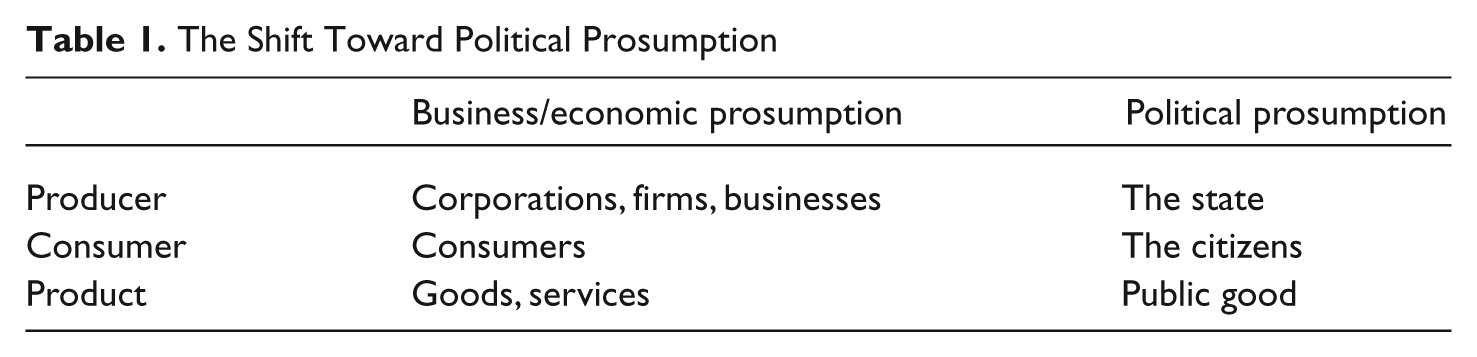
We can demonstrate this idea with the example of the use of force by the state. As recalled, one of the elementary principles that defines the idea of state sovereignty is its monopoly on the use of force and violence within a given territory (Weber, 1921/1964, p. 154; Weber, 1994). For example, military operations are conducted in the name of the state and by organizations that are sanctioned within the framework of the state (even when operating under cover). The public good (product) in this case is what the state defines as its strategic goal in carrying out this military operation—for example, providing its citizens (i.e., consumers) with security.
The availability of technology and information allows individuals and groups to participate in the production of the public good. Again, we must not confuse this kind of participation with actions conducted by individuals in the name of the state and through its own apparatuses (e.g., spies, special ops, or even military units). When arguing that individuals and groups can participate in the production of a public good related to the use of violent means, I mean participation that is not necessarily organized by the state, even if in some respects the state might condone or influence such activities.
There are many examples, and I shall briefly present only one: During Israel’s military operation in Gaza (in 2009), an anonymous group of Israelis established a website that enables users to attack “Hamas” websites by downloading a denial-of-service file. 3 They claimed to be a “group of Israelis, fed up with seeing Israeli settlements attacked by ‘Hamas’” (Grimland, 2009). It is worth mentioning that at the same time that “Hamas” websites were under attack by ordinary Israeli civilians, Muslim hackers (probably not organized under any government apparatus) also attacked Israeli governmental and commercial websites.
We can therefore identify two types of prosumers within the political sphere—both are expressions of voluntary political activity by individuals or groups. The first is related to prosumerist political participation, which is not established by the state but rather as an independent venture or under the guidance of a political figure. The second is related to prosumerist political participation, which is indirectly supported by the state and which yields (or from another perspective, expands) its traditional authority. The latter kind of political prosumption can be described as decentralization of some of the state’s responsibilities, delivering them directly to its citizens. As we shall see, the Masbirim Israel campaign can be examined in the light of the second prosumerist model.
Global, Local, Glocal, Grobal
I wish to link the discussion of prosumption to certain aspects of political globalization. I shall focus especially on the challenges that global processes pose to the modern state, and later I shall explain how the idea of political prosumption is a response by the state to these global challenges.
The idea of the state has been one of the most prominent elements in the organization and regulation of human society over the last 350 years. Yet, processes related to globalization erode the state’s position as the main definer of human geographical space (Hayman & Williams, 2006). Movements of capital, people, technology, information, ideas—along with the growing power and influence of multinational corporations and nongovernmental organizations—all pose a continuous challenge to the framework of the state and to the organization of a world system composed of sovereign states. There is a debate whether these challenges mark the decline of the state as the main political entity (Strange, 1996) and whether the nation-state continues to be the major player of the international system (Gilpin, 2001) or at least retains some power (Conley, 2002). I do not elaborate further on this particular debate. However, it is helpful to describe these challenges as pressures “from above” and “from below” the state.
Global trends put stress on the state from above, especially in two main aspects. 4 First, the state is challenged in its ability and willingness to maintain sole sovereignty over the distribution of power within its borders. Global corporations, international organizations, individuals, and groups all become central players in both the international and local arenas while eroding the power of the state. Second, the idea of the welfare state is challenged due to the erosion of the state’s obligation to the welfare of its citizens and the abandonment of the social and economic sphere to the vicissitudes of market forces (Harvey, 2005). In this respect, we can identify several key trends (which still are effective, even in the aftermath of the latest global economic crisis): the unification of national markets into one global market, the flow of capital to places where the workforce is cheap, technology that replaces manual labor, and the radical emergence of a neoliberal ideology that promotes the minimization of government involvement in social and economic affairs (Harvey, 2006). These trends mark the transition of the nation-state from an organized capitalist state to a nonorganized capitalist state (Lash & Urry, 1987) or from a welfare state to a competition state (Cerny, 1990, 1997). The long-term effects of the recent global crisis on these aspects of the state remain to be seen.
These processes, which are shaped by global trends, create local counterreactions. As opposed to only challenges from above, challenges from below arise as well (Ram, 2005): isolationism, communitarianism, nationalism, and fundamentalism. The state framework that is perceived as disappointing and inadequate and the capitalist culture that is perceived as nihilistic and shallow are supplanted by smaller frameworks that enable the preservation of social responsibilities and of traditional culture and values. This state of affairs was named by Barber and others as the state between McWorld and Jihad: The first signifies the industrialized West, modern technology, consumer culture, and global universalism; the second signifies fundamentalism, sectarianism, and locality (Barber, 1995; Clark, 1997).
The new political state of the 21st century is therefore the glocal condition (Robertson, 1995, 2001): a constellation in which the state is challenged by forces from above and forces from below and thus eroded in the organizational, identical, and cultural perspectives. It is being challenged by forces that seek to merge it with its much larger exterior environment, and it is being challenged by communal identification patterns that seek to disassemble it into smaller internal units (Rosenau, 1997). The global trends purportedly subvert existing local trends; however, not only do they not abolish them, but they inflame and intensify them instead. Thus, the global and the local become mutually linked: The former draws its legitimacy from the “new,” and the latter draws its legitimacy from the “old.” This is the basis of our human condition: on the one hand, unprecedented unification, and on the other, unprecedented disintegration.
To that we should add grobalization (a combination of grow and globalization), that is, the “imperialistic ambitions of nation-states, corporations and organization, and their imposition throughout the world” (Ritzer, 2010, p. 267). In the context of this article, the idea of grobalization signifies the ambition and need of modern nation-states to impose themselves on various aspects of social and political life in order to see their power and influence (Ritzer, 2007, pp. 15-16).
As we shall see, the Masbirim Israel campaign encompasses global, local, and grobal elements. On the one hand, it expresses the neoliberal principle of the state’s decentralization and it uses global tools (i.e., new media). On the other hand, it expresses ideas and notions that can be categorized as local (i.e., nationalism, communitarianism, etc.). In that respect, the campaign is an example of the glocal condition of Israel. At the same time, the campaign expresses the state’s attempt to discipline decentralized PR efforts by creating a unified message base for its citizens. As such, it is an expression of the grobalization of the state in Israel.
Masbirim Israel Campaign
In February 2010, following some 6 months of preparation, Israel’s Ministry of Information and Diaspora Affairs launched a campaign titled Masbirim Israel.5 The purpose of the campaign was to turn the hundreds of thousands of Israelis who travel abroad each year into nonofficial ambassadors who contribute to Israel’s PR efforts and help improve the country’s image worldwide.6 Prior to the campaign, a poll ordered by the ministry revealed that 91% of the Jewish-Israeli population believed that the world perceived Israel in a very negative light. About 90% believed that the world viewed Israel as a place susceptible to terror attacks, 80% claimed that Israel was perceived as an aggressive state, 30% thought that Israel was perceived as a nonfriendly state, and 26% believed that Israel was perceived as a nondeveloped country. On the other hand, 85% claimed that they would be happy to join an effort to improve Israel’s image (Hoffman, 2010).
The campaign aimed to equip all Israeli citizens (as we shall see, every Jewish-Israeli citizen) with tools that would enable them to become PR agents. As part of the campaign, a new Hebrew-only website was launched (www.masbirim.gov.il) 7 with extensive information regarding Israel’s history, politics, society, demography, culture, and so forth. The campaign website also included tips for PR best practices: listening, maintaining eye contact, correct body language, and so on. In addition, a Facebook page and a Twitter account were launched, and booklets with PR messages were distributed in Israel’s Ben-Gurion international airport. The ministry also launched workshops for teaching PR techniques specifically designed for tour guides.
The basic message that the campaign seeks to promote is that Israel is a highly developed country—socially, politically, and technologically—and that the Israeli–Arab conflict is rooted in the refusal of Israel’s Arab neighbors to accept its right to exist and is not due to Israel’s government policies.
The campaign was followed up with TV, radio, and Internet advertisements, all demonstrating how the world views Israel in a distorted fashion. Three clips were presented: In the first, a British journalist reports that the camel is the primary means of transportation in Israel. In the second, a Spanish reporter contends that Israelis eat barbeque outdoors because there aren’t any kitchens in Israel. In the third, a French reporter claims there are bombings on Israel’s streets, not realizing the sounds he hears are fireworks celebrating Israel’s Independence Day. The message is clear: The world is biased, and international reporting on Israel is riddled with false information. Hence, every Israeli citizen must be recruited to a collective effort to change this image.
According to the Government Advertisement Chamber, during 2010 more than a million site entries were listed, and more than 200 PR workshops (especially for youth and official delegators) were supposed to be held. 8 A survey conducted shortly after the launching of the campaign indicated that these advertisements were the most talked-about ads on Israeli websites. Two weeks after the launching, 56% of those with positive attitudes toward the campaign believed it was funny and witty, and 44% believed it was morally justified. Among those with negative attitudes, 54% percent claimed that it perpetuated stereotypes about Israel and reflected right-wing interests and positions, 21% thought that the campaign reflected good intentions but would have an opposite effect than intended, and 14% believed that the campaign should focus more on messages related to terrorist actions and other issues (Ben-Leibovitch, 2010).
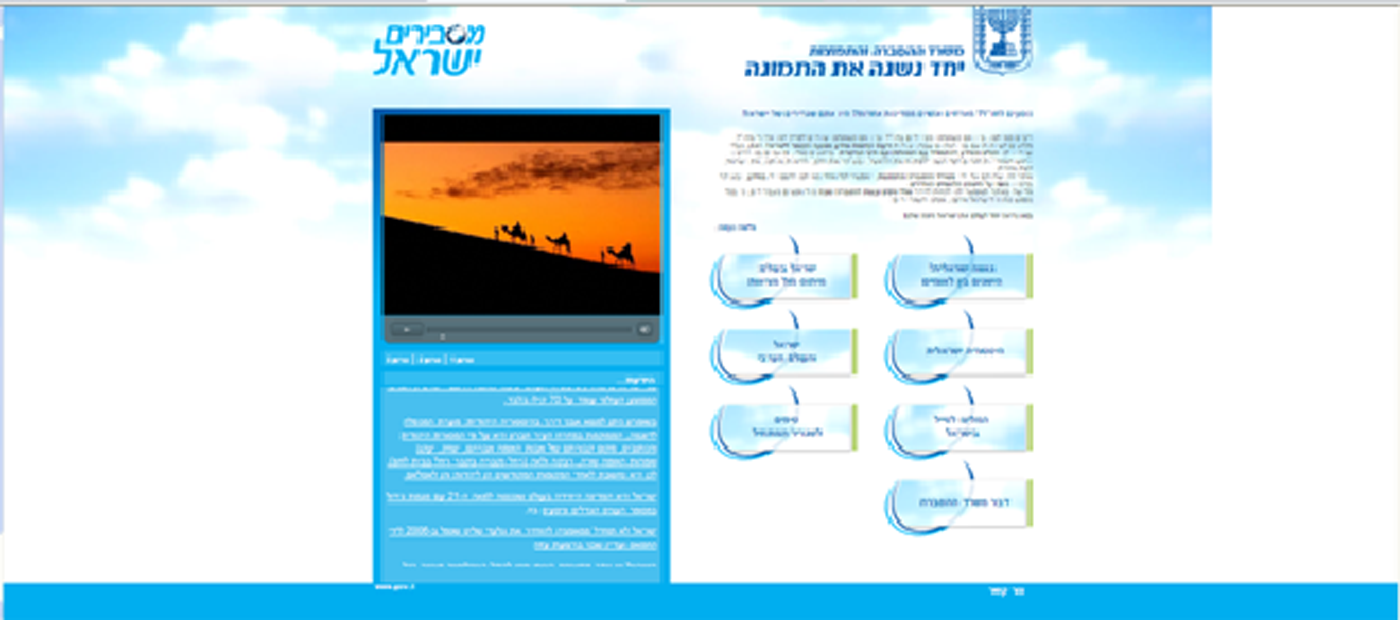
Masbirim Israel campaign home page
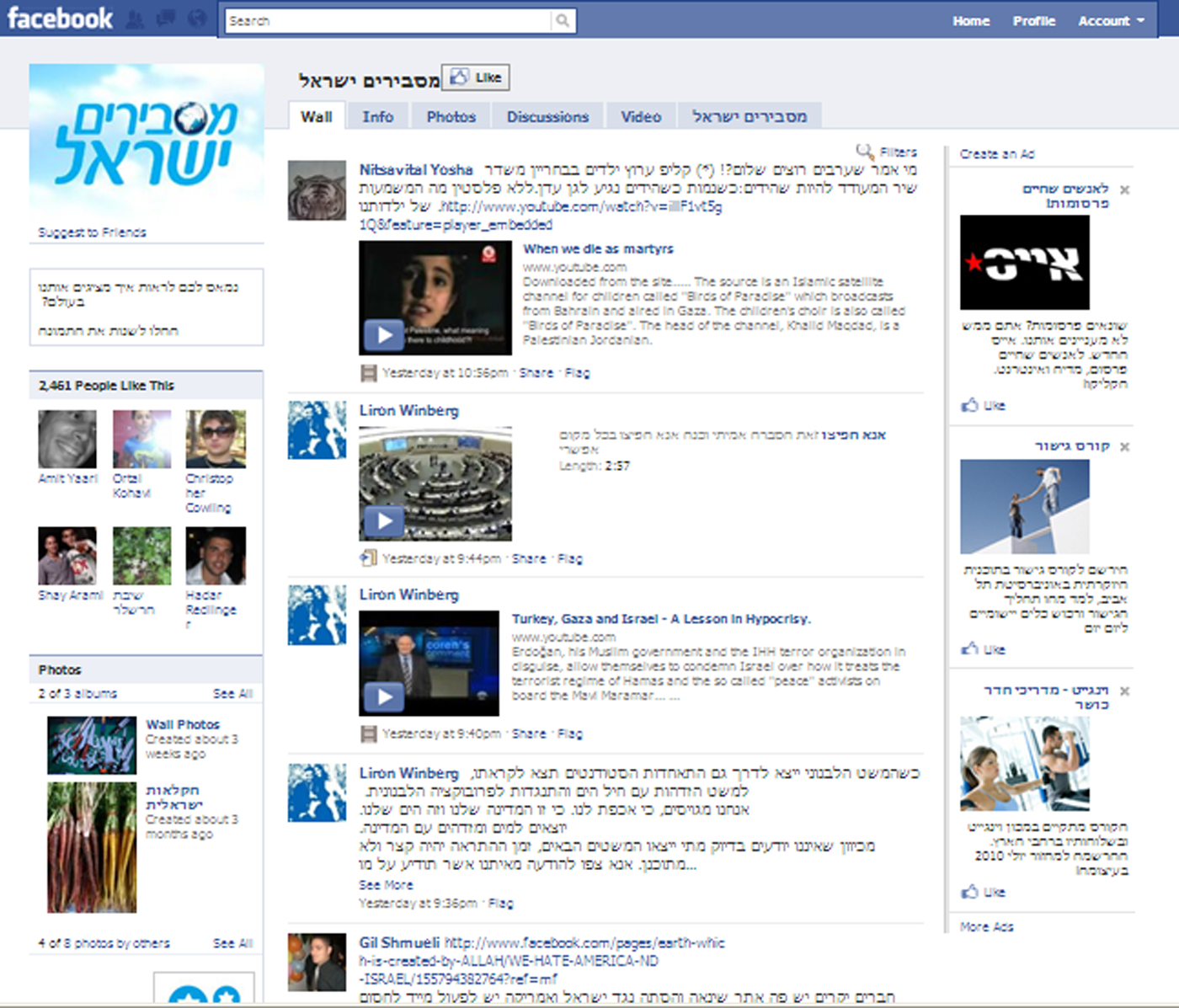
Masbirim Israel campaign’s Facebook page
It is difficult to assess the direct impact of the campaign on PR efforts made by Israeli citizens, for two reasons: First, in recent years, PR activity conducted by officials, groups, and individuals thorough new media has been vastly expending. 9 This trend began several years prior to the Masbirim Israel campaign, especially around crises such as the second Lebanon war (2006) and the Israeli operation in Gaza (2009). Even before the emergence of social networks, during the second Palestinian uprising (the second “Intifada”) in 2002, the Ministry of Foreign Affairs cooperated with the Israeli Internet association in launching a program aimed at integrating Israeli senior citizens in informal PR activities, using their unique accessibility to various languages. 10 It is therefore difficult to isolate the Masbirim Israel campaign and assess its success.
A second reason lies in the inherit similarity between the messages on the official website and the content that was produced by the majority of the Israeli citizens. By its nature, Israeli PR, may it be official or nonofficial, strives to present the Israeli narrative rather than the Arabic narrative in general and the Palestinian narrative in particular. It is therefore difficult to assess what effect, if any, the campaign had on the articulation of the citizens’ messages. Even the examination of the social media channels does not shed light on the subject. 11
Nevertheless, despite the ministry’s claims, the Government Advertisement Chamber’s reports, and the immediate resonance the campaign caused after its launch, one can hardly claim that the campaign itself had an immediate impact: only 3,412 people joined its Facebook fan page, and only 10 followers were listed on its Twitter account.
Discussion
In the context of the Masbirim Israel campaign, I wish to present the following arguments: First, the campaign is an outgrowth of the idea of prosumption in the political sphere, as its essence is the delivery of a public good—whose production has traditionally been the responsibility of the state—to the hands of its prime beneficiary (consumer), that is, the citizens. Second, I argue that this delivery is but another version of the decentralization of public assets held by the government. Third, I argue that the character of the campaign, especially the content created by the Ministry of Information and Diaspora Affairs and the content generated by Israeli users, expresses opinions that reflect the right wing of Israeli politics. As such, this content expresses trends of locality, communitarianism, and somewhat extreme nationalism, which emphasize the Jewish-Israeli perspective while ignoring other local narratives. In this sense, although the campaign is a manifestation of a neoliberal ideology of decentralization and privatization, and although the means that the campaign relies upon are global (i.e., the use of new media), the campaign essentially reflects local opinions and notions. At the same time, and in some respect opposed to the trend of decentralization, the campaign is an expression of grobalization by the state, as it strives to put its citizens to work. This is therefore the glocalized–grobalized sociopolitical condition that characterizes Israeli society in the beginning of the 21st century. I shall now elaborate upon these three arguments.
The first argument is that the campaign is an expression of prosumption in the political sphere. At the heart of the prosumption discourse stands the claim that producers concede their complete control over the process of production and deliver certain dimensions of that process into the hands of consumers. This concession might be voluntary or obligatory, but it is essentially driven by economic interests: In an environment that witnesses tremendous technological and consumer behavior changes, businesses, in order to sustain the logic of maximizing profit, must yield complete control over the process of production in favor of consumers.
In this light, one should perceive the idea of political prosumption. The decision to deliver certain aspects of national public diplomacy into the hands of the public is, in fact, political prosumption. It is not the kind of political prosumption in which individuals help to promote a candidate’s political agenda but, rather, political prosumption that involves the state on the one hand and its citizens on the other hand. The state, which is responsible for planning, designing, and implementing a national strategy for public diplomacy and outreach, is relying on the public for elements of its execution, or simply “putting them to work” (Zwick et al., 2008). Just as consumers started taking part in the process of planning, designing, marketing, or advertising products (in short, in the chain of production), so do the citizens start to participate in the process of the production of PR. The latter becomes a public good (i.e., a good consumed by the Israeli population) when it is consumed passively by an outside population.
Indeed, the state provides the basic principles and guidelines, but the execution is supposed to fall to the citizens themselves. Furthermore, the state specifically defined its role as a facilitator: It would produce the infrastructure needed for the creation of PR, but it would not be the one to conduct the actual PR (at least not in this particular campaign; PR is being conducted, of course, by the state through other channels). The citizens themselves are those who develop the content and actually execute the PR efforts. A good example here is the campaign website: It is written in Hebrew only and is designed solely for the Israeli public, which is supposed to familiarize itself with these guidelines and conduct the PR effort on its own. The public might deliver the message in an informal fashion, such as face-to-face meetings, but also by creating user-generated content (a term which is itself linked to the idea of prosumption), such as clips uploaded to YouTube, blogs, forums, e-mails, and so on.
The potential benefit from this process is obvious: The Internet’s main advantage, as a collaborative project, is in enabling accessibility to a large number of potential contributors, and therefore it is more efficient. In other words, the Internet facilitates harnessing the power of the masses, whereas in traditional PR channels the ability to produce an efficient product is limited to a few professionals. In that manner, the production for the crowd uses the “wisdom of the crowd” (Surowiecki, 2005). Furthermore, using Web 2.0 platforms enables an expansion of the channels through which messages are delivered: audio, video, texts, massive delivery, niche, focused delivery, and so on.
Integrating individuals into the process of PR expresses another trend, which is the transferring of the state’s public assets to private hands. The state of Israel, like other countries—especially in the Western world—has experienced a rapid process of privatization of public services and assets since the 1980s. Between 1986 and 2000, 83 government firms were privatized, for a total sum of 8.7 billion U.S. dollars (Ram, 2005, p. 37). This process was accompanied by other actions including exposure of the local market to global markets, liberalization of currency, business deregulation, reduction in taxation and public expenditure, decrease of government deficits, and reduction in welfare expenditure. These steps marked, and still mark, the decline of the centralized state system, which characterized Israel since its beginnings, and the firm grip of neoliberal ideology and practice in Israeli society.
As part of these trends, Israel also experienced a privatization process in areas related to the production of public services and goods: education, health care services, public media, and so on. Even the basic and fundamental meaning of the state’s exclusivity in holding power did not go untouched: Attempts were made to privatize prisons (unsuccessfully so far), 12 and the Israeli army (the I.D.F.) started privatizing certain services such as catering (Grinberg, 2004), professional training (including in the combat professions; Buchbut, 2007), and even its PR. The military’s spokesman unit hired an advertising agency to market the military as a “brand” and to improve its image in Israel and abroad (Tzoref, 2004).
Transferring elements of public diplomacy into private hands is therefore another step in the trend of the privatization or, better put, the decentralization of public goods and services. However, in this current step, the campaign does not express a transfer of “ownership” but, rather, the integration of private elements in the production of the public service—the same elements that are supposed to be the beneficiaries of the service itself. Thus, decentralization becomes intertwined at this point with prosumption and assumes a new, more complex meaning. In the past, we used to see a strict dichotomy between public ownership and private ownership of means of production or of public goods. Now, this division becomes more sophisticated: The state does not necessarily have to deliver its ownership of means of production completely into private hands; rather, it can decentralize certain elements of the process of production and still maintain the logic of profit and efficiency. By doing so, the state succeeds in preventing (or at least minimizing) public critique against decentralization while maintaining the logic of efficiency. More important, the state can “recruit” its citizens and at the same time maintain its power and influence. This is therefore the grobality of society by the state.
Not only does the state use efficiency as the motif behind this campaign (as well as behind other acts of privatization); it also justifies it by creating a linkage between PR for Israel and the virtues of good citizenship. The state’s rhetoric is based on an emotional and intimate linkage between the PR messages and the citizens’ own personal feelings—between the task of the Ministry of Information and Diaspora Affairs and the civic duties of Israeli citizens. PR is presented as “the mission of the Jewish-Israeli collective”:
Many of us . . . encounter conversations with the locals in which prejudices and false information about Israel are expressed; without having the tools and the information needed to deal with questions and criticism. At these moments we want, and feel that we are obliged, to open the other side’s mind, and especially his heart, to see us, Israel, a bit differently. This site . . . will enable every one of us to gather information, and especially gather pride for our tremendous national achievements. Surfing this website will enable us to equip ourselves with tips and advice for good PR abroad, because in each and every encounter outside Israel, we are the ambassadors! Let’s show the world our Israel’s beautiful face.
13
If we examine the fashion in which prosumption is presented in the business world, we encounter an unsurprising similarity. In both cases, the aim is to create positive empathy and commitment between the product and the consumer by integrating the latter in the act of production. In both cases, the creative aspect that this kind of productive process involves is emphasized. In the business world, when trying to break the code that creates the strong linkage between product and consumer, the main question discussed is, How can a product contain value for the consumer? The answer is, “Value lies in the co-creation experience of a specific patient, at a specific point of time, in a specific location, in the context of a specific event (Prahalad & Ramaswamy, 2004, p. 10). And in another place, “It involves the co-creation of value through personalized interactions that are meaningful and sensitive to a specific consumer” (Prahalad & Ramaswamy, 2004, p. 16).
In other words, in an era of prosumption, the linkage between product and consumer and the obligation for consumption rest upon the ability to create a coexperience between consumer and product. This experience is created by the integration of the consumer in the act of production.
Yet, parallel to this process, which reflects the influence of global, capitalist, and neoliberal factors, we also witness countertrends of (extreme) nationality and locality. These trends as well are expressed in the Masbirim Israel campaign. The issue of locality in Israeli reality is complex and multidimensional, yet this issue is beyond the scope of this inquiry, and I shall not discuss it here in depth. Among the various factors and trends, the Masbirim Israel campaign expresses national local patriotism but in a way that links (Jewish) ethnicity and that belongs to the framework of the state. In other words, the campaign represents trends of locality, which equate the Zionist state with the Jewish-Israeli narrative. As such, the campaign excludes other social groups (especially Arabs and non-Zionist Orthodox Jews) and thus contradicts the global–libertarian model of an open, liberal, and pluralist society.
This issue is expressed in the general outline presented by the Ministry of Information and Diaspora Affairs, as well as in the content produced by the citizens themselves. The ministry’s messages focus on “being an Israeli” and cherish the Jewish-Israeli collective identity:
I have no doubt that being an Israeli is a privilege. It is an asset but it is also a burden, since being an Israeli nowadays is not easy. . . . The state of Israel, in its 62 years of existence, has reached achievements in all fields and acquired a distinguished position amongst developed nations. Yet at the same time, the state of Israel deals frequently with enemies which seek to destroy it, with critique from the outside, and with a long list of mythos and prejudices which has no real grasp in reality.
14
The ministry continually emphasizes Jewish historical and moral rights in the land of Israel and devotes considerable efforts to the dismissal of the legitimacy and historical rights of the Palestinians in the land of Israel:
Palestine has never been an Arab state, though the Arabic language was dominant among the majority of the Arab population after the invasions of the Muslims in the 7th century. No Arab or Palestinian state ever existed in the land of Israel.
15
The history of the Israeli–Arab conflict is presented, accordingly, as a result of the reluctance of the Arabs to accept Jewish existence in the region, and not as a result of Israeli policy. This agenda is presented both in relation to the state of Israel within the borders of 1948 and to the occupied territories and the Jewish settlements there.
The exclusion of the Israeli Arabs from the narrative presented by the ministry is also expressed in other issues. When the ministry tries to reject the “mythos” that Israel is a religious state, it presents statistics relevant to the Jewish population only.
When certain highlights in the history of the state of Israel are presented, they refer only to the achievements of the Jewish population, while the Arab and Orthodox groups are not mentioned. Arabs in the occupied territories (and in Arab states) are mentioned only in relation to acts of war and terror. The only reference to the Arab citizens of Israel is in the context of refuting claims about the “demographic danger” that the Arabic ethnic group poses to the Jewish ethnic group within the state of Israel and between the Jordan River and the Mediterranean sea (i.e., the state of Israel including the occupied territories).
The exclusion of Israel’s Arab citizens is particularly conspicuous since the campaign website mentions not only Israeli Jews but also Jews in general—even those who are not Israeli citizens.
This agenda is also expressed in the user-generated content, which is essentially citizens’ interpretations of the ministry’s guidelines. Examination of this content on Facebook pages, and in sites linked to Facebook, reveals that user content is slightly more balanced than what appears on the campaign website. Nevertheless, although Israel’s government policy is occasionally criticized, such opinions are still very rare—especially compared to messages expressing Jewish-Israeli nationalistic feelings. The users’ ability to refer to each other and to the ministry’s messages creates a rather pluralistic debate, yet it is still limited to Jewish participants, who express opinions within the range of extreme right to political center (opinions of the Zionist and non-Zionist left are scarce). Either way, in contrast to other local Internet arenas, it seems that the discussion on these pages is relatively moderate—not a common phenomenon when analyzing Israeli public online discourse, which is usually characterized by straightforwardness and callousness (Kohn & Neiger, 2007). This, I believe, is for two reasons: First, the messages outlined by the ministry were relatively accurate reflections of Jewish-Israeli consensus. Second, apart from the response the campaign drew around the time of its launching, it did not truly resonate with the public over time, probably because it was not launched around a concrete crisis, as were similar past initiatives. 16
Conclusion
The Masbirim Israel campaign is a case study that enables an examination of the trends of change and continuity in the Israeli political sphere. On the one hand, the emergence of the idea of the prosumer as a new dynamic between the government and its citizens reflects continuity in the process of decentralizing the state’s responsibilities. Indeed, this is not literally a decentralization of state assets, but it is certainly another step in the ongoing process of the integration of citizens in the production of common goods in the name of efficiency.
From another perspective, this case study illustrates how processes of globalization create changes in the forms and functions of the state. State sovereignty changes and becomes more adaptable to global challenges. In the unique conditions created by globalization, the state apparatuses are required to change in order to be able to govern. Authority becomes multilayered and sprawled “over” and “under” the state. The fact that private players in civil society play roles traditionally in the purview of the state forces the latter to acknowledge that even in the field of government it is not a sole player anymore, sometimes not even an essential one.
The campaign also demonstrates the complex glocal Israeli reality, in which Western neoliberal ideologies and practices are entwined with communitarianism, nationalism, and sometimes even isolationism. On the one hand are capitalist market politics, privatization, and openness, and on the other hand are politics of identity, ethnicity, and nationality, which perceive the Israeli project as Jewish, under siege, and constantly challenged by those who seek to harm it. In terms of global processes, the Israeli arena expresses clearly the glocal condition—the tension between the global and the local, between McWorld and Jihad.
Footnotes
The author(s) declared no potential conflicts of interest with respect to the research, authorship, and/or publication of this article.
The author(s) received no financial support for the research, authorship, and/or publication of this article.