







Abstract
Focusing on the psychological underpinnings of partisanship, this study asks whether there is a difference in the personality profile for self-described Democrats and Republicans. Using a survey of young voters (N = 610), psychological measures such as the Big Five personality dimensions and locus of control were measured in conjunction with standard political interest variables such as political cynicism and political information efficacy. The results indicate supporters for the two major parties are wired differently, in line with previous findings about ideology. Democrats were driven by an external locus of control and Republicans by an internal locus. This research finds self-identified Independents as truly being somewhere in between.
The study of political parties has often focused on the masses—how the parties operate and move as a whole. One party is considered the “social” party, supporting labor movements or education while another may be more closely tied to issues of defense (Lane, 1955). Even this research that focuses on the differences between the two major parties in the United States, the Republicans and Democrats, focuses on how each of the groups either feel about an issue in the case of agenda setting or what sources each group relies on with regard to media consumption. Indeed, there are few studies that focus on political party identification that bring that the focus down to the individual himself or herself. From that first moment when an individual decides that he or she is affiliated with a particular political party, there must be something within that person that makes him or her feel more Democrat or more Republican. What internal, psychological differences are there between newly affiliated Republicans and Democrats?
Focusing on this question, this study investigates those psychological drives within those new to political parties to determine if there are differences. Specifically, this study examines the personality to see if there is a difference between those who choose to affiliate with the Democratic Party versus those who affiliate with the Republican Party.
The 2012 U.S. presidential election proved to be a choice backdrop for such an investigation of one’s internal psychological characteristics and its relationship to political party identification. The stage for the 2012 presidential campaign was electrified with partisanship. Democrats held strong to the idea that “we built this” nation together while Republicans focused on the individual efforts of Americans’ hard work ethic. Such a philosophical conflict appeared a textbook example of the psychology concept of locus of control, a personality indicator that speaks to where one feels the power in one’s life lies. As such, this study investigates the psychological underpinnings of partisanship to reveal a personality profile of both self-described Democrats and Republicans.
Personality in Politics
Personality within politics has generally been focused on what is commonly called the Big Five, referring to the number of personality dimensions psychology scholars focus on. These dimensions can be measured a number of ways from longer-form surveys to very brief surveys with just five items on it. The dimensions of personality within this worldview are agreeableness, openness to experiences, emotional stability (the inverse of which is called neuroticism), extroversion, and conscientiousness.
In the middle of the past century, Lane (1955) pointed out that “the personality of the individual voter has tended to be overlooked for its influence minimized” (p. 173). Though it has been nearly 60 years—and 15 presidential elections—since that statement was made, scholars have still not truly examined the role of personality in political ideology. Much has changed with the world since Lane’s (1955) scholarly inquiry, and with the rise of the importance of personality as evidenced through the popularity of social media, the question of what personality divisions exist on an individual level among today’s two-party system remains relevant. Cooper, Golden, and Socha (2013) admit that while scholars accept personality has a role in political opinion, there is not much understanding regarding specific personality factors that matter and how they influence political behavior (p. 68). Furthermore, when specific personality factors are studied the only consistent results scholars find occur within a few dimensions, such as openness to new experiences, extraversion, and conscientiousness. Indeed, Ha, Kim, and Jo (2013) submit that the variations found among studies examining personality may be due to differences in measuring personality, sampling variations, and perhaps cultural differences (U.S.-based studies vs. international studies).
Early studies showed that authoritarianism was consistently associated with the Republican Party (Lane, 1955). When looking at Democrats, Lane (1955) found that personality did not play as large of a role regarding party identification for Democrats, however it did for those who were to say they were Independents or Republicans (p. 182).
The resurgence of personality and politics scholarship began around 10 years ago. Caprara, Barbaranelli, and Zimbardo (1999) examined the personality factors with regard to political party identification in Italy. Their findings indicated that extroverts and conscientious people were more likely to align themselves with parties representing distributed justice. Additional international studies have since been conducted in Germany, where Schoen and Schumann (2007) found agreeableness and openness to experiences are key personality factors for liberals. That research also found that liberals in Germany had lower conscientiousness scores. Moving to Belgium, Van Hiel, Cornelis, and Roets (2007) found a positive relationship between conscientiousness and conservatism, as well as a negative relationship between conservatism with openness to experiences and neuroticism (note this study uses the inverse term: emotional stability). Their findings suggest that conservatives have low tolerance for others’ beliefs, are averse to change and high in conscientiousness (Van Hiel et al., 2007).
Moving to research in the United States, Gosling and colleagues discovered conscientiousness and openness to experience can predict party identification (Carney, Jost, Gosling, & Potter, 2008; Gosling, Ko, Mannarelli, & Morris, 2002). Like the German study, these U.S.-based studies found liberals were low in consciousness and high in openness to new experiences (Carney et al., 2008; Gosling et al., 2002). Continuing this work in the United States using the five-factor model of personality, Cooper et al. (2013) found openness to experience, agreeableness, conscientiousness, and extraversion help explain public opinion and political behavior. Their results confirm previous work from other scholars that liberals tend to be open to new experiences and low in conscientiousness (Cooper et al., 2013). They found that extraversion has no influence on affiliation, and they posited that emotional stability does not affect affiliation either (Cooper et al., 2013).
Focusing on candidate choice in the 2008 election, Dirilen-Gümüş, Cross, and Dönmez (2012) found personality differences between those who voted for John McCain and those who voted for Barack Obama. The researchers reported that Obama supporters were more agreeable but lower in conscientiousness when compared to McCain supporters (Dirilen-Gümüş et al., 2012). These candidate choice findings are consistent with ideological generalizations made regarding liberals and conservatives internationally.
The state of personality research as it relates to politics was summed by Cooper et al. (2013), who concluded that while research on the effects of conscientiousness and openness to experience was well developed, there were less consistent findings regarding extraversion, agreeableness, and emotional stability. A review of recent literature in ideology and personality (Cooper et al., 2013; Ha et al., 2013; Van Hiel & Mervielde, 2004) reveals that most scholars appear to agree that liberals and conservatives differ on openness to experiences (liberals high, conservatives low) and conscientiousness (liberals low, conservatives high). To some degree, there is also consensus regarding agreeableness. Beyond that, there is still much debate about the finer points of ideology and personality. Furthermore, while the majority of studies are limited by their national sampling (be it Italy, Germany, or the United States), it is ideology that is investigated as opposed to actual political party identification. These, though similar, concepts are more than semantically different as even the media will refer to a member of the Republican Party as being “moderate” or even “liberal.” As such, it is important for this study to not focus on ideology in the greater sense, but the actual party affiliation to determine the differences between Democrats and Republicans in the United States.
Locus of Control
Even from the early days of measuring locus of control, or the idea of what forces drive one’s life, political implications were considered (Gootnick, 1974). Indeed, research was supportive of the idea that locus of control could provide value in predicting political activism (Gore & Rotter, 1963; Strickland, 1965). Yet Levenson and Miller (1976) aptly ask, “Why should people become involved if they feel they have no mastery over the situation?” (p. 199).
Looking at a group of new voters (college freshman), Gootnick (1974) found that Republicans appear to have a more internal control then Democrats. Continuing this work but on a multidimensional level, Gurin, Gurin, and Morrison (1978) note that while liberals appeared to exhibit more external locus of control, this finding appeared in the ideology factor, and not from feelings of less personal control. As one might expect, stronger liberals scored more external on the ideology index (Gurin et al., 1978). Abramowitz (1973) found that liberal activists exhibit higher external scores than conservative activists.
Research Questions
Given the literature reviewed above, which focuses more on ideology than actual political party affiliation, the following research questions are asked:
Research Question 1: What differences in personality occur based on political party identification?
Research Question 2: Is there a difference between Democrats and Republicans in one’s locus of control?
Research Question 3: Is there a relationship between personality and political cynicism? Political information efficacy?
Research Question 4: Is there a relationship between locus of control and political cynicism? Political information efficacy?
Method
Using a survey deployed to young voters (N = 610) through a nonrandom convenience sample on a politically active college campus during the hot phase of the 2012 U.S. presidential election, this study examined a series of psychological measures alongside traditional political variables. Building on Cooper et al.’s (2013) work on personality, this study continues through replication in understanding the specific personality factors that matter while also incorporating new personality-related measures. Such an approach with replication and expansion is widely supported and encouraged throughout the academy in this area because of the relatively scant research to date (Cooper et al., 2013, p. 68; Mondak, Hibbing, Cnache, Seligson, & Anderson, 2010).
The psychological concepts examined in this study were personality and locus of control. The political variables were political party identification, vote choice, as well as characteristics and feeling thermometer for each political party.
Instrument
Personality was gauged through the brief measure of the Big-Five personality domains (Gosling, Rentfrow, & Swann, 2003). The scale, called the Ten-Item Personality Inventory (TIPI), is a modified and condensed series of 10 statements that examine aspects of personality such as socialization. Gosling et al. (2003) noted that in testing personality through the survey method there are time and space limitations to researchers that make the longer-form personality instruments difficult to implement. Testing the validity of a shorter-format scale against the more traditional instruments, Gosling et al. determined the TIPI scale to be the most “psychometrically superior” of the shorter scales (p. 523). The TIPI measures include two items for each personality construct, which were summed into five separate summative indices:
Extraversion (α = .783): often described as warmth, assertiveness, talkative and other similar positive outgoing traits toward others (Cooper et al., 2013; Schoen & Schumann, 2007)
Agreeableness (α = .459): often described as sincere, loyal, trusting, forgiving, appreciative, and kind, among other attributes (Cooper et al., 2013; McCrae & John, 1992)
Conscientiousness (α = .576): refers to the degree to which one can control impulse and is often referred to as organized, resourceful, reliable, thorough, and so on (Cooper et al., 2013; Schoen & Schumann, 2007)
Emotional stability (α = .569): the inverse label is often used to describe this factor (“neuroticism”), and emotional stability refers to those who are secure, relaxed, and unemotional (Anderson, John, Keltner, & Kring, 2001; Cooper et al., 2013)
Openness to experiences (α = .399): refers to one’s tolerance of diversity, exploration of novelty, curiosity, originality, and sharpness (Cooper et al., 2013; Schoen & Schumann, 2007; Winter, 2003)
In this study, the TIPI items were measured on a 5-point Likert-type scale. Prior to analysis, items were reverse coded as instructed by Gosling et al. (2003). Though the alphas were low, this is to be expected in such a brief and condensed instrument due to the fact there were only two items per construct. TIPI has been used in other political personality scholarship, most notably Ha et al. (2013), who looked at the relationship between personality and political participation measures.
Locus of control, referring to the place from which one feels one’s life is directed, was measured using a 13-item series that presented two statements from which respondents were asked to pick the one they most identified with (Rotter, 1966). Values were assigned to each statement, with the external locus of control statements being 1 point each and the internal locus of control statements being 0 points each. An overall score was then created to determine one’s locus of control, where a higher number indicates an orientation more toward the external locus of control. The scores range from 0 (internal locus of control) to 13 (external locus of control). The use of the locus of control measures in relation to political beliefs is not without controversy, however, as Thomas (1970) asserted the internal locus of control items were skewed toward conservatives and questioned the validity of the measure. Even so, the measures have been used since then with that concern disclosed.
Political cynicism was measured through a series of seven items on a 5-point Likert-type scale. Items were reversed coded as needed so that a higher number represented a greater degree of cynicism. As is typically done with this scale, the items were summed into a single unidimensional index to create one overall cynicism value for each respondent (α = .611). Though the alpha score was low, it is consistent with previous uses of this scale.
Political information efficacy was measured using the Kaid, McKinney, and Tedesco (2007) scale. The three items on this measure were presented on a 5-point Likert-type scale where a higher number indicated a greater degree of political information efficacy. The items were summed into a single index score (α = .859), in keeping with the traditional treatment of these items.
Political demographic variables included political party identification as either Democrat, Republican, or Independent. Party strength was measured on a 5-point semantic differential scale ranging from weak to strong. Finally, the standard political “feeling thermometer” measure was used, asking participants to rate the “temperature” they felt toward each candidate and each political party as if measured with a thermometer.
Sample
Given that this study focuses on the personality dimensions and predisposition of people within the political party, it seemed imperative to target the study to new members to the political system. This rationale was grounded in the understanding that with very little experience (i.e., newly eligible voters), people are making a gut decision as to which political party best represents them. Such a proposition is empirically supported, as previous research has found that young people (fresh out of high school) are most influenced by the personality dimension (Lane, 1955). Scholars presume that this is because as membership in a party continues, one finds increasing social pressures put on oneself that may change party membership and affiliation over time (Lane, 1955). That initial decision, however, can be said to be driven by personality.
The largest group of newly eligible voters is young voters, who have recently come of age immediately prior to an election season. As such, this study targeted young voters on a politically charged college campus to understand the personality of those initially drawn to a particular political party.
The average age of respondents was 19.56 years old (SD = 1.47 years), making them the key target in the “youth vote” demographic. Given their age, this was the first presidential election in which these voters were eligible to participate. Consistent with campus demographics, the sample contained more females (n = 458, 75.1%) than males (n = 145, 23.8%).
Results
The majority of respondents in this survey indicated that they were registered voters (n = 474, 77.7%). Slightly more than half self-identified as being Republican (n = 345, 56.6%), a quarter as being Democrat (n = 149, 24.4%), and 17.5% (n = 107) as being “Independent.” Strength of party identification revealed a rather neutral nonpartisan ideology among this sample (M = 2.73, SD = 1.14). When respondents were asked for whom they would vote if the election were held that day, almost 1 out of 5 remained undecided (n = 116, 19.0%), half indicated Republican candidate Mitt Romney (n = 325, 53.3%), and a quarter said Barack Obama (n = 151, 24.8%). Looking at feeling thermometer readings, respondents were most warm toward the Republican Party (M = 59.00, SD = 31.23), followed by candidate Mitt Romney (M = 53.51, SD = 30.77), the Democratic Party (M = 41.75, SD = 31.55), and candidate Barack Obama (M = 39.28, SD = 34.43). It should be noted, however, that these “thermometer” temperatures for all are rather cool readings.
Personality
In looking at the personality domains measured through TIPI, respondents were scored on two variables each for the five personality constructs. Respondents overall rated slightly higher than neutral on extraversion (M = 7.19, SD = 1.90), agreeableness (M = 7.31, SD = 1.44), and emotional stability (M = 7.08, SD = 1.57). Respondents rated themselves very high on conscientiousness (M = 8.31, SD = 1.43) and openness to new experiences (M = 7.96, SD = 1.37). See Table 1 for individual item scores. With regard to locus of control, respondents overall indicated a somewhat internal locus of control (M = 5.33, SD = 2.11).
Big-Five Personality Domain Scores on the Ten-Item Personality Inventory.
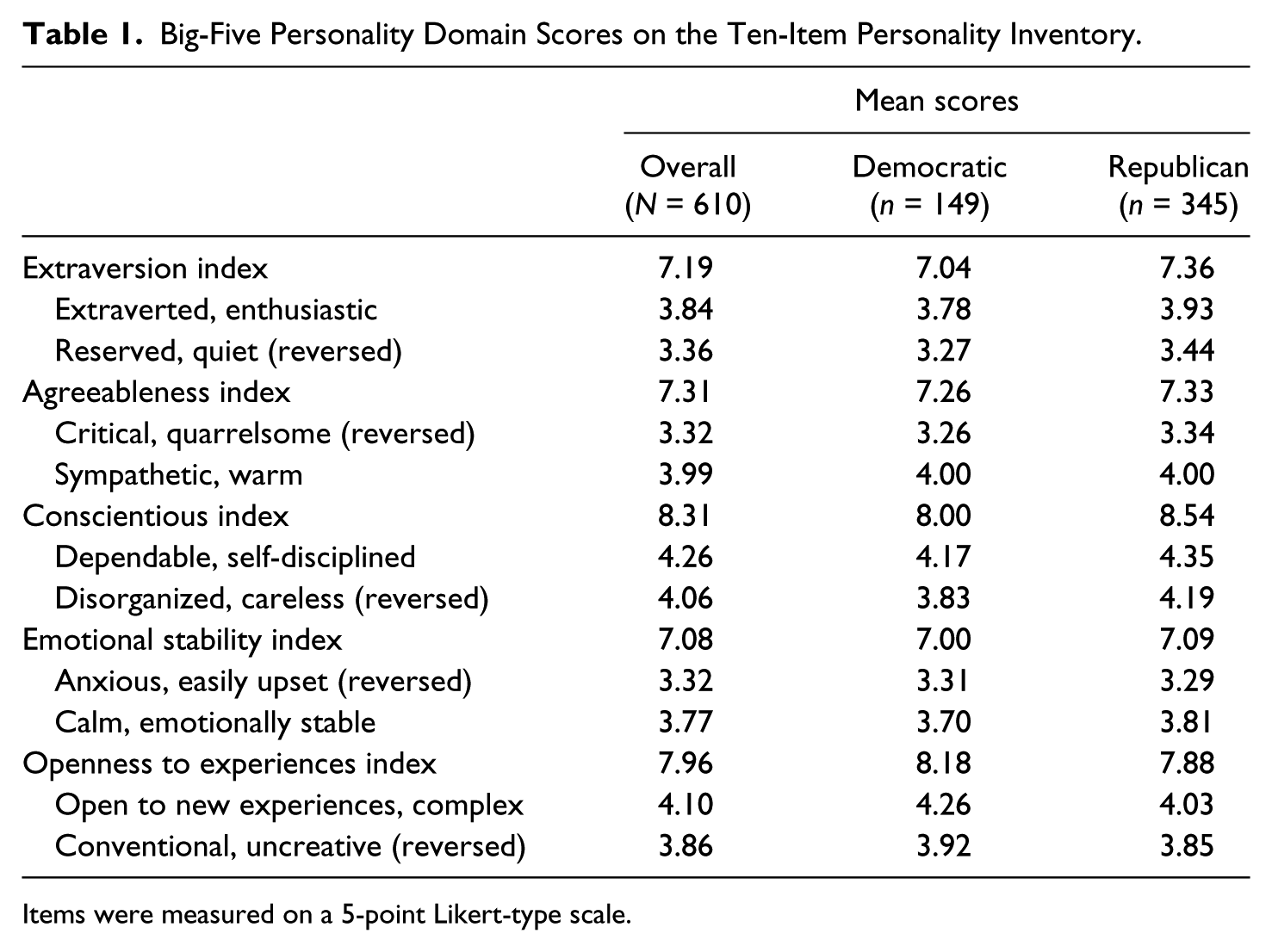
Items were measured on a 5-point Likert-type scale.
Political Measures
The respondents in this survey were slightly cynical, though very close to neutral, regarding their outlook toward politics (M = 22.92, SD = 3.75). They were most cynical regarding politicians agreeing that “one cannot always trust what a politician thinks” (M = 4.01, SD = 0.79), closely followed by concern that the politicians would not do the right thing (M = 3.98, SD = 0.90). Respondents were least cynical about their own power in politics, slightly disagreeing with the statement that “whether I vote or not has no influence in politics” (M = 2.41, SD = 1.11) and their feelings of control about what the government does (M = 2.57, SD = 0.96).
Overall, respondents did not appear to feel efficacious about their amount of political information. The political information efficacy index score indicated low efficacy (M = 9.05, SD = 2.79). The only political information efficacy statement that respondents agreed to was an item that said, “I feel that I have a pretty good understanding of the important political issues facing the county” (M = 3.26, SD = 1.01). Respondents disagreed with statements about feeling well-qualified to participate in politics (M = 2.94, SD = 2.86) and being better informed about politics than most people (M = 2.86, SD = 1.07).
Personality and Political Party Identification
An analysis of variance was conducted on each of the five personality indices based on political party identification (Democrat, Independent, Republican). There were main effects for political party with conscientiousness, F(2, 593) = 9.62, p ≤ .001. The other four personality factors did not result in statistically significant mean differences based on political identification cell.
A follow-up Bonferroni post hoc test showed interaction effects for the differences in conscientiousness based on political party identification. Republicans displayed greater conscientiousness than both Democrats (mean difference = 0.53, p ≤ .001) and Independents (mean difference = 0.48, p ≤ .01).
Moving to the feeling thermometer scores where respondents rated each candidate and each political party as if on a temperature gauge, differences were examined using a series of analyses of variance tests. Main effects were found for feeling thermometers for Barack Obama, F(2, 598) = 34051, p ≤ .001; Mitt Romney, F(2, 598) = 200.88, p ≤ .001; the Democratic Party, F(2, 598) = 214.12, p ≤ .001; and the Republican Party, F(2, 295) = 214.12, p ≤ .001.
A series of Bonferroni post hoc tests revealed mean differences and interaction effects. As might be expected, Republicans rated their party (mean difference = 46.15, p ≤ .001) and their candidate (mean difference = 45.75, p ≤ .001) higher than Democrats; similarly, Democrats rated their party (mean difference = 49.66, p ≤ .001) and their candidate higher (mean difference = 59.45, p ≤ .001) than Republicans.
Looking only at the mean differences between Independents and those from other parties, it appears that that Independents rated the Democratic Party more warmly (mean difference = 26.25, p ≤ .001) than the Republican Party (mean difference = 23.40, p ≤ .001). When rating the Republican Party on the feeling thermometer, Independents rated it more highly than the Democrats did (mean difference = 15.99, p ≤ .001) but not as warmly as Republicans (mean difference = 30.16, p ≤ .001). Independents rated Barack Obama more warmly than Republicans (mean difference = 28.85, p ≤ .001) but not as highly as Democrats (mean difference = 30.59 with Democrats warmer, p ≤ .001). Independents rated Mitt Romney more warmly than Democrats (mean difference = 20.61, p ≤ .001) but not as highly as Republicans (mean difference = 25.13 with Republicans warmer, p ≤ .001).
Locus of Control and Political Party Identification
An analysis of variance was conducted on the locus of control index based on political party identification (Democrat, Independent, Republican), resulting in main effects, F(2, 597) = 3.11, p ≤ .001. A follow-up Bonferroni post hoc test showed interaction effects. Democrats displayed a greater external locus of control than Republicans (mean difference = 0.88, p ≤ .001) and Independents had a greater external locus of control than Republicans (mean difference = 1.04, p ≤ .001). There was not a statistically significant different between Democrats and Independents.
Personality, Political Cynicism, and Political Information Efficacy
A series of Pearson correlations were run between the personality indices with political cynicism and political information efficacy. Though many were statistically significant results, they were also all weak below a threshold correlation value of .30. Political cynicism correlated significantly yet extremely weakly with openness to experiences (r = .09, p ≤ .05), emotional stability (r = .08, p ≤ .05), conscientiousness (r = .10, p ≤ .05), agreeableness (r = –.13, p ≤ .001), and extraversion (r = .12, p ≤ .005). Political information efficacy correlated significantly yet extremely weakly with openness to experiences (r = –.08, p ≤ .05) and extraversion (r = –.10, p ≤ .01).
Locus of Control, Political Cynicism, and Political Information Efficacy
Pearson correlations were run between the locus of control index with both political cynicism (r = –.30, p ≤ .001) and political information efficacy (r = –.23, p ≤ .001). Though weak, both resulted in statistically significant results.
Discussion
The results here further underscore what scholars have begun to understand about the role personality plays in political decisions. Other scholars have focused on political participation and action, and some on political party ideology. Closely related, yet distinctly different in more than just semantics, this study focused on political party identification and its relationship to personality.
The findings here indicate that what we know about liberals indeed holds true for Democrats to some degree. Democrats, like earlier research on liberals has shown, appear to have an extrinsic locus of control whereas Republicans appear to have an intrinsic locus of control just as research has told us conservatives do.
Independents, a group here that appeared to more closely identify with liberals than conservatives, interestingly had higher levels of conscientiousness than Democrats. That said, with regard to locus of control they were more like Democrats than Republicans exhibiting a more external locus of control. This is a signal that Independents, an increasingly popular identification for young people who don’t feel at place within the traditional two-party political system, deserve much more scholarly attention. To this point of popularity, nearly one in five respondents in this survey categorized themselves as Independent. Previous studies examining political ideology and party identification have not reported such high levels of groups who would not formally associate themselves with a party. In some ways it appears Independents in this sample are more like Democrats (candidate preference, party liking, locus of control) and in others they are more like Republicans (personality dimension). This combination of Independents truly being somewhere in between the traditional two parties in the United States warrants additional research to more finely uncover the differences between people who identify themselves as Independents and perhaps understand why they are not interested in officially affiliating with a party.
Less fruitful in this study was the idea that certain political variables such as political information efficacy and political cynicism are strongly related to personality. Future studies should continue to investigate which variables are at play in the political process and how personality relates to these variables.
In summary, this study not only provides the important work of continued replication called for by Cooper et al. (2013) but also furthers deepens empirical knowledge by defining political variables such as political party identification more precisely than merely political ideology. The findings here, when considered with the sum of research in this area, suggest that there are differences in personality based on whether the lens is ideology or identification.
Footnotes
Declaration of Conflicting Interests
The author declared no potential conflicts of interest with respect to the research, authorship, and/or publication of this article.
Funding
The author received no financial support for the research, authorship, and/or publication of this article.