







Abstract
This article critiques the Detroit Future City (DFC) strategic framework concerning municipal service provision and land use over the next few decades. Relying on policy and media documents, we show that the DFC exhibits narrow, market-oriented logics characteristic of the pervasive hegemony of neoliberal urbanism in American city governance. We address the corporate orientation of the Detroit Works Project, the public–private partnership behind DFC, and argue that the plan may exacerbate the racialized spatial injustices produced in Detroit by 20th-century exclusionary metropolitan growth, ineffective governance, and decades-long flawed approaches to economic development. Furthermore, DFC not only advances previous planned-shrinkage attempts but also seeks to repurpose major areas of the city for global investment, reversing their zoning for agriculture and green space. Our analysis of census data shows that Detroit’s most disadvantaged residents disproportionately reside in areas designated as future “innovation landscapes.” Exploratory spatial data analysis indicates that these zones are not internally homogeneous and engulf resilient residential land usage. Moreover, greening serves the symbolic purpose of reconstituting problematically racialized “Black” areas as purified, investment-ready spaces. We urge neoliberal urban research to continue tracing its global embedding and relational evolution, but also to reorganize the pernicious sociospatial reality on the ground.
This study contributes to this special issue’s examination of middle-range urban futures by focusing on current plans for one of the most beleaguered American cities. It assesses the Detroit Future City (DFC) strategic framework unveiled in 2013, regarding the time horizons of 2020, 2030, and 2050, and analyzes the Detroit Works Project (DWP), the elite public–private partnership supported by leading foundations, that has promoted DFC amid much local controversy. We borrow from scholarly critiques to neoliberal urbanism, yet argue that this body of research needs to provide a more explicit account of how market-driven forms of urbanism produce pernicious sociospatial outcomes on the landscape. Accordingly, our analysis engages the global market orientation, networked articulation, technocratic lack of democratic accountability, and elitist visions of the DWP and similar organizations. Yet we also address the kind of future urban geographies that the DFC and comparable plans may produce in the name of governmental efficiency, fiscal responsibility, and sustainable urban development. In the case of Detroit, the problematic persistence of racialized spatial injustice complicates things further. The DFC proposes to phase out municipal services in large sections of the city, by reclassifying their land use designations to agricultural and green zoning. Whereas Detroit’s poorest and most isolated residents disproportionately reside in these “innovation landscapes” of the future, these areas are not internally homogenous and would negatively affect pockets of resilient residential life, already threatened by rezoning and discontinued service provision. Moreover, the greening rhetoric espoused in ecological urbanism echoes the problematic forms of discursive whitening that mark racialized problem neighborhoods. In the predominantly Black city of Detroit, so the thinking goes, “purified” land might once again be leveraged to attract global investments.
The article contains four sections and a conclusion. The first section of this study’s four sections reviews the neoliberal urbanism literature, underscoring that this body of work holds much analytical promise for reshaping urban policymaking in the postrecession United States. In the wake of uneven recovery, market-centric policies are still widely adopted in American cities. The second section revisits the well-known story of Detroit’s urban decline, thorny racial relations, and the controversial record of flawed market-centric policy responses forged by misguided local leadership since the 1950s. The third section entails the DWP case study, showing how the massively funded DWP recruits international consultants and neoliberal technologies to repurpose city space for elitist capital accumulation. The fourth section analyzes the DFC’s land-use propositions. Relying on group-level census data on neighborhood conditions, our statistical analysis compared areas slated for disinvestment to both those that will be strengthened and the rest of the city. Additional exploratory spatial data analysis will demonstrate that officially deemed with “high-vacancy” zones exhibit significant internal heterogeneity that includes vibrant residential pockets that the DFC has neglected. Discourse analysis reinforces our claim that ecological innovation may be serving the purposes of discursive whitening and symbolic whitewashing, reclassifying areas as investment-ready despite current conditions and the persistence of problematic racialized spatial injustice.
The Pervasiveness of Neoliberal Urbanism in the Contemporary American City
Entrepreneurialism represents a long-standing focus of state and local policymaking in the United States. Yet the exogenous market orientation of urban economic development intensified during the late 1970s (Eisinger, 1988). A vast academic literature is dedicated to understanding the connections between accelerated investment, capital mobility, intercity competition, and public entrepreneurialism (Sager, 2011). Many critical geographers have also demonstrated that what is now regarded as neoliberal urbanism emerged not only amid economic transformations but also as a by-product of global processes of territorial state restructuring defined at multiple, interacting scales. The (de)regulatory advancement of free trade and transnational financial integration created an environment that heightened interplace competition both at and above the scale of the nation-state (Jessop, 2002). In the United States, the federal government also eliminated or drastically weakened most urban policies of Keynesian Welfarism, thereby further pressing localities to generate their own revenues (Hackworth, 2007). However, beyond these better-known “rollback” aspects of governmental retrenchment, welfare dismantling, and economic deregulation, the neoliberal urbanism literature is particularly insightful in its analyses of the productive, “rollout” dimensions of neoliberalization (Peck & Tickell, 2002). Since the 1990s, the state apparatus has been actively deployed to generate market-centric urban policy technologies (Smith, 2002). For example, research on so-called third-wave or state-sponsored gentrification shows that a wider array of governmental agencies has now been included in the revamping of city neighborhoods. They focus on raising land values while neglecting displacement effects (Hackworth & Smith, 2001). Moreover, myriad new institutions and policy instruments have been created or refined to secure an ongoing neoliberal order in urban (re)development (Brenner & Theodore, 2002). These include public–private partnerships, fiscal incentives and subsidies, and speculative public investments in select megaprojects and urban infrastructures as well as the built environment of privileged neighborhoods (see also Arena, 2003, for the problematic role of political demobilization that nonprofit organizations may play within neoliberal regimes of urban governance).
Recent studies with a comparative international perspective posit that neoliberal urbanism has diffused worldwide (Robinson, 2011). Numerous countries and cities now emulate the market-centric interventions that were once limited to the North Atlantic Basin. Urban entrepreneurialism and global ambitions have been documented in both high- and low-income countries (Harvey, 1989; Kanai & Kutz, 2013; Owen, 2002). Moreover, relational analyses show that a dense network of policy-mobility circuits facilitates the far-reaching transferability of market-centric schemes to a wide range of urban contexts (McCann, 2011; Peck & Theodore, 2010; Peck & Tickell, 2002). Such global infrastructure for policy transfer includes charismatic experts and consultants, international city alliances, and year-round circuits of conferences, special events, and policy tourism (González, 2011). Comparative International approaches to urban research have also attracted renewed interest as market-driven interventions are modified and hybridized in locales with diverging development trajectories (Robinson, 2011). An important debate is also taking place between notions of neoliberalization because postneoliberalism as market-oriented urbanism has produced some noteworthy disasters and widespread popular resistances—thus demonstrating the need for alternative forms of urbanism for the 21st century (Aalbers, 2013; Bakker, 2013; Leitner, Peck, & Sheppard, 2007; Peck, Theodore, & Brenner, 2013).
In our view, although much of the analytic brunt of this work has focused on urbanization in the global South, the neoliberal urbanism literature also provides a foundation to think through (post)recession American urbanism in the context of the prevailing austerity of the 2010s. Harvey (2012) has eloquently demonstrated how the global economic crisis had explicit urban roots—with links between the domestic burst of the speculative real-estate bubble and mortgage markets and financial failures overseas. This study is aligned with Harvey and other authors who argue that such neoliberal urbanism remains hegemonic in the unevenly resurgent American economy. Wilson and Sternberg (2012) have documented that globalization-oriented approaches still thrive in the governance of major cities, especially in the application to urban redevelopment. Focusing on Chicago, Wilson and Sternberg argue that in the face of heightened economic insecurity and the still-ongoing mortgage foreclosure disaster, redevelopment governance has adopted a new rhetoric. Therefore, the policy discourse is more heavily technocratic, globalist, and focused on market-led exclusionary investments even though it claims to revalorize the poor minority neighborhoods that were historically disadvantaged throughout the city’s uneven development. An additional example of pervasive U.S. neoliberal urbanism is the attempt to place the rebuilding of post-Katrina New Orleans in the hands of private actors, and the particularly controversial proposal to rezone affected neighborhoods into greenways (Dawson, 2010; Krupa, 2010; Ouroussoff, 2009).
This study will show that recent regeneration initiatives undertaken in Detroit are also articulated around neoliberal logics but with the added burden of the city’s multiple economic and physical challenges as well as its thorny history of socioracial governance. This makes Detroit a telling example of how researchers problematizing the contemporary restructuring of American cities in terms of globalized forms of market-centric governance cannot neglect deeply embedded dilemmas of class, race, and localized patterns of decline. Critical research helps unveil the transnational linkages and policy technologies of neoliberal urbanism that restrict and shape local policy options. Yet by also including a detailed analysis of the spatial injustices inherent to the proposed urban restructuring for Detroit, we urge future researchers to carefully investigate the actual impacts on an urban landscape that has already been unevenly developed.
Following Wyly (2011), we argue that systematic empirical research using quantitative techniques is not antithetical to progressive or even radical politics. In fact, empirically informed urban geographical analysis can reinforce social movements to articulate meaningful strategies concerning exclusionary regimes of metropolitan governance. Soja (2010) posits that such mobilizations are increasingly aware of the critical spatial dimensions of social (in)justice as geographically uneven development is increasingly understood not as epiphenomenal but as constitutive and consequential vis-à-vis social life. The widening of sociospatial inequalities by market-led urban processes has been an ongoing concern of neoliberal urbanism research, but such injustices must be documented more explicitly if this body of literature is to remain relevant to the shaping of urban futures.
Detroit’s Prolonged Decline and the Neoliberalization of Policy Responses
Much has been written about urban decline in the United States over the second half of the 20th century (Beauregard, 2003). Detroit’s story is one of the most poignant. This city once “embodied the melding of human labor and technology that together had made the United States the apotheosis of world capitalism” (Sugrue, 1996, p. 17). But for the past half-century it has relentlessly decayed without abatement to a level that some now see it as a “museum of neglect” (Binelli, 2012, p. 11). Moreover, the city’s population has been decimated, from 1,850,000 in 1950 to just over 700,000 in 2013, and now stands as the hollowed-out core of the most segregated major metropolitan area in the nation (Binelli, 2012). The impoverished, predominantly Black city stands in stark contrast to White-dominated suburban ring that boasts some of the country’s wealthiest residential areas as well as several thriving employment clusters. Decades of alleged political corruption, ineffective governance, and misguided policy responses further complicate Detroit’s problems completing the triad of economic recession, racial contention, and governmental ineffectiveness that Reese, Sands, and Skidmore (2014) attribute to the city’s long-term decline.
Government retrenchment and economic development initiatives favoring elite corporate actors have been the norm in Detroit for decades, and many valuable studies focus on how this situation has aggravated the city’s predicaments (Conot, 1974; Darden, Hill, & Thomas, 1987; Farley, Danziger, & Holzer, 2000; Sugrue, 1996; Thomas, 1997). This section will show continuities between long-standing entrepreneurialism and the DFC initiative that the DWP partnership promotes. Yet we also argue that the DFC’s scope and orientation place it within globalized forms of neoliberal urbanism focused on external investments and global competitiveness, thereby contributing to the discourse that critiques the specific modalities and pernicious consequences that neoliberal urbanism brings to Detroit’s market-centric initiatives directed at the neighborhood, city, and metropolitan scales (Hall & Jonas, 2014; Peck, 2011; Pedroni, 2011).
Decades of deindustrialization, the declining American automobile industry, and suburban White flight have severely eroded Detroit’s population, employment, and tax base. As noted above, Detroit lost well over a million residents between 1950 (when it ranked fifth among all the U.S. cities) and 2013. Yet, beyond images of postapocalyptic devastation, it is important to keep in mind that Detroit today is still home to just about 700,000 people. Furthermore, Detroit’s density remains significantly higher than cities of a comparable territorial size such as Atlanta, Denver, and Portland, Oregon—only a small percentage of its population (6%) resides in higher-density areas (30+ people per acre) when compared with these newer, more dispersed cities (DWP, 2012). Undeniably, Detroit faces formidable challenges, which include the nation’s highest rates of unemployment, violent crime, as well as an astonishing estimated 80,000 vacant property parcels that comprise for well over 20% of the total housing stock. Multiple organizations such as Data Driven Detroit now monitor these conditions closely, producing studies such as the comprehensive Detroit Residential Parcel Survey of 2009. Moreover, conditions vary widely across the city: whereas outer areas adjacent to the 8 Mile Road municipal boundary are not unalike comparable to those of surrounding suburbs, inner city neighborhoods and most of east Detroit have experienced far more dramatic decay.
The city of Detroit attracted worldwide media attention when it filed for Chapter 9 bankruptcy on July 18, 2013, the final indignity after its long drawn-out struggle with fiscal conditions and flawed economic development policies. The neglect of local assets and the bias toward elite projects funded by external investors began long before the DWP was created. In fact, making this history of decline even thornier, critics point to Coleman Young, the first Black mayor elected in 1973 as an early example of such problematic modes of growth. Although faithful to the civil rights movement’s goals of empowering African Americans after decades of racial discrimination, the Young administration turned away from the neighborhoods containing the vast majority of the mayor’s constituency. Instead, even the rapidly decreasing funds available from the federal government were allocated to projects in the central business district and its riverfront. Controversial uses of Community Development Block Grant (CDBG) federal monies are well documented (Darden et al., 1987). Young leveraged the flexibility that the CDBG program afforded to municipalities for the use of resources. Redevelopment deals, land provision, and fiscal abatements were granted to the automakers and other large corporations in the name of benefitting low-income communities, the purported target of CDBG initiatives. As private investors focused on thriving suburbs for their expanding businesses, the central city’s limited resources were increasingly tied to such redevelopment deals in select downtown locations, allowing inner-city neighborhoods, rife with racial and class segregation to essentially collapse (Thomas, 1997).
Cyclical abandonment subsequently continued for decades as disadvantaged neighborhoods faced ever-increasing poverty, unemployment, and drug-related crime. As population and employment losses intensified during the automobile industry crisis after 2000, Detroit rose to the top of countless lists of “Most Miserable” or “Most Dangerous” American cities arbitrarily assembled by the national media. Government officials in Detroit and Michigan continue to struggle to reposition local automobile complexes at the global center of mobility and logistics industries. But they have also experimented with initiatives to diversify the economic base with the “creative city” strategies as they face pressures not only to stimulate economic regeneration but also to rebrand Detroit and discard its problematic image (Peck, 2011). More perniciously, Pedroni (2011) posits that such imperatives are not restricted to economic development initiatives. Education policies and several other critical components of municipal social service provision are being retooled to remove select locations from a racially coded narrative of problematic Blackness. A spatial fix of land revalorization and residential property appreciation, if successful, could then be carried out more smoothly.
Although urban renaissance has been much less transparent in Detroit than in other major American cities, a selective revitalization process is underway. Dan Gilbert, the founder of Quicken Loans, has invested $1 billion in downtown property, and gentrification is proceeding in the form of a $100 million upgrade (at the expense of 127 existing units of low-income senior housing) as part of a new downtown arts district (Aguilar, 2014). Selective revitalization is also occurring in other pockets of the city, such as the Midtown neighborhood that encompasses Wayne State University and the Detroit Institute of Arts. Critics argue that these places, discursively constructed as more hip, are bubbles isolated from the rest of the city and house predominantly White, highly affluent populations (Carey, 2013; Pedroni, 2011; Segal, 2013).
Complementing intracity narratives of racially based neighborhood rivalry are racialized metro-politics. Despite Coleman Young’s use of federal funds for commercial rather than neighborhood development, the legendary mayor continues to be revered by many citizens as a pioneer of enhances Black influence to a degree previously unseen in Southeast Michigan. Political successors have often exploited the city-versus-suburb mindset, which has resulted in abuse of power and rampant corruption—most notably in the recent scandal surrounding Mayor Kwame Kilpatrick (Pedroni, 2011).
It should also be noted that grassroots responses to decline have weighed urban agriculture and the greening of vacant lots as viable alternatives long before such proposals were included in the DFC strategic framework. Correctly implemented, these could benefit the city greatly. Gallagher (2010) provides a thoughtful evaluation of the potential and problems of urban agriculture in Detroit and other cities. He considers how vacant lots could be rescued by “filling the space with forestry, artwork, and wildlife habitat” (p. 97). Proposals include greenways organically linking vacant lots across city blocks, increasing the density of tree coverage, and a controlled restoration of wildlife that does not interfere with human activities.
Yet, while Gallagher acknowledges the need for large-scale investments, he notes that to succeed this approach requires the effective participation of local residents and an appreciation of the fine-grained social fabric of urban neighborhoods (see also Foo, Martin, Wool, & Polsky, 2013; and most essays included in Dewar & Thomas, 2012). The following sections show that these conditions are not satisfied by the elitist corporate, market-oriented technocratic DWP project. On the contrary, its externally acquired expertise has recommended a wholesale rezoning to transform extensive tracts of contiguous city blocks into future “innovation landscapes.”
Detroit Works: Neoliberal Urbanism in Action
In 2010, Mayor Dave Bing introduced the DWP amid considerable publicity. The organization behind the DFC strategic framework bears the imprint of the business-oriented mayor and his corporate track record. This section also shows that the DWP exhibits problematic aspects of neoliberal urbanism in its connections within global networks of high-profile urban expertise, folding in quasi-governmental local agencies not directly accountable to the city’s electorate, with elite private actors including powerful regional and national foundations. Moreover, by retaining an expensive public relations operation the DWP masks the DFC’s most exclusionary market-centric aspects with a discourse on technocratic credentials and incontestability.
The first point to be made is that the DWP’s approach is far from exceptional within the hegemonic governance landscape of neoliberal urbanism. Many other quasi-governmental organizations leverage public authority and resources, most notably urban land for private gain. These include the Detroit Economic Growth Corporation, the Detroit River Front Conservancy, the Downtown Development Authority, and the Neighborhood Development Corporation (Gallagher, 2010). Informing their work are a constellation of prominent nonprofits such as the Business Leaders for Michigan, New Detroit, and United Way of Southern Michigan. Moreover, a powerful group of venture philanthropic foundations has provided start-up funding for new programs and initiatives, among them the Kresge Foundation, the Kellogg Foundation, the Skillman Foundation, the Ford Foundation, the McGregor Foundation, and the Broad Foundation (Pedroni, 2011). With such investments, these organizations have acquired greater leverage within the public–private schemes of municipal and regional governance. Their influence became particularly visible following the mortgage foreclosure crisis and the corruption scandals that led to the resignation of Kwame Kilpatrick as mayor in 2008 (Pedroni, 2011).
The DWP’s governance structure consists of an assemblage of public agencies and private actors. In the 14-member steering committee appointed by Bing, four apiece come from the corporate business, nonprofit, and governmental sectors but only a single member from the religious and educational communities. Furthermore, technical advisors include international consultants and renowned architecture and design firms such as Hamilton Anderson, Skidmore, Owings, and Merrill LLP. They have worked alongside the Detroit Collaborative Design Center of the University of Detroit’s Mercy School of Architecture as well as the Harvard-based urban planner, Toni Griffin. The Kresge Foundation is headquartered in affluent suburban Troy in Oakland County, approximately 25 miles north of central Detroit. It deserves greater scrutiny for its commitment of $150 million to the DWP, underscoring Kresge’s heightened involvement in the city’s governance. In 2009, the earlier New Economy Initiative received a total of $100 million from Kresge, Kellogg, and other philanthropic foundations. The goal was to help “restore Southeast Michigan to a position of leadership in the new global economy.” At that time, Kresge Foundation CEO, Rip Rapson, had referred to the initiative as “the largest aggregation of philanthropic capital ever directed to a city, maybe with the exception of New Orleans” (Berman, 2010, p. 11A).
The Kresge Foundation’s involvement clearly relates to Rapson’s crusade to revitalize the central city. Soon after his appointment as CEO in 2006, Rapson publicly stated that he recognized that core Detroit corridors, such as Woodward Avenue, played a crucial role in the metropolitan region. Board member Steve Hemp described Rapson’s approach as follows: “Interested in what he refers to as place-based philanthropy. Rather than a little here and a little there, what if you concentrate resources in a specific geographic zone?” (Hodges, 2009).
In fact, Kresge can be credited as the intellectual source of the DFC and its territorially selective approach to urban downsizing. This foundation provided funding for the Detroit Residential Parcel Survey, actually commissioned by the Detroit Office of Foreclosure Prevention and Response and carried out in collaboration with several nonprofit organizations. That survey documented the condition of every residential property containing one to four housing units—350,000 properties in all, the vast majority of parcels in the city. Local politicians embraced the report wholeheartedly, and the survey’s findings triggered discussions on how to best downsize the city and begin articulating a rationale to justify the selection of winners and losers (MacDonald & Wilkinson, 2010).
The DWP, therefore, is not only an entrepreneurial organization proposing to “improve the cost-structure, innovative capacity, and competitive position of the city’s business in regional, national and global markets” (Detroit Works Project, 2012, p. 39). It also applies market-oriented logics to shape the city’s future. The challenging issues of residential decay are to be solved by unlocking the vast potential of the city’s land assets through preferential zoning, targeted infrastructure investments, attraction of new capital into the city, and innovative approaches to address the underutilization of land (Detroit Works Project, 2012). The following section shows how the DFC is the DWP’s most explicit statement to date as to how the organization’s territorial selectivity will intensity spatial injustices with dramatic implications for local residents.
It is worth noting that even before this plan was adopted as official city policy a selective reduction of municipal services had already begun. Pedroni (2011) has documented school closings. Street lighting is also being phased out in those neighborhoods identified as distressed: In 2012, Michigan lawmakers authorized the creation of a Public Lighting Authority to supervise the reconfiguration of Detroit’s deteriorating public lighting system with the ability to issue bonds up to $160 million to invest in infrastructure upgrades to a system of approximately 88,000 lights, in which more than half were presumed to be out of order. Early plans applied criteria of territorial selectivity, indicating that funds will be allocated to distressed neighborhoods only to remove nonfunctioning streetlights. Refurbishments and new lighting would only be provided in a later phase and would depend on population trends and public safety needs (City of Detroit, 2012).
Detroit Future City: Racialized Spatial Injustices and Fallacies
In early 2013, the DWP unveiled the DFC Strategic Framework Plan amid much local anticipation and ensuing controversy. This section exposes the problematic urban futures proposed in this plan. Through statistical comparisons between differently classified zones, we show that the rezoning proposals contained in the DFC translate into a territorially selective, planned shrinkage that will disproportionately affect the city’s poorest and most isolated residents. The DFC is also predicated on two geographical fallacies: (a) it assumes citywide homogeneity and (b) easy mobility for affected residents to leave the neighborhoods targeted for phasing out. Our exploratory spatial data analysis revealed that while the areas slated for disinvestment and rezoning to agricultural and green land use were demarcated as contiguous city blocks assumed to possess similar conditions of decay, they actually contain pockets of resilient social interaction. A detailed examination of DFC’s narrative and proposed solutions also disclosed a lack of adequate programs to assist with resident relocation. Finally, we argue that the proposed greening of Detroit may be serving the function of symbolically purifying the problematic racial inscription of city neighborhoods. The narrative of ecological restoration constructs an investment-ready set of urban spaces by recasting problematic forms of discursive blackness associated with urban and societal disorder.
The DFC forecasts land-use conditions expected over the next 10-, 20-, and 40-year period. Its main goal is to stabilize the city’s population and redistribute densities in order to make the delivery of city services more cost-effective as well as maximize land values. The plan hinges on an analysis of existing physical conditions and market indicators such as vacant land and homes, median sale prices, subsidized rental housing, dangerous structures, foreclosures, and bank- and city-owned properties. A combination of these variables is used to classify all residential blocks into one of five categories or Framework Zones depending on what is conceptualized as their degree of general vacancy (a composite index and not just the percentage of unoccupied units). The plan also introduces the concept of “land-use typologies” to guide city planning and policymaking, which represents a shift away from standard zoning practices applied to individual properties and parcels that “seek to generate complete neighborhoods by prescribing densities and allowable development types for larger areas” (Detroit Works Project, 2012, p. 103).
Thus, DFC selects zones it deems to be moderately vacant for reinvestment and consolidation, thereby envisioning a future of “Traditional Land Use” zoning, either marked by medium or low structural densities. Certain areas classified as moderately vacant were rezoned, however, to “Green Residential” because their longer-term future would require reevaluation based on actual performance. Yet the most heavily affected blocks will be those marked by high vacancy. DFC proposes that essential services such as sewer, trash collection, street lighting, road maintenance, and public transportation be replaced, repurposed and eventually decommissioned in “Innovation Land Use” (ILU) zones. These mostly residential sections of Detroit are to be rezoned into either productive (urban agriculture) or landscape (green space) land uses.
Using census data, we compared the sociodemographic characteristics of all blocks included in ILU zones and compared them with Traditional Land Use zones and the rest of the city. On average, ILU or “high-vacancy” blocks are home to poorer and more isolated residents. Table 1 shows that the average ILU block is more likely to contain more residents living below the poverty line, higher levels of unemployment, proportionately more households without access to a motor vehicle, and fewer White residents. Clearly, the DFC’s territorial selectivity exacerbates Detroit’s deep spatial polarization by proposing to withdraw public resources from already disadvantaged areas. Moreover, in 2011 one out of five Detroiters still lived on blocks included in ILU categories. Thus, the number of residents that may be affected and displaced by future rezoning is substantially larger (approximately 60%) than the figure the DWP communicates to the press when referring to the high-vacancy sections of the city (Clark, 2013).
Population Characteristics by Proposed Land-Use Typologies, City of Detroit (2012).
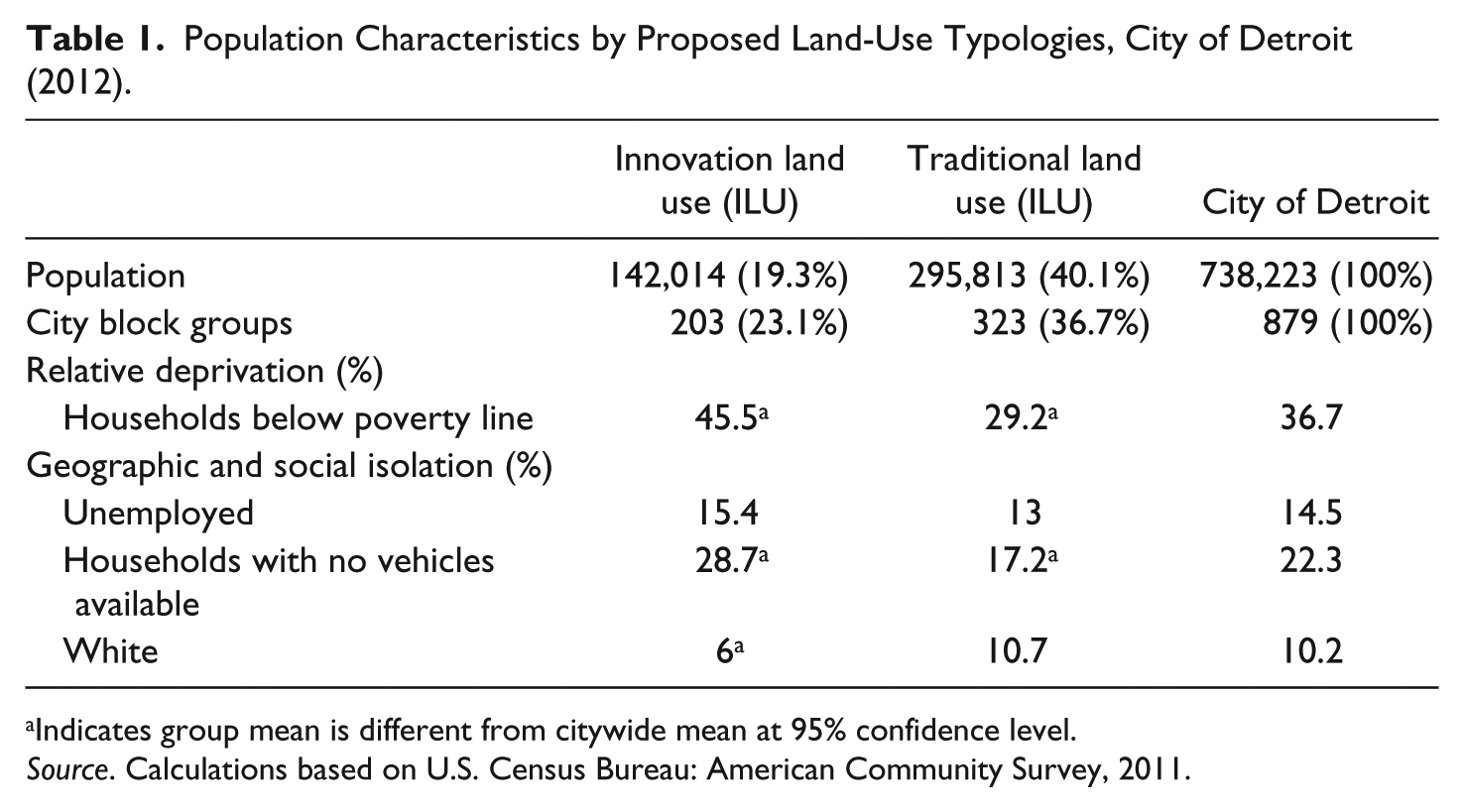
Indicates group mean is different from citywide mean at 95% confidence level.
Source. Calculations based on U.S. Census Bureau: American Community Survey, 2011.
Furthermore, the rezoning proposal is predicated on geographical fallacies of citywide homogeneity and residential mobility. The contiguous rectangular shape of most ILU zones raises suspicions of arbitrary demarcation. Whereas the DFC states that both physical and market indicators were used to determine future zonal frameworks, the document does not disclose precise criteria or methodology employed. In our exploratory analysis, we looked at the main statistical parameters and spatial distribution of block-level vacancy rates for 2010. We found a less than perfect overlap between block units with high vacancy rates and the ILU polygons depicted in the DFC report (DWP, 2012). In fact, the polygons contain eight block units with relatively low vacancy rates (at least 5 percentage points lower than the citywide rate of 23%). Figure 1 displays the relative location of these blocks and the subset of four sites where we conducted a survey of conditions on the ground. We detected clusters and even entire blocks of well-maintained, single-family homes with the usual signs of residential life characteristic of mid- to low-density American neighborhoods. Despite examples of low-intensity vacant land rehabilitation within an existing urban fabric (e.g., Philadelphia’s LandCare Program) by producing increased housing values, raising feelings of safety, and empowering communities through job creation and site ownership, DFC offers more sweeping and dramatic changes (Wachter & Wong, 2008).
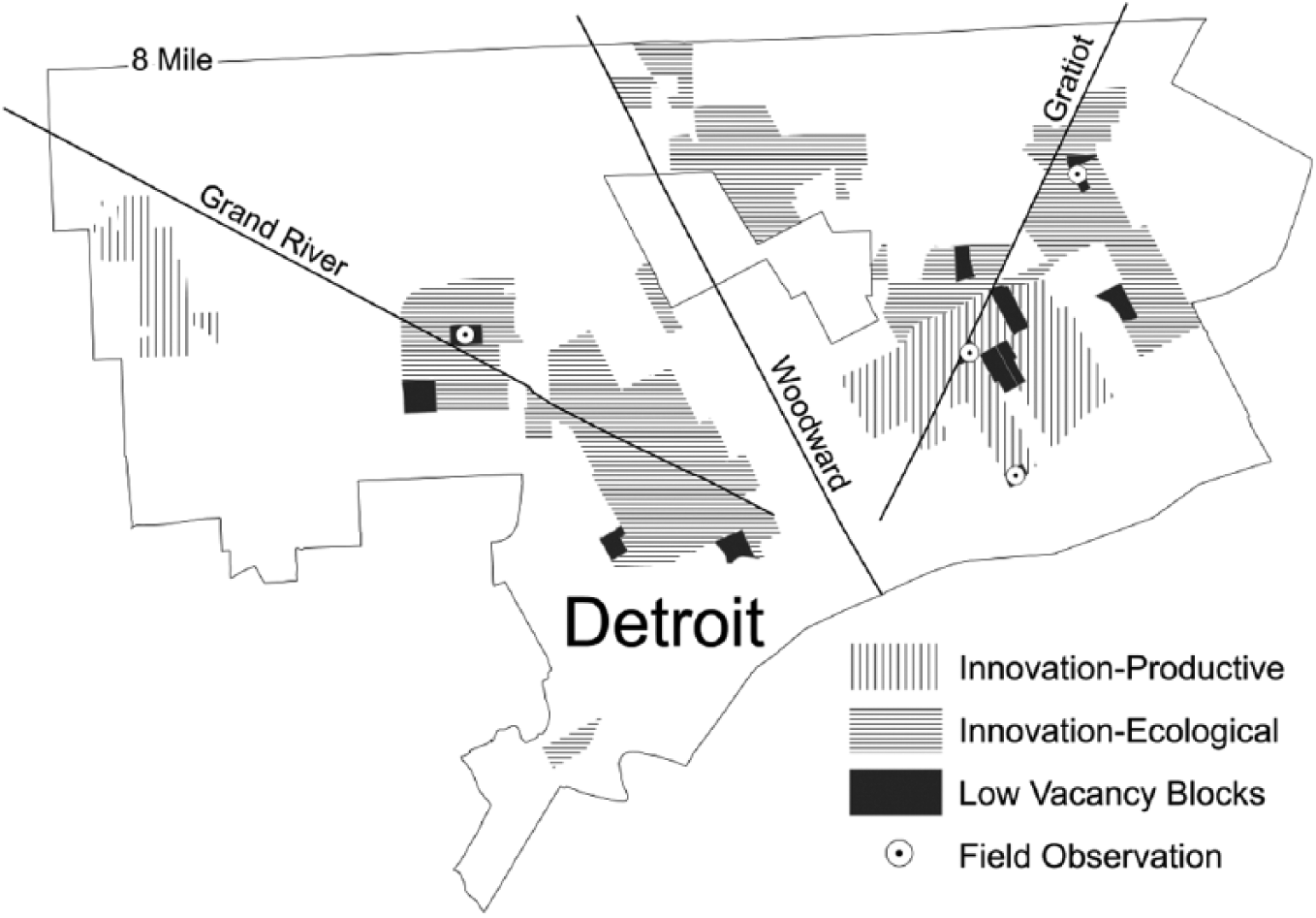
Map of low-vacancy residential quarters in “Innovation Land Use” zones.
Perceived to produce winners and losers, DFC generated considerable social anxiety before its final unveiling because concerned residents lacked information about which blocks would be included in the ILU designation. Not surprisingly, the DWP sought to calm misgivings through its public relations machinery and the DFC text itself. Nowhere, however, does the document specify how daily life can continue in neighborhoods progressively denied their municipal services and infrastructure support. Ambiguity and overoptimism mark relocation proposals such as the voluntary “house-for-house” swap. Also left unclear is how disadvantaged households lacking both residential and employment mobility, and in many cases dependent on the fixed incomes of meager pensions and retirement funds, might be able to pay off their mortgages, save money to relocate, and then access the promised opportunities of building household equity and an improving quality of life in reinvested neighborhoods. In fact, the opposite may occur as the threat of municipal service withdrawal could lower further already depressed land and home values. DFC makes no commitment to funding remedial programs for those suffering displacement, including many homeowners who have maintained their properties in good condition despite adverse neighborhood change.
Finally, it is noteworthy that, as the product of pervasive neoliberal urbanism, the DFC not only propose to reduce municipal services in the rather familiar guise of planned shrinkage for underprivileged inner-city neighborhoods. It also introduces an ambitious campaign of reinvestment and capitalization of urban land: in fact, the City of Detroit owns more than half of all vacant lots in “high-vacancy” areas. Therefore, proposals for urban farming and ecological experimentation may be performing a discursive function beyond the feasibility and cost-effectiveness of such future land-use options. The DFC’s imagery of “green and blue infrastructure,” “desirable landscapes,” and “flowering fields that clean contaminated soils” may be interpreted as yet another trope to portray Detroit as investment-ready, whitewashing the problematic history of extremely uneven development at the metropolitan scale, marked by widespread racialized spatial injustice and oppression (DWP, 2012). Accordingly, Pedroni’s (2011) thesis not only applies to the islands of gentrification arising in privileged sections of the city but is increasingly applicable to neglected neighborhoods now recast as ILU and ecological landscapes, because future waves of external investment are likely to require that the land “be cleared of both its physical structures and, in particular, its discursive inscription, including in this case its dangerous racial inscription” (Pedroni, 2011, p. 210).
Conclusions
Mark Binelli (2012, pp. 15-16), one of the most insightful commentators on Detroit’s fortunes, draws attention to the irony in current plans to green the city as if dealing with “a blank slate, so debased and forgotten it could be remade.” He points out that Detroit, one of the most iconic symbols of the destructiveness of 20th-century suburbanization, is now being hailed for becoming “a model green city for the new century, with bike paths, urban farms, and grass roots sustainability nudging aside planned obsolescence.” This study has shown that such ambitions are riddled with racialized spatial injustices. Intended as a critique of the DWP, elite public partnership and its networks, it contributes to the literature on pervasive neoliberal urbanism in the United States. This evaluation taking of the DFC strategic framework has problematized a case of green capitalism, and more specifically ecological entrepreneurialism, that intends to revalorize urban land for global investment by infusing it with green functions and symbolisms (see Kanai, 2013, for other international cases). Furthermore, this analysis has demonstrated that studies of neoliberal urbanism need not be limited to exposing the global origins and networked processes of market-centric forms of urban governance. On the contrary, they must engage the sociospatial effects of neoliberal urbanism on the ground, particularly if they are to contribute to broader academic and social debates on urban futures.
Our criticisms of the DFC’s rezoning proposal must not be read as being limited to the technical application of a specific mapping methodology that could be refined before it is actually applied. Instead, the argument here is about the need to search for more democratic and just approaches to address Detroit’s colossal challenges. Future research will need to monitor social resistance and mobilization against initiatives such as the DFC. In fact, the proposal has so outraged this profoundly segregated and impoverished city, and particularly those areas most directly affected by public disinvestment and land-use regeneration, that DWP has already been forced to redesign its consultation, civic engagement, and public participation mechanisms (Clement, 2013). The conflicts and political opportunities that these new participatory channels have opened are still in the formative stage. Thus, it is still too early to predict the extent to which localized resistance will be able to further modify extant proposals and whether broader coalitions may emerge to counter physical fragmentation, social inequalities, and deepening racial divisions.
The future envisioned in the DFC strategic framework is loaded with injustices that will disproportionately burden Detroit’s poorest and most isolated residents as well as destabilize residential clusters that have remained resilient even as they were engulfed by ever-greater adversity. In our field survey of affected neighborhoods, we had conversations with residents who were not only unable to relocate but also completely unaware that their properties were targeted to have municipal services withdrawn prior to rezoning into agricultural or green land use. Critiques of neoliberal urbanism in Detroit and elsewhere need to continue analyzing the complex empirical dimensions of sociospatial injustice in cities, especially the role played by market-centric forms of urban governance. Such findings will not only make critical academic research more comprehensive but also could help those affected by and mobilized against neoliberal hegemonies, for example, by supporting their legal challenges and contributing to their framing of issues to gain wider social legitimacy. At about the same time that the City of Detroit’s bankruptcy became sensational news, new findings on the national prevalence of (sub)urban intergenerational poverty traps nationwide were made available (see the Equality of Opportunity Project at http://www.equality-of-opportunity.org/). The neoliberal urbanism research thrust is now more important than ever in making both theoretical and practical contributions to the fight for urban futures in Detroit, as well as cities across the United States and the world beyond.
Footnotes
Declaration of Conflicting Interests
The author(s) declared no potential conflicts of interest with respect to the research, authorship, and/or publication of this article.
Funding
The author(s) received no financial support for the research, authorship, and/or publication of this article.