







Abstract
This article draws principally from the work of preeminent sociologist Alejandro Portes on the rise of Miami as a global city (segmented assimilation as well as the institutional bases for social cohesion amid diversity) to propose a blueprint for reducing social inequality in Greater Miami. Employing key insights from psychology and sociology, we bring together data and research on macro-level structural changes, meso-level dynamics of city politics and institutions, and micro-level dimensions of interactions and attitudes to highlight prospects for promoting ethnoracial interdependence. The diversity and transience that characterize Miami create a major opportunity to disrupt ethnoracial social and economic inequality. Strong public coordinating institutions are required, guided by necessary conditions that facilitate the closing of group-based social distance. We propose three cases—children-targeted programming, emerging prospects in health care, and diversity focused planning in education and housing—as offering opportunities to place Miami 2030 on the path toward cohesive and egalitarian diversity.
Keywords
In their classic analysis, “Miami: A New Global City?” Sassen and Portes (1993) highlighted the processes of rapid, globalization-driven, economic development that transformed Miami from a sultry tourist destination into a truly global city. As cities worldwide engage in economic development and restructuring to achieve sustainable economic activity and growth, what becomes of those segments of the population with limited access to globalization’s windfall? In many cases, as in Miami, traditionally excluded ethnoracial groups are less likely to benefit from new avenues for economic growth, solidifying socially constructed racial divides.
However, the traditional social and economic subordination of those deemed racially inferior need not constrain their access to economic rewards at times of economic restructuring and growth. An earlier stage of economic transformation in the United States provides examples that partially disrupt the narrative of race-based exclusion, not only highlighting the complexity of socially constructed racial categories, but also offering blueprints for city-level organizational and institutional action that can narrow the racial economic divide. We argue that unless the challenges of ethnoracial inequality are addressed through meso-level interventions, macroeconomic development policies that focus primarily on sustainable economic growth and new employment opportunities may solidify if not widen ethnoracial economic inequality and social distance. Miami 2030 would then simultaneously represent both a recreational utopia for the global elite as well as an urban dystopia for the racially marginalized. Indeed, some argue this is already the case (Nijman, 2011).
In this article, we propose an alternative path. The inherent categorical complexity of race in the United States provides both constraints and opportunities to begin closing the racial economic divide in Miami. First, we develop our argument by reviewing trends in economic development and social inequality in Miami since Sassen and Portes’s (1993) original reflections on Miami’s status as a global city. In reference to ethnoracial inequality, we focus primarily on social structural areas of traditional concern to social scientists: inequalities in occupation, income, and poverty as well as related spatial inequalities. Second, we move beyond structural factors to consider how ideologies pertaining to race and the construction of social boundaries shaped the structural incorporation of those initially deemed racially inferior during the early half of the 20th century. We discuss how the intrinsic complexity surrounding the social construction of race and community has brought Miami and other major cities across the United States to an inflection point regarding the future course of ethnoracial inequality and urban development. Third, we maintain that the path beyond this inflection point must necessarily play out on the terrain of ideological cohesion and the coalescence of perceived group interests. Individuals’ ideas about the horizons of group membership and communities are central to understanding their interactions, policy preferences, and, ultimately, the actions of institutions of which they are a part. We therefore highlight elements of Hispanic public opinion in Greater Miami, given Hispanics’ centrality to local political power and their vital role in shaping future urban economic development and social integration. Finally, drawing on Portes and Vickstrom’s (2011) reflections on diversity, institutional coordination, and social cohesion, we identify examples of local institutional action that illustrate opportunities for steering urban development toward ameliorating extant ethnoracial social and economic inequality rather than reproducing or intensifying racial cleavages. We argue that the City of Miami and other institutional actors in surrounding Miami-Dade County can play key roles in implementing policies and programs to stem the tide of growing ethnoracial inequality, potentially making Miami a true model of a more auspicious urban future, rather than a model of ethnoracially segregated and fragmented urban diversity (Nijman, 2011).
Globalization and Ethnoracial Inequality in Miami: 1993 to 2013
Sassen and Portes’s (1993) reflections on Miami as a possible global city revolved around three central hypotheses. First, they predicted that global cities display an increase in administrative and managerial presence, and provided evidence of major U.S. and international corporations that established or relocated their headquarters in metropolitan Miami during the late 1980s and early 1990s to take advantage of the flow of goods, services, investment, and information targeted at Latin American emerging markets. Second, they predicted that global cities like Miami develop a postindustrial production infrastructure of highly specialized services, including financial agencies that work to support and provide services to the management, investment, and international trade industries. Last, they proposed that these features of economic globalization and the highly specialized industries that arise alongside contribute to a “new geography of inequality,” which include spatial and employment inequalities. U.S. Census Bureau data for Miami-Dade County reported in ensuing years largely confirm these hypotheses.
Over the past two decades, Sassen and Portes’s (1993) predictions have been fully confirmed. Since the early 1990s, Miami has experienced remarkable growth across broad sectors of the economy: corporate management industry expanded by one third and the postindustrial sector by no less than 50%. This remarkable growth in management and postindustrial service industries has substantially intensified ethnoracial inequality in Miami, particularly through its effects on the urban area’s occupational structure and spatial relationships. Approximately 15% of non-Hispanic Whites were employed in management occupations between 2005 and 2012, compared with about 7% of Hispanics and 4% of Blacks. Hispanics exceeded more than 50% the representation of Blacks working in business and finance-related occupations in 2012, whereas the White’s proportion was almost triple that of Blacks in these occupations. Similarly, barely 0.5% of Blacks were employed in legal occupations in 2012, compared with 1.5% of Hispanics and 5.6% of non-Hispanic Whites. Since these industries are enmeshed in the globalization-driven growth transforming Greater Miami, today’s answer to Sassen and Portes’s (1993) query—“Has the new internationalization in Miami . . . created new opportunities for African-American workers?”—remains negative. Although the Hispanic–Black business ownership ratio still stands at over 5-to-1 (60.5% of Miami firms in 2007 were Hispanic-owned, compared with 11.4% owned by Blacks), sales and receipts for Hispanic-owned firms totaled a staggering $45 billion, compared with $1.8 billion for Black-owned companies. Thus, it comes as no surprise that Hispanics, Blacks, and non-Hispanic Whites have experienced different, diverging levels of median household income and poverty (see Figure 1).
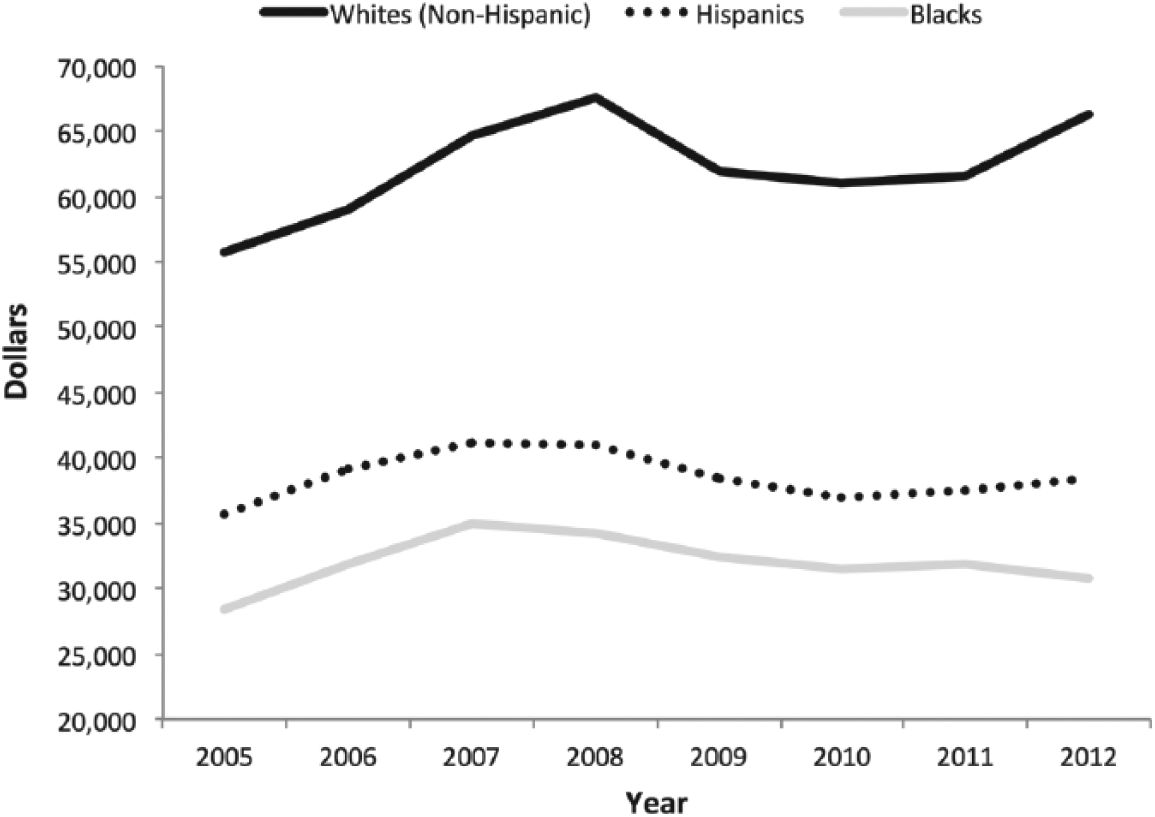
Median household income trends, by ethnoracial group (Miami-Dade County).
The high rates of poverty among Hispanics and Blacks in Miami-Dade reinforce stereotypes of these groups as linked to neighborhood disorder (see Figure 2). The large literature on the urban “underclass” has been described as “the most influential body of scholarship to emerge on urban problems” during the last quarter century (Sugrue, 2005, p. 4). An early strand of this literature couches depictions of race with explanations of the behavior, values, and family structure of inner-city residents. Sugrue (2005) has argued that a complex understanding of the linkages between history and race in the postwar era is largely missing from the “underclass debate” about the past, current, and future condition of cities. The result is that decades of ethnoracial stereotyping, reinforced by urban scholarship, has inexorably connected race to societal ills, social disorganization, and patterns of behavior and processes in ways that perpetuate the denigration of African descendants in the United States.
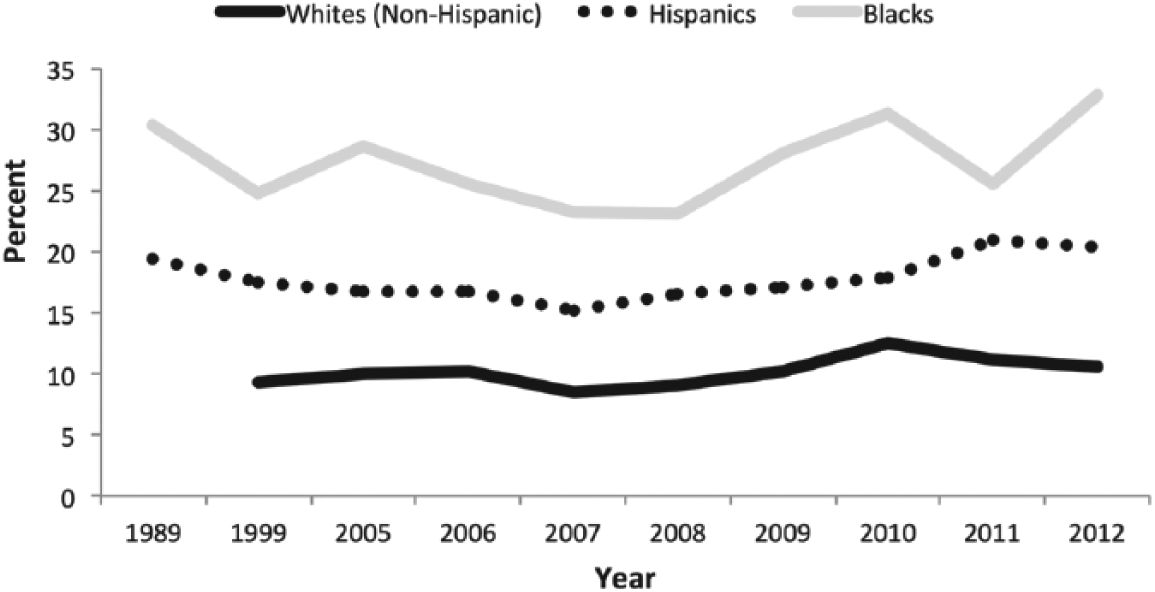
Poverty trends, by ethnoracial group (Miami-Dade County).
Research conducted in Chicago has shown that the presence of Blacks and Hispanics in a neighborhood is linked to perceptions of neighborhood disorder beyond a neighborhood’s actual, systematically observed disorder and decay (Sampson & Raudenbush, 2004). Crime and a variety of other social problems have long been seen as progeny of neighborhood disorder (J. Q. Wilson & Kelling, 1982). Based on recording evidence of physical disorder, social disorder, and physical decay in neighborhood blocks, Sampson and Raudenbush (2004) determined that as the levels of Black and Hispanics living in a neighborhood increase, perceptions of neighborhood disorder increase that are out of synch with actual indicators of neighborhood disorder.
This association between the categories “Black” and “Hispanic” and the perception of neighborhood disorder can reinforce racial segregation. Demographers recognize that many urban centers in the United States have already become majority-minority. Twenty-two of the 100 largest metropolitan areas had become majority-minority by 2010, with Hispanics constituting the largest minority in metro areas such as Los Angeles, Houston, New York, and Miami (Frey, 2011). Within 93 of the 100 largest metropolitans, non-Whites and Hispanics represented the majority of residents living in central cities in 2008, whereas Whites constituted the majority of suburban residents (Brookings Metropolitan Policy Program, 2010). With Blacks and Hispanics constituting plurality segments of urban spaces, cities risk becoming viewed as synonymous with disorder, with ensuing consequences for urban/suburban residential segregation as well as political struggles over local taxes and funding for education, law enforcement, health care, and the like.
The challenge of residential segregation assumes even greater complexity in Greater Miami. Even though Hispanics made up almost two thirds of Miami-Dade County’s population in 2012 (U.S. Census Bureau, 2013), this metropolis differs from other U.S. communities whose Hispanic population is predominantly of Mexican ancestry. Miami, however, is home to a wide range of national-origins within its Hispanic population mosaic. This adds another dimension to traditional racial segregation by introducing segregation among subpopulations within the broader Hispanic category. Researchers find some evidence of segregation between Hispanics in Miami based on year of arrival and income, with the highest levels of intra-Hispanic segregation occurring between high-and low-income Hispanics (Lukinbeal, Price, & Buell, 2012). They also found meaningful levels of Cuban segregation from the next three largest Hispanic groups in Miami (Puerto Ricans, Colombians, and Nicaraguans). These new dimensions in residential segregation compound Miami’s traditional racial segregation, which remains the 10 most racially segregated major metropolitan areas in the United States (with a persistent Black-White Index of Dissimilarity [D] of 73, indicating that 73% of either Blacks or Whites must move to a different census tract to approach equal distribution across tracts; Logan & Stults, 2011).
Whereas recent data largely confirm key elements of the Sassen and Portes’s (1993) predictions for Miami as a global city, the amplification and consolidation of ethnoracial inequality are not inescapable. These data on occupational, income, and poverty differences between ethnoracial groups correspond to socially constructed boundaries. As the next section details, the very nature of race as a social construction provide opportunities to diminish ethnoracial inequalities as well as missteps that can reinforce marginality and exclusion.
Racial Ideology and the Boundaries of Social Citizenship
Although the decline in the American industrial base alongside the rise of its postindustrial production economy revealed that major economic restructuring can intensify existing group-based inequalities (W. J. Wilson, 1978, 1990), an earlier stage of U.S. economic transformation—from agricultural to industrial—showed that intensification of racial inequality is not inevitable. On the contrary, recent historical sociological research on the development of social welfare and relief in the early 20th century revealed the influence that local organizational and institutional actors can have in either reducing or magnifying inequality among marginalized groups (Fox, 2012). Southern and Eastern European immigrants, Mexicans, and Blacks were each viewed as racially inferior populations in the United States during the first decades of the 20th century. Yet both ideologies and institutions operated differently in cities to ensure that Southern and Eastern European immigrants would eventually become White and be incorporated into social citizenship, receiving abundant social assistance, and ultimately enjoying the fruits of America’s economic development. Simultaneously, both the intransigence and vagaries of racial ideology would also relegate Blacks and Mexicans (even those who phenotypically appear White), respectively, to second-class status amid ongoing economic changes.
To understand how Southern and Eastern European immigrants could at one point have been regarded as racially inferior, and how such a boundary perception was eventually overcome through intentional institutional action, requires a brief discussion about the social and historical construction of race. Historically, the conceptualization of racial groups in the United States relied on distinctions made on the basis of three criteria: that racial groups are genetically discrete, reliably measured, and scientifically meaningful (Smedley & Smedley, 2005). The consensus among contemporary scholars of evolutionary biology, anthropology, and genetics is that biological racial distinctions fail on all three criteria. In contrast, contemporary social scientists have extensively documented that “race” is a social rather than a biological construct (Goodman, 2000; Nagel, 1995). The concept of race is a relatively recent historical social construction, largely advanced in the United States during the post–Revolutionary War era when the dominant political philosophy of equality, civil rights, democracy, justice, and freedom for all stood in sharp contrast to the practice of enslaving Africans (Bell, 1988; Marshall, 1987; Smedley & Smedley, 2005).
In the United States, the varied social construction(s) of race can be observed in many different ways, including changing census categories and definitions of race (Thompson, 2012). The methods employed to categorize and enumerate the American population on the basis of race and ethnicity is based on social, rather than biological or genetic usage. From 1790 to 1850, the only broad categories for which data were published were White and Black (Negro), with Black designated as free and slave. Starting with the 1910 census, Asian and Pacific Islander categories other than Chinese and Japanese were identified separately. In the 1930 census only, there was a separate racial category for Mexican, and the 1940 census was the first to include tabulations on the Spanish-speaking White population. Subsequent changes have become increasingly complex, with six additional racial–ethnic categories introduced in the 2000 Census alone, allowing individuals for the first time to claim a mixed racial identity preference; seven million Americans chose to identify themselves as belonging to two or more “races” (U.S. Census Bureau, 2000). The 2010 Census included a total of 15 racial categories and places to write in races not specifically listed on the form as well as the option for respondents to select more than one race.
The history of census data on Hispanic origin is quite different from that concerning race. The first attempt to identify the entire U.S. Hispanic-origin population was made in 1970. This population was defined in three different ways in 1970 census reports: (a) as the Spanish-speaking population, (b) as the Spanish-heritage population, and (c) as the population of Spanish origin or descent based on self-identification. Hispanic origin is considered separately from race in the census, and Hispanics may identify with any race. By 2010, the census evolved to more clearly identify the “Hispanic” category as an ethnicity and not as a race, and the term “Hispanic or Latino” was broadened to include “Hispanic, Latino, or Spanish Origin.” In addition, the option to utilize multiple “boxes” was extended to those identifying themselves as being of Hispanic origin in order to avoid having to prioritize ethnic heritages for those of mixed parentage (e.g., Hispanic and non-Hispanic). Currently, discussions are underway as to whether Hispanics, currently viewed as an ethnic category, should be reclassified as a racial group for the 2020 census (Turnbull, 2012).
Thus it has become a manifest principle in the social sciences that both race and ethnicity are socio-historical constructs, and as such the meaning ascribed to them fluctuates as a function of temporal and spatial considerations (Almaguer, 1994; Omi & Winant, 1994). For peoples of African descent since the end of slavery, race has mainly been a bifurcated category with Black racial identity defined by the one-drop rule. For Southern and Eastern European immigrants and Mexicans, the deployment of racial categories with spatial and racial variation involving city politics, organizations, and institutions, is a striking counterpoint to the racialization of African Americans (Fox, 2012; Fox & Guglielmo, 2012).
The 1924 National Origins Act can be considered the policy triumph of the U.S. eugenics movement, primarily barring Southern and Eastern European immigrants who were seen as different and inferior to other Europeans in terms of race, even if sharing the same status on the basis of color (Fox, 2012; Jacobson, 1998; Ngai, 2005). However, perceptions of racial inferiority did not interfere with Southern and Eastern European immigrants’ inclusion in social citizenship, as indicated by the abundant social assistance they received from federal, state, and local relief agencies and especially social workers. Relief agencies’ historically differential treatment of Southern and Eastern European immigrants vis-à-vis Mexicans is particularly relevant given some of the key urban areas where they took place: Chicago, New York, and Los Angeles, which together with Miami, are among the leading global cities in the United States today. A focus on city-level variation in public and private provision of relief indicates that government policy does not necessarily determine institutional action targeted at particular groups: meso-level institutional actors’ attitudes toward ethnic groups can powerfully shape their agentic behavior to either implement or resist government policies (Fox, 2012).
Despite federal policy targeting immigrants for deportation along with mass public support for expelling aliens on relief during the 1920s and 1930s, relief agency officials varied their responses to expulsion policies. In Chicago, with its high concentration of Southern and Eastern European immigrants, relief officials and social workers resisted cooperation with immigration officials. Contrary to the contemporary popular belief that some European immigrants succeeded in the United States, based primarily on their own individual initiative without “special favors,” there was widespread institutional support for European immigrant social and economic integration. Settlement houses and workplaces in the North, including factories in Chicago, offered English and naturalization classes, whereas schools taught European immigrant children in integrated classrooms. Such institutional support was largely not provided to either Mexicans or African Americans. Meanwhile, in Los Angeles, with its high concentration of Mexicans, relief officials, politicians, and social workers actively abetted the expulsion of Mexicans, at times overstepping their role as relief providers to assume the responsibilities of immigration enforcement. Finally, despite the state of New York passing a law authorizing the forcible removal of immigrants on public support, its Department of Social Welfare as well as the New York City Department of Public Welfare rarely invoked their authority to forcibly remove aliens. Recall that Ellis Island in New York harbor was the primary port of entry for European immigrants. According to Fox (2012), “Southern California relief agencies removed nearly as many ‘alien poor’ [in just 3 years] as the New York State Department of Social Welfare did in the course of over sixty years of work” (p. 178). Central to these processes was the role of racial ideology, particularly variations in assimilation ideology that viewed Southern and Eastern European immigrants as assimilable despite presumed racial inferiority and in time relegated Mexicans to the status of nonassimilability alongside African Americans.
For the purpose of this argument, an important point of emphasis is the categorical instability that allowed for variations in the experiences of two of Fox’s groups: Southern and Eastern European immigrants and Mexicans. For racially inferior Southern and Eastern Europeans, local institutional actions facilitated their incorporation into the fabric of American social citizenship. For Mexicans, whose racial categorization shifted over time—initially seen as assimilable before later being recast as unassimilable—institutional actions also anchored their experience, from initial attempts to include them within the sphere of public and private relief provision before social workers and relief officials eventually settled on Mexican exclusion, restriction, and ultimately expulsion. In both cases, the agency of local actors and institutions determined whether the bounds of social citizenship and accompanying social assistance would facilitate or impede social and economic incorporation.
Categorical Complexity, Generativity, and Ideological Cohesion
Fox’s rich historical narrative on differences between the treatment of Southern and Eastern European immigrants, Mexicans, and the Black population, is a strong and clear illustration of factors that immigration scholars describe in the theory of segmented assimilation (Portes & Rumbaut, 2001). In addition to individual-level factors, such as human capital and family type, immigrant incorporation is also shaped by government policy (e.g., legal or unauthorized immigration, refugee status, etc.), host society reception (extent of discrimination), and coethnic community characteristics (class character, economic and political resources, and the like). As the recent trends in census data classification covered above indicate, many of these structural factors conspired to produce different socioeconomic mobility trajectories among newly arrived Cubans and long-standing African American populations in Miami (Portes & Stepick, 1994).
The irony of highlighting the limitations of census racial and ethnic categories, after first drawing on census data to document Miami’s global city transformations against its background of widening ethnoracial inequality, is not lost on us. Race has served as a proxy for the description and distinctions made among many kinds of psychological and sociological processes in the absence of valid, reliable methods for grouping individuals on the basis of race. The “fact of inequality renders race an important social policy concern” (Smedley & Smedley, 2005, p. 22). A paradox that continues to underlie the complicated legacy of urban social processes. We assert that race has served as a proxy for a range of behaviors and processes that are not, and perhaps may never be, adequately measured. It is this lack of specificity about the functioning of urban settings that has led scholars to be increasingly challenged by the kinds of demographic shifts occurring in cities like Miami. Shifting conceptualizations about race, ethnicity, social identity, and culture—brought to the United States by immigrants from Latin and Caribbean countries, disrupts the current urban underclass debate that rests on the association between African Americans and inner-city social problems, even if that association is not made explicit.
In addition to country-of-origin variations in group classification schemas, the lack of cohesion and immense heterogeneity within the “Hispanic” category presents greater flexibility and opportunity to disrupt the category-inequality dynamic. As the segmented assimilation literature details (e.g., Portes & Rumbaut, 1996), various factors combine to place members of Hispanic subgroups in different social structural positions in urban areas, presenting different paths for upward mobility. Not only are there substantial structural differences that militate against the racialization of these largely Spanish-speaking ancestral groups as “Hispanic,” but social psychological attitudes and attachments further indicate the difficulties of assimilating culturally, historically, and structurally disparate national origin groups into an aggregate pan-ethnic category.
In light of these differences, we believe a major question for urban policymakers centers on how to disrupt the process by which new arrivals’ ethnoracial group schemas become assimilated into the American historical ethnoracial schema of ascriptive inequality (Smith, 1993). It is the instability of these ethnoracial conceptualizations that creates opportunities for decoupling the link between these problematic categories and the underlying social processes that embed categories into inequality-producing structures, including ethnoracially homogeneous social networks. Social networks are indeed fundamental structures through which much economic activity occurs, including having played a central role in Cuban entrepreneurial success in Miami (Portes & Stepick, 1994). However, racially homogeneous social networks have also been a major factor in reproducing “racial inequality without racism” (Ditomaso, 2013).
How can urban spaces be structured to increase the valuation of diversity and eliminate the devaluation of diversity—in the form of perceptions of racialized social disorder or relegation to ascriptive inequality? The possibility of a collective and cross-cultural shift toward what scholars have referred to as generativity offers promise for the future development of multicultural spheres.
The concept of generativity, first introduced by Erikson’s theory of psychosocial development, refers to the individual concern that develops relatively late in life for “establishing and guiding” the next generation and is juxtaposed with “stagnation” (Erikson, 1963). A recent investigation of the cross-cultural comparability of generativity found evidence supporting the construct across African, Latin American, and European contexts (Hofer, Busch, Chasiotis, Kärtner, & Campos, 2008). They describe generativity as originating, in part, from a motivational source that is culturally determined and influenced by the degree to which a context is interdependent:[In societies where] people see themselves as embedded in tight and larger social contexts . . . and define themselves through social roles, the inclination to (inter) act generatively is particularly high. (Hofer et al., 2008, p. 3)This focus on the social context provides the space for institutional actors to play an important part in fostering interdependency.
The part that can be played by local institutions is critical in light of Portes and Vickstrom’s (2011) discussion of the essential role coordinating institutions play in promoting cohesion in the modern world. They provide reminders that strong coordinating institutions promote the types of Durkheimian organic solidarity on which social cohesion in a complex and diverse society is based. Portes and Vickstrom focus on how “strong public coordinating institutions” can organize an otherwise individualistic society, but psychological research indicates it may also be possible to promote interdependence through attention to how conceptions of the self-interact with larger cultural frame works, a cycle of mutual constitution (Markus & Kitayama, 2010). For example, although U.S. residents see themselves primarily in individualistic terms and behave accordingly (disjoint agency), reframing “America” as a nation that acts interdependently (conjoint agency) has implications for changing how individuals view their sense of self and their choice of actions (Hamedani, Markus, & Fu, 2011). Portraying America as a partner in world affairs (conjoint agent) rather than as an independent leader (disjoint agent) yielded a significantly higher likelihood among individuals to act in ways that accommodated group preference over personal preferences. Based on their experimental data, the researchers concluded,
Changing American selves in an enduring way, therefore, may occur only if more ideas, institutions, practices, and products in American contexts—that is, more important sociocultural sources of self—pervasively promote, foster, and sustain the ideas and practices of conjoint agency. . . . Conjoint agency, for example, may become more pervasive as “eco-consciousness” becomes part of everyday living, universities foster “public service,” workplaces and schools award employees and students for “fitting in” and “being cooperative,” urban planners resurrect city neighborhoods to “build community,” and politicians and policy makers nurture America’s role as a “global partner.” (p. 361)
Note again the important space carved out for institutional action. The roles structured by local institutions and their cultural framings, therefore, can become indispensable in promoting and facilitating interdependency that, according to intergroup contact theory, can challenge the hierarchical positioning of ethnoracial group categories. As an approach to reducing racial prejudice, Allport’s classic intergroup contact theory (plus Pettigrew’s later amendment) relies on several situational conditions: equal status between group members’ shared goals, intergroup cooperation, authority support, and potential for generating cross-group friendship (Pettigrew, 1998). To the extent that urban institutional policies proactively incorporate these situational conditions, they can nourish community-level generativity to reduce social distance and reinforce social roles that allow community members to develop a sense of interdependent responsibility for the future of their environment.
We propose that ideological cohesion around interdependence to address inequity can be achieved in multicultural spaces like Miami when diverse groups are institutionally enabled to develop a shared vision for collective benefit that does not require one-way, Anglo-Saxon assimilation (Fredrickson, 1999). Aspects of Hispanic public opinion concerning African Americans reveal opportunities for what culture scholars Small, Harding, and Lamont (2010) refer to as “boundary work,” or “constructing collective identity by differentiating oneself from others by drawing on criteria such as common traits and experiences as well as a sense of shared belonging” (p. 18). According to Miami data from the 2006 Latino National Survey (Fraga et al., 2006), Puerto Ricans and Dominicans perceived the highest levels of commonality with African Americans on socioeconomic opportunities and achievements (see Figure 3 and Figure 4). Cubans were most likely among Hispanic subgroups to perceive a lack of educational competition with African Americans.
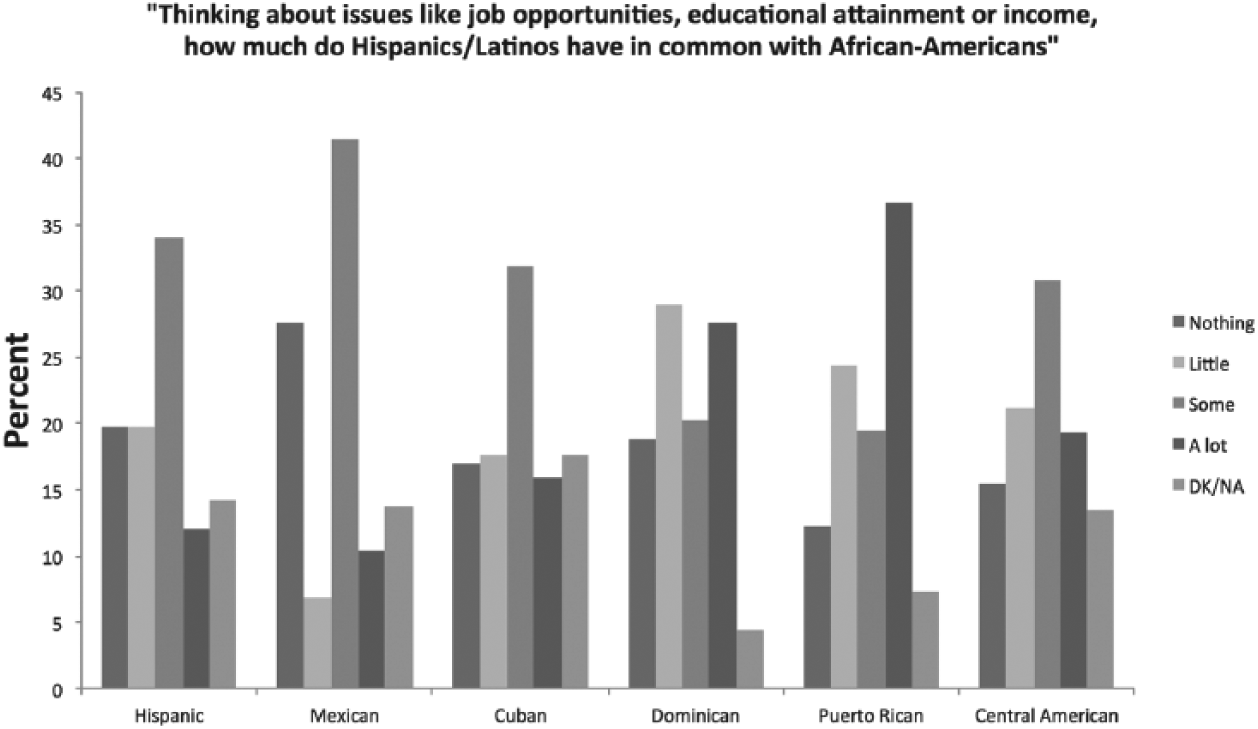
Perceived socioeconomic commonality with African Americans, by Hispanic subgroup.
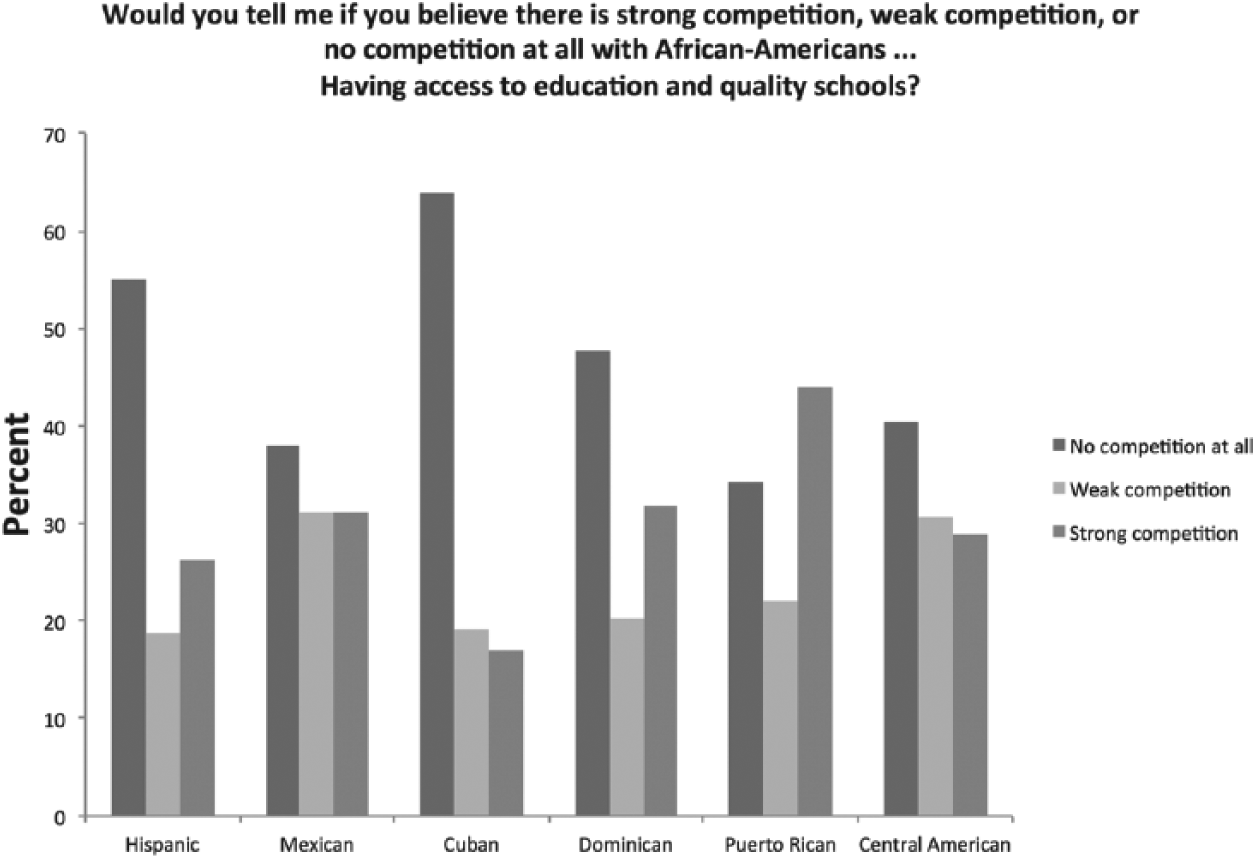
Perceived educational competition with African Americans, by Hispanic subgroup.
In cases where attitudes reflect perceived group competition or perceived lack of commonality, these attitudinal challenges maybe overcome through boundary work in situations where institutions can structure roles, goals, interactions, and maintain equal status between actors. As Bobo (1999, p. 453) remarks in his elaboration of Blumer’s group position theory of racial prejudice,
[Blumer] did note that . . . identities take shape through a historical process, involve perceived differences in physical appearance and culture, may entail origins in separate ecological locations . . . and are decisively influenced by the initial terms and conditions of contact of different groups . . . [Blumer] focused on how to understand the functioning of the sense of group position once a set of racial relations have been largely institutionalized. [Italics added]
Typically missing from studies of global cities and other research on macro-level urban development, social psychology provides a crucial bridge between policies, institutions, organizations, and features of the built environment, on one hand, and the micro-level individual and interactional processes that contribute to reproducing inequality, on the other. Fox’s historically rich, sociologically nuanced analyses of relief provision—and we hope this essay can help address this lacuna.
In sum, social science research can inform public and private sector actors tasked with structuring urban spaces and designing programs that reduce social inequality. As intergroup contact theory suggests, this would likely entail the institutional cultivation of an ideological cohesion around civic advancement, innovative social-problem solving, and overall improvement of well-being. As historical research on the provision of relief indicated, city-level actors can play a vital role in expanding the contours of group boundaries and enlarging the pool of those benefitting from economic growth and developments.
A Way Forward: Meso-Level Institutional Actions
One example of ideological cohesion was a 2002 “The Children’s Trust” Miami-Dade County voter referendum that authorized a levy on a portion of county property tax income to support programs, resources, and interventions for children (The Children’s Trust, 2013). Whereas a similar initiative failed a decade earlier, the 2002 campaign centered on two messages: (a) that the established fund would benefit all children, and by extension all members of the Miami-Dade community including parents, grandparents as well as the legal, judicial, health care, and social service system, and (b) the established fund would be held in a trust with a “sunset provision” so that the initiative could be returned for voter approval within 5 years. These messages helped the referendum pass in 2002, and resulted in a successful reauthorization in 2008 despite the difficult economic climate of that time. Therefore, a shared vision that includes the collective benefit, while still focusing on those most in need, and an emphasis on a shared value of trust, together facilitated an ideological cohesion that was enacted in a political environment that is often divided along racial, ethnic, and socioeconomic lines.
The 2010 passage of the Affordable Care Act points to a second arena of opportunity: Miami’s strong health care sector. Unlike the management and financial services sectors spurring global city economic development in Miami, the local health care sector can now utilize Affordable Care Act–based incentives and opportunities to engage in the types of local institutional actions that can transgress traditional group boundaries and reduce social inequality. Three policies hold particular promise. First, patient-centered programs that actively involve patients, family members, and communities from traditionally disadvantaged backgrounds in addressing health, can create institutionally sanctioned interdependent roles among clinicians, other health service providers, and patients and community members. Second, workforce programs designed to diversify various high-skilled health sector occupations, including active recruitment and tuition support for underrepresented minorities for high-skilled health sector employment training. Third, collaborative or integrative care models that integrate a wide-ranging array of health care professionals to provide comprehensive care that recognizes linkages and comorbidity between a range of physical and mental health outcomes.
It is essential across all these instances that agency personnel do not constitute ethnoracially homogeneous networks, so as to prevent the possibility of role devaluation that often occurs in cases of occupational gender segregation. Avoiding ethnoracially homogeneous networks also maximizes the opportunities for cross-group friendships to develop within and across roles placed in cooperation to achieve shared health goals. Health-related foundations such as the Robert Wood Johnson Foundation have played an active and essential role in supporting programs that maximize the conditions to reduce ethnoracial inequality. The Robert Wood Johnson Foundation’s new focus on building a “culture of health” typifies the kind of broad, inclusive, and integrative vision that can promote the enactment of intergroup contact theory’s five conditions in the structuring of roles, norms, and program goals, with full institutional authoritative sanction (Lavizzo-Mourey, 2014). Furthermore, recommendations from the Robert Wood Johnson Foundation’s Commission to Build a Healthier America offer the type of comprehensive, institutionally interdependent approaches to addressing poor health that can make substantial strides in ameliorating ethnoracial social, economic, and health inequalities. These include early childhood development programs, neighborhood revitalization that does not undermine or displace ethnoracial minority communities, and incorporating nonmedical health measures in community health needs assessments (Arkin, Braveman, Egerter, & Williams, 2014).
To reiterate, in order to optimize the potential that the institutional design and implementation of these health policies and programs reduce social inequality relies on assuring that the five conditions of intergroup contact theory are met, especially the condition of equal status among groups and possibilities for friendship development. As a matter of policy design, the other three conditions—shared goals, cooperation, and institutional authority support—will already be required features of such health-related policies. It will therefore be important that full institutional authority be placed behind ensuring equal status between all roles involved in cooperation.
It is perhaps historically fitting that public health workers, public health organizations, and clinical care organizations, such as hospitals in the 21st century can potentially parallel the roles that relief agencies and social workers played in the early 20th century in breaking down barriers to assimilation faced by Southern and Eastern European immigrants. Herein lies part of the value of the earlier public opinion data: If African Americans and particular Hispanic subgroups are not viewed as competitive threats, and are perceived to be sharing opportunities, then health-related policies and programs can be designed to institutionally break down intergroup boundaries. Real potential exists for institutionally sanctioned interdependency to reconfigure long-standing, hierarchically ordered group boundaries in Greater Miami.
New opportunities such as the Children’s Trust and the Robert Wood Johnson Foundation are promising, but it is equally important that local civic leaders and officials address routine policies in core social institutions like housing and education—primary contexts in which routine, everyday interracial interactions occur. Indeed, schools and neighborhoods are the institutional contexts in which intergroup attitudes are formed. In this regard, a new study provides compelling evidence of the potentially positive impact of both school and neighborhood diversity on community level social cohesion as well as economic productivity and well-being. Using new data based on 29 metropolitan communities in the Social Capital Community Benchmark Survey, Mikulyuk (2014) found that communities with more diverse neighborhoods and schools experienced greater economic productivity and well-being (higher per capita GDP, lower skill segregation, and lower education gaps), and were more cohesive across a wide range of indicators (general social trust, interracial trust, trust in government, interracial friendship networks, and social distance).
A community’s institutional policies and actions are key to establishing either ethnoracially diverse or isolated schools and neighborhoods. Spurred by a long-standing (1967-2001) school desegregation case, Miami-Dade public schools took advantage of funding from the U.S. Department of Education to develop one of the nation’s best and most comprehensive magnet school programs. Magnet schools have been shown to enhance student diversity and intergroup contact as well as academic achievement (Siegel-Hawley & Frankenberg, 2011). However, in Miami today, the significant benefits of diversity stemming from adopting magnet schools are at risk of being eroded by the current policy shift toward expanding charter schools (which are also incentivized by government funding).
Although academic evidence on the outcomes of charter schools is mixed at best, there are strong reasons for concern about the diversity impact of charter schools because they tend to be far more racially isolated (Siegel-Hawley & Frankenberg, 2011). The example of magnet and charter schools in Miami illustrate just how important it is that diversity considerations are a part of the policymaking and planning process in education. The Miami magnet school initiative was driven by a concern for both academic and diversity considerations. Charter schools in Miami (and elsewhere) are typically promoted as strategies to improve educational outcomes for students in heavily minority, high poverty (i.e., ethnoracially isolated) communities. Thus, the charter school initiative locally as well as nationally lacks any consideration for diversity of input (student enrollment composition) or output (ethnoracial relations and community cohesion). There likely are similar examples in the sphere of housing, where research has demonstrated a strong association between the policies and practices of realtors, lenders, zoning boards, and the like, in constraining the access of ethnoracial minorities to White neighborhoods. This suggests that when planning new or redeveloping neighborhoods or when envisioning educational policies, key actors such as planners, policymakers, elected officials, civic leaders, and school board members must be aware of the potential impact of any proposed plans on ethnoracial relations and interactions.
Last, both intergroup contact theory and Portes and Vickstrom’s focus on institutional roles suggest an important caveat concerning the opportunities and limits of philanthropy in addressing social inequality (see also Reich, 2005). To dismantle hierarchically ordered boundaries by group requires the interdependent restructuring of institutional roles on a long-term ongoing basis. On one hand, foundations have longer time horizons than either business or state actors, affording them greater capacity to experiment with potentially risky social policies as well as support and implement long-term programs—what Reich (2013) refers to as the “discovery argument” (p. 13). However, as outlined earlier, there also are theoretical reasons to be wary of philanthropy-funded programs whose goals or outcomes promote positive affective or emotional outcomes without fundamentally reorganizing institutional roles or interactive situations to promote equal status and mid- or long-term interdependency. The cases we highlighted for local action avoid the pitfalls of “feel good” projects that operate primarily at the level of positive affect yet do not substantially alter the underlying structure of roles, norms, interactions, and opportunities that reproduce social and economic inequality. Whereas there still may be some value in projects that chiefly function to “help” disadvantaged populations “feel good” about their creativity and boost their self-esteem, thereby also helping donors “feel good” about their philanthropy, social science scholarship provides sufficient reason to give pause about their potential to ultimately reduce social inequality unless the conditions of contact theory are met.
Conclusion
Research on metropolitan Miami as a global city (Sassen & Portes, 1993), the segmented assimilation process that differentially shapes the socioeconomic opportunities of the urban area’s residents (Portes & Rumbaut, 2001; Portes & Stepick, 1994), and how strongly coordinating institutions can organize cohesion in the midst of ethnoracial diversity (Portes & Vickstrom, 2011), each point, respectively, to the context, the opportunity, and the way forward for a Miami 2030 marked by lower levels of both ethnoracial fragmentation and economic inequality than trends over the last two decades in Miami would indicate. Miami’s emergence as a global city has ushered in a “new geography of inequality,” however, the dissimilarities in arriving groups’ cognitive schemas concerning ethnoracial groups in tandem with the different mobility trajectories available to them based on their mode of incorporation, create an opportunity to channel the development of ideas about ethnoracial group relations in ways that blur the group boundaries that currently abet the U.S. “racial project” that begets ethnoracial inequality (Omi & Winant, 1994). Just as strong coordinating institutions can organize individual activity to promote the pursuit of individual economic goals and social integration, so too can the institutional structuring of particular policies and programs, guided by the necessary conditions outlined in intergroup contact theory, create the possibility for reversing both the stagnation and deterioration of social and economic outcomes for Miami’s most marginalized communities.
Greater Miami is not alone in its depiction as a city of fragmentation and serious economic inequality (see various articles in this issue). By moving the issue of ethnoracial diversity and inequality to the center of reflections on sustainable urban futures, however, we maintain that the promise of economic development linked to the concentration of global capital may seem seductive through a macro lens, but is ultimately shallow. The unequal on-the-ground distribution of economic gains across the ethnoracial mosaic portends the possibility of continued fractious ethnoracial relations and social problems rooted primarily in the current structure of urban inequality. To be sure, economic planning, development of the financial sector, and a focus on sustainable economic growth industries are essential. But, while many of these economic endeavors are likely to involve meso-level structures that encompass intervenient cooperation, shared goals, institutional authority, and even possibilities for friendship, they do not necessarily prioritize the development of equal status among ethnoracial groups, especially given the observed cultural homophily that characterizes hiring at elite professional producer service firms (Rivera, 2012), opportunity hoarding, and the concentration of informational and financial resource exchange through racially homogeneous social networks (Ditomaso, 2013). This is not to dismiss the corporate sector as a potential contributor to reducing ethnoracial inequalities, particularly if the equal group status condition can be met and spillover effects beyond the corporate institutional space can be realized. But the contemporary cultural frameworks and institutional policies and programs that targeted support for children and more collaborative, community-based visions of health that reduce levels of racial isolation in education and housing, seem more promising.
Much has already been written about the transience and social balkanization that accompanies Miami’s resort-city image (Nijman, 2011). As 2030 looms, Miami has the opportunity to truly become a model of a socially integrated and more egalitarian and diverse metropolis: an urban landscape within which the historic boundaries of race that have traditionally produced urban racial inequality can be first thrown into flux before being institutionally dismantled. If as Nijman (2011, p. 206) suggests, “[t]ransience is Miami’s genius loci,” then so be it. Such transience is also sociopsychological in nature, carrying with it the opportunity to unsettle the cognitive ethnoracial hierarchies that mark and shape America’s long-standing ethnoracial group order and unequal resource distribution. But intentional, local institutional action toward that transformational end is necessary. Whether Miami can seize the opportunity to become an exemplar of egalitarian diversity will depend precisely on the strong public coordinating institutions that enable cohesion and smooth functioning in a diverse, modern, and complex global city.
Footnotes
Declaration of Conflicting Interests
The author(s) declared no potential conflicts of interest with respect to the research, authorship, and/or publication of this article.
Funding
The author(s) received no financial support for the research, authorship, and/or publication of this article.