







Abstract
The article analyzes the evolution of state law pluralism in the field of personal status law in India and Indonesia in the postcolonial era. Having inherited pluri-legal personal law systems from their colonial patrons, postindependence leaders in both countries vowed to eliminate and replace pluri-legal arrangements by uniform civil law systems that would not discriminate on the basis of ethnicity, custom, or religion. Despite their attempts at legal unification from the 1940s to 1960s, however, both nations today exhibit high degrees of state law pluralism in personal law. We show that plans for legal unification were abandoned in both countries in the 1970s, and that the turn away from legal unification was mostly driven by concerns of political stability and electoral politics, not, as is often argued in the literature, due to state incapacity or ideological reorientations on part of the ruling elite.
Introduction
Colonial and imperial administrations in Asia, Africa, and Latin America seldom imposed their own law in the realm of personal status law. In most cases, they instituted state law pluralism by which different bodies of religious and customary norms were administered for different ethnic and religious groups: Muslims were subject to (some type of state-recognized) Islamic family law, Jews to Jewish law, Zulus to Zulu law, and so on. In all cases, state administrators, legislators, and specialists in service of the state were put in charge of stipulating what would be recognized as a group’s family law. Anthropologists, missionaries, and legal scholars were given the task of identifying such law and giving it the shape that would make it compatible with modern state administrations.
The pluralism in state law that prevails in many postcolonial and postimperial states today is typically not what the founders of the independent states had envisioned. Having experienced variations of “divide and rule” under colonialism, the leaders of decolonization and independence movements usually regarded state law pluralism not as a blessing but as reason for concern: It put citizens and subjects on unequal footing, and often discriminated not only on the basis of “race” but also religion, ethnicity, and regional background. In many countries, participation in the liberation struggle not only meant fighting for independence and freedom but also for an end to differential treatment by the law. Speeches and writings of nationalist leaders from Indonesia to India, Tunisia, and Nigeria document the strong aversion against legal pluralism at that time. As a Nigerian delegate to the country’s constitutional assembly remarked: the idea of customary courts derives essentially from the plural nature of the colonial society which was predicated on a distinction between the so-called native population and the colonial authority. The perpetuation of this distinction by a duality of laws, customary law and statute law, with implications of inferior and superior laws, is clearly untenable in a sovereign and autonomous society. (Nwogogu, 1976, p. 2)
1
Accordingly, the unification of legal systems became a major pillar of many a postcolonial nation-building projects. 2 Most constitutions of young postcolonial states, therefore, foresaw only one uniform law: “one law for one nation.” 3
Today, however, the picture looks different. Many countries of Asia, Africa, and the Middle East feature high levels of state law pluralism in personal law. No fewer than 50 countries today recognize separate family laws for separate ethnic or religious groups of the population (Künkler & Sezgin, 2014). This phenomenon ranges from countries that recognize only one group’s religion-based family law (Indonesia) to countries that do so for multiple groups. Israel, for example, recognizes 14 different religion-based family laws.
What explains this discrepancy between the early unification projects from the 1940s to 1960s and the contemporary situation where state law pluralism once again dominates the realm of family law in most postcolonial states? Were state leaders like Nehru, Sukarno, Bourguiba, and others insincere when they proclaimed their visions of “one law for all”? Or did they change their views in the course of the nation-building enterprise? If they did not, did legal unification projects fail because ruling elites were unable to realize the corresponding policies?
These are the questions that guide this article. Based on the case studies of India and Indonesia, we trace why state policies gradually distanced themselves from monism a few decades after independence, and in many ways, returned to formalizing a legal system reminiscent of the plurality in state law typical of colonial societies instead of pursuing the type of legal unification projects that had widely been promised as part of the independence struggle.
We argue that in India, elites pursued the unification of personal law between 1947 and 1973. In the period between 1973 and 2001, the unification project was abandoned, as religion-based personal laws were entrenched. After 2001, the country experienced a simultaneous process of harmonization (imposing common rights standards across diverse communal laws) and further confessionalization 4 of its personal laws. The turn in 1973 must predominantly be ascribed to the dynamics of electoral politics, which caused the Congress Party, in face of increasing threats by religious identity-based movements, to further confessionalize the legal system in order to co-opt and gain the support of conservative Hindu and Muslim electorates. The simultaneous developments of harmonization and confessionalization since 2001 are a result of a confluence of factors, including the old habit of co-opting religion for reasons of political expediency, the activism of both courts and NGOs demanding equal rights standards in the absence of unitary laws, and, to a lesser extent, the desire of political elites to accommodate multicultural demands.
In Indonesia, the central government worked toward the unification of the legal system from 1945 until 1970, when, under the new leadership of President Suharto, the postindependence state for the first time formally acknowledged the continued existence of Islamic courts and abandoned its attempt to out-phase them by eliminating their jurisdiction through the passing of a unitary civil marriage law. Although now officially recognized, the decisions of the Islamic courts were still subject to their enactment through civil courts. This changed in 1989 when the Islamic courts were turned into family courts of first instance for Muslims, representing an upgrade for the courts and a move toward state law pluralism. This trend was further enhanced when following the 2001 law on decentralization, subnational administrative units were granted the right to pass their own laws in matters of taxation and religion, among other areas. Legal development after 1970 in Indonesia thus moved broadly toward increasing pluralization of the law, reversing the trend prevalent during the period from 1945 to 1970. We submit that the 1970 turning point was a result mostly of the central state making concessions to networks of ulama, Islamic organizations, and bureaucrats in the Ministry of Religious Affairs (MORA) in exchange for the continued electoral exclusion of Islamic parties.
In both countries, plans for legal unification were abandoned in the 1970s. In both cases, the turn away from the goal of legal unification was mostly instrumental, driven by concerns of political stability and electoral politics, not due to ideological reorientations among the ruling elite.
Legal Unification as State Building
Most West European states, students of Western political history submit, followed a shared trajectory of state building and legal unification. In the course of the formation of the nation-state, they secured a monopoly of rule-making by replacing nonstate jurisdictions with overarching networks of national courts, and gradually standardized the law so that a single body of law would uniformly apply throughout the national territory (Galanter, 1966; Kelsen, 1945; Poggi, 1990). This narrative of a “march toward monism” became a cornerstone of the liberal state-building project (one law for all, irrespective of class, gender, and racial differences), and ultimately provided the basis for modern citizenship. 5
Colonial and imperial administrations, by contrast, usually did not apply uniform law. Differentiated by race, religion, and ethnicity, colonial subjects were categorized into separate legal communities and members of such communities became subject to colonially recognized communal norms and institutions: Ethnic groups were subjected to those communal courts recognized as such by the colonial government (Muslims became subject to shari‘a courts, Jews to rabbinical courts, Hindus to Hindu law, etc.). Imperial powers typically distributed goods and services accordingly while denying populations the benefits of full membership in the political community (Hooker, 1975; Mamdani, 1996; Sezgin, 2013). Until independence, all colonies from Malaysia to Morocco featured pluri-legal systems.
In the process of postcolonial and postimperial state- and nation-building, state elites faced a dilemma: How were they going to deal with these highly fragmented legal systems which many considered detrimental to building a shared sense of belonging? Were they going to preserve them, or eradicate and replace them with unitary bodies of law and legal institutions (Sezgin, 2009)?
Memoirs and documented speeches from the time impart insight into state leaders’ views on these issues. Indonesian state secretary Alwi’s remarks in 1950 reflect the strong association leaders typically made between colonialism, legal pluralism, and negative sentiments of legal inequality: Colonialism is no more. The intellectual leaders of Indonesia hold the view that the native courts and the differences between courts [of the colonial period . . . ] are related to colonialism. In order for that colonialism to die completely without leaving any traces, and also in order to achieve equality of rights, equality of races, and equality of status, it is altogether fitting that the remaining native courts . . . be done away with. Equal Justice under Law is our goal. One kind of law . . . and one kind of court for all the people of Indonesia. (Lev, 2000, p. 62)
Such associations of state law pluralism with colonial rule and views of legal unity as a way toward national unity were widely shared across the postcolonial world. Moreover, state leaders often regarded religious law as out of touch with the social context of the time and viewed modern law as a way to protect those disenfranchised by it. Hence, most postcolonial administrations undertook measures toward decreasing legal pluralism and unifying their legal systems under one overarching network of law and courts.
As discussed in detail in Künkler and Sezgin (2014), we examined 30 cases of postcolonial state building for the period from 1945 to 2013 and charted them along the Legal Pluralism Index, an index which measures the degree of state law pluralism in personal law. Figure 1 indicates overall motions toward legal unification until 1965, when the slope turns to indicate the opposite: increasing pluralization of law. As indicated in the figure, we have found that although many countries on independence undertook reforms toward the unification and depluralization of their legal systems, this trend was steadily reversed after 1965 when many began refragmenting and reconfessionalizing their personal status laws.
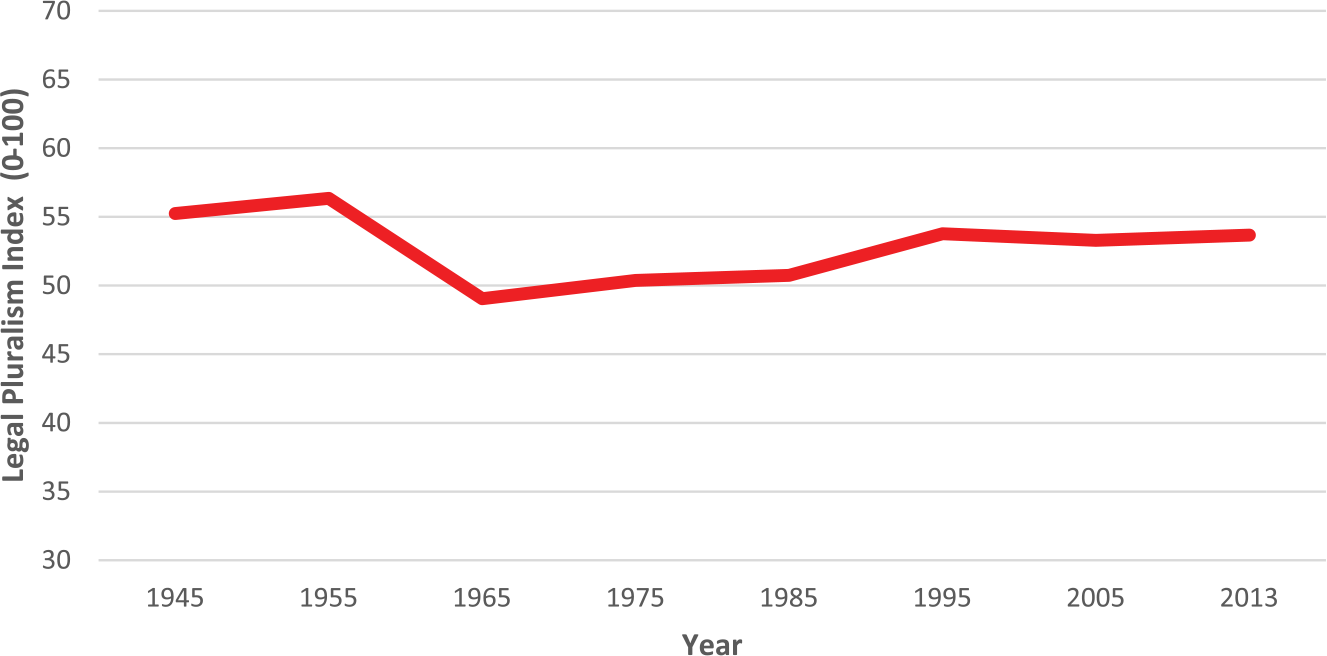
Global trends in state law pluralism (1945-2013).
Many scholars have considered the endurance and reemergence of state law pluralism an anachronistic legacy of colonialism (Bennett & Peart, 1983; Benton, 2002; Fitzpatrick, 1983; Larson, 2001; Roberts & Mann, 1991; Young, 1994). For example, Hooker (1975), Griffiths (1986), and Vanderlinden (1989) argue that pluri-legal personal law systems have survived because most postcolonial states, despite their strong desires to unify their legal systems under an overarching network of law and courts, failed to overcome the resistance of ethnoreligious groups and thereby were forced to continue to recognize the communal jurisdictions which were originally granted autonomy by their colonial or imperial predecessors.
The “colonial legacy” explanations can be harnessed as a powerful catalytic variable to understand the range of options and strategies which were available to postcolonial leaders in encountering challenges of state law pluralism. But they cannot alone suffice to explain the reason why variant forms of state law pluralism still continue to exist, as they suffer a major shortcoming: They neglect the agency of the postcolonial state and the interests of its leaders as well as social forces in preserving, controlling, and manipulating institutions of personal law by consistently treating postcolonial states as disempowered or incapacitated entities.
The colonial period and the following moment of postcolonial state-building were critical as it was during these two periods that the foundations of current personal law systems were laid out. But this does not mean that postcolonial states were permanently “locked in” to a self-reinforcing path that predestined their options and forced them to accept preexisting institutions of personal law (Pierson, 2004; Thelen, 2004). On the contrary, as Figure 1 indicates, and as we demonstrate below in the context of India and Indonesia, personal status systems underwent significant changes. In the two cases under review here, postcolonial leaders did not act out of weakness 6 or were “forced” to continue to accommodate religion-based laws. When they chose to accommodate religion-based laws, they often did that not because of historical contingency but political expediency. In many postcolonial societies, religion continued to remain a powerful source of political and social legitimacy. In parallel to rising power of religious identity–based political movements, especially after the 1970s, the co-optation and accommodation of religious institutions and discourses became a major source of power for both democratic and authoritarian regimes (Elsenhans, Ouaissa, Schwecke, & Tétreault, 2015). In this respect, many postcolonial governments, acting out of concerns for political stability and electoral certainty—and occasionally out of sincere desire for multiculturalism—opted to accommodate demands for pluri-legal personal law systems (Sezgin, 2004).
In the following sections, we trace the evolution of personal status law in India and Indonesia after the countries’ independence and identify major turning points that characterize legal and court reform. We ask whether legal pluralism has been a product primarily of an appreciation and recognition of the diversity of chthonic legal traditions (such as the state’s recognition and celebration of religious pluralism), whether it is rather a product of the inability of political elites to impose monist structures due to societal resistance, or whether other considerations, such as electoral dynamics and regime stability played a major role. Not surprisingly, we find different factors to be at work in different time periods, but surprisingly, these were largely similar in the two cases.
India
1947-1973: Striving for the Unification and Secularization of Personal Laws
India has long suffered from communal divisions that have categorized her people into various castes, ethnic, and religious groups. Conflict arising from these communal divisions reached its climax in 1947 when the country partitioned into two independent states: Pakistan for Muslims and India for those remaining behind. Yet the founding leaders of India fiercely resisted the British plans for partition on the basis of religion and maintained that independent India ought to be a noncommunal, secular, 7 and democratic; a nation in which all citizens would be treated equally regardless of their religious, ethnic, or caste identity. India inherited a personal law system from the British where state-appointed judges applied different bodies of religious and customary laws in civil courts: shari‘a for Muslims, Hindu law for Hindus, and so on. However, the founding leaders, most prominently Nehru and Ambedkar, considered the legal treatment of citizens based on their religious identity as reifying religious and communal difference, and as such incompatible with their noncommunal, secular, and democratic vision for the Indian polity. If India were to be one united nation under law, then separate communal laws needed to be replaced with a single set of norms that would be applicable to all citizens irrespective of their communal affiliation (Ambedkar, 1995; Nehru, 1963, 1989). Eventually, this vision was enshrined in Article 44 of the 1950 Constitution of India, which directs the state “to secure for the citizens a uniform civil code throughout the territory of India” (Raju, 2003).
The supporters of the uniform civil code (UCC) considered the code essential for eradicating in the long term the prevalence of ethnoreligious identification and for cultivating a civic national identity (S. B. Rao, 1968). However, during the Constituent Assembly debates, representatives of the religious minorities as well as right-wing Hindu groups raised concerns about the abolition of communal personal laws and the imposition of a UCC in their place (Deshta, 2002). Particularly, the Muslim members played a pivotal role during the UCC debates in the Constituent Assembly, and it appears that it was ultimately their reservations that fundamentally altered the government’s policy and the fate of the UCC. Instead of being included among the justiciable clauses of the constitution, Article 44 was made part of the Directive Principles, the nonjusticiable section of the Indian Constitution. As such, the UCC was an aspiration, but not a firm mandate for the new government to implement. 8 According to Austin (2001, pp. 17-18), it was actually Nehru who insisted, in deference to Muslim concerns, that “the framing of the UCC be a goal set out in the Directive Principles” rather than a firm mandate for the new parliament. As such, Indian leaders had explicitly recognized that in the postpartition environment, it was politically incorrect and impractical for the Hindu majority to push for the abolition of the shari‘a due to the fear that such a move would further alienate the Muslim minority (A. Rao & Rao, 1974) and possibly cost the ruling Congress Party Muslim electoral support. The Congress was a catchall party drawing substantial support from minorities (Bogaards, 2014). Hence, with these political considerations, the party leaders, while still remaining committed to Nehruvian secular ideals, put aside their monist aspirations, and instead turned their attention to a more attainable and immediate goal: partial unification and secularization of separate communal laws. In this vein, the government initially focused on the Hindu law with the hope that when the parliament took the first steps toward secularizing and unifying the laws of the Hindu majority, this would set in motion a revolutionary movement compelling minorities, especially Muslims, to give up their demand for separate communal law that, in the course of time, the entire country would be brought under jurisdiction of a single civil code (Gajendragadkar, 1971).
The Hindu Code Bill (HCB) reforms of 1955 to 1956 9 aimed not only to partially codify and secularize the traditional sources of Hindu law but also reduce the plurality of the Indian personal law system by unifying communal laws and customs of Hindus, Sikhs, Jains, and Buddhists under a single code, which now treated the latter three groups as “Hindus” for personal law purposes (Derrett, 1999). However, regardless of how progressive or secular it was, the Indian leaders knew that once enacted, the HCB would still be a communal legislation. First, it would not be applicable to non-Hindus; second, under the HCB it would not be possible to legally recognize a marriage between a “Hindu” and a non-Hindu. Therefore, the problem before the Nehru government was that if India was to be truly a secular and democratic nation, then it had to allow interfaith marriages and provide citizens with an alternative civil code—at least in the interim. Ultimately, while parliamentary deliberations on HCB reform was underway, all these considerations led the government to enact the Special Marriage Act (SMA) in May 1954. 10
The SMA is a voluntary secular civil code that is applied to all citizens who opt out of their own communal laws and register their marriages under this act. The property of individuals who are married under the act devolves according to the provisions of the Indian Succession Act (ISA; 1925), a general law, rather than the parties’ communal laws. However, the most important trait of the SMA is that it authorizes interreligious marriages. In this regard, the passage of the SMA (1954) was important for two reasons. First, it constituted a “UCC in embryo” (Smith, 1963, p. 278). Despite their manoeuvres to claim immunity from the jurisdiction of the SMA, the government declined to make exceptions for any religious community. 11 Thus, for the first time ever, all Indians, irrespective of their religion, were theoretically brought under the jurisdiction of a single code in the area of personal law. Second, the continuation of personal laws and the forcible subjection of citizens to their purview were in clear violation of the secular principles on which the Indian state had been built. In this respect, the SMA helped resolve this apparent contradiction by making application of communal laws “technically” consensual—as individuals could now “theoretically” opt for the SMA instead of communal personal law.
Symbolically, the SMA (1954) was a major achievement toward the depluralization and secularization of personal law. In the next two decades, the regime maintained this policy while at the same time accommodating ethnoreligious minorities’ demands for religiolegal and cultural autonomy. This was consonant with the regime’s overarching commitment to the Nehruvian vision of secularism, inclusionary national identity, and democratic tolerance. All in all, in this period, the plurality of personal laws was accepted as a hard reality but when possible, reforms were introduced to replace communal laws with general laws.
1973-2001: Reversing the Trend Toward Unification: Repluralization and Reconfessionalization of Indian Personal Laws
During the first two-and-a-half decades of the Indian republic, Nehru’s vision for a nonsectarian social order and an inclusionary national identity integrating the country’s diverse ethnic and religious groups into a common political framework prevailed and shaped the early postindependence governments’ social policy, particularly in respect to personal law. However, Nehruvian ideals were not universally shared—even within the ruling Congress Party. There were many people in the party who believed that the national identity was to be defined in reference to religious terms—privileging the Hindu majority while relegating non-Hindus to a second-class status. Nehru died in 1964. In the 1967 elections, the Congress Party lost control of eight state governments for the first time and experienced a significant decline in its parliamentary majority (Chhibber, 1999). In response to increasing competition and the rising power of opposition parties, the Congress leaders gradually abandoned Nehru’s secular vision and “sought to coopt the rhetoric and symbols of Hindu nationalism” for populist purposes (Hibbard, 2010, p. 116). Especially in the post-Emergency era (1975-1977), Congress leaders increasingly appealed to the religious sentiments of the Hindu majority and adopted a confessional political discourse. Although the Congress leaders’ embrace of exclusivist religious discourses was mainly driven by electoral considerations, this “contributed greatly to the communalization of local governments and police forces and to an increase in communal violence” in the country (Hibbard, 2010, p. 117).
The ideological transformation of the ruling party and the political discourse in the state institutions inescapably also affected the policy toward personal law. As indicated, the earlier policy was to depluralize the legal system by replacing communal legislations by optional but secular legislations. In the new era, this trend was reversed: The government took steps that deliberately led to further pluralization and confessionalization of the personal law system. A major step that marked the beginning of this new trend was taken with the passage of the Criminal Procedure Code (Cr.P.C.; 1973), especially Section 127. Section 125 of the code dealt with maintenance of divorced wives. The code was to apply to all Indians irrespective of religion. Although this was also the original intent of the Indira Gandhi government, the government made an exception for Muslims by amending Section 127 which now allowed the magistrate to cancel maintenance orders made under Section 125, if the husband had already paid the wife the sum due to her under their communal laws (in the case of Muslims, for instance, the sum is often understood 12 to include maintenance [nafaqa] and deferred dower [mahr], which need to be paid to the wife within her 3-month waiting or iddat period). As Parashar (1992) put it, the significance of this change on the part of government, moved by considerations of political expediency, was that it had departed from its previous position that it was responsible and capable of reforming “all” religious laws. The 1973 law opened the door to a new era of reconfessionalization of the Indian legal system which gained further momentum with the Marriage Laws (Amendment) Act (No. 68; MLAA, 1976).
As noted, succession matters of Hindus who were married under the SMA (1954) were originally subject to purview of the ISA (1925) instead of the HSA (1956). It was also stated in the SMA that if a Hindu had contracted a “special” marriage, this would be deemed to sever his membership from a Hindu joint family. The statutory severance from joint family and “forcible” application of the ISA (1925) were long considered by some Hindu legislators as an undue property-related hardship imposed on Hindus that undermined their ability to contract interfaith marriages. Thus, MLAA reportedly aimed to remove these succession-related “disabilities” by declaring that when two Hindus marry under the SMA, their ties to joint family would not be severed, and their property would devolve according to the HSA rather than the ISA (Sangari, 2000). This seemingly “emancipatory” statutory change had some important consequences. First, as Mahmood (1978) argues, it openly discriminated against non-Hindus (specifically Muslims and Parsis) by denying them the same right to keep their own succession laws when marrying under the SMA (1954). Second, as Derrett (1999) notes, it also led to “de-codification of the general law” by introducing elements of communal personal law into otherwise secular legislation.
Thereafter, the system was gradually reconfessionalized as its secular and unitary contours became less and less visible. This was a direct result of the resurgence of communalism and right-wing politics that first Indira Gandhi, then her son Rajiv Gandhi, and the subsequent Congress and BJP governments adopted.
Ten years later, with the enactment of the Muslim Women (Protection of Rights in Divorce) Act in May 1986, the process of repluralization and reconfessionalization of the Indian personal law system reached its peak. In its famous 1985 Shah Bano decision, challenging the interpretation of the aforementioned Section 127 of the Cr.P.C. in particular, the Supreme Court stated that Section 125 required a Muslim husband to provide maintenance, beyond iddat period, to his divorced wife who was unable to maintain herself. The court’s decision unleashed an unprecedented tide of demonstrations and riots throughout the country, for many Muslims viewed it as an attack on shari‘a and Muslim identity in India. As thousands of Muslims protested the government’s inaction in the face of the court’s alleged encroachment on Islamic law, Rajiv Gandhi, who was initially supportive of the court’s decision, conceded to demands of the conservative elements within the Muslim community and enacted the Muslim Women (Protection of Rights in Divorce) Act in May 1986.
Throughout the legislative process, the government solely relied on conservative groups and their interpretation of shari‘a, while mostly neglecting the views of secular groups within the Muslim community (Noorani, 2004). The All India Muslim Personal Law Board (AIMPLB) was especially instrumental in drafting the bill. As a result, the new law was primarily aimed to exclude Muslim women from the purview of Section 125 and overrule the Supreme Court’s decision in the Shah Bano case. To that end, the law effectively limited the Muslim husband’s responsibility to the period of iddat (Pathak & Rajan, 1989).
Although taking advantage of the ambiguous wording of the 1986 Act, 13 activist courts later expanded Muslim women’s right to maintenance under the law, the very act of enacting such a legislation marked an important milestone (Subramanian, 2014). In the 1950s, when the government reformed the Hindu laws, the driving motivation of the reform was partial unification and secularization of customary laws applied to Hindus, Sikhs, Buddhists, and Jains. In the 1970s, the government created exceptions for certain religious groups in otherwise secular legislation (e.g., Cr.P.C. of 1973, or the MLAA of 1976). This time, however, the government openly supported the legislation of confessional laws for the benefit of just one particular community, and removed an entire group of citizens (i.e., Muslim women) from the purview of secular criminal legislation.
As many commentators, including Arif Mohammad Khan who was a minister in Rajiv Gandhi’s government at the time, stated, the Act aimed to appease the Muslim electorate who were unhappy with the government’s decision to open the gates of Babri Masjid (a contested religious site) to Hindu worshippers in 1985 (Ashraf, 2015). In fact, in a tide of protests, the Muslim voters overwhelmingly supported opposition candidates and punished the ruling Congress Party in several provincial assembly elections from 1985 to 1986 (Hasan, 1994; Noorani, 2004). Thus, in fear of losing the Muslim “vote bank” forever, Prime Minister Gandhi reportedly conceded to the demands of Muslim organizations and agreed to take legislative action in order to overturn the Shah Bano ruling.
In the aftermath of Shah Bano debacle, the very idea of a UCC was increasingly appropriated by right-wing Hindu groups (e.g., BJP) who accused the Congress leaders of being pseudosecularists who turned their back on constitutional principles of secularism and sacrificed national unity for the sake of appeasing the Muslim minority (Ganguly, 2003). The appropriation of the UCC issue by Hindu nationalists led to the erosion of support for the idea of UCC and the project of legal unification even among its most ardent supporters (e.g., women’s groups). In post–Shah Bano India, in parallel to rising communalization of political institutions and discourses, courts were also turned into a normative battleground where some activist judges, sympathizing with right-wing Hindutva groups, took up the cause of UCC in the name of legal unification, secularism, and national unity (Hasan, 1999). Muslim groups, such as the AIMPLB, who considered calls for a UCC or legal unity nothing but a euphemism for the application of Hindu law to Muslims, responded to these normative and judicial threats by establishing informal shari‘a courts (Darul Qazas) all over India (Mahmood, 1995). Informal shari‘a courts were not a new development as such courts had already been existent since the early 20th century in various parts of the country. But what set these new courts apart from other traditional Islamic dispute resolution mechanisms was the political environment and conditions (i.e., rising dominance and threat of Hindutva groups) which gave rise to their formation in the first place. In this regard, they were not just another forum for alternative dispute resolution, but politically motivated institutions that were primarily established to resist attempts at legal uniformity, and challenge the sovereignty of the Indian state by discouraging Muslim citizens from making use of state courts completely: “The Indian courts are not qualified to interpret the shari‘a—especially when the judges are non-Muslims.” 14 “When there is a shari‘a court, if one goes to civil courts . . . [this] will be haram or a sin. . . . Muslims have to come to shari‘a courts . . . ” 15
Since 2001: Simultaneous Harmonization and Repluralization of Indian Personal Law
In the post-2001 era, the Indian personal law system has experienced a process of simultaneous harmonization and repluralization. What seems to have triggered this hybrid process is the drastic transformations that occurred in the social, political, and legal system of the country in the 1990s and 2000s. The weakening of traditional dominance of the Congress Party over Indian electoral politics, the rise of regional parties, and most important, the evolution of the Indian party system into a genuine multiparty system in the 1990s increased the political competition and created various opportunities for opposition parties, especially the BJP. However, in order for the BJP to take advantage of these new opportunities the party had to expand its vote base and secure possible coalition partners by moderating its communalist political rhetoric. And this is exactly what the party did—albeit limited—throughout the 1990s (Hansen & Jaffrelot, 1998).
The relative decrease in communalist discourse created an opening for progressive judges, exercising measured activism, and rising human rights groups to push for harmonization of separate communal laws without necessarily demanding legal unity (i.e., UCC). In this new era, particularly, courts have played a pivotal role in partial convergence of maintenance and divorce laws across various communities (Solanki, 2011; Subramanian, 2008). For instance, in 2001, the Supreme Court ruled, in the Danial Latifi case, in favor of expanding Muslim women’s right to maintenance. A few days later, the Indian parliament removed the Rs. 500 per month upper limit under Section 125 of Cr.P.C., thereby bringing non-Muslim women’s postnuptial maintenance rights on par with those of Muslim women. Likewise, the same year, the parliament acting in response to demands from individual communities, harmonized divorce laws across Hindu, Christian, and Parsi communities (Menski, 2009).
While the trend toward harmonization and convergence was underway, the personal law system simultaneously continued to be further confessionalized. For instance, in 2005, in response to a public interest petition (Vishwa Lochan Madan v Union of India), submitted to the Supreme Court which sought to declare Darul Qazas established by the AIMPLB and others “unconstitutional” (Redding, 2010), the central government argued that Article 26 of the constitution would protect the freedom to establish Darul Qazas to settle disputes between Muslims, and that it welcomed them as alternative dispute resolution mechanisms (Negi, 2005). In other words, the government acknowledged and encouraged the establishment of informal shari‘a courts in the name of protecting religious freedoms, and also—perhaps—financial and administrative efficiency.
In a similar move, in 2012, the central government enacted a law allowing Sikhs to register their customary marriages under the 1909 Anand Marriage Act instead of the HMA (1955)—which was an act aimed at unification of laws and customs among Hindus (including Sikhs).
The steps of simultaneous harmonization and reconfessionalization of law that the Indian government took in the past two decades in the field of personal laws could be interpreted as contradictory. In this vein, one could read these developments as the failure of the secular state to overcome communal opposition to secular legislation and impose equal rights standards. However, it is also possible to read these developments the opposite way. And this is most likely true. In the post–Shah Bano environment, the project of legal uniformity was transformed into an antiminority instrument in the hands of right-wing Hindutva ideologues. In the face of rising communal tensions, the protection and promotion of the multireligious nature of the Indian polity required the reinforcement of existing pluri-legal arrangements by extending further recognition and assurances to religiolegal communities. While the reconfessionalization was underway, the harmonization process, largely spearheaded by the Indian courts provided increasing protection to individuals in the absence of uniform rights standards. Against this background, the Indian government’s seemingly contradictory policies should be viewed not as a meek surrender to communal authorities, but rather as a “deliberate, plurality-conscious” construct (Menski, 2012, p. 253) that aims to strike a balance between individual and communal rights and lays the groundwork for a multicultural concept of national identity (Kymlicka, 1996) while taking into consideration political, financial, and administrative challenges of providing justice in a highly diverse society.
Indonesia: Pancasila as Facilitating “Unity in Diversity”
After proclaiming independence in 1945, the Indonesian leaders faced the very same question that the founders of India encountered: What kind of state should Indonesia become, and should the state be based on a core ethos? Like India, despite the existence of an overwhelming religious majority, in this case Muslim, Indonesia was also a multireligious, multilinguistic, and pluri-legal society. In addition to Islam and Christianity, ancient traditions of Buddhism, Hinduism, Confucianism, as well as various indigenous belief systems inhabited the archipelago. In the process of state- and nation-building, the founding elite decided that in order to overcome existing schisms and attain national unity, they had to do away with the fragmented colonial legal system which, they believed, was unfit for a unitary modern nation-state. At the same time, the founders recognized that in order to preserve the territorial unity of the state-to-be, they had to accommodate cultural particularity and allow at least some degree of religious and cultural diversity. Thus, the motto of independent Indonesia became Bhinneka Tunggal Ika or “unity in diversity”.
Encouraged by the Japanese occupying power which expected imminent defeat, Indonesian national leaders in the early summer of 1945 began to prepare the country’s proclamation of independence, and draft a constitution. Studying various constitutional models, among them the German Weimar constitution of 1920 and the Japanese Meiji constitution of 1889, constitutional drafters intensely debated the future role of religion in the new state. While they soon consented to a draft preamble that national leader Sukarno circulated, disagreements revolved around the exact wording of one of the preamble’s principles. What ultimately became the first principle “the belief in the one and only God,” should, according to some, be endowed with the addendum “with the duty for Muslims to live by religious law.” The latter proposal became known as the “Jakarta Charter.” Only last-minute interventions by the Japanese as well as the credible threat that the Jakarta Charter would undermine national unity by encouraging Eastern islands to secede precluded Sukarno and his deputy Mohammad Hatta from retaining it in the final constitutional text. Following the omission of the Jakarta Charter, Islamist groups across the archipelago revoked their loyalty to the central government and only military threat as well as the prospects of holding elections for a constitutional assembly to draft a permanent constitution the following year allayed their discontent.
Amid Dutch attempts to reoccupy the country after World War II, these elections, however, were not held until a full decade later. Even once the constituent assembly was elected in 1955 and between 1956 and 1958 deliberated over a new constitution, the two-thirds majority needed for turning Indonesia into an Islamic state could not be reached. By 1959, President Sukarno was so frustrated with the inability of the constituent assembly to reach a consensus that he reinstated the 1945 constitution and reaffirmed the preamble’s five principles (pancasila) without the Jakarta Charter, that is, without the duty for Muslims to abide by Islamic law. The unitary, non-Islamic, but panreligious formula that had been agreed on in 1945, henceforth, became the most characteristic feature of postindependence Indonesia’s political system (Künkler, in press).
1945-1970: Attempted Unification of Law and Courts
Before independence in 1945, the country’s judicial system was separated into colonial, customary (adat), and Islamic legal systems. Colonial Dutch law distinguished further on race. Under the Dutch colonial administration, the population was divided into Europeans, Natives, and “Foreign Orientals,” with separate tribunals established for Europeans vis-à-vis natives (Bell, 2006, not unfittingly refers to this as “a kind of judicial apartheid”). The Islamic court system had its roots in a Dutch Royal Decree of 1882 that in Java and Madura put in place a system of Priesterraaden (priests’ councils) with jurisdiction over awqaf (endowment), and Muslim family and inheritance law when all parties were Muslim. Enforcement required an executory decree from the civil courts. In 1937 Islamic appeals courts were established (one in Java and Madura and one in Kalimantan). Whereas jurisdiction beforehand had included inheritance, in 1937, this was transferred to civil courts. The Islamic judges (hakim agama) drew their income from fees of litigants and shares of inheritance cases, so here they lost an important source of income. Only the chairman was a civil servant and as such salaried by the state (Lev, 1972).
When a debate emerged in the Dutch parliament in the 1920s over whether to unify all law in Indonesia and apply Dutch law to all Indonesian subjects, those advocating for the preservation of adat law (the so-called Vollenhoven or Leiden School) prevailed. The position was partly premised on the view that preserving adat law was important to placate the influence of Islamic law. Judicial arrangements predicated on racial distinctions were only eliminated during the Japanese occupation (1942-1945) preceding independence. 16 Customary legal systems further existed side by side in those areas ruled indirectly, with 19 different jurisdictions based on cultural and linguistic particularity. Customary law was not codified and applicable only in matters where no civil law statute yet existed.
At the time of independence, like their Indian counterparts, Indonesian leaders were very keen to put an end to the multiplicity of legal systems and unite the nation under one law (Salim, 2008). Adat was targeted by nationalist, Islamist, and socialist leaders alike, due to its “feudal, imperialist and anti-republican connotations” (Lev, 2000 as cited in Ramstedt, 2004, p. 8; Lukito, 2003). Thus, in some regions, customary courts were eliminated in the early years after independence in 1945. In others, where separatist struggles continued to be waged, their phasing out occurred more gradually. By the time the central power had prevailed over all separatist struggles in 1969, the last customary courts were replaced by state courts.
While the central state thereby succeeded in gradually eliminating customary courts from region to region, the same was not true for Islamic courts. Since mobilization in favor of the preservation of Islamic courts was centralized (in contrast to the customary courts where mobilization was region based), the central state did not succeed in doing away with the Islamic courts and in unifying the court system entirely (Lev, 2000). Islamic courts survived and the duality of shari‘a versus secular courts exists until today.
In practice, from independence until a Basic Law on Judicial Power was passed in 1970, Indonesia was a state striving toward normative and institutional unification, in other words, “legal monism.” In 1946, the Muslim Marriage and Divorce Registration Law was passed that required marriage registration in an effort to make marriage a civil issue. A 1948 law (that was not implemented) explicitly aimed at legal unification and held no provisions for adat and Islamic courts. A 1951 law that superseded it equally made no mention of the existence of adat courts, though it did recognize the separate existence of Islamic courts, while suggesting that the government consult with Parliament on the question whether issues subject to Islamic law should be transferred to the state courts. Accordingly, draft civil marriage laws (which, by implication, would have replaced Islamic law in family affairs) were debated in parliament from 1958 to 1959, and again from 1967 to 1970.
By 1960, all secular courts across the country were regulated in a clearly delineated judicial hierarchy. As legal scholar Simon Butt (2008) has observed: The New Order often stressed the desirability of a single system of national law, that is, codified, single law [ . . . ] that would apply to all members of the population, regardless of ethnicity or belief, as it strongly believed in the constitutive power of law that would transcend local divisions, and further strengthen the national identity. (p. 269)
But political elites recognized early that normative unification would be highly unpopular and, in the context of separatist struggles, unrealistic. While a national body of law was developed that no longer differentiated based on racial categories, and while the court system was being unified, in the realm of personal status law, Islamic courts continued to exist and civil courts continued to recognize region-based adat. The system therefore in this time period was normatively pluralistic (consisting of multiple and competing normative orders) while institutionally unifying.
A Deal: Islamic Law for Electoral Exclusion: 1970-1989
Sukarno’s election-free “Guided Democracy,” which he had inaugurated after the dissolution of the constituent assembly in 1959, came to an end with the so-called aborted coup of 1965, during which allegedly communist-minded generals had attempted to erase half of the military leadership. General Suharto who gained the upper hand in the unfolding power struggle within the military promised a more accommodating policy toward Muslim groups who had felt marginalized under the later Sukarno years. In the anticommunist riots from 1965 to 1966 to which between half a million and a million fell victim, religious leaders cooperated closely with the military in the identification of “targets.” It was much to their shock then that Suharto decided in 1970 to uphold the ban on Masyumi, the mass Muslim modernist party that had gained 20% in the country’s first elections, and also otherwise seemed to be little inclined to deliver on his promise of greater Muslim accommodation.
In the eyes of the military leadership, a moderate dose of legal autonomy for Muslims appeared a fair price for the continued electoral exclusion of Islamic parties. A 1970 Basic Law on Judicial Power stipulated four types of courts: general, religious, military, and administrative courts. With this, state elites officially kissed good-bye to the “monist” strategy they had pursued for the sake of national unity in the postindependence era. In contrast to the 1951 law that suggested the consideration of out-phasing the Islamic courts, the 1970 law recognized religious courts (pengadilan agama) as part of the judicial structure. A 1974 Marriage Law then reformed both Muslim and non-Muslim family law and replaced a multitude of plural adat laws that were still applied in civil courts by principally two laws: one Islamic marriage law for Muslims and one secular for non-Muslims. 17 The 1974 Law further stipulated that marriage law would be applied by the regular (civil) court system for religious minorities and by Islamic courts for Muslims. It slightly increased the jurisdiction of Islamic courts and eliminated the 1946 registration requirement for the validity of marriage. 18 While the secular law was a codified civil law, the Islamic law applied in the Islamic courts was not codified. 19 Because Islamic courts were courts of first instance only, their decisions were regarded as advisory (more precisely, as “fatwas” [legal recommendations that lacked enforcement mechanism]) and as such were subject to confirmation or repeal by civil servants (Federspiel, 1998). The competence of religious courts was not exclusive, and parties could apply to secular district courts for adjudication on the basis of Dutch-derived civil law. This only changed in 1989 when a Law on Religious Courts regulated the appeals procedure anew. Thus, between 1974 and 1989, Muslims in Indonesia enjoyed what Benhabib (2002) calls “the freedom of exit and association.”
Entrenchment of a Fragmented Court System and State Attempts to Codify Islamic Law (1989-1991)
The early and mid-1980s presented a turning point in the relations between religious organizations and the regime. While the New Order, as Suharto’s system came to be known, imposed on all social organizations and parties the acceptance of pancasila (rather than Islam and other ideologies) as their principal ideology in 1984, religious organizations grew increasingly immune to regime intervention. This was partly due to a rising generation within the military that felt more reluctant to uphold the New Order’s anti-Islam policies, and partly it was due to rising levels of identification with Islam among the population that rendered it a framework potentially capable of political mobilization. Suharto then toward the late 1980s surrendered his opposition to modernist Islam, went on hajj for the first time in his life, and proudly declared on his return that he was a “Muhammadiyah” (i.e., a member of the largest modernist Islamic organization of the country). While paying lip service to the idea of Islamic banking, the regime also introduced a new law in 1989, the Law on Religious Courts, which clearly recognized the Islamic courts as courts of first instance for Muslims in family matters as well as inheritance and awqaf. It also made their rulings binding, enforceable, and no longer subject to confirmation by civil judges. The general courts henceforth no longer enjoyed supervisory jurisdiction over the religious courts, 20 though for the Islamic courts, too, the final appellate court remained the Indonesian Supreme Court.
In 1991, a compilation of Islamic law (Kompilasi Hukum Islam di Indonesia [KHI]) issued by the MORA and Supreme Court judges standardized the application of Islamic law in the Islamic courts to provide for a countrywide unitary application of shari‘a. 21 Until today the KHI is used as a guide, rather than a binding code. The reforms of 1989 and 1991 thus further entrenched the fragmentation of the court system, where civil law no longer served as the canopy as which it had functioned after 1974 (Sezgin & Künkler, 2014). The Law of Religious Courts and the KHI made Indonesia’s legal system unequivocally semi-confessional, and its court system fragmented.
Entrenching Multiple Rights Standards (1999-)
Since the incisive reforms of 1989/1991, Indonesia has seen one more far-reaching movement toward normative pluralization. In the aftermath of democratization in 1998, the parliament passed two decentralization laws (1999 and 2004) that dispersed numerous governmental functions down to the units of the regencies (kabupaten, of which today more than 400 exist, in 34 provinces). Within a period of two years, the highly centralist administration of the country was transformed into one of the most decentralized in the world (Aspinall, 2013). Until 2009, in more than 50 regencies, regulations were passed that signaled an Islamizing agenda. Such regulations ranged from banning alcohol, to enforcing curfew laws whereby women must not walk outside without a male guardian after sundown, to requiring couples to recite the Qur’an at their wedding.
While some bylaws aim at the improvement of character, others clearly violate the rights granted in the constitution, such as religious freedom (Art. 29), the equality of all recognized religions, and the equality of men and women. Despite the fact that many such regulations appear incongruent with the national constitution, they are still on the books, as review mechanisms are not properly institutionalized or overburdened, and the Supreme Court, the court of final appeal in these matters, not sufficiently committed to deal with such regulations.
On the one hand, the judiciary should be able to effectively deal with the resulting discrepancy between rights standards set in the national constitution and the regional bylaws that violate them. Regional laws, in terms of legal hierarchy, rank below the Constitution, parliamentary-passed national laws, and many presidential and government regulations. The democratic political system, as a set of laws, is unambiguously spelled out in the constitutional framework and the power to define and shape the legal relationship between state and citizens is formally in the hands of the Constitutional Court and the Supreme Court (Lindsey & Butt, 2013). Regulating the substance of regional laws—of what Lindsey and Butt call “cleaning up the legal debris”—is the mandate of the Supreme Court. However, the massive process of decentralization since 2001 has created numerous parallel institutions and overlaps of mandates that the central state and legal system have yet to master and regulate. Though a “hierarchy of laws” (tata urutan peraturan perundang-undangan) 22 does formally exist, failure to insist on compliance of the law in various judicial and bureaucratic bodies results in the frequent violation of this hierarchy.
Whereas the court system has remained untouched by the decentralization laws of 1999 and 2004, the new power of the regencies to pass their own bylaws has dramatically changed the nature of the Indonesian legal system, at least de facto. Until the hierarchy of laws is reestablished, the consequences of decentralization have had the paradoxical effect that democratization, which is the source for the decentralization process in the first place, has resulted in a multiplication of legal standards (and in places the erosion of legal standards) rather than their unification and elevation. Although Indonesia’s 1945 constitution was reformed in four rounds of amendment between 1999 and 2002 that strengthened civil liberties as well as political, social, and economic rights, these national rights standards are undermined by local bylaws. Currently, the Indonesian legal system is highly plural based on both religion and region. Judging from the societal conflicts that have emerged around particular regional bylaws, the Indonesian state is in the very deep of locating and negotiating a balance between accommodating cultural, regional, and religious particularity on the one hand and delivering on the promise of universal rights standards on the other.
Conclusions
We have argued here that both India and Indonesia pursued policies of legal unification in the realm of personal status law after their independence from colonial rule but de-unified, that is, further pluralized, their legal systems from the early 1970s onward, a trend that broadly continues until today. Whence the goal of legal unification in the first place and why the turn away from it?
While the orientation toward legal unification had broadly the same cause in both countries, that is, the strong rejection of the colonial policies of legal discrimination based on race, religion, and ethnicity, the distancing from the policy of legal unification in the 1970s had separate but not dissimilar reasons in the two countries. In both cases, ruling elites made concessions to societal demands: In the case of India to conservative Muslim and Hindu electorates, which the Congress Party feared to lose to rising religious parties were it to try further reforming Hindu law or out-phasing Islamic law; in the case of Indonesia to the ulama and Islamic organizations who were to remain excluded from electoral politics, as Islamic parties remained banned in Suharto’s New Order. Thus, legal developments in the realm of family law were largely synchronous in both countries, though independent from one another, and largely due to concessions made to religious electorates and elites.
What the case studies of the two countries show, and what we document on a large-N basis in other co-authored work (Künkler & Sezgin, 2014), is that legal unification in the postcolonial world was neither unidirectional nor without variation. Most postcolonial states upon independence strove for legal monism, but, for a variety of reasons, monist ambitions were hardly ever fully implemented. By the mid-1970s, many postcolonial states began pursuing policies that reversed earlier unification attempts and led to further fragmentation and confessionalization of their personal law systems. In this vein, after 1973 the Indian government began a policy of reconfessionalizing its legal system by reintroducing religious principles into its family law legislation. Similarly, the Suharto regime recognized and formalized Islamic family law in 1974 to alley growing discontent among Islamic elites after their hopes for political inclusion had been dashed.
The way legal unification in family law was pursued can broadly be categorized in three ways. The most far-reaching was normative unification, where not only the court system but also the legal system was unified, that is, the entire population became subject to one civil law, as was the case in Tunisia or Ethiopia. Short of normative unification, some countries retained separate family laws but unified all jurisprudence in the same court system, where the same judge would apply different family laws. This was the case in Egypt after 1955 and in India from independence onward. These countries did not achieve normative but at least institutional unification. When institutional or normative unification was not an option, governments often tried to achieve their goal of legal centralization by alternative means. For instance, some limited the subject matter jurisdiction of communal courts and laws, such as was done in the Senegalese Family Code (1972), which limited the purview of Islamic law to inheritance matters alone, while divorce and custody were placed under the jurisdiction of Senegal’s civil code. Others placed certain familial issues under concurrent jurisdiction of civil and communal courts, such as happened in Israel, which allows individuals to bring child custody or alimony cases to the court of their choosing: civil or religious. Yet others passed regulatory legislation or penal sanctions imposing common standards across diverse communal laws and traditions (e.g., minimum marriage age or antibigamy laws), as India did after 2001.
While India had from its independence on an institutionally unified judiciary, this was initially also the goal of Indonesian national leaders: customary and Islamic courts were to be out-phased and their jurisdiction integrated into a civil state court system. This goal was de facto abandoned when a 1970 and a 1974 law formally recognized the continued existence of the Islamic courts, although their decisions still had to be confirmed by civil courts to be enforceable. Muslims therefore in practice had an exit option: For instance, they could effect a marriage to be ruled illegal if the partners did not meet the minimum age as stipulated by civil law. The goal of institutional unification was finally abandoned de jure in 1989 in Indonesia when the Islamic courts were made courts of first instance, on a level equal to the civil courts which deal with the family matters of non-Muslims. While India’s personal law system is therefore institutionally unified, Indonesia’s is unified neither normatively nor institutionally.
The reorientation in legal policy in the 1970s was in these two cases largely a function of changing state–society relations. In the post-Nehruvian era, paralleling increasing electoral competition, the Congress Party abandoned the policy of legal unification and instead opened the door to the reconfessionalization of its legal system. In Indonesia, legal development was not so much a subject of public deliberation as much as a resource for Suharto’s military regime (1965-1998) to secure political loyalty. It needed to appease Islamic elites if it did not want to risk disloyal opposition. The different political regime types notwithstanding—a democracy with the promise of equal treatment before the law here, developmentalist authoritarianism there—legal development in both societies soon became subordinated to considerations of political regime stability rather than societal transformation. The parallels in the development of personal status law systems in India and Indonesia question the extent to which political regime choices are decisive in determining policies toward personal status. Instead, the democratic nature of India’s political system notwithstanding, considerations of regime stability and electoral politics seem to have been more important in both contexts in explaining the increasing pluralization and confessionalization of the legal system.
Besides the substantive points made in this article about the vexed trajectory of legal unification and fragmentation, there is also a methodological lesson to be taken way from this discussion: Scholars typically look at national constitutions to ascertain the extent of individual rights, including religious freedom, in a given jurisdiction. As several large-N projects have shown, rights catalogues have been on the rise in national constitutions, and over time, citizens have been endowed with more and more rights in the post 1950-era. 23 This in turn has prompted scholars to speak of “international convergence”—convergence toward a human rights and liberal rights model that is increasingly prevalent in most national constitutions (Venter, 2008).
Yet no law is closer to a citizen’s experience with the legal system than family law. Many citizens go through life without necessarily coming into contact with penal law, but hardly anyone can escape being subject at some point to the marriage and inheritance laws of the territory in which he lives. A good share of those who get married moreover also at some point will be subject to divorce and perhaps custody regulations—all part of family law.
But family law is hardly ever regulated in national constitutions. Indeed, the very consequential legal changes we have discussed in the context of India and Indonesia took place independent of constitutional developments. In both countries, constitutions remained the same, while the personal law system significantly changed, and not only altered when and how and to whom a person can get married or inherit from but also transformed the very nature of that country’s religion–state relations. To speak of a secular state when citizens are subject to religion-based family law appears to put the very concept of secularity into question. Along similar lines, studying the prevalence of certain rights in national constitutions will tell us little about whether citizens enjoy these where they matter most: in family law.
Footnotes
Acknowledgements
We thank two anonymous reviewers and the following colleagues for their close reading and helpful comments: Sinem Adar, Asli Bali, Nathan Brown, Aaron Glasserman, Matthias Koenig, Hanna Lerner, Bart Luttikhuis, David Mednicoff, Tamir Moustafa, Matthew Nelson, and Shylashri Shankar. Previous versions of this article were presented at the Center for Interdisciplinary Research (ZiF) of the University of Bielefeld; and the Max Planck Institute for the Study of Religious and Ethnic Diversity in Göttingen. Parts of this article were written during research fellowships at the KITLV in Leiden (Künkler) and the ZiF (Künkler & Sezgin). We thank both institutions for their institutional support and convivial environment.
Declaration of Conflicting Interests
The author(s) declared no potential conflicts of interest with respect to the research, authorship, and/or publication of this article.
Funding
The author(s) received no financial support for the research, authorship, and/or publication of this article.