







Abstract
Very little is known about public perceptions of journalists outside Europe and the United States. Even less is known about the role of these attitudes in sustaining civic life around the world. Using individual and country-level survey data, this study explores public attitudes of press performance and their relationship with news consumption and civic participation in 22 countries. The study argues that the nature of civic and local participatory behaviors is often intertwined with notions about what is “good journalism.” Results suggest that public evaluations of press performance influence news use. News consumption is also tightly related to civic participation, even in markedly divergent cultural contexts. Citizens’ assessment of journalism practice is also a positive moderator of these relationships. This study builds on international comparative work related to the effects of press freedom and journalism practice on stimulating public life.
Journalists around the world are rethinking their roles as news professionals. Social media and the Internet have disrupted the traditional practices and routines of political reporters (Franklin, 2012). In response, journalists face pressures to adopt norms of digital culture. They also have to compete with a plethora of information companies online, where the boundaries between professional reporter and copy/paste aggregators are often blurred. Thus, the tenets of “good journalism”—fact checking, covering relevant issues, and holding officials accountable—are role conceptions that are increasingly under threat and often difficult to achieve in reality (Mellado & van Dalen, 2014). In this context, does it matter if journalists abandon their role-conceptions as fair, accurate, and independent watchdogs? The answer to this question depends on how audiences interpret and act on notions of press performance.
Coinciding with changes in the media environment, public evaluations of the news media are at all-time lows in the United States and only about half of people who live in the European Union say they trust written press (European Broadcasting Union, 2017; McCarthy, 2014). Low estimations of the news media have important consequences for the health of public life. Negative opinions of the press have been associated with decreased news use and a preference for entertainment media (Tsfati & Cappella, 2003). These trends are potentially troubling. In particular, the news media are thought to provide the informational needs of communities. When individuals tune-out the news they lack the resources and motivations necessary for solving problems in their communities (Prior, 2005). On the other hand, when citizens regularly read or watch the news, they are more likely to participate in their communities; the path to civic engagement starts at the level of individual news consumption (Bakker & de Vreese, 2011). Therefore, the public’s low evaluation of journalism performance may be triggering a downward spiral of detachment from public life. Despite the importance of news for civic participation, very little is known about the nature of these relationships outside Europe and the United States.
Drawing on an international survey from 2015, this study examines the effect of the public’s evaluation of journalists’ performance as objective, accurate, and relevant actors in society on levels of news consumption and civic participation around the globe. Scholarship has long addressed the so-called “virtuous circle,” where news consumption leads to increased engagement in one’s community and, in turn, more news consumption (Norris, 2000). This study explores the possibility that when individuals evaluate the efficacy of journalism practice as poor, this virtuous circle becomes a downward spiral. Although the relationship between the press and the public may vary widely across journalistic cultures (Hanitzsch et al., 2011), it remains an open question whether audience expectations of the press are geographically fluid. First, the study explores the influence of public attitudes toward journalism on news use and civic participation with an international sample. Next, we test whether there might be a moderating effect of evaluations of press performance on the association between news use and civic engagement. Finally, the study examines whether there are differences in these effects across cultures according to levels of press freedom.
Normative Expectations of Press Performance and News Consumption
The practice of “good journalism” is a set of beliefs about how the press should function in democratic society. Holding public officials accountable, accuracy, covering important stories, and maintaining objectivity (or at least trying to) are tenets of journalism practice that were first proposed in the United States around the time of the Progressive Era political reforms (Williams & Delli Carpini, 2011). Informed by a notion of social responsibility, journalists thought of themselves as expert opinion makers who present politically relevant facts to an otherwise distracted public. Politicians, journalists, and the public share some version of these expectations. Tenets of “good journalism” in this sense operate as social norms (Bennett, 2009). Social norms help groups coordinate action by determining what behaviors are required, permitted, or deviant. Social norms are culturally bound as well and are determined, in part, by geography, history, institutions, and group identity (Bandura, 2001). In their recent work, Achen and Bartels (2017) highlight how important perceptions may also be within the context of today’s democracies, news use, and public affairs. The authors found perceptions about how “democratic” electoral processes were in different countries fluctuated largely. Perceptions about journalism may be equally important. For instance, journalistic norms are significant because they determine the boundaries between professional journalism and the public, and the audience may use them as a guide when evaluating the efficacy of the press, or institutions in general (Benson, 1999). With exception, certain normative expectations are fairly fluid across the world despite wide variations in journalistic cultures (e.g., Hanitzsch et al., 2011).
Though several studies have explored journalists’ role conceptions (Cassidy, 2007; Obijiofor & Hanusch, 2011) this study is concerned with audience perceptions of how well journalists fulfill those roles. Failure to fulfill these professional roles has potential effects on the public’s attitudes toward the news media because individuals evaluate the press according to similar criteria. For example, most Americans view the press as providing a watchdog function and expect accuracy, objectivity, and speed from news products (Cassidy, 2007; Pew Research Center, 2013). Survey work in this area suggests that the public and journalists do not always value role conceptions in the same way. The public tends to value civic and local journalism over watchdog functions, and they put more weight on normative expectations overall than journalists do (Gil de Zúñiga & Hinsley, 2013).
The public’s perception that journalists fail to meet some normative ideal is highlighted in the research around abysmal levels of trust and credibility in the news media (e.g., Ardèvol-Abreu & Gil de Zúñiga, 2017; Tsfati & Cappella, 2003). For example, Fico, Richardson, and Edwards (2004) found that respondents were able to detect imbalance in newspaper stories, and this was associated with rating the newspaper as less credible. This body of scholarship suggests that there are ample opportunities for individuals to rate journalists’ performance as poor.
Negative predispositions toward the press are important because they are associated with lower levels of news consumption. Though people rarely avoid news entirely that they do not trust (Tsfati & Cappella, 2003), empirical evidence suggests that positive evaluations of the press are associated with news consumption, particularly with people who prefer newspapers and alternative news sources (e.g., online news or citizen blogs; Armstrong & Collins, 2009; Avery, 2009). People prefer to consume news from sources they feel provide some personal or social value that coincides with personal expectations (Lee & Chyi, 2014). This is because, people seek to engage in a psychological attachment with their media choices, with the expectation that there is some benefit from continued use, like taking cues about what they should be paying attention to (Tsfati, 2010).
Based on the above literature, the relationship between news consumption and public evaluations of the press are a complex interplay between journalists’ success at fulfilling professional roles, the publics’ expectations of press performance, and individual preferences. Taken together, positive evaluations of press performance and news use should be positively associated.
News and Civic Participation
As with attitudes toward the press, behavioral outcomes from news use are also partially explained by history and culture (Hallin & Mancini, 2011). In the United States, the press has a long history as a coordinator of community action. Since the nascent days of American democracy scholars like Tocqueville postulated that newspapers foster social cohesion simply by providing common ideas (Putnam, 2001). Later, authors claimed that the press operates a “spotlight” on relevant issues on behalf of the public, and binds nations to a common identity (Anderson, 2006). In Western and liberal societies, norms related to journalism are often linked to assumptions about democracy as well. This is because, as scholars have long argued, the nature of public life is inherently tied to mass media, including the news (Benson, 1999; Norris, 2000). The theoretical cornerstone of this work is the role of news as an information flow that helps individuals connect social opportunities to individual needs, coordinate action, and provide fuel for conversations (e.g., Delli Carpini & Keeter, 1997). In other words, when individuals use the media to orient themselves to the social and political world around them, they are better able to leverage information obtained from the mass media and are more likely to participate in civic activities.
Empirical studies on the relationship between news and community engagement are plentiful for Europe and the United States (see Moeller et al., 2014; Zukin, Keeter, Andolina, Jenkins, & Delli Carpini, 2006). Several studies find evidence for a general connection between news and political participation outside the West as well, including China (Zhou, 2006), South Korea (S. H. Kim, 2007), or Egypt (Lim, 2012). However, one difficulty in drawing meaningful cross-cultural comparisons is that political institutions vary in the type of participatory behaviors that are condoned or practiced. The current study focuses on the role of news as a resource for civic engagement because this concept is less contingent on political context.
Civic engagement is different than political participation per se, because civic participation by definition is less concerned with political organizations and institutions. The work required to keep civil society running is largely apolitical. In particular, volunteering, donating money, and engaging in face-to-face meetings with neighbors are key activities of civic participation, or activities aimed at solving community problems (Zukin et al., 2006). Local and national news provides the information needs at the community level, and the health of these societies depends on access to quality public affairs programming. News is a social organizational tool, though not the only one, that contributes to the function of civil society. These prosocial benefits of news consumption are exemplified by so-called media mobilization theories, or the “virtuous circle,” where news feeds a reciprocal relationship among community interest, news consumption, and eventually increased community engagement (Bakker & de Vreese, 2011; Norris, 2001). According to this line of theoretical consideration, the relationship between news use and civic participation should be positive.
International Context
Much of the work on news and civic engagement is based on an American context (Yamamoto, Nah, & Chung, 2017). This is problematic for comparative scholars using past research as a guide because the United States has a somewhat unique history of civic engagement and a unique model of news production. If we accept the assumption that journalistic norms are culturally dependent (Benson, 1999; Obijiofor & Hanusch, 2011), work on the social implications of expectations of press performance is too narrowly dependent on the unique cultural and institutional history of the U.S. press system. Even across Western Europe—where there is relatively consistent tradition of semimarket-driven press systems and speech protection laws—journalists’ role conceptions vary across countries (van Dalen, De Vreese, & Albæk, 2012). If these norms vary, and the public evaluates the press vis-à-vis these norms, then we might assume that relationships between news and perceptions of press performance vary across county contexts as well. The lack of empirical evidence assessing the relationship between attitudes toward the press, news use, and civic participation outside Europe and the United States represents a significant gap in the literature.
Comparing journalism practices and their role in creating the public has mostly been the domain two areas of thought: media systems research (Brüggemann, Engesser, Büchel, Humprecht, & Castro, 2014; Hallin & Mancini, 2011) or news as cultural “fields” (Benson, 1999). According to these authors, the habits and routines of journalism are a product of both institutional and extrainstitutional forces. For example, journalistic role conceptions are determined by a complex interaction between the level of state intervention (policy and regulation), political society (public opinion and discussion), civil society (social capital and free associations), and market influences (see Ryfe, 2017). Despite the variation in social systems, international comparative surveys of the role conceptions journalists themselves hold reveal several similarities. For example, most journalists around the world take very seriously their role as independent watchdogs, feel that individual opinions should not influence reporting, and see economic and political pressure as a major influence on content (Hanitzsch et al., 2011). There is little reason to believe that the public would not also hold some form of these expectations (Gil de Zúñiga, Diehl, & Ardèvol-Abreu, 2018). If, according to comparative scholars, journalism shapes civil and public life, then expectations and norms in the “field” of journalism should translate to similar expectations of performance in the field of the general public. However, few studies exist that track these public expectations across cultures.
One challenge in studying expectations of the press is the difficulty in comparing media systems in general (Hallin & Mancini, 2011). However, since both field theory and institutional approaches to media practice assume that there are multiple—yet finite—social and system-level factors at work, international ratings of press freedom may be a useful proxy for variation in country-level contexts. Press systems can be categorized on three macro-level criteria: level of political freedom, economic influences, and legal environment (Freedom House, 2016). Although limited, these three basic criteria are useful in that they take into account the concepts related to the two dominating paradigms of comparative press research. For exploratory comparisons, a basic measure of press freedom is a suitable, if imperfect, tool for comparing the influence of media culture on democratic outcomes (Giannone & De Frutos, 2016). In the Freedom House framework, countries fall on a spectrum between high press freedom (with lower levels of state intervention and a history of political independence and economic freedom, as in Japan, Germany, the United Kingdom, and the United States), no press freedom (higher levels of state intervention and a history of political and economic constraints on journalistic activity, as in China and Russia), or partly free (somewhere in between, as in Argentina, Italy, and Ukraine; Table 1).
Countries in the Sample, PFS, and Descriptive and Reliability Statistics for News Use, Evaluations of Journalists’ Performance, and Civic Participation.
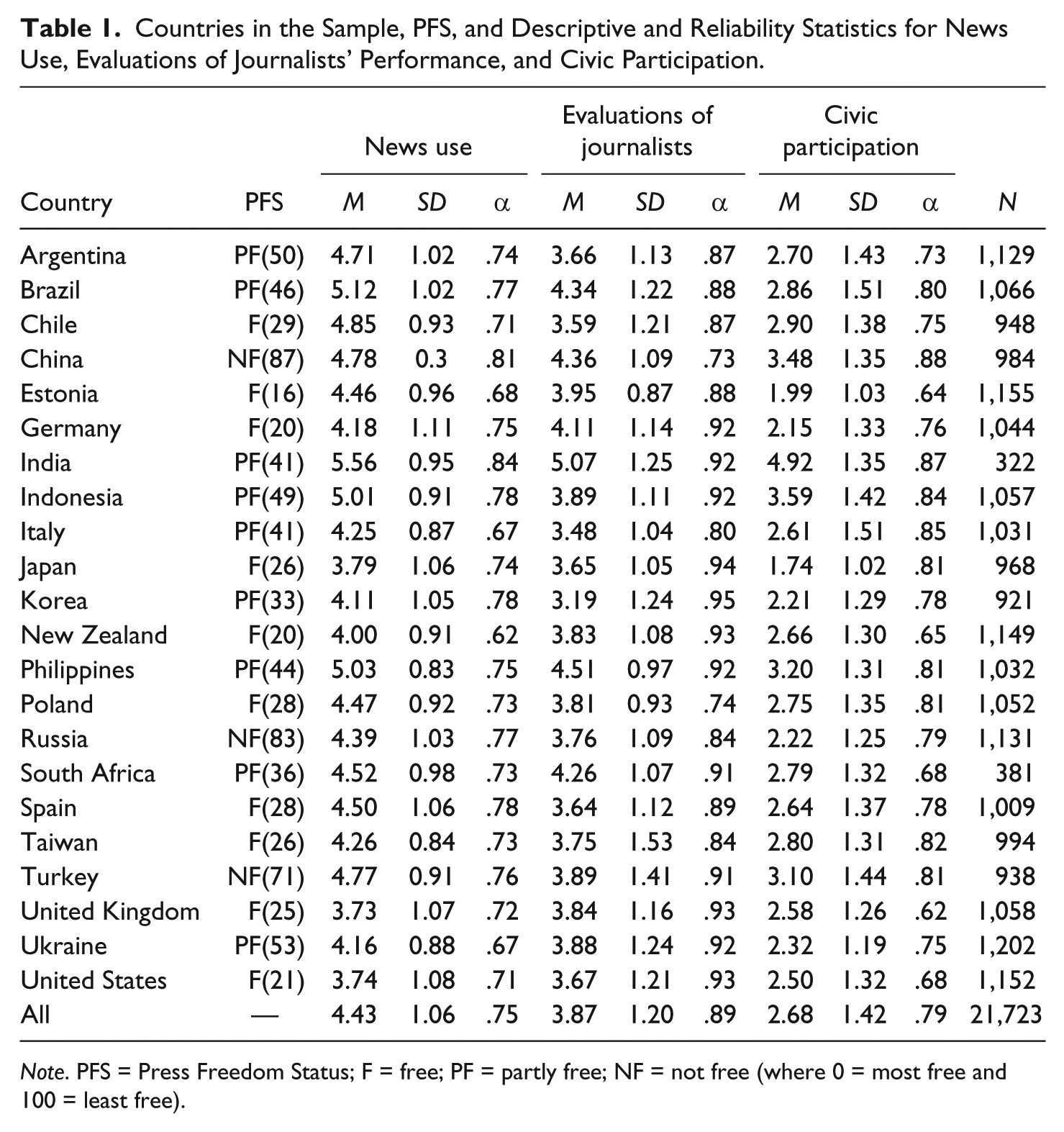
Note. PFS = Press Freedom Status; F = free; PF = partly free; NF = not free (where 0 = most free and 100 = least free).
Research Questions and Hypotheses
Where press systems are more closed or democratic institutions are limited, there is little reason to expect that normative evaluations of the press matter as much. Little empirical work has been done in this area, particularly for countries with shorter histories of liberal institutions. It also remains unclear whether public evaluations of press matter as much in countries with developing information infrastructures, or in places affected by information poverty (Norris, 2001). In theory, news and civic participation should be related across countries because news still provides information needs, regardless of the cultural or institutional setting (Benson, 1999; Norris, 2000). In addition, news still plays a valuable role in transferring ideas, expectations, and opportunities for coordination to mass audiences. Thus, civic participation and news should be positively associated, regardless of the country context. This thinking is in line with journalism as a cultural field, since most authors in this area view civil society as influenced by journalism practice. Also, if many journalism cultures share the same expectations about press performance, we also expect the public to share these expectations as well. Based on the above literature review, the following hypotheses and research questions are posed:
Finally, the positive news consumption–civic engagement relationship detailed in Hypothesis 2 should be enhanced by an individual’s perception of news performance. In particular, for those individuals who retain more positive perceptions of news performance, the positive news consumption–civic engagement relationship will be stronger. In short, the bond between the two behaviors will be strengthened by this perceptual variable. Thus, the following is posited:
Method
Sample
Data comes from the first wave of an online survey collected in 22 countries from the Americas, Asia, Europe, and South Africa. The survey is a part of an international project conducted by a partnership between research groups based in Europe and New Zealand. Items were translated for each country by a large group of participating scholars, employing back-translation (Behling & Law, 2000) or a committee approach (Brislin, 1980).
Survey administration was performed by Nielsen, a media polling company. Nielsen used stratified quota sampling techniques to create samples with demographics that match official census numbers as closely as possible. The survey was conducted from September 14 to September 24, 2015, simultaneously across all countries. Total pool of potential panel participants was over 10 million, and the final sample size was 22,023. The smallest sample was collected in India (n = 409, as it was only representative for New Delhi), and the largest in Brazil (n = 1,224; mean sample for all countries: M = 1,136; SD = 238). The data collected in this study does not strictly rely on randomized samples because Nielsen employs a nonrandom sampling strategy based on quota designs to match individual country profiles. Thus, as indicated by the American Association of Public Opinion Research (2011), typical response rates should not be not calculated. Instead, cooperation rates were reported (average 77% across the panel).
Measures
The survey included a number of items related to news consumption, attitudes toward the press, and behaviors related to civic participation. Demographics, individual political orientations, and discussion network attributes were also recorded. These additional variables were included in all models. Language for the survey items borrowed from studies that addressed social demographics (Verba, Schlozman, & Brady, 1995), news and political discussion (J. Kim, Wyatt, & Katz, 1999), discussion network attributes (Eveland & Hively, 2009), political interest, and political self-efficacy (Morrell, 2003) as potential predictors of individual political participation. Except where noted below, all items used a 7-point Likert-type scale. Descriptive and reliability statistics for the variables of interest in the study are reported in Table 1.
Evaluations of Journalists’ Performance
Respondents were asked four questions about how well they think the news reflects “good journalism” (Fico et al., 2004; Gaziano & McGrath, 1986). The questions were as follows: How well do you think journalists (a) function as the watchdog for the public, (b) perform in verifying facts, (c) perform in being objective, and (c) do in covering stories that should be covered.
Civic Participation
Civic engagement was measured as the extent to which individual’s work to solve problems in their communities. Respondents were asked how often they engage in the following activities offline: (a) Worked or volunteered for nonpolitical groups, such as a community project, hobby clubs, environmental groups; (b) donated money to a charity; and (c) attended a meeting to discuss neighborhood problems.
Overall News Media Use
Eight items asked how frequently one gets news from the following media sources: television news (including cable), print newspapers, online news websites, radio, social media, mainstream news through social media sources, and citizen journalism sites (e.g., blogs).
Control Variables
All models include demographic information: age, gender, education (highest level of education received), self-perceived income (relative to the whole of respondents’ society), and race (coded as majority = 1; for detailed demographic breakdowns by country, see Gil de Zúñiga & Liu, 2017). Additional items asked about political interest, political self-efficacy, discussion network size, frequency of political discussion, and trust in the media is available in the appendix.
Press Freedom Score
The macro-level variable was an indicator of press freedom and information quality at the country level. This item was taken from the 2016 Freedom House rankings of 26 items for legal, political, and economic environment for the free flow of information. Items were added into average indices and included as independent variables in each model tested (0 = more free, see Table 1).
Results
Table 1 includes results for all descriptive and reliability tests for the independent and dependent variables in the study. The center set of columns show how the public evaluated journalists’ performance, in terms of the tenets of “good journalism” across countries (Research Question 1). First, internal consistency of the construct was found to be very good, with an overall Cronbach’s α coefficient of .89. The construct is also consistent across the sample, with alpha values ranging between a maximum of .95 (Republic of Korea) and a minimum of .73 (China). Values for alpha can be considered excellent (above .90) for 12 countries, and good (above .80) for 9 countries. The values of alpha were below .80 in only two countries (China, .73, and Poland, .74).
Overall, respondents rated journalists’ performance just below the median (4) of the scale (M = 3.87, SD = 1.20). Average perceptions of how well journalists fulfill a normative ideal ranged from a minimum of 3.19 (slightly above “not well”) in Korea to a maximum of 5.07 in India (slightly above “well”; Table 1). Mean values for journalists’ performance were above average in six of the countries in the sample: Brazil, China, Germany, India, Philippines, and South Africa. In contrast, respondents rated journalists’ work in this area as below average in the remaining 16 countries. The lowest values were observed in Italy (M = 3.48, SD = 1.04) and Chile (M = 3.59, SD = 1.21).
Research Question 2 asked about the relationships between evaluations of journalists’ performance, news consumption, and civic engagement across countries. As shown in Table 2 (Model 1), results of regression analyses show that perceptions of good journalism exert significant influence on news consumption (Hypothesis 1; β = .077, p < .001). Of the rest of the variables in the model, sociopolitical orientations explained the most part of variance (ΔR2 = .233, p < .001), followed by demographics (ΔR2 = .053, p < .001), and media variables (ΔR2 = .030, p < .001). Though Hypothesis 1 was confirmed in the model with all country cases, large sample sizes make interpreting p values more difficult. An alternative approach is to analyze the hypotheses within smaller country specific subsamples.
OLS Regression Models Predicting News Use and Civic Participation.
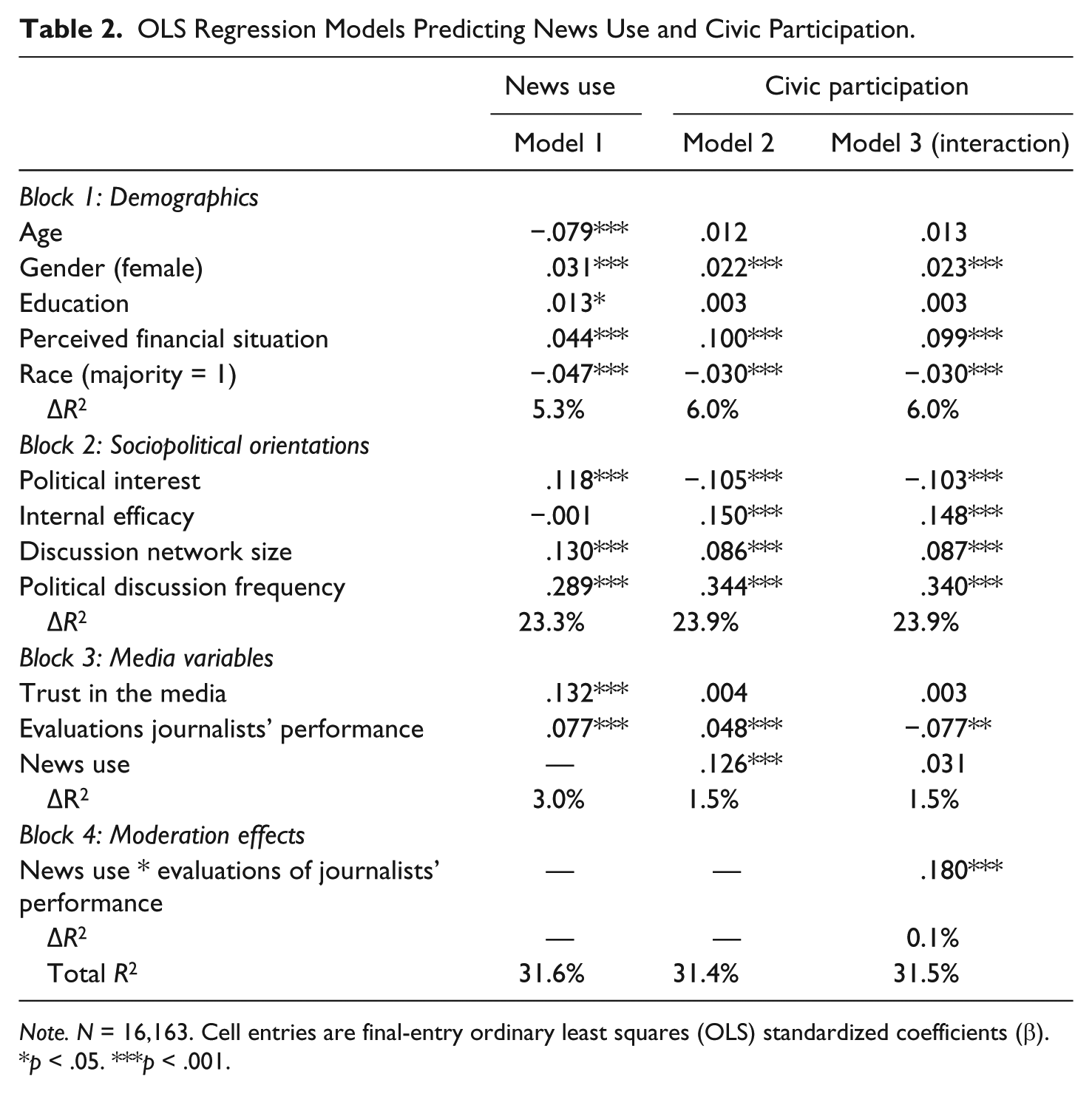
Note. N = 16,163. Cell entries are final-entry ordinary least squares (OLS) standardized coefficients (β).
p < .05. ***p < .001.
The relationships between evaluations of press performance and news use are reported in Table 3 (Model 1). These regression models include the same political and social predictors as models in Table 2. Evaluations of performance were not related to news use in about half of the countries tested. With the exception of China (β = .104; p < .001) and Russia (β = .088; p < .01), countries with more restrictive press systems showed no significant relationship between the variables of interest (Table 3, Model 1). In contrast, respondents based in countries with more liberal press laws tended to consume news, at least in part, based on their evaluations of press performance. The United States (β = .060; p < .05), United Kingdom (β = .072; p < .05), New Zealand (β = .079; p < .05), and Japan (β = .065; p < .05) all have laws protecting freedom of the press from government intervention. The odd case is Germany, where press freedom is on par with other liberal countries in the sample, but no significant relationship between news consumption and normative evaluations was found.
Standardized Beta Coefficients of Perceptions of Good Journalism Predicting News Use (Model 1) and News Use Predicting Civic Participation (Model 2) for Individual Countries.
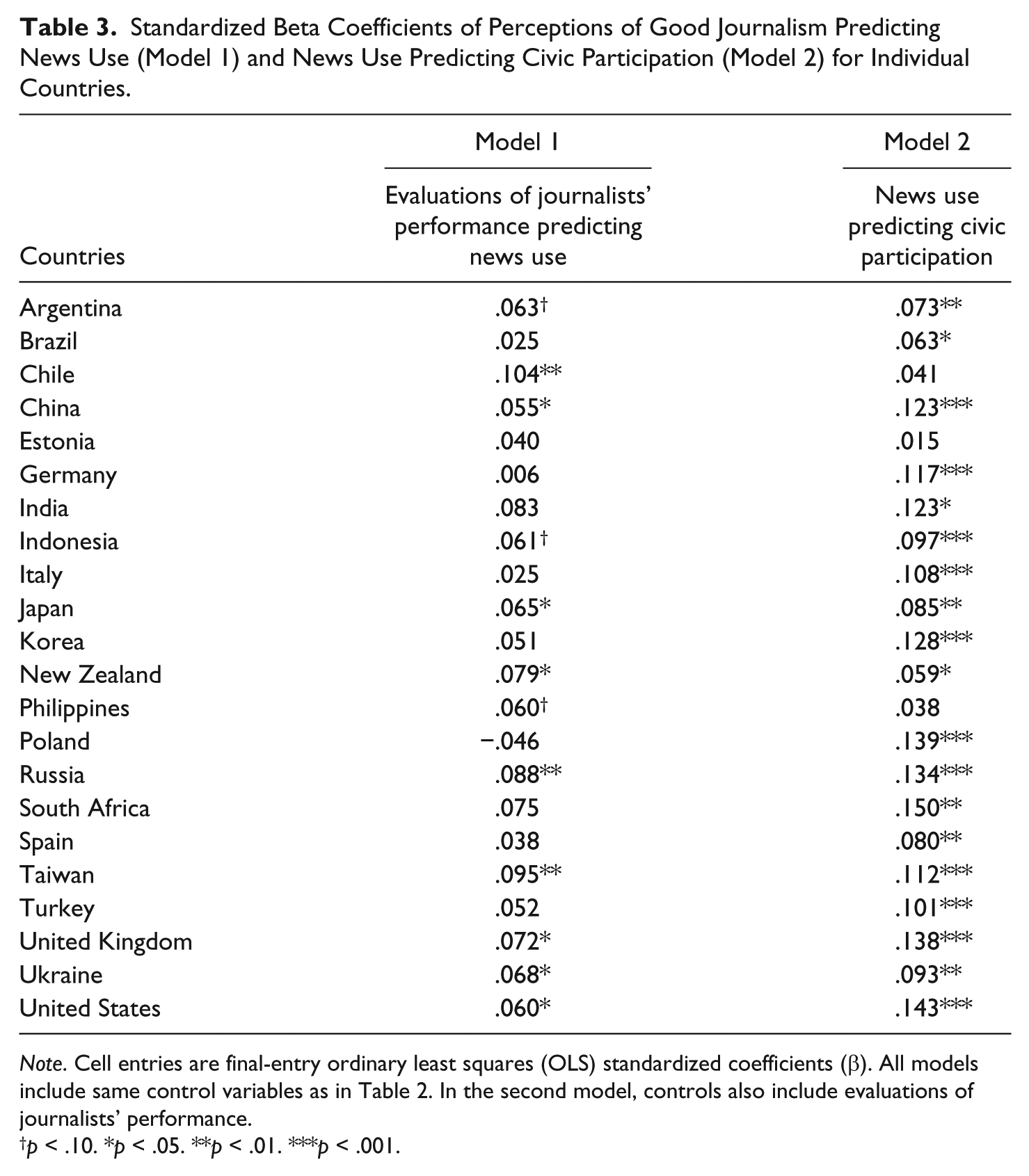
Note. Cell entries are final-entry ordinary least squares (OLS) standardized coefficients (β). All models include same control variables as in Table 2. In the second model, controls also include evaluations of journalists’ performance.
p < .10. *p < .05. **p < .01. ***p < .001.
Hypothesis 2 proposed that the relationship between news use and civic engagement would be positive across countries. Results indicate that news use is directly and positively associated with civic participation (β = .126; p < .001; Table 2; Model 2). The more citizens consume news, the more they participate in activities that aim to contribute to solve problems in their communities. Considering each of the blocks in the regression model, sociopolitical antecedents accounted for most of the variance of offline participation (ΔR2 = .239, p < .001); demographics explained 6.0% of the variance (ΔR2 = .059, p < .001); and media variables explained an additional 1.5% (ΔR2 = .015, p < .001). Within the block of media variables, meeting expectations of “good journalism” (β = .048, p < .001) was a positive predictor of civic participation (Table 2).
Results from the subsamples show the relationship between news consumption and civic engagement (Hypothesis 2) is fairly consistent across countries (Table 3). News consumption was a significant, positive predictor of civic participation in 19 of 22 countries. Among countries that showed a positive relationship with a 95% confidence level or better, standardized regression coefficients (β) ranged from .059 (p < .05) in New Zealand to .143 (p < .001) in the United States. No effect of news consumption on civic participation was found in Estonia, Chile, and the Philippines. Hypothesis 2 was confirmed in most, but not all of the individual subsamples.
Research Question 3 explored the possible moderating effect of evaluations of journalism performance on the relationship between news use and civic participation. In a third regression model predicting civic participation, we included an additional block to test the interaction effect (Model 3; Table 2). When considering all countries in the analysis, results show that a higher evaluation of “good journalism” practice moderates the effect of news use on civic participation (β = .180; p < .001). Those who score high in perceptions of good journalism and news use also tend to participate more in civic activities (see Figure 1).
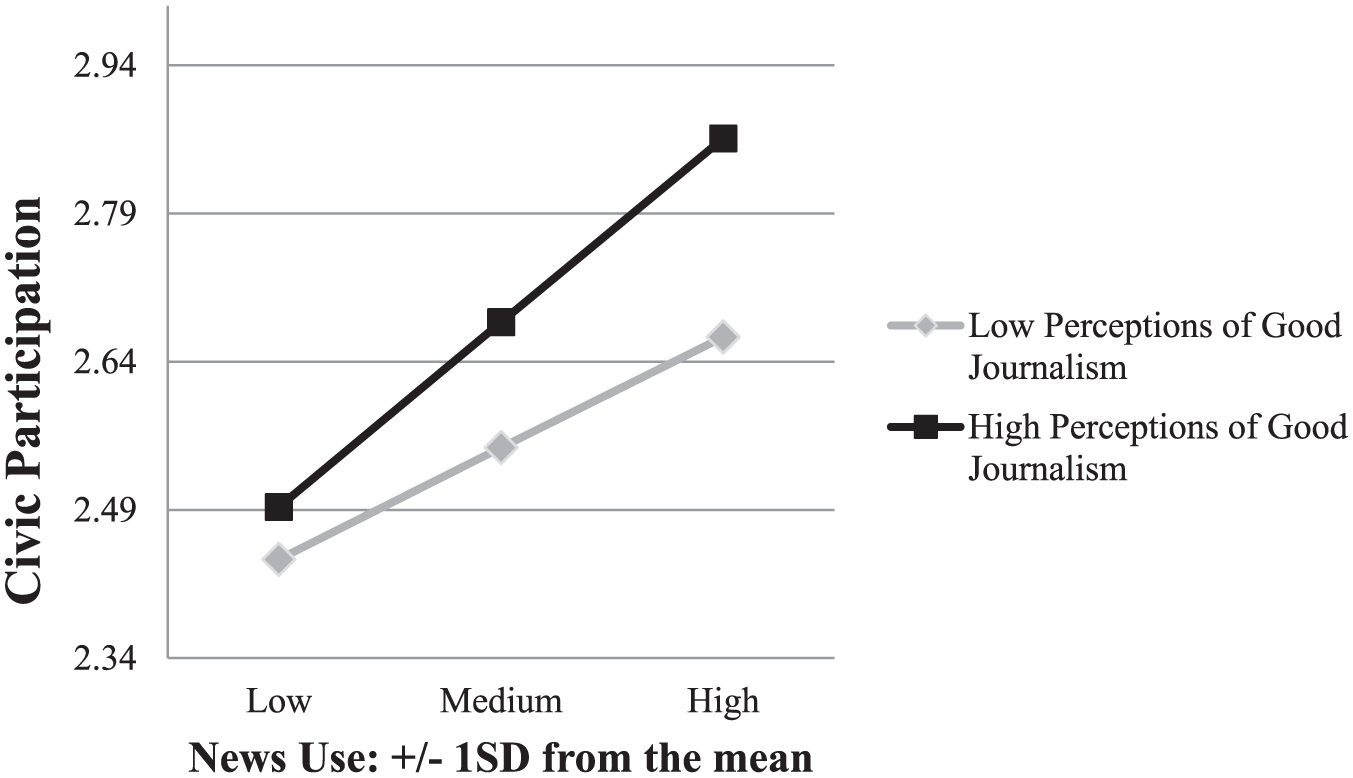
Interaction between news use and evaluations of journalists’ performance on civic participation.
Multilevel Models
A series of tests were conducted in the multilevel model (MLM) framework to account for possible country-level differences in effects. First, to justify employing MLM, we tested for the statistical dependency of the data. We created a fixed intercept model of news use (outcome variable; Log Likelihood = −30730.14), and compared that model with a random intercept model (to allow for variation by country) with no predictors (Log Likelihood = −28905.69, Ratio = 3648.91, p < .001). The null hypothesis—that there are no differences in rates of news consumption across countries—was rejected. Based on this result, we further verified results from the pooled ordinary least squares regressions with MLM.
Table 4 shows unstandardized betas (b) and standard errors (SE) for perceptions of journalism performance predicting news use (Hypothesis 1) accounting for random country intercepts and a country-level indicator of press freedom. 1 The relationship between perceptions of journalism performance and news use (Model 1; Table 4; b = .05, SE = .007, p < .001) is positive and significant. The likelihood ratio test for the random intercept model (Model 1; Table 4; Log Likelihood = −21381.19) and the fixed intercept model (pooled sample, Model 1; Table 2; Log Likelihood = −22114.44; Ratio = 1466.52, p < .001), offers evidence that between-country variance is statistically significant. Based on the intraclass correlation (.084), we can argue that about 8% of the total variance in news use is accounted for by differences between countries. The press freedom scale (inverse-coded, 0 = most free) was a positive predictor of news use, suggesting that country-level conditions of information access and quality influence news consumption (b = .006, SE = .003, p < .01).
Multilevel Models and Random Variance Components for Perceptions of Journalism Performance on News Use (Model 1) and Civic Participation (Models 2-4).
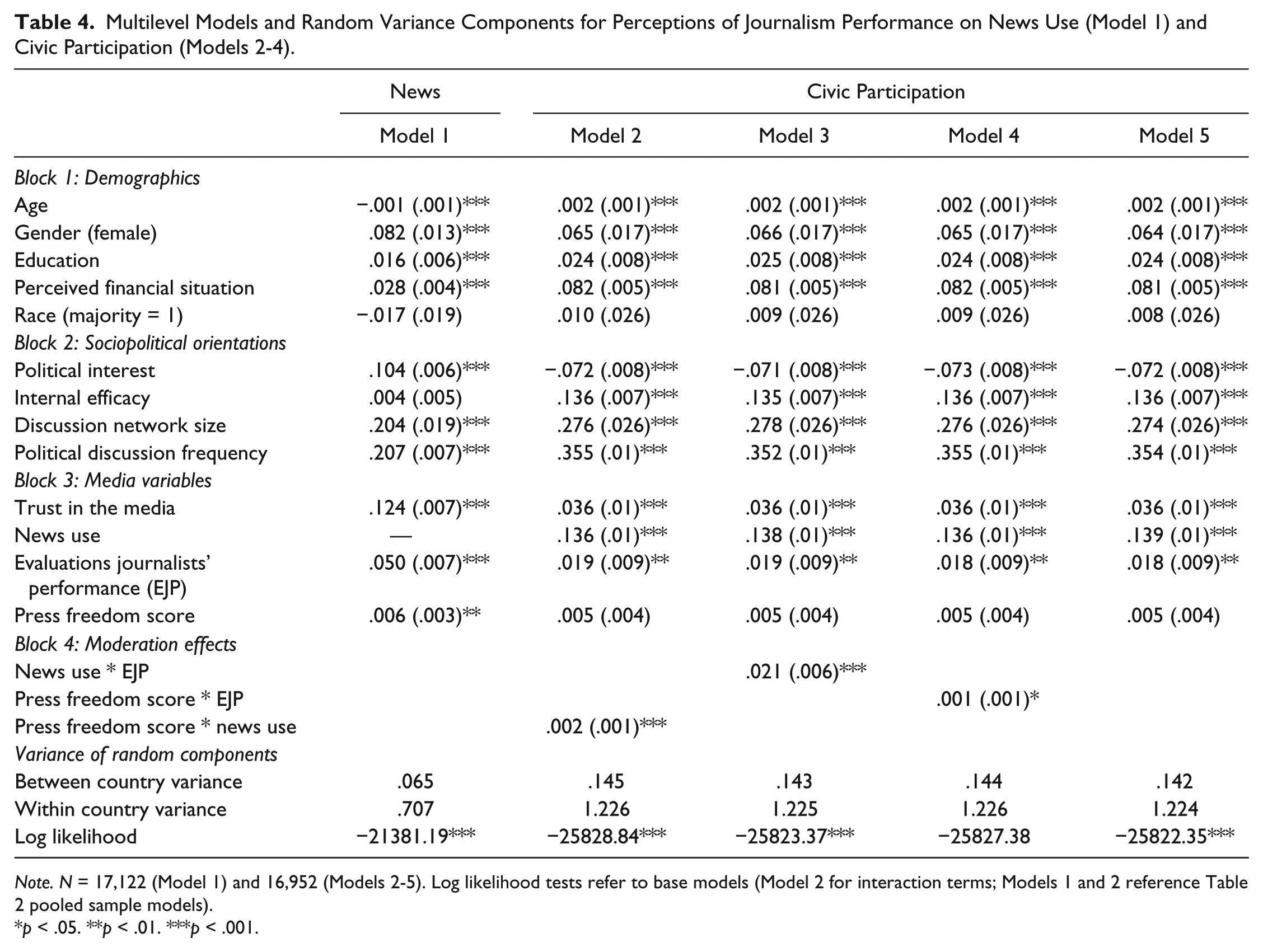
Note. N = 17,122 (Model 1) and 16,952 (Models 2-5). Log likelihood tests refer to base models (Model 2 for interaction terms; Models 1 and 2 reference Table 2 pooled sample models).
p < .05. **p < .01. ***p < .001.
Table 4 also shows results for random intercept models and interaction terms predicting civic participation (Hypothesis 2, Research Question 3; Models 2-5). First, as with news use, a random intercept model with no controls (Log Likelihood = −36874.77) was compared with the restricted model (fixed intercept; Log Likelihood = −38402.15; Ratio = 3054.758, p < .001). The test provides evidence for between country variance in levels of civic participation. Model 2 (Table 4) shows the effects of news and perceptions of journalism performance on civic participation (Hypothesis 2), along with a country-level indicator of press freedom. Both news (b = .136, SE = .01, p < .001) and perceptions of journalism performance (b = .019, SE = .009, p < .01) are positive indicators of civic participation. In line with results reported in Table 2, people who consume news report higher levels of engagement with local affairs, and the same is true for positive perceptions of journalism performance (though the effect is smaller). Variance of the random component indicators suggests that between country variance (residuals = .145) accounts for about 11% of the total variance in the model (intraclass correlation = .106). However, the country-level indicator of press freedom was not related to civic participation (b = .005, SE = .004, p = ns).
Results from Model 3 (Table 4) indicate that the individual-level interaction term (Table 2, Model 2; Figure 1), remains a positive predictor of civic participation (b = .021, SE = .006, p < .001) in the MLM framework. We also tested for cross-level interactions. These tests were exploratory, but given the positive influence of press freedom indicators on news use, it may be that systemic features of the media environment (political, economic, and legal) account for country-level differences in the effect of news use on civic participation.
This assumption was partially confirmed. There was only weak support for a cross-level interaction effect between evaluations of journalists’ performance and press freedom on civic participation, Table 4 (Model 4; b = .001, SE = .001, p = .05). The likelihood tests suggest that press freedom accounts for only marginal differences between countries in the effect of perceptions of journalism performance on civic participation (Log Likelihood = −25828.84 [Model 2]; Log Likelihood = −25827.38 [Model 4], Ratio = 2.937, p = .09). On the other hand, the interaction of news use and press freedom had a positive, statistically significant relationship with civic participation, and the relationship held in the likelihood tests despite the rather small effect size (b = .002, SE = .001, p < .001; Log Likelihood = −25828.84 [Model 2]; Log Likelihood = −25822.35 [Model 5], Ratio = 12.994, p < .001).
Discussion
Few studies have explored the audience’s perceptions of journalism performance outside the United States and even less is known about how these perceptions might relate to news consumption and participation. The results suggest that expectations of journalism performance are strongly related to civic participation, but only predict news use in some countries in the sample. The results also indicate that system-wide conditions related to press freedom are not directly related to civic participation, but do account for variance in country-level differences in the relationships between news and civic participation, as well as evaluations of journalists’ performance and civic participation. Countries with less press freedom tend to “benefit” more from their attitudes toward the news for orienting civic life.
In terms of the measures in the sample, based on the lower bound of reliability testing (Cortina, 1993), the results suggest that the measurements for news use and for evaluations of journalism performance are reliable for all countries in our sample. As expected, these perceptions were also found to vary significantly among societies, ranging from slightly above “not well” (Korea) to slightly above “well” (India). Results also indicate that the positive effect of consuming news on civic participation is strong and consistent across the countries in the data set. In addition, and after testing the interaction effects, we can argue that those who use news and have positive perceptions about the role of journalists tend to participate more in civic activities compared with news users that do not have such a positive view of the work of journalists. In other words, positive perceptions of “good journalism” have a beneficial effect on civic participation for those who consume news more often.
For decades scholars have warned about low levels of news use and the potential hazards of disconnecting from civic life. In addition, most people, especially young ones, get their news online, over social media, or through citizen journalism blogs. This environment is characterized by the possibility for more audience engagement with the news and consequentially, news workers are adjusting to a potential loss of control over the basic values of “good journalism” (Lewis, Holton, & Coddington, 2014). Increased audience involvement, along with the personalization of news products via social media (Lee, Gil de Zúñiga, Coleman, & Johnson, 2014) has led news organizations and media practitioners to reexamine their role conceptions. The results from this study should give cynics of this process some pause. Overall, the public still consumes news based on traditional normative expectations of professional reporting: accuracy, being a watchdog, and covering important stories is positively associated with news consumption, and the results hold for about half of the countries we tested. News is also closely tied to civic participation, regardless of the economic model or historical role of the press. These results offer robust evidence that news provides information and resources for participation at the community-level.
Another interesting finding is the set of countries where audience expectations of performance was positively related to news use (Table 3, Table 4). According to the Press Freedom Status, we expected normative evaluations to matter in countries with a tradition of independent, market-driven press systems, like the United States, the United Kingdom, Japan, and New Zealand. However two countries, Russia and China, also showed positive and significant coefficients in the regression model, despite the fact that these countries have a shorter (or none at all) history of independent media. These findings were echoed in the MLM model, where people living in “less free” press systems consumed more news. Why would norms associated with a Western, liberal news industry be important in China, where state intervention in the media is high, and free speech laws are not as relaxed as in other countries? One potential answer is that like the United States, these systems are still highly profit-driven. That is, these countries are starting to adopt the political and cultural expectations of a market-driven press system. There is some evidence for this in China, where the media are increasingly expected to take on watchdog roles (Liebman, 2005). Another possibility is that as overall competition for attention in the media environment increases, news is increasingly a matter of choice. Individuals with higher expectations of press performance are also the ones who consume the most news.
One limitation of this study is that we cannot triangulate an individual’s evaluation of press performance, the journalists’ role conception, and the news content itself. Like many other studies in this area, there is an implicit assumption that attitudes of the public are tied to the quality of news coverage. Future studies should determine whether news content also plays a role in how the public evaluates press performance. The survey instrument is also prone to error in general, particularly in countries with smaller sample sizes (India and South Africa), and in countries with less Internet penetration (Estonia and the Ukraine).
This study highlights the overwhelming support for the role of news in fostering apolitical community engagement. Evidence here suggests that the prosocial benefits of news consumption remain, regardless of culture. News seems to be serving a universal need for community organization even in countries characterized by higher levels of information poverty, closed media systems, or both. In contrast, the role of the journalists in meeting public’s expectations may be a more fluid, and culturally dependent factor. How news workers decide to incorporate these norms into their work will determine, in part, the role information technology adoption will play in attention to news in the future. As choice increases, people are likely to consume less news, and how they view journalists in this environment matters for civil society.
Footnotes
Appendix
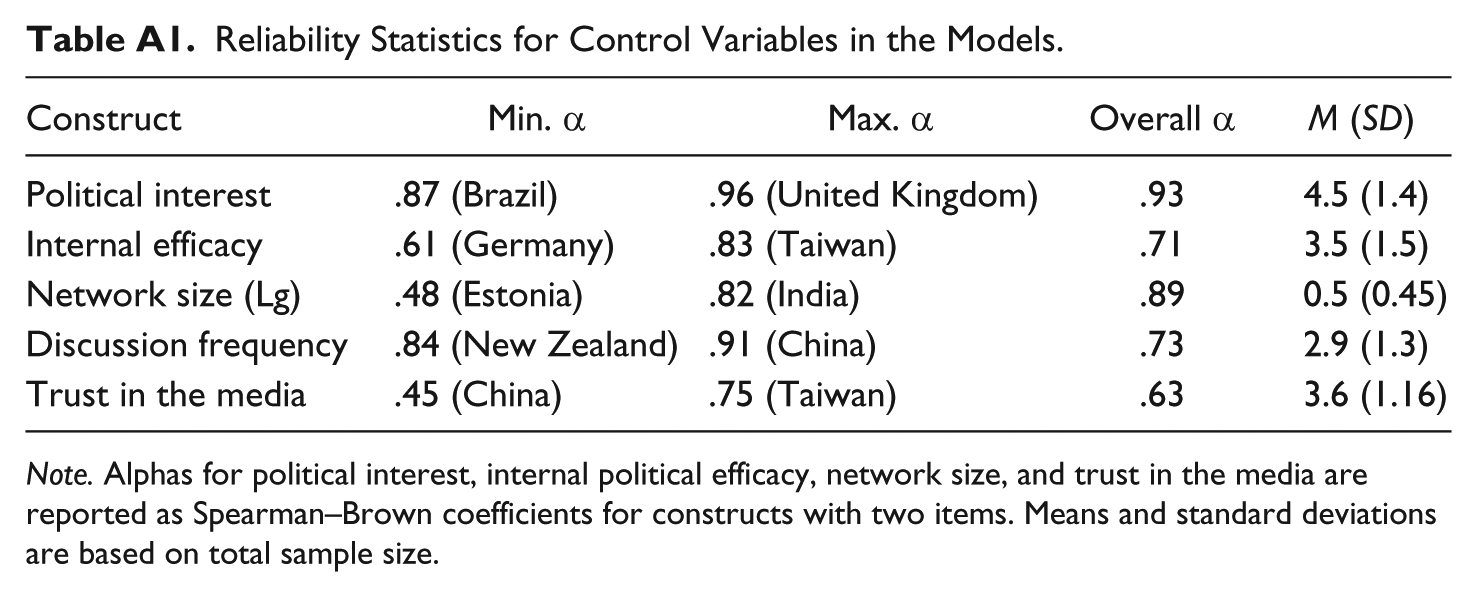
Reliability Statistics for Control Variables in the Models.
| Construct | Min. α | Max. α | Overall α | M (SD) |
|---|---|---|---|---|
| Political interest | .87 (Brazil) | .96 (United Kingdom) | .93 | 4.5 (1.4) |
| Internal efficacy | .61 (Germany) | .83 (Taiwan) | .71 | 3.5 (1.5) |
| Network size (Lg) | .48 (Estonia) | .82 (India) | .89 | 0.5 (0.45) |
| Discussion frequency | .84 (New Zealand) | .91 (China) | .73 | 2.9 (1.3) |
| Trust in the media | .45 (China) | .75 (Taiwan) | .63 | 3.6 (1.16) |
Note. Alphas for political interest, internal political efficacy, network size, and trust in the media are reported as Spearman–Brown coefficients for constructs with two items. Means and standard deviations are based on total sample size.
Acknowledgements
The authors are grateful to James H. Liu and all participants of the Digital Influence World Project for their help with the data collection for this study.
Declaration of Conflicting Interests
The author(s) declared no potential conflicts of interest with respect to the research, authorship, and/or publication of this article.
Funding
The author(s) received no financial support for the research, authorship, and/or publication of this article. The author(s) disclosed receipt of the following financial support for the research, authorship, and/or publication of this article: This research was supported by Grant FA2386-15-1-0003 from the Asian Office of Aerospace Research and Development. Responsibility for the information and views set out in this study lies entirely with the authors.