







Abstract
One of the democratic promises of social media relies on the expectation that citizens will be exposed to more diverse sources of information and will consequently be more likely to encounter views that challenge their beliefs and opinions. Still, recent evidence suggests that although social media may increase exposure to difference, citizen also take active steps to reduce the dissonance they encounter by engaging in selective avoidance tactics such as political unfriending and unfollowing. We report the findings from the first comparative study of political unfriending conducted in Asia, which analyzes survey data from two Chinese societies, Hong Kong and Taiwan. We find that political interest, political discussion network size, and political discussion with distant others all predict the likelihood of engaging in selective avoidance on social media. The results also suggest that political interest is a stronger predictor of unfriending in Hong Kong, while social and psychological factors play a more important role in Taiwan.
Introduction
Social media platforms potentially provide access to highly diverse range of views and perspectives, but they also offer powerful filtering and curation affordances that could promote the creation of homophilic information environments. In addition to being able to create homogenous online networks through selective affiliation, people can also engage in post hoc user filtration (Yang, Barnidge, & Rojas, 2017). With a click of a button, one can hide postings he or she disagrees with and mute or unfriend/unfollow sources that challenge his or her beliefs. Conceptually, these behaviors fall under the term of selective avoidance, denoting efforts to avoid information one disagrees with. These actions also train social media algorithms to automatically filter out unwanted dissonance in the future and create tightly controlled information ecologies (Bakshy, Messing, & Adamic, 2015; John & Dvir-Gvirsman, 2015).
The aim of this study is to closely examine the predictors of politically motivated selective avoidance on social media, specifically political unfriending/unfollowing on platforms such as Facebook and Twitter. Unfriending/unfollowing denotes a deliberate dissolution of social ties, and represents a form of nonalgorithmic, manual reconfiguration of egocentric online networks. We seek to understand both political and social psychological, as well as media use related factors that predict political unfriending by analyzing two unique survey data sets from Hong Kong and Taiwan. Noting the role of culture in the relationship between new technology use and political change in Asia (Skoric, 2007), we also focus on the role of cultural differences in the dynamics of selective avoidance on social media.
Both Taiwan and Hong Kong are renowned for their traditions of free press and civic life, and noninstitutional political activities such as protests are common in both regions. Social media platforms have played an important mobilizational and organizational role in activities such as the Sunflower Movement in Taiwan (B. Chen, Liao, Wu, & Hwan, 2014) and the Umbrella Movement in Hong Kong (F. L. Lee, Chen, & Chan, 2017; P. S. N. Lee, So, & Leung, 2015). However, Taiwan enjoys full democracy in which citizens are free to express their political preferences in periodic democratic elections. In contrast, Hong Kong is only partly free since no universal suffrage exists and the Chief Executive is elected indirectly via an election committee, while the legislative branch is elected more democratically. A recent meta-analysis showed that use of social media platforms is linked with political action in both regions, and yet the effect size is larger in Taiwan than in Hong Kong, arguably because of the difference in the political systems (Skoric, Zhu, & Pang, 2016). In Taiwan, engagement with politics through social media seems to be a byproduct of socialization, given that Taiwanese citizens who use online media to discuss politics and socialize with friends are more likely to publicly express their political opinions and contact elected officials (Hsieh & Li, 2014). In contrast, social media performs a more political role in Hong Kong (H. T. Chen, Chan, & Lee, 2016), arguably as a result of the surging political polarization and appalling inequality (Nobel, 2014; Steinbock, 2017), which are not present in the current Taiwanese political scene. P. S. N. Lee et al. (2015) suggests that social media has become an insurgent public sphere in Hong Kong, based on the finding that social media use contributes to dissatisfaction and distrust of the established political authorities. While Hong Kong and Taiwan are both Chinese societies sharing many cultural, linguistic, and historical traits, Hong Kong was also a British colony for more than a century. Research suggests that there are significant cultural differences between the two regions, such as those related to uncertainty avoidance, power distance, and trust tendencies (Y. H. Chen, Wu, & Chung, 2008).
Literature Review
Even before the arrival of social media, scholars have voiced concerns about the power of digital technologies to deliver highly personalized version of reality to citizens based on their preexisting political preferences and opinions (Sunstein, 2001). The social media ecologies that have emerged since offer even more powerful personalization and filtering affordances, aided by proprietary algorithms optimized to increase advertising efficiency instead of creating a marketplace of ideas. The algorithms are created to recommend content that citizens will like and/or agree with and can therefore inadvertently widen ideological fissures that exist within a society (Flaxman, Goel, & Rao, 2016). Indeed, the supply of public affairs news has become deeply entangled with social networking, which, while enabling marginally more cross-cutting exposure through social endorsement (Messing & Westwood, 2014), may have amplified selectivity thanks to the principle of network homophily (McPherson, Smith-Lovin, & Cook, 2001).
The exponential growth of political information on the Internet has further decimated people’s cognitive ability to assess nonpreferred alternatives (Metzger, Flanagin, & Medders, 2010), making information filtering a necessity. The rise of more homophilous networks, paired with algorithmic filtering and advertising incentives has also accelerated the process of decoupling of “news production” from professional standards and practices, as evident by the rise of “fake news” during the recent U.S. presidential election. Recent evidence suggests that ideological divide between citizens is greater among those who get their news via social media, particularly when it comes to opinion, rather than factual pieces (Flaxman et al., 2016). The increasing power of filtering paired with an ongoing migration to more intimate and closed social media platforms such as Snapchat, WhatsApp, and WeChat potentially signals that the era of context collapse (Marwick & boyd, 2011) and intensive and open weak tie communication over social media may be coming to an end.
The concept of selective avoidance is related to selective exposure, an observed pattern of information seeking and processing in which individuals gravitate toward content sympathetic to their established opinions and partisan biases (Stroud, 2008). And yet selective avoidance is different from the common practice of selective exposure in that, while the latter does not necessarily sacrifice opportunities for cross-cutting exposure (Garrett, Carnahan, & Lynch, 2013), the former purposefully eliminates both present and future encounters with unwanted disagreements by cutting off the connections with the source. In addition to their direct impact, selective avoidance behaviors provide input to social media algorithms which can then automatically filter out dissonant views in the future.
Selection Avoidance on Social Media: Political Unfriending and Unfollowing
Research shows that cross-cutting exposure is linked with increased tolerance, greater openness to political difference, and better understanding of political arguments (Dilliplane, 2011; Mutz, 2002). However, its relationship with political participation is more contested, since exposure to political disagreement may lead to ambivalence, which may depress political participation (Lu & Gall Myrick, 2016; Mutz, 2002; Pattie & Johnston, 2009). In contrast, exposure to likeminded views boosts participation via activation and reinforcement of citizens’ existing attitudes, but it can also lead to more extreme political attitudes and greater polarization and fragmentation (Dilliplane, 2011, 2014; Sunstein, 2001). Selective avoidance of political content may therefore reflect tribalism inherent to politics as citizens holding more extreme political views are more likely to engage in it (John & Dvir-Gvirsman, 2015), which further promotes their participation in contentious political activities such as street protests (Zhu, Skoric, & Shen, 2017). Consequently, moderate and tolerant citizens are likely to disengage from politics, allowing those holding more extreme and radical attitudes to play a more significant role.
Research shows that politics is the second most common reason for unfriending on social network sites, most frequently as a reaction to polarizing posts or exposure to political disagreement (Rainie & Smith, 2012; Sibona, 2014). Citizens who are more politically engaged or extreme in their ideologies are most likely to unfriend or unfollow others (John & Dvir-Gvirsman, 2015), with weak ties being the most common casualty (Rainie & Smith, 2012; Sibona, 2014). Even simply engaging in political talk with friends and family has been linked with greater frequency of unfriending (Bode, 2016). We therefore expect that a broader pattern of interest in politics should also be predictive of unfriending since it is likely reflective of stronger political preferences and greater likelihood of political engagement. This should particularly matter in the case of Hong Kong, which has experienced a more polarized political climate following the Umbrella Movement protests in 2014.
Research on selective exposure suggests that the social aspect of information presented on social media can trump selectivity bias. Social endorsement can increase perceived information utility and thus help reduce partisan selectivity (Messing & Westwood, 2014). Such a positive effect is particularly pronounced among people driven by impression goals of appearing likable and developing relationships (Winter, Metzger, & Flanagin, 2016). However, considering that these studies were experiments, it is unclear whether this is easily generalizable to the real world. In everyday life, people may be willing to compromise on issue stance in order to protect personal relationships and associated social resources (Mutz, 2002). In contrast, in times of heightened political conflict, opinion extremity and commitment to protect personal and in-group beliefs may overshadow other relationship qualities. Exposure to disagreement is thus likely to trigger a defense motivation. As consistently demonstrated by research on cognitive dissonance, a defense motivation such as to justify one’s opinion makes individuals more prone to selectivity bias (Fischer & Greitemeyer, 2010; Frey, 1986; Hart et al., 2009; Winter et al., 2016). At the affective level, anger dominates; it triggers risk-taking behaviors, willingness to spend scarce resources, and a quick reaction that involves little contemplation (Lerner & Keltner, 2001; Lu & Gall Myrick, 2016). Selective avoidance aimed at shielding oneself from dissenting views via a click of a button thus becomes a reality.
Exposure to dissonant and politically polarizing information on social media is likely to increase the chance of unfriending and unfollowing, and it is more likely to be done by those who are more engaged in politics. However, a recent study by Yang et al. (2017) paints a more complex picture, suggesting that although the strength of political ideology, the number of social media contacts, and the time spent using social media all predicted frequency of unfriending, such relationship was surprisingly absent when it came to exposure to disagreement. This absence could be potentially explained by the sociocultural context in which the study was conducted (i.e., Columbia), and also by the nature of measurement deployed, namely a single-item measure assessing the frequency of encountering disagreement with friends’ posts on social media without actively engaging in a conversation or interaction. Although social media users do often monitor others’ opinions through “lurking,” it is also common that they engage with others’ views through commenting, liking, or sharing, particularly during political events. Political disagreement experienced through expression may differ from disagreement experienced through mere exposure. Expression has a self-reinforcing effect that, thanks to humans’ innate confirmation bias, transforms cross-cutting exposure into a source of “postdecisional dissonance,” which evokes a defense position and a stubborn psychological commitment to and “automatic consistency” with the expressed opinions (Cialdini, 1984). In other words, the act of expression tends to move people toward more fortified versions of their views. Such a self-reinforcing effect has been empirically demonstrated in social media studies. Cho, Ahmed, Keum, Choi, and Lee (2016) find that political expression on social media strengthens expressers’ preexisting political preferences. J. K. Lee, Choi, Kim, and Kim (2014) report that, exposure to incongruent views is conducive to more polarized opinion about party and ideology only among those who have engaged in public affairs discussion.
In this study, we therefore aim to examine the role of political discussion in selective avoidance on social media, focusing on two different attributes, namely the discussion network size and the nature of discussions. Although previous research has not directly assessed the impact of the political discussion network size, there is evidence suggesting that the number of contacts on social media is predictive of unfriending (John & Dvir-Gvirsman, 2015; Yang et al., 2017). In addition, the number of people one engages in political discussions with is also an indicator of one’s political activity and ideological commitment, which are expected to increase the likelihood of selective avoidance. In terms of the nature of discussions, we categorize them into those involving known others (e.g., families, friends, and coworkers; Metzger et al., 2010) and those with distant others (e.g., strangers, people different from us in terms of ethnicity and social economic status; Park & Lee, 2012). The difference between the two types of discussions is that the former tends to be more oriented toward agreement seeking than the latter, as the former is bounded by social relationship norms, whereas the latter is not. First of all, social contacts tend to be localized in sociodemographic space. People are biased in the selection of affiliation in favor of those who are similar to them, and grow more alike over time (McPherson et al., 2001). Besides, when interacting with known others, people are subjected to the pressures of social conformity and compliance (Cialdini & Goldstein, 2004). In order to maintain a sense of coherence, people usually stay away from controversial topics and are ready to overlook minor disagreements emerging in their daily interactions (Huckfeldt & Sprague, 1995; Jussim & Osgood, 1989; McPherson et al., 2001). Studies on political talk suggest that people often make political conversations in a social rather than in a civic manner—similar to small talk and gossiping, talking about politics often serves the primary function of social grooming and signaling (Eveland, Morey, & Hutchens, 2011). In other words, we tend to expect agreement when interacting with our existing ties and when disagreement happens, we are more likely to overlook it in the interest of preserving a social connection. In contrast, when interacting with strangers and people of different backgrounds, disagreement is to be expected and it is less likely to be avoided or mitigated for the sake of preserving a tie. Moreover, although people indeed experience disagreement in close relationships (Morey, Eveland, & Hutchens, 2012), studies have also shown that in such contexts disagreement is a means of expressing sociability and intimacy rather than confrontation (Sifianou, 2012). Based on the extant research, we formulate the following research hypotheses:
Political Unfriending and Unfollowing in the Cultural Context: Hong Kong and Taiwan
Research on selective avoidance on social media in the context of Asia is very scarce. A recent study from Hong Kong found a positive association between political use of social media and the likelihood of selective avoidance, with perceptions of out-group threat intensifying this relationship (Zhu et al., 2017). It can therefore be expected that social psychological variables play a role in the decision to unfriend/unfollow users and that of particular importance are those factors related to the maintenance of social relationships. As unfriending and unfollowing on social media resembles and signals the dissolution of social ties, it may be governed by cultural norms. In this study, we therefore examine the roles of cultural orientation—collectivism, and a social psychological trait—fear of missing out (FoMO).
In a collectivist culture, the concept of “self” is defined by “we” rather than “I.” Therefore, it emphasizes the interdependence of relationships between group members. Members take responsibilities to take care of each other and form strong connections. Efforts are spent in achieving group harmony (Kim, Park, & Suzuki, 1990). Therefore, in the context of political discussions on social media, users who endorse collectivistic values may be less likely to unfriend others in order to maintain harmony in the network.
Taiwan has been categorized as a highly collectivistic society (Hofstede, 1983) in which people tend to avoid uncertainty and have an affinity for hierarchy in their organizations and communities. Most Taiwanese receive political information from social media, but they mostly just read or share information rather than engage in commenting or discussing political issues (Taiwan Communication Survey, 2015). This is due to citizens’ ambivalent and negative attitudes toward using Facebook for political discussion and engagement (Lin, 2016). In comparison, while Hong Kong is also categorized as a collectivistic culture and a highly hierarchical society, it significantly differs from Taiwan when it comes to uncertainty avoidance, indicating that its people are more flexible in their interpretation of rules and easier to adapt to ambiguity.
In addition to collectivism, FoMo is another trait variable that is closely tied to social relationships (Przybylski, Murayama, Dehaan, & Gladwell, 2013). It refers to “the fears, worries, and anxieties people may have in relation to being in (or out of) touch with the events, experiences, and conversations happening across their extended social circles” (p. 1842). Individuals, who are high in FoMo, spend more time on social media to monitor potential social activities or trends (Przybylski et al., 2013; Taiwan Communication Survey, 2014). Among teen and adult social media users in Taiwan, around 12% of respondents indicate that the main reasons for using social media is FoMo. Therefore, it is likely that those who are high in FoMo are more likely to engage in various discussions during their social media surveillance activities, including those with dissimilar others. Such behaviors are likely to be predictive of unfriending/unfollowing, which would act as a necessary information management tactic. Furthermore, FoMo may interact with a cultural context, as those who are high in FoMo in Taiwan may demonstrate greater likelihood of engaging in avoidance behavior than Hong Kongers. This is because Taiwanese are higher in uncertainty avoidance and would engage in unfriending/unfollowing with low tolerance of ambiguity or different opinions. Given the above, we aim to examine whether collectivism and FoMo are linked with selective avoidance behaviors in Hong Kong and Taiwan, while focusing on the potential differences between the two societies.
Method
Data
The data were collected by a reputable market research agency, YouGov, which is one of the pioneers of online polling (Twyman, 2008). It adopts what is known as “active sampling”—a panel-based approach—where a sample is drawn from a pool of respondents, matched in terms of desired population quota such as age, gender, and race. This approach ensures that the eventual sample is equivalent and selected with the right proportions.
For the Hong Kong survey (March 7-16, 2016), the participants were recruited from the YouGov proprietary consumer panel using gender and age quotas. For the Taiwan survey (January 6-16, 2016), the participants were recruited via a YouGov trusted panel partner. The sizes of the online panels from which the respondents were recruited were 15,000 and 21,000 for Hong Kong and Taiwan, respectively, with a response rate of 30% to 40%. The final data set is weighted for analysis purposes using the Random Iterative Method which uses an algorithm that checks the target variables of sample distribution against the same variables from known distribution, and then assigns a weighting coefficient that tries to distort each variable as little as possible. The target variables used were based on gender, race, and age proportions according to the population census.
Measures
Selective Avoidance
Selective avoidance was operationalized in this study as politically motivated unfriending or unfollowing. We measured it with the question, “Have you unfriended or unfollowed anyone because of comments or posts related to politics in the past 6 months” (0 = no, 1 = yes, 2 = do not know). Indeed, 12.16% (n = 298) of the 2,450 self-reported social media users in our sample reported to have engaged in such selective avoidance behavior, while 77.27% (n = 1,893) did not. Whereas 10.57% (n = 259) chose “do not know,” which was treated as a missing value in the analysis.
Political Interest
Political interest was estimated with a single-item measure. Respondents answered the question, “How interested are you in what’s going on in government and politics” on a 5-point scale (1 = not interested at all, 5 = extremely interested). Responses yielded a mean of 3.17 with a standard deviation of 1.03.
Collectivism
The collectivism variable measures the degree to which an individual sees him or herself as a part of a collective. The items used tapped into both vertical collectivism where people accept the hierarchy and submit to the authority of their in-group (i.e., obedience, self-sacrifice), and horizontal collectivism where people see the members of a collective as equals and still merge their selves with the in-groups (i.e., conformity, cooperativeness; Triandis, 2001; Triandis & Gelfand, 1998). Respondents were asked to answer the following questions on a 7-point scale (1 = strongly disagree, 7 = strongly agree). (1) “I would sacrifice an activity that I enjoy very much if my family did not approve of it.” (2) “It is important to me that I respect the decisions my friends make.” (3) “If my friend gets a prize, I would feel proud.” (4) “It is important to maintain harmony within my family.” Responses were subjected to a principal component analysis, which found the items to load on a single component. The reliability test yielded a Cronbach’s α of .72. Collectivism scores were estimated by taking the mean of the four items (M = 4.84, SD = 1.00).
Fear of Missing Out (FoMO)
We used the 10-item FoMO scale developed by Przybylski et al. (2013) to measure the psychological trait FoMO. Respondents were asked to answer the questions using a 7-point scale (1 = not at all true of me, 7 = extremely true of me). FoMO scores were estimated by averaging across the items (M = 3.62, SD = 1.14, Cronbach’s α = .92).
Social Media Political Discussion Network Attributes
We measured both the size and nature of political discussion networks on social media. To estimate the network size, we asked the respondents how many people they had discussed political affairs with via social media during the past month, using a 6-point scale (1 = 0-20 people, 2 = 21-50 people, 3 = 51-100 people, 4 = 101-200 people, 5 = 201-500 people, and 6 = more than 500 people; M = 1.48, SD = 1.03).
As to the nature of political discussion, we asked respondents how frequently they had conversed about politics with (1) close friends and families, (2) coworkers and friends, (3) strangers, and (4) people outside their family who are not of the same ethnicity or socioeconomic status, respectively, on a 7-point scale (1 = never, 7 = all the time). Responses were subjected to a principal component analysis with a varimax (orthogonal) rotation. The analysis yielded two factors explaining a total of 84.02% of the variance for the entire set of variables. With high loadings by the Items 1 and 2, the first factor explained 50.66% of the variance. It reflected discussion within one’s social circle, and was thus labeled political discussion with known others. The second factor consisted of Items 3 and 4, which counted for 33.36% of the variance. It reflected political discussion occurring beyond one’s social circle, hence labeled political discussion with distant others. We created the variable political discussion with known others by computing the mean of the first two items (M = 4.78, SD = 1.56, Pearson’s r = .73), and the variable political discussion with distant others by computing the mean of the other two items (M = 2.62, SD = 1.42, Pearson’s r = .61).
Control Variables
We controlled for demographics (age, gender, and education), and media consumption (traditional vs. online). Demographic information is summarized in Table 1. To estimate media consumption, respondents were asked to report how frequently they used traditional and online media to get information about public issues and politics on a 7-point scale (1 = never, 7 = all the time). Traditional media included local free-to-air TV, cable TV, radio news, traditional newspapers, and traditional magazines (M = 3.89, SD = 1.20, Cronbach’s α = .73). Online media included online text news, online magazines, online video news, and online discussion forums (M = 4.34, SD = 1.27, Cronbach’s α = .79).
Summaries of Demographics.

Note. TW = Taiwan; HK = Hong Kong. Age 5-point scale (1 = 18-24 years old, 2 = 25-34 years old, 3 = 35-44 years old, 4 = 45-54 years old, 5 = 55 years old and above); Education 6-point scale (1 = less than high school, 2 = high school degree or equivalent, 3 = some college but no degree, 4 = associate degree, 5 = bachelor degree, 6 = graduate degree).
Results
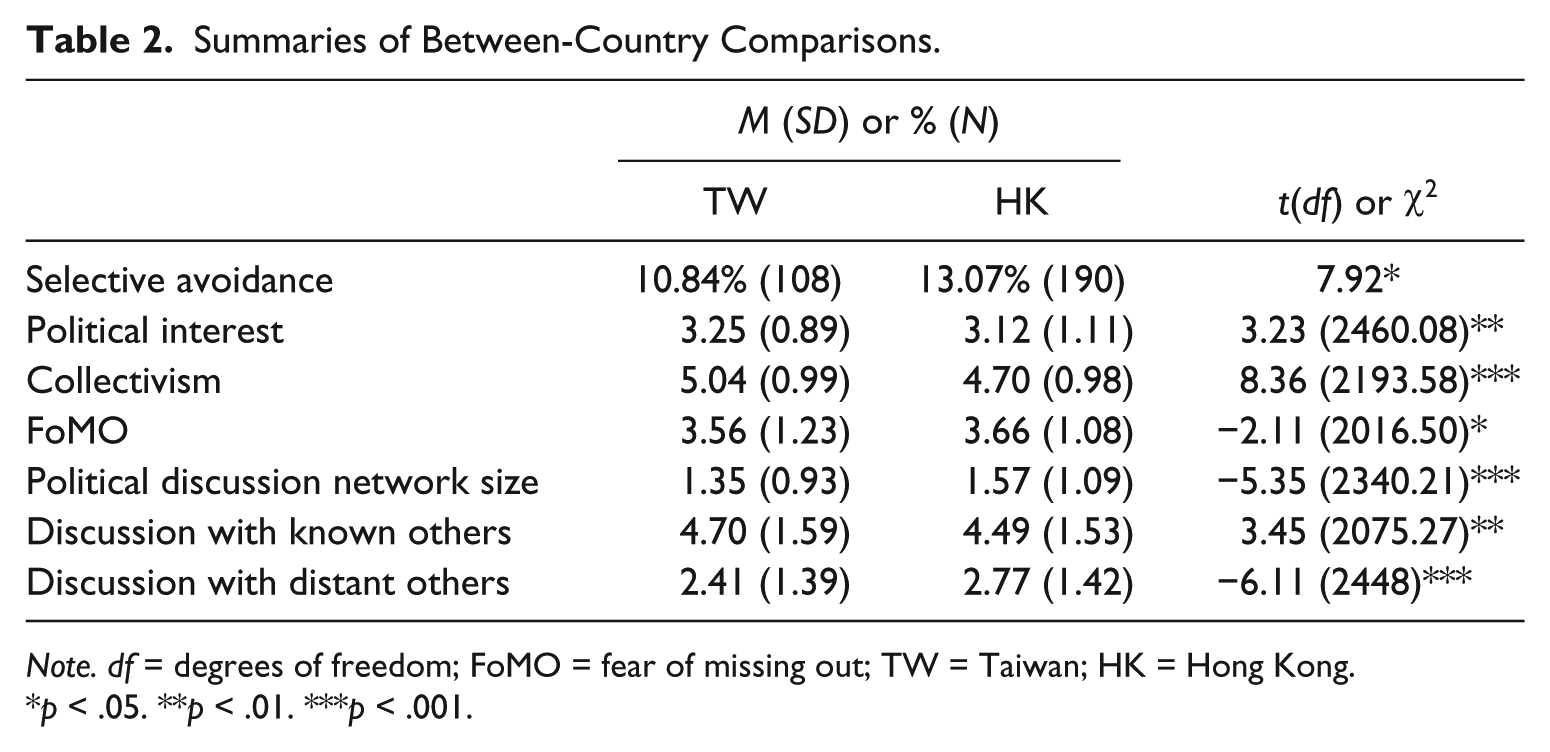
The percentage of respondents who engaged in politically motivated selective avoidance on social media differed significantly between countries, χ2(2, 2450) = 7.92, p < .05; 10.84% (n = 108) of the respondents in Taiwan reported to have unfriended or unfollowed someone, compared with 13.07% (n = 190) of the respondents in Hong Kong. We also note that a lower percentage of Taiwanese respondents (9.04%) reported “do not know” than their Hong Kong counterparts (11.62%).
In our analyses, t tests showed significant between-country differences related to the political and social factors, as well as the three attributes of political discussion network on social media (see Table 2). In general, Taiwainese respondents exhibited a higher level of political interest, t(2460.08) = 3.23, p < .01, stronger collectivist orientation, t(2193.58) = 8.36, p < .001, and a greater tendency to discuss politics with known others on social media, t(2075.27) = 3.45, p < .01, than their Hong Kong counterparts. Hong Kong respondents on average scored higher on the FoMO scale, t(2016.50) = −2.11, p < .05, had larger political discussion networks on social media, t(2340.21) = −5.35, p < .001, and discussed politics with distant others more, t(2448) = −6.11, p < .001, compared with the Taiwanese respondents.
Summaries of Between-Country Comparisons.
Note. df = degrees of freedom; FoMO = fear of missing out; TW = Taiwan; HK = Hong Kong.
p < .05. **p < .01. ***p < .001.
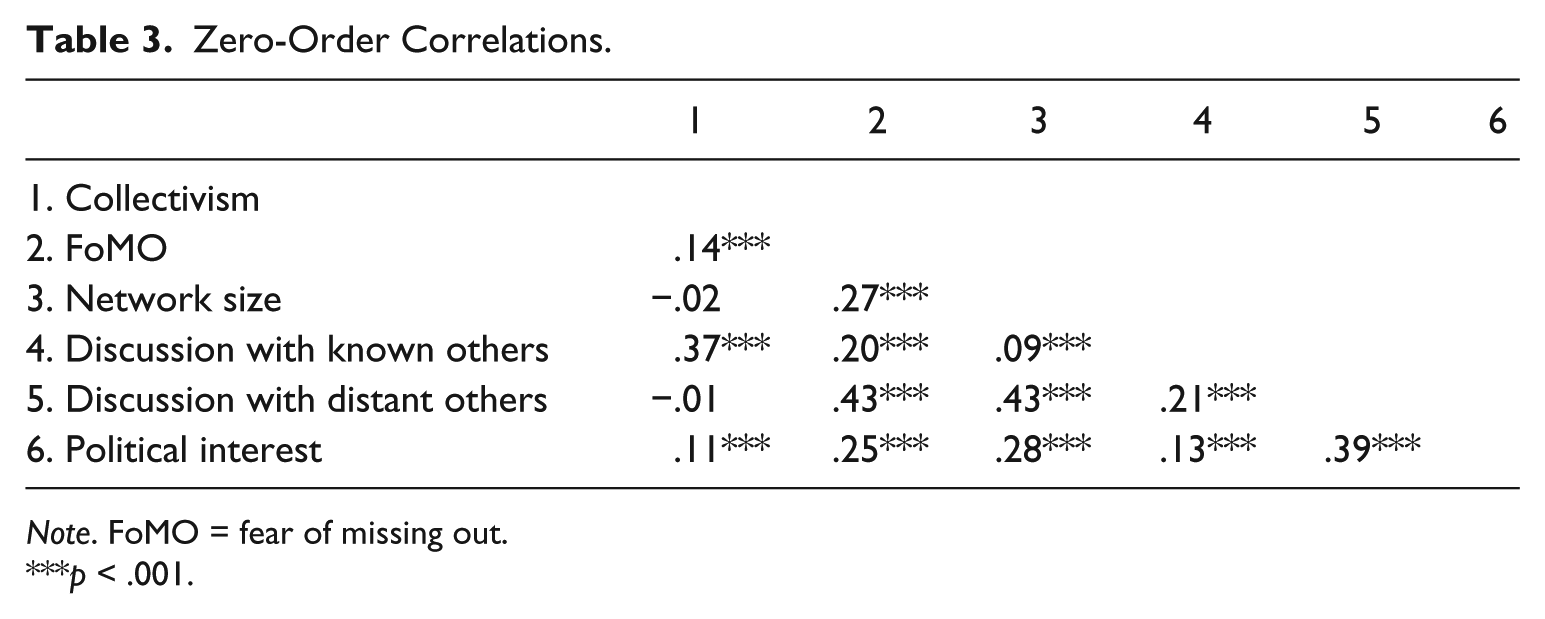
Zero-Order Correlations.
Note. FoMO = fear of missing out.
p < .001.
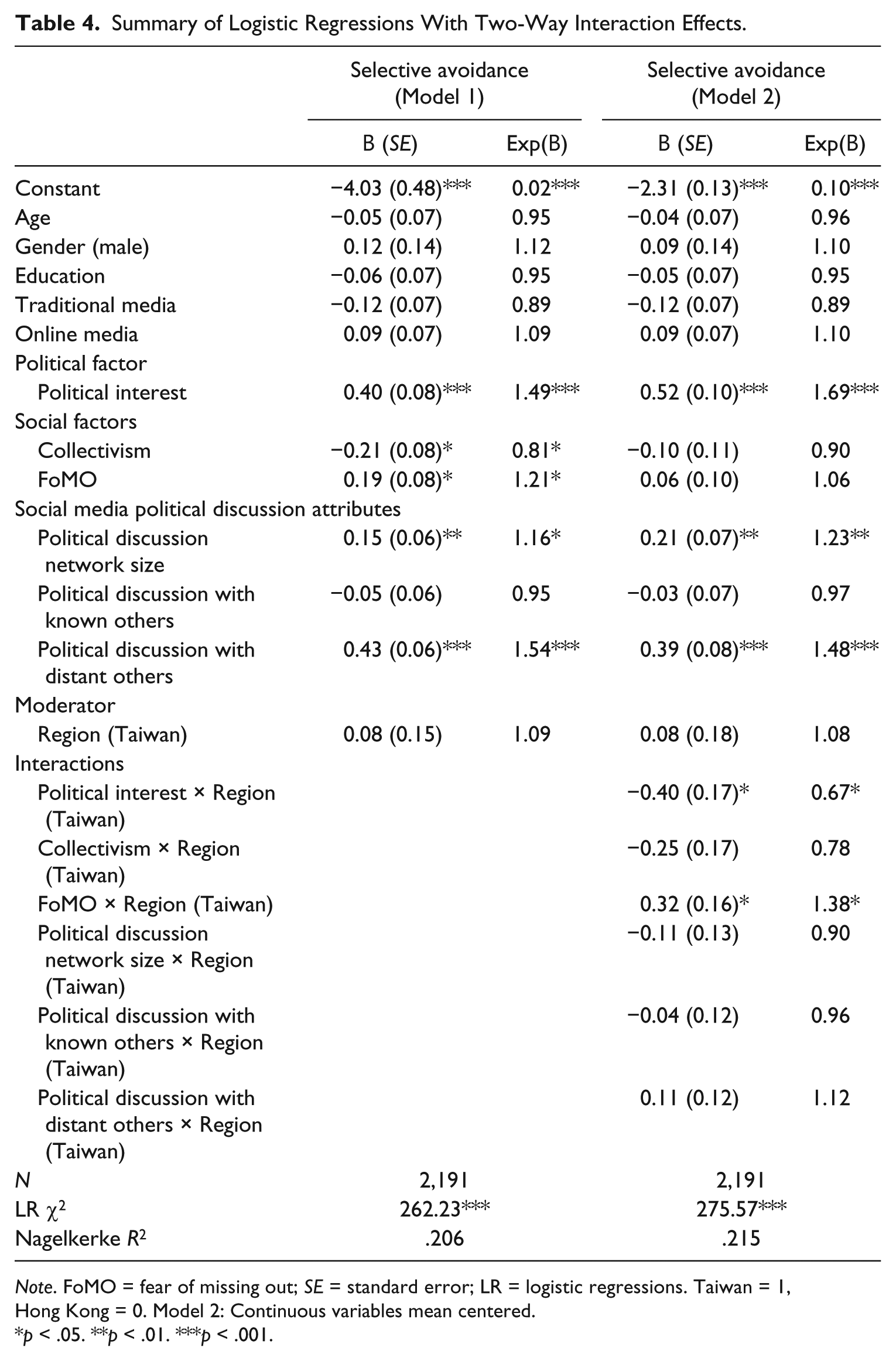
A logistic regression was performed to examine predictors of politically motivated selective avoidance with the two regional data sets combined, followed by a logistic regression with two-way interaction effects using region as the moderator (Taiwan = 1, Hong Kong = 0) to estimate between-region differences. Odds ratios, Exp(Β), were calculated and the results summarized in Table 4. In terms of the main effects of the focal independent variables (Model 1), political interest, Β (SE) = 0.40 (0.08), Exp(Β) = 1.49, p < .001, political discussion network size on social media, Β (SE) = 0.15 (0.06), Exp(Β) = 1.16, p < .05, and discussion with distant others on social media, Β (SE) = 0.43 (0.06), Exp(Β) = 1.54, p < .001, are positively and significantly associated with the log odds of selective avoidance. Hypotheses 1, 2, and 3 are thus supported. Regarding Research Question 1, political discussion with known others is not significantly associated with selective avoidance, Β (SE) = −0.05 (0.06), Exp(Β) = 0.95, p = .36. As to Research Question 2, both FoMO and collectivism are significantly associated with selective avoidance, although in opposite directions. Specifically, one-unit increase in FoMO is associated with an estimated .19 increase in the log odds of selective avoidance, Β (SE) = 0.19 (0.08), Exp(Β) = 1.21, p < .05, whereas one-unit increase in collectivism is associated with an estimated .21 decrease in the log odds of selective avoidance, Β (SE) = −0.21 (0.08), Exp(Β) = 0.81, p < .05.
Summary of Logistic Regressions With Two-Way Interaction Effects.
Note. FoMO = fear of missing out; SE = standard error; LR = logistic regressions. Taiwan = 1, Hong Kong = 0. Model 2: Continuous variables mean centered.
p < .05. **p < .01. ***p < .001.
When it comes to the interaction effects (Model 2), the relationship between political interest and selective avoidance is moderated by region with statistical significance, Β (SE) = −0.40 (0.17), Exp(Β) = 0.67, p < .05. Specifically, the effect size is larger in Hong Kong (Β = 0.52) than in Taiwan (Β = 0.12; Figure 1). Besides, the predictive power of FoMO also differs significantly across the two regions, Β (SE) = 0.32 (0.16), Exp(Β) = 1.38, p < .05; its effect size in Hong Kong (Β = 0.06) is significantly smaller than that in Taiwan (Β = 0.38; Figure 2). The relationships that political discussion network size, discussion with distant others, and collectivism have with selective avoidance are not significantly moderated by region.
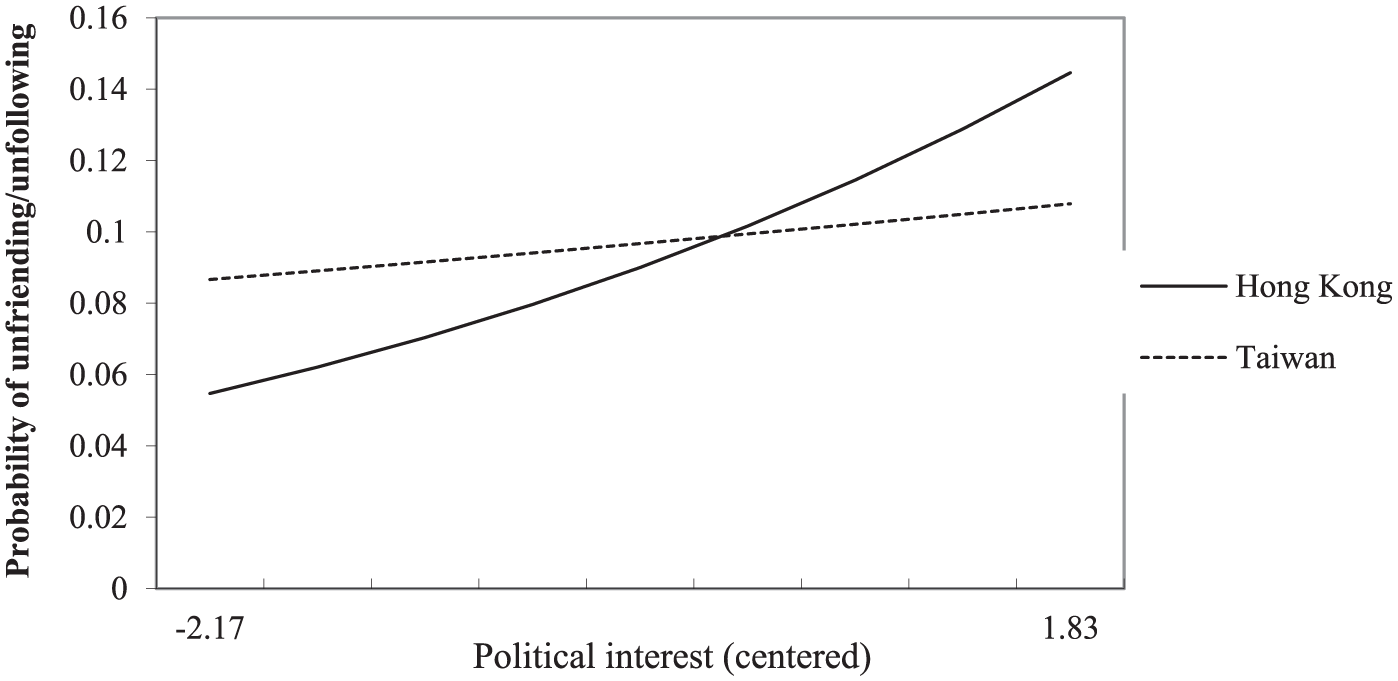
Two-way interaction effect for logistic regression (political interest × region).
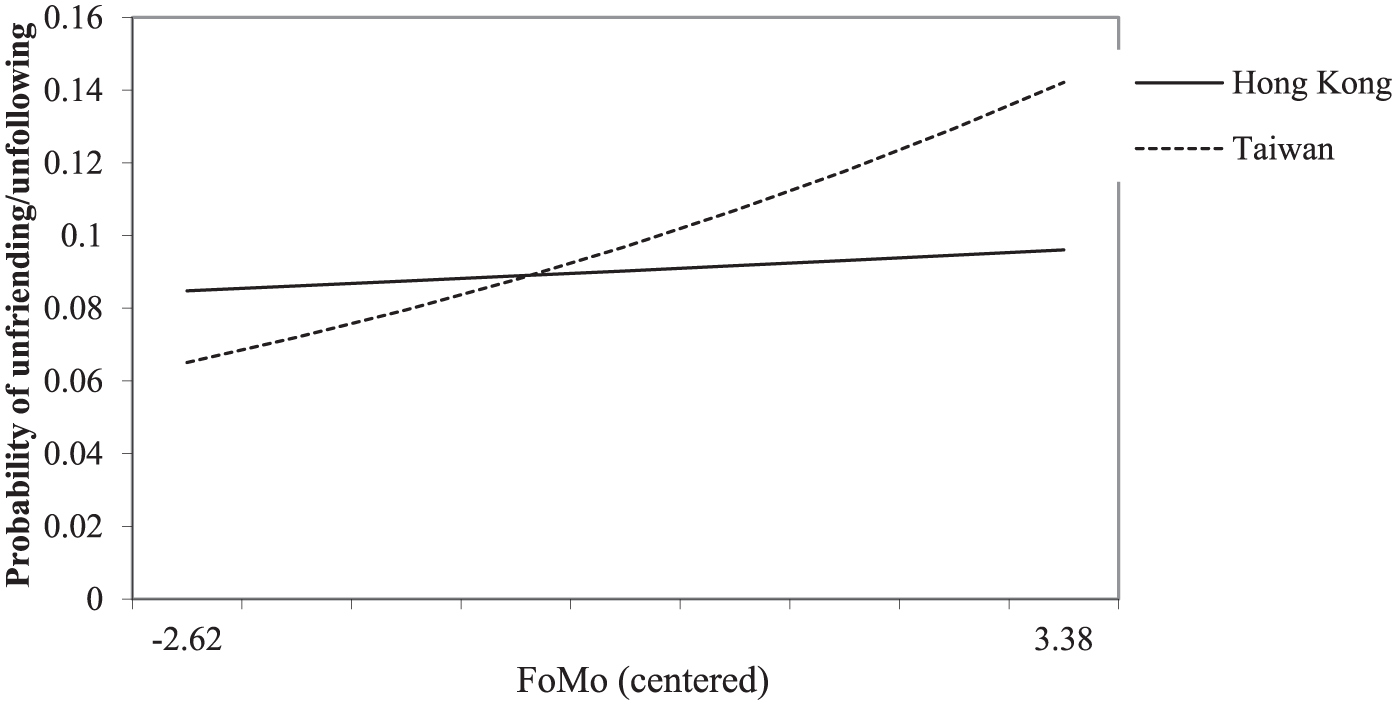
Two-way interaction effect for logistic regression (FoMO × region).
Discussion
The findings demonstrate significant differences in both the frequency as well as the predictors of selective avoidance between the two Asian societies, Hong Kong and Taiwan. While the difference in the rate of political unfriending and unfollowing is not large (around 2%), it is likely an indication of the greater need for post hoc filtration, given the larger discussion network size and more discussions with distant others in the case of Hong Kong citizens. Not surprisingly, the frequency of discussion with known others, while being higher in Taiwan than in Hong Kong, did not predict selective avoidance in either society. This is in line with previous research that shows that the “unfriended” tend to be weak ties (Rainie & Smith, 2012; Sibona, 2014), which in our case were likely coming from the ranks of strangers and people from different socioeconomic or racial groups.
Our study provides further evidence demonstrating that the sheer size of political discussion network size and discussion with distant others on social media are robust predictors of the likelihood of unfriending and unfollowing, irrespective of the cultural context, which is in line with Yang et al. (2017) who reported a similar finding regarding the number of social media contacts. The moderation analysis shows that the positive relationship between political interest and selective avoidance is substantially more pronounced in Hong Kong, whereas the psychological factor FoMO has significantly larger effect in Taiwan. This corresponds to the previous findings showing that political engagement through social media in Taiwan has a strong social element, while in Hong Kong it is more instrumentally political (M. Chan, Wu, Hao, Xi, & Jin, 2012; H. T. Chen et al., 2016). Therefore, psychological factors such as FoMo could further predict avoidance behavior because unfollowing/unfriending is the information management tactic that Taiwanese use to eliminate potential discomfort arising from online social interactions. In contrast, citizens in societies that are low in uncertainty avoidance, such as Hong Kong, are more flexible and open to ambiguity. Therefore, political variables become the salient factor predicting selective avoidance behaviors.
We argue that political unfriending and unfollowing in Hong Kong are indicative of political tribalism and a symptom of heightened affective polarization present in the current Hong Kong society. Affective polarization is followed by increasing hostility and declining trust toward political opponents, as well as greater social distance (Iyengar, Jackman, & Hahn, 2016; Iyengar & Westwood, 2015). As shown in the study of the Hong Kong Umbrella Movement, perceived out-group threat intensifies the positive relationship between political use of social media and politically motivated selective avoidance (Zhu et al., 2017). Moreover, selective avoidance creates an insular socioinformational environment and contributes to cyberbalkanization which may further reinforce polarization (C. H. Chan & Fu, 2015).
The results show that higher levels of collectivism are associated with lower rates of unfriending in both cultures. This is in line with the literature on collectivism, which argues that individuals strive to achieve group harmony rather than satisfy their own needs. Therefore, despite witnessing polarizing discussions and perceiving others as violating the norms of social interactions on social media (McLaughlin & Vitak, 2012), individuals endorsing collectivism may perceive these behaviors as tolerable inconveniences. Simply ignoring this information may be a strategy to keep peace with the members of the in-group. After all, unfriending signals the termination of relationships, which can be seen as undermining social harmony (McLaughlin & Vitak, 2012). In addition, such behavior may alert other members in the common network and cause awkward situations in subsequent interpersonal interactions. Therefore, individuals high in collectivism may adopt less drastic measures for dealing with dissonance on social media.
In contrast to collectivism, FoMO positively predicted selective avoidance on social media, particularly in Taiwan. This can be explained by the innate motivation of those who exhibit high FoMO to monitor all activities and discussed topics in their networks in order not to miss any potential social activities. However, these users also perceive greater social pressure and experience lower levels of psychological well-being resulting from their social interactions. This could explain the negative association between FoMO and unfriending behavior. It is likely that FoMO leads to greater exposure to difference on social media (as evidenced by a moderately high correlation in this study), which becomes a constant source of pressure for these users. Therefore, unlike collectivism, users high in FoMO may decide to pursue selective avoidance tactics to filter unfavorable content during the process of constantly searching for social information on others, particularly dissimilar others.
Limitations and Conclusion
The current study brings further evidence for the claim that “engagement with difference” on social media platforms may lead to post hoc filtration and dissolution of social ties. We also highlight rather different patterns of findings coming from two seemingly similar societies, Hong Kong and Taiwan. Interestingly, although political interest is a stronger predictor of unfriending in Hong Kong, social and psychological factors play a more important role in Taiwan. Since, IYang et al.’ (2017) study demonstrates that exposure to political disagreement may not be the reason behind unfriending, it is possible that unfriending mainly comes as a consequence of political engagement with distant others. Selective avoidance on social media may thus be less about filtering out dissonant political information, and more about avoiding strangers and distant others. Given that political polarization is increasingly taking an affective turn in which citizens openly dislike and even loathe their political opponents (Iyengar et al., 2016; Iyengar & Westwood, 2015), avoiding people rather than information on social media seems logical. This study, however, cannot resolve this issue fully, as our data does not contain identifying information on the “unfriended.” We therefore urge further research on this topic, focusing on the difference between mere exposure to disagreement versus engagement with difference, preferably utilizing both survey-based and behavioral trace data.
Footnotes
Declaration of Conflicting Interests
The author(s) declared no potential conflicts of interest with respect to the research, authorship, and/or publication of this article.
Funding
The author(s) disclosed receipt of the following financial support for the research, authorship, and/or publication of this article: This work was supported by the Strategic Research Grant from City University of Hong Kong and the Ministry of Science and Technology of Taiwan, Grant #103-2628-H-009-002-SS4.
