







Abstract
From a Canadian perspective, this article provides a comparative historical and contemporary overview of foundations in Canada, in relation to the United States and Germany. For the purposes of this analysis, the study was limited to public or private foundations in Canada, as defined by the Income Tax Act. As the Canadian foundation milieu straddles the welfare partnership model that characterizes German civil society and the Anglo-Saxon model of the United States, Canadian foundations as a whole have much in common with the foundation sector in both countries. Similarities include the number of foundations per capita, a similar range in size and influence, a comparable diversity of foundation types, and an explosion in the number of foundations in recent decades (although the United States has a much longer history of large foundations making high-impact interventions). This analysis also highlights some key differences among larger foundations in the three jurisdictions: German foundations are generally more apt to have a change-orientation and are more vigorous in their disbursement of income and assets. U.S. foundations are more likely to play a welfare-replacement role in lieu of inaction by the state. Canadian foundations play a complementary role, particularly in the areas of education and research, health, and social services. At the same time, there is a segment of Canadian foundations that are fostering innovation, social and policy change, and are embarking on meaningful partnerships and acts of reconciliation with Indigenous Peoples in Canada.
Keywords
Introduction: Defining the Scope of Comparative Analysis
From a Canadian perspective, this article undertakes a comparison of foundations in Canada, the United States, and Germany, three of the larger jurisdictions, globally, with a significant foundation sector. The analysis occurs in three broad contexts: a comparative historical evolution of foundations; a comparative demographic landscape, including regulatory regimes and classifications; and a description of the nature and role of community foundations. Even if the scholarly exploration of the nature and scope of foundation activities is in its infancy, the comparison of foundations in Canada with the United States and Germany is both timely and pertinent.
To date, Canadian scholars have undertaken preliminary work on the role of foundations across a number of fields. This exploratory research has investigated larger grantmaking foundations from both a comparative and peripheral perspective; an analysis of foundation operational demographics; case studies in collaboration and public policy engagement, and a broader ecosystem analysis of the role of foundations. 1 A recent 3-year research project (2014-2017), undertaking an exploration of social innovation, societal change, and Canadian grantmaking foundations was the first of its kind in Canada (PhiLab, 2017).
Because of the robustness of federal data with respect to charitable organizations, we have chosen to look only at the charitable subset of organizations in Canada that refer to themselves as “foundations”: Private and public foundations identified under the Income Tax Act. Private foundations include an informal subset commonly identified in the United States as “family foundations” (e.g., Donner Canadian Foundation, Weston Foundation), as well as most of the well-known corporate foundations (e.g., RBC Foundation, Suncor Energy Foundation). Public foundations include community foundations and other pooled philanthropic vessels such as local United Ways/Centraide, Tides Canada, and the Canadian Women’s Foundation. It is worth noting, however, that many other types of entities refer to themselves as “foundations,” but are not captured under this analysis. 2
Although it would seem on the surface that private foundations are the manifestation of private wealth for public benefit; while public foundations (including community foundations) are the manifestation of public wealth for a collective benefit, in reality the distinctions between public and private foundations are increasingly minute and arcane for three reasons. First, community foundations are engaged as private fund administrators, managing directed funds for a donor-designated public purpose. Second, both are commonly engaged in responsive grantmaking, as distinct from self-directed charitable activity, funding external applications or appeals for support; and third, both public and private foundations are primarily place-based in their practices (Community Foundations of Canada, 2015; Philanthropic Foundations Canada, 2015; The Circle on Philanthropy and Aborginal Peoples in Canada, 2012).
There are roughly an equal number of private and public foundations in Canada (see Figure 1). They and are distinguished from each other by their source of capital and their governance structure (Imagine Canada & Philanthropic Foundations Canada, 2014). One source (Arlett, 2014), puts the percentage of family [private] foundations at 86% of all private foundations, which would be consistent with the pattern of individual and family wealth creation in Canada. Both public and private foundations carry out their own charitable activities and/or disburses funds to qualified donees (e.g., registered charities) to an annual quota of at least 3.5% of capital assets (Canada Revenue Agency, 2017; Hoffstein & Man, 2007). In the United States, the disbursement quota is 5% of market value of assets (Lajevardi, Rigillo, Rabinowitz-Bussell, & Stauch, 2015). There is no disbursement quota in Germany, but foundations are required to spend all investment income within a 2-year period unless established to build a reserve (Stolte, 2014).
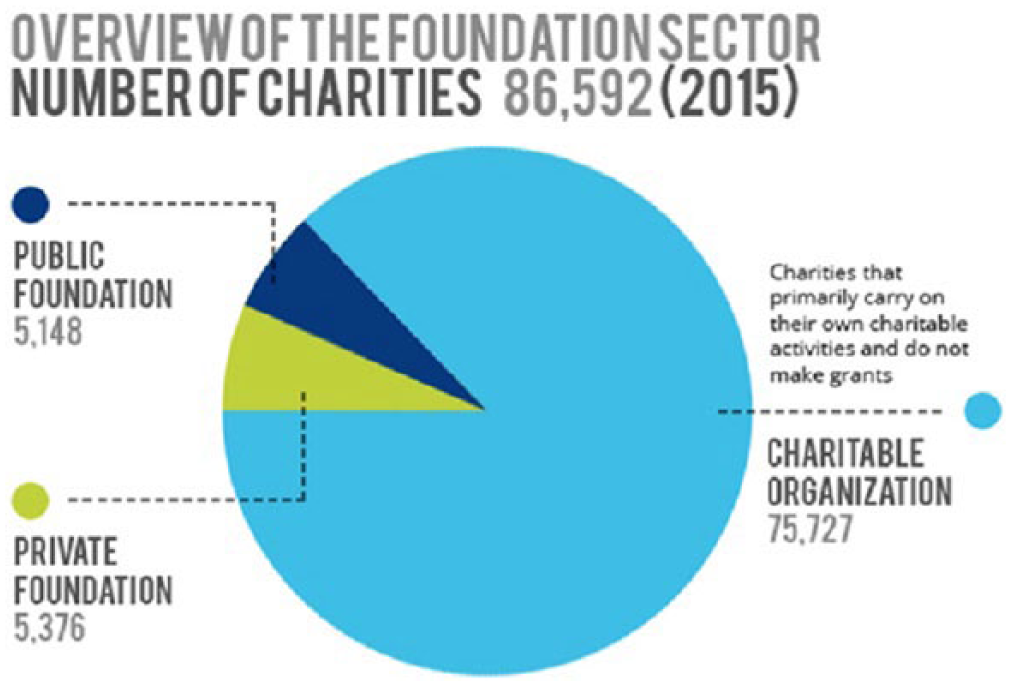
Overview of the Canadian foundation sector.
From a governance perspective, private foundations in Canada may have 50% or more of its governing officials who are related to each other. Public foundations must have more than 50% of its governing officials who are unrelated to each another. Private foundations receive the majority of its funding from a source that is represented on the foundation board, while the opposite is true for public foundations (Canada Revenue Agency, 2018). No such requirements for foundations regarding the number or type of board members exists in Germany (Stolte, 2014).
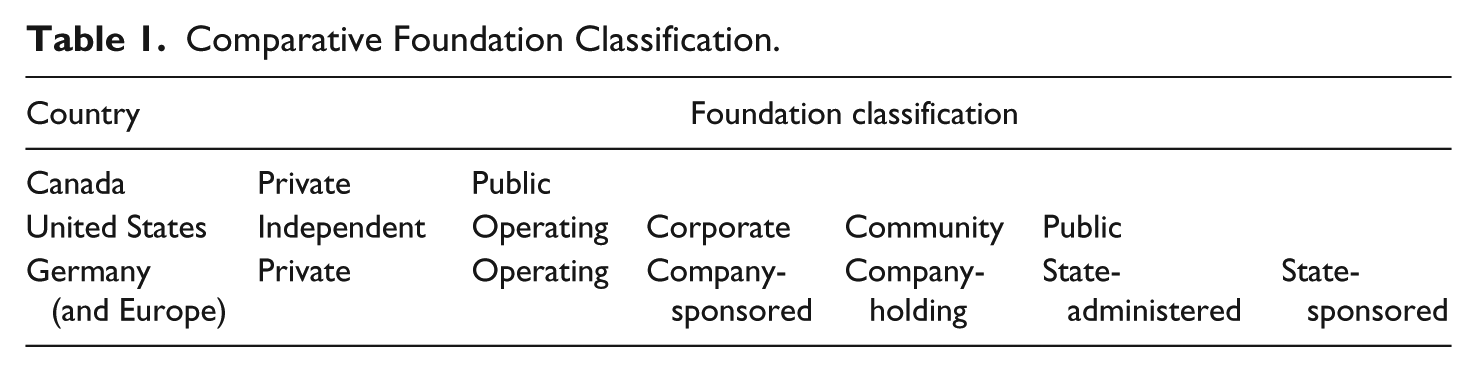
The United States has a number of classifications of foundations, including independent foundations, operating foundations, corporate foundations, community foundations, and public foundations (Toepler, 2016). Germany (see Table 1), has a much more varied and liberal classification system, including foundations that would fall under similar categories as Canada and the United States, but extending to include company holding, state-administered and state-sponsored foundations (Toepler, 2016).
Comparative Foundation Classification.
At the heart of understanding what constitutes a foundation in Canada is the concept of raising capital for charitable purposes. This mobilization of capital is initiated through a primary endowment (legacy), a collection of endowments bequeathed by patrons, or through an annualized collection of individual and/or corporate donations. Once the pool of funds is established, the organizational structure takes the form of either a private or a public (e.g., community) foundation. Public foundations, unlike private foundations, are not created by a family legacy or a private corporation, and this creates a number of advantages and disadvantages.
Public foundations have a more diversified governance structure in terms of representativeness and a higher spending obligation than private foundations. Public foundations are responsive to and a reflection of a wide range of community interests. Having to carry out an annual fundraising campaign or provide fee-for-service activities to renew their pool of funds is a distinctive feature of public foundations. This has implications for how public foundations engage in public policy. As public foundations are more dependent than private foundations on the impact of their public image, they tend to avoid political bias or controversial funding choices that could hinder their fundraising efforts.
These two realities—private and public foundations in Canada—have resulted in the formation of major intermediary organizations that have developed specific policy and education programs and are organized into resource networks to support their development. For example, two national networks Community Foundations of Canada for community foundations and Philanthropic Foundations Canada for private foundations were founded in 1999 and 1992, respectively, for just this purpose (Community Foundations of Canada, 2017a; Philanthropic Foundations Canada, 2017).
Of course, foundations can be classified by purpose, assuming that registration and reporting data provides this opportunity. At this time, there is no clear way to classify foundations in Canada by their approach and roles, that is, operating or mixed, or relief, change or protection as this is not a registration or reporting requirement. However, foundations in Canada do have to declare a specific public purpose under which they will operate, corresponding to four pillars of charitable purposes: education, religion, welfare and other public benefits (see Figure 2).
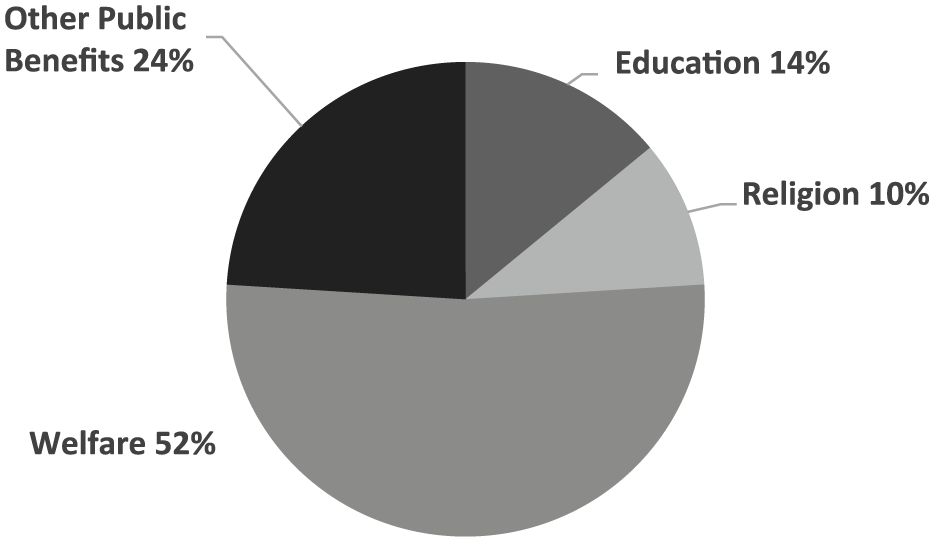
Distribution of Canadian foundations within charitable purpose categories (%).
Within Anheier’s Foundation Triangle (Anheier, 2018, Figure 2, p. 1595), there is no statistical data to date that would differentiate among innovation, complementary, substitution, and build-out activities/roles. However, there has been some analysis on the extent to which foundations approach their activities as an operating, grantmaking or mixed/hybrid foundation. According to Lefèvre and Khovrenkov (2017), 66% of Canadian foundations (i.e., public + private) are hybrids, 17% are operational, and 17% are solely subsidizing or grantmaking.
In keeping with the Foundation Triangle, donations made by Canadian foundations are mostly donations related to relief activities (welfare) and minority donations focused on the transformation of institutional or organizational systems (Philanthropic Foundations Canada, 2016c). Very few foundations aim at transformations of the whole societal system (in connection with radical breakthrough innovations; Elson & Hall, 2017). The distinction between relief and protection is not so clearly defined in Canada, although we can classify under the heading of protection the foundations that intervene on environmental issues (including the protection of the environment) or the foundations that are engaged in the “political” defense of social groups (demands for social justice to represent the interests of these groups). We can easily distinguish two dominant groups of practices: relief (majority) and social change (minority), on the one hand, and, on the other hand, protection (in connection with environmental justice) and representation (in link with the issue of social and cultural rights).
On the four categories composing the lower part of the Foundation Triangle—namely innovation, complementarity, substitution, and build-out—we have observed the following in Canada: First, these four categories come together as follows: Innovation and Build-out form a first set, whereas Complement and Substitution form a second set. Second, there appears to be a consensus among grantmaking foundations, namely to be complementary to actions that are the responsibility of the State, the Market, and civil society organizations. The idea of substitution is not highly valued. When foundations are brought in, in spite of themselves to take actions that represent a “substitution,” they do so either to explore and experiment in order to demonstrate the relevance, effectiveness, and efficiency of good social practices, or to overcome a short-term urgent need, especially in the context of sever or sudden budget cuts. In both cases, such interventions are considered temporary (in the short and medium term) and influential actions are carried out (advocacy) so that the actors concerned recommit themselves to their respective responsibilities (Berthiaume & Lefèvre, 2017).
In this work of complementarity and exploration/experimentation (nonsubstitution), various types of actions are mobilized, but focus is on innovation and, more rarely, build-out. The innovation repertoire mainly explores social, organizational, strategic innovations, and sometimes sociotechnical innovations. Build-out, such as it is, it is mainly oriented toward capacity building rather than scaling. This is a reflection of the place-based orientation of most Canadian foundations, their relatively small size and Canada’s large land mass and population disbursement.
Data Availability
Despite the dearth of scholarship on Canadian foundations, Canada enjoys one of the most comprehensive databases of information on charities in the world, including public and private foundations. This database 3 is populated by the statutory requirement of all charities, regardless of size or type, to file annual returns (T3010) with the federal government (Canada Revenue Agency, 2002, 2016). The database includes information on purpose designation, board composition, fundraising, program and funding activities in Canada and internationally, administrative costs, and political activities. While this database is a genuine asset, and will only improve as an online filing system is introduced, studies exploring this database are few and far between (Khovrenkov, 2016). While there are limitations in the T3010 as a self-reporting database with partial monitoring, some meaningful comparisons among Canada, the United States, and Germany can be made.
Comparative Beginnings
The structured and institutionalized form of modern foundations in Canada is relatively new, emerging in the early 1900s and only requiring centralized registration in 1967 (Elson, 2011; Lefèvre & Rigillo, 2017). However, it would be a disservice to the history of Canada to say that this was the beginning of foundations, in the sense that foundations are only one means, other than through taxes and private donations, to redistribute accumulated wealth with the intention of achieving a public (i.e., societal) benefit (Sulek, 2010). Predating colonial foundations in Canada by thousands of years, are the sacred and holistic nature of Indigenous forms of giving and receiving. Whether it is a “Giveaway” at a powwow, the day-to-day sharing of food, or a Potlatch ceremony, the sacred nature and collective community benefit of giving and receiving through prescribed protocols continues to take place in Indigenous communities across Canada and the United States (Bruchac, 2016; The Circle on Philanthropy and Aborginal Peoples in Canada 2012).
Germany too has a long history of foundations that predate those in either Canada or the United States. Germany has a tumultuous history that saw foundations flourish from the mediaeval period up to World War I, growth that was a reflection of wealth created by industrialization, like Canada and the United States, only to be decimated by hyperinflation, Nazi persecution, and communism in the decades following World War I. It was only after German reunification in 1989 that most (i.e., 70%) of the country’s current foundations were established (Adam & Lingelbach, 2015; Anheier et al., 2015).
It would also be a disservice to profile the emergence of foundations in Canada as independent from either its historic geopolitical position as a colony of Great Britain or as a neighbor to the United States. In the early 1900s, as Lefèvre and Rigillo point out, 25% of Canada’s domestic capital was in foreign hands, particularly British. This is in sharp contrast to the United States where it never exceeded 5% (Lefèvre & Rigillo, 2017). In Canada, only two foundations were founded in the three decades following the establishment of the Massey Foundation in 1918. The Massey Foundation was the first charitable trust established in Canada. It was established with a majority of the estate of Hart Massey, son of the founder of the Massey farm equipment company. The foundation supported a number of arts and educational initiatives, including Massey College at the University of Toronto (“Massey,” n.d.). During this same time, some foundations in the United States grew both large and powerful, the Rockefeller and Carnegie foundations notable among them. These two foundations donated a total of $18.9 million to Canadian universities, museums, and libraries between 1911 and 1950 (Brison, 2014). Aside from his native Scotland, the one country outside the United States that Andrew Carnegie chose to establish libraries was Canada.
Many of the powerful American foundations also had both cross-over familial and employee ties to Canada (Fong, 2008). The Montréal-based McConnell Foundation, established in 1937, and inspired by these large American foundations, was for many decades a rare example of a Canadian foundation making often transformative investments in health, education, and the arts on a scale that approached that of the large U.S. foundations (Lefèvre & Rigillo, 2017).
Historically, private foundations in Canada have reflected the particular religious or ideological philosophy of the founder, which often expressed itself in sharp contrast to the focus or ethos of the company from which that wealth was created and derived (Martin, 1985). This contrasts with the analysis of foundations in Germany where there is evidence of direct corporate control of foundations (Anheier et al., in this issue). The one exception to this is the subclass of private foundations 4 colloquially referred to as “corporate foundations,” where their interests align with, in some measure, those of the namesake/partner company. As such, they can be viewed at times, as noted in the profile on Germany (Anheier et al., in this issue), as serving a quasicorporate agenda.
While the scale of foundations in Canada, in absolute numbers, is significantly different from the United States, Canadian foundations, and the regulations governing them have both copied and differentiated themselves from the development of foundations in the United States. If one common thread can be drawn across foundations in Canada, the United States, and Germany, it is their contribution to education and research, health, and social services (Anheier et al., 2015; Hammack & Smith, this issue; Imagine Canada & Philanthropic Foundations Canada, 2014). There are, however, two distinguishing features of contemporary Canadian foundations. The first is foundation engagement with Indigenous Peoples in Canada. The second is the growing presence and strength of community foundations.
Foundations and Indigenous Peoples in Canada
If there is one distinguishing feature of Canadian foundations in our view, it would be their current—and, it must be said, very recent and nascent—engagement with Indigenous Peoples in Canada. A number of events have occurred that have brought the historical and current abuse and cultural genocide suffered by Indigenous Peoples to the fore. These events include the report of the Royal Commission on Aboriginal Peoples, the Truth and Reconciliation Commission, followed by formal apologies for the culturally genocidal residential schools program, and ongoing health, educational, and economic disparities (Dussault & Erasmus, 1996; Harper, 2008; Trudeau, 2017; Truth and Reconciliation Commission of Canada, 2015). Foundations, educational institutions, civil rights groups, and the nonprofit sector as a whole are taking steps to understand and to work to build a new relationship with Indigenous People (Calgary Chamber of Voluntary Organizations, 2017; Universities Canada, 2015).
Philanthropic Foundations Canada and Community Foundations of Canada, which now include Indigenous content, participation, and protocols in their gatherings, joined many other public and private foundations across Canada to come together in the wake of Truth and Reconciliation of Canada events to sign a Declaration of Action toward the shared goal of Reconciliation in 2016 (Community Foundations of Canada, 2017b; Philanthropic Foundations Canada, 2016b; The Circle on Philanthropy and Aboriginal Peoples in Canada, 2016). At this point, the visibility attributed to these announcements has yet to match the level of funding commitments, although that too is changing (Galloway, 2017). The level of funding to Aboriginal groups by foundations remains quite low, and only 1% of foundations can be classified as active Aboriginal funders (Gravelle & Struthers, 2014; Rigillo, 2016).
Numerous national, provincial, and local initiatives are underway and foundations are making their own significant contribution (“Reconciliation Canada,” 2017). These collaborative initiatives are working to educate, understand, and act with Indigenous Peoples in a way that may help repair, if not remediate, Canada’s colonial living legacy (Lacerte & Lacerte, 2017). Canadian foundations are but one of many change agents in this process, including Canada’s federal government, but if foundations stay the course, it could change not only the landscape of Indigenous relations in Canada but also the landscape of Canadian foundations.
The potential impact of this shift to recincile colonial practices could have profound implications for how we think about the public good, and at minimum charitable activity, in Canada. On one hand, there is cautious optimism that long-standing and embedded colonial practices may change. On the other hand, a fear that this may be one more incidence where Indigenous issues, including land reclamation and treaty rights, are initially highlighted and then marginalized, both financially and politically (Indigenous and Northern Affairs Canada, 2015; Truth and Reconciliation Commission of Canada, 2015). As stated by Philanthropic Foundations Canada (2016a), “Reconciliation is not an Indigenous issue, it is a Canadian issue” (para 1). Only time will tell if this is indeed becomes the case. For now, however, there are Canadian foundations that are taking steps to start what will undoubtedly be a long and challenging process (Rigillo, 2016).
In comparison, the United States has two foundation affinity groups that have formed around Indigenous issues—Native Americans in Philanthropy (2017), focused domestically, and International Funders for Indigenous Peoples (2017), that have an international focus. 5 In this regard, the German government, rather than foundations, appear have taken the lead on support for the United Nations Declaration on the Rights of Indigenous Peoples (Federal Ministry for Economic Cooperation and Development, 2013).
Community Foundations
Community foundations are a distinct form of private, family foundations in two ways. First, community foundations derive their funds from multiple sources, including individuals, corporations, governments, and private foundations. Second, their mandate is focused on specific place-based grantmaking (Phillips et al., 2011).
The community foundation movement started in Cleveland, United States, in 1914 by banker, attorney, and philanthropist, Frederick H. Goff, for the purpose of pooling charitable gifts of its citizens into a single, permanent trust to be administered for the betterment of their city (Community Foundation Atlas, 2017a). This movement has since grown to 1,858 foundations in 71 countries, including Canada and Germany, with total annual grants in the order of US$5 billion and combined reserves of US$63.3 billion (Community Foundation Atlas, 2017b). Their growth has been significant. Indeed, 70% of community foundations have been established over the past 25 years. Community foundations, through volunteer citizen committees, tend to allocate grants to Education (15.1%), human and social services (12.8%), arts and culture (12.5%), health (11.1%), and environment (9.6%; Community Foundation Atlas, 2017b).
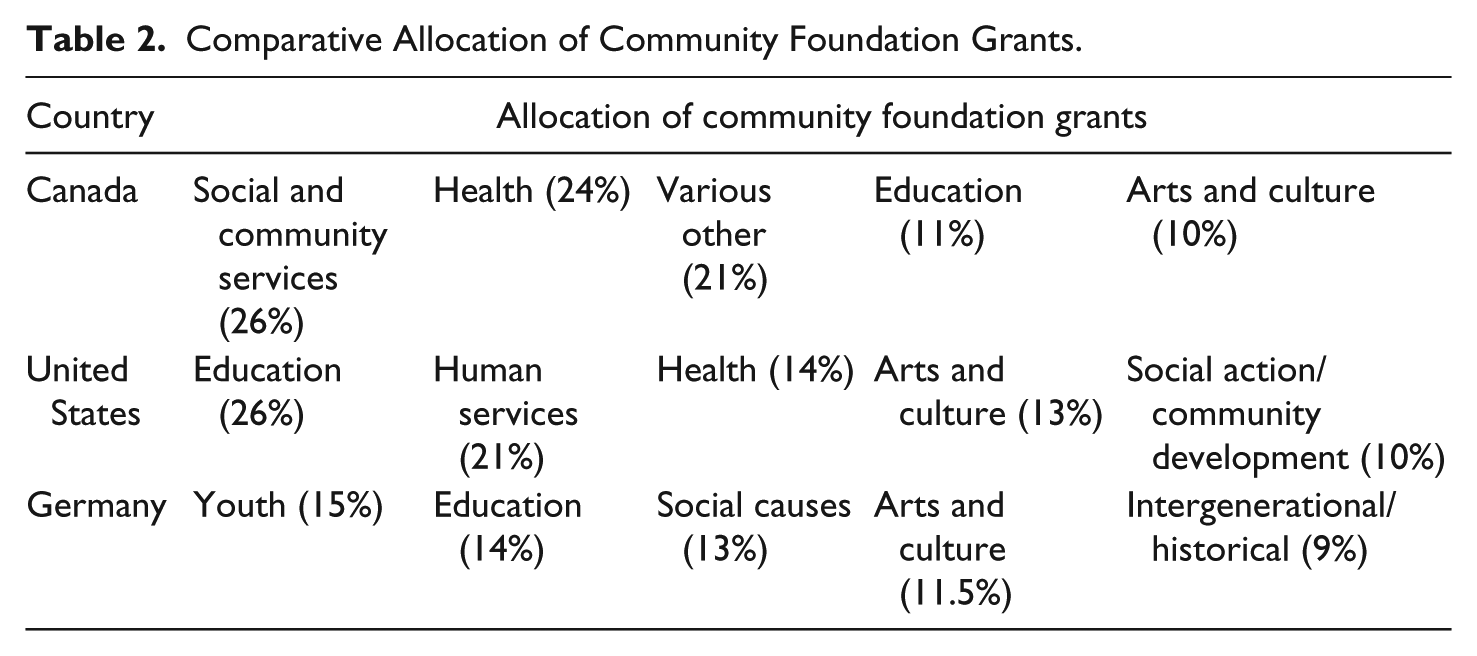
In Canada, the first foundation, the Winnipeg Foundation, was founded in 1921 by William Alloway, another prominent banker (Community Foundation Atlas, 2014; Community Foundations of Canada, 2017b; The Winnipeg Foundation, 2017). The 191 community foundations in Canada are specific “placed-based” foundations that solicit funds across their communities for broad community-based and community-led initiatives, while also acting as an administrator for directed funds (Community Foundations of Canada, 2014, 2015). Indeed, 85% of Canadian communities now have access to a community foundation (Community Foundations of Canada, 2015). In 2015, community foundations grants in Canada went to social and community services (26%), health (24%), various other community initiatives (21%), education (11%), and arts and culture (10%; Community Foundations of Canada, 2015; see Table 2).
Comparative Allocation of Community Foundation Grants.
Community foundations are a unique phenomenon within the foundation world. Unlike private foundations with an asset base of individual or family accumulation of wealth, community foundations attempt, to varying degrees, to serve as a collective trust for citizens to invest in and improve the collective well-being of their communities. As such, community foundations—in principle at least—provide an opportunity for all citizens to invest in their collective commons. Community foundations also function as an appealing option to high net worth individuals to setting up a private foundation, due to (a) their robust investment stewardship and oversight and (b) the savings that accrue from a pooled investment. Donors may still prefer to retain discretion over their fund. In fact, the majority of most community foundation’s funds are not disbursed at the discretion of the collective, but rather at the donor’s discretion. Only 20% of assets, on average, held by community foundations in Canada are unrestricted, that is, to be used at the discretion of the foundation, while on average 34% of community foundation assets are donor-advised funds, going to a charitable cause or activity designated by the donor, not the foundation (Community Foundations of Canada, 2015).
The reality in Canada is that the funding priority profile of private and community foundations are quite similar and with limited funds, community foundations too develop specific funding schemes to assist particular groups within a given community (Community Foundations of Canada, 2015; Imagine Canada & Philanthropic Foundations Canada, 2014). Private foundations in Canada also tend to be place-based 6 (e.g., 78% in 2011), and while some larger private foundations are space-based. That is, address issues that extend well beyond their geographical catchment area, this exception tends to be displayed by large foundations who have self-identified a broad national mandate for their activities (Imagine Canada & Philanthropic Foundations Canada, 2014; Philanthropic Foundations Canada, 2016c).
In the United States, there are now 789 community foundations with US$64.9 billion in assets (Foundation Center, 2014a). The most recent profile of U.S. community foundations reports a pattern of grant allocation to education (26%), human services (21%), health (14%), arts and culture (13%), and social action/community development (10%; Foundation Centre, 2012).
In Germany, community foundations are a relatively recent phenomenon, but they have grown rapidly to the current level of at least 348 community foundations. Community foundations are seen as a break from the tradition of the German welfare state provision and the principle of subsidiarity (Küstermann, Rummel, & Schwärzel, 2016). Community trusts in Germany were established in the 1996, also imported from the United States, and built on an earlier German tradition of operating foundations and raising funds for endowments and project support (Hellmann & Nährlich, 2013; Keller, 2015).
These community foundations blend the tradition of German foundations and donating with mobilizing and allowing for active civic commitment (Küstermann et al., 2016). Support by community foundations in Germany (2015) went to youth (15%), education (14%), social causes (13%), and arts and culture (11.5%). Of interest is that there were significant funds also allocated to cross-generational initiatives, international understanding, and heritage and history preservation (Küstermann et al., 2016). These community foundation priorities reflect clear similarities with Canada and the United States, but they also reflect the current needs of youth and intergenerational issues; the influx of refugees; and the long-standing commitment to heritage preservation (Küstermann et al., 2016).
Comparative Regulatory Regimes
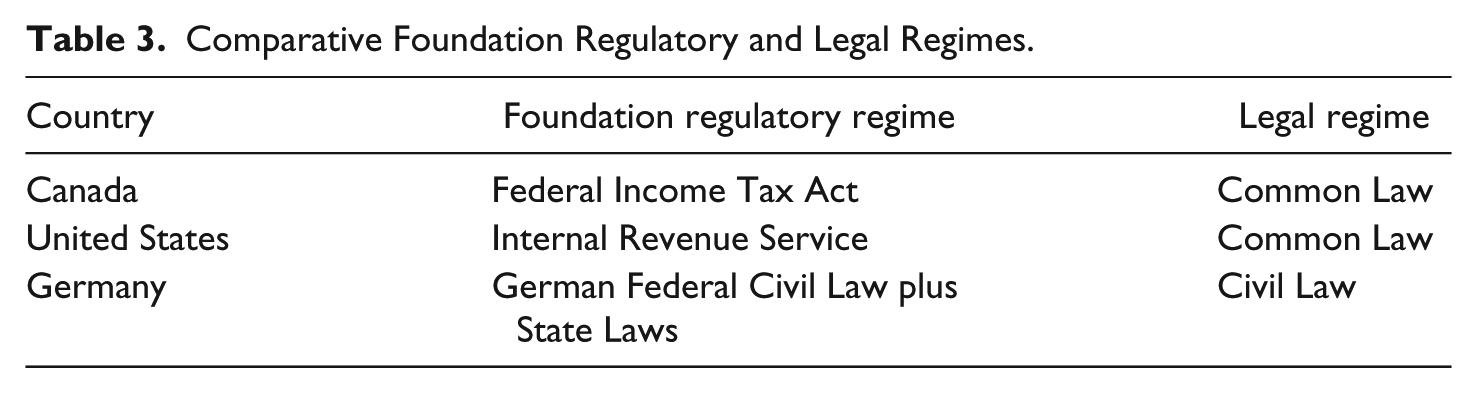
The regulation of private and public foundations in Canada is taxed-based, governed by Section 149.1 of the Income Tax Act (Canada Revenue Agency, 2002; Chan, 2016). The designation “foundation” has no statutory standing as a form of incorporation, other than as designated in this Act (see Table 3). The designation, registration, oversight, enforcement provisions, and reporting requirements is administered by the federal government through the Canada Revenue Agency, even though provinces have the constitutional authority to administer charities (Elson, 2011). A similar oversight body exists in the United States through the Internal Revenue Service and 501(c) of the Tax Code. In Germany, foundations can be established at a State or Federal level and under the Civil Law, for any legal purpose, public or private. The only constraint in Germany is that a foundation cannot be set up to have the founder as the sole beneficiary. Tax exempt foundations do have to have a public benefit (Council on Foundations, 2016). The Civil Law in Germany, as distinct from Common Law, which is applied to Canada and the United States, among others, is based on the contextual application of principles and not legal precedents, which is the case with Common Law (Chan, 2016; Council on Foundations, 2016).
Comparative Foundation Regulatory and Legal Regimes.
Comparative Foundation Growth
Most recently, Canada has seen a modest yet steady growth in the number of foundations, increasing from 9,046 in 2006 to 10,664 in 2016, with an average growth of about 150 foundations per year and an overall percentage growth of 16% between 2006 and 2014 (personal communication, Canada Revenue Agency). This pales in scale in comparison with the United States (86,726 foundations) and the more than 21,000 in Germany (Bundesverband Deutscher Stifungen, 2016; Foundation Center, 2014b).
When mapping the growth of foundations by number over the same period (2006-2014), Canada’s growth rate of 16% is below that of the United States (19.7%) and Germany (44%; see Figure 3). If there is a silver lining to this cloud, on a per capita basis, Canada has a higher rating (2.91 foundations per capita) than either the United States or Germany (both have 2.64 foundations per capita).
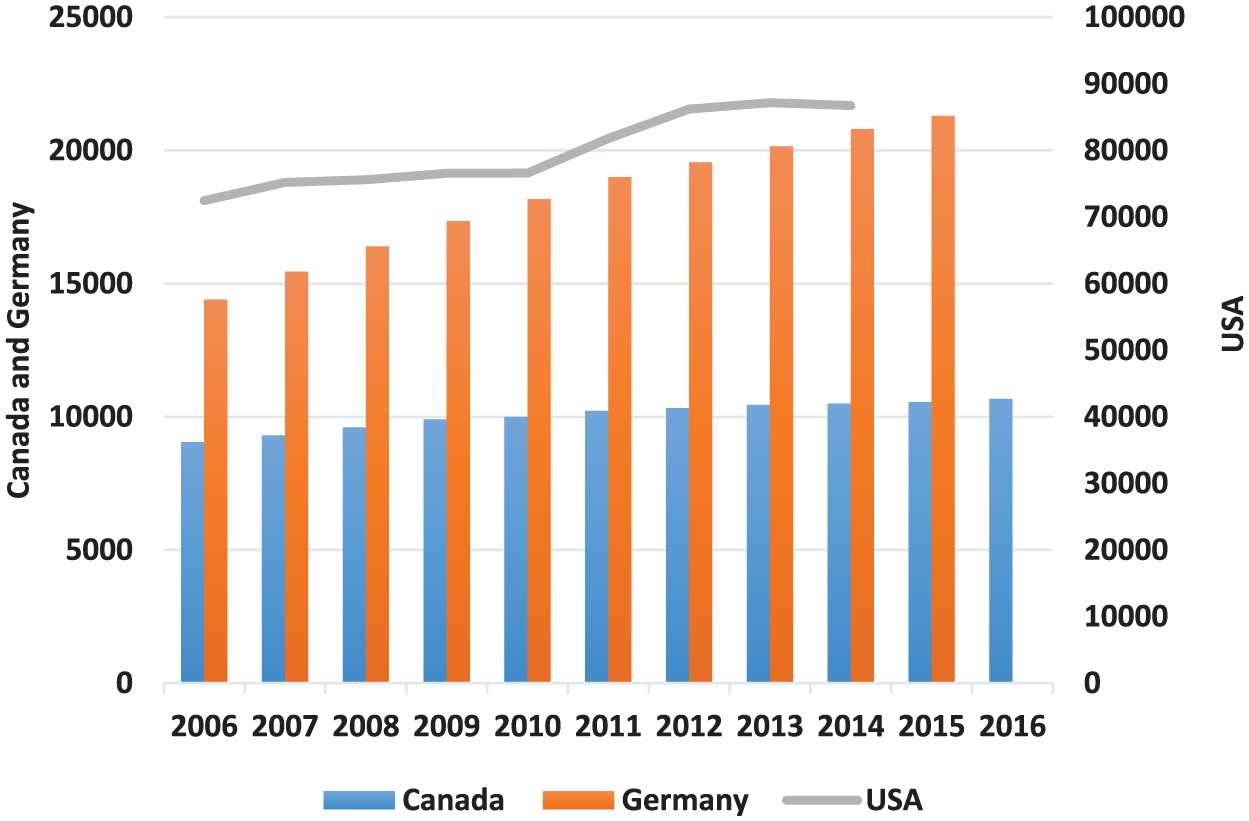
Comparative growth of foundations in Canada, United States, and Germany (number).
Comparative Foundation Assets
Canadian assets for public and private foundations are in the order of CAD$55.7 billion (personal correspondence, Canada Revenue Agency). More recent analysis (2015 data) has revealed that there are 10 very large foundations in Canada, with assets in excess of CAD$500 million that account for 30% of total foundation assets (personal communication, Canada Revenue Agency). This finding is parallel to the profile of foundations in the United States, where the top 50 of 86,726 foundations in that country account for 29% of total foundation assets and 19% of gifts to charities.
Iryna Khovrenkov, who has conducted the most recent comprehensive statistical analyses of foundations in Canada, first revealed the considerable disparity in the influence of a small number of larger foundations on the resourcing of charitable activity. Her profile of 2008 T3010 data revealed that small and medium foundations (73.2% of the total number of foundations) account for 4.03% of total assets and 10% of gifts to charities and that the top 0.5% of foundations account for 32% of total assets and 21% of all gifts to charities (see Table 4). This disparity has continued to climb with 2014 T3010 data revealing that the 10 largest foundations (0.1% of foundations) in Canada account for 30% of all foundation assets (Khovrenkov 2016). The Mastercard Foundation leads the pack at almost CAD$10 billion or 17.5% of all foundation assets (Philanthropic Foundations Canada, 2016c).
Canadian Foundations by Asset Size (2002-2008).
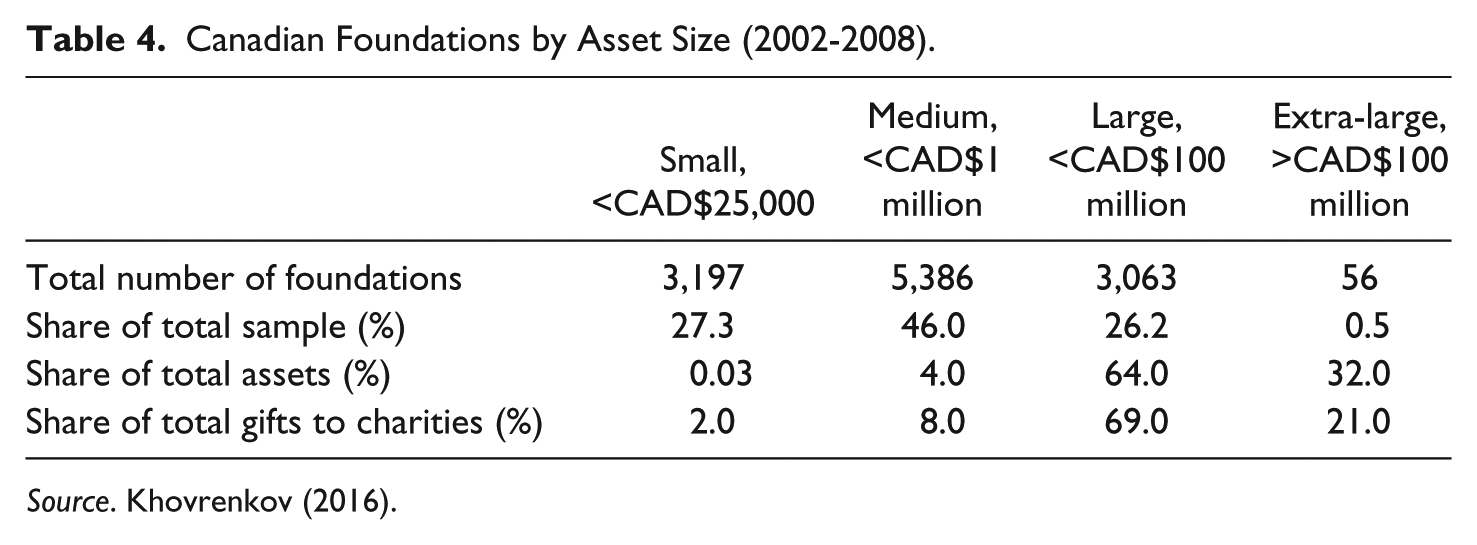
Source. Khovrenkov (2016).
Germany is also remarkably similar to Canada. In Germany, 22.83% of foundations can be considered small (<€100,000); 44.33% are medium (<€1 million); 24.2% are large (<€100) and 1.72% fall into the extra-large foundations (>€100 million; Anheier et al., 2015). The asset distribution of foundation assets in the United States are similar, as profiled in Table 5; but certainly at a higher order of magnitude in the United States with 50 of the largest foundations having assets in excess of US$1.8 billion (Foundation Center, 2014b).
Comparative Foundation Asset Distribution.
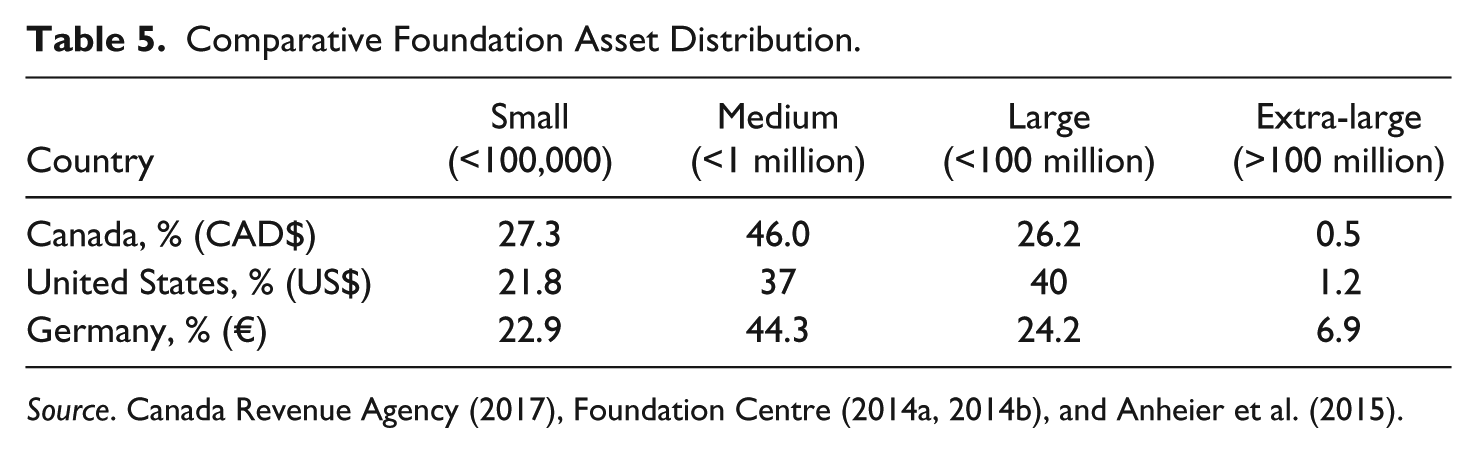
Source. Canada Revenue Agency (2017), Foundation Centre (2014a, 2014b), and Anheier et al. (2015).
In Germany, which has the largest number of foundations in Europe, the average asset value held by a foundation in Germany (€3.7 million) is pushed higher by very large foundations (e.g., Robert Bosch Foundation with assets of €5 billion), the sector is dominated by foundations with asset values in the small and medium brackets: almost three quarters of German foundations have an endowment of less than €1 million, and 28% hold no more than €100,000 (Observatoire de la Fondation de France & Centre d’Étude et de Recherche sur la Philanthropie, 2015).
Comparative Disbursements and Vitality Indexes
Not all foundations disburse funds to qualified donees, but those that do provide a remarkably similar pattern for their funding priorities (see Table 6). Education, health, social services, and arts and culture are common across all three countries. German foundations account for one third of total foundation spending in Europe. In Germany, a unique church tax (the Kirchensteuer) is added to any income tax due at the rate of 8% to 9% and this tax has had a negative impact on the overall rate of individual giving, as many view this tax as a form of donating (Observatoire de la Fondation de France & Centre d’Étude et de Recherche sur la Philanthropie, 2015).
Comparative Foundation Funding Preferences.
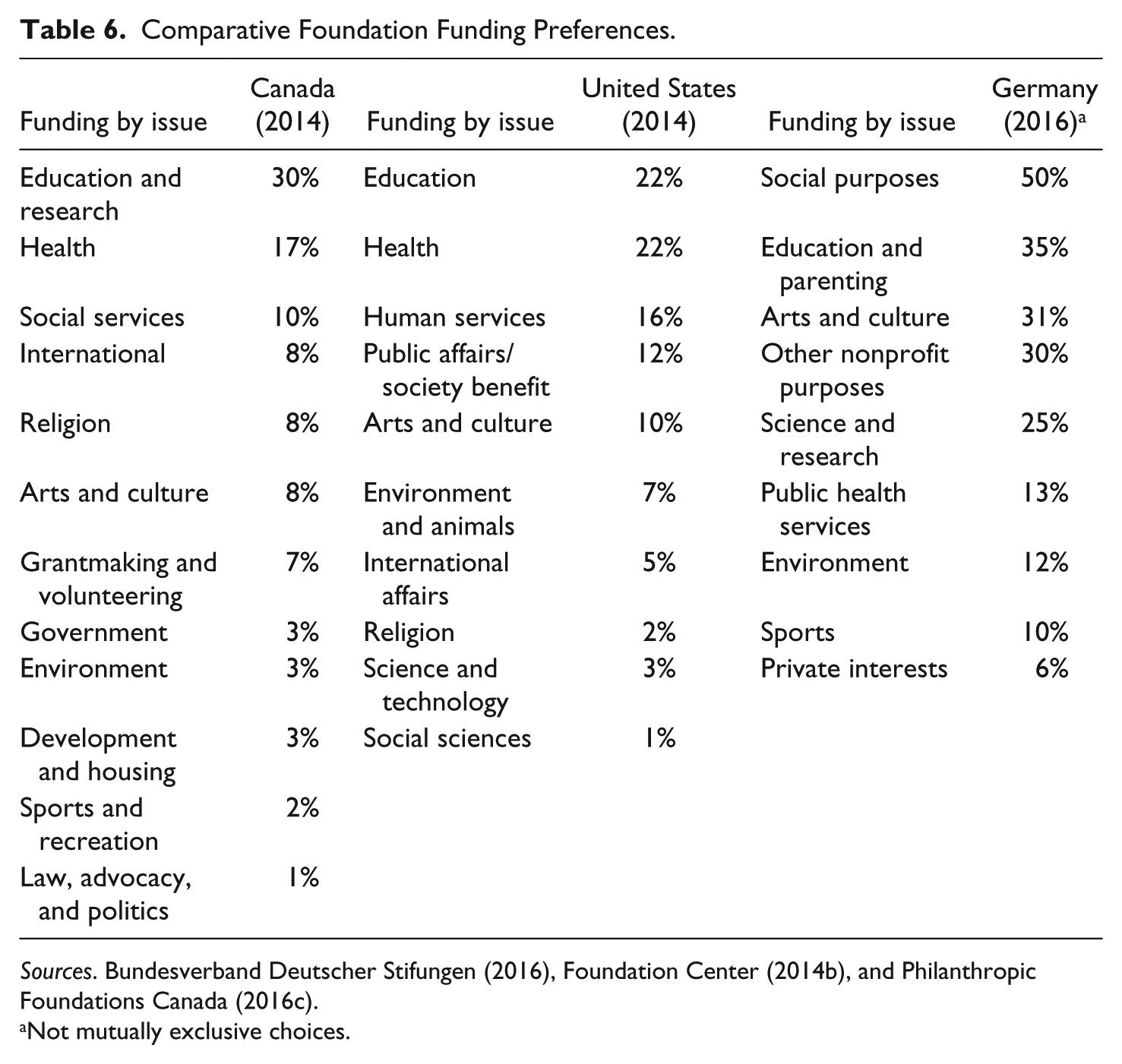
Sources. Bundesverband Deutscher Stifungen (2016), Foundation Center (2014b), and Philanthropic Foundations Canada (2016c).
Not mutually exclusive choices.
One of the controversial aspects of foundations is their ability to build endowments, typically in perpetuity, while enjoying low disbursement quotas, particularly in Canada. The Canadian quota requires private foundations to disburse a mere 3.5% of their assets annually, and public foundations are required to disburse 50% of annual donations. The U.S. disbursement quota is 5% of assets (Hoffstein & Man, 2007; Lajevardi et al., 2015). Germany has no such quota, although they are subject to the Gebot der zeitnahen Ertragsverwendung or a timely use of proceeds, that being interest and dividend income, but not capital gains, less a one third holdback of net income to preserve the endowment (Toepler, 2004).
The vitality of a foundation’s annual output (overall investment in the community) relative to its asset base can in a very general way be extrapolated: What is known as the “vitality index” or the spending/asset ratio is a healthy 24% in Germany (it is an average of 12% across Europe), but only 7% in the United States (Fondation de France, 2015; Observatoire de la Fondation de France & Centre d’Étude et de Recherche sur la Philanthropie, 2015). This breaks down to a vitality index of 7.5% for community foundations in the United States and 6% for private foundations (Foundation Center, 2014b). In Canada, the vitality index is 14% (2014 figures) for public foundations and only 6% for private foundations (Philanthropic Foundations Canada, 2016c).
According to the Observatoire de la Fondation de France and Centre d’Étude et de Recherche sur la Philanthropie (2015), the lower vitality of American foundations can be explained by the marked predominance of independent foundations set up by individuals and families. Accounting for more than 90% of all American foundations, these individual and family foundations have a much lower expenditure-to-assets ratio than other categories of foundation (especially corporate foundations, which spend the equivalent of 24% of their assets). Primarily, the result of a strategy to capitalize personal and family wealth, American foundations therefore spend a relatively low proportion of their assets, and this ratio would in all likelihood be even smaller if independent foundations were not required by law to spend at least 5% of their capital each year. This capitalization trend appears to be echoed in Canada. The much higher ratio for public foundations can be largely explained by the use of nonendowed flow-through funds generated by community campaigns (e.g., United Way), community foundations and foundations dedicated to raising funds for universities, hospitals, and other large charities.
This vitality also extends to the public policy realm. In Germany, foundations have a long and undisputed history of public policy engagement, and are as involved in active service provision, advocacy, watch-dog activities, and political deliberation as they are in the intermediary role of grant making (Strachwitz, 2015). Each political party has its own foundation, financed by the state, proportional to the numbers of elected in the Bundestag, and these foundations are very active especially in foreign policy (Dakowska, 2014). In the United States, foundations are being challenged for what is seen as an undue and nondemocratic influence on public policy, due in no small part to schisms opening up in the body politic and a lack of stakeholder accountability (Harman, 2016; Kraeger & Robichau, 2017; Skocpol, 2016). Community foundations and their place-based focus helped legitimize the foundation form in the United States; otherwise foundations have gone through periods of deliberately staying out of the limelight and publically highlighting their innovations (Hammack, 2006). Beyond statutory malfeasance, there has been limited debate in Canada concerning the legitimacy of foundations. In Quebec, community organizations have strongly criticized why foundations receive favourable policy status and tax benefits, while the provincial government has cut community-based funding (Lefèvre, 2015b).
Unlike the United States, and more similar to Germany, the allocation of funds to particular issues in Canada complements, rather than substitutes, government funding; particularly in the area of education, health and social services, and arts and culture. For religion, foundation funding is not a state substitute. In the areas of the environment and housing and development, foundations often act as a substitute for inadequate state funding.
Comparative Role of Canadian Foundations in a Societal Landscape
Foundations Vis-à-Vis Civil Society
Overall, Canada’s nonprofit and voluntary sector resembles the sectors of a group of countries that display a “welfare partnership model” of civil society development, comparable to Germany, the Netherlands, Belgium, France, and Ireland, for example. This is due to similarly high levels of government funding and a predominance of service activities (Hall, Barr, Easwaramoorthy, Sokolowski, & Salamon, 2005). It has further been estimated that 85% of Canada nonprofits provide services (e.g., health, education, social services), with the remainder engaged in expressive activities (e.g., faith-based, sports, culture; Hall et al., 2005; Salamon, Sokolowski, Haddock, & Tice, 2013). To put Canadian foundations in context, foundations represent 12% of Canada’s registered charities and 6% of Canada’s overall number of nonprofit organizations (Hall et al., 2005; Philanthropic Foundations Canada, 2015a).
However, Canada differs from other welfare partnership countries along some important dimensions. It retains a stronger volunteer presence and enjoys a level of private philanthropic support more in line with countries that display an “Anglo-Saxon model” of development (e.g., Australia, United States, United Kingdom). According to Hall et al. (2005), Canada represents an amalgam between the welfare partnership and Anglo-Saxon models.
Comparative Roles
Foundations in Canada, like all registered charities, operate in the sometimes ambiguous public–private space between the provision of a public benefit as regulated by the state and the private interests of the benefactor (Chan, 2016). While the state, through the charity registration process, define what is considered a statutory public benefit, foundations, once approved, can function as an operational or donative foundation or any combination thereof. While they may be informally categorized as donative or operational, Canadians foundations can vary how they allocate their funding without the need for any statutory approval, so long as they maintain their disbursement quota on charitable activities or grantees.
Similarly, foundations can independently decide to fulfil their mandate in a variety of ways. This ranges from the highly relevant complementary and innovative roles in Germany and the innovation and social and policy change roles of foundations in the United States (Toepler, 2016). Toepler posits that there are two “camps” in the German foundation community (see Figure 4).
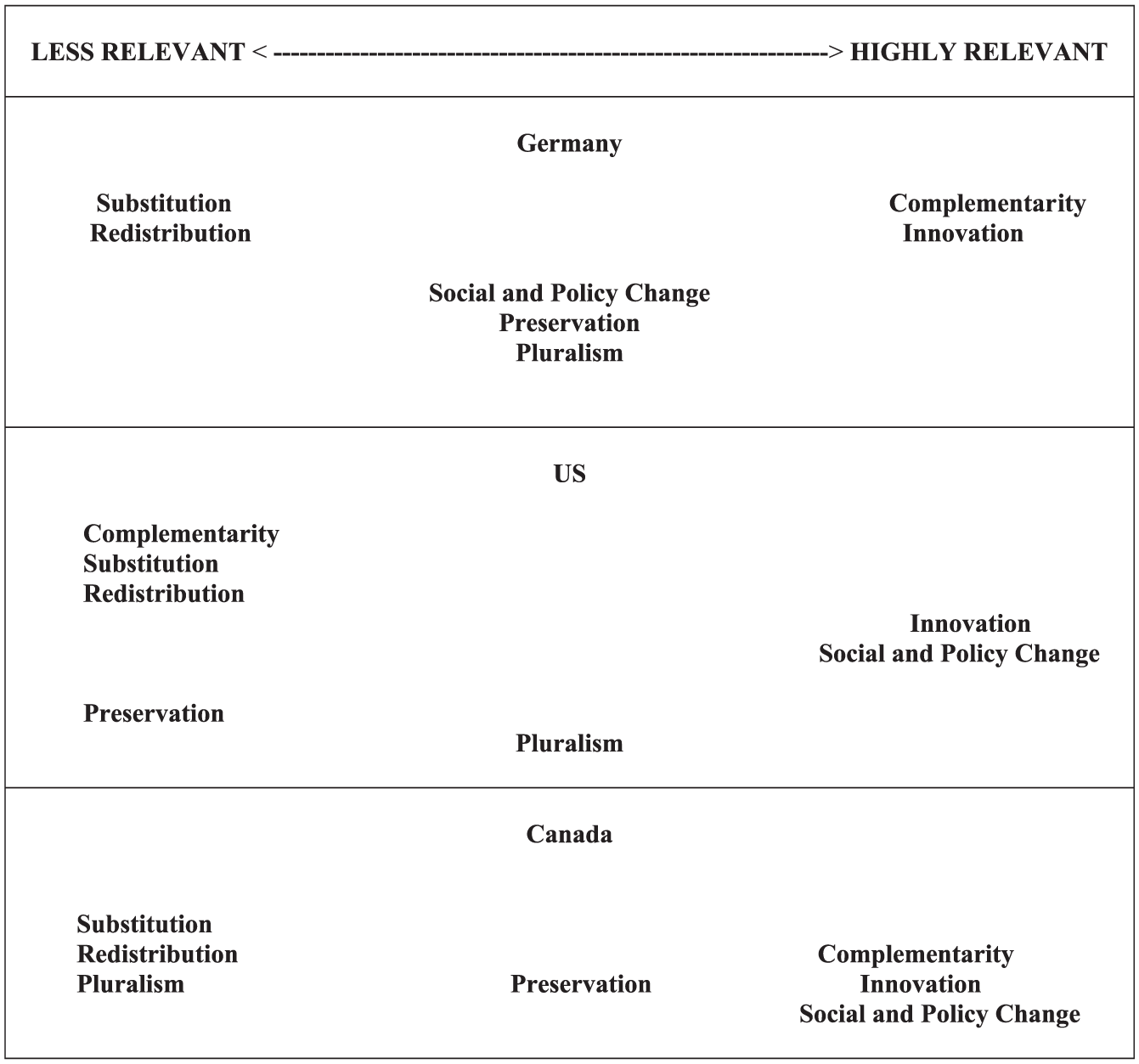
Comparative foundation role assessment.
The first one is a corporatist camp that complements government services by providing and supporting services. The second is a liberal camp that supports innovation, independent of the state. Less relevant, according to Toepler (2016) are substitution or redistribution roles in Germany; and any complementary, substitution, redistribution, or preservation roles in the United States. Foundations in Canada too reject any notion that they can be a substitute for government funded services, while they are certainly prepared to advocate for changes in policy and subsequent service funding (Elson & Hall, 2016). Canadian foundations play a complementary role, funding initiatives that are outside the direct mandate or policy priorities of government, particularly in the areas of education and research, health, and social services. For example, some time-limited interventions have been undertaken by Canadian foundations. Lucie and André Chagnon Foundation, for example, made massive new investments into early childhood development, healthy eating, and active living, but even this long-term partnerships (5 and 10 years) with the Government of Quebec, for hundreds of millions of dollars, did not compensate for the decline in public funding, and the foundation subsequently ended the partnership.
Grantmaking foundations, trying to leverage their influence and improve their impact are being urged by foundation sector leaders to embrace advocacy and public policy grantmaking as a way to enhance their results and advance their missions (Elson & Hall 2016; Cave, 2016; Northcott, 2016). While converts are few in number, public policy grantmaking has been described as “one of the most powerful tools available to foundations for creating real change” (Alliance for Justice, 2004, p. 1; Coffman, 2008). A recent study demonstrated that policy-focused grantmaking foundations often migrated into public policy from a growing appreciation of the limitations of a singular focus on program funding (Elson & Hall, 2016). For example, the Margaret & Wallace McCain Family Foundation and the Atkinson Charitable Foundation were both instrumental in supporting the movement for early childhood education in Ontario (Turgeon, 2014).
In the United States, individuals, rather than foundations in particular or nonprofit organizations in general are expected by hegemonic ideology to adapt to any service shortfall. While the early years of foundations in the United States collaborated with government and thus played a complementary role in the development of libraries and educational institutions, foundations now see themselves as “change agents,” either in innovation or through a social/policy change role (Johnson Centre, 2016; Mosley & Galaskiewicz, 2015; Toepler, 2016). This latter role of “change agent” is mirrored in the higher profile work of policy-focused private foundations in Canada (Elson & Hall, 2016; Pearson, 2017a, 2017b). In Canada, while there are certainly social innovations that operate independent of government, there is also a strong complementarity role and a high level of intergovernmental engagement as part of foundation reform and innovation agendas (Elson & Hall, 2016; Fondation Béati et al., 2015; McConnell Foundation, 2017).
Community foundations in Canada tend to be conservative in the social policy and innovative arenas, supporting community report cards (Vital Signs), fostering community leadership, equity, and inclusion, but rarely engaging in public policy advocacy (Phillips et al., 2011; Phillips et al., 2016). Given the extent to which community foundations in Canada currently fund health and community/social services, they appear to play a complementary and substitution role, rather than taking on the role of community “change agents” (Community Foundations of Canada, 2015; Phillips et al., 2011; Phillips et al., 2016). Like community foundations in the United States, traditional practices, the need to continue to appeal for donations, and the percentage of donor directed funds, could go some way to explain this more conservative role (Millesen & Martin, 2014).
Conclusion
In conclusion, we return to elements of the framework presented in the introductory article. It is clear that the current type of capitalism staged by the Canada-based Canadian experience represents a fifth case that lies between Coordinated Market Economy-like and Liberal Market Economy-like (see Table 2 in Anheier, 2018. p. 1598). Canada is really at the middle interface of the market coordination approach and the state coordination approach. In addition, in Canada’s federal state, the provinces are also add their own significant influence given their jurisdictional responsibility for health, education, and welfare. Quebec, for example, has a more developed social support system than other provinces. Therefore there are parts of Canada that are in a similar classification as social democratic countries.
In Anheier’s Table 2 (Anheier, 2018, p. 1598) on the varieties of capitalism, state versus market dominance, Canada would be located between the United Kingdom and the Netherlands. In connection with Esping-Andersen’s typology of Welfare regimes, Canada would be in the liberal category while revealing a new dimension that of the recommodification of welfare action through the development of social welfare, the social economy, and social entrepreneurship (Esping-Anderson, 1996). This process of recommodification is also very challenging for foundations that are called on to follow and support innovations that are driven by not-for-profits, by cooperatives and mutuals (collective entrepreneurship), and by social entrepreneurs (impact bonds and related practices). The situation is such that, on the question “Social origins approach, government spending, and nonprofit sector scale” (see Anheier, 2018, Table 4, p. 1599), Canada finds itself in the social democracy window but with a nonprofit sector that is closer to that in the United States and Germany. All these elements make Canada a relatively unique case in the arena of relations between the state, the market, and civil society.
The comparative history of foundations in Germany, the United States, and Canada show how this institutional form has been consistently reinforced over time. While external forces have buffeted societies and modified foundations priorities, their statutory form has remained remarkably consistent. This form is reinforced with every foundation application, donor allocation, and statutory report. Canada’s political, economic, and colonial history is also reflected in the nature and priorities of the foundation sector. Wealthy industrialists in Germany and Canada, like in the United States, have established private family foundations that continue to this day. Sobering is the comparative vitality index, where private foundations in both Canada and the United States lag behind that of German foundations. This may change as foundations move to invest more of their assets in the achievement of their public benefit activities, but any spending-to-asset ratio change is likely to be incremental at best unless statutory provisions also change.
Canadian and German foundations, much less wary of government action than the United States, often work in collaboration with or parallel to governments to complement activities and achieve a common societal goal. This collaboration or codependency may achieve results, but such change can be much slower than most foundations or those in need would like (Elson, 2011). In this context, government action (or inaction) currently defines the context in which innovation takes place. The engagement of foundations in the public policy arena is also long-standing, and this engagement too has shifted with contextual changes, and, given the level of foundation independence, they will likely continue to do so.
Each of the three countries have intermediary organizations that help support public and community foundations as a viable sector (Bundesverband Deutscher Stifungen, 2016; Foundation Center, 2014b; Philanthropic Foundations Canada, 2015b). While the three countries have several similarities, there are two notable and potentially defining differences in Canada. One is the health and growing civic engagement of community foundations. Second is the extent to which individuals, groups, foundations, and governments across Canada are starting a conversation about “decolonizing philanthropy” and the processes that will be required to build meaningful, collaborative, and ongoing partnerships with Canada’s Indigenous Peoples.
Footnotes
Acknowledgements
The authors would like to express their appreciation to the external reviewers for their insights and suggestions; and to Helmut Anheier for his invitation to participate in this special issue and guidance throughout.
Declaration of Conflicting Interests
The authors declared no potential conflicts of interest with respect to the research, authorship, and/or publication of this article.
Funding
The authors disclosed receipt of the following financial support for the research, authorship, and/or publication of this article: The author(s) received financial support from the Social Sciences and Humanities Research Council of Canada for a three-year research partnership development grant associated with the authorship of this article.
Notes
Author Biographies
 ).
).