







Abstract
The consecration of artists is a fundamental issue in the study of artistic fields. Status theory proposes that consecration (or “status”) is constructed through associations between actors, leading the actors to choose partners whose status is comparable to theirs. This theory, widely used in the study of artistic consecration, tends to undersocialize actors as it only considers their relative position in the status order. In particular, it hypothesizes that when two actors associate, they do so on the basis of their relative position in their respective areas of reference. Yet status theory can be accused of ignoring the aesthetic dimension of the works produced. In other words, it overlooks what makes art worlds distinct from other fields of production. The aim of this article is to complete this hypothesis by showing how aesthetic affinities can contribute to pairing choices (between a publisher and a poet, in particular), and how these aesthetic affinities can play a determining role in unequal artistic consecration.
Keywords
Introduction
The consecration of artists is a fundamental issue in the study of artistic fields (Becker, 1984; Bourdieu, 1996). What we might call status theory (Podolny, 1993) proposes that consecration (“status” in Podolny’s vocabulary) is constructed through associations between actors, leading the actors to choose partners whose status is comparable to theirs. This theory, widely used in the study of artistic consecration (Giuffre, 1999; Menger, 2014; Shin, Lee, & Lee, 2014), tends to undersocialize actors as it only considers their relative position in the status order. In particular, it hypothesizes that when two actors associate, they do so on the basis of their relative position in their respective areas of reference. Like other social scientific analyses of the arts, status theory can be accused of ignoring the aesthetic dimension of the works produced. In other words, it overlooks what makes art worlds distinct from other fields of production. The aim of this article is to complete this hypothesis, whose relevance to the world of contemporary poetry, we have discussed elsewhere (Dubois & François, 2013), by showing how aesthetic affinities can contribute to pairing choices (between a publisher and a poet, in particular), and how these aesthetic affinities can play a determining role in unequal artistic consecration.
Poetry is a particularly suitable area for this theoretical perspective. Commercial logics are rarely present, and commercial value is a result of the literary recognition a poet may acquire. Poetry is a relatively autonomous space in Bourdieu’s sense (1996). The different artistic evaluations (literary awards, critical acclaim, academic recognition, and anthologies) all feature the same names: it is thus possible to work with a clear, established hierarchy, from which the dominant figures of French 20th-century poetry emerge who, doubtless, will maintain their reputation with the passage of time, in what has been called “retrospective consecration” (Schmutz, 2005).
We have organized the article as follows. We begin by discussing status theory, including the nature of relations between actors. Next, we present our data and method. The third section shows that the world of contemporary poetry is organized around aesthetic affinities and social solidarities, divided between three key publishers. The fourth section shows how this aesthetic segmentation of the world of contemporary poetry carries over to differing degrees of consecration. The final section concludes.
Status and Aesthetics in Consecration Trajectories
Status theory is based on two principal hypotheses (Menger, 2014). The first proposes that the differences in consecration that we may observe retrospectively are the result of a process of progressive amplification of differences that are initially insignificant. The second hypothesis proposes that this enlargement of gaps that were originally tiny is based above all on a logic of selective matching (Podolny, 1993): actors associate with others with the same status as themselves, whatever their field, so that each one’s consecration enhances that of the other. In this way, the gaps from those who are inferior grow larger. This explanation can be criticized for its formal nature: whatever the qualities of artistic production, the only thing that counts is the difference in recognition and the actors’ propensity to associate with partners who enjoy an equivalent or greater level of prestige.
However, associations between actors can be based on factors other than their relative status. In artistic worlds in particular, they can be based on aesthetic affinities. Film producers do not work with a particular director only because they enjoy equivalents levels of prestige in their respective fields; they also do so because the director’s aesthetic tastes correspond to the producer’s project (Mary, 2006). As in other artistic fields, aesthetic identity plays a key role in the world of literature. Publishers have long sought to develop an aesthetic, intellectual, and commercial identity; this is the very idea of the literary collection, which has been the publisher’s principal commercial tool since the second half of the 19th century (Mollier, 1988). The question is particularly important in artistic worlds like poetry, in which literary value is at the heart of the assessment of work, and is the basis of its commercial value. In these circumstances, while actors certainly tend to associate with others according to their respective level of prestige, status theory does not explain why a celebrated poet will work with one respected publisher rather than another publisher with a similar reputation. Apart from the formal logic of status, we have to look at the contents of the relations between partners, in this case between poet and publisher, and more precisely the aesthetic identity on which this association is based.
This perspective, in the case of poetry, leads us to study two principal factors in detail. The first is the fact that for poets, publishers are markers not only of status but also of aesthetics: by working with one publisher rather than another, the poet positions him or herself in a specific area of a heterogeneous, conflictual aesthetic space. We will describe the three mechanisms by which publishers construct a particular aesthetic identity: this identity is obviously based on the selection they make among the work they receive, but also on the fact that groups of poets form around them, which operate as spaces for the socialization of new poets, and later as spaces for the sociability of more established poets. These social mechanisms contribute to perpetuate the aesthetic segmentation of the poetry world. The second point raises the question of how this aesthetic segmentation takes on a vertical dimension: How do these aesthetic affinities influence the shared, stable hierarchies that structure the world of contemporary poetry? We will focus on the two main mechanisms that explain how these aesthetic affinities influence consecration: the use of publishers by those who influence reputation as a means of evaluating poets, the perpetuation within the consecration bodies of the solidarities operating in the poetry world.
Data and Method
We base our study on a biobibliographical database of 150 poets born since 1920, and therefore who began their career after the Second World War. We began with a list of 722 poets compiled from several institutional, critical, and anthological sources. We selected the 150 best-known (we detailed our method of developing this database in Dubois & François, 2013). We show that this list can be divided into three groups with differing degrees of consecration: by combining multiple correspondence analysis and cluster analysis, we show that the different elements of consecration (literary awards, critical recognition, and academic recognition) all converge to form a generally consistent hierarchy in the world of contemporary poetry. The poets who get the most prestigious literary awards are also those who benefit from the highest level of academic recognition. We can therefore assign each poet to one of three clusters (dominant, median, or dominated) that emerged from the hierarchical list. Note that speaking of “dominated” poets is relative since all poets in our data set belong to the most recognized population of writers. We completed our database by searching systematically through all PhD theses dealing with contemporary poetry presented over 30 years (1985-2015).
Since this research is attempting to uncover the details of relations between poets and publishers, we have to investigate the aesthetic identities not only of poets but also of publishers, the poets’ socialization spaces. This leads us to explore literary history, including the history of contemporary poetry since 1945, and more broadly that of poetry as a whole, since poetry can only be understood in its historical perspective (Bourdieu, 1996). Here, the sources are manifold. Literary historians have published many analyses of the contemporary poetry field, its aesthetic issues, and its history (e.g., Bancquart, 1996; Forest, 1995; Jarrety, 2001; Martin, 2013). Poets have also written widely about their sphere. A number of them have published memoires, intellectual autobiographies (e.g., Réda, 1995; Veinstein, 2016), or their letters. The editors themselves, many of whom are writers, have left autobiographies or letters (e.g., Boulanger, 1998; Cayrol, 1982; Paulhan & Gallimard, 2011). These sources reveal not only the literary history of poetry but also its social history, through the composition of influential groups, poetry reviews, and collections. We therefore studied numerous secondary sources that reported significant events in the history of contemporary poetry.
Publishers as Aesthetic Markers
The Aesthetic Identity of the Publisher
The range of aesthetic choices within French contemporary poetry was completely redefined after the Second World War. This redefinition took place by taking up once more the tension developed in 19th-century poetry between meaning and form, between subjective expression and existence in the world, and research into formalism. Nevertheless, in the immediate postwar period, two related trends led to a profound renewal of French poetry. First, the war challenged the dominant aesthetic values in poetry, and in particular surrealism, which Breton, the leader of the movement, was unable to relaunch (Nadeau, 1970). At the same time, publishers were looking for new authors to revitalize their catalogs in these new circumstances (Simonin, 1998). Leading literary publishers competed to attract the best young writers and launched collections specifically for promising newcomers (Forest, 1995). This reorganization was led by the three publishers who dominate French poetry: Gallimard, le Seuil, and Flammarion. Therefore, we explore the aesthetic identities of these three publishers who work with all the best-known French poets.
Originally, Gallimard was an extension of the literary magazine Nouvelle Revue Française (NRF) launched in 1908, under the aegis of André Gide in particular. Its aim at the time was to renew classical literature by promoting “pure” work, which rejects formalism and the idea that nothing but the text exists, promoting a certain formal continuity. This editorial line remained fairly vague, but kept Gallimard apart from the avant-garde, with the exception of surrealism, which can be seen as an extension of romanticism into the questions of the subject and lyricism (Nadeau, 1970). This policy continued after the war, and Gallimard did not publish the most radical avant-garde poetry, remaining oriented toward formalism. Indeed, for a long time Jacques Réda, a major contemporary poet and member of the dominant cluster, directed the NRF and was at the same time a member of the firm’s reviewing committee. He was an author “at the head of a revival of so-called neo-lyrical poetry, said to be a reaction to the deconstructed modernist landscape” (Jarrety, 2001, p. 654) working notably in regular verse (Réda, 1999). The critics recognize in Réda “a voice [that] attempts [ . . . ] to remain apart, a lyrical voice indeed, if lyricism is the expression of an existential wager” (Micolet, 2001, p. 655) and in Gallimard “a powerful narrative revival, relieved of theoretical weight: intimate, biographical writing about childhood, memorial literature, minimalist snippets from ordinary life, a new lyricism” (Cerisier, 2009, p. 517).
Just as Gallimard relied on the NRF as a breeding ground, the group of poets published by le Seuil originated in a single literary magazine: Tel Quel. Around Tel Quel grew, not a poetry movement, but more broadly an avant-garde movement for literature (novels, narratives, and poetry), politics, and social sciences. Apart from the magazine, it has its own le Seuil collection. Its aim is to bring literature closer to the social sciences, and above all linguistics (Jakobson and Greimas in particular). In literature, this research results in a type of “textualism” affirming that nothing exists in the text apart from the text; literature must not and cannot aim at representing the world, in what would necessarily be an illusion. Going further than the Nouveau Roman, which Tel Quel supported at its outset, it sees all meaning as contained in the text: the meaning cannot preexist the text or be found beyond it. This is also a political wish, since literary text operates as a criticism of the usual language identified with the dominant ideology. “Writing is the continuation of politics by other means” (Tel Quel, 1968, p. 78). One of the major poets in this movement, Denis Roche (1972), published “Le mécrit” and made his celebrated expression “poetry is inadmissible” the title of his complete poetry works (Roche, 1995): classical form and lyricism are both theoretically wrong and ideologically complicit with the bourgeoisie.
The third aesthetic grouping in contemporary French poetry has also centered on a magazine and a publisher, the literary magazine Action Poétique (AP) and Flammarion. Although the magazine does not belong to Flammarion, this firm has published many of the major contributors to AP, and the director of Poésie Flammarion since 1994, Yves Di Manno, has worked actively with AP. This group brings together a variety of authors concerned with the importance of form. “AP poets consider themselves custodians, historians and actors of the formal tradition” (Boulanger, 1998, p. 92). The formalism of Flammarion poets leads them, as Claude Adelen, one of the pillars of both AP and Flammarion, stresses, to “refuse any internal monologue” against lyrical poetry (as cited in Boulanger, 1998, p. 96). Their ideas are closely akin to those of a number of American modernist poets (Pound, William Carlos Williams, Zukofski, Oppen, and Ashbery). Without identifying with the textualism of Tel Quel, this trend favors formal work, as Yves Di Manno clearly states the following:
Of course, I still feel closer to “formalists” (with the traditional speech marks) than to the others, because at least I learn a certain number of things when reading them. I’m thinking particularly about everything that has been accomplished around Action Poétique, about the circle created by Henri Deluy, with Jacques Roubaud, Paul Louis Rossi [ . . . ] The recent anthology by Pascal Boulanger is sufficient proof of this, it seems to me [ . . . ] To come back to the present, while I remain skeptical with regard to certain actions—but I have differing passions and do not belong to any clan—several books have moved me in recent years by the way they link this subversive work, which, as I see it, is the basis of modern writing, with consideration for formal discipline, which is without doubt the major advance of recent decades. (Di Manno, 1998, p. 12)
Clearly, the aesthetic choices upheld by le Seuil and Flammarion are closer to each other than to those of Gallimard. Yet, while authors do move between publishers, this movement is much more frequent between the two major publishers in the French literary field (Gallimard and le Seuil) than between those whose aesthetic choices ostensibly appear less in opposition. Within our sample, those authors who have published with Gallimard, while not being totally absent from Flammarion collections are underrepresented by this publisher (and the opposite is also true: authors who have published with Flammarion have published much less with Gallimard than the rest of our sample). However, authors who have published with le Seuil (or Gallimard) are more likely to have published with Gallimard (or le Seuil) than the other poets in our sample (see Table 1). While aesthetic logics are evident, they are overlaid and sometimes contradicted by logics of status.
The Major Publishers.
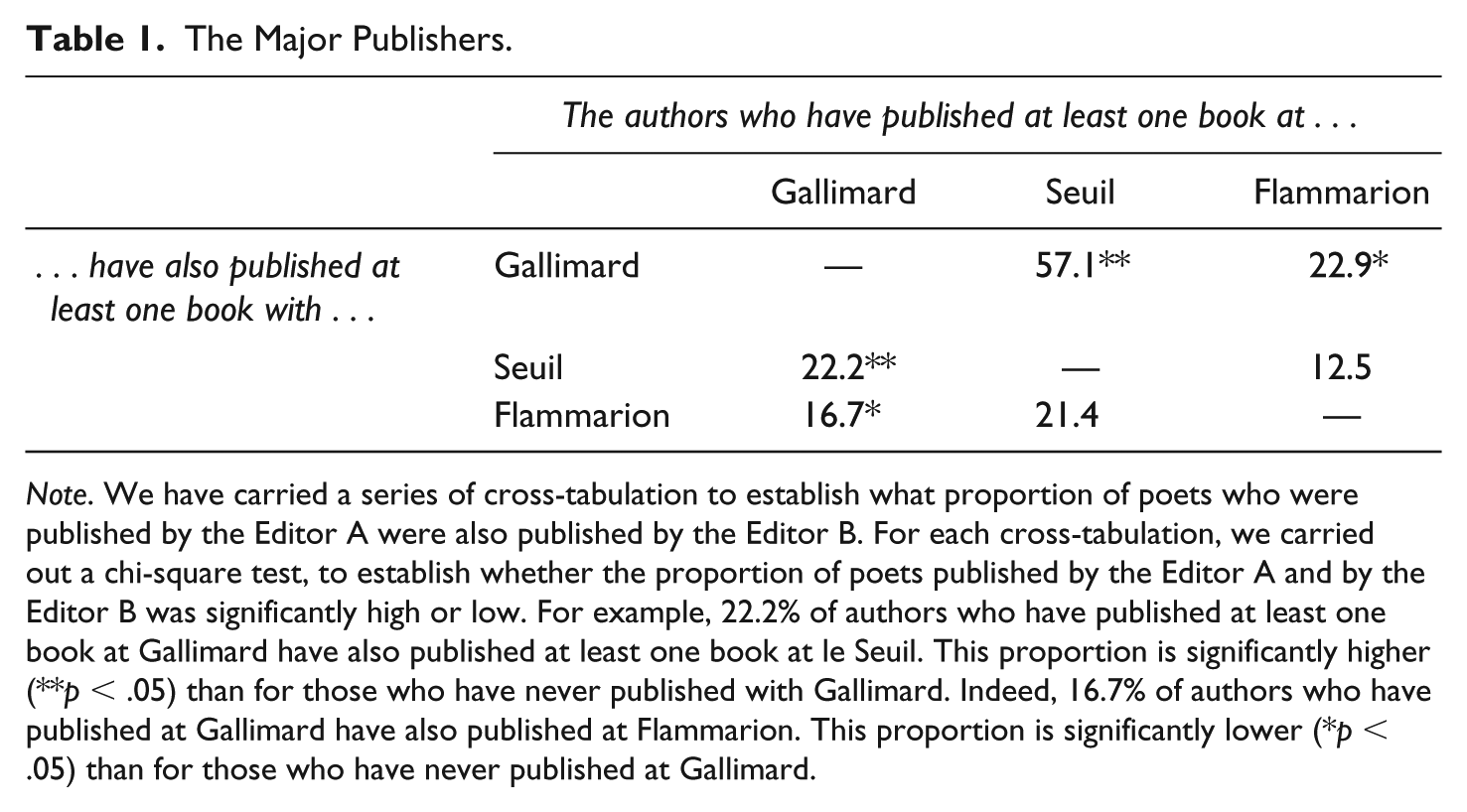
Note. We have carried a series of cross-tabulation to establish what proportion of poets who were published by the Editor A were also published by the Editor B. For each cross-tabulation, we carried out a chi-square test, to establish whether the proportion of poets published by the Editor A and by the Editor B was significantly high or low. For example, 22.2% of authors who have published at least one book at Gallimard have also published at least one book at le Seuil. This proportion is significantly higher (**p < .05) than for those who have never published with Gallimard. Indeed, 16.7% of authors who have published at Gallimard have also published at Flammarion. This proportion is significantly lower (*p < .05) than for those who have never published at Gallimard.
Similarly, publishers that organize and promote aesthetic choices operate more as poles of attraction than as exclusive strongholds. More modest houses gravitate around these major publishers, preferring to work with poets whose aesthetic tastes are compatible, if not identical, with those found at Gallimard, le Seuil, or Flammarion. As shown in Table 2, more than 40% of the authors who have published with Gallimard have also worked with Al Benoit, and 20% of those who have published with Flammarion have worked with Orange Export Ltd., a small house led by Hocquard, an important poet who strongly criticized lyricism and has never been published at Gallimard. Without being impermeable, these aesthetic groups are relatively independent of each other: Flammarion’s authors are underrepresented in work published by firms in Gallimard’s aesthetic orbit.
Major and Other Publishers.
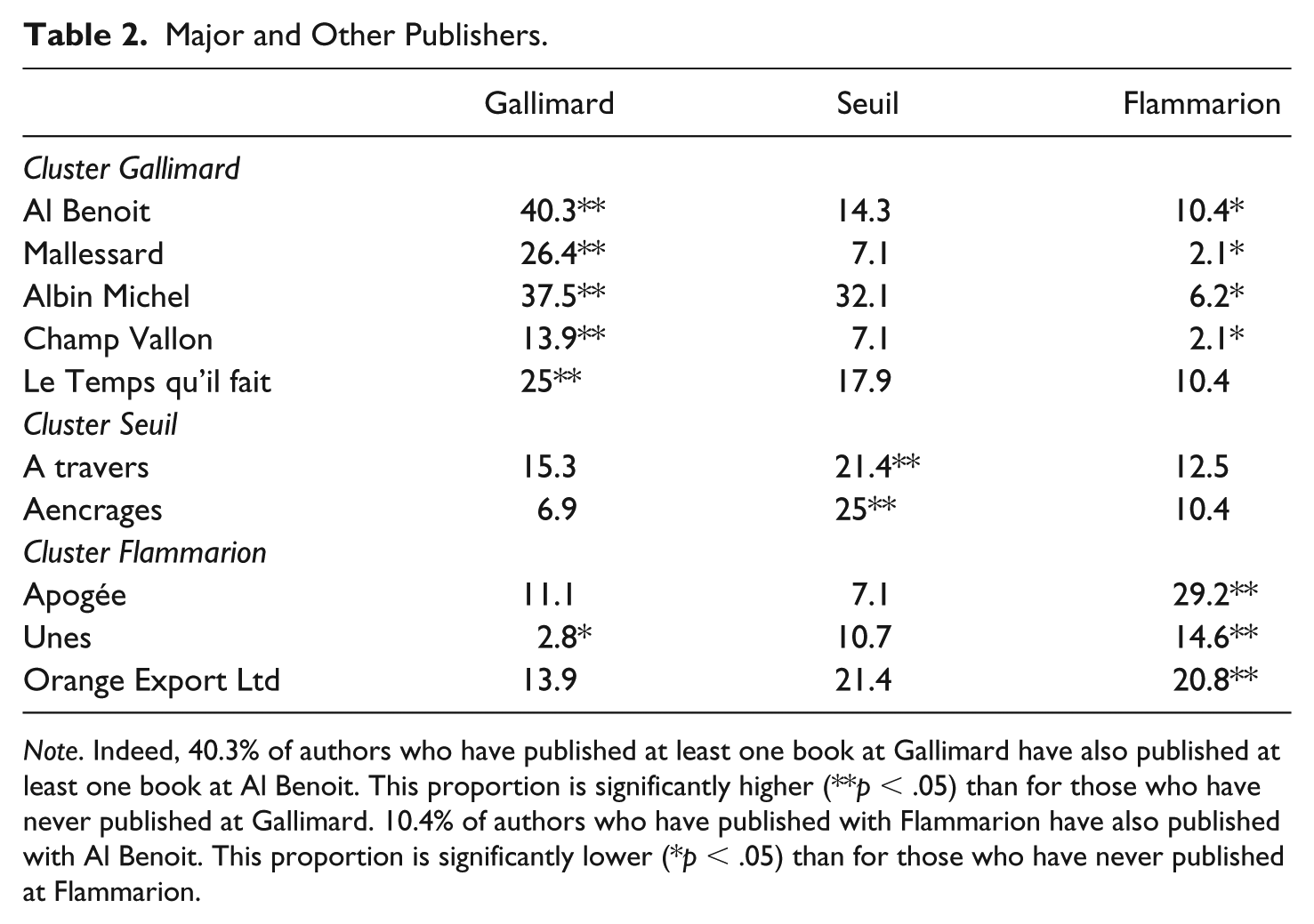
Note. Indeed, 40.3% of authors who have published at least one book at Gallimard have also published at least one book at Al Benoit. This proportion is significantly higher (**p < .05) than for those who have never published at Gallimard. 10.4% of authors who have published with Flammarion have also published with Al Benoit. This proportion is significantly lower (*p < .05) than for those who have never published at Flammarion.
French contemporary poetry is thus organized in separate aesthetic groups, which have long been clearly defined and are constantly joined by new poets. These aesthetic orientations are clustered around major publishers who organize their own constellations of smaller publishers with comparable (or at least compatible) aesthetic orientations. Indeed, publishers signpost the aesthetic choices of the world of contemporary poetry so clearly because they are established as mechanisms used to organize the field and to transmit a number of aesthetic conventions.
Aesthetic Families Organized Around Publishers
The reason that publishers are aesthetic markers is that they have gathered over several decades a group of poets sharing aesthetic tastes. However, it is also because these aesthetic affinities are developed and shared socially and in solidarity networks that help organize the world of contemporary poetry around the publishers: groups gather around publishers because of their aesthetic affinities, and they redefine this aesthetic identity. Poets join groups when having already started to shape their own aesthetics through their necessary preliminary learning of poetry history and forms (Dubois, 2011). These groups do not emerge in a vacuum but in a field built through literary history around aesthetic issues. They frame and promote collectively built aesthetics through socialization, which is a necessary weapon in the struggle between groups competing for literary recognition (Boschetti, 2001). Aesthetic framing thus results from a subtle balance between individual choices, collective identities, and strategies and literary history. Poets cannot be fully “cynical” in adopting any aesthetic that would just be the most rewarding one (Ribard & Schapira, 2013), while groups are also built around aesthetic identities which precede homophilic dynamics.
Three mechanisms are central to explain this role of publishers in poetry: they select the texts, they are at the heart of the poets’ socialization, and they develop poles in their relations of sociability. These three mechanisms bring into play network activities, associating poets and gatekeepers, who are often poets themselves.
The first of these mechanisms is to some extent the most expected, since it corresponds to a publisher’s traditional gatekeeping function, seen in other artistic settings (Bystryn, 1978), by which they sort texts by work they wish to publish and work that they reject. In poetry, this gatekeeping function is generally undertaken by poets themselves who share the aesthetic tastes of the publisher. Thus, the Gallimard paperback poetry collection is today directed by André Velter, a poet influenced by Rimbaud, whose poetry is “patent, radically other, devoted to the sovereign energies of life, light, and love; confronting and disqualifying the disenchanted part of the world . . . ” (Velter & Bianu, 2013, p. 15). The traditional Gallimard editorial line is perpetuated here, as recognized—sometimes criticized—by more avant-garde authors. Take, as an example, this interview with a poet and publisher:
The Gallimard poetry collection, which is the leading vector for promoting poetry in France, has an image of contemporary poetry that is, I would say, limited to a certain school, a certain tendency, when you see that there are three Grand Prix National de Poésie award winners it does not publish [Heidsieck, Fourcade, Tortel]. It is almost unjust towards . . . apart from Bernard Heidsieck
1
they are not great revolutionaries. Fourcade is in the wake of Char, and Tortel neither is a great revolutionary. One asks himself why [they did not appear in the Gallimard pocket collection]. Once again, we get into . . . , into . . . (Interview, September 20, 2004)
However, the tendency for publishers to structure the aesthetic identities of the world of poetry is based on other mechanisms beyond the function of selection that is, of course, theirs. They constitute spaces that socialize newcomers to their world. This socialization is first intellectual. Aspiring poets become familiar with the poetry of their seniors before proposing their own texts, and this encounter takes place in a space marked by strong, stable editorial identities. Philippe Jaccottet, a major Gallimard author, has stood up for poets often published by the house throughout his career. In his collection of essays on contemporary poetry (Jaccottet, 2015), 89% of the authors studied have published with Gallimard or Mercure (a subsidiary of Gallimard), 10.7% with le Seuil, and 7.1% with Flammarion. The Flammarion and Seuil authors have all published with Gallimard as well.
This literary socialization is carried on by their entry into more concrete relationships in a space that is organized around the publisher. The trajectory of the young poetry collective that was brought together early on by the writer and editor Philippe Sollers, and which became Tel Quel, is a good example of this phenomenon. Tel Quel originated in a group of friends: many of its founders were colleagues in classes préparatoires or business schools, who met at the bar du Pont-Royal, where Sollers and his colleagues later met the future members Jean-Pierre Faye and Jean-Edern Hallier at the end of the 1950s. Several future principal Tel Quel poets (Pleynet and Roche in particular) met before the magazine was founded and were introduced to the new group through Jean Cayrol, a poet and editor at le Seuil. Cayrol published the young Tel Quel authors in his collection Ecrire and welcomed the magazine as a chance to develop the loyalty of these promising young authors.
The foundation of Tel Quel is moreover a typical example of the socialization organized around publishers in that it makes use of a senior tutelary figure, in this case Francis Ponge. Even if later on he achieved recognition as a novelist, it was under the protection of a poet that Sollers launched his career as a writer. Sollers sent Ponge a prose text inspired directly by the senior writer. Ponge attempted unsuccessfully to have the work published by Gallimard, after which Sollers turned to le Seuil. The partnership between Tel Quel and Ponge was thus forged around le Seuil and a network of friends:
the alliance between Ponge and what was to become the Tel Quel group might never have happened, of course. For it to occur, a series of chance meetings and reciprocal empathies was crucial. We can clearly see, though, how the convergence fully satisfies dual, symmetrical expectations: when he reaches his sixties, a poet is looking for followers who will guarantee the future of his work whilst, from their viewpoint, young people are looking for a mentor who will consecrate them as writers. The story of the alliance was also one of friendship. (Forest, 1995, p. 25)
The socialization that is built around publishers is replaced later by the renewal of these friendships established by assiduously frequenting close circles in which aesthetic tastes are forged and cohesion develops. A number of the poets published by Gallimard were grouped over many years around Georges Lambrichs who, in 1967, founded the Cahiers du chemin, a magazine published by Gallimard, before taking charge of the publisher’s flagship magazine, NRF. One of these poets, Jude Stéfan, described the weekly meetings of the leading Gallimard poets, headed by Lambrichs:
At first, the “Cahiers du chemin” meals took place in the rue des Canettes [ . . . ] everyone knew each other. Lambrichs invited three or four people each time, and that’s how I got to know them [ . . . ] Then, Lambrichs widened the circle, and invited people to his home in the rue de Villersexel. We sat around a big table, with him and his wife Gilberte at each end. The guests changed every week, but some people came very regularly, including me, because that way I escaped from the provinces. The kernel was made up of Janvier, Réda, Deguy—who came and went as he wanted—Trassard, and Chaillou. (Stéfan, 2005, pp. 63-64)
All of these poets (Deguy, Stéfan, Janvier, Réda; and novelists Trassard and Chaillou) have appeared in the Gallimard pocket collection.
The same type of sociable relations, organized around a senior figure (Henri Deluy), can be found with Flammarion poets. Deluy is indeed the poet who is most regularly in the Flammarion poetry collection. One of the poets in the group speaks ironically but with affection of the monthly meetings with the “Sultan”:
We love our sultan passionately. . . . Of course, he has his character; but we have ours, as well. He is not a tyrant, in any case. Every new moon, the Grand Council meets; everyone speaks. Some say that the sultan listening to us is at heart only the emanation of the collective will. Such a view is just and false. For there is a very good chance that in the absence of our sultan, the Empire would fall to pieces. Indeed, nobody would dream of usurping his role. (Petit, 1979, p. 65)
Publishers are thus at the heart of the aesthetic segmentation of the poetry world. By accumulating a catalog of poets who share aesthetic tastes, they progressively build a literary identity that distinguishes them from each other. This aesthetic identity, guaranteed by the poets who select texts for publication, acting as gatekeepers, is strengthened by the socialization and sociability centered on the publishers. Publishers are thus good proxies for aesthetic orientations, because of literary history and their role in making public works. Poets holding key positions such as collection or magazine editors operate as brokers who use their network to lead aesthetic endeavors (Bystryn, 1978). But how does this aesthetic segmentation of the poetry world apply vertically in the stable, shared hierarchies of consecration?
Publishers at the Heart of Poetic Consecration
The aesthetic identities developed by publishers influence a poet’s chances of consecration directly. As seen in Table 3, Gallimard poets are overrepresented among the most recognized poets, while those with Flammarion are underrepresented. Indeed, Gallimard is the French publisher most able to establish writers (Simonin, 1998). Correspondingly, Flammarion poets are overrepresented among the least consecrated poets, while those who have published with Gallimard are underrepresented in this group. Poets who have published with le Seuil are distributed more evenly among different levels of consecration. Certainly, poets who have published with le Seuil are overrepresented (underrepresented) in the dominant group of poets (the dominated group), which if we only look at those who have published with le Seuil but have not published with Gallimard, these anomalies disappear.
Consecration of Poets by Publisher.
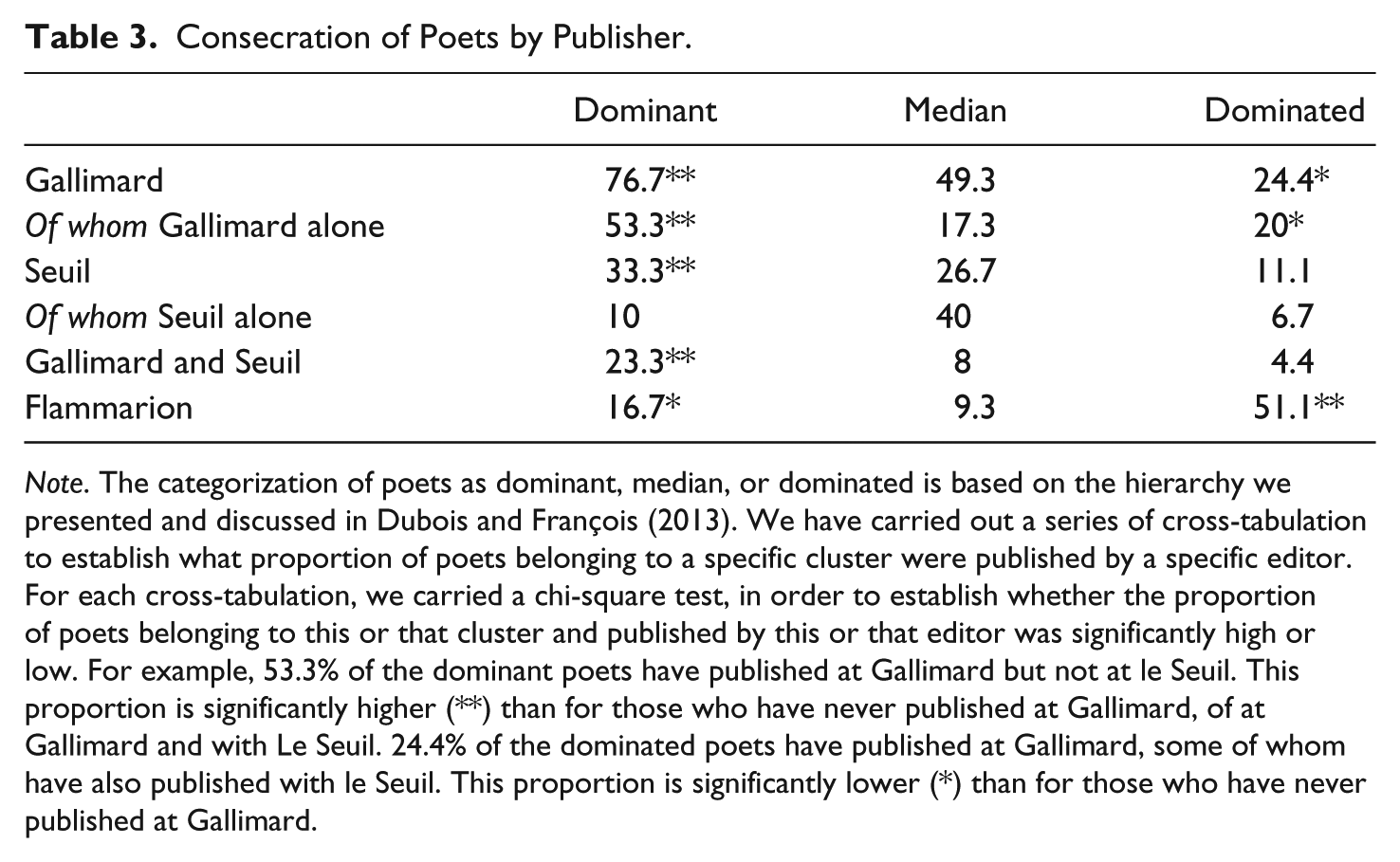
Note. The categorization of poets as dominant, median, or dominated is based on the hierarchy we presented and discussed in Dubois and François (2013). We have carried out a series of cross-tabulation to establish what proportion of poets belonging to a specific cluster were published by a specific editor. For each cross-tabulation, we carried a chi-square test, in order to establish whether the proportion of poets belonging to this or that cluster and published by this or that editor was significantly high or low. For example, 53.3% of the dominant poets have published at Gallimard but not at le Seuil. This proportion is significantly higher (**) than for those who have never published at Gallimard, of at Gallimard and with Le Seuil. 24.4% of the dominated poets have published at Gallimard, some of whom have also published with le Seuil. This proportion is significantly lower (*) than for those who have never published at Gallimard.
The consecration of poets is thus directly linked to their aesthetic position in the contemporary poetry world. How can we explain the fact that Gallimard poets are so overrepresented among the most consecrated poets, while Flammarion poets are so overrepresented in the least recognized group? We propose two mechanisms, diffuse but significant, that may lead to such a clear link between publisher and degree of consecration.
The first is the role publishers play in the assessment of bodies that recognize poets and lead to their consecration: publishers function as a guarantee of quality. This alone is not enough on which to make an assessment, but it contributes (Karpik & Scott, 2010). The degrees of consecration that we revealed are based on a comparison of the rankings created by different groups: literary awards, academic work, critical acclaim, and so on. These different groups give publishers a determining role, particularly when awards juries are not contemporary poetry specialists. Thus, 90% of the poets in our population who have received the Prix Goncourt for poetry prize have published with Gallimard. 2 Similarly, 80% of the poets in our population who have received the Académie Française prize are Gallimard poets, and less than 10% are Flammarion poets. Both of these prizes are awarded by nonspecialists, who follow the most visible contemporary poetry publications but who are not necessarily aware of the finer subdivisions or most recent alignments. They are also more receptive to more classical poetics, which are closer to their own aesthetic tastes; more experimental positions remain confined to the world of poetry. In other words, these bodies are at the heart of the management of the passage from recognition to renown (Lang & Lang, 1988). Among the different clues that contribute to the construction of the juries’ assessment, publishers play a key role: they are a guarantee of quality and aesthetic orientation that can be used to make at least an initial selection among the competitors.
The role publishers play when assessments are made can be witnessed in another area of the consecration process: university. Many more Gallimard and Seuil poets than any others have been the subject of a thesis (57% of Gallimard poets, 64% of le Seuil poets), while the proportion of Flammarion poets who have been the subject of a thesis does not differ significantly from the rest of our population. This is particularly true when the thesis directors are not contemporary poetry specialists: If we consider situations where the director has worked on only one contemporary poetry thesis, 77% of these theses deal with at least one Gallimard author, and 22% cover a Flammarion author. Even fewer theses are devoted to the study of poets who have published with le Seuil, but not with Gallimard (15%).
Academia is, at least partly, divided up in a similar way as publishers. Poets are often intimately linked to the bodies that consecrate them. Professors who have directed at least 10 theses devoted to contemporary poetry are very often linked to publishers, either because they are poets themselves (such as Maulpoix, Collot, Conort, and Gleize), or because they are assiduous, intimate fellow travelers, such as Jean-Claude Mathieu, one of the great university specialists in contemporary poetry who was also personally associated with major authors in the Gallimard nebula (Char, Du Bouchet, and Jaccottet). In other words, the fault lines and groupings of contemporary poetry can be found within the bodies that make a poet’s reputation. It would be too simplistic, of course, to suppose that poets with certain aesthetic tastes, such as Jean-Marie Gleize, who is a formalist poet and a central member of the le Seuil group, only direct theses that study formalist poets. Although theses directed by J.-M. Gleize study more Flammarion poets than those directed by most of his colleagues (with the exception of M. Collot, who is close to Gallimard), Gleize has also directed theses on Gallimard poets, and among many theses studying Gallimard poets along with Flammarion ones. Nonetheless, more of the thesis directors specializing in contemporary poetry are associated with Gallimard than with le Seuil or Flammarion. While they are not exclusive, sectarian apologists for a single publisher’s authors, they are understandably more inclined to direct theses on subjects that they know and appreciate.
The mechanism that carries aesthetic and editorial divisions over to consecrating bodies also occurs with literary awards. It is often pointed out with regard to prizes for new novels that dominant publishers strongly influence jury selection, since members who are also writers are often linked to these publishers: Gallimard, Le Seuil, and Grasset (which does not publish poetry) clearly dominate the prizewinners (Ducas, 2013). Even if the financial stakes cannot be compared, the world of poetry is also influenced by this type of logic: more than 80% of the authors in our population who have received the Prix Mallarmé have published with Gallimard. Among the current members of the Académie Mallarmé, 36% have published at least one book with Gallimard or Mercure, 3% with le Seuil, and 6% with Flammarion. The prize is dominated by more traditional, lyrical forms of poetry. No radically experimental poet has won the prize, only neosurrealists, poets close to the everyday lyricism of Réda, or even religious poets. Although it is exaggerating to suggest that a given consecrating body is in the hands of a given publisher, the partial overlap between consecrating bodies and publishers (or between the social space of production and that of consumption) explains the fact that the fault lines that we find in one area are also found, to a lesser degree, in another.
Conclusion
Status theory proposes an analytical frame that can explain the spectacular differences in degree of consecration that appear retrospectively between certain artists. In this article, we have attempted to demonstrate how it is not only possible but also necessary to consider aesthetic segmentation in the arts world if we are to explain the hierarchies that occur there. The aesthetic choices of poets at the beginning of their career are often crucially important for their future level of consecration.
The analysis of aesthetic tastes does not simply add a variable to the model, it also enhances understanding of the sociological significance of the variables used. In “standard” status theory, as presented by Menger (2014), for example, selective matching refers to the comparison of two statuses. It postulates that the actor is rational (i.e., wishes to optimize his or her position in the game of comparisons) and knowledgeable (i.e., aware of the relative positions of his potential partners). The inclusion within status theory of aesthetic affinity clarifies, completes, and frames the nature of these relations. It explains in detail why a given poet will choose a given publisher, rather than another of equivalent status, and the “space of possibilities” (Bourdieu, 1996) that it opens for him: a formalist stands very little chance of being published by Gallimard. Poetical engagement, which is based above all on aesthetic reasons, will lead an aspiring formalist poet to read and then associate with other formalist poets, publishers, and critics. The issue is not that individuals reach a ceiling because of suboptimal matching; it is that groups form based on aesthetic affinity, and their unequal success in consecrating bodies mitigates (or multiplies) the chances of future consecration of those who start careers today and will be judged tomorrow. Our study contributes to the literature on consecration as art worlds are structured not only by reputation but also by aesthetics affinities. In the visual arts, art dealers are closely to tied to artistic innovation and groups of artists, from Durand-Ruel and impressionism to Leo Castelli and abstract expressionism. In the music industry, actors tend to cluster around genre communities (Lena & Peterson, 2008). For instance, the rise of baroque music has shaped relations between musical actors within the classical music world (François, 2008). Bridging status theory and aesthetic affinities helps clarify how and why actors make connections and opens new avenues for future research in the arts.
Footnotes
Acknowledgements
The authors wish to thank warmly the guest editors of this special issue, Timothy Dowd and Vaughn Schmutz, for their continued support and insightful comments.
Declaration of Conflicting Interests
The author(s) declared no potential conflicts of interest with respect to the research, authorship, and/or publication of this article.
Funding
The author(s) received no financial support for the research, authorship, and/or publication of this article.