







Abstract
Self-responsibility is a prominent keyword in social policy and in welfare state reforms. The concept of self-responsibility, though, has never been clearly dissected for welfare state analysis. In particular, the debate on the turn toward self-responsibility in welfare states has not been adequately conceptualized, nor has the institutionalization of the family in welfare states been correspondingly analyzed, though all welfare states, to different degrees, apply family-related conditions to social rights. In other words, welfare states have treated individuals with family differently from individuals without family, and this has an impact on the interpretation of the turn toward self-responsibility. In this contribution, we systematically and comparatively analyze welfare state change in the family-related conditions applied to social rights, in order to identify shifts in financial responsibility for social rights from the public realm to either the individual or the family. We analyze changes occurring between 1993 and 2013 for two social security levels and two target groups in six European countries. Our findings show that trends toward reducing public financial responsibility, as in shifting financial responsibility for social security from the public realm back to citizens, have not prevailed. On the contrary, public financial responsibility for social rights has in part increased and in part been reshifted onto the family, so that self-responsibility is subsumed here under the concept of subsidiarity, and therewith refers to a nonindividualized “self”. Citizens, in other words, are not increasingly conceived by welfare state regulations as isolated and self-reliant individuals, but as subjects embedded in both the public and family spheres.
Keywords
Introduction
Self-responsibility is a prominent keyword in social policy and in welfare state reforms on all political levels—European, national, and local alike. Welfare states were established by taking over responsibility for social risks to their citizens. The literature on welfare state reforms mainly agrees that the turn toward self-responsibility corresponds to retrenchment or cost-containment policies, and to a reshift of parts of the established welfare state responsibilities to the citizens. Whether indeed public responsibility decreased and was thereby reshifted onto the citizen, can be analyzed in two ways. First, one can assess developments in absolute terms with regard to welfare state expenditures, outcomes in benefits, and so forth. Indeed, this procedure is dominant in welfare state analysis, and it clearly shows considerable differences in the generosity of welfare states both in historical and international comparative perspective. Second, one can analyze the development in relative terms checking for a reduction in public responsibility for a predefined security level caused by governments’ shifting of social risks back toward the citizens. The latter approach has hardly been attempted so far and in particular not in a systematic and comparative manner. It is relevant, though, since the concept and implementation of citizenship is complex, incorporating to different degrees also family membership.
The subject of welfare state intervention in terms of social security is, basically, the individual. However, the entitlements of an individual are, depending in their degree on time and country, put into perspective when he or she has family. For those having family, both additional and reduced entitlements are commonly applied. Reasons for these family-related rights are cost compensations and valuation of the family on the one hand and subsidiarity and the principle of family solidarity on the other. If public financial responsibility (PFR) has indeed been reduced and correspondingly reshifted from the public to the citizens, this might have happened in two ways. First, entitlements based on family reasons might have been reduced; second, financial responsibility for those in need might have been reshifted from the public to the family. In both cases, the financial responsibility of the family would increase and the individualistic interpretation of citizenship newly put into perspective. These kinds of shifts in financial responsibilities have not yet been systematically analyzed. Consequently, we ask in this contribution whether and in how far the financial responsibility of the public in established welfare states has been reduced in the sense of being reshifted to the individual worker and his or her family.
We do so by analyzing shifts in financial responsibility for social security between the public realm, the individual, and the family. Empirically, we draw on social security systems for the unemployed and for persons of pension age in six European countries and compare the share of financial responsibility in 1993 and 2013. We first draw on the insights of established welfare state literature and clarify our analytical approach. Then, we introduce our methodological approach, since this kind of analysis requires an innovative method. Thereafter, we present our findings, discuss them and conclude.
Literature Review
Welfare states were formed in a long historical process. Initially, risks that used to be covered by each individual or family alone came to be recognized as social, and therewith, public, and needed to be answered by social interventions. These social interventions comprise social services and social security systems which, in international comparison, took shape in quite different forms. They differed in entitlement principles, organization, and financing. Social security systems in particular were financed either by means of labor revenue (employers’ and employees’ contributions) or by means of general revenue (taxation, primarily on income), establishing either a citizen–employee or a citizen-as-taxpayer model. What they had in common, though, was that they applied a citizen-as-worker-with-family model by providing the social security of the workers and their families. Hence, with the introduction of social security systems, the traditional financial responsibilities of the worker and his or her family were, in substantial part, shifted from the private sphere to the public realm (Flora & Heidenheimer, 1981; C. Pierson, 1998).
The automatism with which social security systems secured the citizens, though, has been weakened by different welfare reforms of the past three decades. In systems of the citizen–employee model, in which citizens as workers and their families had been automatically socially secured by means of the labor market participation of the head of the household, self-responsibility entered the system as optimized and individualized labor market participation of all the “able-bodied”, and self-arranged additional social security (particularly, in forms of welfare markets; Bode, 2008; Frericks, Maier, & De Graaf, 2007; Gilbert, 2002). In systems of the citizen-as-taxpayer model, again, in which citizens had been automatically socially secured by means of residency (in people’s security system, individual labor market participation was presupposed), there was a significant shift toward self-responsibility as well: Self-responsibility increased because of reduced social security levels in relation to the general development of wealth of the country, and because of the strengthening of so-called occupational and in part also marketized welfare as additional social security that depends, also here, on optimized labor market participation (Frericks, Maier, & De Graaf, 2006; Natali, Keune, Pavolini, & Seeleib-Kaiser, 2018; Titmuss, 1958).
While the reforms of the past decades involved a turn toward increased self-responsibility, it is not clear, though, what the term exactly means. One interpretation is a neoliberal one (“do-it-yourself welfare” as Klein and Millar [1995] called it; see Maier, this issue), that corresponds to strongly believing in individual opportunities to foresee different kinds of future developments, and to rationally plan one’s whole life embedded in a chosen labor-market participation. This thinking is grounded on the idea that there are self-responsible, free, and unregulated individuals within a “self-recovering” market system (the market society, see Frericks, 2015; Campbell, this issue). The corresponding individual financial responsibility and its development has been much analyzed in terms of marketization, privatization, and retrenchment policies. Another interpretation is a fully functionally oriented but broader reform of social policies: an “all-encompassing” self-responsibility as a behavioral norm in all sorts of activities that are seen as functional for welfare state sustainability (Frericks, 2014). This behavioral norm, as established in current social rights’ conditions, is not restricted to labor-market participation but relates also to family formation, lifelong learning, additional social security investments, and so forth, and it is supported by corresponding welfare state benefits. Since these benefits, however, depend on an “ideal” compliance with the redefined norm of self-responsibility, this new form of self-responsibility is overloading citizens since it is “also further from socio-economic realities” (Frericks, 2014, p. 536). The ambivalence of current developments toward “active citizenship” is particularly emphasized by Jensen and Pfau-Effinger (2005) who identify, in addition, also positive developments in terms of increased possibilities for citizens to actively participate in society (further developed by Eggers, Grages-Karabiner and Pfau-Effinger, this issue). None of these interpretations, however, answer the question whether and in how far the financial responsibility of the public in established welfare states has been reduced in the sense of reshifted onto the individual worker and his or her family.
This question may focus on two aspects. First, one focuses on the question whether PFR has indeed been reduced in absolute terms. Here, welfare state literature refers to retrenchment policies (Starke, 2006, see Figure 1). The interpretation of a reduction in PFR has to be put into perspective though if fundamental cuts in public spending are not to be found. And indeed, there is a reduced increase in public spending discussed in the literature in terms of recalibration rather than retrenchment (P. Pierson, 2001). Also, in terms of total costs a reshifting of financial responsibility from the public to the individual worker and his or her family has not been identified, but rather a decrease in employers’ financial responsibilities that have been shifted to public responsibilities as tax revenues (Frericks & Maier, 2012). In addition, it has been identified that public intervention has changed in terms of a reduction in public supply and an increase of welfare markets with corresponding regulations. However, since many regulations are accompanied by corresponding subsidies, this does not necessarily involve a reduction of PFR (Frericks, 2010, 2017). In short, the financial responsibility of the state in absolute terms has not changed much.
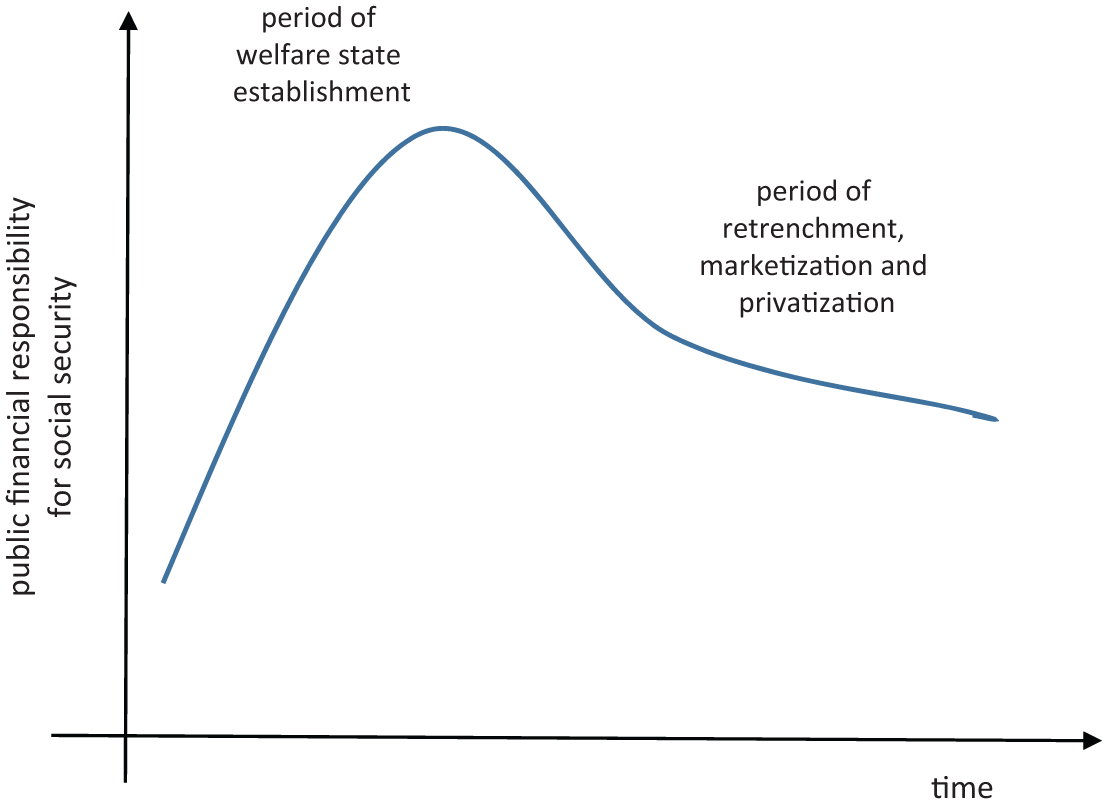
Self-responsibility as a reduction in public financial responsibility for social security in absolute terms.
Since this first form of PFR and its development has been much analyzed also in terms of marketization, privatization, and retrenchment policies, and since it does not clarify much the concept of responsibility with regard to the citizen and his or her family, in our contribution, we focus on another form of reduced public responsibility.
This second form of reduced PFR relates to public spending on social risks in times of sustained work interruptions of those having a family and for nonwork-related social contributions (i.e., societal work that goes beyond labor market participation such as caring for relatives). Classical readings of social security and social rights differ in the degree to which they consider the family of the citizen: While prominent scholars, such as Marshall (1981) or Esping-Andersen (1990), refer to the fact that the family has been a constitutive part of welfare state institutions, the major reference point of their concepts and analyses is the individual or the (average production) worker. Whether current analyses refer entirely to the individual or also to the family depends mainly on the gender awareness of the scholar and corresponds to the unclear and ambiguous concepts of citizenship in this regard in classical welfare state theory (see Lister, 2003). Thus, at least implicitly classical welfare state theories do take the family as a major component of social security and social rights into account. This is not surprising since the societal model of the time during which welfare states were established was the male breadwinner model (Crompton, 1999). Although this holds true for some countries much more strongly than for others, all European welfare states have shown family-oriented welfare state institutions (Frericks, Höppner, & Och, 2016; Pfau-Effinger, 2004).
Analytical Approach
In this contribution, we aim to answer the question whether and in how far the PFR in established welfare states has been reduced, in the sense of being reshifted onto the individual worker and his or her family. The analytical approach to answering this question relates to the second form of reduced PFR and it comprises two manifestations in which welfare state institutions have been family-oriented. One is the PFR for nonwork-related social contributions, that is, welfare states recognize and financially value different forms of societal work that go beyond labor market participation such as caring for relatives. And indeed, well-established welfare states have taken financial responsibility with regard to care tasks in considering family responsibilities in the calculation of social rights by adding entitlements to citizen- or employee-related social rights that are based on familial care (Frericks, 2010). Relevant to answering our question is here whether these entitlements have been reduced in the course of the past decades’ welfare reforms.
The second manifestation relates to social risks and poverty prevention. Here welfare states have, to an extent depending on the country and era, ascribed financial responsibility to family members and not to the public realm; that is, they apply subsidiarity. This subsidiarity assigns financial responsibility to the “lower level”—not to the public realm but to the family or individual. Some countries practice subsidiarity by refuting or ignoring PFR and thereby putting financial responsibility onto the family by default (identified for Italy by Saraceno & Keck, 2010). Mostly, though, subsidiarity is regulated explicitly and thus officially ascribed to the respective level. Since we focus on the official policy of our countries, we analyze the latter form of subsidiarity. Subsidiarity is applied for periods of long-term financial dependency on the public purse and has been organized by means of family-based means tests that include income and assets of different family members to calculate the financial responsibility of family members to maintain the claimant before he or she is financially supported by public means. With regard to our question, PFR is reduced if means tests have been strengthened with regard to family in the past three decades, that is, if PFR has been shifted onto the citizens as family members. Self-responsibility would correspond here to the concept of subsidiarity, that is, to a “nonindividualized self”.
In short, a turn toward self-responsibility in terms of reduced PFR for social security could be observed in two forms: first, a reduction of PFR for families, or, since the subject of social rights is in the end always the individual, a reduction of family-based entitlements; and, second, a reduction of PFR for social risks of those having family (see Figure 2).
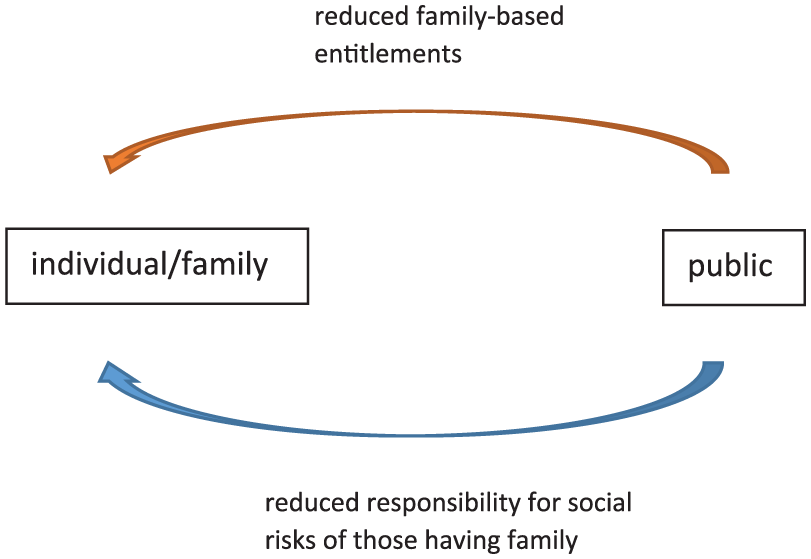
Self-responsibility as a reduction in public financial responsibility for social security in relative terms.
This trend—different from decreased public financial responsibilities in terms of retrenchment and putting responsibilities back onto the individual or family by default (general cuts in total spending)—is an explicit shift clearly observable in social policy change and measurable in relative terms, as we will show. In this contribution, we analyze these shifts in financial responsibility from the public purse to the individual for family-based entitlements on the one hand, and for social risks in terms of means tests on the other.
Methodology
Analyzing differences and changes in welfare states is a widespread undertaking. But despite the high number of publications on this issue, this undertaking is from a methodological perspective not self-evident or uniform; it is being continuously debated and is thus far from fully developed (e.g., Clasen & Siegel, 2007). The most common manner of analyzing welfare state differences and changes is based, on the one hand, on the comparison of quantitative macro data on welfare states like their expenditures, benefits, and outcomes. Studies that apply a qualitative approach, on the other hand, make do with a small number of cases. For our object of concern, both of these commonly accepted methodological approaches are unsuitable.
To answer the question of this contribution, we need to measure changes in the relative public financial responsibility within the logic of the respective social security system. That is, we need to analyze institutional differences, in the sense of measuring and quantifying differences of mainly qualitative nature, for a larger number of cases. This kind of institutional analysis is still uncommon and underdeveloped in welfare state research. Therefore, we developed a new method for doing so (Frericks, Höppner, & Och, 2018) that we apply in this study.
This method applies an ideal typical approach that corresponds to Weber’s original idea of using ideal types. Ideal types, he suggested, need to be constructed as a “limiting concept (Grenzbegriff), against which reality is compared, so that particular significant component parts of its empirical content can for the sake of clarification be measured” (Weber, 2004, p. 390, italics in original). Since we aim to answer the question whether and in how far the PFR in established welfare states has been reshifted to the individual worker and his or her family, we analyze change in family-based entitlements and family-based means tests. Consequently, the focus on the degree to which rights in terms of public means varies with claimants’ having family, requires constructing PFR for social rights with family as our ideal-type. The markedness of PFR for social security with family ranges between the “purely ideal limiting concept” of full public responsibility on the one end of our axis, and none on the other. For a more nuanced analysis, we differentiate between three dimensions of family: partner, children, and other family members. This differentiation corresponds to the main references to social rights in most welfare states (Walker, 2005). Where additional conditions are applied to these general family dimensions (such as being married or living in the same household), we weight the indicators (see below).
As elaborated above, shifts in the financial responsibility for social security with regard to family-related contributions and social risks can be identified by means of changed family-based benefits on the one hand and changed means tests on the other hand. Both rely on different subsystems of social security: the social insurance of the average citizen and the poverty preventing minimum income system. These correspond to the differences in social security as identified already by Marshall (1981) and as applied in all established welfare states in the form of the target social security level (TSSL) and the poverty prevention level (PPL) (Frericks, 2013). The first is the nationally defined benefit level and is institutionalized as the calculation norm that reflects the country’s political concept of the average citizen. The latter contains the minimum income schemes for those in need and is, in general, based on means tests.
Empirically, we draw on two social security systems: old age security systems, addressing people of pension age, and unemployment security systems, addressing the unemployed. Both systems have been reformed in all European welfare states and are, therefore, appropriate for a European comparison of change. In addition, these social security systems are sufficiently similar to be suitable for systematic comparison. In case there is no specific minimum income scheme for the unemployed or for persons of pension age in a country, we study the general social assistance at PPL where this is applied for our target groups instead. For the object of our concern, we study how the degree has changed to which public financial means for family-related rights can help reach a “full” benefit at TSSL or to which PFR is reduced by means of family-involving means tests at PPL. In old age security at TSSL the indicators of our analysis are survivor pensions for retirement age survivors, additional pension benefits if having a partner, pension entitlements for the care of a frail partner or family member, and pension entitlements for having or caring for a child. We focus on public social security only and do not consider welfare markets. If the markedness of these TSSL indicators increases, we observe an extension of PFR. This is also the case for the TSSL indicators of unemployment security that contain a higher benefit level or a longer duration of unemployment benefits if the claimant has family. At PPL, public responsibility increases if care-based entitlements are extended or introduced, and if the income and/or assets of family members are less strictly considered in means testing.
We measure this degree on an ordinal scale ranging between 0 and 1. A value of 1 means that the welfare state bears 100% of the financial responsibility for the social security of a citizen having a family. At TSSL, “full” benefits might be reached solely by means of rights related to family, so that a value of 1 corresponds to 100% public responsibility for citizens having a family. At PPL, a value of 1 means that all financial responsibility in the PPL systems is borne by the welfare state, which corresponds to 0% financial responsibility for the citizen’s family. A value of 0 means, at TSSL, that there are no family-related social rights, and at PPL, that the family has to bear the full financial responsibility for the citizen. If an indicator is based on further conditions like being married or living in the same household, we consider this by weighting the indicator. Since we are not interested in the absolute numbers but in the degree of change, we present in the following the increase (+) and decrease (−) of PFR (the absolute numbers are to be found in the appendix). A change of 0.10 equals a 10% change in the degree of PFR.
We compare the changes in PFR between 1993 and 2013. The first date allows us to get a picture of welfare state differences before major reforms began, the latter is the date for which we could best collect recent data. For each of the three family dimensions (partner, children, and other family members) at TSSL and PPL, we identify all relevant indicators, that is, regulations in old age and unemployment security systems that refer to the family.
The countries in our analysis are Denmark, France, Germany, Spain, Sweden, and the United Kingdom. The selection of countries guarantees a variation among long-established European welfare states that least controversially correspond to the major regime types in the classification approach of Esping-Andersen (1990; Ferragina & Seeleib-Kaiser, 2011). In addition, the selected countries are the most analyzed ones in comparative welfare state analysis and consequently appropriate for the further development of welfare typologies. The data that we use for these countries are comparatively reliable and complete. The raw data were collected within a research project focusing on welfare state individualization (see Frericks et al., 2016). It is based mainly on the European database Mutual Information System on Social Protection (MISSOC), data from the International Social Security Association, the Organization for Economic Co-operation and Development, and the World Bank, as well as scientific and public national and international reports and publications.
Findings
Old Age Security
In all of our six study countries PFR for social security of the citizens of pension age has increased between 1993 and 2013 both at TSSL and PPL with more changes at TSSL than at PPL.
In Denmark, PFR strongly increased on the partner dimension (+0.43) and on that of other family members (+0.44) since for caring family members the option was introduced to be employed by the municipality and thereby earn regular pension entitlements (Frericks, Jensen, & Pfau-Effinger, 2014). Pension rights based on child care increased only slightly (+0.01). At PPL, public responsibility increased also on a very low level due to a change in the basic pension’s supplement for couples (+0.01).
The United Kingdom extended PFR on all three family dimensions at TSSL and on the partner dimension at PPL. At TSSL, entitlements of survivors in the additional state pension were lowered, but PFR increased on the partner dimension because rights for caring family members were extended (+0.11). The latter is also the case for the other family members’ dimension (+0.13). On the child dimension (+0.05), the share of child care years that are considered for the basic state pension increased. As to PPL, with the abolition of the income support, the strictness of means testing decreased for the partner somewhat (+0.04; Bozio, Crawford, & Tetlow, 2010).
The changes in PFR in old age security are reported in Table 1 for both TSSL and PPL. A plus (+) indicates an increase and a minus (−) a decrease in PFR.
Changes in Public Financial Responsibility for Old Age Security of Individuals with Family (from 1993 to 2013, TSSL and PPL).
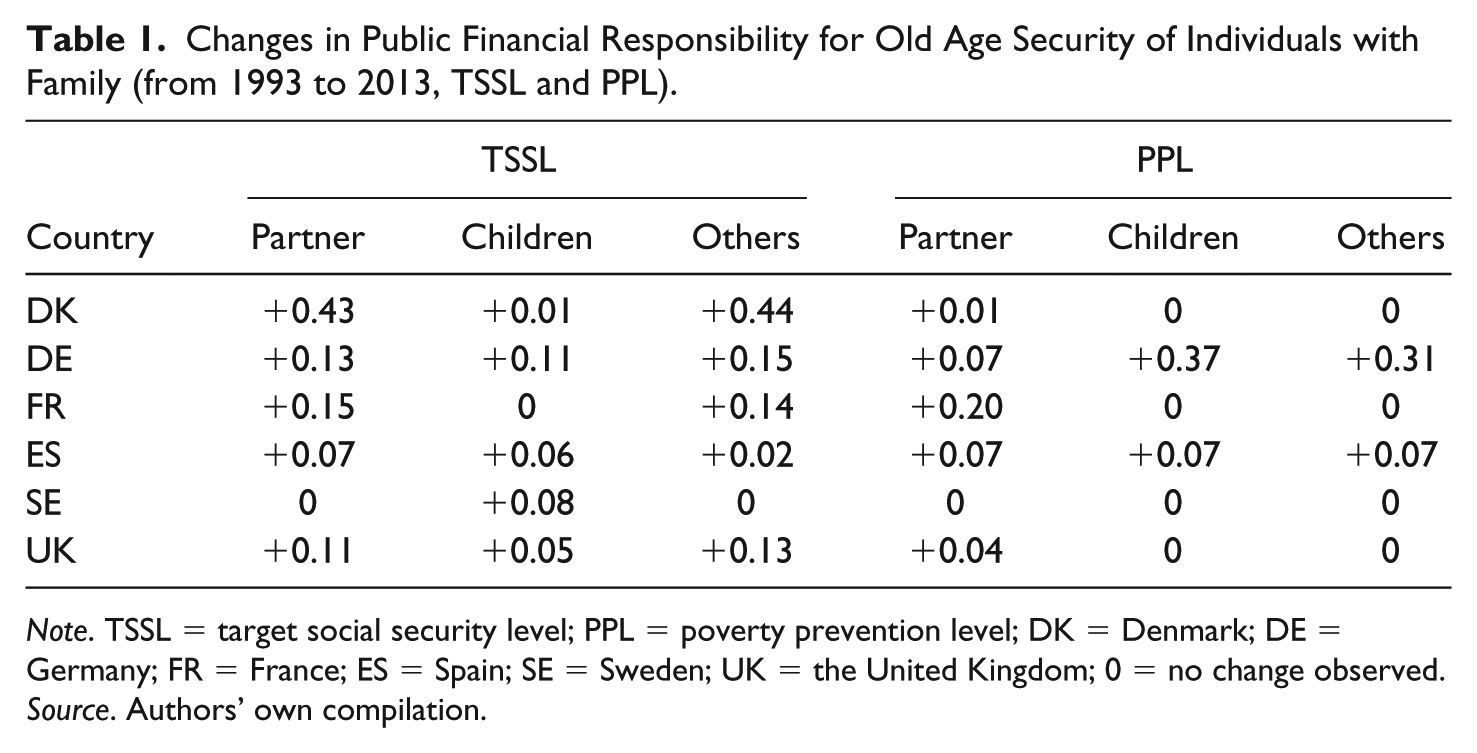
Note. TSSL = target social security level; PPL = poverty prevention level; DK = Denmark; DE = Germany; FR = France; ES = Spain; SE = Sweden; UK = the United Kingdom; 0 = no change observed.
Source. Authors’ own compilation.
Between 1993 and 2013, PFR for old age security increased in Germany at TSSL on all three family dimensions. On the partner dimension—as in the United Kingdom—the amount of the survivor pension was lowered in 2001 (Deutscher Bundestag, 2001), while on the partner (+0.13) and other family members dimension (+0.15) pension entitlements for caring for a frail family member were significantly extended (Bäcker, Bispinck, Hofemann, Naegele, & Neubauer, 2008). On the child dimension, Germany also extended PFR (+0.11) as benefits for parents with low income and for survivors were introduced what might help a citizen to reach a “full” pension. At PPL, PFR increased in the course of the reform of social assistance for persons of pension age in 2003. Means testing of family members became less strict, especially for children (+0.37), but also for partners (+0.07) and other family members (+0.31; Goedemé, 2012).
We find a similar development, although less pronounced, in Spain. At TSSL, the amount of the survivor pension was raised (Boldrin, Jimenez-Martin, & Peracchi, 1999; MISSOC, 2018) and new entitlements for caring relatives were introduced (+0.07), which led to a higher PFR on the partner dimension (Gutiérrez, Jiménez-Martín, Vegas Sánchez, & Vilaplana, 2010). The latter also applies to the other family members’ dimension (+0.02). Moreover, the period of parental leave considered in the pension calculation was extended from, in total, 1 year to 3 years of the 35 contribution years necessary to receive a “full” pension (child dimension +0.06). At PPL, on all three family dimensions the means testing became less strict and hence, PFR increased (+0.07; Eardley, Bradshaw, Ditch, Gough, & Whiteford, 1997; MISSOC, 2018).
In France at TSSL, PFR was extended on the partner (+0.15) and other family members dimensions (+0.14), again because of the introduction of new pension entitlements for caregiving relatives (Keefe, 2004) and (on the partner dimension) a slight increase in the benefit level of the survivor pension. For PPL, we observe both an increase and a decrease in PFR. In 1993, a rather strict means test was applied only to the partner without considering children or other family members. With the introduction of the ASPA, means testing became less strict for the partner (+0.20; Eardley et al., 1997; MISSOC, 2018).
Last, in Sweden, with the introduction of the new pension system in the late 1990s/early 2000s, pension entitlements for having children increased (Anderson & Meyer, 2006) so that we identify a change on the child dimension (+0.08).
Table 2 aggregates the changes at TSSL and PPL by listing the overall development on the three family dimensions as well as the mean change of the three dimensions. We compute the mean here for two reasons. First, the calculation of values for differentiated family dimensions was helpful for a clear and transparent analysis of the data; however, the focus of this contribution is the change in PFR for social security of those having family in general; second, the reference points of our data are the ideal-typical values of 0 and 1 and the mean corresponds to this logic.
Overall Change of Public Financial Responsibility for Old Age Security of Individuals with Family (from 1993 to 2013).
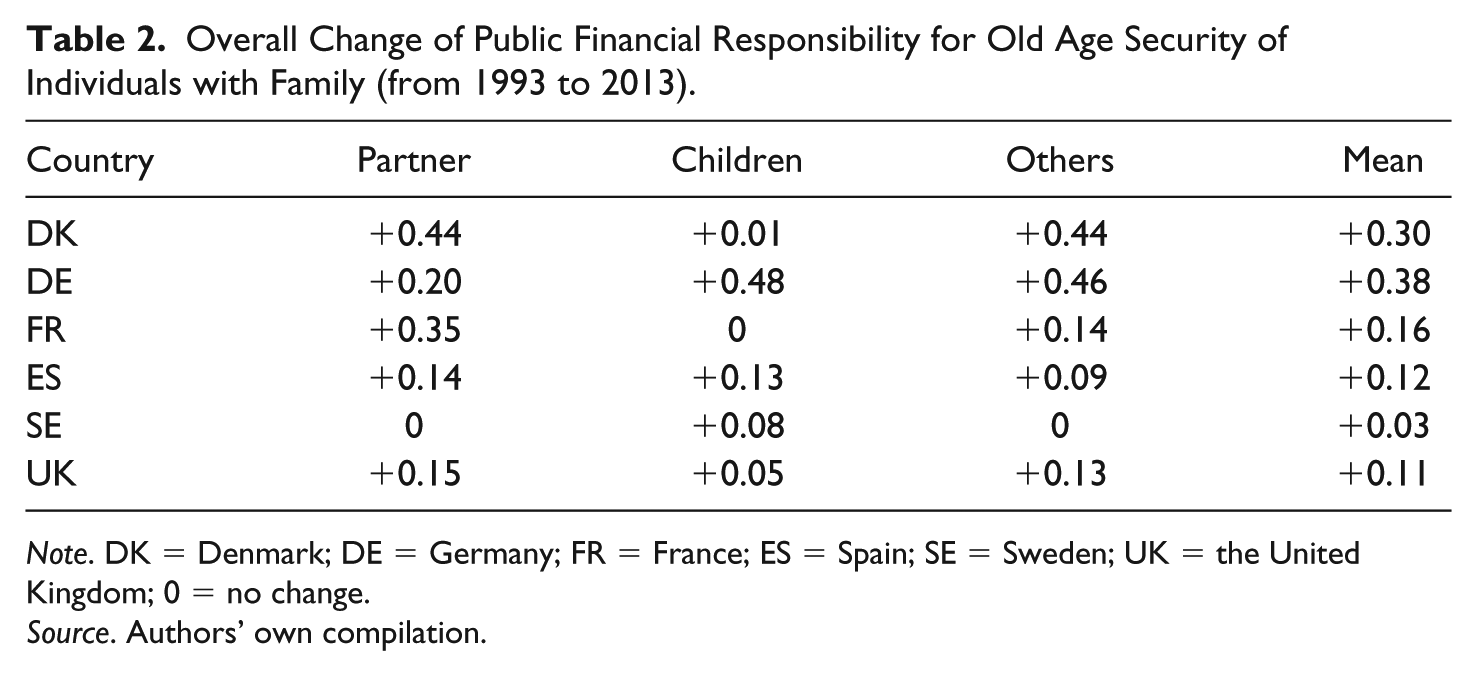
Note. DK = Denmark; DE = Germany; FR = France; ES = Spain; SE = Sweden; UK = the United Kingdom; 0 = no change.
Source. Authors’ own compilation.
In summary, we find an increase in PFR at least on one of the three family dimensions in all six countries. There is a large variation between the cases as for instance the change on the child dimension is negligible in Denmark (+0.01) and extraordinary in Germany (+0.48). There are no observations of a decrease in PFR for old age security.
Accordingly, the mean values for each country show that there is no average decrease in PFR. There is, though, a huge variation in the degree of increase in PFR which is largest in Germany (+0.38) and smallest in Sweden (+0.03). Again, this concerns, as clarified above, a change in the relative financial responsibility for the two predefined social security levels; it does not address entitlements in absolute terms.
Unemployment Security
As for unemployment security, the picture becomes more complex as some countries have extended PFR, while others reduced it. The changes are summarized in Table 3.
Changes in Public Financial Responsibility for Unemployment Security of Individuals with Family (from 1993 to 2013, TSSL and PPL).
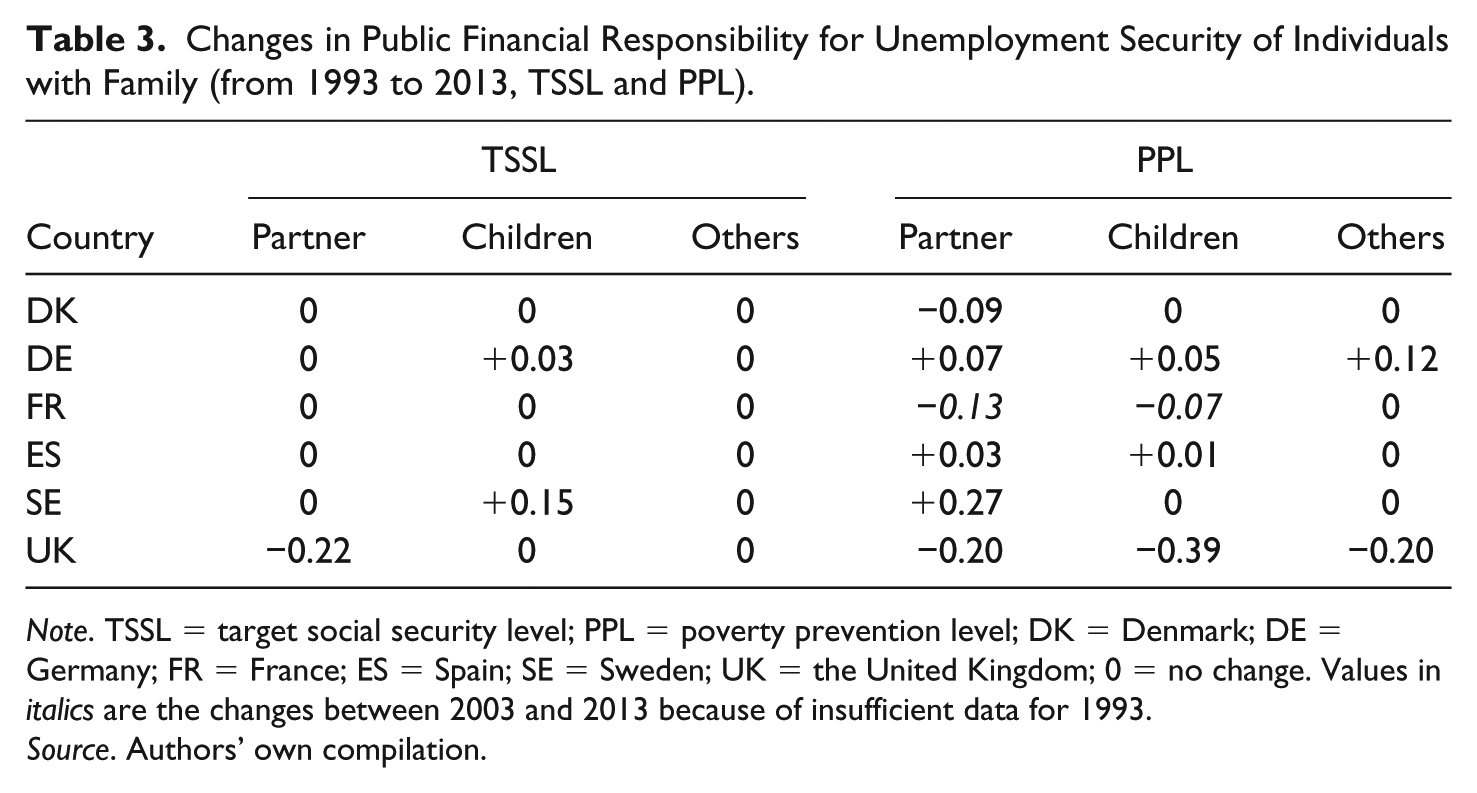
Note. TSSL = target social security level; PPL = poverty prevention level; DK = Denmark; DE = Germany; FR = France; ES = Spain; SE = Sweden; UK = the United Kingdom; 0 = no change. Values in italics are the changes between 2003 and 2013 because of insufficient data for 1993.
Source. Authors’ own compilation.
In Denmark and France, PFR for social security of the unemployed with family was reduced at PPL between 1993 and 2013; it did not change at TSSL. Both countries intensified the strictness of the means test, which was in France due to the introduction of the revenue de solidarité activé (Legros, 2009). While in Denmark this change only refers to the partner dimension (−0.09), in France it also concerns the child dimension (−0.13 partner and −0.07 child).
In Germany, there was an increase in PFR at TSSL on the child dimension (+0.03) because of a change in the amount of the benefit for unemployed with children (Bleses & Seeleib-Kaiser, 2004). We also find an increase in PFR at PPL because means testing became less strict for the partner (+0.07), for children (+0.05), and for other family members (+0.12).
Similarly, in Sweden PFR was increased on the child dimension at TSSL (+0.15) because benefits for unemployed with dependent children were extended in 2007 (Bengtsson, 2014). At PPL, the duty to maintain the partner became less strict in 2003, which results in an increase in public responsibility (+0.27).
In Spain, at PPL means testing became slightly less strict on the partner (+0.03) and children dimension (+0.01).
Last, in the United Kingdom, there were changes at TSSL and PPL, all of them in form of a decrease in PFR. At TSSL on the partner dimension (−0.22), family supplements were abolished when the contribution-based Jobseekers’ Allowance was introduced in 1996 (Clasen, 2011). On all three dimensions at PPL, the requirement of labor market availability became stricter for persons with care responsibilities, i.e. the care-based entitlements have been reduced (−0.20 partner and other family members, −0.30 child; see also the contribution of Jane Millar, this issue). Moreover, with the introduction of the Jobseekers’ Allowance, a child’s income was included in means testing under certain conditions (additional −0.09 on the child dimension).
Table 4 summarizes the findings for unemployment security at TSSL and PPL and provides also the mean values for the change in PFR of each country. Compared with old age security, the picture for unemployment security is more complex because three countries decreased PFR at PPL and, in case of the United Kingdom, also at TSSL, while three other countries on average increased PFR (see mean value). Changes are most numerous on the partner dimension and less so on the other family members dimension where we only find a change in PFR in two countries. While in Sweden (+0.14), Germany (+0.09), and Spain (+0.01) PFR increased, Denmark (−0.03), France (−0.07), and even more clearly the United Kingdom (−0.34) have decreased PFR.
Overall Change in Public Financial Responsibility for Unemployment Security of Individuals with Family (from 1993 to 2013).
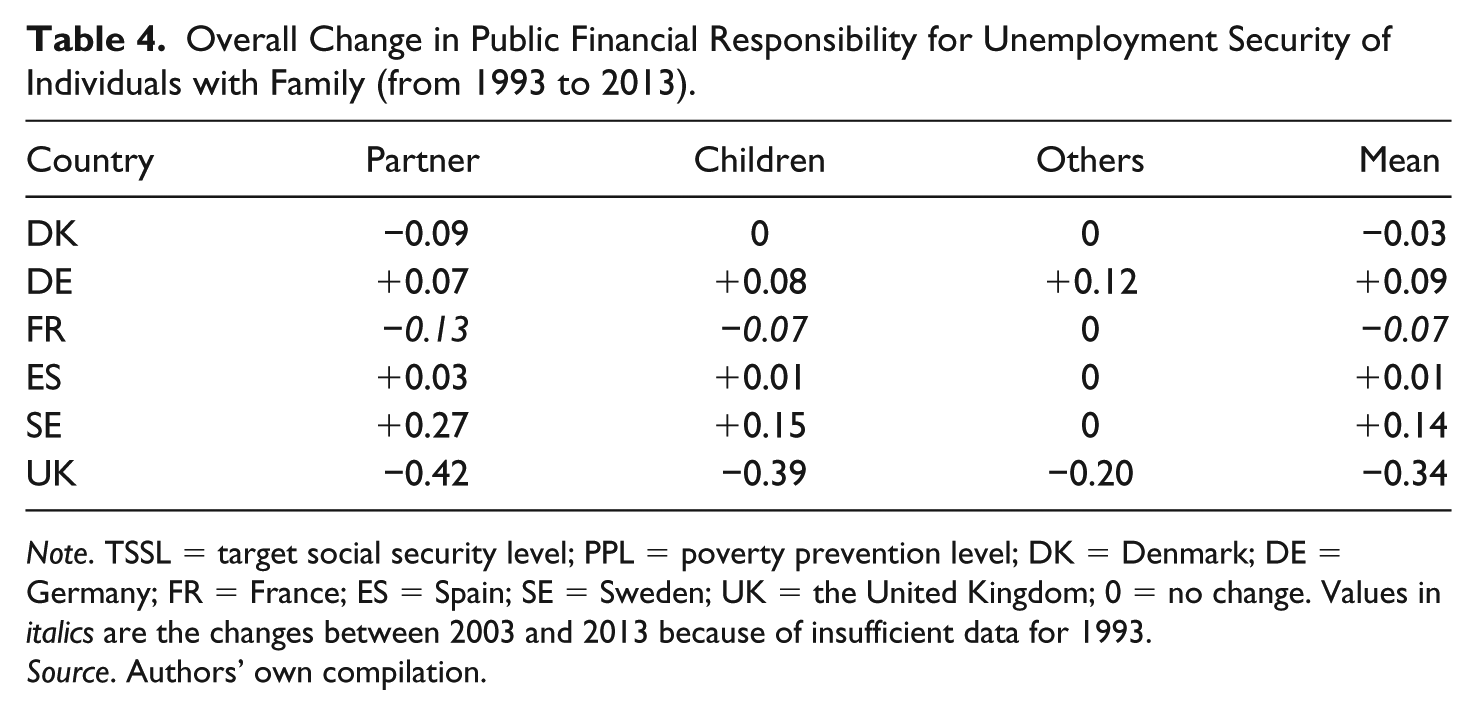
Note. TSSL = target social security level; PPL = poverty prevention level; DK = Denmark; DE = Germany; FR = France; ES = Spain; SE = Sweden; UK = the United Kingdom; 0 = no change. Values in italics are the changes between 2003 and 2013 because of insufficient data for 1993.
Source. Authors’ own compilation.
Discussion
The findings show that there is no general reduction in PFR. On the contrary, in all of our countries we observe an increase in PFR at both security levels in old age security; in unemployment security, the picture is somewhat more complex.
The observed changes in the mean show that in old age security in all six countries PFR increased between 1993 and 2013. In unemployment security, in three of the six countries, PFR decreased instead. The markedness of the change in the mean ranges from +0.14 (Sweden) to −0.34 (the United Kingdom) in unemployment security, and between +0.38 (Germany) and +0.03 (Sweden) in old age security. Among our six countries, the United Kingdom, France, and Denmark reduced PFR in unemployment security, but increased PFR in old age security. Germany, Sweden, and Spain increased in both policy fields PFR. Hence, our observations do not fit well the welfare regime typology. Indeed, it has been much contested (Leitner, 2003; Lister, 2003) whether the welfare regime approach has adequately covered differences with regard to the institutionalization of the family in welfare states. Current institutional analyses show that this is not the case (Frericks et al., 2016). This is not surprising though, since, as shown above, the main concepts of citizenship and social rights have not systematically conceptualized the citizen (and the corresponding PFR) as an individual or as a family member.
Changes in the different analytical units (security levels, policies, and family dimensions) show that we observe most changes in old age security (24), and none of these was a reduction in PFR. In unemployment security, 15 changes were identified; 7 of them, however, were a reduction in PFR. How can we interpret these differences? Roughly speaking, there seems to be a general approval of improving family-based entitlements for the elderly. The literature would suggest interpreting these findings in terms of current deservingness discourses that favor the elderly over the unemployed (Bahle, Hubl, & Pfeifer, 2011; Van Oorschot, 2006). Drawing on an earlier study of Frericks (2013), however, would suggest that in the course of individualizing pension rights in terms of the entitled unit, rights have been shifted from the family to the individual. Our findings partly confirm this interpretation: While family as the unit of social rights changed ambivalently between countries (toward the individual in the United Kingdom and Germany by means of lower survivor pensions, but toward the family in France and Spain by means of higher survivor pensions), we observe, indeed, a clear extension of social rights reasons in terms of family in our cases. By means of entitlements for child care and care of frail family members, individual rights increased that are based on the family. Hence, while at TSSL PFR for families as a unit are partly reduced (e.g., widows’ pensions), PFR for family-based rights, that is, family included as a reason for social rights, are partly extended (e.g., child care credits). In the German and British old age security system, this development seems to be a shift in PFR from the first (family as the unit of rights) to the latter (family as the reason for individual entitlements). Moreover, combined with the fact that family is more financially responsible in case of need (means tests), one could interpret this development as a change toward a stricter behavioral norm as identified earlier by Frericks (2014). Social rights, thereby, depend more on ideally complying with the “ever more all-encompassing” and more strictly regulated norm of behavior as set down in the conditions of social security institutions, corresponding to a form of self-responsibility which is neither a “stand-alone” nor an individualized one. This interpretation of developments also seems reasonable in terms of regulations specifying the responsibilities of the individual and the family toward each other, such as those of the different family members in case of divorce or surviving spouses. We did not add these regulations to the analysis above as they do not involve public financial means but are limited to redistribution within a family. They add, however, to our discussion. Germany for instance introduced pension splitting for spouses in 2001, indicating that family is not seen any more as a private black box but as an issue of public concern. In terms of regulations though, it forms rather part of the subsidiarity principle that has thereby been strengthened in part also because, in financial terms, public financial means are not concerned but only those of the family.
Subsidiarity is also what we see when we compare changes in TSSL with those in PPL. In TSSL, we identified 18 changes in total, with one of them as a decrease in PFR. In PPL by contrast, nearly one third of the 21 changes (6) are a decrease in PFR. In other words, six of the seven changes toward a reduction in PFR took place at PPL. This seems to indicate a shift toward subsidiarity in that, in case of need, the family is increasingly the unit to refer to—not the public purse. Since the total of seven changes as a reduction in PFR makes not even one fifth of the total changes identified (39), this development, however, is only part of the picture. To draw again on the earlier argument of deservingness, here it makes sense since PFR increased with regard to rights that correspond to full rights of the average citizen, while it decreased with regard to rights of those in need, which is especially the case of the unemployed. This development is clearest in the United Kingdom because it is the country with the most reductions in PFR in four research units, and the clearest decrease in PFR on average, with 0.34 in unemployment security.
Conclusion
Social security had been established to reduce the private financial responsibility of citizens for social risks. The citizens have thereby been traditionally interpreted and institutionalized as the individual worker and his or her family. In welfare state analysis, a turn toward self-responsibility has been discussed and identified first and foremost as a decrease in public financial responsibility (PFR) in absolute terms, that is, as retrenchment or recalibration policies. In this study, we asked in how far the financial responsibility for social security has been shifted away from the public hand toward the citizen in terms of a change in relative financial responsibility for social security.
The basic argument of our contribution is that understanding welfare state change with regard to (self-)responsibility is possible only if we look closer at what is happening in welfare states with regard to shifts in responsibilities. We started our undertaking by reviewing the main literature and clarifying our approach, which posits that social security has been institutionalized for the individual, but has always included family in one way or another. Individuals with family have been treated differently in terms of social rights from those not having family, both in extended entitlements and in reduced entitlements. Correspondingly, the welfare state change that we are interested in can appear in two forms: First, a reduction in PFR when (family-based) means tests become stricter; second, a reduction in PFR when family-based entitlements are downsized. The first change corresponds to an increase in subsidiarity in shifting PFR back to the family. This family focus of responsibility differs from self-responsibility as commonly referring to the individual. Stricter means tests thereby would be explicit policy decisions toward subsidiarity, a development that hardly corresponds to the general policy discourse on the European, national, and local levels which refer to the responsibility of the individual as corresponding to current policy approaches. The second change,—downsized family-based entitlements—corresponds to retrenchment (and lead to subsidiarity rather by default) as generally addressed by welfare state literature. Consequently, we analyzed shifts in responsibility by identifying the degree to which PFR changed with regard to social security. We did so for two social security levels (Target Social Security Level and Poverty Prevention Level) and two target groups (for those of pension age, and for the unemployed) and compared the relative PFR for social security of those having family in 1993 and in 2013 in six European countries.
Our findings show that we partially observe the first change—stricter means tests in unemployment security—in half of our study countries, but the opposite of the second change, that is, an increase in family-based entitlements. These findings contradict the general interpretation of welfare state change as retrenchment or recalibration since, in relative terms, public responsibility for social rights increased. In addition, they confirm—but only partly so—a development toward subsidiarity when it comes to means-tested benefits, in form of a shift from PFR to the family.
We offered in the foregoing discussion some interpretations with regard to specific developments and differences. With regard to the focus of this special issue,—self-responsibility—we interpret the findings as follows. Reductions in PFR and trends to shift financial responsibility for social security back from the public purse to the citizens do not prevail. Self-responsibility, consequently, is not so much implemented in terms of neoliberal cuts and do-it-yourself individual units (earlier referred to as “the market society”). Instead, we observe a turn toward self-responsibility in terms of reduced family rights accompanied by the individualization of rights that include (new) family-based entitlements (first and foremost with regard to public resources – increase in family-based rights – and in part by family resources – increase in family-related regulations such as pension splitting). Concurrently to this individualization that attends an increase in individual rights, we observe in some countries a reshift of PFR onto the family (subsidiarity). Self-responsibility, thus, is institutionalized as a public concern accompanied by PFR and embedded as a publicly regulated family concern. Citizens, in other words, are not conceived in welfare state regulations as isolated and self-reliant individuals, but as subjects embedded in both the public and family spheres.
Footnotes
Appendix
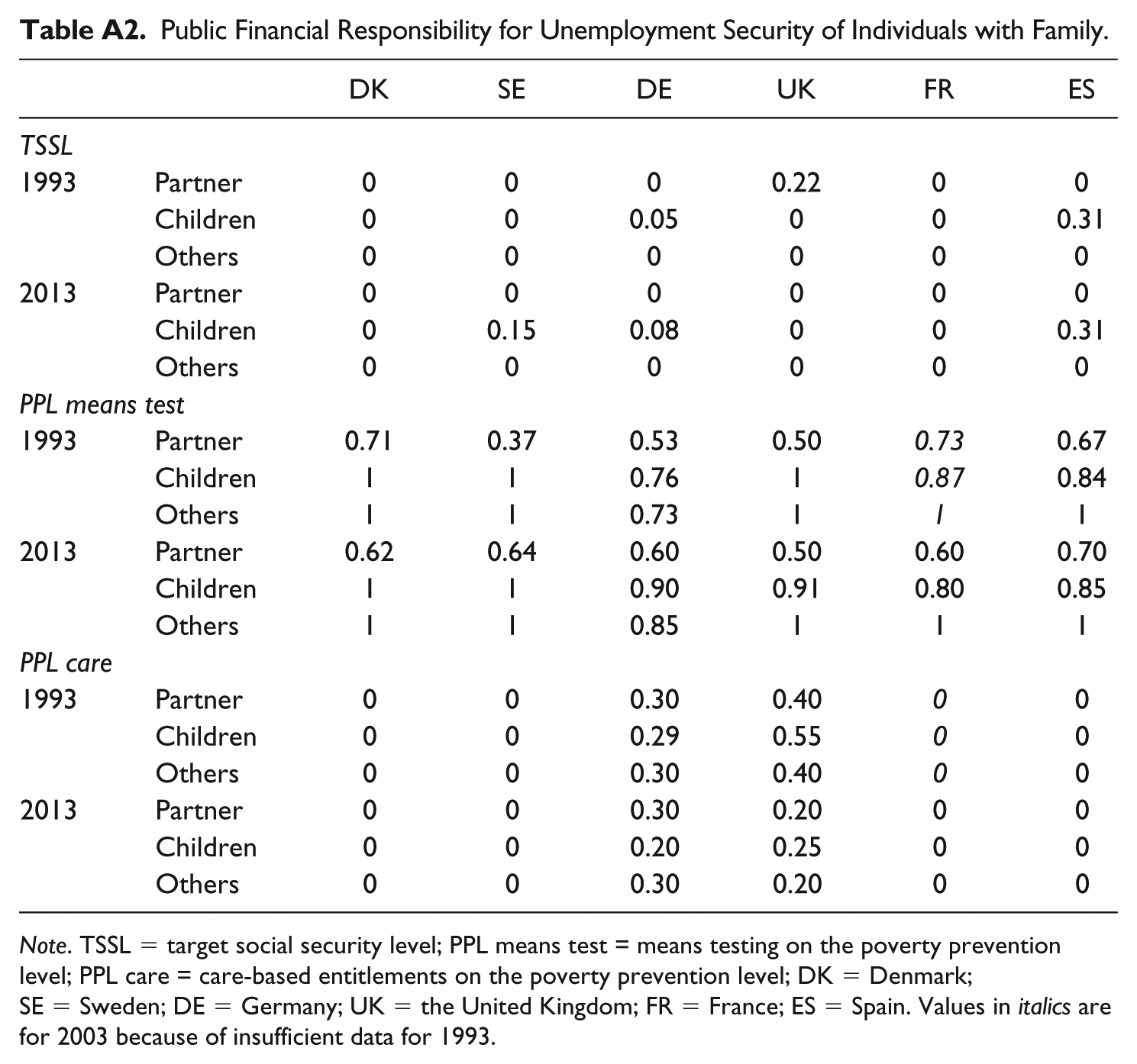
Public Financial Responsibility for Unemployment Security of Individuals with Family.
| DK | SE | DE | UK | FR | ES | ||
|---|---|---|---|---|---|---|---|
| TSSL | |||||||
| 1993 | Partner | 0 | 0 | 0 | 0.22 | 0 | 0 |
| Children | 0 | 0 | 0.05 | 0 | 0 | 0.31 | |
| Others | 0 | 0 | 0 | 0 | 0 | 0 | |
| 2013 | Partner | 0 | 0 | 0 | 0 | 0 | 0 |
| Children | 0 | 0.15 | 0.08 | 0 | 0 | 0.31 | |
| Others | 0 | 0 | 0 | 0 | 0 | 0 | |
| PPL means test | |||||||
| 1993 | Partner | 0.71 | 0.37 | 0.53 | 0.50 | 0.73 | 0.67 |
| Children | 1 | 1 | 0.76 | 1 | 0.87 | 0.84 | |
| Others | 1 | 1 | 0.73 | 1 | 1 | 1 | |
| 2013 | Partner | 0.62 | 0.64 | 0.60 | 0.50 | 0.60 | 0.70 |
| Children | 1 | 1 | 0.90 | 0.91 | 0.80 | 0.85 | |
| Others | 1 | 1 | 0.85 | 1 | 1 | 1 | |
| PPL care | |||||||
| 1993 | Partner | 0 | 0 | 0.30 | 0.40 | 0 | 0 |
| Children | 0 | 0 | 0.29 | 0.55 | 0 | 0 | |
| Others | 0 | 0 | 0.30 | 0.40 | 0 | 0 | |
| 2013 | Partner | 0 | 0 | 0.30 | 0.20 | 0 | 0 |
| Children | 0 | 0 | 0.20 | 0.25 | 0 | 0 | |
| Others | 0 | 0 | 0.30 | 0.20 | 0 | 0 | |
Note. TSSL = target social security level; PPL means test = means testing on the poverty prevention level; PPL care = care-based entitlements on the poverty prevention level; DK = Denmark; SE = Sweden; DE = Germany; UK = the United Kingdom; FR = France; ES = Spain. Values in italics are for 2003 because of insufficient data for 1993.
Acknowledgements
This contribution is, in the broader sense, a result of the research project INDIV (Individualization of the Social Citizen: Developments and Contradictions in Europe), which was generously financed by the Fritz Thyssen Foundation and led by Patricia Frericks from 2014 to 2017. The raw data on unemployment security were collected by Ralf Och who kindly agreed to provide them for this analysis. The data presented here have been recoded for this analysis.
Declaration of Conflicting Interests
The author declared no potential conflicts of interest with respect to the research, authorship, and/or publication of this article.
Funding
The author received no financial support for the research, authorship, and/or publication of this article.