







Abstract
This study aims to explain the solidarity behavior toward a specific needy group that is not part of the national community (refugees) in comparison with vulnerable in-groups (the disabled or the unemployed), taking into account the interplay between individuals’ political orientations and their social dispositions based on the ranking preferences of solidarity beneficiaries. Through a multivariate regression analysis of survey data in eight European countries, we find that respondents’ ranking preferences have a lower impact on solidarity practices toward refugees, which are strongly fostered by progressive political orientations. This means that support for refugees relies on a universalistic conception of solidarity and entails political commitment to both leftist positions on economic issues and to libertarian stances on cultural issues. The latter only affect solidarity actions toward needy out-groups, unveiling the tensions between universalistic-particularistic concerns that are embodied in individual perceptions of deservingness between groups and in the cultural–identitarian dimension of political conflict.
Keywords
Introduction
The increased inflow of refugees from Syria and other regions affected by wars, the inability of the European Union institutions and its member states to establish a coordinated asylum policy and mechanisms of admission and integration, and the success of populist parties and the mobilization of Eurosceptic and xenophobic protests across Europe have all raised concerns that solidarity toward vulnerable groups that are not part of national community, such as refugees, is severely at risk. Nevertheless, the refugee crisis has also highlighted the importance and growth of transnational solidarity organizations (Ataç, Rygiel, & Stierl, 2016). Indeed, a web of civic engagement sustained by civil society organizations has been working on a daily basis to meet the basic needs of refugees, taking the form of both advocacy and service provision. How widespread are these solidarity activities in favor of refugees? And which individual characteristics favor such activities? Building on a comparison between needy vulnerable groups, we examine solidarity practices toward in-groups that are a part of European countries’ national community (e.g., unemployed people and people with disabilities) against needy, vulnerable out-groups (refugees). The main goal of the current study is to examine the explanatory factors that account for the differences in individual solidarity-based behavior toward refugees based on political attitudes and perceptions of deservingness between groups.
Understanding the attitudinal and political drivers of solidarity practices toward refugees in the European context is a goal that deserves scholars’ attention due to the centrality that migration-related issues have acquired lately on the public agenda. Migration is not a neutral issue from a political standpoint: Scholars have stressed the importance of new cultural issues such as migration for contentious politics (Flanagan & Lee, 2003; Kriesi et al., 2006) and for the success of right-wing populist parties (Mudde, 2011). Consequently, we can expect that political orientations are important to explain not only antirefugee attitudes and behaviors but also prorefugee solidarity practices.
In addition, literature on migration attitudes and migrants as solidarity recipients has highlighted that perceptions of deservingness are bounded by identity and reciprocity concerns that situate migrants as the least deserving solidarity recipient (van Oorschot, 2000, 2006). Likewise, we expect that solidarity behavior toward refugees will also depend on individuals’ deserving rank preferences and embodies identity differentiation mechanisms by which one can assume that people will engage less in solidarity practices in favor of refugees.
Recent literature on attitudes toward welfare state redistribution shows that universalistic concerns and political values are key to understanding ranking preferences toward welfare recipients. In previous studies focused on solidarity practices in specific national contexts, we highlighted the importance of political factors and perceptions of deservingness as covariates of solidarity-based behavior in general (Fernández G. G., 2018; Maggini, 2018). Now, we aim at unveiling whether such findings affect beneficiary group types differently and if it can be generalized through a pooled analysis of eight countries covering part of the political, cultural, and socioeconomic diversity of Europe (Denmark, France, Germany, Greece, Italy, Poland, Switzerland, and the United Kingdom). One of the major contributions of this article is that it unveils the fact that solidarity-based behavior toward refugees is rooted in the cultural–identitarian political divide (particularism vs. universalism), which is channeled through political orientations and social dispositions of perceptions of deservingness. The structure of the article is as follows: The first section briefly reviews the literature on solidarity and introduces the hypotheses to be tested, the second section presents the methodological approach, and the third section shows the empirical results: First, it provides a general picture of a variety of solidarity practices in eight European countries with respect to a specific out-group (refugees); second, it shows the findings of the statistical analysis to verify our hypotheses; and in the end, we wrap up with concluding remarks.
Solidarity Behavior: Theory and Hypotheses
We conceive solidarity practices as actions through which individuals engage to help or support others in struggle or in need, be that through contributions or by active support of activities. Through our own survey, we aimed explicitly to measure various forms of reported solidarity actions (e.g., donate money, donate time, engage as a passive or an active member of an organization, engage in lobbying and advocacy), which cover the charitable, civic, and political dimensions of solidarity. These various forms of solidarity practices give us a reliable picture about the extent to which European citizens are committed to support refugees.
With respect to solidaristic prosocial behavior, scholars have explained solidarity practices through factors related to social traits, social capital, and social beliefs (Gundelach, Freitag, & Stadelmann-Steffen, 2010; Wilson, 2000). In this article, however, we are interested in covariates of target-oriented solidarity behavior toward refugees, rather than in covariates of solidarity-based behavior in general. Several studies on the so-called “deservingness” debate about the welfare distribution have shown that in Europe immigrants are considered less entitled to welfare than native needy social categories such as the elderly, the handicapped, or the unemployed (Applebaum, 2002; Bay & Pedersen, 2006; van Oorschot, 2006, 2007). According to van Oorschot (2006), community membership and shared obligations, characterized by “identity” and “reciprocity” criteria, are at the basis of the low perceived deservingness of immigrants. Indeed, through the social marker of citizenship, one could argue that norms of reciprocity are stronger within groups than between groups. Crepaz and Lijphart (2008) indicate “Being a citizen means to be endowed with a repertoire of rights and obligations that is not, by definition, available to outsiders” (p. 2). Refugees, who are not part of the national community of their host society, can be therefore seen as a less deserving vulnerable out-group compared with the more deserving vulnerable in-groups such as the disabled and the unemployed. Comparing the correlates of solidarity behavior toward needy out-groups against needy in-groups can allow us to examine the tensions between universalistic-particularistic individual concerns that polarize immigration debates.
Therefore, we consider two streams of literature relevant to understanding the identitarian–cultural conflict—one on political factors and the other on the perception of out-groups’ deservingness.
With respect to the stream of research on political correlates, scholars agree that solidarity is highly patterned by political preferences and ideological orientations (Blekesaune & Quadagno, 2003; Likki & Staerklé, 2014). Political factors seem to be particularly relevant to explain solidarity toward out-groups such as refugees. Indeed, immigration-related issues are divisive issues that are at the center of the political agenda nowadays, and solidarity toward refugees apparently has become a contentious field that separates people with different political orientations. In this regard, various studies dealing with the ideological outlook of Western publics unveiled a bidimensional structure of the political space (see Grasso & Giugni, 2018). One dimension relates to issues of economic equality, dividing supporters of economic redistribution from supporters of laissez-faire economics (the traditional economic left–right distinction). The other dimension concerns issues of social order and cultural diversity, based on the contrast between authoritarian and libertarian positions (Kitschelt, 1994). According to Beramendi, Häusermann, Kitschelt, and Kriesi (2015), the authoritarian-libertarian positions can be combined with concerns for group identity and diversity in an increasingly multicultural world (national demarcation vs. supranational integration; Kriesi et al., 2006). In this regard, scholars have shown that people with cosmopolitan attitudes are overrepresented among the middle classes with a high level of education (Achterberg & Houtman, 2009; Houtman, Achterberg, & Derks, 2008), who usually combine cultural liberalism with prowelfare preferences (Kitschelt & Rehm, 2014), according to the traditional unidimensional distinction between progressiveness and conservatism (Middendorp, 1978). This dichotomy states that progressive people support both economic equality and cultural pluralism, whereas conservative people support both economic freedom and cultural uniformity.
Relying on these insights, we expect that individuals with more prorefugee sentiments will hold progressive positions (both on the economic and on the cultural dimension). Namely, we hypothesize the following:
Consequently, the libertarian cultural positions, as part of an overall progressive attitude, should be relevant to explain solidarity activism toward refugees. However, for many people, the libertarian–authoritarian cultural divide does not overlap with the left–right economic divide, given the aforementioned increasing bidimensionality of political space of Western countries. Indeed, electoral studies have highlighted the increasing presence of voters who combine right-wing stances on cultural (especially immigration) issues with relatively left-wing positions on workers’ protection, income redistribution, and international trade (the so-called left-authoritarians; see Mudde, 2007, on welfare chauvinism). This is especially with regard to working-class voters who have been increasingly attracted over the past decades by the conservative and authoritarian stances on immigration of right-wing populist parties (Mudde, 2011). Therefore, it is possible that needy in-groups (e.g., the unemployed) are supported not only by progressive people à la Middendorp but also by people with left-wing positions on the economy and with authoritarian stances on the cultural dimension. Hence, we hypothesize that the cultural divide (libertarian vs authoritarian values) of the political space is relevant to explain solidarity behavior only when refugees are the target of solidarity:
The aforementioned cultural dimension of the political space distinguishes preferences for a “universalistic” conception of social order in which all individuals, regardless of their social or ethnic background, should enjoy the personal freedoms to make choices about their lives, from preferences for a “particularistic” conception that entails a clear demarcation of boundaries between those who are members of a collective heritage and tradition and those who are not (see Häusermann & Kriesi, 2015).
This latter point would suggest that the universalistic-particularistic public divide also shapes social dispositions toward out-groups, which influence solidarity attitudes and behaviors toward refugees. In this sense, solidarity is not only attached to abstract universal communities but also to specific reference groups. In particular, specific acts of solidarity seem to be conditional and thus tied to images and perceptions of target groups’ deservingness. In this study, we are not interested in the mechanisms explaining perceptions of deservingness. Rather, we focus on how the individual rank preferences of informal solidarity recipients affect solidarity practices toward refugees compared with needy in-groups (the disabled or the unemployed people). We advance that these ranking preferences also inform us about the public divide between universalistic-particularistic display in people’s attitudes and behaviors toward certain vulnerable groups. As previously mentioned, public perceptions of the relative deservingness of needy groups shows that independent of the welfare state model and context, individuals rank immigrants as less deserving according to an “identity” criterion, being an out-group very different from the in-group of European citizens (van Oorschot, 2000, 2006). Thus, public preferences of solidarity beneficiaries situate refugees as less deserving regardless of their social needs and risks. Moreover, various studies, in particular in the United States, have shown that social programs targeted at groups with a negative public image are less supported by the public (Huddy, Jones, & Chard, 2001; Katz, 1989). Consequently, we hypothesize that the probability of engaging in solidarity practices decreases toward groups that individuals perceive as less deserving on the basis of identitarian considerations:
Aside from group-specific correlates of solidarity and regardless of the target group, we assume that there are individual characteristics fostering solidarity in general. Hence, we integrate and control in our analysis of solidarity practices for other factors considered as determinants of prosocial solidarity behavior. Among other political factors, we control for political involvement in terms of interest in politics because it is often associated with civic engagement (Scrivens & Smith, 2013) and with voting choices, especially of the young people (Maggini, 2016). Additionally, we control for social capital measures such as social trust and frequency of social connections (Halpern, 2005; Putnam, Feldstein, & Cohen, 2003), social beliefs such as religiosity (Abela, 2004; Lichterman, 2015) and social tolerance (Leite Viegas, 2007), and sociodemographic characteristics and social traits of individuals such as age, gender, education, income, and social class (Beyerlein & Bergstrand, 2013; Valentova, 2016).
Data and Methods
The present analysis uses data from the TransSOL survey conducted in November-December of 2016, in eight countries included in the project: Denmark, France, Germany, Greece, Italy, Poland, Switzerland, and the United Kingdom. The questionnaire contains standardized cross-national measures of people’s behaviors, attitudes, and beliefs in a broad range of important societal domains. The country samples consisted of at least 2,061 to 2,221 respondents each, with a pooled data set of 16,916 cases. To test our hypotheses, we carried out statistical analyses with pooled data. 1 Concretely, we built a multivariate logistic regression model with dummies for countries to control for contextual differences between countries. We operationalized the dependent variable—that is, solidarity practices toward specific target groups—by combining a series of questions about different kinds of solidarity actions that help mirror the charity, civic and political dimensions of solidarity: donating time or money, passive and active membership in organizations, buying (or refusing to buy) products, and protest participation. 2 The reliability scale between these items is high (alpha test 0.66): Thus, the items shared an important covariance, measuring the same underlying concept. Consequently, we created dichotomous dependent variables (0 = no action, 1 = at least one action) for the target groups: one for out-group (refugees) and one for in-groups (the unemployed or people with disabilities). Indeed, we are aware that solidarity behavior toward refugees, the unemployed, and the disabled could show different patterns. However, we focus on the distinction between in-groups and out-groups as it informs us how solidarity behavior toward vulnerable groups differentiates between needy groups that are part of the political community and those who are not. We consider that this distinction allows us to capture the public divide between universalistic and particularistic concerns channeled through political orientations and social dispositions, as hypothesized in the previous section.
As independent variables, we included the following measures: political values (economic values left–right index, social values libertarian–authoritarian index) and social dispositions toward needy groups (deservingness scale).
The economic left–right orientation of respondents has been measured as an additive index of positions linked to a unique factor component 3 from 0 to 10, with the value of 0 corresponding to the far left and the value of 10 corresponding to the far right. The authoritarian and libertarian values orientation was measured as an additive index of values linked to a unique factor component. 4
As for deservingness, our survey includes a battery of items measuring respondents’ willingness to improve the conditions of the selected target groups on a 5-item scale (1 = not at all, 2 = not very, 3 = neither, 4 = quite, and 5 = very much), which are highly correlated (alpha test 0.73). Hence, we created an additive scale of deservingness. Relying on a proxy to mirror the operationalization adopted by van Oorschot (2006), our assumption is that respondents’ concerns about groups conditions reflect their perception of the deservingness toward the groups and the rank-order of their informal solidarity preferences.
Finally, we added as control variables social capital measures (social trust, frequency of social contacts with friends), social beliefs (religiosity, social tolerance), the level of cognitive political involvement of respondents (interest in politics), and sociodemographic characteristics of respondents (age, gender, income, education, social class) 5 .
Before running the logistic regression model with dummies for countries (with Switzerland as reference category), all independent variables were normalized through rescaling.
Empirical Results
The picture of diverse solidarity practices (donating time or money, passive and active membership, buying products, and protest participation) in favor of refugees across the selected countries shows that on overage 27.1% of respondents have been engaged in at least one solidarity activity, with some noteworthy differences across countries (see Figure 1): Greece and Germany are the countries with the highest level of engagement (36.4% and 34.1%, respectively), whereas France and the United Kingdom show the lowest level of engagement (20.2% and 21.7%, respectively).
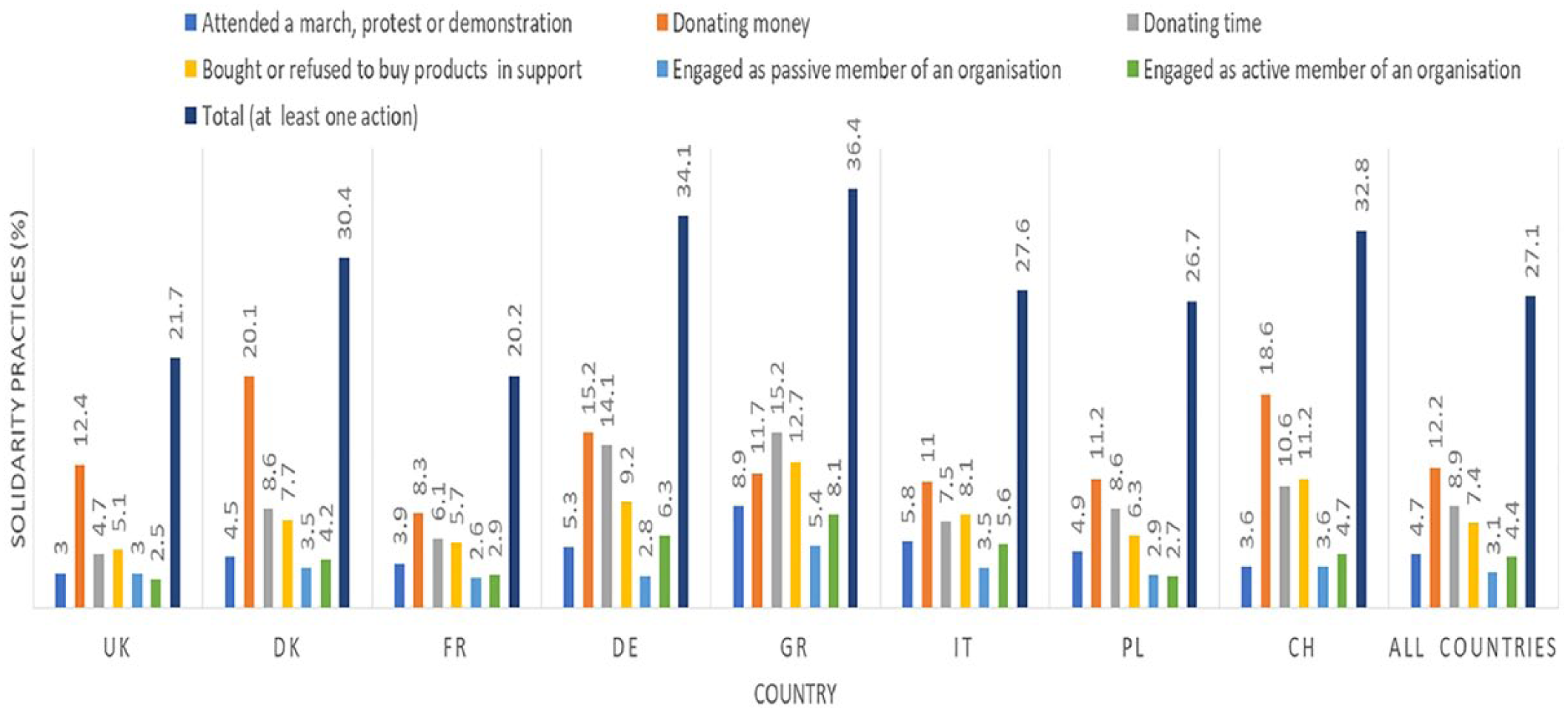
Type of reported solidarity activities in favor of refugees across countries (in %).
If we look at the different type of solidarity practices, the charity behavior of donating money is the most frequent action in all countries (12.2% on average) except in Greece, where donating time is the most frequent action (15.2%). Conversely, political protest-oriented activities are not widespread (4.7% on average), with a peak in Greece (8.9%). Similar patterns can be found regarding the active and passive involvement in organizations supporting refugees. Finally, buying or refusing to buy products in favor of refugees is a political action more widespread than protest-oriented actions in all countries (7.4% on average), with a peak in Greece (12.7%), where such action ranks second after donating time.
To confirm that refugees are considered by European citizens as an out-group less deserving of help compared with other needy groups “closer to us” as being part of the national community, we performed the statistical means differences of deservingness between the three target groups (refugees, the unemployed, and the disabled), a Tukey test of multiple means comparison. 6 The Tukey’s range test showed that means of willingness to improve the conditions of our three target groups are statistically significantly different from one another (Figure 2). Asylum seekers and refugees are perceived as the least deserving group, in comparison with the unemployed and especially the disabled (the most deserving group as expected). Thus, these results indicate that identity-cultural tensions are translated as well on individuals’ social dispositions because even though refugees are in a vulnerable situation beyond their control, as out-groups they are perceived as less deserving of being helped compared with needy citizens. Foremost, these results suggest that people are more willing to provide support to people they can identify with more than with people who cannot be blamed for their neediness because they do not have personal control over their current situation. Second, the results inform us on the individual rank preferences of informal solidarity, which are conditioned by symbolic boundaries that prefigured the “anonymous others” mainly over the distinction of “insider” versus “outsider” (Reeskens & van Oorschot, 2012).
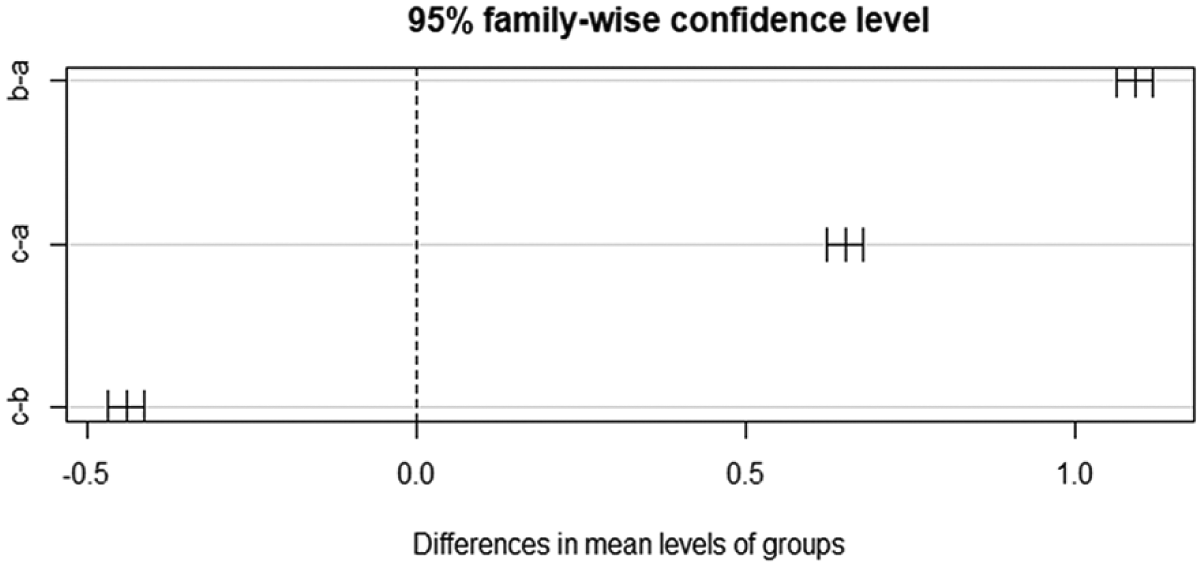
Differences of multiple means comparison of the willingness to improve the conditions of the vulnerable groups.
To test our hypotheses and to investigate the (different) determinants of solidarity actions in favor of refugees compared with other vulnerable groups, we included the independent variables presented in the previous section in a multivariate logistic regression model with dummies for countries. Supplemental Table A2 (available online) presents results for the full model 7 with all independent variables for each target group, which includes odds ratios (with robust standard errors) as well as goodness-of-fit statistics (Akaike information criterion and Bayesian information criterion coefficients, pseudo-R2 values of Nagelkerke). In logistic regression, the odds ratio compares the odds of the outcome event (providing solidarity) one unit apart on the predictor.
The results confirm that political factors and social dispositions of deservingness condition and affect differently solidarity practices across groups: refugees versus disabled and unemployed people. With regard to the political factors, political covariates are strongly relevant to examine solidarity practices, especially with regard to the support to refugees’ populations. Figures 3 and 4 show the marginal effects of political orientations on solidarity practices across target groups. As expected, the more one has leftist orientations on the economy and has libertarian values, the more she or he is likely to support refugees (Hypothesis 1a). People who take leftist positions on economic issues are also more likely to support the needy in-groups, even though the relationship is less significant compared with the observed support toward our out-group, whereas there is no significant relationship between libertarian values and support toward the in-groups. As expected, therefore, different dimensions of the political space (left–right and libertarian–authoritarian divides) have a differentiated effect depending on the target group: Libertarian positions on cultural issues increase the probability of supporting the refugee out-group but have no impact on solidarity practices toward the needy in-groups (Hypothesis 1b).
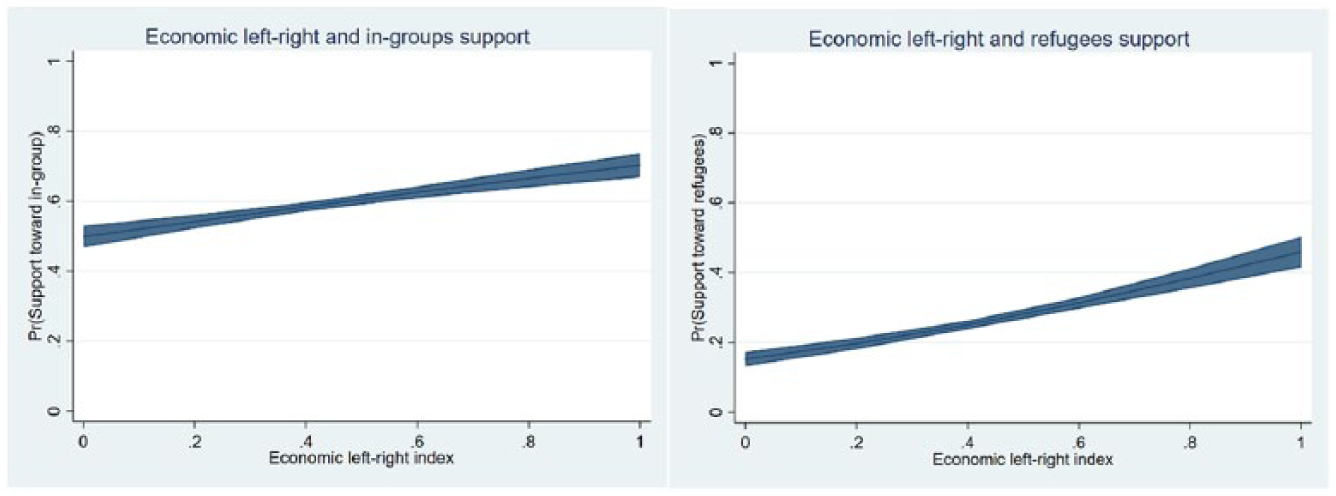
Marginal effects of economic left–right index on solidarity practices by target groups.
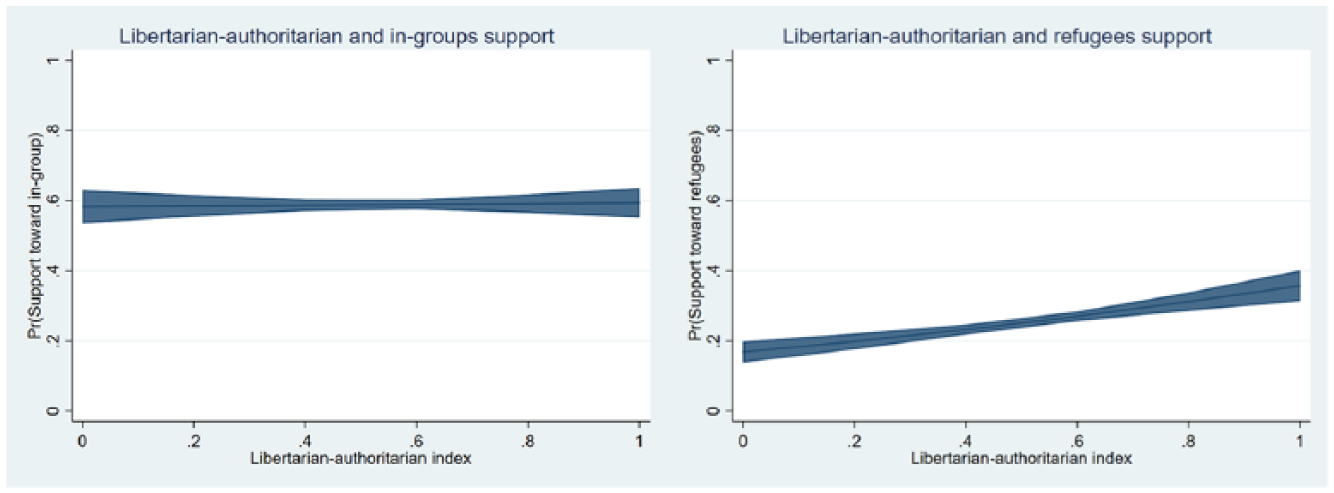
Marginal effects of libertarian–authoritarian index on solidarity practices by target groups.
These results show that the migration field is highly politicized and the cultural divide of the political space is central to explain a prorefugee behavior, more than the traditional economic left–right divide, which matters also for solidarity actions toward in-groups.
Likewise, our results highlight the importance of the perception of deservingness on solidarity practices across target groups. More precisely, the marginal effects on solidarity practices (see Figure 5) corroborate that deservingness has a strong impact on solidarity behavior, which varies according to the target group (Hypothesis 2): Its impact is lower on solidarity toward the out-group (refugees) compared with needy in-groups. Indeed, keeping all variables constant and assessing the maximum score of deservingness, the probability of engaging in a solidarity practice toward refugees is less than 40%, while for the other two vulnerable groups it surpasses 60%. This confirms again that perceptions of deservingness and their impact on solidarity behavior toward different target groups rely on identitarian concerns (van Oorschot, 2000).
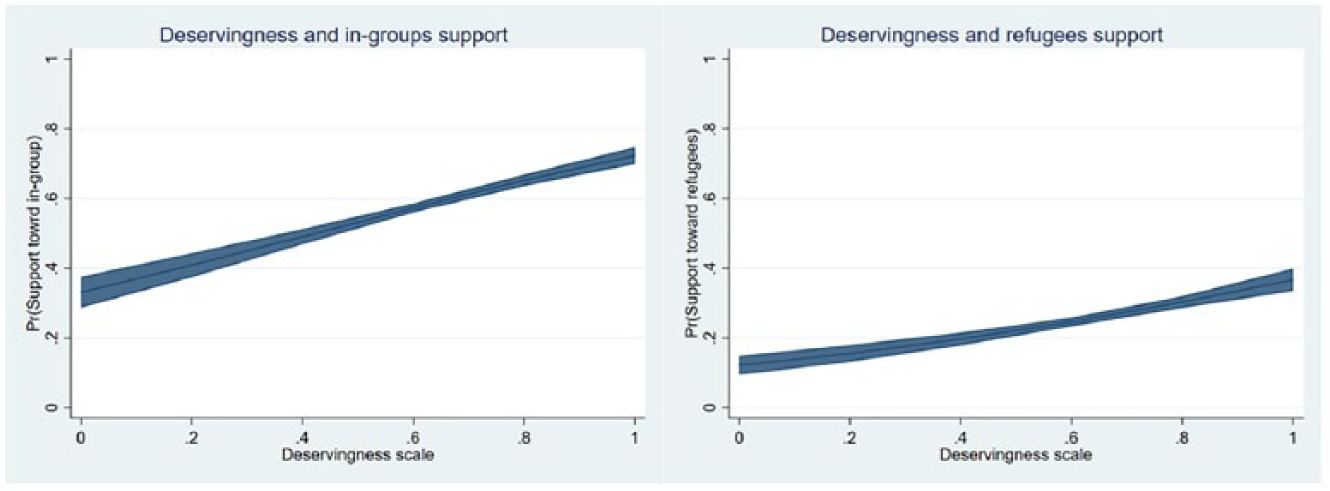
Marginal effects of deservingness scale on solidarity practices by target groups.
Regarding control variables, there are some predictors fostering solidarity practices in general, regardless of the target group. In particular, as shown in Supplemental Table A2, religiosity, political interest, and both measures of social capital (social trust and frequency of social connections with friends) are very significant (with p at 0.1%). Concerning the sociodemographic controls, age has negative effects on solidarity practices in favor of refugees, whereas it is not significant for in-group support. Indeed, scholars have shown that young citizens are more active in nonconventional participation, according to different levels of “biographical availability” in the life course (Beyerlein & Bergstrand, 2013). In addition, it is worth mentioning that social class categories have an effect only on solidarity practices in favor of refugees—education categories are again more relevant for supporting the out-group—whereas income level is significant (with p at 5%) and positively related only to support in favor of needy in-groups. In particular, people with low and intermediate education levels are less likely to be engaged in solidarity practices toward refugees compared with people with the highest education attainment. Moreover, belonging to the upper classes increases significantly the odds of supporting refugees compared with people of the working class.
Conclusion
This article aimed to deepen knowledge on solidarity toward needy groups in Europe that are not part of the national community (i.e., out-groups) by providing fresh empirical analyses on solidarity practices with respect to a specific out-group (refugees) in comparison with other vulnerable in-groups (the disabled or the unemployed) and to explain such solidarity actions with reference to respondents’ political preferences and their ranking preferences of solidarity beneficiaries.
The overall picture that results from the analysis of solidarity practices toward refugees is that more than a quarter of respondents are engaged in prorefugee actions. Interestingly, Greece, one of the countries that has received the highest influx of refugees since 2015 within the Eurozone, showcased the largest number of prorefugee political actions. In Greece, there is also the highest level of overall engagement in favor of refugees, immediately followed by Germany, whereas the French and the British show the lowest level of engagement. Regarding the type of actions, charity and civic behavior as donating money and time prevails in most countries over political protest-oriented activities, whereas buying or refusing to buy products in favor of refugees is a more diffused political action.
Furthermore, refugees are considered as less deserving of being helped compared with the disabled and the unemployed, which asserts a criterion of deservingness based on “identity” rather than on “control over neediness” (van Oorschot, 2000).
In general, findings show that solidarity is a multifaceted phenomenon, and its practices can be fostered by a variety of factors: social, political, and attitudinal. Hereafter, focusing only on one kind of these factors would be limiting and not adequate to comprehend the complexity of reasons underlying the individual choices to support others in need (or, conversely, to not support others). In addition, our analysis shows that covariates of solidarity practices often depend on the target group. First, political factors play a relevant role to explain support toward refugees, in comparison with other needy in-groups. In particular, libertarian values foster solidarity actions only toward refugees, whereas leftist orientations on economy also foster solidarity toward in-groups. Thus, solidarity toward refugees entails political commitment to libertarian values as opposed to authoritarian stances, confirming the specificity of this cultural dimension compared with the traditional left–right dimension and the importance of new cultural issues (e.g., migration) for contentious politics (Flanagan & Lee, 2003). This is particularly significant for a continent faced with both economic turmoil and refugee crisis in the past years, where right-wing populist parties have mobilized more on the libertarian–authoritarian dimension than on the economic left–right divide aiming at gaining votes among the lower classes by using migrants as scapegoating of their fears and economic distress (Mudde, 2011). In this regard, our data show that refugees are supported more by people in more professional classes with higher levels of education compared with working-class people with lower educational levels.
Second, our hypothesis about the differentiated impact of deservingness on solidarity behavior across target groups is confirmed: People support the group they consider as more worthy of being helped, but refugees are the group less positively affected by deservingness considerations when analyzing solidarity behavior. This indicates that individual rank preferences of informal solidarity beneficiaries are strongly conditioned by symbolic boundaries of “us” and “them.” This suggests that citizenship boundaries contribute to differentiate between those who are more entitled to be helped—that is, citizens versus noncitizens—regardless of their actual neediness and vulnerability.
To sum up, the key lesson drawn from our analysis is that the interplay between political orientations and social dispositions should be taken into account to explain solidarity behavior toward a needy out-group such as refugees. Hence, findings show that solidarity toward refugees displays some specificity compared with solidarity toward other vulnerable groups, unveiling tensions between universalistic-particularistic concerns, which are embodied in individual perceptions of deservingness between groups and in the cultural–identitarian dimension of political conflict. Independent of the positive effect of deservingness on solidarity behavior, we unveil that respondents’ ranking preferences have a lower impact on solidarity practices toward refugees, which are strongly fostered by progressive political orientations. In other words, support for refugees can be considered as a specific aspect of solidarity with human beings as such, and it heavily depends on both libertarian and leftist political preferences. Nevertheless, this universalistic conception of solidarity is not widespread in the whole society but is more widespread among individuals in more advantaged sections of society. In a period where traditional ideological alignments are challenged by populist political entrepreneurs, which combine economic left-wing positions with conservative cultural stances (the so-called left-authoritarians), this elitist retrenchment of cosmopolitanism can be particularly problematic with respect to vulnerable groups in Europe like refugees. Thus, the challenge for policymakers is to spread the support of solidarity toward out-groups throughout society in a context of crisis and competition over scarce resources and attached to a social model more strictly defined in terms of a traditional nation state. Strengthening the welfare system, creating inclusive policies, and renewing the citizenship contract are all very politicized and polarized issues to be discussed and further investigated. Hence, solidarity toward out-groups has a strong political element: It requires, in a first instance, to surpass migrants’ portrayal as a group with distinct morals, norms, and values that threaten the national community and the state safety net as it appears that such sentiments do not simply reflect economic concerns but also rely on more general cultural conflicts and social values.
Supplemental Material
Online_Appendix – Supplemental material for Politicization of Solidarity Toward Out-Groups: The Case of Refugees
Supplemental material, Online_Appendix for Politicization of Solidarity Toward Out-Groups: The Case of Refugees by Nicola Maggini and Eva Fernández G. G. in American Behavioral Scientist
Footnotes
Authors’ Note
The data employed in this article were collected as part of the European Horizon 2020 Project TransSOL led by Christian Lahusen at the University of Siegen.
Declaration of Conflicting Interests
The authors declared no potential conflicts of interest with respect to the research, authorship, and/or publication of this article.
Funding
The authors received no financial support for the research, authorship, and/or publication of this article.
Supplemental Material
Supplemental material for this article is available online.
Notes

Author Biographies
References
Supplementary Material
Please find the following supplemental material available below.
For Open Access articles published under a Creative Commons License, all supplemental material carries the same license as the article it is associated with.
For non-Open Access articles published, all supplemental material carries a non-exclusive license, and permission requests for re-use of supplemental material or any part of supplemental material shall be sent directly to the copyright owner as specified in the copyright notice associated with the article.
