







Abstract
Starting from a definition of altruism as situations in which a given actor sustains harm while another actor gains benefits, we compare the behaviors of respondents in relation to the members of three main groups of beneficiaries—refugees and asylum seekers, unemployed people, and people with disabilities—through the analysis of original survey data collected in eight European countries (N ~ 16,000) in the TransSOL project. We investigate in particular the reasons why people act on behalf of each of these three groups without being a member of any of them or having close ties with any individuals in these groups. These respondents are compared with respondents who are members of these groups and/or have close ties with people within them so as to isolate the factors underlying individual-level altruistic behavior. Our results show that political altruism emerges out of a complex combination of factors and is not simply reducible to social structural positions, subjective feelings of attachment or resources, but is the result of the interaction of these influences and that these vary when looking at support for different social groups.
Introduction
In a chapter on political altruism, Charles Tilly (2001) distinguished between four kinds of behavior depending on different combinations of harm and benefit. He defined altruism as situations in which a given actor sustains harm while another actor gains benefits. Our analysis in this article emerges from this definition and compares the behaviors of respondents in relation to the members of three main groups of beneficiaries—refugees and asylum seekers, unemployed people, and people with disabilities—through the analysis of original survey data collected in eight European countries (N ~ 16,000) in the TransSOL project. We investigate in particular the reasons why people act on behalf of each of these three groups without being a member of any of them or having close ties with any individuals in these groups. These respondents are compared with respondents who are members of these groups and/or have close ties with people within them so as to isolate the factors underlying individual-level altruistic behavior.
In those cases where individuals act on behalf of refugees and asylum seekers, the unemployed, and disabled, without themselves being one or having kin or friends within these groups, we can say that they do not stand to benefit directly from their participation in collective action. These militants can be thus understood as what McCarthy and Zald (1977) called “conscience constituents.” In this way, these types of actions can be seen as an instance of political altruism (Passy, 2001). In this context, we thus also ask to what extent does altruistic political participation have a logic specific to itself and distinct from what we tend to expect for more general instances of political mobilization in terms of the key factors which should lead individuals to engage at the level of sociodemographics, political values, and networks? However, as further noted by Passy (2001), there is hardly a consensual definition of altruism and authors from different fields stress different aspects. Psychologists tend to emphasize altruism’s intentional-oriented character and the actors’ costs/benefits balance (Piliavin & Charng, 1990). The first aspect emphasizes motivations of the actor, whereas the second is closer to behaviorist approaches, which define altruism as “social behavior carried out to achieve positive outcomes for another rather than for the self” (Rushton, 1980, p. 8) stressing what individuals do regardless of their motivations. On the other hand, motivational approaches define altruism as “a motivational state with the ultimate goal of increasing another’s welfare” (Baston & Shaw, 1991, p. 108).
Passy (2001) defines political altruism as all actions (a) performed collectively, (b) that have a political aim, and (c) an altruistic orientation as defined by Bar-Tal (1985-1986, p. 5): “altruistic behavior (a) must benefit to other persons, (b) must be performed voluntarily, (c) must be performed intentionally, (d) the benefit must be the goal by itself, and (e) must be performed without expecting any external reward.”
In this way, political altruism is a type of behavior based on actions performed on behalf of a group, and not aimed to meet individual interests; and presumably directed at a political goal of social change or the redefinition of power relations; moreover, individuals involved in this type of social change do not stand to benefit directly from the success deriving from the accomplishment of those goals (Passy, 2001).
Studying under what conditions individuals engage in altruistic acts, and more specifically politically altruistic acts, are fundamental goals for social science and form the basis for understanding the bases of our social organizational and political systems. Moreover, this investigation leads us to explore two fundamental paradoxes. The first is whether political altruism is truly altruistic or not. As Passy (2001) notes with respect to Wuthnow’s (1991) study of the voluntary sector in the United States, are “acts of compassion” truly such or rather a channel of self-expression? If, as Wuthnow (1991) argues, they help people “feel better” and are a way to convey caring feelings are these still altruistic acts? According to Bar-Tal’s (1985, p. 86) definition, one of the four characteristics of altruism is to perform a deed without expecting a reward. However, “feeling better” would be one such reward. And yet, Bar-Tal speaks of external rewards, while those received by the people interviewed by Wuthnow are internal: they do not come from the individuals’ external environment, but rather from within the individuals themselves. Thus, following Bar-Tal’s definition, these “acts of compassion” investigated by Wuthnow are altruistic.
Moreover, the second paradox relates to whether we can make sense of political altruism with the theoretical tools offered by the classic models of collective action such as Olson’s (1965), and, more generally, following a rational choice model. For Olson, as noted by Passy (2001), individuals acting on behalf of others were irrational. However, resource mobilization and political process approaches to collective behavior models (McAdam, 1982; McCarthy & Zald 1977; Tilly, 1978; Tilly, Tilly, Tilly, 1975) emphasized how collective action is a rational effort to obtain certain goals. In this framework, how can we make sense of the rational logic of political altruism? Is altruistic activism explained by different factors relative to more interest-based forms of collective action?
The TransSOL dataset allows us to investigate these questions since it contains data both on individuals’ political action on behalf of the three above-named groups as well as whether they fit into these groups themselves or have close ties with people in them. Therefore, assuming a situation of costs and benefits, acting on behalf of others when you yourself are not part of that group nor have close friends and family that are part of it, can count as a cost and hence that act can be framed as an altruistic act toward that group.
Based on previous research, our investigation aims to show that altruism varies in terms both of the groups which individuals support and in the extent to which individual characteristics support altruism toward different groups in terms of three key dimensions identified in the literature: social proximity, group attachment, and social leadership. In what follows, we first review extant literature on political altruism and prosocial behavior including on key determinants linked to social proximity and social structure. Then we discuss our data and methods, indicators, and modelling strategy before turning to our findings. Finally, we discuss our conclusions and implications for future research.
Previous Research and Hypotheses
Research on altruistic and prosocial behaviors is as extended as it is fragmented. We only scratch the surface of such body of works, focusing on those that are most directly linked to our research questions and hypotheses. A large literature argues that social distance between two individuals will influence the magnitude of their altruistic behaviors toward each other (Long & Krause, 2017). Early theories of altruism focused on kinship and the idea of genetic drivers behind altruism (Hamilton, 1964). On the other hand, reciprocal altruism does not rely on genetic proximity and obtains when someone makes sacrifices for an unrelated other, which may respond reciprocally and thus cooperatively in the future (Trivers, 1971). In this way, Axelrod’s (1984) and Trivers’ (1971) insight is that individuals may behave altruistically toward unrelated others—these “acts of kindness”—in the hope that the other will eventually return the favor. At the same time, the idea of the Good Samaritan (Gospel of Luke 10:25-37) suggests that true altruism is that offered by a stranger (Long & Krause, 2017). In general, research tends to show that social proximity is closely linked to altruism and individuals demonstrate greater levels of altruism toward others who were more closely related and that the closer an individual felt to another person, the more altruistic sentiments would be demonstrated toward that person (Rachlin & Jones, 2008). Research finds less altruism towards those who are more socially distant (e.g., strangers relative to family) (Long & Krause, 2017). Understanding why individuals exhibit altruistic behavior under different circumstances and toward individuals of varying levels of social proximity are fundamental questions of social science research. While social preferences play an important role for making sense of the provision of public goods, these preferences vary hugely between individuals and are likely to depend on the relationship between givers and beneficiaries.
A substantial body of scholarship has shown that individuals engage in altruistic prosocial behaviors and there are important links between social structure and prosocial behavior (Coleman, 1988). However, there are large inter- and intrapersonal variations that still needing explanation, with two key social–structural dimensions along which generosity varies systematically identified as group attachment and social position in previous research (Baldassarri & Grossman, 2013): (a) group attachment positively affects prosocial behavior and this is not simply reducible to social proximity; (b) leadership positions showed greater generosity toward in-group members leading to the conclusion that prosocial behavior varies also relative to one’s place in the social hierarchy.
While research to date has shown that individuals do act altruistically, it is still unclear what causes inter- and intrapersonal variations (Nolin, 2012). Factors such as wealth, education, and age cannot account for all the variations and structural factors are suggested to also have an impact. Moreover, when researchers remove anonymity or vary the identity of the recipient this leads to further and significant interpersonal variation (Baldassarri & Grossman, 2013). For example, individuals share larger amounts of resources with their kin as well as with friends and acquaintances compared to strangers (Branas-Garza et al., 2010; Goeree, McConnell, Mitchell, Tromp, & Yariv, 2010; Leider, Möbius, Rosenblat, & Do, 2009). Moreover, research has shown that shared identities including ethnicity, religion, and political partisanship also impact on altruistic preferences (Fowler & Kam, 2007; Habyarimana, Humphreys, Posner, & Weinstein, 2007; Whitt & Wilson, 2007).
Studies have shown that individuals are most willing to share resources with people they are connected to most closely than to more distant alters. These studies tend to use social network measures looking at distance geodesically between ego and alter and they tend to focus on closed systems such as high school students or villages, whereas in modern society, individuals belong to multiple groups with overlapping identities and their altruism toward these is likely to vary between individuals and groups (Baldassarri & Grossman, 2013). As such, the expectation is that individuals will extend generosity beyond interpersonal relationships, generalizing to wider social groups. Social identity based theoretical conceptions of social distance show that individuals are more likely to act prosocially toward in-groups relative to out-groups (Habyarimana et al., 2007; Whitt & Wilson 2007).
Group attachment is the strength of one’s identification with a group and the stronger it is, the greater tends to be the altruism. While both social proximity and group attachment should lead to altruism, these are distinct since the former should be linked to past experiences that are particularized, whereas the latter is instead linked to generalization, linked to a broader set of individuals (Baldassarri & Grossman, 2013). Being exposed to in-group members has been found to develop positive expectations about the group in general, leading one to perceive its members as more honest, friendly, and trustworthy than members of out-groups (Brewer & Campbell, 1976; Yamagishi & Toko, 2000).
Based on the extant literature, we examine three main hypotheses about political altruism on behalf of the three groups at hand following the work of Baldassarri and Grossman (2013). The first is the social proximity hypothesis. Previous research has shown that altruistic behavior is more likely when the social distance between the giver (ego) and receiver (alter) diminishes. However, Baldassarri and Grossman (2013) note how previous work had failed to distinguish between two different aspects of social distance: (a) social proximity or the likelihood of the ego and alters’ frequency of interaction, amount of information about each other, and so on (Granovetter, 1973) and (b) group attachment linked to the strength of their abstract identification with other members of their group. However, most studies cannot distinguish between social proximity and group attachment since they use network approaches which tend to conflate the two. Baldassarri and Grossman (2013) have aimed to try to address this issue with lab-in-the-field experiments in Uganda. In this article, we take an alternative approach and use survey measures which ask individuals about their political action on behalf of three different and specific groups, their group attachment to these groups, as well as their own membership and social proximity to other individuals in this group. We suggest, following Baldassarri and Grossman (2013), that individuals are more likely to act altruistically to individuals in groups of which they are members or of which their kin and friends are members, irrespective of attachment to this group.
Our second expectation is the group attachment hypothesis. Based on social identity theory, individuals rely on categorization schemas, and these in turn allow them to generalize their interpersonal experiences to a broader class of alters and to relate to these even in the absence of a personal (direct or indirect) relationship (Baldassarri & Grossman, 2013). As such, unfamiliar others are classified as members of in- or out-groups based on certain traits such as, for example, ethnicity, gender, or class—that are relevant in a given social context (Ellemers, Spears, & Doosje, 1997). Based on this distinction, we follow Baldassarri and Grossman (2013) in expecting that the strength of group-specific identity and sense of belonging determine the extent to which individuals consider the preferences of alters who have been classified as group members.
Our third and final expectation relates to the social status of people engaging in prosocial behavior: the social leadership hypothesis. Processes of social differentiation which characterize complex societies brings with them a second form of categorization and generalization: namely, that higher status individuals acting as leaders may feel a stronger obligation to act altruistically either to signal ability or competence and thus increase their influence (Baldassarri & Grossman, 2013). This may be due to a number of reasons. For example, due to their position within social networks: leaders might have more opportunities to act prosocially because, due to the central they have in the network, they have access to information and contacts—both in terms of social and work networks—that other individuals do not have. Or this might relate to the labor relation: the type of work may affect the time available to display solidarity toward others. For example, people who have self-directed jobs and score high in autonomy, decision making, and complexity of working tasks volunteer in a wider range of activities (Wilson, 2000; Wilson & Musick, 1997).
Furthermore, differentiation exists not just between but also within groups in terms of hierarchy. Three mechanisms have linked social position in a group to the level of prosocial behavior toward its members (Nolin, 2012). To start with, a high-status position could bring with it greater expectations for prosocial behavior including reputation costs for not meeting these expectations. Moreover, generous behavior signals competence and the intent to engage in beneficial exchange relations (Baldassarri & Grossman, 2013). Finally, selection processes lead people that exhibit a high degree of other-regarding preferences to occupy central positions. As such, following Baldassarri and Grossman (2013), we would expect an increase in prosocial behavior among more high-status individuals.
Data and Methods
To investigate these questions we use data from the project “European Paths to Transnational Solidarity at Times of Crisis: Conditions, Forms, Role-Models and Policy Responses” (TransSOL), funded by the European Commission under the auspices of Horizon 2020 (Lahusen and Grasso, 2018). The survey was conducted with approximately 2,000 respondents in each of eight countries (Denmark, France, Germany, Greece, Italy, Poland, Switzerland, and the United Kingdom) and included questions on individuals about their political action on behalf of three different and specific groups, their own membership and social proximity to other individuals in this group, their group attachment to these groups, and their leadership position in society in terms of higher education as well as many other classic variables in participation research. In this way, we can assess which of social proximity, group attachment, or social leadership are most relevant for explaining political action on behalf of the refugees and asylum seekers, the unemployed, and the disabled as well as whether there are differences in these underlying processes between these three groups.
To measure political activism on behalf of each group—our dependent variable—we used a question asking whether individuals had engaged in at least one of the following actions in support of the rights of the specific group at hand: donating money or in-kind donating time; support of a campaign; volunteering for an initiative/organization concerned with these issues; membership in an organization concerned with these issues; demonstrative protest in support of these rights; participation in boycott/strike/occupation of public spaces in support of these rights. To create the variable, we reverse-coded the response item stating that the respondent has done none of the forms listed, so that 1 means that they have done at least one of the six kinds of political activities and 0 means they have done none of them.
Our three key independent variables are operationalized as follows: For social proximity, we looked at whether respondents were part of this group and/or had family, friends, and acquaintances in these groups; for group attachment, whether the respondent said they felt very or quite attached to the relevant group; for social leadership, if they had a university or higher education. We use having a higher education as a proxy for leadership in society since individuals with higher education and socioeconomic status are more likely to be in these positions. Additionally, our analyses include a number of controls: age as a continuous variable, a dummy for female to look at gender differences; class as a categorical variable; and other standard controls for participation, such as employment status, political interest, and associational membership (Giugni and Grasso, 2017).
We first use cross-tabulations and proportions to look at descriptive differences, then we apply regression analysis to test our hypotheses. Given that the respondents are all nested in countries, we apply multilevel models to account for the hierarchical nature of the data. Since our dependent variables are binary, we use logistic models. We include variables in stepwise models to assess how their effects are related to address our hypotheses and examine underlying effects at play.
Findings
Our analysis proceeds in two steps. First, we examine descriptive results for acting on behalf of each of the three beneficiary groups among individuals who belong to these groups or have friends and kin within them. Second, we show the results of the regression analyses controlling for various factors in a stepwise setup to test our three hypotheses and see how the inclusion of different variables impacts on the effect of our key independent variables.
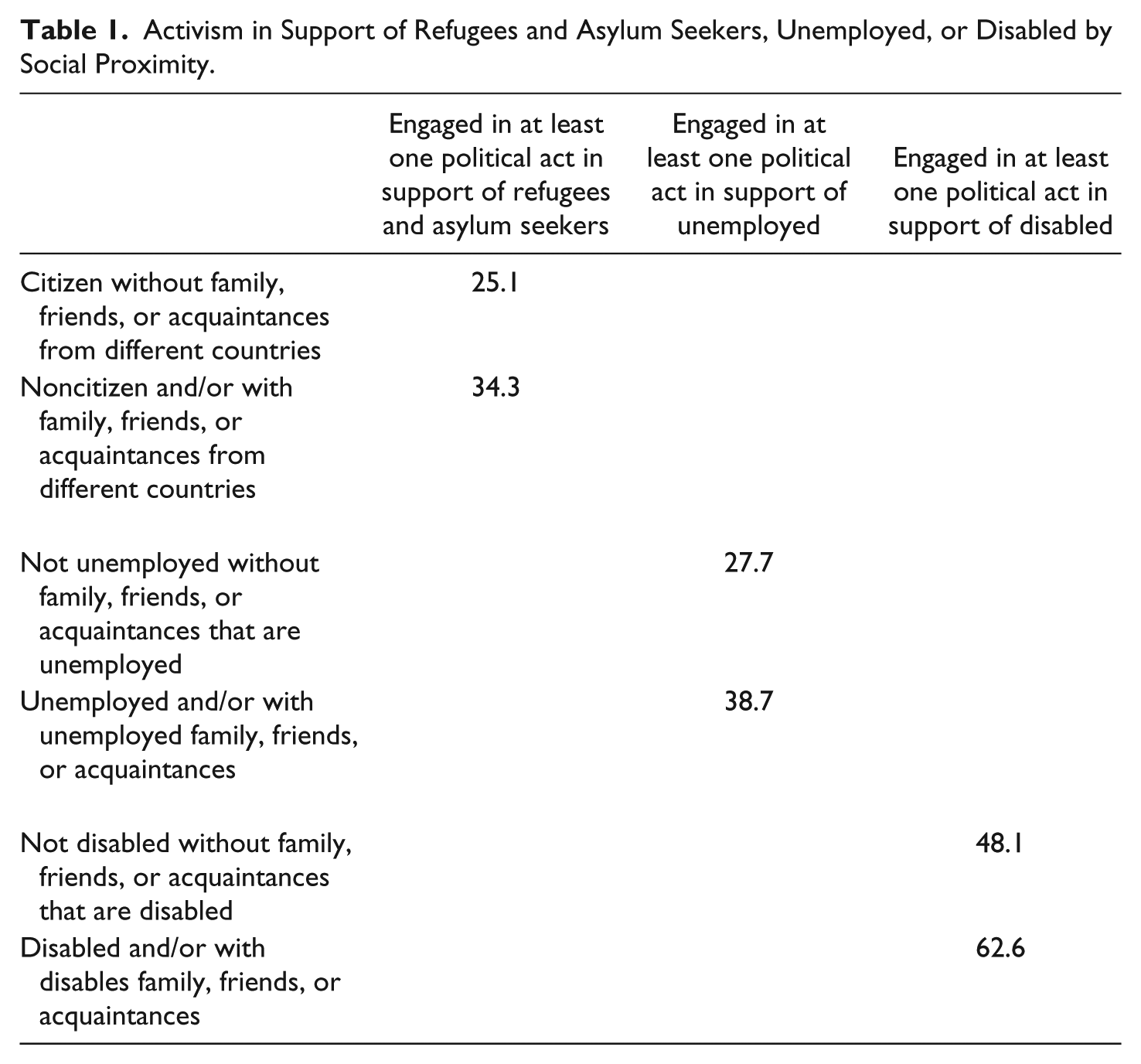
Table 1 shows action on behalf of refugees and asylum seekers, unemployed, and people with disabilities according to our indicator of social proximity. We see first that there is a large gap in the proportion of individuals who provide support in favor of refugees and asylum seekers between the two groups. Those individuals that are themselves noncitizens or have family, friends, or acquaintances from abroad are much more likely than those who are citizens without relations from abroad to engage in activism in support of refugees and asylum seekers. Similarly, with respect to activism in support of unemployed people, those who are themselves unemployed and/or have family, friends, and acquaintances who are themselves unemployed are much more likely to engage in actions supporting this group. Again, we have further preliminary evidence for social proximity here. Activism in support of the disabled reflects the pattern that levels are much higher among those who are themselves disabled or have family, friends, and acquaintances that are disabled. Levels of activism in support of the disabled are the highest, followed by unemployed and finally refugees or asylum seekers. Thus, for all three types of beneficiaries, the evidence supports the idea that social proximity is linked to greater prosocial activism.
Activism in Support of Refugees and Asylum Seekers, Unemployed, or Disabled by Social Proximity.
Turning to assessing descriptive evidence for group attachment, we can see in Table 2 that that there is also a large gap in activism in support of refugees and asylum seekers between those who say that they feel attached to this group and here the gap is much larger than for social proximity, supporting theorizing in the literature that feelings of attachment to a group are wider than simply one’s membership or direct relations within that group. We see a similar pattern for activism in support of unemployed people, as the gap is larger than for social proximity and suggests the subjective aspects of group attachment extend beyond being oneself a member of a group or having family, friends, and acquaintances within it. The same is also true with respect to the patterns for activism in support of the disabled. Here, once more, the gap is larger when looking at differences by group attachment relative to social proximity. Again, this suggests that attachment to a group is more complex than simple membership or direct relationships and has a greater effect on activism than these.
Activism in Support of Refugees and Asylum Seekers, Unemployed, or Disabled by Group Attachment.
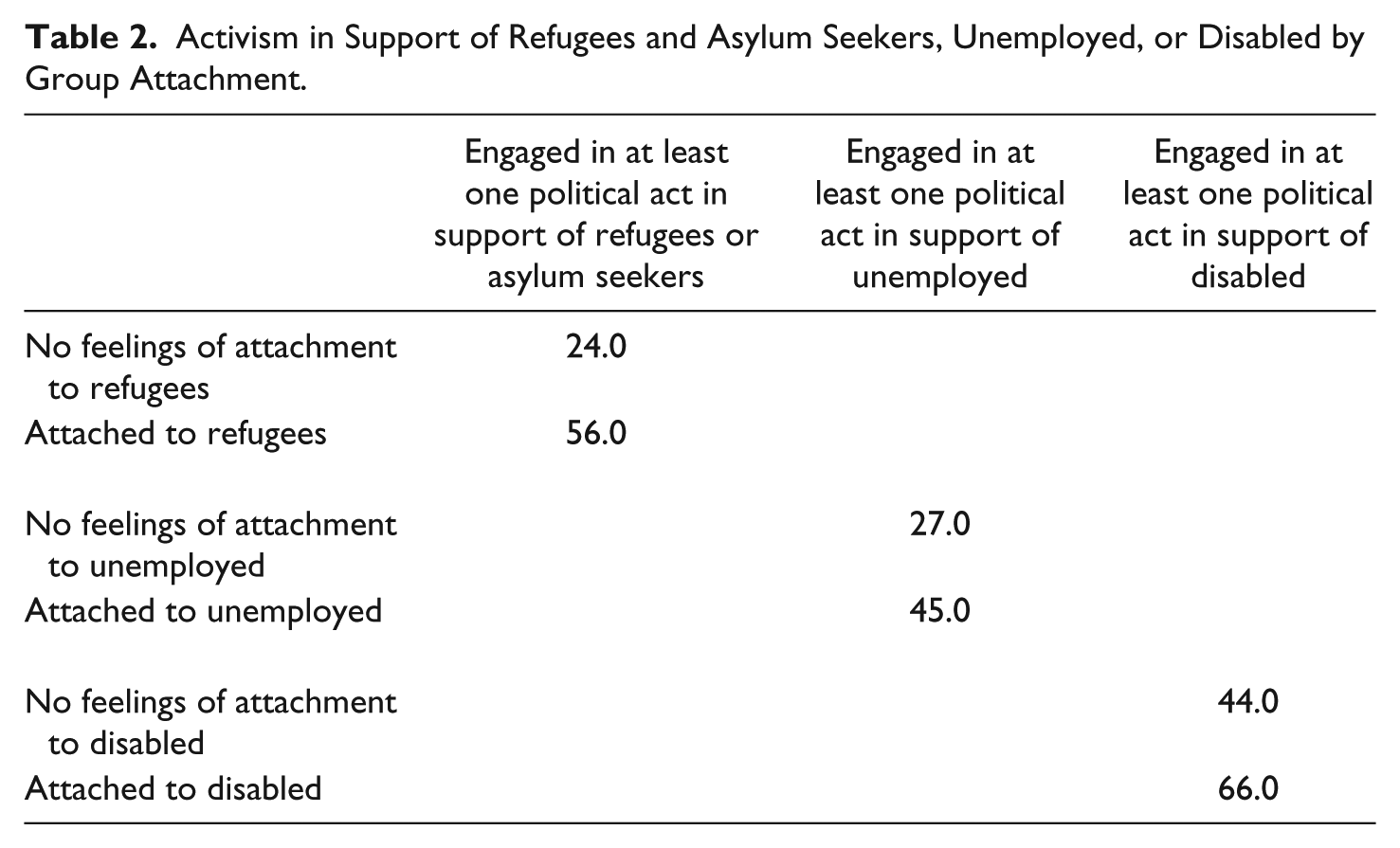
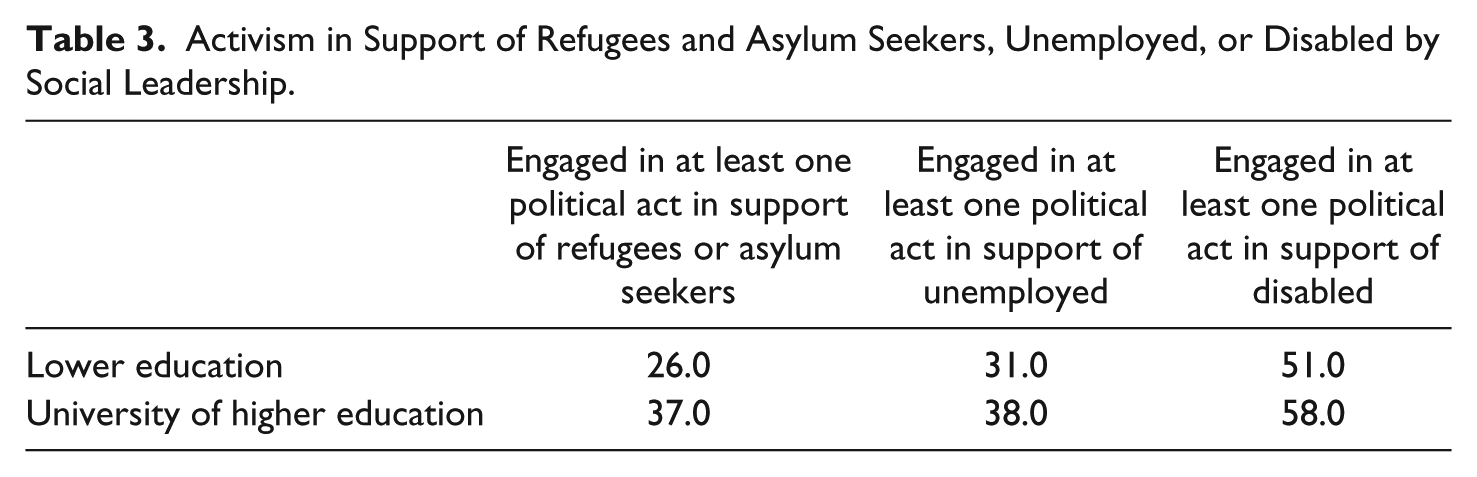
Table 3 turns to looking at whether being in a position of social leadership is linked to greater prosocial behavior as hypothesized in the literature. As we mentioned earlier, we consider having a higher education (university or higher) as a proxy for leadership in society. As we can see, leaders are more likely to act on behalf of refugees and asylum seekers, thus supporting the social leadership hypothesis. Here differences are similar to those for social proximity, so that the group attachment hypothesis appears at least on the basis of this preliminary descriptive information to hold the most support. Concerning leadership effects for actions on behalf of the unemployed, again we see that the hypothesis is supported. The differences are similar to those for social proximity and not as wide as those based in group attachment, matching patterns for actions in support of the unemployed. The hypothesis is supported in this preliminary descriptive analysis also for leadership effects for actions in support of the disabled, but the gap is not as wide as for group attachment, but also social proximity. This follows previous patterns to some extent, but suggests that, while group attachment appears most important across groups, social proximity appears more important for support of the disabled relative to support of refugees and asylum seekers as well as the unemployed, with social proximity generally as the second most important differentiating criterion of the three for all three groups, and social leadership appearing to be the least discriminating factor for actions in support of the three types of beneficiaries.
Activism in Support of Refugees and Asylum Seekers, Unemployed, or Disabled by Social Leadership.
So far we have examined descriptive results examining our three hypotheses for activism in support of the three beneficiary groups. In the next step, we examine regression analyses which include different factors in different steps to examine changes in effects. These results are presented in Supplementary Table A1 (available online) for activism in support of refugees and asylum seekers, Supplementary Table A2 for activism in support of the unemployed, and Supplementary Table A3 for activism in support of the disabled.
Turning first to the results in Supplementary Table A1 for activism in support of refugees and asylum seekers, we can see from the results for Models 1, 2, and 3 that as suggested by the descriptive results presented earlier in the analysis, all three of social proximity, group attachment, and leadership effects are supported but group attachment appears as the most important, showing that the cognitive subjective dimension is highly relevant for making sense of why individuals engage in political activism on behalf of refugees and asylum seekers, and this is net of both their structural positions in terms of social proximity to the group or social leadership as shown in Models 4, 6 and 7, where the effect of group attachment is hardly diminished with the inclusion of these other two variables in the models. Moreover, we can see that the sociodemographic controls included in Model 8 do not reduce the effect of group attachment, but are strongly associated with leadership effects, given occupational class is also part of socioeconomic status with education. We find in Model 8 that all occupational classes except for managers or senior administrators are less likely than professionals to engage in activism in support of refugees and asylum seekers with differences being particularly large with respect to the semi- or unskilled manual class. Moreover, the results from Model 9 show that political interest has a strong effect on participation which is partially linked to group attachment and social leadership. Finally, Model 10 shows that group attachment is importantly related to associational membership suggesting that being members of voluntary associations develops group attachment feelings supporting activism on behalf of refugees and asylum seekers. Moreover, the effect of gender becomes significant when controlling for political interest and particularly associational membership in Models 9 and 10, suggesting that once we account for women’s lower interest and associational propensity, they are more likely than men to be active.
Moving on to the results in Supplementary Table A2 for activism in support of the unemployed, we can see that here as well the three effects are largely independent of each other and that group attachment is more relevant than social proximity and leadership (Models 1-7). Moreover, women are less likely than men to engage on behalf of the unemployed and Model 8 shows that social leadership is closely linked to class and all occupational classes are less likely to engage in support of the unemployed than those in professional occupations, except for managers or senior administrators, foremen or supervisors, and skilled manual. Moreover, Model 9 shows an important effect of political interest and Model 10 one for associational membership which is linked to group attachment, suggesting once more this is fostered in organizations.
The results from Supplementary Table A3, for activism in support of the disabled, show that here group attachment also has a more preponderant effect than social proximity and leadership but the difference between social proximity and attachment is not as great as for the other two groups. This suggests that social proximity has an important impact for activism in support of the disabled. Moreover, we can see from Model 4 that in this case, social proximity and group attachment are related to a larger extent than when looking at activism in support of refugees and asylum seekers and the unemployed. There are no gender effects for this type of activism, and Model 8 once more shows that occupational class is closely linked to leadership effects, with all classes being less likely than the professional class to act in support of the disabled except for managers or senior administrators and foremen or supervisors. Model 9 further shows an important effect of political interest and Model 10 one for associational membership, which is once more linked to group attachment but also to social leadership.
Conclusion
In this article, we examined the bases of altruistic political action and aimed to address the question of why individuals engage in acts on behalf of others. We tested three key hypotheses derived from the literature—the social proximity hypothesis, the group attachment hypothesis, and the social leadership hypothesis—and showed that each has some role for explaining activism in support of three groups of beneficiaries: refugees and asylum seekers, the unemployed, and the disabled. Following previous work and applying it to an original set of comparative survey data collected in the context of the TransSOL project, we found that the effect of group attachment was distinct and nonreducible to social proximity. Moreover, we found important leadership effects showing that people in higher status positions are more likely to act in altruistic fashion. We found in particular that group attachment stood out as the major factor for activism in support of these groups, greater than both social proximity and leadership effects in all three cases.
Our results show that political altruism emerges out of a complex combination of factors and is not simply reducible to social structural positions, subjective feelings of attachment or resources, but is the result of the interaction of these influences and that these vary when looking at support for different social groups such as refugees and asylum seekers, the unemployed, and disabled. Moreover, we showed that associational membership looks to be an important factor for developing group attachment and that relative to action in support of the other two groups social proximity was particularly important for activism in support of the disabled, although still less important than group attachment. In absolute terms, individuals are more likely to act on behalf of the disabled, than the unemployed and last for refugees and asylum seekers.
The value of our study, we believe, lies not only in replicating existing findings with different data, but also in the differentiated look we provide, as compared with previous research. In particular, our analysis suggests that prosocial behavior is not an intrinsic characteristic of certain individuals—as opposed to other, less altruistic, people—but is an emergent property of social relations that depends on their social embeddedness and the extent to which they feel close to specific target groups. Further research should be conducted in this direction to explore more thoroughly the interactions of all these factors. Furthermore, this kind of analysis should be put into context, for example by looking at how the individual-level mechanisms we have identified vary depending on certain features of the broader environment (Grasso and Giugni, 2016), such as for example a toughening of public discourse on immigration, as one example of a particularly salient issue in the current moment (Giugni and Grasso, 2018).
Supplemental Material
Online_Appendix – Supplemental material for Do Unto Others? Individual-Level Mechanisms of Political Altruism
Supplemental material, Online_Appendix for Do Unto Others? Individual-Level Mechanisms of Political Altruism by Marco Giugni and Maria T. Grasso in American Behavioral Scientist
Footnotes
Acknowledgements
We would like to thank Eva Fernández Guzmán, Christian Lahusen, Nicola Maggini, and Thomas Montgomery in particular for their comments as well as the other participants of the special issue panels at the TransSOL Final Conference, May 16-17, 2018, in Brussels.
Authors’ Note
Results presented in this article have been obtained within the project “European Paths to Transnational Solidarity at Times of Crisis: Conditions, Forms, Role-Models and Policy Responses” (TransSOL).
Declaration of Conflicting Interests
The authors declared no potential conflicts of interest with respect to the research, authorship, and/or publication of this article.
Funding
The authors disclosed receipt of the following financial support for the research, authorship, and/or publication of this article: This project was funded by the European Commission under by the EC Horizon 2020 research and innovation programme (Grant Agreement No. 649435).
Supplemental Material
Supplemental material for this article is available online.

Author Biographies
References
Supplementary Material
Please find the following supplemental material available below.
For Open Access articles published under a Creative Commons License, all supplemental material carries the same license as the article it is associated with.
For non-Open Access articles published, all supplemental material carries a non-exclusive license, and permission requests for re-use of supplemental material or any part of supplemental material shall be sent directly to the copyright owner as specified in the copyright notice associated with the article.
