







Abstract
Researchers have characterized the challenges many deaf and hard of hearing (DHH) students face in postsecondary science, technology, engineering, and mathematics (STEM) programs to three domains: preparation, socialization, and access. Additionally, some research has found that learners who are DHH have poor autonomous learning skills. The Deaf STEM Community Alliance, a project supported by the National Science Foundation (NSF HRD-1127955), created a model virtual (online) academic community called the DHH Virtual Academic Community to directly address preparation, socialization, and access challenges with the logic that online resources provide innovative and flexible means to adapt to complex student needs and schedules. This article describes a mixed-method study regarding one instructor’s effort to supplement developmental math education with online videos for students who are DHH, addressing issues relating to the challenges of preparation and access. Data analysis used both quantitative and qualitative methods to interpret student responses (n = 89) about viewing behaviors and perceived benefits of the videos. Analysis of viewing behaviors also incorporated aggregated user analytics generated by YouTube. An unexpected finding of the study relates to the opportunity to develop autonomous learning skills by using the videos. While previous research with this student population has frequently found that students are teacher dependent, this study suggested that providing review videos allowed students to practice and master content on their own, strengthening their autonomous study skills.
Carla aspires to be a biomedical engineer. Gabriel dreams of becoming an architect. Ester wants to study fresh water marine animals. Micah hopes to teach science to students with special needs. What do these students have in common? All are enrolled in postsecondary programs that can help them attain their career goals as they juggle classes, work on- and off-campus, attend to their physical well-being, contend with the weather and its complications, and maintain a social life. Also, each of these students are individuals with hearing loss, and as such, face additional challenges in attaining postsecondary success.
Autonomous learning is a popular topic in education today and autodidactic skills are required of individuals to be lifelong learners (Fischer, 2000). Despite the growing expectation that students be autonomous learners, educators of students who are deaf or hard of hearing (DHH) routinely find that their students continue to lack these skills (Kahn et al., 2013). Today, many educators and students use online resources to enhance teaching and learning. Online resources provide innovative and flexible means to adapt to student needs and can accommodate their complex schedules; these resources may also have the potential to better accommodate the individual needs of deaf learners to promote autonomous learning. This article analyzes student feedback about one instructor’s effort to provide supplemental videos for developmental math education for students with hearing loss and specific learning needs.
Students with hearing loss, who refer to themselves as DHH students, are among the underrepresented in science, technology, engineering, and mathematics (STEM). While it is difficult to determine an accurate count, approximately 221,000 students who are DHH are enrolled in postsecondary programs (1.3% of all college students; Garberoglio, Palmer, & Cawthon, 2019). This participation rate is likely to be an underestimate, only including those students who receive services through a university office of special services for disabled students or who are enrolled in special colleges for students who are DHH (Marschark et al., 2008). Students who are DHH tend to be older than their hearing peers (average age 31 vs. 25.7 years old for hearing students) and 17.1% of students who are DHH are veterans, compared with 4.7% of hearing students (Garberoglio, Palmer, & Cawthon, 2019). Unfortunately, a mere 18% of DHH students receive a bachelor’s degree in any major (compared with 34% of hearing students) and only 24% of those degrees are in STEM (Garberoglio, Palmer, Cawthon, & Sales, 2019). DHH students’ tendency to select and persist in STEM majors follows the pattern of students in other underrepresented groups, which means that they disproportionately self-select out of that major or are less likely to persist in it (Armstrong, 2008; Chen & Soldner, 2013). For DHH students, the academic STEM pipeline is extremely narrow. Among students who persist in STEM through to their PhD, only 0.02% are DHH (Hoffer et al., 2007). Fewer DHH STEM majors consequently translates to fewer DHH employees in the STEM workforce (Walter, 2010).
DHH students, like their hearing peers, require a strong educational foundation in STEM and allied fields to attain STEM degrees or obtain employment in STEM (Kahn et al., 2013). However, the path to success includes many hurdles for these students. Neglecting these needs results in a “participation gap,” marginalizing students whose communication and learning styles are different than their hearing peers (Jenkins et al., 2006; Komesaroff, 2005).
Researchers have identified three domains of challenges for DHH students to succeed in postsecondary STEM programs: preparation, socialization, and access (Elliot et al., 2013; Foster, 2009; Walter, 2009). The Deaf STEM Community Alliance, a project supported by the National Science Foundation (NSF HRD-1127955), created a model virtual academic community called the Deaf and Hard of Hearing Virtual Academic Community (DHHVAC) to address those challenges (Elliot et al., 2013; Gehret et al., 2017). This article describes one of the DHHVAC’s asynchronous approaches to address issues relating to the challenges of preparation and access as well as the unexpected outcome of the opportunity to reinforce autonomous learning skills.
Preparation Challenges
Literacy and Cognitive Challenges
Preparation for a successful postsecondary career in STEM begins early in one’s education. DHH students’ lower proficiency in math and science may be associated with the lower literacy rates many DHH students have in English, approximate to a fourth-grade reading level (Bull, 2008; Kelly, 2008; Marschark & Wauters, 2008). Researchers have found that DHH students often struggle with math concepts that are embedded in word problems, a staple of mathematics education and assessment (Kelly et al., 2003). Additionally, research has demonstrated that some DHH students experience short-term memory issues and are inconsistent in their intentional utilization of prior knowledge during recall (Hauser & Marschark, 2008; Liben, 1979). These memory performance problems can negatively influence scaffolding that contribute to the mastery of critical STEM skills relative to their hearing peers.
Exposure
Formal exposure to math and science traditionally starts in elementary school and interest in STEM careers often takes hold during secondary education (Warne et al., 2019). In recent years, elementary school instructional time in science has declined for all students, regardless of their hearing status (Blank, 2013), diminishing the opportunity to be exposed to STEM topics. Warne et al. (2019) found that among 15,847 college undergraduates, students who had taken AP Calculus in high school were more likely to express an interest in STEM careers. However, DHH students are likely to miss out on many opportunities to be exposed to math and science education. Nationally, 60% of DHH students spend at least 80% of their day in a mainstreamed educational setting (U.S. Department of Education, National Center for Education Statistics, 2017). In elementary and secondary education, educators often expend additional efforts to support DHH students’ literacy needs to the exclusion of other disciplines. Consequently, they tend to pull students out of some classes, which tend to be math and science lessons (Marschark et al., 2001). In contrast with hearing peers, on average, DHH students arrive at college with less exposure to high school courses in higher level science and mathematics which may be due, in part, to students’ literacy deficiencies and their absence from science and math classes and are less likely to have taken college-level coursework than their hearing peers (Garberoglio, Palmer, & Cawthon, 2019; Kelly et al., 2003; Marschark et al., 2001).
Nationally, DHH students are enrolled in developmental courses at a higher rate (41.7%) than their hearing peers (39.1%; Garberoglio, Palmer, & Cawthon, 2019). In a study conducted at RIT/NTID, Albertini et al. (2012) report that 72% to 77% of incoming students are placed in developmental mathematics courses. For DHH students, less exposure to STEM coursework in secondary school often means that these students need to complete developmental courses before they are ready for the rigors of postsecondary STEM coursework (Therriault & Krivoshey, 2014). These additional courses often extend the length of time required for students to obtain an associate’s or bachelor’s degree. The longer it takes for students to work through required coursework, the more vulnerable students are to attrition (Therriault & Krivoshey, 2014). Therefore, providing DHH students with the appropriate education that can hasten their progress is critical.
Autonomous Learning Skills
Autonomy in learning is an important skill for students to develop as it enables effective studying and is a valued skill for employment (Luke & Hogarth, 2011). It is a popular topic in education today, and autodidactic skills are required of individuals to be lifelong learners (Fischer, 2000). The autonomous learning skill set involves a variety of different factors, including “knowledge, ability, attitude and motivation of the learners, in addition to the various constraints the learning environment imposes on learning, such as curriculum requirements, teaching and learning approaches, and institutional control” (Chiu, 2012, p. 266). The availability of online learning resources means that students have greater access to educational materials and greater exposure to a constant flow of information. Changes in technology influence the delivery of educational content as well. The ubiquity of mobile devices supports the potential for students to access learning materials both in and out of the classroom (Traxler, 2007). This paradigm shift in education places greater emphasis on personalized learning and necessitates that students be able to identify formats and strategies that help them master educational content (Dabbagh & Kitsantas, 2012).
Despite the growing expectation that students be autonomous learners, educators of DHH students routinely find that their students continue to lack these skills. In an effort to encourage autonomy prior to college, Kahn et al. (2013) created a curriculum at three schools for DHH high school students in earth science to enhance their autonomous learning skills. The study found that teacher facilitation of inquiry influenced the students’ ability to engage in scientific problem solving. In another study, DHH high school and college students, classroom teachers and itinerant teachers of the deaf were interviewed about studying supplemental academic materials. These researchers found that high school students and college students used supplemental notes created with a speech-to-text service differently from one another. High school students simply read the notes, while a portion of college students both read and annotated the notes (e.g., creating study guides or isolating vocabulary). The study also found that while teachers at any level would suggest to students that they should study for a test, they generally did not provide guidance about strategies for effective study, nor did they have ideas about how students could use their notes to study (Elliot et al., 2002).
Other researchers have found that students who are DHH continue to exhibit “teacher dependent” characteristics during postsecondary education in higher proportion compared with hearing students. The DHH students tend to depend on clear and structured instruction from their teachers instead of pursuing knowledge independently (Marschark et al., 2001). However, students’ dependency may also be in response to an expectation of their instructors. Another study found that students’ instructors emphasized dependent learning in their teaching styles (Lang et al., 1999). In a later study at the same institution, Albertini et al. (2012), found DHH students expressing low scores in motivation for academic study, time management, and concentration for study. Each of these findings suggest that DHH students look to their instructors for guidance about what and how to learn.
Access Challenges
Access and Communication Preferences
DHH students arrive at school with various communication preferences (Leigh, 2008; Pappas et al., 2018). With increased advances in assistive hearing technology such as digital hearing aids and cochlear implants, some students depend on their residual hearing, and are educated in a mainstreamed, oral environment. Manual communication systems take on various forms such as cued speech, Signed English, or American Sign Language (ASL). While ASL is receiving greater recognition as a preferred communication mode for those who are DHH, ASL resources such as teachers and sufficient numbers of trained interpreters, are in short supply (Foster, 2009; Walter, 2009). Furthermore, there is a paucity of ASL vocabulary associated with STEM, so a team of skilled ASL interpreters is constrained to communicate complex STEM constructs by a lack of vocabulary. ASL, like other living languages, is in a constant state of growth and change. Currently, efforts to grow STEM ASL vocabulary are being developed and shared digitally, through projects such as ASL Clear (Learning Center for the Deaf, 2016), ASL-STEM Forum, (2009), and ASLCORE (2018).
Historically, educators have often relied on audio–visual materials to supplement their lessons, and the Internet has made content readily available. With the advent of content-sharing platforms such as YouTube, there is a burgeoning repository of online lessons (Dinmore, 2019). One popular example of educational videos are those produced by Khan Academy which currently boasts more than 1.6 million views and more than 4.6 million subscribers (Khan Academy, 2019). Typically, these videos offer audio, a visualization of the content, and captioning. For the general population, these videos incorporate many of the features that fulfill criteria for good instructional design of educational videos (Brame, 2015). However, the speed of narration, absence of a visual of the narrator’s face, and lack of manual communication means that these videos are likely insufficient for many learners who are DHH (Pappas et al., 2018).
Many online educational videos are not accessible for DHH individuals for additional reasons. First, it is possible that the captions may exceed the reading ability of DHH students (Lang & Steely, 2003). Second, the quality of captions varies widely. For example, YouTube has an automatic captioning function that is often (though not consistently) enabled on videos. Because accuracy is not reliable with automatic captions, this solution is unacceptable for educational content when the instructor’s goal is that students receive accurate information (Parton, 2016). Third, even if instructional videos incorporate accurate and appropriate reading level “plain language” captioning, these features may not be sufficient for access by DHH students (McKeown & McKeown, 2019). Because of the wide variety of communication preferences of students are DHH, desirable features should include audio, visual display of content, a visual of the narrator’s face, captioning, and ASL (Pappas et al., 2018). These features would also satisfy Universal Design for Learning requirements, as students with a variety of learning preferences could benefit (Rose et al., 2010). When designed with DHH learners in mind, online educational videos offer a preferential learning alternative for DHH students as compared with an in-person, mainstreamed setting with hearing learners (Long et al., 2007; Pappas et al., 2018).
Educational Supports for DHH Students
In addition to providing DHH students with in-class supports such as notetakers, real-time captioning, and interpreters, students have historically been supported by out-of-class tutors (Cawthon et al., 2009; Elliot et al., 2013). Out of class tutors who support DHH students need to have both subject mastery and appropriate communication skills to support individual students’ communication preferences. However, resource distribution is a challenge. There are few population centers in the United States with a concentration of DHH individuals large enough to support the livelihoods of those professionals. DHH students attend many schools across the United States, and may not be attending a school that has a deep resource network to support DHH student academic success, especially given the backgrounds that these students may bring to their postsecondary education. It would seem imperative to develop online resources that can be delivered to any DHH student and that combine content expertise with access preferences.
The Deaf and Hard of Hearing Virtual Academic Community Model
In 2011, the Deaf STEM Community Alliance was tasked to build a model virtual (online) academic community for DHH students in STEM majors. The goal of the program was to create online opportunities that support student preparation, socialization, and access to STEM information so that more students may graduate with a STEM major. The program included students from three different campuses in the Northeast—a 2-year community college program, a master’s level university, and a highly productive doctoral-level research university. The primary project staff was housed at the master’s level university, which has a robust program for DHH students in STEM (and non-STEM) majors. The design model was both iterative and incremental (Cockburn, 2008), to accommodate students’ needs and responsiveness to the project. In this article, we discuss one approach, asynchronous videos, that we have implemented through the DHHVAC. While other aspects of the DHHVAC target socialization efforts, this article aims to address the challenges of DHH student preparation for and access to STEM coursework and also present student feedback about these educational materials. Research questions that are addressed in this article include the following:
Method
Design
This study describes the results of a mixed-method study administered to gain feedback about online learning videos created for developmental math courses for a population of students with specialized learning needs. The study focuses on a survey administered to students and the aggregated user analytics collected by YouTube.
Participants
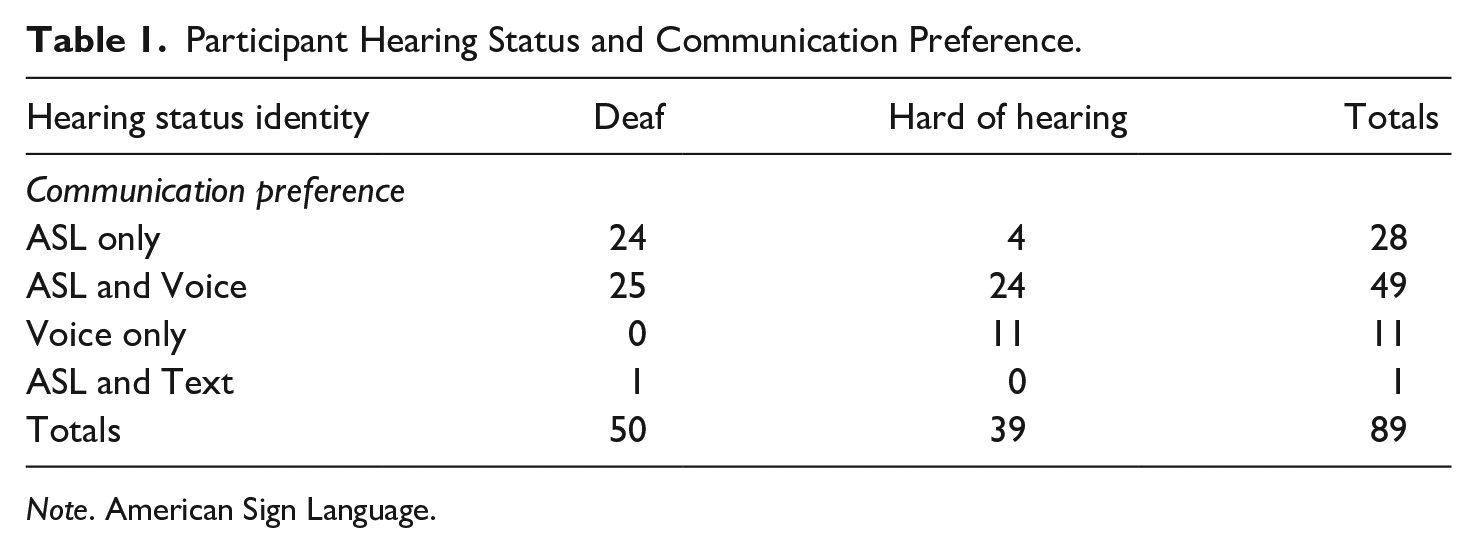
Survey respondents included (n = 89) DHH postsecondary students enrolled in one of seven developmental mathematics courses at the master’s level university from the Spring semester 2017 to Fall Semester 2018, which were all taught by the same instructor. Respondents were queried about their hearing status identity and their communication preferences. Among the Deaf students, communication preferences were evenly divided between those who use ASL only and those who use both ASL and voice. However, the preponderance of hard of hearing students prefer ASL and voice. These results are shown in Table 1.
Participant Hearing Status and Communication Preference.
Note. American Sign Language.
Materials
Instructional videos (n = 405) were created for a series of developmental mathematics courses that were taught by a single instructor. Each video covered a specific math problem that was covered in the courses. The videos were rather short, running between 26 seconds and 9 minutes, with the length of each video depending on the complexity of the problem. This approach corresponds to the recommendation of Guo et al. (2014) for creating brief instructional videos to maximize student engagement. All videos included audio, a visual of the instructor using sign language and speech, captioning, a whiteboard, and a calculator when appropriate. Videos were archived in the project’s YouTube channel, with a private listing that is only available to the instructor’s students. The private listing technique enabled the project to monitor user analytics generated by students’ video viewing (Dinmore, 2019). The courses covered include Applications of Algebra, Explorations of Algebra, Foundations of Algebra, Integrated Algebra, Pre-Algebra, and Trigonometry.
An online survey was created that included a combination of 19 closed- and open-ended questions about respondent characteristics (identification as Deaf or Hard of Hearing; communication preferences—use of ASL alone or in combination with voice, or voice alone), student viewing behaviors (whether videos were viewed and if so, when and how often), feedback about the videos (whether they were clear, whether they were useful), and perceived benefits.
Procedure
During each unit of instruction, students were reminded about the availability of the videos and were given the URLs for the appropriate videos. At the end of the semester, the instructor requested that students complete the online survey about their video viewing experiences.
Data and Analyses
Video viewing behaviors were monitored each semester with YouTube user analytics which were analyzed to get a deeper understanding of student viewing behaviors. User analytics and quantitative survey data were summarized with descriptive statistics and means testing where appropriate. Student comments about perceived benefits were reviewed and thematic categories were created with content analysis (Bogdan & Biklen, 2007). Two independent raters evaluated the open-ended responses to the questions and their ratings were compared. Interrater reliability was high, with a Cronbach’s α = .996. The content analysis was conducted in the social science tradition in which themes are documented, but coded responses in each theme are not enumerated (as they would be in a quantitative, market research approach; Bengtsson, 2016).
Results
Student Engagement With the Videos
Among the respondents, 81 (91%) students watched at least some of the videos and 11 students (12%) did not watch any videos. For students who did not watch the videos, the primary reasons for doing so included feeling like they already knew the material (seven responses) and not having the time to watch the videos (three responses). One respondent did not give a reason for not watching the videos.
Frequency of Viewing Videos
The number of videos varied by course and semester, between 45 and 143 videos per course, and varied in length between 26 seconds and 9 minutes. Students had unlimited access to views. The project monitored user analytics with the YouTube analytics feature. The average number of views per video varied by course, with students viewing the fewest videos in the Applications of Algebra class and Integrated Algebra the most. User analytics are summarized in Table 2. On the survey, students were asked how often they viewed videos. Overall, students said that they were most likely to view most videos once and some more than once. Of the students who watched the videos, 17 respondents (18.5%) watched the videos one time, 42 (45.7%) watched most of the videos once but watched some videos multiple times, 13 respondents (14.7%) watched most of the videos more than once and 9 respondents (9.8%) watched all the videos more than one time. Students were also asked about their preferred time for viewing the videos. There were no significant differences for when students chose to view the videos. Viewing behaviors are described in Figures 1 and 2.
YouTube Video User Analytics by Course.
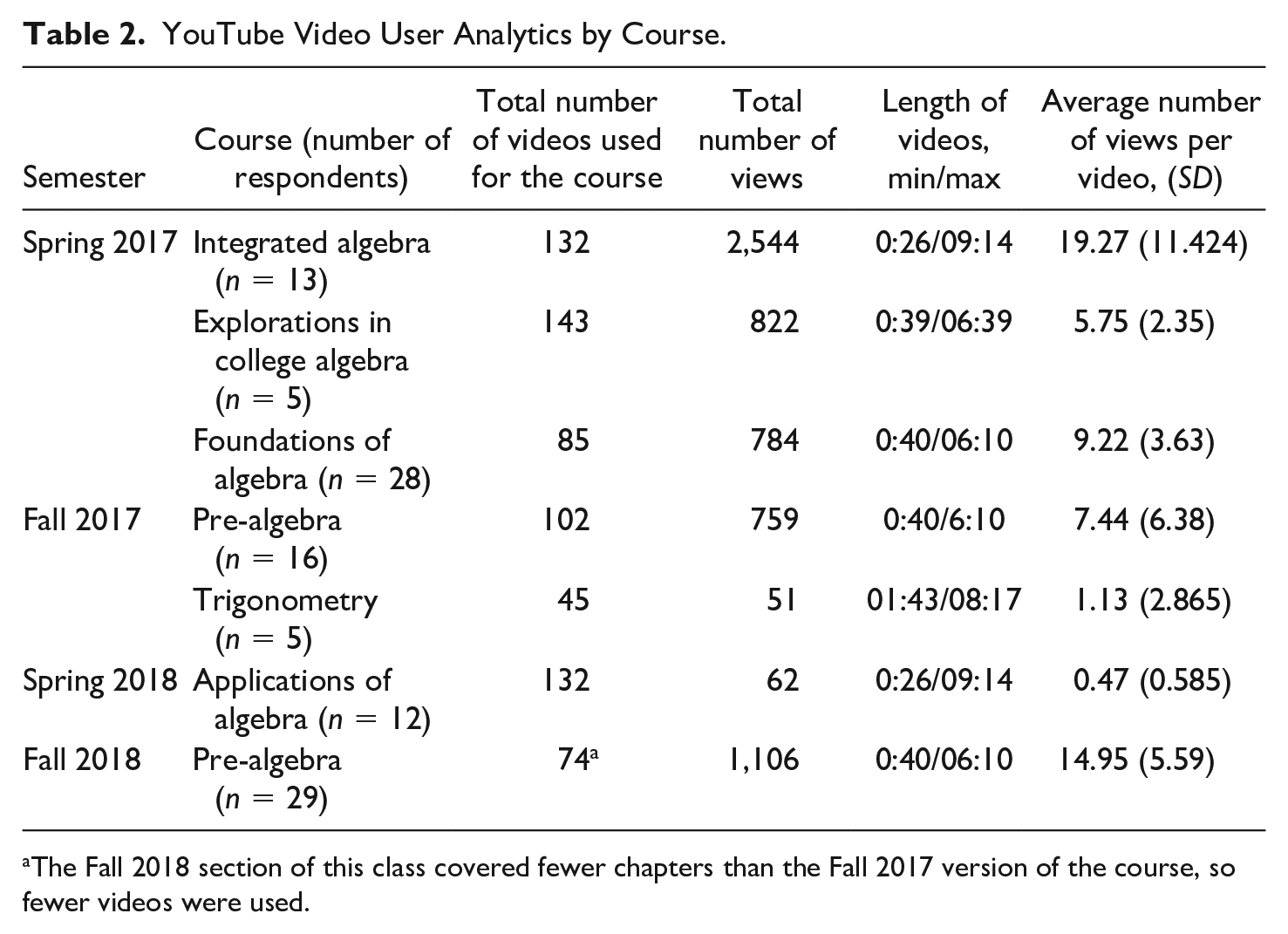
The Fall 2018 section of this class covered fewer chapters than the Fall 2017 version of the course, so fewer videos were used.
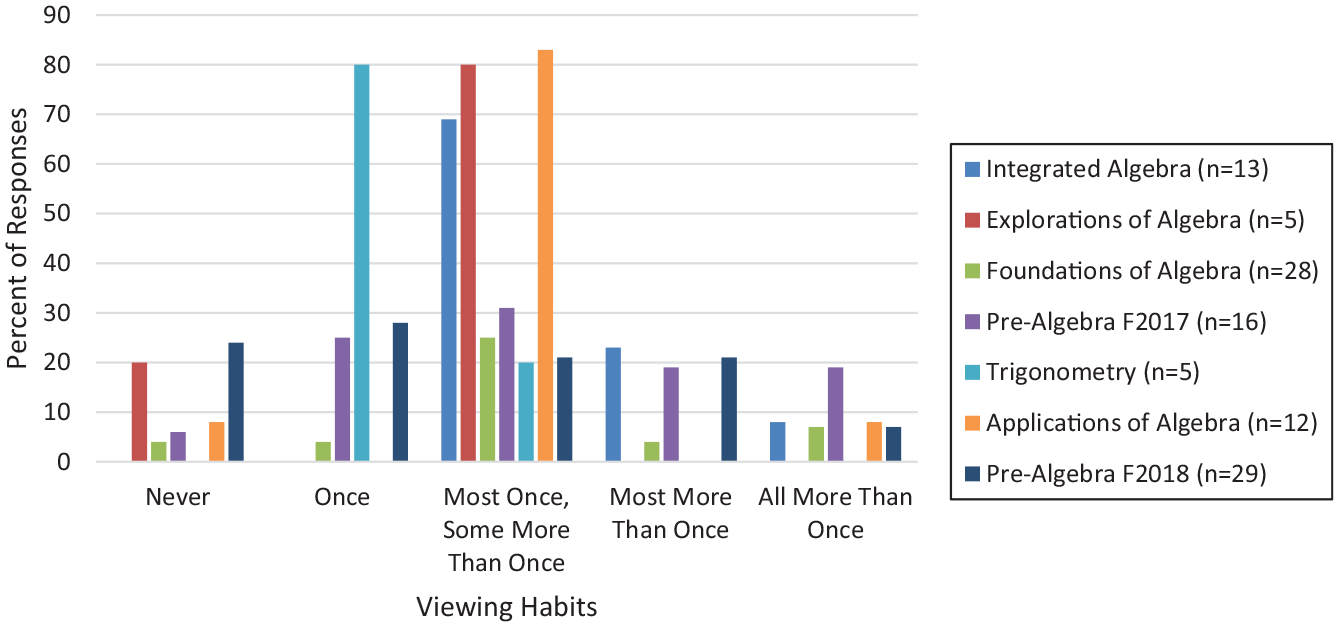
Viewing habits by course.
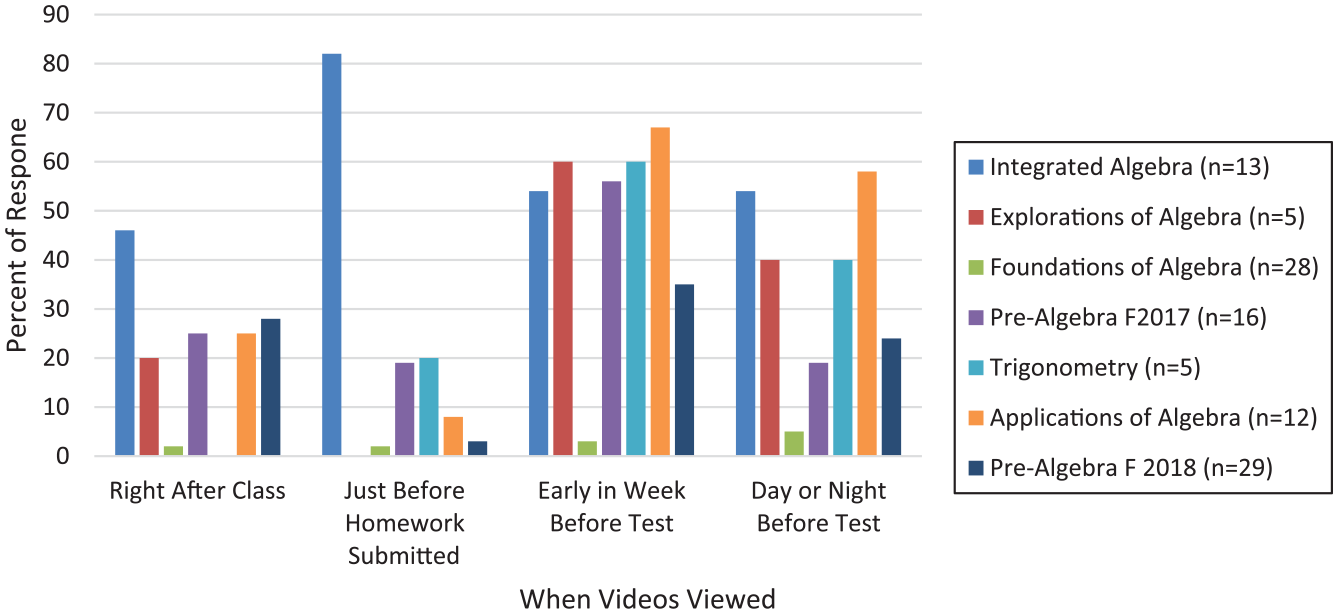
Timing of video viewing.
Information Presentation
Since students have different communication preferences and hearing loss identities (Deaf vs. hard of hearing), their preference for how they receive information could vary. For that reason, students were asked to report on the type of information delivery they focused on most and which of these delivery channels they found to be most informative. Respondents were asked whether they preferred to receive academic instruction through ASL only, captioning only, or a combination of ASL and captioning. Both Deaf and Hard of Hearing groups preferred to focus on the combination of signing and captioning as compared with either alone (χ2 = 31.45, degrees of freedom [df] = 6, p = .00). Since some students might also rely on residual hearing, the videos included audio as well as ASL, captioning, and whiteboard/calculator visuals. When considering which type of presentation yielded the most information, deaf and hard of hearing groups ranked audio, signing, and whiteboard similarly. However, the hard of hearing group ranked captioning as more informative than the deaf group (f = 6.936, p = .01, df = 87).
Perceived Benefits of Videos
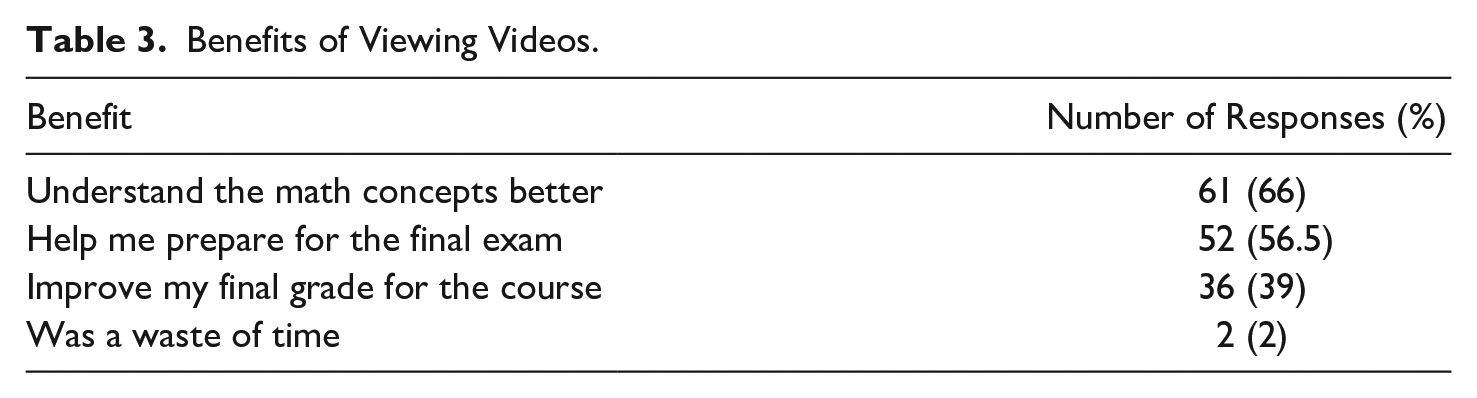
Students provided feedback about the benefits of the videos in two ways, through multiple-choice selection and free response. The multiple-choice options included, “helped me understand the math concepts better,” “helped me prepare for the final,” “will help my final grade,” “was a waste of time.” Respondents could select more than one response for this question. Approximately 66% of respondents felt that the videos helped them to understand the math concepts better and 56.5% of respondents felt that viewing the videos helped them prepare for the final exam. The results for this question are summarized in Table 3.
Benefits of Viewing Videos.
Open-ended responses were analyzed through content analysis. While some of the responses reiterated the forced-choice themes, students’ written comments implied that they benefitted from the videos in other ways as well. The thematic categories emerged from the verbatim quotes and include four major themes: improved understanding and content review, visualization and step-by-step illustration of concepts and procedures, communication features and clarity of communication, and support of independent learning. The featured quotes are excerpted from the surveys without grammatical corrections.
Improved Understanding and Content Review
Many students felt that having the opportunity to view the videos afforded them improved understanding of the material. They were able to review the videos as many times as necessary to understand the procedures involved in solving the problems and to recall critical information that they may have had difficulty retaining. Illustrative quotes explaining students’ perceptions of improved understanding with the videos include the following: Better understanding, more knowledge, much better grades if I watched the video a lot before tests or quizzes. I really like the videos. The (sic) really helpful for when I don’t know how to do the problem or don’t know how to understand a concept. I used it to check to make sure that I have correct answers so I can do amazing for finals. Helped me remember the things I forgot.
Visualization of Concepts and Step-by-Step Illustration of Procedures
DHH students rely heavily on visual information. Therefore, visual reinforcement of the videos should help them to master math concepts. Visualization was frequently mentioned as a benefit of the videos as was the explicit step-by-step explanation of how to solve the mathematics problems. Some of the students described these benefits as follows: The white board shown plenty information, I wrote down everything from the board. Helps a lot for me since I am visual learner. More visual more understandable and clear to understand the problems. By showing step-by-step and can build your knowledge of mathematic ways.
Communication Features and Clear Messaging
Videos produced by this instructor included audio, captioning, ASL, and whiteboard features. In addition, numerous students commented that the instructional videos provided clear communication. Students appreciated both the multiple ways information was presented and the ways in which the instructor communicated that information. For example: I can read the captions to understand the math problems better because my signing is not 100%. Captions, whiteboards and sign language. Communication was very slow and clear, she did everything step by step in each chapter and showed by hand on how to solve the problems. It was fabulous!
Support of Independent Learning
A final recurrent theme that emerged was the opportunity to use the videos to support independent learning. Within this theme, students discussed viewing the video multiple times instead of repeatedly asking the instructor for help, relying on the video when the instructor was unavailable, self-reliance for learning the material, and reducing travel to campus. Comments relating to this theme include the following: I can rewind to figure out rather than ask again and again. I learn with video when teach is busy or is resting at home. I don’t need teacher to help me understand and I learned myself to solve the problem. It is nice to have video because we are always busy and also I live off campus. It is good benefits for me to use video instead of drive all the way to campus. If I do not understand after I watched video, I will ask the teacher to clarify.
Discussion
The results of this survey about DHH students’ viewing experiences of review videos for developmental mathematics courses found that most students did watch the videos. While students in all the courses surveyed viewed some of the videos, viewing behaviors varied by course. The analysis of student reports suggested that students were most likely to say that they viewed most of the videos once and some more often. This finding was corroborated by the user analytics gathered by project staff. Students also reported that they had a tendency to watch the videos early in the week of a test or the day or night before a test.
Most students found the videos to be beneficial. The findings from the closed-choice questions suggested that the respondents found that the videos helped them to understand the mathematical concepts presented during the course and helped them prepare for the final. Students’ written comments reinforced these ideas. In addition, students felt that characteristics of the videos were especially beneficial, including multiple communication features such as captioning and signing, and the step-by-step visualization of the problems helped the students master the concepts being presented.
This study had its limitations. One critical limitation is that we could not compare the learning outcomes of the students with others who did not have the opportunity to view videos. There was also no way to track which students in particular viewed the videos. Future studies need to address both of these questions. Despite these limitations, providing supplemental online videos for developmental mathematics offered students a new opportunity to learn and review material. The videos offered students an opportunity to review material as often as needed to satisfy individual student learning needs. The videos were produced according to standards that are consistent with both good instructional design and Universal Design for Learning. Most importantly, this study demonstrated a means for DHH students to strengthen their autonomous learning skills, strengthening a critical foundation for future studies in STEM.
Respondents to this survey identified as either Deaf or hard of hearing, and they expressed a variety of communication preferences. Employing multiple representations of the material (as compared with only audio or only captioning, e.g.,) is representative of the Universal Design for Learning principle of multiple representations of material (Rose et al., 2010) and supports the suggestions of educators of the deaf (Lang & Steely, 2003; Marschark et al., 2008; McKeown & McKeown, 2019). Mayer (2012) suggests that multimedia learning is more effective when it is received by students through multiple channels (e.g., audio and visual). He documents many experiments that suggest cognitive load is greater (and learning is more inefficient) when information is presented by two methods that rely on the same receptive channel (e.g., captioning and an illustration) for students who are hearing. The results of the present study suggest that DHH students are receptive to and appreciate of learning materials that provide multiple means of access, regardless of the emphasis on visual presentation. The fact that students indicated some videos were played more than once might indicate that students choose to focus on one input at a time. This is a distinct advantage that online materials hold compared with in-class methods of presentation that occur in real time and restrict a DHH student’s attention to one mode (e.g., instructor, slides or whiteboard, interpreter, real-time captions). Future research should include a deeper investigation into these viewing habits.
Students also felt that being able to replay the videos as often as needed was useful to review and remember content. As noted earlier, research has documented that students who are DHH often have memory challenges (Hauser & Marschark, 2008; Liben, 1979), so providing students with materials that can reinforce their memory may support their learning in ways that traditional support like group study sessions or office hours cannot accomplish.
Finally, students felt that having access to the videos allowed them to exercise autonomous learning—students did not have to rely exclusively on the physical presence of the instructor to learn, review, or master content. Availability of the videos meant that students could better integrate their learning and study into their complicated schedules, allowing students to take control and responsibility for their learning. According to some of the comments made by the students, they expressed a desire to be autonomous learners which was enabled by having access to the videos. Historically, DHH students often rely on supportive systems (such as additional tutors) to aid in their learning, so this was a surprising and encouraging theme. Albertini et al. (2012) demonstrated that previous incoming classes of students to the same institution expressed weak motivation for academic success, self-regulation for reviewing for class, and test preparation. Providing supplemental videos for test review is perhaps a strategy that appeals more to the students and aligns better with their learning preferences.
Motivation for academic success has been shown to correlate with persistence in postsecondary STEM programs of study (Simon et al, 2015; Van Soom & Donche, 2014) and the weak motivation exhibited by DHH students (Albertini et al., 2012) contributes to this underrepresentation. The perceived benefits DHH students described from viewing these supplemental videos could be viewed as a meaningful use of online information to help reduce a knowledge gap. This could be significant given the conceptual shift in the view that the digital divide is not merely defined by access to the Internet, but rather by the informational use of that resource (Wei & Hindman, 2011). Cultivating a habit in DHH students to use educational resources they deem useful for their learning could be envisaged to, in turn, compel them to seek out additional meaningful resources on the Internet that benefit their own learning. This could further lead to improved retention in STEM disciplines.
Previous research with this student population suggests that instructors may bear some responsibility in fostering teacher-dependent students (Kahn et al., 2013; Lang et al., 1999). Therefore, the instructor’s willingness and motivation to create supplemental video libraries deserves plaudits. Chametzky (2014) suggests that online learning solutions that support learner engagement such as the videos used in this study contribute to student success. However, while online learning has become ubiquitous, its acceptance within the academic community is not universal.
Supporting online resources, University administrators perceive online solutions as a cost-savings measure given its low dependence on physical infrastructures (Ubell, 2017). Students find online learning useful for its inherent flexibility (Bryant, 2011; Elliot et al., 2013; Gehret et al., 2017; Tsuei, 2014). Many students who are DHH report having at least some online postsecondary education (45.7% at least one online course, 17.1% entire program online; Garberoglio, Palmer, & Cawthon, 2019). Therefore, it follows that making online resources that address these students’ learning needs would produce a good return on investment and that more online materials that are accessible for those with varied communications needs should be encouraged.
Despite administration and student endorsements, not all faculty enthusiastically embrace online learning solutions. Faculty critics suggest that online learning is devoid of the personal connections that they can provide in the classroom. Others are concerned with student expectations for immediate response at any time of day or night (Ubell, 2017). Another demand that concerns faculty is the time investment required to become technically proficient with the platform that will be used to deliver online learning solutions. Online delivery of educational material requires instructors to be both content and technology experts (Bryant, 2011). If administrators and students and some faculty find value in online solutions such as the supplemental videos used in this study, it is critical for instructors to have sufficient institutional support to create appropriate instructional materials for their students so that students will have the resources to develop and foster their autonomous learning skills.
Recent research has suggested that student who are DHH hold similar aspirations for college success as their hearing peers (Garberoglio, Palmer, & Cawthon, 2019). Providing accessible learning materials that encourage autonomous learning skills offers the opportunity for more positive learning outcomes for students. This study offers one example of how online learning materials can support students’ efforts to become autonomous learners and move closer to academic success.
Footnotes
Declaration of Conflicting Interests
The authors declared no potential conflicts of interest with respect to the research, authorship, and/or publication of this article.
Funding
The authors disclosed receipt of the following financial support for the research, authorship, and/or publication of this article: This research was supported by National Science Foundation Grant HRD-1127955. Any opinions, findings, and conclusions expressed in this material are those of the author(s) and do not necessarily reflect the views of the National Science Foundation.