







Abstract

My name is Chango Cummings, I am a Black American artist, designer, and Twin Cities, MN native. In 2021, I completed my Senior year at Parsons school of Design and received my BFA in Architecture. My focus at Parsons was utilizing architectural design to create regenerative Black spaces. In this reflection essay, I want to break down some aspects of my experience in white spaces, Black spaces, and spaces in between that have led me to the work I am currently doing. Only 2% of registered Architects in the United States are Black. Most folks, even architects, can’t name a Black Architect off the top of their head. And Black women architects? They are only 0.2% of registered architects, you could count on two hands the Black women architects in the U.S. Architectural design is a hyper-white space, and that is the reason I entered the field. For me, it is as plain and simple as this—if we are not building our own communities and spaces how do we expect them to change or to function for Black well-being. I am not an academic, I am a practitioner of race-conscious architectural design, and as such the research on white space is informative—and I have a unique vantage point which can contribute to that research.
The hyper-white field of Architecture creates hyper-white spaces, and hyper-white space is hyper anti-Black. Anti-Blackness in the field of Architecture starts from the ground up, from the college classrooms to the professional realm and everything in between. When a field is controlled by white men, and Black people have been excluded, there really is no question that it will function in this way. Unless, of course, you do the work of undoing, but this work is hard and grueling, and it falls on the shoulders of Black people who are already marginalized in the field of architectural design. Most are not up for this task and even if you are up for it, many times it still fails. Academia has a special kind of evil when it comes to the anti-blackness. My path to university was trial after tribulation.
A Child in Hyper-White Space
I went from two top Twin Cities, MN private schools that were both anti-black and passive aggressively so. This type of elite hyper-white space functioned in what I call the country club mentality. As a Black person, when you enter the country club it is assumed you don’t belong, you must be visiting and or with a white friend. There is no way you could belong to such white space because the space has been literally created to keep you out. I experienced this feeling in predominantly white private schools. The feelings of imposter syndrome and alienation are heavy for Black and most other POC students. If you don’t conform to white styles of learning, talking, living, moving, and breathing, you might as well just move around.
I experienced much resistance when I entered Pre-K with dreadlocks and bright green eyes; there was really no fitting in, even if I tried. At such a young age, I couldn’t fully comprehend the ideas of code-switching or conforming so I was just myself: energetic, free, honest, and Black. This provoked reaction from students and staff alike, I was kicked out of class, off of the bus, off of the playground, etc. Ultimately, the school told my parents I had some type of behavior disorder and recommended I be medicated with ADHD drugs. My parents, of course, said no. But when the school staff realized they couldn't break me into conforming to the norms of their hyper-white space, I was kicked out, or “asked to leave.” I was kicked out of both of the private schools I attended before the age of 8 and then later at the age of 13. I then made my way to the public school realm.
Becoming a Young Man in Hyper-White Spaces
The public schools had a different way of functioning. These schools were in the inner-city where white students were not the majority and so they functioned less in the country club style and more so like real-world white spaces. In these schools, the staff created micro white spaces within space. The AP classes and certain extracurricular activities are where they resided. Crosscountry skiing, Orchestra, Robotics Club, Debate Team, these were all micro white spaces within the racially “diverse” schools. Thee spaces were very insulated and many times you would hear white students saying it felt like they went to a completely different school inside the school—because they did. Generally, when I entered these spaces I felt the exact same anti-blackness as I had the private schools. The country club mentality was still there, but this was now backed by government systems. Public schools of course are a part of the racial social system, and they have school social workers, police officers, and law enforcement policies and the courts to create sanctions for students who do not follow the norms of white space. If you miss enough school or violate school rules like dress codes, you go to court, if you keep missing school or violating rules, you go to jail. Ultimately, this system was a lot more in your face and brutal than the private school for me. I witnessed Black and POC students get tazed, arrested, and brutalized by the staff and police on the school grounds. This was not only extremely traumatizing as a young student but was more difficult as I realized this is just a reality of the world we live in. Another method of trying to break you and get you to conform to whiteness.
Now, the public school lunch tables were where you really began to see the dynamics of racialized space. In my high school, St. Paul Central high school, that by diversity standards was seemingly utopic—30% Black, 30% White, 30% Asian/Latinx, and 10% other demographically, you could see each group broken down and segregated by a lunch table. The Hmong students sat with each other, the East African students had their table, the Black American students had theirs, and the white students had theirs. Of course, there was some overlap but if you walked into the cafeteria and looked around it very much resembled a prison yard style of segregation. These divides are ultimately a result of cultural, social, and economic norms, and of course, there is a larger context resulting from racialized space. At one point, the school even tried to create Black academic spaces within the high school. They created a program called African American Male AVID. This was a program that I was in the ninth grade and it had black students from all walks of life, and our staff leader was ironically and perhaps unsurprisingly a white male. The space to me felt synthetic, though it was good to be with my people, we were still under the rules of the system in a white space. They created an academic policy required for participation in the group, so if your grades dropped below a certain GPA you would be unable to participate. As a result, I was kicked out of this program during my first year because the traditional curriculum and rules-based organization of the educational system did not fit with my learning style. There was no academic space within educational white spaces that functioned for my benefit as a Black teen. My choice was either to learn the type of material presented in the type of way institutionalized by these white space or you fail. So I failed. Over and over again. This experience trained me to think I was a failure; dumb because I was unable to learn or adapt to the style of learning in white spaces: a style that ultimately was never made for me. It was this experience that pushed me to the afterschool program that really informed my current trajectory: Juxtaposition Arts (JXTA).
Black-Centered Education and Training
Juxtaposition Arts is a youth run, non-profit arts organization in the heart of Northside Minneapolis, the focal Black neighborhood in the Twin Cities. The ethos of JXTA is essentially to serve as an incubator for youth artists, designers, and creatives that look to take their craft to a world class level. JXTA both centers and affirms the beauty and power of Black art and gives Black youth the opportunity to do real work and real projects, within their community and for their community. JXTA was the first place that I truly felt at home, not only due to the primarily Black youth demographics but because of its Black leadership which had created a curriculum based on Black art, Black community, and Black learning styles. The organization is Black owned and operated, and seeing this type of space as a young Black man changes your perspective. It functioned in a way that was the ultimate for me. And truly, there is nothing that compares to being a Black youth, being taught by someone who looks like you.
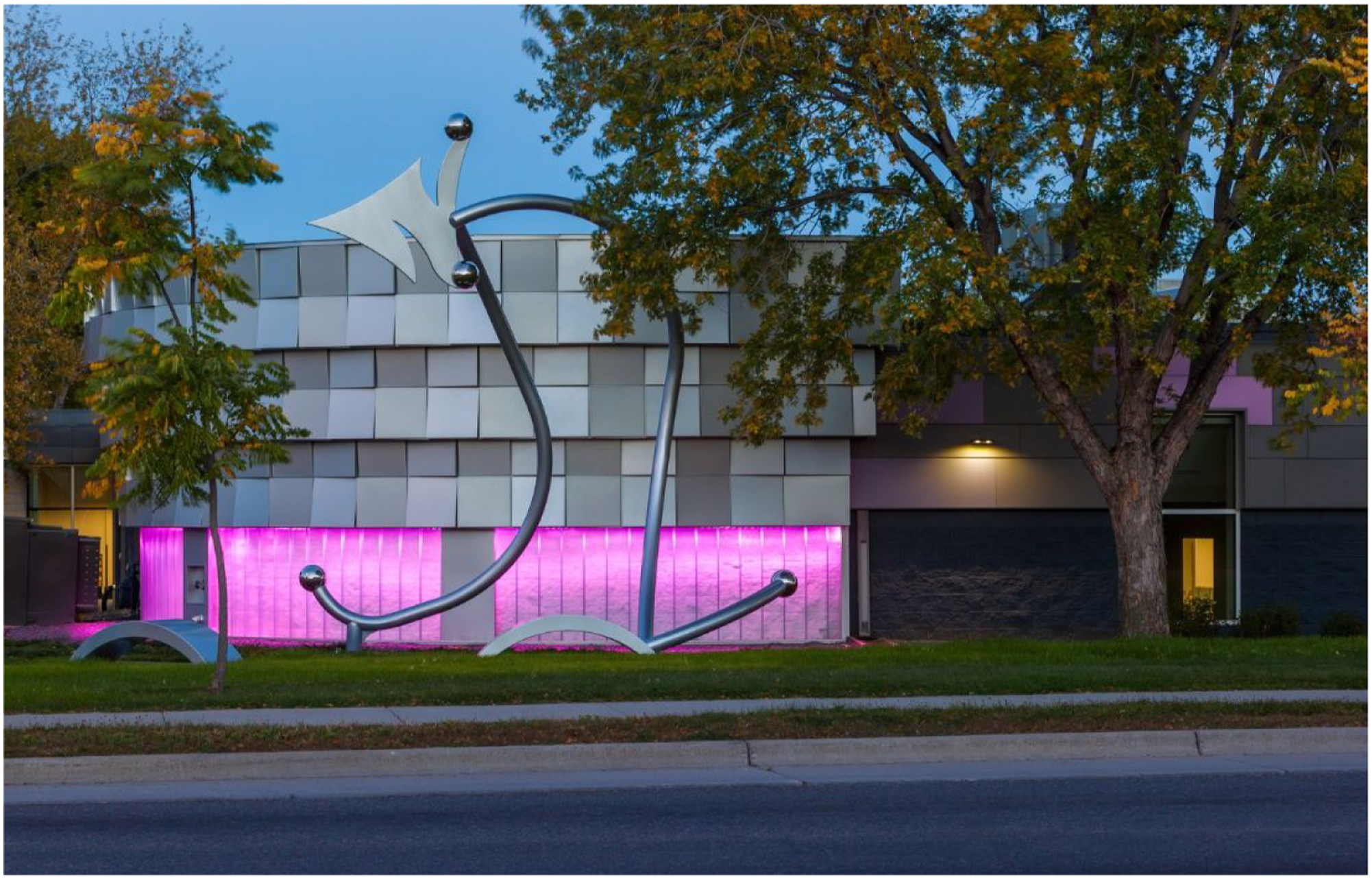
The environment at JXTA was what pushed me into the field of architecture and design. I worked in a program called the “Environmental Design Lab,” and through that program I was able to learn the whole Architectural Design process in college level designed courses and hands on design projects. At age 15, I created a design proposal and presented it to the city of Minneapolis, and my design was eventually chosen for display in North Minneapolis. My first public art sculpture “The North Arrow” is a 20 ft stainless steel public art piece that still stands, blocks away from JXTA, at the boundary of North Minneapolis. This was one of many wins I achieved through my work at JXTA. These wins were so important for me and my trajectory. I regained the confidence that was so badly beaten out of me in regular academia. The feelings of not being worthy and being a failure were dismantled though this Black community space where my learning style and the designs I produced were valued. I began to realize that it wasn't me that was the failure, but it was the white spaces that made me feel this way. This was what JXTA did for many Black and other POC youth. Beyond the traditional arts training, it really recalibrated the Black body to its potential and purpose. I found that my purpose through JXTA was design, specifically Architecture. Figures 1and 2
Proposal image for the North Arrow. Samuel, Ero-Phillips. North Arrow Render. 2012, Juxtaposition Arts, Minneapolis MN, USA. The North Arrow installation. North Arrow Photo. 2012, Juxtaposition Arts, Minneapolis MN, USA.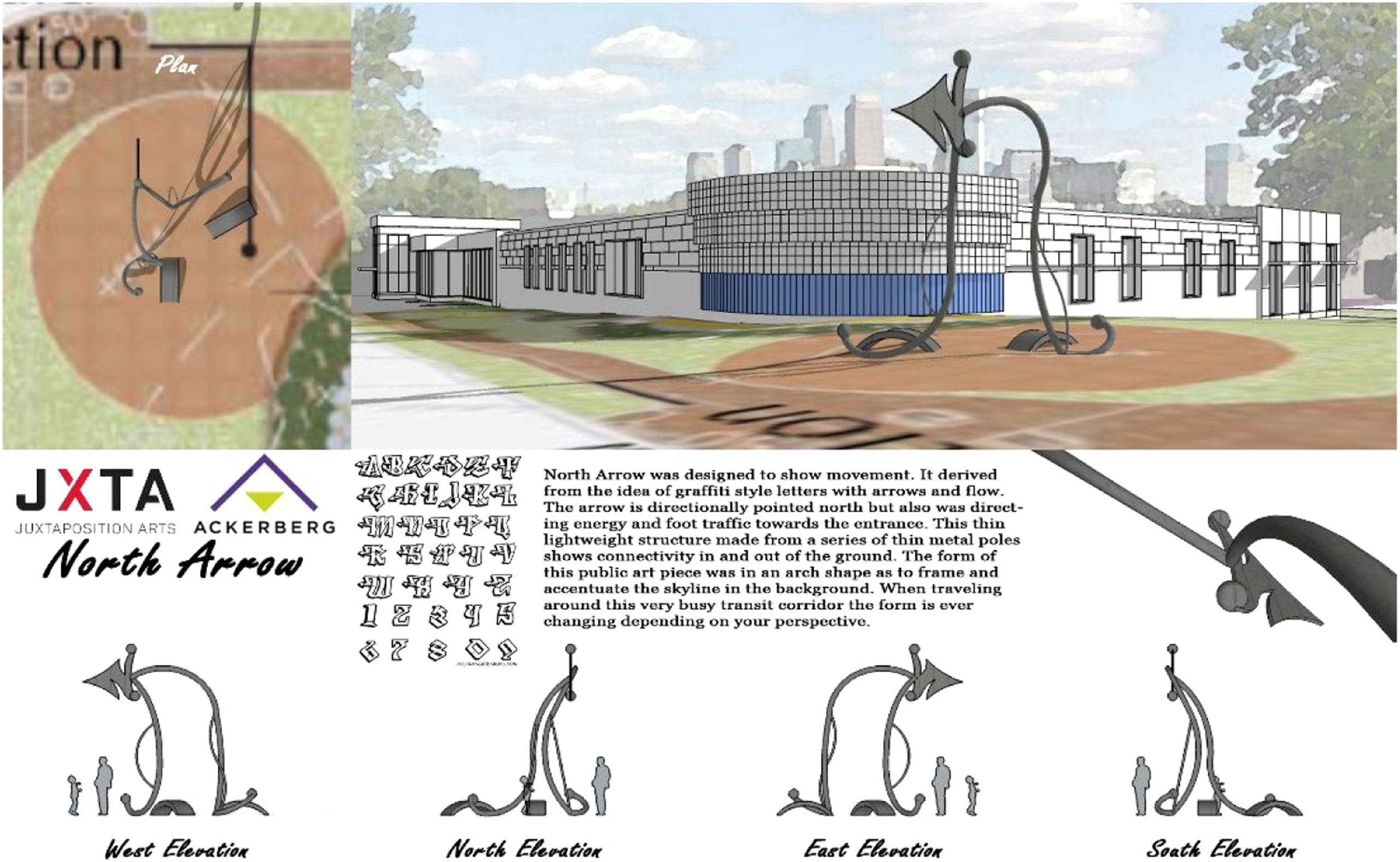
I was always an artistic kid and I grew up in an artistic household. Through my experience at JXTA, I realized I wanted to have my hand in something that I could use for my community. I saw architecture as my calling, and I thought if I could shape my community I could change it as well. My lead teacher in the Environmental Design Lab was Sam Ero-Phillips, a Black American Architect, and he told me I could do the same as long as I put heart into it. I saw the lack of Black designers in the field, and it made me wonder why given all of the successful Black architectural designers I saw at JXTA. I learned that we have always been builders and designers—but the field of architecture lacked our presence. Eventually I would learn why.
Navigating Hyper-White Space to Become a Professional Black Architectural Designer
After failing out of High School, I took my GED and I began my journey to higher education. It took a couple years and going to what I call a JUCO (Junior College) of Art schools to get me to where I wanted to be, and eventually I was accepted at Parsons. Parsons is one of the top ranked and most elite art and design schools in the world. Situated on fifth Avenue in Manhattan, NY, it attracts some of the best, “brightest,” and richest students from around the world. If the Private Schools I attended were like country clubs, then Parsons was like the MET Gala. Almost immediately upon entering I realized that I was in for a challenge in that space. I was not scared because I was a seasoned vet in racist academic spaces, and I had learned how to articulate my experiences with white racism by working with prominent Black architects at JXTA, so I felt nothing could phase me. I quickly discovered that students at Parsons generally never interacted with Black people in their lives, so their reaction when seeing me was either shock or just dead silence, usually the latter. By that point in my life, I preferred someone ignoring me to anything else that might lead to a hostile racist micro-aggression.
In my first year at Parsons, I had a few racist professors that gave me that crazy look or energy that let me know they didn't respect me. I decided the best way to deal with that level of hostility was to drop the classes with these professors, so I didn’t experience anything too crazy in that first year. When I entered my second year, I saw the true colors of Parsons Architecture program. I was one of maybe five Black students in my whole program. In my year, I was one of two. It was immediately clear that I had entered another hyper-white private school space, like those I had grown up in. Me and the other fellow black architect were immediately alienated. We experienced regular micro-aggressions letting us know that we were outsiders and were not completely welcome in that space. Fortunately for me, I encountered a good German professor who saw my talent and insight from day one, and he made sure I knew it. Unfortunately for my the other Black student in my year, he had one of the worst, most anti-Black professors who was notorious for hostilely targeting students of color, and as a result he dropped out of the program. That was when I began to understand why Architecture is such a white profession. The gatekeepers were white men, and most of them were intentionally or unintentionally anti-Black. If these gatekeepers decided they did not like a student, the student could literally be removed from the program. There was one professor who was notorious for telling students “you will never be an architect” as a way of breaking students.
In my years at Parson, I watched as many of the very few Black students in my Architecture program didn't survive. There were many elements of the program that could take you out including professors, students, and supplies. Supplies became an ultimate evil for those of us Black students who were not wealthy, because if you could not afford the hundreds of dollars worth of supplies you needed each semester, you ultimately could not succeed in courses. Another thing that held back Black students was that, if one professor failed you, you would have to re-take a course, adding another 70,000 to your debt or taking you out if you could not afford the money or time. Because nearly all of the professors were white, they held white biases about what constitute good or bad architecture, and this meant that many of the Black students, who were not lucky enough to get the one or two professors who valued Black art, ended up being failed out of the program.
I was lucky, because I started my program with an amazing professor as well as real-world experience in the field of architectural design that had shown me the value of Black art and design. I had knowledge at my disposal which gave me the resilience I needed to succeed in the white space of Parsons. Unfortunately, when white students saw this, I encountered resistance. They showed me their fragile anger in the critiques they gave my work. Part of the architecture program involves showcasing of your work in front of staff, guests, and your fellow students and getting receive critiques. These are supposed to serve as a space where you get constructive criticism and learn how to better your work. The white students in my course, many of whom were explicitly racist, used this as a time to tear me down. They laughed through my presentations, talked to each other, and did not even looking at my work. These white students were blatantly disrespectful to me and to my work, as well as to other Black and other POC students. Eventually I realized I had to report their behavior to the dean because it was affecting my ability to succeed in the program. When the dean did not take any action, I decided that the best strategy would be to disrupt the white space in my classrooms by having my own people in my corner, so I invited my fellow Black students and friends to come to the critiques. Their very presence would begin to break up the white space from its core. On top of that it made me feel more safe and comfortable within the space. They knew that if I was not the only Black person in the room they had to be held accountable.
Some of my fellow students understood this need to create Black space inside of the white space of Parsons as well and together we formed the first Black designers cohort in Parsons history called The OBSIDIAN Group. We were able to come together to organize and ensure we could attend each other’s critiques, and hold space and just talk amongst each other. In the process, we realized we were encountering the exact same things, just in different classrooms, or at different times and spaces. Just the fact that we were able to create Black space within the hyper-white space was beneficial for our success. In my senior year, I served as the Vice President of The OBSIDIAN Group. During that year we started to ask the question, Does Parsons deserve Black students?
I want this to be a question that Black students across the nation consider, not only at Parsons but for academia at large. Does your school deserve Black Students? Or does your profession deserve Black people? I see it as simple as this, if Black people are unable to sustain and maintain a healthy and happy Black body within any white space does that space really deserve them? We have fought battle after battle to enter these spaces. Our very presence adds an irreplaceable insight and expertise that can only come from the Black community. It is irrelevant how wealthy or “educated” your student body or workforce is, ultimately it is lacking without the presence of Black people. So you need us, but do you deserve us? If you don't deserve us, what can these hyper-white spaces do to deserve us? This is a conversation I would like to see happening in academia and beyond.
Footnotes
Declaration of Conflicting Interests
The author(s) declared no potential conflicts of interest with respect to the research, authorship, and/or publication of this article.
Funding
The author(s) received no financial support for the research, authorship, and/or publication of this article.