







Abstract
The accelerating development of autonomous vehicles is expected to have important effects on society such as reducing the number of traffic accidents, preventing the disabilities and deaths attributed to car accidents, and reducing pollution. However, their adoption depends on the willingness of the population to accept this innovation and incorporate it in their everyday activities. This study investigated the association between socio-demographic factors, political ideology, and attitudes toward technology and its perceived potential impact on society on support for driverless cars. We conducted a secondary analysis of a large sample of employees in the United States (n = 2,470). Based on conceptual frameworks relevant to the study of technology adoption such as the self-interest hypothesis, the usefulness of the technology, ideological orientation, and socio-demographic gaps in attitudes toward technology, our results indicate that perceived social outcomes of driverless cars are strongly associated with their support. Age and gender are negatively associated with support for autonomous vehicles. In contrast, perceived positive outcomes of the introduction of technology in the workplace are positively associated with them. Individuals with a consistently conservative ideology are also less likely to be supporters of autonomous vehicles. Our findings indicate that the centrality of the expected societal impact of autonomous vehicles implies the need to provide the public with accurate facts about their expected effect. Doing so is critical to increasing the public’s willingness to adopt the technology and support its production. People must also be reassured that regulations and product designs will be created to ensure their safety.
Introduction
The purpose of this study is to investigate the factors associated with public opinions on driverless cars in the United States. Driverless vehicles are currently being developed in several commercial and research projects worldwide (Nordhoff et al., 2018). The United States is probably one of the key nations for the development of autonomous vehicles in terms of hardware and software development. Indeed, the testing of automated driving systems is being conducted across the country (National Highway Traffic Safety Administration, 2020).
Whereas autonomous vehicles are predicted to improve people’s well-being in various areas, there are also some concerns about them expressed at the individual and societal level. On the positive side, there are claims that wide-scale use of autonomous vehicles will greatly reduce the number of traffic accidents and prevent both the disabilities and deaths that are currently attributed to car crashes (Fagnant & Kockelman, 2015). Automated cars are also expected to increase the accessibility of the disabled and the elderly to transportation and enhance their individual mobility and participation in society (Fagnant & Kockelman, 2015). Moreover, given that autonomous vehicles tend to run on electricity, their widespread use would promote ecologically friendly mobility and reduce gas emissions. In addition, autonomous vehicles can be linked to a central traffic control system that improves traffic management, further reducing fuel consumption and pollution (Mersky & Samaras, 2016). These solutions can also have additional positive externalities such as improving traffic efficacy and reducing travel costs, including public transportation fees (Burns, 2013).
Beyond these social benefits, there are several challenges that driverless transportation poses to society and need to be discussed as well. Autonomous transportation might cause a shift in the labor force because human drivers could become less necessary (Hohenberger et al., 2016). Some authors have also warned that autonomous vehicles pose a risk to people’s privacy because of the recording of their movements (Hudson et al., 2019). Furthermore, whereas most adherents agree on technology’s effect on improving road safety, there is still no undisputed evidence that automated cars are significantly safer than non-autonomous cars or that traffic crashes will be reduced (Hudson et al., 2019). Whether because of these challenges or unsubstantiated concerns, 71% of Americans drivers say they would be afraid to ride in a fully automated vehicle (Edmonds, 2019).
Consequently, as with previous innovations, the study of technological acceptance is critical for the future of the adoption of autonomous vehicles and requires the investigation of the factors associated with public attitudes toward driverless cars. To accomplish this goal, we conducted a secondary analysis of a large data set of the United States population that was collected by the Pew Internet and American Life Institute.
This study contributes to the literature by situating the acceptance of autonomous vehicles in the broader discussion of the fear of job loss and the acceptance of technological innovations. In other words, this study is important because of the potential consequences of these beliefs. Whereas positive attitudes pave the way for the uptake of autonomous vehicles, negative ones may reduce public acceptance of new autonomous and driverless cars. Negative attitudes would dampen innovation and investment, increase the regulations surrounding such innovation, and ultimately affect the potential economic growth of countries worldwide. This is not to say that regulations, societal impacts, and ethical concerns about autonomous vehicles should not guide their design (Borenstein et al., 2019). However, societal discussions about the risks and benefits of technological innovations should be guided primarily by facts.
Literature Review
While many studies have been published on the impact of automation and technology on society, much less is known about how people subjectively perceive this technological change, and the understanding of the attitudes supporting the adoption of innovations such as driverless cars (Dodel & Mesch, 2020). This is an important topic because attitudes may impact the rates of public acceptance of the development and introduction of autonomous vehicles. Public acceptance rates may also affect the investment in these cars, and ultimately the growth potential of economies. The literature review is organized around the conceptual frameworks that have been suggested in the past as relevant to technology adoption. Specifically, we consider the self-interest hypothesis, people’s attitudes about the usefulness of technology, their ideological orientation and socio-demographic gaps in attitudes toward technology.
Self-Interest Hypothesis
Why are almost three quarters of Americans afraid of fully self-driving vehicles? (Edmonds, 2019) An important predictor of attitudes toward driverless cars is fear of job loss due to automation. We draw on the scholarly literature on the antecedents of job insecurity attitudes at both the micro and macro level (Chung & Mau, 2014; Chung & Van Oorschot, 2011; Mau et al., 2012). This literature indicates that such fears are largely driven by economic self-interest. At the individual level, we expect that those with less education and weak economic positions are more likely to be fearful of driverless vehicles. In contrast, we expect people with stronger labor market positions to respond more positively to driverless cars.
According to the findings of Dekker et al. (2017), those who have jobs that are more likely to be negatively affected by automation are more likely to fear the advance of robots at work. These fears depend on education and income and result from one’s economic self-interests. Those with more education and income have a better position in the labor market and are less likely than those with less education to fear automation and driverless cars (Dekker et al., 2017).
Consistent with the self-interest hypothesis, a recent study on automation in the workplace found differences in the perception of the impact of these technologies on the job market. The results of the variables measuring socio-economic status (education and income) were consistent. Those who were better educated and earned more felt that technology had a positive effect on their work life (Dodel & Mesch, 2020). These results were confirmed in a European study documenting that education and income are positively associated with positive attitudes toward driverless cars and driverless trucks (Hudson et al., 2019). These findings appear to be a result of both general perceptions about technology and its specific characteristics. The study reported a positive association between education and the acceptance of the use of robots. Furthermore, this acceptance increased the acceptance of driverless vehicles. The second explanation has to do with self-interests. Those with less education and less income might be concerned about the impact of driverless vehicles on their job prospects and afraid that the price of transportation, if dependent on driverless vehicles, would rise (Hudson et al., 2019).
Similar support for the hypothesis about self-interest comes from the findings of Morikawa (2017) who studied the socio-demographic determinants of the impact of artificial intelligence and robotics on employment. He demonstrated that younger people and those with postgraduate studies were less concerned that their jobs would be replaced by artificial intelligence and robotics. Thus, based on the self-interest hypothesis we expect that:
H1: Education and income will be positively associated with supportive attitudes toward autonomous vehicles.
Socio-Demographic Differences
Previous studies on the effect of computerization in the job market have found that there are differences in the perceived positive impacts of computerization and artificial intelligence according to socio-demographic factors. Although, driverless cars are a promising technology that may help older adults safely maintain independence, because no fully self-driving vehicles are yet available to the public, most research has been limited to subjective survey-based assessments that depend on the respondents’ limited knowledge based on second-hand reports and reports a negative relationship between age and attitudes toward automatic vehicles (AVs).
In a study of computerization in the work place, older people expressed more negative perceptions regarding the impact of new technology on their current job (Dodel & Mesch, 2020). Similarly, older Europeans were more uncomfortable with driverless cars. The older the respondent, the more negative were the attitudes. Furthermore, these attitudes were more negative among older people who did not drive than those who did (Hudson et al., 2019; Rahman et al., 2019). A possible explanation has to do with self-interest, that is, the association of age with trust and risk perception of AVs.
A study examined the specific factors that affect younger and older adults’ trust in self-driving vehicles. Older individuals were less likely to trust self-driving and reported a perception of higher risk during travel (Dodel & Mesch, 2020; Rovira et al, 2019). Thus, consistent with the self-interest model, it appears that perception of personal risk and lack of trust in automatization are associated with negative attitudes among the elderly.
Gender is another important variable affecting attitudes toward the social impact of autonomous vehicles. Hudson et al.’s (2019) European study also confirmed that men were more likely than women to be accepting of autonomous vehicles. Similarly, German women indicated that they were less likely than men to use autonomous vehicles (Hohenberger et al., 2016). Hohenberger et al. (2016) argue differences in affective responses to AVs (i.e., anxiety and pleasure explain gender differences). Women expressed higher levels of anxiety from driving in AVs and lower levels of pleasure by driving in AVs than males.
Other authors point to evidence that those who travel more often and for longer distances by car tend to have more positive attitude toward driverless cars. Frequency and length of driving by car tends to be correlated with several socio-demographic attributes such as age and gender, and this may be the culprit of gender and age-based differences (Hudson et al., 2019).
Based on these findings, we expect that:
H2: There will be a negative relationship between age and supportive attitudes toward autonomous vehicles.
H3: There will be a relationship between gender and supportive attitudes toward autonomous vehicles in which women will be less supportive than men.
Political Ideology and Acceptance of Technology
Studies of public opinion on science and technology in the United States have shown the existence of divergent opinions according to ideological lines (Gauchat, 2012). Compared with liberals, conservatives have less confidence in science and are more skeptical about scientific issues such as climate change and vaccinations (Choma et al., 2014; Gauchat, 2012). A recent study on the role of ideology on attitudes toward driverless cars found an ideological divide in public reactions to the subject. Compared to liberals, conservatives expressed more concern about autonomous vehicles and more support for regulating driverless cars (Peng, 2020).
A number of explanations have been suggested for this gap. First, political ideology may be associated with openness to new experiences. Support for this argument comes from a study reporting that conservative attitudes are negatively associated with openness to experiences and positively associated with the fear of threats and job loss (Jost, 2003). Second, driverless cars would bring about socio-economic consequences that potentially resonate more with specific ideology-related worldviews. Dixon et al. (2020) showed that liberals were more supportive of self-driving cars, but this link disappeared when worldviews were concerned (Dixon et al., 2020). Based on these findings, we expect that
H4: There will be a relationship between political ideology and supportive attitudes toward autonomous vehicles in which conservatives will express more negative attitudes than liberals.
Familiarity With Technology Hypothesis
Another factor that might be associated with public attitudes toward driverless cars is people’s previous experience with technology. According to the familiarity hypothesis, when individuals become more familiar with technologies in the workplace and at home, they become more accepting of them (Kahan et al., 2009). Exposure to Internet applications at home and on the job, and frequent use of software are expected to be positively associated with attitudes toward new technological innovations such as driverless cars. The digital environment provides people with access to information and promotes their learning and self-confidence in coping with new technologies (Eynon et al., 2018). In a longitudinal study on perceptions about job insecurity, Internet users reported fewer fears in this regard than non-Internet users (Lissitsa & Chachashvili-Bolotin, 2016). A high frequency of Internet use can be considered a reasonable proxy for technology use in everyday life, and studies had found that individuals who are heavy users of technology regard the impact of technology on society as positive (Dodel & Mesch, 2020).
Furthermore, the introduction of technology into the workplace has not only increased some employees’ familiarity with the technology but also may have promoted more positive attitudes toward their potential effects on their job prospects and futures. Dodel and Mesch (2020) found that previous positive experiences with technological innovations in the workplace predicted more optimistic attitudes toward automation and their societal consequences. Thus, based on these findings, it is plausible that previous and current experience with technologies will have an impact on the attitudes reducing the barriers to supporting driverless cars. Therefore, we posit that:
H5: The more positive the perception of the effect of various technologies on their job prospects and the greater their exposure to the Internet in terms of their frequency of use, the more likely people are to regard the effect of driverless vehicles as positive on society.
Perceived Social Impact of Driverless Cars
In the study of intentions to use new technologies, a model that has been widely used is the technology acceptance model. A central component of the model is the perceived usefulness of technology, a dimension that has been defined as the “degree to which a person believes that using a particular system would enhance performance” (Davis, 1989, p. 320). Perceived usefulness refers to the benefits that are realized by using a specific technology (Hegner et al., 2019). Previous studies have listed the perceived usefulness of autonomous vehicles as a decrease in travel time, improvement of transportation safety, reduction of traffic accidents, and improved mobility of the elderly and disabled (Fagnant & Kockelman, 2015; Rahman et al., 2019). In a study conducted in France, perceived usefulness was identified as the variable that explained the most variance in the intention to use autonomous public transportation shuttles (Motak et al., 2017). Similarly, a study conducted in the United States that investigated the factors associated with policies supporting driverless cars measured perceived usefulness by asking people to indicate if they believed that autonomous vehicles would offer benefits to individuals and society. They found that perceived social impact had a positive effect on support for legislation that allows the manufacturing, sales, and use of driverless cars (Dixon et al., 2020). Thus, based on the perceived usefulness or social impact hypothesis, we expect that
H6: Perceptions about positive social outcomes will be positively associated with supportive attitudes toward autonomous vehicles.
In sum, our study aims to improve the understanding of the impact of autonomous vehicles on society by integrating various frameworks to assess people’s support for and attitudes toward autonomous vehicles. First, it provides evidence about the socio-economic and demographic social statuses that are associated with attitudes supporting the adoption of autonomous vehicles. Second, we investigate the roles of ideology and of previous experiences with technology in the adoption of new technologies such as autonomous vehicles. Third, we examine the role of perceptions about the social impact of autonomous vehicles on supportive attitudes toward their adoption.
Data
To test these hypotheses, we conducted a secondary analysis of the 2017 Pew Research Center’s American Trends Panel. This is a national, probability-based online panel of adults in the United States living in households. The survey was fielded for the Pew Research Center by Abt Associates from May 1 to May 15, 2017. In total 4,135 ATP members completed the survey’s 27th wave. The survey was administered in English and Spanish.
The target population for the survey was non-institutionalized people aged 18 and over living in the United States including Alaska and Hawaii. Overall, 4,135 individuals responded to the survey. However, because we were interested in variables involving experience with technology, particularly in the workplace, we limited the sample to those reporting that they were currently employed. Thus, the final sample of the study was a subset of the 2,470 employed individuals at the time of the 27th wave of the Panel. All analyses were conducted using the weighting scheme developed by PEW Research Center for the 27th wave of the American Trends Panel (Smith & Anderson, 2017).
Methods and Variables
Our dependent variable is a measure of the acceptance of autonomous vehicles. Individuals were asked to indicate their response to four questions: “How enthusiastic are you about driverless cars?” “How safe would you feel sharing the road with a driverless passenger vehicle?” “How safe would you feel sharing the road with a driverless freight truck?” and “How worried are you about the development of driverless vehicles?” Responses to all the items were on a 4-point Likert-like scale ranging from “not at all” to “very much.” We reverse coded the responses to the questions about being worried to make them consistent with the other responses. As a consequence of their ordinal nature, the four items were subjected to a categorical principal component analysis (CATPCA) in order to reduce the dimensionality of the data. CATPCA is a non-linear principal component analysis suited to deal with nominal and ordinal variables (Linting et al., 2007). The procedure signaled that a single dimension or factor was the most adequate solution and thus the items were combined by CATPCA into a single continuous variable measuring the acceptance of autonomous cars. The scale has acceptable internal reliability (α = .85).
Perceived Social Impact of Driverless Cars
This concept was measured with several items that asked respondents to indicate the potential outcomes of driverless cars for society. The items asked them to indicate the extent of their agreement that the following is likely to happen if driverless cars become widespread: “elderly and disabled people will be able to live more independently,” “many people who drive for a living would lose their jobs,” “owning a car will become much less important to people,” “there would be less traffic in major cities,” and “most people will never learn how to drive a car on their own.” Responses to the items were “yes, very likely” (coded as 1) and “no, not likely” (coded 0). All of the items were introduced as a series of dummy variables.
Attitudes toward technology in the workplace was measured with a number of items. Respondents were asked: “Thinking about how your work is, has technology generally made your work more or less. . .,” “demanding,” “interesting,” and affected “your opportunities for advancement in your career.” Each variable was introduced as a single variable and responses were coded 1 for “more” and 0 for “less” or “no impact.”
Perceptions About the Impact of Novel Technologies on One’s Current Job
This index was created using six variables that asked the respondents to indicate the extent that the following technologies had a positive, negative, or no impact on their job or career: industrial robots, word processing, email or social media, software that manages daily work schedules, smartphones, and technologies that support customers. The variables were subjected to an exploratory factor analysis resulting in a single dimension. Following Dodel and Mesch’s (2020) strategy, the variables were combined by summing up the responses. Positive responses were coded as 1, neutral as 0, and negative as −1. Summing them resulted in a simple total index. All negative values were then recoded to −1 due to the extremely small count of values less than −1. Higher values indicate a positive impact of technologies on the job. The internal reliability of the scale was acceptable (α = .67).
Frequency of Internet use was inquired through a question asking respondents how often they usually used the Internet. Those who used the Internet constantly were coded as 1 whereas those who used it less frequently were coded 0. Ideological orientation was measured using the Pew Research Center’s ideological consistency scale (Pew Research Center, 2014). The scale is composed of 10 questions that assess the extent to which individuals have mostly liberal or mostly conservative viewpoints across a range of political value dimensions such as the social safety net, homosexuality, and military strength (Pew Research Center, 2014). Responses are coded as “−1” for liberal responses, “1” for a conservative ones, and “0” for other categories (don’t know/refused/volunteered). Thus, the scale can range from −10 (liberal responses to all 10 questions) to +10 (conservative responses to all 10 questions). For our study we used a recoded version of the variable differentiating between individuals with a consistently liberal orientation (−10 to −3), an inconsistent one (−2 to 2) and conservatives (3–10), using liberals as the reference category.
Socio-Demographic Variables
Age was measured in four categories: 18 to 29, 30 to 49, 50 to 64, and 65 to 85 years old. The categories were introduced as a series of dummy variables where 18 to 29 years old was the omitted category. Gender was coded 1 for women and 0 for men.
Education was measured using a categorical variable of five categories: “high school graduate or less” (reference category), “some college,” “associate degree,” “college graduate,” and “postgraduate.”
Income was measured in annual terms using nine categories ranging from 1 for “less than $10,000” to 9 for “$150,000 or more.” As a a type 1 ordinal variable or a categorized metric variable with known thresholds (Kampen & Swyngedouw, 2000), and following Pasta (2009), income was introduced as a continuous variable in the model.
Control Variables
Marital status was coded as 1 for married and living together, and 0 for single. Race was measured with two dummy variables, one for Whites and the other for Blacks.
Analytical Strategy
Based on the four factors associated with the acceptance of driverless cars in the literature, we conducted a hierarchical ordinary least squares regression (OLS) analysis with four blocks of variables. These blocks tested our hypotheses.
Findings
Descriptive Statistics
Descriptive statistics for the sample are presented in Table 1. In total, we had 2,470 respondents, 47.3% of whom were women and 52.7% of whom were men. In terms of education, 28% had a high school education or less, 25% had some college education, 9% graduated from college, and 21% had a graduate education. Sixty percent of the respondents were married and 62% were White, and 12% Black. As to age, 26% were 18 to 29, 41% were 30 to 49, 27% were 50 to 64, and 6% were 65 to 90 years old. Regarding ideological consistency, 40.6% were liberal, 35.9% inconsistent or mixed, and 23.5% conservative.
Descriptive Statistics.
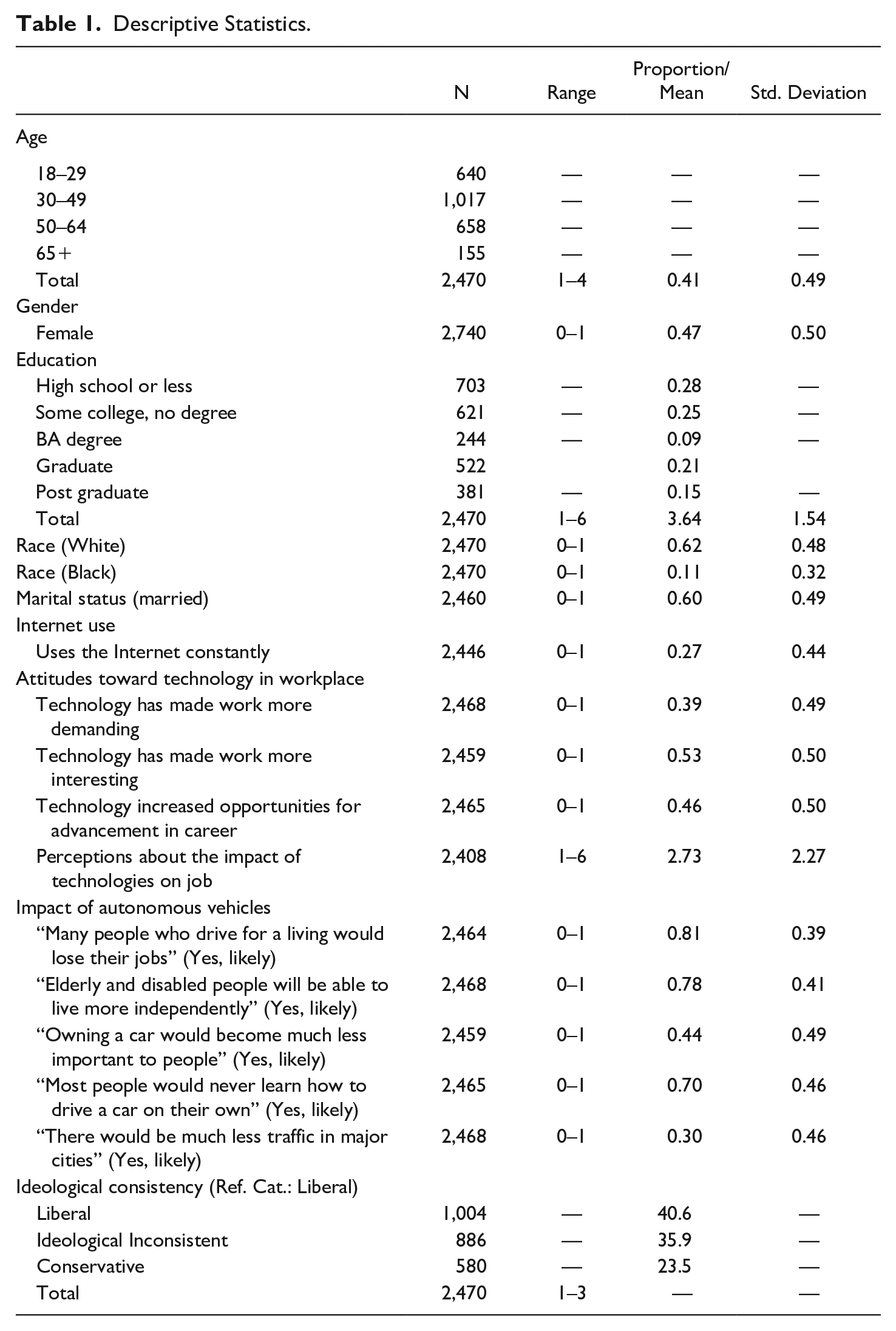
As to Internet use, 26.7% of respondents used the Internet constantly. In terms of the respondents’ attitudes toward technology in workplace, 38.8% considered that technology made their work more demanding, 53.5% said it made it more interesting, and 46.4% maintained that it increased their opportunities for advancing in their career.
The median of the index assessing perceptions about the impact of technology on their job or career was positive (three out of a maximum of six). However, 23% of respondents maintained that technological innovations had negative or no effects in this regard.
Regarding their beliefs about the social impacts of autonomous vehicles, a strong majority believed it is likely that “Many people who drive for a living would lose their jobs” (80.7%), that “Elderly and disabled people will be able to live more independently” (78.4%), and that “Most people would never learn how to drive a car on their own” (69.7%). Less prevalent beliefs are the likelihood that “Owning a car would become much less important to people” (43.6%) and that “There would be much less traffic in major cities” (30.5%).
Predicting Support for Autonomous Vehicles
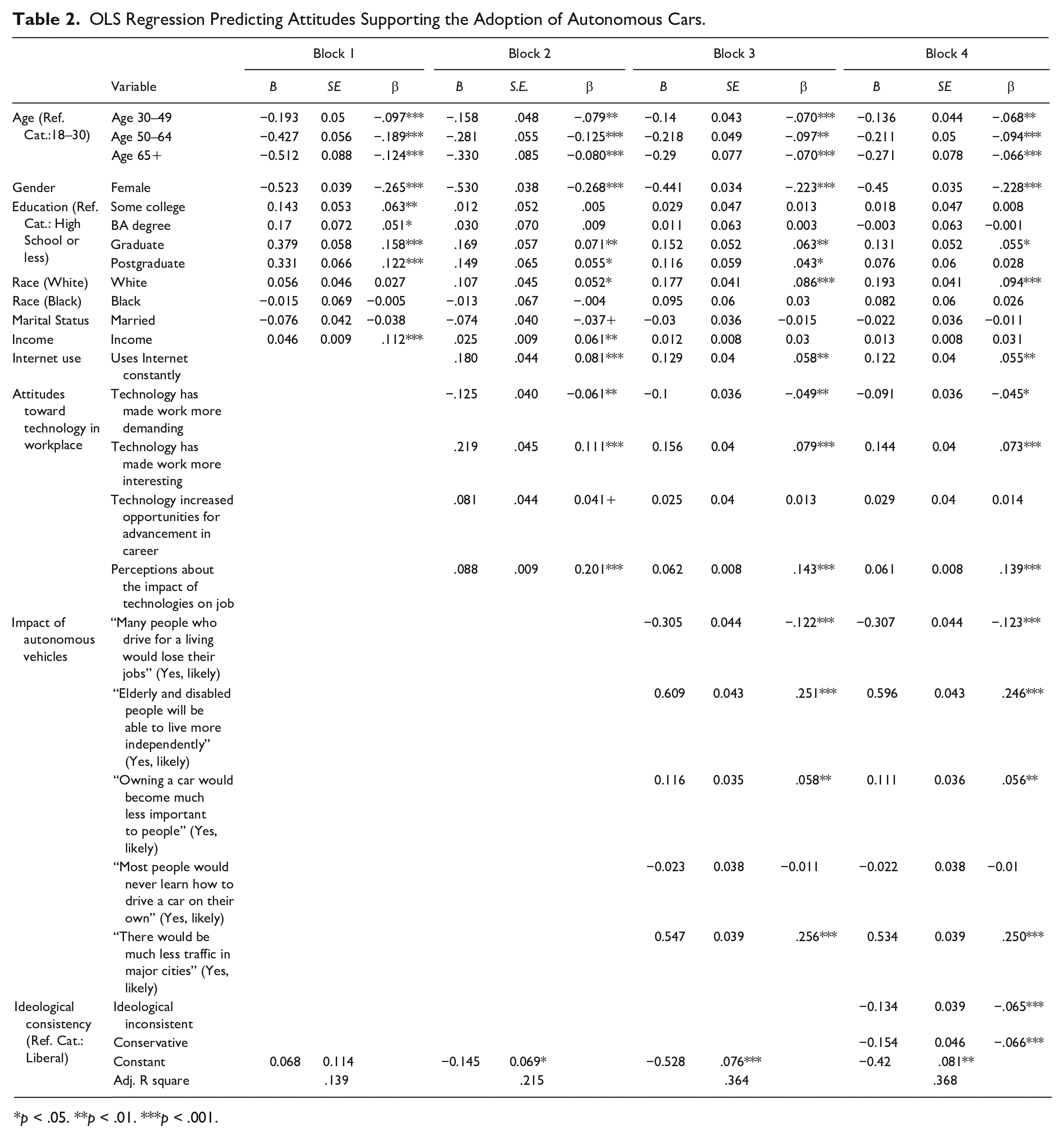
We present the results of our study in Table 2 on the following pages.
OLS Regression Predicting Attitudes Supporting the Adoption of Autonomous Cars.
p < .05. **p < .01. ***p < .001.
We conducted a series of hierarchical OLS regressions predicting support for autonomous vehicles. In the first block we introduced the socio-demographic variables. In the second block we added attitudes toward technology. In the third we included attitudes toward the social impact of driverless cars, and in the fourth block we added ideological orientation. Whereas the original number of employed respondents was 2,470, because of missing cases distributed across several independent variables and the size of the sample, we opted to perform a listwise deletion of missing cases for the analyses. Our models were comprised of 2,306 respondents with valid responses for all variables losing close to 7% of the sample. As Schafer and Graham (2002) argue, it is reasonable to resolve a missing-data problem with the deletion of a small part of the sample; more so when there is no reasonable indication of a missing not at random scenario and there are no missing values in the dependent variable.
When introducing the socio-demographic variables, the results showed that age was negatively associated with attitudes supporting driverless cars (H2). The older the respondents, the less the support was for driverless cars in all steps of the hierarchical models (p < .001). Similar results emerged regarding gender (H3). Women expressed statistically significant less support for autonomous vehicles across all models. Furthermore, gender had the strongest effect of all the socio-demographic attributes in block 1, and the third highest standardized β when all blocks were included in the model (p < .001). Thus, we conclude that H2 and H3 are supported in our study.
Race, a control variable, was not associated with public attitudes toward driverless cars in block 1. However, after controlling for attitudes toward technology in the workplace in block 2, White respondents showed consistently higher levels of support for autonomous vehicles than non-Whites (standardized β = .094, p < .001 in step 4). Being African American was not statistically significant across all models. Marital status (being married), the other control variable, also had no effect on the dependent variable.
While education was positively associated with support for driverless cars, its effect (H1) was far less stable. Those who had a post-high school education were more supportive of driverless cars in block 1 (only graduate and postgraduate at p < .001). However, after the introduction of attitudes toward technology in the workplace in block 2, we found that only those with a graduate or postgraduate degree maintained their statistical significance (p < .05). In the final two steps only those with a graduate degree expressed statistically significant greater support for autonomous vehicles compared to individuals with a high school education or less (p < .05). Similar to education, income was associated with support for driverless cars—the higher the income, the greater was the support for driverless cars in block 1 (β = .112, p < .001). However, the strength of its effect halved after the introduction of attitudes toward technology in the workplace (β = .061, p < .01), and disappeared in blocks 3 and 4. As Dodel and Mesch (2020) showed, both income and education are direct antecedents of attitudes toward technology. Similarly, we found that they are also direct antecedents of attitudes toward autonomous vehicles. Consequently, before completely rejecting H1, we explored the possibility that perceptions about the impact of novel technologies on one’s current job could be mediating the effects of income and education. We used the Karlson–Holm–Breen (KHB) method for estimating these mediations effects. The KHB method evaluates the degree to which a control or mediating variable mediates the relationship between the treatment and outcome variables (Kohler et al., 2011). We found that the effects of both income and education were partially mediated by perceptions about the impact of novel technologies on one’s current job (between 20% and 27% of the original variables’ effect). Thus, we documented partial support for the self-interest argument that operationalized H1, providing an indication of an indirect rather than a direct effect on the dependent variable.
In the second step, we added variables measuring familiarity with technology and perceptions about the impact of novel technologies on one’s current job. Individuals who reported using the Internet almost constantly expressed support for the introduction of driverless cars (H5). Regarding attitudes toward technology, the findings support the familiarity hypothesis. Individuals for whom new technologies had a positive impact on their jobs, and those who saw technology as interesting were more likely to support the introduction of driverless cars. Similarly, people who maintained that technology had made their job more demanding were less likely to support the introduction of driverless cars. However, feeling that technology had increased opportunities for advancement in their career had no effect on the responses. All of these effects of block 2 remained stable after the introduction of variables from blocks 3 and 4. Thus, we can conclude that there is support for the direct effect of all of the variables included in H5.
Block 3 introduced attitudes regarding the expected social impact of driverless cars, almost all of which behaved as hypothesized in H6. Individuals who expected that the introduction of driverless cars would create more unemployment were less supportive of driverless cars (β = −.123, p < .01 in model 4). On the other hand, those who believed that cars would be less important (β = .056, p < .01 in model 4), that driverless cars would have a positive impact in the sense of reducing traffic (the highest β = .250, p < .001 in model 4), and the elderly and disabled would be able to live more independently (the second highest standardized β = .246, p < .001 in model 4) were more supportive of driverless cars. The belief that owning a car would become much less important to people had no statistically significant effect.
In our final model, we introduced ideological orientation or consistency. Results provide evidence to support our H4, as conservatives and moderates indicated statistically significant less support for driverless cars than liberals.
Discussion
Driverless cars are an innovative technology that is being rapidly developed and is expected to have important effects on society. Like any technology, its mass adoption depends on the willingness of the public to use the technology and to adopt it in their everyday life. The purpose of this study was to investigate a comprehensive model explaining the attitudes related to the acceptance of autonomous vehicles. Our conceptual model relied on previous studies on the acceptance of technology and the growing literature on public attitudes toward autonomous vehicles.
Our empirical model showed that, consistent with other studied technologies, a variety of socio-demographic variables are predictors of these attitudes. Women and older individuals were more reluctant to accept autonomous vehicles. In the case of gender, previous studies have shown that women and men appear to differ in their emotional reactions to new technologies, women report higher scores in anxiety and lower scores in expected pleasure from driving AVs than men (Hudson et al., 2019). In addition, these gaps might be associated with gendered disparities in terms of the lack of information on the skills required to operate driverless cars and their social effects. The effect of age has been reported previously and requires more investigation. One explanation is that the elderly have less exposure to and knowledge about technology. Therefore, they may regard autonomous vehicles as another potentially negative externality of technological change. A second explanation is that although arguments that autonomous vehicles will make transportation more accessible to the elderly and disabled, they have not made their case adequately to these groups. Our findings are consistent with previous studies and may indicate that older individuals report negative attitudes as they are less likely to trust self-driving and perceived AVs as a high-risk activity (Rovira et al, 2019); improving the information provided to the public in this regard might reduce the reluctance of the elderly to embrace autonomous vehicles. Future studies are needed to investigate the extent to which gender and age are affected by the level of knowledge and information that these social groups have.
Our findings are also somewhat consistent with the self-interest hypothesis. In our intermediate models people with a strong position in the labor market were more likely to support the adoption of autonomous vehicles. Furthermore, familiarity with technology directly mediated this support. A plausible explanation is that individuals with higher incomes and more education are more aware of the potentially positive impact of new technologies as a whole and feel less threatened by them (Hudson et al., 2019; Mesch & Dodel, 2020). This idea is supported by the mediation of education and income through the impact of technological innovations in the workplace. In accordance with the familiarity hypothesis, these self-interested individuals are the same people who have already experienced the positive effect of technologies in their workplace in improving their career opportunities or making their work more interesting (Dodel & Mesch, 2020). As a result, they are more likely to emphasize the opportunities of autonomous vehicles.
Based on the familiarity hypothesis, we also investigated the role of extended exposure to the Internet, which was associated with positive attitudes toward the adoption of autonomous vehicles. As a whole, our findings support previous studies that investigated attitudes toward autonomous vehicles and toward robots (Hudson et al., 2019). Our findings indicate that the possibility of a spillover effect from one technological innovation to others might not be limited to robots and autonomous vehicles and may refer to technological innovations as a whole. Thus, those who use the Internet constantly and those who have positive attitudes about the effects of technology in the workplace are more supportive of autonomous vehicles.
We also relied on the technology acceptance model that emphasizes two central concepts as influencing technology adoption: ease of use and perceived usefulness. As the technology of autonomous vehicles is still under development, we chose to focus only on perceived usefulness. We included several measures of the perceived positive and negative social outcomes of autonomous vehicles. Our study shows the importance of this concept, as the explained variance of the model increased significantly after the addition of this concept. In addition, the effect of education and income on attitudes to AVs is partially mediated by their effect of the impact of AVs on society. These findings highlight the centrality of providing clear information about the impact of autonomous vehicles to the public.
Finally, we investigated the role of worldviews on the extent of acceptance of autonomous vehicles. Consistent with previous findings, ideology is an important factor affecting the attitudes of individuals. While providing accurate, scientific information to the public about the potential positive effects of driverless cars is important, political ideology seems to distort the information provided. In other words, this information does not seem to change a priori attitudes that are related to more liberal or conservative worldviews. Future studies need to address this phenomenon. They should investigate why conservative worldviews tend to be less supportive of technological innovations such as autonomous vehicles and how to overcome ideological barriers to the acceptance of such technologies.
Limitations and Future Lines of Research
Our study was based on a representative sample of employed Americans. Whereas our findings are reasonably generalizable and are in line with European studies, cross-national and comparable studies should be conducted in order to assess the role of exposure to information about autonomous vehicles and national involvement in the development of the technology. In other words, are our results generalizable to other countries that have less exposure to autonomous vehicles in their economies?
Moreover, as we argued, technological acceptance is a complex process in which several factors interact, both in terms of experience with technology and attitudes concerning particular technologies or innovations as a whole. Whereas our study addressed some of these links, we did not delve into the paths from which these relationships could arise. For example, it will be of benefit to introduce in the future more direct measures of risk perception, including driving history and car accidents history, to measure the extent that previous incidents affect current attitudes.
In this study, our test of the self-interest hypothesis relied on measures of education and income. Yet, when studying the potential threat to unemployment by AVs, it will be more appropriate in the future to measure occupation to conduct a direct test of the hypothesis.
In terms of future lines of research, we suggest the need to assess societal attitudes toward and acceptance of various state-of-the-art technological innovations as a more global process using structural equation-derived techniques. The mediations we documented between socio-economic variables and previous experience with technology signal the need for future research to consider the sequential and conditional nature of the acceptance of technological innovation, similar to the digital divide phenomenon (Van Laar et al., 2019).
Footnotes
Declaration of Conflicting Interests
The author(s) declared no potential conflicts of interest with respect to the research, authorship, and/or publication of this article.
Funding
The author(s) received no financial support for the research, authorship, and/or publication of this article.