







Abstract
Ethnic self-identification plays a pivotal role in shaping voter behavior, particularly in diverse electorates like Arizona. This research explores how the strength of ethnic identity influences candidate evaluations in the 2024 U.S. Senate election in Arizona. Using Social Identity Theory, the study examines survey responses from 373 Arizona residents, focusing on Hispanic and White voters. Results show that Hispanic voters with stronger ethnic self-identification evaluate co-ethnic candidates more favorably, while White voters exhibit little change based on identification. Additionally, alignment on key policy issues in Arizona—such as immigration—emerged as a stronger predictor of candidate evaluations than ethnicity itself. Furthermore, the findings challenge the assumption that ethnicity significantly affects partisan identification or co-ethnic voting among Hispanic voters, suggesting a shift toward issue-based decision-making and the strength of ethnic self-identification. These results underscore the complexity of voter behavior among Hispanics in the United States, where identity intersects with policy concerns, offering new insights into how ethnic and issue-based factors influence electoral outcomes.
When it comes to understanding the Hispanic electorate’s pivotal role in the outcome of U.S. elections, DeSipio (1998) described it perfectly, referring to the Hispanic community as the new American electorate. Since then, many studies have focused on the relevance of Hispanic turnout, partisanship, and ethnicity, among other topics, to determine the variables by which scholars can predict the voting behavior of this complex community. The Hispanic community is the most significant minority in the United States, constituting 19.1% (63.7 million as of July 1, 2022) of the population (U.S. Census Bureau, 2022). It is estimated that this minority will make up 26.9% of the total population by the year 2060 (U.S. Census Bureau, 2018). This demographic shift suggests a vast change is underway, with over one-quarter of Americans identifying as Hispanic (U.S. Census Bureau, 2018).
Numerous studies have focused on ethnicity as a salient element that acts as a heuristic in Hispanic voting decisions (e.g., Griffin, 2014; Morín et al., 2021). More specifically, research has examined how the participation of a Hispanic candidate can mobilize the Hispanic community regardless of their political party (i.e., Cuevas-Molina & Nteta, 2023; Manzano & Sanchez, 2010). However, Morín et al. (2021) argued that when it comes to U.S. voting, Hispanics differ from other groups, such as African Americans, because their ethnic identity is intertwined with their nation/country of origin (Itzigsohn & Dore-Cabral, 2000). This implies that Hispanics’ ethnic identity cannot be understood as a monolithic voting group because the country of origin may generate divergence in voting patterns, whereas the African American community holds a more unified pan-ethnic identity, which is less affected by their family’s country of origin.
Hispanic voters, like any ethnic group, are deeply complex, with a variety of factors potentially influencing their vote choice. For example, other identity-intersecting factors are important to Hispanic voters, such as party affiliation and candidate ethnicity/race (see Cuevas-Molina & Nteta, 2023; Morín et al., 2021). Therefore, to understand this electorate, a multidimensional approach is essential. Studies have suggested that factors such as voter ethnicity, issue positions, partisanship, and candidate evaluations all play a role in shaping Hispanic voting behavior (Cain & Kiewiet, 1984). While ethnicity may not always have a direct impact on voting preferences, it is often associated with positions on key issues, which can shape the way candidates are evaluated (Graves & Lee, 2000). Given the growing relevance of Hispanic communities in influencing the outcome of American elections at any level, it is pivotal to understand Hispanics’ voting behavior to have a better and more realistic approach to this electorate for the sake of campaign strategists and groups who work on voter mobilization or certain issues related to voting policies.
To build on these previous studies and provide a more nuanced understanding of Hispanic voters that takes into account a more complex web of factors, we conducted a survey among Hispanics and White American residents of Arizona, focusing on their vote decision process for the 2024 U.S. Senate election. Beyond reviewing current scholarship regarding variables influencing vote behavior in political science, we introduce a new variable, strength of ethnic self-identification. Previous studies, such as those by Graves and Lee (2000), assessed the relationship between partisanship, candidate evaluation, and issue position as key factors influencing voters’ decisions. However, they treated ethnicity as a nominal variable, that is, Hispanic or non-Hispanic. Expanding to include the strength of one’s ethnic identity allows us to understand the role of ethnicity, specifically the self-identity of a Hispanic voter, when determining how Hispanics see themselves as part of the community and how it plays a structural role in their vote preferences.
Ethnicity in some contexts is often treated as a dummy variable that focuses solely on whether an individual checks the box for Hispanic, Asian American, and so on. But, when it comes to the ethnicity of voters, we posit that ethnicity is better understood beyond these nominal confines. We argue that the degree to which one self-identifies as part of an ethnic group affects the relevance of ethnicity to the variables that influence vote preference: issue position, partisanship, and candidate evaluation. We discuss these variables and their relationship with ethnicity and Hispanics in the following sections and anchor our focus on the strength of ethnic identification in social identity theory (SIT) scholarship to answer the question: How much does one’s Hispanic ethnic identity influence their vote preference?
SIT and the Role of Ethnicity in Vote Preference
SIT explains how individuals categorize themselves and others into groups, leading to the evaluation of their own group more favorably than out-groups (Hogg, 2016, p. 7). Tajfel and Turner (1979; see Tajfel, 1981) argued that individuals derive self-esteem from their membership in these in-groups, which are defined by factors such as racial, ethnic, and gender identities. These identities shape how individuals classify themselves, compare to out-groups, and establish a sense of belonging. In the context of political participation within the Hispanic community in the United States, understanding their engagement requires examining how shared identity influences perceptions of “who they are, what they should believe, and how they should behave” (Hogg, 2016, p. 6).
However, Huddy (2001) mentioned that although identity is seen as a distinction process between the in-group and the out-group, ethnic identity is multifaceted and presents different characteristics according to its salience. Therefore, the group membership that is most extreme among the members will determine the group’s status, which often feeds concepts such as ethnocentrism, which refers to the tendency of individuals or groups to evaluate and interpret the world through the lens of their own cultural values, often viewing their own identity and culture as superior to others (Hogg, 2016). One element that feeds ethnocentrism is national identity, which is a bond, or a “sense of belonging” (Triandafyllidou, 1998, p. 595) to one’s nation. Hence, it is understandable that by basing the identity of the Hispanic community in an Americanized context, that is, based on an understanding of their political participation in the context of the United States, many Hispanics self-identify first as Americans and then as ethnic members of the Hispanic community (see Citrin et al., 1990). Ranking national identity over ethnic identity might change a group’s identity idealization because it impacts who constitutes the in-group and out-group (e.g., Citrin & Sears, 2014; Garcia & Sanchez, 2021). For example, if Hispanics see national identity as their superordinate identity, then the in-group is fellow Americans and the out-group are non-Americans, which can include an array of Hispanic communities.
Other identity-salient groupings can also manifest, such as language use and partisanship. These perceived differences between the out-group and the in-group are what social identity systematically points out as favoritism of the group identity and derogation of what is not primarily associated with that identity. In terms of political membership, the self-perceived political party identity can, in certain ways, “sway” partisan attitudes (Greene, 2004).
Given the varying identity-salient groupings for Hispanics, they may prioritize different superordinate identities depending on the context. For example, during a U.S. Senate election in Arizona, a Hispanic voter might invoke their ethnic identity when evaluating a Hispanic candidate, particularly if issues like immigration or bilingual education are central to the campaign. However, in a national election where economic stability or national security dominates, the same voter may emphasize their national identity as an American, favoring a candidate whose policies align with those broader concerns, regardless of ethnic affiliation. This dynamic aligns with identity theory, which “explain[s] how the organization of identities that make up the self-impacts the probability that a given identity is situationally enacted” (Brenner et al., 2016, p. 231). For example, if Hispanics downplay their ethnicity and attune toward their partisan membership, it creates a form of adaptation as individuals move from one context to another.
It is important to clarify that, as a factor influencing ethnic and political perceptions, the adaptive process within the Hispanic community can play a significant role in shaping individuals’ decisions regarding which in-group they choose to affiliate with. According to the theory of cross-cultural adaptation (Kim, 1995, 2017), this adaptive spiral in which the person integrates into their host society is a human process of survival. While cross-cultural adaptation traditionally focuses on an individual adapting to a new host culture, it is important to note that the majority of Hispanics in the United States are native born (68%), with 32% identifying as immigrants (Batalova, 2024). As such, when we talk about adaptation for these 68% of Hispanics, the tension is between ethnic and national identities. This transformation of identity, as mentioned by Kim (1995), can evolve from being a Hispanic to emphasizing national identity as an American.
As such, the self-identity goes through an established process of shifting from a monocultural self-definition to embark on the formation of an intercultural self, not only as a Hispanic but also as an American. When we combine this sense of cross-cultural adaptation with social identity and self-categorization, one of the identities outweighs the other, impacting the voter’s decision.
Ethnicity and Hispanic Evaluation of Political Candidates
In the voting process, however, voters are not just dealing with their identity but also the identity of the candidate. If the candidate is a member of the Hispanic community or has phenotypical characteristics associated with this political minority in the United States, Hispanics may favor this in-group candidate based on these traits associated with their ethnic/racial identity. Besco (2019) called this inter-minority affinity voting (see Cuevas-Molina & Nteta, 2023; Manzano & Sanchez, 2010; Miller & Chaturvedi, 2018; etc., who explain this concept from the perspective of co-ethnicity). 1 In line with this, Huddy (2001) argued that ethnic identity can lead to in-group favoritism, but this is more pronounced for voters who share the same ethnic background as the candidate. Therefore, Hispanic voters with strong ethnic self-identification may evaluate Hispanic candidates more positively due to this shared identity, especially when the candidate’s policies align with the issues that matter most to the Hispanic community. De la Garza et al. (1992) also found that Hispanic candidates were more favorably evaluated by Hispanic voters than by White voters, suggesting that ethnic solidarity plays a significant role in candidate preference. Another study by McConnaughy et al. (2010) exposed Hispanic voters to two candidates, Hispanic and White, and used the same description for each candidate with only their ethnicity varying. Hispanic participants chose the Hispanic candidate over the White, showcasing co-ethnic voting.
For White voters, however, the influence of ethnic identity on candidate evaluation is more nuanced and may be influenced by broader political affiliations or policy preferences. For White participants in McConnaughy et al.’s (2010) study, the ethnicity of the Hispanic candidate compared to the White candidate functioned as a partisan cue. It signaled immigration attitudes, such as a sense of Hispanic political power, leading to “stereotypical thinking about the candidate” (McConnaughy et al., 2010, p. 1207), resulting in negative outgroup attitudes. Additionally, McConnaughy et al. (2010) suggested that for White voters, when it comes to judging a Hispanic candidate, the candidate’s ethnicity is evaluated based on the prejudice they might have toward immigrants in general instead of this ethnic group. Visalvanich (2016) posited that one of the main variables influencing White voters’ candidate evaluations of Hispanic candidates is racial resentment: White voters with low racial resentment are more receptive to minority candidates, while those with high racial resentment have negative racial attitudes and negative evaluations of the cross-ethnic candidate. In turn, when there is high racial resentment, White voters exhibit more negative out grouping tendencies when they have to judge minority candidates because they see those candidates as less competent and with a tendency to lean toward liberal ideas.
Therefore, when evaluating a political candidate during an election, the ethnicity of voters and the candidate might influence some outcomes when deciding who to vote for (see Arora & Stout, 2019; Barreto, 2010; Barreto & Nuño, 2011; Benjamin, 2017). In particular, the strength of one’s ethnic identity may impact their vote formation process and whether this identity becomes superordinate. Hispanic voters with high ethnic identity might evaluate Hispanic candidates more positively than non-Hispanic candidates (Visalvanich, 2016).
However, Hispanic voters with lower ethnic identity might evaluate Hispanic candidates less positively (e.g., Barreto, 2010). As a result, we hypothesize the following.
H1a: Hispanic voters with strong ethnic self-identification evaluate Hispanic candidates more positively than Hispanic voters with low ethnic self-identification.
When comparing White voters with higher and lower ethnic self-identification, we expect significant differences. Previous research suggests that high ethnic self-identification often correlates with in-group biases and more negative evaluations of out-group candidates (Huddy, 2001; Visalvanich, 2016). In turn, White voters with higher ethnic self-identification should harbor more negative assessments of Hispanic candidates, the out-group, than White voters with lower ethnic self-identification.
H1b: White voters with strong ethnic self-identification evaluate Hispanic candidates less positively than White voters with low ethnic self-identification.
Partisanship and the Hispanic Electorate
Hopkins et al. (2023) explained that Hispanics are not strongly connected to America’s political parties; rather, their partisanship is responsive to identity threats. For example, Gutierrez et al. (2019) discussed how Latino voters in the United States mobilized during the presidential election when a candidate like Donald Trump attacked the Latino community. As such, when Hispanics encounter a political party that somehow threatens their identity as a Hispanic, it can reshape their vote preference so that they vote for another political party. Hopkins et al. (2023) found this responsiveness in a panel study on Hispanic and Asian Americans, focusing on their partisan identities between 2016 and 2018, in contrast to White Americans. They found that 41% of Hispanic respondents identified as “independents” in both waves, Asian Americans had a small shift from 42% to 45% in how they identified as “independents” during these periods, and Whites decreased from 22% in 2016 to 13% in 2018. In total, 56% of Hispanic respondents maintained partisanship between 2016 and 2018, compared to Asian Americans with 70%, and Whites with 90%. Comparatively speaking, the Hispanic vote is more unstable, with almost half of the Hispanic electorate shifting their partisan identification. Looking at their political affiliation between 2016 and 2020 (Pew Research Center, 2021), White voters stay mostly the same, with 39% and 43% for Democrats and 54% and 55% for Republicans. Black voters were also consistent at 91% and 92% for Democrats and 6% and 8% for Republicans. Hispanics had more variance with 66% and 59% for Democrats and 28% and 38% for Republicans. Hence, comparatively, there is more shifting in partisan identification within the Hispanic population during those periods. This finding, when coupled with the role identity threat plays in vote preference, suggests ethnic identification can impact Hispanic vote preferences, especially for those who exhibit lower, and thus more mutable, party affiliation. As a result, we proposed the following hypothesis:
H2: Lower partisan identification will prompt greater co-ethnic voting among Hispanic voters than White voters.
Ethnicity, Policy Issue Position, and Vote Preference
Ethnicity and partisanship often shape issue positions, but their influence depends on whether the issue is deeply tied to a voter’s identity. Issues that resonate strongly with a specific ethnic or racial group can create clear divides within the electorate. For example, Cain & Kiewiet (1984); Cain et al. (1987) found that while issues like abortion showed minimal variation in importance between Mexican American and White voters, policies concerning bilingualism and immigration control were far more salient to Hispanic voters. These issues, by invoking cultural preservation and identity, often amplify contrasts between Hispanic and White voters, particularly when policies threaten group identity.
In the context of this study on the U.S. Senate race in Arizona, immigration emerged as one of the most critical issues for voters, alongside housing and education (Center for the Future of Arizona, 2024). We included questions on these three issues in our study, which enables respondents to articulate their policy positions, providing insights into whether issue stances influenced candidate evaluations. This approach aligns with research indicating that voters frequently prioritize ideological alignment over identity-based considerations. For instance, Abrajano et al. (2005) found that White voters in Los Angeles were more likely to support Hispanic candidates when their issue positions aligned, underscoring the weight of substantive policy agreement over racial or ethnic cues in shaping evaluations.
Nevertheless, the influence of issue prioritization or alignment on evaluations may vary across voter groups and specific issues. White voters, for example, might not assign the same importance to issues like immigration, which resonate more strongly with Hispanic voters. Instead, they may prioritize concerns that are more closely tied to their own experiences or identity. These differences suggest that while issue alignment is critical, its salience may be mediated by the voter’s cultural and demographic context. Based on this, we propose the following hypothesis:
H3: For White voters, their position on issues more relevant to Hispanic voters than to White voters will not significantly impact their candidate evaluations.
Methodology
This study is based on a survey conducted to collect data on ethnic identity, issue positioning, partisanship, and candidate evaluation among Hispanic and White voters in Arizona. Surveys are an effective method for gathering self-reported data on political attitudes, identities, and behaviors, as they allow for direct insights into how individuals perceive candidates and align with political issues (Groves et al., 2009). This approach is particularly suitable for capturing the nuances of ethnic self-identification and voting preferences, as well as how these factors influence candidate evaluation. To analyze the influence of ethnic identity and other factors on candidate evaluation, this research employed multiple regression analysis, as proposed by Graves and Lee (2000). Regression analysis is an appropriate method for assessing the strength and direction of relationships between variables, and in this study, it allowed for testing hypotheses related to ethnic self-identification, candidate evaluation, and co-ethnic voting.
Data were analyzed using SPSS Version 28 (Tabachnick et al., 2007). Before conducting the regression analysis, assumptions of linearity, normality, and multicollinearity were tested to ensure the validity of the model. A significance level of p < .05 was used to determine statistical significance.
To test the model, we selected the U.S. Senate election in Arizona. Arizona was chosen due to its unique demographic and political characteristics, including its status as a major destination for Hispanic migration, given its proximity to the U.S.–Mexico border (Durand & Massey, 2019). This migration has significantly reshaped the state’s political landscape, transforming Arizona from a historically Republican stronghold to a competitive swing state (Burtch-Buus, 2024). Arizona has a relatively high Hispanic population, with almost a third of the population identifying as Hispanic and a 25% increase in Hispanics since 2010—suggesting strong growth of this group in this state (Archer, 2023). Finally, the presence of both a Hispanic and a White candidate in this open election made it an ideal setting to explore how ethnic identity might influence voter behavior and candidate evaluation, without the presence of confounding variables such as incumbency. The Hispanic candidate was Democrat, Ruben Gallego, and the White candidate was Republican, Kari Lake.
Participants
The sample consisted of 373 adults residing in Arizona, with participants identifying as White (n = 286) or Hispanic (n = 87). The participants’ ages ranged from 18 to 85 and over (M = 3.14, SD = 1.434). In terms of political affiliation, 77 participants (20.7%) identified as Republicans, 167 (44.8%) as Democrats, 118 (31.6%) as Independents, and 11 (2.9%) indicated other political affiliations. Regarding gender, 156 participants (41.8%) identified as men, 211 (56.5%) as women, 5 (1.3%) as non-binary, and 1 (0.3%) preferred not to disclose their gender identity. These demographic characteristics highlight the diversity of the sample across ethnic, political, and gender identities.
Procedures
After gaining IRB approval from the researchers’ university, data were collected using Prolific (n.d.), a web-based platform designed for participant recruitment. Participants were prescreened based on the eligible criteria for this study: being at least 18 or older, being a U.S. citizen, resident of Arizona, and identifying as White or Hispanic. These inclusion criteria reflect the study’s design and add external validity to the study as individuals need to be 18 or older, Arizona residents, and U.S. citizens to vote in this election.
Those participants who met these criteria were redirected to a survey hosted by Qualtrics (n.d.), between October 9 and November 1, through a link provided within the Prolific platform. After consenting to participation, participants first encountered images of the 2024 U.S. Senate candidates for Arizona Republican Kari Lake and Democrat Ruben Gallego (Bradner, 2024). Along with the photos was a short description of each candidate that included their name, party affiliation, where they were born, and their parents’ place of birth (see Appendix A). Participants then answered questions about their identity and demographics. Next, they were asked which candidate they were leaning toward, and based on that response, they were then directed to questions to evaluate their selected candidate. Finally, participants answered questions evaluating their stances on prominent political issues in Arizona. Additionally, attention checks were employed as a validation mechanism to ensure the quality of the data.
The estimated average time for each participant to complete the questionnaire was approximately 5 minutes and 16 seconds. Each participant was compensated $2.00 upon survey completion, equating to $22.78 per hour, which Prolific rates as a great compensation. Finally, data were screened after collection to identify any possible inconsistencies, and any responses flagged as invalid due to failure to pass any attention check were excluded from the final analysis.
Measurements
Strength of Ethnic Identity
To measure the extent to which people feel some connectedness to their ethnic identity, we used five statements from the Multigroup Ethnic Identity Measure designed by Roberts et al. (1999). This scale was designed to measure if a sense of belonging and commitment to an ethnicity can impact pride and positive feelings related to their group (Roberts et al., 1999). Examples of the statements include “I have a clear sense of my ethnic background and what it means for me” and “I am happy that I am a member of the group I belong to.” A four-point Likert-type scale was employed, ranging from (1) Strongly disagree to (4) Strongly agree. Cronbach’s alpha obtained was .929.
Party Affiliation
Political party affiliation was assessed through multiple items, with response options including “Democrat,” “Republican,” “Independent,” or “Other.” This measure was derived from a standardized survey question developed by Gallup (2021). Additionally, the questionnaire inquired about participants’ sense of loyalty and association with their chosen party affiliation. To gauge the strength of party affiliation, a 3-point Likert scale was utilized, ranging from 1 (very strongly) to 3 (not very strongly). Regarding loyalty to their selected party, a 4-point Likert scale was employed, with response options spanning from 1 (not at all) to 4 (very much). These questions were adapted from the time series questionnaire of the 2020 American National Election Studies (2020). Acceptable Cronbach’s alpha reliability was obtained at .839. To ensure consistency in the direction of scoring, party affiliation and political loyalty variables were reverse coded so that higher scores reflected a stronger endorsement of the construct. After reverse coding, all variables were standardized for analysis.
Vote Preference
Vote preference was adapted from the Civic Engagement Tracking Survey, created by the Pew Research Center (2013), asking participants if the election were held today, which candidate they would lean toward voting for. This question was adapted to refer to intentions in Arizona regarding the 2024 U.S. Senate race between Lake and Gallego.
Candidate Evaluation
Funk (1999) developed a measure that contains four traits to understand how people can evaluate a candidate: competence, leadership, integrity, and empathy. Competence refers to a candidate’s qualities, such as “intelligent, knowledgeable, etc.” Leadership measures how inspiring the candidate can be and how often this individual shows or provides signs of leadership. Integrity looks at how honest a candidate can be and their level of morality. Lastly, empathy examines whether this candidate cares about people. For this analysis, the competence and leadership traits were combined and called leadership effectiveness, with sample items such as: “[She/He] is an intelligent candidate” and “I think of [she/he] as someone who gets things done.” In the case of integrity, a sample item includes: “[She/He] is a decent candidate,” and for empathy, a sample item includes: “[She/He] cares about people.” A four-point Likert-type scale was employed, ranging from (1) Strongly disagree to (4) Strongly agree. Cronbach’s alpha was .961.
Issue Position
In terms of issue position, items were drawn from the survey created by the Center for the Future of Arizona (2024), in which each year, the center asks Republicans, Democrats, and Independents in the state about voters’ perspectives on issues that are central to voters’ discussions in the state. We selected the three top issues according to Arizonans. These three issues were immigration, housing and education. A four-point Likert-type scale was used, ranging from (1) Strongly opposed to (4) Strongly supported. There was also the option: Don’t know/Refuse to answer. Items were tailored to reflect the Arizona senate candidates’ discussions regarding the above issues, 2 an example of each are: “The current influx of thousands of migrants at the southern border is an international humanitarian and refugee crisis. Our leaders must work together to find a bipartisan solution to this problem” for immigration; “State and local government must do more to ensure that housing options are affordable and available to middle and low-income earners throughout the state” for housing; “Private schools that receive state funding should be held to the same standards as public schools when it comes to financial reporting requirements, academic reporting requirements, and employment standards” for education. We obtained acceptable Cronbach’s alpha of immigration = .716, housing = .784, education = .710.
Results
Ethnicity and Candidate Evaluation
A series of statistical analyses were conducted to test the following hypotheses: Hispanic voters with strong ethnic self-identification evaluate Hispanic candidates more positively than Hispanic voters with low ethnic self-identification (H1a), and White voters with strong ethnic self-identification evaluate Hispanic candidates less positively than White voters with low ethnic self-identification (H1b).
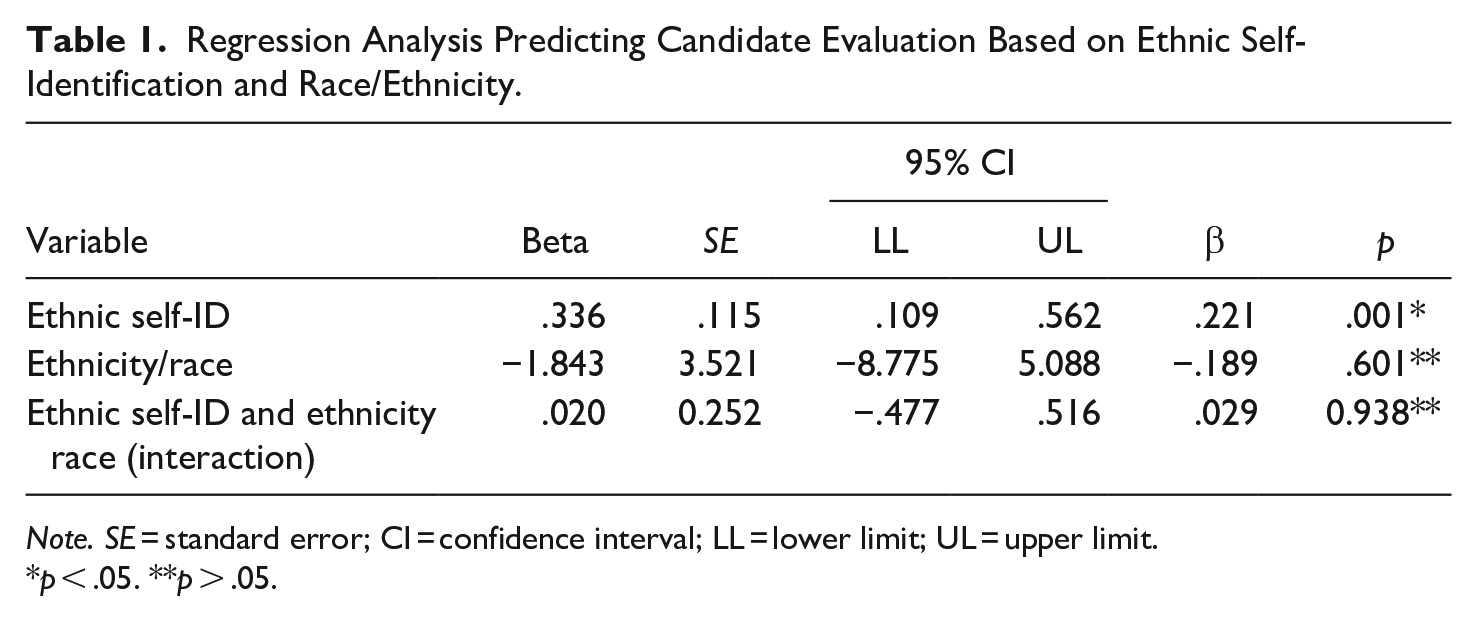
A multiple regression analysis was conducted to examine the effects of ethnic self-identification, race/ethnicity, and their interaction on the evaluation of Hispanic candidates. The overall regression model was statistically significant, F(3, 271) = 3.979, p = .008, with an R2 of .042, indicating that the model explained 4.2% of the variance in candidate evaluation. Ethnic self-identification was a significant predictor of candidate evaluation, β = .221, B = .336, t(271) = 2.919, p = .004, indicating that stronger ethnic self-identification is associated with immigration policies extensively, highlighting their differing approaches to border security and immigration reform (CBS News, 2024) more positive evaluations of the Hispanic candidate. This effect was found for both Hispanic and White voters, suggesting that strong ethnic self-identification is linked to more favorable evaluations of the candidate for both groups (see Table 1).
Regression Analysis Predicting Candidate Evaluation Based on Ethnic Self-Identification and Race/Ethnicity.
Note. SE = standard error; CI = confidence interval; LL = lower limit; UL = upper limit.
p < .05. **p > .05.
Race/ethnicity did not significantly predict candidate evaluation, β = −.189, B = −1.843, t(271) = −.524, p = .601. There was no evidence that being Hispanic or White affected how voters evaluated the Hispanic candidate. The interaction term was also not significant, β = .029, B = .020, t(271) = .078, p = .938, indicating that the relationship between ethnic self-identification and candidate evaluation was not moderated by race/ethnicity.
Hispanic voters with strong ethnic self-identification were expected to evaluate Hispanic candidates more positively than Hispanic voters with low ethnic self-identification. This hypothesis is supported, as ethnic self-identification significantly predicted more positive evaluations of the Hispanic candidate. However, White voters with strong ethnic self-identification were expected to evaluate Hispanic candidates less positively than White voters with low ethnic self-identification. This hypothesis was not supported. There was no significant effect of race/ethnicity or the interaction term on candidate evaluation.
Partisan Identification and Co-Ethnic Voting
A logistic regression analysis was conducted to test H2, which posits that lower partisan identification prompts greater co-ethnic voting among Hispanic voters than White voters. Specifically, this hypothesis predicted that lower levels of partisan loyalty and weaker partisan identification would be associated with a higher likelihood of co-ethnic voting among Hispanic voters compared to White voters. The dependent variable was coded as 1 for co-ethnic voting by Hispanic voters and 0 for co-ethnic voting by White voters. The independent variables included low levels of partisan loyalty, weak partisan affiliation, and their interaction term.
The overall fit was assessed using the Omnibus Tests of Model Coefficients. The results indicated that the inclusion of loyalty, strong partisan affiliation, and the interaction term did not significantly improve the fit of the model over the null model. The chi-square test was not significant, X2 (3, N = 373) = 1.110, p = .775, suggesting that the predictors did not collectively contribute to a statistically significant improvement in the model’s ability to predict co-ethnic voting.
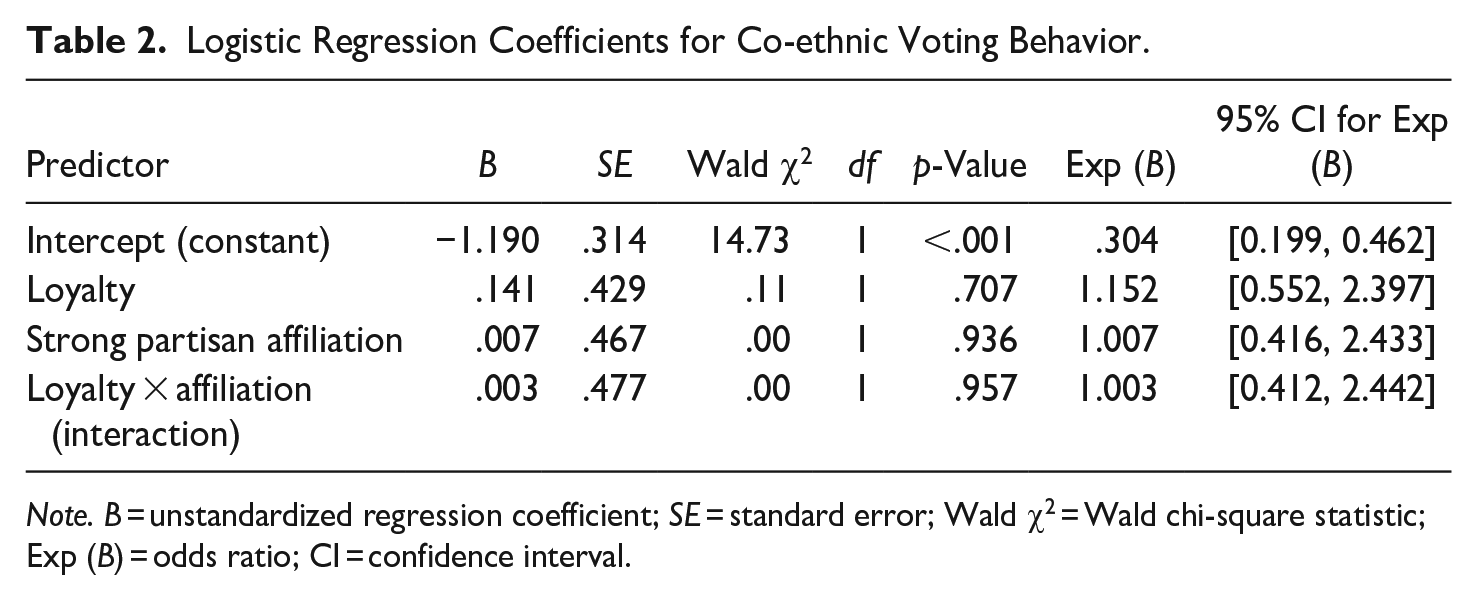
Regarding the individual predictors, none significantly contributed to explaining the likelihood of co-ethnic voting for a Hispanic versus a White candidate: Loyalty was nonsignificant (B = .141, p = .707), indicating that loyalty did not significantly affect co-ethnic voting behavior. Strong affiliation was also nonsignificant (B = .007, p = .936), suggesting that strong partisan affiliation did not significantly influence the likelihood of voting for a co-ethnic candidate. The interaction term between loyalty and strong affiliation was similarly nonsignificant (B = .003, p = .957), indicating that the combined effect of these two predictors did not significantly predict co-ethnic voting behavior (See Table 2).
Logistic Regression Coefficients for Co-ethnic Voting Behavior.
Note. B = unstandardized regression coefficient; SE = standard error; Wald χ2 = Wald chi-square statistic; Exp (B) = odds ratio; CI = confidence interval.
The constant (intercept) was statistically significant (B = −1.190, p < .001), with an odds ratio Exp(B) = .304. This suggests that when loyalty and strong affiliation are both at their baseline levels (i.e., zero), the odds of co-ethnic voting (for a Hispanic vs. a White candidate) are relatively low.
The results of the logistic regression analysis do not support Hypothesis 2, which predicted that lower partisan identification (as measured by loyalty and strength of party affiliation) would prompt greater co-ethnic voting among Hispanic voters than White voters. Neither the individual predictors nor their interaction significantly explained the likelihood of voting for a co-ethnic candidate. These findings suggest that other factors beyond loyalty and partisan affiliation may be more important in determining co-ethnic voting patterns among Hispanic and White voters.
Voter Issue Positions and Candidate Evaluation
A series of multiple regression analyses were conducted to examine the influence of ethnicity (Hispanic vs. White), positions on three relevant political issues (immigration, housing, and education), and their interactions on the evaluation of two political candidates: Ruben Gallego and Kari Lake. In both models, the key predictors included race/ethnicity, the three issues, and the interaction terms between ethnicity and each issue.
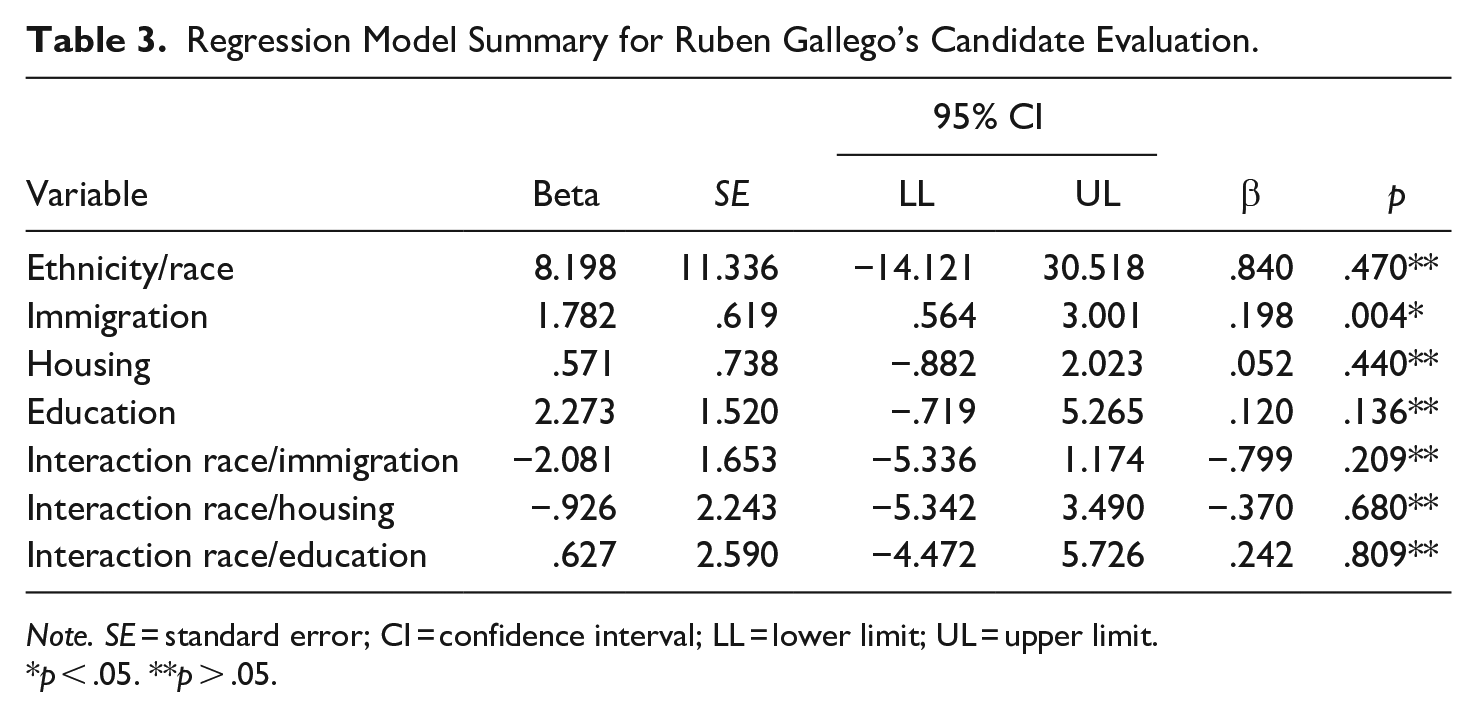
For Gallego, the Hispanic candidate and Democrat, the regression model explained a modest amount of the variance in candidate evaluation (R2 = .076) and was statistically significant, F(7, 267) = 3.144, p = .003. This model suggested that ethnicity, issue positions, and their interactions had a notable influence on Gallego’s evaluations, although the effect sizes were small. The ethnicity variable (0 for White and 1 for Hispanic) was a significant predictor of candidate evaluation (B = −8.198, p = .470), with Hispanic voters rating Gallego more favorably than their White counterparts, though the effect size was relatively small (see Table 3).
Regression Model Summary for Ruben Gallego’s Candidate Evaluation.
Note. SE = standard error; CI = confidence interval; LL = lower limit; UL = upper limit.
p < .05. **p > .05.
Voters’ positions on immigration significantly impacted their evaluations of Gallego (B = 1.782, p = .004). Hispanic voters’ stronger ethnic identification with immigration issues likely influenced their positive evaluations of Gallego. The housing and education issues were not significant predictors of candidate evaluation, with p-values of .440 and .136, respectively, suggesting that these issues had little influence on how voters evaluated Gallego. The interactions between ethnicity and the issues (immigration, housing, and education) did not significantly predict evaluations of Gallego. The interaction terms were nonsignificant, indicating that the relationship between issue positions and candidate evaluation was relatively consistent across ethnic groups.
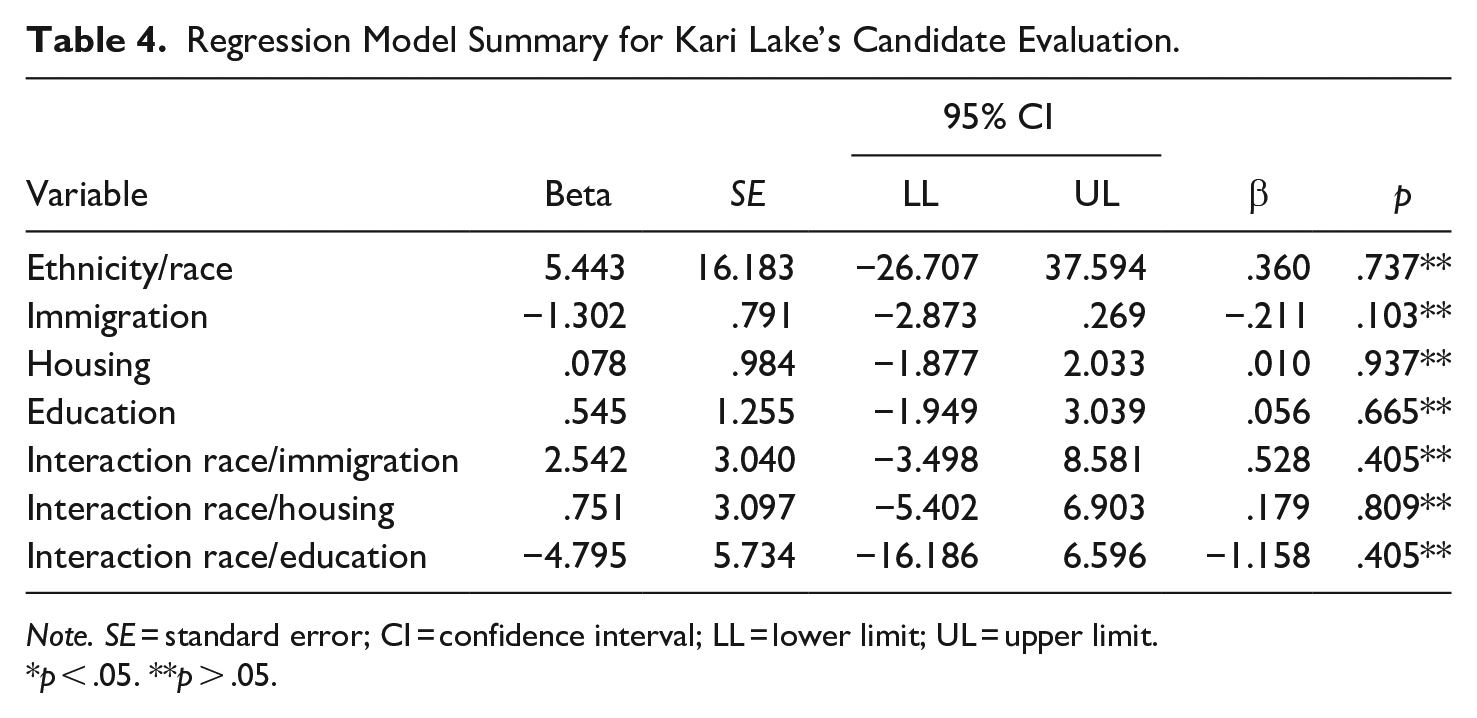
For Lake, the White candidate and Republican, the regression analysis yielded a nonsignificant model (F[7, 90] = .668, p = .698), explaining only 4.9% of the variance in the evaluation of Lake (R2 = .049). This finding suggests that Lake’s candidate evaluation was less influenced by ethnicity and issue positions compared to Gallego’s. The ethnicity variable did not significantly predict candidate evaluation (B = 5.443, p = .737), indicating that ethnicity did not play a significant role in the evaluation of Lake. The immigration variable was marginally significant (B = −1.302, p = .103), but the effect size was small, suggesting that immigration was not a strong predictor of Lake’s evaluations. Both housing (B = .078, p = .937) and education (B = .545, p = .665) were not significant predictors, indicating these issue positions did not strongly affect evaluations of Lake (see Table 4).
Regression Model Summary for Kari Lake’s Candidate Evaluation.
Note. SE = standard error; CI = confidence interval; LL = lower limit; UL = upper limit.
p < .05. **p > .05.
The interaction terms between ethnicity and the issues (i.e., immigration, housing, and education) were also not significant, indicating that ethnicity did not moderate the relationship between issue positions and the evaluation of Lake.
Discussion
The intent of this study was to assess how the strength of an individual’s ethnic self-identification affects their evaluations of candidates, with a specific focus on Hispanic and White voters’ perceptions of Hispanic and White candidates running in Arizona’s 2024 U.S. Senate race. The aim was to expand previous research, such as Graves and Lee (2000), who assessed the relationship between partisanship, candidate evaluation, and issue position as key factors influencing voters’ decisions, by moving beyond binary/nominal assessments of voters’ ethnic identity to better understand how the strength of one’s identity plays a role amidst these other variables and which variables contribute more to candidate evaluations for Hispanic and White voters. In this pursuit, some expectations bore out, while others did not, suggesting ethnic self-identification may manifest in different ways than expected. These results align with the theoretical model of ethnic voting by Graves and Lee (2000), which posits that ethnicity is a key factor in shaping candidate evaluations, but also highlight the complexity of how identity and issue alignment interact in influencing voters’ preferences.
First, we predicted that strength of ethnic self-identification could impact Hispanic and White voters’ assessments differently and this was not supported. Specifically, we posited that Hispanic voters with strong ethnic self-identification would evaluate Hispanic candidates more positively than Hispanic voters with low ethnic self-identification (H1a), and White voters with strong ethnic self-identification would evaluate Hispanic candidates less positively than White voters with low ethnic self-identification (H1b). The results of the multiple regression analysis provided support for H1a but did not support H1b. Unexpectedly, White voters with strong ethnic self-identification evaluated Hispanic voters more positively than White voters with lower self-identification. As such, we did not see White voters with strong attachment to their ethnic identity negatively out-group the Hispanic candidate, which would have been expected based on previous scholarship (Huddy, 2001; Visalvanich, 2016). This finding supports the notion that ethnicity plays a critical role in shaping how voters assess political candidates, suggesting that individuals from different ethnic backgrounds may form divergent evaluations based on their ethnic affiliations or perceived shared experiences (Ansolabehere & Puy, 2016; Ben-Bassat & Dahan, 2012). The results highlight the importance of ethnic identity, and specifically the strength of one’s ethnic identity, as a potential lens through which political preferences and candidate evaluations are filtered, corroborating the view that ethnic background can influence voter behavior.
Further analysis using Pearson correlation revealed a positive correlation between ethnic self-identification and candidate evaluation. This result suggests that voters who strongly identify with their ethnic group tend to evaluate candidates more positively, potentially reflecting a sense of shared cultural or social connection with candidates of the same ethnic background. These findings are consistent with prior research showing that ethnic self-identification can influence both political preferences and evaluations of candidates (Sullivan & Arbuthnot, 2009). The positive relationship observed between ethnic self-identification and candidate evaluation implies that ethnic identity may be a crucial factor in political decision-making, with individuals more inclined to support candidates they perceive as advocating for their ethnic group’s interests, creating a linked fate (see Barreto, 2010; Chong & Rogers, 2005).
However, the findings also revealed a weak, nonsignificant correlation between ethnic/racial identity (i.e., Hispanic vs. White) and candidate evaluation for Hispanic participants. For White participants, the correlation was similarly nonsignificant. These results suggest that while ethnicity may play a role in shaping evaluations of candidates, it is not the sole determinant. The weak, negative correlation observed among Hispanic participants could reflect more complex interactions between ethnic identity and political preferences, potentially including factors such as disillusionment with candidates who fail to align with voters’ expectations or values. However, since this relationship was not statistically significant, it indicates that ethnicity alone may not sufficiently explain how Hispanic participants evaluate political candidates (Uhlaner et al., 1989).
The lack of significant findings between ethnic self-identification and candidate evaluation for White participants further supports the idea that the relationship between ethnic self-identification and candidate evaluation may differ across ethnic groups. White participants, in particular, may not prioritize racial or ethnic identity in their candidate evaluations. This could be due to various factors, such as the numerical dominance and symbolic representation of White candidates in the political landscape, or because other aspects of White participants’ social identities (e.g., political ideology, partisanship) may have a stronger influence on the evaluation process than racial self-identification alone.
Second, we hypothesized that lower partisan identification would lead to greater co-ethnic voting among Hispanic voters as compared to White voters. However, the results for H2 suggest that ethnic identity does not play as significant a role in shaping partisan identification or pride/loyalty toward political affiliation as might have been expected given Hispanic’s relative fluidity in partisanship. Although ethnicity is often a pivotal factor in the political behaviors of minority groups—such as voting preferences and candidate evaluation—the current findings indicate that Hispanic voters do not exhibit greater partisan fluidity or co-ethnic voting tendencies based on ethnic identification alone.
One possible explanation for this pattern is that certain Hispanic subgroups, such as Puerto Ricans, Dominicans, some Mexicans, and Central Americans, exhibit a strong alignment with the Democratic Party in the United States (UnidosUS, 2024). However, the results of the 2024 presidential election, in which “62% of Hispanic voters supported Harris compared to 37% for Trump” (UnidosUS, 2024, para 1), underscore that Hispanics are not a monolithic group aligned with a single political party. Instead, this trend reflects a broader political shift, in which factors, such as economic policies, may play a significant role in influencing voting behavior. This alignment appears to transcend ethnic identity, with political affiliation being more strongly influenced by ideological preferences and policy positions (Hajnal & Rivera, 2014). Moreover, existing literature suggests that Hispanics are more likely to evaluate political candidates based on merit—specifically, the potential benefits candidates can bring to the community—rather than on political identity or party affiliation (DeSipio, 2006).
This trend is further reflected in the results of the Arizona U.S. Senate race, where Democrat Ruben Gallego received 1,676,335 votes (50.1%) compared to Republican Kari Lake’s 1,595,761 votes (47.7%) (NPR, 2024), a margin of only 2.4%. This close outcome occurred in a state with approximately 1.3 million Hispanic voters (LPPI, 2024). Such a result can be interpreted through the lens of Hispanic voting fluidity, which suggests that Hispanic voters exhibit greater flexibility in their decision-making processes, potentially allowing for more nuanced or issue-based evaluations (DeSipio, 2006).
These findings stand in contrast to previous studies suggesting that ethnic identity is a key determinant of voting behavior, with lower partisan identification being associated with stronger co-ethnic voting tendencies (e.g., Berry et al., 2019). The lack of a significant relationship between ethnicity and partisan identification in this study may reflect shifting political dynamics or demographic changes that were not captured in earlier research. Additionally, factors such as age, generational status, or acculturation may also influence partisan affiliation and loyalty but were not addressed in the present analysis. Recent analyses suggest that age plays a significant role in shaping individuals' voting behavior over the course of their lives, as preferences for policy positions evolve in ways that reflect shifting priorities (see Ahlfeldt et al., 2022; Tilley & Evans, 2014). For example, Ahlfeldt et al. (2022) examined how political alignment changes with age in Switzerland and found that, over time, individuals tend to shift from left-leaning to right-leaning positions as they get older. It could also be inferred that the different life stages voters experience, such as education, career progression, or family formation, can change or modify their political positions throughout their lives (Stoker & Jennings, 2006). Factors such as age, gender, and societal cultural transformations can influence voter transitions, playing a key role in the changes in voting behavior over the life cycle (Stoker & Jennings, 2006).
Migration and acculturation processes significantly influence how migrants perceive the government of their host country (Wals & Rudolph, 2019). According to Wals and Rudolph (2019), migrants exposed to democratic systems before migrating tend to exhibit lower trust in national governments compared to those socialized in more authoritarian regimes. This distinction is evident in the voting behaviors of Cuban and Venezuelan migrants in the United States. Political socialization experiences prior to migration can, therefore, shape the political acculturation process in the host country. Even for U.S.-born Hispanics, the governmental experiences of their immigrant parents could influence their political perceptions, as family plays a key role in political socialization.
Research also suggests that generational status impacts the political perceptions and participation of Hispanics in the United States (Masuoka, 2008; Potochnick & Stegmaier, 2020; Santoro & Segura, 2011). Portes and Rumbaut (2001) argued that first-generation Hispanic immigrants, who maintain strong ties to their country of origin, have their ethnic identity shaped by these connections. In contrast, second-generation Hispanics, while still connected to their heritage, begin to adopt U.S. political norms, which may influence their approach to co-ethnic voting (Potochnick & Stegmaier, 2020). This generational shift often weakens ethnic identity, which in turn may reduce political participation. However, it is important to note that a strong ethnic identity does not necessarily correlate with a preference for co-ethnic candidates, as individuals may prioritize other political issues (Santoro & Segura, 2011). Thus, while generational status plays a role in shaping political behavior, it is not the sole determinant of voting patterns.
Finally, for H3, White voters’ positions on issues more relevant to Hispanic voters than to White voters were not expected to significantly impact their candidate evaluations. However, the results of the multiple regression analyses strongly support the idea that candidate-voter alignment is a critical factor in shaping candidate evaluations (Logan et al., 2012). However, the influence of ethnicity in this context appears to be more nuanced and complex, varying by the candidate and the issues under consideration.
For Ruben Gallego, the findings revealed that alignment on immigration—an issue highly relevant to Hispanic voters—had a significant positive effect on candidate evaluations. This suggests that Hispanic voters’ support for Gallego was influenced by perceived alignment on immigration reform and other key policy issues, consistent with issue voting theory (Conover & Feldman, 1984). Ethnicity alone did not drive evaluations as strongly, supporting the idea that voters evaluate candidates based on policy positions rather than just demographic characteristics. While ethnicity had a modest effect on candidate evaluation, the more substantial factor in Gallego’s case was likely the perceived alignment on issues such as immigration, a concept that can be understood through the lens of linked fate. 3 According to this framework, Hispanic voters may perceive a Hispanic candidate as more attuned to their issues, linking descriptive and substantive representation (Pitkin, 1969).
For Lake, the analysis found no significant relationship between ethnic identity or alignment on key issues and candidate evaluation. Specifically, issues such as immigration, housing, and education did not significantly influence how White voters evaluated their candidacy. The lack of statistical significance in the relationship between these issues and candidate evaluations (i.e., p > .05 for immigration and other issue interactions) suggests that White voters may not prioritize these issues—or at least not in a way that affects their support for Lake. This lack of significant findings, coupled with the weak correlation between ethnicity and candidate evaluation, further support the idea that ethnicity self-identification may not be as a critical factor in shaping evaluations for White voters as it is for Hispanic voters.
The weak correlation between ethnicity and candidate-voter alignment in both cases suggests that for Hispanic voters, candidate alignment on issues that are particularly relevant to their community (e.g., immigration reform) has a more substantial influence on candidate evaluations than shared ethnic identity. This challenges the assumption that ethnic identity alone significantly shapes candidate preferences, as suggested by Valdez (2011). Additionally, the lack of significance in the findings for Lake points to the possibility that for White voters, policy concerns may play a less decisive role in their evaluations, potentially due to the dominance of White candidates in the political landscape, or other facets of social identity that take precedence over ethnicity in shaping candidate evaluations.
These findings highlight the importance of issue-based campaigning, which may be more effective in engaging Hispanic voters and fostering their political participation. Given that Hispanic voters were more likely to evaluate candidates based on issues of particular concern to their community (such as immigration), candidates who align with these policy preferences may find more success than those relying solely on ethnic appeals or co-ethnic voting strategies. This supports the findings of Macías Mejía (2024), who argued that issue-based campaigning may prove more effective in engaging Hispanic voters than traditional ethnic-based approaches.
Taken together, these results contribute to the growing body of literature examining the intersection of ethnicity, candidate alignment, and voter evaluation. While previous research has emphasized the role of ethnic identity in shaping political preferences (e.g., Pantoja et al., 2001), the current study suggests that alignment on key issues plays a more significant role in determining candidate evaluations, particularly in a diverse electorate. This aligns with more recent studies suggesting that voters—including minority voters—are increasingly making political decisions based on issue congruence rather than ethnic identity alone (e.g., Sears & Huddy, 2017).
Limitations
While this study provides valuable insights into the role of ethnic self-identification, ethnicity, and candidate-voter alignment in shaping candidate evaluations and voting behavior, several limitations should be considered when interpreting the findings. First, the cross-sectional design of the study limits the ability to make causal inferences about the relationships between ethnic identity, candidate evaluations, and partisan identification. Future research employing longitudinal designs could better capture the dynamic nature of these relationships over time. Second, the sample in this study was composed of Hispanic and White voters, potentially limiting the generalizability of the findings to other ethnic or racial groups. The study’s findings may not fully reflect the diversity of the electorate, particularly in regions with larger populations of Black, Asian, or Native American voters, whose experiences and voting behavior may differ. Third, the study relied on self-reported measures of ethnic identity and candidate evaluation, which may be subject to social desirability bias or respondent interpretation. Participants may have overestimated or understated their ethnic identification or candidate preferences due to the perceived sensitivity of these topics. Incorporating behavioral measures or other methods of data collection could mitigate these biases.
Finally, the description of Gallego said he was a “second-generation American, with a Colombian mother and a Mexican father.” As such, his description indicated his ethnicity and generation status, whereas the Lake description did not mention generational status. Gallego’s mention of his Colombo-Mexican heritage may resonate strongly with first-generation voters, who often maintain deep ties to their country of origin and ethnic group, which play a key role in shaping their identity (see Portes & Rumbaut, 2001; Santoro & Segura, 2011, for insights on generational status and its relation to voting decisions). However, for second-generation and subsequent generations, the connection to co-ethnic candidates may be less pronounced due to the weakening of ethnic identity as a result of generational acculturation. This shift in identity and political behavior warrants further investigation to determine whether appeals to ethnic background can still strongly influence voting patterns, particularly when compared to candidates who do not emphasize ethnic ties.
Conclusion
This study explored the role of ethnic self-identification, ethnicity, and candidate-voter alignment in shaping candidate evaluations among Hispanic and White voters. The findings indicate that ethnicity is a significant predictor of candidate evaluation, with ethnic self-identification positively correlated with more favorable evaluations. However, the relationship between racial identity and candidate evaluation was weak, suggesting that while ethnicity plays a role, it is not the sole determinant in how candidates are evaluated. Additionally, the study found no significant evidence that ethnic identity influences partisan identification or co-ethnic voting among Hispanic voters, challenging earlier assumptions about the centrality of ethnicity in partisan loyalty.
Furthermore, the results highlight the importance of candidate-voter alignment on issues of relevance to Hispanic voters, showing that alignment on policy issues—particularly those such as immigration—is a stronger predictor of candidate evaluation than ethnicity itself. This finding contributes to the growing body of literature that suggests issue congruence may be a more salient factor than ethnic identity in shaping voting behavior, particularly in a diverse electorate.
Footnotes
Appendix A
Declaration of Conflicting Interests
The authors declared no potential conflicts of interest with respect to the research, authorship, and/or publication of this article.
Funding
The authors received no financial support for the research, authorship, and/or publication of this article.
