







Abstract
We contribute to the herd behavior and behavioral economics literature by comparing the determinants of head coach candidate interviews and hires with the determinants of successful head coaches. We use National Football League (NFL) data from the 2015 to 2016 through 2021 to 2022 NFL seasons. This results in 435 candidate observations for our Interview and Hired models, as well as 582 head coaches in our Team Win Percentage and Cover Against the Spread models. Our results indicate misalignments between hiring practices and actual determinants of effective coaching. We also suggest that this irrational decision-making is associated with league herd behavior. Overall, NFL head coaches serve as the executive of the team, which allows us to provide insight into herd behavior within the executive labor market in professional sports leagues and traditional for-profit contexts.
Introduction
Herd behavior occurs when people make decisions based on what others are doing (Banerjee, 1992). Often, herd behavior is researched from a financial decision-making perspective (Scharfstein & Stein, 1990; Wever & Aadland, 2012). However, herd behavior has also been applied to job candidate selection (Banerjee, 1992; Oberholzer-Gee, 2008). Herd behavior studies have demonstrated that decision-makers are more prone to make decisions based on the herd when they are concerned about their reputations (Bursik, 2012; Scharfstein & Stein, 1990).
In the National Football League (NFL), owners and general managers (GMs) may be especially susceptible to herd behavior, as evidenced by conservative decision-making intended to not upset NFL fanbases (Bursik, 2012; Romer, 2006). More specifically, former NFL head coach (HC) and Pro Football Hall of Fame inductee Tony Dungy said, owners will often select a HC who are known commodities because “at least everybody knows him and everybody will say this is a good hire,” rather than selecting the best coach for the position (Gannt, 2016, para. 8). Thus, we posit that NFL owners and GMs will be more likely to interview and hire HC candidates for HC positions if they have been interviewed by more teams in the previous season. Moreover, these decisions made based on herd behavior may not be optimal decisions.
Firm irrational decision-making is also related to the executive labor market. Khurana (2002) provided evidence of board incompetence in the case of executive successions and pointed to charismatic extroverted chief executive officer (CEO) candidates as oftentimes attracting the attention of the board, but subsequently not meeting performance expectations following their appointment. Furthermore, “systematic selection processes can help identify better candidates, but these processes are not common in CEO or board member selection” (Nyberg et al., 2021, p. 184). As with CEO hires, NFL HCs appear to be hired without insight from research or human resource experts, but rather by NFL team owners whose expertise may not be in hiring effective executives to lead organizations. Relatedly, case studies found that legal analysts perceive NFL hiring decision-makers to behave irrationally (Cureton, 2021). This sentiment has also been echoed by scholars, journalists, and coaches as well (Bursik, 2012; Gannt, 2016; Romer, 2006). Thus, we further posit that NFL HC interview and hiring decisions are irrational, as they are based on determinants that are inconsistent with increasing team performance.
We build on herd behavior theory by examining the relationship between previous interview opportunities on securing future interviews and, ultimately, HC positions. Our study adds to the field of behavioral economics by examining the congruence, or lack thereof, between determinants of HC candidates/hires and determinants of successful HCs. Our analysis also provides insight beyond sport, as HCs are often used to analyze CEOs in management and economics research (Fredrickson et al., 1988; Humphreys et al., 2016).
Methodology
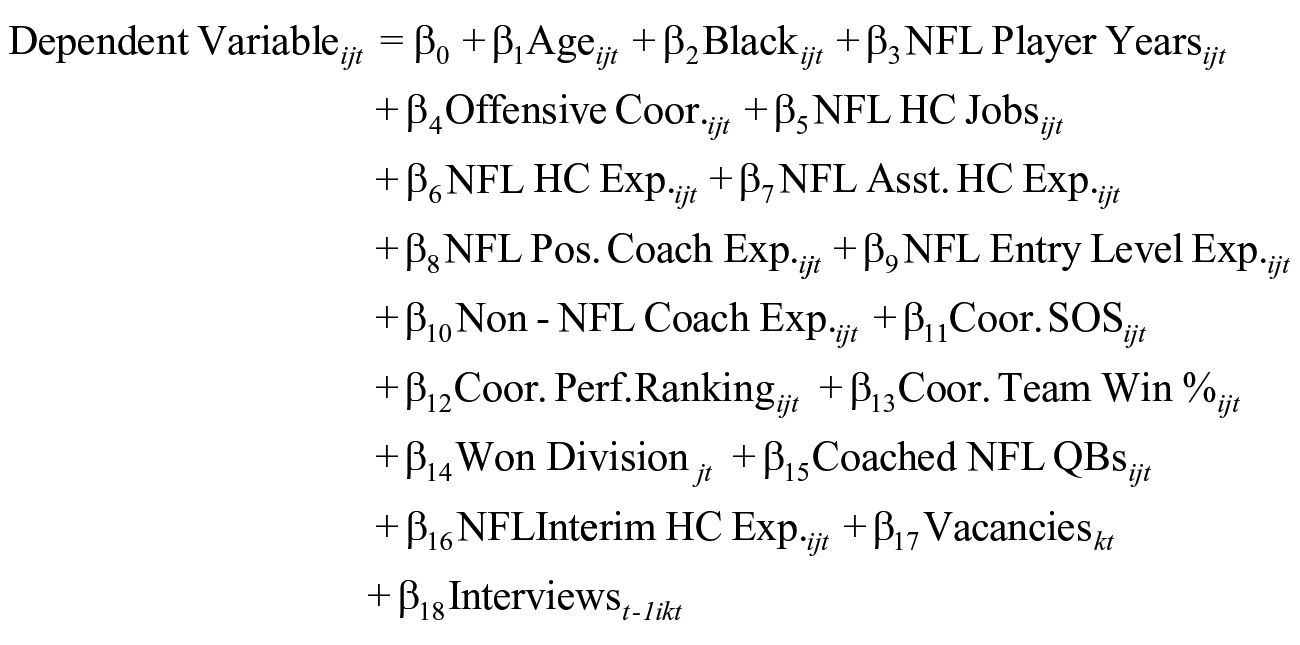
We utilize data from the 2015 to 2016 through 2021 to 2022 NFL seasons to examine coaching candidates’ propensities to secure NFL HC interviews and positions. We limit our study to NFL offensive and defensive coordinators, who comprise the majority (64.9%) of appointed HCs and are evaluated on similar criteria. Four regression models are estimated, each with a different dependent variable and random effects. We also implement clustered standard errors in the Hired, Team Win %, and Cover ATS % models. Our outcome variable of interest in our hired model (Hired) examines how likely each candidate is to be hired as an HC. Hired candidates are indicated by a value of “1,” while unhired candidates are represented by a “0.” Due to the binary nature of our dependent variable, we analyze our panel data using logistic regression.
The dependent variable for the Interview Model is a count of NFL HC jobs, where the offensive or defensive coordinator was a candidate after the season (Interviews). The candidate data for each NFL HC vacancy were obtained from www.profootballrumors.com, where the annual “NFL Head Coaching Search Trackers” includes reliable citations for the media sources used to confirm that the coaches listed were considered viable candidates for the positions. The Interview Model also analyzes the relationship between race and past interview opportunities on the amount of future interview opportunities received. Given that the dependent variable for each observation in the Interview Model is an integer ranging from 0 to 7, a negative binomial regression is estimated to analyze our panel data.
Season win percentage (Team Win %) is the dependent variable in the Team Win % Model. Our linear regression panel model examines the relationship between HC interview determinants and subsequent HC success. The sample period and population for the Team Win % Model differ from the sample used for the Hired and Interview Models. The Team Win % Model’s sample is restricted to one team observation per season and only includes teams with HCs who were hired from a coordinator role between the 1985 and 1986 season through the 2021 to 2022 season. Using the same sample, the Cover ATS % Model uses a dependent variable of the percent of games in a season that the team covered against the spread (i.e., outperformed expectations; Cover ATS %). We utilize the Cover ATS % Model, as previous research emphasized the importance of examining performance relative to expectations, rather than raw performance alone (Humphreys et al., 2016; Salaga & Juravich, 2020).
We use Interviewst − 1 as a measure of how many teams considered each candidate for an HC role in the previous season. We also collected several control variables for each model related to coaching background and performance. Age accounts for an HC’s age in the given year of observation, NFL Player Years measures years of NFL playing experience, NFL HC Jobs is the sum of previously held HC jobs, NFL HC Exp is the number of years of NFL HC experience, NFL Asst. HC Exp. is the number of years of assistant HC or coordinator experience, NFL Pos. Coach Exp. is the number of years of NFL position group or special teams coach, NFL Entry Level Exp. is the number of years of entry-level NFL coach experience (e.g., assistant position group; quality control), Non-NFL Coach Exp., which measures years of non-NFL coaching experience, and a count of the number of NFL interim HC tenures (NFL Interim HC Exp.). Binary control variables include Offensive Coor., where a “1” indicates the coach’s most recent non-HC position was an offensive coordinator, or “0” for previously employed defensive coordinator, and Coached NFL QB, where a “1” indicates previous sole experience as an NFL quarterbacks coach and a “0” indicated otherwise. Performance as a coordinator is also controlled for through measuring schedule strength (Coor. SOS), team offensive or defensive performance rank (Coor. Perf. Ranking; 1 is best, 32 is worst), winning percentage, and whether or not they won the division (Won Division). We also control for the race of the hired HC (Black; Braddock et al., 2012), where a “1” indicates a black HC and a “0” indicates a non-black HC.
Additional controls are only utilized in some of our models. Vacancies control for the number of HC vacancies is available in each season in the Hired and Interview Models. We also control for player quality characteristics (1st Rd. Picks; Avg Player Exp.; Avg Player Age; Age × Avg. Player Age), difficulty of schedule (Team SOSt − 1), and recent team success (Team Win %t − 1) in our Team Win % and Cover ATS % Models.
We present our Hired and Interview Models below:
Our Team Win % and Cover ATS Models take the form:
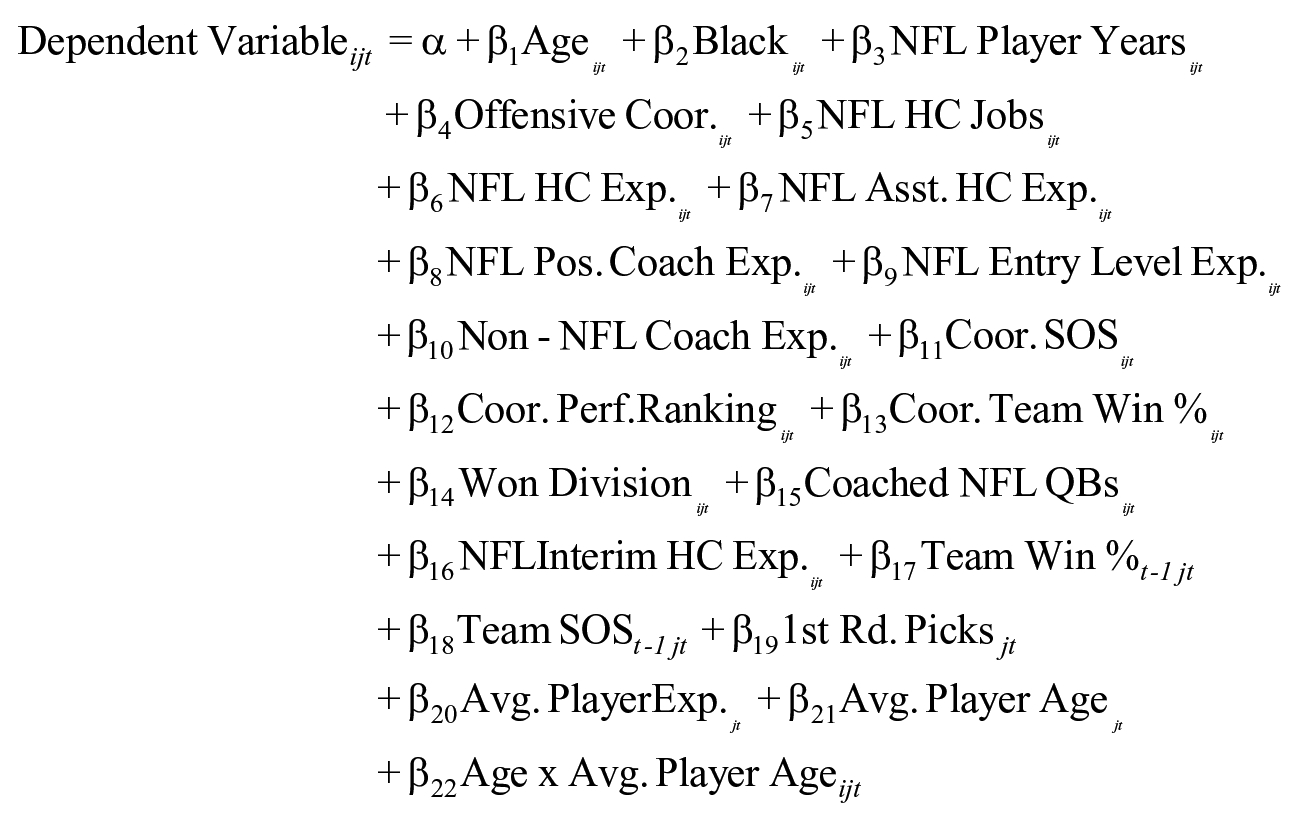
In our models, i refers to the individual HC, j the individual NFL organization, k the NFL as a whole, and t to the year of the observation.
Results/Discussion
We report summary statistics for all variables in Table 1. Our sample utilized 435 coach-season observations for the Hired and Interview Models, while we had 582 team-season observations in our Team Win % and Cover ATS % Models. Coordinators were potential candidates for 0.561 HC vacancies per year, with 7.6% hired each year as HCs.
Summary Statistics.
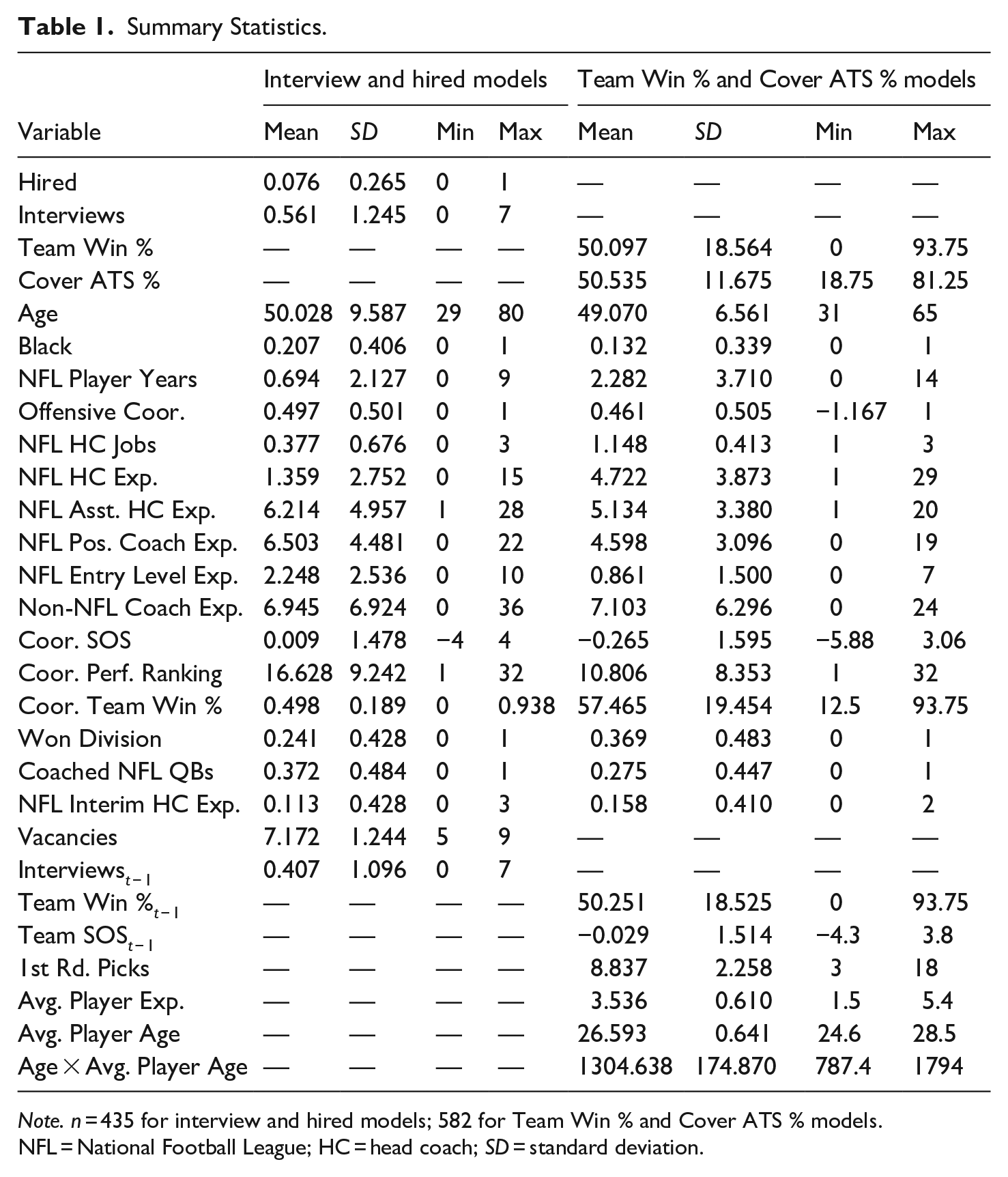
Note. n = 435 for interview and hired models; 582 for Team Win % and Cover ATS % models. NFL = National Football League; HC = head coach; SD = standard deviation.
We present the regression results in Table 2. In both the Interview and Hired Models, the Interviewst − 1 variable was positive and statistically significant, supporting the notion that herd behavior does play a role in NFL HC appointments. More specifically, for each interview in a year, HC candidates can expect more than a 2% increase in the probability of securing an HC position the following year. While a 2% increase may not appear substantial, when coaches are candidates for five, six, or seven HC positions in a given year, their probability of getting hired as an NFL HC the following year increases by 16%, 21%, and 27%, respectively, relative to coaches with no interviews in the year prior to potential appointment.
Regression Results.
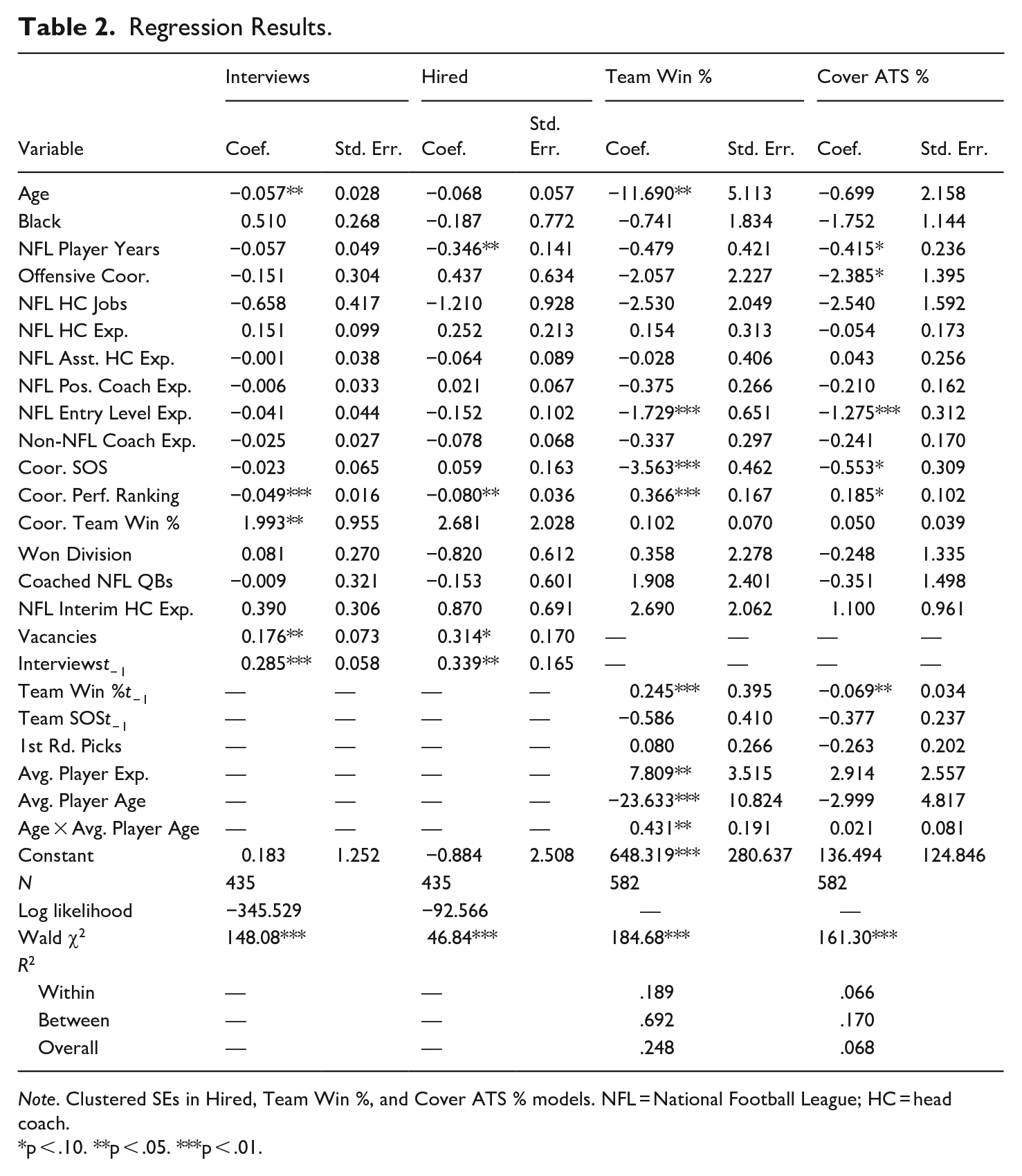
Note. Clustered SEs in Hired, Team Win %, and Cover ATS % models. NFL = National Football League; HC = head coach.
p < .10. **p < .05. ***p < .01.
Our results also suggest that hiring criteria do not align with determinants of winning. Specifically, Coor. Perf. Ranking is positive and significant in the Team Win % Models, but is negative and significant in the Interviews and Hired Models. Therefore, while better performance as a coordinator is more likely to lead to more interviews and a higher likelihood of appointment to NFL HC, success as a coordinator is actually associated with lower performance as an HC, both in terms of team winning percentage and covering against the spread. This may be due to the fact that it likely takes a different set of skills to manage an entire NFL team than it does to lead high performance related to just one side of the ball. This idea is consistent with management literature that shows people who are successful at one level in their organization are not always successful managers within that same industry (e.g., Benson et al., 2019). Similarly, superstar CEOs have been found to perform worse relative to past performance and other CEOs (Malmendier & Tate, 2009). Thus, previously high-performing executives, either in the past or in lower-level positions, often perform worse as organizational leaders in the future, despite having a higher likelihood of securing future executive positions.
In addition, even though Offensive Coor., NFL HC Jobs, NFL Entry Level Exp., and Coor. SOS are not significant determinants of interviews and appointments for NFL HC positions, we found evidence that they may be detrimental to NFL HC performance. NFL Entry Level Exp. was associated with significant decreases in team performance. A potential reason is that entry-level coaches often have limited experience playing or coaching at high levels. Moreover, if a HC or coordinator does not notice sufficient value in the entry level coach to promptly promote them to coaching a position group, it suggests they may not have the ability to be successful at higher levels within the organization or industry, though they may have been promoted based on other factors, such as networks, team performance, or isolated years of strong performance that may not have been sustainable.
Previous studies indicated that NFL HC playing experience had no significant effect on team winning percentages, but was detrimental to securing NFL HC positions (J. J. Foreman et al., 2020). Similarly, we find that the probability of coordinators being appointed to NFL HC positions decreases with more NFL playing experience. Also consistent with J. J. Foreman et al. (2020), we find no significant relationship between NFL HC playing experience and team winning percentage; however, our analysis reveals a negative relationship between NFL HC playing experience and the percent of games NFL HCs covered against the spread. Though commonly touted as an important coaching qualification (Conklin et al., 2022), NFL playing experience seems to be more of a hindrance to NFL HC appointments and success. The consequences for NFL coaches of having played in the NFL may be due to a variety of causes, including less time spent as a coach, biases held from having played the game, or cognitive limitations from playing a sport that regularly causes brain trauma.
Although Age has a negative coefficient in both the Interviews and Team Win % Models, the interaction between Age and Avg. Player Age is positive and statistically significant in the Team Win % Model. Figure 1 depicts the relationship between Age, Avg. Player Age, and Team Win %. As depicted in Figure 1, younger teams perform better with younger coaches and older teams perform better with older coaches. Despite positive associations in other diversity measures (e.g., nationality), Kearney and Gebert (2009) also found similar evidence that age diversity was not positively related to team performance. This could potentially be attributed to differing perspectives on job-related roles and tasks. However, t-tests and simple linear regressions using hired coach age as the dependent variable and average player age on the team as an independent variable revealed that coach ages at the time of appointment were not significantly affected by the age of the team during their first year of coaching (p > .10). Thus, the evidence from the present study suggests that team owners do not appear to appoint coaches based on determinants of successful HCs, in general or for their particular teams.
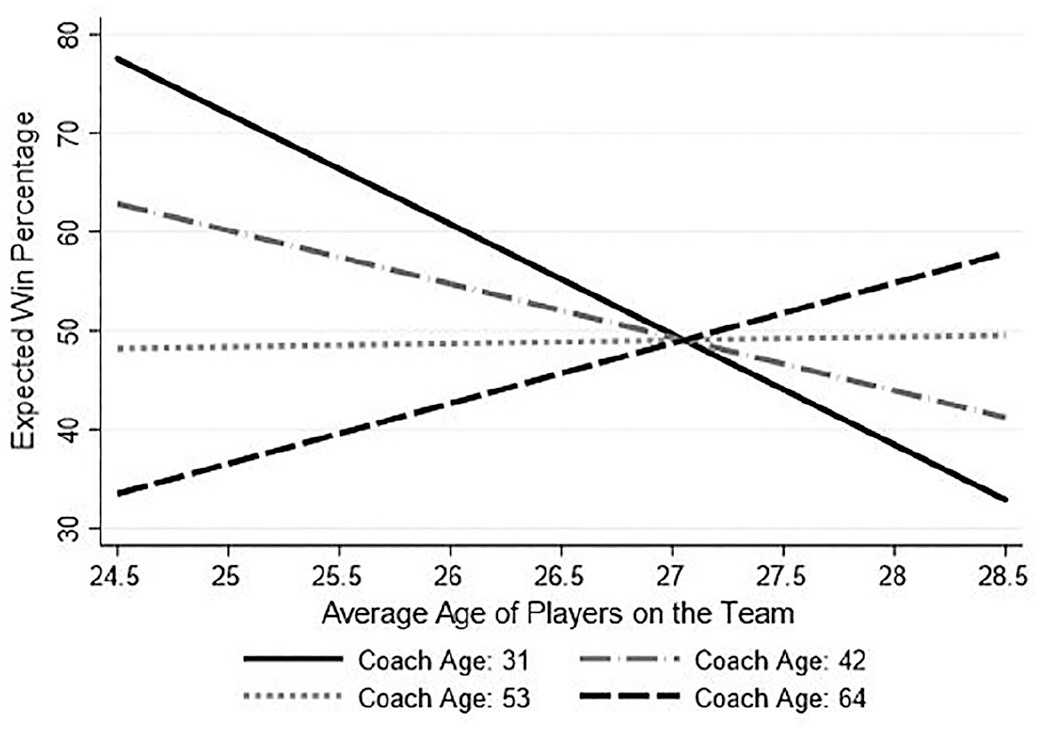
Expected win %, by player and coach age.
Regardless of the age of the team, older coaches appear to experience discrimination in the NFL HC labor market, as they are significantly less likely to be interviewed for NFL HC positions. We also evidence a practically significant negative association between age and HC hiring. This finding is consistent with beliefs and allegations from current and former coaches about age discrimination in professional coaching (e.g., Florio, 2023; Hernandez, 2023; Sando, 2025). Age discrimination in appointments to executive positions has also been empirically evidenced in other NFL HC studies (e.g., J. J. Foreman et al., 2020) as well as within the CEO literature (Schepker & Barker, 2018; Ward et al., 1995). While perhaps unethical or illegal, this discrimination may be a successful tactic given that team winning percentages decline as NFL HCs age, except potentially for older teams.
One significant determinant of selecting offensive and defensive coordinators as HC candidates was the coordinator’s team winning percentage. Given that this was not a determinant in hiring or HC success, it provides evidence that decision-makers may first identify successful organizations to draw candidates from as they fill out their candidate lists.
Within the present study, we found several instances of misalignment between NFL HC hiring practices and determinants of effective coaching. This misalignment is consistent with previous research (J. J. Foreman et al., 2020) as well as the hypothesis that NFL team owners and GMs charged with appointing NFL HCs behave irrationally as they make decisions that are contradictory to their best interest (i.e., appointing NFL HCs who are most likely to succeed). Part of the cause of the irrational decision-making may be due to the propensity to make decisions based on herd behavior, as supported by the higher likelihood of hiring an HC who was established as a legitimate candidate by other NFL team owners and GMs.
Conclusion
Effective personnel decisions, especially at the upper echelon of an organization, are among the most important actions organizations take (Fredrickson et al., 1988; Nyberg et al., 2021). Successful hiring strategies cannot be implemented without a comprehensive understanding of the process and it may behoove decision-makers, as well as researchers, to consider best practices established in fields such as human resource management (Nyberg et al., 2021). Thus, the results of the present study contribute to our understanding of the hiring process, which appears to rely on herd behavior and involves several discrepancies between hiring and organizational performance. These hiring practices originate with creating a short list of candidates that does not necessarily reflect a pool of candidates who are likely to be successful NFL HCs.
By understanding how the short list of candidates (i.e., the candidate pool) is created, as well as how decision-makers progress to appointing a candidate, we can better understand how dismissals and other personnel decisions are made (Fredrickson et al., 1988; J. Foreman & Soebbing, 2015; Kahn, 2000; Nyberg et al., 2021). Thus, we contribute to executive dismissal research, which, until now, has been limited to using candidate pool proxies as a determinant of CEO dismissals. Our use of actual NFL HC candidates identified determinants of actual candidates, which can subsequently be used to identify candidates in future studies (e.g., to determine whether dismissal decisions actually rely on knowledge of potential qualified candidates to replace the executive).
Furthermore, the results of the present study could be used to identify where the most sought-after coaches take positions (e.g., glass cliff studies) or when sham interviews are taking place as a result of the Rooney Rule—both of which can have policy implications within and outside the NFL (Duru, 2018). Therefore, scholars, leagues, and coaches can take appropriate action in remedying these potential discrepancies and benefit by understanding career development pathways.
Footnotes

Funding
The author(s) received no financial support for the research, authorship, and/or publication of this article.
Declaration of Conflicting Interests
The author(s) declared no potential conflicts of interest with respect to the research, authorship, and/or publication of this article.