







Abstract
This research aims to explore individual-level reactions to protest and counter-protest interactions in Georgia. Since gaining independence, societal polarization has been a defining aspect of Georgian society. While earlier divisions centered around government support, recent issues—such as LGBTQ rights—have intensified both protests and counter-protests. The literature has documented the dynamics of protests and counter-protests in various contexts, highlighting their impact on each other and on public discourse. However, the influence of these dynamics on public support—particularly through the lens of emotional and cognitive shifts—remains relatively unexplored, especially in the Georgian context. Based on 66 in-depth interviews, this article examines how the dynamics of protests and counter-protests affect bystanders’ perceptions. Three narratives of judgment were identified to depict sequences capturing the development of these attitudes. These narratives reflect shared emotional tones that shape the trajectories of individual perceptions. This research contributes to the literature on social movements by demonstrating that the presence of counter-protests can fundamentally alter the emotional landscape and cognitive (moral) judgments of bystanders. It also details the argumentative basis of such changes. Furthermore, it extends the theoretical framework of protest–counter-protest dynamics by showing how these interactions create new emotional fields for identity alignment and public discourse in polarized societies.
Introduction
Understanding protest and counter-protest interactions is critical for analyzing how public support is shaped and contested. These interactions serve as powerful sites for the negotiation of societal values and identities, often influencing not only immediate public reactions but also longer-term shifts in collective memory and discourse. These dynamics are particularly salient in transitional societies like Georgia, where they reflect deeper struggles over national identity and democratization since independence from the Soviet Union. In this context, protest–counter-protest interactions have played a key role in shaping public discourse (Gegeshidze & De Waal, 2021; Samkharadze, 2022; Silaghadze, 2023). Traditionally, these divisions have centered around support and opposition to the government (Caucasus Research Resource Centers [CRRC] Georgia, 2020). However, the landscape of social conflict evolved in 2012, when issues related to LGBTQ rights emerged as new and significant triggers for counter-protests on the streets (Shevtsova, 2022). While LGBTQ 1 mobilizations manifested as peaceful expressions advocating for equal rights, counter-protests, often organized by groups like the Ultra-Right Movements, frequently involved threats, provocations, and acts of violence.
These confrontations have prominently featured on Rustaveli Avenue in front of the Parliament in Tbilisi. The predominantly male counter-protesters, often dressed in black, projected an image of authoritative power, intensifying public spectacle and tension. In Georgia, such events, referred to as “actions and contractions,” 2 have significantly shaped public discourse, prompting observers to (re)shape their judgments. These interactions between opposing groups have led to some individuals becoming stronger in their opinions, remained neutral or shifted their support between the conflicting groups. These shifts are visible in media discourse, reflecting broader societal impact.
Recent scholarship has observed dynamics between protest and counter-protest in various contexts (Ayoub & Chetaille, 2020; Reynolds-Stenson & Earl, 2018; Shahin, 2023). However, the effects of these dynamics on public opinion, and particularly in terms of how they influence shifts in individual positions, on a subjective, individual level represents a relatively recent area of exploration. Additionally, the role of emotions in shaping new perspectives within this micro context has not been thoroughly examined, especially in the Georgian setting.
This article aims to address this gap by exploring the individual-level responses to protest–counter-protest interactions with a focus on emotional and cognitive dimensions of attitudes. Through a qualitative approach involving 66 in-depth interviews with individuals who have observed these interactions, the research findings describe how seemingly counter-protests can stimulate reflection and judgment on a subjective level (Klandermans, 1997). This, in turn, has the potential to transform into individual action and, eventually, collective action (Stryker & Statham, 1985; Van Zomeren et al., 2008). Overall, the article contributes to the scholarship on the individual and subjective aspects of collective action.
The article is divided into the following four sections: First, the literature review on protest–counter-protest dynamics. The second section elaborates on the background of LGBTQ activism in post-Soviet region, with a particular focus on Georgia. The third section presents the research design followed by the empirical analysis. The article concludes with a summary and reflections on the research implications.
Literature Review: Protests, Counterprotests, and Their Impact on Public Opinion
Protests aim to challenge political systems and propose alternatives (Eslen-Ziya et al, 2019; Rocchetti & Pilati, 2025, this issue); however, their impact often depends on how opposing voices respond. The interactions between two opposing protests can be either confrontational or peaceful, challenging the legitimacy and claims of the original protest (Meyer & Staggenborg, 1996). By upholding the status quo or offering alternative perspectives, protest–counter-protest dynamics shape public perceptions—a vital resource that enables mobilization, signals elites, and attracts activists, though it can also be jeopardized by certain tactics (Ennis, 1987).
Most existing scholarship has focused on the macro context—how opposing movements develop and influence one another (Alimi & Hirsch-Hoefler, 2012; Becker & Copeland, 2016; Esacove, 2004; McCright & Dunlap, 2000; Meyer & Staggenborg, 1996; Rohlinger, 2002). Only recently has attention shifted to the micro-level dynamics of protest–counter-protest interactions, including framing and counter-framing within individual events (Ayoub & Chetaille, 2020; Giorgi, 2017; Goodwin & Jasper, 2006; Jasper, 2018). Scholars have also examined discursive strategies, tactical differences (Gallagher et al., 2016), and event-level interactions (Reynolds-Stenson & Earl, 2018; Rocchetti & Pilati, 2025, this issue; Shahin, 2023). Another strand addresses resource mobilization, showing how organizational infrastructure can bolster protest effectiveness and limit counter-protest impact (Inata, 2019). Overall, recent contributions have redirected scholarly attention to the event level and refined our understanding by distinguishing between counter-protests that are embedded in broader counter-movements and those that emerge independently, highlighting the role of local civil society, actor characteristics, and spatial control (Haunss et al., 2025, this issue).
Scholarship shows that counter-protests can reshape the protest environment and influence dominant narratives (Andrews & Biggs, 2006; McCluskey, 2017). Protests and counter-protests not only affect each other but also shape how observers perceive contested issues. Exposure to opposing messages may foster deeper understanding or, alternatively, reinforce polarization and existing beliefs (Mutz, 2006). The visibility and intensity of counter-protests can hinder consensus and deepen divisions (Meyer & Staggenborg, 1996). Visual and discursive confrontation helps define group identities—clarifying who “we” are and what “we” oppose—while mobilizing emotional investment. However, how protest and counter-protest dynamics affect shifts in individual level beliefs is a relatively new area of study. Against this backdrop, this article extends the literature by exploring how individuals respond to protest–counter-protest interactions, focusing on the emotional and cognitive dimensions of attitude formation.
Background: LGBTQ Activism in Post-Soviet Region
LGBTQ Protests and Counter-Protests in Eastern Europe and the South Caucasus
LGBTQ rights in post-Soviet countries face persistent challenges rooted in historical and cultural legacies. Soviet-era repression suppressed large-scale activism, though some underground resistance endured (Altman, 1993; Rutland, 2023). Homosexuality was briefly decriminalized between 1917 and 1934 (Dawsey, 2021; Englestein, 1995), but renewed criminalization led to decades of persecution, shaping enduring public attitudes (Rutland, 2023).
Following the Soviet collapse, post-Soviet states faced pressure to adopt human rights standards, including LGBTQ protections, particularly through European Union (EU) integration efforts (Isaakyan, 2013; Rutland, 2023; Wilkinson, 2019). Despite international support, LGBTQ protests and pride events often encountered violent counter-protests, rooted in Soviet-era stigmatization of homosexuality as “bourgeois degeneracy” (Altman, 1993; Healey, 2002; Rutland, 2023). Conservative leaders and the Russian Orthodox Church reinforce this legacy, framing LGBTQ rights as threats to traditional values and national identity (Buyantueva, 2018).
Since 1991, public opinion has evolved unevenly. Eastern Europe shows gradual progress, especially in EU-aligned states like Slovakia and the Czech Republic (Pew Research Center, 2017). In Ukraine, support reached 63.7% by 2022 (Nash Svit Center, 2022), while Russia has grown more restrictive—62% favored limiting LGBTQ rights in 2023 (Nash Svit Center, 2022). The South Caucasus remains highly conservative: 97% of Armenians opposed homosexuality in 2017, and 82% were unwilling to have LGBTQ neighbors in 2022 (Pew Research Center, 2017; World Values Survey, 2022). While underexplored, some research links public opinion to LGBTQ visibility, with media narratives playing a key role (Karakashyan, 2020; Wiedlack, 2017).
The Emergence of LGBTQ Activism and Counter-Protests in Georgia
Since independence in 1991, Georgia has experienced deep polarization, primarily around government support or opposition (CRRC Georgia, 2020; Gegeshidze & De Waal, 2021; Samkharadze, 2022; Silaghadze, 2023). The 1990s brought instability, including President Gamsakhurdia’s ousting and violent conflicts in Abkhazia and South Ossetia (Cornell, 2001; De Waal, 2010; International Crisis Group, 2004; Wheatley, 2005). Under Shevardnadze (1992–2003), economic hardship, corruption, and Orthodox conservatism left little space for LGBTQ activism, despite EU aspirations and decriminalization of homosexuality in 2000.
Under President Saakashvili (2004–2013), limited progress was made on LGBTQ rights. The 2006 Labor Code banned employment discrimination based on sexual orientation (Labor Code of Georgia, 2006), and the Böll Foundation supported the region’s first LGBTQ magazine, Me in 2007 (Stöber, 2013). From 2010, NGOs began promoting LGBTQ issues but faced strong resistance, particularly from radical Orthodox groups. Government support was inconsistent—tolerating domestic homophobia while promoting a liberal image abroad (Stöber, 2013). In 2012, the Criminal Code was amended to increase penalties for hate crimes (ILGA-Europe, 2012), yet the state was often seen as applying double standards. The first public LGBTQ event by LGBT–Georgia in 2011 went largely unnoticed due to low awareness and scarce civil society resources.
Since 2012, under the Georgian Dream government (2012–present), an anti-discrimination law was passed in 2014 under the EU Visa Liberalization Action Plan, despite opposition from the Orthodox Church (Legislative Herald of Georgia, 2014; Radio Free Europe/Radio Liberty, 2014). Initially, the government’s stance on anti-LGBTQ protests was neutral or disapproving, but over time it aligned more closely with the Church. Events like IDAHOBIT 3 (since 2011) and Tbilisi Pride (since 2019), while framed as celebrations, also served as protests against discrimination. These events consistently triggered violent counter-protests, notably the Church’s “Family Purity Day,” launched in 2014 in opposition to LGBTQ visibility (Radio Free Europe/Radio Liberty, 2024).
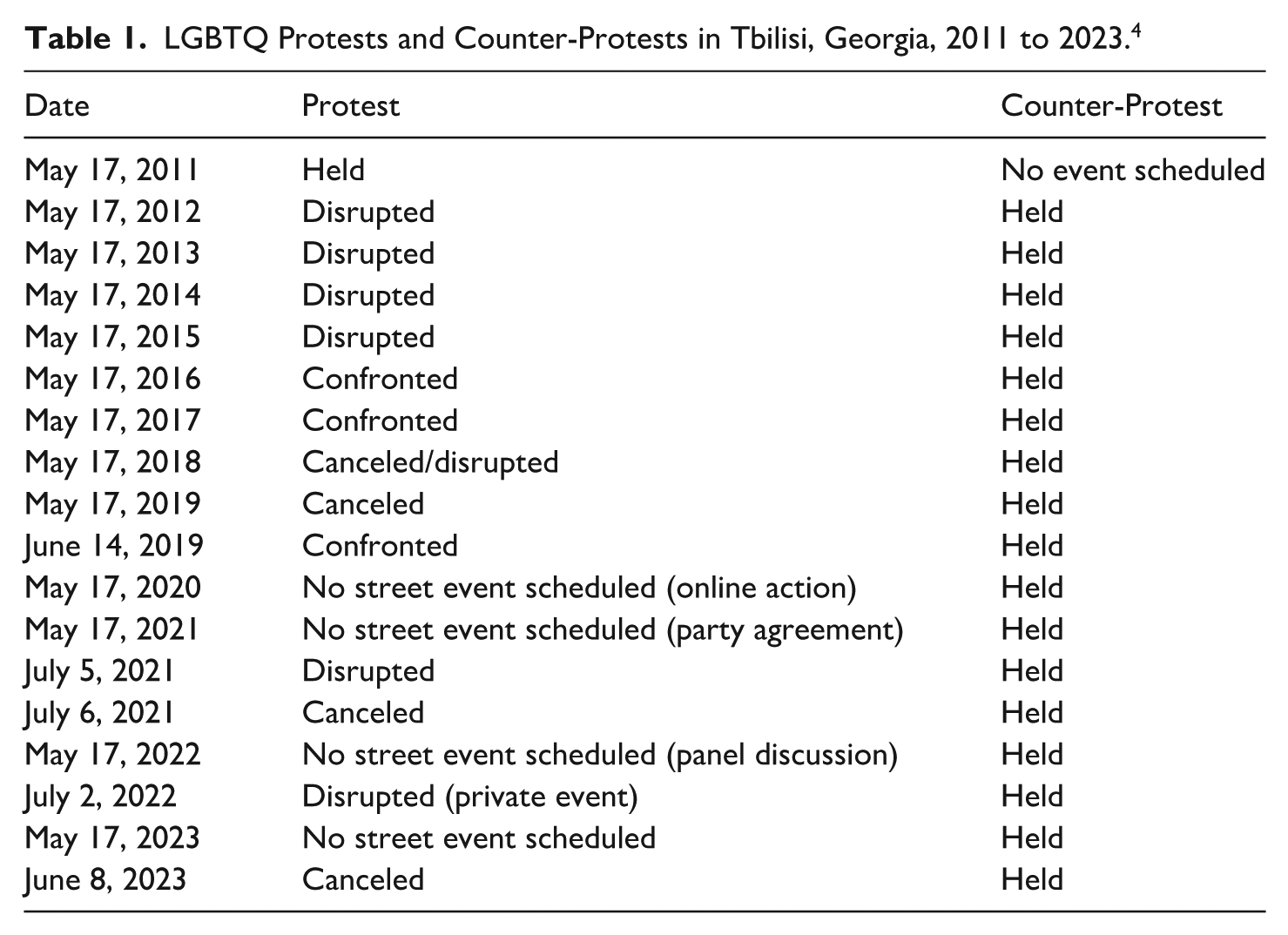
The Georgian Orthodox Church, deeply rooted in the country’s cultural and historical identity, holds a powerful position (Gegeshidze & Mirziashvili, 2021). Its open opposition to LGBTQ visibility has helped sustain negative public attitudes since independence (Fredriksen-Goldsen et al., 2021; Pew Research Center, 2016; Quinn, 2007; World Values Survey, 2022). These negative views, also reinforced by radical nationalist groups, enable swift counter-mobilizations that are often tolerated by the state. As a result, most LGBTQ events faced large counter-protests, with physically violent incidents occurring especially in 2012 and 2013 (see Table 1 and Appendix).
LGBTQ Protests and Counter-Protests in Tbilisi, Georgia, 2011 to 2023. 4
Research Design
The study employs a qualitative research approach to explore subjective experiences and narratives in the context of protest and counter-protest dynamics (della Porta, 2014; Hennink et al., 2020). A total of 66 in-depth interviews were conducted with individuals who had witnessed protests and counter-protests over several years, across three distinct periods: (a) 2011 to 2013 (20 interviews), (b) 2014 to 2018 (18 interviews), and (c) 2019 to 2023 (28 interviews). The three periods reflect key shifts in LGBTQ protest dynamics: initial visibility and backlash (2011–2013), legal recognition with ambiguous state support (2014–2018), and growing polarization and organized activism following Tbilisi Pride (2019–2023). In each period, participants were selected using purposive sampling based on their direct observation of protest and counter-protest interactions. Snowball sampling was used to recruit eligible respondents from various demographic backgrounds, age and gender groups to capture a broad spectrum of perspectives.
The in-depth interviews were conducted using the same semi-structured interview guide, which allowed for flexibility in exploring individual experiences while ensuring that attitudes on key topics were covered. The interview guide included questions designed to elicit detailed accounts of participants’ observations, emotional and cognitive reactions, and any shifts—or continuity—in opinion and underlying rationale. Each interview focused on a specific period but also invited reflection on earlier events, depending on timing. Since interviews covered both recent and distant events, potential memory biases—such as emotional recall, shifting perspectives, and temporal inaccuracies—were addressed (della Porta, 2014). To support chronological recall, participants were first asked to describe events from memory; a timeline of key developments from the relevant period was then introduced only when needed to help clarify or fill in gaps. Interviews were structured to elicit detailed responses and allow cross-checking through contextual discussion (Creswell, 2007; Gubrium & Holstein, 2009).
Interviews were audio-recorded with consent and transcribed verbatim. Using a narrative approach rooted in oral history, transcripts were analyzed to identify recurring themes in how respondents made sense of their experiences (Gubrium & Holstein, 2009). Analysis was conducted in MAXQDA 24.9.1 (VERBI GmbH, Berlin, Germany) (Kuckartz, 2014; Kuckartz & Radiker, 2019).
As a result, three narrative types were inductively identified by analyzing how respondents—across all time periods—made sense of and emotionally reacted to protest–counter-protest interactions. Each interview was first examined to trace whether and how attitudes toward protest shifted or remained stable. Interviews showing similar patterns were grouped into storylines, and these were then organized into three broader narratives (each consisting of two storylines; see Graph 1), based on shared emotional tone and interpretive trajectory. Rather than comparing attitudes by time period, the analysis focused on recurring cross-temporal patterns that emerged from the full dataset.

Attitude formation from initial position to changed position. This figure schematically illustrates three overarching narratives of attitudinal change and stability, each containing two storylines. The visual mapping shows how respondents’ initial positions toward the protest evolved into distinct interpretive and moral stances over time. Generated in MAXQDA 24.9.1.
Data: Three Narratives of Attitudinal Change and Stability
Graph 1 schematically presents three narratives, each comprising two storylines, to trace how respondents’ initial attitudes toward the protest evolved into distinct positions over time.
Narrative 1: From Protest Reluctance to Support/No Support
Narrative 1 focuses on respondents whose initial reluctance toward LGBTQ activism evolved into more defined positions—either supportive or oppositional—through their moral justification of the violence during protest–counter-protest interactions. In storyline 1.1, violence was the starting point; respondents judged it negatively and formed their positions accordingly. In contrast, in storyline 1.2, respondents started to view the events through the lens of “traditional” values and identity, which made the use of violence appear morally justifiable. Initially, respondents described LGBTQ street mobilizations as “unpleasant” and publicly uncomfortable, affirming equal rights in principle but questioning their visibility, which some labeled an “anomaly.”
I was thinking that. . . ok. . . I know that they are part of our society, but is it necessary for them to be so loud about their sexual preferences? It was something that I didn’t want for my kids, or even to imagine that it’s the norm and that people get to choose another type of family. So, let them be and do whatever they want—but is it necessary to organize public events? . . .It makes you think that maybe it’s ok to have the same lifestyle. But in general, I was kind of ok with them. . . I just wasn’t sure about this publicity. (Nino, age 45, interview, 2012)
Some respondents became more empathetic toward activists (1.1), while others reinforced their negative attitudes (1.2). In the first case (1.1), the respondents recalled specific events of protests and counter-protests confrontation. Counter-protest tactics were described as “shocking,” prompting empathy and a sense of urgency to protect the activists. It also created a fear that if at some point something was perceived as non-traditional or disagreed with by religious institutions, it could have been handled in the same way. For these respondents, eventually, the activists were victims, whereas, as they said, the government was not creating a safe space for them.
One thing I knew was that the activists were mobilizing to celebrate the International Day Against Homophobia. . . and at the same time, they were protesting LGBTQ discrimination and abuse. And as I said, I had mixed feelings about it. I did not like this publicity. But then the media broadcasted the counter-protest—people who were priests and religious figures in dark clothes, mostly men, with crosses in their hands and violent manners. . . oh my God. . . One of the priests was holding a chair, as if he was preparing to beat someone with it. I was shocked. (Kato, age 52, interview, 2016) I am not a religious person in the sense that. . . I don’t go to church regularly, but I believe in God and I believe in praying. I have my own way of practicing religion, and sometimes I go to church as well. So for me, what I saw in the behavior of the counter-protesters was more unacceptable than the mobilization, which physically did not cause any harm to anyone. Well, for me, violence is just not justifiable under any circumstances! (Lali, age 60, interview, 2014) We saw that there were police present to protect the activists. In the beginning, there was hope that everyone would express their positions safely and then go home. But the police could not handle the situation. This makes me feel unsafe and makes me think that the role of the police was just a façade. Even they could not resist—or maybe even did not want to resist—the violence of the counter-protesters. . . .In the name of God, they could be violent to me as well, if I disagree with some principles of their ideology. . . .So, we should protect minorities. (Giorgi, age 48, interview, 2018)
Visual elements—attire, symbols, and expressive behavior—shaped impressions of both groups. The aggressive stance of counter-protesters, beyond their language, contributed to a shift in sympathy.
In the second case (1.2), the 2012 and 2013 events served as key reference points, shaping respondents’ reactions, as they did in the subsequent narratives. Following the confrontations between protests and counter-protests, these respondents aligned themselves toward counter-protest people. However, based on their attitudes, this alignment was a bit contradictory and problematic. Many of them were condemning violence but at the same time were trying to justify counter-protests. While their anger was directed to the both sides, their sympathy was still aligned to the counter-protesters’ position.
Of course, I do not like violence or any expression of it, but at the same time, it can be understandable. When someone intrudes on your privacy and tries to instill something that is not acceptable, that can be a reason for defense—and sometimes these defensive mechanisms are radical. (Irakli, age 50, interview, 2013) I was angry with the activists, because what they do with this public expression is an invitation to confrontation. They knew that their actions would provoke a counter-protest and even rage among religious groups, but they still mobilized. So, isn’t it a provocation? . . .But at the same time, what the priests are doing is not nice, and it is not compatible with religion. They could have had a non-violent strategy for these counteractions. (Beso, age 40, interview, 2015)
This narrative showed how counter-protest violence acted as a catalyst for deeper reflection on social values, highlighting how respondents’ moral frameworks and emotions shaped their eventual stances toward LGBTQ activism.
Narrative 2: From Protest Support to More Support/Careful Position
Narrative 2 focuses on respondents who supported LGBTQ protests based on freedom of expression and overall democratic principles but responded differently to confrontation—some reinforced their support on principle, while others favored strategic restraint for the sake of safety. Unlike Narrative 1, which involves shifting values, this narrative centers on navigating dilemmas within existing democratic commitments.
In the first group, respondents clearly affirmed that everyone has the right to express their opinions and viewed it as a civic duty to defend those whose rights are under threat—especially when the government fails to intervene. Each confrontation deepened their indignation toward the counter-protesters, described as instilling fear and undermining public expression. Some suggested these “radical groups” should face legal consequences.
For these proponents of free speech, protest–counter-protest interactions only reinforced their convictions. They condemned the religious extremist factions behind the counter-protests. Many emphasized how the contrasting appearances of the two groups reflected their ideologies: activists were fewer, peaceful, and displayed LGBTQ flags and anti-discrimination posters, while counter-protesters—often clergy in dark clothing—acted aggressively. One respondent recalled seeing leaders wearing swastika symbols. Counter-protesters also significantly outnumbered the activists. Even without direct confrontation, some respondents said that the stark visual contrast between the groups—coexisting in the same space—made their stance even clearer.
I remember, I was coming back from work and I saw those two groups together, and for me the contrast was so stunning that I just knew that no matter what. . . I did not want to be part of this dark, archaic, and radical energy that was felt among the counter-protesters. On that occasion, too, the counter-protesters were all men. This was also something to think about. Meanwhile, the LGBTQ activists included men, women, youth—and they were very colorful. Just being there, nothing else. They were harmless. (Dato, age 50, interview, 2019) Well. . . you know, just imagine a silent movie, without any hint of verbal content. It would still be clear who was up to what. You could read the furiousness in their faces; they were shaking their fists as if someone had insulted or physically attacked them. They were in a mood for physical fight—even from the screen I could feel this tension and readiness to fight, as if they were at war. And then you see these activists—ordinary people who were just standing in the same space. . . (Nato, age 28, interview, 2021)
In the second group, respondents were also very strong about democratic development of the country and initially supported the protest activists both before and after confrontations. However, their stance became more skeptical following the confrontations, particularly regarding whether this was the appropriate method for LGBTQ activists to defend. They suggested that, since society might not yet be prepared to fully embrace such diversity, it could have been advantageous to temporarily refrain from public demonstrations and explore alternative tactics to prevent violence and further suffering.
Well, I am one of the supporters of the action participants, and I truly believe that if we want to be part of the civilized world, our fundamental right to free speech and expression—regardless of sexual orientation or any other characteristic—should be defended. But just not to escalate things, and just for their own sake, maybe it is better now not to be so outspoken. I was so distracted by the violent language and bodily expression that the counter-protesters used, that I was afraid someone would be harmed. And does it all even feel worth it? (Sandro, age 40, interview, 2021) When you see that the government does not provide safety, then you should compromise as a citizen for your own and others’ safety. These counter-protesters are impenetrable, incomprehensible. So, in this situation, what is the option? . . .I would say that you should refrain or change tactics. (Nino, age 36, interview, 2019)
Narrative 2 operating within the democratic principles reveals that exposure to confrontational dynamics forced respondents to navigate the limits of civic ideals in practice, highlighting the tension between defending rights and adapting to societal hostility.
Narrative 3: From Protest No Support to Support/No Support
Narrative 3 reveals a similar pattern of divergence as seen in Narratives 1, but with different starting points. The storylines illustrate a clearer divide between competing moral frameworks: human rights versus “traditional values.”
In the first group (3.1), respondents acknowledged that their initial disapproval was shaped by their social environment. Heterosexual relationships were seen as the unquestioned norm. Their understanding of the LGBTQ community was limited and largely shaped by religious teachings, which framed non-heterosexual orientations as sinful and a threat to Georgian identity and traditional gender roles. Confrontations between protesters and counter-protesters left them confused and prompted reflection on their prior assumptions. Initial emotional responses included disapproval, anger, and, for some, even rage toward the violent behavior of the counter-protesters.
It was completely unacceptable to use violence or to forcefully demand that someone be thrown off the street—or to stop someone from harmless actions. . . .And it’s even more unacceptable when you see that those who demand this are religious people. I had such a feeling of injustice . . . that it really made me think where I was, what I supported. . . .I was thinking that if I wanted to live in a civilized country, where you are safe in what you say or how you express yourself, and if you do not harm others, then being LGBTQ. . . you should have the right to protest or celebrate whatever you want in public space—like others can. The other thing is whether I like it or not; I may not like that lifestyle, but I believe that one should have freedom of expression, no matter what lifestyle you have. (Nato, age 31, interview, 2014) For me, at first it was a rational decision—that everyone should be equal under the law of expression. The counter-protesters, with their appearance and how they were dressed. . . all in dark, with Nazi regime symbols and posters reflecting hate, disgust, and homophobia. Allegedly, they were protecting traditional values and Georgian identity, but when I was looking at them, it was just bad. The way they talked or acted. . . they were not representing me. So, although emotionally I still did not have full acceptance of their lifestyle, rationally, I will defend their rights always. (Ketevan, age 32, interview, 2016)
As observed, respondents, in the process of contemplation, differentiated between rational and emotional acceptance. In both cases, respondents explained that witnessing two contrasting protests occurring simultaneously in the same space heightened the perceived differences between them. Moreover, these interactions prompted deeper reflection and analysis, ultimately shifting their focus toward “the fundamental value of human life and rights.”
In the second case (3.2), respondents stated that their perceptions had not changed—and in some cases, had even become stronger. They viewed LGBTQ street mobilizations as a form of “propaganda” aimed at raising awareness and portraying the community as victims to gain sympathy—a narrative they found unconvincing. Furthermore, they expressed little surprise at the reactions of religious individuals, including clergy. These respondents believed that, in the face of perceived threats to national identity, it was imperative to defend one’s country and family by any means necessary.
Georgian man is not like this. We must defend our family values. Man should be man, and a woman should be a woman. With this publicity, they are trying to diminish our Georgianness, and we won’t let them do it at any price. Throughout history, religion helped us to survive, so there is nothing surprising that our priests are here to defend us. (Nika, age 30, interview, 2020)
Among this group, some disapproved of the violent act from the counter-protesters, yet they were unequivocal in their stance that LGBTQ people were unacceptable. Some even explicitly blamed the LGBTQ community for inciting the violence in the counterprotest.
I remember I was not in Georgia at that time and when I was scrolling Facebook, it was full of videos and photos of this confrontation. At first, I was anxious about these violent photos where LGBTQ people were put into a yellow bus to make them safe but the contraction people surrounded it and were shaking the bus. At first, I did not like what I saw but then when I got all the information for me all that contraction rage was understandable and. . . (now) I am even more strongly convinced that they should not be allowed this public propaganda. They want to put their wrong ideas in our kids’ minds and this is also violence and we should be defensive. So, after each event I feel angrier about them. (Irakli, age 35, interview, 2015)
Overall, Narrative 3 also revealed that confrontations intensified moral conflict, leading some respondents to reflect on human rights, while others hardened their opposition, by framing the visible contrast between groups as a threat to “Georgian identity.”
Across all narratives, emotions such as anger, fear, and sympathy played a central role, as did the moral justification of violence. While the overarching framework of judgment—democratic values versus “traditional values”—remained similar, the starting points and the moral meanings attached to these emotions differed. Importantly, the moral justification of violence emerged as a key trigger for divergence, particularly in Narratives 1 and 3, where it led respondents toward either stronger support or firm opposition. In these cases, interpretive frameworks evolved along a visible axis of competing values. By contrast, Narrative 2 remained grounded in democratic imperatives, with divergence emerging not from shifting value systems but from varying emotional responses to risk, safety, and civic responsibility. This distinction helps explain how, despite similar interpretive frameworks, different starting points can lead to divergent feeling–thinking processes, shaped by moral and experiential grounding.
Conclusion
The research aimed to explore the emotional and cognitive aspects of individual narratives in shaping individual attitudes in response to protest–counter-protest interactions in Tbilisi, Georgia (2011–2023). The interaction between protests and counter-protests revealed three narratives that demonstrate patterns and trajectories shaped by democratic principles—such as freedom of expression and human rights—versus “traditional values” that justify or tolerate violence. Starting from different attitudinal positions, many converged on shared principles or values. What distinguished them was not the positions they affirmed, but the emotional and cognitive pathways they took to arrive there. These emotionally charged encounters prompted reassessments that laid the foundation for new perspectives on both protest groups and their values (Goodwin et al., 2001).
While the qualitative approach offered in-depth insights into individual experiences, its ability to generalize findings to the broader population is limited. However, the research aimed not to generalize findings but to uncover patterns of judgment formation and perceptions at the individual level. These findings lay the groundwork for future qualitative research to delve deeper into specific narratives, as well as for quantitative research to explore generalized public attitudes, thereby fostering a more holistic understanding of political behavior.
The findings highlight the role of “feeling-thinking processes” (Jasper, 2014) in the dynamics of social protests. Emotions and cognition are not separate domains; moral evaluations and practical judgments are deeply shaped by emotional experience. Far from being purely individual, emotions function as structural components of political engagement, shaping how people perceive and align with social movements (Haidt, 2001; Marcus et al., 2000). This framework offers an important complement to traditional models of social movement theory that emphasize issue framing (Snow & Benford, 1988), resource mobilization (McCarthy & Zald, 1977), or political opportunities (Tarrow, 1998; Tilly, 1978). This study advances social movement theory by integrating emotion-driven perception shifts into models of public alignment. It reveals how confrontational episodes—especially in polarized contexts—can provoke affective dissonance, leading to critical reflection and reassessment of prior positions (Crossley, 2003; Davenport, 2005). A central insight of this study is how the perceived extremity of protest or counter-protest tactics can recalibrate public judgment: when counter-protest is framed as excessively repressive or disproportionate, even radical protest claims may come to appear more legitimate by comparison. This emotional contrast sharpens our understanding of how support for movements is often shaped not by ideology or policy content, but by the affective framing of dissent (Verkuyten et al., 2022).
Finally, the Georgian case offers broader insight into protest under transitional conditions. It illustrates how emotional and moral judgment mechanisms operate in contexts marked by cultural traditionalism, democratic aspirations, and authoritarian tendencies. This demonstrates how “feeling-thinking processes,” shaped by the sociopolitical environment, can drive both personal transformation and macro-level shifts—even within traditional and religious contexts, and in settings where democratic institutions remain fragile.
Footnotes
Appendix
(Zhghenti Nino: The Impact of Protest and Counter-Protest Interactions on Public Opinion: Reactions to LGBTQ Rights Activism in Georgian Society)
Acknowledgements
This research benefited from the assistance of BA students, whose contributions to the data collection process are sincerely appreciated.

Funding
The author received no financial support for the research, authorship, and/or publication of this article.
Declaration of Conflicting Interests
The author declared no potential conflicts of interest with respect to the research, authorship, and/or publication of this article.