







Abstract
The effects of a single stroboscopic training session on anticipating tennis serve direction were explored. Intermediate tennis players in both the stroboscopic training (n = 16) and control (n = 16) conditions completed 40 pretest and 40 post-test service video clips, prompting them to indicate the serve trajectory direction. Identical on-court training was provided for both conditions after the pretest, in which each participant was asked to return 40 tennis serve shots. In the experimental condition, participants performed the task wearing stroboscopic glasses, whereas those in the control condition performed the task naturally, without any glasses. Response accuracy and reaction time (RT) were measured. Results revealed that stroboscopic training significantly improved response accuracy. However, there were no significant differences in RT between conditions. The present study indicates that a single training session can improve the anticipation of serve trajectory detection in tennis. Further research must examine the transfer to the natural environment and investigate anticipation in other types of tasks, such as during play in tennis and in other sports.
Introduction
Being able to “read the game” is a crucial component of skilled performance in sports (Mann et al., 2007). High-skill athletes maintain advanced perceptual-cognitive skills such as anticipation, situational assessment, and decision making (Basevitch et al., 2020; Ward et al., 2009; Williams et al., 1999). According to Tenenbaum’s (2003) decision-making model and information processing theory, the ability to gaze and attend to relevant cues in the environment is the initial process that dictates the accuracy and swiftness of a decision, and consequently, the final action. Furthermore, visual attention plays a central role in anticipating upcoming events, particularly under high-speed and uncertain conditions. As such, perceptual-visual skills are perceived as a key component in the decision-making process (Lebeau et al., 2016; Sáenz-Moncaleano et al., 2018; Savelsbergh et al., 2002; Williams & Ward, 2003).
Research in the area is divided into general visual capabilities (e.g., acuity, depth perception) and domain-specific visual attention (e.g., ability to attend and process relevant cues; Luck & Vogel, 1997). This distinction is important, as there is little support that general visual abilities are related to sport performance (Fransen, 2024; Memmert et al., 2009). However, domain-specific perceptual-visual processes, such as gaze behavior and pattern recognition, have been shown to be linked with sport performance (Basevitch et al., 2020; Sáenz-Moncaleano et al., 2018; Tenenbaum, 2003). Thus, the purpose of the current study was to examine the effect of training domain-specific perceptual-visual attention on anticipating the direction of tennis serves.
Different methods of domain-specific perceptual-visual training (i.e., temporal occlusion and stroboscopic training) help streamline and censor the type of environmental cues entering the selection process (Wilkins & Gray, 2015; Williams et al., 2002). These methods are designed to train an athlete in recognizing the relevant cues required for anticipating what will happen next. The temporal occlusion paradigm is one of the primary methods used to measure and train cue utilization and visual attention (Basevitch et al., 2020; Williams et al., 2002). For example, in a study by Abernethy et al. (1999), the researchers showed video clips of a squash play, occluded the play at different temporal points (e.g., 60 ms before ball contact, 80 ms before and after ball contact, and when the swing was completed), and asked the participant to anticipate the direction and distance of the ball. Results indicated that anticipation can be enhanced using the temporal occlusion paradigm as a training method. Enhancement of perceptual-cognitive skills via the occlusion method provides support for the ability of training visual attention skills. However, one of the major limitations of using video-based scenarios is the lack of ecological validity, potentially diminishing the advantage experts maintain over their less skilled opponents and limiting the transferability to real-world environments (Button et al., 2021; Mann et al., 2007; Raab et al., 2019).
Another method of perceptual-vision training used for enhancing anticipation skills is stroboscopic technology (Bennett et al., 2004; Mitroff et al., 2013; Wilkins & Gray, 2015). The implementation of stroboscopic technology in training limits the visual information available to athletes by means of only allowing intermittent glimpses of the environment; thus, forcing the athlete to focus on the most relevant environmental information (i.e., cues) to execute a certain task successfully (e.g., catch a football; Smith & Mitroff, 2012). Appelbaum et al. (2011) described stroboscopic training as a method aimed at utilizing limited information (i.e., stroboscopic effects) to make quicker and more accurate decisions. For instance, Smith and Mitroff (2012) found that stroboscopic training reduced errors in anticipatory timing and accuracy in a laboratory task (e.g., Bassin Anticipation Timer). However, the visual tests that were used as outcome measures lacked ecological validity and varied in training methodology.
In the present study, we used on-court training with stroboscopic glasses to examine the anticipation skills of intermediate tennis players. Specifically, we examined the effects of an acute stroboscopic training session in the natural environment (i.e., one-time administration—40 tennis serve returns on-court) on the anticipation of tennis serve direction using a domain-specific video-based assessment. A primary concern for vision training programs is ecological validity, as most studies have been conducted in the laboratory, and thus could not be generalized to the natural sport environment (Abernethy & Wood, 2001; Fransen, 2024). As such, in the current study, pre-recorded video clips of tennis serves were used to measure anticipated serve direction pre- and post-stroboscopic training. In addition, to increase ecological validity, participants were exposed to the stroboscopic training on the tennis court in the natural sport environment. We expected that stroboscopic training (i.e., returning tennis serves on the court while wearing the stroboscopic glasses) would result in faster and enhanced anticipation of service ball direction.
Method
Participants
Thirty-two intermediate club tennis players (75% male; Mage = 24.34, SD = 5.54) from a southeastern university in the United States participated in the study. Participants were randomly assigned to either the stroboscopic (n = 16) or control (n = 16) conditions. The sample included intermediate tennis players (M = 8.56 years, SD = 5.48 of competitive tennis experience) who regularly practiced tennis (M = 2.31 days/week, SD = .76). Inclusion criteria were: (a) playing competitive tennis in high school and/or at the university club (non-varsity) level, (b) currently playing on either a club team or on a weekly basis, (c) right handedness, and (d) not being prone to epileptic episodes or motion sickness.
Task
Forty video clips of anonymous tennis players, at the same level as the participants, serving from the returners’ perspective, were included in the study. The service shots were performed to both the ad and deuce sides of the court; the server and direction (i.e., ad or deuce) of the serve shots were randomized. The video clip ended when the server’s racket contacted the ball. The participants were asked to anticipate the direction of the ball trajectory (i.e., right or left side of the serving box) by clicking the F key (i.e., left side) or J key (i.e., right side) on a keyboard as quickly as possible. Accuracy and response time were measured using OpenSesame (OpenSesame; Amsterdam, The Netherlands), an open-source software that was used to prompt the tennis service video clips.
Training Conditions
Two training conditions were implemented in the present study. The experimental condition consisted of on-court training while using the stroboscopic glasses. Participants in the experimental group were asked to return forty serves in blocks of 10 shots, while the strobe glasses were active. Only one of the eight levels was employed for alternation rate (i.e., opaque and transparent); specifically, the fourth level (i.e., 100 ms opaque and 100 ms transparent; see Smith & Mitroff, 2012). In between each block, players were asked to lift the glasses above their eyes and rest for 1 min. Participants were notified that they could stop the practice at any time. Participants in the control condition went through the same training as their counterparts in the stroboscopic condition, including rest periods after each block of 10 serve shots, but were not exposed to the strobe activation.
Instrumentation
Tennis Service Video Clips
Tennis service video clips were filmed using a camcorder positioned approximately 130 cm inside the baseline and at a height of 150 cm. The video clips were taken from the perspective of a player returning a serve. The placement and angle of the camera were considered most ecological and representative of real game situations by two high-level tennis coaches. The two servers—one male and one female—in the video clips were intermediate-level players and at a similar level to the study’s participants. Eighty serve shots were recorded. Forty serve shots from the ad court and 40 from the deuce court. Each side (ad/deuce court) presented the receiver with 20 serves directed to the left side and 20 directed to the right side of the service box.
OpenSesame 3.0 (OpenSesame; Amsterdam, The Netherlands)
An open-source program builder that was used to prompt the tennis service video clips, and to record the participants’ response accuracy and reaction time (RT). The participants were instructed to click the F key if they anticipated that the ball would travel to the left side of the service box, and the J key if they predicted that the ball would travel to the right side of the service box. RT was measured in milliseconds.
Stroboscopic Glasses (Nike Vapor Strobe; Beaverton, OR, USA)
The glasses provide a stroboscopic environment by means of liquid crystal lenses that continually transition from transparent to opaque. When the lenses are transparent, the participant can clearly view the environment. Conversely, when the lenses are opaque, the participant’s view is occluded. There are eight levels of occlusion, ranging from 25 to 900 ms, in which the lenses are opaque. The shorter the time the lenses are opaque (e.g., level one at 25 ms), the more a participant can see, and vice versa. Similar to Smith and Mitroff (2012), only one level was used for stroboscopic training (i.e., level four at 100 ms).
Procedure
Participation in the study was voluntary and commenced when arriving at the training site, after which participants signed the approved informed consent form. Once the consent was read, signed, and returned, participants were asked to complete a brief demographic questionnaire. After the inclusion criteria had been verified, the researcher explained the task, and the study commenced.
Each participant first completed the pretest. The pretest consisted of the players indicating whether a previously recorded serve (projected on a 32” TV screen) would land on the left side or right side of the service box; concurrently, the OpenSesame software recorded the player’s RT. Each participant individually went through 10 practice trials before the 40 pretest video clips commenced. The participants were given a maximal allotted time of 6 s to respond after the ball contacted the racket. A new video clip commenced immediately after their response was recorded. At the end of the pretest, the player was asked to proceed to the tennis court and was fitted with the stroboscopic glasses if selected for the stroboscopic condition. To ensure the safety of the players, the researcher allowed time for them to familiarize themselves with the sensation of being put in a stroboscopic environment (e.g., ball tossing and walking around). Once safety was ensured, the players were asked to return 40 serve shots in blocks of 10 with 1-min rest periods in between each block. Those in the control condition were also asked to return 40 serve shots; however, they did not wear the stroboscopic glasses.
Upon completion of the on-court task, each player was asked to exit the court and take a post-test. The post-test consisted of video clips of 10 practice trials and another set of 40 serve shots. Accuracy and RT were once again recorded. At the completion of the post-test, the player was debriefed, and questions were answered.
Statistical Analyses
Statistical Package for the Social Sciences (SPSS) 23 (Armonk, NY, USA) was used to analyze the data. An Analysis of Variance (ANOVA) was performed to assess baseline differences between groups. Mixed Repeated Measure (RM) ANOVA was used for performance scores (i.e., RT and accuracy) using time (pre- and post-intervention) as the two levels of within RM, and two conditions (stroboscopic and control) as between-subject factors. In addition, a one-sample t-test was performed on accuracy to determine differences from a chance guessing rate of 50%. An alpha value of .05 was set for all statistical tests. Furthermore, effect size, Cohen’s d, was reported where appropriate.
Results
Ball Direction Accuracy
The one-way ANOVA performed on response accuracy at the outset of the study revealed non-significant difference between the two conditions (Strobe: M = 55.16%, SD = 12.23%; Control: 56.09%, SD = 8.27%), F(1, 30) = .065, p = .80. Accuracy was not significantly above chance at pretesting for the stroboscopic group (M = 55.16%, SD = 12.23%, t[15] = 1.69, p = .11) but was found to be significantly above chance for the control group (M = 56.09%, SD = 8.27%, t[15] = 2.95, p < .05). The follow-up RM ANOVA performed on response accuracy revealed a significant time by condition interaction effect, F(1, 30) = 6.02, p < .05, η p 2 = .16, d = .66, and a significant main effect for time, F(1, 30) = 6.651, p < .05, η p 2 = .18, d = .70. Descriptively, players’ anticipatory direction accuracy in the stroboscopic condition increased more from pre- to post-tests than in players in the control condition (Strobe: M = 55.16%, SD = 12.23% to M = 61.41%, SD = 11.97%, d = .52 vs. Control: M = 56.09%, SD = 8.27% to M = 56.25%, SD = 10.33%, d = .02). Both the stroboscopic and control condition post-test scores were significantly above chance (Strobe: M = 61.41%, SD = 11.97%, t[15] = 3.81, p < .05; Control: M = 56.25%, SD = 10.33%, t[15] = 2.42, p < .05). The time by experimental condition effect is presented in Figure 1. The main effect for condition was non-significant, F(1, 30) = .340, p = .564, η p 2 = .011, d = .087.
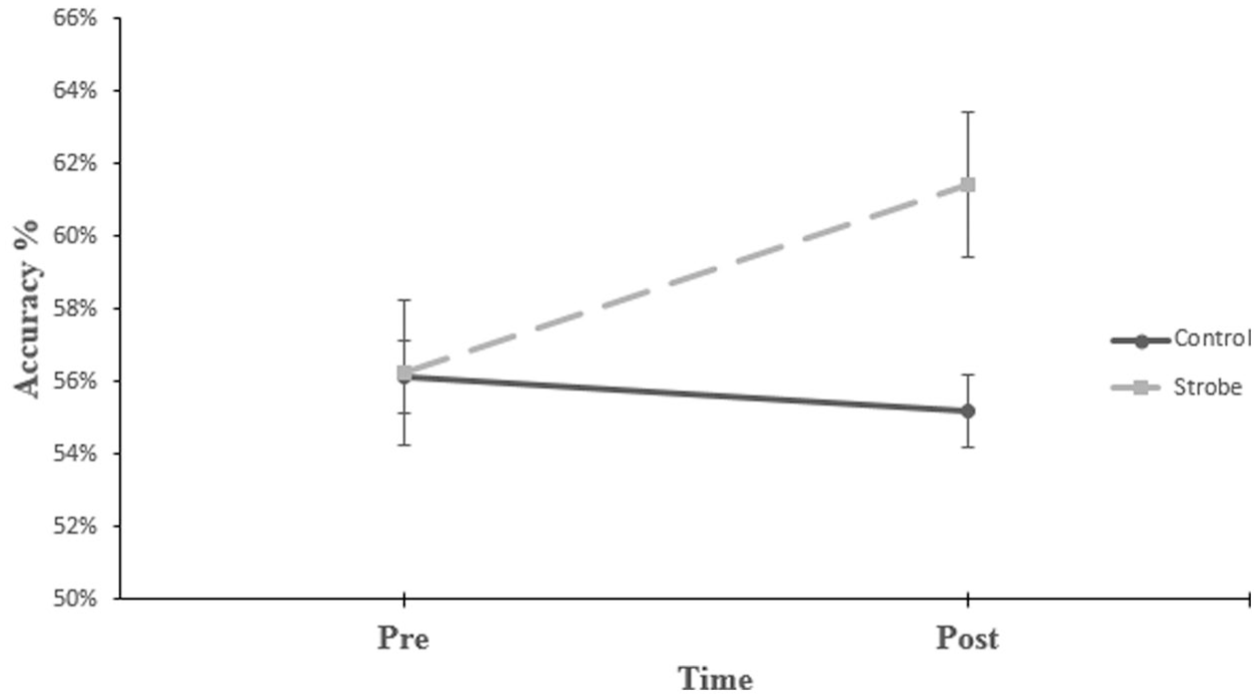
Mean (SE) for accuracy pre- and post-test scores (%) in the stroboscopic and control conditions.
Reaction Time
The one-way ANOVA performed on RT at the outset revealed a non-significant condition effect (Strobe: M = 341.09 ms, SD = 258.93 ms vs. Control: M = 272.97 ms, SD = 276.83 ms), F(1, 30) = .517, p = .48). The mixed RM ANOVA performed on RT revealed non-significant effects for time, F(1, 30) = .226, p = .638, η p 2 = .007, d = .075, condition, F(1, 30) = .038, p = .847, η p 2 = .001, d = .054, and time by condition interaction, F(1, 30) = 2.80, p < .105, η p 2 = .085, d = .367. Descriptively (see Figure 2), RTs became faster following the stroboscopic condition (M = 341.09 ms, SD = 258.93 ms to M = 305.16 ms, SD = 278.76 ms, d = .13) and slower under the control condition (M = 272.97 ms, SD = 276.83 ms, to M = 337.43 ms, SD = 282.87 ms, d = .23).
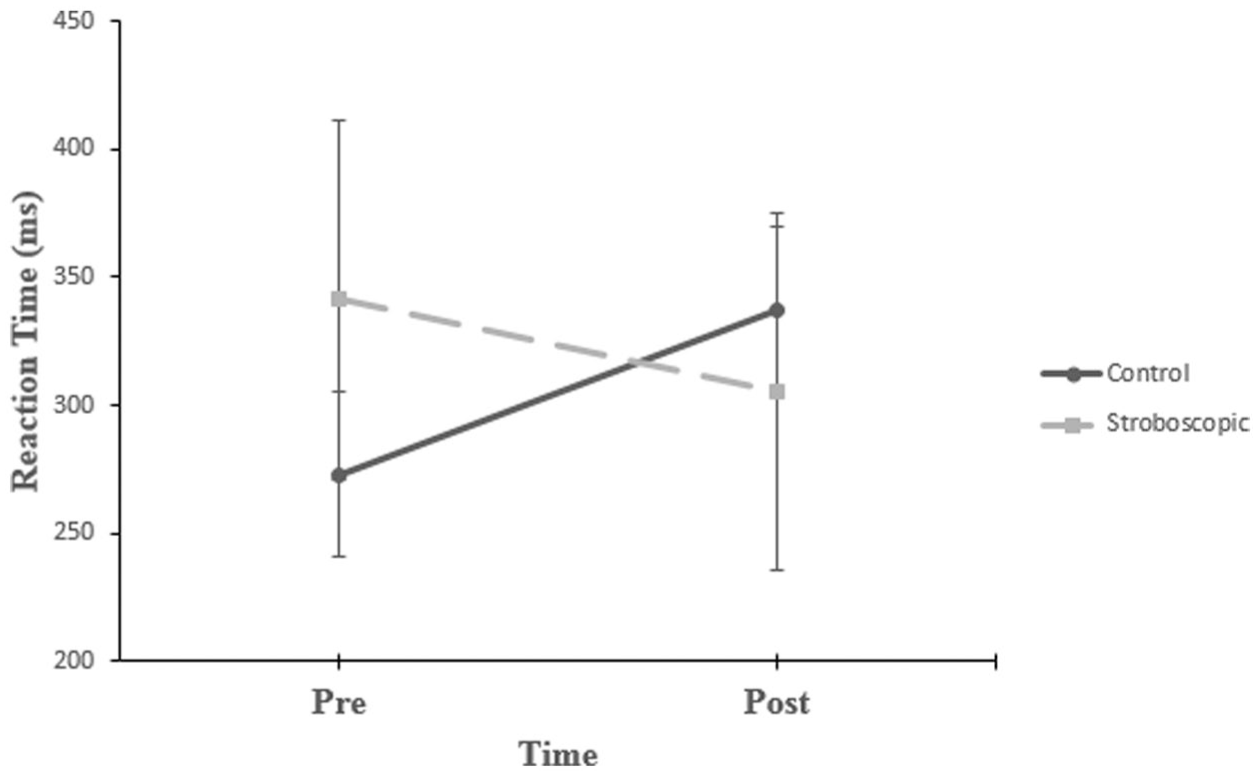
Pre- and post-test RT means (SE) in the stroboscopic and control conditions.
Discussion
The primary aim of the present study was to examine the effects of acute stroboscopic training on the anticipation of the tennis serve ball trajectory direction. Training under stroboscopic conditions forces athletes to anticipate based on the limited environmental information provided (Jothi et al., 2025; Wilkins & Applebaum, 2020). Thus, athletes are then able to pick up cues more efficiently, leading to improved visual attention, RT, and anticipation (Appelbaum et al., 2011). Indeed, Smith and Mitroff (2012) showed that stroboscopic training reduced errors in anticipatory timing and accuracy in a laboratory task (e.g., Bassin Anticipation Timer). Thus, we hypothesized that following a short stroboscopic training, both response accuracy and RT would improve compared to a control condition where stroboscopic glasses were not used.
Anticipation Accuracy
Similar to previous research findings, our results revealed a significant improvement in response accuracy (i.e., higher accuracy percent in the post-test than in the pretest) for players using the stroboscopic glasses (Jothi et al., 2025; Smith & Mitroff, 2012). Thus, surmising that after only one training session with the stroboscopic glasses, players are better able to anticipate the direction of a tennis serve. To compose a more ecological methodology, we utilized on-court training (i.e., physically returning serves on the tennis court) rather than laboratory training using ball tossing and/or general visual acuity tasks (Appelbaum et al., 2012; Fransen, 2024; Smith & Mitroff, 2012), thus making the training more task-specific. Moreover, the performance outcome measures that were used to determine response accuracy and RT were more representative of the training and actual tennis gameplay. Further research is needed to examine the long-term effects of stroboscopic training, as the current study only examined immediate effects (Hülsdünker et al., 2021). In addition, it is necessary to also examine the actual serve return to explore transfer to the natural environment (Fransen, 2024). Importantly, participants in this study were intermediate tennis players. In addition, their pretest anticipation accuracy scores were barely above or not significantly above chance. Thus, the effect observed may primarily reflect novice-to-competent skill acquisition rather than the enhancement of advanced expert anticipation skills. Hence, research examining higher-level players is needed to rigorously examine whether similar acute effects occur where perceptual cues are already highly refined.
Anticipation RT
Unlike previous findings, there were non-significant differences in pre- and post-test RTs between players in the two conditions (Luo et al., 2025; Smith & Mitroff, 2012); however, there were interesting descriptive trends. For instance, players exhibited faster RT after stroboscopic training, whereas those in the control condition had slower RT to some extent. Nevertheless, longer exposure to such training is required to substantiate this conclusion (Hülsdünker et al., 2021). In addition, similar to anticipation accuracy, examining serve return performance in the natural environment (e.g., on court) post-training might reveal more significant results and indicate transfer to the real-world environment (Fransen, 2024). It is also important to examine differences between training accuracy and speed of anticipation, as the underlying mechanisms and processes could be different (Kuan et al., 2018; Van Ede et al., 2012) or there might have been a speed-accuracy trade-off (Donkin et al., 2014). Thus, future research is needed to examine differences in speed and quality of improvement in anticipatory skills following similar perceptual-cognitive interventions and training. In addition, to determine the true nature of the underlying mechanisms, longer interventions are needed, coupled with longitudinal study designs.
Conclusion and Limitations
The present study examined the effects of a single stroboscopic training session on a sport-related task. Significant effects were found in response accuracy; however, there were no significant differences in RT. Further training in a stroboscopic environment may reduce anticipatory RT, a trend shown herein, and can be applied to novice and expert players. Longer training protocols must be used to determine the long-term effects of stroboscopic training in players varying in skill level and age. In addition, training anticipation during play, in addition to set-plays such as serves, must be explored. In this study, we used a fixed stroboscopic level of 100 ms opaque and 100 ms transparent. This was based on previous studies such as the study by Smith and Mitroff (2012). However, it is plausible that there are more effective stroboscopic protocols in general and protocols that could be geared to individual athletes based on specific parameters such as style and level of play. Thus, future research should compare various protocols across diverse populations to understand the relationship between the stroboscopic level and anticipatory effects. Finally, to examine transfer to the natural sport environment, performance outcomes must be measured on court or in alternative immersive environments. For instance, advancements in current technology provide researchers with a platform to train an athlete in a more engaging and ecological environment (e.g., virtual reality) and physically swing the racket to respond to a video prompt, rather than pressing keys on a keyboard. The main implications of the study’s findings are that acute stroboscopic training is effective in improving video-based responses. Furthermore, stroboscopic training has the potential to be used in improving return of serves in tennis on court, but more research in ecological settings is needed. Stroboscopic glasses are a simple and easy tool for athletes to implement in their training regimen and are relatively inexpensive; thus, they could be geared to athletes of all levels and ages.
Footnotes
Funding
The authors received no financial support for the research, authorship, and/or publication of this article.
Declaration of Conflicting Interests
The authors declared no potential conflicts of interest with respect to the research, authorship, and/or publication of this article.