







Abstract
The 2024 presidential campaign marked an unprecedented time in American politics. The race began with the sitting president, whose son was recently convicted of illegally purchasing a firearm, and a former president, who had been convicted on charges of falsifying business records. Though both legal situations could have been damning for their campaigns, many people felt that the convictions were politically motivated. More specifically, many partisans felt that the charges related to their party’s candidate were politically motivated. The present study examines the influence of partisan motivated reasoning in this unprecedented situation, utilizing the theoretical framework of identity-motivated elaboration to better understand how individuals process information about the convictions of political figures. The findings reveal that partisans spent greater cognitive energy defending the in-party candidate than the candidate from the competing party. Likewise, they engaged in more negatively valenced elaboration against the outparty candidate. Moreover, this identity motivated elaboration biased the attitudinal formation process and influenced perceptions that the legal process was being used as a political weapon. This study highlights the crucial role of identity congruence in shaping perceptions of conviction, influencing both direct and indirect cognitive responses.
Keywords
Introduction
The 2024 presidential election was a historically significant moment in the United States, characterized by extreme polarization and unique legal challenges faced by both major candidates. This election was unprecedented, as both original candidates were embroiled in federal criminal controversies. On one side, presidential nominee Donald Trump, who was running for a second, nonconsecutive term, was the only ex-president that had been convicted on felony charges (Sisak et al., 2024). A jury found Trump guilty of 34 counts of falsifying business records in May 2024 (Reardon, 2023). Prosecutors claimed that prior to the 2016 election, Trump directed his lawyer, Michael Cohen, to pay $130,000 in hush money to adult film star Stormy Daniels to prevent her from disclosing allegations of a sexual encounter (Epstein, 2025). While this payment itself was not illegal, the reimbursement to Cohen was improperly recorded as legal expenses to conceal its actual purpose.
The convictions brought greater uncertainty to the election. In what polls predicted to be a close election (Rakich, 2024), any effect on candidate support could be pivotal. Though many Trump supporters dismissed the verdict as politically motivated, political journalists speculated that Trump would lose a great number of supporters over the convictions, which could cost him the election (Bennett, 2024; Brooks, 2024; Davies, 2024; Durkee, 2024). The potential downfall of the Republican candidate sparked optimism among Democrats, as the convictions, many argued, highlighted Trump’s lack of character and questioned his fitness for office (Swenson, 2024). Following the convictions, polls began shifting toward Biden (Rakich, 2024).
On the other side, sitting President Joe Biden’s name also appeared in headlines due to a legal scandal involving his son, Hunter Biden. In June 2024, a federal jury found Hunter Biden guilty on three felony charges related to falsifying information on a mandatory gun-purchase form, becoming the first child of a sitting president convicted on felony charges (Chase et al., 2024). Although the conviction of a family member of a politician is distinct from the conviction of a politician themselves, Joe Biden’s personal character was called into question in relation to his son’s legal situation. The convictions, alongside bribery allegations emerging from texts and emails found on Hunter Biden’s laptop that allegedly referred to his father as “the Big Guy” (Cawthorne, 2023), led to questions of Joe Biden’s reputation, morals, and family values (Viser & Abutaleb, 2024). The polls reflected these doubts and balanced the ground lost by Trump following his convictions (Emerson College Polling, 2024). Though President Biden urged the country to respect the decision of the jury, many Democrats cried that the decision was politically motivated (Barrow, 2024), echoing Republican’s claims over Trump’s convictions.
This extraordinary context not only added layers of complexity to an already contentious electoral process but also influenced voter perceptions and decisions in multifaceted ways. Although the legal troubles of both candidates may have been pivotal in shaping electoral outcomes, public reactions were not uniform. Chase et al. (2024) indicated that individuals across the political spectrum often interpreted these convictions as politically motivated, reflecting the profound influence of partisanship on public opinion. For instance, supporters of the Democrat Party were more likely to view Hunter Biden’s felony convictions as politically driven, while they may have considered Trump’s convictions as a fair and legitimate legal judgment devoid of political bias. The current study investigates a partisan-motivated reasoning theoretical explanation for this phenomenon, where partisans believe the convictions of their partisan group member, but not those of the opposing party, are politically motivated.
Investigating how partisans process political information about their political ingroup and outgroup, the current study posits that this divergence in perception may be attributable to motivated reasoning (Kunda, 1990), a cognitive process through which individuals preferentially process information in a manner that aligns with their preexisting beliefs, thereby minimizing discomfort from conflicting information. While it is evident that political issues can be interpreted differently based on individuals’ political affiliations and attitudes to alleviate discomfort and reinforcing existing beliefs (Bolsen et al., 2014; Weeks & Garrett, 2014), the specific cognitive mechanisms and information processing pathways that lead individuals to their subjective conclusions remain less understood. Partisanship, an unmistaken driver of political attitudes, can operate as a heuristic (Lau & Redlawsk, 2001) or motivator of greater, though biased, elaboration (Jennings et al., 2020). The present study seeks to better understand the elaborative mechanisms of partisanship’s influence, proposing that persuasion occurs through both the central (H4) and peripheral (H5) routes simultaneously. In doing so, the study tests and develops theory by examining a current political issue.
Building on the theories of motivated reasoning (Kunda, 1990) and identity-motivated reasoning (Jennings, 2019), the following section proposes and justifies the elaborative process through which partisan identities influence the way that individuals process political information. The unique political context affords an opportunity to understand how partisans demonstrate motivated reasoning when the information is about the prototypical leader (i.e., Trump) and test if the motivated reasoning extends beyond the leader to other group members associated with the prototypical leader (i.e., H. Biden). The research design and the results are presented in the subsequent sections before concluding with a discussion of implications. The study aims to capture an important and unique moment in American political history to understand how people process political information and to develop prominent theories used in political communication research.
Identity Motivated Elaboration in Information Processing
Partisanship and Valenced Elaboration
Partisan identity can influence how supporters of different political parties perceive and accept the convictions. According to Social Identity Theory (Tajfel & Turner, 1979), individuals tend to define themselves as group members as well as independent individuals. Once a group identity becomes important, members start categorizing themselves and others, highlighting their group’s distinct characteristics compared to other groups. Since social identities are central to an individual’s self-concept, people are motivated to uphold and enhance their group’s positive distinctiveness and defend its status (Huddy, 2001). As a result, individuals tend to view new issues, events, and individuals through a biased perspective that favors their group over others, in order to protect or boost their social self-esteem (Abrams & Hogg, 1988; Tajfel & Turner, 1986). Given these motivational aspects, partisan identity plays a key role in understanding, processing, and responding to new information in a way that ensures the interpretation is beneficial and favorable to one’s own group.
In addition to social identity theory, motivated reasoning theory documents how partisan identity influences information processing. Motivated reasoning theory posits that individuals are driven by two key objectives during the opinion formation process: the accuracy goal, which is the desire to arrive at the correct conclusion, and the directional goal, which is the intention to reach a conclusion that resonates with one’s personal preferences and offers a sense of validation (Kunda, 1990; Taber & Lodge, 2006). When individuals possess strong political party affiliations, they tend to prioritize the directional goal, focusing on reinforcing their pre-existing beliefs and supporting their party’s perspective. As a result, they often overlook or dismiss contradictory information, irrespective of its objective accuracy (Bolsen et al., 2014; Druckman et al., 2013). Consequently, information that aligns with their attitudes and supports their in-party perspective is perceived as more convincing and favorable.
Through this biased information processing influenced by party identity, partisan identity also plays a significant role in emotional information processing, giving rise to what is known as identity-motivated valenced elaboration (Jennings, 2019). Valenced elaboration refers to the inclination of individuals to engage in either positive or negative cognitive processing (O’Keefe, 2012). Building on this concept, identity-motivated valenced elaboration describes that individuals with strong partisan identities are inclined to participate in positively valenced elaboration when they encounter information that aligns with their party, as such information is perceived as more favorable and reinforces their pre-existing beliefs. Conversely, negatively valenced elaboration occurs when individuals are confronted with information that challenges their existing beliefs, often resulting in resistance to counter-attitudinal messages (Malone, 1998). Therefore, both cognitive and emotional elaboration regarding political messages can be shaped by an individual’s partisan identity. This, in turn, leads to more identity-congruent elaboration (Jennings, 2019; Petty & Cacioppo, 1986) and influences biased information processing by differentially affecting emotional perceptions of in-group and outgroup members.
Jennings and Warner (2025) found that the framing of an op-ed article on the movie, Vice, either as an attack on Dick Cheney and Republicans or on Democrats, changed the way partisans processed the argument; people elaborated on the information with an identity-congruent bias. In the context of the 2024 presidential election, Republicans may display greater positively valenced elaboration regarding Trump’s conviction. On the other hand, they are likely to engage in negatively valenced elaboration toward Hunter Biden’s conviction. In light of this, we anticipate the following:
Valenced Elaboration and Political Attitudes
Biased cognitions regarding specific political figures and issues can create further biases in perception and judgment. Positively valenced elaboration fosters positive sentiment towards specific information, enabling individuals to interpret it in a favorable light (Petty et al., 1993). This effect occurs because positively valenced elaboration originates from the reception of pro-attitudinal messages (O’Keefe, 2013). Specifically, when individuals encounter information that aligns with their pre-existing attitudes, it evokes positive emotions, thereby facilitating a more favorable interpretation of the presented information. This process not only enhances receptiveness to the information but also promotes active support for it, thereby reinforcing existing beliefs and positions. On the other hand, when individuals engage in elaboration driven by negative sentiments toward specific information, particularly when it is counter-attitudinal, they tend to develop consistently negative interpretations of that information. This form of elaboration restricts cognitive flexibility and reduces openness to new persuasive information, making individuals less receptive to alternative viewpoints and evidence that may contradict their pre-existing biases (Bless et al., 1996).
These dynamics imply that positively valenced elaboration about Donald Trump and Hunter Biden can heighten perceptions of politicalization surrounding a conviction, particularly when individuals are politically motivated and biased. For instance, when individuals view Donald Trump’s legal challenges favorably, positive elaboration may lead them to perceive these convictions as politically motivated while bolstering support for his position. In contrast, individuals who harbor negative sentiments toward Trump and Hunter Biden or the convictions itself may experience negatively valenced elaboration that diminishes perceptions of politicalization, as they become less likely to frame the situation within a political context and more likely to reduce bias against the judicial system. Given these dynamics, we hypothesize as follows:
Partisan identity plays a significant role in influencing how individuals interpret political events, with valenced elaboration serving as a critical mechanism that mediates this influence. When individuals identify with a politician along partisan lines, this connection facilitates a biased process of valenced elaboration (Jennings, 2019). These emotional biases can lead to skewed evaluations of the politician, as partisans tend to engage in increased positively valenced elaboration while exhibiting reduced negatively valenced elaboration regarding their preferred candidate (Jennings et al., 2020). Such cognitive strategies not only help partisan supporters mitigate cognitive dissonance but also serve to reinforce and polarize their political attitudes (Jennings, 2019).
This information processing may be amplified when individuals encounter salient issues, resulting in a greater allocation of cognitive effort toward comprehending these topics. During the 2024 presidential campaign, the convictions of Donald Trump and Hunter Biden emerged as particularly salient issues that significantly influenced voters’ responses to presidential candidates and their voting behavior. These matters attracted substantial media coverage and sparked extensive public discussion. Such high-profile cases engage the interest of many individuals, particularly those who are politically active. Partisans, in particular, are motivated to understand the implications of these events for their party’s success.
This salience prompts deep cognitive elaboration as individuals strive to navigate the complexities inherent in these issues (Petty et al., 1981). The likelihood of partisans engaging more heavily in the central route to information processing increases, which is further associated with heightened cognitive elaboration (Petty & Cacioppo, 1986). Additionally, personal involvement with an issue typically results in greater elaboration (Chaiken, 1980).
As a result, exposure to this salient issue likely fosters high levels of cognitive elaboration among partisans. This elaboration allows individuals to interpret the information surrounding the convictions through either a positive or negative lens, subsequently forming their attitudes and opinions. That is, this process of valenced elaboration enables partisans to navigate their perspectives on the convictions. Consequently, a congruent partisan identity is expected to positively predict perceived politicalization of the convictions indirectly, as partisans engage in both positively and negatively valenced elaboration when interpreting information about the issue. Taken together, we propose the following hypothesis:
Partisan-Motivated Reasoning and Politicalization of the Convictions
While issue salience encourages cognitive elaboration and central route processing, partisanship can act as a peripheral cue, influencing political decision-making through mental shortcuts (Bullock, 2011). According to partisan-motivated reasoning, individuals tend to accept information that confirms their existing beliefs with minimal scrutiny to protect their partisan identity (Bolsen et al., 2014; Kunda, 1990; Taber & Lodge, 2006). This reliance on cognitive heuristics can hinder critical analysis and reduce elaboration on political arguments (Jennings, 2019; Lau & Redlawsk, 2001). As individuals prioritize alignment with their party’s views, those with stronger congruent partisan identities are more likely to directly perceive politicalization in convictions that support their party’s interests. Therefore, we hypothesize that congruent partisan identity strength will have a direct effect on the perceived politicalization of the conviction.
Method
Participants and Procedure
To test the hypotheses an online study was conducted on 231 students in communication and political science courses at a large Southern university. The sample (Mage = 21.86; SD = 2.95) consisted of 117 women (50.6%) and 112 men (48.5%), with two (.9%) participants identifying as gender non-binary. When asked to indicate all races/ethnicities in which they identify, 36 (15.6%) identified as African American/Black, 7 (3.0%) as Asian, 24 (10.4%) as Hispanic, 24 (10.4%) as Native American/Alaskan Native, 4 (1.7%) as Native Hawaiian/Pacific Islander, and 171 (74.0%) as White/Caucasian. Politically, 6.9% (n = 16) were strong Democrats, 18.6% (n = 43) were moderate Democrats, 13.0% (n = 30) leaned Democrat, 9.1% (n = 21) did not express a preference for either party, 19.0% (n = 44) leaned Republican, 25.5% (n = 59) were moderate Republicans, and 7.8% (n = 18) were strong Republicans.
After completing a demographic pretest, participants were shown either a brief article about Trump’s falsifying business records convictions or Hunter Biden’s illegal purchase of a firearm convictions. Though one stimulus is about the candidate (Trump) and the other is about a family member (H. Biden) that only has an indirect effect on the candidate’s reputation, there is great value in having one article from each partisan social group. Following exposure to the article, participants completed a post-test regarding their thoughts on the issue. Each article was three paragraphs and 219 words long; the tone of the article was informative and as objective as possible (see Appendix A). Following, they were presented with the article on Trump or H. Biden that they had not yet read. In the end, each participant read both articles and completed a second post-test. Order was randomized, so that half received the Trump article first and half received the H. Biden article first.
Measures
Partisan Social Identity and Strength of Identity
Similar to previous studies on identity-motivated elaboration (Jennings et al., 2020), a 7-point, Likert-type scale was used to measure partisan identity. Participants were asked, “To what extent do you consider yourself a Democrat or Republican?” Participants who responded strong Democrat (1), Democrat (2), or Lean Democrat (3) were categorized as having a Democrat social identity, while those responding strong Republican (7), Republican (6), or Lean Republican (5) were categorized as having a Republican social identity. Those who indicated that they had no preference between parties (4) were asked a follow-up question (i.e., “I know you don’t have a preference between the two parties, but say you had to vote for a generic candidate from one of the two. In this case, who would you be more likely to vote for?”) and sorted accordingly. In the end, there were 132 with a Republican social identity (57.1%) and 99 with a Democrat social identity (42.9%).
The same scale was used to measure the strength of the partisan identity. The scale was folded, so that respondents who responded strong Democrat or strong Republican were coded as Strong Partisan (4). Partisans (3) were those that identified as Democrat or Republican. Those that leaned toward one party were categorized as Weak Partisans (2) and those that did not identify with either party were categorized as Unaffiliated (1). M = 2.42; SD = .86.
Valenced Elaboration
Consistent with previous studies (Krosnick & Petty, 1995; LaMarre & Walther, 2013) that have used thought listing as a measure of elaboration, positively and negatively valenced elaboration were each measured with a single writing prompt (Jennings, 2019). With regard to Trump, participants were asked to summarize why a person may believe that people should not vote for Trump because of the convictions (Trump Negative Elaboration; M = 24.44; SD = 19.89) or why the convictions should not affect voting decisions (Trump Positive Elaboration; M = 27.11; SD = 19.49). Regarding Hunter Biden, participants were asked to summarize why a person might believe that his convictions speak negatively (H. Biden Negative Elaboration; M = 34.27; SD = 31.00) of his father, Joe Biden, or should not affect perceptions (H. Biden Positive Elaboration; M = 24.61; SD = 24.86).
Politicization of Convictions
The degree that the convictions were perceived to be politically motivated was a 6-item scale: (e.g., “Trump [Biden] was targeted because of hi [his father’s] politics”; “These convictions were politically motivated”; and “I question the legitimacy of the court proceedings”). Participants responded on a seven-point, Likert-type scale ranging from 1 (strongly disagree) to (strongly agree). Trump: M = 3.96; SD = 1.64; α = .94; H. Biden: M = 3.35; SD = 1.24; α = .87.
Results
The first hypothesis predicted that in-party members would engage in greater positively valenced elaboration about the convictions of Donald Trump/Hunter Biden and less negatively valenced elaboration than competing outparty members or those not identifying with either party. To examine this hypothesis, four Analysis of Variance (ANOVAs) were conducted, two for Trump (partisan prototypical leader) and two for Biden (partisan group member) with partisanship (Republican, Democrat, or non-affiliated) as the group variable and (a) positively valenced elaboration (H1a) and (b) negatively valenced elaboration (H1b) as dependent variables.
First, we present the results for the partisan prototypical leader, Donald Trump. Analysis of H1a revealed that there were significant group differences for both positively (F[228] = 4.63, p < .05) and negatively valenced elaboration (F[228] = 30.48, p < .001). LSD post hoc analysis revealed that, consistent with the hypothesis, Republican in-party members (M = 31.03; SD = 13.48) engage in greater positively valenced elaboration about Trump than Democrat competing outparty members (M = 21.02; SD = 21.49; p < .01). However, the difference between Republicans and those not affiliated with either party (M = 27.72; SD = 21.48; p = .27) was not significant. Non-affiliates engaged in greater positive elaboration about Trump than Democrats (p < .05). In regard to Trump’s conviction, H1a was mostly supported. Examining H1b, Democrats (M = 38.64; SD = 23.10) engaged in greater negatively valenced elaboration about Trump’s convictions than either Republicans (M = 14.77; SD = 11.74; p < .001) or non-affiliates (M = 23.46; SD = 17.97; p < .001). Those not affiliated with either political party engaged in more negatively valenced elaboration than Republican in-party members (p < .01). H1b, with regard to Trump, was fully supported.
Next, we shift to the partisan group member, Hunter Biden. Significant group differences were observed for both positively (F[228] = 29.70, p < .001) and negatively valenced elaboration (F[228] = 5.71, p < .01), so LSD post hoc analysis was conducted. Supporting H1a, Democrats (M = 41.81; SD = 35.22) engaged in more positively valenced elaboration than either Republicans (M = 12.18; SD = 9.76; p < .001) or non-affiliates (M = 24.01; SD = 18.90; p < .001). Non-affiliates engaged in more positively valenced elaboration about Biden’s convictions than Republicans (p < .001). Examining H1b, Republicans (M = 38.73; SD = 19.86) engaged in greater negatively valenced elaboration than Democrats (M = 22.76; SD = 21.84; p < .01) but not non-affiliates (M = 37.81; SD = 40.29; p = .84). Those not affiliated with either party engaged in greater negative elaboration than Democrats (<.01). In total, H1 was mostly supported, as significant differences were observed for positively and negatively valenced elaboration for both Trump and Biden. Figure 1 depicts the influence of a partisan social identity on the biasing of elaboration.
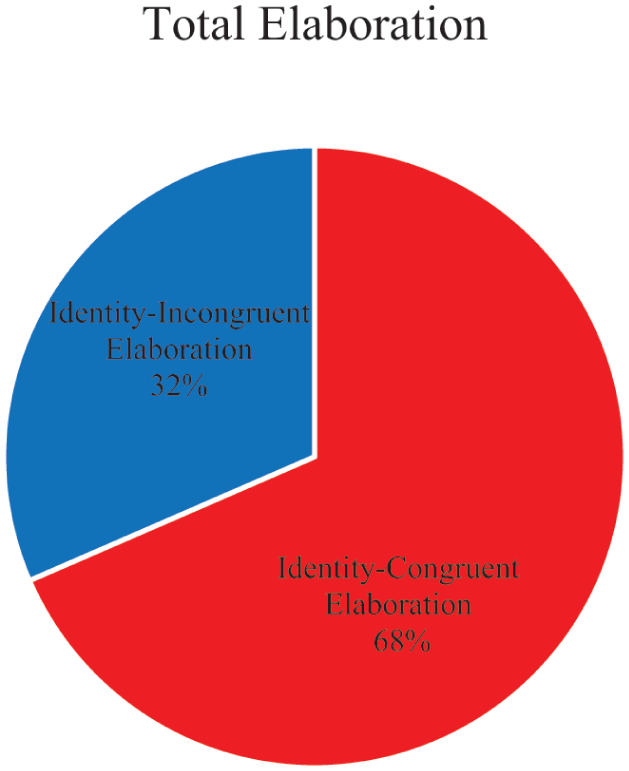
Percent of congruent and incongruent elaboration by partisans.
A parallel mediation model using the PROCESS macro (Hayes, 2022) was conducted to test H2 to H5. The second hypothesis, the first step of the hypothesized model depicted in Figure 2, predicted that stronger identification with a political party would predict greater bias in elaboration. For both Trump and Biden, H2 was fully supported. A stronger Republican social identity increased positively valenced elaboration (F[1, 229] = 20.76; B = 2.06; se = .67; p < .001; LLCI = 1.74; ULCI = 4.38; R2 = .08) and decreased negatively valenced elaboration about Trump (F[1, 229] = 48.60; B = −4.53; se = .65; p < .001; LLCI = −5.81; ULCI = −3.25; R2 = .18). Likewise, strength of a Democratic partisan identity increased positively valenced elaboration (F[1, 229] = 51.52; B = 5.80; se = .81; p < .001; LLCI = 4.21; ULCI = 7.40; R2 = .18) and decreased negatively valenced elaboration about Biden (F[1, 229] = 23.26; B = 5.12; se = 1.06; p < .001; LLCI = −7.22; ULCI = 3.03). The results (See Figure 3 for visualization) revealed full support for the second hypothesis.
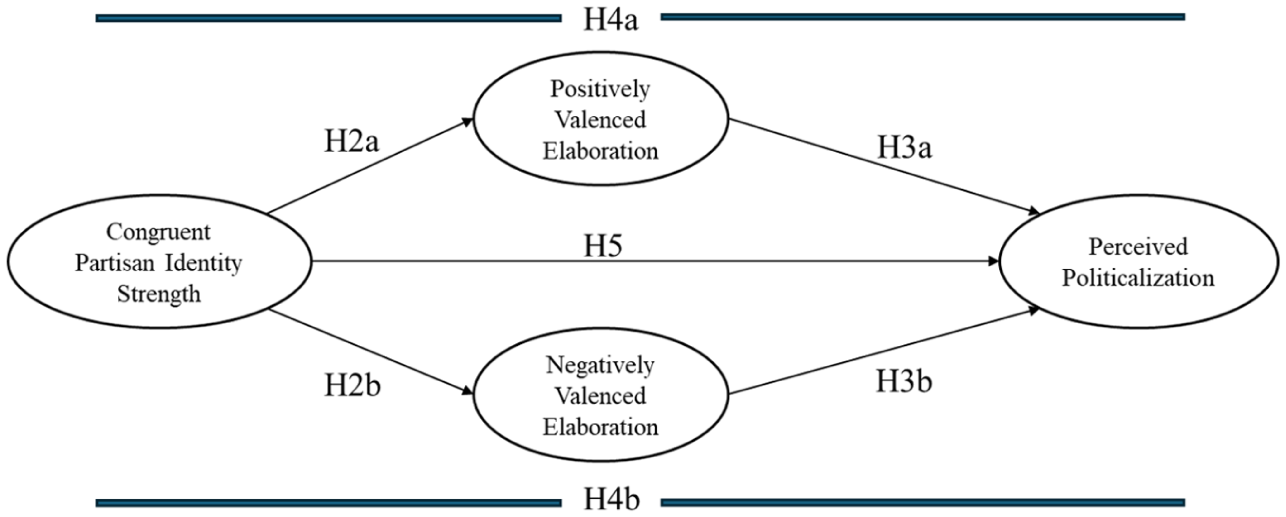
Hypothesized parallel mediation model of the influence of partisan identity strength on perceived politicalization of convictions through positively and negatively valenced elaboration.
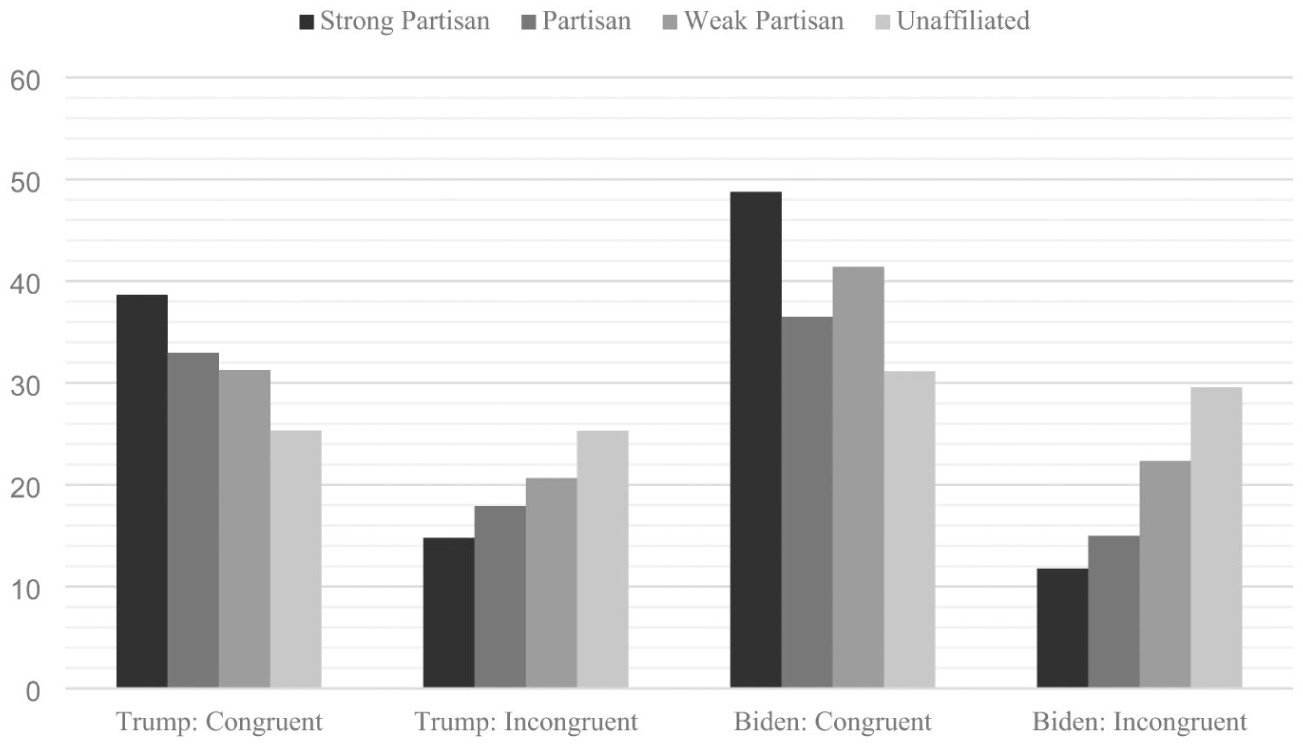
The influence of strength of partisan identity on biased elaboration.
The third hypothesis examined the effect of elaboration on perceived bias in the judicial system. Again, full support of the hypothesis was observed. For Trump, positively valenced elaboration increased perceptions that the convictions was political (B = .02; se = .00; p < .01; LLCI = .01; ULCI = .02), and negatively valenced elaboration decreased perceptions of bias (B = −.01; se = .01; p < .05; LLCI = −.02; ULCI = −.01). Similarly, positively valenced elaboration about Hunter Biden led to increased perceptions that his convictions were politically motivated (B = .01; se = .00; p < .05; LLCI = .00; ULCI = .02), and negatively valenced decreased such perceptions (B = −.01; se = .00; p < .01; LLCI = −.02; ULCI = −.00). H3 was fully supported.
The fourth hypothesis, combining H2 and H3, predicted an indirect effect of strength of partisan identity on perceived bias through both positively and negatively valenced elaboration. For Trump, both H4a and H4b were supported. Partisan strength had an indirect effect on perceived bias through both positively valenced elaboration (B = .05; se = .02; LLCI = .02; ULCI = .08) and negatively valenced elaboration (B = .06; se = .02; LLCI = .02; ULCI = .10). However, H4 was only partially supported for H. Biden. The indirect effect was significant through negatively valenced elaboration (B = .04; se = .03; LLCI = .01; ULCI = .12) but not through positively valenced elaboration (B = .05; se = .03; LLCI = −.00; ULCI = .13). In sum, the fourth hypothesis, which examined the central route of persuasion, was mostly supported.
In addition to the indirect effects through elaboration, H5 predicted that a direct effect of partisan strength on perceived bias would remain after accounting for the indirect effects. For Trump, this direct effect was significant (B = .57; se = .05; p < .001; LLCI = .47; ULCI = .67). In total, the direct and indirect effect of partisan strength explained nearly 60% (R2 = .59) of variance in perceived bias in the convictions of Donald Trump (F[3, 227] = 107.85; p < .001).
The fifth hypothesis was supported for Biden, as well. In fact, the direct effect, as with Trump, was greater than the combined indirect effects (B = .14; se = .05; p < .01; LLCI = .03; ULCI = .25). The direct (H5) and indirect effects (H4) accounted for 15% of the variance in perceptions that the Biden convictions was politically motivated (F[3, 227] = 13.10; p < .001). The fifth hypothesis, which examined the peripheral route of persuasion, was fully supported by the data.
Discussion
The 2024 U.S presidential election was an unprecedented moment in American democracy. For the first time, two candidates of major parties were linked to the felony conviction: the former President Donald Trump was convicted of falsifying business reports, and Hunter Biden, the son of the sitting President Joe Biden, was convicted of illegal procurement of a firearm. Though Joe Biden was not convicted on a crime, his son’s convictions still posed a threat to his reputation. As people were exposed to political information, a partisan divide emerged on how these convictions were perceived. The present study provides meaningful insights into a unique political situation in the 2024 presidential election by applying theory, while the political situation furthers our theoretical understanding of the way in which people process political information.
Partisanship as a Social Identity
Public discourse, including that from major news outlets (Davies, 2024; Viser & Abutaleb, 2024), expressed the possibility that the two set of criminal convictions could alter the election. The high turnout and Trump’s victory in the 2024 election are consistent with polls (Yoon-Hendricks & Brunner, 2024) that suggest that few Trump supporters were turned away by the convictions. Though Biden dropped out of the presidential race, there is no indication to suggest that his son’s convictions were related (Lange, 2024). In the present study, this identity-motivated elaboration manifested as partisans found few reasons why their in-party member should be convicted and a great number of reasons why the member of the opposing party should be punished for his crimes, which influence perceptions of the judicial system. Republicans were more likely to say that Trump’s trial was politically motivated, and Democrats were more likely to perceive politicalization of Biden’s convictions. The present study focused on a more salient political issue, examining reactions to criminal convictions during an active presidential campaign, which represented a substantially stronger identity threat. The study extends the boundary conditions of the theory of identity-motivated elaboration (Jennings, 2019), and the findings provide insight into the cognitive process through which partisans maintained their support for their party’s presidential candidate.
The study positions identification with a political party at the center of the attitudinal formation process. Partisanship did indeed function as a social identity (Greene, 1999), resulting in ingroup favoritism and outgroup denigration (Tajfel & Turner, 1986), which influences the way that people think about and issue and form their political attitudes. Consistent with the partisan social identity perspective (Greene, 1999), partisans were more likely to view the convictions of their partisan group member as politicized and the member of the opposing party as justly convicted. Beyond opinions of the politicalization of the judicial system, intergroup bias manifested as motivated elaboration and was employed in the defense of the prototypical leader of a partisan group (Trump) and to a partisan group member (H. Biden) that was associated with the leader. For people to engage in identity-motivated elaboration, Jennings and Warner (2025) argued that one’s partisan social identity must first be activated. For Trump, a partisan divide was observed for perceptions of politicization, positively valenced elaboration, and negatively valenced elaboration, but for Hunter Biden, it was not observed for negatively valenced elaboration. Interestingly, while Democrats (ingroup members) cognitively defended Hunter Biden, Republicans (outgroup) did not express more reasons why his convictions should influence the election.
Partisanship’s Elaborative Role in Attitude Formation
The elaboration likelihood model posits that people form attitudes through the central and the peripheral route (Petty & Cacioppo, 1986). Lau and Redlawsk (2001) found that partisanship operates more peripherally through partisan heuristics, while Jennings (2019) argued for a more central route, cognitively heavy influence of partisanship. The findings suggest that partisans defended their political social identities through both routes, engaging in partisan-motivated reasoning and partisan heuristics. When processing information through the peripheral route, people engage in less elaboration than when processing through the central route (Petty & Cacioppo, 1986). Republicans (Democrats) believed that Trump’s (Biden’s) convictions were politically motivated simply because the figures shared a partisan social identity. Defending one’s social group provides a directional goal that partisans may pursue by dismissing counter attitudinal information (Kunda, 1990). In other words, people demonstrated an unwillingness to accept the convictions of a partisan social group member as legitimate, and resultingly explained the convictions as being politically motivated. This direct effect of shared identity on attitude was observed even after considering the impact of elaboration on potential reasons that the convictions may (or may not) be legitimate.
This elaboration on reasons the convictions may be legitimate represents attitude formation through the central route. As people learned about the convictions of the two partisan figures, ingroup favoritism manifested as identity-defensive cognition. Partisans employed valenced elaboration as they processed the news that Donald Trump and Hunter Biden were convicted on felony charges. This identity-motivated elaboration (Jennings, 2019) explicates how two people (one Republican and one Democrat) can come to differing conclusions based on the same information. Similarly, Petty and Cacioppo (1986) found that an emotional attachment to a message can bias elaboration. Compared to people of the opposing party, people engaged in greater positively valenced elaboration to support their partisan member and increased negatively valenced elaboration when considering the convictions of the outparty member. Specifically, Democrats exerted greater cognitive resources considering reasons that Trump’s convictions should be disqualifying from holding the office of President of the United States, while, conversely, developing reasons that Biden’s convictions held little meaning; similarly, Republicans engaged in greater elaboration against Biden and supporting Trump. Support of the partisan group member (ingroup favoritism) and opposition to the competing partisan group (outgroup denigration) provided a directional goal (See Kunda, 1990) that motivated biased elaboration on the convictions. This valenced elaboration mediates the effect of a shared partisan identity on political attitudes. As the valenced direction of the elaboration had an impact on the attitude formation, news coverage of the convictions further divided the electorate.
Limitations and Future Studies
The limitations of the present study should be considered when evaluating the findings and addressed in future research on partisan-motivated reasoning. The sample consisted of a single university sample, which limits the generalizability of the findings. Only two related issues (the convictions of Donald Trump and Hunter Biden) were analyzed. There was an important distinction between the convictions and subsequent article that were used as stimuli: One candidate was convicted (Trump) while it was the family member of the other candidate (Biden) that was convicted. However, both articles represent attacks on a partisan social in-group or out-group member, which prior research suggests will be processed in a biased manner (Jennings & Warner, 2025; Kunda, 1990). Because the convictions were real events beyond research control, a decision between examining perceptions of only the Trump convictions or including the Biden convictions was necessary. The researchers deemed the benefit of partisan balance of including the Biden convictions to outweigh the limitation. The context of the experiment was a political issue in the United States, while other countries (especially those with a multi-party system) may process information and form attitudes differently. Future studies should examine different issues (with varying degrees of salience and ideological relevance) with different outcome variables on more representative samples.
Conclusion
As predicted by the theory of identity-motivated elaboration (Jennings, 2019), partisanship motivated greater elaboration (central route processing) to defend one’s own partisan social group and derogate the opposing social group when exposed to information about the convictions of two figures related the 2024 election: Donald Trump and Hunter Biden. Moreover, perceptions of the politicization of the judicial system were likewise informed by partisan heuristics (peripheral route processing), revealing that the two routes of persuasion (Petty & Cacioppo, 1986) work complementarily to generate intergroup bias in the attitude formation process. By examining these reactions through the dual lenses of partisan social identity (Greene, 1999) and elaboration processes (Petty & Cacioppo, 1986), the study advances understanding of political information processing in an environment increasingly defined by social rather than ideological divisions (Iyengar et al., 2012). Considering the social and cognitive mechanisms of influence, the findings provide insight into why citizens may respond in different, even opposite, ways to political information.
Footnotes
Appendix A
Acknowledgements
The authors employed generative AI tools such as ChatGPT-4 (Open AI) to improve the readability of our writing and for refining and editing, without generating content for the article.

Funding
The authors received no financial support for the research, authorship, and/or publication of this article.
Declaration of Conflicting Interests
The authors declared no potential conflicts of interest with respect to the research, authorship, and/or publication of this article.