







Abstract
This study examines how Turkish newspapers with divergent ideological orientations—Yeni Şafak, Sabah, Sözcü, and Evrensel—construct Elon Musk and Donald Trump as symbolic figures within Turkey’s polarized media system. Drawing on 144 news and opinion pieces, the research employs an integrated qualitative design that combines systematic content analysis with discourse-historical analysis to investigate how global technological elites are domesticated within national moral and ideological frameworks. The analysis follows a hierarchical coding strategy encompassing evaluative tone, thematic framing, discursive strategy, and moral valence, ensuring analytical consistency through intercoder reliability and multi-level triangulation. Findings reveal a polarized yet morally coherent media field. Pro-government outlets frame Musk and Trump as embodiments of rational modernity and entrepreneurial sovereignty, while oppositional newspapers depict them as symbols of capitalist spectacle and inequality. Across ideological divides, technology itself is moralized—either celebrated as virtue or condemned as vice—demonstrating that Turkish journalism constructs technological modernity as a moral and political category rather than a neutral domain of progress. The study introduces the concept of the ‘Musk Effect’ to capture how transnational technological elites function as discursive instruments through which semi-peripheral nations negotiate soft power, legitimacy, and modernity. Situated at the intersection of celebrity politics, digital diplomacy, and platform capitalism, the analysis highlights the methodological value of multi-layered qualitative triangulation in revealing the ideological work of media discourse in contemporary techno-politics.
Keywords
Introduction
The 2024 U.S. presidential election unfolded not merely as a domestic contest but as a pivotal global event. Marked by extreme disruptions—including ‘the attempted assassination of one of the candidates and the resignation of the other’ (Harris et al., 2025, p. 7)—the election reverberated across international media systems. Its significance extended beyond Washington, shaping debates on global power realignments, the durability of Western alliances, and ongoing geopolitical conflicts in Ukraine and Gaza. As such, the contest exemplifies how American presidential politics now function as global spectacles with material and symbolic consequences far beyond U.S. borders.
For Turkey, a NATO member and long-time U.S. partner that increasingly acts as a transactional and unpredictable ally, the election provides a uniquely revealing case. As a liminal actor—neither a fully consolidated ally like Germany nor an adversarial power like Russia—Turkey exemplifies what Hallin and Mancini (2004) call a polarized pluralist media system, making it a swing case for understanding how global political events are refracted through domestic ideological conflict. Once framed as a strategic partnership, Turkish-American relations have devolved into conflict and bargaining. The Erdoğan-Trump era, despite personal rapport, was riddled with crises over defense procurement and regional security (Jarombek, 2024, p. 2). The Biden administration continued this trajectory of managed antagonism. Within this strained context, however, President Erdoğan cultivated an unusually warm rapport with Elon Musk, producing a puzzling contrast: while Washington remained diplomatically distant, Turkish media celebrated a private entrepreneur closely aligned with Trump’s political base. Musk’s hybrid status as entrepreneur, celebrity, and political provocateur underscores how global media systems now integrate non-state elites into symbolic struggles of soft power, making his presence central not only for Turkish discourse but for understanding broader patterns of global political communication.
Turkey thus provides an especially instructive case for analyzing the global reverberations of the 2024 U.S. presidential election. Unlike Russia or China, where American elections are often framed within overtly adversarial state logics (Bykova et al., 2018, p. 1; Gavra & Slutskiy, 2020, p. 1; Moore & Colley, 2024), Turkey occupies a liminal position as a NATO member, a transactional ally, and a periodically estranged partner of Washington. Its media system, long characterized by polarized pluralism (Hallin & Mancini, 2004), offers a fertile ground for observing how ideologically driven outlets negotiate the paradox of U.S.–Turkey tensions while simultaneously domesticating Elon Musk as a techno-political ally of President Erdoğan. In this sense, Turkey functions as a revealing swing case within the broader comparative literature on international representations of American elections.
Within this polarized media environment, the central paradox animating this study emerges: how can Turkish news outlets narrate persistent antagonism toward the United States while, at the same time, symbolically embracing Elon Musk as a techno-political ally? This contradiction illustrates how transnational media systems reconcile tensions between state-level diplomacy and the symbolic domestication of global entrepreneurs, making Turkey a critical site for examining the ideological mechanics of framing.
Musk’s multidimensional persona intensifies this puzzle. He is not only positioned as a global technology magnate but also as a self-styled culture warrior engaged in a campaign against the ‘woke mind virus’ (Kelley, 2025, p. 9). His provocations, coupled with his highly publicized eccentricities, further elevate him into a hybrid figure—innovative, controversial, and media-saturated. Trump, too, occupies a hybrid symbolic status in Turkey, where he is simultaneously condemned as an unreliable ally and valorized as a strongman leader. Beyond this ambivalence, Trump’s persona continues to function as a crucial interpretive frame, allowing Musk’s symbolic capital to be mobilized in ways that amplify and legitimize Trump’s political image. Together, Musk and Trump supply Turkish media with a repertoire of frames ranging from cultural resistance to technological populism. It is within this interplay that the ‘Musk Effect’ emerges, wherein Musk’s symbolic capital functions to enhance Trump’s legitimacy in Turkish media discourse (Gao et al., 2025, p. 1,254).
This paper therefore investigates how Turkish newspapers with differing ideological orientations—Yeni Şafak, Sabah, Sözcü, and Evrensel—construct and utilize the public figures of Donald Trump and Elon Musk. Specifically, this study explores how these newspapers frame Elon Musk in the context of Turkey’s national interests and foreign policy discourse. It also examines the ways in which Musk is portrayed as a techno-political figure, analyzing how this depiction functions in contrast or in complement to narratives surrounding Donald Trump. Finally, the research delves into how these newspapers utilize Musk’s personal traits and eccentric behaviors to construct him as a charismatic and media-friendly public persona. What are the specific ideological differences between the newspapers? How does Turkish media portray other tech figures?
To address these questions, the study analyzes 144 news and opinion articles published between July 2024 and January 2025 in four ideologically distinct Turkish newspapers: Yeni Şafak and Sabah (pro-government and conservative), and Sözcü and Evrensel (oppositional and left-leaning). These outlets were selected through purposive sampling to capture the ideological range of Turkey’s polarized pluralist media system (Hallin & Mancini, 2004). The dataset was compiled via systematic keyword searches (‘Elon Musk’, ‘Donald Trump’, ‘ABD seçimleri’) in each outlet’s digital archive. Articles were then coded across thematic, ideological, and rhetorical dimensions, using a collaboratively developed codebook refined through intercoder calibration (Cohen’s κ = .84). This process established a robust foundation for identifying macro-level framing patterns. To deepen interpretation, the content analysis was complemented by critical discourse analysis, focusing on the moral and linguistic mechanisms through which technological charisma and political power were domesticated within national narratives. This integrated qualitative strategy enabled both breadth and depth, linking structural patterns of representation to the ideological operations of Turkish media discourse.
By addressing these questions, this study makes three contributions. First, it expands research on the global reverberations of U.S. presidential elections by analyzing the case of Turkey, a country that oscillates between alliance and autonomy within the Western order. Second, it bridges scholarship on framing theory and soft power by conceptualizing Musk as a techno-political figure whose symbolic presence transcends national borders. Finally, it advances comparative political communication by showing how non-state elites, when domesticated through media representation, become instruments of symbolic politics and ideological legitimation. To this end, the article employs an integrated framework of media framing theory, ideological discourse analysis, and techno-political soft power, illuminating not only how media construct individual figures, but also how technology, ideology, and soft power intersect in shaping the symbolic terrain of global political communication.
The analysis proceeds on three levels: (a) ideological framing of Musk and Trump as moral and political figures; (b) their articulation within national and techno-political discourses of soft power; and (c) their relational construction as complementary symbols of entrepreneurial rationality and populist leadership.
Framing the Global Spectacle: The Geopolitics of Media Narratives
National elections in the United States have evolved into global media spectacles, events where international media outlets selectively frame and interpret American politics to reflect their own geopolitical priorities and domestic ideological currents (Sevin & Uzunoğlu, 2017, p. 316). The theoretical foundation for understanding this process lies in media framing theory, which explains how the press shapes public perception by selecting certain aspects of a perceived reality and making them more salient in a communicating text. As Entman (1993) defines it, to frame is to promote a ‘particular problem definition, causal interpretation, moral evaluation, and/or treatment recommendation’ (p. 52). This mechanism is not neutral; it is a strategic tool used to construct narratives that serve specific political and ideological ends.
In the international arena, this process becomes a form of geopolitical media framing. Research on state-sponsored media demonstrates how nations strategically narrate U.S. elections to bolster their own legitimacy and challenge American influence. For instance, comparative analysis of Russian and Chinese media reveals two distinct propaganda models: Russia’s RT employs a ‘partisan parasite’ model, aiming to subvert the U.S. political system by mimicking its domestic partisan media, while China’s CGTN utilizes a ‘surface neutrality’ model that cloaks pro-state propaganda with a superficial impression of impartiality (Moore & Colley, 2024, p. 1,322). Similarly, broader studies of non-democratic media show a significant shift in coverage between the 2016 and 2020 U.S. elections, with narratives about American democracy becoming ‘substantially more frequent and negative’ over time (Hinck, 2024, p. 129).
This study situates Turkey within this comparative context, utilizing Hallin and Mancini’s (2004) ‘Polarized Pluralist’ model to conceptualize its media system. This model, characterized by deep partisan entanglements and the strategic instrumentalization of the press, explains why Turkish media outlets often function as the public voice of distinct political movements rather than as neutral observers. This structure is particularly relevant when analyzing coverage of U.S.–Turkish relations, a topic that has been historically fraught. Research on American media’s own portrayal of the alliance has revealed a persistent negativity bias, where ‘unfavorable narratives are persistent’ and moments of diplomatic reconciliation fail to generate positive coverage to the same degree as disagreements (Jarombek, 2024, p. iv). By examining how Turkey’s polarized media frames the U.S. election, this study explores how these established geopolitical tensions are narrated for a domestic audience.
Having established the geopolitical and systemic context of media framing, the analysis must now turn to the unique nature of the figures being framed—the new techno-political elites who operate within and beyond these structures.
Within this global mediascape, the Turkish case highlights a specific paradox: the symbolic domestication of Elon Musk and Donald Trump within an ideologically divided press that uses them to negotiate national identity and technological modernity. This global process acquires distinctive contours in Turkey, where admiration for American technological power coexists with deep-seated skepticism toward U.S. political hegemony—a tension personified in the differential treatment of Musk and Trump.
The New Power Brokers: Techno-Political Influence and the Hybrid Elite
While media framing theory explains the narrative construction of political events, the rise of figures like Elon Musk requires a more specific conceptual lens. The contemporary digital economy, dominated by mega-platforms, has sparked intense debate over whether capitalism itself has been superseded. Theorists like Yanis Varoufakis (2024) argue that we have entered an era of ‘Technofeudalism’, a new mode of production where corporate income derives not from traditional profit but from ‘rent extraction’ enabled by monopoly control over digital platforms (as cited in Gilbert, 2024, p. 562). However, this study aligns with the counter-argument that these shifts represent not the end of capitalism, but the emergence of a new regime of accumulation: ‘platform capitalism’ (Gilbert, 2024, p. 561). It is within this framework that the concept of techno-political influence becomes crucial.
This term describes the unique power wielded by hybrid elites who merge technological innovation, vast economic resources, and ideological spectacle to shape public discourse. This influence is structurally rooted in platform capitalism, where a new ‘vectoralist class’ derives power from its monopoly control over the primary vectors of information (Gilbert, 2024, p. 563). Elon Musk embodies this new hybrid elite. Characterized as a ‘mercurial’ and revolutionary figure of the Fourth Industrial Revolution, his public persona is shaped by a unique psychological profile and a penchant for provocative intervention (Kelley, 2025, p. 2). His status is amplified by his unprecedented reach on his own platform, X, where his posts garner billions of views, allowing him to bypass traditional media gatekeepers entirely (Stimpson, 2025, p. 36).
Musk’s influence is further magnified by his self-styled role as a transnational ‘culture warrior’ engaged in a campaign against what he calls the ‘woke mind virus’ (Kelley, 2025, p. 9). This ideological crusade was central to his takeover of Twitter, where his robust advocacy for free speech resonated strongly with conservative users and was framed as a direct challenge to the platform’s previous content moderation policies (Wang et al., 2024, p. 5). This transformation into a potent political symbol is not merely theoretical; it has been shown to have a measurable impact on electoral dynamics, with Musk’s high-exposure activities correlating with short-term boosts in Donald Trump’s polling numbers (Gao et al., 2025, p. 1,248).
It is this hybridity that makes Musk a uniquely powerful figure for strategic framing within Turkey’s polarized media landscape. His global persona is often ‘domesticated’ through symbolic alignments that adapt his image to local ideological needs. In pro-government media, for instance, he is frequently framed through laudatory comparisons to national figures like Selçuk Bayraktar, a recurring trope in the Turkish press. As President Erdoğan’s son-in-law and the internationally recognized architect of Turkey’s formidable military drone program, Bayraktar has become a powerful symbol of national innovation and geopolitical assertiveness. This frequent framing positions both Musk and Bayraktar as parallel visionaries of technological independence. This process allows Musk’s symbolic capital to be instrumentalized, serving as a powerful resource for narratives that intersect with Turkey’s national interests, its relationship with the West, and its own internal culture wars. These symbolic equivalences show how Turkish media localize global figures, transforming them into vehicles for moral and national narratives—a process that underpins what this study terms the ‘Musk Effect’.
Tracing the Narrative in a Polarized Landscape
Having established the analytical framework, this section outlines the narrative logics that organize Turkish media representations of Elon Musk and Donald Trump. Rather than restating procedural details, it explains how specific discursive patterns—innovation, leadership, and morality—structure the transition from textual features to ideological meaning. To trace the construction of narratives surrounding Musk and Trump in ideologically polarized Turkish media, the study adopts an integrated qualitative design combining systematic content analysis with critical discourse analysis. This two-stage approach allows for both a structured mapping of framing patterns and a deeper interpretive examination of their ideological and historical underpinnings (Jensen, 2002; Wodak, 2015). The integration of these approaches constitutes a form of methodological triangulation (Flick, 2004), enhancing credibility through the convergence of complementary analytical perspectives.
The sample includes 144 news and opinion articles drawn from four national dailies representing Turkey’s ideological spectrum: the pro-government conservative Yeni Şafak and Sabah, the secular-nationalist Sözcü, and the socialist-left Evrensel.
These outlets were selected not merely for their political alignment but for the distinct sociological segments they command. Sabah, a mass-market daily owned by the pro-government Turkuvaz Media Group, functions as the primary agenda-setter for the ruling Justice and Development Party (AKP), effectively operating as the flagship of the government’s populist coalition. Yeni Şafak, while lower in circulation, serves as a theoretical hub for the country’s Islamist intelligentsia, articulating the ideological foundations of the government’s ‘New Turkey’ project. On the opposition front, Sözcü represents the secular-nationalist (Kemalist) mainstream; it is one of the country’s highest-circulation newspapers, combining fierce anti-government critique with a hawkish, state-centric approach to foreign policy. Finally, Evrensel serves as a key voice for the socialist left and labor unions, offering a structural critique of capitalism that differs sharply from the nationalist opposition of Sözcü. This selection ensures the analysis captures not just a binary government-opposition split, but the distinct Islamist, Nationalist, and Socialist inflections of Turkish political discourse.
Articles were identified via targeted keyword searches (‘Elon Musk’, ‘Donald Trump’) using Google Advanced Search and outlet-specific databases. This purposive selection ensured ideological breadth and thematic relevance within the polarized Turkish press, consistent with Hallin and Mancini’s (2004) polarized pluralist model. Each article was examined for evaluative tone, thematic focus, ideological markers such as populist nationalism, techno-optimism, and anti-Westernism, as well as for recurring discursive strategies. Quantitative frequencies were used descriptively to illustrate distributional patterns across outlets, complementing qualitative interpretation rather than serving as an independent statistical analysis.
In the second stage, discourse-historical analysis (Wodak, 2015) was applied to explore how language constructs national identity, political antagonism, and symbolic alignment. Van Dijk’s (1998) ideological square guided the mapping of binary oppositions—particularly the moral dichotomy of ‘us’ (national, rational, virtuous) versus ‘them’ (foreign, corrupt, irrational). Together, these frameworks enabled a layered understanding of how global figures are domesticated within Turkish ideological discourse. Throughout the process, triangulation operated at multiple levels, including data triangulation through the analysis of ideologically diverse outlets, methodological triangulation through the integration of content and discourse analysis, and theoretical triangulation through the dialogue between framing, critical discourse analysis, and soft power theory.
The analysis adhered to Lincoln and Guba’s (1985) criteria for trustworthiness. Credibility was achieved through iterative reading and recoding of the dataset over several months, allowing for immersion in linguistic and contextual nuance—a process referred to as prolonged engagement. Dependability and confirmability were ensured through systematic documentation and analytic memoing, in which interpretive decisions, emerging patterns, and theoretical reflections were recorded during coding to maintain a reflexive audit trail. These procedures established a transparent and replicable foundation for interpretation, ensuring that insights into Turkish media discourse were grounded in consistent analytical rigor.
As one of the two coders involved in the analysis, the author acknowledges the importance of reflexivity in qualitative interpretation. The research was conducted with awareness of the author’s own position within Turkey’s academic and media environment, where questions of ideology, polarization, and journalistic autonomy are intensely debated. This positionality inevitably shapes interpretive sensitivity—particularly regarding how national identity, modernization, and technological discourse intersect. To mitigate potential bias, coding decisions were discussed collaboratively with a second researcher, and analytic memos were maintained throughout the process to document interpretive reasoning. The study, therefore, approaches subjectivity not as a limitation but as an analytical resource, following Lincoln and Guba’s (1985) and Berger’s (2015) understanding of reflexivity as integral to credibility. By making the interpretive stance explicit, the research maintains transparency about how meaning was negotiated, rather than presumed, within the analytical process.
Framing the Musk Effect in Turkish Media
This section presents the key findings from a large-scale qualitative content analysis of 144 news items and opinion pieces published by four ideologically diverse Turkish newspapers—Yeni Şafak, Sabah, Sözcü, and Evrensel. The analysis followed a directed qualitative content analysis approach (Hsieh & Shannon, 2005), combining theoretically informed and data-driven strategies. Coding categories were initially developed deductively, drawing on framing theory (Entman, 1993) and critical discourse analysis (Fairclough, 1995), and then refined inductively through iterative engagement with the dataset.
Each article was coded across thematic, ideological, and rhetorical dimensions, focusing on evaluative tone, frame structure, actor representation, and moral positioning. Moral valence was operationally defined as the attribution of intrinsic ethical qualities—such as ‘virtue’, ‘sin’, ‘purity’, or ‘corruption’—to technological acts, distinct from their functional utility. To ensure consistency and reliability, the coding process was carried out by two researchers—the author and a research assistant—who first established a gold standard codebook based on a jointly coded pilot sample of ten articles. The finalized codebook was then applied independently to the entire dataset, and intercoder reliability was assessed using Cohen’s Kappa, which yielded an average score of 0.84, indicating substantial agreement according to Krippendorff’s (2013) thresholds for qualitative reliability.
Quantitative frequencies were used descriptively to illustrate distributional patterns across outlets, complementing the qualitative interpretation. Table 1 summarizes the five dominant thematic clusters. To address the ideological variance, the table breaks down the prevalence of each frame by outlet, highlighting the polarized nature of the coverage.
Dominant Thematic and Moral Frames.
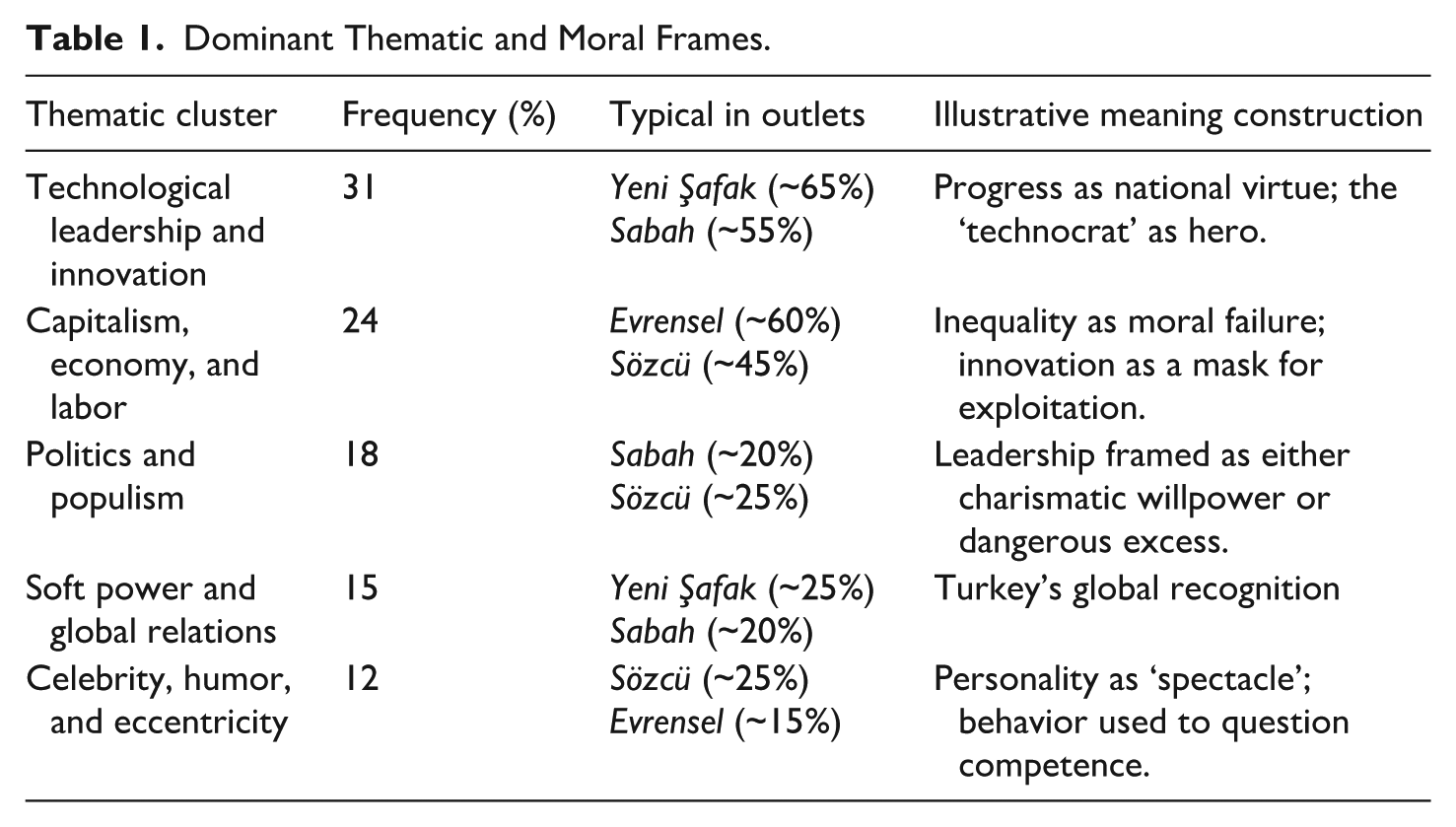
Table 1 summarizes the five dominant thematic clusters and their associated moral framings identified through the coding process.
To complement the large-scale mapping, 20 representative texts were selected for in-depth discourse analysis following Fairclough’s (2003) three-dimensional model. This close reading focused on tone, metaphor, intertextuality, and narrative construction, exploring how Musk and Trump were positioned within wider ideological and geopolitical discourses. The combination of systematic coding and interpretive analysis thus provides both breadth and depth, illustrating how Turkish media transform Elon Musk and Donald Trump into symbolic instruments for articulating national identity, ideological orientation, and competing visions of modernity.
Framing Patterns Across the Corpus
The coding results demonstrate a markedly polarized representational landscape across the four newspapers. Quantitative coding frequencies indicate that 58% of the analyzed items adopted a positive or approving frame toward Elon Musk and Donald Trump, 33% employed a critical or oppositional frame, and 9% maintained a neutral or informational stance. Yet, these proportions were distributed unevenly across outlets, reflecting distinct ideological alignments. Yeni Şafak (83% positive) and Sabah (74% positive) consistently foregrounded themes of leadership, rationality, and visionary innovation, while Sözcü (72% negative) and Evrensel (88% negative) relied on irony, critique, and structural analysis. These quantitative patterns are consistent with the reliability-tested coding framework (Cohen’s κ = .84), confirming that the observed differences are not artifacts of coder bias but represent stable ideological distinctions within Turkish media discourse.
Before examining the discursive dimensions of framing, it is useful to establish the overall evaluative landscape. Table 2 summarizes how the 144 coded items distribute across positive, negative, and neutral framings, offering a quantitative snapshot of ideological polarization within Turkish print media. These proportions serve as the empirical foundation for the interpretive patterns discussed in the following sections.
Evaluative Orientation across Newspapers (n = 144).
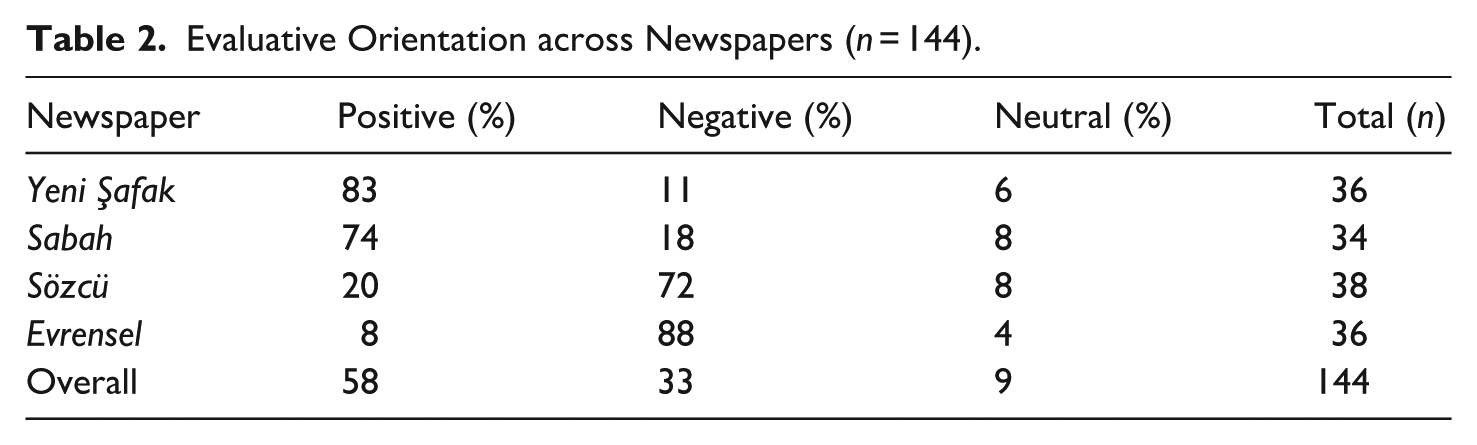
Coding shows a strong ideological division consistent with Hallin and Mancini’s (2004) polarized pluralist model.
This polarization reflects not merely divergent editorial orientations but what Van Dijk (1998) describes as distinct ideological grammars—discursive systems through which media reproduce group identities and worldviews. In the pro-government press, technological success functions as a moral and national signifier: innovation is equated with discipline, productivity, and faith in national modernization. In the oppositional press, by contrast, Musk and Trump are framed as embodiments of structural inequality and the spectacle of capitalism (Debord, 2024), their visibility exposing rather than resolving the contradictions of global power.
Frequency analysis also revealed five dominant thematic clusters across the corpus: technological leadership and innovation (31%), capitalism, economy, and labor (24%), politics and populism (18%), soft power and global relations (15%), and celebrity, humor, and eccentricity (12%). These categories often overlap, reflecting the hybrid nature of contemporary media discourse (Fairclough, 1995). Technology narratives frequently spill into political commentary, while humorous or sensational framing often operates as a vehicle for ideological evaluation. The coded data thereby affirm Entman’s (1993) contention that framing is never purely descriptive: each representation entails a moral prescription about power, virtue, and belonging. Through such evaluative framings, Turkish newspapers do not simply report on Musk and Trump but rearticulate broader struggles over modernity, legitimacy, and national identity.
From Technocratic Heroism to Capitalist Spectacle
Across the full corpus of 144 items, the representation of Elon Musk and Donald Trump oscillates between two dominant macro-frames: rational heroism and capitalist spectacle. These macro-frames, identified through the thematic and evaluative dimensions of the coding scheme, reveal the extent to which Turkish newspapers transform global figures into moral archetypes.
The first cluster—most prevalent in Yeni Şafak and Sabah—constructs Musk and Trump as technocratic reformers: rational actors who resist bureaucratic inertia and embody meritocratic efficiency. Musk’s frequent appeals to ‘innovation beyond limits’ and ‘streamlining government’, as reproduced in these outlets, resonate strongly with Turkey’s own developmentalist discourse, in which technological progress is equated with national renewal. As one columnist in Sabah argued, framing Musk’s efficiency as a model for national governance: The era of the sluggish, heavy-footed bureaucrat is ending. Musk shows us that the state does not need to be a burden; it can be as agile as a rocket. Just as Turkey broke its chains with the National Technology Move, figures like Musk prove that when you remove the obstacles of the ‘old world’ mentalities, the horizon of what is possible expands indefinitely. This is not just business; it is a war against the inertia that holds nations back.
In this framing, his perceived alignment with Trump symbolizes a reordering of global power around entrepreneurial rationality, a model in which the technocrat supplants the career politician as the legitimate agent of change. This discourse reflects what Weber (1978) theorized as rational-legal authority, reimagined within a neoliberal context where managerial efficiency and visionary pragmatism are moralized as political virtues. It also mirrors what Mirowski (2014) describes as the ‘entrepreneurial ontology of neoliberalism’, in which technological success serves as proof of both competence and moral integrity. Within these narratives, Musk and Trump are less individuals than emblems of a world governed by innovation, productivity, and willpower—values that Turkish pro-government media habitually align with their own project of national modernization.
In contrast, Sözcü and Evrensel employ what the coding scheme identifies as the spectacle frame, presenting Musk and Trump as media-manufactured myths that obscure the contradictions of global capitalism. Reports on Musk’s extravagant lifestyle, volatile public statements, or involvement in extractive industries—such as Evrensel’s coverage of ‘Bolivia’s lithium and the global race’—foreground the disjunction between technological idealism and material inequality. An editorial in Evrensel captured this skepticism, explicitly contrasting Musk’s futuristic rhetoric with labor realities: They sell us a dream of Mars, but the reality is built on the same old exploitation here on Earth. While Musk plays the chaotic genius on his own social media playground, the cost of his batteries is paid by miners in the Global South and workers denied their unions. This is not the future; it is nineteenth-century capitalism dressed up in a space suit. The spectacle of his wealth is designed to dazzle us so we do not look at the cracks in the foundation.
This oppositional framing exemplifies Debord’s (2024) argument that in late capitalism, power manifests through visibility, and visibility itself becomes the commodity. Musk’s omnipresence, in this sense, signifies not genuine innovation but the fetishization of innovation as performance.
In addition to evaluative tone, the coding revealed five thematic and moral clusters that organize media representations of Musk and Trump. Table 3 outlines these clusters, showing how technological, political, and cultural narratives are moralized through the language of virtue, discipline, and critique.
Dominant Thematic and Moral Frames.
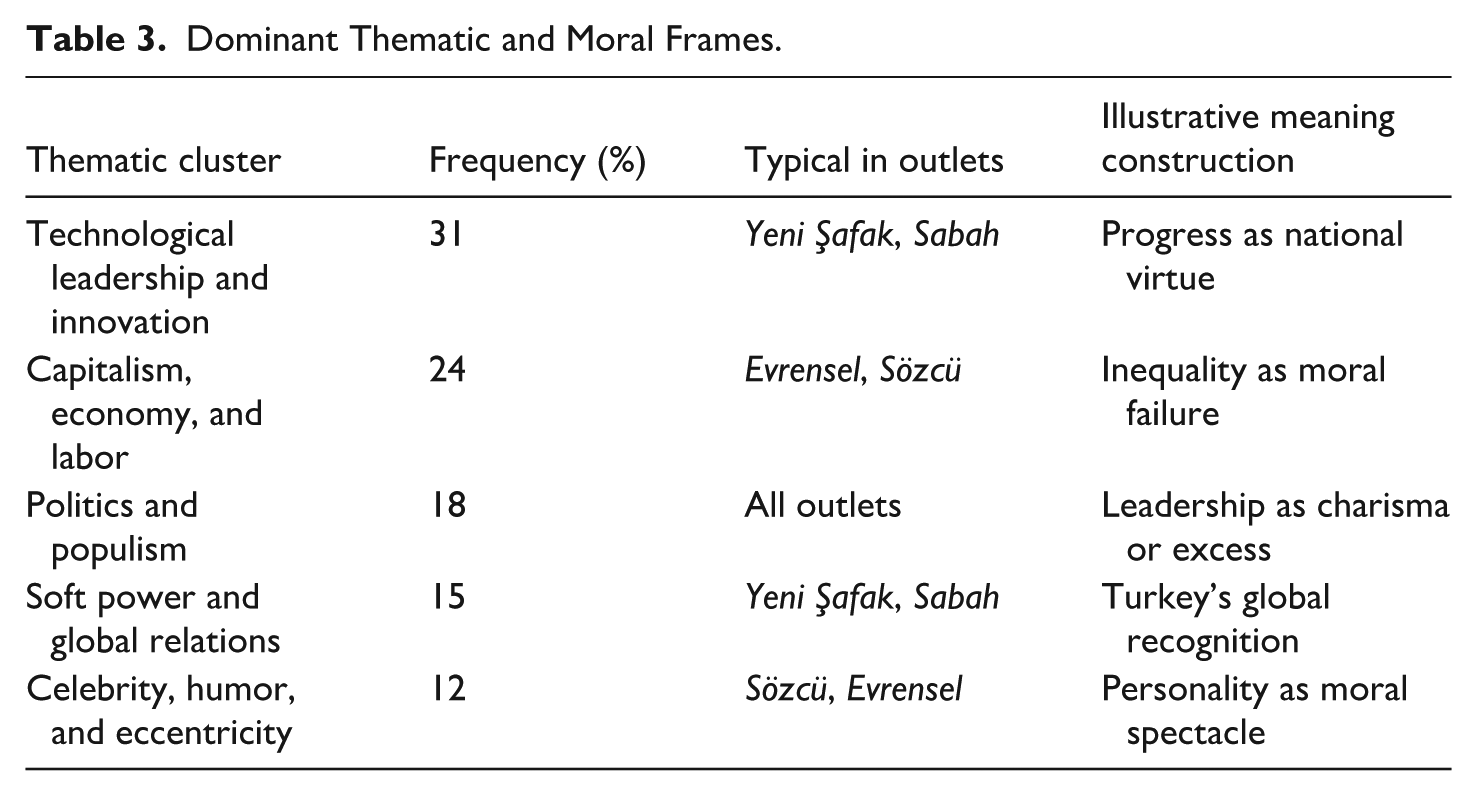
As detailed in Table 3, five thematic and moral clusters structure the representation of Musk and Trump across outlets, revealing distinct ideological preferences and rhetorical strategies.
Between these poles lies a smaller subset of texts, approximately 9% of the total sample, which exhibit what the codebook designates as ambivalent framing. These articles, found primarily in lifestyle or technology supplements, oscillate between fascination and skepticism. They celebrate Musk’s visionary achievements while simultaneously questioning his motives or the ethical implications of his enterprises. This hybrid discourse reflects what Barthes (1972) termed mythical speech—a mode of communication that both admires and ironizes its subject, thereby reaffirming the ambivalence of technological modernity in contemporary media culture.
Taken together, these framing patterns reveal a press system divided not simply by political ideology but by competing ontologies of modernity. The rational-heroic frame invests in technological rationality as moral order; the spectacle frame exposes it as illusion. The ambivalent middle ground, though comparatively rare, suggests that fascination with technological charisma coexists uneasily with critique, confirming that Musk and Trump function as contested signifiers through which Turkish media articulate their broader anxieties about power, progress, and legitimacy.
Ideological Polarization and National Identity
The ideological coding of 144 news items reveals a pronounced division that mirrors Hallin and Mancini’s (2004) characterization of the polarized pluralist model, in which the press functions as an instrument of political and moral partisanship. Within this configuration, media outlets do not merely mirror ideological orientations; they actively produce them through processes of selective framing, lexical choice, and evaluative tone. The findings show that Yeni Şafak and Sabah—both pro-government and conservative newspapers—construct Elon Musk as an extension of Turkey’s ‘national technology’ discourse (milli teknoloji hamlesi), a narrative that merges innovation, productivity, and faith into a vision of disciplined modernity.
In this discourse, Musk’s figure is often implicitly paired with that of Selçuk Bayraktar, Turkey’s leading drone technologist and emblem of the milli teknoloji hamlesi. However, this comparison performs a specific ideological function by bridging two distinct domains. Bayraktar is not merely a technologist but President Erdoğan’s son-in-law and the architect of Turkey’s military drone program—a sector framed as a matter of existential national survival. By drawing parallels between Musk and Bayraktar, pro-government media effectively ‘militarize’ Musk’s commercial innovations, imbuing his private ventures with the same moral weight as Turkey’s defense industry. Both are framed as visionary engineers who embody the fusion of faith, discipline, and technological mastery, reinforcing a narrative where technological sovereignty is paramount. This articulation exemplifies what Yilmaz (2021) terms a technonationalist imaginary—a symbolic fusion of spiritual virtue with technical competence that legitimizes political authority through the language of progress. Donald Trump’s trajectory, when invoked in these outlets, functions as a moral allegory of leadership and willpower, reflecting the domestic rhetoric of visionary governance associated with Erdoğan’s developmental populism (see Akser & Baybars-Hawks, 2012).
In contrast, Sözcü and Evrensel reinterpret the same figures through the intersecting lenses of economic justice, class critique, and ideological skepticism. In their coverage, Musk ceases to represent creative innovation and instead embodies the contradictions of neoliberal capitalism—what Fuchs (2021) describes as the myth of digital capitalism, in which the cult of the entrepreneur obscures the structural inequalities sustaining technological progress. Trump, similarly, is portrayed as the convergence point between financial privilege and populist demagoguery, a spectacle through which the absurdities of capitalist democracy are made visible. These oppositional outlets situate both men within what Couldry and Hepp (2017) call the mediated construction of reality, wherein media systems reproduce global hierarchies by normalizing elite visibility and valorizing Western models of power and success.
The distribution of evaluative codes further reinforces this ideological bifurcation. Terms such as ‘rationality’ and ‘leadership’ recur as positive signifiers in right-leaning newspapers, while ‘capitalism’, ‘propaganda’, and ‘inequality’ dominate the oppositional press. In Van Dijk’s (1998) framework, each ideological bloc performs positive self-presentation and negative other-presentation through its treatment of Musk and Trump, thereby reaffirming its own moral boundaries. This discursive polarization extends beyond overt commentary: even ostensibly descriptive reporting embeds implicit moral hierarchies, defining technological agency as either virtuous or corrupt. For conservative outlets, technological mastery signifies divine order and patriotic virtue, echoing Fairclough’s (1995) contention that media discourse reproduces power through the moral normalization of hegemonic values. For progressive newspapers, by contrast, technology is a site of ethical crisis—a field where profit eclipses public good and innovation conceals exploitation. Despite these opposing moral positions, both orientations engage in what Couldry (2012) calls the ritualization of media power, turning technology into a moral category that organizes collective meaning. The result is a media environment where technological discourse functions simultaneously as political ideology, ethical commentary, and cultural self-definition.
Soft Power and the Global Projection of Turkey
A persistent pattern emerging from both the coded corpus and the close textual analyses concerns the use of Musk’s image as a discursive lens through which Turkish media articulate the nation’s imagined position within the global order. Approximately one quarter of all coded items link Musk explicitly to Turkey, most often through accounts of diplomatic encounters, investment proposals, or symbolic analogies that align his entrepreneurial charisma with Turkey’s technological ambitions. In Yeni Şafak and Sabah, such representations function as instruments of soft power, portraying Turkey as an ascendant technological actor whose vision garners recognition from Western innovators. Musk’s visits, tweets, and statements are narrated as gestures of respect—evidence that Turkey’s leadership and modernity are acknowledged by global elites. This narrative logic resonates with Nye’s (2004) conceptualization of soft power, wherein attraction and legitimacy replace coercion as the central mechanisms of influence. However, in the context of Turkey’s strategic culture, this dynamic transcends the mere accumulation of ‘attraction’, functioning instead as a demand for techno-sovereignty wherein recognition by global elites validates national agency. By appropriating Musk’s symbolic capital and recontextualizing it within a national frame, these outlets construct what Couldry (2012) terms a mediated center—an imagined communicative space in which Turkey participates confidently in global modernity rather than occupying its margins.
In contrast, Evrensel and Sözcü invert this representational logic, reading Turkey’s fascination with Musk as symptomatic of what Chakrabarty (2000) defines as postcolonial desire—a longing for recognition from the capitalist metropole. In these accounts, Musk’s gestures toward Turkey do not affirm its technological sovereignty but rather expose a deeper dependency: the reliance on external validation and imported prestige. What appears in pro-government narratives as partnership is recast as image politics, where visibility substitutes for structural innovation and symbolic proximity to global capital is mistaken for genuine progress. This interpretive divergence situates the Turkish press squarely within the geopolitics of representation. As Sevin and Uzunoğlu (2017) argue, soft power in Turkey operates not solely through diplomatic strategy but through mediated storytelling that refracts the nation’s global identity. Through Musk’s figure, Turkish media negotiate this ambivalence—simultaneously aspiring to global belonging while articulating skepticism toward Western dominance. Musk thus becomes both a mirror and a mediator: a projection of Turkey’s dual impulse to claim a place among the global elite and to preserve a critical, semi-peripheral vantage point from which to question that very hierarchy.
Personality, Charisma, and the Moral Economy of Media
At the discursive level, Musk’s persona—his charisma, humor, and eccentricity—emerges as a central organizing node in the moral economy of Turkish media representation. Coding results show that references to Musk’s personality appear in more than 60% of the analyzed items, yet their evaluative inflection varies sharply according to ideological orientation. In conservative outlets, eccentricity is reframed as authenticity, and charisma becomes evidence of visionary creativity. Musk’s unfiltered communication style—especially his use of social media—is praised for its candor, spontaneity, and defiance of convention. This interpretive pattern corresponds to Turner’s (2010) theorization of celebrity politics, in which charisma operates as a moral resource within populist culture. Within this framing, Musk’s irreverence, like Trump’s, signifies not irresponsibility but independence from bureaucratic constraint, aligning with the populist valorization of ‘speaking truth to power’. His personal style thus functions as a rhetorical proxy for political courage and creative leadership, translating individual performance into collective aspiration.
Oppositional outlets, however, recontextualize the same traits as markers of egoism, volatility, and spectacle. Musk’s humor is interpreted as arrogance, his risk-taking as recklessness, and his confidence as delusion. In this discursive formation, the individual’s excess becomes a metonym for systemic inequality—the eccentric billionaire as the visible symptom of an invisible structure of accumulation. This critical framing resonates with Debord’s (2024) conception of the spectacle, wherein critique is itself subsumed into the circulation of images. Even oppositional coverage, in reproducing Musk’s visibility, participates in the logic it seeks to contest. The endless reiteration of his persona—across political columns, lifestyle features, and digital news feeds—sustains what Couldry (2012) calls the myth of the mediated center, the illusion that social coherence resides in the visibility of a singular, charismatic figure.
Through this process, Musk’s persona becomes a ritualized site of ideological exchange, simultaneously affirming and destabilizing the moral logic of contemporary capitalism. His image serves as a semiotic arena where the virtues of innovation and the vices of excess are continually negotiated. For both ideological camps, Musk embodies the paradoxes of modern celebrity power: he is at once an object of moral aspiration and of ethical anxiety, a figure through whom Turkish media explore their own entanglement with the performative dimensions of authority, charisma, and technological modernity.
Integrative Patterns
Taken together, the 144 coded texts reveal a media environment in which Elon Musk and Donald Trump function not simply as subjects of journalistic attention but as semiotic instruments through which Turkish newspapers perform and reproduce ideological identity. The patterns that emerge across the corpus demonstrate that media discourse about these figures is less concerned with their empirical actions than with what they represent—their symbolic capacity to embody competing moral, political, and epistemic orders.
In the pro-government press, Musk and Trump are mobilized to affirm narratives of rational modernity, order, and global recognition. Their portrayals conflate technological mastery with political legitimacy, positioning entrepreneurial rationality as both a marker of civilization and a source of moral authority. In contrast, oppositional outlets deploy the same figures to dramatize inequality, contradiction, and moral decline, using irony, critique, and structural analysis to expose the dissonances of neoliberal capitalism. Across the ideological spectrum, however, these representations converge in their dependence on moral storytelling, where global politics becomes domesticated through the language of virtue and corruption, pride and shame, discipline and excess.
The close reading of 20 representative articles substantiates these patterns at the micro-discursive level, revealing how rhetorical strategies—particularly irony, metaphor, and humor—serve as vehicles of ideological alignment. The interplay of admiration and critique, fascination and suspicion, transforms technological discourse into a narrative terrain through which Turkish media articulate competing visions of national identity and moral modernity.
The ‘Musk Effect’, therefore, should not be understood as a unified narrative but as a discursive formation in Foucault’s (1972) sense: a constellation of recurrent themes, evaluative frames, and moral grammars through which the press negotiates the boundaries of the possible and the desirable. One orientation celebrates rational mastery and entrepreneurial nationalism, projecting a vision of progress grounded in order and faith; the other insists on critical distance and ethical skepticism, exposing the contradictions of capitalist spectacle and the moral hazards of technological charisma. Yet both perspectives ultimately reaffirm the constitutive power of media discourse—its capacity to shape how technology, power, and identity are imagined, contested, and legitimized in contemporary Turkey.
Discussion
This study examined how Turkish newspapers across the ideological spectrum—Yeni Şafak, Sabah, Sözcü, and Evrensel—construct and utilize the figures of Elon Musk and Donald Trump as symbolic devices for articulating national identity, technological modernity, and moral authority. The analysis combined large-scale qualitative content coding with in-depth critical discourse analysis, revealing a media environment in which global celebrity, political ideology, and technological discourse intersect. The findings, when situated within the study’s theoretical framework, illuminate how Turkish media perform ideological work through selective framing, moral evaluation, and symbolic appropriation.
Interpreting the Findings Through the Theoretical Framework
Re-examining Musk and Trump as a paired symbolic repertoire reveals how Turkish journalism reconciles admiration for Western innovation with resistance to Western political dominance. Revisiting the study’s central question—how Turkish media reconcile anti-Western rhetoric with admiration for Musk’s techno-charisma—these findings show that ideological polarization coexists with shared moral frameworks. The results reaffirm Entman’s (1993) conceptualization of framing as both selection and moral evaluation. Turkish newspapers do not simply report on Musk and Trump; they transform them into vehicles for ethical and political instruction. In Van Dijk’s (1998) terms, these representations reproduce the ideological square—affirming the in-group’s virtues while problematizing the out-group’s flaws. In the conservative press, Musk and Trump embody rationality, meritocracy, and sovereignty; in the opposition press, they signify excess, exploitation, and spectacle.
This polarized discursive structure closely aligns with Hallin and Mancini’s (2004) polarized pluralist model of media systems, where journalism functions as an extension of political and moral partisanship. Yet, as Fairclough (1995) reminds us, ideology operates most effectively through the naturalization of moral hierarchies. In this study, both ideological poles moralize technology itself: pro-government newspapers sanctify innovation as a divine and national duty, while oppositional outlets cast it as an ethical failure of capitalism. Thus, rather than producing competing epistemologies, Turkish newspapers share a common moral grammar—a tendency to frame technology as a question of virtue and legitimacy rather than policy or practice.
Table 4 summarizes how moral codes and discursive tendencies vary across ideological orientations. The comparison illustrates that while pro-government and oppositional outlets diverge in tone and emphasis, both rely on moral vocabularies to define technological progress and leadership as ethical categories.
Cross-Level Patterns: Moral Codes by Ideological Orientation.
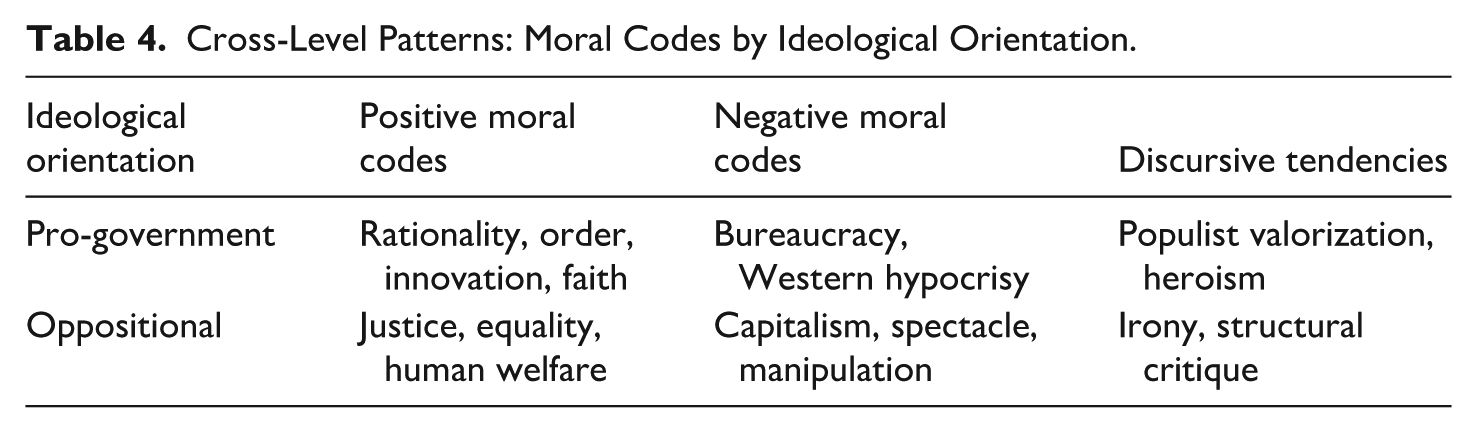
As Table 4 indicates, both ideological blocs moralize technology, albeit through divergent ethical vocabularies—one sanctifying innovation as virtue, the other condemning it as excess.
Debord’s (2024) theory of the spectacle helps to explain why Musk and Trump sustain discursive centrality across ideological divides. Their omnipresence in Turkish media confirms the logic of visibility as power: critique and celebration alike contribute to the maintenance of their symbolic capital. Meanwhile, Nye’s (2004) concept of soft power contextualizes the way pro-government outlets reframe Musk’s interactions with Turkey as evidence of global recognition. The attraction of Musk’s symbolic authority is not incidental but instrumental—part of a larger national narrative of technological self-assertion within the global hierarchy.
Together, these frameworks demonstrate that the ‘Musk Effect’ operates as a discursive formation (Foucault, 1972), wherein power, technology, and morality are continuously rearticulated through mediated performance. Turkish journalism thus emerges as a site where global narratives are domesticated, and domestic ideologies are projected outward through the language of global modernity.
Implications for Digital Public Diplomacy, Platform Power, and Media Ideologies
The findings hold significant implications for understanding the intersection of media ideology, digital public diplomacy, and platform-mediated power.
First, Musk’s representation illustrates how digital diplomacy in Turkey increasingly operates through mediated personhood rather than institutional communication. Pro-government outlets appropriate Musk’s charisma as a form of symbolic capital that validates Turkey’s participation in the global technological elite. This supports Sevin and Uzunoğlu’s (2017) observation that Turkey’s soft power strategy increasingly depends on narrative appeal rather than traditional diplomacy. In this sense, Musk functions as a proxy diplomat, his celebrity leveraged to communicate Turkey’s modernization project to both domestic and international audiences.
Second, the omnipresence of Musk and Trump in Turkish media underscores the hybridization of platform power (Couldry & Mejias, 2019). Their personas circulate simultaneously through global digital platforms and national media ecosystems, collapsing the distinction between local and transnational spheres of influence. Turkish newspapers amplify narratives that originate on Twitter or X, thereby participating in what Poell et al. (2023) describe as platformized journalism—a mode of news production shaped by algorithmic visibility and emotional virality. The ideological appropriation of Musk’s tweets—often treated as authoritative statements rather than performative provocations—reveals how platform dynamics increasingly mediate the moral economy of Turkish journalism.
Third, these dynamics expose the persistence of media ideologies that moralize technological power. As Spitulnik (1996) argues, media ideologies shape how societies imagine the role of communication technologies in moral and civic life. In Turkey, technology is consistently linked to virtue—whether as a symbol of divine order and self-discipline (in conservative narratives) or as a warning against capitalist excess (in oppositional ones). This convergence shows that the Turkish press, regardless of orientation, situates technology within a moralized epistemology of modernity, where progress is inseparable from righteousness.
Ambivalence and Reflexivity in Polarized Media
While the analysis reveals sharp ideological contrasts, it also exposes deeper ambivalences that complicate the binary of pro-government and oppositional media. These ambivalences reflect both structural features of the Turkish media system and the interpretive challenges of analyzing it. Across outlets, fascination and critique coexist: even when Evrensel and Sözcü denounce Musk’s capitalist excesses, they reproduce his visibility through detailed coverage and striking visuals. This paradox reflects Debord’s (2024) observation that the spectacle absorbs its own critique—the act of opposition still sustains the visibility economy it resists.
At the same time, the moralization of technology emerges as a shared discourse across ideological lines. Both conservative and progressive newspapers frame technological power in ethical terms, whether as divine order or moral failure. This convergence suggests that polarization in Turkish media does not necessarily produce epistemic fragmentation; rather, it sustains a moral coherence rooted in the belief that progress must be justified through virtue.
Reflecting on these patterns also demands reflexivity regarding the research process itself. As a researcher working within Turkey’s polarized media environment, interpretive proximity is both a resource and a limitation. Awareness of this positionality shaped the reading of irony, moral language, and political subtext throughout the analysis. In this sense, the ambivalences observed in the media discourse also mirror the analytical ambivalence inherent in studying one’s own media culture—where critique, identification, and distance constantly intertwine. Recognizing this reflexive tension does not undermine validity; rather, it situates interpretation as part of the same moral and ideological field it seeks to understand.
Synthesis
Interpreted through this theoretical lens, the ‘Musk Effect’ encapsulates the paradox of contemporary Turkish media: a system both polarized and interdependent, morally charged yet structurally aligned, critical yet complicit in the logics of spectacle and soft power. Through Musk and Trump, Turkish newspapers narrate not simply global events but the nation’s own negotiation with modernity—its aspiration to belong, its anxiety about dependency, and its faith in the redemptive promise of technology.
Ultimately, this study demonstrates that the ideological function of Turkish media lies not only in what it says about power but in how it makes power visible. By transforming global figures into moral allegories, the press performs the dual role of national interpreter and global participant—situating Turkey within the mediated imagination of a world where technology, charisma, and ideology have become inseparable.
Conclusion
This study examined how Turkish newspapers across the ideological spectrum—Yeni Şafak, Sabah, Sözcü, and Evrensel—construct Elon Musk and Donald Trump as symbolic resources for articulating national identity, technological modernity, and moral authority. Through a combined content and discourse analysis of 144 items, it demonstrated that these global figures are framed less as news subjects than as ideological instruments through which Turkish media negotiate their own visions of progress, virtue, and sovereignty.
The findings extend framing theory (Entman, 1993) by revealing that frames in polarized systems operate as moral and political categories rather than purely informational ones. They also refine Hallin and Mancini’s (2004) polarized pluralist model by showing that Turkish media polarization conceals a shared moral logic: across ideological divides, technology is framed as a field of virtue and legitimacy, where moral order replaces empirical evaluation. For pro-government outlets, Musk and Trump embody rational mastery and entrepreneurial nationalism; in opposition newspapers, they personify capitalist spectacle and systemic inequality. Yet both camps moralize technological progress, demonstrating that the boundaries between faith, innovation, and ideology remain porous within Turkey’s media discourse.
The Musk Effect as a Comparative Framework
Beyond the specific case of Turkey, the ‘Musk Effect’ offers distinct analytical utility for comparative political communication. It conceptualizes the mechanism by which semi-peripheral nations utilize transnational non-state elites to bypass traditional diplomatic hierarchies. By aligning with figures like Musk, state-aligned media can project an image of techno-sovereignty—the capacity to participate in the global technological future—without relying on the validation of traditional Western state actors.
This phenomenon is likely not unique to Turkey. The ‘Musk Effect’ provides a framework for analyzing similar dynamics in other media ecologies where populist leadership intersects with digital capitalism. Future research could productively apply this lens to contexts such as Brazil, where the tension between digital sovereignty and platform power has animated political discourse; India, where the domestication of Silicon Valley elites often dovetails with nationalist narratives of global ascension; or Argentina, where libertarian leadership has explicitly mobilized Musk’s symbolic capital to legitimize economic restructuring. In each case, the ‘Musk Effect’ suggests that the legitimacy of modern governance is increasingly mediated through proximity to techno-libertarian icons. Future studies might also productively employ the Spiral of Silence theory to examine how these techno-populist figures leverage social media algorithms to manufacture a perception of ‘silent majority’ support, effectively silencing dissent through the amplification of loyalist swarms.
Implications for Soft Power and Legitimacy
Ultimately, this study suggests a shift in how we understand soft power in the digital age. While Nye (2004) originally defined soft power as the ability to attract and persuade, for pro-government Turkish media, the utility of Musk is less about attraction and more about recognition. When Musk interacts with Turkish leaders or technology, he is framed as validating Turkey’s agency, transforming him from a foreign capitalist into a proxy diplomat for the nation’s modernization project.
Future research should explore how emerging AI elites and other global techno-political figures are integrated into similar moral and ideological frameworks, and how semi-peripheral media systems negotiate their participation in global techno-politics. As technology becomes an increasingly moralized domain of political imagination, the struggle over who defines innovation remains inseparable from the struggle over who defines legitimacy itself—both within nations and across the mediated hierarchies of the global public sphere.
Footnotes

Funding
The authors received no financial support for the research, authorship, and/or publication of this article.
Declaration of Conflicting Interests
The author declared no potential conflicts of interest with respect to the research, authorship, and/or publication of this article.