






Abstract
This article introduces the concept of “Activism by cop” to describe situations in which protesters deliberately elicit police response to generate symbolic images, media attention, and leverage responses from authorities. We argue that in contemporary protest contexts, protesters do not merely anticipate police repression, but actively stage, elicit, and choreograph intervention as part of a mediatized and interactional performance. Elicited interventions become part of a coordinated performance and democratic dance wherein protesters and police co-produce moments of confrontation, shaping political narratives and propelling struggles over legitimacy into public and political arenas. We analyze how protesters incorporate police intervention into their action repertoire through a case study of a Dutch protest (2025) involving ethnography, (video elicitation) interviews, and (social) media analysis. Based on our analysis, we theorize activism by cop as an agentic tactic that integrates moral claim-making, civil disobedience, and state interaction. Our analysis builds on literature regarding activist tactical choices and narratives, the “new visibility” of policing, and protest policing. We also show how police struggle with elicited intervention, and they respond with institutional logics of legality, order, and public legitimacy. This article demonstrates that policing styles and repression are not merely structural constraints but become tactical resources that activists deliberately and agentically activate to create, manipulate, and reconfigure the political opportunity structure through interaction with the state. In doing so, they actively engage with—and seek to reconfigure—the repressive dimensions of the political opportunity structure itself.
Introduction
On November 17, 2018, Extinction Rebellion (XR) orchestrated a high-profile blockade of five bridges in central London. In a short documentary
1
aired by The Guardian about the action, XR co-founder Roger Hallam is seen addressing a town hall, explicating his intended strategy as rejecting conventional forms of protest: Emailing, writing letters, going on a day march, it’s no good. We need about 400 people to go to prison, maybe need 2.000 or 3.000 people to get arrested. And I’m at the position where I’m going to go down in November because I’m ready, because you’ve got nothing else to lose.
After the meeting, Hallam sifts through completed questionnaires, counting how many people are willing to go to prison, and underscores the symbolic potency of an arrest: The action itself is not actually that important, it’s the going to prison which has got cultural resonance, as you might say.
In Hallam’s calculus, the act of being arrested is not a by-product of civil disobedience, but an objective in itself designed to create a powerful visual symbol, mobilize supporters, and pressurize authorities. 2 His explanation reveals a distinctive protest tactic: the deliberate elicitation of police intervention. Protesters act not merely to disrupt urban life and garner attention, but elicit police response to produce cultural resonance. The willingness to endure arrest and sacrifice personal liberty frames the action as a political statement, where the act of disruption (i.e., blocking bridges) recedes behind the symbolism of imprisonment—a form of embodied dissent invoking deep democratic and historical associations of sacrifice and struggle. Days later, Hallam reiterates his commitment to this strategy telling protesters at Parliament Square: “So I’m still taking you up on your offer to go to prison as well.”
In the documentary, a journalist observes the strategy of eliciting police intervention as activists declare: “I am willing to be arrested, I am willing to be jailed, and I can tell you something, I’m willing to die for this movement.” He subsequently asks a police officer: “They actually want to get arrested because they want to raise the profile of their issue. I mean, does that add dilemma in terms of policing?” The officer’s response captures the pragmatic, negotiated nature of policing: Well no, you know, we will only arrest people if we need to. Just because someone, if someone is going to take a course of action that facilitates, that necessitates an arrest then of course we’ll take it.
The activist’s morally grounded commitment sets the stage for an interaction with police that is as much about performance and meaning-making as about law enforcement and public order. In these moments, protesters and police co-produce scenes of confrontation that circulate rapidly through news and social media. We interpret these encounters as part of a “democratic dance”: interactional performances in which state authorities and protesters enact and contest the legitimacy of protest and policing. This interaction epitomizes this dance where police weigh tactical considerations, resources, and legal thresholds, while protesters sometimes strategically manipulate those responses for maximal political and public effect.
The day of the mass blockade in London further crystallizes these dynamics. After hundreds of protesters occupy a bridge, Hallam tells a British liaison officer at the scene: “I have a complaint, that the arrests are not happening quick enough.” In his response, the officer stresses operational limitations: “Unfortunately, there was too many of you and we may have run out of police officers at the minute until we get some more police officers.” Hallam then invokes historical precedent to push for expedited arrests before revealing the strategic purpose of the action:
“It’s just not acceptable. 1963, Birmingham, Martin Luther King campaign. The police, like, requisited buses from the bus company to arrest them.”
“More buses”
“Because we don’t really want to block the roads, we just want to get a load of people arrested, and then we can say to the politicians you know, a thousand people are happy to lose their liberty because we want some change.”
Hallam’s remarks illustrate a tactical logic: arrest is not an outcome but a sought-after media event produced through police intervention. To Hallam, protesters “can’t be arrested quick enough” as he continuously repeats he hopes “we’ll get a few more arrests.” Hallam and the officer continue to discuss how the arrests are to be sped up:
“They’ve got a bus”
“A bus did you say? Transportation to get everyone off the road?”
[nods]
“So they’re going to speed up a little bit now?”
“As you requested [smiles]”
Their exchange reveals the strategy of arrests as leverage to transform the protest into a high-visibility one, and becomes almost meta-theatrical—a protest leader negotiating the pace of police intervention, while the officer signals logistical limits: “we may have run out of police officers . . . .” The interaction forms a key part of the democratic dance: protesters deliberately risk arrest to convey commitment, expose state repression, and generate a visual and moral narrative aimed at influencing media coverage, public opinion, and political decision-makers. At the same time, police decisions must remain contingent, balancing public safety concerns with protester rights and operational capacity. The liaison officer ultimately concludes: “At this time, we are stopping any more arrests because we’ve got two of the bridges open, so therefore, we deem the threat to life not as high as it was.”
This case exemplifies what we term “Activism by cop”: a strategic protest tactic in which protesters deliberately elicit police response to generate symbolic images and media attention, and leverage responses from authorities and effects public opinion. Activists calculating with (police) repression as an outcome to benefit a movement has a long history, going back to Gandhi’s nonviolent protests (Glaeser & Sunstein, 2015; Ollitrault et al., 2019; Sharp, 1973; Vinthagen, 2015). Yet, we argue that contemporary protest contexts, particularly media infrastructures, intensify this dynamic by making police intervention more easily recordable, shareable, and strategically usable in real time through the ubiquity of smartphones, livestreaming, and social media circulation. Activists do not merely anticipate repression, but actively stage, elicit, and choreograph police intervention as part of a mediatized and interactional performance.
Following the analogy of “suicide by cop”—in which an individual provokes police into using lethal force (Jordan et al., 2020)—we introduce the concept of activism by cop to describe situations where elicited interventions become part of a coordinated performance. This shifts the analytical focus from police intervention as a potential outcome to a deliberately produced moment. We view this as part of a democratic dance wherein protesters and police co-produce moments of confrontation, shaping political narratives, contesting legitimacy, and propelling these struggles into public and political arenas. The interaction between Hallam and the officer illustrates that arrests, far from unwanted escalation, are collaboratively staged and their documentation circulates as potent visual symbols of political commitment and state response. Arrests are transformed from a punitive outcome into a strategic resource that activists intentionally orchestrate.
We theorize activism by cop as an agentic tactic that integrates moral claim-making, civil disobedience, and state interaction. We build on literature regarding activist tactical choices and narratives (Jasper, 2004), the “new visibility” of policing (Goldsmith, 2010), and protest policing (Della Porta & Fillieule, 2004; Earl & Soule, 2006; Wahlström, 2011). We draw on one particular Dutch protest case (2025), involving ethnography, (video elicitation) interviews, and (social) media analysis, to analyze how protesters incorporate police intervention into their action repertoire. We also show how police struggle with elicited intervention, and that they respond with institutional logics of legality, order, and public legitimacy.
The article contributes to debates on activists’ tactics and the policing of protests by illuminating how protesters and police make sense of each other’s actions, and navigate and contest narratives and interpretations of authority. We also contribute to a longstanding debate in political sociology about the relationship between political opportunity structures and activist agency. In political opportunity structure approaches, protest is shaped by the institutional and political context in which movements operate. This context structures which claims, tactics and strategies are likely to be effective, making protest more likely under conditions of partial openness and less likely under either full inclusion or severe repression (Tilly, 1978). While scholars such as Jasper (2004) have shown that activists always retain agency in deciding whether and how to act when opportunities or threats arise, we advance this insight by showing that activists not only respond to political and policing contexts, or anticipate repression, but can also produce them. Through what we conceptualize as activism by cop, protesters strategically elicit police intervention and coercive responses to generate visibility, shape media narratives, mobilize supporters, and exert political pressure. We demonstrate that policing styles and repression are not merely structural constraints but become tactical resources that activists deliberately activate to create, manipulate, and reconfigure the political opportunity structure through interaction with the state. In doing so, they actively engage with—and seek to reconfigure—the repressive dimensions of the political opportunity structure itself.
The Contemporary Protest Landscape: Protest Tactics and Protest Policing
Protests are surging throughout the world (Van Stekelenburg & Klandermans, 2024). Movements such as XR, Just Stop Oil, and pro-Palestine have intensified civil disobedience and non-violent direct action, turning streets, campuses, and public institutions into key sites of political contestation (Keesman, 2024, 2025). Recent research documents a shift toward more confrontational actions such as blocking infrastructure and targeting cultural institutions that maximize visibility by directly engaging authorities, particularly the police (Busher & Wahlström, 2023; Fillieule & Accornero, 2016; Gurr, 2015; Hutter & Teune, 2021; Tufekci, 2017).
Protest tactics range from marches and petitions to more disruptive forms such as blockades, occupations, and sit-ins (Della Porta & Diani, 2006). Within this repertoire, civil disobedience plays a central role. As a form of intentional law-breaking, civil disobedience is not only a tactic of disruption but also a communicative and strategic practice aimed at exposing injustice and eliciting societal and political response (Bedau, 1969; Berglund, 2023; Rawls, 1971). It is intended to signal dissent and provoke reaction, and thus operates as a moral claim and strategic intervention, combining normative critique with what Vinthagen (2015) described as “principled pragmatism.” Through civil disobedience, protesters may aim to generate a response from authorities that reveals the character of a regime, amplifying public concern and potentially mobilizing broader support (Glaeser & Sunstein, 2015). Protesters often strategically calibrate their actions to elicit intervention without undermining their own legitimacy. Wang and Piazza (2016; see also Gayle, 2023) argued that while disruption can challenge power, attract media attention and mobilize supporters, it also risks alienating the public and provoking further repression. Sharp (1973) referred to this as “political jiu-jitsu,” indicating that repression can both backfire and strengthen a movement.
In contemporary media-saturated political environments, protest tactics are not merely instruments of disruption but become key mechanisms for generating visibility and political leverage. While video activism has long served to document dissent, contest state narratives, and mobilize public and political support (Monahan, 2006; Wilson & Serisier, 2010), the scale, speed, and participatory nature of mediated protest has changed significantly. Livestreams and smartphones have created a decentralized visual ecosystem in which protesters document, curate, and circulate contentious encounters. Social media platforms further shape these dynamics by producing what Luhtakallio and Meriluoto (2024) called “visuality-based public spheres,” in which political relevance is increasingly tied to visibility, circulation, and affective resonance. Protest events are often designed with “Insta-worthiness” and shareability in mind (Caldeira et al., 2021), privileging highly symbolic and emotionally charged moments such as standoffs, arrests, or the spectacle of police intervention.
Images have always been central to how social movements perform and communicate dissent, including the public display of WUNC—worthiness, unity, numbers, and commitment (Tilly, 1978)—but social media have intensified, diversified, and accelerated their circulation, turning visuality into a key arena in which protest meaning, legitimacy, and collective identity are constructed (Mattoni & Teune, 2014). Qualifying protest now increasingly hinges on the capacity to generate visibility, attention, and followership; powerful action is action that can be styled and framed as noticeable, urgent, and shareable (Hopster, 2021). Algorithmic infrastructures reinforce this logic by privileging spectacular and emotionally charged images, particularly those depicting conflict and violence, which circulate faster and more widely than less dramatic content (Hoffmann & Neumayer, 2025). This logic can be strategically exploited not only by activists but also by political actors who use visual framings of disorder to portray certain movements as chaotic or illegitimate while positioning themselves as guardians of law and order.
These confrontational actions and their (biased) media coverage have fueled stronger state responses, politically driven repression including new legislation and criminalization of protest in countries such as the United Kingdom and France (Fillieule et al., 2025), raising concerns about shrinking civic space and the right to protest. Protest is increasingly framed as a threat to public order, intensifying cycles of provocation and repression. While activists have always anticipated repression as part of protest, we argue that—amplified by the new visibility of policing and the mediatization of protest—eliciting police intervention has evolved into a pronounced protest strategy to generate symbolic images, moral claims, and political and public leverage. With police increasingly operating under conditions of maximal visibility—where interventions are recorded, circulated, and morally evaluated—protests are becoming performative struggles over how disorder, dissent, and authority are publicly and politically interpreted.
Protest Tactics: Moral Claim-Making, Civil Disobedience, and “Activism by Cop”
We introduce the concept activism by cop to describe situations in which protesters deliberately elicit police response to generate imagery that amplifies their claims, gain media attention, mobilize supporters, and elicit responses from authorities. The relevance of the analogy of “Suicide by cop” does not lie in equating activist tactics with self-destructive intent, but in highlighting the strategic eliciting of state force. In both cases, police intervention is not a by-product of the interaction, but the very mechanism through which meaning and impact are generated. In contemporary protests, this unfolds within a media-saturated and politically polarized environment in which moral claim-making, civil disobedience, and activism by cop operate as strategic mechanism of contention. Moral claims articulate why activists act; civil disobedience structures how they apply pressure; and activism by cop determines what becomes publicly visible by transforming police intervention into a media event. Together, these elements produce a field of moral confrontation in which legitimacy, interpretation, and public sympathy are not merely contested on the street but constructed through mediated encounters between protesters and the state.
Moral claim-making, as conceptualized in framing theory, refers to activists’ production of normatively laden diagnostic and prognostic frames that construct injustice, responsibility, and necessary action (Benford & Snow, 2000). These moral claims not only articulate a movement’s normative horizon but also function as a strategic resource that activates moral intuitions among bystanders, mobilizes supporters, and pressures institutional actors (Galvin, 2019). As Jasper (1997) argued, the moral logic of protest is inseparable from emotional and cognitive processes that shape actors’ strategic repertoires; reflecting this logic, an XR activist stated that she feels morally obliged to escalate to more radical actions when other methods fail to deliver results, because “without pressure, unfortunately, nothing changes” (NOS, 14 November 2021). 3
Civil disobedience operates as both a communicative and performative extension of these moral claims. Rooted in traditions from Rawls (1971) to contemporary critical theorists like Celikates (2016b), civil disobedience is widely understood as a public, conscientious breach of law intended to expose structural injustice and compel democratic responsiveness. Rather than being merely instrumental, it embodies moral claim-making: it dramatizes the disproportion between the normative commitments activists articulate and the institutional failures they seek to contest. Civil disobedience thus functions as a moral amplifier that increases the resonance, clarity, and urgency of moral claims.
Within this strategic constellation, activism by cop represents a more controversial yet theoretically significant tactic. Building on insights from the political process tradition and the study of repression (Della Porta & Fillieule, 2004; Earl, 2011), it involves intentionally adopting protest forms likely to trigger police intervention. This mechanism leverages what McAdam (1983) termed “backfire dynamics” and what contemporary scholars would describe as repression-generated mobilization (Earl, 2011). Police intervention produces high-stakes visual and emotional cues, which (social) media logics, readily amplify. As a result, repression becomes part of a deliberate strategy to visibilize state overreach, expose inequalities in the policing of dissent, and reinforce activists’ claims about the moral and political stakes of the conflict. We argue that activism by cop is a form of strategic dramaturgy that relies on predictable patterns of state response to strengthen the moral authority of the movement. Importantly, tactics aimed at eliciting police intervention are not uniformly embraced within movements: strategies are often debated and contested (e.g., XR’s emphasis on arrestability has generated criticism about exposing vulnerable participants to disproportionate risk or that mediatized confrontational tactics foreground spectacle over substantive claims, alienating potential supporters). We treat activism by cop not as a consensual movement strategy, but as a strategy whose adoption also includes internal struggles over effectiveness, inclusivity, risk, and political meaning.
Drawing on Jasper’s (1997) The Art of Moral Protest, we understand protests as a form of moral action in which claims, emotions, and strategic interactions mutually reinforce each other. Jasper shows that activists mobilize through moral vocabularies, strategic choices, and emotion work—but his mechanism of “moral shocks” does not fully capture the dynamics we observe. Rather than materializing shocking events or reinterpreting spontaneous confrontations, activists deliberately engineer conditions under which state actors reveal their coercive power. Civil disobedience thus becomes not only a moral performance but also a calculated tactic to provoke predictable police responses. This is where activism by cop adds to Jasper’s framework: police intervention is intentionally invited to produce morally legible moments that validate activists’ claims, activate emotions such as indignation and solidarity, and shift public interpretations of legitimacy. Instead of reactive framing after a shock, activism by cop constitutes a proactive strategy that integrates moral claim-making, civil disobedience, and state interaction into a single field of moral confrontation. While activists typically anticipate repression as a potential resource, we argue that contemporary media infrastructures enable them to capture, circulate, and strategically time these interactions, making eliciting police intervention a central protest strategy.
Protest Policing: New Visibility, “Insta-Worthy” Protests and The Battle Over Public Image
Protest is inherently performative. Celikates (2016a) argued that civil disobedience is a performative practice of public contestation, situated between symbolic politics and real confrontation. From a cultural-sociological perspective, Alexander (2011; see also Alexander et al., 2020; Çıdam et al., 2020) conceptualized protest as a social performance in which activists stage truth-claims and moral narratives, and Juris (2008) noted that direct action is a form of “performing politics,” where activists embody their claims through visible, affective, and symbolic practices. In his ethnography of anti-corporate globalization activism, Juris (2005) showed how performativity unfolds through digital infrastructures (e.g., email lists, open‑publishing platforms) to “generate alternative information” and upload real‑time documentation of police actions, contesting official narratives and circulating counter‑images. Indeed, protest events function as image events that communicate messages and generate emotions, identities, and solidarity. Recent research also underscores the performative dimension of civil disobedience. Berglund (2023) showed that disruptive protest carries a prefigurative, performative legitimacy, as activists enact alternative democratic futures through disruptive acts. This aligns with the increasing mediated nature of protest, where visibility becomes a strategic terrain in the interaction between protesters and police.
The shift toward digitally mediated action intersects with the transformation of policing from a relatively low‑visibility occupation to high-visibility one (Sandhu & Haggerty, 2015). The proliferation of smartphones, citizen journalism, and digital platforms has rendered police-civilian encounters increasingly recordable, shareable, and publicly contestable (Brown, 2016; Greer & McLaughlin, 2010). This transformation—what Goold (2003) termed the “panopticization of the streets”—has subjected everyday policing to continuous scrutiny, with highly mediated incidents intensifying public engagement regarding legitimacy, accountability, and just policing (Goldsmith, 2010). Thompson (2005) argued mediated visibility has become a political weapon: through practices of sousveillance or counter-surveillance, civilians can challenge official narratives and partially rebalance asymmetries of power between police and citizens (Friis Søgaard et al., 2022; Newell, 2014). Although this does not eliminate police authority, the diffusion of cameras has altered the dynamics of policing on the ground.
Through Insta-worthy tactics and the filming of police interventions, contemporary protests increasingly oscillate between street and screen, producing a hybrid public arena in which sounds, emotions, and tempos of contention are translated into shareable visual performances that construct the protest’s political meaning, urgency, and determination of the protesters. The same visibility that disciplines citizens, that is, panopticization, can thus also be strategically used by activists to render police actions visible and to generate public attention and moral leverage. Visual media are therefore not a neutral backdrop to the democratic dance between protesters and police, but an integral component of its choreography, shaping how confrontations unfold, how they are interpreted, and how legitimacy is negotiated (Campeau & Keesman, 2024). In this highly contested field—where pressures to criminalize and repress protest collide with claims about the fundamental right to demonstrate—the battle over public image has become a central terrain of contemporary protest policing (Keesman, 2025; Van Stekelenburg, 2023).
For activists, repression thus shifts from a mere constraint within the political opportunity structure to a strategic resource: within today’s media ecology, protesters challenge the police not only physically or organizationally but also reputationally and symbolically. Through livestreams, viral clips, and carefully staged Insta-worthy confrontations, police interventions are transformed into publicly circulating performances that invite moral and political evaluation (Friis Søgaard et al., 2022; Goldsmith, 2010; Newell, 2014; Thompson, 2005). Arrests, removals, and uses of force become visual claims about injustice, repression, and democratic breakdown, often travelling more widely and rapidly than official police narratives (Brown, 2016; Greer & McLaughlin, 2010).
This development adds a crucial new dimension to what Earl and Soule (2006) theorized as situational threat. Although their “blue approach” showed that police repression is shaped primarily by the immediate (local) risks protesters pose to officers responsible for maintaining order, in today’s mediated protest environment, police must also anticipate the reputational and political consequences of how their actions will appear when recorded, shared, and interpreted by public and politicians (Campeau & Keesman, 2024; Sandhu & Haggerty, 2015). Visibility thus becomes a tactical resource for activists: even routine enforcement may be reframed as excessive, illegitimate, or abusive once rendered into viral images and circulated through social media networks (Goldsmith, 2010). Research on increasing forms of dialog policing to combat this (Gorringe et al., 2012; Wahlström & Oskarsson, 2006), showed that such approaches are contested: at COP26 in Glasgow, protesters actively resisted engagement with police as they felt undermined (Gorringe et al., 2024a; 2024b; 2025).
It is precisely this visibility that contemporary activists exploit through what we term activism by cop. By provoking police intervention under conditions of maximal visibility, protesters transform policing as repression into a strategic resource, mobilizing mediated images of arrest, removal, or confrontation as evidence of moral commitment and state repression (Monahan, 2006; Wilson & Serisier, 2010). In this mediatized democratic dance, protesters and police co-produce moments of confrontation in which, importantly, the role of the police itself is shifting. Although police have traditionally acted as executors of state authority tasked with facilitating or constraining protest, activism by cop increasingly positions them as actors whose interventions are strategically elicited by protesters seeking visibility, media coverage, and moral leverage. Protesters actively draw police into the scene, turning police action into a central element of the protest’s dramaturgy and into a focal point of its struggle over visibility, legitimacy, and political meaning—a struggle that is ultimately played out not only on the street but in its mediatized afterlife as well, the battle over public image, where legitimacy, authority, and the right to protest are publicly contested (Keesman, 2025; Van Stekelenburg, 2025).
Empirical illustration: Democratic Dance and Activism by Cop
To illustrate how activism by cop operates, we analyze a Dutch protest episode (2025) from XR. This episode became a focal point for media, public and political debate about the legitimacy of protest actions and policing tactics.
We used a multi-method approach combining ethnographic fieldwork at protest sites and during police patrols, semi-structured and video-elicitation interviews with protesters and officers, and analysis of (social) media content (on the video-elicitation method see Keesman, 2022). Participant observation captured in-situ interactions, while interviews elicited intentions and interpretations. Media materials—livestreams, participant footage, and news coverage—were analyzed to trace how confrontations were visualized, circulated, and contested. Analytically, we examined (a) protest–police interactional dynamics, (b) strategies to render police intervention visible and politically legible, and (c) the mediatization of these encounters, using thematic coding across all data sources. In doing so, we connected on-the-ground practices with post-hoc interpretations and mediated representations—providing insight into the interactional choreography of the strategic use of police intervention as a protest tactic.
“Let’s Wait a Little Longer”: XR Activists Anticipating Police Intervention
Ijmuiden is a crucial Dutch maritime hub, where the world’s largest sea lock controls the passage of commercial, cargo, and cruise vessels between the North Sea and inland waterways. In August 2024, Extinction Rebellion (XR) repeatedly blockaded the Ijmuiden locks to protest the cruise industry, first halting the Jewel of the Seas on August 9 to 10, then the Seven Seas Mariner on August 11, and later multiple vessels on August 18. At the lock, protesters positioned themselves at the entrance, with some locking on, which both blocked operations and—according to police—posed serious risks to their safety, prompting intervention (see Figure 1).
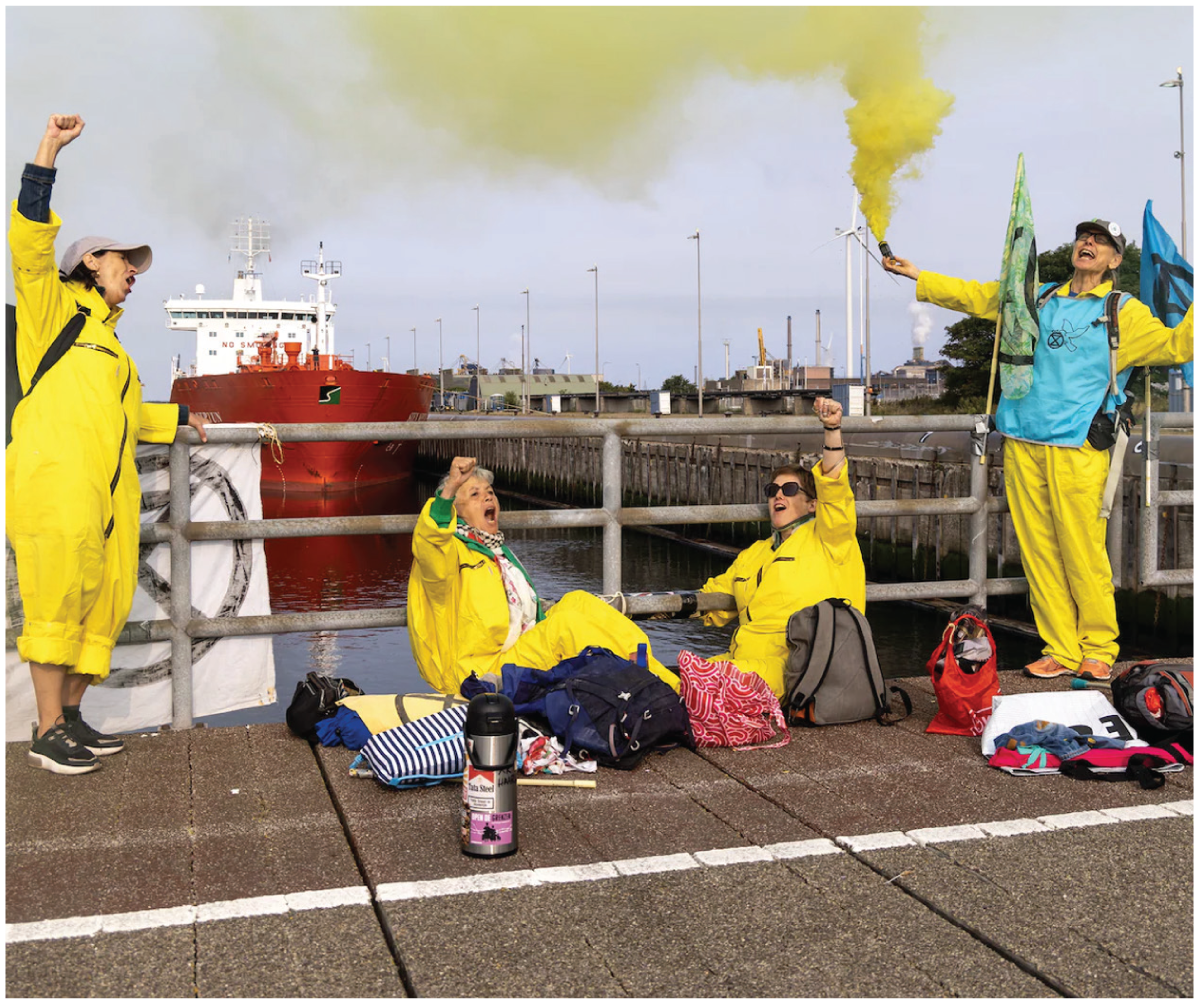
Protesters locking themselves on.
Police also intervened on safety grounds when locals—many of whom, often for generations, depend on the locks and shipping for their livelihood—mobilized to oppose XR’s actions, leading to heated debates and occasional altercations. The mayor and police described these counter-mobilizers—“Angry Ijmuidenaren,” some known from earlier clashes with XR at Tata Steel Ijmuiden—and feared they might push activists into the locks, creating a tense and antagonistic atmosphere (Figure 2).
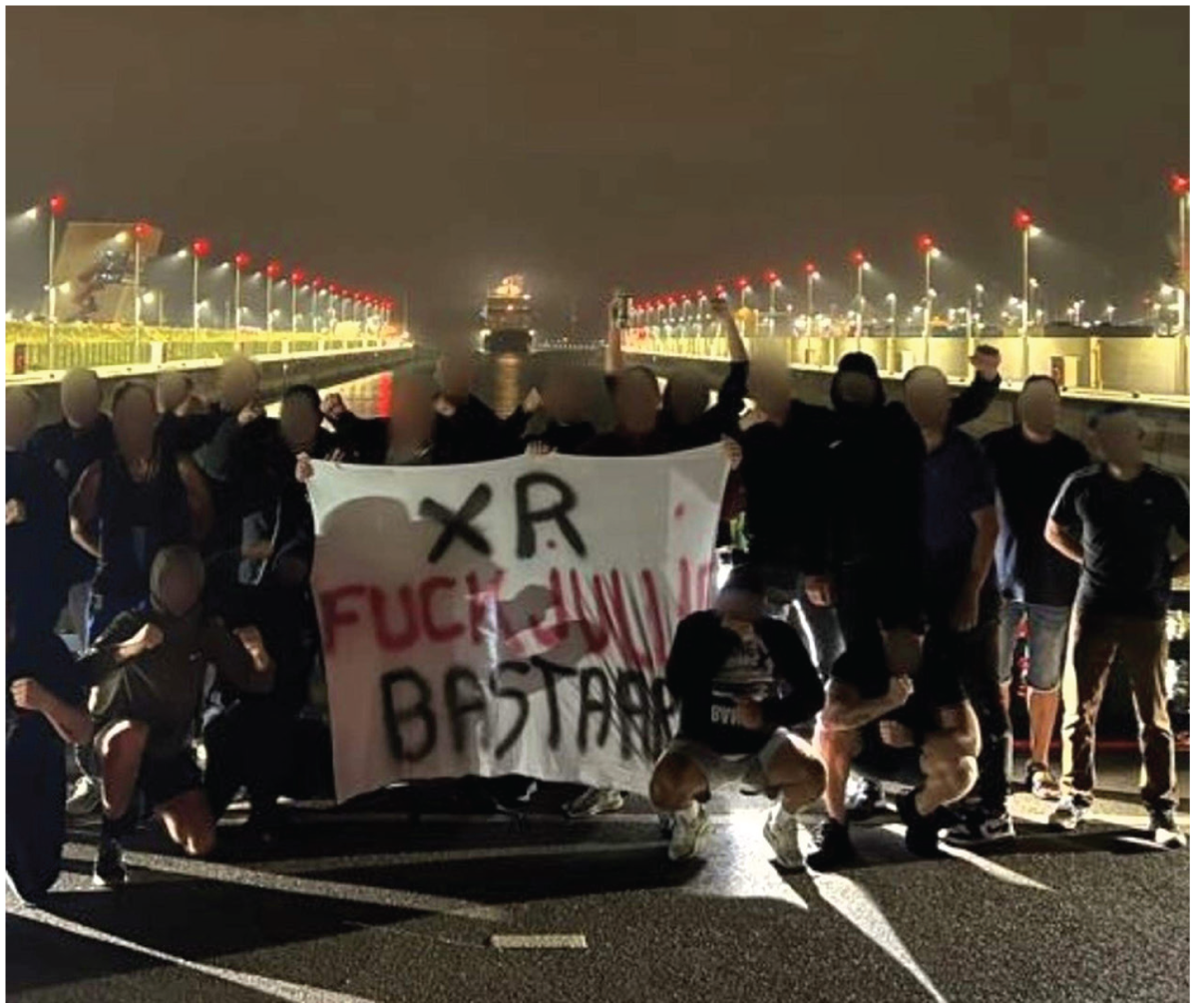
“Angry Ijmuidenaren.”
Together, this high risk of confrontation and police deployment increased the protest’s newsworthiness. On the day of one of the protests, the by XR anticipated police presence was initially present only in a low-profile capacity. Protesters explicitly remarked on the absence of the riot police, whose deployment they had expected given the combination of a disruptive action to lock themselves onto the locks and potentially openly hostile counterdemonstrators. As time passed, and police maintained their low-profile presence at distance, the protesters remained in place, periodically discussing whether to continue or to leave. When they began to consider ending the action, a police van—interpreted as a riot vehicle—passed by. Protesters were overheard by officers in the van saying, “There’s the riot police, let’s wait a little longer . . . ” and consequently remained at the site. Police likewise noted that protesters seemed to recalibrate their plans in response to the possibility of police engagement.
This episode illustrates how the mere anticipation of police involvement, signaled through the passing of an allegedly identified riot police vehicle, became a decisive factor in protesters’ tactical decision-making. In line with the activism-by-cop logic, this interaction reveals how protest actions are adjusted in response to perceived police readiness, with the prospect of intervention itself becoming an integral part of the protest’s performance. Indeed, protesters often express that they hope their protests will make the news, like this XR activist: “If we break the law or if the police have to intervene, there is a greater chance that it will appear in the media.” He notes that civil disobedience, especially when it provokes police action, significantly increases the visibility of their actions and journalists engaging. Later on, the same activist explains about site selection: We choose that location because we know the media will come. . . if we break the law and the police have to act, there is a greater chance it will make the headlines, and with it, the arrests, but also the message we are trying to convey.
This is a strategic logic: protests are staged to maximize the likelihood of police engagement and subsequent media coverage, with peaceful law-breaking used strategically to generate images that amplify the movement’s claims.
This strategy behind site selection, locking sea locks for cruise boats, fits XR’s broader strategy of targeting highly visible critical and symbolic infrastructure, where circulating images, often broadcasted by XR’s own livestreams on XRTV Live 1, 4 turn moral claims and activist commitment into confrontational pressure with and on the state. Strategically, the locks function as a key infrastructural bottleneck, where disruption produced immediate economic and logistical consequences, while symbolically, by targeting cruise vessels rather than commercial or cargo ships, XR turned the disruption into a moral claim and gave it highly newsworthy visibility. XR made this explicit in its framing of the cruise actions, 5 calling for the immediate abolition of the cruise industry in response to an “urgent and rapidly escalating climate and ecological crisis,” and condemning cruise travel as “exorbitant and unjustifiable luxury” in “a world where the Global South already bears the everyday costs of climate breakdown.” By blocking sea locks, XR staged moral claim-making through civil disobedience, while images of glued-on activists against a blocked cruise liner condensed moral urgency, activist commitment, and political demand into a single powerful, media frame.
Media visibility has always been seen as a crucial component of getting a message across, but in recent years its importance has become amplified by the mediatization of protest. Even coverage that is negative or frames actions as confrontational is, according to an activist a necessary evil: “It is important that the message comes across. Even if the coverage is negative, that frame is already expected. If we were to stop exercising our rights just because it generates such media attention, then we would have lost.” Visibility itself is treated as a tactical resource, independent of the tone of coverage, reinforcing the centrality of strategic civil disobedience in contemporary activism.
This approach is also evident in large-scale infrastructure protests such as the XR highway blockades in the Netherlands. The same activist reflects: Civil disobedience is deployed to generate attention. . . a deliberate law-breaking, but peaceful, with no violence. We are exercising our rights, and the location is strategic—between VNO-NCW, the Ministry of Economic Affairs, and the Dutch parliament—so we reach our intended audience. The fact that it is likely to attract media attention is, in principle, a positive side effect.
Activists are thus highly attuned to the visual dimension of their actions, deliberately designing them for news and social media circulation. They adapt tactics based on anticipated media attention: more spectacular or disruptive actions are deployed when it is likely to maximize visibility, while remaining within the boundaries of non-violence.
Researchers in the Netherlands 6 observed that protesters are aware of how these dynamics influence perception, and the elicitation of police intervention is often central to generating the desired visibility. They seem to increasingly deliberately push the boundaries of the law to draw attention to their cause. Take high-profile climate activist Hannah Prinsen, she stated that by repeatedly engaging in disruptive protest actions in which arrest was an anticipated outcome, she treats detention not as an accidental consequence but as an integral part of her moral duty to bear witness and to escalate pressure for climate action. By calibrating when and how they provoke police responses, activists thus turn law-breaking and confrontation into strategic tools to ensure their message reaches a wider public. These observations underscore a consistent tactical logic: protesters do not simply respond to police presence, but actively anticipate, elicit, and stage it, integrating resulting interactions into the broader performative and mediatized choreography of protest. Police intervention, whether immediate or delayed, is a central element in shaping visibility and amplifying the activists’ claims.
Police officers expressed deep frustration with their role in these protests, feeling that their presence was being instrumentalized for political purposes, and they were deployed to manage what was fundamentally a political rather than a policing problem (see also Keesman, 2025). The previously mentioned highway blockage case illustrates how officers increasingly interpreted repeated XR actions through a dramaturgical lens. During the 40th blockade, police unions and spokespersons publicly framed the protests as a “toneelstuk” (theatrical performance), with officers cast as unwilling participants in a scripted confrontation. In a primetime talk show, police union leader Jan Struijs quoted an officer who remarked: “I don’t want to take part in this play; otherwise I would have gone to drama school instead of the police academy.” This captured a widely shared perception that XR’s tactics deliberately pulled the police into a mediatized performance designed to generate visibility and political pressure, rather than facilitating or constraining a demonstration. Struijs’s successor, Nine Kooiman, echoed this frustration by describing the police as a “glorified towing service” sent to “clean up political messes,” even suggesting that officers should “just let them sit and call us only when it escalates,” since reduced intervention would also mean less media attention. In this way, policing became entangled in a broader struggle over public image, legitimacy, and political meaning, rather than simply protest policing.
Discussion and Conclusion
This article introduced the concept of activism by the cop to capture how contemporary protest increasingly incorporates policing itself into the repertoire of contention. Rather than treating police intervention as a structural constraint, protesters strategically engage, challenge, and sometimes provoke it in order to generate visibility, moral claims, and political leverage. This dynamic reflects a broader transformation in contemporary protest, in which protest unfolds within a highly mediatized, polarized, and juridified public sphere (Keesman, 2025; Van Stekelenburg, 2025).
While eliciting police response by activists’ counting on beneficial outcomes is not new, we argue that the increased mediatized landscape of protests and protest policing has intensified moral claim-making, civil disobedience, and activism by cop as a strategic mechanism of contention. This interaction disrupts the classical “democratic dance” of protest and policing, in which demonstrations are facilitated, and confrontation is followed by repair through dialog, de-escalation, and mutual recognition of democratic legitimacy. Activism by cop undermines this cycle by making repression itself politically valuable. When police intervention is framed as evidence of democratic erosion or human rights violations, facilitative gestures lose symbolic force, may be read as weak policing, or are simply not observed. This is reinforced by political and public discourses that portray protesters as irresponsible or illegitimate, thereby narrowing the space for genuinely facilitative policing.
Thus, activism by cop poses a profound operational and normative dilemma for the police. Dialogue-based and facilitative policing presuppose a shared commitment to de-escalation and communicative exchange. Yet in contemporary protest ecologies—characterized by heterogeneity, loose coupling, and digitally mobilized sub-groups (Van Stekelenburg & Klandermans, 2024)—some actors may be strategically invested in provoking enforcement rather than avoiding it. This places police in a double bind: intervening risks producing the very images activists seek, while restraint risks loss of control and public legitimacy. Navigating this tension—between strategic provocation and the protection of the right to demonstrate—has become one of the defining challenges of protest policing in the current conjuncture.
Crucially, activism by cop cannot be reduced to either activist agency or police behavior alone. It emerges from their interaction within a specific and polarized structural and discursive context. Activists operate in an environment marked by declining institutional responsiveness, political polarization, and media logics that reward disruption and spectacle. Police, in turn, are embedded in political and legal regimes that increasingly frame protest through risk, security, and liability rather than as a democratic practice to be facilitated (Keesman, 2025). Both sides act with this context in mind: protesters anticipate how police intervention will be interpreted by media, publics, and politicians, while police anticipate political backlash, legal exposure, and reputational risk. Within this shared field of expectations, escalation becomes a rational strategy for activists seeking visibility and moral authority, while control and juridification become rational strategies for authorities seeking governability.
In this reflexive environment, the battle over public image becomes central. Social media and real-time video transform protest–police encounters into contests over meaning that extend far beyond the street. As the National Ombudsman and Amnesty International have noted, selective and sensational images often overrepresent disorder and underrepresent the overwhelming prevalence of peaceful protest. Activism by cop exploits this asymmetry: images of forceful policing become “empirical bridges” that translate abstract grievances into embodied claims about repression, democracy, and rights.
Finally, the democratic dance as structure–agency perspective developed in this paper has important methodological implications. If activism by cop emerges from the interaction between activist strategies and repression as institutional constraints, it cannot be captured through macro-level indicators such as protest counts, use of police force, or incident statistics, nor by focusing solely on either police or activist tactics. It requires a multi-level, multi-actor, and multi-media approach that attends to the micro-level where the democratic dance unfolds: the situated encounters between protesters, police officers, stewards, mayors, journalists, and online audiences in and around concrete protest moments. Activism by cop operates in these micro-dynamics, where a baton, a drone, a shouted warning, or a viral clip can reframe an entire protest. Studying mere outcomes (arrests, bans, or court rulings) therefore misses the crucial processes through which escalation, learning, or repair are either produced or foreclosed. Moreover, it is in these interactions that structure becomes visible as practice—how officers interpret risk, how activists test boundaries, how facilitative gestures are read as weakness or legitimacy, and how escalation or restraint is immediately translated into images and narratives. Without analyzing the situated encounters in which the “democratic dance” actually unfolds, the strategic logic of activism by cop would most likely have remained largely invisible to us.
Footnotes

Funding
The authors received no financial support for the research, authorship, and/or publication of this article.
Declaration of Conflicting Interests
The authors declared no potential conflicts of interest with respect to the research, authorship, and/or publication of this article.