







Abstract

Alexithymia, a cognitive deficit in the experience of emotion, is associated with emotional dysregulation. Alexithymia as measured with the 20-item Toronto Alexithymia Scale (TAS-20) has been widely studied and related to a good number of clinical outcomes, both self-reported and observer-rated. However, it is not clear what kind of cognitive deficits the TAS-20 actually assesses and how they translate into “real-life” problems of emotion regulation. This study is an attempt to shed further light on the mechanisms involved in alexithymia and to evaluate how these mechanisms contribute to an experimentally induced performance of emotion regulation in a prospective design. The study has been supported in part by the APsaA Fund for Psychoanalytic Research.
Background
The original formulation of alexithymia, stemming from the psychoanalytic observation of psychosomatic patients, emphasized a deficit in mentalization. The emblematic alexithymic patient suffered from what French psychoanalysts called operatory thinking (pensée opératoire), a profound “cognitive” deficit produced by the eradication of emotional representations. For those French analysts, the unavailability of representations for emotions was due to the massive use of a primitive form of suppression (répression in French) that weakened the preconscious system of operatory patients. The thinking of these extremely alexithymic individuals was found to be concrete and action-based. This formulation of alexithymia views it as the result of a deficit in representation and cognition.
Later formulations introduced the notion of a reversible form of alexithymia brought about by the defensive avoidance of emotional representations. A regression in affect differentiation and desomatization was seen as a way to cope with trauma or excesses of negative affects. Alexithymia was seen not as a deficit in representational resources, then, but as the manifestation of a defensive process. In empirical research studies, dissociation, primitive defenses, and neurotic defenses, usually measured using questionnaires, have also been found to be related to alexithymia.
So what kind of alexithymia does the TAS-20 assess? Clinicians often have the “operatory” kind of alexithymia in mind when imagining clinically significant alexithymia. It is doubtful, however, that this kind of alexithymia would characterize the significantly alexithymic individuals found in student populations, where levels of “true” alexithymia can reach 10.9%. It is also doubtful that a self-report approach could adequately reveal significant deficits in representation and cognition.
This study explores the mechanisms underlying the reduced access to representations of emotions (cognitive or defensive) in alexithymia as measured with the TAS-20 by using a situation of experimentally induced sadness. Methodologically, the study does three important things: (1) it uses a prospective design, measuring alexithymia before the evaluation of the quality of emotion regulation, thus clarifying the relationship between alexithymia and regulation (when alexithymia and its regulation outcome are measured at the same time, it is not possible to determine if alexithymia is the cause or the result of the emotional condition). (2) It assesses the regulation process with an observer-rated method. (3) It forces a “live” performance of emotion regulation by use of an experimental procedure (induction by film). We hypothesize that alexithymia will be more strongly associated with defensive mechanisms given that the sample is composed of undergraduate students in a psychology program and that the regulation task is benign.
Method
Participants and procedure
One hundred twenty-eight undergraduate students (86% female, mean age = 22.8 years) first completed a series of self-report questionnaires online, which included the TAS-20 and a short version of the Defensive Style Questionnaire. The participants were then seen individually and asked to complete the PANAS (see below); to view the initial three minutes of Kenneth Lonergan’s 2000 movie You Can Count on Me, which depicts two children crying at their parents’ funeral; to complete the PANAS again; and to describe their emotional reaction to the film excerpt. The interviewers were a female and a male graduate student with clinical experience. The interviewers were instructed to help the participants clarify and elaborate their response. The interviews, which lasted from ten to fifteen minutes, were recorded and transcribed. The interviews ended after three verbal fluency tasks were performed. After a participant left the room, the interviewer rated aspects of the participant’s observable reactions to the interview with scales designed for this study. Both interviewers were blind to the questionnaire data and hypotheses.
Measures
The Positive and Negative Affect Schedule (PANAS) is a 20-item scale that measures the dimensions of negative affects (10 items) and positive affects (10 items). Four items on sadness, taken from the instrument’s original item pool (PANAS-X), were added. The mean of these four items was used to evaluate the experience of sadness before and after induction (sadness induction = post – pre).
The Toronto Alexithymia Scale (TAS-20), a 20-item measure of alexithymia, evaluates three factors: F1, difficulty identifying emotions; F2, difficulty expressing emotions; F3, externally oriented thinking. A cutoff score of ≥ 61 indicates the presence of significant alexithymia. The total score was used here.
The Defensive Style Questionnaire (DSQ-20) is a selection, based on factor analyses obtained from an earlier student sample, of 20 items from the DSQ-60, which because of its factorial instability was not used. These items formed seven scales: adaptive, humor, altruism, image distortion, isolation of affect, splitting, and physical isolation. Only the two scales most strongly associated with alexithymia and the postinduction scales were retained (isolation and splitting).
To quantify postinduction interviewer observation of participants’ emotion regulation, 31 items to be rated on a 9-point Likert scale were created for the interviewer’s assessment of manifestations of emotion regulation in the participant during the postinduction interview. The items cover aspects of cognitive elaboration, emotion avoidance, and fear of expression of emotions. Nine interviewer observation items were significantly correlated with alexithymia at r above .24, and a factor analysis found that they formed a single factor explaining 61% of the variance. These items were divided into two conceptually distinguishable scales: cognitive complexity (e.g., interviewer observed a complex emotional life: α = .88, 4 items) and emotion avoidance (e.g., interviewer observed a denial of emotions: α = .86, 5 items).
In the verbal fluency tasks, participants were asked to give as many different words as they could in 60 seconds that (1) begin with the letter p; (2) name animals; (3) name negative emotions. The only task associated with alexithymia or the postinduction scales was the number of negative emotion words.
Findings
Participants presented the following levels of alexithymia (mean total score = 44.2, SD = 11.0; n = 12 or 9.4% = alexithymic). Induction of sadness was successful, with a significant difference between pre- and postinduction measurements of sadness (Cohen’s d of .56, which indicates a medium effect).
Cognitive complexity and nonavoidance of emotion were strongly correlated (see Table 1: r = .76**), which was expected because they both initially formed a single factor. However, both scales were slightly more correlated to their expected cognitive or defensive target: cognitive complexity was more strongly related to fluency of negative emotion words (n = 87, r = .26* vs. r = .18), and nonavoidance was more strongly related to isolation of affect (r = –.34** vs. r = –.28**). The latter comparisons were presented in order to support the concurrent validity of the observer-rated scales. However, the comparisons tend to indicate that the two factors are more similar than different.
Correlations among the variables used in the study
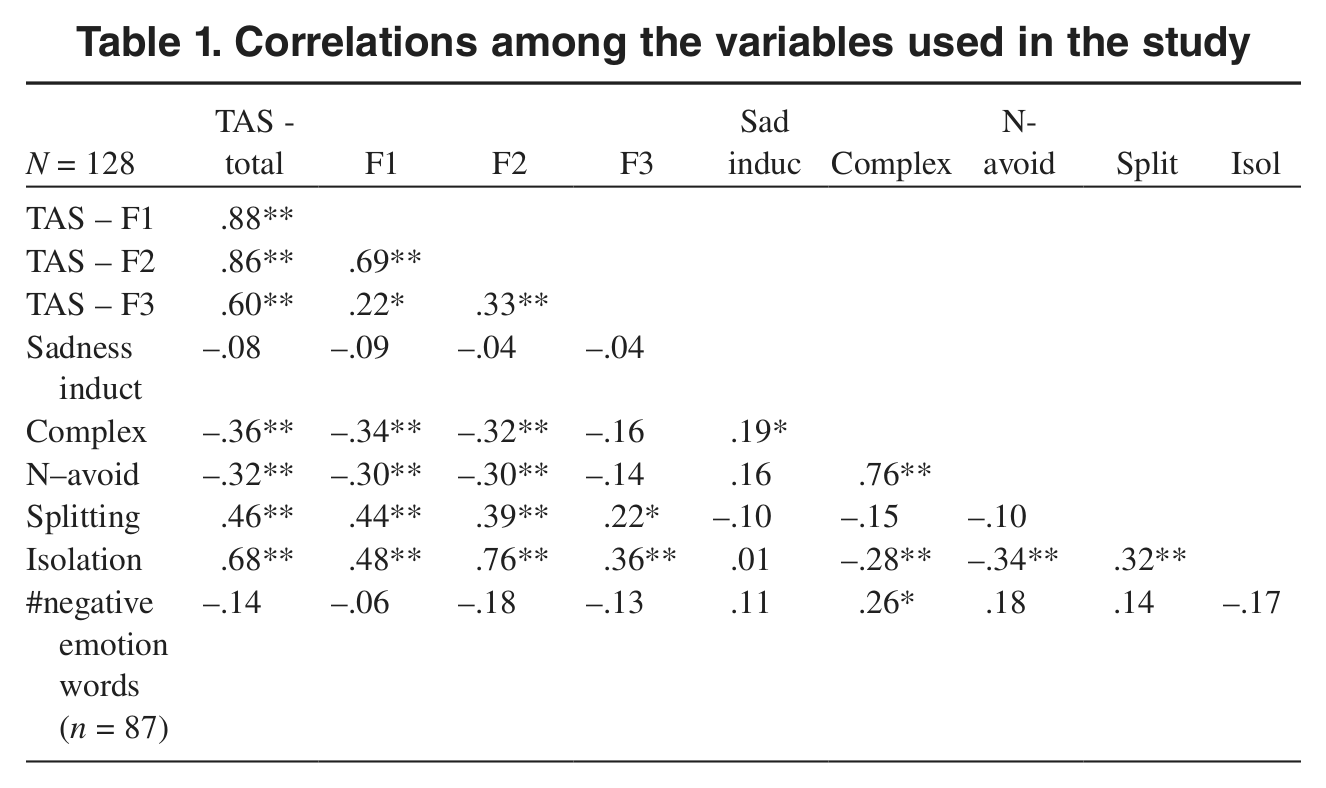
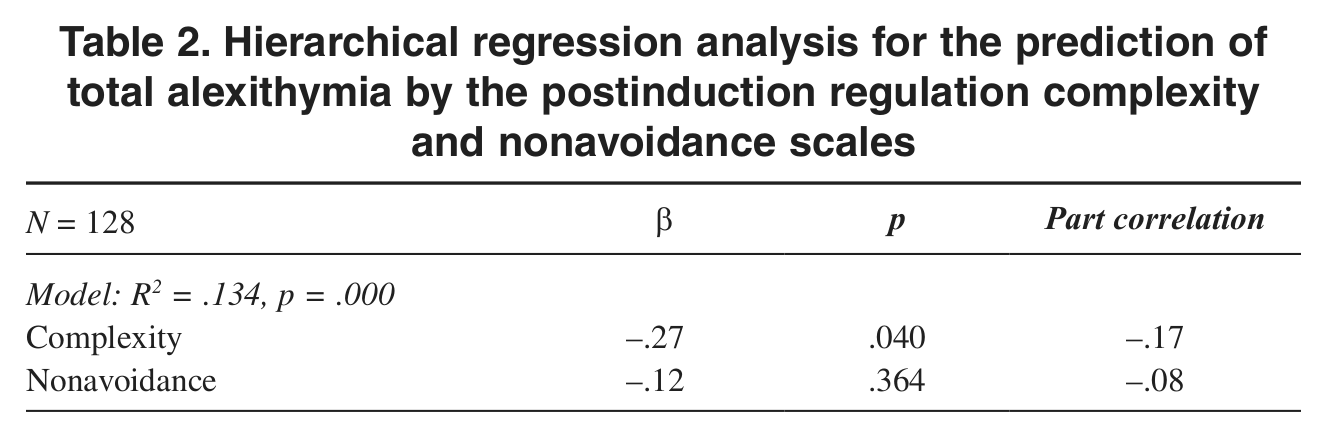
Total alexithymia was moderately correlated with both observer-rated manifestation of the participants’ emotion regulation: complexity: r = -.36**; nonavoidance: r = -.32**. A regression analysis showed that cognitive complexity had the only unique significant contribution to total alexithymia when entered together with emotion nonavoidance (see Table 2: R2 = .134**, complexity: β = -.27*).
Hierarchical regression analysis for the prediction of total alexithymia by the postinduction regulation complexity and nonavoidance scales
Discussion
Overall, the findings tend to picture alexithymia, as measured with the TAS-20, as combining cognitive and defensive-avoidant features in a student sample, with a small predominance of reduced cognitive complexity. This result somewhat contradicts our initial expectation that a defensive-avoidant attitude would predominate in the reactions of students to this benign exposure to sadness. However, the facet of cognitive complexity assessed here is not operatory thinking. This more benign form of cognitive deficit is more difficult to differentiate from emotional avoidance, as the former can be the result of the latter. In other words, it is likely that emotional avoidance and a lack of cognitive complexity are intimately related, and that one contributes to increase the other. Also, a student sample will not provide the entire range of alexithymic reactions seen in clinical settings.
Footnotes
The authors of this paper received the Robert J. Stoller Travel Award.