







Abstract
By developing the concept of “gastronationalism,” this article challenges conceptions of the homogenizing forces of globalism. I analyze (1) the ways in which food production, distribution, and consumption can demarcate and sustain the emotive power of national attachment and (2) how nationalist sentiments, in turn, can shape the production and marketing of food. The multi-methodological analyses reveal how the construct of gastronationalism can help us better understand pan-national tensions in symbolic boundary politics—politics that protect certain foods and industries as representative of national cultural traditions. I first analyze the macro-level dimensions of market protections by examining the European Union’s program for origin-designation labels that delineates particular foods as nationally owned. The micro-level, empirical case—the politics surrounding foie gras in France—demonstrates how gastronationalism functions as a protectionist mechanism within lived experience. Foie gras is an especially relevant case because other parties within the pan-national system consider it morally objectionable. Contemporary food politics, beyond the insights it affords into symbolic boundary politics, speaks to several arenas of sociological interest, including markets, identity politics, authenticity and culture, and the complexities of globalization.
Efforts within the European Union (EU) to create a unifying, pan-European sense of identity have generated tensions within and among nations over the principles of universalism and exceptionalism. Scholars of European integration politics often cite religion, language, ethnic composition, or region to illustrate how nations seek to preserve (or overcome) their sense of distinctiveness (Bail 2008; Brubaker 1996; Calhoun 2007; Keating 2004) and to construct symbolic unity through everyday talk and social practice (Billig 1995). Such practices, which communicate the value of national distinctiveness, have recently been theorized through the frames of branding (Aronczyk 2007) and impression management (Rivera 2008). Few analyses, however, scrutinize related institutional strategies and how material objects and industries are legitimated and protected as uniquely representative of national traditions. Relevant processes are situated within a constellation of legislative, cultural, and industry-based dynamics— dynamics that influence the evolution of inter-institutional relationships (Evans and Kay 2008).
Scholarship in organizational sociology increasingly recognizes that markets and politics depend on embedded codes and cultural understandings (Rao, Monin, and Durand 2003, 2005; Vasi 2007; Weber, Heinze, and DeSoucey 2008). We know surprisingly little, however, about relationships among regulated markets, political institutions, and national cultural identities. Examining nationalized protections for certain objects, namely foods, contributes to ongoing debates about the permeability of national boundaries within the EU’s pan-national structures (Checkel and Katzenstein 2009; Fligstein 2008; Held et al. 1999) and about the ways in which globalization spurs resistance to culturally homogenizing trends (Appadurai 2001; Ritzer 2003; Thompson and Arsel 2004; Watson 1997).
My aim here is not to generate a theory of European integration based on food politics, but to delineate how foods constitute cultural and material resources that affect and respond to political agendas. Indeed, within the contemporary EU, food is a contested medium of cultural politics that demarcates national boundaries and identities. Historians and anthropologists have embraced the theme of food, culture, and society in their scholarship (Douglas 1984; Goody 1982; Mintz 1985; Scholliers 2001; Watson and Caldwell 2005), and food studies are increasingly recognized for their ability to integrate multiple research areas and methods (Belasco and Scranton 2002; Freedman 2007). The sociological relationship between food and globalization is an especially rich juxtaposition because it highlights the dialectic produced by globalism’s homogenizing tendencies and the appearance of new forms of identity politics invigorated by an increasingly homogenous environment (Berger and Huntington 2002; Inglis 2005). I conceptualize this juxtaposition as gastronationalism. 1
Examining the political construction of foods as institutionalized vehicles of national cultural identities sheds rich theoretical light on debates between European integrationists and protectionists (Brubaker 1996; Fligstein 2008; Opp 2005; Pribán 2007). Gastronationalism, in particular, signals the use of food production, distribution, and consumption to demarcate and sustain the emotive power of national attachment, as well as the use of nationalist sentiments to produce and market food. First, I examine how responses to globalizing markets have assumed a distinct organizational form—a form that prizes conceptions of tradition and authenticity as desirable rationales for protecting certain foods at the national level (Hobsbawm and Ranger 1983; Scares 1997; Shils 1981). The EU’s national-origin labeling program couples foods’ market status with valorized cultural prowess tied to national identity, characterizing and revaluing national food as a central part of the national diet. This language of authenticity assists the development of narratives about geography-based particularities of cultivating plants and animals for eating (Bell and Valentine 1997).
Then, building on Burawoy’s (1991, 1998) extended case method and drawing on the case of foie gras in France, I examine these macro-level processes as they are harnessed, manipulated, and re-created at micro-interactional levels. Gastronationalism, as a form of claimsmaking and a project of collective identity, is responsive to and reflective of the political ramifications of connecting nationalist projects with food culture at local levels. It presumes that attacks (symbolic or otherwise) against a nation’s food practices are assaults on heritage and culture, not just on the food item itself.
How does an object vilified in some locales become morally and politically justified as traditional, authentic, and worthy of protected status in others? Foie gras, the fattened liver of a force-fed duck or goose, is valorized as a symbol of French national identity, history, and culinary culture. It is also a target of critical opposition, fueled by international animal rights organizations. This dualism exposes salient questions regarding social spaces for objects or practices seen as morally problematic within new, potentially adversarial, pan-national relationships.
Vehicles of Collective National Identity
National cultural boundaries are problematic objects of study because their emphasis on universal features obscures contradictory subcultures, cultural diffusion, and the ways in which cultural policies are open to multiple interpretations (Dobbin, Simmons, and Garrett 2007). Any single definition of “nation” will legitimate some claims and delegitimate others (Opp 2005). Yet, improved understanding of the flexibility of national identity is essential for assessing its role within integration politics in Europe and beyond (Fligstein 2008; Keating 2004).
I use Brubaker’s (1996:10) broad definition of nationalism—a set of idioms, practices, and possibilities available in cultural and political life, delimited by social or physical boundaries—to consider the ways in which a nation’s people are defined, or self-define, as a distinct group. Such practices help people learn who they are through interactions and social life (Brubaker and Cooper 2000). Anderson’s (1991) description of a nation as an “imagined community” likewise proposes that we regard national identity as a phenomenon of collective belonging. Claims to nationhood are not just internal appeals to common descent; they allege uniqueness vis-à-vis other nations, substantiating potential claims for future distinctions (Zerubavel 1995).
Nationalist symbols and practices, such as flags and anthems, can be emotionally charged signs of independence that demonstrate a country’s social circumstances at the time of their adoption (Cerulo 1995). These objects unite citizens around shared practices such as saluting or singing (Firth 1973; Hobsbawm and Ranger 1983). When it comes to symbolic power and implications for identity politics, food is no exception. Foods offer links between social actors and their cultural pasts (Gabaccia 1998), shared bonds of familial or religious identity (DeVault 1991; Ray 2004), and narratives of organizational identity (Fine 1996; Maurer 2002). For example, a social comparison such as “we eat pork, they don’t” articulates tropes of similarity and otherness through shared consumption patterns and prohibitions. Food and eating are expressions of culture and shapers of identity; they are potential sources of material and political valuation.
Gastronationalism connects foods’ social and cultural attributes to politics by making the material, commercial, and institutional processes that shape foods the very objects of investigation. Such dynamics are seldom topics of sociological inquiry in their own right, but there are notable exceptions. These include Mennell’s (1985) examination of the powerful forces implicated in the development of ideas around taste in certain foods and cuisines as cross-class markers of French and British nationhood; Warde’s (1997, 2009) studies of consumption that historicize relationships among foods’ exchange and status, and the recent “invention” of British cuisine as a symbolic tool of nation-building; and Ferguson’s (1998, 2004) exploration of how French cuisine’s historical development was strategically linked to brokers of cultural ideology. Ferguson, in particular, contends that gastronomy provided nineteenth-century France with a distinct identity—a kind of “culinary nationalism.”
This prior work shows how foods function symbolically as markers of identity and community for otherwise geographically, socially, and politically divided populations. Moreover, it reveals how food can be an important arena where conflicts over globalization’s pan-nationalist impacts are fought. In cases of gastronationalism, the state intervenes in the market, acting as an ideological agent and a broker for food production and distribution as cultural goods. Gastronationalism thus connects macro- and micro-level concerns around globalism, from the state to food producers’ and consumers’ lived experiences.
Cultural Patrimony and Protectionist Roots in the EU
Because gastronationalism is situated in the context of integration politics, I draw on institutional theories of state-market relationships to help explain recent institutional designations of “tradition” and “patrimony.” These theories illustrate how regulatory structures operationalize national (and international) systems of political values (Bartley 2007; Prasad 2006). Moreover, adding food to these networks of institutional relationships builds on insights from economic sociologists’ growing interest in meaning-making and cultural work within market-state systems (Dobbin 2004; Fligstein 2008; Fourcade-Gourinchas and Healy 2007; Zelizer 2005). From the perspective of organizational theory, this integration has great promise for incorporating agency and politics into cultural and institutional analyses.
The Treaty of Maastricht officially created the European Union (EU) on November 1, 1993. Before then, this association was known as the European Economic Community or the Common Market. The Common Market was created post–World War II to stimulate economic integration, create shared political values, and offer a powerful voice in international relations (Bretherton and Vogler 1999; Laible and Barkey 2006). Today, the EU is composed of 27 member states, and the basic principle of free trade—that open and competitive markets optimize resources—operates as the dominant mechanism for resource allocation, the circulation of goods and services, and policy formation. Policymakers, however, have long argued that certain cultural goods (particularly audiovisual goods) should be considered cultural exceptions and external to free trade (Gordon and Meunier 2001; Ridler 1986). This idea stems from the 1947 General Agreement on Tariffs and Trade (GATT), which called for European countries to “protect national cultural treasures of artistic, historical, or archaeological value” in the deregulation of markets (GATT 1947). Supporters often frame these arguments for recognizing “cultural exceptions” or “cultural patrimony” within international trade and policy agreements as a country’s right, or even duty, to preserve and promote its cultural heritage and prevent “irretrievable loss” (Bishop 1996:187).
“Cultural exceptions” refer mainly to claims for protection of specific types of cultural goods (namely film, television, and music) within EU member states, or similar types of media products that celebrate national culture (Ahearne 2003). These claims incorporate the principles that the production of cultural goods is necessarily place-specific and that global markets are affected by unequal starting points, unbalanced resources, and strategic competition from dominant market players (e.g., Hollywood for films) (Barber 1996; Prowda 1997). “Cultural patrimony” describes what is fundamental to a people’s or a nation’s history; it weds materialist and symbolic interests as intrinsic to reinforcing, reflecting, and influencing a group’s values and collective identity (Hoffman 2006). Cultural patrimony is not owned by a people; rather, it represents their self-defined collective national identity. In this sense, it is similar to notions of folklore or heritage. For example, while old paintings can be considered cultural property, Leonardo da Vinci’s Last Supper and Botticelli’s Birth of Venus are classified as Italian cultural patrimony.
Supporters of both types of claims have tied them to the perceived negative effects of Americanization, globalization, and pan-European homogenization (Meunier 2005). These claims play an important role in current ideological battles over the European project (Menéndez Alarcón 2004). Although national industries are typically not included in these definitions, I contend that gastronationalism facilitates national claims of cultural patrimony for foods because it performs similar symbolic boundary work in creating exceptions, under the veneer of culture, within otherwise open-market structures. In setting institutional precedents for resource-based claims of cultural and national specificity (Kockel 2007), cultural exception designations for media help contextualize new national categories for protecting food in the face of expanding globalist dynamics.
Methods, Data, and Results
My multimethod approach explores gastronationalism’s macro and micro dimensions within contemporary European food politics. To theoretically develop and empirically capture gastronationalism as an institutional construct, I created a database containing every foodstuff (N = 790) that received protected national status under the EU’s designation of origin program between the program’s establishment in 1992 and December 31, 2007. I then analyzed emergent patterns across the 21 countries claiming these labels, using small-N research methods (Mahoney 2000). I also collected and analyzed materials related to several instances of contentious politics that resulted from this labeling program; these materials include news articles, academic and trade conference proceedings, industry and producer Web sites, application and registration documents, EU case law, 2 and food history books.
To investigate gastronationalism’s micro-level complexities and the implications of these dynamics, I conducted an in-depth case analysis of foie gras in France, a food item with morally contested production methods. During 2006 and 2007, I collected primary data during four months of ethnographic fieldwork at 10 foie gras farms and 7 production facilities (ranging in size from a 2-person to a 250-person operation), a Parisian gourmet food exposition, local outdoor markets (including marchés du gras), tourist offices, foie gras museums, shops, restaurants, and a hotel management school. I conducted 40 interviews with French foie gras producers, high-level industry representatives, social movement activists, consumers, chefs, tourism employees, and local government officials. I conducted the interviews primarily in French; a few, depending on a respondent’s comfort level with the English language, were in English. The majority of interviews were one to two hours in length. I had a portion of the interviews transcribed and transcribed the remainder myself. All French to English translations are my own.
On my first research trip, I contacted producers, chefs, and industry members through a “foie gras amateur guide” (Serventi 2002) and through academic connections in Paris, Dijon, Lyon, and Toulouse. These initial contacts allowed for snowball sampling, which proved advantageous. Intermediaries were often necessary for me, as an American who was sometimes viewed with skepticism, to gain access. During my second research trip in 2007, I traveled and conducted interviews alongside an American journalist who was also writing about foie gras controversies (Caro 2009). This journalist had access to respondents I would not otherwise have been able to interview. Beyond these new interviews, I also conducted follow-up interviews with several 2006 respondents. Finally, I undertook content analyses on materials produced inside and outside France related to foie gras history and politics: news articles from Le Monde, the International Herald Tribune, and Agence France-Presse; Web sites and listservs; opinion pieces; industry newsletters and materials (including videos, in-house materials, and trade publications from Rougié, France’s largest foie gras producer); tourism materials collected from local offices; food history books accessed at the Bibliothèque Nationale and purchased in French bookstores; EU documents regarding foie gras production; and transcripts of French National Assembly and Senate debates.
The Cultural Exception for Traditional Foods
From the EU’s inception, the development of integrated agricultural policies and a common market for food products—the Common Agricultural Policy (CAP)—has been a core activity. Indeed, some argue that the EU’s establishment was a purposeful step toward making food and agricultural products more competitive internationally (Sarasúa, Scholliers, and Van Molle 2005). Agriculture absorbs 50 percent of the EU’s annual budget, and CAP plays a central role in mediating trade, improving rural standards of living, and regulating public funds for food transport and research development.
The legal underpinnings of EU governance of food production, distribution, and marketing make claims for national specificity both salient and problematic. According to the regulatory principle of mutual recognition (Article 28 EC), a food product lawfully marketable in any one EU member state must be so in all (subject to limited exceptions, namely health). Furthermore, to protect all member states’ markets, the EU’s harmonized food production standards reflect the regulations of the member state with the least stringent quality protections for the item in question. These requirements apply to multinational corporations and small-scale producers alike. Efforts to protect certain foods within this market structure have led to nationally-based contention. 3
Such regulations, along with ever-increasing market integration, have significantly affected the physical production of foodstuffs, generating fears about their “potential to destroy the rich culinary diversity of member states” (MacMaoláin 2007:19). For example, EU hygiene and health standards requiring pasteurization limit the production and sale of certain raw-milk cheeses (West 2008). Cross-national obligations to distribute foodstuffs among states also open producers to potentially unfair trading practices and price competition from those with better resources (MacMaoláin 2007).
In 1992, recognizing dilemmas created by this system, particularly for small-scale and artisanal food producers with aspirations to sell in national and international markets, the EU instituted a program to register certain food and agricultural products as exceptions to CAP. Within this program, producers of “traditional” food products can apply to receive one of three EU-sponsored labels—Protected Designation of Origin (PDO), Protected Geographical Indication (PGI), or Traditional Specialty Guaranteed (TSG)—to designate their products as possessing certain unique characteristics, mostly associated with place. These labels aim to protect food products from imitation, their names from misuse, and consumers from potential misrepresentation. Of the 790 labels awarded before December 31, 2007, 57 percent were PDO, 41 percent were PGI, and only 2 percent were for TSG. 4 For PDO and PGI registrations, a product must be linked to a geographical area. The TSG label reflects the use of traditional production methods but does not specify place. 5
Claims based on geographical origin have been more desirable than those for production method, supporting the relevance of gastronationalism. Moreover, these claims give certain producers within certain nations the right to use place names in their marketing, packaging, and presentation. They thus link sets of values and symbols to institutionalized representations of territory and history, and “share the common goal of furthering authenticity” within member states and the EU as a whole (European Commission 2006:5). Authenticity claims linking food to place—what the French term terroir, or what Trubek (2008) calls “the taste of place”—rest on assumptions that geographic conditions contribute to foods’ inherent characteristics and qualities (Bell and Valentine 1997). These foods are typically marketed and sold as specialty products because of their limited availability (van der Lans et al. 2001). Table 1 provides several examples of these products.
Examples of PDO, PGI, and TSG Labeled Products
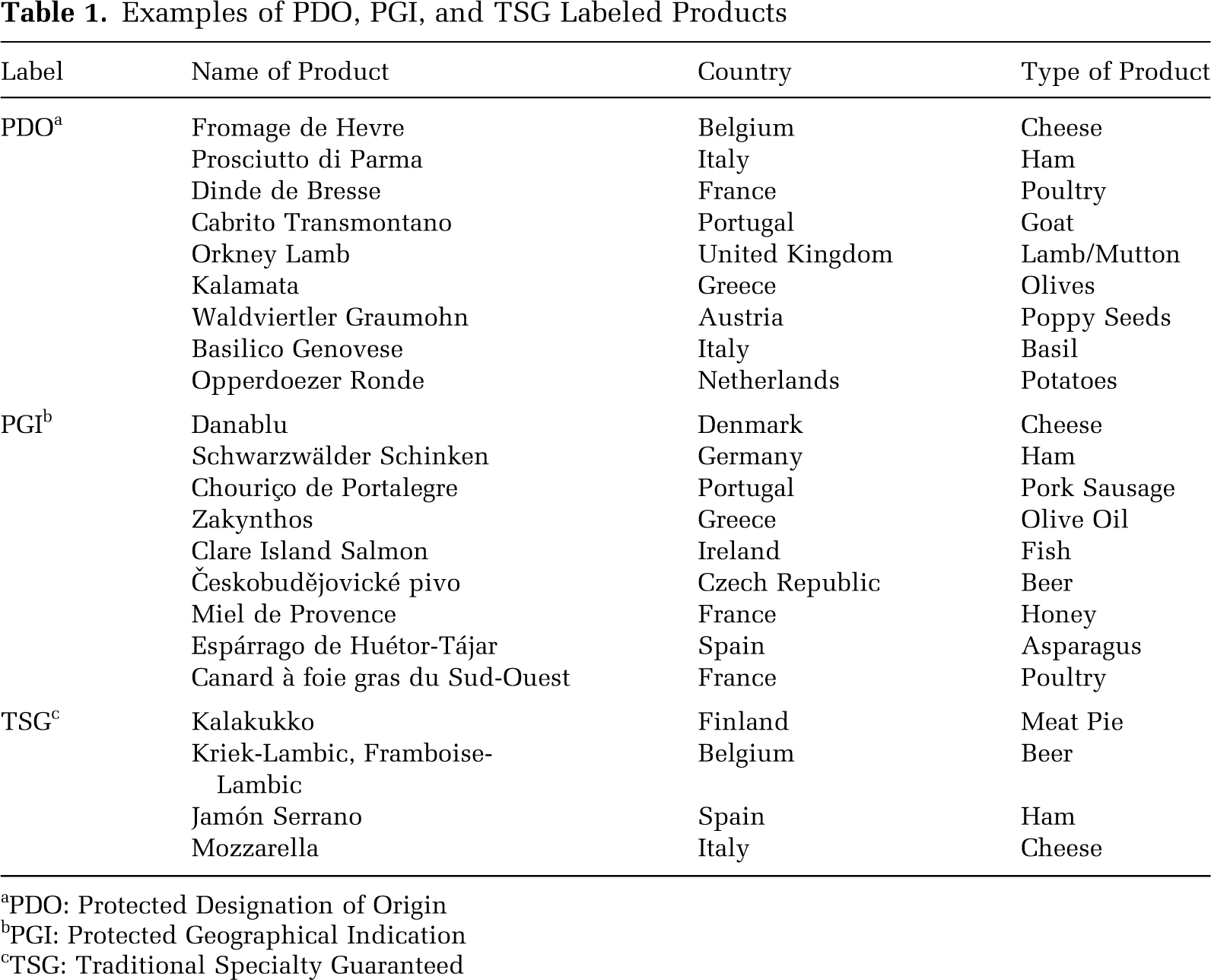
PDO: Protected Designation of Origin
PGI: Protected Geographical Indication
TSG: Traditional Specialty Guaranteed
From 1992 until January 1994, member states used an abbreviated application procedure to inform the Commission of foodstuffs they wished to register, with the understanding that designations satisfying the Commission’s requirements would be registered. During this period, some countries (e.g., France, Spain, and Germany) submitted many more applications than others (e.g., the Netherlands).
After January 1994, the registration procedure intensified, giving early adopters of the program an advantage. The new label registration process, which remains in effect today, requires a group of producers to organize into a consortium, create a specific definition of their product, 6 and submit an application to their national agricultural office. The national office then examines the application to ensure compliance with the requirements and chooses whether to forward it to the European Commission’s Agricultural and Rural Development Department. If forwarded, the Official Journal of European Communities publishes the request to inform other member states and the general public of the application. External parties have six months to lodge an objection, admissible only (1) if the application is not in full compliance with requirements, (2) if the name is considered generic, or (3) if registering the name would jeopardize the existence of a similarly named product or trademark. If no objections are made, the European Commission registers and publishes the newly protected name in the Official Journal of European Communities. It is a member state’s responsibility to ensure that its registered products comply with official specifications.
The 790 products registered before December 31, 2007 (as well as those pending approval) are not distributed evenly among member states. To determine why gastronationalism is more pronounced in certain countries, I chose several country-level variables to examine national patterns in the configuration of these labels. Table 2 presents variables corresponding to the 21 countries that have at least one registered food product. 7
Comparing Percent of National Origin Labels by Levels of Agriculture, Infrastructure, and Culinary Self-Consciousness
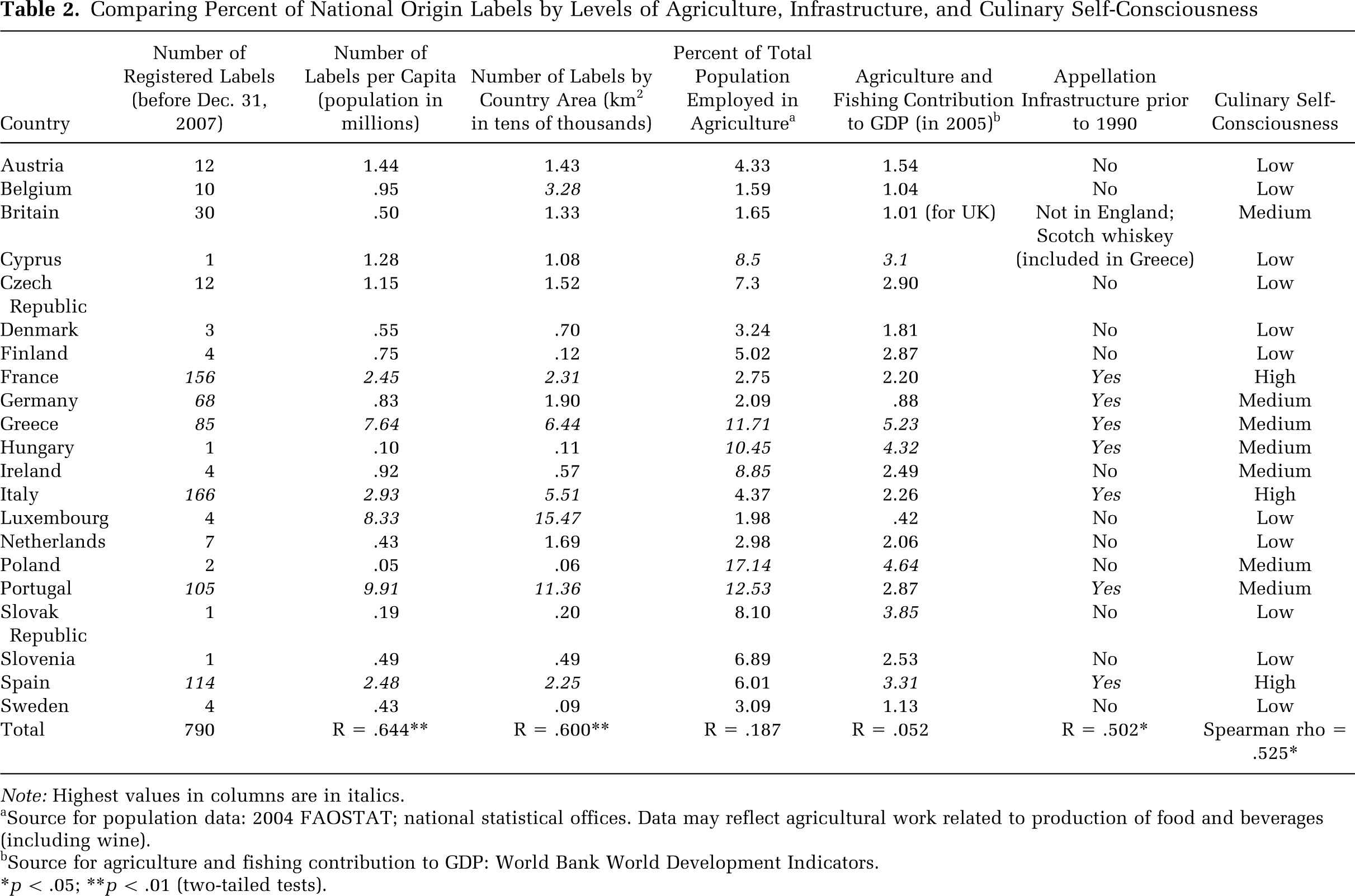
Note: Highest values in columns are in italics.
Source for population data: 2004 FAOSTAT; national statistical offices. Data may reflect agricultural work related to production of food and beverages (including wine).
Source for agriculture and fishing contribution to GDP: World Bank World Development Indicators.
p < .05; **p < .01 (two-tailed tests).
To identify conditions associated with countries that are high utilizers of the labeling program (i.e., Italy, France, Spain, Portugal, Greece, and Germany), I first calculated the number of labels registered in each country per capita (in millions) and per 10,000 km2 to control for each country’s population size and land area (e.g., the difference between Germany and the Netherlands). Population and area show statistically significant correlations with the number of registered labels (p < .01). Population density within countries, however, is not statistically significant. Portugal, Germany, and Luxembourg have the highest rate of labels per capita and in relation to areal extent. Luxembourg’s relational numbers are high, however, due to its very small size and population; thus, I do not consider it equally alongside other member states in calculating low versus high utilizers.
After controlling for the size of population and territory, I hypothesized a significant positive correlation between number of origin labels and national reliance on agricultural output, measured by the current value of each country’s agricultural contribution to gross domestic product (GDP) (Column 5 in Table 2) and the percentage of each country’s population employed in agriculture (Column 6 in Table 2). Neither of these correlations are statistically significant (R = .187 for the population measure and R = .052 for GDP contribution). Greece is the only country with both a high per capita measure of registrations and high levels of agricultural GDP contribution and agricultural employment. A large percentage of Portugal’s population is involved in agricultural production, but contribution to GDP is low. Other countries with high rates of agricultural contribution to GDP, such as Poland and Hungary, have extremely low rates of registered food origin labels. National reliance on agricultural output does not correlate with being a high utilizer of the origin labeling program.
I then considered whether countries had a program to geographically demarcate agricultural products before the EU program began. Producers from countries with existing designation programs would likely perceive value in the new pan-national system. Countries with prior appellation programs 8 should hypothetically be high utilizers of protected designation labels. 9
Indeed, there is a strong positive relationship between the prior existence of such programs and the percentage of total labels registered by high utilizing countries. For the six countries that had appellation infrastructure prior to the EU program, 10 the mean percentage of total origin labels is 14.63 (SD = 4.88). For countries without such a program, the mean percentage of total origin labels is .86 (SD = .98, t = 10.7, df = 18, p < .001). A t-test shows statistical significance at p < .01. Correlating the existence of an infrastructure with a country’s number of labels (controlling for population) is also statistically significant (p < .05, R = .502, N = 19). Existing programs did provide an entrenched organizational form that helped producer-organized consortia succeed at making use of the EU’s program.
Do states’ leaders view nationally marking food items as a means to gather additional support for collective identity and self-presentation (e.g., we eat Kalamata olives because we are Greek, and it is part of our identity to do so)? I considered the relative degree of each country’s national culinary self-consciousness to assess the extent to which food and cuisine appear central to promoting national identity to internal and external audiences. 11 I constructed a metric of culinary self-consciousness out of three variables: existence of national food festivals, books about cuisine for foreign audiences, and whether a country recently applied to the United Nations Educational, Scientific and Cultural Organization (UNESCO) to recognize its overall culinary heritage, as several European nations did in 2008 (Sciolino 2008). 12
I scored each measure 0, .5, or 1 across three variables and combined them in a 0 to 3 scale. To consider promotion to internal national audiences, I ranked the number of food-related festivals and food trade shows by country in 2008, as catalogued by FoodReference.com, 13 and assigned a 1 to countries that had seven or more festivals that year and .5 to the two countries that had between three and six festivals (Belgium and Ireland). 14 To account for the perceived role of external audiences in generating national culinary self-consciousness, I ranked the number of books about each country’s cuisine sold under the “travel/food” category at the U.S.-based Amazon.com. I coded the four countries higher than the average (mean = 15.67) as 1, and the seven countries that had between 7 and 14 books listed received a .5. 15 While these criteria might also be used to measure publishing or tourism, they do link to ideas about the degree to which culinary cultures are promoted to outsiders. For the third measure, I assigned a 1 to countries that applied to UNESCO in 2008 to include their national food culture (i.e., France) or the Mediterranean Diet (i.e., Spain, Italy, and Greece) on UNESCO’s list of cultural heritage sites and patrimonial intangibles.
I then assigned a high measure of culinary self-consciousness (see Table 2) to the three countries that scored a 3 on the compendium measure: France, Italy, and Spain, which are three of the six countries with the highest rates of label registrations. The other three countries with high rates of label registrations—Greece, Portugal, and Germany—scored a medium. The Spearman rank-order correlation coefficient (a non-parametric measure of association based on the rank-ordering of variables) calculated between culinary self-consciousness and the percentage of total origin labels by country is .525 (p < .05, N = 20), indicative of a strong positive relationship between the two. Controlling for a country’s number of labels per capita, however, negates the measure’s statistical significance, indicating either that the measure is not highly correlated to label registrations or that national interest in food and cuisine is not dependent on population numbers.
If considering the first explanation, regressing these three variables (i.e., agriculture, appellation, and culinary self-consciousness per capita) against a country’s number of labels per capita shows, indeed, that only preexisting appellation infrastructure is statistically significant (β = 4.879, p< .05). If considering the second, the nominal variables of previous appellation and culinary self-consciousness are individually necessary and jointly sufficient conditions for countries to be high utilizers of gastronationalist claims (Mahoney 2000). If a necessary condition is present, the outcome could be either present or absent. Yet, the two variables are jointly sufficient, so a present sufficient variable (from either column) means the outcome (high utilization) will be present. Countries with appellation infrastructures and/or high or medium levels of culinary self-consciousness will thus have significantly higher levels of protective origin labels institutionalized through the EU program, and they will be more likely to advance gastronationalist claims.
Few origin label applications are unsuccessful (personal communication, Antonella Farnararo, DG Agriculture Office), but some can be. For example, although Italian law previously enforced domestic standards for production of pasta (as made exclusively from durum wheat), Italy was unable to register it. Even though many consumers consider pasta to have Italian origins, production had diffused too widely and its “generic” name prevented it from receiving a label. Italy was successful, however, in registering “pizza Napoletana” as a TSG in April 2008, after 14 years of legal wrangling (Article 8(2) of Regulation 509/2006). The registration specifies, among other details, the hours required for leavening the dough, as well as its required height, baking temperature, and seasonings (but not the place of production). 16
Claims for the protection of particular foodstuffs as nationally significant help us understand the revitalization of practices or items considered traditional during times when old identities are perceived to be in jeopardy (Calhoun 1993; Cavanaugh 2004; Hobsbawm and Ranger 1983). Gastronationalism is exclusionary in this regard because it prohibits others from making similar food claims, either materially or symbolically. The European Court of Justice resolves competing national interests. For example, in February 2008, the Court ruled that only cheeses bearing the PDO “Parmigiano-Reggiano” 17 can be sold as “Parmesan” cheese in European member states outside of Italy. This ruling followed three years of infringement proceedings brought by the Consorzio di Parmigiano-Reggiano and the European Commission against Germany for marketing its own version of “Parmesan” and not sufficiently protecting the Italian PDO in its market.
Another important case—often cited by food law scholars—is a 10-year legal dispute between Greece and other member states over feta cheese. Greek feta production has been codified in increasingly specific terms since 1935 (Dalby 1996); it was awarded a PDO label in the first official list of registered products (Regulation 1107/1996). In 1999, Denmark and Germany, supported by the United Kingdom and France, contested the label, raising three key issues concerning feta’s status as Greek. First, they argued that the name “feta” contains no geographic place name and actually derives from an Italian word. Second, the geographic area that Greece submitted in its application encompasses a variety of climate conditions shared by other European nations. Third, and perhaps most important to the European Commission’s decision to annul Greece’s PDO (Regulation 1070/1999), they argued that the name had become generic and was therefore ineligible for protection (Evans and Blakeney 2006). 18
Revisiting the issue in 2002, the Commission reversed its ruling and reinstated the registration of feta as a Greek PDO (Regulation 1829/2002). The Court upheld its ruling after an appeal from Denmark and Germany, noting in its brief that 85 percent of production and 80 percent of consumption occurred in Greece, and that feta cheese produced in Denmark and Germany often referred to Greece with words, pictures, or color schemes on its packaging. Non-Greek cheese-makers lost the right to use the name “feta” within the EU at the end of 2007 (Evans and Blakeney 2006), but they may still sell their cheeses as “feta” outside the EU (e.g., when exported to the United States).
These cases show how the EU program confers on foods (and their producers) the legal right to draw national boundaries in an otherwise open marketplace. The labels are often promoted as improving farmers’ incomes, support and resources for rural communities, and retention of rural populations—and in many cases, they do. More importantly, gastronational claims about the significance of tradition and authenticity, as invoked in the organizational work of registering an origin label, highlight the nationalized revaluation of food producers who might otherwise disappear in a competitive pan-national climate.
The Case of French Foie Gras Politics
Beyond international implications, gastronationalism as a construct possesses important micro-level complexities, namely its use in defensive claimsmaking for a particular food within a nation, and institutional strategies at the level of lived experience. As a case of gastronationalism, foie gras differs from protected foods like feta cheese or proscuitto di Parma because organizations in the United States and many EU countries want its production to cease altogether. 19 Animal rights groups argue that foie gras’s production methods are cruel and immoral. Foie gras production in Europe is regulated by the European Union Commission on Animal Health and Welfare, but many EU member states have outlawed its production within their borders. Its marketing and consumption cannot be banned, however, due to CAP’s principle of mutual recognition (Article 28 EC). 20
Foie gras is the fattened liver of a duck or goose. It is produced through a process known as gavage, which requires a person to use a tube to manually feed the duck or goose two or three times a day in the last 12 to 20 days of the bird’s life. Long valued as a specialty dish, foie gras was first depicted in Egyptian bas-reliefs from 2500 BC and documented in Roman agricultural treatises (Serventi 2002; Toussaint-Samat 1994). Historical texts attribute its prevalence in France to the Romans in Gaul (southwestern France) and to Jewish populations in northeast France, who raised geese for their kosher cooking fat. The French gastronomic foie gras tradition has roots in early culinary texts such as La Varenne’s Le Cuisinier François, published in 1651, and the menus of seventeenth-century royal banquets (Guérard 1998). By the 1800s, goose foie gras had become an integral part of the emergent field of French gastronomy and an international status symbol of luxury and elegance (Ginor 1999).
Today, foie gras is ubiquitous in France. As of 2006, around 80 percent of world foie gras production and 90 percent of world consumption occur there, where it is a $2.5 billion industry. According to Comité InterProfessionnel des Palmipèdes du Foie Gras (CIFOG), the French foie gras industry encompasses approximately 15,000 farms and 600 processing facilities, ranging from small family-run businesses to large-scale operations. The industry employs about 30,000 people, including many part-time and seasonal workers, and it indirectly affects about 100,000 jobs (e.g., veterinary practices, business, marketing, distribution, and tourism). Throughout the country, menus abound with foie gras dishes. Specialty foie gras shops are part of urban streetscapes, and foie gras is sold at most outdoor markets, specialty grocery stores, large supermarkets, chain stores, and, in the Southwest, even at gas station convenience stores.
The conditions of French foie gras production and consumption are, in fact, recent phenomena. Rates of foie gras production and consumption within France have tripled since the 1970s, due in large part to state support (through the National Institute for Agricultural Research [INRA]) for new technologies that lowered production costs (Jullien and Smith 2008). In the 1980s, the introduction of pneumatic, hydraulic, and computer-calibrated feeding systems allowed each duck to be fed in several seconds, rather than the 30- to 60-second feeding required for artisanal production. 21 Additionally, the industry-wide switch in the 1970s to making foie gras from ducks (which are considered heartier and easier to keep in industrial farm facilities) instead of geese made foie gras less expensive and thus available to a wider range of consumers. In interviews, industry members referred to these processes as “the democratization of foie gras.”
French government directives concerning foie gras production emerged only within the past few decades, concurrent with expanding EU political and market integration. In 1993, the French government issued regulatory guidelines that created specific definitions for different foie gras products. In 1998, an EU Council Directive codified guidelines for the welfare of all animals kept for agricultural purposes in Europe. The 93-page document specific to foie gras production defines animal welfare measurements and includes recommendations to improve production conditions (Scientific Committee on Animal Health and Animal Welfare 1998). 22 In response to an inquiry posed by a member of the European Parliament, the Council stressed that “it should be mentioned that a ban on force-feeding is neither foreseen by the Directive nor by the recommendations mentioned” (European Commission 2001).
Around the same time these recommendations were released, in early 1999, the French government applied for and received the EU PGI label “Canard à foie gras du Sud-Ouest.” 23 The application was criticized not by animal rights groups, but by small-scale, artisanal foie gras producers for its lack of specificity concerning the size of production operations and particular quality measures for the resulting products. These producers’ claims indicated fears that traditional, small-scale farms would be put in economic jeopardy by industrial producers (Téchoueyres 2007). National agricultural authorities, however, were invested in having the EU designate foie gras a French food. The French national office and the European Commission accepted the application, allowing producers of any size in Southwestern France to obtain the PGI label.
Throughout this period, France faced mounting international criticism of foie gras production from animal rights organizations. 24 Protests and vandalism in Britain targeted department stores and restaurants that sold foie gras, and legislators across the United States considered prohibitions. A small but vocal animal rights group within France, Stop Gavage, began to get media attention and to draw support from international animal rights groups. 25
In October 2005, legislators in the French National Assembly and Senate voted by large majorities to declare foie gras part of the “officially-protected cultural and gastronomic patrimony of France” (Loi d’orientation agricole n° 2341, article L654-27-1 du code rural). The Assembly’s deputies provided an accompaniment to the amendment, which proclaimed that “foie gras is an emblematic element of our gastronomy and our culture.” The amendment noted that the product “perfectly fulfills criteria” defining national patrimony “and the link to terroir that characterizes the originality of the French food model.” Testimony by Senate legislators suggests that the declaration was made “anticipating any initiative from Brussels [the EU’s headquarters].” In response to a senator’s statement that the “advertisement of foie gras in law” by national endorsement seemed unnecessary, another responded that “it is because gavage is contested that it is necessary to inscribe it in law; otherwise, the good spirits of Brussels will come and ban from us all that is our terroir.”
As this exchange indicates, gastronationalism’s targets necessarily include national and international audiences in linking moral, patriotic, and market actions as one and the same. Perceptions of ideological differences rendered national boundary maintenance strategies around foie gras necessary within the pan-national enterprise; ideas about international condemnation galvanized this gastronationalist claim for institutionalized protection of national cultural patrimony. Even the head of Stop Gavage understands the uphill battle his group faces. When I asked him why he believes France decided to protect foie gras, he responded:
There is a recent polarization on foie gras—it is the patrimony. It is the identity of France. It’s like wine from Bordeaux. Development of foie gras production is within the last 60 years, more or less. It was there, but very weak before, there was little consumption, not all that widespread. So, the foie gras industry had a lot of work to do on the image of foie gras as something from the Southwest and, later, as being part of the image of France, like the Eiffel Tower.
His response illustrates how state-market relationships use the concept and tools of culture, even when the object in question is morally problematic.
Naturalizing and Historicizing National Tradition
Perceptions of a country’s history influence which objects are incorporated into cultural identity narratives (Hobsbawm and Ranger 1983; Scares 1997), and these perceptions necessarily respond to internal and external forces. My interviews and conversations with people at all levels of the French foie gras industry were replete with claims and stories that relied heavily on the concepts of nature, history, and tradition in order to link foie gras to contemporary French national interests and self-identity.
Conceptual uses of nature, as Lévi-Strauss (1969) has taught us, are culturally embedded phenomena, and distinctions between nature and culture are the products of ideological choices. Throughout my interviews and review of secondary sources, I found the explanation that foie gras production mimics or exploits a “natural process” (i.e., waterfowl store fat in the liver for migration). Informants frequently invoked this claim in response to questions regarding current criticism, to challenge accusations that production imposed “unnaturalness” on the birds, or to explain the use of ducks and geese instead of other birds or animals (see also Heath and Meneley 2007). These narratives also connect origin and discovery stories of foie gras production in Egyptian and Roman civilizations to its current prominent position in French culinary culture, extending the “greatness” of past civilizations to the present (Dalby 2003; Ginor 1999; Serventi 2002).
Moreover, linking nature and the physical landscape with “authentic” products draws attention to the materiality of gastronationalism. In contrast to environmental and ecological discourses that emerged out of nineteenth-century romanticism, which present nature as either a utopian paradise or a threatening wilderness outside the bounds of human society (Heller 1999), the French vision of “nature” is predicated on notions of social rural life. According to French sociologist Claude Fischler (1990), these include the terroir and savoir-faire that produce the wine, cheese, and pâtés that are emblematic of French cultural history.
Foie gras is historicized as part of social rural life by invoking familial tradition. Several of the small-scale farms I visited send someone to drive around France once or twice each year to make deliveries to long-time clients and friends. Interviewees frequently mentioned their grandmothers as influential in their conceptions of foie gras’s traditional Frenchness (similar to folk understandings of the cowboy in North American cattle production [Blue 2008]). 27 Until the advent of industrialized foie gras production, it was typically the job of elder female family members to raise poultry and other small animals for household consumption. For some country families, this role continues:
Bonne-maman, at age 75, still raises and feeds about 20 to 30 birds each November for the winter holidays for her children’s families. She tells me that she’s done this all her life and learned the practice from her grandmother. She uses the old-fashioned gavage tool, where she sits on a chair or stool and, while wearing a skirt, holds the bird between her legs to feed it. She soaks the corn kernels in water to soften them for the feed. She also showed me her vegetable garden and several rabbits she keeps for food. (fieldnotes)
These narratives connect the social realms of family, civil society, and the market to naturalize and ennoble foie gras’s Frenchness within local and national communities.
Campaigns created and heavily marketed by local governments and chambers of commerce to encourage regional tourism within France also characterize foie gras as indicative of French national identity. While tourism has long been critiqued for oversimplifying the subtle variations of cultures and for physically manipulating places to create an air of authenticity for visitors (MacCannell 1973), the existence of an organizational infrastructure for tourism indicates institutional values assigned to a place or culture, whether or not these values are ideologically charged or in flux (Gotham 2007).
Entire towns and regions within France use foie gras production and consumption as draws for tourism. Sarlat-le-Canèda, a well-preserved medieval town in Périgord, is a foie gras Disneyland. Every restaurant in the city center, including a pizzeria, advertises foie gras dishes. Storefronts are packed with duck and goose products and related knick-knacks. In the town’s central plaza, tourists often take photographs with the bronze statue of three geese, which was donated in 1875 by Rougié, currently France’s largest foie gras producer.
Signs for foie gras farms and their attached shops, sometimes hand-drawn to evoke rustic charm, dot the southwestern French countryside. 26 These signs often present images of smiling ducks wearing bowties or playing musical instruments. Visitors can eat at restaurants located on these small, picturesque farms or stay overnight in inexpensive guest rooms. Marchés du gras (fat markets) are another draw in these regions for tourists and locals alike. Every week during the winter, people can purchase duck and goose carcasses and livers directly from producers at these markets. These are not regular farmers markets; the only things sold are raw carcasses and livers. I watched several hundred people line up at a November marché du gras in the town of Gimont, anxious for the market’s controller to blow the 10 a.m. start whistle; they stampeded to the tables, shopping baskets in hand, once he did.
The Southwestern departments’ government-sponsored tourist offices have also spurred the development of the “foie gras weekend.” Organized and promoted with support from the national agricultural office, visitors can spend a night on a working foie gras farm, where the main activity is cutting up and cooking your own duck or goose to bring home, with instruction from the farm’s proprietor. According to my interviews with local government and tourism officials, the goals of these programs are to acquaint French people and foreigners with the people engaged in foie gras production, to increase consumption, and to “prove” to visitors foie gras’s national cultural value.
National Solidarity and Cultural Boundaries
Gastronationalism must appeal to an immediate level of collective identity that recognizes boundaries between insiders and outsiders. One potential informant, a professor, told our intermediary she would meet with me only if I “enjoyed eating foie gras.” When I asked her why she had solicited this information, she responded:
Because you came with the category of American. And, some Americans are against the production of foie gras. So, I didn’t want to invite one of them, because I didn’t want to meet someone who doesn’t like foie gras. It’s a question of national solidarity. I don’t think I am especially nationalist, but in this context, I defend it.
When asked about bans and critiques outside of France, rather than defending foie gras production as not cruel, almost all interviewees responded by valorizing it as an authentic French food and connecting it to a perceived sense of belonging based on national tradition. For example, the president of CIFOG and CEO of Feyel-Artzner (a Strasbourg-based foie gras company) explained (in English):
I cannot imagine that foie gras could be banned in France because it’s a very traditional product, consumed in this country for a long time. Our country and our law say that our product is a traditional product that has to be protected. It’s by law. Mainly people like it as a gastronomic product. But, they buy it also because it’s a ritual. You have to. It’s exactly the same as in your country, at Thanksgiving you have to have your turkey. There is no Thanksgiving without turkey. And, we have no Christmas without foie gras. It’s a ritual in our country. You have to do it.
Similar to the role played by the Thanksgiving turkey in bringing American families together for a ritualized meal, the work of cultivating French national taste for foie gras steeps it in cultural notions of tradition. One visitor to a gastronomic food exposition in Paris told me (in English), “If you try to beat the foie gras traditions, you’re going to beat the traditions of Christmas for us. I am 35 years old, and have had foie gras at every holiday.” Legal protections, however, around foie gras in France and turkey in the United States differ. Although it is possible that turkey production will one day be a cornerstone of international contentious politics for animal rights movements, it is not currently so, nor has the U.S. government offered special legal recognition and protection to its production. Embedding foie gras in French law politicizes it as central to France’s self-identity as a leader in both culinary culture and resisting global market forces.
While somewhat of an exceptional case of gastronationalism, foie gras offers a unique lens into the work of maintaining national boundaries within a pan-national system. The 2005 legislative protection of foie gras reflects and emboldens the use of cultural narratives of tradition and national defense within foie gras’s social and material worlds. Producers and state representatives recognize foie gras as something dear to them placed in potential jeopardy by external forces. Foie gras has come to represent and demarcate French national patrimony, at least in part, because it is morally contentious elsewhere. Today, preserving foie gras is a small but significant way for the French to defend the idea of France.
Conclusions
Block and Somers’s (2005) concept of “ideational embeddedness” describes how ideas have power in shaping market-based regimes. While they apply this concept to the transformation of state-sponsored welfare regimes into more market-driven entities, their attention toward the coupling of economic principles with the power of ideas provides a template for considering how states and industries use culture to legitimate and protect their markets. Yet, policy discourses around the globe about the protection of culture in the face of homogenizing markets reveal how cultural exceptions problematize policies that promote cross-national cooperation.
Gastronationalism is an important claimsmaking device for sociologists to consider in this regard. While some may interpret such policies as simply protecting material interests, the data presented here demonstrate that gastronationalism’s contentiousness creates a means of cultural and national differentiation. Although it remains politically rooted and shaped by markets, gastronationalism elucidates patterns of, and claims for, exceptionalism based on notions of cultural tradition and patrimony. It strategically weds considerations of national identity to the idea of the nation as a protector of cultural patrimony, as demonstrated by Tables 1 and 2. Nationalist layering of marketing and myth-making in contentious food politics further suggests that food itself contributes to national claims of significant qualitative differences and to the power dynamics of national identity politics.
The case of foie gras permits deeper scrutiny of gastronationalism’s ideological components in protectionist policies and the theoretical significance of institutionalized cultural resistance to globalism. Foie gras politics are not simply a national peculiarity, but a manifestation of national cultural identity that deliberately addresses foie gras’s, and thus France’s, standing in the EU. External claims about the morality of animal welfare are countered with claims about the salient roles played by history and traditions in supporting contemporary cultural identity and uniqueness. Gastronationalism buttresses national identity against perceived threats from outsiders who wish to eliminate certain objects or practices. This adds an important layer to gastronationalism’s role in creating cultural market and political protections.
For France, gastronationalism is central to bolstering national self-identification. Cuisine continues to be one of the most universally recognized components of French culture, and one of France’s greatest sources of domestic and international pride (Pitte 2002; Shields-Argeles 2004; Trubek 2008). French cuisine’s institutional threads reach from the Guide Michelin system of restaurant ratings, which centralized symbolic power in the culinary field (Hansen 2008), to the Meilleur Ouvrier de France, a coveted award within the culinary profession that, since 1924, gives winners the right to wear the French flag’s colors on their collars (Fantasia forthcoming). As Meunier (2000:107) writes, “by painting globalization as a direct attack on French food, its opponents receive national approbation for a collective struggle against la mal-bouffe, or ‘lousy food.’”
State-based gastronational strategies have reverberated nationally. In 1989, the French Ministry of Culture created the Conseil National des Arts Culinaires (National Council of Culinary Arts), with the mission of protecting French gastronomy by teaching about the national palate. Its activities include a taste education program for children and an official inventory of the culinary patrimony of each French region. Gastronomic expositions are held throughout France (financed by city governments) to expose people to foods from different regions. The Salon Saveurs in Paris, for example, is a biannual three-day affair that hosts 250 to 300 artisan producers of various food products (including many with PDO and PGI labels, and 20 to 25 foie gras booths) and 25,000 visitors. These expositions are important sales and networking resources, allowing small- and medium-sized food producers to circumvent large distribution channels and build national awareness of their products.
Conceptually, the construct of cuisine emphasizes the development of specific techniques and celebrates chefs who possess those techniques (Ferguson 2004; Trubek 2000). This makes cuisine portable across space and time. 28 For example, celebrated French chefs made New York City a mecca for haute cuisine restaurants in the late-nineteenth century (Kuh 2001), and today acclaimed chefs from Europe and the United States, such as Alain Ducasse and Daniel Boulud, are opening restaurants in Japan and China.
Gastronationalism, on the other hand, focuses on the institutionalized protection and promotion of certain food items as grounded in their place of production. The concept of an origin designation for a food product incorporates the unique material roles of soil, climate, and the specialized knowledge that accompanies generations of food producers tied to a particular locale; it is the materiality of the food ingredient in its raw form that is valued. By using food as a material vehicle of national identity, gastronationalism meshes the power and resources of cultural, political, and economic identities as they shape and are shaped by institutional protections.
Gastronationalism is confined neither to high-utilizing countries nor to Europe, especially as issues of food safety and producers’ economic viability receive media attention and public scrutiny. Geographic labeling programs for food and consumer products are becoming widespread across the globe (Evans and Blakeney 2006), and they serve as strategic assets for producers who wish to manage their identity and differentiate themselves from others (Lounsbury and Glynn 2001). For example, the oriGIn project(Organisation for an International Geographical Indications Network), a Swiss-based nongovernmental organization representing 85 groups from more than 30 countries, began advocating in 2003 for more legal protections for geographic indicators at transnational levels. The group’s membership currently includes such diverse products as Bolivian Quinua Real de Lipez, Guatemalan Café de Antigua, Indian Basmati rice, Kenyan tea, Idaho potatoes, and Mexican tequila.
International private organizations, such as Slow Food, provide similar institutional support and recognition for foods and food producers they consider “authentic.” Slow Food (which originated in Italy and has consortia across the globe, including an active presence in the United States) prides itself on preserving and promoting artisanal food items and traditional production practices considered “near extinction” due to global impacts of agribusiness (Andrews 2008; Chrzan 2004).
These public and private organizational forms tell a story that distinguishes gastronationalism from a simple dichotomy of tradition versus progress. These organizations oppose homogenizing forces in principle, yet they rely on such forces to differentiate themselves when promoting multiple localisms—what Slow Food calls “virtuous globalization.” Furthermore, without valuation and purchase by wealthier consumers (as Slow Food argues), some food traditions would be economically unsustainable and disappear, making this type of globalism more palatable for anti-globalization adherents. Such strategies, however, must remain cognizant of their potential to promote a romanticized past that ignores the travails of peasants, farmers, and the poor, what Laudan (2004) calls “culinary Luddism.”
Gastronationalism is part of a broader identity project unfolding across Europe and the world that is responding to potential losses of control of production and national industries, accelerated by global moves toward open trade (Barber 1996; Dobbin et al. 2007; Steger 2002). In terms of public attentiveness, gastronationalism ties to, and potentially substitutes for, attention paid to other changes accompanying pan-national integration politics, such as income inequality (Beckfield 2006), the welfare state(Brady, Seeleib-Kaiser, and Beckfield 2005), and new waves of migrants escaping poverty and political persecution (Gingrich and Banks 2006). In this regard, gastronationalism could be considered part of the same response to globalism that has given rise to xenophobic nationalist organizations (Taras 2009).
Combining the work and resources of food industries with national interests demonstrates the importance of considering contentious micro-cultural politics in the study of multi-state systems. This project endorses economic sociologists’ growing interest in meaning-making within market-state systems. Engagement with meanings and materials associated with a rapidly receding past situates, and even creates, these present-day forms of institutionalized protections. Gastronationalism is a critical concept for sociologists: it reflects and refracts social conditions under which market-based identities engage with national boundaries, the public recognition of difference, and the importance of community. Its myriad consequences for consumers, interest groups, industries, and policymakers, however, remain to be seen.
Footnotes
Acknowledgements
I am grateful for the most helpful of comments and suggestions from Gary Alan Fine, Elise Lipkowitz, John Millhauser, Mark Caro, Erin McDonnell, Geoff Harkness, Lynn Gazley, Heather Schoenfeld, David Schleifer, Christopher Bail, Nicola Beisel, Jeremy Freese, James Mahoney, the Northwestern University Culture Workshop, ASR editors Vinnie Roscigno and Randy Hodson, and the anonymous reviewers. I also warmly thank the late Allan Schnaiberg for his steadfast support and mentorship throughout the years.
1.
I use “gastronationalism” as coined by Swart (2000, 2002) in two regional conference presentations. No published articles came out of this work. The term gastronationalism has also been used, according to Cassell’s Dictionary of Slang ( ), to differentiate national identities through insults based on food preferences. For example, arguments between the United Kingdom and France over British beef (and the fear of mad cow disease), after France illegally maintained a ban on imports that the rest of the EU had lifted three years earlier, led to the increased use of “rosbif” to denote a British person, parallel to the way “frog” has been used to insult the French.
2.
Accessed via EUR-Lex, which provides free access to the Official Journal of the European Union.
3.
For example, a 30-year battle over the production and marketing of chocolate began when Britain joined the EU in 1973; the dispute ended with a 2003 ruling by the European Court of Justice in Luxembourg. Eight EU member states (in particular Spain and Italy) objected to and restricted the distribution and marketing of British chocolate within their borders, because British chocolate is made with up to 5 percent vegetable fat instead of pure cocoa butter. These objections were overruled and the restrictions deemed illegal under the principle of mutual recognition, entitling British chocolate products open access to all EU markets ().
4.
It was not until August 1996 that the first TSG registration application (for Italian mozzarella cheese) was published in the Official Journal. Other TSG labels are primarily concentrated in Belgium (for beer) and Sweden and Finland (for processed food products, such as pies).
5.
6.
For example, according to the definition set by the producers’ consortium, to attain the PDO label for proscuitto di Parma, or Parma ham, the meat must be sliced and packaged in the region of production. This proved controversial; the consortium brought a suit against a UK grocer and a distributor for slicing the meat themselves and selling it without the official brand mark on the product or packaging (see Salumificio v. Asda Stores Ltd & Hygrade Foods Ltd []).
7.
Timing of approval does not reflect nationally specific processes or events. The Commission did not release a list of the first 320 designation labels until June 1996, due to large amounts of paperwork and the fact that many applications required additional information. Subsequent registrations have similarly been released in groups.
8.
For example, Appellation d’Origine Contrôlée in France, Qualitätatswein mit Prädikat and Qualitätatswein bestimmter Anbaugebiete in Germany, Denominação de Origem Controlada in Portugal, and Denominación de Origen in Spain.
9.
Examples of prior multilateral agreements are the Madrid Agreement of 1891, which included policies for handling false or deceptive indications of a good’s source, and the Lisbon Agreement of 1958, which specified protections for appellations of origin and their international registration.
10.
Most of these appellation programs were created for wine production (). Hungary introduced the world’s first vineyard classification system in 1730, based on sun exposure, soil quality, and potential to develop fungus. My measure counts only appellation systems that came into existence after the development of the modern European state system.
11.
Measuring the importance of food culture to a country is a tricky conceptual task; few countries have poor opinions of their food cultures. With unlimited time and expert resources, one could tally the number of food scenes or references in each nation’s literature or film, or comb archives of all 21 national newspapers for articles related to food.
12.
I considered but did not include in my metric other potential boundary-drawing identifiers that could reveal the extent to which culinary self-consciousness is a product of tying national culture to perceptions of external threats (). These include, but are not limited to, issues of ethnic, religious, and linguistic diversity and immigration patterns, which are beyond the scope of this analysis.
13.
Foodreference.com is a food news and information Web site that receives about one million page views per month and claims to host the most complete worldwide listing of food festivals.
14.
At the low end, several countries listed no festivals; at the high end, Britain had 52. The mean number of festivals by country is 6.3 per year.
15.
Italy, at 98, had the highest number of books listed.
16.
This label has already produced paradoxical results. Non-Italians recently won the World Pizza Championships; they produced “authentic” pizza Napoletana by following the ingredient list and designation rules (). This demonstrates one reason why TSGs are less sought after protections than PDO or PGI labels.
17.
Parmigiano-Reggiano is a slow-maturing cheese made in the Emilia-Romagna region of northern Italy. There are just over 400 cheese production houses in the region, which produce about 3 million cheeses annually. Some mechanization is used in the process (e.g., mechanical arms turn the cheese wheels), but it is still considered artisanal. A 1934 decree by the Italian government created the Consorzio di Parmigiano-Reggiano (for further information, see ).
18.
The Greek government responded unsuccessfully that the “feta” produced outside of Greece was manufactured incorrectly because it used cow milk instead of sheep and goat milk.
19.
Israel, one of the larger foie gras producers outside of France in the 1990s, banned its production in 2002 through a 2 to 1 Supreme Court decision. The Israeli Supreme Court applied existing anticruelty laws to the force-feeding of birds. California, one of only two states in the United States that produces foie gras, passed a production ban in 2004 that will go into effect in 2012. The city of Chicago passed a distribution ban for restaurants in April 2006, which was repealed in May 2008. Several other U.S. cities and states have considered ordinances similar to the Chicago ban, but none have enacted one.
20.
Many EU countries with production bans were never foie gras producers; this legislation was mainly symbolic. Foie gras production in Europe is permitted only in France, Spain, Belgium, Hungary, and Bulgaria—nations designated in EU documents as “traditional zones” of production.
21.
Until they are brought into gavage, the ducks and geese are not confined to pens. During gavage, they are kept in either pens or individual cages (by EU decree, the use of cages will be eliminated in France by 2015). Pens and cages prevent the birds from burning energy, so they fatten more easily. This process is similar to confinement practices used in raising most farm animals eaten today ().
22.
While many animal rights groups use this document to support their claims, it does not actually condemn the practice of force-feeding. Instead, it suggests limiting production to where it was a “current practice,” eliminating individual cages, and continuing “scientific study” regarding animal welfare standards and alternative methods of production.
23.
This region currently produces about 50 percent of duck foie gras made in France.
24.
Animal rights organizations position foie gras as a touchstone in debates over farm animal welfare. French producers are well-aware of recent critiques that equate their work with animal suffering, and they insist on their commitment to tradition and to their animals’ well-being. When asked about international criticism, many respondents suggested that anthropomorphism led people to misunderstand and denigrate the process. Several noted the disproportionate level of outrage regarding foie gras relative to other problems facing animals and people alike. One chef I interviewed in Bordeaux went on a tirade about other countries, especially the United States, caring about ducks when they “don’t demonstrate caring about people.” I pressed him, saying that foie gras has opponents within France, too. He immediately responded, “Yes, but America doesn’t have a monopoly on imbeciles. There are assholes in every country.”
25.
Chefs and producers I interviewed were dismissive of Stop Gavage, asserting that foie gras is a decidedly French food and a national tradition.
26.
The foie gras farms that welcome tourists account for only about 10 percent of France’s total annual foie gras production. The majority of foie gras ducks are raised and processed in larger, more industrial facilities.
27.
Notably, the root of the term “patrimony” is patri-, or father, connoting a gendered relationship to cultural heritage. The nostalgic past evoked by the case of foie gras includes the role of female family members (namely, grandmothers) in national patrimony.
28.
I thank one of ASR’s anonymous reviewers for pointing to this important difference between cuisine and individual foods.
References
Supplementary Material
Please find the following supplemental material available below.
For Open Access articles published under a Creative Commons License, all supplemental material carries the same license as the article it is associated with.
For non-Open Access articles published, all supplemental material carries a non-exclusive license, and permission requests for re-use of supplemental material or any part of supplemental material shall be sent directly to the copyright owner as specified in the copyright notice associated with the article.
