







Abstract
Increasingly, scholars have come to see the news media as playing a pivotal role in shaping whether social movements are able to bring about broader social change. By drawing attention to movements’ issues, claims, and supporters, the news media can shape the public agenda by influencing public opinion, authorities, and elites. Why are some social movement organizations more successful than others at gaining media coverage? Specifically, what organizational, tactical, and issue characteristics enhance media attention? We combine detailed organizational survey data from a representative sample of 187 local environmental organizations in North Carolina with complete news coverage of those organizations in 11 major daily newspapers in the two years following the survey (2,095 articles). Our analyses reveal that local news media favor professional and formalized groups that employ routine advocacy tactics, mobilize large numbers of people, and work on issues that overlap with newspapers’ focus on local economic growth and well-being. Groups that are confrontational, volunteer-led, or advocate on behalf of novel issues do not garner as much attention in local media outlets. These findings have important implications and challenge widely held claims about the pathways by which movement actors shape the public agenda through the news media.
Social movement scholars often depict the news media as playing a pivotal role in shaping whether and how movements generate broad social change. The news media can shape the public agenda and influence public opinion and elites by drawing attention to movements’ issues, claims, and supporters. Moreover, media attention helps to define public understanding of a movement itself—who its leaders are, what it wants, and how it seeks to bring about social change. If the impact of movements is indirect and operates through the media, this raises a key question about the relationship between media and social movements: Why are some movement organizations more successful than others at gaining media attention? Specifically, what organizational, tactical, and issue characteristics lead to greater media attention? Scholars have proposed several important and competing explanations of media coverage about social movements, but these claims have not been tested systematically in multivariate analyses.
Differential media attention is consequential for three major reasons. First, media may influence movements’ leadership and authority, the adoption of organizational forms and tactics, the ability to acquire financial resources or recruit members, and the diffusion of protest, organization, and ideas from one location to another (Andrews and Biggs 2006; Gitlin 1981; Myers 2000; Vliegenthart, Oegema, and Klandermans 2005). Second, scholars have found that media attention can shape the political agenda and the policy process (Baumgartner and Jones 1993; Edwards and Wood 1999; Iyengar, Peters, and Kinder 1982; McCombs and Shaw 1972). 1 Finally, media attention may influence public opinion and discourse and the public’s broader understanding of social problems (Hilgartner and Bosk 1988; Schoenfeld, Meier, and Griffin 1979). In this context, the news media are especially significant as the primary site where discussion of scientific, legal, cultural, and economic issues coexists (Ferree et al. 2002). Taken together, these claims and the research underpinning them underscore the importance of developing and testing theories of media attention.
In this article, we investigate differential media attention for a representative sample of local movement organizations employing two distinct types of data. First, we use in-depth, structured surveys with 187 local environmental organizations in North Carolina. The surveys provide detailed information about each organization’s activities, issues, leadership, structure, resources, and strategies. Second, we conducted comprehensive media searches for 11 major daily newspapers in the state over a two-year period and identified and coded every article that refers to one of the 187 organizations that completed the survey. Drawing from theories of media, organization, and social movement studies, we evaluate three sets of alternative explanations concerning the organizational characteristics that enhance or diminish media attention.
Conceptualizing and Explaining Media Attention
Movement organizations face substantial challenges in their efforts to gain media attention, but some are far more successful than others. We begin by clarifying what media attention is and then turn to scholarship on news-making, coverage of protests, and movement organizations. We highlight the major debates and conceptual issues in these literatures and the theoretical contribution we make in this study.
Media Attention
Media attention is a scarce and coveted resource in contemporary societies. Although media may cast a negative light on movements, media attention, or what some scholars call visibility, is understood to be “mostly advantageous” for organizations (Vliegenthart et al. 2005:370). Koopmans (2004:373) argues that “other things being equal, the amount of visibility that gatekeepers allocate to a message increases its potential to diffuse further in the public sphere.” Media attention flows through a variety of channels, including television, the Internet, radio, and movement-generated and other specialized sources (Koopmans 2004; Rohlinger 2007). Mainstream media sources are especially important, however, because of their wide distribution and status (Ferree 2003).
Many studies conceptualize and measure media attention minimally as a matter of gaining coverage or not (Amenta et al. 2009; Barakso and Schaffner 2006; McCarthy, McPhail, and Smith 1996; Oliver and Myers 1999; Ramos, Ron, and Thoms 2007). Some communication and movement scholars treat media attention in a more nuanced way by measuring the prominence of media coverage. Gaining more prominent coverage signals the importance that newspapers attribute to an actor or an event and increases the likelihood that a story will reach a wide audience (Clayman and Reisner 1998). Key indicators of prominence include an article’s placement (e.g., on the front page), length, inclusion of pictures or graphics, and how often and where an actor is mentioned in an article (Ader 1995; Corbett 1998b; Koopmans and Olzak 2004; Shoemaker 1984; Vliegenthart et al. 2005). Cognitive psychologists and communication scholars have used eye-tracking methods to examine how people read the news and the factors that increase the likelihood that articles are read (Bogart 1981; Garcia and Stark 1991). The key insight from this work is that most individuals scan newspapers and stop at selected entry points to read more intensively; graphics, headlines, and article placement play a key role in structuring readers’ attention (Garcia and Stark 1991; Holmqvist and Wartenberg 2005; Holsanova, Rahm, and Holmqvist 2006; Rayner, Miller, and Rotello 2008).
Media attention—defined as the amount and prominence of coverage that an actor, event, or issue receives—can be differentiated from two other important outcomes, standing and preferred framing (Gamson and Wolfsfeld 1993). Standing indicates that a group is not only the object of media attention but is also treated as an important actor with voice in the media (Ferree et al. 2002). For example, reporters confer standing when stories present a movement as having a legitimate moral voice or being an authoritative expert. Actors achieve preferred framing when their messages are communicated without distortion (Ryan, Anastario, and Jeffreys 2005). This article focuses on media attention, which Koopmans (2004) argues is a necessary condition for achieving more advantageous outcomes like standing or preferred framing. For environmental issues, Mazur (2009) argues that quantity and saliency of coverage matter more than content because mass audiences are more influenced by media signals than by content.
News-Making: Theory and Evidence
What drives media attention? Communication scholars, political scientists, and sociologists have developed rich and overlapping traditions of scholarship on the social construction of news. Fundamental to these perspectives is the observation that news media are not neutral channels reflecting the events of the day. Like other institutions, media are shaped by organizational, economic, political, social, and cultural forces that influence the practices of news-gathering and the content of news. These dynamics have numerous consequences for whether and how social movements are covered.
News agencies, especially editors and reporters, act as gatekeepers who sort through events and define what is and what is not an important story. The concept of gate-keeping has been central since it was introduced in the 1950s (Shoemaker and Reese 1996), and scholars have identified various mechanisms through which it operates. Arguably, one of the most powerful mechanisms is the media’s preference for authoritative or official sources, even in stories that threaten dominant narratives (Bennett 1990; Bennett, Lawrence, and Livingston 2006). We focus briefly on three key aspects of the media: news values, news routines, and issue attention cycles.
Media scholars have long held that journalists’ news values influence media attention. Galtung and Ruge’s (1965) influential analysis of foreign affairs reporting identifies 12 news values that structure attributions of newsworthiness. Important examples include an event’s magnitude, social proximity, unexpectedness, and personification (Harcup and O’Neill 2001; Shoemaker and Reese 1996). Field studies of journalists and editors suggest that news values are complex and negotiated (Gans 1979; Lester 1980). Gans (1979) finds that U.S. journalists adhere to quintessentially American values like individualism and a celebration of small town pastoralism and share distaste for ideological excess and social disorder.
Scholars distinguish news values from more mundane news routines, which structure the work of reporters and editors (Oliver and Myers 1999). Routines include the ongoing demands of meeting deadlines and the organization of news into established beats (McCarthy et al. 1996; Ryan 1990). Beats structure topics (e.g., crime or state government) and where reporters spend their time (e.g., at city council meetings). Finally, reporters maintain relationships with sources that allow them to quickly access information and analysis.
Downs (1972) coined the concept of issue attention cycles to describe the way media attention to particular issues rises and falls through dynamics endogenous to the news media itself. As part of their identity and strategy, organizations position themselves with respect to particular issues in a broader movement sector. In doing so, organizations may intentionally or inadvertently make themselves more or less newsworthy (McCarthy et al. 1996).
The implications of these theoretical concepts for movement organizations are clear. Organizations that pursue claims or act in ways that resonate with established news values should gain greater media attention. For example, newspapers should cover organizations that are larger, proximate, and address issues of greater social significance. Similarly, organizations that address issues high on the media’s agenda, and whose strategies place them in regular proximity or interaction with reporters, will be more newsworthy.
Protest and Collective Action in the News
Among movement scholars, research on media and protest has grown in recent years. The initial motivation behind this scholarship was methodological; researchers attempted to evaluate selection bias—why some events are covered by the media while others are not—and the validity of media reports of protest events (Barranco and Wisler 1999; Earl et al. 2004; Franzosi 1987; Oliver and Maney 2000; Olzak 1989; Ortiz et al. 2005; Snyder and Kelly 1977). The major methodological innovation has been using the official permits that organizers obtain for events to construct listings of nearly all protest events. Scholars then compare the characteristics of permitted events to the much smaller number that gain media coverage (Maney and Oliver 2001; McCarthy et al. 1996). Core findings from these studies show that the news media select above all else on the size of events, as well as on an event’s location and issues.
These methodological issues have led movement scholars to consider broad theoretical questions regarding the movement–media relationship. For example, in a study of protest events in Washington, DC, McCarthy and colleagues (1996) find that larger events and an event’s relationship to issue attention cycles in the media have the strongest relationship to event coverage. In another important study, Oliver and her colleagues examined collective events (not just protests) in Madison, Wisconsin. Oliver and Myers (1999) find that events that are larger, have recreational and business sponsors, are downtown (closer to the routine locations of news reporters), and involve conflict are more likely to be covered. The presence of non-local organizers reduces the likelihood of coverage, presumably because reporters prefer stories with local and homegrown actors.
In summary, many of the core theoretical insights in the study of news operate with respect to protest coverage. Specifically, issue attention cycles, journalists’ criteria of newsworthiness, and news-gathering routines shape the distribution and content of news coverage (Carroll and Ratner 1999; Gamson and Modigliani 1989; Lester 1980). Although we know a great deal about media coverage of events, movement scholars have paid much less attention to media coverage of organizations (for exceptions, see Amenta et al. 2009; Rohlinger 2006; Vliegenthart et al. 2005).
Movement Organizations and Media Attention
Social movements can gain extensive media coverage beyond that associated with specific protest events. Most studies of the relationship between organizations and media coverage have been conducted by communication scholars (e.g., see Barakso and Schaffner 2006; Barker-Plummer 2002; Carroll and Ratner 1999; Corbett 1998b; Griffin and Dunwoody 1995; Ramos et al. 2007; Shoemaker 1984). Although this literature is limited by reliance on small, purposive samples of organizations, these studies provide insights and frame the core puzzles that we examine. We focus on two debates central to this work and the broader scholarship on social movements: first, scholars have examined whether formal organization and resources enhance media attention; second, debates focus on the relative advantages and disadvantages of routine, insider tactics versus more disruptive outsider tactics.
Reporters’ preferences for authoritative sources and influential individuals place movement organizations at a significant disadvantage (Corbett 1998a; Tanner 2004). However, reporters may be influenced by organizations’ well organized and targeted efforts, and some movement organizations are more successful than others. For example, Mazur (1998) finds that a relatively small grassroots organization, the Love Canal Home Owners Association, was covered more often and more favorably in local newspapers and the New York Times than were government officials and businesses. Ramos and colleagues (2007) find that Amnesty International’s reports and press releases influence coverage of human rights abuses in The Economist and Newsweek. Similarly, Griffin and Dunwoody (1995) examine the impact of an advocacy group’s press kits concerning toxic clusters on subsequent coverage, and they find the kit encouraged newspapers to assign reporters to the story.
Analyses of the media and movement organizations converge on a core hypothesis: organizational resources increase media attention because resources signal newsworthiness and provide greater capacity to pursue coverage (Barker-Plummer 2002; Corbett 1998b; Gamson and Wolfsfeld 1993). In her study of pro-choice organizations, Staggenborg (1988) contends that paid staff played critical roles by sustaining relationships with journalists and through other forms of organizational maintenance (see also Barker-Plummer 2002). Membership may also play an important role by signaling public support for an organization. Many social movement organizations do not have individual members, however, and derive resources and legitimacy from other sources (e.g., grants and expertise). Scholars point to the growth of member-less advocacy organizations as a key trend (Berry 1999; Skocpol 2003). Through greater efficiency and expertise, non-member organizations may be better able to capture media attention. Finally, organizational networks are a further resource that may increase media attention (Kennedy 2008). Movement leaders may turn to peers for advice, collaborate in particular projects, participate in coalitions, or be affiliated with larger organizations (Ansell 2003; Diani and Bison 2004; Diani and McAdam 2003; McCarthy 2005; Skocpol, Ganz, and Munson 2000).
Do particular tactical forms increase an organization’s likelihood of gaining media attention? The most widely used distinction and enduring debate concerns the relative efficacy of insider versus outsider tactics (Taylor and Van Dyke 2004). Outsider tactics rely on confrontation, disruption, and counter-institutional and symbolic challenges to existing practices and meanings. By contrast, insider tactics operate within prevailing institutional rules and are less confrontational. Since Tilly’s (1982) work on protest repertoires, it has been widely understood that the same tactic may be confrontational in one society or time period and not in another. Nevertheless, in the contemporary U.S. environmental movement, we can distinguish insider tactics such as lobbying, press conferences, and educational (or awareness) campaigns from outsider tactics such as blockades, occupying buildings, and establishing counter-institutions.
Some scholars argue that outsider tactics provide drama, conflict, and novelty that heighten newsworthiness (Gitlin 1981). Alternatively, other scholars contend that news routines and the preference for authoritative sources favor organizations that use insider tactics (Oliver and Myers 1999; Vliegenthart et al. 2005). Schudson (2002:255) claims that news is primarily “on a day-to-day basis . . . the story of the interaction of reporters and government officials, both politicians and bureaucrats.” He argues that “resource-poor organizations,” like those that compose most social movements, “must adjust to modes of organizational interaction more like those of established organizations” to secure media attention (p. 257). We should thus expect groups that work closely with government officials to gain more media attention. Similarly, movement organizations that strategically target the media have greater success at gaining media attention (Ryan et al. 2005).
In this study, we assess competing explanations for differential media attention that echo long-standing debates about the determinants of movement success more generally (Gamson 1990; Piven and Cloward 1977). Specifically, we investigate whether organizations that have greater capacity (e.g., staff, resources, and members) are better positioned to secure media attention. Furthermore, we examine whether reliance on insider or outsider strategies and tactics enhances coverage.
Hypotheses: Explaining Differential Media Attention
Organizational capacity
Which organizational characteristics influence media attention? Gamson and Wolfsfeld (1993:121) argue that “the greater the resources, organization, professionalism, coordination, and strategic planning of a movement, the greater its media standing and the more prominent its preferred frame will be in media coverage of relevant events and issues.” We thus expect older organizations with greater staff, formal committees, networks, and members to gain a larger share of media attention. Expectations for local affiliates of larger organizations (e.g., Audubon Society or Sierra Club groups) are mixed because while they may benefit from name recognition and legitimacy, they may appear less newsworthy to reporters seeking local stories (Oliver and Maney 2000).
Strategy and tactical repertoire
Organizations that use insider tactics, especially tactics that involve regular interactions with political authorities, should have greater media attention. In addition to lobbying, insider tactics include organizing conferences and community events and media tactics (e.g., building relationships with reporters and issuing press releases). Historically, demonstrations are the classic exemplar of an outsider tactic. However, demonstrations have become routinized in recent decades as event leaders coordinate with authorities to plan peaceful and low-risk events (McPhail, Schweingruber, and McCarthy 1998; Meyer and Tarrow 1998; Sampson et al. 2005). Organizations that stage routine demonstrations should gain greater media attention.
Organizations that use outsider tactics should receive less media attention. Confrontational strategies may generate colorful and dramatic copy but have minimal legitimacy because “talking loudly and carrying a small stick” can be ignored (Gamson 1990:87). Strategies that emphasize personal transformation, often referred to as identity deployment, should have either no effect or a negative effect on media coverage because this strategy typically entails limited demands on state actors (Bernstein 1997). Moreover, organizations using this strategy often advocate the development of parallel institutions and practices that are internally oriented toward the movement’s participants.
Issues and media attention
Prior scholarship suggests that media attention depends on activities and frames that connect to the issues reporters care about—not just organizational strength or tactical repertoires. Anticipating which issues will be most salient to local newspapers is difficult. However, scholarship on local newspapers suggests issues that fit themes of local economic growth and well-being should gain more attention (Kaniss 1991; Logan and Molotch 1987; Marchi 2005). Descriptions of the environmental movement’s history show an initial wave of conservation and preservation issues prior to the 1970s, followed by a shift toward a new set of ecological issues emphasizing the human causes and consequences of environmental degradation (Brulle 1996; Dalton 1994). Drawing attention to the social dimensions of the environment is more likely to resonate with news values that emphasize personification and human interest (Galtung and Ruge 1965; Shoemaker and Reese 1996). Although traditional conservation and preservation issues remain central to the broad movement, these issues are likely to be less newsworthy (Ader 1995). Ecological issues have become increasingly important among organizations and in the media (Johnson 2006; Mazur and Lee 1993). Finally, organizations vary in terms of their geographic focus, from protecting a particular park or neighborhood to addressing global environmental challenges like climate change. Expectations here are also mixed because a broad focus may signal the importance of an organization’s work but be offset by reporters’ preferences for local themes. To summarize, organizations that focus on ecological issues, farming, urban and suburban sprawl, or statewide issues should gain greater media attention; traditional preservation and conservation organizations should be less newsworthy.
Research Design, Data, and Analysis
We combine two primary data sources: (1) surveys with a representative sample of local environmental organizations operating in North Carolina and (2) media coverage of those organizations identified through full text electronic searches of 11 daily newspapers in the state in 2004 and 2005. North Carolina provides an ideal setting with its diverse organizational population and its environmental, social, and political characteristics. In addition, environmentalism is an important case for examining contemporary movements with variation in organizational forms, strategies, issues, and goals. Not surprisingly, movement scholars are beginning to develop more systematic research on this case (Agnone 2007; Andrews et al. 2010; Brulle et al. 2007; Johnson 2008; Soule and King 2008).
Research Design
This study’s methodological strengths include (1) the large representative sample of local movement organizations, (2) detailed data on theoretically relevant organizational characteristics, and (3) the use of multiple local newspapers. Studies of organization coverage typically use very small samples selected purposively—in part, because of their newsworthiness, and the organizations are large national entities with broad visibility, such as major environmental (Corbett 1998b) or women’s organizations (Barakso and Schaffner 2006). Local movement organizations have received considerably less scholarly attention than large national organizations, despite their substantive importance to the development and dynamics of movements. Moreover, local movement sectors have diverse organizational forms and practices that provide theoretical leverage for addressing the questions and debates pursued here (Andrews and Edwards 2005; Kempton et al. 2001; Reger and Staggenborg 2006).
The focus on multiple local newspapers also distinguishes this study from much of the prior scholarship. Most studies rely on national newspapers such as the New York Times. For many purposes this is an appropriate choice, but local newspapers offer distinct theoretical and substantive advantages. Oliver and Myers (1999:43) argue that “regional news media cover a much higher proportion of the events within their catchments than do national media, and . . . may provide a much more comprehensive documentation of events than any national newspaper ever could. However, more studies are needed of the construction of local news before this potential can be realized.” In 2004, U.S. daily newspaper circulation was an estimated 54.6 million, of which national newspapers constitute a small fraction. The leading national newspaper, the New York Times, reported daily circulation of 1.1 million in 2004 (Bianco, Rossant, and Gard 2005). George and Waldfogel (2006) find that expansion of the New York Times into local markets changes the readership and composition of local newspapers, with a decline in national and international news and an increase in space devoted to local reporting. As a result, local and national newspapers may be becoming increasingly distinct. Substantively, some research suggests that newspapers—especially local papers—are closely tied to public perceptions about salient issues (Palmgreen and Clarke 1977; Walgrave and Aelst 2006).
Recent work by political scientists shows that local newspapers report often, favorably, and with a local angle in coverage of their Congressional delegations (Schaffner and Sellers 2003) and on the President’s domestic travel (Barrett and Peake 2007). Based on fieldwork at metropolitan newspapers, Kaniss (1991) shows that local papers are especially concerned with local economic growth and with creating and sustaining a local identity to consolidate far-flung metropolitan news audiences (see also Logan and Molotch 1987; Marchi 2005). This work on local newspapers underscores the substantive and methodological advantages of studying coverage of local movement organizations.
North Carolina Environmental Organization Survey
The first author and Bob Edwards collected the original survey data, and our first task was to compile a list of active environmental organizations in North Carolina. We defined movement organizations broadly to capture variation in theoretically relevant characteristics such as professionalization, tactical repertoire, ideology, and targets (Burstein 1998). We used five major criteria in constructing the sampling frame: (1) group has a North Carolina mailing address, (2) groups include local subunits as separate organizations (e.g., each Audubon Society in North Carolina affiliate is included), (3) group makes public-interest claims in contrast to private-interest claims (e.g., an industry group), (4) group members are primarily adults; we exclude high school and college student groups on the assumption that these would be less stable over time and more focused on their institutions, (5) and groups are non-state actors. We consulted 27 major sources including national, regional, and local directories of organizations (Andrews and Edwards 2005). We did not limit our sampling frame to groups that make exclusively or even primarily environmental claims, and we did not make having individual members a criterion for inclusion, as do some studies of associations. Through this process, we identified 478 distinct organizations operating in 2002.
We selected a random sample of organizations and conducted detailed surveys with organizational leaders between October 2002 and August 2003. Our dataset contains an unusually broad cross-section, including, for example, groups that focus on environmental justice, land trusts and conservancy, sprawl and development, species preservation, and coastal issues. Organizations’ structure, strategies, resources, and ideologies are also diverse. Interviews with organizational representatives followed a structured format with a combination of closed and open-ended questions. Major topics included environmental issues, activities, networks, organizational structure, and resources. Compared with other organizational surveys, we attained a relatively high response rate of 59 percent (Knoke, Marsden, and Kalleberg 2002). We completed an extensive analysis of potential nonresponse bias by using data for the entire population collected from published directories and organizational Web pages (Martin, Baumgartner, and McCarthy 2006; Smith 1997; Tomaskovic-Devey, Leiter, and Thompson 1994). We found no statistically significant differences between respondents and nonrespondents in terms of their geographic location, issue focus, targets, and organizational characteristics such as staff, members, and organizational age. 2
Collecting Media Coverage
The second dataset we use is derived from electronic full-text newspaper searches for 11 major daily newspapers in North Carolina. We conducted newspaper searches using NewsBank’s collection America’s Newspapers, which permits full-text online searches. For all organizations that completed our survey, we searched on the organization name (including all known variations of an organization’s name). This strategy uses conventional boolean techniques, and we used the shortest known variant of an organization’s name to ensure we collected all relevant articles. For example, we used “Conservation Trust” for the Conservation Trust of North Carolina, rather than a longer variant. The first author and a graduate research assistant conducted all searches. Items were read to determine whether they should be downloaded for inclusion in the study. We distinguished among several types of items: news stories, editorials, op-ed articles, letters to the editor, announcements, and other incidental references to an organization (e.g., in an obituary).
In this article, we examine 2,095 newspaper articles. We use news stories, editorials, and op-eds because these are either authored by employees of the newspaper or confer the newspaper’s organizational legitimacy. We exclude letters to the editor, announcements, and other incidental mentions of an organization. The vast majority of articles included in this dataset—approximately 85 percent—are traditional news stories. 3
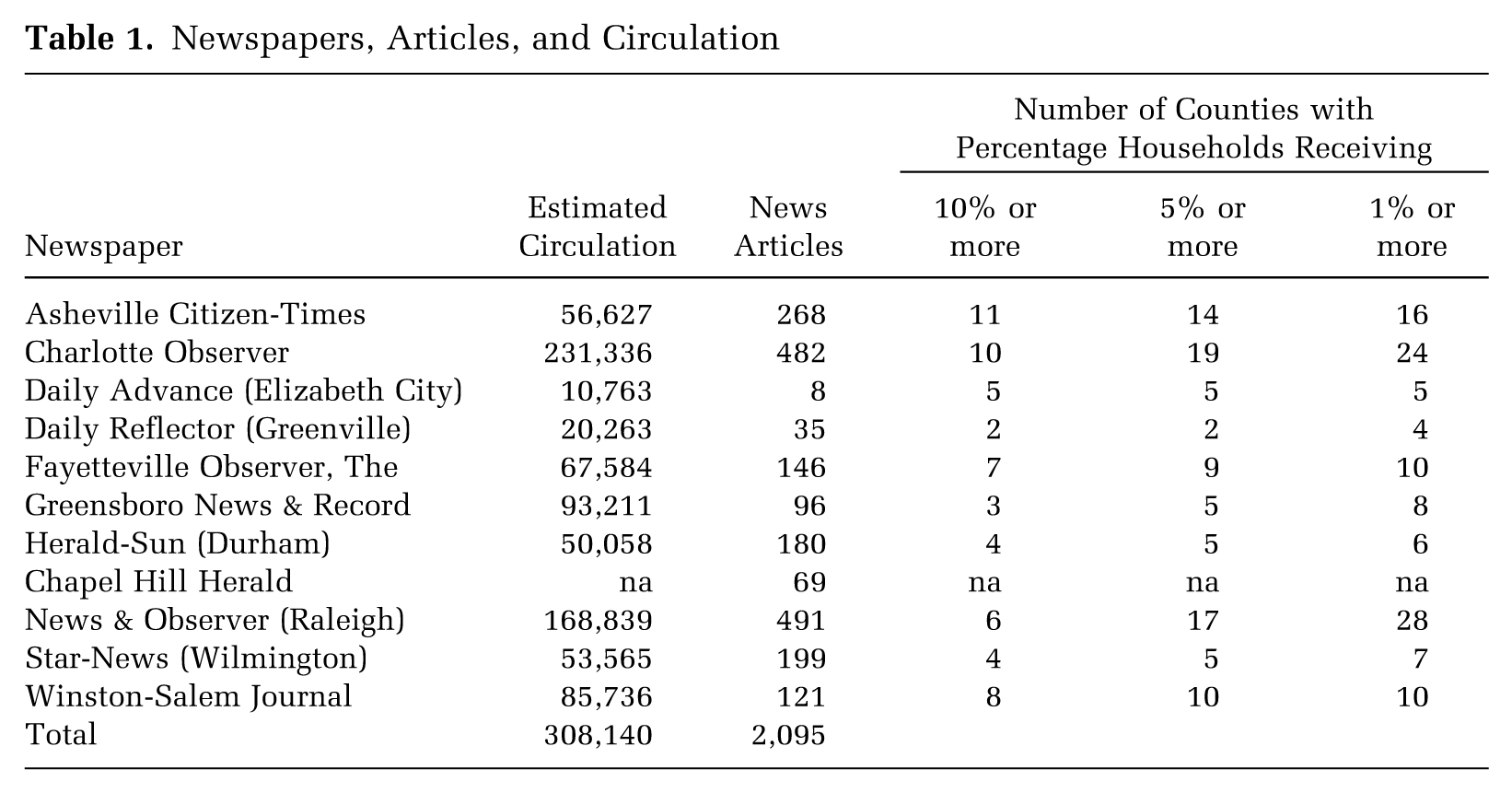
Table 1 lists the 11 newspapers with the largest circulations in North Carolina; they are based in cities and counties with the largest population concentrations. Figure 1 shows the cities where these newspapers are based and the locations of environmental organizations that completed our survey. These newspapers reach the different regions of the state, from Asheville in the western mountains to Wilmington on the coast. Table 1 includes the number of articles from each newspaper that are included in our analysis. Over 40 percent of the articles come from two newspapers—Raleigh’s News & Observer and the Charlotte Observer. We also report the number of North Carolina counties for which 10 percent, 5 percent, and 1 percent or more of households receive each newspaper; 4 this shows that all newspapers reach beyond their immediate locales. In addition, these data indicate wide variation in these newspapers’ geographic reach, with the News & Observer reaching 1 percent of households in 28 of North Carolina’s 100 counties.
Newspapers, Articles, and Circulation
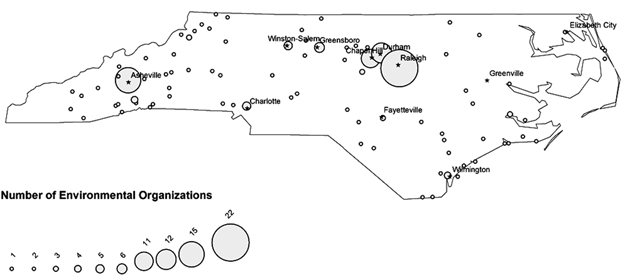
Location of North Carolina Newspapers and Density of Environmental Organizations by City
Dependent Variable: Media Attention
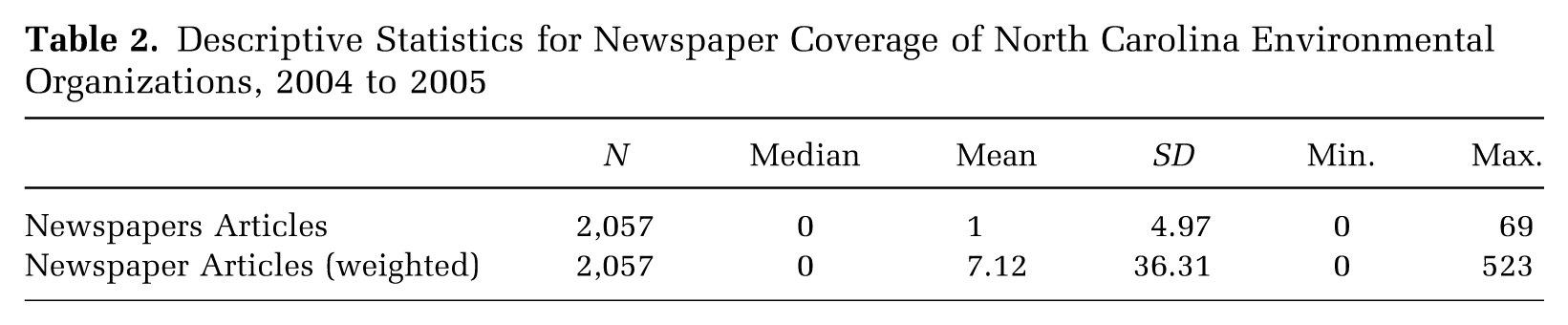
We measure media attention by a weighted count of the articles that mention an organization in 2004 and 2005 in each newspaper (see below for a description of the weighting procedure). An organization is thus included in our dataset once for each newspaper (N = 2,057; organizations = 187 and newspapers = 11). Table 2 summarizes descriptive statistics for the unweighted count and the weighted number of articles. The distribution is highly skewed; 41 percent of the organizations did not receive coverage in any newspaper.
Descriptive Statistics for Newspaper Coverage of North Carolina Environmental Organizations, 2004 to 2005
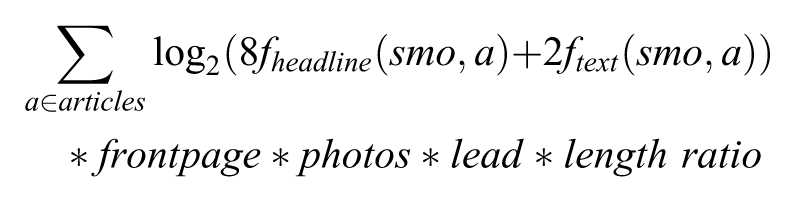
Some articles signal greater media attention than do others. For example, an article may be featured more prominently in the newspaper or an organization may be given greater attention in the article itself. We constructed a measure that weights each article by characteristics that influence the amount of attention conferred to an organization. 5 Specifically, we measure the number of times an organization is mentioned in the text, whether it is mentioned in the headline, placement on the front page, article length, presence of photos, and whether an organization is mentioned in the first paragraph (Ader 1995; Braun and Vliegenthart 2009; Corbett 1998b; Shaw and Sparrow 1999; Shoemaker 1984). These characteristics influence the likelihood that readers will pay attention to an article and its content (Garcia and Stark 1991; Holmqvist and Wartenberg 2005; Holsanova et al. 2006; Rayner et al. 2008). Among all articles, 4.1 percent mention an organization in the title and 10.9 percent in the first paragraph, 18.2 percent of articles are on the front page, and 36 percent include a picture or a graphic. The median article mentions an organization once, but 39 percent of the articles have multiple mentions. Finally, the average article is 674 words. Following Vliegenthart and colleagues (2005), we calculate each article’s contribution to an organization’s media attention score by taking the log base two (log2) of organization mentions, where the first occurrence in a headline is weighed as 3 and the first occurrence in an article as 1. We consider articles more important if they are on the front page, include photos, or mention an organization in the first paragraph; we multiply the article score by 2 when these conditions are present. Finally, we incorporate article length by taking the ratio of an article’s length to the average article; we multiply this ratio by an article’s score. Thus, articles above the mean length increase an article’s score, and shorter articles reduce it. Formal notation for the measure is the following:
To ensure the results are not simply an artifact of the components or weights included in this measure, we ran separate analyses using simpler weighting procedures. These supplementary analyses yield the same profile of results and interpretation as the models presented below (see Table S1 in the online supplement [http://asr.sagepub.com/supplemental]).
Independent Variables
Organizational capacity
We measure organizational age as the number of years since founding. We estimate staff size by combining a respondent’s report for the number of full-time (= 1) and part-time staff (= .5); the median is 1. We measure an organization’s formal structure as the number of task committees (median = 3). For membership, we include a categorical measure. 6 Organizations with members rely on them for resources (e.g., dues and labor) and legitimacy in representing their interests. Our measure distinguishes non-member organizations from organizations of varying sizes. The first category is organizations without individual members (21 percent). The remaining four categories are grouped by membership size: medium membership (30 to 399 members, representing the 10th to 50th percentiles in terms of membership within membership organizations), large membership (400 to 3,199 members, representing the 50th to 90th percentiles), and very large membership (more than 3,200 members, or greater than the 90th percentile); organizations with small membership, fewer than 30 members, are the excluded category. The smallest membership organizations include the grassroots associations that some scholars associate with high participation (Smith 2000). Table A1 in the Appendix includes descriptive statistics for all variables.
We also measure an organization’s networks to other environmental organizations using two variables. First, a dichotomous variable measures whether a group is a local affiliate of a larger national organization (e.g., the Audubon Society). We measure an organization’s embeddedness in local organizational networks with a scale based on three dimensions of an organization’s networks: (1) number of partners with which an organization co-sponsored events or activities in the past year, (2) number of coalitions an organization participates in, and (3) number of organizations that provided advice during the past year. We standardize the items in the scale so that each contributes equally to the scale’s variance. The typical (median) group is not affiliated with a national organization, did not co-sponsor activities with other groups, belongs to one coalition, and turned to two other organizations for advice in the prior year. Table A1 in the Appendix reports scale reliability statistics (Cronbach’s alpha) for this and other scales.
Organizational strategy and tactics
To capture a group’s tactical repertoire, we constructed four variables measuring (1) political advocacy and lobbying, (2) organizing and outreach, (3) media effort, and (4) demonstrations. The first three measures are based on scales of items that measure whether a group engaged in selected activities over the past year. We measure advocacy and lobbying with 13 distinct activities, including contacting members of the state legislature, making presentations at advisory commissions, and monitoring debates and decisions of state or local legislators (alpha = .87). We measure organizing and outreach with a 14-item scale (alpha = .78) that includes holding social events, information booths, public speaking, and conferences. We measure an organization’s media strategy based on three indicators: whether the organization issued press releases in the prior year, whether leaders had reporters as acquaintances, and whether leaders contacted local reporters in the prior year. Items used in these scales are similar to those included in prior studies of interests groups and social movement organizations (Schlozman and Tierney 1986; Walker 1991). We measure demonstrations using two questions that asked whether a group had organized or participated in a demonstration in the state capitol or in their community during the prior year. Groups that answered “yes” to either question are coded as “1,” and “0” otherwise. This measure does not assume that demonstrations are confrontational because the logic underlying many demonstrations is to draw attention to claims by showing a large number of committed and unified people (Tilly 1993–94).
We include additional measures for confrontational and identity deployment strategy. The tactical measures described earlier capture organizational behavior, whereas the confrontational and identity deployment strategies reflect orientations that are less easily observed. Scales are composed of multiple items from the survey in which we asked organizational representatives to indicate whether a statement “describes your group’s strategy”; response categories range from strongly disagree (1) to strongly agree (5). The four-item scale for confrontational strategy (alpha = .73) includes the use of litigation, boycotts, and confrontational action to disrupt the status quo, as well as not seeking a moderate public image. Litigation, boycotts, and confrontational action all entail the imposition of costs or constraints on a target or opponent; in this way, they differ from much of the activity described earlier that involves compromise, negotiation, and persuasion. We measure identity deployment strategy with a four-item scale (alpha = .81) based on a focus on teaching sustainable lifestyles, changing individuals, promoting sustainable products, and building a model community.
Environmental issues and organizational identity
We measure the kinds of issues a group works on with five scales for important and distinct domains of environmental concern. For a variety of issues, organizational leaders were asked whether it was a “major” issue, a “minor” issue, or not an issue for their group. Two scales distinguish between issues associated with the first and second waves of the environmental movement (e.g., wildlife protection and nature preservation for the first wave and energy and recycling for the second). We constructed additional scales to assess agriculture/farming and sprawl, which should be especially salient given their relationship to local economic well-being. Table A1 in the Appendix describes the items included in each scale. Finally, we measure the geographic scope of an organization’s efforts, ranging from the international to the neighborhood. We recoded the original seven-item responses into a dichotomous indicator for whether an organization focuses at the state, national, or international arena; zero indicates a focus on a neighborhood, city, county, or region within the state.
Control Variable
Geographic proximity
We measure an organization’s proximity to a newspaper by calculating the inverse distance in miles from the city where the organization is headquartered to the city where the newspaper is based. 7 The median distance to an organization’s closest newspaper is 12.2 miles.
Analysis
We employ negative binomial regression models to assess the influence of organizational, strategic, and issue characteristics on media attention. A negative binomial regression model is appropriate for analyses in which there is overdispersion, as is the case here (p <.01). Typically, Poisson and negative binomial models are used with count data, but Winkelmann (2008:65) contends this is not necessary and these models are “useful for non-count dependent variables as well” (see also Wooldridge 2002). In our case, the dependent variable is not a count because of the weighting procedure described earlier, but the negative binomial model is appropriate given the data’s distribution. Because we have multiple observations for each organization—one for each newspaper—we employ negative binomial regression models with standard errors robust to intra-organizational correlation. The organizational characteristics are constant within organizations, so we cannot include indicator variables, or fixed effects, for each organization. Negative binomial models that control for distribution of the dispersion parameter between organizations, such as those included in most statistical packages (e.g., xtnbreg in Stata), produce biased coefficient estimates when there are unmeasured organizational characteristics that influence the outcome variable, and practitioners are generally discouraged from using them (Allison and Waterman 2002). Our simulations suggest that negative binomial models with cluster-robust standard errors produce unbiased coefficients and accurate confidence intervals in the presence of unmeasured organization effects on the outcome variable with our data structure, and we employ this strategy here. 8 We include an indicator variable for each newspaper to control for unobserved newspaper characteristics because we are concerned with isolating the organizational characteristics that influence media attention.
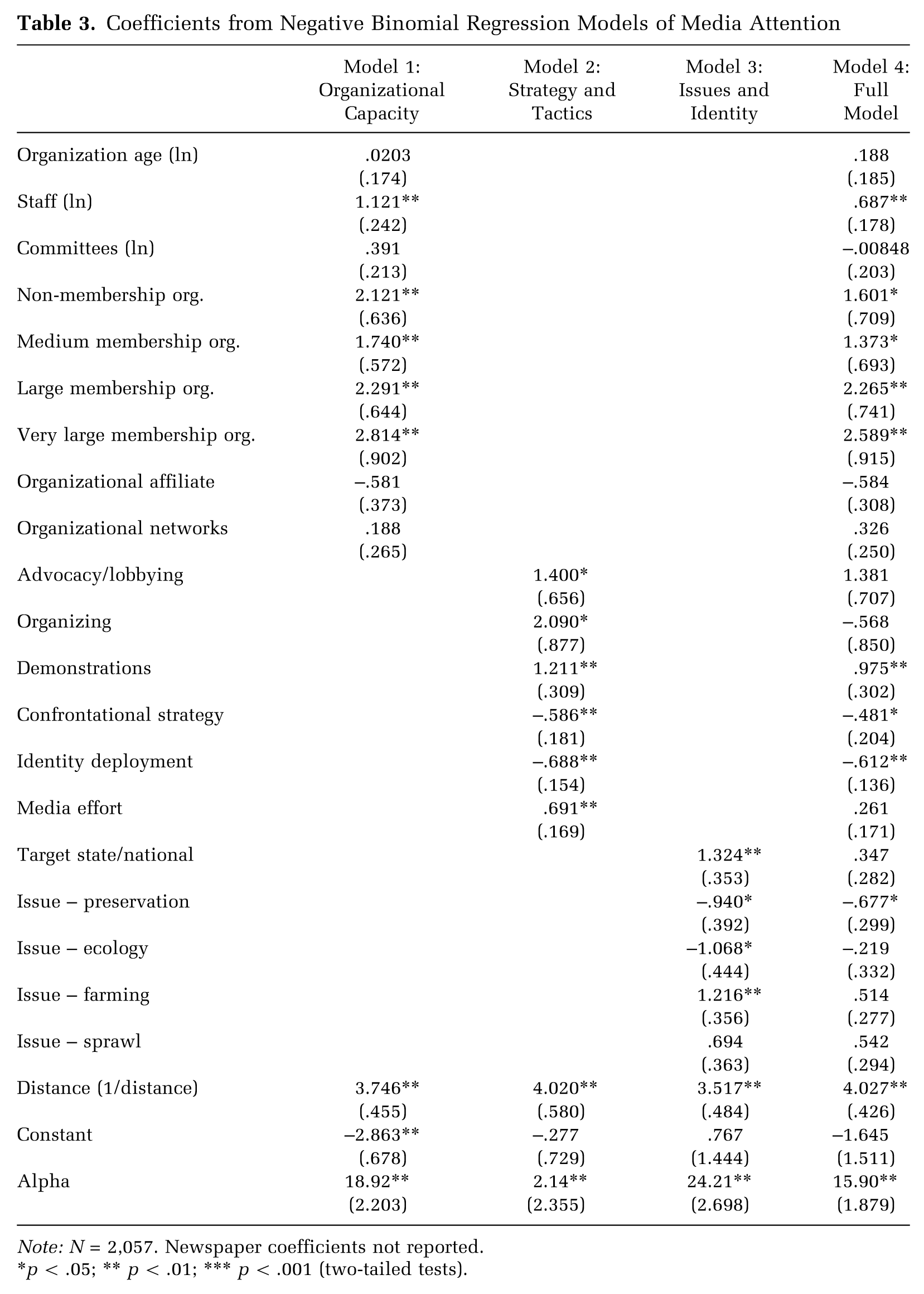
Table 3 presents partial models for the three sets of explanatory factors and a full model. This strategy allows us to consider the characteristics of organizations that are (and are not) included in media representations of the environmental sector and test relevant theoretical expectations. The models presented here are based on 20 imputations of the small fraction of missing survey data. We implemented this procedure using the ice and mim commands in Stata (Royston 2007) and results are nearly identical to the complete case analysis.
Coefficients from Negative Binomial Regression Models of Media Attention
Note: N = 2,057. Newspaper coefficients not reported.
p <.05; ** p <.01; *** p <.001 (two-tailed tests).
Model 1 shows the major organizational characteristics that are expected to influence an organization’s media attention. Staff size has a positive effect on news coverage, but organizational age, task committees, affiliation, and networks have no statistically significant effect. In summary, organizations with greater staff—who may bring greater expertise, skills, and continuity to their work—are better able to capture media attention in local newspapers.
Membership has an important, although complex, relationship to media attention, and we use a categorical measure with indicator variables to uncover the pattern. 9 Organizations with very small membership (i.e., 30 members or fewer) receive the least media attention; this is the excluded category and represents the 10 percent of membership organizations in our sample with the fewest members. Medium membership organizations (i.e., between 31 and 400 members) receive the second lowest amount of attention. Non-membership organizations receive the next highest amount of attention, followed by large and very large membership organizations. In the same way that large protest events gain greater media attention than small events, organizations with large memberships experience advantages when making claims. Organizations without members can still acquire substantial media attention, and we suspect this is due to the professional expertise they cultivate.
Model 2 examines how an organization’s strategy and tactics shape its coverage in local newspapers. Here, core findings show that greater levels of advocacy, organizing, media effort, and demonstrations enhance media attention. 10 These analyses also reveal strategic orientations that diminish media attention. Organizations with an identity deployment strategy that emphasizes personal transformation receive less attention, as do organizations that employ a confrontational strategy. These results indicate that organizations using outsider or counter-institutional strategies have diminished media attention. Insider tactics, whether mobilizing people or routine advocacy, increase media attention.
Model 3 examines whether organizations are more likely to gain media attention if they work on certain kinds of environmental issues. Organizations with a state or national focus receive greater media attention than do organizations focusing on a specific city, county, or neighborhood. Farming and sprawl have a positive and significant effect for media attention. Given North Carolina’s rapid population growth—an estimated 21.4 percent growth in the 1990s—sprawl may be part of a recent issue attention cycle for local newspapers. We also find that preservation has a negative and significant relationship.
Model 4 presents a summary model that includes all three sets of independent variables. Before examining the relationship between organizational capacity, strategy, and issues, we highlight the findings regarding distance and the theoretical implication of these patterns. Geographic proximity is an important predictor of media attention in all models. News media analysts often point to the significance of geographic proximity for structuring media attention. Studies of protest coverage also show this pattern (Myers and Caniglia 2004). For local newspapers, stories that describe activities and issues facing the local community are deemed especially salient. Organizations located closer to news agencies should thus be more likely to gain media attention—for example, by attending regularly scheduled city council meetings. Proximate organizations are more likely to encounter reporters or to organize activities that reporters will attend. These claims find support in the study of collective action and protest events (Oliver and Maney 2000), and our analyses confirm this finding with respect to movement organizations.
Turning to the broader findings of Model 4, the central insights from the partial organizational capacity model are confirmed. Staff and membership have positive impacts on media attention. Two key measures of tactics—advocacy and organizing—are no longer significant. Demonstrations, however, still has a significant positive relationship to media attention, and identity deployment and confrontational strategies have negative relationships. In the full model, we find that the positive effect of a state or national focus or a focus on farming, sprawl, and sustainability are no longer significant. This suggests that the attributes of organizations advocating in these areas are better predictors of coverage than are the environmental issue areas themselves. The one exception is that organizations with a strong focus on preservation issues gain less coverage.
Three supplementary analyses add further confidence to the results presented here. First, we examined whether the density of environmental organizations influences organizations’ ability to gain media attention. Guided by density dependence theories of organizations, we expected a curvilinear relationship. We tested whether the number of organizations (from the entire population rather than the sample) in the same county affects local news media coverage, but we found no evidence of a linear or curvilinear relationship. Second, we examined whether controlling for past newspaper coverage alters any of the relationships regarding organizational capacity, strategy, tactics, or issues reported here. Using a question that asked organizational leaders to indicate on a five-point scale (from “none” to “a very large amount”) how much coverage their organizations had received in local newspapers in the prior year, we found that substantive relationships were not altered, although past coverage does have a significant and positive relationship. Finally, we looked closely at the relationship between the environmental issues an organization prioritizes and the content of the articles about the organization. Given the theoretical importance of the issue attention argument in the literature, we conducted additional analyses to buttress our interpretation. This is challenging because the relationship we establish in Table 3 between an organization’s issue focus and the amount of media attention is indirect. For each article, we coded whether there is attention to each of the sets of issues (i.e., preservation, ecology, farming/agriculture, and sprawl) measured at the organizational level. These analyses show a strong relationship between the kinds of issues organizations pursue and the content of articles, and this adds confidence to our interpretation. (See Tables S3 and S4 in the online supplement for additional details and results.)
Discussion and Conclusions
Sociology, communication studies, and political science have all extensively debated the determinants of media attention. In recent years, this question has become increasingly central to the study of social movements. Most prior work is limited by relatively small and purposive samples of organizations, lacks detailed and systematic data about organizations, and relies on a small number of national newspapers. This study overcomes many of these limitations to examine an enduring question about media attention to social movements. Overall, the findings presented here indicate that news media report more extensively on organizations that are geographically proximate, have greater organizational capacity, mobilize people through demonstrations or organizations, and use conventional tactics to target the state and media. The findings regarding proximity lend support to the longstanding claim that media routines and localism as a criterion for newsworthiness shape news content. More resourceful organizations are better able to establish and maintain relationships with the news media and may also be better able to signal the legitimacy of the organization and its claims. Regarding membership, our pattern speaks to the ongoing debates about the transformation of civic associations with the rise of member-less advocacy groups (Berry 1999; Putnam 2000; Skocpol 2003; Walker 2009). Despite the growth in non-member organizations, membership remains an important resource; perhaps membership signals the broader interest and newsworthiness of a group’s claims and activities. On the other hand, non-membership organizations are more effective than small membership organizations at securing media attention. Mobilizing people by organizing and working closely with political authorities are strategies that gain more media attention. Demonstrations are an especially powerful strategy for gaining media attention, and this positive relationship is present even in models controlling for organizational resources and issues. By contrast, organizations that emphasize confrontational strategies that impose costs on targets and identity deployment strategies of building alternative organizations and markets gain less news coverage.
Taken together, these findings go a long way toward advancing our understanding of the relationship between the news media and movement organizations. Many studies of the news media select on issues or organizations that have already become salient objects of media attention (e.g., major oil spills or the spotted owl controversy). Many actors (and issues) go unnoticed, and this disparity reveals the durable forces that shape media representations of the environmental movement. Ultimately, a relatively small proportion of all environmental movement organizations capture the majority of media attention, and these organizations are much less diverse than the broader population of movement organizations. Organizations that do get noticed gain an important source of potential influence as they seek to bring about social change, while those left out do not.
Our analyses reveal new insights about the relationship between an organization’s issue focus and its media coverage. We show that organizations working on issues that address economic and social dimensions of the environment gain greater media attention. These findings support claims that local newspapers’ issue attention cycles favor stories that highlight local angles and focus on economic growth (Kaniss 1991; Logan and Molotch 1987). The issues that structure local environmental organizations appear quite distinct from the themes that characterize national coverage. Although global warming and climate change gained considerable attention during this period, these issues appear very rarely in the articles we collected. For example, 1.9 percent of the articles reference global warming, and 1.3 percent reference climate change. We hope this finding will motivate further research on the differences between local and national media coverage and issue attention cycles.
This study also speaks to recent efforts to challenge the state-centered focus of movement scholarship. Specifically, critics note that movements make claims on a much wider range of targets than just state institutions, including cultural practices, religious organizations, market actors, and the mass media (Armstrong and Bernstein 2008; King and Soule 2007; Snow 2004; Van Dyke, Soule, and Taylor 2004). Given the diverse targets and strategies employed by the organizations we studied, our research supports this key insight. Nevertheless, media attention does flow disproportionately to organizations that interact with the state, consistent with Oliver and Maney’s (2000) work on collective action events and Amenta and colleagues’ (2009) study of national movement organizations.
The study does have several limitations that may raise further questions. One clear limitation is that our analysis considers only the extent to which the news media pays attention to an organization, despite the fact that one news story may marginalize, trivialize, or denigrate a movement organization and its cause, while another article may celebrate and promote an organization. News stories vary internally on many key dimensions beyond those measured here; these dimensions connect directly to questions about a movement organization’s ability to shape the public agenda. On a related note, this analysis is movement-centered, and we know that many other actors seek media attention on environmental issues. For example, prominent individuals, state institutions, and major events or disasters may shift media attention on the environment in important ways that alter the newsworthiness of movement organizations and their efforts. Scholarship that examines attention to movements alongside other kinds of actors would mark another important contribution to the field (Ferree et al. 2002; Mazur 1998).
Other limitations may derive from the fact that this is a case study of a single movement. For example, news coverage of environmentalism may favor professional expertise due to the centrality of science and law to environmental discourse. Moreover, environmentalism has become a relatively stable arena of social movement activity. Although these qualities may help define the scope conditions of this study, they are true for many other important contemporary movements (Dalton and Kuechler 1990; Meyer and Tarrow 1998).
Further limitations will likely have to be addressed in different kinds of research. Long-term trends in news coverage and movement development are beyond the scope of this study. In addition, a different research design is required to examine the success and failure of particular tactical and framing choices for specific events. On the other hand, this study does reveal many of the underlying causal factors that contribute to an organization’s media attention. Much of the coverage that movement actors receive derives from their broader reputation and visibility rather than their choices surrounding a particular event. By demonstrating a strategy for examining a representative sample of local movement organizations combined with systematic news coverage from local newspapers, this study provides an important point of departure for developing our understanding of movements’ effects on the public agenda. More important, the findings contribute to a broad theoretical account of the relationship between movements and the media and provide new insights regarding who speaks for movements.
Footnotes
Appendix
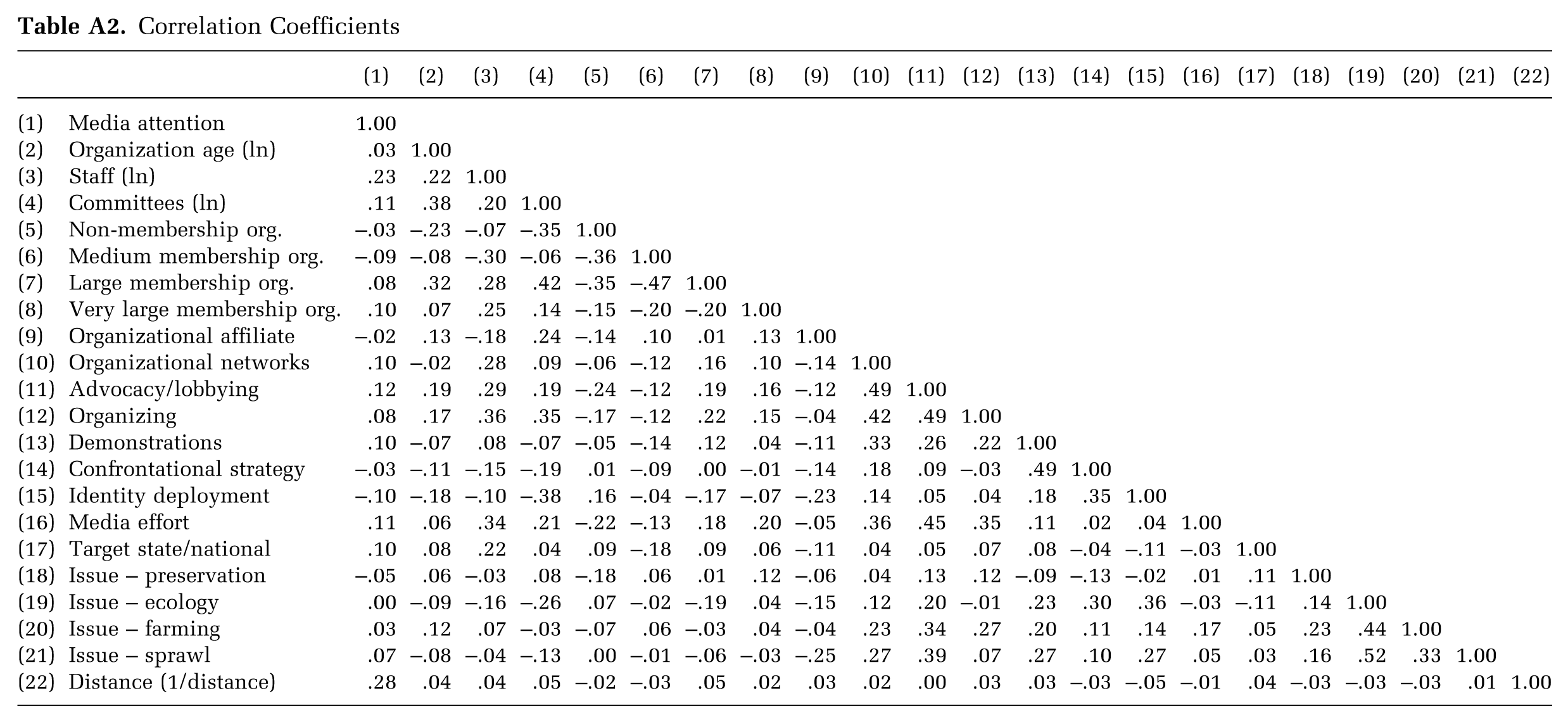
Correlation Coefficients
| (1) | (2) | (3) | (4) | (5) | (6) | (7) | (8) | (9) | (10) | (11) | (12) | (13) | (14) | (15) | (16) | (17) | (18) | (19) | (20) | (21) | (22) | ||
|---|---|---|---|---|---|---|---|---|---|---|---|---|---|---|---|---|---|---|---|---|---|---|---|
| (1) | Media attention | 1.00 | |||||||||||||||||||||
| (2) | Organization age (ln) | .03 | 1.00 | ||||||||||||||||||||
| (3) | Staff (ln) | .23 | .22 | 1.00 | |||||||||||||||||||
| (4) | Committees (ln) | .11 | .38 | .20 | 1.00 | ||||||||||||||||||
| (5) | Non-membership org. | −.03 | −.23 | −.07 | −.35 | 1.00 | |||||||||||||||||
| (6) | Medium membership org. | −.09 | −.08 | −.30 | −.06 | −.36 | 1.00 | ||||||||||||||||
| (7) | Large membership org. | .08 | .32 | .28 | .42 | −.35 | −.47 | 1.00 | |||||||||||||||
| (8) | Very large membership org. | .10 | .07 | .25 | .14 | −.15 | −.20 | −.20 | 1.00 | ||||||||||||||
| (9) | Organizational affiliate | −.02 | .13 | −.18 | .24 | −.14 | .10 | .01 | .13 | 1.00 | |||||||||||||
| (10) | Organizational networks | .10 | −.02 | .28 | .09 | −.06 | −.12 | .16 | .10 | −.14 | 1.00 | ||||||||||||
| (11) | Advocacy/lobbying | .12 | .19 | .29 | .19 | −.24 | −.12 | .19 | .16 | −.12 | .49 | 1.00 | |||||||||||
| (12) | Organizing | .08 | .17 | .36 | .35 | −.17 | −.12 | .22 | .15 | −.04 | .42 | .49 | 1.00 | ||||||||||
| (13) | Demonstrations | .10 | −.07 | .08 | −.07 | −.05 | −.14 | .12 | .04 | −.11 | .33 | .26 | .22 | 1.00 | |||||||||
| (14) | Confrontational strategy | −.03 | −.11 | −.15 | −.19 | .01 | −.09 | .00 | −.01 | −.14 | .18 | .09 | −.03 | .49 | 1.00 | ||||||||
| (15) | Identity deployment | −.10 | −.18 | −.10 | −.38 | .16 | −.04 | −.17 | −.07 | −.23 | .14 | .05 | .04 | .18 | .35 | 1.00 | |||||||
| (16) | Media effort | .11 | .06 | .34 | .21 | −.22 | −.13 | .18 | .20 | −.05 | .36 | .45 | .35 | .11 | .02 | .04 | 1.00 | ||||||
| (17) | Target state/national | .10 | .08 | .22 | .04 | .09 | −.18 | .09 | .06 | −.11 | .04 | .05 | .07 | .08 | −.04 | −.11 | −.03 | 1.00 | |||||
| (18) | Issue – preservation | −.05 | .06 | −.03 | .08 | −.18 | .06 | .01 | .12 | −.06 | .04 | .13 | .12 | −.09 | −.13 | −.02 | .01 | .11 | 1.00 | ||||
| (19) | Issue – ecology | .00 | −.09 | −.16 | −.26 | .07 | −.02 | −.19 | .04 | −.15 | .12 | .20 | −.01 | .23 | .30 | .36 | −.03 | −.11 | .14 | 1.00 | |||
| (20) | Issue – farming | .03 | .12 | .07 | −.03 | −.07 | .06 | −.03 | .04 | −.04 | .23 | .34 | .27 | .20 | .11 | .14 | .17 | .05 | .23 | .44 | 1.00 | ||
| (21) | Issue – sprawl | .07 | −.08 | −.04 | −.13 | .00 | −.01 | −.06 | −.03 | −.25 | .27 | .39 | .07 | .27 | .10 | .27 | .05 | .03 | .16 | .52 | .33 | 1.00 | |
| (22) | Distance (1/distance) | .28 | .04 | .04 | .05 | −.02 | −.03 | .05 | .02 | .03 | .02 | .00 | .03 | .03 | −.03 | −.05 | −.01 | .04 | −.03 | −.03 | −.03 | .01 | 1.00 |
Acknowledgements
For helpful feedback, we thank Kraig Beyerlein, Guang Guo, Anne Hunter, Charlie Kurzman, Chaeyoon Lim, Peter Marsden, John Munoz, Charles Seguin, ASR editors and reviewers, and participants in the Culture and Politics Workshop at UNC-Chapel Hill. We are grateful to Bob Edwards with whom Andrews collected the original survey data. Prior versions were presented at the American Sociological Association meetings, the University of Washington, and the University of Arizona.
This project was funded in part by a fellowship from the Russell Sage Foundation and grants from the UNC Center for Public Service, Research/Creative Activity Grants Committee of the East Carolina University Faculty Senate, American Sociological Association’s Fund for the Advancement of the Discipline (FAD), and Harvard University’s Milton Fund.
1.
2.
These results and other details regarding the analysis are available from the authors on request.
3.
The same article could be included more than once if it mentions multiple organizations.
5.
This measure is similar to Vliengenthart and colleagues’ (2005) visibility score, which includes the number of times an organization is mentioned in an article, whether the article appears on the front page, and whether the organization is mentioned in the title.  weight an article by a newspaper’s circulation, which was appropriate given that all three newspapers in their study had a national readership. We do not weight by circulation because each newspaper has a distinct market. We ran analyses with the measure weighted by circulation, but it did not alter the patterns or interpretation.
6.
Respondents were asked whether their organization has individual members. Respondents who answered “yes” were asked to estimate the number of members.
7.
We add 1 to the distance so that proximity can be calculated for organizations and newspapers in the same city. We tested alternative formulations of the distance measure, such as the inverse square root and the inverse squared (Hedstrom 1994; ); these performed similarly to the simpler measure used here.
8.
Table S2 in the online supplement includes details on the simulation. Stata code for this simulation procedure, and for replication of all reported and supplementary analyses, are available from the first author.
9.
The VIF scores in the complete model are highest for the membership indicator variables, ranging from 2.45 to 5.06. Other modeling strategies, such as including an indicator variable for membership and a continuous membership count variable, and splitting the sample between membership and non-membership organizations, produce a similar relationship between membership type, number of members, and media attention. Additionally, the finding from our regression models that small membership organizations receive the least coverage, followed by non-membership organizations, with large membership organizations receiving the most coverage, is consistent with the raw data and the bivariate relationship between membership and media attention.
10.
We examined a measure of confrontational protest, such as occupying public spaces. Relatively few organizations report using confrontational protest (5.8 percent), and it has a negative and nonsignificant effect.
References
Supplementary Material
Please find the following supplemental material available below.
For Open Access articles published under a Creative Commons License, all supplemental material carries the same license as the article it is associated with.
For non-Open Access articles published, all supplemental material carries a non-exclusive license, and permission requests for re-use of supplemental material or any part of supplemental material shall be sent directly to the copyright owner as specified in the copyright notice associated with the article.
