







Abstract
Culture and politics have a close relationship, but how exactly does the cultural become the political? This article builds a theoretical framework for this question by examining Vietnam-era U.S. poets’ politicization of Buddhism at the expense of more effective or more easily controllable discursive resources. I find, first, that outcomes depend on whether would-be appropriators and legitimate owners of the appropriated resource can strike a mutually beneficial bargain. Second, whether two such distinct parties emerge depends on how tightly contexts of the appropriation process are linked. Consequently, appropriation is best understood as reciprocal exchange.
How does the cultural turn into the political? The political relevance of cultural elements varies over time and across space; also, one cannot know ahead of time which actors can effectively use which elements because meanings are contested. Two questions thus emerge: How do actors choose which cultural elements to try to convert to political assets? And what affects the outcomes of conversion attempts?
Recent scholarship has gained remarkable insights into these questions, but we lack a comprehensive framework of cultural appropriation. This article begins the construction of such a framework by examining the politicization of Buddhism at the hands of U.S. poets during the Vietnam War. It is well known that poets such as Robert Bly, Allen Ginsberg, and Gary Snyder opposed the Vietnam War, that they were involved in the Americanization of Buddhism, and that these two activities had some overlap (Farrell 1997; Gitlin 1993; Smith 1995). But this constitutes a puzzle: among the religious and philosophical traditions available to these poets, existentialism and neopaganism posed smaller threats to their cherished autonomy, and Christianity would have been a more effective resource. Why, then, did Buddhism dominate these traditions among poets?
I propose to solve this puzzle by conceptualizing appropriation as reciprocal exchange of scarce symbolic and material resources between two heterogeneous parties (Emerson 1981). I argue that successful appropriation takes place when appropriators strike a mutually beneficial bargain with these resources’ legitimate owners. For this to occur, two conditions must be met. First, the legitimate owners of the resource to be appropriated must have some visibility in the appropriators’ social space. Second, the owners must depend on the appropriators for something they value highly. Among the religious and philosophical traditions available to U.S. poets at this time, only Buddhism met both conditions.
When owners are insufficiently visible, appropriators may feel unable to carry the process of conversion through. Without the support of credentialed experts, importation of cultural novelties smacks of dilettantism, and appropriators are often aware of this. This was the case with existentialism and neopaganism. If owners do not depend on would-be appropriators, they may deny them access. This was the case with Christianity.
This framework has a deterministic element—once the two parties of the process have emerged, legitimate owners’ visibility and dependence determine the outcome. But it also has a fundamental indeterminacy. Whether two such parties will emerge depends on how the milieus of the appropriation process are linked. As the number of milieus increases, the chain they constitute becomes more likely to break. In the case examined here, Buddhist clergy’s dependence on the poets resulted from the rise of a self-orientalizing reform movement in Japanese Buddhism. Furthermore, the legacy of this New Buddhism was transmitted to the United States via Europe, so struggles among European cultural elites, with all their indeterminacy, were crucial.
Key Concepts
Politics and culture
By politics, I refer to all struggles that affect the distribution of scarce material and symbolic resources. By culture, I refer to the symbolic dimension of social life: signs are the building blocks of culture, with religious and philosophical texts among its subsets. Because meaning is not inherent in texts, culture is an ongoing construction, a practice (Ortner 1984) that provides actors with toolkits they can deploy creatively for problem solving (Swidler 2001).
This means that culture is built into politics, and that the interpretation of texts is potentially, although not always, political. This organic relationship does not make the question of how the cultural turns into the political meaningless—the same elements of culture are sometimes central to political struggles and sometimes fall entirely outside their scope. Consequently, political actors must choose from multiple master frames (Snow and Benford 1992), identities (Bernstein 1997; Gamson 1995), organizational forms (Clemens 1993, 1997; Isaac 2002), forms of contention (Tilly 1978), and tactics (Downey and Rohlinger 2008; Turner 1970).
The field approach to cultural production (Bourdieu 1993, 1996) provides the most systematic account of the politics/culture nexus in the practice paradigm. In this approach, texts’ meanings vary across fields and across positions in the same field. Given that cultural practices mark status differences, the political import of texts is variable. If twentieth-century U.S. poetry constituted a field, therefore, the Buddhism/protest nexus may be explained partly with reference to field dynamics such as intra- and inter-field conflict.
U.S. poetry was indeed a field, as poets had a distinct value system and code of behavior (Büyükokutan 2010a). These were frequently at odds with the market principle, reason of the state, and mainstream morality; they thus had a strong influence on poets’ politics, with career poets being far more likely than the median U.S. voter to have left-libertarian views. Poets could advance their literary careers by defending this kind of politics, and participation in the Vietnam peace movement was one way to do that (Büyükokutan 2010b).
Some critics argue that the field approach reduces human practices to instrumental behavior by paying insufficient attention to meaning (e.g., Alexander 1998, 2003). From a strict Bourdieusian perspective, this criticism misses the point, which is the destabilization of the interest/meaning dichotomy. Nevertheless, some of Bourdieu’s followers have indeed taken meaning for granted to maximize analytic rigor in limited space. To avoid this trade-off, I start my analysis with a thick description of the Buddhism/poetry/protest nexus.
Appropriation
The notion of appropriation is widely used to discuss whites’ plunder of black culture (e.g., Chin 2001; Delgado and Stefancic 2001; Kincheloe 1998; Tate 2003), dispossession of indigenous groups by multiculturalism (Possamaï 2002; Thomas 1999; Ziff and Rao 1997), and non-Western cultural entrepreneurs (Goldstein-Gidoni 2005). The main problem with this literature is its moralistic tendency. The sense one gets from this literature is that appropriation has just one cause—structural inequality—and just one consequence—victimization. It is therefore tempting to discard the term and instead use a less loaded one such as diffusion. Because diffusion has no normative connotations, scholars use the term to study not just the ultimate cause and final outcome of cultural change, but also its intermediate steps. Consequently, diffusion studies are more nuanced, distinguishing between three kinds of independent variables that describe the actor, environment, and innovation (Wejnert 2002). While little in this literature describes how these three variables interact, this is not an inherent weakness of the diffusion concept but an interesting question it makes possible to ask. Moreover, there is a substantial literature on the diffusion of cultural innovation in social movements (Strang and Soule 1998).
If appropriation takes a certain kind of political dynamic for granted, however, diffusion underestimates the impact of politics on cultural innovation (Buttel 2000; Molnár 2005; Moretti 1999). It is therefore healthier to critically rethink the concept of appropriation. Rather than the theft of a preexisting entity by a preexisting group, appropriation may be seen as the ongoing constitution of cultural goods as desirable objects and the actions of groups prepared to struggle for their ownership (Schneider 2003). Following this definition, scholars must direct more attention to the specific actors and milieus of this process.
Therefore, actors of the appropriation process may have conflicting interests and expect to sacrifice some interests to secure others. In addition, because conflicts of interest within the two parties may emerge, I expect to find that the outcome of the appropriation process depends on, among other things, whether one of the two parties is significantly more cohesive than the other.
The appropriation process is complex, but I contend that it can be understood in terms of a simple logic. I expect to find that successful appropriation requires mutual dependency between the two parties; as such, their interactions constitute social exchange (Blau 1964; Emerson 1962; Homans 1974). In other words, I expect to find that appropriation takes place when appropriators and legitimate owners both stand to benefit, even if the benefits they derive are unequal. I expect to find that mutual dependence is a function of the relative size of the two parties’ stocks of material resources and that too wide a gap in favor of either party will prevent collaboration. I do not, however, expect the simplicity of the exchange logic to annihilate the roles of culture and history. The relative value of various material resources is a matter of historical contingency.
The claim that appropriation may be understood as exchange does not, as some would argue, necessarily instrumentalize culture. In some cases, exchange is not negotiated but reciprocal (Emerson 1981)—that is, the terms of the deal are not formally specified. In reciprocal exchange, goods do not change hands simultaneously but sequentially, making the process uncertain. Participants display a greater variety of emotional expressions in reciprocal than in negotiated exchange (Lawler and Thye 1999). These emotions are not mere reactions to the process but affect its outcome, partly because reciprocal exchange features substantive, not procedural, fairness (Molm, Peterson, and Takahashi 2003). Exchanges that drive the appropriation process may be of this sort.
For this rethinking of the appropriation perspective to be truly successful, it must engage with diffusion research. I therefore distinguish among effects of actor, environment, and innovation characteristics. I expect that all three kinds of variables will be significant, although not necessarily equally.
Data and Method
The research for this study consists of two stages. First, I used secondary sources to derive two lists: (1) U.S. poets who figured prominently in the Vietnam peace movement, and (2) major poets associated with philosophical and religious movements. I then used archival and biographical materials to verify claims in the secondary sources. Archival materials consist of 13 poets’ correspondence, diaries, and notebooks. Biographical materials consist of biographies and autobiographies, printed correspondence, essays, and interviews.
Regarding participation in philosophical and religious movements, I distinguish between primary and secondary interest. This simplifies a complex reality—the line between primary and secondary interest is fuzzy, and some poets in this list would deny the distinction. Yet discourse and practice may diverge, and even the most eclectic poets relied on some sources more than on others.
The second phase, constructing an account of the diverging histories of religious/philosophical sources of poetic dissent, relies on a close examination of five encounters between poets and philosophical/religious experts. I use all three sources of data to identify poets who were leading actors in the appropriation of these traditions, and I trace their level of association over time. I pay special attention to moments of institutionalization of the relationship between poets and experts. I examine whether the notion of social exchange captures the dynamics of their interactions, whether the exchanges in question were negotiated or reciprocal, and whether the material resources and internal cohesion of the two parties influenced the meanings that religious and philosophical texts came to acquire.
The Case: Buddhism and the U.S. Poetry Field
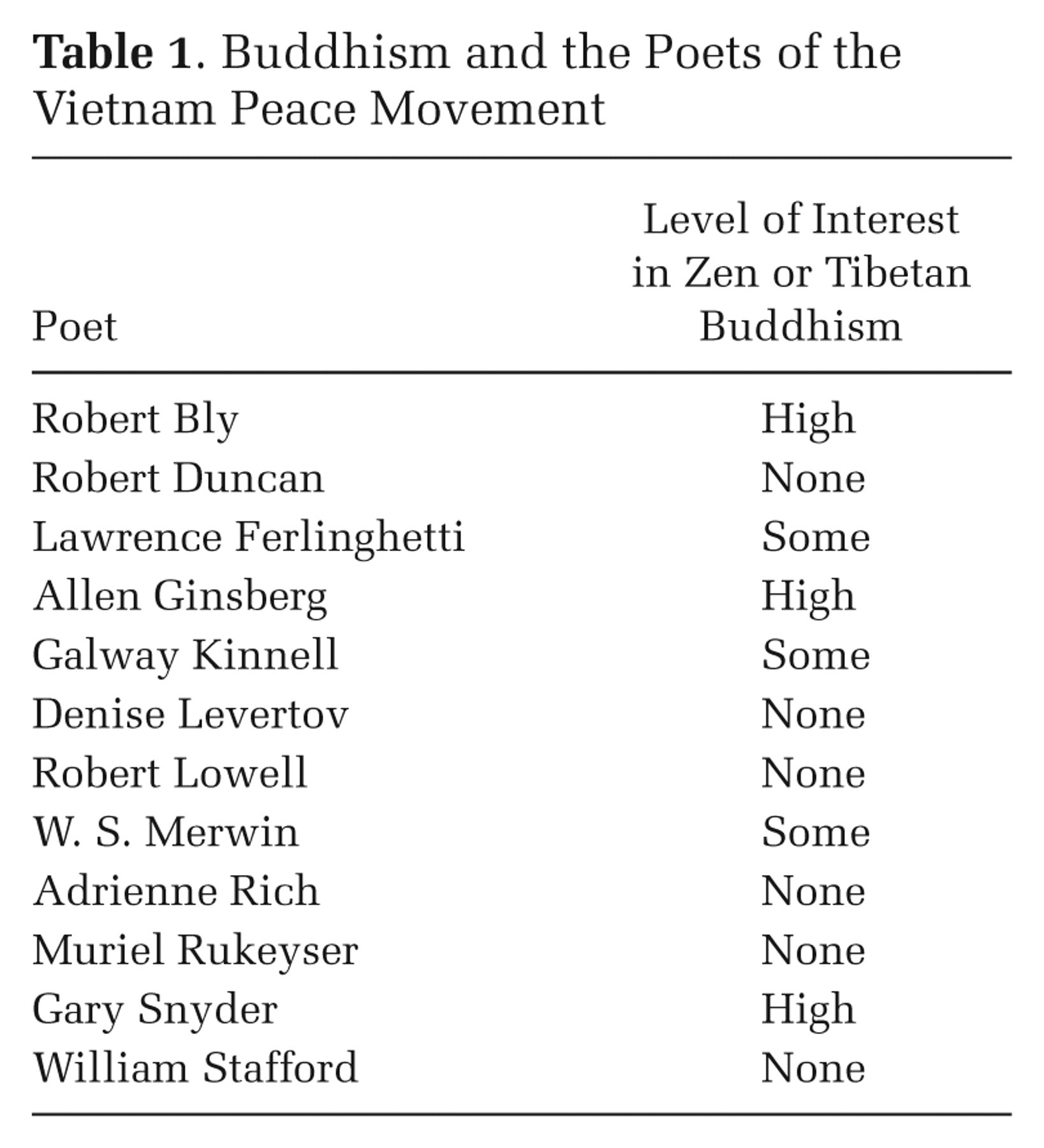
Of the 12 U.S. poets most active in the antiwar movement, six had some interest in Buddhism (see Table 1). Given that the number of U.S. Buddhists was negligible at the time of the Vietnam War, this is quite remarkable.
Buddhism and the Poets of the Vietnam Peace Movement
Buddhism informed these poets’ political language. In a 1961 essay that he revised several times during the sixties, Gary Snyder (1999:177–78) invoked Buddhist dogma to denounce the Vietnam War:
The national polities of the modern world maintain their existence by deliberately fostering craving and fear: monstrous protection rackets. The “free world” has become economically dependent on a fantastic stimulation of greed which cannot be fulfilled, sexual desire which cannot be satiated and hatred which has no outlet except against oneself, the persons one is supposed to love, or the revolutionary aspirations of pitiful, poverty-stricken marginal societies like Cuba or Vietnam. The conditions of the Cold War have turned all modern societies—Communist included—into vicious distorters of man’s true potential. They create populations of “preta”—hungry ghosts, with giant appetites and throats no bigger than needles.
The antagonists in Snyder’s narrative are fear, greed, and hatred. The importance of these terms follows from his view of the cosmos, based on Buddhist notions of no-self, emptiness, and interdependence. According to the notion of no-self, human subjectivity does not have a fixed essence, so humans are capable of unbounded self-transformation. Fear of the unknown, including fear of the Vietnamese, is therefore misplaced. The idea of emptiness extends this creative impermanence to inanimate beings, denouncing attachment to them—because all things are constantly changing, the desire to conquer them is pointless. According to the idea of interdependence, all beings depend on one another for their well-being, so the us-versus-them language of war is fundamentally wrong. A Buddhist prognosis followed from Snyder’s (1999:178) Buddhist diagnosis:
The joyous and voluntary poverty of Buddhism becomes a positive force. [Buddhism’s] traditional harmlessness and refusal to take life in any form has nation-shaking implications. The practice of [Buddhist] meditation, for which one needs only “the ground beneath one’s feet,” wipes out mountains of junk being pumped into the mind by the mass media and supermarket universities.
Other U.S. poets interpreted Buddhist texts similarly. In an interview that appeared in Minnesota Daily on March 28, 1969, Robert Bly suggested the Vietnam War was a result of the U.S. failure to appreciate interdependence:
Q: Do you believe in God? A: In the last 10 years, I’ve learned most from the Buddhists. If you go to a Buddhist teacher and say “Do you believe in God?” he’ll say, “Let’s not use these long words, these words are too long!” There is a skin between our selves and our inner being. Freud said there’s a sea inside of us and inside that sea is your inner life, your spiritual life, your sexual desires. Then there’s the outer world made of streetcars and everything. These two worlds can’t rub against each other, it’s too painful. So you develop a skin, just like a cow develops a hide—you wouldn’t want her guts to rub against a barn! In America this skin gets very thick. You spend the first 20 years of your life making this skin thicker. The problem is to get through the skin. Q: Why is it so important to get inside the skin? A: The odd thing is that not only inside yourself is your spiritual life and your sensual desires but also other people. That’s what’s mysterious! We cannot see the Vietnamese because we can’t see anything inside ourselves. The Vietnamese are inside there in some mysterious way.
Bly (1980:41–43) elaborated on his view of Buddhist meditation in an interview conducted in April 1971:
Human beings all believe that they have one brain and that it can unify their life. This is the primary error. In evolution, when we changed from a fish to a mammal we changed the body, altered it, but in the brain, that did not happen. What happened was addition. The reptile brain is absolutely intact, at the base of the skull. . . . Then when we became a mammal, the huge mammal brain was folded around the reptile brain. . . . Now these two brains have separate nervous organizations. In late mammal times, the third brain was added. Some people apparently get trapped in one of the brains: a cold war militarist may be trapped in the reptile brain. . . . I suspect that meditation is a way to transfer energy from the reptile brain to the mammal brain, then from the mammal brain to the new brain.
The notion of no-self also informed Allen Ginsberg’s politics:
Four days after the Kennedy assassination, Allen was interviewed by Leland S. Meyerzova of The Burning Bush, a nationally distributed Jewish periodical. Kennedy had been a strong supporter of the civil rights movement, and the magazine was interested in Allen’s views on the relationship between Jews and blacks, as well as the relationship between American and Israeli Jews. Allen, still agitated by Kennedy’s death and the possibility of an anti-Communist backlash that would undermine his hopes for world brotherhood, issued a pointed, strongly worded statement that was brutal in its honesty. His own family, which considered itself liberal, did not have any Negro friends and would have been upset if any of their daughters married a Negro or non-Jew, Allen said . . . “In other words, Jewish race consciousness is built upon the same stuff that killed President Kennedy, to the extent that it excludes other human images as clan to its family consciousness. . . . Astonishing mirror image resemblance between Nazi theory of racial superiority and Jewish hang-up as chosen race. They didn’t desire it—any of them. Any fixed static categorized image of the Self is a big goof.” (Schumacher 1992:402–403)
Buddhism also shaped these poets’ political action repertoires. On June 22, 1965, Gary Snyder and Philip Whalen protested the Vietnam War by doing Buddhist meditation outside the Army Induction Center in Oakland, California. In January 1967, Snyder and Ginsberg chanted Buddhist sutras at the San Francisco Human Be-In, an antiwar event, after leading a Buddhist purification ritual of the event site. Ginsberg led protesters in chanting Buddhist mantras during an antiwar march in Berkeley in 1965, and he would repeat this performance during the Democratic National Convention of 1968. He also chanted Buddhist sutras before the benefit readings he gave for antiwar presidential candidate George McGovern in 1968 and the nationwide antiwar poetry readings of 1969.
The antiwar movement was one of partially overlapping movements known as the New Left, and these poets used Buddhism to defend other components of the New Left agenda as well. At a 1969 Sierra Club conference, for example, Snyder wrote and distributed a sutra he named after Smokey the Bear, a figure from U.S. Forest Service educational posters. In Snyder’s version, Smokey is a reincarnation of Buddha: he enlightens those who protect wildlife and promote peace while punishing those who harm nature and prosecute wars.
Other religious and philosophical sources of poetic dissent
Poets’ shared understanding of Buddhism was due to the special place of the sublime in the U.S. poetry field (Büyükokutan 2010a). As the field became partially autonomous, poets challenged the logic and values of the state, market, and science. They redefined their art as the production of a distinct kind of knowledge, “the revelation of the particular in its thusness.” 1 They adopted a view of the cosmos as a pluralistic template of infinite possibilities rather than a logical whole. In doing so, they drew on religious and philosophical traditions, preferring mystical, heterodox interpretations to mainstream ones. During the Vietnam period, four other traditions could have provided poets with such interpretations: French existentialism, neopaganism, radical Catholicism, and liberal Protestantism.
In the postwar period, French existentialism became highly popular among U.S. intellectuals. On February 18, 1956, for instance, The Nation published an article by Albert Levi on existentialism. Levi wrote that loss of religious faith had undermined confidence in cosmic values, making existentialism’s isolated individual the last stand of a desperate humanism. In that context, the emergence of mass culture as the greatest threat to authentic selfhood gave the existentialist ideal of self-determination “a holiness hitherto accorded only to prayer.” That is, although existentialism was secular, it competed for religious attention space; its particular brand of individualism allowed it to function as an expression of left libertarian politics.
Neopaganism refers to a “polytheistic, fleshly, erotic and ecstatic” piety (Surette and Tryphonopoulos 1996:xvii), and therefore it, too, has a left libertarian political sensibility. Neopaganism includes interest in the Orphic and Pythagorean cults, Gnosticism, alchemy, Kabbalah, Theosophy, and American Indian religion. These traditions had great relevance for twentieth-century U.S. poets because they provided modern poetry with its ideology. Some canonical modernist poets conceived of poetry as a mystery cult with sole access to an esoteric knowledge, elevating it over the mundane world of money (Fredman 2005).
The radical Catholicism of the journal Catholic Worker was a powerful vessel of midcentury U.S. pacifism (Farrell 1997; Klejment and Roberts 1996; McNeal 1992; Roberts 1984). Kenneth Rexroth and William Everson, two leaders of the poetic avant-garde of the 1950s, were converts to radical Catholicism; Robert Lowell was a sympathizer (see Table 2). Radical Catholic ideas underlay Lowell’s objection to U.S. participation in World War II and Rexroth’s pacifist masterpiece, The Phoenix and the Tortoise (1944).
U.S. Poets and Religious and Philosophical Traditions in the Postwar Period
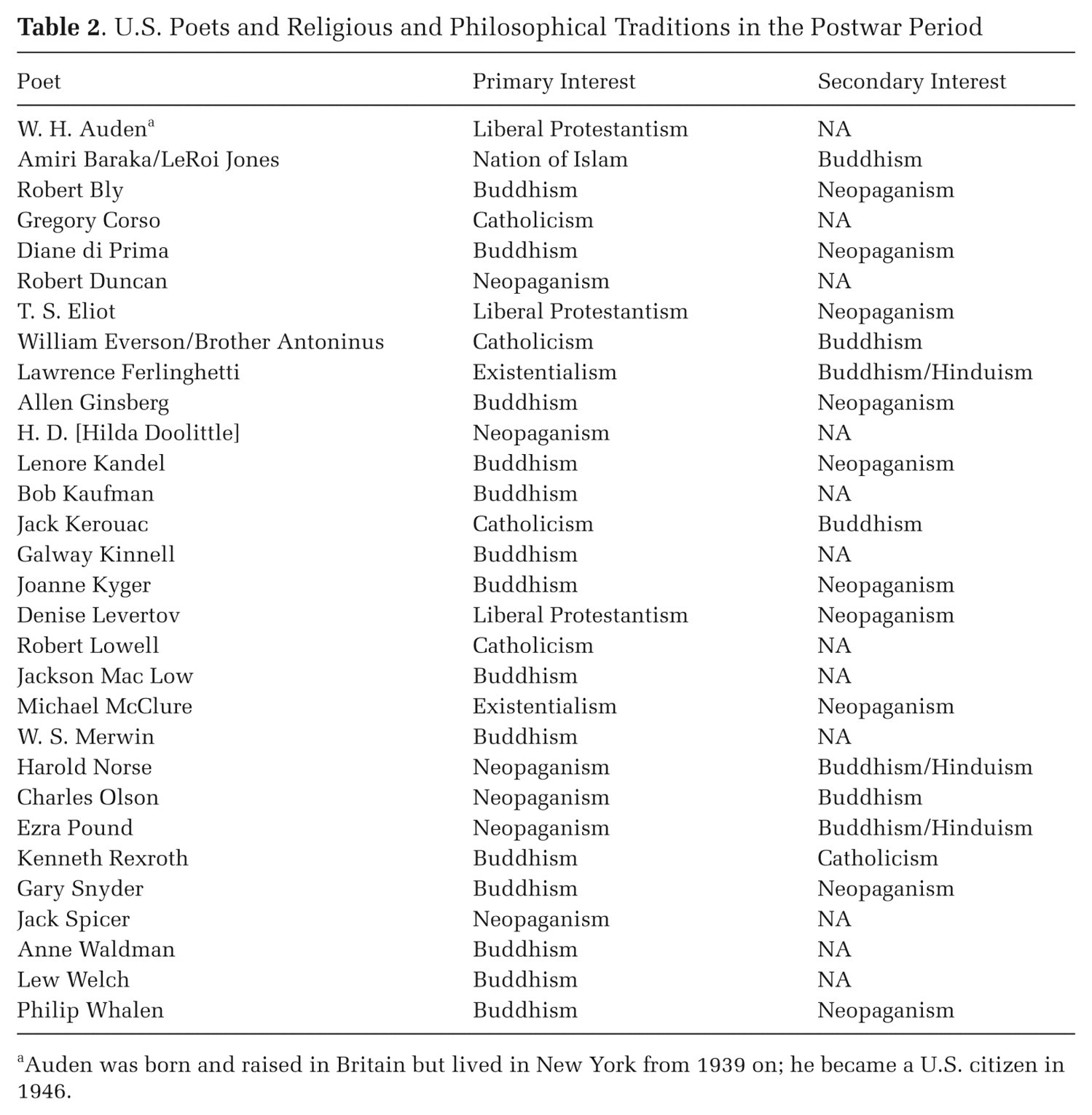
Auden was born and raised in Britain but lived in New York from 1939 on; he became a U.S. citizen in 1946.
Liberal Protestantism refers to older U.S. denominations that reject literal readings of the Bible and emphasize its egalitarian sections. Younger and stricter churches have periodically successfully challenged liberal Protestantism (Finke and Stark 1992). But with its long history in New England, the center of U.S. high culture, liberal Protestantism has had a power beyond what its size would suggest and it was therefore impossible for any U.S. intellectual to ignore.
The dominance of Buddhism
Table 2 lists all the major poets of the postwar period associated with religious or philosophical movements, according to the secondary sources I examined. The table shows that the Buddhism/poetry nexus was far more vital than all its rivals—14 of the 30 poets in Table 2 have a primary interest in Buddhism, compared with six for neopaganism, four for Catholicism, three for liberal Protestantism, and two for existentialism. Furthermore, of the 16 poets who did not have a primary interest in Buddhism, seven had a secondary interest in it.
This finding is intriguing for two reasons. First, many intellectuals opposed the Buddhism/art nexus, and they had a good argument. Modern fields of cultural production reject all external authority (Bourdieu 1996), so one must appear to put the autonomy of the field above all else to gain entrance. Consequently, being involved with Buddhism was risky for a poet because the poet had to become the apprentice of a full-fledged Buddhist master to acquire legitimate knowledge of Buddhism. Consider the following letter from Cid Corman to Gary Snyder, which Corman wrote after Snyder claimed there was something essentially Buddhist in Japanese Noh drama, a genre both poets liked:
I am not at all convinced that [Noh drama’s] power has any vital connection with Zen (Renondeau’s book puts very little connection on it): I think Buddhism in Japan came with aristocratic ties and there is that, a sense, if you like, of naked elegance. The spirit of it? Why, man, the spirit of it is art, theatre, or, in other words, care and the communication of it, of life caring for life. (I’m dead set against any sectarian labels or any religious business—which doesn’t mean I won’t admit what obviously exists, but it does mean I won’t encourage it. Don’t mistake me. This is not challenging individual belief or spiritual feeling, not at all, but I do stand against any organization of what seems to me creatively must be kept individual.)
2
Second, antiwar poets were aware that they needed the U.S. public on their side, and that the average citizen in this most Christian of industrial societies saw Buddhism in a bad light. One would thus expect the poets to bracket their spiritual quests when addressing the public or to express the same ideas in Christian language.
From the autonomy perspective, it is understandable that poets relied more on Buddhism than on Christianity. For the same reason it would have been a more effective tool, Christianity would be a more tangible threat to poets’ independence. Similarly, from the effectiveness perspective, Buddhism was superior to neopaganism and existentialism. Credentialed experts of Buddhism lived in the postwar United States, and these experts were more visible than those of neopaganism and existentialism.
Taking these two concerns together, Buddhism was the happy medium between effectiveness and autonomy; it provided some of both. But there is no reason to assume that all poets had the same considerations in crafting their political practices. In fact, it is more likely that some poets were inclined to maximize efficiency, others to maximize autonomy, and the rest fell along various points of the autonomy–effectiveness continuum. The group-level outcome would tap into all these traditions more or less equally.
Explaining the Buddhism Nexus Away?
It may not be obvious that the Buddhism/poetry/protest nexus is worthy of sociological investigation. It can be explained, to some degree, as a reflection of poets’ romantic worldview, as a passing fad, and as a product of conjuncture. These explanations fail, however, to account fully for the phenomenon.
Orientalism
One could argue that U.S. poets’ interest in Buddhism was just a manifestation of their romanticism. Indeed, as a semi-autonomous field, U.S. poetry rejected the means/ends rationality of political and economic fields in favor of a worldview with some romantic overtones (Büyükokutan 2010a). From this perspective, poets’ Buddhism did not necessarily involve a true appreciation of Eastern wisdom; it must have been an instance of orientalism (Said 1979).
This account can make sense both of the prominence of Buddhism and the weakness of Christianity in the poetry/protest nexus. But it is ultimately unsatisfactory because existentialism and neopaganism were also exotic from the poets’ perspective. As a current that originated from Paris, existentialism created distinction among U.S. poets because of the antinomy between the cold world of profit and war and the undisputed world capital of free artistic creation. Neopaganism was the romantic invention par excellence, and the celebration of American Indian lore became its most potent form because the native was constructed as a non-Western figure.
American Buddhism as a fad
Interest in Buddhism in the United States may be viewed as a fad that merely coincided with the war. From this perspective, whether poets were concerned about autonomy and effectiveness is beside the point because the cycle of fads ignores such considerations.
Although the Zen boom of the late 1950s had a faddish dimension, U.S. intellectuals’ fascination with Buddhism extends back to the nineteenth century (Kern 1996; Lopez 1995, 1998; Morgan 2004; Munroe 2009; Prothero 1996). Politicization of Buddhism at the hands of intellectuals began much earlier than 1965. Nineteenth-century enthusiasts found elements of a liberal political culture in Buddhism (Prothero 1996; Tweed 1992), and avant-garde movements in San Francisco fused Buddhism with anarchism in the 1930s and 1940s (Davidson 1989; French 1991; Schwartz 1998; Smith 1995).
Cultural opportunity
From the cultural opportunity perspective (Ferree et al. 2002; Hallgrimsdottir and Benoit 2007; Koopmans 2005), it is understandable that U.S. dissidents took an interest in the religion of the country against which their government was waging war. In this context, dissenting poets could expect Asian Buddhist clergy to constitute a smaller danger to their freedom.
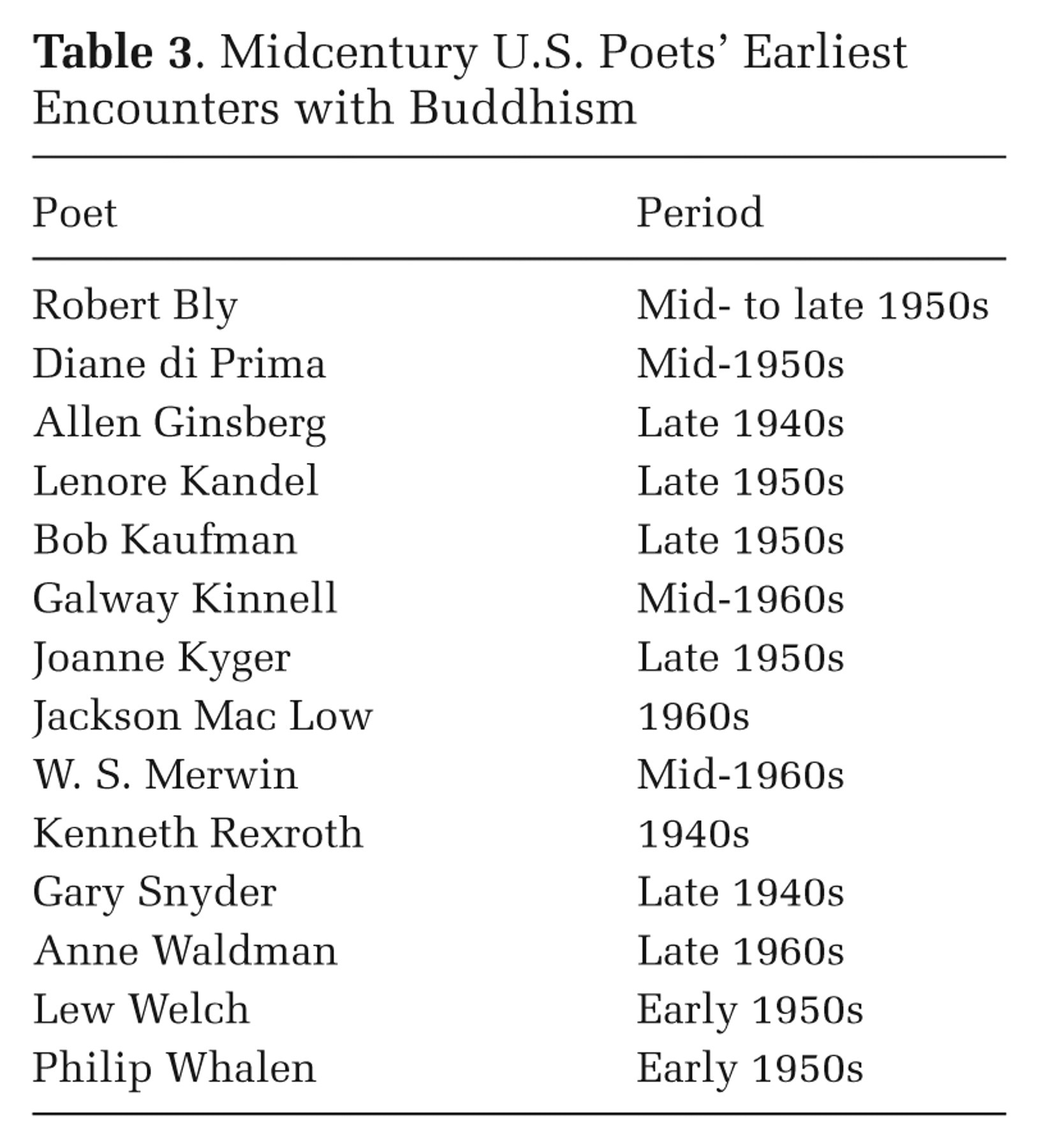
There is no denying that after U.S. combat troops landed in Vietnam, Buddhism’s attraction for dissenting intellectuals improved vis-à-vis neopaganism, existentialism, and Christianity. Some poets with primary interests in Buddhism were indeed not part of the Buddhism nexus until 1965 (see Table 3). However, the poets who started and led the Vietnam-era politicization of Buddhism were studying Buddhism long before that date (see Table 3). Rexroth wrote about Zen in the late 1940s, and his central position in the San Francisco literary scene assured that Buddhism found sympathizers among younger poets. Snyder was among these younger poets; he learned Chinese and Japanese in the early 1950s so he could read Zen texts in their original language. In the late 1950s, when Snyder was receiving Zen training in Japan, he discussed Buddhist teachings with Ginsberg and Whalen in a steady stream of letters. With the exception of Bly, all of the poets in Table 3 owed their knowledge of Buddhism to Rexroth, Snyder, Ginsberg, and Whalen—their first significant encounters with Buddhism took place in the artistic milieus dominated by these four men.
Midcentury U.S. Poets’ Earliest Encounters with Buddhism
This is not to say that poets’ Buddhism was fixed from 1950 to 1975. Initially, it was individualistic and pessimistic about the prospect of meaningful social change in the foreseeable future; over time it became more communalistic and optimistic. These were variations on the same theme, however. Throughout the period under study, poets’ Buddhism was oppositional; it was based on notions of no-self, emptiness, and interdependence and emphasized meditation practice above all others.
Toward an Explanation
Explanations in the preceding section and extant work on appropriation all leave out the legitimate owners of the appropriated resources and imply that appropriators do not meet significant resistance from the owners or that the owners’ actions do not matter. In what follows, I challenge this premise by examining dissenting poets’ relationships to Buddhist and Christian clergy, existentialist philosophers, and Native American shamans.
Buddhism
Nineteenth-century European scholars could not decide whether to think of Buddhism as a religion or as a philosophy; some Japanese intellectuals took advantage of this when they accepted the orientalist premise that Asian religions produce stagnant societies (King 1999). These intellectuals repudiated the devotional rituals of folk Buddhism and reinterpreted Japanese Zen Buddhism as a radical empiricist epistemology compatible with science (Snodgrass 2003; Tweed 1992).
If deflecting charges of being unscientific was the immediate concern for these intellectuals, their long-term interest was to assert the superiority of Buddhism over science. Soon, a mystic strand of this New Buddhism emerged. Its favorite practices, sitting meditation (zazen) and study of irrational riddles (koans), were thought to free the mind from the limits of instrumental rationality by showing the oneness of all things.
New Buddhism bore little fruit at home because most Japanese did not approach Buddhism with an orientalist lens. However, two Western groups—middle-class professionals and artists—were interested. The former saw their own individualism and modernism in the scientific strand, and the latter found justification of art’s continued existence in modernity in the mystic strand’s attack on instrumental rationality (Dezeuze 2006; Hakutani 2001; Rabinovitch 2002; Westgeest 1997). Vietnam-era U.S. poets subsequently discovered Buddhism partly through their study of European art.
From the 1920s on, therefore, there were New Buddhist clergy willing to take opportunities in the West. After 1945, those who could prove they had not endorsed Japanese militarism could try their chances in the United States. Because their elitism had destroyed their popular support in Japan, and because their monasteries were stripped of their land in 1945, these Buddhist masters needed wealthy sponsors.
Poets like Ginsberg and Snyder were not wealthy themselves, but they had access to mass media, wealthy liberal donors, lecture circuit organizers, publishing houses, and some political elites. Therefore, when the poets asked the masters’ approval of the Buddhism/protest nexus, the latter could hardly refuse. After 1959, the poets’ hand became even stronger as the Chinese invasion of Tibet increased competition on the supply side.
The story of Shunryu Suzuki (1904–1971) is a case in point. Suzuki emphasized sitting meditation over devotional practices and was frustrated with having to devote most of his time to the latter. In 1959, he accepted the abbotship of a small Japanese American temple in San Francisco. There, he effortlessly gained a following among young whites. He accepted them even when they showed little promise, and he increasingly neglected his duties toward his Japanese American community. In 1961, these white followers incorporated the San Francisco Zen Center with Suzuki as its permanent master.
Suzuki accommodated his U.S. students’ political activities although he was quite conservative by comparison. When poets Diane di Prima, Lenore Kandel, and Joanne Kyger became his students, he did not try to dissuade them from their political commitments. He even appeared at the Human Be-In alongside Kandel, Ginsberg, and Snyder, although his participation was limited to smiling briefly at the audience from the stage. Recognizing Suzuki as an ally, Ginsberg and Snyder helped the Zen Center’s fundraising effort to launch the first Zen monastery outside Asia. Opening in 1969, this monastery put Suzuki ahead of Japanese Zen masters who had arrived in the United States earlier.
Seeing that Suzuki did not mind his brand of politics, Ginsberg developed strong ties with him. Ginsberg had travelled in Asia in the early 1960s, avowedly looking for a spiritual master, but he never made a commitment to anyone he met. Ginsberg experimented with many ideas, crafting his own individual spiritual potpourri. After his return to the United States in 1963, this started to change. Ginsberg studied chanting with Suzuki even though he was not the kind of person Suzuki would normally invest in—he was noncommittal, loud, and footloose—and even though chanting was not something Suzuki emphasized.
Ginsberg’s shift in behavior may have been related to changes in the political and cultural atmosphere. In 1963, as U.S. involvement in Vietnam began to increase, he participated for the first time in a political demonstration (Ginsberg 2001). Moreover, as Vietnam and the New Left entered the U.S. public’s horizon, opposition between poets and political elites became more open. In that context, the cost of spiritual dilettantism started to outweigh its benefits. It was one thing to celebrate interdependence, emptiness, and no-self as the harbingers of a future golden age, but it was another to publicly denounce an initially popular war effort in the name of those teachings. Poets could be charged with dilettantism in both cases, but accusations would be more serious for the latter. They would come not just from experts on Asian history and culture but from respectable government officials, and they would appear in high culture journals and daily newspapers. In that context, an alliance with Buddhist clergy became more and more advantageous.
Consequently, the relationship between Ginsberg and Suzuki did not just benefit Suzuki; it also helped Ginsberg. In his high-profile public appearances, Ginsberg attempted to pass as a spiritual expert to gain credibility. 3 Because his religious credentials were actually quite slim, however, he needed the support, or at least the cooperative silence, of career gurus. Suzuki provided him with just that. During the 1969 trial of the Chicago Seven, for instance, Ginsberg flaunted his knowledge of Buddhism from the witness stand, explicitly invoking his studies with Suzuki.
In the last years of his life, Suzuki faced increased competition from Tibetan clergy for poets’ and artists’ attention. The most important of these was Chögyam Trungpa (1939–1987), who used the Chinese invasion of Tibet as an opportunity to violate the constraints that came with high spiritual office. Without the land they owned, his superiors could not sanction Trungpa for dressing in Western clothes, drinking excessively, and having sex with his students. Trungpa legitimated these actions as the manifestation of a “crazy wisdom,” and in such uncertain times for Tibetans, his actions were arguably as appropriate as anybody else’s.
A widespread discourse presented Buddhism as a corrective to ordinary reason, so Trungpa’s experiment paid off. Ginsberg, too, built a public persona on scandalous behavior, so when the two met in 1970, they developed rapport quickly and Ginsberg left his loose affiliation with Suzuki to become Trungpa’s student. In 1974, Ginsberg put his sprawling network at Trungpa’s service in setting up the Naropa Institute, the first U.S. Buddhist university. With his protégé Anne Waldman, Ginsberg became the co-director of Naropa’s writing department.
Naropa was a stunning achievement. It brought many young people to Trungpa’s brand of Buddhism and provided Ginsberg with a steady supply of poetry students and a position from which to apply leverage over other poets.
Existentialism
The dynamics of appropriation were quite different for existentialism. In his private notebooks, Ferlinghetti took extensive notes on Albert Levi’s 1956 article on existentialism (quoted earlier) and asked:
Why should Existentialism seem anti-poetic in nature to so many people & poets? Mainly, perhaps, because they are really ignorant of existential bases, or at least they have almost a total misconception of Existentialism?
4
Ferlinghetti belonged to an existentialist minority among his literary allies. A letter from Whalen to Snyder shows the rivalry between Buddhism and existentialism in this community:
Thos. Parkinson had me to dinner & then had his writing class in after dinner to lionize me a little & I roared a little & read a couple poems, but to what effect I couldn’t tell. But the kids were interested & a few did listen & a few are not entirely square . . . 6 or 7 of the liveliest are trying to equate Zen & Existentialism—they being sure there is really nothing left but Existentialism, or the Logical Positivism none of them approve. One said, “You have to be either an Existentialist or a Neo Conservative,” & I tried to explain there were a couple hundred other persuasions in our culture—but I doubt I convinced anybody.
5
In an earlier letter, Whalen scolded Snyder for considering existentialism as an alternative to Buddhism:
Reading the lives of S. Francis, S. Philip Neri and S. Theresa, [Allen Ginsberg] has, like you, been worried in the mind about religion vs. sexual continence &c. Now goddamit, two of you on my hands with this damned Manichee twaddle is too much. Pretty soon you’ll be coming on about “metaphysical guilt,” “angst,” and the whole Barthian line
6
right in the middle of the Partisan Review.
7
Whalen disliked existentialism because he saw it as a reinforcement of cold war conservatism:
I wrote [to Ginsberg] and I repeat, at less length, to you: Don’t it depend on your view of what a man is? I mean, are you going to buy the Judaeo-xtian-cum-platonist view of the split man; the bright spirit in dull gross filthy clay routine, with all its implications about sex—that it is a degradation of the soul via the agency of the body (which is a sin) that can only be wiped out by confession, repentance and baptism & the grace of Christ & the Holy Ghost and everybody? Or is the nature of man something else, to-wit, the product of his own karma and of his own mind, with the possibility of busting into something else?
Whalen’s understanding of existentialism was flawed. His defense of “the whole person” did not mandate rejection of existentialism, and the Buddhist notion of karma is not necessarily incompatible with existentialism. But Whalen was the theoretical mind of this community, and his attack on existentialism convinced all of his friends except Ferlinghetti. From this point on, existentialist ideas no longer appeared in Snyder’s diaries or in the correspondence between Snyder and Whalen.
If Ferlinghetti and Snyder had interacted with existentialist philosophers when Whalen was making his case against existentialism, the outcome might have been different. However, language philosophy and logical positivism dominated U.S. philosophy departments in the postwar period and existentialism remained, for the most part, outside the university establishment. A keyword search in Philosopher’s Index for Camus, Sartre, or existentialism yields 338 English-language articles in peer-reviewed journals from 1950 to 1970, while a search for the keywords logic, Popper, or Russell yields 3,833 articles. 8
Neopaganism
The case of neopaganism was similar to that of existentialism. In an interview conducted over 1969 and 1970, Snyder said that his early interest in American Indian religion was frustrated as he failed to find authoritative sources confirming its richness. Consequently, Snyder started his study of Buddhism:
Doug Flaherty: When you began writing poetry, what was it that made you turn to Oriental philosophy instead of sticking to the American Indian legends of your own environment? Snyder: For one thing, I don’t think that I understood the richness and complexity of traditional primitive cultures. For another thing, traditional Hinduism and Buddhism have added a great deal onto basic shamanistic and primitive ritualistic ceremonial practices and life styles. That is a great value. There is nothing in primitive cultures that is at all equivalent to Mahayana philosophy or logic. There is a science and true sophistication of certain states of mind and power that can come through shamanism but the shaman himself doesn’t understand the power. Buddhism and yoga have been gradually emerging as a true science of the mind. (Snyder 1980:15)
Looking back, Snyder found his decision was based on faulty premises:
The Buddhist and Hindu traditions, although they specialized in and progressed greatly in the realms of philosophy, yoga, and extraordinary meditative techniques, also lost something which the primitives did have, and that was a total integrated life style. . . . Certain primitive cultures that are functioning on a high level actually amount to what would be considered a spiritual training path in which everyone in the culture is involved and there are no separations between the priest and layman or between the men who become enlightened and those who can’t. What we need to do now is to take the great intellectual achievement of the Mahayana Buddhists and bring it back to a community style of life which is not necessarily monastic. (Snyder 1980:15–16)
By the time of this interview, the war in Vietnam was going at full speed, and there was not enough time to do as thorough a study of American Indian culture as Snyder would have liked. Through the end of the war, his political language relied more on Buddhism than on anything else.
Snyder’s helplessness was due to the invisibility of authentic specialists of American Indian religion. As a child, Snyder sometimes participated in American Indian religious rituals, but he knew no shamans with enough name recognition to prevent his knowledge of American Indian religion from being dismissed as superficial, incorrect, or irrelevant to artistic and political debates. In his many writings on American Indian lore, in his personal diaries, and in his correspondence, I found no reference to any particular Indian teacher. Consequently, without any conscious calculation of effectiveness, Snyder was increasingly drawn to Zen.
Radical Catholicism
In the case of radical Catholicism, appropriation failed for a very different reason. From the War of Independence to the mid-twentieth century, U.S. Catholics went from being a suspicious minority to the single largest Christian denomination in the United States. By 1950, Catholicism was well established in the U.S. religious landscape.
Catholicism was organized into a strict hierarchy that limited dissent, although pockets of dissent, such as Dorothy Day’s Catholic Worker movement, existed within this structure. Organized as a coalition of autonomous communities, the Catholic Worker movement sought poverty relief and published a pacifist newspaper. The movement benefited from the autonomy of religious orders, where Day’s ideas resonated.
After 1945, these pockets of dissent survived in dioceses whose bishops tolerated them. Therefore there was some continuity, so radical Catholicism could dominate the religious wing of the peace movement together with liberal Protestantism (Anderson and Ernst 2007; DeBenedetti and Chatfield 1990; Small and Hoover 1992). Some priests-turned-poets such as Daniel Berrigan became the public face of Catholic peacemaking. Berrigan remained in the Jesuit order despite being arrested for his antiwar activities.
Not all Catholic activist-poets were that lucky, however. William Everson, a conscientious objector, converted to Catholicism in 1948, and from 1950 to 1951 he lived in a Catholic Worker community. In 1951, he became a Dominican lay brother, taking the name Brother Antoninus. Over the next two decades, Everson faced intense difficulties in reconciling his spiritual, artistic, and political commitments. In 1959, Time published a sensationalist feature article, bringing Ginsberg and Everson under national spotlight. For the spiritual masters Ginsberg worked with, this provided an opportunity for publicity; however, John J. Mitty, the Archbishop of San Francisco, needed no such publicity and banned Everson from performing in poetry readings and giving interviews. Everson’s order did its best for him, and he was allowed to travel to other parts of the country for readings. But the ban on interviews remained binding until after Mitty died in 1961, when his successor eventually lifted the ban. Everson’s participation in public life remained limited until 1969, when he finally left the order to get married.
If Everson had been living in a Zen monastery instead of a Catholic one, he would not have had to choose between a woman and his religious community. Rules regarding celibacy were just as strict in some schools of Buddhism, but Asian masters who came to the United States did not even consider this option, especially for special students like Ginsberg, whose homosexuality, in a decisive break from the past, was fully accepted. Acceptance of sexuality was important for poets like Everson and Ginsberg because their private lives constituted the raw material of their poems and their public personae were erected on their poetic agendas.
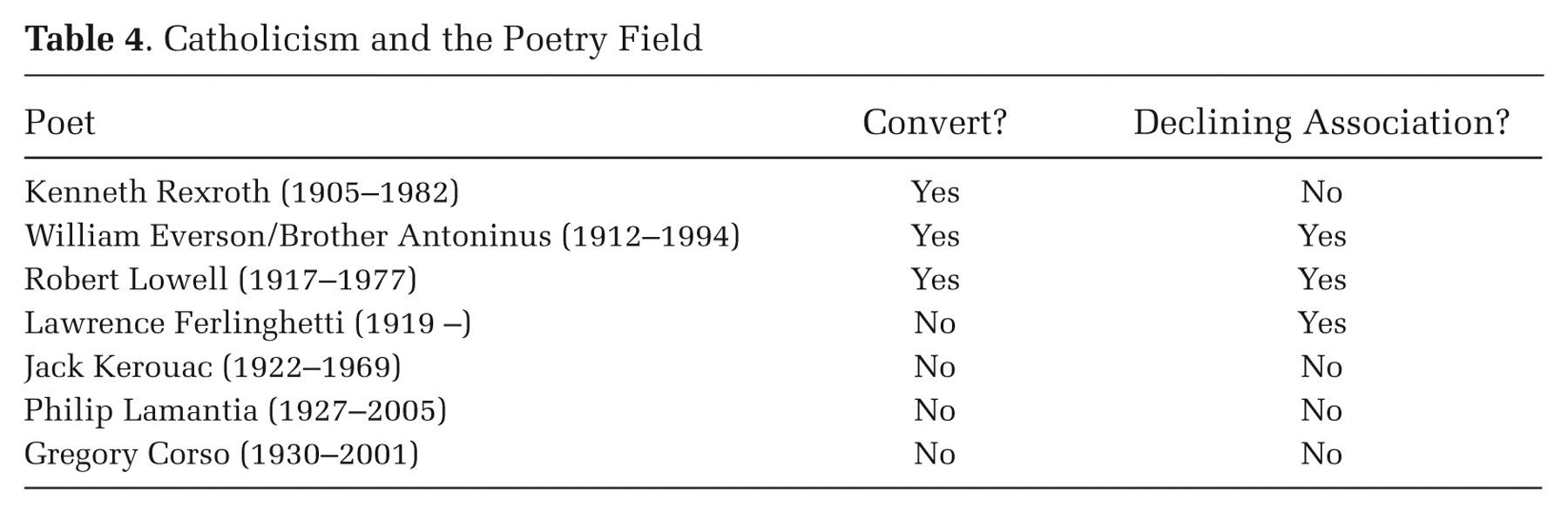
Everson’s fate is representative of a larger trend. Converts were the overwhelming majority among Catholic poets born before 1920, but they no longer appear among poets born after that date (see Table 4). The strong organic relationship between Catholicism and the poetry field was therefore getting weaker in the postwar period. Furthermore, association with Catholicism declined later in life among poets born before 1920 (see Table 4), highlighting the difficulties involved in maintaining the poetry/Catholicism nexus as the Catholic Worker challenge was steadily co-opted.
Catholicism and the Poetry Field
Liberal Protestantism
Among the liberal Protestant poets of Table 2, only Denise Levertov was associated with the antiwar movement, and unlike poets with Buddhist, Catholic, existentialist, or neopagan interests, she was born to Protestantism. Furthermore, Levertov’s full conversion to Christianity did not occur until the 1980s.
Lessons of the radical Catholic experience make this understandable. The most prominent liberal Protestant pastors and theologians of the postwar period were William Sloane Coffin, Paul Moore, Reinhold Niebuhr, and Paul Tillich. Tillich died the year Vietnam became a major issue; Coffin and Moore came from families that dominated the cultural and economic life of the country; and Niebuhr had already achieved widespread fame in the 1930s. Liberal Protestant leaders were therefore more than self-sufficient in terms of economic capital, access to an ideal audience, and connections in the field of power. Consequently, they had no need to align with radical poets, even though the two groups agreed about Vietnam.
Discussion
Actors of the appropriation process had, as I expected, multiple and contradictory interests. Poets would benefit from preserving their autonomy and increasing their political effectiveness, but they could not always have it both ways. Similarly, legitimate owners of religious and philosophical traditions would benefit from retaining full control over their traditions and from increasing their audience, and these goals were not always compatible. Both parties had to prioritize and strategize.
This meant the poets would be best off with traditions that had legitimate owners with whom they could bargain, and this was possible only in the case of Buddhism. Asian Buddhist clergy’s visibility added gravitas to the poets’ public personae; poets’ far-reaching networks provided the clergy with material resources they badly needed. Therefore, competition existed among Buddhist clergy for poets’ loyalty, giving the latter significant leverage over the former.
In the cases of radical Catholicism and liberal Protestantism, poets had no such leverage. Christian clergy had wealthy and willing donors, a well-established place in mainstream culture, and direct access to the lay population. When Everson went too far in turning Catholicism into an appendage of the avant-garde, the church censured him and remained in complete control of the situation. Perhaps because of these dynamics, poets did not even try their hand with liberal Protestantism, even though it did not have a single hierarchy and some prominent liberal Protestant leaders were sympathetic to the antiwar cause. Liberal Protestant clergy simply did not need the poets; so their decentralized organizational structure would at best have limited the negative impact of their assault on the poets if the latter had tried to appropriate Protestantism in a way that the clergy did not approve. This situation never came close to that, however. Liberal Protestant clergy were so self-sufficient that poets’ paths never crossed with theirs. Consequently, the idea of drawing on liberal Protestantism never occurred to antiwar poets.
In the cases of existentialism and neopaganism, the leverage poets had over experts was useless. There were some philosophy professors with sympathies for existentialism at U.S. universities, but they were in peripheral institutions. Consequently, young poets in New York and San Francisco could find no one with incontestable credentials with whom to discuss existentialism. In the voluminous correspondence Ginsberg, Snyder, and Ferlinghetti kept with a wide variety of people, I found no discussions about existentialism with philosophers. 9 The situation was similar for the most compelling form of neopaganism, American Indian religion. Indigenous shamans’ capital stock could have benefited from an alliance with dissenting poets, but shamans were almost entirely invisible to the lay public, so poets could not rely on their help in convincing the public that this was serious business.
All in all, therefore, outcomes of cultural appropriation attempts depended largely on the amount of economic and social capital the two parties commanded. When the tradition to be appropriated had resident experts with some visibility but without the material resources indispensable for their goals, appropriators with a sufficiently large and varied stock of social capital gained leverage. When resident experts were not sufficiently visible, appropriators felt that they could not achieve the task by themselves. When experts already had all the resources they believed they needed, they had no reason to share ownership of their tradition with outsiders. Therefore, appropriation can indeed be seen as social exchange.
Strikingly, actors’ intentions may be irrelevant to the outcome of the appropriation process once the two distinct parties have emerged. That is, actors did not need to see the process as a cold-blooded negotiation for resources for these resources to exert a powerful influence. Nor is it necessary, as one might assume from this study, that the two parties shared political views. Once appropriators and legitimate owners accepted the stakes of the games that animated their fields, the relationship between their fields gave a certain direction to the events that followed, and each new step in this direction made it harder to reverse course.
Such path dependency is endemic to the cases I studied. Ginsberg genuinely gave his all to Trungpa; he cut his relationships with other spiritual teachers because of his fast-paced life, not because he calculated their potential contribution to his career. The question, then, is why his life was fast-paced, and that brings us back to his identity as a certain kind of U.S. poet. Snyder did not compare the net benefits of Buddhism vis-à-vis American Indian religion; nor did Everson leave the Dominican order because he wanted to increase his symbolic capital via political intervention. Suzuki may or may not have planned to use San Francisco’s Japanese American community as a stepping-stone, he may or may not have perceived Trungpa as a threat, and his politics was quite different from that of his poet students. Trungpa may or may not have meant to use the Chinese invasion of Tibet to alter the balance of power in Tibetan Buddhism in his favor, and he was no political radical. Archbishop Mitty may or may not have considered the impact of his punishment of a wayward poet on the size of his flock. Finally, liberal Protestant pastors’ and theologians’ sympathy for the antiwar cause made little difference because they and the poets circulated in different milieus. Everyone acted in ways that were reasonable given the roles they had played for decades in competitive fields of cultural production that they took for granted; the imbalance of material resources between their fields slowly pushed them toward the eventual outcomes.
Because the effects of material resources were spread out over a long period, fumbles were not just possible but frequent. Fields sensitized actors to their symbolic interests, and more accomplished actors adjusted faster and better to changing circumstances, but following one’s tastes did not, as one might deduce from the inconsequentiality of intentions, guarantee success. Among poets, Everson did his best to harness religion to his public persona, but because his perspective was shaped by his immediate environment, his appropriation attempts ultimately failed. Among clergy, Trungpa’s acuity did not prevent him from attempting in vain to depoliticize Ginsberg’s Buddhism.
The constitution of the two parties in the appropriation process was a thoroughly cultural and historical process, so material assets were not the only things that mattered. For owners of cultural resources to depend on would-be appropriators, they had to believe the appropriators had indispensable resources. The desirability of particular kinds of material resources presumed certain dispositions toward the world that were products of fateful historical developments. Recall that Suzuki and Trungpa depended on U.S. poets because their target audience was the educated upper middle class of Western societies, and this disposition was the product of Buddhism’s history in Asia. If nineteenth-century Buddhist modernizers had not adopted Western intellectuals’ worldview, Suzuki would not have found Japanese American religiosity misguided and the poets would have been superfluous to his goals.
The limited impact of actor intentions, the uncertainty of the process, and the constitutive roles of culture and history may be surprising given my claim that exchange theory is relevant for cultural appropriation. But one should remember that poets and religious/philosophical specialists never got together to sign a formal contract—this was not negotiated but reciprocal exchange. Reciprocal exchange engages not just means/ends rationality but actors’ whole subjectivity, introducing the kind of uncertainty that allows culture and history to play a greater role.
Recall that I expected the two parties’ relative cohesion to have a decisive impact on the outcome of the appropriation process. This is the one part of my original framework that the evidence does not clearly support. In the case of Buddhism, the silent rivalry between Suzuki and Trungpa benefited Ginsberg and the strict hierarchy of the Catholic Church worked to Everson’s disadvantage. But the lack of such a centralized organizational structure in liberal Protestantism mattered little. In cases of such wide disparity in bargaining power between two parties, therefore, relative cohesion may be beside the point.
Recall that a successful rethinking of the appropriation perspective must engage with diffusion research. This leads to two questions. First, does the poetry/Buddhism nexus confirm diffusion scholars’ key finding that one must distinguish among characteristics of actors, environments, and innovations? Second, what does the history of the Buddhism/poetry nexus imply for the key question of how these three variables interact?
Regarding the first question, in some cases researchers may need to pay attention only to the actors and the environment; the characteristics of the innovation in question may not have much of an independent effect. The evidence I presented belies the importance of Buddhism’s faddish and exotic nature—the Zen boom of the 1950s played a smaller role in Buddhism’s rise among politically active poets of the 1960s than is commonly thought, and other equally exotic cultural traditions found fewer followers. Furthermore, the much-touted permissiveness of Buddhism vis-à-vis Christianity was more the consequence of actor and environment characteristics than an independent cause. Buddhist clergy built a particularly liberal spiritual practice in the United States because they had few resources and they had few resources because of their history. Pending confirmation by future research, diffusion scholars’ list of three kinds of variables may be replaced with a shorter, more convenient one of just two.
Regarding the second question, my findings again present a simpler picture for future research. In some cases, there may not be much interaction to speak of among the three kinds of independent variables. In the case under study here, actor and environment characteristics operated sequentially and therefore independently: unpredictable links between milieus of appropriation were the crucial explanatory factor from the mid-nineteenth century to the early 1950s; after that point, actors’ material resources determined the outcome.
Conclusion: A Two-Prong Framework Of Cultural Appropriation
If we pay close attention to concrete actors and contexts, the perspective of appropriation has great promise for studying how the cultural turns into the political. Regarding actors, the evidence I presented shows that their material resources decisively shape the outcomes of conversion attempts. Contrary to extant work, however, resources of the legitimate owners of the traditions to be appropriated must also be taken into account. Consequently, appropriation is best understood as intergroup exchange. Regarding the contexts of appropriation, the findings balance the determinism and materialism of the preceding account by highlighting the disparate histories that must converge in narrow windows of opportunity for appropriators and owners to meet. This means that the exchange in question is not negotiated but reciprocal.
Simple as it is, the framework I advocate— actors’ resources, contexts’ histories—allows us to ask many interesting questions, with which I would like to conclude. First, does research into other episodes of appropriation confirm the determinism of visibility and dependence? Are legitimate owners’ visibility and dependence as necessary when the cultural resource in question is not related to the sublime? Discourses related to the sublime may be more threatening to would-be appropriators’ autonomy, or at least threatening in a different way, but they may also be more effective. Do these two effects cancel each other out?
Second, what happens when the two parties do not have a direct relationship? How does the brokerage of a third party change the process? Does a third party alleviate appropriators’ concern for autonomy or exacerbate it?
Third, can we distinguish qualitatively between different kinds of cultural transfer based on how many generations they span and how many levels of analysis and contexts they cross? If that is possible, do potential appropriators take this into consideration? If they do, do they see longer spans as influencing the autonomy dimension, the effectiveness dimension, or both?
Fourth, I argued that actors do not necessarily view the appropriation process instrumentally. How much variability is there in this? If cynicism varies, does it strengthen the actor’s hand by allowing him to plan ahead, or weaken it because sincerity is charming and disarming? Finally, are the effects of actor and environment characteristics always independent? Or do key actors sometimes span multiple milieus, such that they influence and are influenced by context in a stronger sense?
Footnotes
Acknowledgements
Earlier versions of this article were presented at the 2009 Annual Meeting of the Society for the Scientific Study of Religion and at Sabancı University. I would like to thank Mariana Craciun, Heejin Jun, Michael Kennedy, Howard Kimeldorf, Camilo Leslie, Meltem Müftüler-Baç, Tasleem Padamsee, Ayşe Parla, Hiro Saito, Ethan Schoolman, Gisèle Sapiro, George Steinmetz, Alan Wald, Claire Whitlinger, anonymous reviewers, and the ASR editors for valuable comments and questions.
1.
Journal entry in journal 2 (1957-Japan). Gary Snyder papers, D-050, Special Collections Library, University of California, Davis.
2.
Cid Corman letter to Gary Snyder, August 4, 1958. Gary Snyder papers.
3.

4.
Journal entry, Box 26, folder 6. Lawrence Ferlinghetti papers, BANC MSS 90/30 c, The Bancroft Library, University of California, Berkeley.
5.
Philip Whalen letter to Gary Snyder, January 6, 1957. Gary Snyder papers. Emphasis in the original.
6.
Karl Barth (1886–1968) was an existentialist philosopher. “Metaphysical guilt” and “angst” are existentialist terms.
7.
Philip Whalen letter to Gary Snyder, August 4, 1956. Gary Snyder papers.
8.
Minuscule as it is compared to 3,833 articles, 338 scholarly articles may still indicate a sufficiently developed support base. This is misleading for three reasons. First, this means fewer than 17 articles per year. Second, this small number of articles per year includes sympathetic and hostile ones. Third, not all of these articles were written by U.S.-based scholars.
9.
Ginsberg did correspond with at least two close friends—Jack Kerouac and Carl Solomon—about existentialism during the 1950s. Neither of these two men, however, was a professional philosopher—they did not have any philosophy degrees, hold a position in a university philosophy department, nor publish in philosophy journals. As such, they did not have the credibility of a legitimate expert in public debates.
References
Supplementary Material
Please find the following supplemental material available below.
For Open Access articles published under a Creative Commons License, all supplemental material carries the same license as the article it is associated with.
For non-Open Access articles published, all supplemental material carries a non-exclusive license, and permission requests for re-use of supplemental material or any part of supplemental material shall be sent directly to the copyright owner as specified in the copyright notice associated with the article.
