







Abstract
Conventional wisdom holds that friends protect against depression through the social support they provide; however, depression likely has a role in structuring friendship networks. In particular, we investigate friend selection mechanisms responsible for similarity in depression among friends (i.e., homophily). Preference is one explanation, yet several correlates of depression make homophilous selection among depressed individuals unlikely. We propose two alternative mechanisms—avoidance and withdrawal—that can produce depression homophily in the absence of preference. These alternative mechanisms create homophily indirectly by limiting friendship partners available to depressed individuals. We test the preference, avoidance, and withdrawal mechanisms using data from the National Longitudinal Study of Adolescent Health and a dynamic network model. Results provide support for the withdrawal mechanism. These findings help explain how depression affects friend selection and have broader implications for understanding selection mechanisms responsible for network patterns such as homophily.
Research documents numerous pathways through which social networks affect individual well-being (Berkman and Glass 2000; Umberson, Crosnoe, and Reczek 2010). Networks offer support to buffer the impact of stress on health (House 1981), provide norms regarding health behavior (Berkman et al. 2000), and serve as the infrastructure for disease transmission (Morris 2004). The association between networks and health takes on added complexity when one considers that networks themselves are constituted through individuals’ actions. Health conditions that affect individual behavior can thus have broad implications for network structure. Scholars have long acknowledged important consequences of social structure for health (e.g., House, Umberson, and Landis 1988; Link et al. 1989). Only recently, however, has the link from health to social networks received concerted attention (Cornwell 2009; Crosnoe, Frank, and Mueller 2008; Haas, Schaefer, and Kornienko 2010).
The current study examines how health affects social networks by focusing on one of the most common mental health issues confronting adolescents—depression. Scholars estimate the prevalence of major depression among adolescents at 15 percent, with up to 40 percent experiencing depression at subclinical levels (Avenevoli et al. 2008; Compas, Ey, and Grant 1993). Subclinical depression (Cantwell and Baker 1991) is serious enough to contribute to negative outcomes. 1 Most prior research identifies aspects of social networks that serve as protective or risk factors for depression. For instance, support from friends often provides a protective function against depression (Herman-Stahl and Petersen 1996; Lin, Dean, and Ensel 1986); having more friends can thus improve mental health (Ueno 2005). Still, not all friends provide support (Wellman and Wortley 1990) and having too many friends may increase one’s risk for depression (Falci and McNeely 2009). Researchers have paid less attention to the converse link, that is, how depression may affect friendship network structure. Nevertheless, several correlates of depression affect the nature and quality of interpersonal interactions, and likely have implications for the friend selection process (van Zalk et al. 2010).
In examining how depression affects network structure, we are particularly interested in uncovering mechanisms responsible for similarity in depression among friends, that is, homophily (Hogue and Steinberg 1995; Rosenblatt and Greenberg 1991; Segrin 2004). Homophily is one of the strongest patterns of human association and is important to investigate because, in part, of how it restricts the flow of ideas and other resources across society (McPherson, Smith-Lovin, and Cook 2001). In the case of mental health, homophily suggests that individuals with mental health problems are reliant upon friends with similar problems, friends who may not have the capacity to offer needed assistance or support. For relatively healthy individuals, homophily shields them from others with mental health problems.
Homophily on a variable attribute, such as depression, could arise through processes of selection or socialization (Kandel 1978). Scholars have found some evidence of socialization on depression (Hogue and Steinberg 1995; Prinstein 2007; van Zalk et al. 2010), although others conclude that friend selection is most likely responsible for homophily (Segrin 2004). Our interest is in disentangling selection mechanisms responsible for depression homophily. 2 In particular, we focus on homophily that exceeds the level expected by chance based on structural factors that constrain interactions to be homogenous (e.g., population composition [McPherson et al. 2001]). Such homophily is often assumed to be preference-based, but we argue it can appear without preference for homophily.
Despite the adage that “misery loves company,” there are several reasons why depressed individuals may not prefer to associate with one another. We propose two alternative mechanisms that can lead to homophily. First is homophily through avoidance, which occurs when individuals are excluded by others because of a particular characteristic (e.g., depression). Exclusion restricts one’s friendship options to other excluded individuals, resulting in homophily. Second is homophily through withdrawal from social contact, brought on by a condition such as depression. When individuals withdraw from friendships, they become marginalized in the broader friendship network, which excludes them from the normative network processes that help build and sustain friendships (e.g., depressed adolescents may be less integrated into peer groups). Consequently, marginalized individuals develop friendships with others who are similarly marginalized (e.g., others who are depressed), resulting in homophily.
In the spirit of analytical sociology (Hedström and Bearman 2009), we identify explicit mechanisms linking individual behavior to patterns of social behavior (Hedström and Swedberg 1998). Although our empirical focus is on depression, the mechanisms we propose can be applied to other dimensions (e.g., behaviors or attributes) where network selection differs between actors with high versus low values on the dimension. This represents middle-range theory (Merton 1968) or a micro-macro model (Raub, Buskens, and van Assen 2011) that is general enough to explain homophily on many dimensions.
Mechanisms Of Selection Homophily
Two classes of theories explain homophily through selection. The first is rooted in features of social structure that create homogeneity in social interactions and thereby provide more opportunities for relationships among similar individuals (McPherson et al. 2001). The most basic structural factor is population distribution, which determines how much homophily would be expected by chance (i.e., baseline homophily). Another aspect of structure is the correlation of individual attributes in the population. Homophily can appear spuriously due to consolidation if the dimension in question is correlated with another dimension on which selection operates (Blau 1977). For example, because females experience depression at higher rates than do males (Lewinsohn et al. 1993), a preference for sex homophily could create depression homophily as a byproduct. Finally, substructures or foci, such as schools, workplaces, and churches, encourage homophilous associations by bringing similar sets of individuals into a common setting where friendships can develop (Feld 1981). The second explanation for homophily emphasizes factors that lead to a preference for friends similar to oneself. For instance, homophilous friendships facilitate communication (Rogers and Bhowmik 1970), promote identity reinforcement (Byrne 1971), and reduce uncertainty (Prisbell and Andersen 1980). Individuals may prefer homophilous friendships simply because they are easier to maintain and provide greater satisfaction.
We do not discount structural and preference-based explanations; rather, we suggest they are incomplete and may not account for selection homophily on all dimensions. Homo-phily on an attribute like depression requires that individuals at both ends of the continuum disproportionately associate with similar others (e.g., non-depressed individuals must have non-depressed associates and depressed individuals must have depressed associates). Oftentimes, however, individuals display different interpersonal behaviors or are perceived differently by others depending on their value on the attribute. In such cases, individuals situated at one end of the continuum may be more attractive in general than individuals at the other end. In the case of depression, there is strong theoretical justification to expect non-depressed individuals to prefer non-depressed friends; but, as we will explain, several aspects of depression raise doubts about whether depressed individuals truly prefer friends who are also depressed. We begin by reviewing evidence for why homophily on depression might arise through preferences. We then describe two alternative mechanisms that can help explain homophily among depressed individuals in the absence of preference.
Preference as a Homophily Mechanism
Scholars have advanced several theories to explain why depressed individuals would prefer homophilous friendships. Schachter (1959:24) proposed that individuals in stressful situations prefer the co-presence of others who are facing similar threats, concluding that “misery doesn’t love just any kind of company, it loves only miserable company.” One explanation for this finding is that others experiencing similar circumstances provide relevant information that helps alleviate uncertainty (Kulik and Mahler 2000). Another possibility is that homophilous relationships offer greater rewards with fewer emotional costs. For instance, depressed youth provide more compassion and understanding than do their non-depressed counterparts (Rook, Pietromonaco, and Lewis 1994). In terms of costs, depressed adolescents generally feel more anxious and hostile after interacting with non-depressed peers (Rosenblatt and Greenberg 1991). By contrast, depressed friends are less critical during interactions (Baker, Milich, and Manolis 1996) and less wary of the stigma associated with depression (Link et al. 1989). If depressed friends are better able to fulfill needs of depressed adolescents, with fewer costs, then homophily on depression may be preferred by both depressed and non-depressed individuals. Figure 1a depicts this preference-based mechanism.
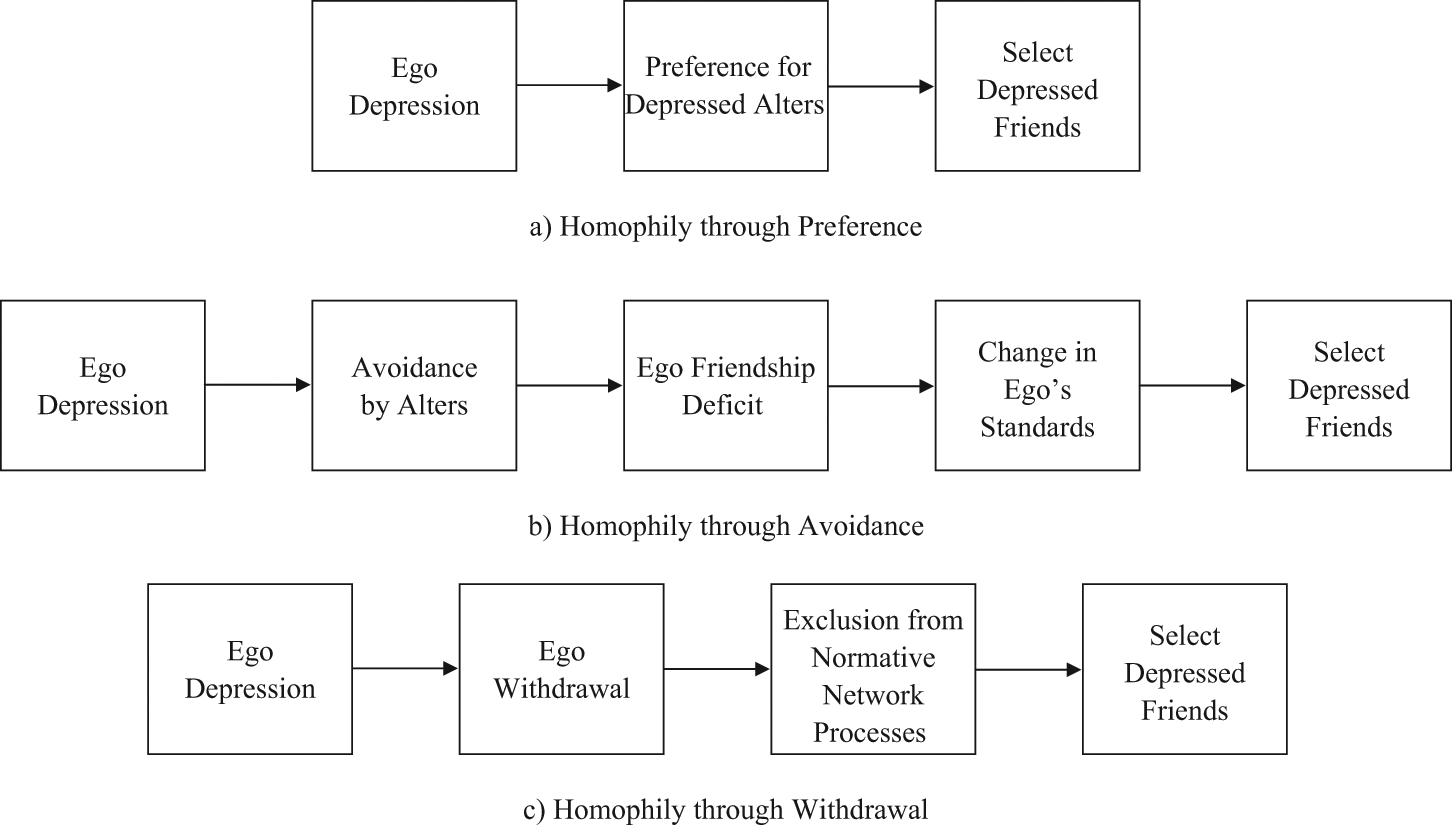
Mechanisms of Homophily
Alternative Homophily Mechanisms
Several behavioral correlates of depression may make depressed individuals less attractive as friends, even to one another. If this is the case, yet homophily on depression still exists, then a process other than preference must be responsible. We propose two such mechanisms: an alter-based mechanism, whereby others avoid depressed individuals, and an ego-based mechanism in which depressed individuals withdraw from friendships. The next sections explain how behaviors that accompany depression can affect network dynamics through avoidance and withdrawal and, in turn, lead to depression homophily.
Avoidance
Depressed individuals, for several reasons, might be avoided by their peers when it comes to forming new friendships or rejected by peers in established friendships. This ultimately leads to depression homophily through the process shown in Figure 1b. To begin, mental illness carries a stigma that can decrease one’s attractiveness as a friend (Link and Phelan 2001; Lucas and Phelan 2010; Martin et al. 2007). In addition, behaviors that accompany depression can produce negative reactions in peers (e.g., negative affect induction [Coyne 1976a, 1976b]). For example, depressed youth make more negative statements to friends (Segrin and Flora 2000), laugh less often (Rook et al. 1994), and exhibit poor interpersonal problem-solving skills, such as hostility in challenging peer situations (Rudolph, Hammen, and Burge 1994). Furthermore, depressed adolescents, especially females, are more likely to negatively dwell or ruminate about events (Jose and Brown 2008) and to seek excessive reassurance and negative feedback from others (Borelli and Prinstein 2006).
In turn, these behaviors produce negative responses in depressed youths’ friends and interaction partners. Interactions with a depressed partner can generate more negative emotions and less enjoyable experiences compared to interactions with non-depressed partners (Baker et al. 1996; Rockhill et al. 2007; Rudolph et al. 1994). In line with the greater demands placed on them, friends generally provide higher levels of support to their depressed peers (Daley and Hammen 2002). Yet depressed adolescents often believe they do not receive adequate support from friends (Rudolph, Flynn, and Abaied 2008). This discrepancy reflects the higher costs of maintaining a relationship with a depressed friend, which can ultimately threaten the relationship. Indeed, friendships with depressed youth are characterized by less stability (Chan and Poulin 2009) and lower quality in terms of companionship, support, and validation (Brendgen et al. 2002). When interactions with depressed youth are too emotionally intense or demand too much time and energy, potential partners may avoid depressed youth as friends.
Social exclusion leads to anxiety (Baumeister and Tice 1990) and discomfort resembling physical pain (Eisenberger, Lieberman, and Williams 2003). One response to the friendship deficit caused by exclusion is to adjust one’s friendship standards to be more inclusive. Potential partners who were previously deemed undesirable become more attractive and are treated more generously (Maner et al. 2007; Pennebaker et al. 1979). As individuals who others avoid lower their standards, they become less likely to avoid others, including others with that same unattractive attribute. In the case of depression, depressed individuals become more open to friendships with others who are also depressed. The result is homophily on depression among depressed individuals.
The avoidance mechanism differs from preference homophily in that similarity is not the motivation behind the friendship. Non-depressed individuals prefer non-depressed friends because they provide the greatest rewards (or fewest costs), not because such friends are similar to themselves. Among depressed individuals, friendships with non-depressed peers are also the most rewarding and hence most desirable. But because such peers reject them, depressed individuals lower their standards and accept friendships with others who are depressed. Depressed individuals’ partner selection behavior is thus at odds with their preferences (van Straaten et al. 2009).
Withdrawal
Depression homophily can also emerge due to the social withdrawal that accompanies depression, as shown in Figure 1c. Subclinical depression is characterized by somatic signs (e.g., fatigue, loss of energy and appetite, hypersomnia or insomnia, and somatic complaints), psychological symptoms (e.g., self-criticism, self-doubt, and a lack of interest in normative activities), and emotional dysregulation (e.g., sadness, guilt, irritability, and agitation). Each of these factors can reduce one’s investment in forming and maintaining friendships. Depressed individuals may also perceive a stigma associated with their mental state, in which case withdrawal can be a means to avoid negative interactions (e.g., devaluation and discrimination) and preserve their sense of self (Link et al. 1989). Finally, because depressed individuals tend to view themselves as less competent when providing emotional support to others (Rudolph, Hammen, and Burge 1997), they may withdraw from relationships rather than receive support and incur an obligation they cannot repay (Greenberg and Shapiro 1971).
Depression-related withdrawal does not by itself create depression homophily. Withdrawal reduces the number of friends, but it does not directly affect the distribution of depression among one’s friends (i.e., depressed individuals may have fewer depressed and non-depressed friends). Instead, withdrawal leads to homophily as depressed individuals come to occupy more marginalized network positions where they have less access to peers through the network processes that provide friendship opportunities and reinforcement. For instance, withdrawal makes one less likely to reciprocate others’ friendship gestures. Also, fewer friends generally means fewer opportunities for transitivity (i.e., friendships with a friend of a friend) because fewer peers will be accessible through one’s friends. Finally, individuals with fewer ties are less likely to have friendships through popularity, which occurs when individuals with many friends are more likely to receive future friendship gestures (i.e., the Matthew Effect). We refer to these three processes as normative because they are found in a wide range of friendship networks (Rivera, Soderstrom, and Uzzi 2010; Snijders, van de Bunt, and Steglich 2010).
Because depressed individuals are less embedded in the friendship network, they are more likely to have friendships outside of normative network processes. This leads to friendships with others who are also marginalized, including depressed peers. Although marginalized individuals may encounter one another less often than they encounter peers who are more prominent in the network, they find one another more amenable to friendship. Depressed individuals may prefer non-depressed friends, but such peers are inaccessible. Consequently, homophily emerges as an unintended consequence of the friend selection processes.
Current Study: Evaluating Homophily Mechanisms
Preference, avoidance, and withdrawal are each associated with a specific pattern of network change over time. Identifying these patterns requires differentiating changes in outgoing ties (i.e., friend selection) from incoming ties (i.e., being selected by others). Preference homophily is indicated by a tendency for individuals to select friends whose level of depression is similar to their own. Avoidance is indicated by depressed individuals having fewer incoming ties over time relative to non-depressed individuals. Withdrawal is indicated by depressed individuals having fewer outgoing ties over time relative to non-depressed individuals. Each of these patterns is represented by an effect in our statistical model. Concluding that one of these mechanisms is operating requires that the representative effect persist net of the other selection mechanisms and controls described below.
Any evaluation of selection mechanisms resulting in homophily must control for structural sources of homophily and other friend selection processes. To adjust for the distribution of depression in the network, we measure similarity relative to the average level of similarity across all possible dyads in the network (i.e., baseline homophily). We control for consolidation by including selection effects for several attributes related to friendship and depression (e.g., sex). Estimates of effects of depression are thus net of effects of characteristics associated with depression (e.g., we estimate preference for depression homophily net of preference for sex homophily). Our evaluation must also consider friend selection through normative network processes. Such processes must be present for the withdrawal mechanism to produce homophily as shown in Figure 1c. In addition, network processes can amplify effects of other selection processes (Wimmer and Lewis 2010). For example, a preference for homophily may lead one to select alters with similar levels of depression. Transitivity could then create a tie between those alters, resulting in a depression homophilous relationship without that being the alters’ intent. Controlling for effects of normative network processes ensures that other estimates are unbiased (Moody 2001; Mouw and Entwisle 2006).
Method
Data
We use data from the National Longitudinal Study of Adolescent Health (Add Health), a nationally representative sample of U.S. adolescents. Our analysis draws on in-home interviews conducted during the first two waves of data collection. We measure depressive symptoms and friendship networks during Wave I, and friendship networks again one year later in Wave II. To assess social network changes, it is critical to have high coverage of the target population, which in our case means all students within a school. Our sample thus consists of students who attended one of 16 saturated schools, where all students were targeted for network data collection during Waves I and II. We exclude one of the saturated schools from our analysis because of a low response rate (less than 75 percent). 3 We exclude middle schools and high school seniors from the analysis due to their high rates of attrition. The sample consists of 1,820 9th to 11th grade students in nine high schools.
Measures
Individual attributes
Add Health measured depression using 19 items from the Center for Epidemiologic Studies Depression Scale (CES-D). Questions asked whether students had experienced particular depressive symptoms within the past week, with responses ranging from 0 to 3 (see Part A of the online supplement [http://asr.sagepub.com/supplemental]). We calculated a continuous measure of depression by reverse-coding the appropriate items and averaging scores (α = .86). 4
To prevent spurious results due to consolidation, we control for the following individual characteristics that are correlated with depression and salient to the friend selection process: sex (0 = male, 1 = female), age, race/ethnicity, parent’s education, BMI, puberty, health, and same-sex attraction. We coded race/ethnicity as Hispanic, White, Black, Native American, Asian, and other. We calculated parent’s education as the highest level of education achieved by the more highly educated parent. Categories include 0 = never went to school, 1 = less than high school, 2 = high school graduate or completed GED, 3 = business/vocational/trade school graduate or some college, 4 = college graduate, and 5 = professional training beyond four-year degree. We calculated BMI the traditional way ([weight in pounds × 703] / height in inches squared) and then, for scaling purposes, divided the result by 10. We calculated puberty for females using three items based on breast development, curviness, and menstrual period. For males, three items inquired about underarm hair, facial hair, and lowered voice. To make the male and female items comparable, we transformed responses to range continuously from 0 to 1 and took their sum (see Part A of the online supplement for exact wording and transformations). The survey measured health by asking students to evaluate their health from “excellent” to “poor” on a five-point scale. Same-sex attraction was measured by asking respondents if they have ever had a romantic attraction to someone of the same sex (0 = no, 1 = yes). Table 1 describes the distribution of our sample on these measures for each school and overall.
Descriptive Statistics for Individuals and Schools, by School and Overall
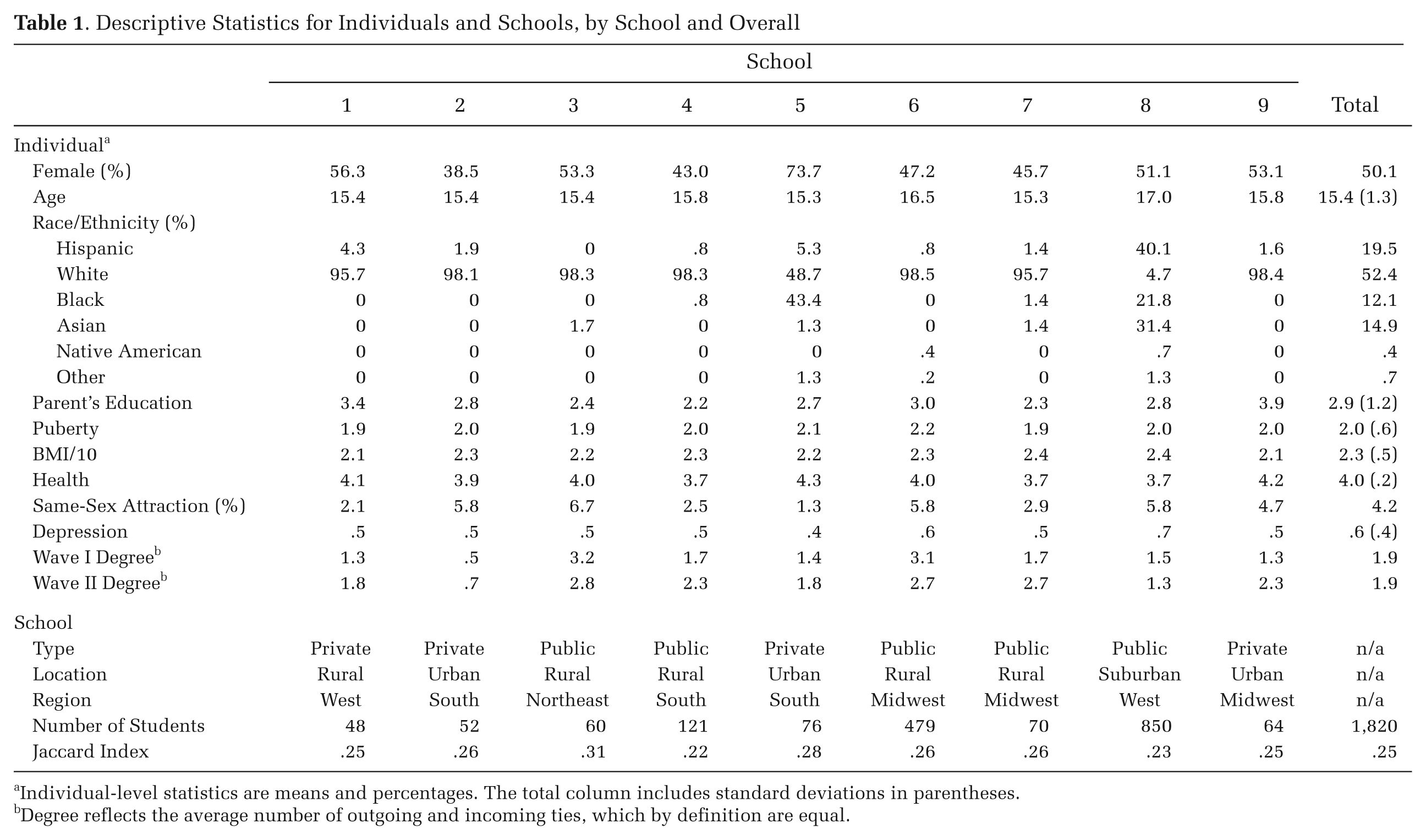
Individual-level statistics are means and percentages. The total column includes standard deviations in parentheses.
Degree reflects the average number of outgoing and incoming ties, which by definition are equal.
Friendships
Friendships were measured at each wave by asking respondents to name their five best male and five best female friends. 5 We required data from respondents and their friends and only include nominations of peers who attended the same school and completed the survey. For each possible dyad, we code the tie as present (1) or absent (0). 6 Networks are directed, meaning a tie from i to j is measured separately from a tie from j to i. Across the nine schools, there are 988,142 possible directed friendship ties. The average number of friendships (i.e., degree) remains relatively constant across the two waves at 1.9 per student. The Jaccard index indicates that 25 percent of friendships that existed in either wave are present at both waves. None of the schools have a Jaccard index lower than .2, which would raise concerns about too much time between observations (Snijders et al. 2010).
Analytic Strategy
Our primary analysis uses a stochastic actor-based (SAB) model that predicts network change from Wave I to Wave II (Snijders 2001; Snijders et al. 2010). The model conditions on the Wave I network and tests several effects hypothesized to produce the network observed at Wave II. Although we observe the network at discrete time points, the model assumes that ties change on an underlying continuous time-scale that follows a Markov process. Specifically, network change occurs through a series of micro-steps in which actors are given the opportunity to modify their outgoing ties, either by forming new ties or dropping existing ties. Within each micro-step, a randomly selected actor evaluates all possible changes to outgoing ties based on effects included in the model. Changes are made in an effort to maximize the following objective function:

where f i (β, x) is the value of the function for actor (i) given the current set of parameter estimates (β) and state of the network (x). The k effects, represented as ski(x), may be based on network or individual attributes (v). After evaluating possible changes, an actor makes the change with the highest positive evaluation (although with a small amount of randomness introduced to the evaluation). For instance, when the reciprocity parameter is positive, changes that create a reciprocated tie or remove an unreciprocated tie are evaluated higher and are more likely to be made. If no changes have a positive evaluation, the actor maintains the existing set of outgoing ties. A rate effect regulates how often actors are given the opportunity to change their ties. Only one actor can change a tie at any given moment, preventing actors from coordinating relationships between themselves.
Individual and dyadic covariates related to depression at Wave I are the effects of greatest interest to us. We use the depression similarity effect to determine whether egos were more likely to select alters who were similar to themselves (i.e., the Attribute Similarity effect in Table 2). We center similarity scores using mean similarity across all possible dyads in the network
Formulas for Selection Effects
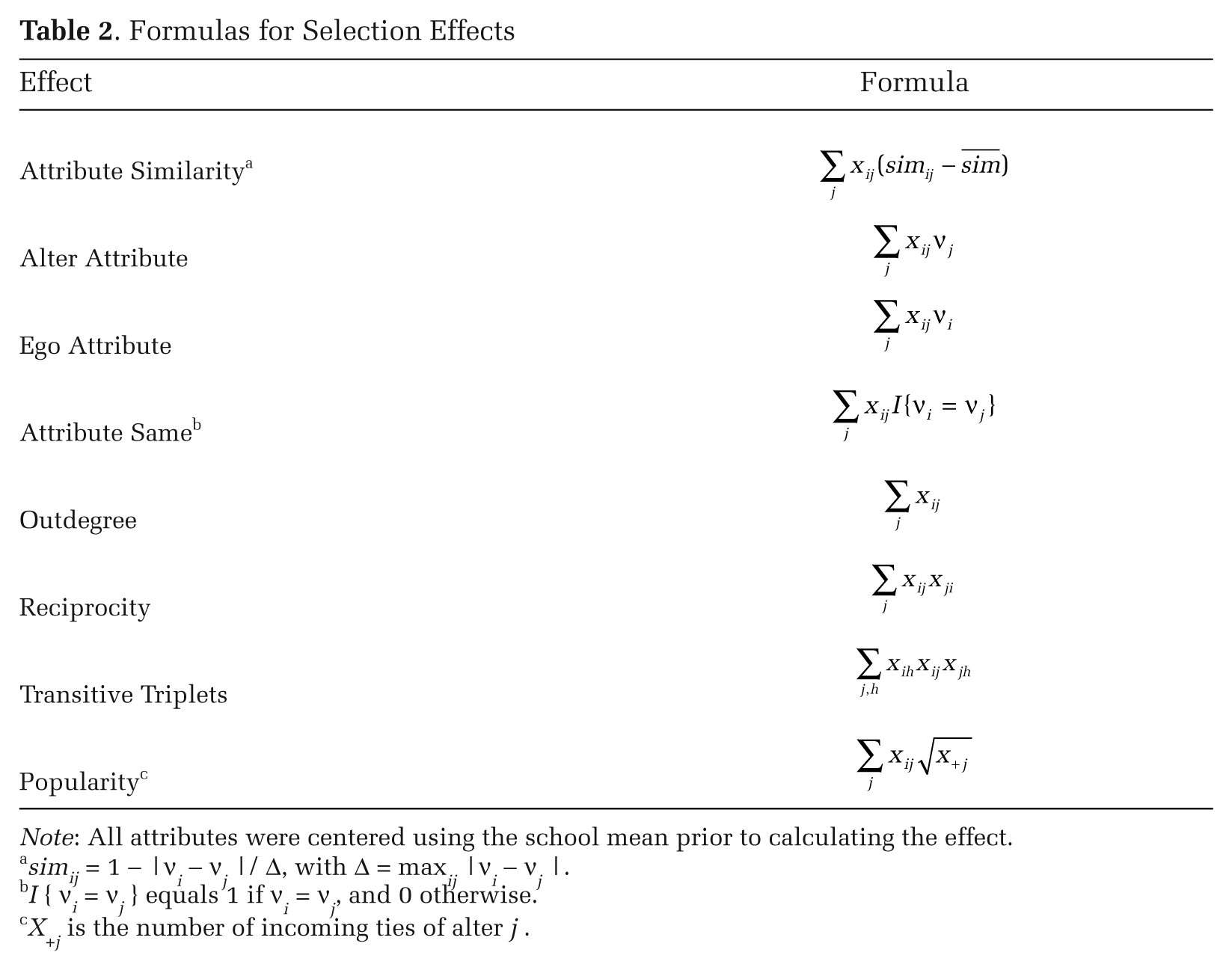
Note: All attributes were centered using the school mean prior to calculating the effect.
sim ij = 1 - |v i - v j |/ Δ, with Δ = max ij |v i - v j |.
I {v i = v j } equals 1 if v i = v j , and 0 otherwise.
X+j is the number of incoming ties of alter j.
To further prevent spurious results due to consolidation, we include ego, alter, and similarity effects for sex, age, parent’s education, puberty, BMI, health, and same-sex attraction. For race/ethnicity, we use the Attribute Same effect (see Table 2), which indicates whether adolescents selected others with the same race/ethnicity. We code dyads in which adolescents were the same race/ethnicity as 1, and all others as 0. Should addition of any of these effects to the model reduce the magnitude of the depression effects, then selection on these attributes was creating the appearance of selection on depression though consolidation.
All models necessarily include a rate effect to control for opportunities to change ties and an outdegree effect to control for number of ties in the network. An outdegree parameter of 0 corresponds to a probability of .5 for each tie in the network. Because the probability of any single tie is generally quite small, estimated outdegree parameters are typically negative (Snijders et al. 2010). Measures of normative network processes include reciprocity, transitivity, and popularity (see Table 2 for formulas). A positive reciprocity parameter would indicate that adolescents were more likely to select peers who had previously selected them. We model transitive closure using the transitive triplets effect. A positive parameter would indicate adolescents were more likely to select a peer if the tie created a transitive structure (i.e., i → j, j → h, and i → h). The popularity effect reflects how the number of incoming ties (i.e., indegree) affected the future likelihood of being selected by others. The square root transformation reduces the weight given to actors with more incoming ties (Snijders et al. 2010). Thus, when an ego chooses among alters, differences between lower indegree alters matter more than differences between higher indegree alters. A positive popularity parameter would indicate that adolescents were more likely to select peers whom many other students had previously selected.
We conducted analyses using version 3.17w of the Simulation Investigation for Empirical Network Analysis (SIENA) software program (Snijders et al. 2009). We followed procedures outlined by Snijders for model fitting and testing for convergence (Snijders et al. 2010). Because each school represents a distinct network with no possibility for overlap, we estimated separate models by school. We then used a meta-analysis to combine model estimates and test for the significance of effects across schools (Snijders and Baerveldt 2003). Details of the meta-analysis are provided in Part B of the online supplement.
Results
Our analysis proceeds in three stages. First, to gain initial insight into the relation between depression and friendship networks, we examine the bivariate association between depression and network structure. Second, we use a series of SAB models to test the hypothesized homophily mechanisms. Third, given evidence that homophily is due to withdrawal, we decompose the friend selection process. For adolescents at different levels of depression, we calculate rates at which normative network processes were responsible for friendships and the extent to which homophilous friendships occurred outside of normative network processes.
Bivariate Analysis
We first consider the association between depression and adolescents’ number of friends. Results indicate that depression is significantly correlated with the number of incoming and outgoing friendship ties. Students with higher levels of depression were less likely to select others (r = –.06, p = .01) and to be selected by others (r = –.10, p < .001). These results are consistent with the withdrawal and avoidance mechanisms, respectively, but do not provide conclusive evidence for either (which requires the longitudinal analysis).
We next consider whether homophily on depression exists. We calculate odds of an ego selecting an alter with a similar level of depression, relative to odds of selecting an alter with a different level of depression. We define similarity as a depression score within .1 of one’s own score. The odds ratio of 1.22 is positive and significantly greater than one (95% CI: 1.13, 1.31), indicating that depression homophily occurred at a greater than expected rate. Odds of a friendship between two adolescents with similar levels of depression were 22 percent higher than the odds of a friendship between dissimilar adolescents.
To help convey the pattern of homophily, Figure 2 presents odds of friendship presence (versus absence) for each combination of ego and alter depression. 7 The z-axis reflects odds of friendship; the x- and y-axes reflect depression levels of ego and alter, respectively. The saddle-shaped pattern provides clear evidence of depression homophily. Adolescents with low or high levels of depression were more likely to have homophilous friendships. Only adolescents with scores in the middle, around 1.0, were just as likely to have heterophilous as homophilous relationships.
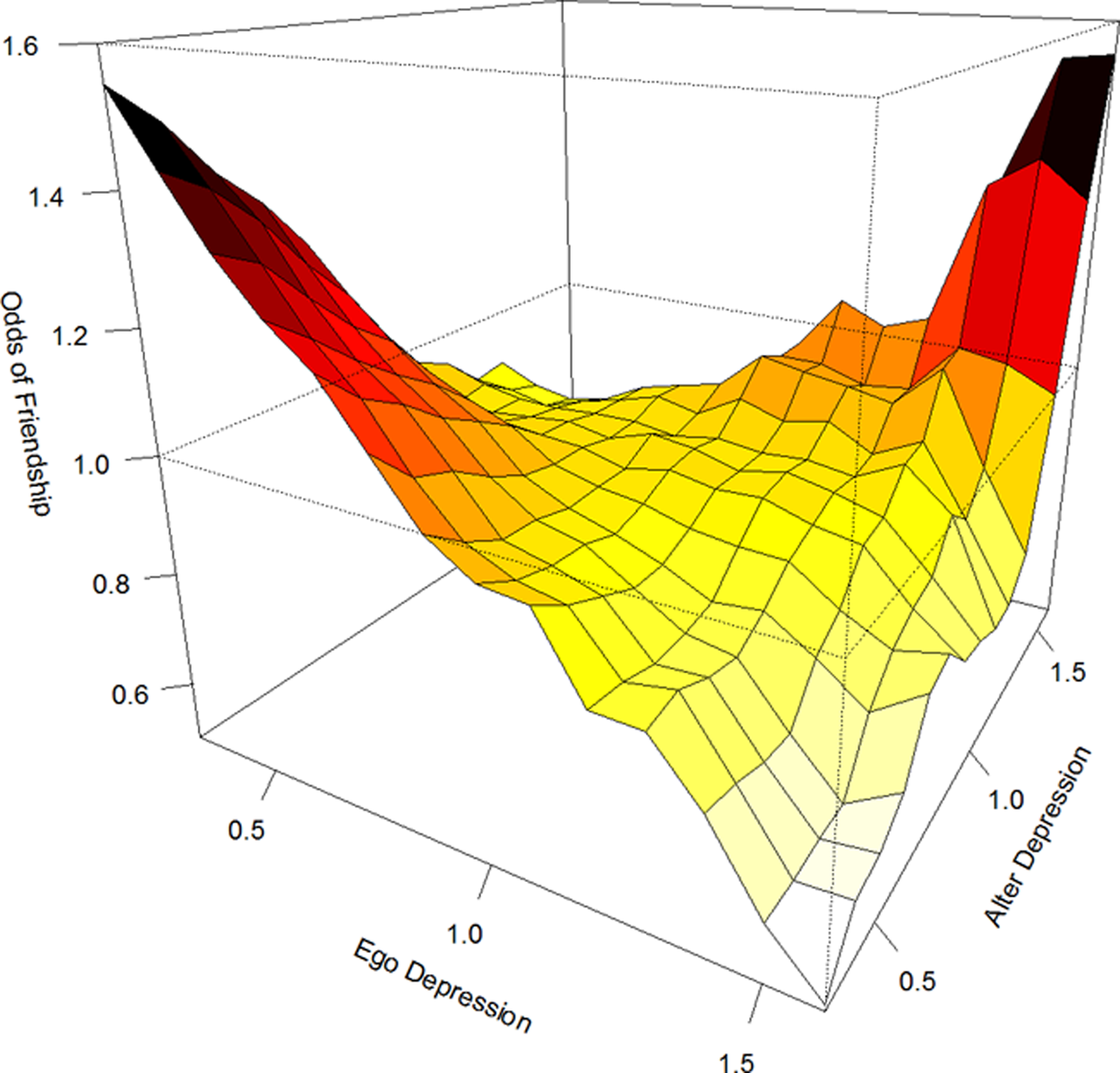
Odds of Friendship by Ego and Alter Depression
SAB Models
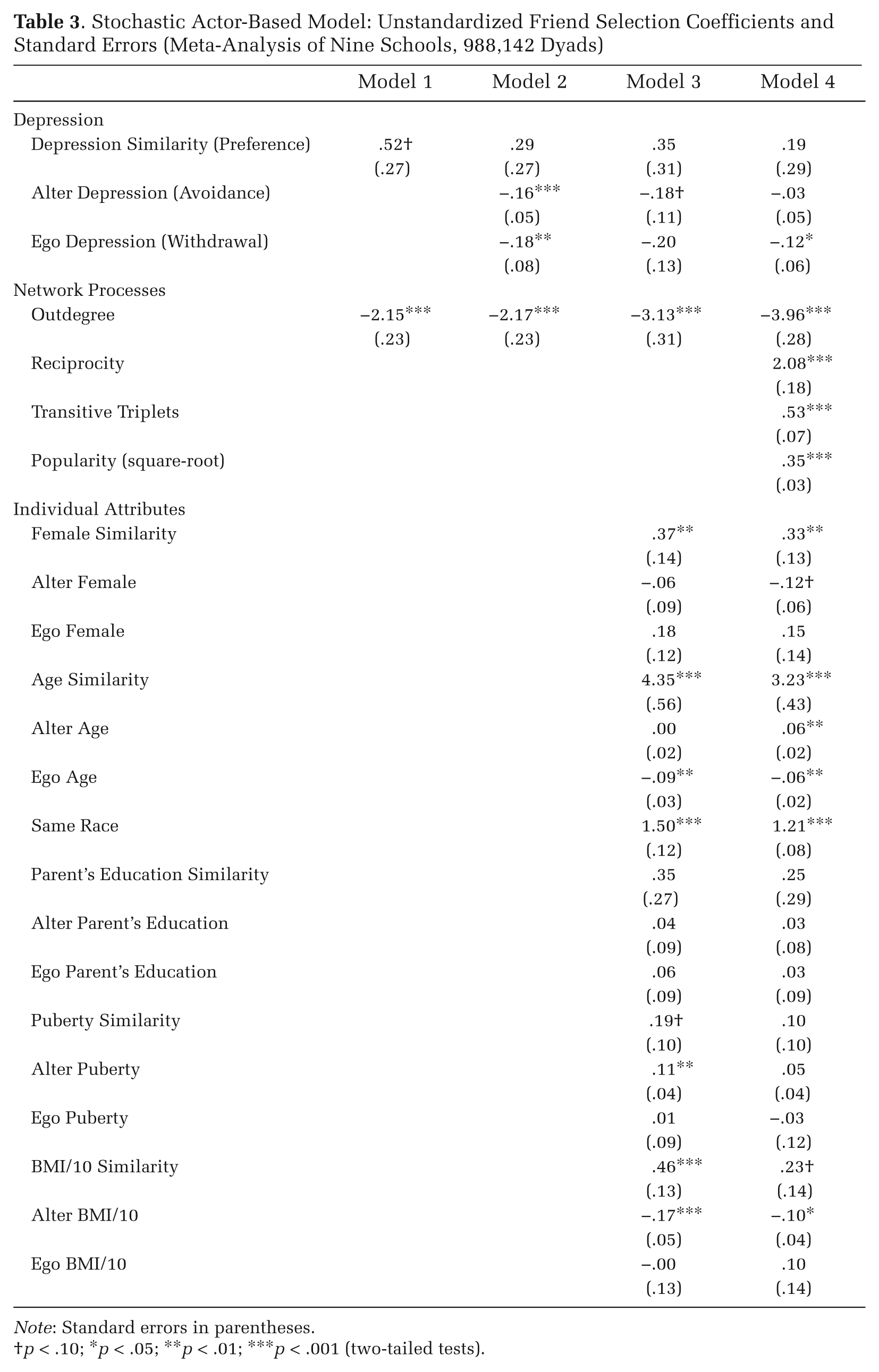
We now address mechanisms responsible for homophily on depression. We begin by testing whether homophily on depression exists over time. Model 1 assesses the total effect of depression similarity on friendship likelihood; it is not intended to evaluate mechanisms responsible for homophily, so it does not include controls for alternative selection processes. Meta-analysis results in Table 3 reveal a marginally significant tendency for homophilous relationships to form and persist (μθ = .52, p = .055). Recall that the SAB model predicts who selects whom as a friend. Adolescents who were more similar in their level of depressive symptoms were thus more likely to select one another as friends over time. Subsequent models determine whether this homophily was due to preference or other hypothesized mechanisms.
Stochastic Actor-Based Model: Unstandardized Friend Selection Coefficients and Standard Errors (Meta-Analysis of Nine Schools, 988,142 Dyads)
Note: Standard errors in parentheses.
p < .10; *p < .05; **p < .01; ***p < .001 (two-tailed tests).
In Model 2, we add effects for depression related to avoidance (alter depression) and withdrawal (ego depression). This model tests whether the marginal similarity effect observed in Model 1 is a consequence of depression-related avoidance or withdrawal. Results indicate that depression affected the friend selection behavior of oneself and one’s peers. The negative ego depression parameter suggests that more depressed adolescents selected fewer friends over time. The negative alter depression parameter suggests that adolescents with higher levels of depression were less likely to be selected as a friend by Wave II. Compared with Model 1, the magnitude of the depression similarity parameter drops by half and is no longer marginally significant. Consequently, there is no evidence of a preference for friends with similar levels of depressive symptoms. The tendency toward homophily found in Model 1 is an indirect product of withdrawal or avoidance.
Model 3 adds effects for consolidating factors that could create spurious depression homophily. As expected, most individual attributes play some role in the friend selection process. 8 For sex, age, race, puberty, and BMI, friendships between similar adolescents were more likely than friendships between dissimilar adolescents. We observe a significant negative effect for ego age, suggesting that older adolescents were less likely to add or maintain friends. This is consistent with extant research documenting declines in the size of friendship networks during high school (Cairns, Xie, and Leung 1998). We also find a significant negative effect of alter BMI, meaning that as BMI increased, adolescents were less likely to be selected as a friend. This effect is also indicative of an avoidance process and is consistent with prior research (Crosnoe et al. 2008). The positive effect of alter puberty suggests that more developed students were more likely to be selected as friends.
Of particular interest was how effects of depression changed when adding possible consolidating factors. Magnitudes of ego and alter depression effects remain substantively unchanged, although their standard errors increase. These increases are driven by greater between-school variances, not larger standard errors for the school-level estimates (which would occur with consolidation). Thus, we conclude that consolidation is not responsible for observed effects of depression on network structure.
Model 4 adds effects for normative network processes in the form of reciprocity, transitivity, and popularity. This model tests whether depression-related withdrawal and avoidance operated net of the magnifying effects of these network processes. In addition, one or more of these processes must be present for the withdrawal mechanism to produce homophily. Results indicate that all three structural effects are significant and in the expected direction. Over time, students were more likely to select alters who had nominated them (reciprocity), friends of their current friends (transitive triplets), and peers whom many other students had previously selected (popularity).
Turning to effects related to depression, we see that they each drop in magnitude. The ego depression parameter remains negative and significant, which is evidence that depression led to withdrawal from social contact. By contrast, the alter depression parameter decreases and is nonsignificant, revealing that the avoidance of depressed peers seen in prior models is due to network processes introduced in Model 4. That is, depressed adolescents were less likely to be selected because they were less accessible through network processes, not because of their depression. For example, depressed adolescents who withdrew had fewer opportunities to be selected through reciprocity. The result is fewer incoming nominations, a pattern that could be amplified through the effect of popularity. In combination, these results suggest that withdrawal was ultimately responsible for the observed effect of homophily on depression.
To assess sensitivity of our results to specification of models and effects, we estimated a number of alternative models. 9 First, the measure of depression similarity described earlier assumes that the effect of similarity is equal regardless of an individual’s level of depression. This may fail to capture homophily that is stronger for individuals at one or both ends of the depression scale. We thus tested an interaction between ego depression and depression similarity to determine whether similarity preferences are linearly related to one’s depression. We also specified depression similarity as the product of ego’s and alter’s centered depression scores, which gives greater weight to extreme scores (either high or low) and would capture a curvilinear effect of depression similarity. Second, although our interest is in friend selection related to depression, estimates of such effects could be biased if depression changes over time due to socialization or other forces. Consequently, we estimated models that account for changes in depression from Wave I to Wave II and include effects for socialization on depression. Finally, the right-skewed depression measure may contain outliers that could potentially influence results. As an alternative specification, we estimated models with a four-category measure of depression (0 to .4, .41 to .8, .81 to 1.2, and 1.2+), which minimizes the impact of outliers on results. None of these alternative specifications produce substantively different results for the friend selection process.
Depression and Network Processes
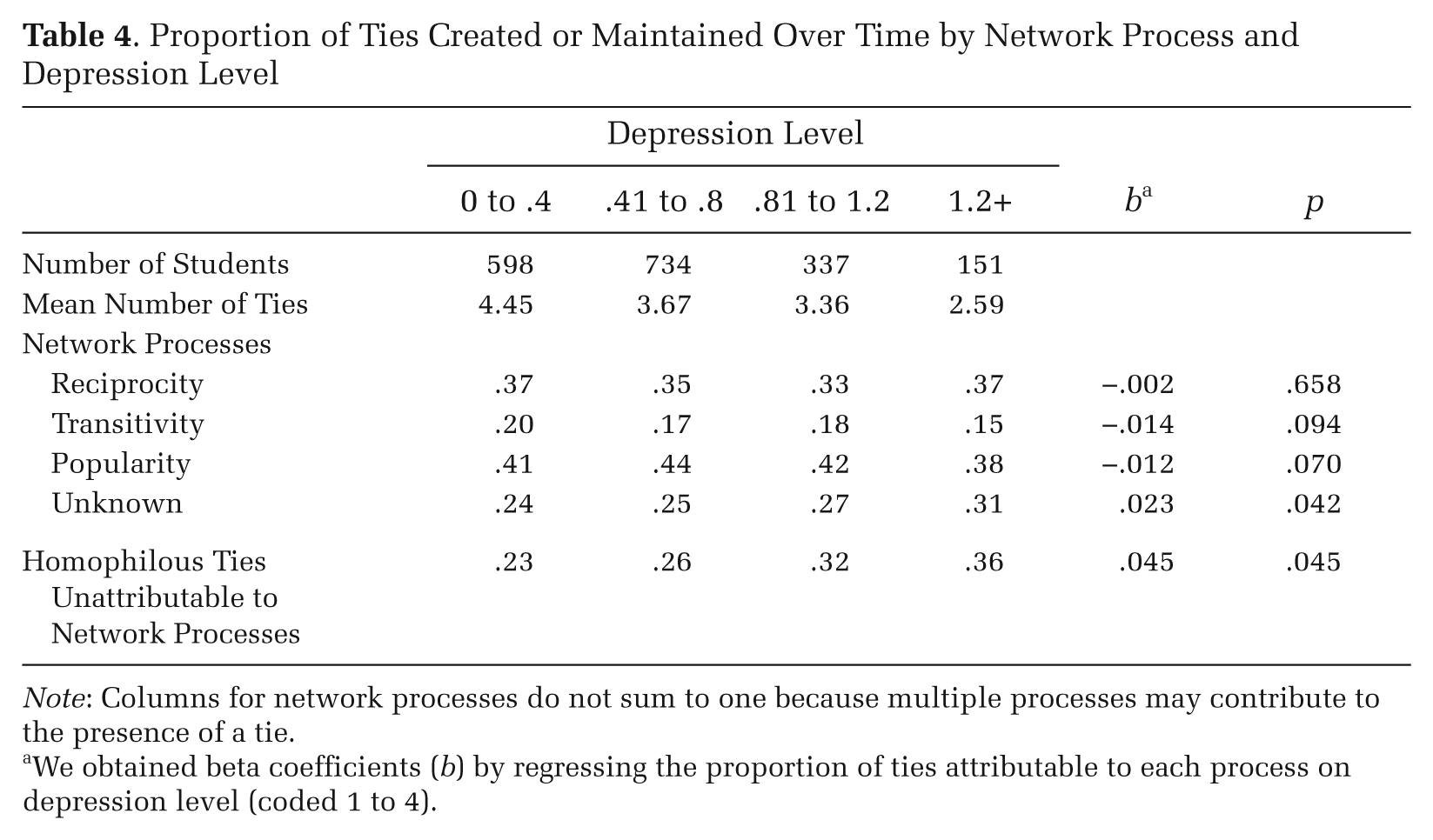
The pattern of results so far is consistent with the withdrawal mechanism, which proposes that depressed individuals occupy more marginalized network positions and are hence less reliant on normative network processes for friendship. In turn, homophily emerges because depressed individuals are more likely to encounter one another outside of normative network processes. However, results do not indicate how operation of normative network processes differed by depression level, nor that depressed adolescents were more likely to have homophilous ties outside of normative network processes. To support our inferences, we decompose the friend selection process for adolescents at different levels of depression. For each adolescent, we count the number of incoming and outgoing ties at Wave II that could be attributed to reciprocity, transitivity, or popularity. 10 We also count how many ties cannot be attributed to any of the three processes. We divide these sums by the total number of ties at Wave II to obtain the proportion of ties attributable to each network process (or to none of them). For this analysis, we separate adolescents into four levels of depression and use a permutation test to assess differences in network processes across levels. 11 For each measure in Table 4, we regress the observed proportion on depression level. We compare the observed regression coefficient to a distribution of 1,000 regression coefficients obtained after randomly permuting depression scores and recalculating proportions. P-values indicate the proportion of permutations in which the measure and depression have the expected association with a magnitude as strong as that observed. We expect depression to be negatively associated with normative network processes and positively associated with their absence.
Proportion of Ties Created or Maintained Over Time by Network Process and Depression Level
Note: Columns for network processes do not sum to one because multiple processes may contribute to the presence of a tie.
We obtained beta coefficients (b) by regressing the proportion of ties attributable to each process on depression level (coded 1 to 4).
To begin, our results reveal that depression is negatively associated with number of friends over time. The most depressed adolescents had two fewer ties over time than did the least depressed adolescents (approximately one less incoming tie and one less outgoing tie). This complements the earlier finding that depression led to network marginalization. Turning to network processes, we observe that depressed adolescents were generally less likely to have friendships through normative network processes. Regression coefficients for each process are negative, indicating that adolescents with higher levels of depression were less likely to have ties through the process. Transitivity is behind 20 percent of the ties for adolescents in the lowest depression category, compared with only 15 percent of friendships for adolescents in the most depressed category. This pattern repeats for popularity, where the least depressed adolescents had 41 percent of their ties through popularity, compared with 38 percent for adolescents in the highest depression category. Reciprocity displays a decreasing trend over the three lower levels of depression but then increases for the most depressed adolescents.
Notably, the proportion of friendships that cannot be attributed to any of the normative network processes differs by depression level. As the Unknown row in Table 4 indicates, at higher levels of depression, normative network processes were significantly less likely to contribute to friendships. For the least depressed adolescents, 24 percent of their ties were outside of normative network processes, compared with 31 percent of ties for the most depressed adolescents. These results offer evidence that depressed adolescents’ greater marginalization left them with proportionally more friendships through other means.
Finally, we calculate the proportion of homophilous friendships unattributable to normative network processes. We define homophily as a friendship with someone in the same or an adjacent depression category. As Table 4 shows, the likelihood of homophilous friendships outside of normative network processes significantly increased with depression level. For the least depressed adolescents, 23 percent of homophilous friendships were outside of normative network processes. This percent increases across levels of depression, reaching 36 percent for the most depressed adolescents. This pattern exists because less depressed students were more embedded in the friendship network, which promoted contact with less depressed peers. By contrast, due to their marginalization, more depressed adolescents had friendships outside of normative network processes, where they encountered more depressed peers. In combination with results for the SAB models, these findings offer support for the withdrawal mechanism.
Discussion
Our goal in this study was to better understand the association between health behavior and social networks. We focused specifically on how depression among adolescents affects the friend selection process, resulting in depression homophily. We articulated three theoretical mechanisms through which individual action could lead to depression homophily. The simplest mechanism is a preference for homophily, in which all individuals (even those experiencing depression) prefer friends with similar levels of depressive symptoms. The second mechanism posits that the stigma and aversive behaviors associated with depression cause others to avoid depressed individuals (even others who are themselves depressed). To overcome the friendship deficit this creates, depressed individuals become more amenable to friendships with depressed peers. According to the third mechanism, depressed individuals withdraw from friendships, leaving them in more marginalized network positions where they have less access to others through common network processes. Consequently, depressed individuals develop friendships with other marginalized individuals, including others who are depressed.
Our analysis provides support for depression homophily through withdrawal. We found no evidence of preference for homophily or that depression encouraged avoidance by one’s peers. Instead, the process by which depression affected friend selection was more complex. Depressed adolescents withdrew from friendships over time, leaving them with fewer friends and in network positions that were less conducive to friendship. In turn, others were less likely to select depressed adolescents as friends because they occupied marginalized network positions, not because of their depression. Homophily on depression emerged indirectly as network processes helped support friendships among non-depressed adolescents, leaving depressed adolescents to find one another through other means.
The avoidance and withdrawal mechanisms that we proposed differ from prior theories for homophily that stress (1) structural forces exogenous to the network or (2) a preference for homophily (McPherson et al. 2001). By contrast, avoidance and withdrawal explain homophily through endogenous friend selection processes. Friendship outcomes depend not only on one’s own behavior but on selection behavior of other individuals in the network. Consequently, when a condition like depression affects something as basic as friendship quantity, the effect can reverberate through the network and culminate in homophily (even when no one prefers homophily). In the present study, withdrawal was responsible for homophily; however, other scholars suggest that avoidance can have similar consequences (Hektner, August, and Realmuto 2000; Hogue and Steinberg 1995), and this is supported by experimental evidence (Schaefer 2009). We thus conclude that homophily in excess of what can be accounted for by structural factors does not necessarily reflect a preference for homophily. Homophily can also be endogenously induced through processes of avoidance and withdrawal. 12
These proposed mechanisms represent middle-range theory (Merton 1968) that can be extended to dimensions beyond depression, although the actual behaviors and perceptions serving as the basis for selection behavior will likely differ from those that accompany depression. An important next step is to clarify conditions under which these homophily selection mechanisms operate (Hedström and Swedberg 1998). Avoidance and withdrawal mechanisms require that actors at opposite ends of the continuum either behave differently or are perceived differently by others. Additional dimensions where this occurs include aggression, obesity, and physical disability, which are characterized by stigma or aversive interpersonal behavior (Crosnoe et al. 2008; Lucas and Phelan 2010; Sijtsema et al. 2010).
One must be careful to distinguish preference-based from endogenously induced homophily. These processes can produce the same cross-sectional association between homophily and friendship presence. Only by observing the pattern of friend selection over time is it possible to determine mechanisms responsible for homophily. Our research thus emphasizes the importance of using appropriate methods when investigating mechanisms behind patterns of social behavior such as friend selection. The ability to properly address questions such as ours is increasing as more longitudinal network data become available and dynamic network methods, such as the SAB model, are more widely adopted (Steglich, Snijders, and Pearson 2010).
The avoidance and withdrawal mechanisms have implications for outcomes beyond homophily. For instance, when aggressive children are excluded by peers and left to form homophilous friendships, their aggression may be reinforced (Sijtsema et al. 2010). Moreover, withdrawal and avoidance have independent negative consequences for individual well-being. Withdrawal can lead to difficulties with peers and school and engender mental and physical health problems (Baumeister and Leary 1995; Rubin, Coplan, and Bowker 2009). Subsequent social isolation stemming from these processes can limit access to social capital (Lin 2001) and increase mortality risk (House et al. 1988). The methods we used can inform investigations of influence, withdrawal, and avoidance processes, as well as help explain the emergence of homophily.
The conventional view of the link between social networks and health is unidirectional, with networks as exogenous (e.g., Umberson et al. 2010). Our results are consistent with prior research documenting a negative association between adolescent depression and social integration (Falci and McNeely 2009; Ueno 2005). However, the effect we observe is in the opposite direction: depression led to lower integration through withdrawal. Thus, the current findings serve as a challenge to current thinking about how health may affect friendship network structures. Our research not only demonstrates that individual characteristics affect network structure, but that a characteristic often considered to be a product of social network functioning also has a role in structuring the network. By treating network structure as the outcome, we were able to uncover processes through which patterns of relationships develop and individuals find themselves in their particular network positions. In conjunction with research on health (Haas et al. 2010) and personality (Kalish and Robins 2006), this expands our knowledge of how micro-level processes contribute to macro-level social structures.
We proposed multiple processes related to depression that could affect friend selection behavior, including reduced energy, fear of stigma, and disinterest in normative activities. Delineating which mechanisms are in operation is vital to appropriately target interventions to counter negative consequences of depression for social integration. For instance, psychotropic drugs are increasingly used to counteract depression in adolescents (Thomas et al. 2006). For such treatment strategies to positively affect social integration, they must alter the relevant causal pathway. In addition to the risks for suicide and suicidal ideation they carry (Vitiello and Swedo 2004), medication runs the risk of negative effects through alternative causal pathways: medication may carry its own stigma (Pescosolido et al. 2007), which can exacerbate avoidance and withdrawal, or the flat affect that psychotropic medications often produce can foster avoidance by peers. Moreover, medication alone does not compensate for sociobehavioral deficits that accompany depression. Even if antidepressants function as intended, they may leave adolescents with a desire for greater social integration but lacking the social skills to achieve such changes. Psychotherapeutic interventions (e.g., behavioral activation) that focus on reducing social withdrawal and inactivity by reorganizing adolescents’ social lives to increase levels of positive reinforcement may be more effective (Jacobson, Martell, and Dimidjian 2001).
While our research provides new insight into how depression affects network structure, there are several remaining questions. To begin, we were unable to distinguish between depression as a short-lived state versus a stable trait (Cole et al. 2006). Duration of depression likely has implications for others’ willingness to maintain relationships with depressed friends. On a related point, most depression in our sample was likely at the more prevalent subclinical level. The processes we investigated, such as avoidance, may be stronger among adolescents with clinical depression. For instance, peers who are clinically depressed may impose greater costs on friendship or carry greater stigma, which could lead others to directly avoid them (see Lucas and Phelan 2010). From a sampling perspective, we were only able to examine friendships among adolescents in the same school. Given that depressed students, especially girls, are more likely to nominate friends outside of school (Ueno 2005), it is important to investigate who these friends are and how their friendships differ from those within schools (van Zalk et al. 2010). It would also be useful to investigate the degree to which ties to non-school friends are a consequence of within-school dynamics and the experience of marginalization that we found. Finally, our sample included only nine high school networks. Relative to many network studies, nine is a lot. Still, testing these processes on a larger and more representative set of networks would provide greater precision.
This research investigated several processes through which social networks come into being. We identified effects of one dimension of friend selection—depression—yet much work remains in partialing effects of other salient dimensions of friendship, normative network processes, and the feedback of friendships on behavior. In moving forward, it is imperative that theory keep pace with methodological advances that allow for investigation of complex processes such as these.
Footnotes
Acknowledgements
We express our appreciation to Tom Snijders, jimi adams, Steven Haas, Sarah Hayford, Matthew Pittinsky, and Carey Cooper for their helpful comments on an earlier draft. This research uses data from Add Health, a project directed by Kathleen Mullan Harris and designed by J. Richard Udry, Peter S. Bearman, and Kathleen Mullan Harris at the University of North Carolina at Chapel Hill, and funded by the Eunice Kennedy Shriver National Institute of Child Health and Human Development (P01-HD31921), with cooperative funding from 23 other federal agencies and foundations. Special acknowledgment is due Ronald R. Rindfuss and Barbara Entwisle for assistance in the original design. Information on how to obtain the Add Health data files is available on the Add Health website ( ).
).
This research was supported by the
Notes
References
Supplementary Material
Please find the following supplemental material available below.
For Open Access articles published under a Creative Commons License, all supplemental material carries the same license as the article it is associated with.
For non-Open Access articles published, all supplemental material carries a non-exclusive license, and permission requests for re-use of supplemental material or any part of supplemental material shall be sent directly to the copyright owner as specified in the copyright notice associated with the article.
