







Abstract
A burgeoning literature considers the consequences of mass imprisonment for the well-being of adult men and—albeit to a lesser degree—their children. Yet virtually no quantitative research considers the consequences of mass imprisonment for the well-being of the women who are the link between (former) prisoners and their children. This article extends research on the collateral consequences of mass imprisonment by considering the association between paternal incarceration and maternal mental health using data from the Fragile Families and Child Wellbeing Study. Results show that recent paternal incarceration increases a mother’s risk of a major depressive episode and her level of life dissatisfaction, net of a variety of influences including prior mental health. The empirical design lends confidence to a causal interpretation: effects of recent incarceration persist even when the sample is limited to mothers attached to previously incarcerated men, which provides a rigorous counterfactual. In addition, the empirical design is comprehensive; after isolating key mechanisms anticipated in the literature, we reduce the relationship between recent paternal incarceration and maternal mental health to statistical insignificance. These results imply that the penal system may have important effects on poor women’s well-being beyond increasing their economic insecurity, compromising their marriage markets, or magnifying their risk of divorce.
Family instability has increased markedly since the 1970s, especially for already disadvantaged low-income and minority families (Cherlin 2010; Ellwood and Jencks 2004; McLanahan 2004). In response, a large literature has emerged on the effects of family instability, suggesting harmful effects of its key dimensions—divorce, separation, and nonmarital fertility—on children (e.g., Amato, Loomis, and Booth 1995; Cherlin 1999; Fomby and Cherlin 2007; Jaffee et al. 2003; Kim 2011; McLanahan and Sandefur 1994). A smaller literature has tested the effects of family instability on men and women, generally suggesting negative effects for adults as well (Amato 2000; Avellar and Smock 2005; Meadows 2009; Meadows, McLanahan, and Brooks-Gunn 2008).
Yet some dimensions of the surge in family instability have not been fully studied; for these dimensions, the focus on the family remains incomplete. Although divorce, separation, and nonmarital fertility have become more common over time, they are not unique to the present era (DuBois [1899] 1996; Liebow [1967] 2003; Office of Policy Planning and Research, U.S. Department of Labor 1965; Patterson 1998; Stack 1974). Incarceration presents a different picture. Since the 1970s, the incarceration rate has risen enormously, to the point that incarceration is now a common event in low-income, minority families (Western and Wildeman 2009). Unlike the broader literature on family instability, research on imprisonment has, until recently, focused primarily on its consequences for men, overlooking its consequences for their wives and partners (e.g., Massoglia 2008; Pager 2003; Schnittker and John 2007; Western 2002, 2006). Few scholars, it would seem, think of incarceration as a family matter in the same way they think about divorce, separation, and nonmarital fertility as family matters.
Despite this focus, there are reasons to expect that incarceration might also affect individuals connected to the currently and formerly incarcerated, even if the direction is uncertain and the issues involved are different. A handful of qualitative studies suggest that fathers’ incarceration diminishes mothers’ well-being (Braman 2004a; Comfort 2008; Daniel and Barrett 1981; Fishman 1990; Lowenstein 1984; Morris 1965; Nurse 2002; Schwartz and Weintraub 1974). Multiple reasons exist for this negative relationship. Incarceration involves, at a minimum, a forced separation from partners and often sharply diminished socioeconomic resources, both during and after a sentence (Geller, Garfinkel, and Western 2011; Swisher and Waller 2008). Incarceration also involves considerable stigma, much of which spreads to people associated with inmates (Braman 2004a). In these ways, effects of paternal incarceration on mothers are a direct extension of effects of incarceration on incarcerated men. But the parallels are imperfect and it remains unclear whether effects on mothers are as overwhelmingly negative as they are on fathers. Some mothers, for example, express relief when a difficult or distant father is incarcerated (Comfort 2008). Some also use the event as a turning point, realizing a new sense of independence and purpose (Edin, Nelson, and Paranal 2004; Nurse 2002). Consequences of incarceration may be asymmetric between mothers and fathers in other ways as well. For example, some mothers re-partner (Nurse 2002), thereby shedding the stigma of incarceration in ways that are nearly impossible for former inmates.
To fully understand if and how paternal incarceration affects the well-being of the women with whom they have children, it is important to consider characteristics of the mother, the inmate, and their relationship, all in the context of a longitudinal design that allows for sequential analysis. Few studies have explored the topic at all and, to our knowledge, no study has included all of these desirable features simultaneously, which is especially important given the many complex and countervailing influences. Most research employs select samples, such as juveniles (Nurse 2002) or women who visit their incarcerated partners often (Comfort 2008), or is taken from contexts with very different incarceration patterns than those currently found in the United States (Lowenstein 1984; Morris 1965). Moreover, quantitative research in this area has taken a piecemeal approach, focusing on effects of incarceration on women’s marriage markets (Charles and Luoh 2010), union stability (Lopoo and Western 2005), and material hardship (Schwartz-Soicher, Geller, and Garfinkel 2011), but not on well-being, an important outcome in its own right that might be a product of incarceration’s other effects.
In this study, we investigate mental health effects of paternal incarceration on the mothers of inmates’ children using data uniquely suited to the task, the Fragile Families and Child Wellbeing Study. We estimate the association between paternal incarceration and two related but distinct indicators of maternal mental health, major depression and life dissatisfaction. Research has linked these outcomes to additional impairments throughout the life course (Miech and Shanahan 2000; Teitler and Reichman 2008; Yu and Williams 1999) and to child well-being (King and Heard 1999; Turney 2011), making maternal mental health an important bridge between literatures spanning parents and their offspring. We also elucidate the mechanisms underlying the association between paternal incarceration and maternal mental health. The Fragile Families data are multidimensional. They allow us to explore effects of paternal incarceration on maternal mental health using a large, diverse sample; a longitudinal design; an established measure of major depression; a variety of characteristics about both parents, including paternal impulsivity and history of domestic violence, drug use, and incarceration; and rich information about parents’ relationships. These features provide a considerable improvement over previous studies, allowing us to evaluate consequences of paternal incarceration with greater sensitivity to social selection processes and mechanisms.
Collateral Consequences of Mass Imprisonment
After a long period of mild fluctuation in the United States, the imprisonment rate began a steep, steady climb in 1973, reaching an unprecedented rate of more than 500 per 100,000 and an annual outflow of nearly 750,000 inmates (Maguire 2011a, 2011b). As the incarceration rate has risen, so too has the number of incarcerated parents. Between 1991 and 2007, the number of imprisoned parents increased nearly 80 percent to 357,300, affecting 1,706,600 children (Glaze and Maruschak 2008). Prisoners with young children are, in fact, the norm. Given the young age of most inmates, many have a child under the age of 8 years; many also have multiple children (Glaze and Maruschak 2008). Furthermore, rates of paternal incarceration among black children far exceed those among white children. Whereas about one in four black children can expect to have a parent imprisoned during their childhood, only one in 25 white children can expect the same (Wildeman 2009). Because the mean length of a prison stay is several years (Patterson and Preston 2008), inmates are likely to be absent during key developmental periods of their children’s lives.
Despite this, paternal incarceration could still improve—or at least not harm—children’s well-being. Assuming incarcerated men make poor fathers, some researchers presume positive or null effects and, therefore, a spurious relationship in instances where research finds negative associations (e.g., Giordano 2010). To be sure, this assumption is in line with literature on effects of family instability on children, as the absence of an antisocial father has minimal negative effects on children (Jaffee et al. 2003) and the dissolution of high-conflict marriages can enhance children’s well-being (Amato et al. 1995). Yet the preponderance of evidence on incarceration suggests negative effects on children and, in the case of positive effects, important contingencies (Comfort 2007; Foster and Hagan 2007, 2009; Geller et al. 2009, forthcoming; Hagan and Dinovitzer 1999; Murray and Farrington 2008; Wakefield and Uggen 2010; Wakefield and Wildeman 2011; Wildeman 2010; Wildeman and Western 2010). For example, research suggests that the sizable minority of children whose fathers are abusive or incarcerated for a violent offense suffer less from paternal incarceration than do the majority of children whose fathers are not abusive or incarcerated for a violent offense (Wildeman 2010).
The same issues apply to mothers, but quantitative research on consequences of incarceration for families tends to leave out mothers. This is surprising given that these women form a bridge between incarcerated men and their children, potentially blunting or accentuating any negative effects on children (Braman 2004a; Nurse 2002). Understanding effects of paternal incarceration on mothers necessitates considering both parents’ characteristics in equal measure, as well as characteristics of their relationship before and after the sentence. As difficult as it is to evaluate effects of incarceration on adult men and their children, it is perhaps even more difficult to evaluate effects of paternal incarceration on mothers, as such indirect effects may involve multiple agents, complex pathways, and countervailing influences.
Paternal Incarceration and Maternal Mental Health
Understanding Effects of Paternal Incarceration on Mothers
For several reasons, incarceration of fathers likely has a negative effect on the mental health of the mothers of their children. Much of the literature highlights the uncertainty and isolation associated with even short spells of incarceration. Daniel and Barrett (1981), for example, find that distress and loneliness among inmates’ wives is particularly high, and Fishman (1990) describes the time while husbands are behind bars as one of crisis and anxiety for the family. Implicit in these studies is a vision of incarcerated fathers as committed to their children and their children’s mothers, which may be a reflection of these studies’ underlying samples. Because some studies begin with intact or even thriving partnerships, these findings may not generalize to all former inmates (Comfort 2008). Studies using more representative samples, however, also find broad evidence for family commitment among incarcerated fathers. In a large-scale interview-based study, Edin and colleagues (2004) find that most incarcerated fathers were saddened by the loss of their relationship with their children’s mother and expressed regret for missing key milestones in their children’s lives. Incarcerated fathers’ behaviors are often consistent with these sentiments, as most fathers try to maintain contact with their children while in prison (Glaze and Maruschak 2008). Assuming fathers are dedicated to their children, incarceration is presumably a loss for those they leave behind (Braman 2004a), but other mechanisms could make matters even worse.
Indeed, incarceration introduces a host of unique stressors that may damage relationship quality. In an ethnography of wanted men, Goffman (2009) describes how wanted status leads, in some instances, to partners using the threat of calling the police as a form of social control. For men involved with the criminal justice system, partners may pose particular threats that can undermine trust (see also Nurse 2002). Even when not leveraging a partner’s status to achieve certain ends, women often feel complicit in their partner’s behavior and, indeed, may be pressured by police to report on their partner’s whereabouts (Goffman 2009). Under these conditions, even ordinary signs of commitment, such as witnessing the birth of a child, assume a threatening edge (Goffman 2009).
For their part, mothers often struggle with managing their households in the father’s absence. Incarceration does more than simply reduce the real and potential support available to mothers. Considerable research, for example, suggests that having an incarcerated father adversely affects children’s mental health, which might redouble back to mothers. Children of incarcerated parents experience the trauma of having a parent arrested, the stress of losing a caretaker, and the stigma of having an incarcerated parent (Comfort 2007; Parke and Clarke-Stewart 2002). As a result, children often suffer from a range of behavioral problems, including hyperactivity, aggression, and delinquency (Gabel 1992; Geller et al. forthcoming; Murray and Farrington 2005, 2008; Roettger and Swisher 2011; Wakefield and Wildeman 2011; Wildeman 2010). Such changes would increase parenting difficulties under the best circumstances, but especially when there are fewer adults to share supervision. Moreover, these difficulties are unlikely to be resolved when fathers are released, as relationships with their children may have deteriorated, preventing even the most motivated fathers from helping out (Swisher and Waller 2008). To cope with the stigma of being involved with incarcerated men, mothers may also form new relationships (Edin 2000; Nurse 2002) and shield their children from knowledge of the father’s situation (Hairston 2005), but these strategies rarely resolve their difficulties and sometimes make them worse (Nurse 2002).
Adding to these problems is the diminished socioeconomic resources available to mothers, both while the father is incarcerated and after release. Indeed, as a matter of emphasis some studies target socioeconomic consequences of incarceration as the root from which other difficulties grow (Morris 1965; Noble 1995; Richards et al. 1994). Many findings support this argument. Nearly 70 percent of fathers in prison report they contributed financially to their children prior to incarceration, and slightly more than half of fathers in state prisons report they provided primary financial support to their children prior to arrest (Glaze and Maruschak 2008). Indeed, for many inmates, criminal activities are not inconsistent with these commitments, as they are often a financial supplement to traditional employment (Edin 2000). Regardless of whether they are legal or illegal, earnings cease entirely when fathers are incarcerated. At the same time, incarceration increases some expenses. While fathers are incarcerated, mothers face the additional expense of providing personal items for the inmate and maintaining contact (Hairston 2005), which is considerable given the distance to many prison facilities, the cost of purchasing gifts and shipping packages, and prisons’ unusually high phone service fees (Braman 2004b; Comfort 2008; Grinstead et al. 2001). Economic costs of imprisonment extend even further, as the legal debt incarcerated individuals accrue dramatically increases their monthly expenditures and possibly their wives’ expenses, too (Harris, Evans, and Beckett 2010).
Requirements of an Adequate Research Design
It is easy to envision the difficulties of sharing a child with an incarcerated man. Yet all the apparent effects of incarceration on maternal depression and life dissatisfaction—traveling through various pathways and actors—could simply reflect powerful forces of selection. Mothers who share children with incarcerated men may suffer from high levels of stress whether or not the father was incarcerated. Incarceration is concentrated among persons with low levels of education living in low-income communities where depression is most common (Kessler et al. 1995; Ross 2000). Furthermore, the damaging characteristics associated with current and former prisoners, including erratic and abusive behavior, may have been present before their sentence (Gottfredson and Hirschi 1990), and even fathers who are dedicated to their children are often abusive in their relationships (Johnson and Waldfogel 2004; Western and Wildeman 2009). For these reasons, some women report relief when a troublesome partner is incarcerated (Comfort 2008); these effects may be obscured in designs that inadequately account for selection.
A more direct form of social selection is also possible. Research has linked depression to a variety of negative outcomes, suggesting that depression itself may be associated with mothers getting involved with incarcerated men. In particular, mood disorders increase the odds of premarital parenthood (Kessler et al. 1997; Mollborn and Morningstar 2009), reduce the likelihood of marriage among single mothers (Teitler and Reichman 2008), and increase the likelihood of divorce (Kessler, Walters, and Forthofer 1998), perhaps due to low self-esteem and attachment to partners with poor self-control and employment prospects.
Considering the full set of potential influences, effects of the incarceration of a current or former romantic partner on mothers’ mental health are uncertain, and no quantitative research has yet considered this question in a rigorous design. A rigorous design requires a number of elements: longitudinal data; information on both parents, as well as potential mechanisms, including characteristics of their relationship and parenting-related stress; a sufficiently large sample to avoid unusual sample composition issues; a lagged measure of mental health; and, for an appropriate comparison, partners of individuals who are at high risk of incarceration but who are not incarcerated.
A rigorous design also requires sensitivity to the measurement of mental health. Because psychological consequences of incarceration are not well established, it is important to consider multiple manifestations of distress; to this end, we use a categorical and a dimensional measure. For the former, we examine major depression using an instrument premised on the diagnostic criteria established by the American Psychiatric Association’s Diagnostic and Statistical Manual (see our detailed discussion below). For the latter, we examine life dissatisfaction, assessed in a global fashion and measured on a four-point scale. These two measures are correlated but shed light on different aspects of well-being. Whereas major depression is more affective, revealing a severe emotional reaction with syndrome-like features, life dissatisfaction is more cognitive, revealing a reflexive judgment and life summary, albeit one influenced by current emotions (Headey, Kelley, and Wearing 1993; Schwarz and Strack 1999). Because life dissatisfaction is continuous, it may be more sensitive to social influences and, indeed, some sociologists focus on continuous measures for this reason (Mirowsky and Ross 2002). Yet the literature reviewed earlier suggests that incarceration may have especially strong psychological effects on mothers, leading not only to an increase in distress but also to an increase in the risk for major depression. By using categorical and dimensional measures, we can assess this possibility directly. We are also able to assess whether effects of paternal incarceration are consistent across the range of distress, which is directly relevant to some of our concerns (see Kessler 2002). For example, major depression might be more sensitive to social selection than is life dissatisfaction, especially if the former has more severe behavioral consequences than the latter, further increasing the value of a design that is comprehensive with respect to its independent and dependent variables.
Data, Measures, and Analytic Strategy
Data
Data from the Fragile Families and Child Wellbeing Study, a longitudinal cohort examination of about 5,000 children born in urban areas between 1998 and 2000, provide the elements necessary to examine the link between paternal incarceration and maternal mental health (Reichman et al. 2001). The sampling frame included hospitals in 20 U.S. cities with populations greater than 200,000, which were stratified by labor market conditions, welfare generosity, and child support policies. Unmarried mothers were oversampled. Initial interviews were conducted with mothers in hospitals shortly after they gave birth and with fathers either in hospitals or elsewhere as soon as possible after the birth. Both parents were then interviewed by telephone about one, three, and five years after the birth. 1 Of the mothers who participated at baseline, about 90, 88, and 87 percent completed the survey at the one-, three-, and five-year waves, respectively (Bendheim-Thoman Center for Research on Child Wellbeing 2008).
In constructing our analytic sample, we dropped observations in which the mother did not complete both the three- and five-year surveys (n = 1,051). We also dropped observations missing values for either dependent variable at the five-year survey (n = 121). Few observations were missing data on the independent variables, and we used multiple imputation to preserve as many observations as possible. We imputed data with the ICE procedure in Stata 11.0, producing 20 datasets (Royston 2007). In the imputation model, we included variables related to incarceration, well-being, and the likelihood of being missing (Allison 2002). Our final sample represents 77 percent of the original sample (N = 3,826). Although the imputed models preserve observations, models based on listwise deletion reveal virtually identical findings (results available upon request).
The data have a number of notable features. First, they include a large number of women who have a child with an ever-incarcerated man. This is vital because it allows us to compare women involved with incarcerated men with those at high risk of being involved with incarcerated men, thereby strengthening counterfactual causal inference (LaLonde 1986; Leamer 1983; Li, Propert, and Rosenbaum 2001). Second, given high rates of depression, life dissatisfaction, and paternal incarceration among mothers in the sample, Fragile Families is the only broadly representative dataset with enough variation to generate reliable estimates of effects of paternal incarceration on maternal mental health. Finally, the data include a wealth of information about both parents, making it possible to adjust for preexisting differences between mothers who have and have not experienced the incarceration of their child’s father. This is the key difference between Fragile Families and the National Longitudinal Survey of Youth 1979 (NLSY79), the other data source regularly used to consider effects of incarceration (e.g., Lopoo and Western 2005; Massoglia 2008; Schnittker and John 2007; Western 2002).
Measures
Maternal mental health
We examine two indicators of maternal mental health—depression and life dissatisfaction—both measured at the three- and five-year surveys. DSM-IV diagnoses of major depressive episodes come from mothers’ responses to the Composite International Diagnostic Interview Short Form (CIDI-SF) Version 1.0 November 1998 (Kessler et al. 1998; see also Kessler and Ustun 2004). Mothers were asked if, at some time during the past year, they had feelings of depression or were unable to enjoy things that were normally pleasurable. Respondents who experienced at least one of these symptoms most of the day, every day, for a two-week period were asked additional questions (about losing interest in things, feeling tired, experiencing a change in weight of at least 10 pounds, having trouble sleeping, having trouble concentrating, feeling worthless, or thinking about death), and those who answered affirmatively to three or more of these questions are considered to have Major Depressive Disorder (MDD). These are not lifetime measures of MDD, but refer to current or 12-month MDD (1 = presence of MDD, 0 = absence of MDD). 2 Although some limitations stem from the abbreviated form of the CIDI relative to the full version (Link 2002), it is often used in community surveys, especially when administration of the full CIDI is not feasible (Aalto-Setala et al. 2002). About 21 percent of mothers reported symptoms sufficient for a diagnosis of major depression at the three-year interview and 17 percent reported depression at the five-year interview. Mothers were also asked how satisfied they were with their life, given response categories ranging from (1) very satisfied to (4) very dissatisfied. Mean values of life dissatisfaction at the three- and five-year interviews were 1.708 and 1.685. Some models also control for prior depression and life dissatisfaction (measured at the three-year survey).
Paternal incarceration
Our explanatory variable is recent paternal incarceration. We separate paternal incarceration into recent and past incarceration, but we focus our discussion on recent incarceration because it provides more leverage for estimating causal effects. For both measures, we rely on the mother’s and the father’s reports and assume the father was/is incarcerated if at least one report is affirmative (relying on only one report can lead to underreporting [see Geller et al. 2011]). 3 We define recent paternal incarceration as the father being incarcerated between the three- and five-year interviews, including at the five-year interview. Coded this way, recent paternal incarceration includes fathers currently in prison with respect to when the outcomes were measured (at the five-year interview). 4 We define distal paternal incarceration as the father having been incarcerated at any point up to and including the three-year interview.
Some features of these variables are important to emphasize. For one, the two incarceration variables are distinct but not mutually exclusive. Some recidivists, for instance, will have affirmative responses for both variables, and some with distal incarceration will nonetheless have no recent incarceration, which is the focus of our analysis. In addition, these measures pertain only to timing of incarceration. We cannot precisely estimate length of the sentence or number of times the father was incarcerated, but for reasons discussed earlier, we believe timing is essential for understanding incarceration’s effects on the family. Attention to timing also allows us to estimate causal effects with greater certainty. With this in mind, we include distal paternal incarceration either as a control variable or to restrict the sample to those likely at high risk of recent incarceration. In both cases, the variable provides us with information on prior incarceration, thereby allowing us to adjust for the risk of incarceration with more accuracy than would be possible with only our other control variables (discussed in the next section). The reference category for the set of incarceration variables is respondents with no lifetime experience with incarceration. Incarceration is not uncommon. Nearly 20 percent of mothers were connected to a man who had experienced recent incarceration after the three-year survey, and 39 percent were attached to a man who had been incarcerated by the three-year survey. Moreover, of the 20 percent of fathers who experienced recent incarceration, 79 percent had also experienced distal incarceration, highlighting the overlap between the two measures of incarceration we utilize.
Controls
The analyses control for a host of characteristics likely associated with paternal incarceration and maternal mental health. Furthermore, Fragile Families allows us to maintain appropriate time-ordering between the dependent, explanatory, and control variables: all controls were measured at or before the three-year interview. Many of these controls were measured for mothers and fathers. Race is represented by a series of dummy variables: white, black, Hispanic, and other race. A dummy variable indicates a respondent was born outside of the United States. Age is measured in years. Education is measured with a series of dummy variables: less than high school diploma, high school diploma or GED, and postsecondary education. We control for parents’ relationship status at the three-year survey: married, cohabiting, in a nonresidential romantic relationship, and no longer romantically involved. We note whether the mother reported a romantic relationship with a new partner at the three-year survey. We also include a dummy variable indicating whether either of the mother’s biological parents experienced a two-week period of feeling depressed, down in the dumps, or blue, a sensitive if not specific indicator of a history of major depression.
We also control extensively for economic well-being and family functioning at the three-year interview. We adjust for maternal reports of income-to-poverty ratio, material hardship, relationship quality with the child’s father, number of children in the household, co-parenting, paternal engagement, and parenting stress. The income-to-poverty ratio is the ratio of the household income to the thresholds established by the Census Bureau. These thresholds correspond to the year before the interview and are based on household size and composition. Mothers were also asked if, at some point in the past year, they experienced up to 12 proffered events because there was not enough money (e.g., received free food or meals, did not pay the full amount of rent or mortgage payment, or borrowed money from friends or family to help pay the bills). We summed answers to these questions to create a scale of material hardship ranging from 0 to 12. Relationship quality is based on maternal reports of her relationship with the father (1 = poor to 5 = excellent). Number of children in the household is a continuous variable. Two indicators of co-parenting, shared responsibility (α = .934) and cooperation in parenting (α = .956), are coded as suggested in prior research (Carlson, McLanahan, and Brooks-Gunn 2008), with higher values indicating greater levels of co-parenting. Mothers were also asked how many days per week the father did activities with the focal child, such as sing songs, read stories, or hug or show physical affection (α = .681). The final paternal engagement measure is the average of these responses and ranges from 0 to 7. Fathers who did not see the child more than once in the past month are coded 0. Parenting stress comprises an average of responses to the following (1 = strongly disagree to 4 = strongly agree): being a parent is harder than I thought it would be; I feel trapped by my responsibilities as a parent; taking care of my children is much more work than pleasure; and I often feel tired, worn out, or exhausted from raising a family (α = .699).
Finally, we control for three important paternal characteristics: impulsivity, domestic violence, and drug or alcohol abuse (Gottfredson and Hirschi 1990). Adjusting for these variables diminishes concerns that a father’s antisocial behavior drives both his incarceration and his partner’s mental health. Impulsivity is measured by an abbreviated form of Dickman’s (1990) impulsivity scale, based on an average of six questions (1 = strongly disagree to 4 = strongly agree): I will often say whatever comes into my head without thinking first; often, I don’t spend enough time thinking over a situation before I act; I often say and do things without considering the consequences; I often get into trouble because I don’t think before I act; many times, the plans I make don’t work out because I haven’t gone over them carefully enough in advance; and I often make up my mind without taking the time to consider the situation from all angles (α = .976). Domestic violence is based on the mother’s report that the father hit, slapped, or kicked her at any point up to and including the three-year interview. 5 Fathers have a drug or alcohol problem if, at any point up to and including the three-year interview, he or the mother reported that drugs or alcohol interfered with the father’s work or that drugs or alcohol made it difficult for him to get a job or get along with friends or family. 6 In some models, we control for change in domestic violence and change in drug or alcohol abuse between the three- and five-year interviews to account for the possibility these changes are associated with both paternal incarceration and maternal mental health, further solidifying our test of causal effects by providing a rigorous test of spuriousness before turning to mechanisms. 7
Mechanisms
We examine three sets of mechanisms that may explain the association between paternal incarceration and maternal mental health: economic well-being, relationship type and quality, and parenting quality and stress. Economic well-being is represented by the change in the mother’s income-to-poverty ratio and material hardship between the three- and five-year interviews. Relationship type is measured at the five-year interview. It is considered a mechanism, and we also control for relationship type at the three-year interview. 8 In addition, we include a dummy variable indicating a new romantic partner moved into the mother’s household between the interviews and a measure of change in relationship quality between the three- and five-year interviews. The third set of mechanisms includes maternal reports of changes in shared responsibility in parenting, cooperation in parenting, father engagement, and parenting stress. 9
Analytic Strategy
We use logistic regression models to estimate depression and ordinary least squared (OLS) models to estimate life dissatisfaction. 10 We include city fixed-effects because interviews took place in 20 cities. Our analysis proceeds in two stages, each of which involves several models. In each, we present tables for depression (Tables 1 and 3) and life dissatisfaction (Tables 2 and 4).
In the first stage (Tables 1 and 2), we estimate effects of recent paternal incarceration using several strategies. We first present the unadjusted relationship between paternal incarceration and maternal mental health (Model 1). We then consider the robustness of this relationship by introducing maternal (Model 2) and paternal characteristics (Model 3) associated with the dependent and explanatory variables. The next model adjusts for a lagged dependent variable (Model 4). Because relatively few mothers move into or out of depression across waves, a lagged dependent variable is preferable to a fixed-effects model. In these models, our goal is to estimate effects of recent paternal incarceration, relative to no history of paternal incarceration, on maternal mental health. Here, we use distal paternal incarceration as a control variable. Like recent paternal incarceration, distal paternal incarceration can be interpreted with respect to the reference category, mothers attached to never-incarcerated fathers.
We also use distal paternal incarceration in another way. Although Models 1 through 4 include a variety of control variables, it is still possible that point estimates presented in these models are biased. In particular, it is possible that mothers in our reference category—those involved with never-incarcerated fathers—were never truly at risk of being involved with incarcerated fathers. If so, these mothers do not provide an appropriate counterfactual for effects of incarceration and using distal paternal incarceration as a control variable does not resolve the issue. As another strategy, we use distal paternal incarceration to restrict the sample. In Model 5, we restrict the sample to women attached to men who had been incarcerated by the three-year interview. Accordingly, fathers who experience only recent incarceration and not distal incarceration are not included in the sample. 11 Although this procedure eliminates many mothers involved with recently incarcerated men, the subsample provides a superior test of effects of recent paternal incarceration by diminishing unobserved heterogeneity and increasing confidence that the control group (the reference category) was at some risk of incarceration, in this case because they had experienced it before (LaLonde 1986; Leamer 1983; Li et al. 2001). 12 In Model 6, we add two more paternal characteristics that may render the relationship between paternal incarceration and maternal mental health spurious: change in domestic violence and drug and alcohol abuse between the three- and five-year interviews. We should note that we do not believe distal paternal incarceration is unrelated to maternal well-being or even less strongly related to maternal well-being than recent paternal incarceration. We are simply less confident in our ability to estimate its effects given the structure of the data, and we use the subsample restriction as one of several estimation strategies. In addition, it is important to note that some of our strategies may produce overly conservative estimates. Tables 1 and 2 focus on estimating effects rather than exploring mechanisms. We use them to produce a baseline estimate. But if changes in domestic violence and substance abuse are a consequence of recent incarceration, Model 6 presents a preliminary test of mediating mechanisms rather than a baseline estimate of incarceration’s effects. For this reason, Models 5 and 6 should be considered alternative bounds, with Model 5 providing the upper bound and Model 6 the lower bound.
In the second analytic stage (Tables 3 and 4), we consider three sets of mechanisms that might mediate the relationship between recent paternal incarceration and maternal mental health. All models include the full set of controls shown in Model 5 of Tables 1 and 2. Similar to Model 5, these models are also restricted to mothers attached to men who experienced distal incarceration. Thus, we start with a model that features a rigorous reference cell and set of controls. We explore three classes of mechanisms, introduced separately: economic well-being and hardship (Model 1), relationship status and quality (Model 2), and parenting quality and stress (Model 3). In Model 4, we include all the mechanisms simultaneously and, in Model 5, we add measures of change in paternal domestic violence and in drug and alcohol abuse, thereby allowing us to assess the total amount of mediation under both our upper- and lower-bound assumptions.
Sample Description
Table A1 in the Appendix presents descriptive statistics for the full sample and by incarceration history. Mothers who had a child with a recently incarcerated man were about 60 percent more likely to report depression at the five-year survey than were all other mothers, and they also reported more life dissatisfaction. However, having a child with a recently incarcerated man may not in itself have caused their distress, as these mothers were also severely disadvantaged relative to other mothers in a host of domains, including socioeconomic status and prior mental health.
Results
Relationship between Paternal Incarceration and Maternal Mental Health
Turning first to Table 1, Model 1 considers the association between recent paternal incarceration and maternal depression controlling only for distal paternal incarceration. It indicates that recent paternal incarceration is significantly associated with a greater risk of depression. For mothers who had a child with a recently incarcerated man, the odds of being depressed are 54 percent (e.434) higher than for women who had a child with a man not recently incarcerated ( p < .001). A history of paternal incarceration by the three-year interview is also significantly associated with an elevated risk of maternal depression, but the relationship is substantially smaller (p < .01).
Logistic Regression Models Predicting Mother’s Depression by Father’s Incarceration with Controls (Log Odds)

Note: All models include city fixed-effects. Standard errors in parentheses.
Recent paternal incarceration is defined as any incarceration taking place between the three- and five-year interviews.
Distal paternal incarceration is defined as any incarceration taking place up to and including the three-year interview.
The distally incarcerated sample represents mothers attached to fathers who had ever been incarcerated up to and including the three-year interview.
p < .05; **p < .01; ***p < .001 (two-sided tests).
Although findings from Model 1 suggest that recent paternal incarceration is associated with a substantial and significant increase in the risk of depression, this model does not control for factors associated with both recent paternal incarceration and maternal depression, other than distal paternal incarceration. The remaining models introduce other controls in a progressive fashion. Taking into account maternal characteristics in Model 2, the relationship between recent paternal incarceration and maternal depression continues to be statistically significant ( p < .01), and the magnitude of the coefficient diminishes by 23 percent, suggesting the observed maternal characteristics explain some, but not all, of the association between recent paternal incarceration and mothers’ increased risk of depression. Adjusting for maternal characteristics renders the relationship between distal paternal incarceration and maternal depression statistically insignificant and diminishes the size of the coefficient by nearly two-thirds.
Adjusting for paternal characteristics in Model 3 diminishes the statistical significance of the recent paternal incarceration–maternal depression relationship ( p < .05), a result driven by antisocial behaviors. Nonetheless, compared to Model 2, the magnitude of the relationship is only diminished by 9 percent in Model 3. After adjusting for paternal characteristics, the relationship between distal paternal incarceration and maternal mental health declines again—down 47 percent from Model 2 to .048. In Model 4, we adjust for maternal depression at the three-year interview. The association between recent paternal incarceration and maternal mental health remains statistically significant ( p < .05), providing evidence of robustness. Perhaps more interestingly, the association between recent paternal incarceration and maternal depression diminishes 43 percent from Model 1 to Model 4, suggesting conditions associated with recent paternal incarceration and maternal depression explain more than two-fifths of the relationship. Selection into having a recently incarcerated partner, therefore, is also important in explaining this association.
To this point, we have proceeded as though mothers attached to never-incarcerated men are a sufficient reference group. But estimates based on this group may be biased insofar as many of these women were at little risk of experiencing paternal incarceration. To diminish this concern, Model 5 focuses on women attached to men who had been incarcerated by the three-year interview. As with earlier models, these results support the conclusion that recent paternal incarceration is associated with a significant ( p < .05) increase in the risk of maternal depression. Net of observed characteristics and prior depression, the odds of experiencing a major depressive episode are 28 percent higher for mothers attached to recently incarcerated men. When we adjust for changes in paternal domestic violence and drug or alcohol abuse in Model 6, the relationship between recent paternal incarceration and maternal depression remains statistically significant at only the .10 level. As noted, however, these results may underestimate effects of paternal incarceration because changes in domestic violence and changes in paternal drug or alcohol abuse may result from incarceration. It is also worth noting that although results in Model 6 suggest only a marginally significant association between recent paternal incarceration and maternal depression, the association is nonetheless substantial. In fact, point estimates suggest nearly a 25 percent increase in the probability of experiencing a major depressive episode among mothers of recently incarcerated fathers when all control variables are held at their means.
In Table 2, we consider life dissatisfaction. Consistent with Model 1 in Table 1, Model 1 in Table 2 shows that women who have a child with a recently incarcerated man report more life dissatisfaction than do women attached to never incarcerated men (.193, p < .001). Coefficients for recent and distal incarceration are indistinguishable. In Models 2 and 3, which respectively adjust for maternal and paternal characteristics, only recent paternal incarceration is associated with more life dissatisfaction (p < .01). This association persists in Model 4, which adjusts for earlier life dissatisfaction. In the most rigorous models (Models 5 and 6), we employ the same sample restrictions used in Table 1. In Model 5, recent paternal incarceration is associated with more life dissatisfaction ( p < .01) and, similar to results for depression, the coefficient for recent incarceration is larger in Model 5 than in Model 4, buttressing the case for a causal effect. Moreover, this relationship remains significant in Model 6 (.092, p < .05), which adjusts for changes in paternal domestic violence and alcohol or drug use. These effects are large relative to available standards. Recent paternal incarceration increases maternal life dissatisfaction by only about 6 percent, but this effect is comparable to the protective effects of Hispanic ethnicity.
OLS Regression Models Predicting Mother’s Life Dissatisfaction by Father’s Incarceration with Controls

Note: All models include city fixed-effects. Standard errors in parentheses.
Recent paternal incarceration is defined as any incarceration taking place between the three- and five-year interviews.
Distal paternal incarceration is defined as any incarceration taking place up to and including the three-year interview.
The distally incarcerated sample represents mothers attached to fathers who had ever been incarcerated up to and including the three-year interview.
p < .05; **p < .01; ***p < .001 (two-sided tests).
Mechanisms Underlying the Paternal Incarceration–Maternal Mental Health Relationship
Tables 1 and 2 established the baseline effects of incarceration, but we are also interested in mechanisms that might explain these effects. We address mechanisms in Tables 3 and 4. Each model in these tables includes the full set of controls shown in Model 5 of Tables 1 and 2, although we do not report those coefficients. 13 We first turn to estimates of maternal depression in Table 3, exploring different types of mechanisms across consecutive models. For each mechanism (except relationship status), we use change scores, linking effects of incarceration on well-being to changes in other domains. The models reveal that all the factors play some role, but economic factors and parenting are more prominent. Model 1 suggests that changes in economic well-being between the three- and five-year interviews diminish the magnitude of the association between recent paternal incarceration and maternal depression by 26 percent. Model 2 indicates that changes in relationships and the quality of those relationships explain little of the association. Model 3, however, indicates that changes in parenting experiences explain 29 percent of the association. In Model 4, which considers all the mechanisms simultaneously, the relationship between paternal incarceration and maternal depression is, unsurprisingly, smaller than in any other model, diminished by 41 percent relative to Model 5 in Table 1. The final model includes all variables from Model 6 in Table 1, which estimates a more conservative test of the association between paternal incarceration and maternal depression. Including these mechanisms explains about 35 percent of the association. Taken together, these findings suggest that changes in economic well-being and parenting stress and experiences are the primary mechanisms linking paternal incarceration to maternal depression.
Logistic Regression Models Predicting Mother’s Depression by Father’s Incarceration with Mechanisms, Restricted to the Distally Incarcerated Sample (Log Odds)
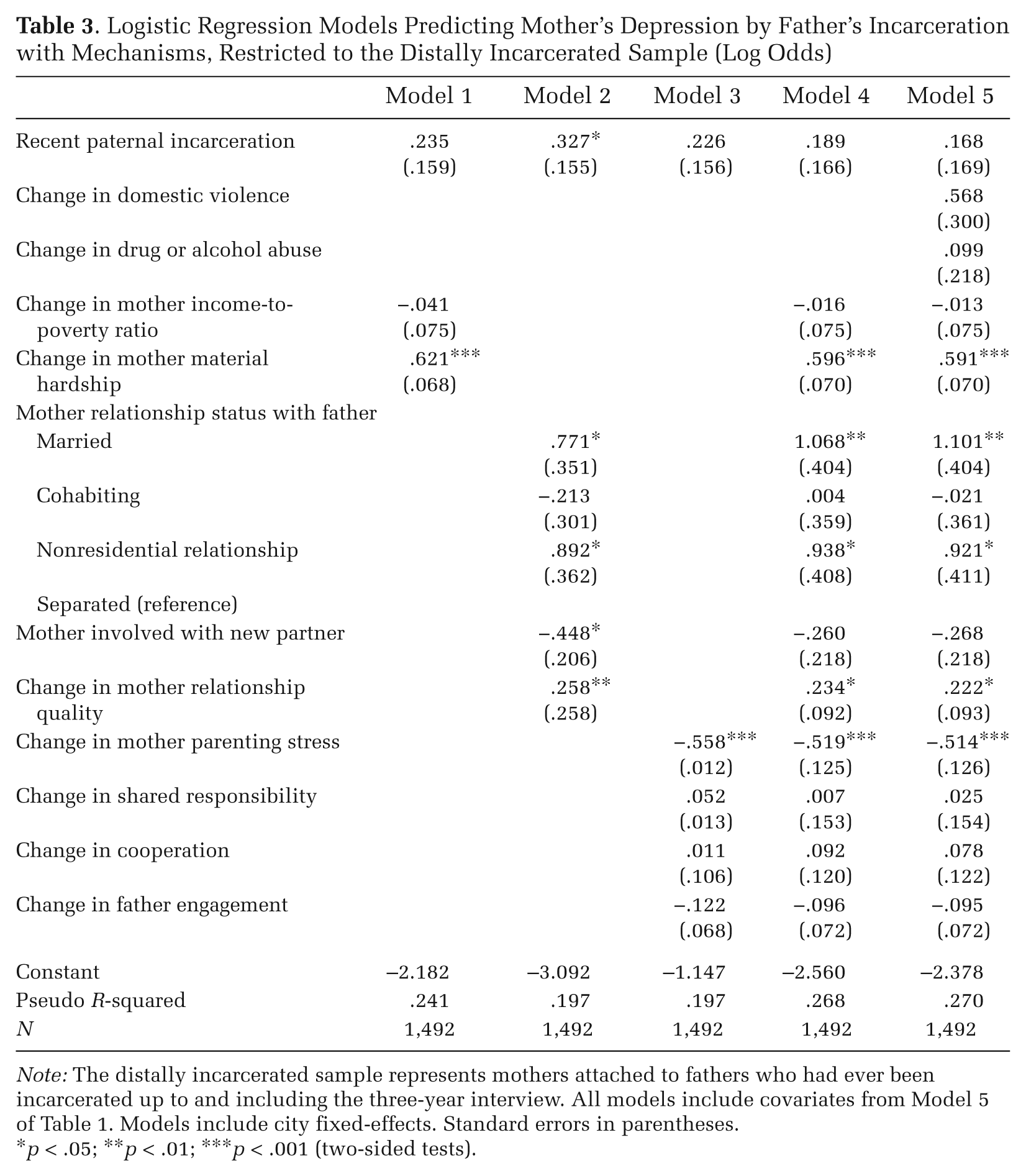
Note: The distally incarcerated sample represents mothers attached to fathers who had ever been incarcerated up to and including the three-year interview. All models include covariates from Model 5 of Table 1. Models include city fixed-effects. Standard errors in parentheses.
p < .05; **p < .01; ***p < .001 (two-sided tests).
In Table 4, we examine the mechanisms underlying the association between paternal incarceration and maternal life dissatisfaction using the same structure. As a starting point, we use the coefficient for recent paternal incarceration in Model 5 of Table 2 (.103). There are some differences relative to major depression. Adjusting for changes in economic well-being in Model 1 diminishes the association between recent paternal incarceration and maternal life dissatisfaction by about 18 percent. The association is even less in Models 2 and 3. Changes in relationship characteristics explain 25 percent of the association (Model 2), and changes in parenting experiences explain 32 percent of the association (Model 3). In contrast to estimates for major depression, relationship and parenting experiences may be more important mechanisms than economic well-being for life dissatisfaction. In Models 4 and 5, we consider all the mechanisms simultaneously, and the relationship is reduced by approximately half: 52 percent according to the upper-bound estimate and 45 percent according to the lower-bound estimate. In both cases, the relationship is statistically insignificant.
OLS Regression Models Predicting Mother’s Life Dissatisfaction by Father’s Incarceration with Mechanisms, Restricted to the Distally Incarcerated Sample
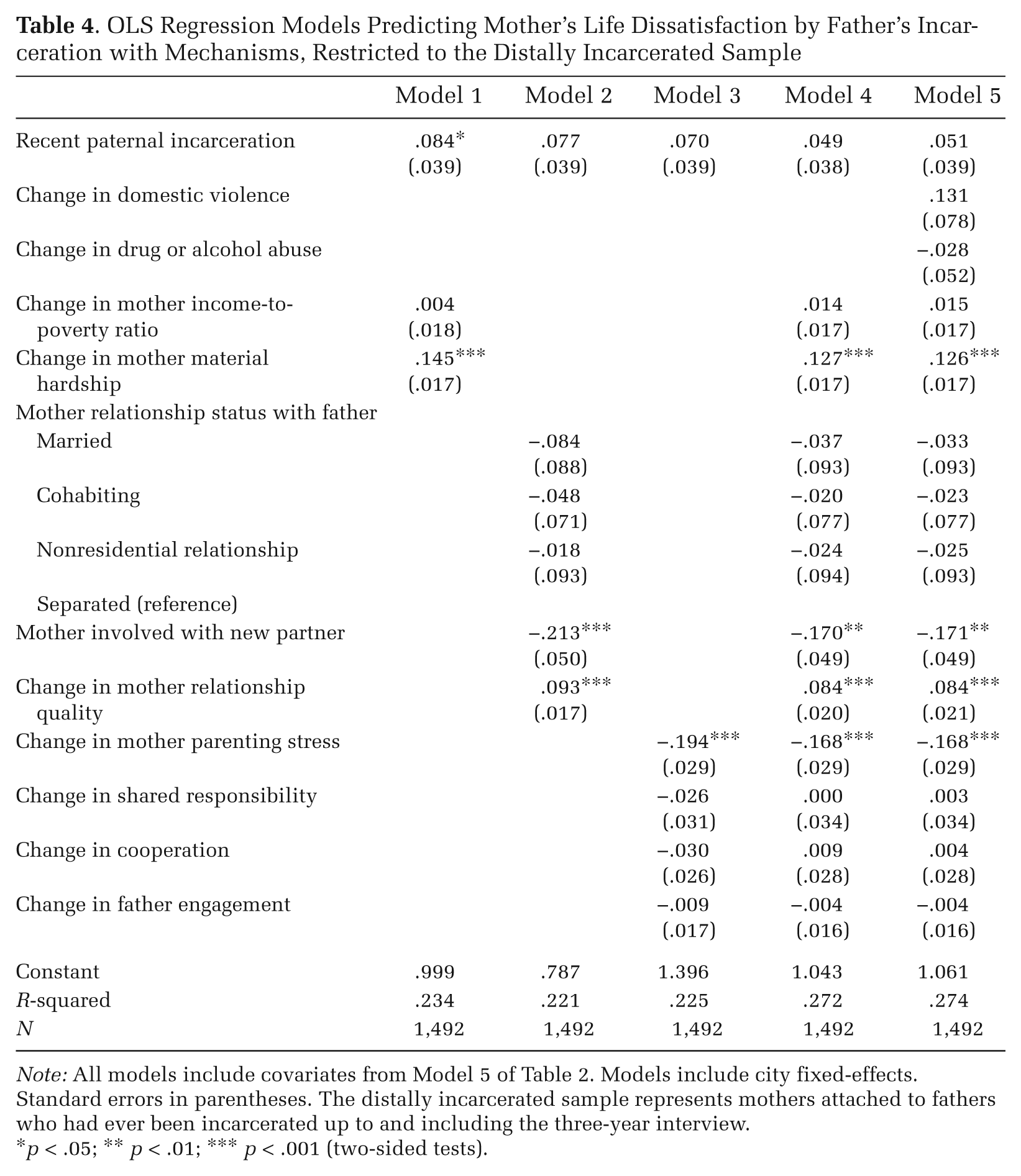
Note: All models include covariates from Model 5 of Table 2. Models include city fixed-effects. Standard errors in parentheses. The distally incarcerated sample represents mothers attached to fathers who had ever been incarcerated up to and including the three-year interview.
p < .05; ** p < .01; *** p < .001 (two-sided tests).
Discussion
This study bridges the literature on effects of incarceration on current and former inmates with the literature on effects of incarceration on children and families by focusing on the often overlooked situation of mothers. These seemingly disparate literatures have more in common than might first appear: our results suggest that the negative effects of incarceration on mothers stem in no small part from the well-known effects of incarceration on socioeconomic status (Pager 2003; Western 2002, 2006). Yet results reveal additional dimensions to effects of incarceration, suggesting the collateral consequences of incarceration are not only a matter of increasing socioeconomic instability. Indeed, our results also point to important effects on social relationships, with implications for maternal mental health.
The first stage of our analyses revealed a statistically significant negative association between recent paternal incarceration and maternal mental health. In the fully specified model for the complete sample (Model 4 of Tables 1 and 2), paternal incarceration is significantly associated with major depression (b = .248) and life dissatisfaction (b = .103). These effects are not an artifact of characteristics of the mother, the father, or the relationship they had before the father was incarcerated. The characteristics most consistently associated with maternal mental health reflect socioeconomic resources, which are also related to paternal incarceration. The quality of the mother’s relationship with the father prior to incarceration also plays a role, but putting maternal characteristics and characteristics of the relationship in the same model still leaves most of the association between paternal incarceration and maternal mental health. The relationship between paternal incarceration and maternal mental health also reflects characteristics of the father, but almost entirely insofar as these characteristics are reflected in the mother-father relationship. Indeed, on their own, fathers’ characteristics matter very little for mothers’ mental health, a striking pattern given how much of the literature focuses on these characteristics. In Model 5 of Tables 1 and 2, for example, none of the characteristics of the father, apart from incarceration itself, is related to maternal mental health. Paternal race, education, and impulsivity are related to incarceration, of course, but they do not explain the poor mental health of mothers who partner with incarcerated men.
Instead of being a reflection of incarcerated men’s characteristics, effects of paternal incarceration are a reflection of how incarceration undermines social and economic stability. All the mechanisms identified in the literature play a role. Fathers’ incarceration leads to financial instability among mothers, further deterioration of already vulnerable relationships, and growing parenting stress. But the relative strength of these influences is different than anticipated. The socioeconomic impact of incarceration has been the focus of much of the incarceration literature, especially as it applies to effects of incarceration on men. However, in the case of spillover effects of incarceration on mothers, parenting-related stress plays a somewhat more important role than relationship quality or economic well-being. Even if the socioeconomic impact of incarceration were entirely eliminated, incarceration would still undermine the well-being of incarcerated men’s families. Together, however, the impact of these assorted mechanisms is substantial. In models that include all three types of mechanisms, recent incarceration is no longer related to major depression or life dissatisfaction. This reduction to statistical insignificance is not merely a matter of power: the paternal incarceration coefficient is much smaller (between 35 and 52 percent) in models accounting for mechanisms than in models accounting only for selection (Models 5 and 6 in Tables 1 and 2).
Limitations
Although our models help to disentangle the mechanisms linking paternal incarceration to maternal mental health, certain features of our design leave some questions unresolved. Most noteworthy are the remaining dimensions of unobserved heterogeneity. First, Fragile Families does not contain information regarding the circumstances surrounding a father’s arrest or imprisonment, both of which may influence mental health. Some evidence suggests, for example, that individuals who witness a family member’s arrest experience distress as a result (Comfort 2007). Similarly, separation may be more or less distressing depending on the ease with which the relationship can be maintained during a sentence. Comfort (2008) describes the obstacles women experience when visiting their partners in prison, stemming from the long distance many have to travel, unusually large phone bills, and the strict supervision of visitation. The distress of having an incarcerated partner may be less when the visitation process is easier and less costly. Similarly, some incarcerated fathers may suffer less because of the policies and practices of their prisons and, as a result, be more effective fathers upon release. Second, the root source of parenting stress is unclear, and different sources imply different processes. Increased parenting stress could be due to less adult supervision, more struggles with work-family balance, or changes in children’s behavior that make parenting more difficult. Future research should investigate the more proximal stressors that drive these relationships.
Finally, it is worth speculating about remaining threats to causal inference. Our design has a number of important elements: it features appropriate time-ordering of variables, utilizes a reference group uniformly at risk of paternal incarceration, and controls for changes in fathers’ antisocial behaviors that could have led to their incarceration. Our confidence is further enhanced by our ability to control for a host of specific influences cataloged in prior research on the topic. Even so, it is possible that some unmeasured factors increase distress and the likelihood of incarceration, or that some of our covariates are measured with sufficient error to decrease their power as control variables. In supplementary analyses (see Table S2 in the online supplement), a precisely matched sample shows that such selection forces would have to be substantial to render the effects of incarceration insignificant. Given the existing literature, it is unclear what these forces are, but without further research unobserved heterogeneity will remain a concern.
To that end, we encourage more empirical research on a topic that does not naturally lend itself to an experimental approach. Given the unprecedented rise in incarceration and the potential for strong spillover effects, the risks of not understanding incarceration’s consequences are perhaps more severe than the risks of occasionally overstating its effects. Moreover, without a complete understanding of whether and how incarceration matters, the likelihood of over-controlling can be as great as that of under-controlling. For example, some of our control variables, such as education or impulsivity, could be outcomes of incarceration rather than determinants; thinking of them in terms of selection could thus lead to overly conservative conclusions about effects. Similarly, an incomplete understanding of mothers’ situations could lead to an overly restrictive approach, especially in communities where incarceration is pervasive. For example, given that many mothers in the Fragile Families sample re-partner with new men, some of whom have experienced incarceration themselves, our results may underestimate the consequences of incarceration by focusing only on biological fathers’ incarceration. Our confidence in our results in part reflects the nature of our two dependent variables. Given the broad and severe behavioral consequences of depression, major depression is likely more sensitive than life dissatisfaction to selection. Yet, in general, controlling for depression is no more consequential for the incarceration coefficients than is controlling for prior life dissatisfaction, lending further support for an effect rather than an association.
It is also important to consider the broad scope of incarceration. At present, much of the research in this area focuses on black-white disparities in the lifetime risk of imprisonment for men (e.g., Pettit and Western 2004) and the resulting effects of incarceration on black-white labor market inequalities (e.g., Western 2006). Although incarceration disproportionately affects African Americans, it also disproportionately affects Hispanics, who are well-represented in Fragile Families. In our sample, nearly 20 percent of recent experiences with paternal incarceration were experienced by Hispanic mothers (see Table A1 in the Appendix), a finding consistent with research on increases in lifetime risks of imprisonment for Hispanic men (Bonczar 2003). Yet Hispanics are virtually absent from the research on imprisonment, in much the same way as women (but see Comfort 2008; Nurse 2002; Roettger and Swisher 2011; Swisher and Waller 2008). In this study, we highlighted the importance of considering incarceration as a family matter; future research should be mindful of the many different kinds of families it affects.
Conclusion
Our results suggest that fathers’ incarceration harms the mental health of mothers of their children. In a specific way, our study adds to a growing body of research on the collateral consequences of incarceration and, like much of that research, highlights the centrality of incarceration’s socioeconomic effects. At a more general level, our study reveals that inmates are embedded in networks comprised of partners and children who are not shielded from the effects of incarceration. Like inmates, their families may have a difficult time adjusting to incarceration, even if the impact of incarceration is more indirect and its effects seemingly more avoidable. Researchers and policymakers interested in contemporary U.S. families may do well to consider incarceration’s contributions to family instability, as its influences are transmittable in ways social scientists are only beginning to understand.
Footnotes
Appendix
Means and Standard Deviations of Variables Used in Analyses
| Full Sample | Recently Incarcerated Fathers | Not Recently Incarcerated Fathers | ||||
|---|---|---|---|---|---|---|
| Key Variables | Mean | SD | Mean | SD | Mean | SD |
| Mother depression (y3) | .208 | .301 | .185*** | |||
| Mother depression (y5) | .169 | .240 | .152*** | |||
| Mother life dissatisfaction (y3) | 1.708 | 1.929 | 1.655*** | |||
| Mother life dissatisfaction (y5) | 1.685 | 1.912 | 1.630*** | |||
| Recent paternal incarceration a (y5) | .195 | 1.000 | .000*** | |||
| Distal paternal incarceration b (b, y1, y3) | .390 | .786 | .294*** | |||
| Mother race (b) | ||||||
| Black | .489 | .639 | .452*** | |||
| Hispanic | .258 | .190 | .275*** | |||
| Other race | .037 | .025 | .040 | |||
| White | .215 | .145 | .232*** | |||
| Mother foreign-born (b) | .144 | .047 | .168*** | |||
| Mother age (b) | 25.212 | (6.057) | 22.975 | (5.329) | 25.754*** | (6.098) |
| Mother education (b) | ||||||
| Less than high school | .281 | .366 | .261*** | |||
| High school diploma or GED | .250 | .260 | .248*** | |||
| Postsecondary education | .469 | .374 | .492*** | |||
| Mother’s parent experienced depression (y3) | .328 | .370 | .318** | |||
| Mother income-to-poverty ratio (y3) | 1.935 | (2.495) | 1.122 | (1.121) | 2.131*** | (2.688) |
| Mother material hardship (y3) | .890 | (1.268) | 1.229 | (1.427) | .807*** | (1.212) |
| Mother relationship status with father (y3) | ||||||
| Married | .320 | .107 | .370*** | |||
| Cohabiting | .196 | .162 | .204** | |||
| Nonresidential relationship | .057 | .094 | .048*** | |||
| Separated | .427 | .637 | .376*** | |||
| Mother involved with new partner (y3) | .098 | .141 | .088*** | |||
| Mother relationship quality with father (y3) | 2.878 | (1.444) | 3.465 | (1.391) | 2.736*** | (1.421) |
| Mother number of children in household (y3) | 2.307 | (1.337) | 2.407 | (1.386) | 2.283* | (1.324) |
| Mother parenting stress (y3) | 2.727 | (.691) | 2.636 | (.732) | 2.749 *** | (.679) |
| Mother report of shared responsibility in parenting (y3) | 2.647 | (1.156) | 2.145 | (1.158) | 2.768*** | (1.122) |
| Mother report of cooperation in parenting (y3) | 3.189 | (1.021) | 2.817 | (1.091) | 3.279*** | (.983) |
| Mother report of father engagement (y3) | 4.975 | (.929) | 4.895 | (.964) | 4.995** | (.919) |
| Father race (b) | ||||||
| Black | .508 | .670 | .468*** | |||
| Hispanic | .263 | .200 | .278*** | |||
| Other race | .040 | .029 | .043 | |||
| White | .190 | .101 | .211*** | |||
| Father foreign-born (b) | .160 | .065 | .183*** | |||
| Father age (b) | 27.857 | (7.219) | 25.517 | (6.789) | 28.424*** | (7.206) |
| Father education (b) | ||||||
| Less than high school | .333 | .469 | .300*** | |||
| High school diploma or GED | .304 | .340 | .295* | |||
| Postsecondary education | .363 | .190 | .405*** | |||
| Father impulsivity (y1) | 2.172 | (.996) | 2.336 | (1.035) | 2.133*** | (.982) |
| Father engaged in domestic violence (b, y1, y3) | .082 | .174 | .060*** | |||
| Father drug or alcohol abuse (b, y1, y3) | .177 | .355 | .133*** | |||
| Change in domestic violence (y3, y5) | −.042 | (.303) | −.088 | (.443) | −.030*** | (.256) |
| Change in drug or alcohol abuse (y3, y5) | −.067 | (.387) | −.047 | (.509) | −.072 | (.351) |
| Change in mother income-to- poverty ratio (y3, y5) | .007 | (1.891) | .048 | (1.054) | −.004 | (2.043) |
| Change in mother material hardship (y3, y5) | .192 | (1.222) | .246 | (1.449) | .179 | (1.160) |
| Mother relationship status with father (y5) | ||||||
| Married | .318 | .066 | .379*** | |||
| Cohabiting | .129 | .087 | .139*** | |||
| Nonresidential relationship | .035 | .046 | .032 | |||
| Separated | .519 | .149 | .450*** | |||
| Mother involved with new partner (y5) | .156 | .251 | .133*** | |||
| Change in mother relationship quality with father (y3, y5) | .169 | (1.264) | .374 | (1.503) | .119*** | (1.194) |
| Change in mother parenting stress (y3, y5) | .055 | (.658) | −.008 | (.712) | .071** | (.643) |
| Change in mother report of shared responsibility (y3, y5) | −.172 | (.901) | −.358 | (1.118) | −.127*** | (.834) |
| Change in mother report of cooperation (y3, y5) | −.121 | (.833) | −.266 | (1.102) | −.086*** | (.749) |
| Change in mother report of father engagement (y3, y5) | −2.828 | (2.053) | −3.859 | (1.920) | −2.570*** | (2.005) |
| N | 3,826 | 746 | 3,080 | |||

Note: b = measured at baseline interview; y1 = measured at one-year interview; y3 = measured at three-year interview; y5 = measured at five-year interview. Asterisks for significance tests comparing fathers recently incarcerated to fathers not recently incarcerated.
Recent paternal incarceration is defined as any incarceration taking place between the three- and five-year interviews.
Distal paternal incarceration is defined as any incarceration taking place up to and including the three-year interview.
p < .05; **p < .01; ***p < .001 (two-tailed tests).
Acknowledgements
We are grateful to Hedy Lee, Jim Raymo, and the ASR reviewers and editors for helpful feedback on earlier versions of this manuscript.
For copies of the files used to conduct all analyses presented, please contact the first author. Data utilized for all analyses are available at http://opr.princeton.edu/archive/ff/. For a complete list of funders of the Fragile Families and Child Wellbeing Study, see  .
.
Funding for this research was provided by postdoctoral fellowships from the Robert Wood Johnson Foundation Health & Society Scholars Program to Wildeman and Turney and a Robert Wood Johnson Foundation Investigator Award in Health Policy Research to Schnittker.
Notes
References
Supplementary Material
Please find the following supplemental material available below.
For Open Access articles published under a Creative Commons License, all supplemental material carries the same license as the article it is associated with.
For non-Open Access articles published, all supplemental material carries a non-exclusive license, and permission requests for re-use of supplemental material or any part of supplemental material shall be sent directly to the copyright owner as specified in the copyright notice associated with the article.
