







Abstract
As social movements co-evolve with changes in states and markets, it is crucial to examine how they make particular kinds of actors into focal points for the expression of grievances and the demand for rights. But researchers often bracket the question of why some kinds of organizations are more likely than others to become targets of social movement pressure. We theorize the “social production of targets” by social movements, rejecting a simple “reflection” model to focus on configurations of power and vulnerability that shape repertoires of contention. Empirically, we extend structural accounts of global commodity chains and cultural accounts of markets to analyze the production of targets in the case of the anti-sweatshop movement of the 1990s. Using a longitudinal, firm-level dataset and unique data on anti-sweatshop activism, we identify factors that attracted social movement pressure to particular companies. Firms’ power and positions strongly shaped their likelihood of becoming targets of anti-sweatshop activism. But the likelihood of being a target also depended on the cultural organization of markets, which made some firms more “shamable” than others. Contrary to suggestions of an anti-globalization backlash, globalization on its own, and related predictions about protectionism, cannot explain the pattern of activism.
Keywords
Contemporary social movements routinely take aim at corporations. From the targeting of Nestlé, Chevron, and The Home Depot for environmental degradation, to animal rights protests against Procter & Gamble and General Motors, to the battle between gay rights proponents and opponents for sway over Disney and AT&T, activists have made pressing for corporate change a key part of broader social change agendas. While activists continue to target states and international organizations, “naming and shaming” corporations has become a signature piece in many social movement repertoires (Crossley 2002; Raeburn 2004; Schurman 2004). These campaigns have reinvigorated debates about corporate responsibility within and across borders and increased interest in commodity chain structures that tie transnational corporations (TNCs) to sites of exploitation. Sociologists have documented varied movement influences on companies (e.g., King and Soule 2007) but have also questioned how deeply these strategies contribute to social change (Seidman 2007).
Yet researchers have overlooked how particular actors become social movement targets in the first place. Some research focuses on heavily targeted firms without comparing them to untargeted peers (O’Rourke 2005; Spar and LaMure 2003) or addresses the selection problem statistically before analyzing how targets are affected (King and Soule 2007; Lenox and Eesley 2009). Other work presumes states as targets, even as social movements become transnational in scope (Tarrow 2005). None of these approaches consider the production of social movement targets—that is, the public identification of particular actors as responsible for injustice—as a substantive social process. Although prior research shows that non-state actors were frequent targets in the twentieth century (Luders 2006; Van Dyke, Soule, and Taylor 2004) and that the target shapes activists’ tactics (Walker, Martin, and McCarthy 2008), this leaves open questions about how some actors become major social movement targets, while others largely fly under the radar.
To fill this gap, we theorize the “social production of targets” and examine this process in the case of the anti-sweatshop movement of the 1990s. As Armstrong and Bernstein (2008:76) argue, as social movement scholarship expands beyond a focus on the state, the key question is not just why movements emerge or succeed but “why do challenges take the forms that they do?” We address this question on two levels. First, we extend arguments about repertoires of contention, the structural and cultural terrains of social movements, and strategic exploitation of opportunities to develop an account of the production of targets as a general social process. Second, using the case of the anti-sweatshop movement, we examine in detail why particular corporations become major targets of naming and shaming campaigns. A number of lead firms in apparel and footwear commodity chains faced scrutiny over labor conditions in their supply chains in the 1990s, but not all were equally targeted. Nike faced such intense pressure that its CEO admitted the company “has become synonymous with slave wages, forced overtime and arbitrary abuse” (quoted in Cushman 1998), but some of its competitors escaped this fate. The Gap and Phillips-Van Heusen were branded with the sweatshop stigma, but Abercrombie and Fitch and Haggar were left virtually untouched. Sociologists have built rich case studies of anti-sweatshop campaigns, but few have systematically assessed their patterns, and this important movement has not been brought into the core of social movement research.
To explain the conditions under which firms are likely to become targets of activism, we use longitudinal, firm-level data on the apparel and footwear industry from 1993 to 2000. A unique source of data—trade journals—provides information on social movement pressure, including campaigns that were overlooked in general press sources. We start with evidence from particular cases, and supplement our panel models with Fuzzy-Set Qualitative Comparative Analysis (fsQCA) techniques to better examine combinations of factors.
Two theoretical approaches help us explain why some firms were more likely than others to be targets. A structural account of firms’ susceptibility to activism is provided by literatures on global commodity chains, TNCs, and globalization (Gereffi 2005). This work suggests that a firm’s power, its position relative to points of production and consumption, and its spatial organization shape the likelihood of becoming a social movement target. On the other hand, research in economic sociology emphasizes firms’ positions in the cultural organization of markets (Rao, Monin, and Durand 2005; Zuckerman 1999), and research at the intersection of social movements and organizational theory suggests various ways firms’ status, reputation, and public commitments shape their links to activism (King 2008; Schurman 2004; Soule 2009).
We find that both accounts are necessary to explain the pattern of anti-sweatshop activism. Firms’ power and positions strongly shaped their likelihood of being targets. But some of what first appears rooted in power and position is explained by firms’ cultural vulnerabilities. Specifically, firms with positive corporate reputations or major branding activities were more likely to become targets. Particular combinations of structural power and cultural vulnerability almost guaranteed that firms would become major targets of activism. On the other hand, predictions about globalization and anti-globalization prove inaccurate when formulated in general terms. Neo-classical economists and their popular champions portray anti-sweatshop activism as driven by protectionist interests (Bhagwati 2004; Friedman 2005), but we find that this misspecifies the key dynamics in the production of targets.
Our work advances social movement theory in three ways. First, we combine previously separate insights about mobilization processes, repertoires of contention, and opportunity structures into a general account of the social production of targets. Second, we advance research on “industry opportunity structures” and measure multiple aspects of these structures. Prior work highlights resource dependence (Luders 2006), market structure (Schurman 2004), reputation (Best and Lowney 2009; King 2008), and corporate social responsibility (CSR) (Soule 2009) but rarely measures more than one or two of these factors. Third, while recent work has brought social movement research closer to organization theory (Davis et al. 2005), we also move it closer to the burgeoning interest in global commodity chains (Bair 2009; Gereffi 2005; Schrank 2004), which we believe is crucial for explaining contemporary transnational activism.
Our research design seeks to correct the literature’s common bias toward “positive” cases—that is, heavily targeted companies. In addition, by employing a quantitative, longitudinal analysis while maintaining the texture of a particular movement, our approach bridges the gap between a growing interest in quantifying the interaction between movements and firms (King and Soule 2007; Vasi and King 2012) and the rich case-based literature on the anti-sweatshop movement (Armbruster-Sandoval 2005; Brooks 2007; Esbenshade 2004; Rodríguez-Garavito 2005; Seidman 2007).
Production of Social Movement Targets
Toward a Theoretical Framework
How do particular social actors become social movement targets? The most intuitive answer—that they simply engage in objectionable behaviors—is deeply flawed. Casual observers often adopt this kind of “reflection” model, whereby a pattern of social movement pressure is assumed to reflect an underlying pattern of objectionable activity. Not only does this type of account overlook local circumstances in which mobilization does not emerge (Wright and Boudet 2012), it overlooks the active production of social movement targets and the audiences for this process. While major catastrophes sometimes thrust particular companies into the spotlight (e.g., Union Carbide after the Bhopal disaster and BP after the Deepwater Horizon accident), more commonly, the problems that animate social movements are systemic and hidden, such that no responsible actor automatically comes to the fore. For instance, sociologists have argued persuasively that labor rights violations are rooted in the structure of production (Bonacich and Appelbaum 2000) and that toxic hazards are built into the logic of industrial operations (Grant et al. 2010). Furthermore, information about the behavior and culpability of different actors is often quite sparse until after a social movement has forced new information to light. The Toxics Release Inventory, for instance, which allows citizens and scholars to identify the worst polluters, was itself an outgrowth of community right-to-know activism.
We argue that linking particular actors to systemic problems and generating public information about these actors’ practices are crucial parts of what social movements do. This social production of targets occurs through processes that have only been described separately in existing literature: social movements frame everyday practices as problematic—and promote particular diagnoses of the problem (Benford and Snow 2000). They make visible and memorable moments that de-legitimate the existing social order (Armstrong and Crage 2006); some events that appear exogenous are traceable to social movement organizing (Best 2012). Social movement organizations publicly articulate grievances and identify responsible parties not only by holding protest events, but also by developing capacities to attract media attention (Rohlinger and Brown 2013) and gather new types of information (Rao 1998).
Yet activists do not produce targets de novo or in circumstances of their own choosing. While our account rejects the reflection model, we also seek to move beyond strong constructivist analyses that are divorced from structures of exploitation. We therefore view the production of targets as bound up with repertoires of contention and configurations of power. As theorized by Tilly (2006), repertoires of contention are routinized sets of targets, tactics, and understandings of social change. They provide scripts for the “loosely scripted theater” (p. 41) that social movements enact. Theorists emphasize that repertoires of contention are historically specific and shaped gradually by “overarching configurations of economies and state-building” (Tarrow 1995:90–91), but subsequent work focuses largely on variation in tactical repertoires in a given period (Taylor and Van Dyke 2004; Walker et al. 2008). We seek to return attention to the co-evolution of repertoires of contention and configurations of power by highlighting the production of targets, a subset of this larger process.
Configurations of power are complex sets of actors and networks with the capacity to “organize and control people, materials, and territories” over time (Mann 1986:2–3). Two general features of such configurations are especially important for repertoires of contention and the production of targets. First, configurations of power always include vulnerabilities and spaces for leverage, whether at the interstices of different networks of control (Mann 1986), in the overlap of multiple fields (Evans and Kay 2008), or in the contradictions of a multi-institutional social order (Armstrong and Bernstein 2008). It is the presence of vulnerabilities within systems of domination that has made “opportunity structures” a crucial concept for social movement scholars. This includes not only formal political opportunities, but multifaceted opportunity structures based on discourse and informal alignments (McCammon et al. 2001). We argue, following Schurman (2004:258), that industry opportunity structures, or features of an “industry’s organization, structure, and culture [that create] weaknesses activists [can] exploit,” must be incorporated to explain the production of targets.
Second, both structural and cultural dimensions of power configurations shape the terrain that social movements navigate (Armstrong and Bernstein 2008; Polletta 2008). We see structural dimensions as rooted in large-scale patterns of resource exchange, and cultural dimensions as based on symbolically potent images and discourses, although we recognize that the two may intersect and be mutually constitutive. Analyzing the production of targets requires one to unpack the bases of material and symbolic power in different social fields (e.g., states and markets) and among different actors in the field (e.g., particular firms in a market).
Why Corporations?
Before seeking to unpack material and symbolic power among apparel and footwear firms, we turn briefly to the issue of how corporations and markets in general have become frequent targets of activism. Existing research points to several large-scale economic, political, and cultural changes. First, many corporations became bigger, less bounded, and more spatially extended during the 1980s and 1990s. These changes were rooted in various ways in deregulation, the liberalization of trade, the supply chain revolution, and a shareholder value movement that emphasized outsourcing (Davis and McAdam 2000; Gereffi, Humphrey, and Sturgeon 2005). Second, by some accounts, the hollowing of nation-states has increased the relative attraction of global markets and TNCs as targets (Bandy and Smith 2005; Schurman 2004). Related work suggests that the rise of neoliberal ideology has led some activists, correctly or incorrectly, to discount the role of nation-states and focus on reforming companies and markets directly (Bartley 2007; Seidman 2007). Finally, growing consumer interest in “voting with your dollars”—whether driven by post-materialist values or class distinction (Johnston and Baumann 2010)—has created a niche for social movements to act as arbiters of “bad” and “good” corporate activity.
Of course, “lobbying the corporation as well as the government” is not an entirely new phenomenon (Vogel 1978:3), and there may be practical reasons for doing so, such as activists’ need to attract media attention (King 2008) and the hope that changing private policies will rectify particular problems and shape future public policy (Luders 2006; Raeburn 2004). What is striking is how widespread such hopes became by the 1990s, as environmentalists waged market campaigns against retailers and brands (Hendry 2006); religious groups redoubled their pressure on firms (Himmelstein 1997); and labor rights activists combined domestic corporate campaign strategies with global naming and shaming as popularized by human rights activists (Seidman 2007).
The Anti-Sweatshop Movement: A Study in the Production of Targets
The anti-sweatshop movement arguably made the TNC into the central locus of struggle over labor rights and globalization at the turn of the twenty-first century. Previous attempts to promote global labor rights focused on government trade policy (Tsogas 2001); although the anti-sweatshop movement continued that tactic to some degree, most anti-sweatshop activism targeted companies.
Unions, religious organizations, immigrant- and human-rights groups, and students were all central to campaigns that exposed previously hidden information about exploitation and the violation of labor rights in apparel and footwear production. Ethnic-based immigrant rights groups in domestic garment districts organized some of the earliest campaigns, bringing workers out of the shadows to appeal to brands and retailers (Louie 2001). Campaigns concerning foreign factories were often facilitated by prior activist networks, such as those forged through peace and solidarity work in Central America (Esbenshade 2004; Seidman 2007) or through international NGO and union networks in Asia (Connor 2004). At the helm of many campaigns was the National Labor Committee (NLC), a media-savvy group that “shamed the apparel industry into taking stock of its labor practices” (Krupat 1997:75) in campaigns against The Gap, Disney, and most famously, Kathie Lee Gifford’s line of clothing for Wal-Mart. Funding for the anti-sweatshop movement came not only from religious groups and human rights NGOs, but from the Union of Needletrades, Industrial, and Textile Employees (UNITE). As UNITE struggled to organize workers in this highly mobile industry, it began to find that “this idea of a consumer campaign . . . could provide a lot of leverage here in the U.S.” 1 The union mobilized labor, religious, and community groups to pressure Guess, Liz Claiborne, Kohl’s, and others over the suppression of nascent unions in domestic and foreign factories, and it indirectly supported many other campaigns, including “provid[ing] a lot of support to the student movement.” 2
Anti-sweatshop activists worked strategically to turn particular companies into targets. As one activist wrote to others, “we just need to be resolute about picking targets and working with our local partners to find where they are producing, then, doing the painstaking survey work and analysis that will ultimately empower them.” 3 Another activist described combining a lawsuit against a number of companies for exploiting immigrant workers in Saipan with “a public campaign targeting The Gap and some media work.” 4 In some instances, anti-sweatshop activists orchestrated or leveraged events that forced companies into the spotlight. In 1996, the NLC brought 15-year-old Honduran worker Wendy Diaz to the United States to confront Kathie Lee Gifford and Wal-Mart, and UNITE almost simultaneously uncovered a New York sweatshop producing Gifford’s line. Industry actors complained about the strategy of “target[ing] a high profile company” and sought to “put a muzzle on these watchdog groups” (Rolnick 1997:72).
The production of targets was also controversial within the movement. Naming and shaming companies garnered media attention for labor rights issues, but some activists worried it was not empowering workers. Three brief case studies clarify the contours of anti-sweatshop campaigns, the debates surrounding them, and the production of corporations as targets.
Wal-Mart in Bangladesh
Wal-Mart was an early and frequent target, beginning with an exposé of child labor in its suppliers in Bangladesh, which aired on NBC’s Dateline in early 1993. The campaign to get Wal-Mart (and to a lesser extent, Sears and Kmart) to end the employment of children, and a threatened boycott of apparel from Bangladesh, raised public awareness in the United States, but Brooks (2007) argues that these tactics had perverse effects in Bangladesh, where children and their advocates were brushed aside in cleaning up the industry’s image. For Brooks (2007:xx), this case exemplifies how “creating the sweatshop as something to be consumed by . . . activists and consumers” in affluent countries ignores actors on the shopfloor. For the movement, the case sparked debate about whether anti-sweatshop pressure must be linked with local grassroots struggles.
Phillips-Van Heusen in Guatemala
Campaigns focused on Central American factories did link local organizing with pressure on companies like The Gap, Kohl’s, and Phillips-Van Heusen (PVH). UNITE, Guatemalan unions, and international unions cooperated to build a solidarity campaign to support unionization of a PVH factory (Armbruster-Sandoval 2005). This led to demonstrations targeting PVH, as well as JC Penney, which sold many PVH goods. In Armbruster-Sandoval’s analysis, PVH was a useful target, in part, because its CEO fostered an image of corporate responsibility and sat on the board of Human Rights Watch. Still, PVH closed the factory in 1999, after initial union success, spurring another wave of protest.
Tultex: a non-target
Tultex, which made Logo Athletic and Tultex brand activewear, did not become a target of anti-sweatshop activism, despite risks in its supply chain. In the early 1990s, most of Tultex’s production occurred in its U.S. factories, with some production done by foreign contractors. The company’s annual reports reveal a dramatic shift over time to a heavy reliance on foreign contractors. As described by Collins (2003:133), the Confitek maquiladora in Aguascalientes, Mexico, which sewed shirts for Tultex, was a “dark and cramped” factory. In its wages, hours, use of piecework, and recruitment of young women, Confitek was quite similar to a nearby factory that made jeans for Liz Claiborne (Collins 2003). Yet while Liz Claiborne was scrutinized over its Central American suppliers (Armbruster-Sandoval 2005; Rodríguez-Garavito 2005), Tultex was not. Tultex sold branded apparel, but it did not invest heavily in imbuing its brands with meaning. Nor was the company highly regarded in the business community. It struggled through the 1990s before eventually filing for bankruptcy in 1999. Without considering non-targets like Tultex, accounts of the anti-sweatshop movement are incomplete.
Overall, these cases hint at some of the debates about whether naming and shaming is a powerful strategy (Spar and LaMure 2003) or a distraction from more meaningful attempts to secure domestic labor and citizenship rights (Brooks 2007; Seidman 2007). They also inform our hypotheses about factors that made some companies more susceptible than others to becoming protest targets.
Hypotheses
Structural Accounts of Power and Susceptibility
The literature on global commodity chains (henceforth GCC) offers a structural account of firms’ susceptibility to activism. 5 The GCC concept was originally coined to refer to “a network of labor and production processes whose end result is a finished commodity” (Hopkins and Wallerstein 1986:159), but it soon spawned a literature focused on the coordination of global production and the possibilities for firms to upgrade from low- to high-value-added positions (Gereffi 1999). The most fundamental idea in the GCC literature is that a firm’s power and profit depend on its position in a particular style of commodity chain (Bair 2009; Gereffi 2005). In buyer-driven commodity chains, as apparel and footwear are traditionally characterized, large lead firms that design products and own brand names set the terms for the rest of the production process and capture the greatest profit from the chain’s operation.
Powerful positions can also breed social movement pressure, because activists may focus on firms with the most control over conditions of production. Describing apparel commodity chains, Bair and Palpacuer (2012:524–25) argue that activists “realized that they could leverage the buyer-driven dynamic of these chains to their advantage, [such that] . . . lead firms calling the shots regarding what is made, where, and at what price could also be held responsible for labor conditions.” The power of lead firms depends, in large part, on their size, because larger firms are price-setters that hold great sway with suppliers, and their practices ripple more broadly than do smaller firms’ actions (Appelbaum and Gereffi 1994). 6 While large firms exist in many segments of the apparel and footwear industry, the big-5 general retailers—Wal-Mart, Kmart, Sears, Target, and JC Penney—exercise extraordinary influence on production sites around the world (Appelbaum and Gereffi 1994). If more powerful firms are more likely to be social movement targets, then we would expect the following:
Hypothesis 1a: The larger a lead firm, the greater its likelihood of becoming a target of activism.
Hypothesis 1b: The big-5 retailers are more likely than other retailers to become targets.
GCC scholars also categorize lead firms by their relationship to points of production and consumption. Gereffi (1999) identifies three types of lead firms in the apparel and footwear industry. The first is retailers that arrange for the production of “private label” goods; this category includes most general retailers and specialty stores. The second, branded marketers, are “manufacturers without factories” that rely completely on networks of suppliers to make products to their specifications. Many branded marketers were “born global” in the 1970s and 1980s, whereas other types of firms shifted from domestic to global production. Third, branded manufacturers own at least some factories of their own, while also using domestic or foreign contractors for some steps in the production process. Table 1 summarizes these firm types.
Lead Firms in the Apparel and Footwear Industry
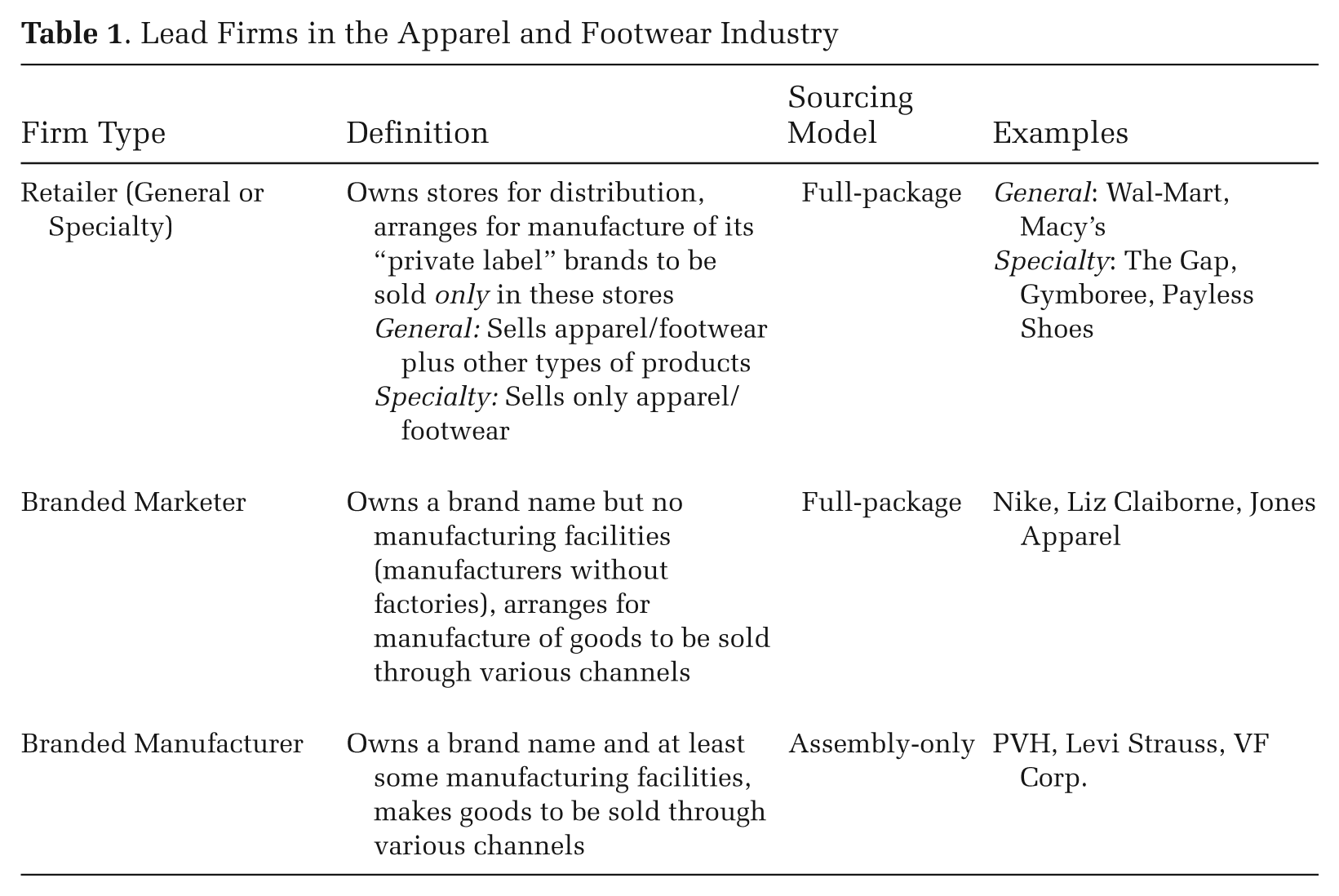
If the structure of exchange and exploitation shapes the production of targets, then lead firms’ susceptibility to anti-sweatshop pressure may depend on their distinctive relationships to the point of production. To supplement their own factories, branded manufacturers typically rely on assembly-only sourcing arrangements, in which contractors engage in basic assembly of raw materials provided by the lead firm. These contractors have very low profit margins (Gereffi 2005), little capital investment, and little incentive to maximize productivity. Akin to Commons’s ([1905] 1977) classic “sweating system,” this arrangement tends to devalue production workers (Bonacich and Appelbaum 2000; Piore 1997), generating the kind of abuses that anti-sweatshop activists may expose. On the other hand, the literature also suggests reasons why full-package suppliers, which are typically used by retailers and branded manufacturers, can also generate labor abuses. These suppliers obtain materials to make the finished product to a buyer’s specifications, and they typically have higher profit margins (Gereffi 1999:39). Yet even as assembly-only suppliers have upgraded to full-package production, the prices they receive from lead firms have often fallen (Schrank 2004). Price pressure combined with the strict standards for quality and delivery time that these suppliers face (Gereffi et al. 2005) can lead to forced overtime, unstable employment, and militaristic management (Locke, Amengual, and Mangla 2009). In short, the stylized sourcing profiles identified in the GCC literature provide rationales for either of the following expectations:
Hypothesis 2a: Lead firms that utilize assembly-only contractors (i.e., branded manufacturers) are more likely than others to become targets of anti-sweatshop activism.
Hypothesis 2b: Lead firms that rely on full-package suppliers (i.e., retailers and branded marketers) are more likely than others to become targets of anti-sweatshop activism.
Different types of lead firms are also in particular positions relative to the point of consumption. Here, the GCC literature overlaps with accounts of industry opportunity structures that emphasize firms’ dependence on end consumers (Luders 2006; Schurman and Munro 2009). Retailers generally have the most direct exposure to consumers and should therefore be susceptible to public pressure. Although the distinction has blurred slightly with the rise of outlet stores and online retailers, retailers generally have spaces (e.g., parking lots and shopping floors) where activists can confront consumers with information. Retailers differ, though, in their sensitivity to market disruption (Luders 2006): firms that are heavily dependent on a narrow line of goods, such as apparel or footwear, may be most susceptible to anti-sweatshop activism, which scrutinizes their sole line of business. For these reasons, we expect the following:
Hypothesis 3a: Retailers are more likely than other types of firms to be targets.
Hypothesis 3b: Retailers that specialize in apparel or footwear are more likely than general retailers to be targeted.
Research on the anti-sweatshop movement notes a specific way a firm’s market position can make it more susceptible to activism. Some apparel and footwear companies depend not just on mass consumer markets but on organizational buyers and licensing partners—especially universities that license their logos. This has made universities an important site of concentrated, organizable market pressure (Seidman 2007). More generally, because a relatively small number of collegiate sports programs account for much of the collegiate-licensing market, this observation is consistent with Schurman’s (2004) more general point that dependence on a small number of business partners increases opportunities for activists.
Hypothesis 4: Firms linked to collegiate licensing are more likely than others to become targets of anti-sweatshop activism.
Finally, the structure of production may matter because it can expose firms to risks associated with globalization. While apparel and footwear production became increasingly global in the late 1980s and early 1990s, not all lead firms contributed equally to this trend. If anti-sweatshop campaigns are anti-globalization reactions, as observers on both the left (Brecher, Costello, and Smith 2000) and the right (Bhagwati 2004) argue, then we might expect activists to punish firms at the forefront of globalization. In addition, leaders in the globalization of the industry may be more deeply linked to extreme forms of poverty, lax regulation, or other factors that provide fuel for anti-corporate campaigns. Or, as Armbruster-Sandoval (2005) illustrates, globalized firms may be pulled into insurgent labor movements and attempts to globalize labor struggles. Although it is hard to disaggregate these factors, they all lead to the following expectation:
Hypothesis 5a: Firms on the leading edge of globalization are more likely than others to become targets of activism.
Such claims are usually made without regard to lead firms’ production models, but a closer look at commodity chains suggests that globalization may be most important in shaping the risks for branded manufacturers. Some branded manufacturers were aggressive globalizers, taking advantage of new trade policies in Mexico and the Caribbean in the late 1980s (Gereffi 1999), while others remained focused on domestic factories through much of the 1990s. 7 This segmentation of global and domestic production was less common for other types of firms, which were more uniform in their orientation toward global production. This suggests a conditional hypothesis:
Hypothesis 5b: For branded manufacturers more than other types of firms, being on the leading edge of globalization shapes the likelihood of being targeted.
A particular type of anti-globalization story has become taken for granted among neo-classical economists and in much of the popular discourse. Here, anti-sweatshop campaigns are seen as protectionist responses driven by the interests of unions, who take advantage of citizens’ and consumers’ misguided fears of globalization (Bhagwati 2004; Friedman 2005; Kristof and WuDunn 2000). By this logic, unions and their surrogates should seek to punish manufacturers whose globalization means abandoning organized domestic workers; in the service sector, these alliances may use sweatshop allegations to weaken non-unionized retailers, while unionized competitors are buffered from criticism (Manheim 2001). Although not among our central hypotheses, we test this protectionist hypothesis, which focuses on unionization and firms’ shifts toward foreign production.
Cultural Organization of Markets and Firm Vulnerabilities
Although the production of social movement targets should be shaped, in part, by power and opportunities rooted in the structure of exchange, there are also cultural and symbolic factors that may make some firms more likely than others to be targeted. Organizational and economic sociologists have shown how market positions are constituted by categories, reputations, status hierarchies, and evaluations in organizational fields (Espeland and Sauder 2006; Zuckerman 1999). Some social movement scholars argue that corporate brands, reputations, and other distinctions in markets create opportunities for activism (King 2008; Schurman 2004; Soule 2009). The strategy of naming and shaming corporations is made possible by firms becoming shamable—that is, developing deep investments in their image, reputation, and social standing that can quickly be tarnished in the media spotlight. While the GCC literature treats corporate images as nearly synonymous with size and position, these other literatures focus on the production of images in their own right. We discuss three aspects.
One account focuses on branding—that is, the marketing trend that makes brands not just symbols of quality but imbues them with deeper meanings and associations (Klein 1999). Nike, for instance, describes itself as “leveraging a deep emotional connection that people have with sports and fitness” (Klein 1999:21). Firms that invest in major branding activities may make attractive social movement targets, because activists can play off a company’s image and visibility to capture media attention and increase consumer awareness of a problem (Best and Lowney 2009; Lenox and Eesley 2009). Activists may also expect such firms to respond to protect their brand investments (Schurman 2004; Spar and LaMure 2003). By definition, all lead firms own brands, but some do more than others to make themselves highly visible, salient, and meaningful. 8 We expect the following:
Hypothesis 6: Firms that engage in especially large or notable advertising or branding campaigns are more likely than others to become targets of activism.
Consumers are not the only relevant audience, however. Firms may be attentive to evaluations of peers, professionals, and analysts in the organizational field (Rao et al. 2005; Zuckerman 1999). For instance, “just as firms compete for consumers, so also do they vie for reputational status” (Fombrun and Shanley 1990:234). Existing research suggests a firm’s reputation in the business community, or reputational capital, can be quickly tarnished by scandal (Love and Kraatz 2009), and positive reputations can be “powerful magnets for attracting unwanted attention from social movement activists” (King 2008:409). Activists may target recognized industry leaders to generate buzz within the business community, leverage investor pressure, or send a message to firms further down the status hierarchy. Additionally, if social movement organizations are seeking to build their own public profiles (Jasper 2004), they may want to hitch their wagon to high-status rather than low-status targets.
Hypothesis 7: Firms that have a positive reputation in the business community are more likely than others to become targets of activism.
Moral distinctions in markets may also provide opportunities for activists. Firms that are publicly portrayed as virtuous or socially responsible are more prone to charges of hypocrisy (Best and Lowney 2009; Himmelstein 1997) as activists make them “live up to their own book of rules” (Alinsky 1971:128). Vogel (2005:54) notes that “Ford has found itself targeted by activists because its CEO had promised to create a more environmentally responsible automobile company; its competitors, who made no such commitment, have been subject to much less scrutiny.” As one anti-sweatshop activist put it, “let’s face it, hypocrites are far more interesting than mere wrongdoers,” 9 and as mentioned earlier, PVH faced special scrutiny because of its connection to Human Rights Watch.
Hypothesis 8: Firms linked to or recognized for social responsibility are more likely than others to become targets of activism.
Combining These Approaches
Most work stresses the primacy of either structural or cultural positions, but the intersection may also be relevant. Schurman and Munro’s (2009) account of the cultural economy of commodity chains argues that the combination of power at the top of a buyer-driven commodity chain and investment in brands makes some firms especially good targets. More generally, structural power in an industry (based in our case on lead firms’ size) combined with cultural vulnerability in a field (based in our case on branding, reputation, or social responsibility) could make firms especially susceptible to social movement pressure. This suggests a conditional hypothesis:
Hypothesis 9: Larger firms with some type of cultural vulnerability are more likely than others to be targeted.
Data and Methods
Our analysis focuses on 151 large U.S.-based lead firms in the apparel, textile, and footwear industries. To develop our sample, we used Standard & Poor’s Compustat North America Industrial Annual File, which covers publicly reporting firms. We identified firms with the appropriate Standard Industrial Classification (SIC) codes and used a minimum size threshold, because for naming and shaming strategies to be viable, some level of size must be reached. 10 We also used annual reports to verify companies’ responsibility for apparel/textile/footwear production. 11
To measure whether firms were targets of anti-sweatshop activism, we developed a comprehensive database of anti-sweatshop movement activity in this industry from 1993 to 2000. 12 While social movement researchers often rely on newspaper reports to count instances of social movement activity, we utilized more specialized sources of information to develop a rich dataset on campaigns in one particular sector. The two leading trade journals by circulation—Bobbin and Women’s Wear Daily (WWD)—provided detailed coverage of social movement challenges and industry politics. We collected 1,467 articles related to the industry’s labor politics and coded them to generate a record of movement activity targeting particular firms. Social movement activity was operationally defined as any attempt to force change in the labor practices of the industry (or its firms) led by advocacy groups based outside companies, trade associations, or government. This included protests and demonstrations at stores, leafleting and other non-confrontational demonstrations, union solidarity pickets, and human rights lawsuits, reflecting the multifaceted character of anti-sweatshop campaigns. 13 To avoid conflating anti-sweatshop campaigns with more routine or localized labor conflicts, we excluded efforts that were solely about union negotiations in the United States and involved only labor unions as sponsors (e.g., a strike by domestic textile workers seeking a new contract). We supplemented trade journal data with information on targeted companies from secondary sources (Armbruster-Sandoval 2005; Bonacich and Appelbaum 2000; Louie 2001; Manheim 2001; Ross 1997). 14 Comparing our database to coverage of the New York Times and eight other newspapers in selected years, we found no clear evidence of additional targets, and we found the newspaper coverage to under-represent anti-sweatshop activity, especially early in a protest cycle (capturing one-fourth of our targeted companies in 1994 and one-half in 1996). 15
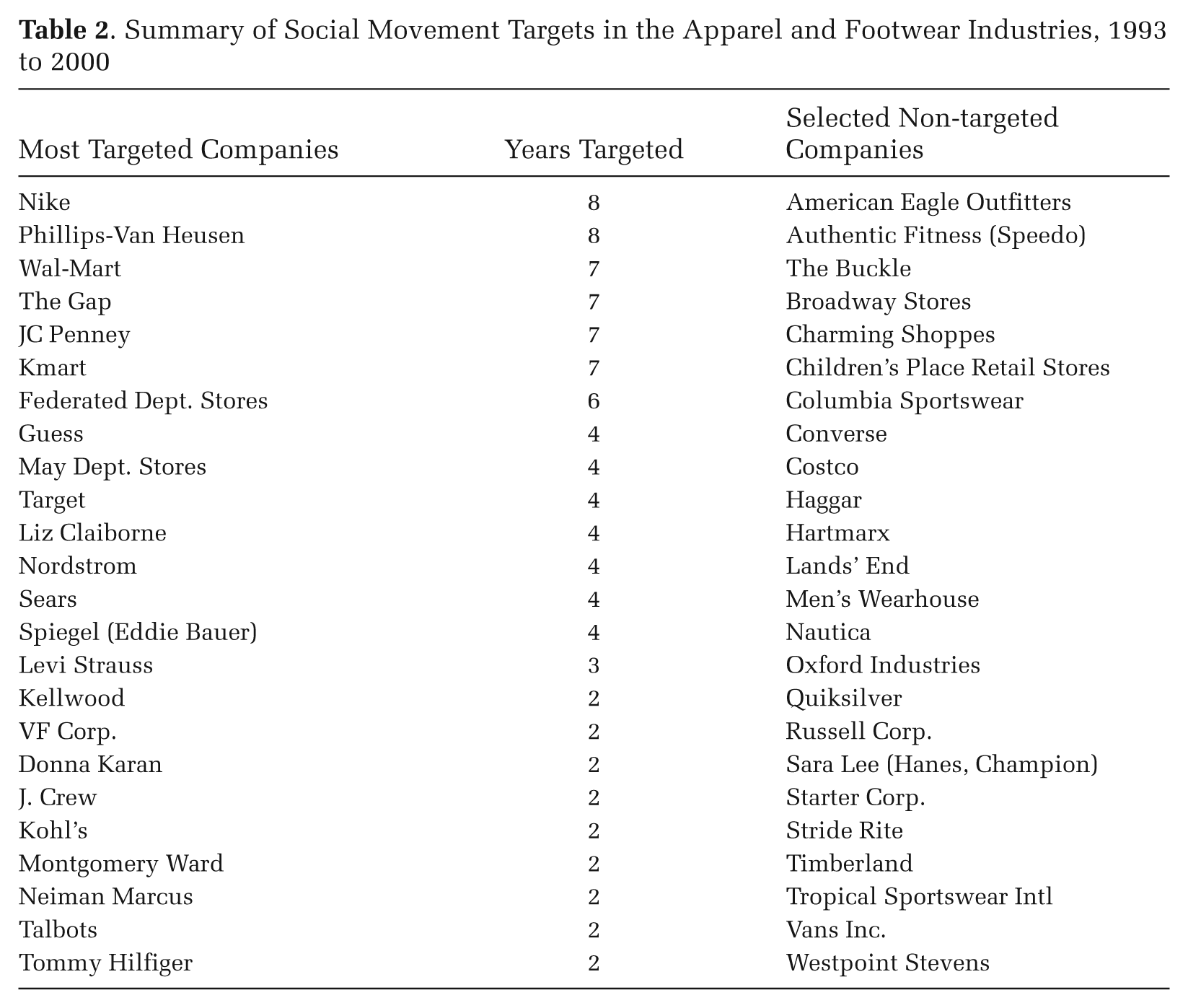
Overall, 26.5 percent of the 151 lead firms in our sample were implicated in anti-sweatshop campaigns at some point between 1993 and 2000, and 60 percent of those were targets in multiple years. Table 2 shows the most frequent targets, as well as some companies that were not targeted.
Summary of Social Movement Targets in the Apparel and Footwear Industries, 1993 to 2000
To explain variation in the rate and frequency with which firms were targets, we utilized (unbalanced) panel models with a binary dependent variable—a yearly indicator of whether a company was a target of anti-sweatshop activism. 16 We estimated the models using Stata’s “xtgee” command, with a logit specification (equivalent to a longitudinal logistic regression), using robust standard errors clustered by company to adjust for a lack of independence between their yearly observations.
In addition to testing our hypotheses, our longitudinal approach allows us to assess whether targeting is sticky, such that being targeted at one point increases the likelihood of being targeted again, and to control for critical events that could shape the underlying rate of firm targeting. We include dummy variables for two key moments: First, 1995 to 1997 saw a surge of activity, beginning with the discovery of enslaved garment workers in El Monte, California, and continuing with the 1996 Kathie Lee Gifford exposé and a wave of protests against Nike and others in 1997. The second key moment came in 1999, when exploitation in Saipan spurred a series of lawsuits and protests.
Measurement of Independent Variables
A straightforward measure of lead firms’ power is their size, which we measure as the natural log of a firm’s total assets in a given year (from Compustat). 17 This follows established practice and is highly correlated with alternatives. 18
We used information from annual reports to identify whether lead firms were branded manufacturers, branded marketers, or retailers, following criteria from Gereffi (1999) and Schrank (2004) (see Table 1). We differentiated retailers that specialized in apparel or footwear from general retailers (SIC 53).
Data on collegiate licensing in our period are scarce, but we developed an indicator of firms engaged in the practice by the end of the decade, using the Collegiate Licensing Company’s disclosed list of the top-25 licensees in 1999 and the Worker Rights Consortium database for 2000 to 2001. Of the firms in our sample (including their subsidiaries), 6.6 percent were collegiate licensees, and we assume this is true throughout our period. With collegiate-licensed apparel accounting for roughly 2 percent of the industry (Van Der Werf 2001), it is reasonable to assume this captures most or all collegiate licensing in our sample.
Scholars rarely measure globalization at the firm level, instead focusing on entire industries or national economies. Firms are not required to report on their supply chains, and if they do, it is in non-standardized ways. But to explain patterns of anti-sweatshop pressure in the 1990s, it is crucial to develop reasonable proxies for firms’ globalization during that period. We were able to use information from annual reports to measure two basic factors. First, we created a dummy variable to mark leading globalizers (as highlighted by Hypotheses 5a and 5b). Firms of any type were included if at least half of their manufacturing (by volume or value) occurred outside the United States (in owned or contracted factories) early in our period (in 1993 or 1994, or if not available, the first year they were listed in Compustat). General retailers were also included by default, because previous research shows they relied heavily on foreign production and Asian purchasing offices by the early 1990s. 19 Overall, 96 firms were leading globalizers, 37 were not, and 18 did not provide sufficient data. We report complete-case analyses and use supplemental models to ensure that missing data are not biasing our estimates. Second, to assess whether campaigns reflected a protectionist backlash against firms that had owned domestic factories, we created a dummy variable marking branded manufacturers that shifted from U.S. to foreign production during our period. 20 To test for protectionist effects, we interact this with a dummy for unionization of a company’s U.S. workforce, based on annual reports, supplemented with the Bureau of National Affairs’ Source Books on Collective Bargaining and Employee Relations. Because some argue that even small union presences can spawn protectionist campaigns (Manheim 2001), we measure whether a nontrivial amount (over 2 percent) of a company’s U.S. workforce was unionized in 1993 to 1994. 21
To measure whether firms engaged in major advertising or branding activities, we use a dummy variable representing whether a company was included in Advertising Age magazine’s annual “100 Leading National Advertisers” list (1991 to 2000, based on ranking total advertising expenses) or its annual “Marketing 100” list (1992 to 2000), which profiles “current brand success stories” and their creators (Edwards 2005). Together, these lists identify companies (roughly 20 percent of our sample) that made the largest investments in developing a brand identity among consumers. The measure is time-varying, and once a company is listed, we consider it as having an investment in advertising/branding from that point onward.
We measured a positive reputation in the business community with a similar time-varying dummy variable for having been listed in Fortune magazine’s annual list of the “Top 100 Most Admired Companies” (1991 to 2000) with a score above the mean for the relevant industry segment. 22 Fortune conducts a yearly survey of executives, analysts, and directors, who rate the largest firms in their industries on attributes like “quality of management” and “wise use of corporate assets.” This differentiates firms that are well-regarded in industry circles (e.g., Liz Claiborne and Target) from their maligned counterparts (e.g., Fruit of the Loom and Kmart). Researchers have used the Fortune ratings to assess how corporate reputation affects performance (Roberts and Dowling 2002), is affected by managerial decisions (Love and Kraatz 2009), and shapes firms’ responses to social movements (King 2008). Our purpose is to measure how being publicly lauded in the business community shapes who becomes a social movement target in the first place. Because the Fortune ratings have a known financial “halo effect,” we control for market performance, measured as return on assets, a simple and widely used measure (net income divided by total assets, from Compustat).
We measure two types of links to CSR. Many firms are linked to social causes through their philanthropic activities, which paint them as good corporate citizens and embed them in the nonprofit sector (Barman 2007). We therefore measure the existence of a corporate foundation in a given year, based on an extensive search of the Foundation Center’s Foundation Directory (using print editions initially and the online database for later-emerging foundations). We also measure which firms were publicly recognized for CSR, using a time-varying dummy variable for being listed in the Domini 400 Social Index, a socially responsible investment index (created in 1990) that consists of companies judged to have positive social and environmental records by KLD Research and Analytics, a leading socially responsible investment firm. Although imperfect measures of actual responsibility, these measures publicly portray firms as socially responsible and predate the expansion of CSR in the 2000s.
To test Hypothesis 9, we interact firm size with our indicators of cultural vulnerability and then use fsQCA to test more complex combinations of these factors.
Results
Initial bivariate analyses (not shown) revealed that becoming a target of anti-sweatshop activism was associated with size, being a leading globalizer, being a branded marketer, and being a big-5 retailer, as well as with being a major advertiser/brand, having a positive corporate reputation, having a corporate foundation, and having recognition for social responsibility. (Each of these were considered individually.) The models discussed in the next sections assess the net effects of different factors to determine which best predict patterns of social movement pressure.
Power and Structural Positions
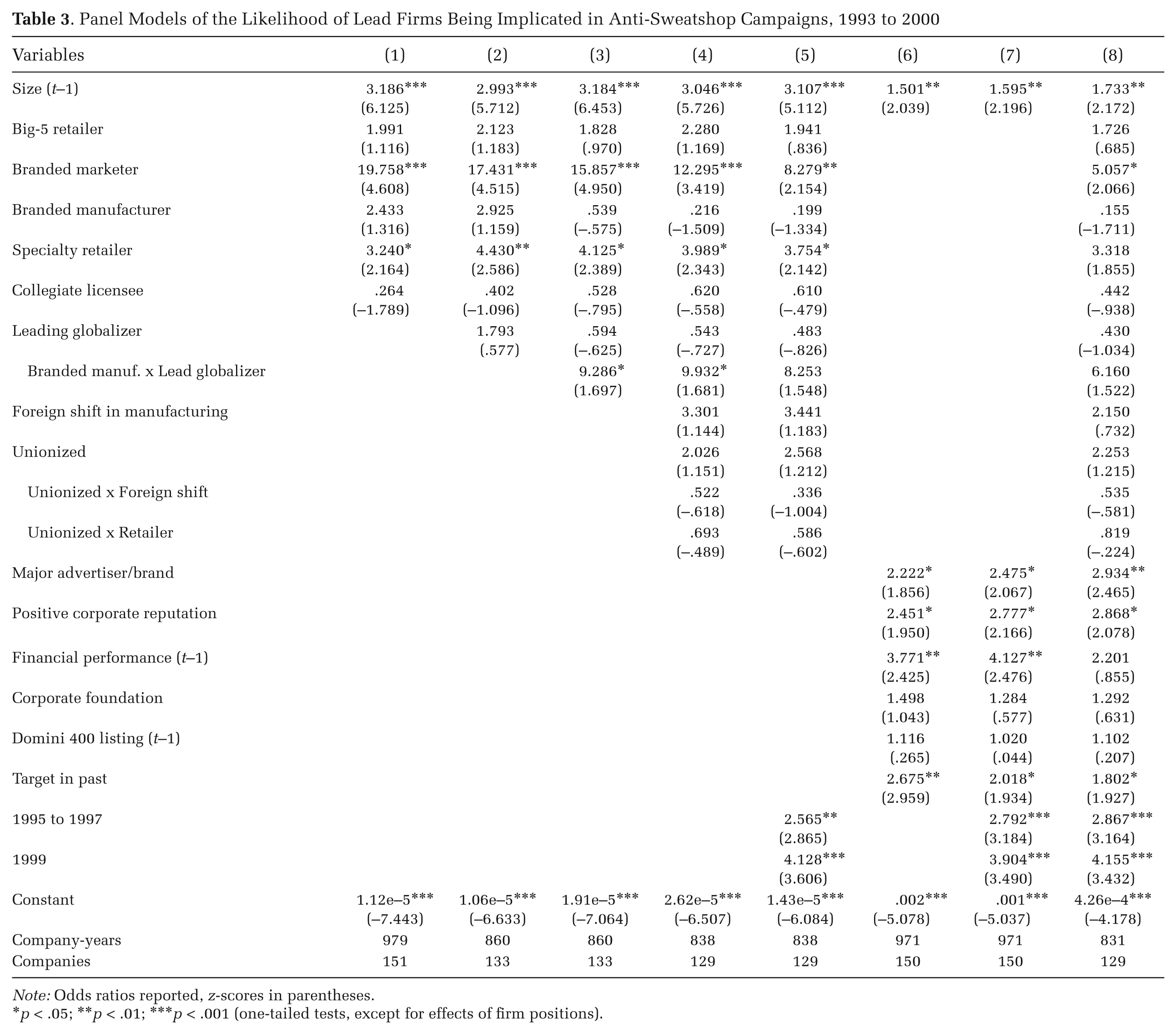
The first model in Table 3 focuses on lead firms’ power and their relationship to points of production and consumption. As Hypothesis 1a predicts, company size is positively related to the likelihood of becoming a target. But contrary to Hypothesis 1b, being among the big-5 retailers did not further increase the likelihood of becoming a target.
Panel Models of the Likelihood of Lead Firms Being Implicated in Anti-Sweatshop Campaigns, 1993 to 2000
Note: Odds ratios reported, z-scores in parentheses.
p < .05; **p < .01; ***p < .001 (one-tailed tests, except for effects of firm positions).
This model also shows that some types of lead firms were more susceptible to anti-sweatshop activism than others. Branded marketers (manufacturers without factories) faced nearly 20 times the odds of being targeted than did general retailers (the reference group). Specialty retailers faced more than three times the odds of being targeted. Overall, branded marketers had the highest risk of being targets, followed by specialty retailers, followed by branded manufacturers and general retailers, which were not significantly different from one another. These results provide mixed support for hypotheses about how lead firms’ relationships to points of production and consumption shape their susceptibility to sweatshop allegations. Contrary to Hypothesis 2a, firms that typically used assembly-only contractors were among the least likely to become anti-sweatshop targets. Consistent with Hypothesis 2b, firms that used full-package suppliers (branded marketers) were among the most likely targets. But general retailers, who also relied on full-package suppliers, were unlikely to be targeted (controlling for size), which tempers support for Hypothesis 2b. The non-effect for retailers also fails to support the idea that firms closest to consumers should be especially susceptible (Hypothesis 3a). Instead, we find support for Hypothesis 3b, which predicts that specialty retailers’ greater dependence on the apparel and footwear markets made them more susceptible to criticism.
We do not find support for the prediction (Hypothesis 4) that collegiate licensees would be especially likely targets of anti-sweatshop campaigns. The coefficient in Model 1 is negative and not statistically significant (and with additional controls in further models, a null effect becomes clear). While case-based research notes that collegiate licensing attracted anti-sweatshop pressure to a few companies, we find it did not systematically attract such pressure during the 1990s.
Model 2 incorporates the globalization of firms’ production processes. While there was a zero-order association between being a leading globalizer and being targeted, when controlling for firm size and type, being on the leading edge of globalization did not increase the likelihood of being a target, contrary to Hypothesis 5a. In Model 3, we do find support for the conditional effect of globalization predicted by Hypothesis 5b: branded manufacturers that were among the leading globalizers in an industry faced much higher odds than most others of being anti-sweatshop targets. The non-significant main effects indicate that leading globalizers that were not branded manufacturers, and branded manufacturers that were not leading globalizers, were no more likely than others (controlling for size and type) to become targets.
If specific protectionist interests were driving anti-sweatshop targeting, then we would expect the interaction of unionized workers and a shift to foreign production to have a statistically significant positive effect. It does not. Nor do we find support for the idea that unionized retailers were buffered while criticism went disproportionately to their non-union competitors: the interaction between unionization and retailer is non-significant. Overall, although unions played a key role in the anti-sweatshop movement (partially as a defensive reaction to globalization), and one can point to instances in which sweatshop allegations were made amid domestic labor conflicts, the pattern of targeting does not map onto the pattern of union interests in protecting jobs at particular firms. 23
Model 5 shows that the key periods of 1995–1997 and 1999 had higher rates of targeting, as expected, and other effects are robust to these controls. (The exception is that the conditional effect of globalization becomes harder to discern, an issue to which we return.) Overall, structural factors matter: larger firms, branded marketers, and specialty retailers had enhanced risks of being targets.
Cultural Vulnerabilities
Our initial analyses revealed zero-order associations between each of the four measures of cultural position and being a target (not shown). In Model 6, we examine their net effects (controlling for firm size so as not to conflate position in the cultural organization of markets with mere prominence). Companies that engaged in major advertising or branding activities had more than twice the odds of others of becoming anti-sweatshop targets, consistent with Hypothesis 6. Consistent with Hypothesis 7, having a positive reputation in the business community increased the odds of becoming a target by a factor of nearly 2.5. Market performance itself also appears to matter, above and beyond constructed reputations.
Contrary to Hypothesis 8, we do not find that links to CSR shaped the pattern of anti-sweatshop attention. Controlling for size and other features of the cultural organization of markets, the effect of having a corporate foundation is positive but not statistically significant. The coefficient for being listed in the Domini 400 responsible investment index is also positive but is far from being statistically significant. While there are certainly examples of activists seeking to leverage hypocrisy among firms expected to be charitable or responsible, having these potential vulnerabilities did not generally make companies into anti-sweatshop targets during our period.
Finally, anti-sweatshop activism appears to be sticky: once a firm was targeted, its risk of further targeting increased. In addition, Model 7 shows the previous effects are robust to controls for time, indicating that branding activities and reputation shaped the pattern of activism above and beyond major moments of scandal and widespread scrutiny.
Net Effects of Structural and Cultural Positions
The full model (Model 8) provides the clearest indication of the net effects of structural and cultural factors. The effect of firm size remains positive and statistically significant, indicating that even when controlling for marketing activities and reputation, sheer size matters in attracting anti-sweatshop activism, providing strong support for Hypothesis 1a. While the previous effects of size could reflect not only power but visibility, this possibility is minimized (although perhaps not completely eliminated) by including these controls. Branded marketers continue to have an enhanced risk of becoming targets (partially consistent with Hypothesis 2b), but the size of this coefficient has shrunk. This suggests that the high susceptibility of firms in this structural position is partially but not fully a function of their advertising/branding activities and corporate reputations. In the full model, Hypotheses 3b and 5b receive less support: the coefficient for specialty retailers remains positive, but it does not quite reach the .05 level of significance (two-tailed test). The conditional effects for branded manufacturers are in the expected directions but do not quite reach statistical significance.
Companies’ branding activities and corporate reputations continue to have major implications for their likelihood of becoming targets, providing strong support for Hypotheses 6 and 7. These coefficients remain similar in magnitude in the full model, suggesting that the effects of branding and reputation as produced in the organizational field are distinct from differences in firm type as theorized by the GCC literature. Market performance is no longer statistically significant, suggesting that its previous effect was due to successful companies being disproportionately in positions (like branded marketer) susceptible to activist pressure. The effects of prior targeting and particular moments persist in the full model.
Combinations
To test Hypothesis 9, we first interacted size with each of our two effective measures of cultural vulnerability (branding activities and reputation). Neither interaction is statistically significant (with or without controls), suggesting that simple combinations did not shape the likelihood of being targeted (not shown).
To investigate more complex combinations of structural power and cultural vulnerability, we turn to fsQCA, which helps identify configurations and allows for probabilistic tests of causal sufficiency. Because fsQCA demands that the analyst carefully define candidates for the outcome, we focus on the 120 lead firms that had sufficient data to be included in our full model and operated for at least half of our period. We conducted analyses with the “fuzzy” command in Stata (Longest and Vaisey 2008). To construct the set of “major targets of anti-sweatshop campaigns,” we summed the number of years each firm was a target and transformed these into fuzzy scores from 0 (non-membership) to 1 (full membership) (using the ranking procedure described by Longest and Vaisey [2008]) (mean = .26, s.d. = .38). We used the same method to define the set of large firms and used dichotomous indicators of our four potential cultural vulnerabilities based on whether they occurred at any point in our period.
Out of 23 configurations (that best fit at least one company), an analysis of consistency revealed six configurations that were significantly more consistent than all others with the outcome (each with scores of at least .65 on a 0–1 scale). At one extreme, if a firm was large and had all four forms of cultural vulnerability, it was almost guaranteed to be a major anti-sweatshop target (consistency = .93). Next, we logically reduced the six configurations with high consistency, and nine that were highly inconsistent with the outcome.
Table 4 shows the resulting three pathways to being a major target of activism. The most common involves being large, a leader in advertising/branding activities, having a positive reputation, and being in the Domini 400 (LARGE*BRAND*REP*DOMINI). Two other pathways are possible, although less common and with lower levels of consistency. There are also pathways to not being a target of anti-sweatshop activism. Not being large, not being a leading advertiser/brander, not having a positive reputation, and not having a foundation (large*brand*rep*foundation) was highly consistent with not being a target. Although far less common, two pathways to not being targeted include large firms—(LARGE*brand*rep*FOUNDATION*domini) and (LARGE*brand*REP*DOMINI). These are rare but intriguing pathways that suggest the liability of largeness may sometimes be counteracted by having links to philanthropy or social responsibility, so long as these are not coupled with too many other cultural vulnerabilities.
Summary of Results from fsQCA of the Combination of Structural Power and Cultural Vulnerability
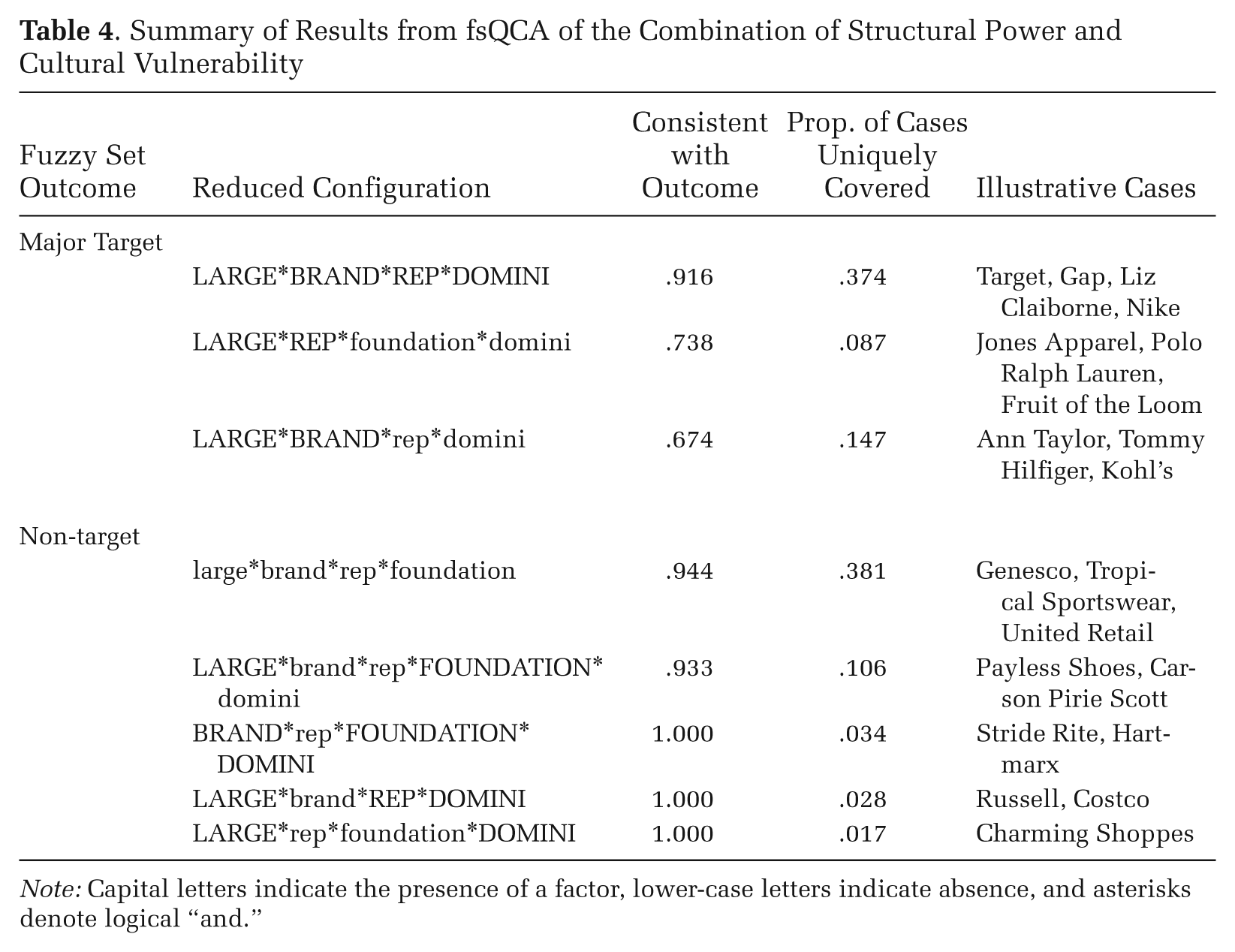
Note: Capital letters indicate the presence of a factor, lower-case letters indicate absence, and asterisks denote logical “and.”
Like Roscigno and Hodson (2004), we incorporate our most consequential configurations into our longitudinal models. 24 Table 5 shows that even controlling for structural factors and underlying time trends, these configurations are potent. When firms were large, were leaders in advertising/branding, had a positive reputation, and had a Domini 400 listing, they had much higher odds of becoming targets. Extending Hypothesis 9, it is clear that the combination of structural power and multiple forms of cultural vulnerability helped turn some companies into major targets of anti-sweatshop activism. In a sense, social movement pressure may be an expected, “normal” cost for firms that are large, visible, and well-regarded in an industry under scrutiny. On the other hand, when firms were not large, were not leading advertisers/branders, and had neither a positive reputation nor a foundation, their odds of becoming targets were greatly reduced. This includes firms like United Retail Group (which used suppliers in China, Indonesia, and India), Tropical Sportswear (an early mover in sourcing from the Dominican Republic), and Genesco (which shifted production from U.S. factories to contractors in China). In addition, when controlling for these configurations, we find clear effects of globalization among branded manufacturers (as shown in the lower part of the table). Globalization did not make an across-the-board difference, but it does appear to have made particular types of firms susceptible to anti-sweatshop scrutiny, consistent with Hypothesis 5b.
Key Configurations Incorporated into Panel Models of the Likelihood of Lead Firms Being Implicated in Anti-Sweatshop Campaigns, 1993 to 2000
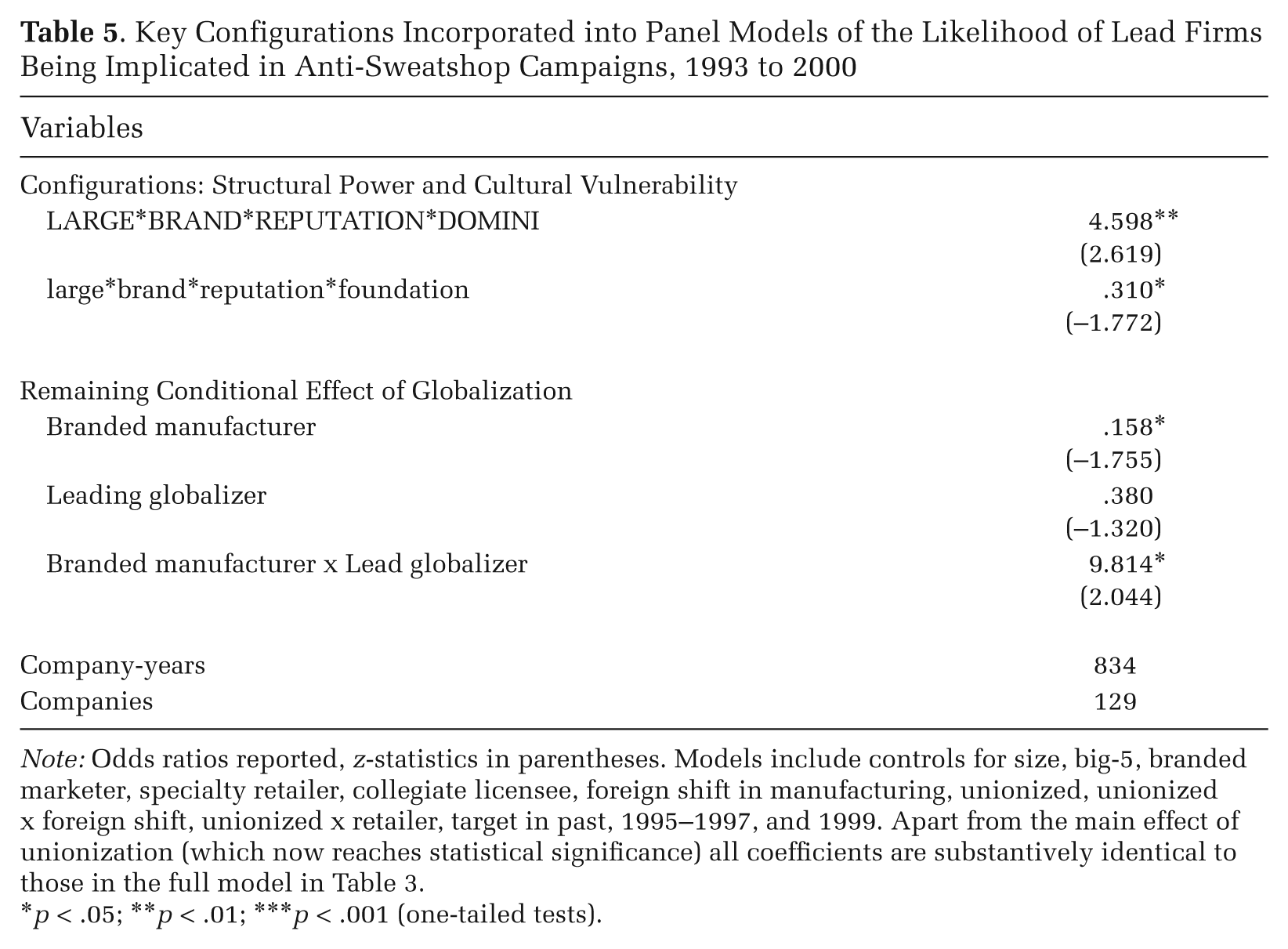
Note: Odds ratios reported, z-statistics in parentheses. Models include controls for size, big-5, branded marketer, specialty retailer, collegiate licensee, foreign shift in manufacturing, unionized, unionized x foreign shift, unionized x retailer, target in past, 1995–1997, and 1999. Apart from the main effect of unionization (which now reaches statistical significance) all coefficients are substantively identical to those in the full model in Table 3.
p < .05; **p < .01; ***p < .001 (one-tailed tests).
Discussion
Supplemental analyses (see the online supplement) show that findings about firm size, branded marketers, reputation, and branding activities are quite robust to alternative model specifications. The patterns for specialty retailers and branded manufacturers become slightly more and less blurry under different model specifications, so some caution is in order here, as in many moderately sized samples. Nevertheless, by using longitudinal models, fsQCA, and referring back to particular companies and campaigns, our analyses greatly clarify the underlying conditions that attracted anti-sweatshop activism to particular types of companies.
One finding that was only partially anticipated occurs throughout our analyses: branded marketers (and to a slightly lesser extent specialty retailers) seem to attract activist pressure as an organizational form, that is, above and beyond branding activities and corporate reputations and more than expected based on sourcing models (which are the same as for general retailers). We suspect these firms were at risk, in part, because they tightly squeezed their full-package suppliers (to retain as much as possible for design and marketing) and, in part, because their images were salient in a way our measures do not fully capture.
While our goal was to examine multifaceted social movement pressure, rather than features of protest events, we used supplemental models to unpack instances of litigious (i.e., the campaign included a lawsuit) versus non-litigious targeting and assess whether legal mobilization followed a different logic (not shown). For the most part, it did not. Size, branded marketer, and being targeted in the past have substantively identical effects for each type of targeting. Some factors are easier to discern for one or the other type of targeting (advertising/branding for non-litigious targeting; corporate reputation for litigious targeting) but are not significantly different in their effects. The dummy variable for 1999 is strongly related to litigious targeting but unrelated to non-litigious targeting, which reflects that year’s Saipan lawsuits.
Conclusions
The linking of systemic problems to particular actors should be seen not as natural or inevitable but as an accomplishment of social movements. Social movements force particular kinds of actors into the spotlight and make them focal points for the redress of grievances and enforcement of rights, with profound implications for trajectories of social change. We argued that this occurs primarily through a process in which activists identify features of power configurations that can be leveraged to both generate attention and press for change.
There is obviously some contingency in the strategies developed by social movement organizations and the risks faced by potential targets, but our research identifies a set of underlying conditions that led anti-sweatshop activism in some directions more than others. Simply put, firms’ likelihood of becoming targets depended on the structural and cultural positions they occupied. The size of lead firms had a basic structural effect on the pattern of social movement activity, above and beyond other market distinctions, while also amplifying the effects of cultural distinctions (and vice versa). Brand investments and positive reputations played major roles in attracting social movement pressure to particular companies, but links to CSR did not matter on their own. Time also mattered: particular moments of crisis increased rates of targeting, and once companies became targets, they were likely to continue to be scrutinized, even as others (including some aggressive globalizers) flew under the radar. This is not to suggest that the production of targets is arbitrary or capricious. Indeed, the pattern followed the structure of exchange and exploitation in global production to some degree—as seen with the frequent targeting of branded marketers and globalized branded manufacturers—and it did not simply reflect unions’ specific interests in protectionism. But it seems there were enough risks at the point of production (in both full-package and assembly-only suppliers, domestic and foreign factories) that other factors were determinative.
Focusing systematically on both positive and negative cases produces several new insights about anti-sweatshop and anti-globalization activism. Globalization’s direct influence has been overstated, in part, because observers have emphasized only a few actual targets. Many major anti-sweatshop targets were leading globalizers, but many other leading globalizers did not become frequent targets. In addition, the expectation that collegiate licensing attracts social movement pressure may have resulted from overlooking collegiate licensees that were not frequent targets (e.g., VF and Tultex). Similarly, some major targets had links to CSR that could be leveraged, but many other firms with these links were not heavily targeted. On this point, the temporal dimension of our research is also important. One would likely find correlations between CSR and anti-sweatshop pressure in the 2000s, once CSR initiatives expanded (Lim and Tsutsui 2012), although the causal arrow would largely go from movement pressure to CSR practices (and perhaps back again). In our initial wave of anti-sweatshop pressure, CSR fields were sparser and other factors were more important for the production of targets.
The anti-sweatshop case suggests that the combination of firms’ structural power and cultural vulnerabilities may be creating a deep imprint on social movement repertoires. Certain firms (firms that were large, leading advertisers/branders, and with good reputations and recognition for social responsibility) were almost guaranteed to be targets of anti-sweatshop activism, while firms lacking structural power and cultural vulnerability were almost guaranteed not to become targets, even though some of them could credibly be charged with profiting from sweatshops. This logic of target production has complex implications for activism and industrial organization. In industries, this logic of target production has set into motion processes by which some targeted “sinners” become lauded “saints,” as negative scrutiny gets transformed into accolades for participating in CSR initiatives and issuing “sustainability” reports. For social movements, shaming a corporation mobilizes attention, but it also carries risks—of becoming more attentive to images than to on-the-ground practices, letting other forms of exploitation go unnamed, or obscuring the contributions of states. The trajectory of social change depends, in part, on how agile social movement organizations are in navigating this terrain, weighing alternatives, and finding points of leverage that are both unexpected and forceful.
As scholars investigate these topics, trade journals may provide valuable data, not only on industry discourse, but on patterns of contention. We prioritized depth of focus on a single movement, engagement with the case-based literature, and use of multiple analytic methods to discover salient patterns. But our strategy for collecting longitudinal data on social movement pressure (as well as for measuring firm types, globalization, and cultural positions) could be carried out more broadly. Of course, our method is not the only way to capture the production of social movement targets. Qualitative research on how activists evaluate targets could produce complementary findings and deeper analyses of contingent events and interpretive processes involved. Further work is also needed to address privately held firms and those based outside the United States and to determine whether similar effects exist for other movements.
In our case, the industry opportunity structure for movements was based largely on branding and reputation and only contingently on CSR or consumer contact. On its own, direct exposure to end consumers did not matter, and the very largest retailers faced no special risks, although specialty retailers did. This contrasts with some other cases, like the anti-GMO movement, where large retailers were key targets (Schurman and Munro 2009), and civil rights boycotts, where retailers were vulnerable to protest because they were “dependent on local consumption” and consumers would “shy away from the sites of contention” (Luders 2006:971). We suspect the differences partially reflect the goals of different movements, and we suggest the following hypotheses for future work: (1) Firm size has a nearly universal (and seemingly linear) effect on the pattern of social movement pressure. (2) When movements focus on consumers’ concerns about their own health, safety, or dignity, then exposure to consumers, industry concentration, and very basic components of brands (i.e., simple recognition and perceived quality) will be most important in shaping the pattern of activism. Here, the opportunities for maximizing consumer mobilization are key, as in the GMO and civil rights cases. (3) When movements seek to mobilize solidarity with others or address distant, indirect risks, then more expansive features of corporate image—like the mythos of a brand or its reputation in the business community—become more important. Here, as in the anti-sweatshop movement, a wider array of pressure points must be mobilized.
Our account can be extended in two further ways. First, factors that shape the production of corporate targets may also matter for non-corporate targets. For instance, branding activities by governments and political leaders may shape where social movement pressure is directed, and reputational hierarchies in inter-state systems may be points of leverage for activists. We argued that social movements respond to particular configurations of power, but there may now be enough isomorphism between industry and political configurations that common patterns can be found.
A second path forward is to investigate higher-level shifts in repertoires of contention. We argued that corporate targeting has become a signature piece of the repertoire, but further work is needed to assess whether this piece is truly dominant (relative to targeting governments, for instance); how bundles of targets, tactics, and understandings of social change are evolving over time; and whether general patterns can be identified across movements and locations. The national social movement as theorized by Tilly (1984) is certainly still with us, but just as this repertoire was forged as an older form of contention “lost its addressee” (Young 2002:662), it is worth asking whether the repertoire is changing as non-state power structures grow and strategies diffuse across movements.
For research on global and transnational processes, this study suggests the need to temper claims of anti-globalization backlashes. While globalization set the stage for anti-sweatshop activism and shaped the risks for some types of firms, there was no simple correspondence between the globalization of firms’ production processes and the scrutiny they received. Nor can unions’ protectionist interests explain the pattern of targeting, contrary to many critiques of anti-globalization movements. Discussions of resistance to globalization, whether neo-classical, Marxist, or Polanyian in inspiration, often imply a generalized backlash and thus obscure the logic of target production. Our results suggest that explaining anti-globalization resistance requires an integrated analysis of the spatial reorganization of production, organizational forms and commodity chain positions, and cultural distinctions in markets. With a few exceptions (e.g., Lim and Tsutsui 2012), GCC-inspired accounts of transnational corporations and cultural-institutional analyses in economic and organizational sociology have proceeded on separate tracks. Greater dialogue is necessary to explain contention over labor, environmental, and consumer rights in global markets. Such dialogue may also open up inquiry into topics like the construction of TNC boundaries (which the GCC literature treats as technologically determined), the embeddedness of nonlocal inter-firm networks (which are neglected in economic sociology), and the categories through which TNCs and global markets are evaluated.
Footnotes
Acknowledgements
We thank Rachel Ernst, Shawna Smith, Michael Thompson, and Steve Viscelli for data collection assistance. For comments and suggestions on previous versions of this article, we thank Art Alderson, Elizabeth Armstrong, Elizabeth Borland, Leslie Gates, Raymond Hicks, Michael Mulcahy, Rob Robinson, Fabio Rojas, Rachel Sherman, Christi Smith, and audiences at Sun Yat-sen University, the University of North Carolina, and the American Sociological Association annual conference, as well as the anonymous reviewers for ASR.
Notes
References
Supplementary Material
Please find the following supplemental material available below.
For Open Access articles published under a Creative Commons License, all supplemental material carries the same license as the article it is associated with.
For non-Open Access articles published, all supplemental material carries a non-exclusive license, and permission requests for re-use of supplemental material or any part of supplemental material shall be sent directly to the copyright owner as specified in the copyright notice associated with the article.
