







Abstract
Scholars typically view class socialization as an implicit process. This study instead shows how parents actively transmit class-based cultures to children and how these lessons reproduce inequalities. Through observations and interviews with children, parents, and teachers, I found that middle- and working-class parents expressed contrasting beliefs about appropriate classroom behavior, beliefs that shaped parents’ cultural coaching efforts. These efforts led children to activate class-based problem-solving strategies, which generated stratified profits at school. By showing how these processes vary along social class lines, this study reveals a key source of children’s class-based behaviors and highlights the efforts by which parents and children together reproduce inequalities.
Children are not passive players in the reproduction of social inequalities. We know that children’s behaviors vary with social class and generate stratified profits in school (Calarco 2011; Farkas 1996; Streib 2011). Less clear is how children learn to activate class-based strategies and how those lessons contribute to stratification. Scholars typically treat cultural acquisition as an implicit process in which class-based childrearing practices automatically shape children’s behavior (Arnett 1995; Heath 1983; Lareau 2011). Given parents’ active management of children’s lives (Edwards 2004; Lareau 2000; Nelson 2010) and children’s active resistance to parents’ desires (Chin and Phillips 2004; Pugh 2009), however, cultural transmission may involve more agency than implicit socialization models imply. Furthermore, while scholars assume that parents’ cultural coaching reproduces inequalities (e.g., Lareau 2011), research has not linked these efforts to their payoff for children in school.
To investigate these possibilities, this study examines how parents actively transmit culture to children, how children respond, and how those responses generate stratified profits. I base these analyses on a longitudinal ethnographic study of middle- and working-class families in one elementary school. I conducted observations and in-depth interviews with the children, their parents, and their teachers. I found that parents contributed to social reproduction by actively equipping children with class-based strategies that generated unequal outcomes when activated at school. Parents’ relationships with the school varied by social class and shaped their beliefs about teachers’ behavioral expectations. Those beliefs led parents to adopt contrasting strategies for managing problems at school and to coach their children to do the same. Specifically, working-class parents stressed “no-excuses” problem-solving, encouraging children to respect teachers’ authority by not seeking help. Middle-class parents instead taught “by-any-means” problem-solving, urging children to negotiate with teachers for assistance. These ongoing and often deliberate coaching efforts equipped even reluctant children with the tools needed to activate class-based strategies on their own behalf. Such activation, in turn, prompted stratified responses from teachers and thus created unequal advantages in school.
This study has important implications. First, it clarifies class-based socialization models by showing that children’s acquisition of class-based behaviors is neither implicit nor automatic; rather, cultural transmission involves active efforts by both parents and children. Second, it helps explain class-stratified childrearing patterns, suggesting that parents’ efforts reflect beliefs stemming from their positions in the social hierarchy. Third, it demonstrates that by examining how cultural transmission varies along social class lines, and by linking these processes to their payoff in schools, we can better understand the mechanisms of social reproduction.
Class, Culture, and Reproduction of Inequalities
Scholars conceptualize culture in myriad ways (Small, Harding, and Lamont 2010), but here I view culture as a “tool kit” that includes both “strategies of action” (Swidler 1986) and “logics of action” (DiMaggio 1997). Strategies of action are skills or behaviors used in social situations (Bourdieu 1990; Lareau and Weininger 2003). Logics of action are frames for interpreting situations (Harding 2007; Small 2004). This view of culture recognizes that individuals might behave differently in the same situation because they possess different strategies for use in that situation, or because they interpret the situation differently and thus choose to activate different strategies.
While cultural tool kits have numerous dimensions (e.g., gender, age, race, and ethnicity), research on tool kits generally focuses on social class (Bourdieu 1990; Lareau 2000). To identify social classes, tool-kit scholars typically use educational and occupational attainment (Aschaffenburg and Maas 1997; Condron 2009). 1 In doing so, they find that middle- and working-class individuals perceive themselves differently in relation to dominant institutions and also possess different strategies for navigating those settings (Lamont 1992, 2009; Lubrano 2004; Stuber 2012). Compared to their working-class counterparts, middle-class individuals experience a stronger sense of belonging in schools and other institutional arenas (Carter 2005; Khan 2010; Lareau 2000; Lubrano 2004). They also see their status as equaling or surpassing that of institutional professionals and are thus more comfortable demanding accommodations from institutions (Brantlinger 2003; Cucchiara and Horvat 2008; Lareau 2000).
Class-based cultural tool kits are closely linked to inequalities (Bourdieu 1990; Lareau and Weininger 2003). Within a social setting, behaviors will generate profits if they converge with the culture of that setting. Poorly aligned behaviors, in contrast, will produce few or no advantages, and may even result in sanctions.
Research shows, for example, that children’s activation of class-based tool kits can generate unequal advantages. In school, children tend to behave in class-patterned ways that produce stratified consequences (Heath 1983; Nelson and Schutz 2007; Streib 2011). Middle-class children more readily voice their needs and, in doing so, attract more immediate attention and more complete support from teachers (Calarco 2011). These inequalities reflect teachers’ and administrators’ expectations that students will behave in “middle-class” ways (Carter 2005; Farkas 1996; Mehan 1980; Wren 1999). While working-class students must play catch-up, middle-class students come to school ready to meet these expectations (Bernstein 1990; Foley 1990; Lubienski 2000) and to reap the benefits—including higher grades and higher competence ratings from teachers (Farkas 1996; Jennings and DiPrete 2010; Tach and Farkas 2006). What research on culture and classroom interactions has not examined, however, is how children learn these different strategies or why they activate them in the classroom.
Families and Reproduction of Inequalities
Socialization scholars imply that children’s class-based behaviors emerge automatically in response to class-based childrearing practices (Arnett 1995). Middle- and working-class parents typically adopt different childrearing styles, and their children behave in different ways (Chin and Phillips 2004; Edwards 2004; Heath 1983). Lareau (2011:6), for example, shows middle-class parents allowing children to negotiate and assert themselves and their children displaying an “emerging sense of entitlement.” Working-class parents, in turn, emphasize obedience and deference to authority, and their children demonstrate an “emerging sense of constraint.” Lareau concludes that children’s behaviors are likely an implicit and automatic response to class-based childrearing practices.
Such explanations, however, have two important limitations. First, they ignore the possibility of more active cultural transmission (Elder 1974; Pugh 2009; Thorne 1993). Research shows that parents and children can both be very strategic in their actions. Middle-class parents, for example, intervene for their children at school (Brantlinger 2003; Lareau 2000; Nelson 2010), and working-class parents try to manage how their families are perceived by others (Edwards 2004). Yet, because scholars pay little attention to the logics of action that guide childrearing decisions, it is unclear whether or how parents deliberately try to equip children to manage their own challenges. Similarly, while scholars have documented children’s rejection of parents’ wishes (Chin and Phillips 2004; Pugh 2009; Zelizer 2002), they have not fully explored how children come to accept and utilize parents’ class-based lessons. Lareau (2011), for example, observed children only in interactions with parents and did not conduct interviews with them. Thus, she cannot say how children behave in their parents’ absence or how children make sense of and internalize what they learn.
Second, socialization research has done little to link class-based cultural transmission to social reproduction. Lareau (2011), for example, assumes that class-based childrearing patterns matter for inequalities. Yet, she does not show how children’s entitlement or constraint generates stratified profits. Overall, while existing research highlights important social class differences in childrearing, children’s behaviors, and classroom advantages, we know little about how the active efforts of parents and children contribute to cultural transmission or how this transmission reproduces inequalities.
This study examines these possibilities, considering how parents prompt children to activate class-based behaviors and how those efforts contribute to social reproduction. I do so by answering the following research questions:
How do parents’ understandings of appropriate classroom behavior vary with social class?
How do parents actively teach children class-based behaviors?
How do children come to activate parents’ preferred behaviors?
How does this activation reproduce social inequalities?
I answer these questions with data from a longitudinal, ethnographic study of middle- and working-class, white families whose children attended the same elementary school.
Research Methods
Research Site and Sample
Maplewood (all names are pseudonyms) is a public elementary school near a large, Eastern city (see Figure 1). While most of Maplewood’s families are middle-class, many (~30 percent) are working-class. This allowed me to compare how middle- and working-class parents and children interact with each other and with the same teachers. My connections to the community (a close relative is a Maplewood employee) facilitated access to the site and acceptance of the project.
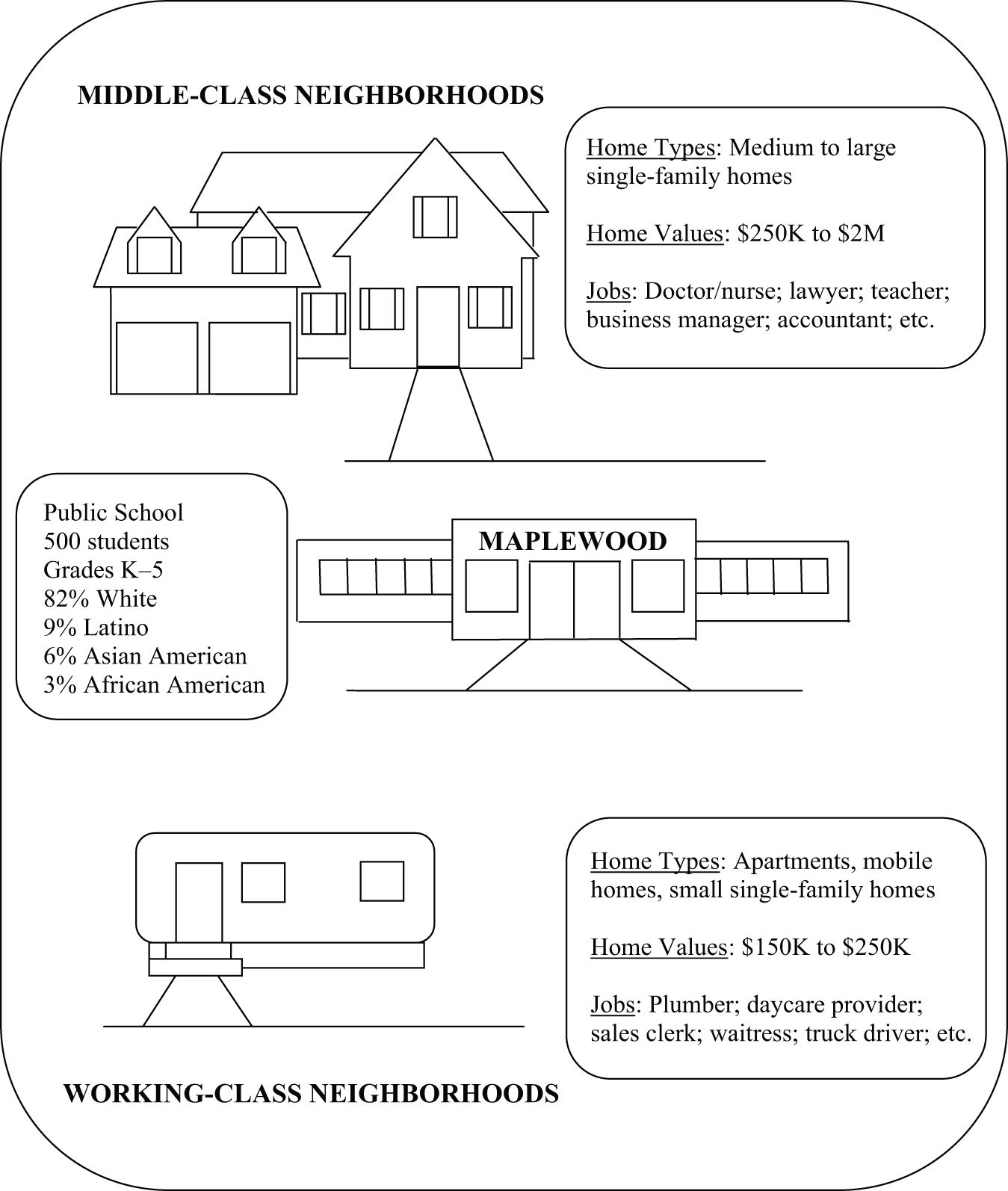
Research Site
At Maplewood, I chose one cohort (four classrooms) of students to follow from 3rd to 5th grade. The minority population at Maplewood was small and stratified, including middle-class Asian Americans and working-class Latinos. Thus, to avoid conflating race and class, I focused on white students. I also excluded students who moved away. See Table 1 for sample characteristics and recruitment procedures.
Participants by Role and Type of Participation
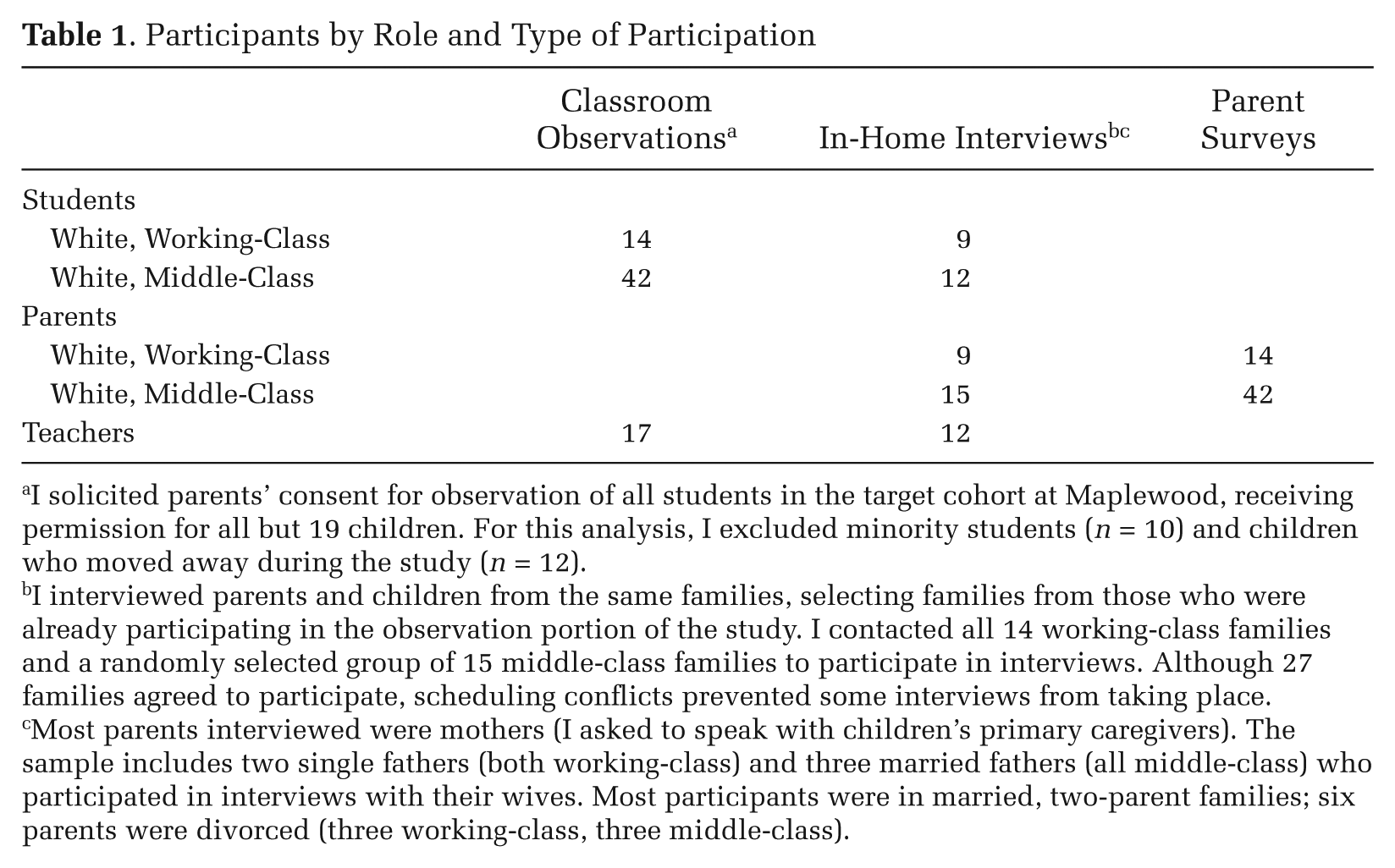
I solicited parents’ consent for observation of all students in the target cohort at Maplewood, receiving permission for all but 19 children. For this analysis, I excluded minority students (n = 10) and children who moved away during the study (n = 12).
I interviewed parents and children from the same families, selecting families from those who were already participating in the observation portion of the study. I contacted all 14 working-class families and a randomly selected group of 15 middle-class families to participate in interviews. Although 27 families agreed to participate, scheduling conflicts prevented some interviews from taking place.
Most parents interviewed were mothers (I asked to speak with children’s primary caregivers). The sample includes two single fathers (both working-class) and three married fathers (all middle-class) who participated in interviews with their wives. Most participants were in married, two-parent families; six parents were divorced (three working-class, three middle-class).
I used surveys and school records to identify students’ social class backgrounds, grouping them by parents’ educational and occupational status (Aschaffenburg and Maas 1997; Condron 2009). Middle-class families had at least one parent with a four-year college degree and at least one parent in a professional or managerial occupation. Working-class families did not meet these criteria; parents typically had high school diplomas and worked in blue-collar or service jobs. These were “settled-living” working-class families (Edwards 2004; Rubin 1976) with steady jobs, stable relationships, and neat, clean homes. There were, however, a few single-parents in both class groups. While these parents sometimes felt overwhelmed with responsibilities, their efforts to teach their children closely paralleled those of two-parent families from similar class backgrounds.
Data Collection
The longitudinal study included in-school observations; in-depth interviews with children, parents, and teachers; parent surveys; and analyses of students’ school records. Table 2 provides details. I observed during the students’ 3rd-, 4th-, and 5th-grade school years, visiting Maplewood at least twice weekly, with each observation lasting approximately three hours. I divided time equally between the four classrooms in each grade and rotated the days and times I observed each class. During observations, I used ethnographic jottings to document interactions I observed and to record pieces of dialog from informal conversations with teachers and students. After each observation, I expanded these jottings into detailed fieldnotes.
Study Overview and Timeline
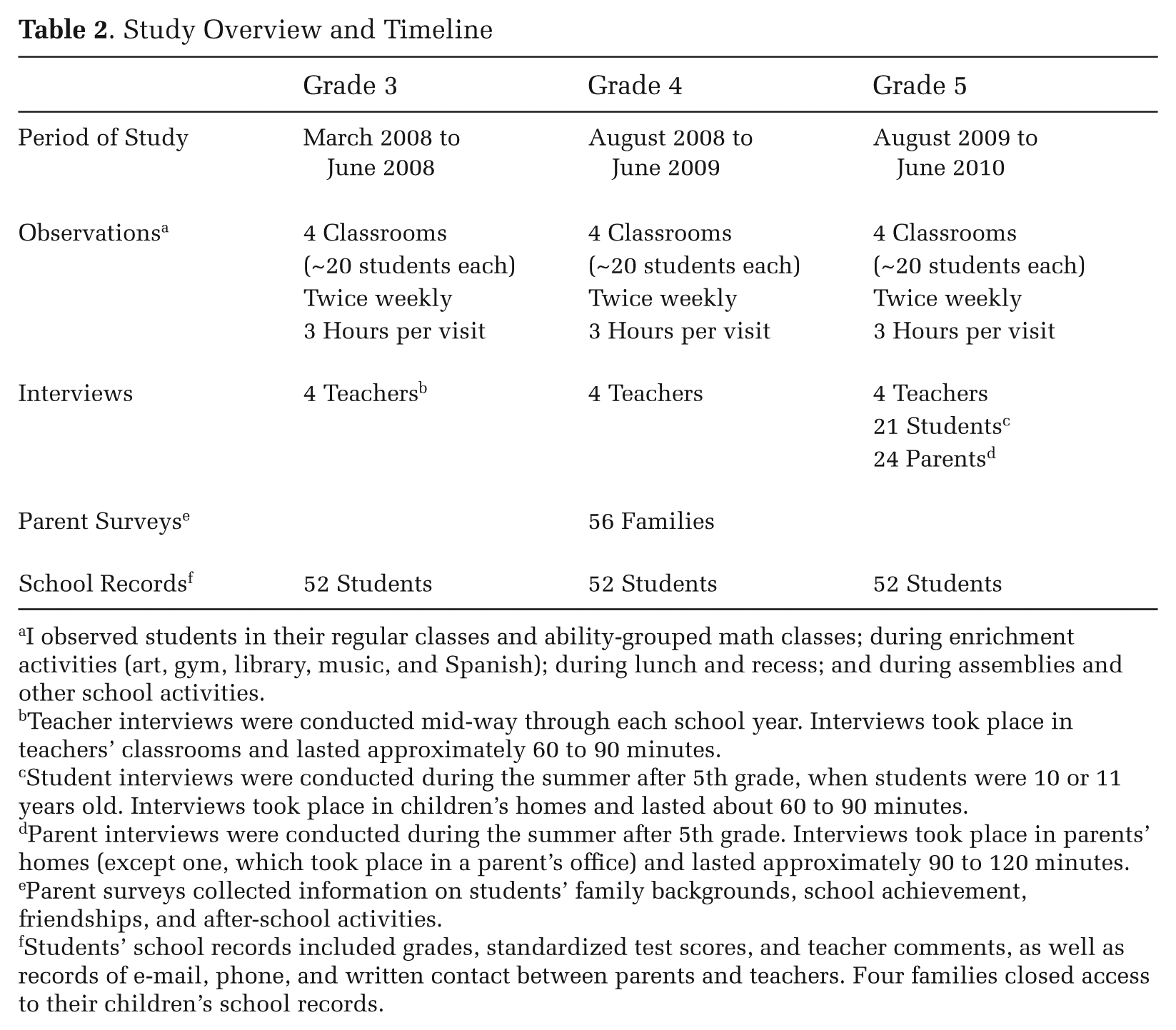
I observed students in their regular classes and ability-grouped math classes; during enrichment activities (art, gym, library, music, and Spanish); during lunch and recess; and during assemblies and other school activities.
Teacher interviews were conducted mid-way through each school year. Interviews took place in teachers’ classrooms and lasted approximately 60 to 90 minutes.
Student interviews were conducted during the summer after 5th grade, when students were 10 or 11 years old. Interviews took place in children’s homes and lasted about 60 to 90 minutes.
Parent interviews were conducted during the summer after 5th grade. Interviews took place in parents’ homes (except one, which took place in a parent’s office) and lasted approximately 90 to 120 minutes.
Parent surveys collected information on students’ family backgrounds, school achievement, friendships, and after-school activities.
Students’ school records included grades, standardized test scores, and teacher comments, as well as records of e-mail, phone, and written contact between parents and teachers. Four families closed access to their children’s school records.
Ethnographers must make hard choices. In this study, I focused my three years of observations in classrooms so as to see the payoff of parents’ efforts. As a result, the study does not include systematic home observations. Still, I was able to observe parent-child interactions during school events and during interviews in family homes. These observations corroborated the numerous reports of parent-child coaching that I gathered from interviews with children, parents, and teachers.
All interviews were audio-recorded and transcribed. I used these interviews to understand children’s home lives, school experiences, and interactions with parents, teachers, and classmates. When speaking with parents and students, I concluded each interview by asking interviewees to respond to four vignettes. These vignettes described typical classroom challenges (e.g., “Jason is struggling to understand the directions on a test”) and were based on situations I had observed or learned about through conversations with teachers. With each vignette, I asked interviewees to describe how the characters should respond to the situation (e.g., “What do you think Jason should do?”). I also asked participants to discuss similar experiences in their own lives. I then coded these open-ended responses and used them to compare respondents’ attitudes across social class and generational lines. I present some of these comparisons to highlight patterns documented in the larger ethnographic study.
Data Analysis
I conducted an ongoing process of data analysis, regularly reviewing fieldnotes and interview transcripts and writing analytic memos (Emerson, Fretz, and Shaw 1995). I used the memos to identify emerging themes in the data, discuss connections to existing research, and pose additional questions. After creating a preliminary coding scheme from themes in the memos, I used ATLAS.ti to code sections of fieldnotes, interview transcripts, documents, and seating charts. While coding, I also developed data matrices (Miles and Huberman 1994) to clarify comparisons and identify disconfirming evidence.
Parents’ Understandings of Appropriate Behavior
Before examining parents’ coaching of class-based strategies, it is important to understand how social class shaped these efforts. Research highlights social class differences in parents’ interactions with their children (Chin and Phillips 2004; Lareau 2011) and with their children’s schools (Cucchiara and Horvat 2008; Lareau 2000; Nelson 2010). Yet, scholars say little about the origins of such patterns. At Maplewood, I found that middle- and working-class parents had different strategies for managing problems at school. Those differences reflected parents’ positions in the status hierarchy, which influenced their comfort interacting with the school and led them to adopt different class-based logics of action for interpreting the “appropriate” form of behavior in those settings.
Middle-Class Parents: Modeling By-Any-Means Problem-Solving
Middle-class parents adopted a by-any-means approach to solving problems with their children’s schooling. They actively intervened to request support and accommodations, lobbying to have children tested for gifted or special needs programs and often writing notes excusing their children from homework and other activities. Ms. Bell sent this note to her son’s 3rd-grade teacher, Ms. Nelson, when he left his homework at school:
Dear Paula, Aidan forgot his homework folder yesterday. As a result, he was not able to do his homework last night. I will have him complete it this evening. I apologize for the inconvenience. Last night I had him read and do math problems from a workbook to replace homework time. Again, sorry he won’t be prepared today. Susan
Middle-class parents seemed to expect their interventions to generate benefits, and they were usually correct in that assumption. Ms. Nelson, for example, generally required students to stay in for recess if they forgot their homework. Given Ms. Bell’s note, however, Ms. Nelson allowed Aidan to submit the homework the next day with no penalty.
Middle-class parents adopted this by-any-means approach to problem-solving because they interpreted classroom interactions through a logic of entitlement. Given their educational and occupational attainment, middle-class parents appeared to perceive themselves as equal or greater in status relative to children’s teachers. As a result, they were very comfortable intervening and questioning teachers’ judgments regarding classroom assignments, ability group placements, testing procedures, and homework policies. One interview vignette described a student, “Brian,” who came home complaining about being “bored” in math class. As Table 3 shows, parents’ responses to this vignette divided sharply by social class. While all the middle-class parents saw the situation as requiring immediate requests for accommodations, working-class parents tended to view deference to teachers’ judgments as the appropriate response.
Summary of Open-Ended Responses to Vignette 1 by Social Class
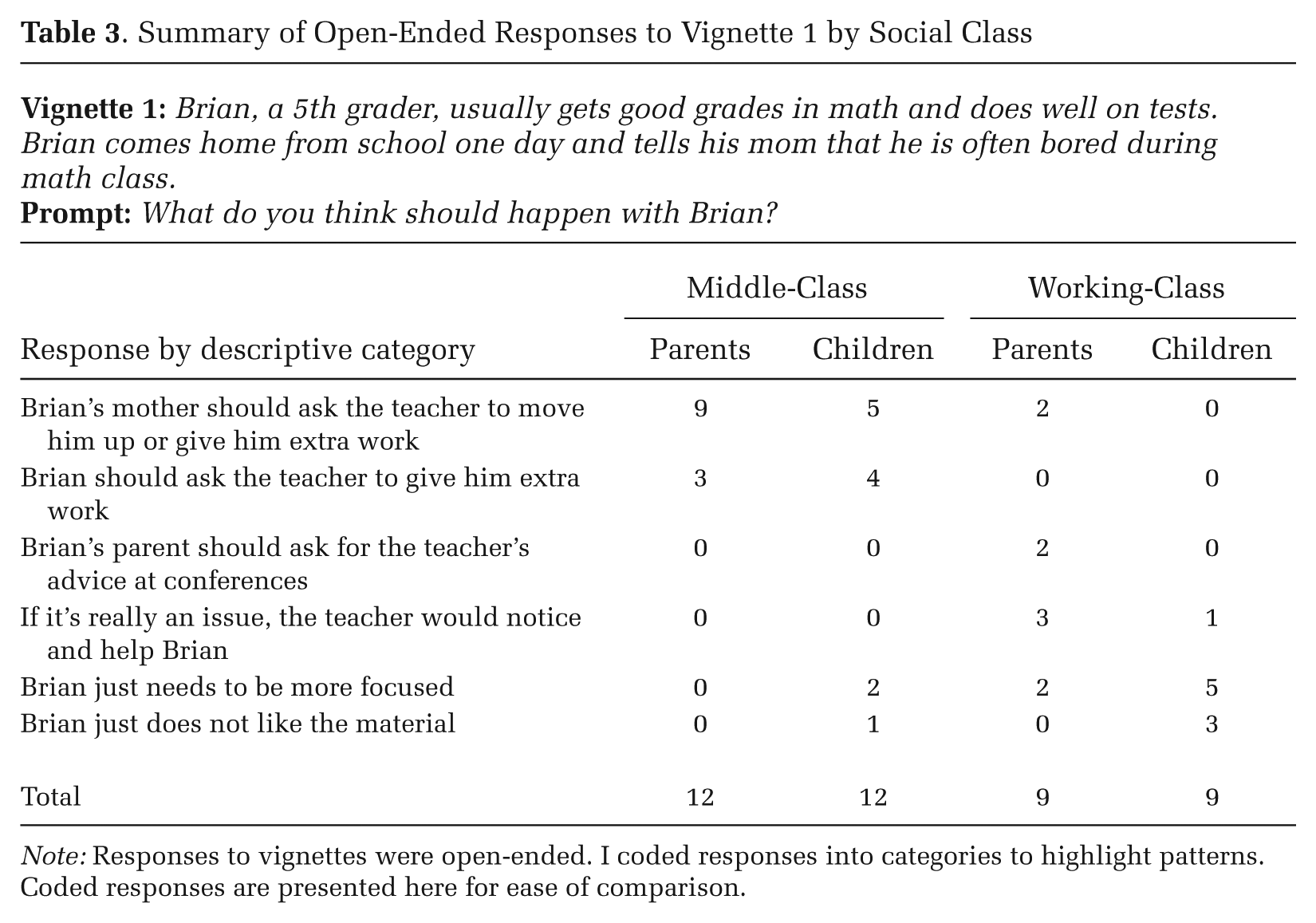
Note: Responses to vignettes were open-ended. I coded responses into categories to highlight patterns. Coded responses are presented here for ease of comparison.
When asked open-ended questions about how Brian’s parent should respond in this situation, all the middle-class parents said they would talk to the teacher or encourage Brian to talk to the teacher. Ms. Matthews’s response was typical of middle-class parents:
I would ask for a higher math class. I think that would be the obvious first step. And if that’s not a possibility, then I think asking for additional work, or asking if Brian could mentor one of the other children. That way he could use the knowledge that he has to help another child learn. I think that would be a good lesson for him.
Although the teachers worked hard to determine the appropriate math level for each student, Ms. Matthews, like many middle-class parents, perceived herself as a better judge of her child’s needs. These parents also believed they were entitled to negotiate with teachers, seeing such requests as an “obvious first step.” At Maplewood, teachers were reluctant to change students’ placement. Yet, many middle-class students (but no working-class students) were moved up due to their parents’ persistent requests.
This entitlement to intervene prompted middle-class parents to be highly involved at school and granted them insider status at Maplewood. Many middle-class mothers at Maplewood were full-time parents, but even employed mothers helped run volunteer programs, bake sales, and evening events that raised more than $50,000 annually for the parent-teacher organization (PTO). In light of their involvement, middle-class parents were often deeply familiar with school expectations, procedures, and personnel. They also readily exchanged this information with other (typically middle-class) parents during play-dates, soccer games, school events, and phone conversations. As a result, middle-class parents knew the sequence and timing of state assessments, the weekly school schedule, and the procedures for requesting accommodations.
That insider status shaped middle-class parents’ beliefs about teachers’ behavioral expectations. They understood that—unlike when they were in school—teachers valued questions and requests from both parents and students. As Ms. Shore, who works full-time but contacts her children’s teachers regularly by e-mail, explained:
It’s become more than just a gentle encouragement. It’s official. You’re a high-quality learner if you’re willing to ask questions when you have one, and [the teachers] actually reward the asking.
Middle-class parents recognized that although their own teachers might have balked at such requests, school expectations had changed. They assumed that teachers would reward proactive help-seeking, and thus they adopted a logic of entitlement in managing problems at school.
Working-Class Parents: Modeling No-Excuses Problem-Solving
Unlike their middle-class counterparts, working-class parents adopted a no-excuses approach to educational challenges. In light of their limited educational and occupational attainment, working-class parents generally trusted the school to decide what was best for their children. Even when working-class parents were frustrated with teachers’ decisions, they tended not to intervene. Ms. Campitello’s son Zach, for example, often went to school with incomplete assignments. In our interview, Ms. Campitello explained that while she tried to help Zach with his homework, both she and Zach struggled with the material. Tears brimming in her eyes, she recalled:
Zach gets so frustrated that he just won’t do it. And I tried, but it was really, really hard. It got to the point, honestly, where I just gave up. . . . I wish the teachers would just help him at school. Cuz they get this stuff. They know what the kids are supposed to be doing.
Ms. Campitello believed the school could do more to help Zach with homework and with his understanding of the material. Yet, like other working-class parents, she did not inform Zach’s teachers or ask for additional support.
Working-class parents adopted this no-excuses approach to problem-solving because they interpreted classroom interactions through a logic of constraint. Given their educational and occupational attainment, they perceived themselves as less knowledgeable than “expert” educators and thus avoided questioning teachers’ judgments. Responding to the Brian vignette, for example, none of the working-class parents said they would ask the teacher to move Brian to a higher math level (see Table 3). Similarly, in 2nd grade, Ms. Trumble noticed that her son, Jeremy, was not reading as well as his older siblings had at that age. Ms. Trumble worried, but she did not intervene:
I thought maybe there was something wrong, but I didn’t wanna say anything. I think the teachers are pretty good. If there’s any kind of problem, I think they’d jump on it right then and there to help. Like [in kindergarten] they figured out that Jeremy had some speech problems and they got him into speech therapy.
Even when their children were struggling, working-class parents “didn’t wanna say anything.” They assumed that teachers had a better understanding of children’s academic needs, and that they as non-professionals were not equipped to influence decisions about children’s schooling.
This reluctance to intervene prompted working-class parents to be less involved at school and relegated them largely to outsider status at Maplewood. Working-class parents occasionally attended conferences or concerts, but they spent relatively little time volunteering. Even the few working-class parents who did not work full-time were not a regular presence at school. As a result, working-class parents tended not to be very familiar with school expectations, procedures, and personnel. This lack of familiarity was compounded by the fact that working-class parents generally had few social connections with teachers or other Maplewood parents.
That outsider status shaped working-class parents’ beliefs about teachers’ behavioral expectations. Without inside information, working-class parents tended to rely on their own experiences in school as a guide. During an interview, Mr. Graham remembered a formative incident from 5th grade:
The teacher gave us a test and none of us understood. We were like, “What are you talking about?” I mean, it was like she thought she explained it clear as day. And we read it, but it just didn’t jive.
2
When I asked Mr. Graham what happened next, he continued, shaking his head:
Well, she was upset because we asked her about it. She yelled at us, cuz she just didn’t understand why we didn’t get it! That was a rough little time in school. I mean, a number of us were upset about it, crying upset about it. I think I probably took the brunt of it, cuz I was the one that challenged her.
While the teachers at Maplewood did reprimand students for offenses like being off-task, name-calling, and running in the hallways, I never saw a teacher punish a student for seeking help. Middle-class parents, by virtue of their insider involvement, recognized that school expectations around question-asking had changed over time. Working-class parents, drawing only on their own school experiences, assumed that teachers would perceive requests as disrespectful, and thus they adopted a logic of constraint in managing problems at school.
Parents Teach Class-Based Behaviors
Parents’ class-based logics shaped not only their comfort interacting with teachers, but also their beliefs about how to manage challenges appropriately at school. Such beliefs prompted parents to coach their children to activate similar strategies when interacting with teachers. Although parent-child coaching exchanges were generally serendipitous rather than planned, their messages were more deliberate and their intended consequences were more explicit than research on social class and childrearing typically implies (Arnett 1995; Heath 1983; Lareau 2011).
Middle-Class Parents: Coaching By-Any-Means Problem-Solving
Middle-class parents actively coached their children to adopt a by-any-means approach to dealing with classroom challenges. In 1st grade, Danny Rissolo was being bullied by a classmate. As Ms. Rissolo explained:
The kid he was sitting next to was a bully, and was making fun of him. Danny wanted me to fix it for him, but I said to him, “You know what Danny, I’ll do that for you, but I want you to do something first. I want you to go to Ms. Girard, and say something like ‘Ms. Girard, can I talk to you for a minute?’” I said, “Ask her what she thinks you should do.” At first [Danny] was like: “You want me to do all that?” And I said: “You can do it! You’re a smart guy. You’re very articulate. You can do this. And if it’s still a problem, I’ll call her also, but you need to do this first.”
Smiling, Ms. Rissolo went on to describe proudly how Danny—barely 7 years old at the time—successfully convinced Ms. Girard to change his seat and move him away from the bully:
Well, he did it. He talked to Ms. Girard and asked her what she could do. And she was able to say: “You know what, I’m gonna be changing where you’re all sitting next week. Why don’t we change tomorrow instead? And no one has to know why.” And his problem went away. And so he saw, he learned, early on, how to advocate for himself.
Ms. Rissolo could have just contacted Ms. Girard on Danny’s behalf. Instead, and like other middle-class parents at Maplewood, she coached her son to seek assistance for himself.
Middle-class parents’ coaching efforts reflected their belief that children should draw on all available resources when managing problems at school. In interviews, these parents stressed that children should be comfortable approaching teachers with questions and requests for individualized support. These beliefs were particularly apparent in middle-class parents’ responses to an interview vignette describing “Jason’s” struggles to understand a science test question. As Table 4 shows, parents’ responses to this vignette divided sharply along social class lines. Middle-class parents all stressed that Jason should solve the problem by-any-means, whereas working-class parents all emphasized a no-excuses approach.
Summary of Open-Ended Responses to Vignette 2 by Social Class
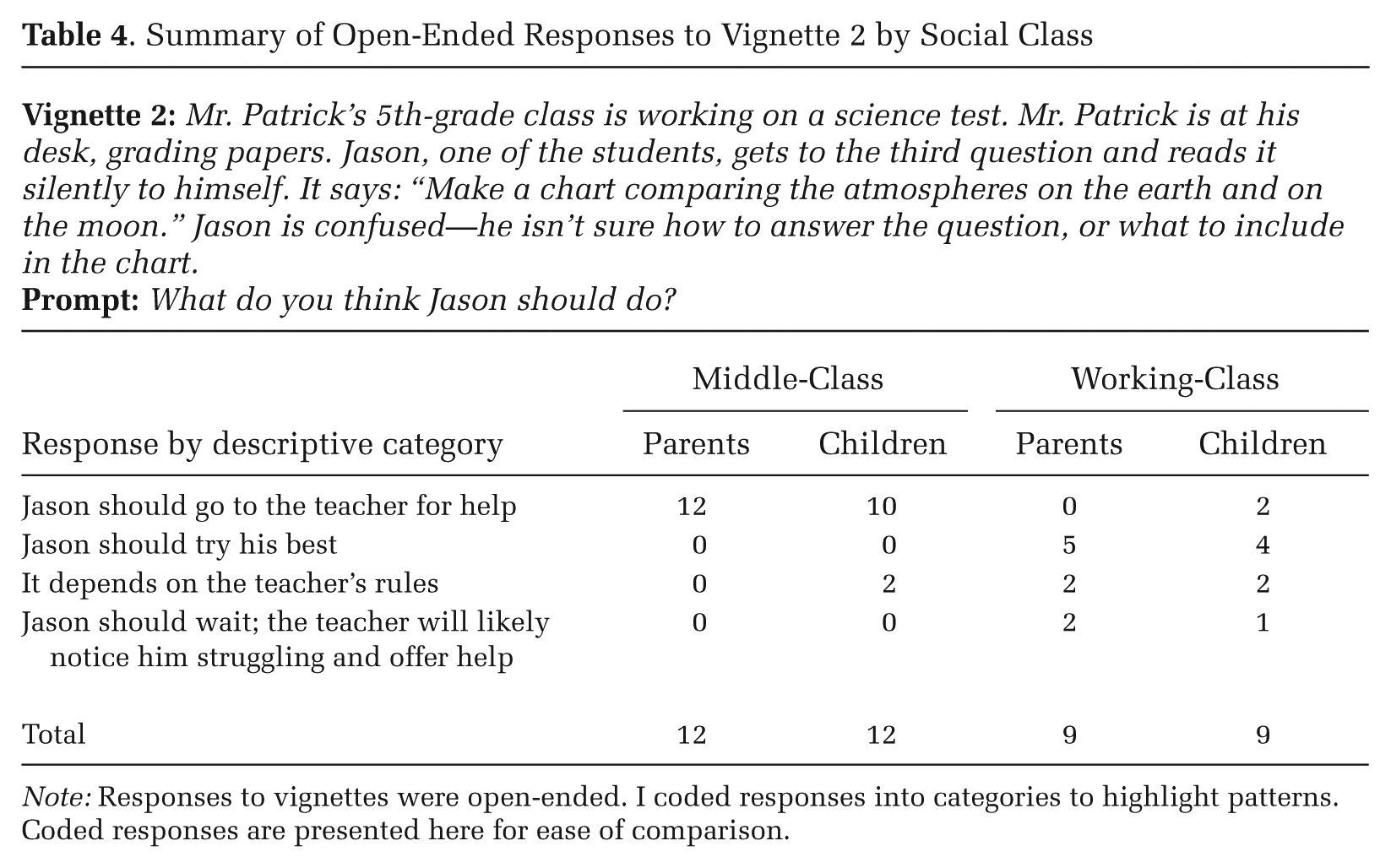
Note: Responses to vignettes were open-ended. I coded responses into categories to highlight patterns. Coded responses are presented here for ease of comparison.
When asked “What should Jason do?” middle-class parents all said that Jason should “go to the teacher” for help. Ms. Long, for example, expressed sentiments commonly echoed by middle-class parents:
Jason should ask the teacher to clarify for him. Cuz if Jason was having the problem then everybody else is probably having the same problem. You want a kid to be able to answer the question, to make sure that he understands, rather than just not doing anything. So I think Jason should ask the teacher and the teacher should tell the whole class.
The middle-class parents at Maplewood expressed that children should readily seek assistance, and that teachers are obligated to provide such support.
As with Danny and the bully, the coaching efforts that stemmed from these beliefs equipped middle-class children to activate by-any-means problem-solving strategies. Similarly, when Gina Giordano began getting Bs and Cs on tests in 4th grade, Gina’s parents coached her to go to her teacher for help:
We always tell her, “You go up and you talk to the teacher. You find out—you don’t use your friends. You go to the teacher and find out.” Like, Gina was [struggling] . . . and I told her, “Well, go ask your teacher what that means. That’s your resource.”
Parents’ active coaching efforts inspired middle-class children to “use their resources” when confronting problems in school. As Gina explained:
Like, I was having trouble staying organized, and I kinda talked to my parents about it. They told me to go talk to my teacher, Ms. Hudson. . . . [So] I asked her if she could help me with my organization and stuff, [and] . . . she just brought me to the back of the class and showed me a few things.
Gina recognized that her parents taught her valuable strategies for managing problems, and she regularly enacted those strategies at school. During a 5th-grade math class, Gina was working with her (middle-class) partner Beth. Following instructions, Gina and Beth found a recipe (for six servings), and using what they had learned about multiplying fractions, tried to determine how much of each ingredient they would need to feed 25 people. These complex calculations soon had the girls arguing. Frustrated, they sought out Ms. Dunham:
As they approach, Gina calls out loudly, “Ms. Dunham!” Ms. Dunham turns, and Gina begins to explain: “We don’t really get how to do this. We don’t know what we need to multiply by to get to 25 servings.” Ms. Dunham walks them through the process of multiplying the amount of each ingredient by 25/6, and then reducing each fraction to its simplest form.
Gina could have continued working or asked a classmate for help. Instead, she went straight to the teacher. In doing so, Gina drew on the by-any-means problem-solving strategies she learned at home. As with most of the middle-class students, I also observed Gina become more confident in deploying those strategies over time.
Working-Class Parents: Coaching No-Excuses Problem-Solving
Unlike their middle-class counterparts, working-class parents coached their children to adopt a no-excuses approach to problem-solving. Ms. Trumble, for example, noted that her son Jeremy sometimes “will forget stuff.” She went on to describe how she uses these situations to teach Jeremy to be more responsible:
And I’ll say, “You have to tell your teacher that you forgot it, and stay in for recess and get it done then.” And that’s what he ends up doing. Because I tell him, “There’s nothing I can do. You forgot your homework. I don’t know what it was.”
These explicit messages seemed to lead Jeremy to activate a no-excuses approach when managing problems at school. In 5th grade, the day his book report was due, Jeremy arrived without it:
Slumping into his seat between Riley and Alan (both middle-class students), Jeremy laments, “I finally finished my book report last night, and then I left it at home . . . ” Riley, head cocked, looks at Jeremy. She asks, puzzled, “Can’t your mom bring it for you?” Jeremy drops his chin down and shakes his head. “She has to work, so if I forget things, she says it’s my responsibility.” Riley blinks, bewildered. Later, when Ms. Dunham checks his homework, Jeremy apologizes and admits that he does not have his project. Ms. Dunham says disappointedly: “You’ll have to stay in for recess.”
In similar situations, middle-class students generally adopted a by-any-means approach, asking to call a parent to bring in the assignment or to receive an extension on the deadline. Like other working-class students, however, Jeremy followed his mother’s instructions and accepted his punishment without excuse.
Working-class parents’ coaching efforts reflected their belief that children should draw only on their own resources and avoid inconveniencing teachers by seeking help. These beliefs were particularly apparent in working-class parents’ responses to the interview vignette describing Jason’s struggles with the science test. After reading this vignette, working-class parents typically responded by saying that Jason should work hard and try his best (see Table 4). As Ms. Marrone explained:
Jason should just try his best. I tell my kids to work hard. And they all learned how to do it. Like with Shawn, he reads better now. So he doesn’t ask me for help as much. Like, he can do his homework by himself now.
Some working-class parents believed that help-seeking would undermine their children’s willingness to work hard. Others noted that children might “get in trouble” for seeking help, and thus they encouraged their children to “skip it and come back” or wait for the teacher to offer assistance. Although they varied somewhat in their reasoning, working-class parents consistently emphasized that children should avoid proactively making requests.
As with Jeremy and the forgotten project, the coaching efforts that stemmed from these beliefs prepared working-class children to activate no-excuses problem-solving strategies. This can also be seen with an example from the Graham family. In an interview, Mr. Graham recounted a problem with his daughter Amelia’s 3rd-grade report card. He described how they read the report card together, and how Amelia noted that one of the teacher comments “didn’t seem to make sense.” As Mr. Graham recalled: “I told Amelia not to ask about it, cuz the teacher probably wouldn’t be too happy.” Explaining this approach, Mr. Graham noted:
I just want my kids to be respectful and responsible. . . . My kids, I always told ’em: “Look, if you’ve gotta give somebody a hard time, give it to me. Don’t give it to your teachers. Don’t give it to other parents.” And I’ve never had a teacher complain. Or, if my kids go and play at somebody else’s house, I’ve never had a parent say: “Your child can’t come back.” You know? My kids are good for the teachers and for other parents.
These active coaching efforts taught working-class children to work hard and avoid “complaining” when confronting problems in school. In my conversations with teachers, they would often bemoan middle-class students’ “lack of problem-solving skills” and their reluctance to tackle difficult challenges. In these same conversations, teachers would often praise working-class students like Shawn and Amelia for their “work-ethic.”
This willingness to work hard and avoid excuses was readily apparent in working-class students’ management of challenges at school. Near the end of the year, the 5th graders invited their parents to attend an outdoor rocket-day event marking the culmination of their study of space exploration. The students had spent class time assembling and decorating plastic model rockets, readying them for launch at the event. On the big day, the students, giddy with excitement, waited in four lines on the field behind the school. Teachers and parent volunteers helped them load tubes of explosives into their rockets. The children launched the models using a remote device. After watching their rockets fly about 100 yards across the playground, they retrieved them and rejoined the line to try again:
Although there are many parents milling around, Amelia’s parents are at work. After her launch, Amelia retrieves her rocket and jogs slowly back toward the line, a crestfallen look on her face. Amelia is holding her rocket in one hand and the rocket’s parachute in the other. The string attaching the parachute to the rocket broke during the flight. Rather than rejoin the line, Amelia sits down in the grass by herself. Her face set tight with concentration, Amelia tries to fix the rocket, carefully tying and retying the broken string.
As Amelia worked, Ted Peters, a middle-class student, ran toward the line. Instead of joining his classmates, Ted veered off, approaching his mother, who was chatting with other parents:
Ms. Peters turns, smiles broadly, and praises Ted for a “great flight.” Ted, frowning, holds out his rocket and explains that the string attaching the rocket’s parachute has broken. After inspecting the broken string, Ms. Peters says encouragingly, “Go ask Mr. Fischer for a new string. I’m sure he’ll be able to help.” Ted’s grim expression brightens. He turns and dashes toward his teacher. When Mr. Fischer sees the broken string, he retrieves an extra string from a supply bin and helps Ted reattach the parachute. Ted then immediately rejoins the line to launch his rocket again.
While Amelia eventually succeeded in tying the two broken ends of string, it took her much longer. Ted immediately rejoined the line, stepping in behind the friend who had gone before him in the first round. As a result, Ted got to launch his rocket four times, while Amelia only got to launch her rocket twice. Despite this setback, however, Amelia did not complain or ask to move ahead in line. In doing so, and like other working-class students, Amelia drew on the no-excuses problem-solving strategies that she learned from her parents’ instruction at home.
Parents Teach Class-Based Interpretations
Given the possibility of children’s resistance to parents’ intentions (Chin and Phillips 2004; Pugh 2009), parents engaged in deliberate and ongoing efforts to teach children not only different strategies of action for managing challenges, but also different logics of action to use in deciphering the “appropriate” strategy for a given situation. Effectively, parents taught children to see the world—or at least the classroom—through their eyes. These coaching exchanges were rarely planned; instead, they tended to occur as a natural response to situations as they arose. Yet, parents did convey their messages deliberately, not only by passively modeling different orientations, but also by actively shaping how children viewed themselves and their teachers. Through repeated exposure to such messages, even reluctant children tended to gradually adopt their parents’ logics and to use them as a guide in activating “appropriate” strategies of action.
Middle-Class Parents: Teaching Entitlement
Middle-class parents actively encouraged their children to adopt a logic of entitlement in their interactions at school. They did so by teaching their children first, to feel deserving of support, and second, to recognize the benefits of entitlement and its by-any-means approach to problem-solving. Ms. Matthews described this approach:
I really feel like [my kids] need to have those skills . . . to be able to talk to [the] teacher to understand and to work through those problems. When you get into a boss situation, your mom doesn’t call and say, “Sorry my daughter doesn’t understand what she’s supposed to come and do today at work.” You know, you need to learn how to do that! And if you don’t start at this stage, it makes it more difficult and then you get fired! So I tell my kids, “It’s okay to ask those questions in that setting. This is a place where you go every day. You talk to this teacher every day. He’s invested in your interests.” And once they learn to overcome that hurdle, it becomes easier to then deal with asking for [other things].
Like other middle-class parents, Ms. Matthews stressed to her children both the benefits of help-seeking (e.g., you might get fired if you do not seek help) and their deservingness of support (e.g., the teacher is invested in your interests). In doing so, she worked to develop her children’s sense of entitlement to assistance at school.
These entitlement-oriented messages helped middle-class children—especially shy children—overcome reluctance around help-seeking. Keri Long’s mother, for example, realized early on that Keri was hesitant to seek assistance from teachers. She recounted this incident:
Keri was doing well in 3rd grade. She had straight As until this one math test [on which Keri got a C]. She came down [from studying in her room] and said, “I’m confused about this.” And I said, “Go talk to your teacher about it! You need to tell your teacher this is what you need help with.”
Despite her mother’s strategy-based coaching, Keri did not ask for help. Ms. Long, shaking her head in exasperation, continued:
She didn’t have the power in her to do it. To say: “I need help.” . . . And that brought her grade down! She got a C on the test and it brought her down. . . . Which, to me, was very upsetting, because I told her, “Go! Get help!” And she just . . . I dunno. Keri’s very timid, very shy. I’m trying to teach her to look up and shake hands. That adults aren’t scary and that the teachers are there to help her. It’s getting better, but it’s taken her a really long time.
Although Keri was reluctant to follow her mother’s instruction, Ms. Long was not deterred. Like other middle-class parents, Ms. Long continued to work with Keri, repeatedly stressing that Keri deserved assistance and that the “teachers are there to help her.”
Over time, and in light of such persistent encouragement, even very shy middle-class children became more comfortable negotiating with teachers. From 3rd to 5th grade, for example, I watched Keri grow more confident in these interactions. One day, Ms. Dunham’s 5th graders were working on a social studies test, using their books to complete short-answer essay questions about the Civil War. One question asked students to identify a main event and describe its significance:
Before setting the students to work, Ms. Dunham calls out: “Use your resources. But it’s open book, not open neighbor!” After working for a few minutes, Keri picks up her textbook and carries it with her as she approaches Ms. Dunham’s desk. Pointing at a passage in the book, she asks quietly, “Does this count as a main event?” After glancing at the book, Ms. Dunham explains, “This is a good event, but you probably want to look for something larger.” Ms. Dunham then helps Keri recall some significant events they discussed in class.
In an interview, Keri linked her increasing comfort with help-seeking to her mother’s encouragement, explaining: “My mom tells me that I should do it [ask for help]. And so I usually go and ask Ms. Dunham.” With time and intensive coaching from their parents, even very shy middle-class children gradually adopted a sense of entitlement to support. In doing so, they also developed the confidence needed to activate a by-any-means approach to problem-solving.
Messages about the benefits of by-any-means problem-solving also helped alleviate reluctance among middle-class children who worried that help-seeking might cause others to perceive them as “dumb.” With a worried frown, Ms. Dobrin described how she and her husband regularly remind their son Ethan of the importance of help-seeking:
Ethan’s teacher evaluations always said, “He’s a joy. He’s bright. He’s making great grades, but he needs to ask for help sometimes.” Now, I don’t think asking for help is comfortable for Ethan, but what we try to impress on him is, “Think about how important it is that you get that information. If you need that information to do the job correctly, then you need to ask the teacher.”
Initially, Ethan did not like seeking help: as a high-achieving student, he worried that help-seeking would prompt others to question his abilities. Given Ethan’s reluctance, his parents worked with him repeatedly. They would stress the importance of help-seeking and “coach him to flag a teacher down, or get up and go talk to the teacher during a test.”
These messages, in turn, helped middle-class children to adopt a logic of entitlement and to view help-seeking primarily through its benefits. By 5th grade, for example, Ethan seemed very comfortable voicing his needs. I regularly watched him ask teachers to extend deadlines, clarify directions, and even provide assistance during tests. During the spring of 5th grade, Mr. Fischer’s class was taking a math test. Mr. Fischer circled, glancing at students’ work and answering questions about the test:
Ethan taps his pencil eraser lightly against his cheek, frowning. As Mr. Fischer circles past, Ethan calls out quietly but hopefully, “Mr. Fischer?” Mr. Fischer immediately stops and turns toward Ethan, asking with genuine concern, “You okay?” Ethan shrugs and admits that he is not sure if he is interpreting a question correctly. Squatting down, Mr. Fischer does not give Ethan the answer, but helps him recognize his mistake. Ethan nods, quickly finishing the problem correctly.
Ethan’s logic of entitlement seemed to prompt him to activate this by-any-means approach to problem-solving. Responding to my question about why he asked for help on occasions like that one, Ethan explained:
I didn’t want to guess and risk getting it wrong. I don’t want to get it wrong, because then I won’t get as high a grade as I should have gotten. So it’s just better to go up and ask the teacher. And then normally I would get it right.
Like other middle-class students, Ethan was initially reluctant to seek help. Through his parents’ repeated, active encouragement, however, Ethan eventually came to recognize the benefits of help-seeking. In doing so, Ethan was able to draw on a logic of entitlement to overcome his fears and to feel comfortable voicing his needs.
Working-Class Parents: Teaching Constraint
Working-class parents actively encouraged their children to adopt a logic of constraint in interactions at school. They did so by teaching their children, first, to perceive their own needs as secondary to those of others, and second, to recognize the importance of hard work.
Working-class parents equated help-seeking with selfishness and sought to discourage such behaviors by actively downplaying their children’s individual needs. Ms. Webb, for example, did this with her daughter Sadie. While I was interviewing Ms. Webb in the kitchen of the Webb’s mobile home, Sadie entered the room to ask (politely) for the powdered iced tea mix:
Ms. Webb gives Sadie a skeptical look and laughs, “Get it yourself! What’re you asking me for?” Sadie nods and pulls a chair out from the kitchen table, using it to climb up and retrieve the can of iced tea mix from the cabinet over the refrigerator. As Sadie does this, Ms. Webb, turning to me, says playfully, “She’s a spoiled brat. Not gonna make it in the real world.”
Although Sadie tried to ask for help, her mother quickly denied this request. Like other working-class parents, Ms. Webb stressed that assistance would “spoil” her daughter.
Over time, and in light of such messages, working-class children appeared to perceive help-seeking as selfish and disrespectful of others. Sadie, for example, was loud and outgoing with her friends, but very polite and deferent to her teachers. As Sadie explained in an interview, she rarely asked for help:
If you have a question about homework, you should just skip it. You don’t wanna go up and bug the teacher. And then, if she [the teacher] says: “Did anybody have any problems with the homework?” Then you can raise your hand.
With time and coaching from their parents, working-class children gradually came to view classroom challenges through a logic of constraint. Doing so prompted working-class children to adopt a no-excuses approach to problem-solving and to avoid seeking help.
Working-class parents also equated help-seeking with laziness. To discourage such behaviors, they emphasized the importance of hard work. Ms. Compton, for example, struggled to help her son Jesse with homework. She described, close to tears, how overwhelmed she felt by frequent, complex assignments and by her own work schedule, which prevented her from being home in the afternoons. Given those challenges, Ms. Compton tried to motivate Jesse to do his homework on his own. As Ms. Compton explained:
Jesse can be lazy. He’s very, “I can’t do it. I don’t know what I’m doing.” But he just needs a push to do it on his own. I just tell him, “You can do it. I know you can do it. I’ve seen you do this. I want you to try.” Then he gets his confidence up and he snaps out of that low moment.
Jesse hated homework, but, like most working-class parents, his mother repeatedly encouraged him to just keep trying.
Such messages helped Jesse and other working-class children adopt a logic of constraint and view help-seeking primarily through its drawbacks. Jesse, for example, worked very hard but still struggled with schoolwork. Despite these struggles, however, Jesse believed he should not seek help:
Some of the stuff Ms. Dunham told me, it didn’t really make sense, but I just had to say: “Okay, I’ll try.” Like, sometimes I feel like I can’t do it, but my mom says I can’t say that. And I don’t wanna get in trouble.
In interviews, other working-class students also stressed the importance of hard work and the potential drawbacks of help-seeking, saying things like:
You need to work hard and learn things. Like, teachers give you homework to learn things. And then if you get help from your mom and dad, you’re not learning that stuff. And if you get it from a calculator, you still don’t learn it.
In light of parents’ active encouragement, working-class students came to view classroom interactions through a logic of constraint. They recognized the benefits of hard work and the possible negative consequences (social and academic) of actively voicing their needs.
This recognition tended to prompt working-class students not to ask for help at school. In the classroom, for example, I rarely saw either Sadie or Jesse seek assistance. As I learned from a conversation with Ms. Dunham, she took her 5th graders to the school library one Monday to take out books on African American historical figures. She gave her students until Thursday to find 10 facts for a biography project. Jesse was absent on Monday, so Ms. Dunham left the assignment on his desk. On Tuesday, however, Jesse did not ask for permission to go to the library. Instead, he asked his mother to take him to the public library. Ms. Compton did not have time; she said he would “just have to figure it out.” On Wednesday, however, Jesse did not explain the situation to Ms. Dunham or ask to go to the school library. Instead, he came to school on Thursday without his facts:
Jesse is slumped low in his seat, his shoulders sagging. When Ms. Dunham [who is checking students’ homework] approaches, she asks, “Do you have your facts?” Jesse shakes his head but does not look up. Sensing that something is wrong, Ms. Dunham squats down next to Jesse, asking softly, “You okay?” Jesse waits for a long moment, and then whispers, “I tried to do them, but my mom got mad, cuz I said we needed to go to the library.” Ms. Dunham’s eyes widen, as if recalling that Jesse was absent when the class went to the library. She reassures Jesse, promising to “give mom a call” to explain the mix-up and giving him a library pass and an extension on the assignment. Jesse thanks Ms. Dunham earnestly, giving her a tentative smile.
Like other working-class students, Jesse often concealed his challenges and tried to manage them privately. This was a risky strategy. Had Ms. Dunham not intervened, Jesse would have received a lower grade on his project, and he might not have turned it in at all. Ironically, while Jesse likely wanted to avoid appearing lazy or disrespectful by asking for help, his failure to explain the situation could have led Ms. Dunham to see him as lazy and disrespectful for not completing his work.
How Activation Reproduces Inequalities
As such examples suggest, the active transfer of class-based culture from parents to children helped reproduce social inequalities. We know from prior research that children’s activation of class-based strategies can generate stratified profits in the classroom (Calarco 2011; Farkas 1996; Streib 2011), and those profits result from teachers’ responses to particular behaviors (Mehan 1980; Tach and Farkas 2006; Wren 1999).
This study provides further evidence of such patterns, showing that teachers reacted differently to by-any-means and no-excuses problem-solving, and those reactions had significant consequences. During art class one morning, the students were taking an assessment that would determine part of their grade. For the assessment, students had 15 minutes to choose a print of a famous painting and answer a series of questions about its mood, tone, and style. During the assessment, Ted, Melanie, Kelly, and Kal, all middle-class students, raised their hands, and Ms. Cantore circled around, answering their questions:
Melanie thrusts her hand high in the air, twisting around in her seat to look for Ms. Cantore. Spotting her, Melanie calls out in a loud whisper: “Ms. Cantore!” Ms. Cantore, who was across the room, strides quickly toward Melanie. As Ms. Cantore approaches, Melanie explains: “I’m not sure what to write for the mood part. Like, I know the tone is light, but I’m not sure how to describe the mood.” Ms. Cantore smiles, asking: “Well what do you feel when you look at all of those pastel colors?” Melanie thinks for a moment, scrunching her forehead before asking: “Um . . . happy?” Ms. Cantore nods vigorously, adding: “Now you just need to think about other ways you can tell this is a happy painting.” Melanie nods confidently, saying: “Okay, got it!”
Meanwhile, Zach Campitello, a working-class student, appeared to be struggling with the assessment, but never asked for help:
Zach is sitting hunched over his paper, a deep-set frown on his face. Zach glares at the print for a long time before eventually starting to write. When Ms. Cantore circles past, she notices that Zach has only brief answers for each question. Ms. Cantore reaches down and taps Zach’s paper. She explains quietly but firmly: “You need to write more than one sentence for each answer.” Zach nods, but does not look up.
Ms. Cantore hesitated, as though she might ask Zach if he needed help. Simultaneously, however, Colin, a middle-class student, called out for help, and Ms. Cantore went to assist him:
Zach lets out a harsh sigh. His face red with frustration, Zach begins furiously erasing everything he has written. With forceful swipes of his hand, Zach then begins to scatter eraser dust all over the table. As Zach finishes erasing, Ms. Cantore calls out to inform the class that they have five minutes left to work. Zach groans and begins writing a longer answer to the first question. When time is up, however, Zach has not finished the other questions. Rather than explain, he simply drops his assessment in the box, submitting it incomplete.
As with Melanie, by-any-means problem-solving prompted teachers to quickly recognize students’ struggles and to respond with immediate assistance. No-excuses approaches, on the other hand, were harder for teachers to diagnose, and thus prompted less frequent, less immediate, and less complete support. Those differences in teacher support, in turn, generated stratified profits in the classroom. Middle-class students like Melanie were able to use the help they received to finish assignments more quickly and more accurately. Working-class students, on the other hand, often took longer to finish assignments, did them incorrectly, or, like Zach, never completed them at all.
Working-class students did sometimes overcome challenges on their own (as with Amelia in the rocket example), and they often took pride in their do-it-yourself attitudes. In Mr. Potter’s math class, for example, students were working on a set of tricky word problems:
As Mr. Potter circles around, many of the middle-class students call out to ask for help with number 29. Mr. Potter eventually decides to give a hint to the whole class rather than help each student individually. He announces: “If you’re stuck on 29, you need to think about . . . ” Before Mr. Potter can finish, Jared, an outgoing working-class student, interrupts, calling out: “Wait! I wanna try it first!” Mr. Potter smiles broadly at Jared, nodding approvingly, and then explains to the class: “If you get stuck on 29, skip it, and we’ll go over it together.”
Although it took him much longer than classmates who got help, Jared smiled proudly when he eventually completed the assignment on his own.
Other times, however, working-class students failed to overcome problems on their own, and those setbacks often left them discouraged. Zach, for example, was clearly struggling with the art assignment, but he did not voice his needs. Instead, Zach tried to work hard on his own. Eventually, though, the frustration became too much to bear. In the face of such setbacks, Zach chose to submit his assessment incomplete. As a result, Zach was one of only three students to receive an “unsatisfactory” in art for the marking period. Such patterns, in turn, provide further evidence of the stratified profits that can result—at least in the short-term—from students’ activation of class-based strategies of action.
Discussion
While we know that social class differences in children’s classroom behaviors contribute to inequalities (Calarco 2011; Farkas 1996; Streib 2011), existing research says little about how children learn to activate class-based strategies. Instead, and despite evidence that parents actively manage children’s lives (Edwards 2004; Lareau 2000; Nelson 2010) and that children actively resist parents’ wishes (Chin and Phillips 2004; Pugh 2009), scholars tend to imply that children’s habits are an implicit response to parents’ class-based childrearing styles (Heath 1983; Lareau 2011). Thus, it is unclear how or why parents coach class-based strategies, or how children respond to those efforts. Existing research often neglects to link class-based cultural transmission to inequalities in children’s lives, focusing on the advantages parents generate for children (Brantlinger 2003; Cucchiara and Horvat 2008; Lareau 2011) and not on how parents teach children to secure advantages for themselves.
Exploring these possibilities, I found that middle- and working-class parents adopted different approaches to interacting with educators and taught their children to do the same. Specifically, middle-class parents coached children to problem-solve “by-any-means,” including seeking assistance from teachers. Working-class parents instead stressed a “no-excuses” approach to problem-solving, teaching their children to manage challenges on their own and to avoid pestering teachers with requests. These lessons, in turn, had important consequences for students. While many children were initially reluctant to heed parents’ instructions, their reluctance prompted more active and ongoing coaching from parents. Such efforts eventually led children to adopt class-based logics of action and to use them in activating class-based problem-solving strategies.
These findings are important in that they highlight the agency in cultural transmission processes. Scholars of cultural transmission typically rely on top-down socialization models to explain similarities between parents and children (Kohn 1969; Lareau 2011). Childhood scholars critique these models for being overly deterministic (Corsaro 1994; Pugh 2009; Thorne 1993) but focus on children’s peer groups and thus offer little evidence of intergenerational exchange. By examining how children acquire and activate class-based strategies of action, I find that both children and parents have more agency in cultural transmission than class socialization models imply. Parents, for example, worked to equip their children with the skills and orientations they believed were most appropriate. Furthermore, while children generally came to accept their parents’ lessons, that process was far from automatic. Rather, it took an ongoing process of coaching, reluctance, and reinforcement to help children gradually acquire the skills and orientations needed to manage challenges in the “appropriate” (i.e., class-based) way.
Such findings also suggest that cultural transmission plays a critical role in reproducing social inequalities. Research on cultural transmission (e.g., Chin and Phillips 2004; Edwards 2004; Lareau 2011) rarely shows the payoff of parents’ class-based socialization. Similarly, studies of classroom behavior show that children’s activation of class-based strategies of action generates unequal outcomes (Calarco 2011; Farkas 1996; Streib 2011), but say little about how children acquire or learn to activate those strategies. This study bridges these gaps by linking parents’ lessons to their stratified profits in school. In doing so, I found that middle-class children’s by-any-means approach to problem-solving generated more advantages than did working-class children’s no-excuses approach. Specifically, teachers tended to recognize middle-class students’ needs more quickly. They also provided middle-class students with more attention and assistance in overcoming challenges they faced. As a result, middle-class students typically completed their assignments more quickly and more accurately than did their working-class peers (see also Calarco 2011).
Additional research is needed to understand how the payoff of parents’ lessons might vary across contexts and over time. In college or in the workplace, for example, individuals who use no-excuses problem-solving might do better than those who are used to having parents or teachers solve problems for them. In the short-term, however, there are clear benefits to by-any-means problem-solving. As research shows, help-seeking and other non-cognitive skills are closely linked to school achievement (Farkas 1996). Furthermore, by attracting attention and support from teachers, these strategies may also bolster students’ sense of academic competence and their attachment to school (Karabenick 1998; Stanton-Salazar 1997). By tracing these profits to their origins, this study illuminates the mechanisms of social reproduction, showing how parents’ lessons contribute to academic inequalities.
In doing so, this research may also clarify how social class influences childrearing. Certainly, there are many possible explanations for parents’ class-stratified lessons. They may stem, for example, from the values and beliefs about success that parents acquire in their work roles (Kohn 1969), or from parents’ familiarity with dominant institutions (Bourdieu 1990; Lareau 2011). While more research is needed to investigate these possibilities, my observations and interviews suggest that parents’ coaching efforts stem, at least in part, from their positions in the status hierarchy.
Parents’ status positions shaped their relationships with the school and their comfort interacting in those settings. Because of their educational and occupational attainment, middle-class parents saw themselves as equally or more qualified than teachers to make decisions about their children’s education. That sense of expertise also compelled middle-class parents to ensure their children’s needs were met, leading them to be highly involved at school and to demand accommodations on their children’s behalf (Brantlinger 2003; Cucchiara and Horvat 2008; Lareau 2000). That involvement, in turn, gave middle-class parents insider knowledge of school procedures and personnel. They saw first-hand (or learned through their networks) that schooling had changed over time, and they recognized that teachers were generally willing to help and even “reward the asking.” Middle-class parents used that knowledge in teaching their children to solve problems “by-any-means.” Working-class parents, on the other hand, generally saw teachers as experts who could be trusted to make decisions about their children’s educational needs (Cucchiara and Horvat 2008; Lareau 2000). That sense of deference led working-class parents to be less involved at school and to avoid speaking up, even when they questioned teachers’ judgments. That outsider status left working-class parents less familiar with the contemporary structure of schooling and led them to rely on their own school experiences as a guide (e.g., recalling being reprimanded by teachers for seeking help) when teaching their children a no-excuses approach to problem-solving. Taken together, these patterns suggest that positions in the status hierarchy may influence the logics of action that parents use in determining what counts as “appropriate” or beneficial behavior in school settings.
Tracing cultural transmission to its consequences required years of observations coupled with lengthy interviews triangulating key patterns. Those in-depth methods, in turn, necessarily involved tradeoffs (Hammersley and Atkinson 1995). It would have been interesting, for example, to examine how race and ethnicity contribute to within-class variations in cultural transmission and their consequences for inequalities. Maplewood, however, had few African American students, and the other minority groups (Asian American and Latino) were divided along social class lines. Thus, with reluctance, I focused only on whites. Given these limitations, I can only speculate about similar cultural transmission processes in minority families. While some scholars show that class-based parenting patterns persist across racial and ethnic lines (Lareau 2011), others find important cultural differences between African American and white parents from similar class backgrounds (Diamond 1999). Given evidence of broader cultural differences in help-seeking (Mojaverian and Kim 2013), parents’ lessons about managing problems at school might vary with families’ race, ethnicity, or immigrant status. Thus, future research should explore how class-based cultures are transmitted in other settings.
Conclusions
Social class differences in children’s behaviors have real consequences for their opportunities and outcomes (Calarco 2011; Farkas 1996; Streib 2011). Yet, because scholars typically treat class-based socialization as an automatic process (Arnett 1995; Heath 1983; Lareau 2011), it is less clear how children learn to behave in class-based ways or how lessons learned at home reproduce inequalities. Through observations and interviews with middle- and working-class children, their parents, and their teachers, I describe the active processes by which class-based cultures are transmitted across generations, and I show how these processes contribute to social reproduction. First, I link parents’ beliefs about schooling to their cultural coaching efforts, describing how parents’ beliefs reflect their status in relationship to the school. Second, I link parents’ coaching efforts to children’s activation of class-based behaviors, demonstrating that children use what they learn at home to manage problems in school. Finally, I link this activation process to its payoff in school, explaining how teachers’ responses to children’s problem-solving strategies affect their opportunities for support and success. By showing how each mechanism varies along social class lines, this study clarifies the origins of children’s class-based behaviors and highlights the active processes by which parents and children together reproduce inequalities.
Footnotes
Acknowledgements
A previous version of this manuscript was presented at the 2012 meeting of the American Sociological Association. I am deeply grateful to Annette Lareau, Brian Powell, Melissa Wilde, Elizabeth Lee, Laura Napolitano, Weihua An, Steve Benard, Youngjoo Cha, Jennifer C. Lee, and Cate Taylor for their feedback on various drafts, as well as to the editors and anonymous reviewers for their thoughtful recommendations.
Funding
The research reported here was supported by the Department of Sociology at the University of Pennsylvania, by the Gertrude and Otto Pollack Fellowship, and by the Institute of Education Sciences, U.S. Department of Education, through Grant R305C050041-05 to the University of Pennsylvania. The opinions expressed are those of the author and do not represent views of any supporting agencies.
Notes
References
Supplementary Material
Please find the following supplemental material available below.
For Open Access articles published under a Creative Commons License, all supplemental material carries the same license as the article it is associated with.
For non-Open Access articles published, all supplemental material carries a non-exclusive license, and permission requests for re-use of supplemental material or any part of supplemental material shall be sent directly to the copyright owner as specified in the copyright notice associated with the article.
