







Abstract
This article builds on group position theory and the subcategorization model of intergroup contact by illustrating how, in a small-town settler-colonial context, contact tends to reproduce, rather than challenge, the inequitable racial structure. In Northwestern Ontario, Indigenous-settler relations are characterized by widespread intergroup marriage and friendship as well as pervasive prejudice and discrimination. Using 18 months of fieldwork and 160 interviews and surveys with First Nations, Métis, and non-Indigenous residents, I show that although contact is associated with less “old-fashioned” prejudice (i.e., overt categorical hostility), it does not necessarily eliminate whites’ superior sense of group position. Even white individuals who have close Indigenous friends or spouses often express laissez-faire racism. Three mutually reinforcing social processes—subtyping, ideology-based homophily, and political avoidance norms—interact to sustain whites’ sense of group superiority and justifications for racial inequity. These processes are facilitated by historical and structural conditions, in this case colonization and small-town dynamics.
According to the contact hypothesis, intergroup interaction, over time, alleviates stereotypes and hostilities. In the best-known formulation, Allport (1954) specified four necessary conditions within the contact situation: status equality, common goals, cooperation, and support from authorities, laws, or customs. 1 Additional conditions, such as face-to-face interaction with friendship potential, have also been proposed (Pettigrew 1998). Yet, a meta-analysis of 515 quantitative studies found that, even without these conditions, “intergroup contact typically reduces intergroup prejudice” (Pettigrew and Tropp 2006:751). Moreover, psychologists have identified several mechanisms whereby contact might reduce prejudice, including changes in the social representations of ingroups and outgroups, outgroup knowledge, intergroup anxiety, empathy, perspective-taking, collective guilt, and self-disclosure (Brown and Hewstone 2005; Dovidio, Gaertner, and Kawakami 2003).
Other scholars criticize the contact paradigm for overreliance on laboratory experiments and abstract decontextualized measures and for reducing prejudice to an individual pathology, disconnected from wider power structures (Bonilla-Silva 2003; Dixon, Durrheim, and Tredoux 2005; Durrheim and Dixon 2005; Erasmus 2010; Jackman and Crane 1986). 2 From a group threat (Blalock 1967) or group positioning (Blumer 1958) perspective, contact with minority groups, especially under conditions of group-based resource competition (Nagel 1995a), may be perceived as threatening and thereby exacerbate prejudice. 3 This theory is supported by studies showing that as local minority populations increase, so do overt antipathy and opposition to race-targeted policies and programs (e.g., Quillian 1996; Taylor 1998). However, these studies rarely measure contact directly and instead rely on demographic (usually black/white) proportions. This is problematic because there may be “different relationships between contact and [prejudice] at different levels of analysis” (Forbes 2004:72). With a large and growing Indigenous population, white individuals who have direct, frequent, positive contact with Indigenous people may be less prejudiced than those who do not. Moreover, group threat theory better explains whites’ attitudes toward blacks than toward Hispanics or Asians (attitudes toward Natives are rarely measured). Dixon (2006:2180) suggests this is because a “historically and culturally rooted racial/ethnic hierarchy differentially shapes whites’ present-day threat of, contact with, and ultimately prejudice towards” these groups. Although more “assimilated” groups may seem less threatening, “negative cultural images” portray blacks as categorically different and inferior (Dixon 2006:2185). Yet, even Dixon finds that, controlling for local black population share, white individuals who know and feel close to black individuals express less (traditional) anti-black prejudice.
Conversely, a 1975 survey found that although white individuals in the United States with black friends and acquaintances of equal or greater socioeconomic status were less likely to express negative affect and crude stereotypes toward blacks, more than half maintained conservative racial policy views, opposing integrated schools and equal job opportunities. The authors concluded that when whites have intimate contact with blacks, feelings of personal animosity and social distance crumble. This, however, does not alter the relationship of inequality [or] discriminatory policy orientations [that] are driven by an enduring force—the material and cultural interests in white racial privilege. (Jackman and Crane 1986:481–82)
Thus, contact may be more effective at reducing some aspects of prejudice (crude stereotypes and personal animosity) than others (discriminatory policy orientations), at least under some (vaguely defined) historical-structural conditions.
More generally, “the benefits of contact often fail to generalize” beyond individual outgroup members or immediate situations (Durrheim and Dixon 2005:22). For example, white housewives in a South African study developed warmer attitudes toward their black servants than toward “whites in general” but continued to demean “blacks in general” (Durrheim and Dixon 2005:23). Within contact theory, a long-standing debate concerns whether contact works best when group membership is salient (Hewstone and Brown 1986) or when contact promotes personalization (Miller and Brewer 1984) or a common superordinate identity (Gaertner and Dovidio 2000). Pettigrew (1998) proposed a three-stage temporal synthesis of decategorization, followed by mutual differentiation and recategorization, which he suggests is likely to occur in cross-group friendships. Still others eschew such debates and instead focus on participants’ “working models of contact” and the social practices and interpretive repertoires that reproduce and legitimize systems of racial domination. For instance, Durrheim and Dixon’s (2005:20) critical-discursive approach investigates “how everyday constructions and practices of contact may sustain . . . ideological traditions” and racist structures. For Jackman and Crane (1986:481), “The issue is not whether whites generalize to blacks as a whole,” but how friendship with individual subordinates “modifies [how] dominant group members defend their privilege.”
This article uses in-depth interviews, surveys, and ethnographic observations in a small-town settler Canadian-Indigenous context to show that although contact is associated with less old-fashioned prejudice (overt categorical hostility), it does not necessarily eliminate whites’ superior sense of group position. 4 I then extend and elaborate on contact theory by (1) combining insights from the subcategorization model (Brown and Hewstone 2005) with group position theory (Blumer 1958; Bobo 1999) and a critical-discursive analytic approach (Durrheim and Dixon 2005) that highlights the interpretive and behavioral processes that justify racial inequities, (2) illustrating the reproduction of racism under conditions of high contact with extensive qualitative data on how three mutually reinforcing social processes—subtyping, ideology-based homophily, and political avoidance norms—maintain whites’ sense of group superiority, and (3) establishing the importance of local context and colonization in the reproduction of racism.
In the community study presented here, many whites who have Indigenous friends or spouses or interact with Indigenous neighbors under Allportian conditions still blame Indigenous people for their poverty, oppose policies to compensate for historical injustices, and resent Indigenous people who exercise treaty rights or seek substantive equality. By distinguishing multiple types of prejudice—negative affect toward Indigenous peoples in general versus the superior sense of group position that undergirds racism—we can better appreciate the limited role of contact in improving intergroup relations. Although many scholars make similar distinctions, “the classical prejudice model [including contact theory] does not expect expressed feelings of competitive threat to differ sharply from other expressions of prejudice” (Bobo and Hutchings 1996:954). Group position theory does not make this assumption (Blumer 1958). Yet, only a few studies (Durrheim and Dixon 2005; Jackman and Crane 1986) have empirically demonstrated that contact may reduce old-fashioned prejudice while leaving the sense of group position intact. I extend this finding to a new context, and, as Lamont, Beljean, and Clair (2014) advocate, focus on explicating the social processes that generate it.
Although other scholars have documented similar processes separately, subtyping has received far more attention, and connections among these processes have not been articulated. This article analyzes how these processes work together in a settler-colonial context to inhibit contact effects and sustain group position prejudice. Specifically, whites tend to view Indigenous friends as exceptions, thereby reinforcing whites’ superior sense of group position. This process is particularly likely when Indigenous people appear to share the dominant racial ideology, an appearance enhanced by avoiding discussions of racism.
Finally, I theorize how all three processes are facilitated by historical and structural conditions. Although similar processes may operate elsewhere, the racially stratified settler-colonial context and small-town dynamics breed divisions and silences that shape the forms and meanings of contact in ways that sustain group position prejudice. I suggest how attention to context can inform a broader research agenda on the relationship between contact and group positioning in a variety of comparative cases.
Conceptual Framework
Contact refers to interactions between members of different groups. Although it varies by quantity and quality, a reliable indicator of frequent positive contact is cross-group friendship, which is strongly associated with reduced (old-fashioned) prejudice (Davies et al. 2011).
Old-fashioned prejudice, or overt categorical hostility, may be defined as “antipathy based upon a faulty and inflexible generalization” (Allport 1954:9). As Blumer argued, however, this conceptualization of prejudice is sociologically insufficient: beyond negative stereotypes and feelings, prejudice involves a superior sense of group position, that is, a normative belief in group superiority. In the case studied here, prejudice would entail identification with and attachment to the ingroup (Euro-Canadians) but would not require negative affect toward the entire outgroup (Indigenous peoples). The essential features are a sense of entitlement to higher status and resources, and a perceived threat from subordinate group members who challenge these prerogatives. 5 As Blumer (1958:6) suggested, the sense of group position is not primarily a result of “direct personal [interracial] experience”; it is shaped by historical, political, and economic forces, media discourse around “big events,” and “a running process in which the dominant racial group is led to define and redefine the subordinate racial group.” Accordingly, my research shows that contact may reduce whites’ negative feelings toward Natives without altering whites’ superior sense of group position, which, Bobo (1999) suggests, is a constituent element of racial ideologies that defend and justify structural inequality.
Although Canada is often portrayed as an exemplary liberal democratic, peaceful, and multicultural society (not without some justification), it is also characterized by a substantial degree of systemic racism: “laws, rules, and norms woven into the social system that result in an unequal distribution of economic, political, and social resources and rewards among various racial groups” (Henry and Tator 2006:55). Starting with sixteenth-century European colonialism, “racist practices, perspectives and institutions” have been “foundational” (Wingfield and Feagin 2010:6–7). Like the United States, Canada remains a settler-colonial state, “premised on the diminishment of tribal nations and a denial of Indian rights” (Steinman 2012:1120; cf. Alfred 2005; Barker 2009; Cannon and Sunseri 2011; Wolfe 2006). Yet, the ideologies that sustain systemic racism and colonialism “need not be based on overtly negative views about racial minorities in order to be effective” (Bonilla-Silva 2003:74).
In contemporary Canada, the ideological framework within which group position processes operate may be described as laissez-faire racism (Bobo, Kluegel, and Smith 1997), 6 a concept originally developed to explain the emergence of the dominant configuration of white attitudes toward black Americans in the post-civil rights era, which I am extending to an Indigenous-settler relations context. In this case, it entails probabilistic (not categorical) stereotyping of Indigenous peoples, blaming of Indigenous poverty and social problems on Indigenous people themselves (not historical or structural factors), and “resistance to meaningful policy efforts to ameliorate [Canada’s] racist social conditions and practices” (Bobo 1999:464). These views are “rooted in perceptions of threat and the protection of collective group privileges” (Bobo 1999:464). As I will show, even whites with close Indigenous friends tend to maintain a sense of entitlement, view racial inequalities as the “natural” outcome of “fair” practices, and oppose concrete measures to recognize Indigenous rights and rectify injustices. While sometimes tinged with resentment, such views are often expressed with paternalism, including a warm disposition toward Native individuals, but an assumption that “we” know best what is in “their” interests. As Bobo (1999) hypothesizes, paternalism may be more prevalent on a day-to-day basis, as the dominant group seeks to stabilize its power and privileges by avoiding conflict (Jackman 1994), whereas competitive threat is more pronounced during periods of crisis or challenge. What both have in common is that they serve to uphold whites’ sense of group superiority and justify existing structural inequities.
How is group position prejudice sustained amid positive contact with outgroup members? Building on Blumer’s work, Bobo (1999) and colleagues (e.g., Bobo and Hutchings 1996; Bobo and Kluegel 1993; Bobo and Tuan 2006) have expounded group position theory, distinguished it from other theories of prejudice (e.g., symbolic racism), and developed reliable and valid measures that predict opposition to racially progressive policies (e.g., affirmative action) and even political activism against Indigenous treaty rights. Yet, given their survey-based empirical approach, they have not explored the inner workings of micro-social processes that sustain the sense of group position in daily interactions. Elsewhere, I have outlined deliberate strategies that white Canadians use to maintain their privileges in threatening situations, such as creating new rules, playing the victim, and intimidation and coercion (Denis 2012). In this article, I analyze how three largely taken-for-granted interpretive and behavioral processes interact to preserve whites’ sense of group superiority and justifications for racial inequity, despite frequent positive contact.
One such process is subtyping: individuals who disconfirm stereotypes are viewed as exceptions that prove the rule. According to the subcategorization model (Brown and Hewstone 2005; Hewstone and Brown 1986), if outgroup members are perceived only as discrete individuals and not as group representatives, the effects of contact may fail to generalize (Brown, Vivian, and Hewstone 1999; Weber and Crocker 1983; Wilder 1984). My research confirms this prediction, but emphasizes that subtyping is not just an internal cognitive bias but a routine social practice whereby dominant group members “justify [the] social order” and their “sense of superiority” (Kunda 2001:386). The sociological question is how does this process work and what does it mean in the context at hand? The answer lies, in part, in habitual use of shared cultural images that cast the “typical” Indian as a threat to social order, whether protesting for “special rights” or exploiting welfare, for example (Royal Commission on Aboriginal Peoples [RCAP] 1996). Conversely, Indigenous individuals who conform to dominant norms and values and mute their Indian status may be accepted by whites but considered atypical.
Indeed, one basis for subtyping is ideology-based homophily, the tendency to befriend others with similar (racial) ideologies, regardless of their “race.” Because contemporary racism does not require categorical rejection of an entire outgroup, but rather thinking and acting in ways that reinforce structural racial inequity, whites may befriend Indigenous individuals who appear to share their racial views, subtype them as “good Indians,” and thereby maintain a superior sense of group position. The perceived attitude similarity may result from some Indigenous people endorsing laissez-faire ideology—a form of internalized racism (Pyke 2010) historically promoted by Canada’s assimilationist policies—or from a covering strategy (Braroe 1975), in which Indigenous people cope with racism by downplaying their “Indianness.” To date, the role of these processes in inhibiting contact effects and upholding whites’ sense of group position has not been empirically assessed. However, Pettigrew (1998:74) asserts that “people from different groups who have contact . . . are more likely to share similar interests and values,” and if there are (assumed to be) real group differences, such individuals may be seen as “atypical.” My research shows how this plays out in a settler-colonial context, and further suggests that when subordinate group members (appear to) share the dominant racial ideology, it directly validates dominant group members’ sense of group superiority and perhaps carries more weight because of the messenger. Thus, ideology-based homophily is both a basis for subtyping and a potentially independent means of maintaining and justifying racist views.
Finally, subtyping and ideology-based homophily are reinforced by a political avoidance norm, whereby public discussions of racism and colonization are taboo. In small-town Ontario, as in voluntary groups in the United States (Eliasoph 1999:498), “a bond of shared civic etiquette” puts “race-talk” in the category of “topics to be avoided by polite people.” Avoiding race-talk, as opposed to contact with racialized others, is central to contemporary racism (Bonilla-Silva 2010; Feagin 2010; McKinney 2005). In addition to code words being used in place of racial terminology, sensitive topics (e.g., residential schools or treaty rights) are conspicuously absent from public discussion. If such issues are avoided, then the learning, perspective-taking, and motivations to combat injustice that otherwise might result from contact fail to transpire. Whites can remain ignorant about racism and colonialism despite daily interaction with Indigenous neighbors, and they may assume ideological similarity and subtype their “good Indian” friends. Yet, the apparent harmony may be a “thin veneer” (Winship 2004) that cracks when the avoidance norm is breached and underlying contradictions are exposed.
Setting
The study is set in Jackpine, a pulp-and-paper mill-town in Voyageur District, Northwestern Ontario. 7 The region is rich in natural resources (water, timber, and minerals) that fuel its economic engines. Its population, sparsely settled over vast distances, includes mainly descendants of European settlers and local Indigenous peoples. The original inhabitants, the Anishinaabe (The People, in Ojibwa), were semi-nomadic hunter-gatherers and influential brokers with other First Nations. The first “white” settlers were French fur traders, followed by other Europeans in search of work with the mills, mines, and railways. A large town in the district, Jackpine was established in 1903, preceded by two major trading posts. Its current population is around 8,000 (Statistics Canada 2007), but has been declining due to youth out-migration and a precarious forestry sector (Ortiz-Guerrero 2010).
This was a fruitful setting for studying Indigenous-settler relations for several reasons. The history of the fur trade and the relative absence of non-European immigration have created three distinct groups—First Nations, Métis, 8 and white—which both simplifies and accentuates the racial dynamics. Although 83 percent of Jackpine residents identify as white/Euro-Canadian, the town is very near a First Nation reserve of about 700 residents. It is a short drive to five other reserves and several predominantly white farming communities. As the only major service center in the district, Jackpine is the site of daily intergroup contact. At the outset of the study, however, it had never been in the spotlight for racial tensions, making it a conservative test case. Unlike Maple (a slightly larger mill-town), Jackpine had a local reputation for civil race relations.
Historical Context
Understanding Indigenous-settler relations requires historical context. As Blumer (1958:5) said, the sense of group position is a “historical product . . . set originally by conditions of initial contact,” and shaped by subsequent intergroup interactions, especially in the political-economic arena. This section briefly outlines some key historical events and processes that helped mold collective images of “us” and “them,” and the forms and meanings of contact and prejudice, in Northwestern Ontario. (For more comprehensive historical accounts, see Miller 2000; RCAP 1996.)
In the fur trade era (seventeenth to nineteenth centuries), Indigenous-settler relations in northern North America were relatively harmonious, with economic interdependence and intermarriage. However, European elites imported the “doctrine of discovery,” whereby the first European nation to “discover” lands uninhabited by “civilized” peoples assumed “sovereign ownership” (Henry and Tator 2006:107).
As Britain and later Canada expanded west, they often signed treaties with the Indigenous peoples, in part to avoid costly wars. In 1873, the Crown negotiated Treaty #3 with 28 First Nation communities (Anishinaabe bands) in what is now called Northwestern Ontario and Eastern Manitoba. For the Anishinaabe, this was a “sacred” nation-to-nation agreement to share the land in “peace and friendship” (Mainville 2007). According to the government’s text—which Anishinaabe Chiefs at the time could not read and which may have differed from the verbal agreement (Asch 2014)—it was a surrender of 55,000 square miles of land in exchange for much smaller reserves, annuities, other goods and services, and the protection of traditional harvesting rights (Morris [1880] 2009).
In the ensuing decades, Canada flouted the treaty, as understood by Anishinaabe. The federal Indian Act (1876) designated all Indigenous peoples “wards of the state” and unilaterally distinguished “Status” from “non-Status” Indians. If a Status woman married a non-Status man (of any race/ethnicity), she and her children lost Status and all associated rights, as did “Indians” who attended university or voted in elections. The Canadian government also funded a church-run residential school system to “civilize” the “savages” and “assimilate” them to the mainstream working class (Miller 1996; Milloy 1999; RCAP 1996; Truth and Reconciliation Commission [TRC] 2012). For over a century, Indigenous children were forcibly removed from their homes and placed in bleak dormitories, given new English or French names, forbidden to speak their languages or practice their traditions, and indoctrinated with Christianity. Most children were underfed and poorly housed, many were physically and sexually abused, and thousands perished. Survivors were often caught between worlds: denied good jobs in mainstream society because of discrimination and inadequate education, and alienated from their own communities because they had been removed for so long and taught to disdain their ways of life. A residential school operated at the borders of Jackpine and Migiziis First Nation from 1906 to 1974.
Simultaneously, Indigenous economies were disrupted by large-scale resource extraction. In Northwestern Ontario, wild rice paddies were flooded, sturgeon populations depleted, hunting restrictions imposed, one First Nation legally extinguished, and six First Nations forcibly relocated to make way for white settlers (Waisberg and Holzkamm 1993; Waisberg, Lovisek, and Holzkamm 1996). These actions were justified by highest court decisions, such as St. Catherine’s Milling and Co. v. The Queen (1888), in which the Anishinaabe were labelled “heathens and barbarians . . . an inferior race . . . in an inferior state of civilization” (Waisberg et al. 1996:342).
Today, Jackpine’s largest employer, the pulp-and-paper mill, employs 700 workers. Thousands more have jobs that depend on forestry, whether hauling logs to the mill or providing support services. Although the forest industry has brought economic benefits, it has also contaminated waterways, resulting in mercury poisoning in nearby First Nations (Willow 2012). Some companies continue to clear-cut the Boreal forest, infringing on the last possibilities for traditional Anishinaabe lifestyles. Although some First Nations and Métis people historically played a crucial role in bush work, and a handful of Indigenous individuals still have temporary trucking contracts, currently, less than 2 percent of mill employees identify as Indigenous.
Ultimately, colonization has created a racialized structure wherein whites have long enjoyed advantages over Indigenous peoples in terms of income, wealth, education, land control, political power, criminal victimization, and health outcomes (Cannon and Sunseri 2011; Frideres and Gadacz 2011; Henry and Tator 2006; RCAP 1996; Warry 2007). Their superior sense of group position both reflects and reinforces this inequitable racial structure.
Nevertheless, the context is changing. In 2005, the largest land claim settlement in Ontario to date restored 46,000 acres of land to First Nations control, just west of Jackpine. Meanwhile, the forestry sector is struggling, with dozens of mill closures and thousands of layoffs across the region. And while the Indigenous population is booming, the white population is declining: in Voyageur District, between 1996 and 2006, the former increased 51 percent while the latter decreased 6.8 percent. As group position theory would predict, conditions were ripe for the historically dominant whites to perceive a “threat” to their group position: whites’ numbers and economic security were declining, while the historically marginalized Indigenous peoples saw population growth, material gains, and a cultural renaissance. Under these conditions, contact may reduce old-fashioned prejudice, even while many whites seek to maintain their superior sense of group position.
Data and Methods
I used three methods to investigate contact and prejudice: participant-observation, in-depth interviews, and surveys. Between 2007 and 2009, as part of a broader study of Indigenous-settler relations, I lived in Jackpine for 18 months, participating in local voluntary groups (e.g., Right Relations Circle, a small multiracial antiracist group), community events (e.g., hockey, karaoke, and powwows), and private gatherings (e.g., barbecues and fishing trips), and taking detailed field notes on front- and backstage behaviors and meanings. Reactions to my presence varied. Some whites initially expressed racist views, but when told I was studying Aboriginal and non-Aboriginal relations, they avoided this topic and stopped inviting me to gatherings. In contrast, many Indigenous individuals spontaneously shared stories of encounters with racism and invited me for dinner, ceremonies, and recreational activities. In general, I tried to keep a low profile and observe residents in their natural settings.
To supplement this fieldwork, I interviewed 68 First Nations, 14 Métis, and 78 non-Indigenous (76 white) residents in their homes, offices, or other places of their choosing. Using a snowball technique with multiple independent starting points (Biernacki and Waldorf 1981), I chose interviewees based on their special knowledge about a subtopic or other theoretically relevant characteristics. Such “sequential interviewing” is ideal for identifying “social mechanisms” (Gross 2009; Small 2009). Because I also sought to maximize the range of perspectives, I interviewed community leaders and ordinary individuals from major economic sectors (forestry, agriculture, education, and health) and local Indigenous communities. Ultimately, the sample is fairly representative of the regional adult population; 9 more important, for present purposes, it satisfies the conditions of theoretical sampling, including natural cases with the necessary characteristics to evaluate theoretical assumptions (Wilson and Chaddha 2009). For example, I deliberately interviewed some couples who were intermarried and others who were not to compare racial attitudes. 10
I asked interviewees about their identities and values, intergroup boundaries and bridges, experiences with discrimination, and opinions on issues such as the Indigenous-white poverty gap, treaty rights, and the federal government’s 2008 residential school apology. 11 When other issues arose or responses were ambiguous, I posed follow-up questions. Interviews ranged from under 40 minutes (a few whites) to more than four hours (an Anishinaabe elder), averaging 77 minutes for whites and 92 minutes for Aboriginals. 12
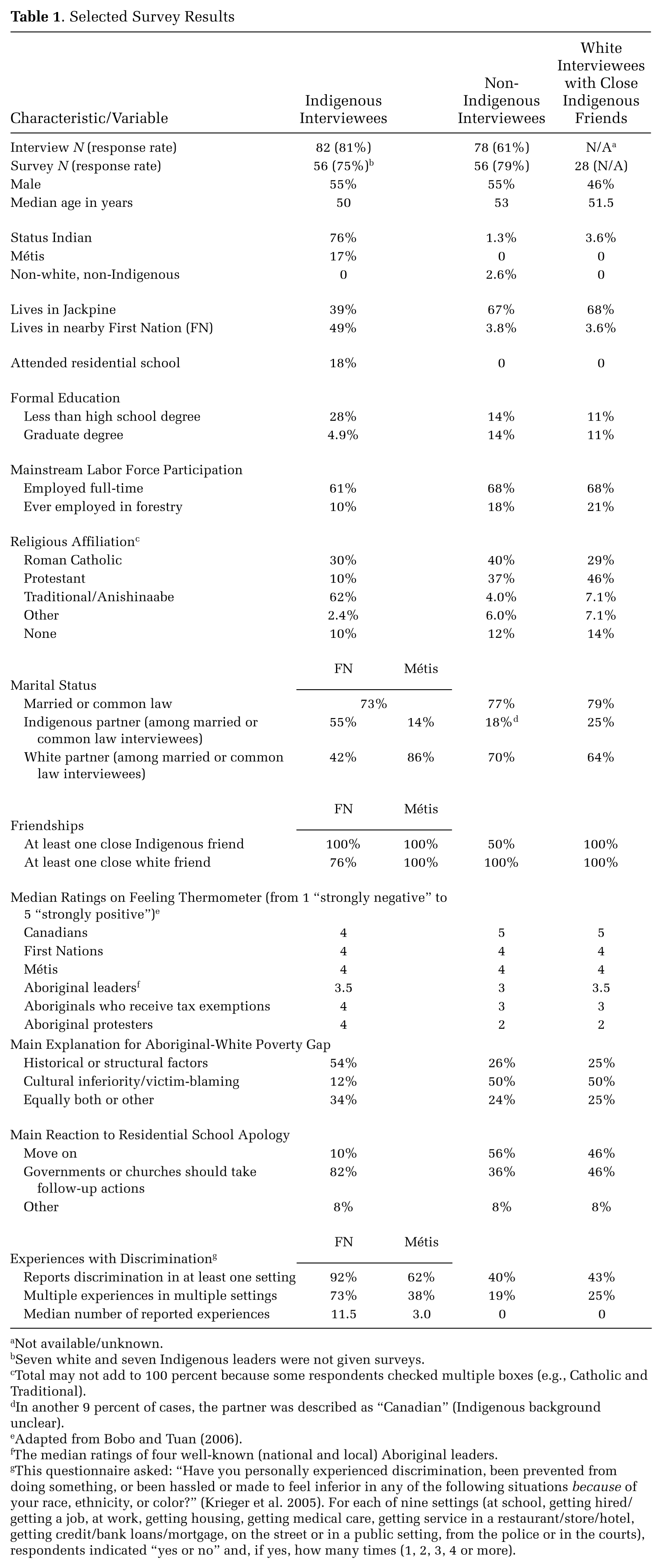
Participants also completed a short written survey, 13 requesting the race/ethnicity, gender, and occupation of their spouse (if relevant) and “five best friends” (proxies for contact). Standard measures of prejudice, including indicators of the sense of group position, were also included. For example, respondents rated their feelings toward various groups (Canadians, First Nations, and Métis), subgroups (Aboriginal protesters and Aboriginals who receive tax exemptions), and individuals (Aboriginal and non-Aboriginal political leaders). Negative affect toward an entire group (First Nations) is a sign of old-fashioned prejudice. More subtle differences in group ratings and negative affect toward specific subgroups (Aboriginal protesters) indicate group position prejudice (Bobo and Tuan 2006). Finally, interviewees completed a questionnaire asking how often they had personally experienced racial discrimination in each of nine settings (for selected survey results, see Table 1).
Selected Survey Results
Not available/unknown.
Seven white and seven Indigenous leaders were not given surveys.
Total may not add to 100 percent because some respondents checked multiple boxes (e.g., Catholic and Traditional).
In another 9 percent of cases, the partner was described as “Canadian” (Indigenous background unclear).
Adapted from Bobo and Tuan (2006).
The median ratings of four well-known (national and local) Aboriginal leaders.
This questionnaire asked: “Have you personally experienced discrimination, been prevented from doing something, or been hassled or made to feel inferior in any of the following situations because of your race, ethnicity, or color?” (Krieger et al. 2005). For each of nine settings (at school, getting hired/getting a job, at work, getting housing, getting medical care, getting service in a restaurant/store/hotel, getting credit/bank loans/mortgage, on the street or in a public setting, from the police or in the courts), respondents indicated “yes or no” and, if yes, how many times (1, 2, 3, 4 or more).
Although the survey provides quantitative evidence that contact coexists with prejudice, even at the individual level, the rich qualitative data flesh out the nature of group positioning and laissez-faire racism and illustrate the three core processes in action. Subtyping, ideology-based homophily, and political avoidance are not just internal psychological processes solicited by a survey or manipulated by an experimenter; they are routine social practices that uphold whites’ sense of group superiority. As the interview and ethnographic data will show, these routines cannot be understood in isolation; they interact and reinforce one another.
The theme of contact coexisting with prejudice emerged during fieldwork. After observing the three processes in some interactions, I began writing about possible interrelations and recording how often and in what contexts they occurred. Finally, I compared the responses of whites with and without close Indigenous friends to identify similarities and differences in racial attitudes and intervening processes. I established reliability and validity by triangulating among data sources and obtaining feedback from local community members. 14
The Paradox
By all measures, there is widespread contact in Jackpine. When asked “what brings Aboriginal and white people together,” residents listed dozens of “bridges,” including shared participation in local institutions (integrated public schools and the Catholic Church), cultural and recreational activities (sports and music), and volunteer programs (e.g., Healthy Living Food Box, a partnership between First Nations, Métis, and Ontario government agencies). They also cited local crises that have united Indigenous and settler peoples against a common enemy. For example, when provincial food inspectors tried to confiscate uninspected beef from white farmers in 2006, a nearby First Nation stored the meat on its reserve land where inspectors could not tread without federal permission. This neighborly move saved hundreds of meals while also reportedly improving relations with the agricultural community.
Intergroup mixing seems especially common among youth. At local Junior A hockey games, I often observed Indigenous and white children sitting together, chatting, sharing snacks, and high-fiving their Indigenous and white hockey-playing heroes as they headed to the dressing room victorious.
There is also a long history of intermarriage and friendship, stemming back to the fur trade. Among married or common law interviewees, roughly 1 in 5 whites had an Indigenous partner. Even more had children who were dating or married to Indigenous individuals. And 42 percent of Anishinaabe and 86 percent of Métis interviewees had a white partner. 15 Intergroup friendships are also common. When asked the racial/ethnic background of their five best friends, 50 percent of white interviewees cited at least one Indigenous friend, and 76 percent of Anishinaabe and 100 percent of Métis cited at least one white friend. Many interviewees also discussed their children’s cross-group friendships.
Nevertheless, prejudice and discrimination abound, evident in both the attitudes of whites and the numerous cases of discrimination reported by Indigenous residents. Although few interviewees (under 5 percent) expressed old-fashioned prejudice (categorical hatred of “Indians”), a majority endorsed laissez-faire racist views. They blame Native people for their social problems, reject policies designed to improve Native living conditions, and resent those who fight for Indigenous rights. When asked why Aboriginal families are three times more likely to be poor (according to Statistics Canada), at least half the white interviewees emphasized individualistic stereotypical explanations such as laziness, alcoholism, or welfare dependence. In contrast, 88 percent of Indigenous interviewees included structural (blocked opportunities) or historical (intergenerational trauma) factors as essential parts of their explanations. As Bobo and colleagues (1997) explain, victim-blaming attributions are one aspect of laissez-faire racism; if Aboriginal people themselves are responsible for their plight, then settler-Canadians, and existing policies and practices, need not change.
After the Prime Minister formally apologized for the residential school system in 2008, I asked interviewees how they felt about it. While most agreed an apology was necessary, whites tended to see it as a final act of “closure,” whereas Anishinaabe and Métis saw it as one step in an ongoing “healing journey.” When asked if follow-up action should be taken, 56 percent of white interviewees said we should “stop dwelling on the past” and “just move on,” whereas 82 percent of Indigenous interviewees specified concrete actions that the government, churches, or local authorities should do to “make good” on the apology.
Moreover, when asked to rate groups and individuals on a feeling thermometer, whites expressed clear signs of group position prejudice. On a one-to-five scale, from “strongly negative” to “strongly positive,” whites gave Canadians a median rating of five; First Nations and Métis a four; Aboriginal leaders a three; Aboriginals who receive tax exemptions a three; and Aboriginal protesters a two. Clearly, Indigenous people who challenge the racial structure—leaders, treaty rights beneficiaries, and especially protesters—are devalued relative to the dominant group, Canadians. 16 These attitudes were echoed in dozens of expressions of group superiority/entitlement and fear/threat throughout my interviews and fieldwork. For instance, white residents labeled Indigenous protesters “rabble-rousers,” worried that First Nations land claims would extend to their own homes and cottages, claimed that Indigenous peoples were incapable of governing themselves, and accused them of living in the past and receiving undeserved handouts at taxpayers’ expense.
Two distinctions should be made here. First, although prejudice is often directed at “Status” and “Treaty” Indians who have unique rights and benefits (e.g., tax exemptions and harvesting rights), many whites also resent Métis and non-Status Indians who have sought expanded rights. The logic is similar: Indigenous people who assert their rights or seek more power and resources are perceived as threatening. Second, some whites expressed different attitudes toward Indigenous people living on- and off-reserve; these opinions tended to surface during questions about the Indigenous-white poverty gap. Many whites recognize that remote northern reserves have limited job opportunities (a structural barrier). However, many whites blame Indigenous people for not moving south and assimilating, with a seeming lack of appreciation for how Indigenous identities are tied to the land. Many whites also assume that Anishinaabe and Métis living in town or on nearby reserves are as well off as whites, and when told that urban Indigenous people are still more likely to be poor, they attribute this to “laziness” or cultural deficits, overlooking the possible effects of labor market discrimination, educational barriers, and historical trauma.
While my aim here is not to generalize about population distributions, it is likely that my quantitative measures underestimate the overall degree of prejudice. Participation in the Right Relations Circle led to interviews with the most vocal antiracists, and some overtly bigoted whites declined interviews. Many whites also expressed more prejudiced views during interviews and informal conversations than they did on questionnaires.
In a 2008 interview, the Town Mayor claimed, “I don’t think racism exists in this area.” My discrimination survey, however, suggests racism not only exists but thrives. Over 90 percent of First Nations interviewees (versus 40 percent of settlers) reported personal experiences with racial discrimination in at least one setting (N = 142). Among Anishinaabe, 73 percent (versus 19 percent of settlers) reported multiple experiences in multiple settings. The median number of reported cases was 11.5 for First Nations and 0 for whites. 17
Several caveats should be noted. In nearly half the cases where settlers reported discrimination, the respondent’s group historically was racialized as non-white (e.g., Italian or Ukrainian), and the discrimination was by a “white” perpetrator. The remaining cases mainly referred to the perceived unfairness of treaty rights or employment equity policies, which some whites call “reverse racism.” Only a few whites reported being personally discriminated against by Natives; just as many conceded that they may have benefited from systemic racism.
In contrast, most Indigenous interviewees offered concrete, vivid accounts. After completing the survey, Simon, a local First Nations man in his late 20s, with fair skin, blue eyes, a white mother and an Anishinaabe father, shared his experience of trying out for the high school hockey team. The assistant coach (and history teacher) “didn’t look up” at Simon during roll call attendance, and when challenged about this disrespect, he forced Simon outside, “grabbed [him] by the collar, threw [him] against the locker, and yelled, ‘Listen here, you fuckin’ Indian: You’re not makin’ my hockey team and you’re not passin’ my class!’” This is one of more than 200 stories of reported discrimination, and Simon is keenly aware of the consequences. The experience led him to drop out of school, quit playing hockey, and (temporarily) deny his Indigenous ancestry. Although intergroup marriage and friendship are widespread, so too are prejudice and discrimination.
What explains the paradox?
Contact and Prejudice at the Individual Level
Perhaps there is a simple explanation: the 50 percent of white people in intimate contact with Indigenous people are not the prejudiced ones. In fact, although no white interviewees with close Indigenous friends or spouses expressed old-fashioned prejudice, at least half retained group position prejudice. For this subgroup of 28 whites, median ratings on the feeling thermometer were virtually unchanged (Aboriginal leaders rose to 3.5). A majority also expressed laissez-faire racism, blaming Indigenous people for their poverty and rejecting follow-up action on the residential school apology (see Table 1).
Some residents intuit a connection between contact and prejudice. According to one Anishinaabe man, whites “who have had relationships [with Indigenous people], long- and short-term, familial and non-familial . . . are more enlightened and understand that we’re in this together.” Confirming this view, the only white millworker who presented himself as “antiracist” was married to a Métis woman and cited her influence in changing his views.
On the other hand, Frankie, a white blue-collar worker in his 60s, exemplifies how contact, under the right conditions, may reduce old-fashioned prejudice without eliminating group position prejudice. Frankie attributes his changing attitudes to ongoing exposure to Native people in Alcoholics Anonymous (AA) meetings: Some of those stories [about residential schools] are just unbelievable. . . . I’ve been in AA meetings and . . . people will say stuff there that they’d never say anywhere else. . . . It’s just mind-boggling.
When asked if his views had changed as a result of these interactions, he responded, “Absolutely. . . . Before they were just drunken Indians, right? Now, they’re my friends.” This case seems to confirm the contact hypothesis, just as Allport described it: ongoing contact, under conditions such as those fostered at AA meetings—face-to-face, equal status in the setting, shared experience of working toward common goals, and an open supportive environment—is associated with less old-fashioned prejudice, at the individual level.
Nevertheless, despite moderating his views and making Native friends, Frankie continues to oppose policies that would alleviate structural inequities and insists that residential school survivors should simply “move on.” He further believes that Aboriginal poverty is due to laziness and that Aboriginal protesters are “criminals against Canada” who “oughta be in jail.” Although he empathizes with Indigenous individuals who experienced trauma, and even has Indigenous friends and extended family members, he still expresses a superior sense of group position, as a white Canadian.
Similarly, many whites on mixed hockey teams retain group position prejudice. On successful teams, contact conditions are optimal—face-to-face, equal status in the setting, goal interdependence, and coaching support for cooperation. Many white players befriend Native teammates, whom they praise for their hockey skills and to whom they surely would pass the puck to win. Yet, while these individuals are unlikely to express overt categorical anti-Native hostility, many still oppose treaty rights and compensation for historical injustices; some even tell racist jokes in the locker room. Within Jackpine, at least, contact effects are often limited to specific individuals or situations.
Closer analysis of whites who have Indigenous friends suggests that contact coexists with a range of intergroup attitudes, including paternalistic, resentful, and antiracist. Many residents are inconsistent in expressing their views, and attitudes do not always match behaviors. Some whites display an overbearing posture that assumes Indigenous peoples are incapable of managing their own affairs. Such paternalism is often expressed subtly, perhaps unintentionally, through use of a high-pitched tone and facial expressions connoting pity, and language equating Natives with property or dependents. Three white female interviewees with close Indigenous friends did this repeatedly. Many other residents, including some Métis, referred condescendingly to “Our Indians,” whom they say are better off than “northern” First Nations. While material prosperity may be somewhat higher on nearby reserves, the language of “Our Indians” and the view that proximity to a “mainstream” town is necessary for well-being presupposes white supremacy.
More generally, approximately half the white interviewees with Indigenous friends expressed laissez-faire or color-blind racism. Although they claimed to be egalitarian, saying we all should be treated “the same,” in the settler-colonial context, this translates into a rejection of treaty rights, a denial of Indigenous sovereignty, a blaming of Native people themselves (rather than historical or structural factors) for Native poverty, and antipathy toward those who exercise their rights or seek a greater share of power. When asked to explain Indigenous peoples’ higher poverty rates, one white resident said: Just no ambition. They have their kids, there’s a [welfare] check comin’ in every week . . . and they’re out gun-bootin’ it up . . . they give the kids [potato] chips and [soda] pop and “goodbye!” They’re probably their own worst enemy . . . you can give ’em a brand new house and they’ll have it wrecked in three years.
Although his own wife is Aboriginal, this interviewee blamed Aboriginal people for their poverty, combining stereotypes about laziness and irresponsibility with the conviction that nothing can be done to improve their living conditions.
Such views are often coupled with denial that racism exists. When asked if racism is “still a barrier for Aboriginal peoples,” a municipal politician with Aboriginal family members replied, “I don’t think around here . . . what I see is great respect.” Nevertheless, many residents who describe themselves as “color-blind,” such as my neighbor Ron, a white working-class male with a Native girlfriend, do, at times, express colored opinions. Over beer, Ron shook his head at the prospect of eliminating racism: “You can be friends . . . live with them and love them. But . . . white will always trust white, Native will always trust Native.”
In short, although a minority of white interviewees (15 to 20 percent) supported Indigenous rights and spoke out against racism, 18 just as many appeared confused or transitional, 19 and more than half of interviewees with Indigenous friends expressed paternalism or laissez-faire racism. Contact may reduce old-fashioned prejudice, but it alone does not eliminate group position prejudice. Three mutually reinforcing social processes—subtyping, ideology-based homophily, and political avoidance—sustain whites’ sense of group superiority and justifications for racial inequity.
Three Social Processes Maintaining Group Position Prejudice
Subtyping: “He’s Not Your Ordinary, Everyday First Nations Person”
One way whites reconcile their relationships with their views is through the social-cognitive process of subtyping. Individuals who violate stereotypes are interpreted as exceptions that prove the rule: “My best friend is Native, but he’s not your typical Native!” “We have good Indians in this town!” Such rationalizations are common (expressed spontaneously by 25 percent of whites with close Indigenous friends) and reinforce group position prejudice.
Among the many cases of subtyping in my data, an older, white, working-class couple, building on and affirming one another’s views, as discourse analysts (Durrheim and Dixon 2005) would expect, described the husband’s First Nations fishing partner as one such exception:
He’s not your ordinary, everyday First Nations person. He’s a graduate forest technician . . . a forward-thinking person.
He’s always inventing things.
And he tried his best to improve the lot of the people on his reserve and he was shunned—I think partly because he was doing too much good!
On another occasion, a retired white man—after learning my research topic over coffee—turned to his retired Native friend and said, “There aren’t many Natives like you, you know? A lot of ’em think they can run a business and next thing you know they run it into the ground.” The Native man (the only one in the room) lowered his eyes, shifted in his seat, mumbled something about education, and changed the subject.
In a third example, a middle-aged white man considered renting his cabin to a local First Nation Chief, asking after our interview if he was “one of the good ones.” He sought my opinion, as a white person, about the Chief’s trustworthiness. Ironically, the cabin owner himself has Indigenous ancestry, but he does not identify as such and has no interest in applying for Status.
Some Indigenous interviewees also alluded to subtyping and being offended by it. Naa-Gaabiinegee-zhig, a traditional man who once denied his Anishinaabe heritage, explained that when he got his “first job at the mill,” his “co-workers would say, ‘Yeah, but you’re a good Indian. You got a job.’” As a young man, this made him feel “real good,” but he later understood that this acceptance was conditional: “If you don’t assimilate, then there’s no approval process.”
As these examples suggest, subtyping is a taken-for-granted social practice that some settlers enact when thinking and talking about their Indigenous friends. While rejecting absolute racial categorizations, this process draws on shared images of what constitutes a “typical” or “good” or “bad” Indian. By viewing characteristics like forward-thinking, educated, entrepreneurial, trustworthy, and “doing good” as fundamentally “unIndian,” whites preserve the negative connotations of the larger “Indian” category and uphold their sense of group superiority. Perhaps most striking, while many residents view Indigenous protesters as “bad Indians,” local Indigenous residents (at least “assimilated” ones with jobs) are seen as “good Indians” because, as one Anishinaabe interviewee put it, they “know their place.”
Ideology-Based Homophily: “She Calls Me an Apple”
As Naa-Gaabiinegee-zhig suggests, subtyping is often based on (perceived) assimilation. Aboriginal persons who conform to dominant norms and values and do not openly challenge the racial structure may be socially accepted, whereas Indigenous activists are seen as a threat. Although racial segregation in friendship networks persists, as indicated by the 50 percent of whites who do not have close Indigenous friends and the 24 percent of Anishinaabe who do not have close white friends, ideology-based homophily—befriending others with similar racial ideologies, regardless of their race—is also widespread and reinforces residents’ biases.
Just as whites express diverse racial views, so do Indigenous people. Although most First Nations and Métis residents defend Indigenous sovereignty and treaty rights, a minority (10 to 15 percent) endorse color-blindness. While many are revitalizing their cultures, others are indifferent to tradition. Some, with mixed backgrounds or lighter skin, try to pass as white or cover their “Indianness”; others literally wear their identity, from beaded moccasins to “Native Pride” baseball caps. Although Indigenous Pride has been resurgent (Nagel 1995b), some still carry the scars of internalized racism, engraved through residential schools or other traumatic experiences and revealed today in stereotypes that some express about their own people, self-blaming explanations for poverty, and a tendency to buy into laissez-faire ideology. Such individuals often embrace and are embraced by whites who both subtype them and see them as validating their prejudice.
In one exchange between a Native man and his white wife of 35 years, the husband proclaimed, “She calls me an apple.” Grinning, his wife concurred, “He’s kind of red on the outside, white on the inside,” partly because, although he “doesn’t wear a watch,” he is always on time, whereas, according to the husband, “A lot of Native people don’t carry a time-clock” and are always late. As the interview proceeded, both husband and wife expressed and supported one another’s laissez-faire views, calling unemployed Natives “lazy” and dismissing follow-up action on the residential school apology.
Ideological affinity also appeared between two middle-aged female co-workers (one Native, the other white and married to a Native man), whom I interviewed in their shared office at a local Aboriginal organization. Explaining racial tensions, they said:
[W]hat happens [in this district] is everybody is so close, and they [whites] must see like we [Status Indians] don’t have to pay taxes, right? We can hunt wherever, whenever . . .
Well, I don’t know if this is racism, but I have a problem with some of that . . . like when these fish are spawning and these people are . . . taking all these fish.
And it’s Native people doing it!
And they’re killing off the species and they think it’s okay! 20
Yeah . . . I know I’m Native, but there’s a lot of Native people out there that complain about nothin’ for nothin’. And you can imagine how that gets to people.
Like I said, they bring it on themselves.
As in the previous case, the white resident’s laissez-faire views are co-constructed, elaborated, and validated by the Native friend, who is simultaneously portrayed as an exception. In this way, ideology-based homophily—facilitated by internalized racism among some Indigenous people—enables contact, even between spouses and equal-status co-workers, to coexist with group position prejudice. As one young Anishinaabe woman put it, intergroup bridges are often strongest among individuals who have been most thoroughly colonized.
Of course, Indigenous and settler people who identify as antiracist or pro-Indigenous rights also tend to associate with each other. When the Right Relations Circle (RRC), a small group of Anishinaabe, Métis, and white residents who joined together to promote “just and equitable” relations, organized the first-ever local antiracism walk in March 2008—attracting nearly 200 Indigenous and 100 non-Indigenous participants—new friendships formed. A First Nations woman in her 60s who had lived abroad for many years said she “met some wonderful people,” including a retired white woman whom she now meets regularly for tea. She also began attending RRC meetings, leading to further friendships with non-Indigenous neighbors who share a common commitment to racial justice.
To some extent, ideology-based homophily may derive from status characteristics other than race, such as education, occupation, or gender (McPherson, Smith-Lovin, and Cook 2001). Nevertheless, interviewees often perceived ideology as a bridging force. At least three intermarried couples referred to shared values when asked “what brought [them] together.” Similarly, when asked about their Indigenous friends, whites often mentioned a common worldview. 21 Among interviewees who expressed laissez-faire racism, ideology-based homophily almost always coincided with subtyping. For example, a white millworker in his 30s described his best friend, a similar-aged Native, as “the kind of guy I . . . respect” because he “graduated from high school . . . got married, had a kid . . . busted his ass . . . bettered himself . . . and now he’s working full-time in a gold mine.” Furthermore, “he has a real problem with the Natives that abuse the system . . . maybe because he had the same opportunities and took advantage of them.”
As Hewstone and Brown (1986:6) note, economically successful “token” minorities may be seen as “proof that [minorities] in general are not oppressed or discriminated against, but are just ‘too lazy.’” By viewing some Indigenous individuals as exceptions, whites can continue blaming Indigenous people in general for their poverty, opposing compensation for historical injustices, and resenting those who refuse to assimilate. Moreover, when Native friends or spokespersons endorse the dominant ideology and disparage fellow Indigenous people, it bolsters their status as “good Indians” and further reinforces whites’ prejudice (e.g., “If my Native friend says it, it must be true!”). 22
Political Avoidance Norm: “We’ve Never Ever Talked about It. And We Don’t Want to Talk about It”
Perhaps more surprising is the degree to which Indigenous and white residents who disagree on fundamental issues tend to live, work, and play together without much open conflict. This situation is facilitated by a local community norm of separating the interpersonal from the systemic, such that daily interactions are typically congenial, but political and economic tensions—the material bases of group position prejudice—fester for years. 23
Whereas many whites view treaties, land claims, and self-government as “boundaries” to better relations, many Anishinaabe and Métis say the “real” boundary is ignorance of and disrespect for their histories, rights, and worldviews. These conflicting frames constitute an important barrier. Yet, the lack of public discussion concerning these issues may be the biggest barrier of all, and this local culture of political avoidance enables both the persistence of laissez-faire racism and (seemingly) friendly, cooperative cross-group relations. 24
A middle-aged white male with many Indigenous friends and relatives, whose family settled in Jackpine generations ago, articulated this principle well: The way I look at it, you’ve got the formal structures: organizational and political. And those are . . . very rigid. First Nations have their own aspirations, their own agendas. . . . Underneath . . . there’s all this intermarriage. . . . You’ve got friends and family, they’re all First Nations, non-First Nations. . . . My daycare lady for my kids . . . she’s [Native]. I don’t know how you reconcile that. Usually we just let the politics roll. . . . We keep our lives separate. . . . Politics has got nothing to do with my hockey team [or] family. . . . When we have Christmas dinner, [my Native relatives] and I don’t talk about the politics. You know, we’ll be in a [business] meeting . . . and that’s what they’ve gotta do, but after the meeting, we’re family.
This resident, like many others, consciously tries to separate the “system,” where political and economic conflict is rife and laissez-faire racism prevails among whites, from the “lifeworld” of family, friends, sports, and entertainment (Habermas 1984). This powerful norm of political avoidance discourages open discussion of racism and colonialism and helps maintain the daily appearance of racial harmony, despite continuing structural inequities. 25
Whites are particularly likely to adhere to this norm, perhaps out of perceived interest in maintaining the status quo. When I began my research, no one spoke publicly of racism. Many Indigenous residents wished to speak with me privately. Some whites denied there was a problem: “If you want to see racism, go to [Maple].” Others expressed prejudice “backstage” (e.g., at all-white dinner parties) but were guarded in public.
One Métis woman described her husband, a white schoolteacher, as “prejudiced against Natives.” When asked how their marriage was possible, given her proud heritage, she said he sees her as “different” (subtyping) and they “agree to disagree” about politics. She encouraged her husband to be interviewed, but he “refused. He doesn’t want to talk about it. I told him ‘Jeff needs to hear your views to get a true picture of how people feel.’ But he just said no.” 26
Some Indigenous residents also avoid such conversations or alter their behavior in public, which may lead whites to perceive exaggerated ideological similarity. An older white millwright recalled asking a First Nations friend about his initiatives “to promote . . . job opportunities on the reserve” and receiving “a vague answer” because he “doesn’t talk too much about that sort of thing.”
During an interview with an Anishinaabe man who argued passionately for Indigenous sovereignty, two balding white men entered the coffee shop. “How ya doin’, Mike?” one said, taking a nearby seat. Half-smiling, Mike waved back: “Pretty good!” He then faced me directly, pulled his chair closer, and continued at a lower volume. I soon discovered that the men were local municipal politicians with vastly different racial ideologies. Publicly, however, they are on a friendly first-name basis. This interviewee later explained that although Jackpine whites compare themselves favorably with “places like [Maple]” (where he used to live): [Jackpine] isn’t immune to [racism] . . . the fundamental issue has always been that we’ve never ever talked about it. And we don’t want to talk about it. We don’t. [emphasis added]
By not talking about racism, residents maintain a balance whereby prejudice and discrimination coexist with daily positive contact.
The Tenuous Balance of Small-Town Indigenous-Settler Relations
The problem is that the balance is tenuous; normally unspoken tensions could boil over at any moment—as in 2008, when the town’s reputation was challenged after six white teenage girls, all members of the esteemed high school hockey team, posted an online video of themselves dancing to powwow music, holding liquor bottles, and mocking Native accents. In the ensuing controversy, many whites denied and minimized the racial implications, whereas many Indigenous residents saw it as the last straw.
For whites, the dominant interpretation (over 75 percent) was that this was a case of “silly girls” making a youthful indiscretion, or an “isolated incident” being “blown out of proportion” by the media. For Indigenous residents (over 75 percent), it reflected the broader, ongoing problem of racism. Five First Nation communities removed their students from school and held emergency community meetings. The Right Relations Circle organized a public forum and antiracism walk (Biimosetaa: Walking Together to Overcome Racism). Letters to the editor flooded the local newspaper. Friendships and marriages began to break apart.
Of the six girls and their families, only one parent agreed to an interview. She said her daughter had become estranged from Native friends and struggled to finish the school year (but notably remained best friends with a Native girl). Three Indigenous parents described how their daughters ended friendships with “the video girls.” A woman of mixed descent said her husband, a “full-blooded Native,” became upset when she downplayed the video, telling her she would never understand because she is a “mutt” (derogatory name for Métis). She left him, temporarily, because of this incident.
Within weeks, however, inertial forces prevailed—ironically, with the aid of an Anishinaabe healing ceremony in which the six girls listened as Indigenous people of all ages explained why the video was offensive and what the powwow meant to them. The girls were given a chance to apologize; they denied hurtful intentions but said they were sorry. They were then formally forgiven and a drum song was played to honor them.
Virtually every interviewee agreed the healing ceremony was an appropriate response. However, it also inadvertently made racism seem, once again, taboo for public discussion. Traditionally, after a healing ceremony has concluded, it is considered inappropriate to discuss the offence that led to it. When debates continued in the media, an Anishinaabe elder who helped organize the ceremony wrote the local newspaper, pleading for residents to “move on.” While it would have been unfair to scapegoat the girls, the promising public dialogue on the broader issues of racism and colonialism also ground to a halt. 27
How Settler-Colonialism and Small-Town Dynamics Matter
Although subtyping, ideology-based homophily, and political avoidance could occur anywhere, these processes may be especially salient in Jackpine and other “border towns” due to historical and structural conditions. They are synergistic forms of “boundary work” (Lamont and Molnár 2002) facilitated by settler-colonialism, particularly in small-town contexts.
In this case, Indigenous individuals who historically were denied Status by the Indian Act often tried to assimilate, in part, by distancing themselves from Status Indians. Until 1982, the Métis were not even recognized as Aboriginal peoples. In Voyageur District, some joined local First Nation communities and legally became “Indian” (due to the unique “half-breed adhesion” in Treaty 3), while others lived in town and identified as white. Residential schools further divided Indigenous peoples, between those who internalized the assimilationist messages and others who resisted. Economic dependence has generated another ideological rift. Indigenous residents who economically benefit from forestry may be less likely to “rock the boat.” Such intra-group divisions create abundant opportunities for subtyping and ideology-based homophily.
Meanwhile, residential schools and conservative church/missionary teachings have fostered political avoidance by emphasizing obedience to authority. The demographic reality of minority status and the history of state-sanctioned violence against Indigenous peoples further dissuade public discussions of racism and colonialism. Yet, the current Indigenous population boom, growing sense of empowerment from cultural revitalization, and recent court decisions affirming Aboriginal and treaty rights may enhance Indigenous peoples’ willingness to assert their interests and openly challenge the system.
Nevertheless, the lack of anonymity in small-town settings is a powerful countervailing force. Indigenous and white residents alike call Jackpine home. They agree it is a great place to raise a family; they love the lakes, forests, and seasons; and they often have deep roots in the region. As much as some Anishinaabe wish the “Whiteman” never “discovered” Turtle Island, most realize the world has changed and settlers are here to stay. As much as some whites want to believe “real” Indians have vanished, many realize that Indigenous peoples and their cultures are also here to stay. Therefore, residents tend to avoid “sensitive issues,” because they know they have to live with the neighbors they offend. As a result, racism and colonization are rarely discussed.
Conclusions and Future Directions
This article confirms central tenets of Allport’s contact hypothesis, while highlighting the limits of contact for overcoming group position prejudice and laissez-faire racism. In the small-town, settler-colonial context of Northwestern Ontario, amid widespread intergroup marriage and friendship, many whites still blame Native people for Native poverty and oppose policies to rectify injustices, and over 90 percent of Anishinaabe report personal experiences with racial discrimination. Although contact is associated with less old-fashioned prejudice, it does not diminish whites’ superior sense of group position, at least, in part, because the historically rooted racial structure remains intact. So long as systemic racism and colonialism persist, many dominant group members—including whites with Indigenous friends and family members—will be motivated to maintain their power, resources, and status. This wider context can infringe on contact situations, inhibiting the generalization of contact effects, even when Allport’s conditions appear to hold within the setting (e.g., in AA and sports teams).
Building on group position theory and the subcategorization model of intergroup contact, and selectively utilizing critical-discursive analytic tools, this article shows how three mutually reinforcing social processes contribute to the reproduction of group position prejudice: subtyping, whereby individuals who violate stereotypes are seen as exceptions that prove the rule; ideology-based homophily, whereby individuals befriend others who appear to share their racial ideologies, regardless of their race; and a political avoidance norm, whereby the interpersonal is separated from the systemic and public discussions of racism are taboo. These processes jointly enable many whites to maintain a superior sense of group position, despite daily and often positive contact with Indigenous individuals. Specifically, whites tend to subtype Native friends who seem to share (and thereby validate) their racial ideologies, and political avoidance in daily interactions exaggerates the appearance of ideological affinity, keeping racial tensions bottled up backstage, so that when the avoidance norm is breached in a crisis, most whites (and some “good Indians”) deny and minimize the racial implications and urgently attempt to restore “order.”
Future research should assess whether and how these processes play out in other contexts, including urban settings and outside North America. A systematic comparison with Maple or another town with a reputation for overt racial conflict could be beneficial. One could also analyze Indigenous-settler relations in separate domains (e.g., school, work, or recreation) to pinpoint when and where the intervening processes operate. Although some might view the workplace as a promising venue for reducing prejudice, this seems unlikely, as many workplaces today do not meet Allport’s conditions for contact (Dixon et al. 2005; Hamberger and Hewstone 1997). Even where Indigenous and white co-workers have relatively equal status and common goals, the former may be subtyped as “good Indians,” especially if they condone laissez-faire views; alternatively, relevant discussions may be avoided in the interests of “team spirit.” 28
According to some models, contact may reduce prejudice because it personalizes “the other” (Miller and Brewer 1984) or facilitates recognition of similarities and development of a common superordinate identity (Gaertner and Dovidio 2000). Yet, this is insufficient in a settler-colonial context where group position prejudice is expressed in part through refusal to acknowledge cultural diversity and Indigenous and treaty rights. The subcategorization model’s emphasis on intergroup interaction (Brown and Hewstone 2005) seems more pertinent here. Yet, the norm in mixed sports teams and treatment settings (and many intermarriages and friendships) is that such differences are irrelevant and should be set aside; while this may create a sense of “we-ness,” undermining old-fashioned prejudice, it also reinforces the view that “we” are all Canadian and should be treated “the same.” Such outcomes may be desirable where groups simply seek acceptance in mainstream society, but they are inadequate to the struggle for Indigenous sovereignty and rights. Institutional support for contact and integration does not necessarily mean support for antiracism, let alone decolonization.
According to Blumer (1958:6), group positions are formed through an ongoing process of social definition that occurs mainly in the “public arena.” Overcoming racism will thus require strong institutional leadership and alternative media and political discourse (Taylor 2000). Rather than norms of silence, which more deeply entrench laissez-faire attitudes and structural inequities, “explicit peer-group norms” (Hewstone and Brown 1986:17) may be needed that support racial justice and Indigenous rights, along with a popular antiracist, anticolonial movement that directly challenges existing power relations (Bobo 1999; Bonilla-Silva 2010; Feagin 2010) and “shared frameworks for constructing the meaning of our relationships” (Durrheim and Dixon 2005:82). In winter 2013, precisely such a movement began to emerge, as Indigenous peoples and settler-allies gathered in towns, cities, and reserves across Canada to promote Indigenous self-determination and environmental protection. Although the provocatively titled “Idle No More” movement has exposed cracks in the settler-colonial foundation, its long-term impact on contact experiences, group positioning, and the three social processes emphasized here awaits the verdict of history and future assessment.
Footnotes
Acknowledgements
Previous drafts were presented at the American Sociological Association, Canadian Sociological Association, and Eastern Sociological Society conferences, a National Gathering of Graduate Students in Aboriginal Health Research, and Harvard University workshops. Thanks to Christopher Bail, Lawrence Bobo, James Fenelon, Michèle Lamont, Neil McLaughlin, Angela Pietrobon, Leanne Son Hing, Van Tran, Jason Turowetz, Mary Waters, Frederic Wien, William Julius Wilson, and ASR reviewers for constructive feedback. Special thanks to research participants. Any errors are my own.
Funding
This research was funded by the Harvard University Native American Program, the National Science Foundation (Grant #0927042), the Social Sciences and Humanities Research Council of Canada, and the Weatherhead Center for International Affairs, Canada Program.
Notes
References
Supplementary Material
Please find the following supplemental material available below.
For Open Access articles published under a Creative Commons License, all supplemental material carries the same license as the article it is associated with.
For non-Open Access articles published, all supplemental material carries a non-exclusive license, and permission requests for re-use of supplemental material or any part of supplemental material shall be sent directly to the copyright owner as specified in the copyright notice associated with the article.
