







Abstract
Bureaucratic and patrimonial theories of organized crime tend to miss the history and mobility of crime groups integrating into and organizing with legitimate society. The network property of multiplexity—when more than one type of relationship exists between a pair of actors—offers a theoretical and empirical inroad to analyzing overlapping relationships of seemingly disparate social spheres. Using the historical case of organized crime in Chicago and a unique relational database coded from more than 5,000 pages of archival documents, we map the web of multiplex relationships among bootleggers, politicians, union members, businessmen, families, and friends. We analyze the overlap of criminal, personal, and legitimate networks containing 1,030 individuals and 3,726 mutual dyads between them. Multiplexity is rare in these data: only 10 percent of the mutual dyads contain multiplex ties. However, results from bivariate exponential random graph models demonstrate that multiplexity is a relevant structural property binding the three networks together. Even among our sample of criminals, we find dependencies between the criminal and personal networks and the criminal and legitimate networks. Although not pervasive, multiplexity glued these worlds of organized crime together above and beyond the personalities of famous gangsters, ethnic homophily, and other endogenous network processes.
Keywords
Fascination with organized crime teeters between the vilification of violent criminals and admiration for their novel entrepreneurial response to certain market demands. While the general public and the academy decry violent gangland massacres and contract killings, the collection of tributes, infiltration of unions, and rigging of elections represent a creative, albeit illegal, pursuit of the American Dream (Bell 1953; Merton 1938). This rags-to-riches interpretation of organized crime was showcased in Merton’s (1938) classic essay, “Social Structure and Anomie,” in which he references Al Capone by name as the exemplar of social ascent via corrupt means. Subsequently, empirical and historical research on the subject of organized crime has focused on the contours of the criminal world: the hierarchy and patronage of criminal organizations, the characters within those organizations, and the violence between them. The reality of the integration of crime within larger society gets lost somewhere within the storied world of garlic bullets and fedora-clad gangsters.
Rather than view organized crime as a one-dimensional network of criminal activities, we begin with the notion that organized crime is defined by its position relative to noncriminal elements of the social world. We argue that organized crime does not refer to just a group of criminals; instead, organized crime comprises the interrelationships among criminal networks, legitimate networks, and personal networks—organized crime exists at the interstices of these seemingly disparate social worlds. Ordinary criminal groups become organized when they buy off police officers, fix ballot boxes, replace union presidents, call in favors, and bestow generosity upon friends in high places. Actions such as these necessitate ties across different social domains and sometimes build on or leverage a preexisting relationship.
The network property of various types of relationships existing between a pair of individuals, such as two co-workers who are also friends, is known as multiplexity (Kadushin 2012:202; Verbrugge 1979; Wasserman and Faust 1994). Unlike social processes that expand networks by reaching out to new actors, multiplexity adds depth to social relationships by building on the existing tie between a dyad. Multiplexity can provide a foundation for trust based on the logic that the new relationship stacks on top of prior relationships, thereby reducing uncertainty and increasing reciprocity (Gondal and McLean 2013; Kadushin 2012:37; Uzzi 1996). For example, when parents rely on kin for childcare, they are stacking an exchange of services on top of a close trustworthy familial tie. The second relationship develops because of the foundation provided by the initial relationship, and the addition of the caregiving role on top of the familial role layers new obligations and expectations.
Multiplexity is an important characteristic of organized crime that generates both its unique character and a unique set of problems. On the one hand, multiplexity organizes criminal groups’ pursuit of the American Dream through connections to the legitimate world. Organized crime reaches beyond the network of gangsters and criminals when it sells illegal goods and services to the noncriminal public or when it invests dirty money into legitimate businesses. On the other hand, the costs of failure for multiplex ties are higher, as exposure can lead to apprehension or death. Organized crime represents a unique case, because cultivating multiplex ties requires individuals to “trust thy crooked neighbor” 1 —a context in which quick cash and shady dealings require people to trust each other, even when corruption and violence are tools of the trade.
We explore multiplexity at a moment in U.S. history when the boundaries between the criminal and legitimate worlds dramatically shifted—Prohibition Era Chicago. Prohibition legislation introduced an invasion of home and leisure that spawned unprecedented integration of crime into legitimate society: politicians adopted anti-Prohibition platforms, judges had access to the best Canadian imports, law enforcement salaries multiplied through bribes, and imbibing Chicagoans declared their bootleggers local heroes. Needing a place to move cash, bootlegging profits fueled legitimate and illegitimate investments in unions, political campaigns, and small businesses that resulted in new overlapping social spheres. Historical accounts and biographies shed light on aspects of Chicago’s Prohibition Era multiplexity, but to the best of our knowledge this case has never been subjected to a relational analysis highlighting the scope, incidence, and structural importance of overlapping social ties. To this end, we created a relational database connecting more than 3,000 individuals and their 15,000 social ties to some aspect of early 1900s Chicago organized crime. Our archival database captures over 100 different types of social interactions and associations, including actors beyond the boundaries of more traditionally defined criminal networks.
This study has two primary empirical objectives. First and foremost, we map the ways multiplexity defined organized crime in Prohibition Era Chicago. Analyzing these networks descriptively permits a precise assessment of the prevalence of multiplexity in organized crime. Second, we use bivariate exponential random graph models to assess how multiplexity structurally contributed to Prohibition Era networks. This second objective speaks to the overlapping dependencies across the networks under conditions in which trust was paramount and, as the title of our study suggests, potentially suspect. Our findings show that multiplexity was rare but relevant in organized crime. Although only 10 percent of mutual dyads across our networks contained multiplex ties, these multiplex ties integrated the criminal, legitimate, and personal networks. Accordingly, results from our statistical models show that multiplexity was a strong property undergirding all three networks.
Our findings have implications for the study of organized crime and the study of social networks more broadly. With regard to organized crime, our results highlight the ways multiplexity links the underworld and mainstream society—a process that organizes crime into mainstream society and, specifically, institutionalized Prohibition networks within the city of Chicago. Our findings on the rarity of multiplexity highlight the difficulty of locating trustworthy bridges when one cannot trust just any crook, neighbor, or politician, even when multiplexity brought the spheres of organized crime together. To the broader field of social network analysis, our findings demonstrate that multiplexity can integrate disparate social worlds, especially under conditions of uncertainty and risk (see also adams, Moody, and Morris 2013). For example, Gould’s (1991) study of the Paris Commune demonstrates that even revolutionary activity, commonly thought to derive mainly from political affinity, relies heavily on informal neighborhood and peer associations. This logic extends to grassroots mobilization, community organizing, fringe social movements, and other networks that hope to ascend from the ranks of the informal to the formal.
Multiplexity and Organized Crime
Multiplexity refers to the network property of two actors directly linked in more than one way or through more than one type of relationship (Wasserman and Faust 1994). This can manifest as (1) role multiplexity, where individuals occupy multiple social positions that provide different relations to others, such as two people who are co-workers and also friends; or (2) content multiplexity, where multiple flows of resources, information, and influence exist between two actors, such as an exchange of money and an exchange of services (Beggs, Haines, and Hurlbert 1996; Kadushin 2012:36). Multiplex ties tend to be strong ties in that the social relationship has multiple bases, and strong multiplex ties can serve as a foundation for trust, obligation, and reciprocity (Gould 1991; Kadushin 2012:37; Krohn, Massey, and Zielinski 1988; Uzzi 1996).
The prevalence and relevance of multiplexity speak to classic theoretical debates in sociology and Western thought on cohesion and community versus alienation and modernity (e.g., Durkheim [1893] 1984; Tönnies [1887] 1957). Anthropological studies and historical research examine multiplexity as an essential feature of clan societies and rural communities—a situation in which economy, leisure, politics, and religion revolve around the family (Blok 1974; Coontz 1988). In contrast, multiplexity should be less common in industrial urban society, where a complex division of labor and bureaucratic institutions replace many interpersonal relationships (Pescosolido and Rubin 2000; Simmel 1955). Rather than rely on kin or neighbors for economic exchanges and social leisure, denizens of industrial society access institutions to meet their needs. Whereas interpersonal interactions require trust, obligation, and reciprocity, trust in institutional interactions is supplanted by regulation, coordination, and procedure (Cook, Hardin, and Levi 2005).
Empirical research on personal networks in contemporary urban settings challenges the loss of community hypothesis by showing how technology and urbanism have expanded the number of social ties in personal networks (Fischer 2011; Parigi and Henson 2014; Wellman 1979). As personal networks have increased in size, they have also become more diverse and more sparsely connected, but this does not mean a loss of close personal ties (Bott 1957; Fischer 1982). Rainie and Wellman (2012) show that technology enhances some of our social ties through increased face-to-face contact, and intimate and multiplex relationships still make up an important part of large personal networks (Fischer 1982). When personal networks expand by reaching out to new actors, multiplexity continues to matter by adding depth to previous relationships. The contrast, however, is that the proportion of multiplex ties shrinks as the size of personal networks grows. Even 100 years ago, when social ties were not Facebook friends and Starbucks baristas, urbanism and capitalism expanded personal networks to include service providers, tenement neighbors, and co-workers. The number of ties grew considerably, but these new ties were not necessarily as emotionally potent as strong multiplex ties.
The empirical crux of understanding the prevalence and relevance of multiplexity rests on how we conceive of and measure social ties. Not surprisingly, empirical research using different measurement strategies has produced varying results on the prevalence and relevance of multiplexity. Some scholars have found that particular configurations of multiplex ties are abundant within certain groups (Heaney 2014; Lusher et al. 2012; Quintane 2013; Verbrugge 1979), whereas other scholarship has found configurations of relationships under which multiplexity is absent (Huitsing et al. 2012). Heaney (2014), for example, finds that the multiplex ties of communication, coalitions, and shared issues shape influence networks among U.S. health policy interest groups. Research also shows that the relevance of multiplex ties depends on organizational contexts (Zhao and Rank 2013), particular configurations of ties (Lazega and Pattison 1999), or areas within a network structure (Gondal and McLean 2013). Lazega and Pattison’s (1999) study of corporate lawyers, for instance, finds that multiplexity was likely between co-work and advice ties and advice and friendship ties, but not between co-work and friendship ties.
In certain contexts in modern life, however, multiplexity should be especially relevant even when it is rare: when institutions are poorly regulated or ill-functioning, interactions include some degree of risk, or institutions and interactions exist outside the formal legal system. During periods of uncertainty, actors prefer to activate preexisting relationships rather than form new ones, and multiplex ties provide a foundation for trust that can reduce risk and mobilize action (Brass et al. 2004; Gondal and McLean 2013). For example, in contemporary markets, multiplexity can provide the trust needed for high-risk investments. Uzzi (1996) finds that CEOs were only willing to invest in startup companies with which they had previous personal relationships. Trust, in this case, was “voluntary” and “nonobligating” but promoted reciprocity and negotiation (Uzzi 1996:678). Residents of high-crime communities often engage in informal means of social control that emphasize multiplex family, neighbor, and religious affiliations over depersonalized appeals to the formal legal system (Pattillo 1998; Venkatesh 2006). Trust and obligation can offset the certainty and security found in regulations and formal contracts, and, although not always the case, multiplex relationships tend to be trusting relationships. The perceived absence, failure, or irrelevance of formal institutions shifts the importance away from formal regulation and toward the trust found in multiplexity.
Avoiding multiplexity can be strategic. Padgett and Ansell (1993) find that the rise of financial markets in Renaissance Florence was the result of Cosimo de Medici’s management of multiple banking, marriage, and financial networks among elite political families. Medici’s success as a multifaceted actor hinged on his position within multiple types of relationships; yet, unlike the oligarchs, Medici’s network almost completely avoided multiplex ties. 2 This avoidance of multiplex ties, and the increased obligations that multiplex ties require, served as the basis for “robust action” (Padgett and Ansell 1993). Medici was embedded in multiple types of relationships, but he avoided the redundancy of multiplexity, thus facilitating his capacity to enact diverse strategies across the Florence elite. 3
Multiplexity defines organized crime while also producing a unique tension. Organized crime requires opportunities and resources, and infiltrating new domains expands networks in terms of players and relationships. In the legitimate business world, large sparse networks often provide access to diverse resources (Granovetter 1973). Organized crime groups, however, expose themselves to surveillance and legal prosecution by definition of the illicit nature of their activities. To avoid detection, organized crime must privilege trust and concealment over efficiency, which, as Baker and Faulkner (1993) point out, requires denser and smaller networks. Building on established relationships allows organized crime to access resources from multiple trusted spheres while keeping relationships close. For example, Ianni and Reuss-Ianni’s (1972) ethnography of the “Lupollo” New York Italian crime family demonstrates that the organization contained overlapping business and criminal relationships between family members. The multiplex nature of the organization was so pervasive that it was captured in the lesson of trust passed down by the Lupollo patriarch, “Pop always said that he trusted Italians more than Americans, Sicilians more than Italians, his paisani [countrymen] more than other Sicilians but most of all he trusted family” (Ianni and Reuss-Ianni 1972:72). One does not simply embark on an illegal enterprise with a stranger, but rather with someone who is trusted. When risky interactions require trust and concealment, criminal ties are likely to coexist with noncriminal ties—a multiplex outcome that can organize crime.
Organized Crime in early 1900s Chicago
At the turn of the twentieth century, organized crime in Chicago and across the United States revolved around the illicit economies of gambling and prostitution. Much to mobsters’ delight, a third economy opened in 1920: the prohibition of the manufacturing, sale, and transportation of alcoholic beverages. During the short 14 years of Prohibition (1920 to 1933), organized crime rings retooled their operations and redirected their resources to exploit the new economic opportunity of booze. These were not peaceful times. Bootlegging crews divided the city of Chicago into distribution territories that required armed protection to deal with price gouging, theft, and double crossing (Landesco [1929] 1968). Additionally, Chicago’s organized crime groups strong-armed themselves into unions, politics, and protection rackets, developing ruthless reputations that still haunt the annals of U.S. history.
During Prohibition, Chicago’s best-known gangster, Al Capone, ascended from brothel doorman to Syndicate boss. Capone’s crew, and others like it, kept the liquor and beer flowing through Chicago, for which Capone described himself as a “public benefactor” (Chicago Daily Tribune 1927:1). In 1931, two years before Prohibition ended, Capone was tried and found guilty of tax evasion and received the longest sentence ever handed down for tax fraud by a judge at that time. Yet, even during Capone’s imprisonment, the criminal organization he had managed and helped build was bequeathed to a lineage of mobster bosses who continued to make violent and infamous names for themselves.
Organized crime in Prohibition Chicago was a story of friendships and favors among disenfranchised groups trying to go legit via risky and illicit entertainment businesses (Boissevain 1974; Haller 1971). Success in bootlegging, prostitution, and gambling required knowing when and where raids would occur, ensuring that the top guys of the Syndicate were not present during those raids, knowing which agents would take a bribe, and guaranteeing that prosecutors never had enough evidence to convict. In turn, this success in the organized crime economies permitted legitimate investments ranging from small businesses, such as dog racetracks and dry cleaning shops, to political campaign donations. These investments opened up new legitimate spheres to organized crime individuals, who were sending their children to private schools and purchasing vacation homes, but the criminal sphere and its dirty money continued to require concealment and protection.
Bootleggers, politicians, mob bosses, and businessmen crossed these worlds with regularity and with intention. Although we knew about this overlap descriptively (Landesco [1929] 1968), we did not have a systematic mapping of these networks until now. By expanding our focus to sets of relations beyond these gangsters, this study provides an inroad to understanding not only the deeper structures of organized crime, but the role of multiplexity for legitimate society as well. The dance between the licit and illicit worlds requires actors to privilege secrecy over efficiency, although, as we show in the next section, a unique tension arises when multiplex relationships are employed.
A Multiplex Ego-Network Example
Before turning to our data and statistical models, we describe a detailed example of multiplexity in our database to illustrate how multiplexity facilitated the daily schemes and covert operations of organized crime in Chicago. Daniel Serritella was a corpulent Italian with many friends and many scandals. His long political career began in 1920 at the young age of 25, when Serritella, then owner of two Chicago newsstands, was voted union president of the Newsboys’ Protective Association. During this time, Serritella’s friends encouraged the “young newsie” to run in the 19th Ward alderman election, under the ambiguous platform of “everything that’s good for America”—a campaign that produced little more than a short headline (Chicago Daily Tribune 1920:17). Serritella’s political importance grew in 1927 when “Big” Bill Thompson won his second term as Chicago mayor and appointed Serritella to the position of City Sealer and First Ward Republican Committeeman. Given the known connection between Al Capone and Mayor Thompson, these appointments generated accusations of Capone buying Serritella’s position with contributions to Thompson’s election funds. When and where Serritella and Capone cultivated their friendship remains unclear, but Serritella was a guest at Capone’s Miami Beach house, attended Capone’s sister’s wedding, and traveled to Cuba with top guys of Capone’s Syndicate.
A Robin Hood-like benefactor to the First Ward, Serritella and his deputy, Harry Hochstein, were embroiled in a weight shorting scandal involving Chicago’s food markets. The City Sealer’s Office would grant political immunity to grocers found guilty of short weighting their scales if the grocers contributed food donations to Christmas baskets for poor residents of the First Ward. When this scandal went to court, the prosecution estimated that in 1930 alone, the short weight scandal cost Chicago shoppers $54 million in lost groceries (Chicago Daily Tribune 1931). The prosecution also established that a truckload of duck meat had been diverted from the First Ward Christmas baskets and sent instead to a soup kitchen operated by Capone. In a balmy May courtroom amid piles of rotting meat used as evidence, the jury found Serritella and Hochstein guilty. One year later, the appellate court repealed the conviction. In spite of his friendships with gangsters and several corruption scandals, Serritella’s long political career continued when he became state senator. All the Windy City politicking eventually ended when Serritella was committed to a hospital and declared mentally ill at the age of 55.
Serritella’s total ego-network (i.e., his direct associates and their ties) included 33 nodes and 133 criminal, personal, and legitimate ties between those nodes: 109 mutual dyads (82 percent) were a single type of tie, 19 mutual dyads (14 percent) contained two types of relationships, and 5 mutual dyads (4 percent) contained all three relationships. The majority of mutual dyads in Serritella’s ego-network were not multiplex. However, Serritella’s position between the political and criminal worlds facilitated many multiplex opportunities. To illustrate how multiplexity generates organized crime networks, Figure 1 plots the criminal, personal, and legitimate ties onto a subset from Serritella’s ego-network, which includes only the 24 multiplex ties that existed in his ego-network and then adds in only the single-plex ties among this reduced set of alters.
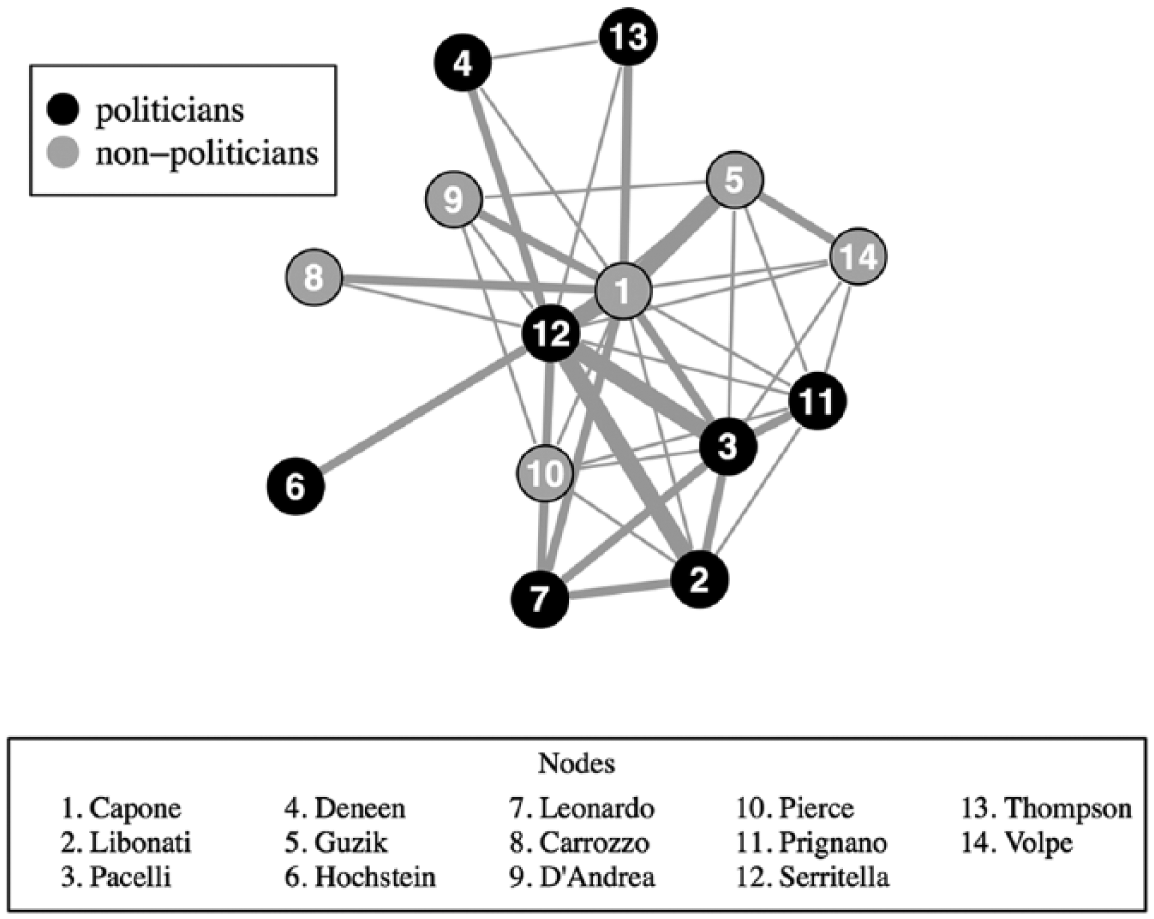
Daniel Serritella’s Reduced Multiplex Ego-Network
Figure 1 reveals that Serritella was embedded in various multiplex combinations of criminal, personal, and legitimate relationships. The black nodes in Figure 1 indicate individuals who were either politicians or worked for politicians, and the gray nodes are non-politicians. The width of each line in Figure 1 indicates the number of tie types between the mutual dyad; the thicker the line the more types of ties between the pair (minimum = 1, maximum = 3). The reduced multiplex ego-network contains 14 individuals directly connected to Serritella and 41 mutual dyads (17 of which are multiplex) between him and his alters. Serritella’s direct relationships spread across all three spheres (seven criminal ties, six personal ties, and seven legitimate ties). Serritella shared all three relationships with Capone, Libonati, and Pacelli, as indicated by the thickest lines. Even though this is Serritella’s ego-network, Capone is quite central.
The personal relationships in this ego-network were all friendships, some of which were lifelong, such as Libonati who was Serritella’s friend since childhood. Serritella’s legitimate ties contained his various political connections and appointments. His criminal ties included the weight shorting scandal with Hochstein, the duck meat scandal with Capone, his attempts to infiltrate unions with Carrozzo, and delivering union votes for Senator Deneen.
Perhaps Serritella’s best example of multiplexity followed a raid on Capone gangsters and local politicians. Seven men were arrested and taken to the police bureau on vagrancy charges. Serritella partnered with local politicians Leonardo and Pacelli, and together they pressured the Chief of Detectives to release the Capone crew and expunge their arrest records. It is difficult to imagine someone risking this abuse of political power without the presence of strong prior relationships, but the arrested men gained access to the legal-political world through their crooked neighbor, a politician and crook himself. Even though only 18 percent of the mutual dyads in Seritella’s total ego-network contained multiplex ties, these rare multiplex ties were relevant to how the underworld and legitimate society coordinated during moments of risk and uncertainty.
The Capone Database
While contemporary social network theory emphasizes the analytic potential of multiplexity, analyzing the content of a tie, sifting through the types of content, and understanding what ties mean present challenges to empirical network analysis. A broad goal of our project is to address some of these challenges with the creation of our “Capone Database,” a relational dataset containing information on more than 3,000 individuals who were in some way connected to organized crime from 1900 to 1950, with the majority of these ties occurring during Prohibition. We created the Capone Database by coding 5,000 pages of archival and secondary sources, which included records from the Chicago Crime Commission (CCC), the Internal Revenue Service (IRS), the Federal Bureau of Investigation, the National Archives-Great Lakes Region, Northwestern’s Homicide in Chicago 1870 to 1930 database (see Bienen and Rottinghaus 2002), the Proquest Historical Chicago Tribune, and John Landesco’s organized crime section of the Illinois Crime Survey of 1929 (Landesco [1929] 1968). Together, these documents provide an outsider perspective of organized crime that was recorded concurrently with the organized crime activities. Our open source archival coding approach is not new to the study of criminal networks (see Baker and Faulkner 1993; Morselli 2003; Pedahzur and Perliger 2006); similar approaches have generated several contemporary criminal network databases (see Asal, Rethemeyer, and Anderson 2009; Bakker, Raab, and Milward 2012; Sageman 2004).
Organized crime constitutes a hidden population, which means the total population is unknown, and the population’s activities are by definition hidden from public viewing or records (Heckathorn 1997). As such, researchers cannot draw a truly random or representative sample, because there is no population list of organized crime members. Hidden populations within a social network framework are sometimes called “dark networks,” meaning outsiders do not know the total structure of a network (Xu and Chen 2008). Dark networks present individual- and relational-level data challenges for analyses.
We addressed these challenges with a two-fold sampling approach. First, we conducted a random seeding method to identify as many individuals as possible in the archival materials by sampling specific documents and files. This entailed requesting “consolidation” files and “public enemy” files from the CCC that summarized key figures and events in their archives. In 1919, Chicago’s business elite formed the CCC with the purpose of protecting the business community from the business of crime (Ruth 1996). The civilian-based organization continues today. The CCC files contain investigator notes, legal documents, letters, and newspaper clippings. Our main goal with this sampling step was to generate a list of individuals from all available files who were somehow mentioned in connection with organized crime. Second, we adopted an informant-based sampling strategy by collecting and coding a corpus of archival documents generated from searching a single informant—Al Capone. After generating a list of Capone’s known associates, we then tried to determine ties among his alters using available historical records, including court testimony, IRS case notes, and newspaper articles. In total, these strategies generated a database that contains relational- and individual-level data on more than 3,000 individuals and their 15,000 ties.
The concern for sampling hidden populations is the bias introduced through the initial seed or informant. Al Capone’s network was by no means normal. In fact, what made Al Capone a useful informant was that he had over 1,300 publicly known discrete ties. Put another way, from Al Capone’s not-so-normal point of view, we got a picture of the largest organized crime ego-network in Chicago during this period. Using Al Capone as the informant introduced bias in the sample, but that very bias is of interest in network research. The Al Capone bias in our data captures the reality that friends and bootlegging partners were not random events. In traditional linear modeling, Al Capone would be an elephant-sized sampling challenge; however, social network tools are designed to explore non-random aspects of social life and allow us to consider Capone’s influence on the networks.
Another challenge inherent in our sample, perhaps even bigger than Al Capone, is the challenge of missing ties. We coded more than 100 types of ties, such as co-arrests, criminal associates, family members, friends, murder suspects, pallbearers, political contributors, and union associates, to name but a few. All of these ties were publicly known relationships and were notable enough to be documented and preserved in newspaper articles and archival documents. This means unremarkable relationships were under-sampled, as were remarkable relationships that escaped documentation. For example, a small-time bootlegger in Capone’s Syndicate might have had only one criminal tie to Capone and one criminal tie to a Capone lieutenant, and the familial or political connections of such a small-time bootlegger warranted no documentation by the CCC or the Chicago Tribune. In short, the missing ties are not random. This issue of non-random missing ties is generally common for the study of illicit networks and secret societies in which members actively conceal their activities (Sageman 2004; Xu and Chen 2008).
Missing ties have two implications for our analyses. First, our networks could provide a conservative snapshot of organized crime during this period. We might expect a null finding regarding multiplexity because we estimate the dependencies between multiple conservative (i.e., under-sampled) networks, and any significant multiplexity finding is likely to be underestimated. The exponential random graph approaches used in our analysis assume that the observed networks are complete and not missing any nodes or ties. Even when data collection adheres to best available practices, research on dark networks must accept the limitation that the data are at risk of being incomplete, and, as such, can produce unstable predictions in modeling (Breiger et al. 2014; Malm, Bichler, and Van De Walle 2010; Xu and Chen 2008). As described in more detail in the next section, we confronted this issue by limiting our sample to the largest component of the criminal network. Breiger and colleagues (2014) caution that one form of selection bias in open source coding of dark networks is nearer completeness on larger criminal groups than smaller criminal groups. Similarly, we believe the ties within the largest criminal component of our data are more complete because of the prominence of certain actors in the archives and the saturation we reached when coding around particular events.
The second implication of non-random missing ties for our analysis is a multiplexity selection bias. The CCC’s and the Chicago Tribune’s motivation to publicize Chicago’s political and union corruption made certain figures and their multiple types of ties more prominent in the archives—such as Daniel Serritella’s ties compared to the two ties of the small-time bootlegger in our example described earlier. This “spotlight effect” on infamous individuals is common in criminal networks from open sources; for example, Sageman’s (2004) database on the Global Salafi Jihad is biased toward leaders and members caught during investigations. One consequence of spotlight effects is that a significant multiplexity finding might pick up only the multiplex action between Capone and his top guys. To address this limitation, we test this potential bias by subsetting our sample for a spotlight effect on Chicago’s top mobsters, who might influence our overall multiplexity results; we find limited evidence of a spotlight effect bias (see the Bivariate ERGM Results section for details).
There could be other limitations of our sample of which we are yet unaware. However, we are convinced that our database’s strengths outweigh its limitations. The Capone Database is remarkable in terms of size, content, and dynamics, both for the study of social networks more generally and the study of organized crime more specifically. Our focus on historical organized crime permits relatively clear and theoretically informed temporal bounding of a beginning and an end to these closed criminal cases. Furthermore, our reliance on multiple archival sources means the Capone Database is not circumscribed by a single organization’s categories or focus on criminal groups. Our database contains information on more than 100 different types of relationships that we are able to aggregate into various analytically meaningful categories. Exploring and analyzing multiplexity requires this fine-grained information on the content of relationships.
Sample: Criminal, Personal, and Legitimate Networks
The present study relies on a subset of ties from the Capone Database. Specifically, our analysis focuses on three broad social spheres: criminal, personal, and legitimate. These three spheres arose from mutually exclusive categorical differences about types of relationships that imply coordination rather than dissolution. 4 The criminal sphere includes relationships such as co-arrests, co-offenses, criminal associations, illegitimate business associations, political corruption, and union corruption. We coded illegal political and union shakedowns as criminal ties, although these criminal ties often accompanied legitimate ties. The personal sphere includes family members, friends, and funeral attendance. Personal ties tend to be strong ties that are neither illicit nor formal. The legitimate sphere includes associations in businesses, formal organizations, politics, and unions—none of these ties could be considered illicit.
We further limited our sample to only the largest component of the criminal network. This step cleaned up the Chicago criminal cases that were not actually part of organized crime, and it removed individuals from the personal and legitimate networks who had no criminal ties. Limiting our sample to the largest criminal component also avoided some of the possibility of missing ties, because sources were most exhaustive and coding was most complete for this group. The resulting sample contained 1,030 individuals and 3,726 mutual dyads between them containing criminal, personal, and legitimate ties. We treated all of these ties as non-directional (no distinction between the sender and the receiver) and cross-sectional. The cross-sectional approach was necessary for this analysis because (1) this sample was missing time data on 15 percent of criminal ties, 63 percent of personal ties, and 15 percent of legitimate ties; and (2) ties with time information reveal the year the tie occurred rather than the beginning of that relationship. For example, when we coded a co-arrest in 1929 as a criminal tie that occurred in 1929, we did not know the origin, duration, or termination of that criminal relationship. Although the span of these relationships in the Capone Database covers 50 years, it is worth noting that about 75 percent of the criminal ties in our sample occurred during Prohibition from 1920 to 1933.
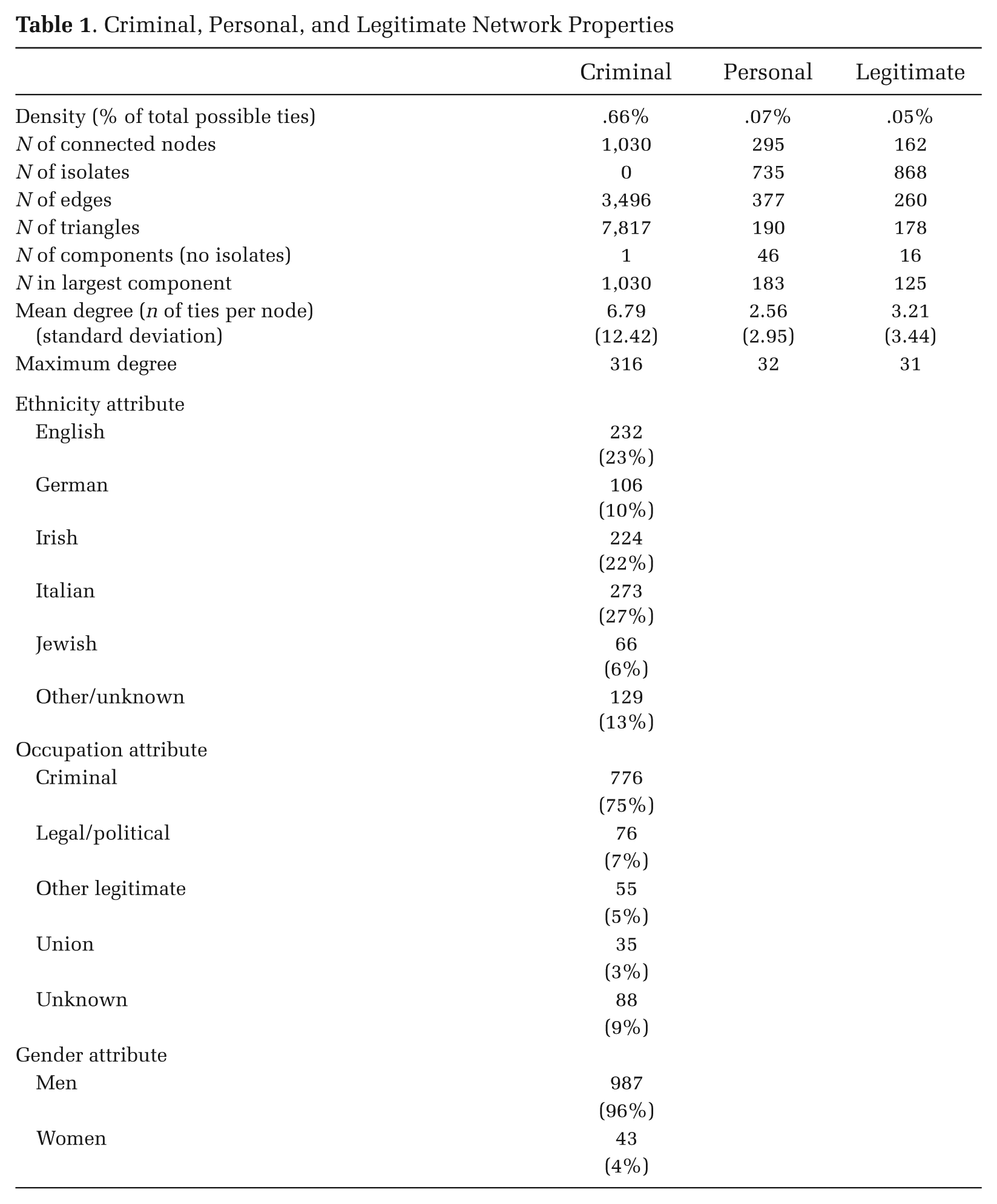
The criminal network had the most edges (3,496) and included the largest component of organized crime. On average, individuals in the criminal network had 6.8 ties; Al Capone was, of course, the outlier with the maximum number of 316 ties. The personal network of family, friends, and funerals included 295 of the individuals in our sample (approximately 29 percent) and 377 personal ties between them. Within this sample, the personal network had 46 separate components not counting any isolates. On average, connected individuals in the personal network had 2.6 personal ties. In the personal network, Al Capone had the maximum number of 32 ties. The legitimate network (business, organizational, political, and union ties) was the smallest of the three networks, containing only 162 connected individuals and 260 legitimate ties between them. It had 16 components, not counting isolates. Connected individuals in the legitimate network had a mean degree of 3.2 legitimate ties, and Al Capone had the maximum degree of 31.
Table 1 lists the basic statistics of these networks and includes the distributions of three individual-level attributes for the sample of 1,030 organized crime individuals. The organized crime network had a relatively heterogeneous ethnic European composition, with almost equal percentages of Italians, Irish, and English. The ethnic heterogeneity of Chicago organized crime is consistent with research by Lombardo (2013), which shows that Chicago organized crime was not a stereotypical ethnic clash of Italians versus Irish. Overall, the criminal occupation included the largest percentage of individuals, although a substantial number of politicians, judges, police officers, union members, and businessmen were in the organized crime sample. Men made up the vast majority of these networks, but criminal ties between husbands and wives contributed to some of the multiplexity in organized crime—a criminal tie layering on a personal tie. There was enough variation in the distribution of ethnicity to suggest that the ethnicity attribute was worth including in the statistical models; however, because criminal men explain the vast majority of the sample, we did not include occupation or gender in the modeling process.
Criminal, Personal, and Legitimate Network Properties
Descriptive Results
Separately, these three networks illuminate various spheres of Prohibition Era Chicago. Unique to this study is our focus on the overlap of these three worlds through the network property of multiplexity. We now examine the extent of multiplexity across these three networks to map out multiplexity’s prevalence.
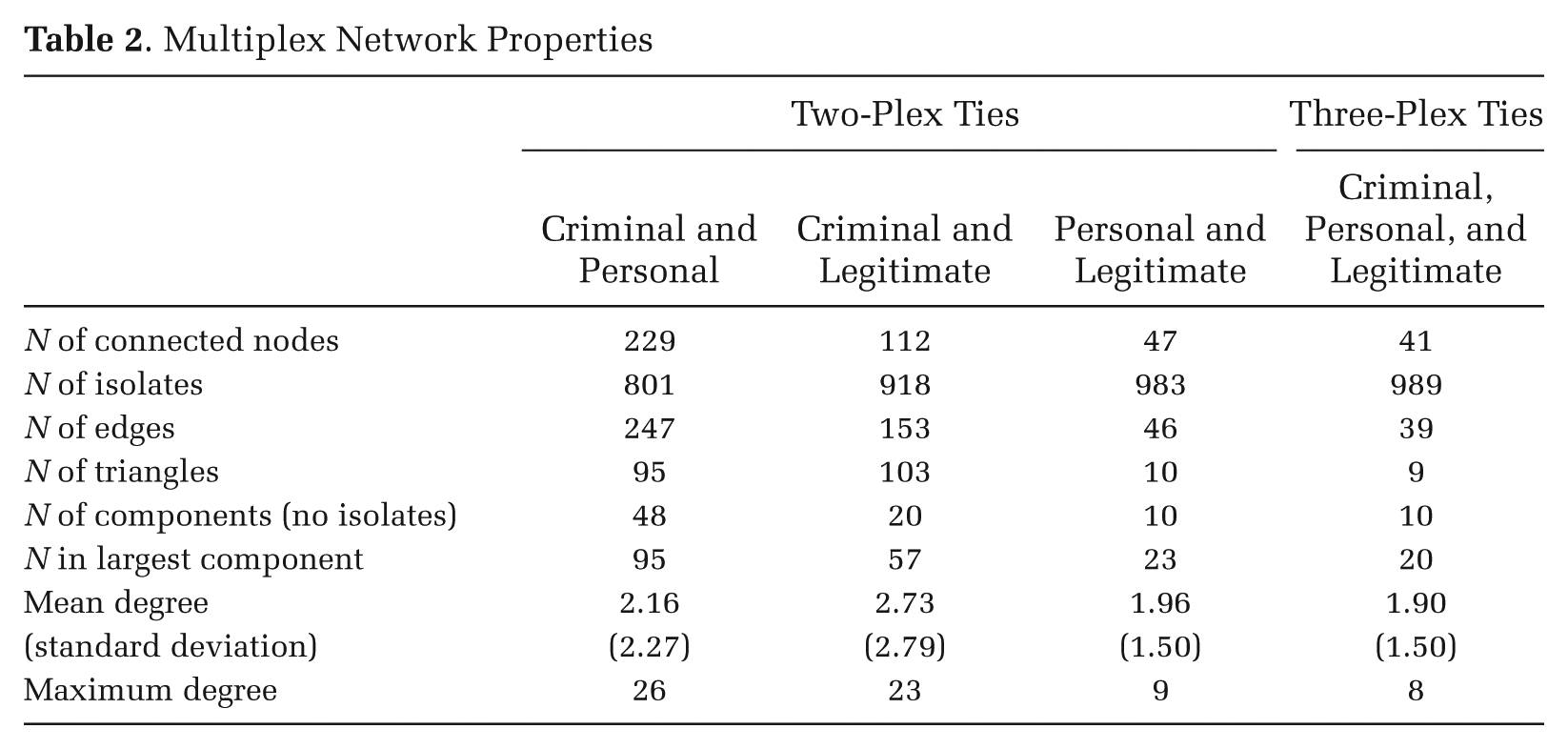
Our organized crime sample contains four possible combinations of multiplexity. Table 2 displays the descriptive results for all four multiplex combinations, presented left to right from most ties to fewest ties. Figure 2 separately plots the criminal, personal, and legitimate networks on top of the 1,030 individuals. The lower-right panel of Figure 2 plots only the mutual dyads containing some combination of multiplex relationships and includes two-plex and three-plex mutual dyads. In total, 306 individuals (30 percent of the sample) resided on 368 mutual dyads that contained multiplex ties, which means only 10 percent of the 3,726 total mutual dyads in the sample contained multiple types of ties between them. We interpret these descriptive findings to mean that multiplexity was rare across these three networks, even when the violence and corruption of the underworld infiltrated mainstream society and the need for trust was paramount.
Multiplex Network Properties
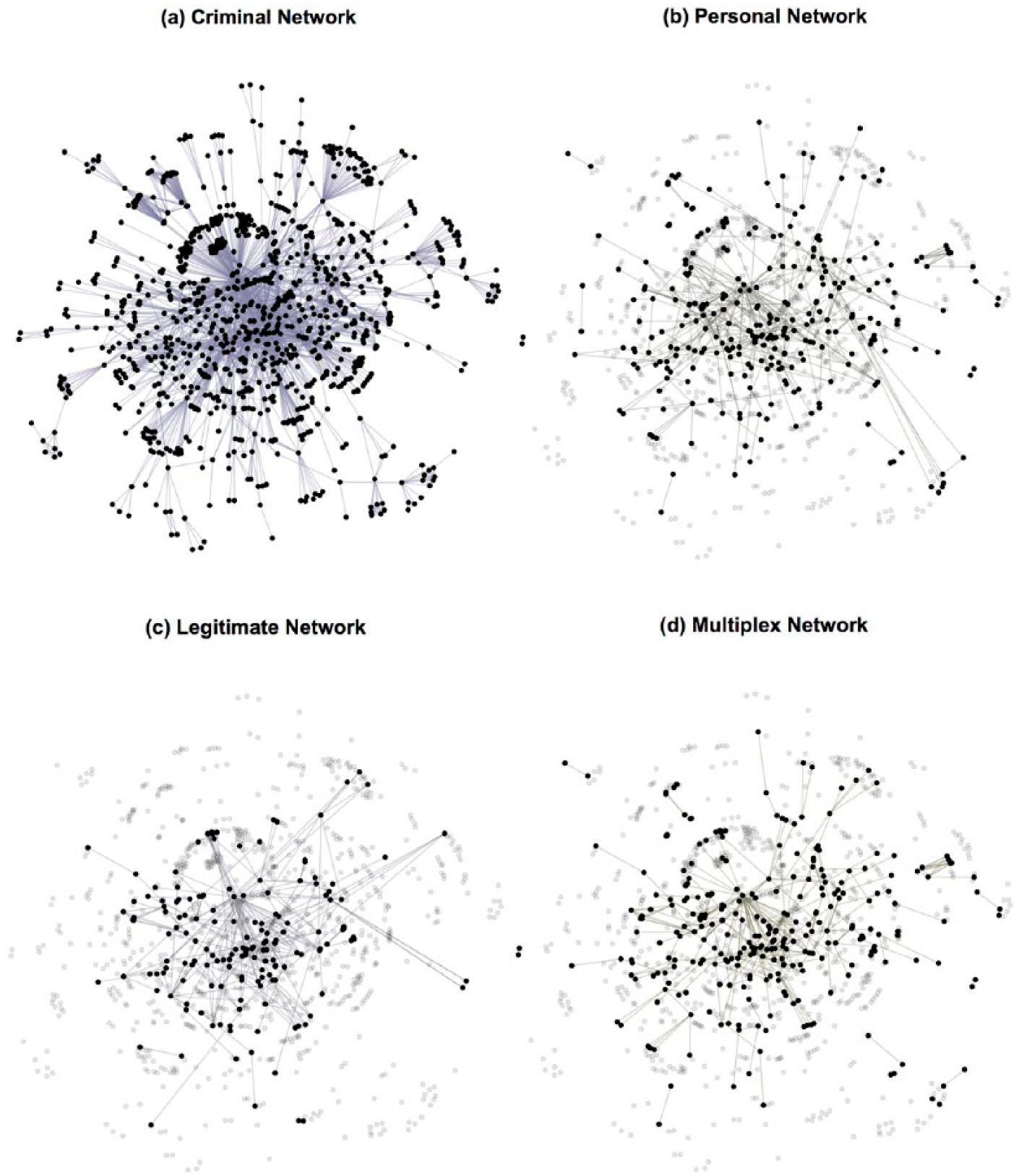
Criminal, Personal, Legitimate, and Multiplex Networks in Early 1900s Chicago Organized Crime
Criminal and personal multiplexity is the most prevalent of the three possible combinations, which is consistent with research demonstrating the importance of peers, associates, and family members on delinquency more generally (Haynie 2001; Zimmerman and Messner 2010). This combination of criminal and personal multiplexity includes 229 individuals and 247 mutual dyads. The second most prevalent combination of multiplex ties in our data is the overlap between criminal and legitimate ties (153 mutual dyads). Only 112 individuals have both a criminal and a legitimate tie. Ordinary criminal groups (e.g., a band of bank robbers or a street crew of drug dealers) should not overlap with legitimate networks to the same degree, but this overlap has been noted as a defining feature of organized crime (Collins 2011; Haller 1971; Papachristos and Smith 2014). Crime gets organized when it moves into legitimate spheres, and legitimate members of society become organized criminals when they participate in the process. This combination of multiplexity is thus an essential feature of organized crime.
Personal and legitimate multiplexity makes up the third combination of ties in our data. Only 47 individuals reside on the 46 multiplex mutual dyads containing both personal and legitimate relationships. This is the only combination of multiplex ties that does not include an illicit tie; for non-offending populations we expect this combination of relationships to be much higher (see Verbrugge 1979). The multiplex ties in this combination represent entirely legal relationships, such as family members who also operate legitimate businesses. However, this multiplex combination could still entail some degree of risk and might require trusting people in personal networks (Uzzi 1996).
The three-plex relationship of criminal, personal, and legitimate ties is the most rare configuration of multiplexity, containing only 39 mutual dyads between 41 individuals. We showcase four of these three-plex relationships in the Serritella ego-network example (Figure 1): old friends used their political connections for criminal schemes. Descriptively, multiplexity is rare among our sample. Only 10 percent of all the mutual dyads are multiplex through some combination of the three types of ties. Yet, even rare ties can prove to be significant for social action.
Analytic Strategy
Exponential random graph models (ERGM) are a class of statistical models used to estimate patterns of dyadic and extra-dyadic dependencies in relational data (Frank and Strauss 1986; Goodreau, Kitts, and Morris 2009; Pattison and Wasserman 1999; Wasserman and Pattison 1996). ERGMs estimate the probability of the presence or absence of a tie in an observed network as a function of a specified set of endogenous network terms (e.g., local statistics of triangles, degree, and shared partners) and can incorporate influences from individual-level attributes and other exogenous network terms (e.g., racial homophily or outlier individuals with high degree) (Lusher, Koskinen, and Robins 2013; Wimmer and Lewis 2010). All parameters estimated in an ERGM are interdependent, and interpretation of the final estimates is conditional on all other terms included in the model. Markov chain Monte Carlo procedures generate samples of random networks with the number of nodes fixed to the observed network, and this sample of simulated networks then provides a distribution of network properties to compare to the properties of the observed network. ERGMs converge when parameter estimates from the set of simulated networks are not significantly different from the observed network. Once all the parameters converge, positive estimates indicate more of that network term in the observed network than expected randomly, given all the other terms included in the model, and negative estimates indicate less of that network term than expected.
Researchers have used ERGMs to examine collaborations in biotech firms (Srivastava and Banaji 2011), racial homophily in social networking websites (Wimmer and Lewis 2010), cohesion in and structures of friendship networks (Goodreau et al. 2009; McFarland et al. 2014), cohesion in co-offending networks (Malm et al. 2010), racial preferences in online dating communities (Lewis 2013), and conflict and geographic distances in gang networks (Papachristos, Hureau, and Braga 2013). These models are especially well suited for examining network multiplexity, because they inherently identify local patterns in networks, including patterns of overlapping ties (see Heaney 2014; Lazega and Pattison 1999; Wang 2013). Given the rarity of multiplexity in our sample, it is possible that multiplexity is not a statistically relevant element of the undergirding structure of our networks. ERGMs provide the modeling specification to test the relevance of multiplexity as a piece of a larger structure.
We are aware of two current approaches to modeling multiplexity within an ERGM framework. The first approach selects one of the observed networks and estimates the edge covariates of the other observed network(s) as an exogenous property of the selected network. For example, Heaney (2014) used this approach to determine which multiplex ties explained an influence network among a set of U.S. health policy interest groups. A second approach simultaneously models the endogenous and exogenous terms occurring within each of two networks in combination with the endogenous and exogenous terms that cross the two networks. 5 Benefits of this second bivariate ERGM approach include (1) avoiding problematic assumptions of causality between two cross-sectional networks, (2) the ability to estimate multiplexity as a cross-network parameter of co-occurring edges, and (3) the possibility that dependencies across two networks might better predict the endogenous effects within a single network (Wang 2013). We used the second modeling approach for these three reasons.
The property of theoretical interest in our models is multiplexity, but multiplexity alone does not account for all of the local patterns in our observed networks. Other network generating mechanisms are also undoubtedly at play. Following recommendations by Lusher and colleagues (2013), we iteratively added and removed endogenous terms to each of our models, that made theoretical sense given our data and topic, until we obtained converged models. Our converged models include three endogenous terms: isolates in the noncriminal networks (estimate a statistic for nodes with degree equal to 0), alternating triangles (estimate a weighted statistic for triad closure in dense regions of the networks), and alternating two-paths (estimate a weighted statistic for open triads in dense regions of the networks). These three endogenous network terms index how these processes unfold within a single network, but these processes do not cross the two networks included in each model. For example, in Model 1 the isolate, alternating triangles and alternating two-paths terms under the personal network measure those three parameters only within the personal network.
We included only one endogenous term that crosses two different networks in the models: the multiplexity term measured as co-occurring edges. 6 The estimates for co-occurring edges indicate the likelihood of multiplex ties across the two networks specified in each model. For example, Model 1 simultaneously models the criminal and personal networks, so the estimate for co-occurring edges measures the likelihood of mutual dyads having both a criminal tie and a personal tie. This approach models multiplexity as one of several mechanisms generating the global structures of our data.
Finally, we added two exogenous terms to our models to include actor attributes. First, we included an Al Capone dummy variable to capture Capone’s unique position in our dataset and to obtain the correct degree distribution in our sample. Second, we included a matching term by ethnicity, or ethnic homophily, to test for increased ties between actors of the same ethnicity. This accounts for possible ethnic clustering within the networks, especially among families. Due to the sparse density of our large networks (few actual ties given the total number of possible ties), our models required us to fix the graph density to treat edges essentially as a “nuisance parameter” (Lusher et al. 2013:154; see also Huitsing et al. 2012; Lusher et al. 2012; Quintane 2013).
Bivariate ERGM Results
Table 3 presents results from two bivariate ERGMs. 7 Model 1 simultaneously models the criminal and personal networks; Model 2 simultaneously models the criminal and legitimate networks.
Bivariate Exponential Random Graph Models (N = 1,030)
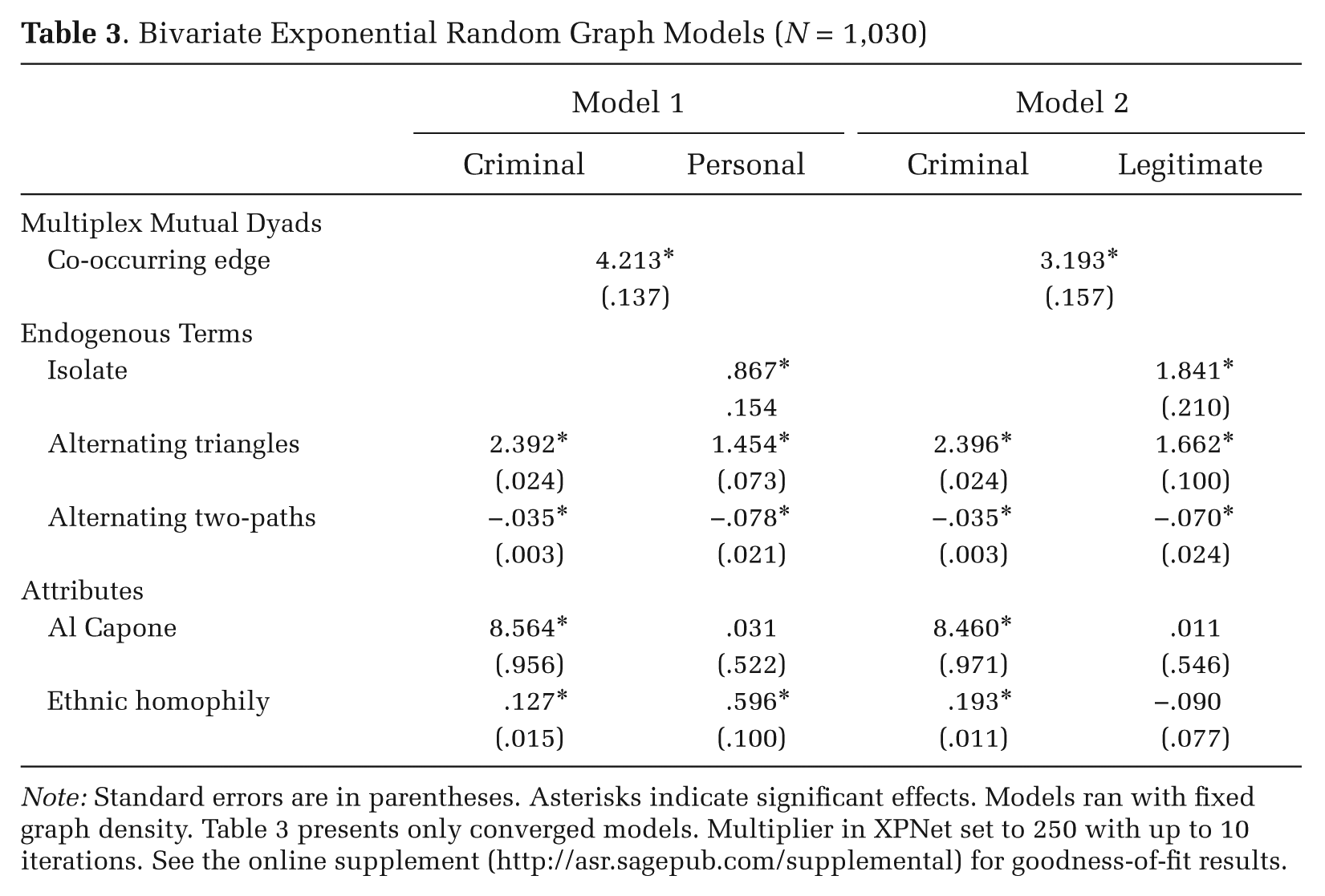
Note: Standard errors are in parentheses. Asterisks indicate significant effects. Models ran with fixed graph density. Table 3 presents only converged models. Multiplier in XPNet set to 250 with up to 10 iterations. See the online supplement (http://asr.sagepub.com/supplemental) for goodness-of-fit results.
Endogenous terms
Clustering and isolates characterize the dependence structure of the networks in our models. The positive and significant effects for alternating triangles, and the negative and significant effects for alternating two-paths, capture the tendency toward triad closure, or clustering, within dense regions of the networks. In other words, edges were more likely to form within these networks when they closed triangles. For example, two people with criminal ties to shared partners were likely to have a criminal tie between them that closed their triangle. We included the isolate term for the personal and legitimate networks to control for the large number of isolates in personal and legitimate relationships in our criminal sample. The positive and significant effects for isolates indicate that the personal and legitimate networks had more isolates than would be expected by chance.
Al Capone
Al Capone has a strong positive influence on tie formation in the criminal network in Models 1 and 2. However, when modeling the personal and legitimate networks simultaneously with the criminal network, the Capone effect in the noncriminal networks is not significant. Capone had the highest degree in the personal and legitimate networks, but the statistical power of his high degree is captured in the modeling of the criminal networks rather than in the personal and legitimate networks. Capone’s most significant activity and influence occurred in the criminal network.
Ethnic homophily
Criminal and personal ties were more likely to form between actors of the same ethnicity, suggesting there was some ethnic homophily in organized crime during Prohibition Era Chicago. However, the effect of ethnic homophily in the legitimate network is not significant. In spite of the networks having some ethnic diversity overall, there was a small in-group tendency in terms of who formed ties with whom. Ethnic homophily tapped into processes of familial ties, criminal ties internal to families (e.g., the Genna brothers, the Capone brothers, the West Side O’Donnell’s, and the South Side O’Donnell’s), and criminal and personal relationships formed within ethnic enclaves of Chicago.
Multiplexity
Multiplexity produced large, positive, and significant parameter estimates in both models in Table 3. This means criminal and personal multiplexity and criminal and legitimate multiplexity explain part of the dependence structure of organized crime in Prohibition Era Chicago. The multiplexity effects are not as large as the Capone effects, but they are larger than the ethnic homophily effects. The significant multiplexity parameter in Model 1 reveals the dependency between criminal ties and familial relationships or friendships. Peers and family members played a significant role in our organized crime sample, and the significance of this parameter estimate suggests that criminal and personal multiplexity served as a bridge between these two worlds. Criminal and personal multiplexity is the most frequent multiplex combination in our data. To name but a few examples, these multiplex mutual dyads include the many criminal activities Al Capone engaged in with his brothers, bootleggers and criminals who formed friendships and attended each other’s funerals, and the “get out of jail free” card Serritella coordinated for his friends.
In both models, multiplexity operated as a mechanism helping to generate the global structure of the observed networks. The multiplexity parameter estimated in Model 2 underscores the dependency between the criminal and legitimate spheres. This multiplex combination supports our argument of organized crime as the integration of criminal and legitimate society. Importantly, the dependency between criminal and legitimate networks went in two directions. Crime got organized when it moved into legitimate spheres—such as when Al Capone made political campaign contributions or when his brother, Ralph, opened racetracks. Crime also got organized when legitimate members of society used their positions of influence within the criminal sphere—such as when judges and law enforcement accepted bribes or when political candidates complied with election rigging.
The magnitude and significance of the multiplexity estimates are strong even with the other endogenous terms included in the model. Whereas alternating triangles are often strong predictors of social networks in general (i.e., a friend of a friend is a friend), our multiplexity estimates demonstrate the importance of context and dependencies across social worlds. Although not pervasive, multiplexity glued these worlds of organized crime together above and beyond the personalities and actions of Al Capone, ethnic homophily, and other endogenous network processes.
It is worth remembering that the point of ERGMs is to model network processes statistically (Lusher et al. 2013). This dynamic language is a bit misleading because we are unable to imply causal ordering of multiplexity given our cross-sectional networks—that is, we do not know with certainty which ties came first and which ties layered new obligations and expectations. The ERGMs do tell us that the process of multiplexity undergirded ties forming across the three observed networks. We rely on the historical examples, like the case of Daniel Serritella, to add depth and meaning to the ERGM multiplexity estimates. Even though we cannot directly measure trust, we infer that the multiplexity estimates could be picking up some of the rare but relevant and trustworthy ties required between the crooked neighbors of Prohibition Era Chicago.
Robustness check for potential spotlight effects
As discussed earlier, one of the sampling challenges with the Capone Database is the possibility of missing ties that are not randomly distributed and therefore could bias multiplex relationships. Famous gangsters and politicians, for example, were featured more prominently under the investigative spotlight. To test the robustness of our multiplexity findings in Table 3, we reran our models under additional sampling constraints to test such a spotlight effect. We extracted four samples based on the criminal degree distribution of the 1,030 individuals in our analysis: the top 1 percent (n = 10), the top 10 percent (n = 108), the bottom 90 percent (n = 922), and the bottom 99 percent (n = 1,020). Our rationale is that if a spotlight effect is producing our multiplexity results, then rerunning the models for the top 1 percent and top 10 percent should replicate the results we found in the full sample. Relatedly, if multiplexity is a result of the spotlight effect, then rerunning the models for the bottom 90 percent and bottom 99 percent—without the Al Capone effect, because he would be dropped from the sample—should not replicate the multiplexity results we found in the full sample.
Examining the spotlight effect across these four samples reveals that multiplexity was more common among Capone and his top associates—36 percent of mutual dyads in the top 1 percent sample contained multiplex ties. Such a concentration of multiplexity in Capone’s inner circle might point to the trust and concealment required among the most criminally involved individuals in the network. Although less concentrated, multiplexity is robust in organized crime across the other three samples. Multiplexity dropped to 13 percent of mutual dyads in the top 10 percent sample and to 9 percent of mutual dyads in the bottom 90 and 99 percent samples. Multiplexity was most concentrated in the top 1 percent of the network, but it existed across the mutual dyads of the less criminally connected as well.
ERGMs with different sized and shaped networks often will not converge with the same restricted set of parameters, because a converged model requires the particular combination of parameters that best simulate the unique patterns and structures of each observed network. As such, deliberately manipulating the degree distributions to generate our spotlight samples might require different combinations of endogenous terms to fit an ERG model. Not surprisingly, the model that successfully fit our full sample did not fit all of the spotlight effect samples. The models for the top 1 percent produced only degenerate models, and models for the bottom 90 percent and bottom 99 percent failed to converge. However, the spotlight effect models using the top 10 percent sample did converge with the exact parameters used to model the full sample. Table 4 presents these results. 8
Bivariate Exponential Random Graph Models Testing Spotlight Effects for the Criminal Top 10 Percent (N = 108)
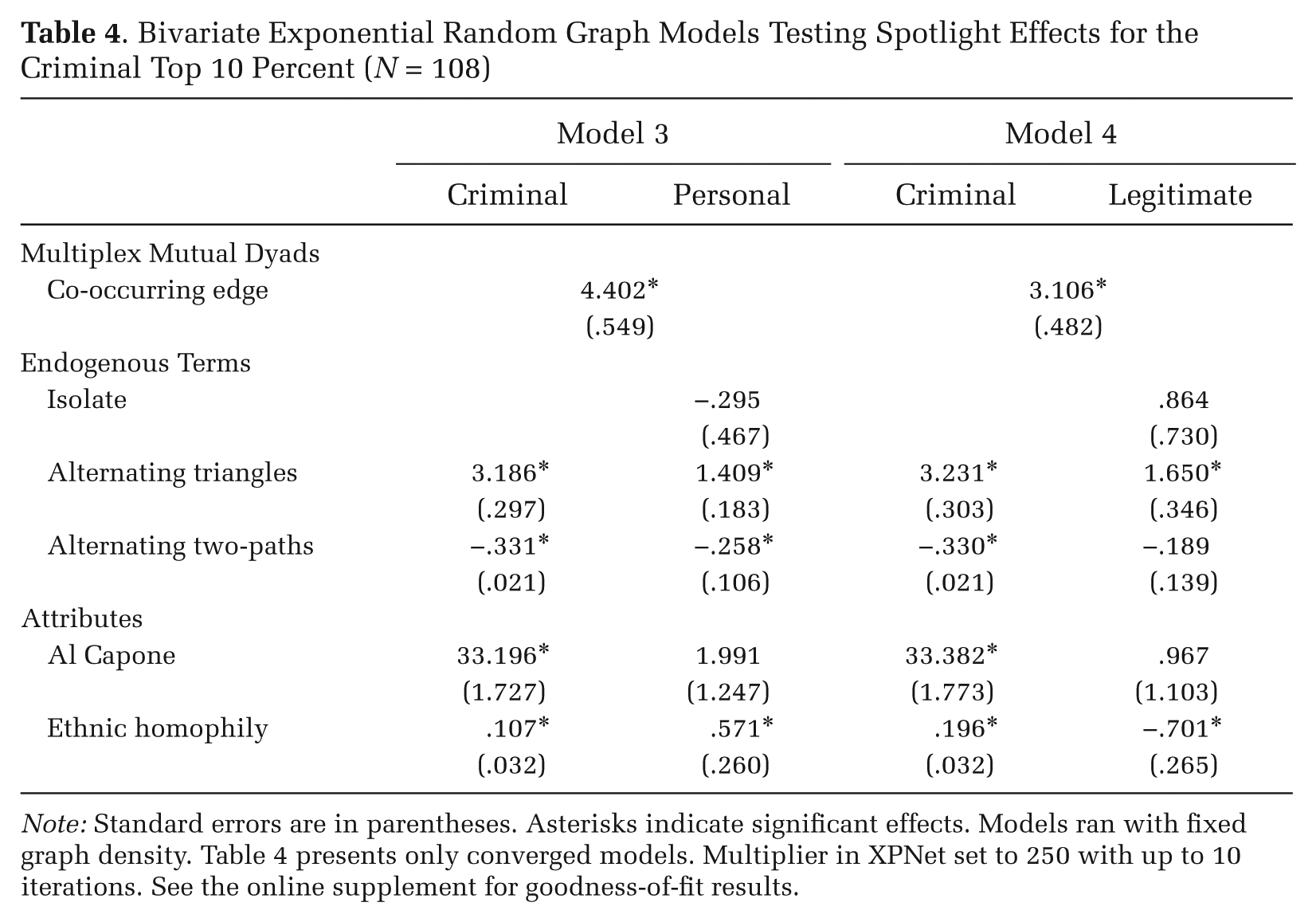
Note: Standard errors are in parentheses. Asterisks indicate significant effects. Models ran with fixed graph density. Table 4 presents only converged models. Multiplier in XPNet set to 250 with up to 10 iterations. See the online supplement for goodness-of-fit results.
Subsetting the sample to the criminal top 10 percent reduces the sample to 108 individuals including Al Capone, 772 ties in the criminal network, 46 ties in the personal network, and 80 ties in the legitimate network. There are 781 unique mutual dyads in the top 10 percent sample, and 13 percent of the mutual dyads contain multiplex ties. The concentration of multiplexity is slightly higher than the 10 percent of multiplex mutual dyads found in the full sample. The most notable difference between the samples is that the top 10 percent sample is 56 percent Italian compared to 27 percent Italian in the full sample.
The multiplexity results from the spotlight effect models are nearly identical to results from the full sample models in terms of direction and significance. Al Capone had a larger effect in the criminal networks in the spotlight models, and isolates were not a significant part of the personal and legitimate network structures. The replication of the multiplexity finding in spotlight Models 3 and 4 suggests some evidence that multiplexity could be an artifact of sampling bias among criminals most under the investigative spotlight. However, our inconclusive results with the 1 percent, 90 percent, and 99 percent samples imply that we should not disregard our full sample results either (see also adams et al. 2012). Historical network processes that occurred in the top 10 percent also occurred throughout the full sample of Chicago organized crime, even across areas of the network that had more ethnic heterogeneity and less multiplexity.
Discussion and Conclusions
Sociological and historical analyses of organized crime tend to focus on the deeds and misdeeds of gangsters and their organizations. Although nearly all of these investigations (including our own) consider the illicit enterprises and activities of organized crime, scholars since Merton (1938) have also viewed organized crime as a pursuit of the American Dream by disenfranchised groups (see also Bell 1953). The present study begins with the notion that organized crime is not an isolated group of criminals or gangsters; rather, organized crime is unique because of its broader integration into and ambitious positioning within noncriminal society (see also Papachristos and Smith 2014). Our findings suggest that one method of organized crime’s integration into mainstream society is through multiplex social relationships. When groups of ordinary bootleggers, brothel owners, and bookies organize and infiltrate police departments, courtrooms, unions, and political offices through overlapping and multiplex relationships, seemingly disparate social worlds collide and generate organized crime networks.
Multiplexity, in general, is rare in modern society. Strong multiplex ties represent only a fraction of a person’s total social connections, and the same was true 100 years ago for Chicago bootleggers, politicians, and union thugs. Our descriptive analyses show that only 10 percent of the mutual dyads in Chicago’s Prohibition Era organized crime network contained multiplex relationships. Despite the rarity of multiplexity, it was precisely the multiplex ties that linked the activities and enterprises of Chicago’s underworld to mainstream society. Our bivariate ERGMs assess how multiplexity structurally contributed to Prohibition Era networks, and the findings demonstrate that multiplexity was a strong network mechanism generating the structures of the criminal, personal, and legitimate worlds. Although not pervasive, multiplexity glued the criminal, personal, and legitimate spheres of organized crime together above and beyond the personalities of famous gangsters, ethnic homophily, and other endogenous network processes.
Our findings further suggest that multiplexity was more prevalent among the most criminally elite (the top 1 percent of the criminal degree distribution), where 36 percent of the mutual dyads between Capone and his nine associates were multiplex. For example, multiplexity permitted Al Capone to access resources from multiple spheres while keeping trustworthy relationships close when he received stolen duck meat and legal immunity from his politician friend Daniel Serritella. Multiplex ties have significant value in building foundations of trust during high risk interactions when boundaries between social words are blurred, when regulation of licit and illicit markets are fickle, and when mistrust can have lethal consequences. Our research suggests that in addition to dense and small networks (Baker and Faulkner 1993), multiplex relationships are also important in prioritizing trust and concealment over efficiency in illicit networks.
Three limitations of this research warrant consideration. First, our estimations of the networks during this time period are conservative because of our reliance on publicly available records written by outsiders to organized crime, the Al Capone initial seed bias, and the general difficulties inherent to sampling hidden networks. ERGMs can estimate and clarify some of the bias, but we are likely underestimating the incidence and relevance of multiplexity to our case. Second, the fundamental assumptions of ERGMs place significant limits on the types of claims we can make, especially pertaining to potential causal mechanisms. Time ordering of the network ties could potentially change or clarify some of our results, and modeling temporal sequencing is clearly an important direction for future research on multiplexity.
Third, not everything fits into a network model. Culture, agency, and context get reduced in this type of analysis. Our Al Capone effect, for instance, demonstrates the Big Guy’s importance as a statistically significant parameter generative of ties in our observed networks. But simply adding a high degree Capone outlier to a model masks Capone’s varied, violent, creative, and occasionally blundering attempts at forging alliances, integrating worlds, going legit, and pursuing the American Dream. A strength of our database is the fine-grained level of detail we maintained on relationships and organized crime characters. We use social network analysis as a logic of discovery for this particular set of events, group of people, and historical moment. This perspective recognizes the value of history and context as essential to interpreting our results. We leveraged the historical narrative of our data and the extended examples provided as part of our larger exploration of the intersection between historical narrative and social network analysis (see Bearman, Faris, and Moody 1999; Erikson 2014).
These limitations notwithstanding, our study shifts definitions and theories of organized crime from a bureaucratic or a patrimonial organization to a complex web of criminal, personal, and legitimate ties between bootleggers, politicians, union members, business owners, families, and friends and their integration of the underworld with legitimate society. We bring network science to gangster-era Chicago—a case that to the best of our knowledge has never before been subjected to this type of relational analysis. In so doing, we are positioned to learn more about the historical moment, the evolution of organized crime, and the dependencies between informal and formal ties. Future research on organized crime should consider other mechanisms by which these sorts of networks facilitate action and influence individual outcomes. What conditions, structural or otherwise, promoted the rise of infamous actors like Al Capone, Frank Nitti, and Tony Accardo? How important are high-activity actors like Capone to the overall efficacy of organized crime networks relative to other actors? We have yet to explore how negative ties (e.g., murders, informants, traitors, or rivalries) or external shocks (e.g., the end of Prohibition or the prosecution of organizational leaders) affect organized crime networks over time. What is clear from the historical record is that sections of our observed organized crime network continued to persist despite hundreds of Prohibition Era murders and a variety of federal prosecutions waged against Al Capone and his associates.
Our study also moves sociological research on multiplexity outside the walls of legitimate institutions and into messier and seemingly disparate social worlds. Multiplexity implies a foundation of trust and obligation that can lead to social action and integrate social relationships. Parents and guardians rely on kin to provide childcare to minimize costs and anxieties. Investors minimize financial risk by investing in new companies with which they have previous personal relationships (Uzzi 1996). Recruiting for social and political movements relies more on informal neighborhood and peer associations than on philosophical or political affinities (Gould 1991). Future sociological research might consider the applicability of multiplex theory and models to other contexts, especially networks ascending from the ranks of the informal to the formal or under conditions of uncertainty and risk—such as grassroots mobilization, community organizing, or fringe social movements. Just as multiplexity mingles crime and legitimate society, it might also act as a similar bridge between big business and politics, unions and financial markets, or workplace and ideology.
Even when multiplex ties are rare, they are still structurally relevant. Overlapping ties tend to be thick ties where trust and reciprocity are likely to reside, or, in the case of Chicago’s bootleggers, where family and friends coordinate their criminal enterprises and where crime organizes into and is integrated with legitimate society. It is useful to think about the social conditions where multiplexity might matter most: where institutions are poorly regulated or ill-functioning, interactions include some degree of risk, or institutions and interactions exist outside the realm of the formal systems of social control. The majority of day-to-day interactions do not exist under these conditions; instead, institutions provide reliability, regulation, coordination, and procedure. When networks and actions teeter into uncertain, unregulated, or risky domains, trusting your crooked neighbors may very well be critical—even if you trust only a few of them.
Footnotes
Acknowledgements
We thank jimi adams, Sharla Alegria, Matt Denny, Bruce Desmarais, Rob Faulkner, Neha Gondal, James Kitts, Kevin Lewis, Liz Roberto, Don Tomaskovic-Devey, Peng Wang, Steve Weston, and the ASR editors and anonymous reviewers for comments, modeling advice, and technical support. We thank the Chicago Crime Commission and Scott Forsythe at the National Archives-Great Lakes Region for access to and assistance with their archival collections. We thank Jenny Malave, Andrew Oh, Mary Scherer, and Shawn Trivette for coding assistance.
Grant Numbers and Funding Information
A Faculty Research Grant awarded by the University of Massachusetts-Amherst funded parts of this research. Parts of this project were supported by Award No. 2013-IJ-CX-0013, awarded by the National Institute of Justice, Office of Justice Programs, U.S. Department of Justice. The opinions, findings, and conclusions or recommendations expressed in this publication are those of the authors and do not necessarily reflect those of the Department of Justice.
Notes
References
Supplementary Material
Please find the following supplemental material available below.
For Open Access articles published under a Creative Commons License, all supplemental material carries the same license as the article it is associated with.
For non-Open Access articles published, all supplemental material carries a non-exclusive license, and permission requests for re-use of supplemental material or any part of supplemental material shall be sent directly to the copyright owner as specified in the copyright notice associated with the article.
