







Abstract
Junior faculty search committees serve as gatekeepers to the professoriate and play vital roles in shaping the demographic composition of academic departments and disciplines, but how committees select new hires has received minimal scholarly attention. In this article, I highlight one mechanism of gender inequalities in academic hiring: relationship status discrimination. Through a qualitative case study of junior faculty search committees at a large R1 university, I show that committees actively considered women’s—but not men’s—relationship status when selecting hires. Drawing from gendered scripts of career and family that present men’s careers as taking precedence over women’s, committee members assumed that heterosexual women whose partners held academic or high-status jobs were not “movable,” and excluded such women from offers when there were viable male or single female alternatives. Conversely, committees infrequently discussed male applicants’ relationship status and saw all female partners as movable. Consequently, I show that the “two-body problem” is a gendered phenomenon embedded in cultural stereotypes and organizational practices that can disadvantage women in academic hiring. I conclude by discussing the implications of such relationship status discrimination for sociological research on labor market inequalities and faculty diversity.
Despite significant gains over the past 30 years, gender disparities in academic careers persist (Samble 2008). Although most pronounced at the level of full professorships, inequalities represent the culmination of stratification that begins earlier in careers (Ceci and Williams 2011). Women now represent at least half of students in doctoral programs in the life sciences, social sciences, and humanities, and their representation in the physical sciences and engineering has increased substantially (National Science Board 2012). Yet, women remain significantly underrepresented in tenure-track positions at research universities relative to their representation in PhD programs, and they are overrepresented among adjuncts and non–tenure-track faculty (Jacobs and Winslow 2004). This is true in traditionally masculine fields and fields where women comprise the majority of doctoral students (Rudd et al. 2008).
Existing research on the mechanisms that drive these inequalities tends to focus on what happens to women in graduate school or once on the tenure track. Scholars have shown that male and female students receive differential access to mentoring, publication opportunities, social support, equipment, and role models while in graduate programs (see Moss-Racusin et al. 2012; Thébaud and Taylor 2015; Van Anders 2004). Advisors may also display bias against female graduate students, perceiving them to be less committed to academic careers than their male peers, even when no attitudinal or behavioral differences exist (Ellemers et al. 2004). Moreover, women may self-select out of academic careers due to hostile disciplinary cultures or concerns about work-life quality (Ceci and Williams 2011; Ecklund and Lincoln 2016; Mason, Goulden, and Frasch 2009). All of this may lead to a leaky pipeline into—and out of—academic careers. Nevertheless, those who do enter tenure-track roles continue to face significant gender disparities in rates of pay, promotion, and tenure in many fields (see Aguirre 2000; Barbezat and Hughes 2006; Perna 2006).
The process of hiring for tenure-track jobs, however, remains a missing link in understanding the persistence of gender inequalities in academic careers. Junior faculty hiring committees are gatekeepers to the tenure track; entering the professoriate is contingent upon a favorable recommendation by a hiring committee. Decisions made by these groups affect not only individuals’ careers but also the demographic composition of departments, disciplines, and universities. Despite their intellectual and social significance, surprisingly little research examines the inner workings of search committees. Perhaps due to access restrictions, studies of faculty hiring are primarily survey- or experiment-based and focus on documenting unequal outcomes. Research shows, for example, that faculty evaluate the same CV more favorably when they believe the candidate is male rather than female (e.g., Moss-Racusin et al. 2012; Steinpreis, Anders, and Ritzke 1999). To fully understand the mechanisms underlying gender inequalities in faculty hiring, it is also necessary to analyze the evaluation process—specifically, how committees collectively evaluate merit and make hiring decisions. Drawing from a qualitative case study of junior faculty hiring committees, this study begins to open up the black box of academic hiring. In this article, I focus on one important but understudied source of gender bias in academic hiring: relationship status discrimination.
The Two-Body Problem
Given the increased representation of women in graduate programs and growing educational homogamy (Schwartz and Mare 2005), doctorate-holders often have academic or professional spouses or long-term romantic partners (Schiebinger, Henderson, and Gilmartin 2008). When one or both partners in a relationship try to land tenure-track jobs, they often encounter what is known as the “two-body problem.” In recent decades, the combination of declines in the number of tenure-track faculty positions with growing graduate school enrollments has produced a highly competitive academic labor market (American Association of University Professors 2015). It can be difficult to find one—let alone two—full-time academic jobs in the same university or geographic area. Moreover, the isolated geographic locations of some universities can limit the availability of nearby nonacademic job opportunities.
The two-body problem has the potential to adversely affect academics’ careers and overall well-being. Individuals may take lower paying or less secure jobs, or self-select out of tenure-track jobs (or academic careers entirely) to co-locate with their partners or families (Mason et al. 2009). Others may opt for long-distance relationships, which in the long run can contribute to added stress and expenses through travel costs and maintaining two households; it can also complicate having children, for those who desire to do so (see Wilson 2002).
Existing narratives of the two-body problem typically portray it as stemming from the structure of the academic labor market and the personal romantic and career choices that individuals make. However, in this article, I demonstrate that the two-body problem is also a gendered phenomenon embedded in cultural stereotypes and organizational practices. Drawing from a qualitative case study of junior faculty searches at a large R1 university, I show that hiring committees used information about candidates’ relationship status to rank candidates and make final hiring decisions. However, the way they did so varied markedly by applicant gender. Committees penalized heterosexual female—but not heterosexual male—applicants who had partners working in academia or in high-status professional jobs. Drawing from highly gendered scripts of career and family that present men’s careers as taking precedence over women’s, committee members believed that partnered women were less likely to accept job offers when a geographic move was involved. They excluded partnered women from offers when there were viable male or single female alternatives.
Gender Biases in Academic Hiring
Most contemporary research on gender discrimination in hiring focuses on gendered assessments of competence. In line with descriptive stereotypes depicting men as better at most things than women (Berger et al. 1977; Fiske et al. 2002), people tend to evaluate male applicants as more able and hirable than equivalent female applicants (for reviews, see Foschi, Lai, and Sigerson 1994; Heilman 2001). Academics are not immune to such biases (Wenneras and Wold 1997). In many academic disciplines, faculty evaluate male job applicants more favorably than females with identical CVs (Moss-Racusin et al. 2012; Steinpreis et al. 1999). 1
Above and beyond such tendencies, prescriptive gender stereotypes—which mandate women not only are but also should be warm, communal, and other-oriented rather than assertive, independent, and achievement-oriented—can further disadvantage women (Eagly and Karau 2002). These stereotypes affect which qualities individuals attune to when evaluating job applicants. For example, when writing recommendation letters for graduate students, faculty tend to focus more on women’s personal qualities, such as whether they are “nice,” “warm,” or would “make a good colleague,” whereas they tend to focus more on men’s scholarly accomplishments and ambitions (Madera, Hebl, and Martin 2009; Trix and Psenka 2003). 2 Additionally, consistent with broader cultural schema depicting women as more devoted to family and social relationships than to intense careers (Blair-Loy 2003; Williams 2001), faculty tend to perceive female doctoral students as being less committed to scholarship and academic careers than males. This is the case even when no meaningful attitudinal or behavioral gender differences between students exist (Ellemers et al. 2004). These distorted perceptions can bias the evaluations made by hiring committees (Madera et al. 2009).
Female job applicants face a double bind: they are viewed as less competent and committed to careers than men, yet they are penalized for assertive, achievement-directed, or career-oriented behavior that violates prescriptive gender stereotypes (Eagly and Carli 2007). Nonfaculty studies of job interviews, for example, show that the exact same achievement-oriented behaviors, such as discussing one’s accomplishments, are interpreted favorably for men but negatively for women and can result in significant backlash against assertive, high-achieving women (Rudman 1998). In summary, gender stereotypes create a situation in which female job applicants are often evaluated differently—and more negatively—than equivalent male applicants, which can contribute to demonstrated gender inequalities in hiring in academic careers and beyond.
Parenthood Penalties and Premiums
Inequalities related to stereotypes of competence and commitment can be compounded by biases related to major life transitions and traditional family expectations for men and women (Ridgeway and Correll 2004). A substantial literature investigates the “motherhood penalty” in careers. People rate mothers and pregnant women as less competent, committed, and dependable than nonmothers with identical qualifications (e.g., Cuddy, Fiske, and Glick 2008; Halpert, Wilson, and Hickman 1993; Williams 2005). Moreover, employers are less likely to hire or promote mothers compared to otherwise equivalent nonmothers; when they do, they pay mothers significantly less than nonmothers for doing the exact same job (Correll, Benard, and Paik 2007). Fathers typically do not experience such penalties, and in some cases they may receive evaluative boosts or elevated pay (Anderson, Binder, and Krause 2002; Budig and England 2001; Rodgers and Stratton 2010). 3
Relationship Status Discrimination
Although biases related to parenthood have received more scholarly attention, relationship status itself may contribute to gender inequalities in careers. For example, although marriage significantly enhances men’s pay and perceptions of their promotability—perhaps because it fosters images of increased stability or reinforces a breadwinner ideal—it typically does not result in the same benefits for women.4,5 As Petersen and colleagues (2014) argue, such differences are partially attributable to occupational sorting. Married men are more likely to be sorted into positions offering higher levels of pay or prestige than are married women. Likewise, within academia, married men are significantly more likely than married women to hold tenure-track positions (Rudd et al. 2008). Such sorting may be due to self-selection, in which married female PhD-holders choose to exit the tenure-track job market or take jobs that are lower-status or lower paying, or that offer greater flexibility or a more supportive work environment (Ceci and Williams 2011; Mason et al. 2009; Van Anders 2004).
However, an additional mechanism may be at play: employers may discriminate against married or otherwise partnered women in employment (Petersen et al. 2014). Stories of employers actively discriminating against married women in the 1960s and 1970s abound, but there has been minimal contemporary research on relationship status discrimination. Given that the ideal worker (Acker 1990) in many professions—including academia and science—is fully devoted to work (Bailyn 2003; Blair-Loy 2003; Ecklund and Lincoln 2016), employers may view involvement in a serious relationship as a commitment that detracts from or is incompatible with total dedication to the job. 6
Yet, there are several reasons to believe that employers may view partnered women and men differently. First, given that partnered women, even those who work full-time, still shoulder the bulk of domestic responsibilities at home (Bureau of Labor Statistics 2016), employers may interpret the presence of a partner as a greater threat to women’s productivity than men’s. Second, over the past 40 years, dual-career couples—in which both individuals work full-time—have become increasingly common (Pew Charitable Trusts 2015). In academia, women are more likely than men to partner with individuals who work full-time, which increases their likelihood of being part of a dual-career couple (Jacobs 2004). At times, dual-career couples may experience competing work demands, such as conflicting schedules, travel requirements, or geographic moves that require flexibility, accommodation, or compromise. Employers may assume that, when faced with such dilemmas, women are more likely to make career concessions or prioritize their partner’s career. Such assumptions may stem from societal stereotypes depicting women as more communal and relationship-oriented than men (Eagly and Carli 2007), opinions that men’s careers do or should take precedence (Potucheck 1997), or direct personal experience. As a result, employers may rate partnered women less favorably due to perceptions of decreased work devotion.
Finally, the presence of a long-term partner may trigger stereotypes related to motherhood, even when women do not have (or even plan to have) children. Indeed, recent research suggests that faculty and doctoral students view female PhD students of childbearing age, regardless of their parenthood status or plans, as potential mothers and regard them as less competent, committed, and career-oriented than male students (Thébaud and Taylor 2015; for similar patterns outside academia, see Turco 2010). Consequently, it is possible that having a spouse or long-term partner could make the possibility of motherhood—and the negative stereotypes associated with it—more real or salient in the eyes of employers.
Relationship Status Discrimination and the Two-Body Problem
Relationship status discrimination is highly relevant to the two-body problem in academia. As noted previously, in addition to being a highly competitive labor market, academic jobs are often geographically dispersed, and applicants often apply to positions outside their current place of residence. Moreover, universities and colleges have limited numbers of tenure-track jobs they can fill; finding an additional academic job for a partner at the same or a nearby institution can be challenging. In more remote locations, nonacademic jobs also may be limited. These factors can potentially create a situation—or perception thereof—in which one partner needs to make a career-related accommodation or sacrifice in order for a candidate to accept a given job offer.
Existing discussions of the two-body problem focus on supply-side contributors, such as structural constraints and how couples respond to them, but demand-side factors may also be at play. Faculty hiring committees may actively consider applicants’ relationship status when making hiring decisions. Hiring committees may seek to avoid the two-body problem altogether by refusing to hire applicants—of any sex—whom they know to be partnered with another academic or full-time working professional, in favor of candidates whom they perceive as more flexible. Yet, given the research on gender stereotypes and gendered evaluations reviewed previously, it is likely that hiring committees may interpret the presence of a “second body” differently for men and women. For example, they may assume that partnered women are (or should be) more likely to put their partner’s careers before their own. As a result, they may perceive partnered women as more constrained geographically and less committed or desirable employees than partnered men or single applicants of any sex. Despite the fact that discussions of whether female job applicants should disclose or hide the existence of a partner to hiring committees are commonplace in online and in-person academic career forums, 7 to the best of my knowledge, no studies have examined how academic search committees handle information about applicants’ relationship status in hiring.
Through a qualitative case study of hiring committees at a large R1 university, I show how these groups gather, interpret, and use information about applicants’ relationship status in the hiring process and how the ways they do so differ by applicant sex. Perhaps surprisingly, given its questionable legality, committee members assumed female (but not male) applicants’ relationship status was a legitimate, job-relevant characteristic. 8 To them, it signaled whether a woman was likely to accept a job offer. They penalized partnered heterosexual women—even the very top performers—in final hiring evaluations if their spouses were academics or professionals with high-status jobs, due to committees’ own assumptions that such male partners were not “portable” or “movable.” By contrast, committees infrequently discussed the relationship status of shortlisted male applicants. When they did, members considered all female partners to be portable, irrespective of their employment status or occupation. In summary, two bodies were seen as an organizational problem and legitimate basis of rejection for female job candidates, but a recruitment issue to be solved after an offer was given to males. As such, the two-body problem is a gendered one that can disadvantage women in obtaining tenure-track jobs.
Methods
Empirical Case: Metropolitan University
I conducted a qualitative case study of three hiring committees at a large R1 university during a single academic year. Case-based qualitative methods are particularly suited for analyzing questions of how and why about complex processes that unravel over time (Yin 2003), such as how hiring committees perform the complicated task of selecting new hires. Moreover, although they constrain generalizability, small-N observational studies are appropriate for revealing previously unknown, understudied, hidden, or illicit social phenomena (Glaser and Strauss 1967; Lofland and Lofland 1995; Small 2009). Studying one university also has the advantage of holding the hiring context constant. This includes structural factors relevant to dual-academic careers, such as geography and university policies regarding partner accommodations.
I refer to this university by the pseudonym Metropolitan University, or Met for short. Met is a prestigious R1 university located within a large metropolitan area, where the local labor market has high industry diversity. Marital status discrimination is against university policy and is illegal in Met’s state. Within the university, I studied three committees—one humanities, one social science, and one natural science—that undertook junior faculty searches simultaneously. The committees I observed each were composed of four to six individuals, but committees differed in their gender composition. Women were most represented in the natural science search, where they made up half the committee, and least represented in the social science search, where there was only one woman. Because I studied only three committees, the article privileges depth of information over breadth and generalizability of findings.
The representation of women among tenure-line faculty at Met is comparable to peer institutions, around 30 percent, but several features of my sample make gender or relationship status discrimination especially likely. First, Met is a private institution with few formal reporting requirements. Second, the university lacks a formal dual-career or partner-hiring policy; cases are handled on a discretionary basis. Third, Met does not provide or require search committee training, nor does it explicitly instruct committees about federal or state anti-discrimination laws. Fourth, evaluation is unstructured and subjective; Met does not require or provide search committees with evaluative rubrics, and departments have near complete discretion in choosing how to assess and select candidates. 9 Prior research suggests discrimination is more likely to occur under such conditions (e.g., Reskin and McBrier 2000; Ridgeway 2011; Uhlmann and Cohen 2005). Finally, the departments I studied are located in male-dominated disciplines. Combined, these factors make my sample a “most likely” case (see Eckstein 1975) when it comes to gender and relationship status discrimination. If this type of discrimination occurs in academic hiring, we would expect to observe it at a university like Met.
I secured access to these committees in accordance with Met administrators and the heads of each search committee and department chairs. Participation was voluntary. All letters and sciences committees conducting searches during the time in question were asked if they were interested in participating in a research study aimed at understanding the workings of search committees, with the intent to develop both research and best practices. Of the six committees contacted, three declined: one due to concerns about confidentiality, one due to the timing of its search, and the other due to concerns that observation could influence the direction of results.
Data Collection
I observed all committee meetings held throughout each search in a single academic year. Direct observation is an especially appropriate research method for studying the work of junior faculty hiring committees for several reasons. First, although interviews can be valuable tools for tapping the subjective dimensions of job candidate evaluation (Neckerman and Kirschenman 1991; Rivera 2012), employers do not necessarily do what they say, particularly regarding sensitive topics like discrimination (Pager and Quillian 2005). Second, hiring decisions in academic departments are usually not made by a lone hiring manager or interviewer. Rather, decisions are made collectively by hiring committees or departments in the course of oral group deliberations. Consequently, direct observation of how committees go about the complex task of reaching consensus about applicants is especially important for accurately capturing how decisions are made.
Committee meetings took place in person and on the phone. My participation was limited to formal communications between members; I was not privy to private discussions in hallways, emails, or behind the closed doors of individual faculty offices unless a member explicitly decided to include me. Additionally, institutional review board restrictions prevented me from accessing candidates’ applications due to concerns surrounding educational privacy laws. Given the sensitive nature of the topic, I replaced all proper names with pseudonyms and obscured minor details about the university and the committees to protect the school, its employees, and its job applicants. All committee members knew me as a sociologist observing hiring practices for the dual purposes of research and formulating best practices on behalf of Met’s administrators. During meetings, I took detailed notes in real time, taking great effort to capture participants’ language and tone as accurately as possible.
Data Analysis
I coded field notes for processes of candidate evaluation. I developed coding categories inductively and refined them in tandem with data analysis (Charmaz 2001; Miles and Huberman 1994). In primary coding rounds, I coded transcripts line by line, paying particular attention to mentions of any criterion or mechanism that participants used to evaluate candidates. In inductive fashion, I did not set out to analyze relationship status. I entered the field with a broad interest in how academic hiring committees evaluate job applicants. However, when sitting in on meetings, the issue of relationship status was a striking theme in terms of both frequency and legality. I developed secondary codes to tap the various ways members gathered, interpreted, and used information about relationship status when evaluating candidates, and how these varied by applicant and evaluator gender. I then quantified and compared code frequencies using the data analysis software ATLAS-ti. I present my results chronologically, discussing how committees determined interview invitations before turning to how they made job offers.
Results
Determining Interview Invitations
There were strong commonalities across disciplines in how committees approached application review. Early discussions of evaluative procedures centered almost exclusively on the logistics of application management, including how many committee members should evaluate a given application packet, how candidates should be divided among committee members, and when to set deadlines. Perhaps surprisingly, none of the committees I observed explicitly discussed which criteria should be used to evaluate merit, how to evaluate quality within a given domain (e.g., research, teaching), or how to weigh the various pieces of information received (e.g., publication history, writing samples, recommendation letters) prior to application review. 10 Rather, this was left to the discretion of individual faculty, who reached holistic evaluations based on their subjective impressions of an applicant and their personal definition of what constituted a good candidate. Likewise, none of the committees had a standard scoring system that all members used; some members force-ranked their top three to five applicants, others assigned points based on a one-to-five scale, and others scribbled down names of exceptionally good or bad candidates on a piece of paper without further justification. Additionally, across the three committees, each group determined interview invitations not through averaging the scores given to applicants or counting the number of members who rated them as a “top” candidate, but through unstructured oral deliberations in which they discussed the merits and drawbacks of each member’s top applicants.
Based on group discussion, committees created a “long list” of approximately 15 to 30 applicants believed to be the most promising in the pool. To identify these individuals, committees most frequently used the status and personal reputations of advisors, followed by the prestige of candidates’ educational credentials. They also performed an initial screen on research quality. Committees differed in how they ascertained the latter. In the natural and social sciences, where reading full writing samples was uncommon, committees most often used the number of written publications, followed by the prestige of the publication outlet. Members of the humanities committee also valued publications, but they placed substantially less emphasis on them. In this discipline, books rather than articles are the norm, making publications less common among doctoral students and recent PhDs. Instead, these committee members read one short writing sample (e.g., dissertation or book chapter) per applicant, and focused on whether they perceived the ideas contained in these documents to be interesting, important, or novel.
To determine which long-listed candidates to interview, committees engaged in further discussion of applicants’ research. Because few faculty in the natural and social sciences read candidates’ full papers, these members relied primarily on research descriptions provided in applicants’ recommendation letters, research statements, and paper abstracts; talk centered on the topic, data sources, or main findings of publications. In the humanities committee, where members read the full dissertations of long-listed candidates, discussions of research were more extensive and included debate about the quality of argumentation, evidence, and writing. Across committees, and similar to Lamont’s (2009) work on academic funding panels, members prized work they perceived as (in order of frequency) interesting, novel, and intellectually or socially significant. In addition, quality had a distinct emotional component—a candidate’s research either excited or bored evaluators based on their personal research interests and how close the work was in topic or method to their own. Furthermore, evaluators sought applicants who displayed research “fit”—whose work was perceived to be complementary with the research interests of other department members. The ideal fit was someone who shared enough commonalities with existing faculty to receive adequate mentorship and to be a partner in intellectual exchange, but who also “brought something different to the table” and was not a “clone” of a faculty member.
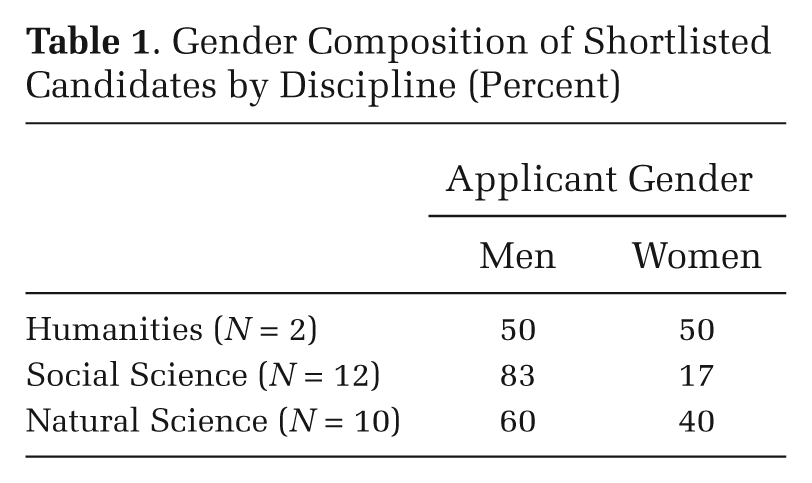
To make fine distinctions (Stevens 2007) among the remaining candidates who passed these thresholds, all three committees actively considered gender and intentionally made efforts to include women on their short lists for interviews. Table 1 shows the gender breakdown for campus visits (known as “fly outs”) by department. Only the natural science committee mentioned race, but it was phrased as a query in terms of whether any shortlisted candidates were underrepresented racial minorities (the answer was no), rather than an active decision to have a racially diverse candidate slate. Relationship status was mentioned infrequently when determining interview invitations, occurring only once across the three committees I observed.
Gender Composition of Shortlisted Candidates by Discipline (Percent)
From Fly Out to Final Offer: “But Is She Movable?”
Relationship status played a pivotal role after interviews, however, when committees regrouped to rank candidates and make hiring recommendations. Conversation in these meetings focused on which candidates met the threshold for being considered a good hire (in their words, “above the bar”) versus those who failed to meet basic hirability criteria (“below the bar”). Crucially, there was no discussion of what qualifications or behaviors were needed to pass this bar. No committee used scoring rubrics for candidates’ job talks and campus visits. Discussions of written work at this stage were infrequent. Instead, assessments of above or below the bar were based primarily on committee members’ impressions of candidates during fly outs, which were gleaned from job talks, one-on-one meetings, group meals, and the views of department members who communicated opinions via email and informal conversation. The most commonly discussed evaluative criteria at this stage were (in rank order) whether committee members (1) experienced positive or negative emotional reactions to job talks (e.g., whether faculty “liked,” “loved,” or “hated” talks or found them exciting or boring); (2) felt the candidate would fit in intellectually with other members of the department; and (3) believed the applicant would accept or decline an offer. 11
Consistent with research showing that discrimination is most likely to occur when candidates have passed a basic threshold of perceived competence (Dovidio and Gaertner 2000), relationship status dominated talk about female candidates deemed to be above the bar or “at bar” in final decision meetings. To judge their likelihood of offer acceptance, committee members across disciplines reported seeking out information about the relationship status of female—but not male—applicants. They did so through indirect or direct questioning during on-campus visits, making phone calls to advisors and colleagues, scrutinizing recommendation letters for information about candidates’ “personal situations,” and basic internet research. The aim was to predict whether a woman was movable by ascertaining her relationship status and (if applicable) her partner’s occupation. The following exchange within the humanities committee about its top candidate, Anna, illustrates that even when committees were aware of the illegitimacy of directly asking about relationship status, they did not question the use of such information to inform their decisions:
I asked her if she would move. She said her husband—[he looks directly at me]—she mentioned it because we cannot ask. Her husband [an academic] is in [another country]. The commute is hard . . .
She said she likes [the area here]. I think she’s movable. She has relatives somewhat nearby.
I think she is head and shoulders above everyone else.
Is she on any [other schools’] lists?
We can’t ask that.
But is she movable? I don’t trust people who are married [laughs]. I thought she was pretty, by the way. [Says to group] I can’t say that.
No, I can’t say that [laughs].
Even though Anna explicitly told the chair she would be interested in moving with her spouse to Met, the committee second-guessed this information. The other candidate (male) brought to interview did not pass the bar, leaving Anna as the only contender after job talks. However, due largely to the uncertainty regarding the “spouse issue,” the committee debated at length bringing in an additional group of candidates to interview. In the end, members could not come to consensus about additional fly outs and, fearing a failed search, gave Anna an offer.
Committees not only questioned the movability of partnered female applicants, but also perceived their career priorities through a highly gendered lens. In line with traditional scripts of work and family that portray men’s careers as taking precedence over women’s (Blair-Loy 2003; Potucheck 1997; Williams 2001), committees assumed that male partners’ careers were the guiding force behind whether a woman was movable. This was the case not only with academic partners, but also for partners who had other types of high-status professional employment. The social science committee illustrated such assumptions when discussing the fate of its top candidate, Esther. To determine offers, the committee assessed not only candidates’ quality but also their probability of accepting an offer at Met (what they called a “probability score”). Esther’s boyfriend figured prominently in members’ calculations of her portability and overall hirability:
She seems to have the highest potential based on limited information.
Her market is good so far. Has [names top-10 R1 department in another city] and [top-10 R1 department] offers; [top-5 R1] liked her.
Some people think it’s unlikely she’d come because of her boyfriend. He’s a [names the boyfriend’s occupation], and [the city where her other offer is] is really the best for that.
I want to put the [acceptance] probabilities on the board. [She writes a .5 probability next to Esther’s name.] She told me that we are better than [her other offers]. But we need to work out her husband. If it were up to her, she would come here.
Note that Esther’s choice of job was described as being largely in the hands of her boyfriend (whom one committee member mistakes for a husband, a common theme for boyfriends). Even though she was the top candidate, and the area where Met is located has numerous jobs in her partner’s field, the committee ranked her lower than male applicants with equal or higher probability scores, because members believed her boyfriend would have to take a career hit. In doing so, they decided on Esther’s behalf to prioritize her boyfriend’s career over her own.
The emphasis on female applicants’ relationship status was most striking in the natural science search, in which three of the five top-performing candidates—Lucy, Elizabeth, and Jennifer—were women. However, even though this search had the largest number of above-the-bar female applicants, as well as the greatest number of female committee members, the group relied most intensively on relationship status and partner occupation as decision criteria. In the case of Lucy, who was considered the top candidate, the group had a short discussion of her merits. They agreed she had a “great CV” and did very well in her job talk, unlike the candidates previously discussed in the meeting. However, as illustrated below, evaluations of her as a desirable hire quickly shifted to discussions of her relationship status, as well as that of the other women interviewed. Lucy was married to a male academic, which harmed her chances:
So it seems like we are overall positive [about Lucy].
It may depend on where her husband [an academic] is going to go. . . . The next step is finding out what her husband will do. We are not going to get her if we can’t get her husband.
So she is close to the top, but we need to get an assessment of her husband.
Yes, is her husband getting an offer [from a department at Met]?
We know way more about Lucy’s husband [than we do about the others]. The last three [candidates, all women] were very good about not giving information.
Does Jennifer have one [referring to a husband]?
Let me check. [There is silence until Lydia alerts the group that she is bringing up Facebook.com on her laptop.] Her best friend is one of my former undergrads.
No, I think she had a wedding but now she’s divorced.
Really? I thought she was married.
Yes, but then she had a divorce. [She continues searching, then turns the computer to the group and brings up evidence of divorce online.] . . . She had a wedding but she’s divorced.
Now she has a boyfriend [clicking her mouse on her laptop]. Let me see. . . . Looks like he’s flexible! [She laughs.] He looks like he’s a hiker or something. He’d move.
We need to find out more things about her husband [referring to the boyfriend].
Shoot, those were old photos. That was [years ago]. Is she married?
Stefano interjects to question whether discussions of Lucy’s relationship status are legitimate, but he is soon dismissed:
I don’t think that should matter.
She was in someone else’s wedding [referring to finding a wedding website of another couple]!
At least we know she was in other people’s weddings. She has friends.
Have you checked the New York Times weddings section?
Yes, that’s how I found out about Elizabeth’s wedding.
Does Elizabeth have an announcement?
Have you checked Weddingchannel[.com]? [She brings up a listing and later finds Elizabeth’s wedding registry.]
Lydia visits site, too. She then shows her computer to Ronald, who begins looking at the registry and commenting on the gifts.
Do people really need this stuff?
Tomas returns to Stefano’s comment about the legitimacy of relationship information, asserting it is indeed job-relevant:
Most people who have a spouse or partner, people bring it up. [Looks toward Stefano.] It is relevant. We need two jobs.
Lucy stood out above others, she was interactive and clear, and there is great synergy with other members of the department.
Can we get more information about Lucy’s husband? I know he’s interviewing at [another department at Met].
I think [that department] should push for her if they want him, saying she needs a job rather than vice versa even if she is our number one pick.
People nod in the room.
Lauren, you’re in his field. Can you find out more information about his offers?
What is striking about this exchange is not only the lengths that committee members went to procure information about women’s relationship status, but also the comfort they felt doing so in my presence. All committee members knew I was observing them for research purposes under the instruction of their university administration. Yet, they not only felt at liberty to engage in such actions, which are against both Met policy and state law, but they also asked me to help them in doing so. In addition, although some might expect a more gender-balanced committee to be less prone to gender bias, female committee members intensified these conversations because they knew how to find out—through networks or specific websites—information about relationship status.
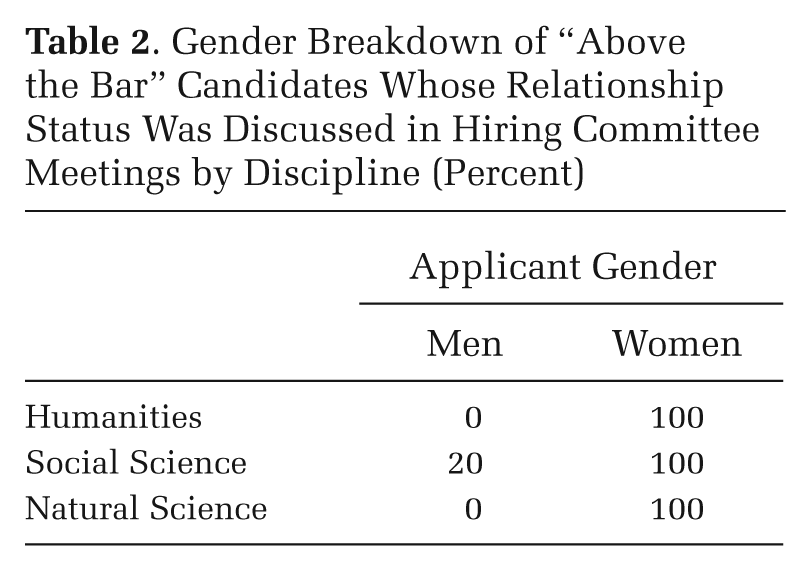
As Tomas asserted, relationship status was seen as a job-relevant criterion for women, but it was rarely discussed for shortlisted male applicants. Table 2 breaks down the percentages of above-the-bar applicants whose relationship status was discussed in hiring committee meetings by discipline and gender. In the few cases when committees discussed men’s relationship status, they presumed all female spouses—even other academics—to be portable, even if it meant the female partner would have to take a relatively low-status job. 12 The following conversation among members of the social science committee contrasts the fate of two applicants, both top performers with potential outside offers and academic partners:
Samuel and Sadie are in lock step. We like both. We have no chance with the latter. We thought we had an inside track because of a partner issue but everyone does. [Another department at Met] is flying her husband out. But the husband has an offer at [an R1 university of similar prestige as Met]. We have no chance . . .
But I didn’t like Samuel’s [job market] paper.
[Names a faculty member, not in room] spoke highly of Samuel as a person and of his work . . .
[Top-ranked department] is thinking of making an offer to him . . .
We could get his wife a lectureship. They like [this geographic area].
I like both Sadie and Samuel. Sadie there is a zero probability of getting.
Gender Breakdown of “Above the Bar” Candidates Whose Relationship Status Was Discussed in Hiring Committee Meetings by Discipline (Percent)
The committee then eliminated Sadie, saying it was “not worth the risk” because her husband had a job offer elsewhere, even though he was a contender for a tenure-track position at Met. However, the committee gave Samuel an offer under the assumption that his wife would follow him for a low-status lectureship.
Summary
In the context of unstructured evaluations, committees in my sample used information about female applicants’ relationship status as a basis for ranking candidates after campus visits and making final hiring decisions. Drawing from gendered scripts of family and career that place women’s careers behind those of men, committees penalized shortlisted women with academic partners or partners whom they considered not portable because they assumed a woman was unlikely to accept a job offer unless her partner was able to procure attractive employment nearby. Interestingly, as illustrated by Esther, perceptions of desirable employment were commonly derived through committee members’ stereotypes of occupations and acceptable jobs, rather than information articulated by applicants or the realities of local labor markets. Such perceptions were deeply gendered. For academic couples, committees viewed lower-status, lower-security jobs off the tenure track (e.g., lectureships, postdoctoral opportunities) as acceptable for women but not for men. This may be one reason why women in dual-career hires are more likely than men to be offered non–tenure-line roles (Schiebinger et al. 2008). By contrast, male applicants’ relationship status was discussed infrequently. When it was, committees viewed all partners as portable and interpreted an academic partner as a recruitment issue to be dealt with after an offer was extended, rather than a basis for not making an offer.
Is Relationship Status Discrimination Unique to Met?
The hiring committees I observed penalized partnered women. This naturally leads to the question: is there something peculiar about Met or the departments I studied that leads to a unique focus on relationship status? To gain traction on this issue, I conducted follow-up interviews with the chairs of each committee, as well as the two senior administrators directly involved with junior faculty hiring: the dean and the associate dean assigned to managing dual-career issues. The goal of these interviews was to obtain important contextual information about the departments I studied and about Met. Interviews lasted between 40 and 70 minutes, and took place at the time and place of participants’ choosing. I asked open-ended questions about how departments and administrators interacted during the hiring process (e.g., when authorizing searches, designating interview lists, giving job offers). I also asked them to describe recent job searches, candidates, and offers, and to reflect on their experiences with dual-career hires. Finally, I presented them with the findings of my study—that search committees used women’s but not men’s relationship status to make hiring decisions—and observed their spontaneous reactions. I took detailed verbatim notes in real time, taking great care to capture participants’ expressions in addition to their original language. I coded notes for common themes using the data analysis software Atlas.ti.
As a point of comparison, I also spoke with seven faculty members charged with overseeing junior faculty searches at one campus of a different large R1 university (“Urban”). Urban has a unique program that assigns tenure-line faculty to serve as search committee specialists. These individuals provide formal and informal guidance to all search committees hiring within their division each year (e.g., arts and sciences, law, medicine) with the aim of promoting equitable and effective hiring practices. Specifically, they help committees devise strategic hiring plans; inform members about evaluative best practices (especially pertaining to diversity); identify illegal or inappropriate committee behavior; review the demographic composition of proposed interviewees and hires (comparing them to the composition of both the applicant pool and the relevant discipline); and meet with and field questions from members throughout the search. As such, these individuals have a breadth and depth of knowledge about junior faculty hiring at Urban. To gain insight into Urban’s hiring processes, I conducted a one-hour focus group organized in association with the university’s office for institutional equity with these individuals. I presented participants with results from my study and observed their spontaneous reactions. I then solicited feedback about how the policies and processes I observed at Met were similar to or different from those they had observed in their home and assigned departments at Urban. I took detailed notes in real time to capture participants’ reactions and questions about my findings.
Urban is similar to Met in that it is a large R1 university located within a large metropolitan area. Likewise, marital status discrimination is against university policy and state law. Urban differs from Met, however, in several ways that one would expect might decrease or even eliminate relationship status discrimination. First, it is a public institution with a well-established culture of promoting student and faculty diversity. Second, it has many institutionalized programs, including the search committee specialists program described earlier, that aim at increasing equity and establishing accountability in hiring (see Kalev, Dobbin, and Kelly 2006). Third, Urban requires search committee members to undergo anti-bias training that includes information about marital status discrimination. Finally, it has a formal, centrally funded partner-hiring program that creates tenure-line jobs for partners. Consequently, whereas Met represents a “most likely” case of relationship status discrimination, Urban represents a “least likely” case (Eckstein 1975). It is important to note that due to access limitations I was unable to conduct a parallel ethnographic study at Urban. Rather than a full case comparison, I include insights from experts with knowledge of multiple departments as an illustrative contrast to investigate whether relationship status discrimination is unique to Met or is present in other settings.
These conversations revealed that although several disciplinary and institutional factors may make relationship status discrimination more common or extreme at Met, relationship status discrimination appears to be a widespread practice in academic hiring.
Sample-Specific Factors
Male-dominated fields
None of the Met search committee chairs reported particularly memorable cases of losing partnered junior women to other universities. They described how, in their experiences, women and men tended to give similar reasons when declining job offers. Eran, the social science chair, reflected, “They always make up reasons. ‘My spouse liked this other city better; I don’t think it’s a great fit.’ The men say it’s their wife, and the wife says it’s their husband. But it’s always because they got a better offer somewhere else. It’s obvious.”
The three departments did, however, share one feature especially relevant to gender: they are all part of male-dominated academic disciplines. Women comprise less than 50 percent of PhDs and tenure-track faculty and less than a quarter of full professors in each field. Given that the gender composition of fields can influence relative patterns of inequality that emerge within them (Kanter 1977; Turco 2010), relationship status discrimination might be less prevalent or pronounced in more gender-balanced fields, like sociology, or where disciplinary cultures are more embracing of women. Limitations in organizational access prevent me from investigating this possibility systematically, but it is notable that when I presented my findings to Met’s dean (“Meredith”) and associate dean (“Veronica”), both described situations in which they witnessed discriminatory processes in male-dominated departments other than the ones I studied.
Neither Meredith nor Veronica sits in on faculty search committee meetings. As a result, they are not privy to the behind-the-scenes conversations about candidates I observed. Nevertheless, when departments want to authorize a job offer, chairs meet with Meredith and Veronica to give the administration a written report that describes and ranks each candidate deemed above the bar. This report also details which of these candidates they would like to offer jobs and why. The report must include an additional explanation if no women or minorities are offered jobs. Meredith and Veronica recalled cases in which two different male-dominated departments justified not offering jobs to top women because of their partners. Veronica described one instance in a male-dominated STEM field: The department interviewed a [female] junior star. They came to us with their list, and they said we know she’s amazing, but she’s married to another [scholar]. We know he’s not coming, so why hire her? They have to turn in an affirmative action form and on it they have to write why if they are not giving an offer to a woman or a minority. And that’s what they wrote. The chair was generally a good guy, but I said this is discriminatory. . . . He looked so uncomfortable. They had clearly done it with a lack of intention. He didn’t realize it.
Meredith described a similar exchange with the head of a male-dominated humanities department: The form said, “This was our top candidate, but we don’t want to give her an offer because she has a partner and we don’t think she’ll come.” It is not up to you to decide. They might not mind having a long-distance relationship. They may be willing to shift things around to make it work. We don’t know about other people’s career decisions, and it shouldn’t be a strike against her. . . . I said, “Take that out of there [the description], and if you think she’s the best candidate, you offer her the job.” After that interaction, I’m not sure if they figured out . . . that wasn’t going to work with me, so they may have had those conversations behind closed doors in the department. I often wondered if they did.
Consequently, although my ability to generalize from my ethnographic sample is limited, relationship status discrimination may be more common or extreme in male-dominated disciplines, such as the ones I studied. Future research should address this important issue in further depth.
Lack of institutionalized partner policy
Relationship status discrimination was not limited to the departments I studied. Is it unique to Met? One factor that may make relationship status discrimination especially salient at Met is that the university lacks a formal dual-career hiring policy. The school does offer assistance to dual-career couples, but partner situations are handled on an ad hoc basis. For academic partners, Veronica typically “floats” a partner’s CV to relevant (“receiving”) departments via email to gauge interest. Receiving departments have complete discretion over what to do with this information. Veronica described “hounding” department chairs, calling them multiple times, just to get them to look at partners’ CVs. She observed a generalized reluctance to hire partners: “They say, ‘No we prefer our own people. We have our own hiring standards.’”
In addition to the fact that hiring agents typically have confidence in their personal ability to judge merit and resist interference from external parties (Rivera 2015), a practical factor also contributed to this aversion. Without a formally funded partner-hiring program in place, departments have to use one of their own lines to hire a partner. As a result, departments frequently perceived partner hiring as a zero-sum game that was more of an imposition than an opportunity. Lydia, the chair of the natural science committee, said, “It feels like they are pushing this subpar person off on us so they can get their person.” In cases when a department was interested in a partner but did not have—or was not willing to use—an existing line, the university did not create extra tenure-track lines. Instead, administrators funded temporary, non–tenure-track positions. The most common of these were lectureships or postdoctoral fellowships. 13
The department chairs I spoke with were aware that the chances of obtaining tenure-track positions for junior job candidates’ partners at Met were slim. For this reason, Eran believed that going through the administration was a waste of time. Instead, members of his department personally called friends in different departments at Met and at neighboring universities, but he reported never having had luck with this approach. “I don’t think we’ve ever gotten someone junior a job for their spouse,” he admitted. Lydia reported that the historically most successful avenue in her department, one she disliked because of its potential for gender inequality, was that “trailing” female spouses were hired to manage their husband’s lab, which provided them with a job but no facilities to do their own research, often ending their own tenure-track prospects. Consequently, administrators and department members had a widespread—and mostly accurate—perception that a lectureship or other temporary, non–tenure-track position was the best Met could do.
Most research universities nationally, especially R1 institutions, are similar to Met in that they lack formal dual-career hiring policies and rarely create tenure-line positions for partners (Wolf-Wendel, Twombly, and Rice 2003). Nevertheless, some universities do have formal partner-hiring programs that provide centralized funding to create tenure-line positions for partners. One common policy is known as “third-third-third,” which is present at Urban and some other large, public universities. This policy involves a host department funding one third of a position, a receiving department another third, and the central administration the remaining third. Meredith had worked at institutions with such policies. She described how, at those places, departments were generally more receptive to partners than at Met. These policies, she said, “sweetened the deal” by providing “extra talent” that was “almost free.” She reflected on the difficulty of getting departments at Met to agree to hire partners: “We don’t have anything like that [policy] at Met. . . . I’ve always wondered if that makes things worse.”
Why did Met lack a formal dual-career program? First, the administration perceived partner programs as being extremely costly. Veronica elaborated on this perspective: You can’t keep minting money. You can’t keep multiplying permanent positions if there’s no money behind it. The university budget is largely personnel costs that are fixed. A lot of people don’t understand that you have to pay for it. There are a fixed number of slices. If you cut it up into smaller pieces, there is less to go around. People don’t get it until you put it in terms of raises and what it does to their compensation.
14
Second, administrators and faculty commented that because Met was generally seen as an attractive place to live and work, the university “didn’t have to do anything” to draw high-quality talent. Eran said of the partner issue, “We think that the prospect of having a job here is so good, we don’t have to even think about it.” Veronica elaborated: “It’s different in a city university like ours versus an isolated one. . . . At [certain universities], creating a second job for a spouse can be necessary because there are no other reasonable jobs within commuting distance.” Or as Peter, the chair of the humanities committee, said bluntly, “They have a good [partner] program at Michigan. But then again, what else is someone going to do in Ann Arbor [laughs]?” Some participants noted that dual-career programs are also more common at mid-ranked universities, where providing two tenure-track jobs to a couple can be a means to compete against other institutions.
Thus, in the absence of a formal—and centrally funded—dual-career policy, Met’s ability to provide attractive employment options for academic partners was limited. Only temporary, lower-status positions were possible for junior hires. The situation was not much better for nonacademic partners; the university offered to “broker connections” with local industries but did not offer a formal employment service. Consequently, Met’s lack of a formalized hiring program may have made the two-body problem more salient in the minds of evaluators.
Yet, if lack of a partner program was the only reason committees used relationship status information in hiring, one would expect committees to penalize applicants of any sex who had academic or professional partners. Instead, committees interpreted employment constraints for partners in a highly gendered way. As illustrated by the contrasting cases of Samuel and Sadie in the social science search, committees viewed low-status, insecure, or uncertain employment options as acceptable for female but not male “trailing” partners.
Furthermore, if lack of a partner program were alone driving my results, relationship status discrimination would be rare at Urban, which has a robust and formal third-third-third partner policy. Although my focus group participants described relationship status discrimination as being less extreme at Urban, nearly half volunteered that they had personally observed cases of departments using information about partners to make offer decisions. Consequently, factors in addition to the presence or absence of a formal partner-hiring program are likely at play.
Features of Academic Labor Markets That Encourage Relationship Status Discrimination
The faculty and administrators I spoke with at Met and Urban revealed broader features of the academic labor market that encourage an emphasis on applicants’ relationship status in hiring.
Fear of losing out (or losing a line)
Across both schools, the faculty I spoke with believed that considering a candidate’s likelihood of acceptance was a valid criterion of evaluation. Recall that it was the third most mentioned criterion in final-round decision meetings across committees; it also was a poignant feature of discussion with search committee specialists at Urban. I argue that the resource-intensive nature of screening processes in academia, combined with the sequential and limited way in which job offers are typically made, can contribute to fears of failed searches. This, in turn, can contribute to heightened emphasis on factors that committees perceive as associated with offer rejection, including relationship status.
Resource-intensive screening
Academic departments tend to structure junior faculty hiring in a time- and labor-intensive way. Unlike labor markets where hiring is outsourced to human resource professionals, faculty at research universities typically shoulder the responsibility of application screening, interviewing, and decision-making. Department members balance these tasks with full-time research, teaching, and service loads. Application materials for junior-level hires are lengthy, often entailing multi-page CVs, recommendation letters, research statements, teaching statements, and samples of written work; a single application can be over 100 pages. Committees typically evaluate hundreds of these applications within several weeks to determine fly outs. Academic job interviews are likewise time-intensive. Candidates travel to the campus and typically “live at” a department for one or more days. During this time they meet with professors, administrators, and graduate students in back-to-back interviews, give a full research seminar (“job talk”), have group meals, and in some departments give an additional teaching demonstration in what can amount to 14-hour days. Met chairs and Urban search committee specialists described how these visits are exhausting not only for candidates but also for faculty who host them, especially when candidates are scheduled close together. For example, the natural science committee brought out 10 candidates, each for a two-day visit, during five consecutive weeks. As Lydia described, during recruiting season, “It’s hard to get anything [else] done.”
Research in psychology and behavioral economics shows that when making decisions, people tend to focus on what they could potentially lose by choosing a specific option, rather than what they might gain (see Kahneman 2011). This bias, known as loss aversion, is a basic feature of decision-making that is exacerbated when people have invested substantial amounts of time or resources into a decision, such as is the case in traditional academic searches. 15 The faculty I spoke with articulated a broad fear of failed searches. Peter summarized this sentiment most succinctly when he confessed, “People invest a lot of time and energy into searches. . . . No one wants to fail.”
All or nothing hiring
Such abstract fears of search failure were compounded by the sequential and limited way in which job offers were typically made. Academic departments often have a very small number of jobs (frequently, only one) they can fill per year. Chairs described how departments within a given discipline typically hire around the same time to remain competitive, and departments often interview the same people. Lydia explained, “Every year, there is a top cohort of people. We’re often competing against [lists several peer universities] to get them.” Top candidates frequently have multiple offers to choose from. This can lead to what labor economists call market congestion, in which the job market stalls until those holding offers accept or reject opportunities, clearing the way for departments to make subsequent offers (Niederle and Roth 2009). Such competition and congestion made the faculty I spoke with afraid that if a first-choice pick declined, the second-choice candidate may have already accepted a job elsewhere by the time an offer was made.
In theory, such delays should not hamper filling a line at universities like Met where departments are not constrained in the total number of offers they can make. Yet, members described being hesitant about hiring candidates beyond their second-choice picks. Ruth, an Urban search committee specialist, proposed a reason underlying this trend, which she had observed in both her home and assigned departments. Psychological research on winnowing (Ross and Ellard 1986), she noted, suggests that when individuals compile a ranked list, such as the ones departments typically create when making job offers, the sheer act of designating someone number one makes other individuals on the list seem relatively unappealing, even when quality differences were trivial prior to ranking. Met chair Peter provided a lay understanding of this phenomenon: “Going to the second would be okay, but going to the third is problematic because it’s your third choice. At that point it’s better to bring out more people.” Lydia provided a slightly more lenient benchmark but insisted, “You never ever want to hire number four.” When making initial job offers, committees thus feared the loss of the “best” candidates as well as their ability to hire any candidates at all.
If a department failed to hire in a given year, it could lose needed resources. Faculty at both universities complained that classes could go unstaffed, or existing department members might have to take up the slack in teaching, research, or service. But what the individuals I spoke with feared most was the loss of the line entirely. If no candidate accepted the job, administrators could refuse to authorize a search in subsequent years. According to Meredith, who authorized lines at Met, losing lines there was rare, except during the financial crisis. Yet, as my conversations with Eran, Lydia, and Peter revealed, Met chairs still feared this could potentially happen. At Urban, where departments compete for more limited resources, participants said that losing a line after a failed search was a real possibility.
Under such conditions, the presence of a partner—especially an academic one—could serve as a negative signal (Spence 1974) of commitment to a school or location that triggered fears of rejection and loss among search committee members. As Peter put it, “Searches can fail if there is a partner situation. It’s always in the back of people’s minds. . . . There is this temptation to find out, not necessarily to ask them but to ask a colleague who knows.” Faculty at both Met and Urban discussed how partners were risky not only because they constrain a candidate’s geographic choices, but also because—from the department’s perspective—they take time to accommodate. The time spent waiting for information on nearby employment opportunities could cause them to lose a second-choice candidate or the line entirely.
Interestingly, Urban participants expressed such sentiments even though the university had a formal partner-hiring program. Thomas noted that although the university offered a third-third-third cost-sharing program, departments still had the final call about partner hires, which created uncertainty and anxiety. 16 In fact, Ruth, the specialist mentioned previously, expressed such a deep fear of losing lines this way (she described to the group how her department recently “got burned” by a partnered applicant who did not disclose this status during the campus visit) that she not only condoned the practice of finding out job applicants’ relationship status during fly outs, but even advocated that the university create a formal database containing the relationship status of all applicants. Such a resource, she argued, would allow departments to make “informed decisions,” while “eliminating discrimination” because they could “use it for men, too.” When I pointed out that using such a database would violate state laws against marital status discrimination, she insisted, “We need to know.”
Although the presence of a partner may indeed prolong the completion of a search, two factors are noteworthy. First, candidates may have reasons other than partner situations that lead them to take time to contemplate offers or reject jobs. However, participants did not cite these as reasons not to offer someone a job (and, in some cases, viewed them as reasons to give jobs). For example, Eran described how candidates who receive large numbers of offers often engage in prolonged negotiations. Yet, as I witnessed in his department, male “market stars” with multiple offers were described as “worth the risk,” even when they were seen as having a low probability of acceptance, whereas partnered female stars were “too risky.” Likewise, Lydia described how in her field, the need for expensive equipment could significantly stall searches. Nevertheless, committees described candidates who required such items for their research as “wins,” even when a “long shot,” because they brought big-ticket technologies that faculty believed the department would not otherwise get. Second, and most importantly, committees perceived having a partner as a negative commitment signal only for female job candidates.
As such, relationship status discrimination may be more likely in congestion-prone labor markets characterized by time- and labor-intensive evaluation and sequential offers. Yet the patterns of discrimination I observed were not merely due to such structural features of the academic labor market: they were also attributable to gendered perceptions of value and risk among evaluators.
Don’t ask, but do use
Complicating matters, nearly all the faculty I spoke with expressed a fundamental misunderstanding about relationship status discrimination. They believed it was discriminatory to ask candidates about their relationship status. But as illustrated in the humanities committee’s exchange about Anna, they overwhelmingly believed that if a candidate disclosed this information voluntarily, using it was legitimate. As Lydia asserted, “You’re not supposed to ask these things and sometimes they tell you, and then that’s fine. Sometimes you can find out from people you know.” Eran fleshed out the distinction between asking and using personal information in further detail: There’s a taboo against asking about these things. Once we are told, then it’s fair game. But we don’t inquire. . . . Once you say it, it’s fair game to use it. People will use it to figure out what’s the probability of getting you. . . . I always tell my students not to disclose anything personal because the negotiation doesn’t just begin after an offer is made.
Crucially, though, it is not asking about relationship status that technically is illegal in states like the ones where Met and Urban are located, but using this information to make hiring decisions. Likewise, although the Equal Employment Opportunity Commission (EEOC) and diversity consultants counsel organizations not to ask job candidates about their relationship status due to the potential for litigation, it is again the act of considering women’s (but not men’s) relationship status in making offers that violates federal anti-discrimination laws on the basis of gender, and in universities, Title IX protections. 17
Interestingly, although Urban’s search committee specialists were considered institutional “experts” in equity, they expressed similar confusion about what constitutes discrimination. After my presentation, specialist Janice mentioned that her home department “doesn’t discriminate” because faculty “know better.” Specifically, she cited how all search committee members are required to participate in anti-bias training, where they learn that “they can’t ask” about relationship status information (and, she joked that in her experience, “they mostly behave”). 18 Nevertheless, she described how faculty in her department sometimes “factor in” information about academic partners when making offers “if the candidate brings it up.” When I informed her that it is the use of marital status that is illegal, she described this insight as “shocking” and announced to the group that a key takeaway from the meeting was a need for the university to re-educate faculty, because she “honestly think[s] people have no clue” that using such information is problematic. Consequently, a lack of awareness about what constitutes discrimination among evaluators may contribute to the use of relationship status in hiring in academia.
Gendered Perceptions of Portability
In the proceeding pages, I have discussed how the gender composition of disciplines, presence or absence of formal partner-hiring programs, structure of hiring processes, and understanding of anti-discrimination regulations may relate to relationship status discrimination. Yet, a crucial puzzle remains: why do committees discriminate against partnered women but not partnered men?
I argue that cultural meanings members brought to bear in evaluation contributed to their differential interpretation and use of partner status by applicant sex. Cultural beliefs about gender exert particular force under conditions of ambiguity or uncertainty (Ridgeway 2011). In addition to uncertainties present in hiring decisions in general (Spence 1974), the faculty I spoke with expressed uncertainty—and concern—about ascertaining candidates’ levels of commitment to a specific university and geographic location. 19 Under such circumstances, they fell back on gender stereotypes when comparing above-the-bar applicants after fly outs.
Gender stereotypes portray men as more committed to careers and women to relationships and family (for a review, see Heilman 2001). Sociologists typically discuss these stereotypes in terms of the perceived amount of effort or time women and men devote to paid work (Ellemers et al. 2004), especially after the arrival of children (Blair-Loy 2003; Ecklund and Lincoln 2016; Stone 2007; Williams 2001, 2005). However, my study participants illuminated a distinct variant of such ideas: that even in the absence of children, women prioritize male partners’ career prospects and preferences over their own, making them less movable than men. Furthermore, this was the case for all types of romantic partnerships, not just marriages. When I described my findings to the Met search chairs and administrators, all cited beliefs present within their “fields” or “among colleagues” that women were more likely to consider their partner’s preferences when contemplating a geographic move, whereas men put their careers first. Eran noted how perceived earning differentials or bargaining power within couples could exacerbate such beliefs: “It is assumed that the man is the breadwinner, so he’s more likely to be a constraint than the other way around” (see Potucheck 1997). Yet, all respondents—without prompting—were quick to point out that, while they believed that considering a candidate’s likelihood of accepting an offer was legitimate, they personally disagreed with these gender-based assumptions, describing them as “old school” and “unfortunate.”
Moreover, while all chairs believed that relationship status discrimination occurs to some degree at other universities (each chair volunteered stories of female graduate students reporting they had been asked about relationship status during job interviews or of personally receiving calls from colleagues asking them about the relationship status of female PhDs), they also insisted—without my prompting—that it does not occur in their departments. Peter, for example, insisted that relationship status has never been discussed in meetings where he has been present. “People may say things in the halls,” he admitted, “but it never makes it into a formal meeting and if it does, people immediately shoot it down as inappropriate.” Similarly, Eran insisted that candidates’ relationship status “is not on our radar screen. We’ve never considered it.” At the end of the interview, he asked me directly whether his committee had brought up the issue during my observation. Displaying how a lack of understanding of discrimination can combine with a lack of awareness of discriminatory behaviors, when I said yes, he immediately interjected, “That must have been Esther. She had a husband [correction: boyfriend] in [another city], and was weighing an offer in [that city] because of her husband. It affected her probability score, but she brought it up; we didn’t ask her.” The most striking example of such disconnect between perception and behavior came from the natural sciences search, where Lydia explicitly volunteered that she never engages in the very type of internet research I saw her conduct at length: “First of all, it’s totally illegal. . . . You can Google stalk your candidate and find out lots of things. I’ve never done that, though.”
But as I personally observed in committee meetings, these same individuals applied gendered assumptions about women’s and men’s work-family preferences when discussing above-the-bar job candidates. Moreover, they explicitly articulated these assumptions as justifications for excluding partnered women in the rare cases when group members, such as Stefano, asked why partner status was relevant. Some of this mismatch between perception and behavior may be due to social desirability biases present in research interviews (Pager and Quillian 2005), but it also suggests an important point about the gendered nature of relationship status discrimination: much like other forms of subtle or “second-generation” gender bias (Ibarra, Ely, and Kolb 2013), it may be operating under the surface, outside of evaluators’ intent or awareness. Still, it affects behavior (Ridgeway 2011).
The types of vague criteria and unstructured, subjective evaluations that are common in academic hiring help pave the way for gendered assumptions—whether conscious or not—to affect decisions. At Met, where relationship status discrimination against partnered women was most extreme, CVs and job talks were reviewed by faculty according to personalized criteria and no unified scoring systems were used. Although some departments at Urban had experimented with checklists and rubrics aimed at making application or job talk review more systematic, neither school had standardized questions, criteria, or scoring systems for one-on-one interviews, where queries about a candidate’s “interest” in a position or locale often took place. Crucially, departments at both schools determined offers through open group discussions where faculty debated aloud the relative strengths and weaknesses of candidates with few guidelines. Research shows that these types of unstructured evaluations and oral group discussions are especially prone to gender bias (see Heilman 2001; Reskin and McBrier 2000; Ridgeway 2011; Uhlmann and Cohen 2005). Compounding this, studies show that faculty members tend to be highly confident in their own abilities to ascertain merit in an “objective” way, even in the absence of formal evaluative protocols (Lamont 2009; Posselt 2016). 20 Yet, individuals who display such meritocratic frames are simultaneously more likely to make biased assessments by gender (Castilla 2008; Castilla and Benard 2010) and less likely to notice discriminatory acts or behavior (Cech, Blair-Loy, and Rogers forthcoming). As such, structural features of the academic labor market may combine with unstructured evaluations to create a situation ripe for gendered beliefs about portability to influence hiring decisions.
In summary, while certain factors may make relationship status discrimination more likely or extreme at Met, general features of the academic labor market encourage the use of gender and relationship status information in hiring decisions. Or, in Meredith’s words, relationship status discrimination against partnered women “is in the water at all these places; it just may be worse at Met.”
Boundary Conditions
As a small-N qualitative study, my ability to generalize to academic institutions as a whole or hiring in general is limited. Met is a private R1 institution that lacks a formal dual-career hiring policy, does not use structured evaluations to determine job offers, and gives faculty large amounts of discretion in the hiring process. While these factors make relationship status discrimination more likely at Met, they are typical among R1 universities nationally (Wolf-Wendel et al. 2003). Additionally, the inclusion of Urban, a public R1 university with a dual-career hiring program that has been recognized for excellence in promoting faculty diversity, as an illustrative contrast allows me to conclude that relationship status discrimination is not unique to Met. However, due to data limitations, I cannot quantify the presence or strength of relationship status discrimination at Met versus Urban, or determine that relationship status discrimination is more or less common at particular types of institutions. Rather, my analysis demonstrates the existence of a powerful, previously undocumented source of discrimination that adversely affects the career prospects of academic women. Future research should examine the role that applicant gender, relationship status, and partner occupation play in hiring for a wider range of disciplines, institution types, and geographic locations. 21 Moreover, although none of the candidates who interviewed at Met during my observation period were partnered and openly gay, future research should investigate whether my findings generalize beyond heterosexual couples (for a discussion of dual-career hires and employee sexuality, see Schiebinger et al. 2008).
Although I cannot generalize statistically to other occupations, my findings may generalize theoretically to competitive, congestion-prone labor markets where evaluation is largely unstructured and geographic relocation is required. Potential examples include executive searches (Khurana 2002), post-MBA private equity recruiting (Turco 2010), and post-residency fellowships in medicine. Future research should also address whether relationship status discrimination persists beyond the point of hire in such markets, such as in promotion decisions or employers’ responses to external job offers received by partnered men and women.
Furthermore, I was not given access to individual job applicants’ dossiers. It is possible that unobserved differences between partnered women versus all other applicants are driving committees’ decisions, despite their explicitly articulated perceptions about men’s and women’s portability. However, given that partnered women were described as top candidates within each search, and married women tend to be more productive than unmarried women on the tenure track (Astin and Milem 1997; Finkelstein 1984; Fox 2005), such patterns are unlikely.
It is also worth noting that the type of data gathered differed between Met (interviews and observation) and Urban (focus group). Met participants were also interviewed prior to being made aware of my results and then asked to react to my results, whereas Urban participants were aware of the study’s focus from the start. Consequently, each group had a different set of conditions and different amount of information.
Finally, it is possible that employers are behaving rationally and simply engaging in a form of statistical discrimination in which partnered women are less likely to accept available job postings. This issue may be especially relevant in academia, where women are more likely than men to have partners who are academics or who otherwise work full-time (Jacobs 2004). One survey found that among already employed dual-career faculty, women were more likely to report that they would turn down external offers if their partner could not find satisfactory employment (Schiebinger et al. 2008). A deeper look, however, reveals that while women may be more likely than men to consider their partner’s career prospects, the numbers who do so are relatively small; the majority of married tenure-line women faculty report that they are not constrained geographically by partners when considering job offers (Mason et al. 2005). Even if men and women decline entry-level positions at similar rates, committees may have distorted perceptions of acceptance rates if they cite different reasons for declining jobs. Women might fear backlash for violating feminine prescriptions of communality by prioritizing factors such as salary, research funds, or institutional prestige, and more frequently cite partners or families as reasons for declining jobs. Future research conducted with job applicants should probe these issues more deeply. Regardless, even if partnered women decline tenure-track jobs at a higher rate than men, committees’ direct and differential use of relationship status information in hiring violates state and federal laws surrounding marital status and gender discrimination, violates Title IX gender protections, eliminates partnered women who prioritize their own careers, and keeps levels of gender diversity in academia artificially low.
Implications
Implications for Research on Gender and Academic Careers
My findings suggest that applicant relationship status can play an important role in determining whether and which women receive full-time, tenure-track job offers. In addition, the study highlights how the two-body problem in academia, which is often discussed as a product of labor market structures or individual choices, is a gendered phenomenon embedded in cultural stereotypes and organizational practices that can serve as a source of gender inequalities in hiring. Women are more likely than men to partner with academics or professionals. But my results show they are also more likely to be penalized by employers for being part of dual-career couples. Consequently, although many factors contribute to the underrepresentation of women among tenure-track faculty relative to the proportion of female PhD-holders, my results suggest that such disparities may be due not only to supply-side factors and a “leaky pipeline” on the candidate side, but also concrete actions by employers that reduce access for partnered female applicants to tenure-track jobs. Given that a large percentage of female PhD-holders are partnered with men who are employed full-time (Jacobs 2004), such patterns affect a large proportion of the pipeline to tenure-track roles. In addition to being a source of gender inequality in careers, the types of informal organizational practices documented here, which bias hiring toward men and single women, may be one factor contributing to a national trend in which female tenure-track faculty are significantly less likely to be married than are male tenure-track faculty (Mason and Goulden 2004; Perna 2006).
Implications for Research on Labor Market Inequalities
Discrimination based on gender or parental status has received a good deal of contemporary scholarly attention, but far less has been written on how employers use information about applicants’ relationship status. Stories of women having to hide wedding rings or being denied work explicitly because of a male spouse are often assumed to be artifacts of a bygone era. However, my results highlight the enduring importance of relationship status in contributing to gender inequalities in labor markets. Despite regulations in many states—including where this research took place—prohibiting marital status discrimination, the hiring committees I observed used information about female applicants’ relationship status when making decisions; committees rarely sought equivalent information about males and rarely used it to exclude them. Not only did committees seek out and use such legally suspect information about women, they held a widespread perception, best illustrated by Tomas, that relationship status information is legitimate and job-relevant, given that accepting the job would mean a geographic move for most applicants.
As such, my findings illuminate gendered assumptions about romantic relationships that influence hiring decisions. They also contribute to sociological understandings of gender stereotypes of commitment. Prior scholars have shown that employers perceive new and expectant mothers as less devoted to paid work than men (Blair-Loy 2003; Correll et al. 2007; Ecklund and Lincoln 2016; Stone 2007; Williams 2001, 2005). Yet, my findings reveal that even in the absence of children, employers view women as prioritizing male partners’ careers over their own; the mere presence of a male partner in a high-status occupation was sufficient to trigger assumptions that men’s jobs are primary (Potucheck 1997). In addition, while most work on the topic focuses on perceptions of women’s decreased time and effort dedicated to jobs, I found that employers also perceive partnered women as less movable and less likely to accept jobs than partnered men.
Interestingly, as illustrated by the cases of Anna (humanities) and Esther (social science), information about movability provided directly by applicants was mistrusted. Instead, committees made work-family calculations and decisions on behalf of female job applicants—regardless of their stated or unstated preferences—in a manner that prioritized male partners’ careers. My results thus suggest that, at least in highly competitive, congestion-prone, and geographically mobile labor markets, marital career penalties women face may be due not only to self-selection out of highly paid, prestigious tracks but also active discrimination by employers.
The cases documented here illustrate a broader form of gender inequality that I term organizational paternalism, in which organizational gatekeepers make career decisions on behalf of workers in a way that encourages conformity to traditional gendered expectations and artificially constrains women’s careers. The search committees in my study solved the two-body problem for women by eliminating the problem for them, but they let men solve it for themselves. Using women’s relationship status as a justification for keeping women out of desirable tenure-track jobs is only one instance of organizational paternalism. Others include declining to interview, hire, or promote a pregnant woman or new mother out of concerns for the welfare of the child or mother (a phenomenon I witnessed in the natural science committee); preemptively “mommy-tracking” women or forcing them to take accommodations or flexible work arrangements they did not request; and denying women (or reserving for men) work- or travel-intensive assignments out of perceived incongruity with traditional family roles (for examples, see Stone 2007; Williams 2001). This subtle but pernicious form of inequality warrants future research.
Finally, my study suggests one potential mechanism behind psychological research on shifting standards, which finds that although women are more likely to be shortlisted for jobs, they are less likely to receive job offers (Biernat and Fuegen 2001; Biernat and Kobrynowicz 1997). Hiring agents may not only apply higher competence standards for women (Foschi et al. 1994) when making final hiring decisions, but they may also hold them to higher commitment standards.
Conclusion
Recently, popular narratives about gender inequalities in careers have honed in on choice as a driver of persistent disparities between men and women in landing top jobs (see Stephens and Levine 2011), including in academia (Ceci and Williams 2011). These accounts frequently portray gender disparities as stemming from the culmination of decisions made by women that disadvantage them relative to men. For example, women may choose academic majors and educational paths that are less lucrative, or they may self-select out of highly paid or prestigious job tracks due to perceived incompatibility with future family plans. Inspired by Sheryl Sandberg’s bestseller Lean In, a popular component of this narrative involves romantic partner selection. In the book, Sandberg instructs young women to choose their partners wisely, selecting one who will support and enable rather than hinder their careers, and who is willing to share household and childrearing responsibilities. Indeed, research suggests this advice is at least partially warranted, as unsupportive partners can be one factor that pushes women out of fast-track jobs or full-time employment (Ely, Stone, and Ammerman 2014; Stone 2007).
These narratives imply that the onus is on women to find a supportive, flexible partner who is willing to shoulder a significant amount of household and childrearing responsibilities so women can commit themselves fully to work. However, much like other individualistic accounts of gender inequalities in careers, these narratives downplay the role of structural constraints, especially employer bias, in shaping women’s careers (Stephens and Levine 2011). Through a qualitative case study of hiring decisions in academia—one type of professional career where the issue of partner selection has received scholarly and media attention—I demonstrate that partner selection shapes women’s careers not only through individual choice, but also via active discrimination by employers. Employers in my sample used women’s relationship status and partner occupation when making hiring decisions, hiring only those women perceived to have portable or movable spouses, if any. Even if women do “everything right” according to individualistic narratives of choice—pick the correct major, excel in school, pursue desirable and demanding work, and find a supportive, accommodating partner—this may not be enough; hiring committees may still treat them as if their careers are secondary and exclude them from top jobs.
Footnotes
Acknowledgements
I wish to thank Roberto Fernandez, András Tilcsik, Sarah Thébaud, Chana Teeger, Sharon Koppman, and members of the Economy and Society at Yale workshop for helpful comments on previous drafts.
1.
Williams and Ceci (2015) found an advantage for women in the most male-dominated fields. However, their study suffered from serious methodological flaws (see  ).
).
2.
Letter writers are also significantly more likely to focus on women’s efforts rather than their achievements and significantly less likely to describe women as exceptional (Schmader, Whitehead, and Wysocki 2007).
4.
Most research in this area focuses on marriage. However, given the increased prevalence of other types of long-term, committed romantic arrangements, documented biases are likely not limited to state-recognized marriages. For the sake of simplicity and clarity, I refer to individuals who are engaged in committed, long-term romantic relationships as “partnered.”
5.
Some researchers find substantial marriage penalties for women, whereas others find that women experience marriage premiums, but smaller ones than men’s (see Budig and England 2001; Killewald and Gough 2013; Petersen, Penner, and Høgsnes 2014).
7.
These discussions often focus on whether women should wear rings or disclose during on-campus visits that they have a partner who also needs employment. For examples, see http://socjobs.proboards.com/thread/3023/ok-disclose; http://scienceblogs.com/sciencewoman/2008/08/25/negotiating-the-illegal-questi/; .
8.
Currently, under federal law, only federal employees are protected from marital status discrimination (Civil Service Reform Act 1978). However, 21 states explicitly outlaw discrimination based on marital status in employment. Yet, in any state, employers who only ask applicants of one sex about their marital status could open themselves up to violations of Title VII of the Civil Rights Act if this information is used to deny employment. Consequently, human resource professionals regularly counsel employers to avoid asking questions about relationship status before hiring decisions are made because of legal risks. According to the EEOC, pre-employment inquiries about marital status, spousal employment, and even a spouse’s name “may be regarded as evidence of intent to discriminate,” as are questions about pregnancy, number or ages of children, and future childbearing or childcare plans. For more information, see .
9.
When hiring faculty, departments interact with Met’s administration three times before offers are given: to authorize the search, request funding for on-campus interviews, and approve offers. Departments do not report demographic information about candidates they would like to interview or hire. However, they must provide a brief written justification at the point of approval if they are not offering jobs to any women or underrepresented racial minorities.
10.
I observed only one explicit discussion of evaluative criteria throughout my study. About midway through the humanities committee’s short-list meeting, member Clara asked, “Are we just considering caliber of the work or fit?” Peter, the committee chair, replied, “Both, but I think our fundamental obligation is to get the smartest person, that’s first.”
11.
In rank order, the next most common criteria were interpersonal skills, research novelty, and research significance. The social science committee also used the number and prestige of other interviews and job offers.
12.
Tellingly, the parental status of two shortlisted men was mentioned, once in the social science committee and once in the natural science committee. In both cases, the number of children was mentioned, but there was no further discussion, and members quickly changed the topic. In the one case where a woman’s parental status was brought up (natural science), issues of a partner and movability were immediately raised: Tomas interjected, “But what about her husband? It’s not like she’s going to leave her two children.”
13.
Creating a new line was typically reserved for “senior superstar” hires who warranted “full court press.” Veronica estimated that each year her office created three or four lectureships and two bridge positions (whereby a department makes a nonbinding agreement to hire a partner once a current member leaves instead of searching anew) for junior and senior hires combined, as well as approximately one permanent line every other year for a senior star. She reported contacting nearby universities to investigate the possibility of tenure-track positions elsewhere, but she had little success. Met participated in a consortium of local universities that hosted an online repository for academic and nonacademic job listings with the goal of minimizing the two-body problem, but as Veronica noted, “There’s almost never anything on there of use.”
14.
However, as a wealthy university, Met has ample financial resources and spends sizeable sums on other aspects of recruitment, such as unlimited numbers of fly outs and start-up packages in the natural sciences that can exceed six figures.
15.
16.
17.
See note 8.
18.
Two members of the group admitted that they personally have asked job applicants about their relationship status during fly outs, but said they did so for recruitment purposes (e.g., to be able to “sell” a candidate on the university).
19.
20.
This may be because quality evaluations are a central part of academics’ everyday lives, in the form of peer review, doctoral student feedback, and grading.
21.
For example, at universities with limited numbers of fly outs or total offers, relationship status discrimination may take place earlier in the hiring process. This could also happen in senior hiring, where information about partners may be more widely known via networks. However, in geographically isolated universities, having an academic partner may be interpreted favorably due to limited nonacademic job options nearby. Indeed, dual-career hiring programs are more common outside major metropolitan areas (Wolf-Wendel et al. 2003). At these universities, there may be discrimination against single applicants (), if faculty perceive the local dating market to be limited.