







Abstract
Threat theory argues that states toughen criminal laws to repress the competitive power of large minority groups. Yet, research on threat suffers from a poor understanding of why minority group size contributes to social control and a lack of evidence on whether criminal law is uniquely responsive to the political interests of majority racial groups at all. By compiling a unique state-level dataset on 230 sentencing policy changes during mass incarceration and using data from 257,362 responses to 79 national surveys to construct new state-level measures of racial differences in punitive policy support, I evaluate whether criminal sentencing law is uniquely responsive to white public policy interests. Pooled event history models and mediation analyses support three primary conclusions: (1) states adopted new sentencing policies as a nonlinear response to minority group size, (2) sentencing policies were adopted in response to white public, but not black public, support for punitive crime policy, and (3) minority group size and race-specific homicide victimization both indirectly affect sentencing policy by increasing white public punitive policy support. These findings support key theoretical propositions for the threat explanation of legal change and identify white public policy opinion as a mechanism linking minority group size to variation in criminal law.
Of the many changes in U.S. penology during mass incarceration, one of the most striking was the shift toward punitive crime policy. Capital punishment drew renewed support after decades of political opposition (Garland 2010). Determinate sentencing laws paved the way for a ballooning prison population (Harmon 2013; Spelman 2009; Stemen, Rengifo, and Wilson 2006), and habitual offender laws increased the “cumulative impact” of incarceration for repeat offenders (King 2019). Although partially intended to minimize discrimination in criminal justice processing (Walker 1993), changes in sentencing law carried stark consequences for racial inequality. Black individuals currently account for one-third of all prisoners, 65 percent of whom are serving time for a mandatory minimum sentence (USSC 2017). For this reason, some scholars charge crime policy—especially drug policy—with erecting a “new racial caste system” through the discriminatory expansion of criminal justice (Alexander 2010).
Despite punitive crime policies driving the prison boom, little research examines why states adopted these new, tougher criminal laws. Yet, “the lion’s share of increasing incarceration was driven by growth in state prison populations and thus by shifts in state sentencing policy” (Raphael and Stoll 2013:117). For instance, in his analysis of the incarceration rate, Spelman (2009) concludes that crime rates and changes to sentencing law were the two most powerful determinants of prison growth. Raphael and Stoll (2009) similarly estimate that 80 to 85 percent of the growth in U.S. prisons can be attributed to sentencing law. Punitive sentencing policies cascaded across the states during mass incarceration, adopted by different states at different points in time. This heterogeneity in sentencing policy adoption contributed to the “varieties of mass incarceration” experienced across the states (Campbell 2018). States’ adoption of criminal sentencing law is thus a crucial, yet understudied, component of mass incarceration.
In this study, I consider whether racial threat drove states to adopt punitive sentencing laws. Racial threat has ensconced itself as one of the dominant theoretical paradigms for explaining the quantity and intensity of criminal punishments. Its core prediction is that when minority groups pose a threat to the dominant group’s political and economic influence, often via large minority group size, dominant groups expand criminal law to suppress the political and economic power of the minority group (Blalock 1967). Many studies have found evidence of threat dynamics, but several challenges have recently been posed to threat theory, citing inconsistent evidence across levels of aggregation and social control outcomes, rarely tested causal mechanisms, and ambiguous theoretical reasoning as key limitations in the current state of threat research (Feldmeyer and Cochran 2019; King and Light 2019; Stults and Baumer 2007; Ulmer, Painter-Davis, and Tinik 2016).
One explanation for these theoretical and empirical ambiguities may be that research has paid insufficient attention to whether and how majority racial groups structure criminal law. Threat theory assumes majority racial groups are able to selectively deploy criminal law to enforce racial dominance. Yet, little research has examined whether the passage of new criminal laws is uniquely responsive to white public policy preferences, as opposed to the policy preferences of racial minorities. This is an important omission, as it is difficult to explain how majority racial groups use criminal law to protect their social standing without evidence that they are able to shape crime policy to suit their political needs.
Methodological difficulties largely explain why research on legal responsiveness to majority racial groups’ interests has been limited. To evaluate whether white members of the public disproportionately influence state sentencing law, it is necessary to measure racial differences in policy preferences at the subnational level. Because crime policy attitudes are polled only infrequently at the state level, it is difficult to construct robust measures of white and black public policy opinions. Furthermore, because numerous types of sentencing law were introduced in quick succession during mass incarceration, an analysis of policy adoption requires data on multiple dimensions of sentencing policy to capture the omnibus changes to state sentencing law and to tie these dramatic shifts in legal infrastructure to threat dynamics. Because few comprehensive datasets on state sentencing policy reforms exist, such analyses have yet to be conducted.
To overcome the data limitations that have hampered prior research, I construct a new dataset of policy adoption by combining primary and secondary data sources on state sentencing law over four decades of mass incarceration (1975 to 2012). The unique state-level data contain information on 230 adoptions of 17 different types of sentencing policy during mass incarceration. To measure racial differences in support for punitive crime policy at the state level, I leverage recent advancements in polling aggregation methods—multilevel regression with poststratification (MRP; Ghitza and Gelman 2013; Lax and Phillips 2009b; Park, Gelman, and Bafumi 2004). MRP is appealing as it provides a strategy to construct robust estimates of state opinion by using multilevel modeling to correct for under- and over-sampling in national surveys. I apply MRP to a sample of 79 surveys composed of 156 survey questions and 257,362 responses to construct new state-level measures of punitive policy support among black and white populations.
To analyze the data, I use pooled event history models and mediation analyses to examine sentencing law adoption in all 50 states. By considering racial differences in policy interests, I introduce white public punitiveness as a mechanism connecting minority group size to sentencing law adoption, and I consider whether race-specific victimization rates indirectly influence sentencing law by shaping the policy interests of dominant racial groups. Results shed light on the processes through which threat manifests in more severe criminal laws and provide support to key theoretical tenets of racial threat theory.
Threat and Sentencing Law
Sentencing policy changes were passed in rapid succession between the 1970s and 1990s (Harmon 2013; Raphael and Stoll 2013; Stemen et al. 2006). No state had adopted a determinate sentencing law abolishing parole for convicted felon offenders in 1975, but 18 states had implemented some form of determinate sentencing law by 1996. These sentencing policies had numerous consequences for the distribution of criminal justice. Policy scholars, for instance, contend that punitive sentencing laws are responsible for the bulk of prison expansion during mass incarceration (Raphael and Stoll 2009; Spelman 2009). In a review of the literature on sentencing, Ulmer and colleagues (2016) conclude that determinate sentencing laws are one of the strongest determinants of racial disparities in sentencing outcomes, echoing claims made in the critical legal tradition of scholarship that mandatory minimum drug laws enforce a legal caste system comparable to Jim Crow (Alexander 2010; Tonry and Melewski 2008).
Although scholars concur on the consequences of punitive sentencing law for criminal justice outcomes, there is less agreement on the causes of sentencing policy adoption. Instrumental response perspectives attribute states’ rapid adoption of sentencing policy to high crime rates. Spelman (2009) characterizes the period of mass incarceration as one of high “crime and limited options,” where prison spending and tough-on-crime politics provided a pragmatic solution to the limited resources available to combat the rising crime rate. Consistent with this explanation, myriad accounts detail the crime rate’s effect on incarceration (Enns 2014, 2016; Raphael and Stoll 2013; Spelman 2009).
By contrast, threat accounts attribute social control to interracial conflict. When the size of a minority group grows, its members pose a challenge to the dominant group’s economic and political resources (Blalock 1967). In response, dominant groups use criminal law to secure their relative economic and political influence. Although policy is a key element of social control, little research has examined how threat shapes sentencing law. Several studies suggest threat has an effect. Jacobs and Carmichael (2002) find that states with large black populations were the most likely to re-institutionalize the death penalty during the 1970s and 1980s. Karch and Cravens (2014) report that the earliest adopters of three-strike laws in the 1990s were states with large black populations. In the historical context, Andrews and Seguin (2015) find that intergroup threat was related to alcohol prohibition in the early twentieth century.
Despite finding associations between minority group size and social control outcomes in many research settings (e.g., Keen and Jacobs 2009; Kent and Jacobs 2005; Liska and Chamlin 1984; Muller 2012; Ramey and Steidley 2019; Stults and Baumer 2007), critics of threat theory have recently pointed to inconsistent results and ambiguous theoretical reasoning as important limitations in the current state of research. Feldmeyer and Cochran (2019) describe a “theoretical fog” hanging over threat theory, where few studies clarify why the correlation between minority group size and criminal punishments should exist.
Inconsistent evidence on the effects of threat has been particularly concerning in research on mass incarceration. Several studies identify positive relationships between black populations and imprisonment (Campbell, Vogel, and Williams 2015; Greenberg and West 2001; Jacobs and Carmichael 2001), but a comparable number find null associations (Enns 2016; Spelman 2009), and similar empirical ambiguities are seen in research on racial disparity in criminal justice contact (see Bridges and Crutchfield 1988; Keen and Jacobs 2009; King, Johnson, and McGeever 2010; Liska and Chamlin 1984; Muller 2012; Yates and Fording 2005). Reviewing the literature on criminal sentencing, King and Light (2019:405–6) note that “it strains credulity to suggest that, in calculating fashion, judges are aware of demographic changes . . . and strategically use their power to stymie the advancement of racial minorities. . . . At a minimum, we would need some evidence beyond a mere correlation between race and punishment to support such an inference.” Echoing this skepticism, Spelman (2009:29, 34) attributes evidence in favor of threat to a failure to consider legal infrastructure, concluding that “social threats have little effect on the number of prisoners”; instead, the prison boom resulted from “increasing crime rates [and] sentencing policies that put more offenders behind bars and kept them there longer.”
I consider an alternative explanation: threat indirectly contributes to mass incarceration through its effect on sentencing law. Because sentencing laws continue to shape trajectories of imprisonment years after they are passed (Harmon 2013; Spelman 2009; Ulmer et al. 2016), much of the effect of racial threat may operate through sentencing policies that limit judicial discretion and are rigidly applied in criminal courts long after their initial adoption (see Savelsberg 1992; Tonry 2009; Walker 1993). Furthermore, because threat theory explicates a bottom-up process of legal change, criminal justice actors do not need to strategically use their power to suppress racial advancement. Lawmakers need only respond to the political interests of dominant groups to implement new sentencing laws, many of which are discriminatory in practice if not principle (Alexander 2010; Tonry and Melewski 2008; Ulmer et al. 2016). Below, I elaborate on this reasoning and introduce the policy opinions of dominant racial groups as a possible mechanism linking minority group size to criminal legal change.
Who Controls the Law?
Why should racial composition influence criminal law? Threat theory assumes majority racial groups are able to selectively deploy criminal law when their interests are threatened. Thus, an important theoretical challenge is identifying how majority groups utilize criminal law to maintain racial dominance. One explanation is that threat inspires criminal justice actors to discriminate with the goal of perpetuating competitive racial advantage. As King and Light (2019) note, this explanation “strains credulity” and, in fact, some evidence suggests perceptions of threat do little to influence criminal justice officials’ decision-making (Johnson and King 2017). Furthermore, it is not immediately clear from this reasoning why criminal justice actors, many of whom are non-white, should be uniformly expected to act in the interest of dominant racial groups.
An alternative explanation is that threat operates through bottom-up political processes that shape criminal laws. When the relative size of the minority group is low, dominant groups are able to rely on “gatekeepers of discrimination,” such as police officers and judges, who engage in “short sighted” and “uncoordinated individual acts” to preserve power arrangements (Blalock 1967:160). In contrast, as the size of the minority group increases, majority racial groups must mobilize to a greater degree in support of new social policies that restrict the minority group’s competitive power. 1 Thus, rather than influencing how criminal justice actors enforce existing criminal laws, minority group size may elicit large-scale shifts in dominant groups’ policy interests that shape how new criminal law is constructed and the rate at which new criminal laws are adopted.
The core expectation of this explanation is that minority group size indirectly influences the passage of new criminal law by increasing white public support for restrictive crime policy. Studies support the possibility that aggregate trends in white respondents’ attitudes are influenced by racial context (Pickett et al. 2012; Quillian and Pager 2010; Unnever and Cullen 2011). For instance, Quillian and Pager (2010) show that white survey respondents react to large black populations with increased assessments of perceived risk (see also Quillian and Pager 2001), and survey research shows minority group size correlates with respondents’ punitiveness (Baumer, Messner, and Rosenfeld 2003; King and Wheelock 2007; Unnever and Cullen 2010, 2011).
Yet, it is far more difficult to show that support for punitive policy among white populations is responsible for changes in criminal law. Extant studies on crime policy responsiveness are inconclusive, as they have not disaggregated measures of policy support by race (Baumer and Martin 2013; Baumgartner, De Boef, and Boydstun 2008; Enns 2014, 2016). 2 To isolate the effect of punitive policy support among the white public, representative measures of their punitive attitudes are required at aggregate levels. Because these measures are difficult to construct, few studies have examined threat mechanisms, or crime policy responsiveness to public attitudes more generally (Pickett 2019).
We add layers of complexity when we recognize that criminal law may be responsive to the opinions of minority groups. Fortner (2015:9) forcefully made this case in reviewing New York’s Rockefeller Drug Laws; he argues that “[a]fter tilting the discursive terrain in the direction of racial equality during the struggles of the civil rights movement, working- and middle-class African Americans tilted it in favor of punitive crime policies” (see also Foreman 2017). Indeed, public opinion research shows that punitive sentiment among white and black populations exhibited “parallel trends,” with their support for tough crime policy rising and falling in tandem for both racial groups during mass incarceration (Anderson, Lytle, and Schwadel 2017; Ramirez 2013; Shi, Lu, and Pickett 2020).
In the study most similar to this one in terms of design and motivation, Stults and Baumer (2007) examine police force mobilization. They find that fear of crime among white populations increases the number of police officers per capita in U.S. counties. These findings are generally consistent with the expectation that minority group size should indirectly influence criminal law by shaping the policy interests of dominant groups. 3 But, because Stults and Baumer (2007) do not compare the effects of white public fear of crime to black public fear of crime, it is unclear whether the effects of criminal justice attitudes are due to members of dominant racial groups desiring increased crime control or criminal justice responsiveness to public concerns more generally.
Research has yet to consider whether criminal laws are constructed in response to white public punitiveness and whether the effect of this support is an indirect consequence of minority group size. This is an important omission, as threat theory requires large-scale and coordinated mobilization among dominant racial groups to establish legal systems that suppress minority groups’ competitive power (Blalock 1967:153–60). By leveraging methodological advancements in polling aggregation, I am able to test the race-specific effects of policy interests on the adoption of criminal sentencing laws that enabled mass incarceration.
Sentencing Law in Historical Context
I expect the racial threat explanation will hold considerable power for explaining changes to sentencing law in the historical context of mass incarceration. Most research on threat dynamics locates the sources of threat in change in minority group size, but it is also possible that the threat posed by large minority populations increases when the legal infrastructure used to maintain power imbalance is compromised. Such an exogenous shock to racial order was posed by Civil Rights progress in the years immediately prior to mass incarceration. In detailing the historical context of sentencing reform, I draw on prior research on felon disenfranchisement laws in the aftermath of the Civil War (Behrens, Uggen, and Manza 2003). I elaborate threat mechanisms and I consider the influence of race-specific victimization rates.
Civil Rights as an Exogenous Threat
Longitudinal research on threat dynamics and temporal variation in criminal punishments typically locates threat in change in the size of the black population (Kent and Jacobs 2005; Muller 2012; Olzak and Shanahan 1996; Parker, Stults, and Rice 2005). Yet, the rate of black population growth did not substantially increase in the years before mass incarceration (see Figure 1). The percent black population increased by 1.4 percentage points between 1930 and 1970, from 9.7 to 11.1 percent. Over the next four decades of mass incarceration, the black population grew at approximately the same rate, from 11.1 percent in 1970 to 13 percent in 2010. It is therefore difficult to attribute states’ rapid adoption of punitive sentencing laws between 1970 and 2000 to a growing black population when the rate of black population growth remained relatively constant prior to and for the entirety of mass incarceration.
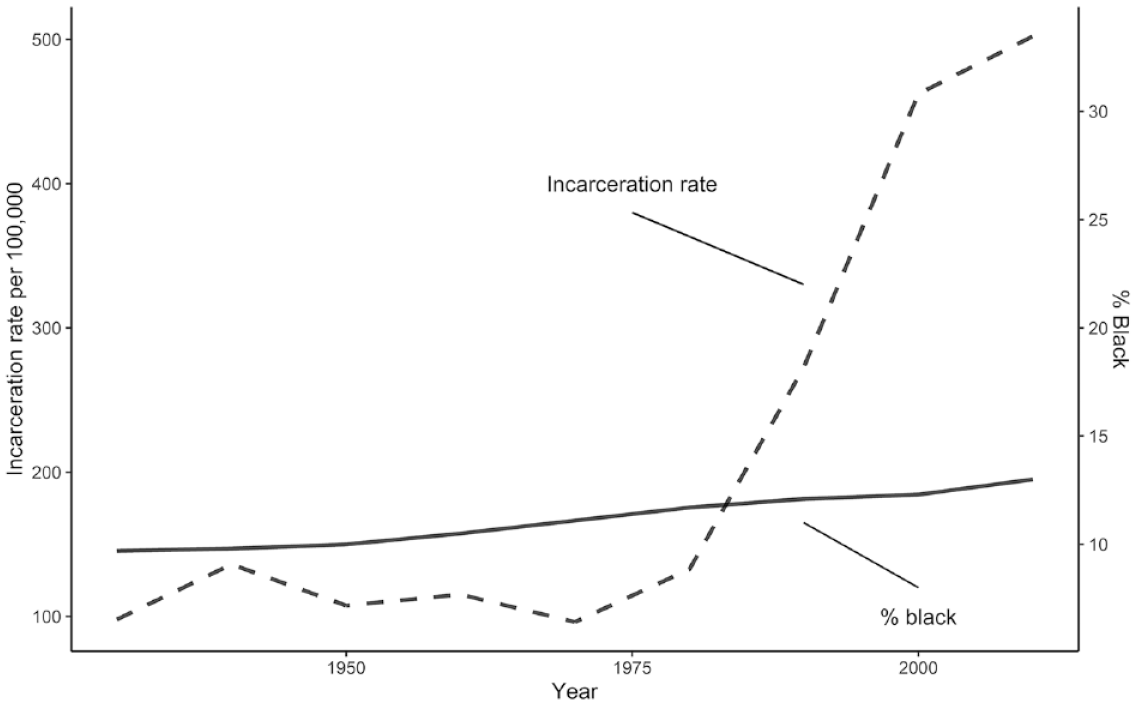
National Trends in Incarceration and Black Population Growth
Considering a similar historical context in the Reconstruction era, Behrens and colleagues (2003) examine historical processes through which Southern states regulated the “menace of Negro domination” in the wake of emancipation. The victories of the Civil War made slavery illegal, creating a stock of newly empowered black populations that threatened to overthrow the white political structure in states with large former slave populations. Behrens and colleagues (2003) show that states with large black prison populations were among the first to pass felon disenfranchisement laws barring former prisoners from voting in political elections. These voter restriction laws established imprisonment as a means to limit the political power of black populations, in turn smoothing the passage of Jim Crow laws in many Southern states.
Much like the Civil War, Civil Rights posed a profound threat to racial order. Like felon disenfranchisement laws in the Reconstruction era (Behrens et al. 2003), the dismantling of voter restriction and employment discrimination laws enabled black people to compete with their white counterparts in labor markets and political office. As Ramirez (2013:334) summarizes, “increases in civil rights and integrations since the 1960s have threatened white Americans and have led to increases in support for punitive policies.” The threat posed by newly afforded civil liberties was likely greatest in states with large black populations who were newly empowered to compete with white populations for jobs, education (e.g., college admittance), and political representation. Thus, states likely turned to sentencing law as white populations scrambled to re-establish racial dominance and replace the legal infrastructure historically used to suppress black populations.
Despite little substantial growth in the black population during mass incarceration, the political and economic empowerment of black populations via Civil Rights progress, combined with large black populations in many states, likely posed a pronounced threat to white populations, driving states to adopt punitive sentencing laws. Thus, my first empirical hypothesis is that the size of the black population—rather than growth in the black population—will be nonlinearly related to sentencing policy adoption. 4 The nonlinear functional form is derived from Blalock (1967:187), who predicts that especially large minority group populations will be able to oppose the white public’s attempts to discriminate via political processes. Black population size should correlate with sentencing policy adoption until a threshold. After this threshold, the relationship should turn negative and decelerate at an increasing rate.
White Public Support for Punitive Policy as a Threat Mechanism
Threat theory predicts that threat to the white population’s economic and political standing motivates them to support social policies that repress the ability of the black population to compete for economic and political resources. In the context of mass incarceration, this could be accomplished through the construction of new sentencing laws that arise in indirect response to minority group size. Thus, I expect white public support for punitive crime policy will have a stronger effect on sentencing law than will black public support for punitive crime policy, and white public support for punitive crime policy will mediate the effect of minority group size.
Explanations in political accounts of mass incarceration align with the expectation that state sentencing laws will be uniquely responsive to white public punitiveness. Many scholars attribute tough-on-crime politics to the Republican Party rebranding itself as the party of “law and order” (Beckett 1997; Jacobs and Carmichael 2001). These narratives point out that most of the federal crime reforms during mass incarceration were carried out under Republican presidencies (Beckett 1997; Beckett and Sasson 2004; Weaver 2007; Western 2006), and at the state level by Republican governments (Campbell and Schoenfeld 2013; Lynch 2009; Page 2011; Schoenfeld 2018). 5 Because the Republican Party relies critically on white voters to maintain their political standing, 6 their policy propositions are likely responsive to the policy preferences of the white public, and thus the punitive policy support of the white public should translate more readily into sentencing policy adoption than does punitive policy support among the black public.
White populations may also support tougher criminal laws because they perceive an unregulated criminal element in states with large black populations (Liska, Lawrence, and Sanchirico 1982; Quillian and Pager 2001; Stults and Baumer 2007). White populations often perceive black populations to be criminally inclined and prone to violence (Chiricos, Welch, and Gertz 2004; Pickett et al. 2012; Russell 1998). In the context of mass incarceration, Weaver (2007) details how political discourse equated black political progress with rising crime rates. Anticipating defeat in the battle against Civil Rights, conservative politicians tied the race riots of the 1960s and militant groups like the Black Panthers to crime in inner cities. This rhetoric appealed to the white population’s deeply held anxieties regarding racial progress and reframed the “problem” of racial equality as one of crime control (see also Beckett 1997; Western 2006), increasing white populations’ support for punitive policy. Whether because of economic, political, or criminal threat, I expect that punitive policy support among the white public will mediate the effect of black population size on sentencing law adoption.
Race-Specific Instrumental Responses
A focus on the white population’s influence over criminal law provides a framework for considering race-specific instrumental crime responses. Most research on social control accounts for the possibility of both threat and instrumental responses (e.g., Kent and Jacobs 2005; King and Wheelock 2007; Muller 2012; Ramey and Steidley 2019; Stults and Baumer 2007), but it is possible that threat and instrumental responses interact. Keen and Jacobs (2009) consider the intersection of threat and instrumental responses by examining how overall crime rates contribute to the racial disparity in prison admissions. They find that “particularly menacing” crimes, like rape and homicide, increase the racial disparity in prison admissions. Whereas Keen and Jacobs (2009) examine how black populations are scapegoated for general criminal offending, I consider how criminal laws are more likely to toughen when white populations are victimized.
Some research suggests white individuals’ punitive policy support is more likely to increase when white victimization rates increase as opposed to when black victimization rates increase. For instance, Liska and colleagues (1982) find that black-on-white homicide victimization increases fear of crime among white populations, yet white-on-black homicide victimization does not increase fear of crime among black populations. This relationship could be related to offender demographics, but it is also possible that victim demographics influence punitive attitudes. When people see members of their own racial group victimized, they are more likely to relate to the victim and believe that their own risk of victimization is higher. As a consequence, when white homicide victimization increases, punitiveness among the white population will likely also increase. This is likely reinforced by media coverage of crime, which disproportionately covers crimes with white victims (Beckett and Sasson 2004; Garland 2001) and is a robust determinant of criminal justice attitudes (Enns 2016; Shi et al. 2020). I therefore expect white, but not black, homicide victimization rates will indirectly affect sentencing policy by increasing white public support for tough crime policy.
In summary, I expect sentencing policy adoption will vary as a nonlinear threat response to large—rather than growing—minority groups. I further expect white, but not black, public punitive policy support will predict sentencing policy adoption and will mediate the effect of minority group size. Finally, I expect that because the white public holds unique influence over criminal law, white homicide victimization rates will have an indirect effect on sentencing policy by increasing white public support for punitive crime policy. To test these hypotheses, I construct a new dataset of 230 state sentencing policy adoptions, and I leverage recent methods for measuring state-level public opinion using national surveys. Because these methods for measuring state-level public opinion are unfamiliar to most sociologists, I introduce them in detail below.
Measuring Racial Differences in Punitiveness at the State Level
Measuring state-level policy opinion presents methodological difficulties. Criminal justice attitudes are usually only polled in national surveys that are not representative of states. Furthermore, the most consistently polled questions typically relate only to specific dimensions of criminal justice policy, such as death penalty support. Because policy responsiveness to public attitudes typically evolves as lawmakers anticipate the types of policies—rather than specific policies—the public prefers (Stimson 1999, 2004), single-indicator measures of policy opinion risk over-stating temporal variation in punitive attitudes and underestimating the effects of punitive opinion on sentencing policy (Pickett 2019).
To overcome these issues, I use a two-stage measurement strategy that entails first correcting for non-representative sampling in national surveys using multilevel regression with poststratification (MRP), and second measuring latent policy opinion variables for black and white populations using a dyad ratio algorithm. These two measurement strategies have been successfully combined by Enns (2016) and Enns and Koch (2013) to measure punitive sentiment, liberalism, and conservativism at the state level over time. Each method has also been widely applied independently to measure public opinion at the national and subnational levels (Baumgartner et al. 2008; Enns 2014; Lax and Phillips 2009a, 2009b; Park et al. 2004; Ramirez 2013; Stimson 1999; Weaver 2007).
Measuring State Response Frequencies
MRP has recently gained attention as a promising method for measuring state-level public opinion in the absence of representative polling data (Enns 2016; Enns and Koch 2013; Ghitza and Gelman 2013; Lax and Phillips 2009a, 2009b; Park et al. 2004; Shirley and Gelman 2015; Tausanovitch and Warshaw 2013; Warshaw and Rodden 2012). MRP involves first pooling responses to similar survey items (e.g., “Do you support capital punishment for persons convicted of murder?” “Are you in favor of the death penalty for convicted murderers?”) from a large number of national surveys into a single “mega-poll.” Responses are then modeled as a function of demographic characteristics and state-level attributes using multilevel logistic regression. Including demographic and state-level regressors recaptures geographic and demographic covariance, such as differences between black and white individuals, men and women, and age groups in support of capital punishment, as well as state-level heterogeneity.
In the second step, the coefficients from multilevel modeling are applied to state-level demographic data, such as those obtained from the Census. State-level demographics are arranged into a data matrix such that cells represent the proportion of a state population that shares a demographic characteristic with respondents in the mega-poll. For instance, in the model presented here, punitiveness responses are regressed on gender, race, age, and education. The demographic data thus include separate columns for the proportion of a state population made up of black women between age 18 and 30 who did not graduate high school, who did graduate high school, and so on for all possible combinations of race, gender, age, and education. The cells in the demographic data are multiplied by the coefficients obtained from multilevel modeling. The values are then transformed into predicted values using a logistic function and summed to the state level. The final measures represent the proportion of a state population expected to offer a response (i.e., support the death penalty). These estimates are “poststratified” in the sense that they are weighted by the population composition in each state.
The thrust of MRP is that it leverages geographic and demographic covariance to inform predicted state response rates. Respondents provide information on state-level response patterns through the homogenous effect of demographics (i.e., race, gender, and age effects) that can be applied to all state estimates, regardless of their location. It is perhaps unsurprising, then, that MRP has been shown to outperform most other popular methods for measuring subnational opinion (other than state-level polling) in methodological assessments (Lax and Phillips 2009b; Park et al. 2004; Warshaw and Rodden 2012). 7
Despite the advantages of MRP, several limitations warrant discussion. MRP can sometimes underestimate differences between states, meaning there is an excess of state-invariant (national) trending (Lax and Phillips 2009b). This issue can be addressed in a straightforward fashion by controlling for national time trends in analytic models using MRP measures, as I do here. The second limitation is that validity of MRP estimates usually suffers when informative state-level covariates are omitted from the MRP model (Lax and Phillips 2009b; Tausanovitch and Warshaw 2013; Warshaw and Rodden 2012). I address this by including public conservativism, racial composition, and region as state-level covariates, each of which have been successfully used to model public punitiveness in prior research using MRP (e.g., Enns 2016; Shirley and Gelman 2015). Finally, MRP sometimes underestimates group differences in public opinion (Ghitza and Gelman 2013). The difference in coefficients for white and black public punitiveness should therefore be regarded as a conservative estimate.
I measure white and black public support for tough crime policy using responses to the General Social Survey, Gallup, ABC, Time, and Harris polls administered between 1971 and 2016. Even though the dependent variable is only measured between 1975 and 2012 (discussed below), I include earlier and later years to increase the amount of overall information included in MRP estimates. In total, I use 257,326 responses to 156 survey questions administered in 79 surveys, averaging 5,718 responses per year. 8 Support for punitive crime policy is based on responses to six questions that have been successfully used in past research (Enns 2014, 2016; Ramirez 2013): (1) support for capital punishment for persons convicted of murder, (2) belief that courts do not deal harshly enough with criminals, (3) belief that there should be more government spending on police, (4) belief that there should be more government spending on law enforcement, (5) belief that there should be more government spending on halting the rising crime rate, and (6) belief that prisons should punish, rather than rehabilitate, inmates. The wording for each question is provided in Table S1 of the online supplement.
Sentencing Law Adoptions in the United States, 1975 to 2012
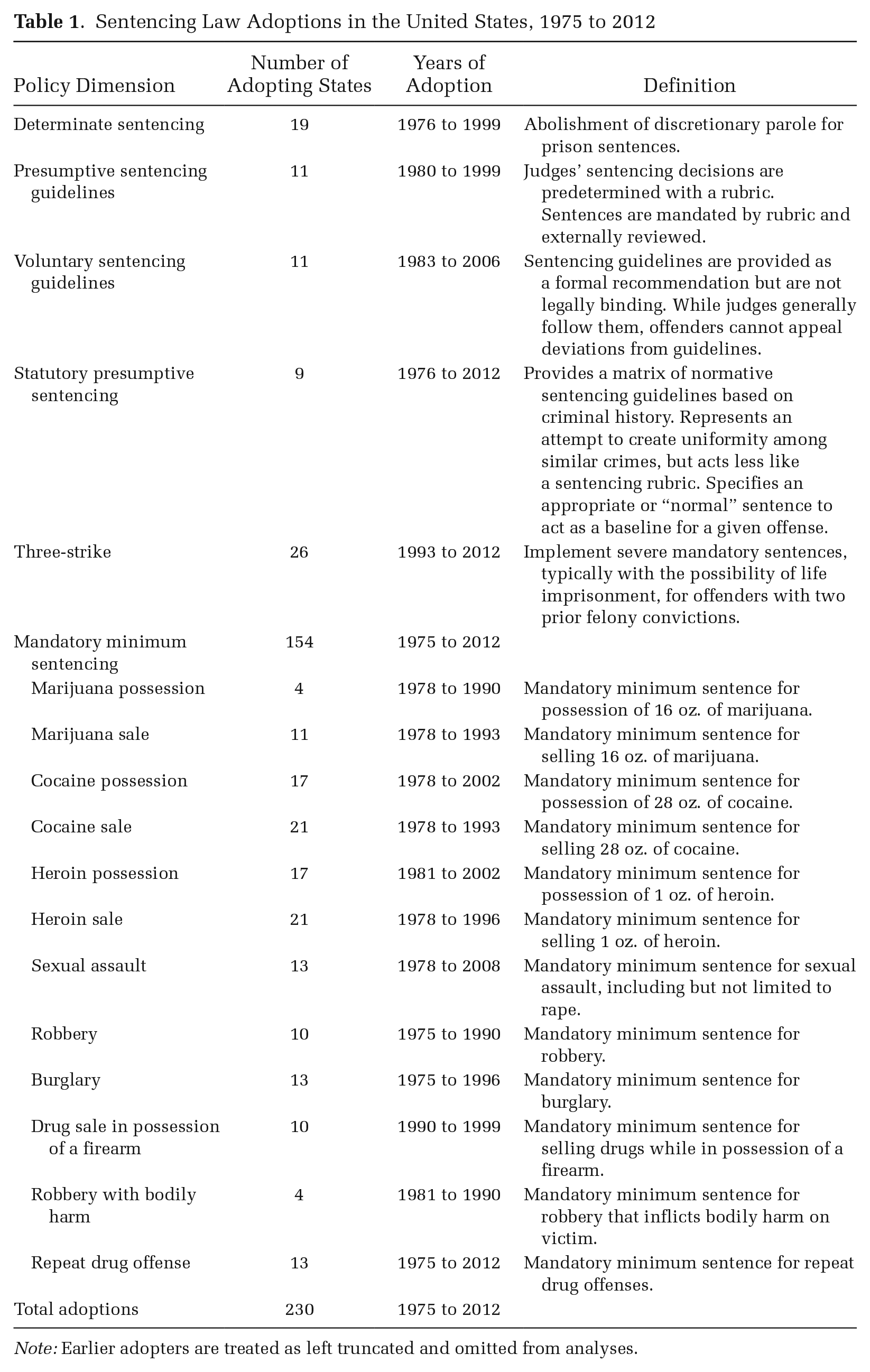
Note: Earlier adopters are treated as left truncated and omitted from analyses.
My MRP model is based on MRP models used in prior research to measure state-level punitiveness (Enns 2016; Shirley and Gelman 2015). To measure racial differences, I use a conventional MRP as described earlier but include interactions between demographics and other variables (Ghitza and Gelman 2013; Shirley and Gelman 2015). The interactions allow response rates for each demographic to vary across possible group combinations and geographic boundaries (i.e., black respondents in the South are allowed to be more punitive than black respondents in the North). Given a respondent i nested in a state j in year t, the regression can be represented as follows:
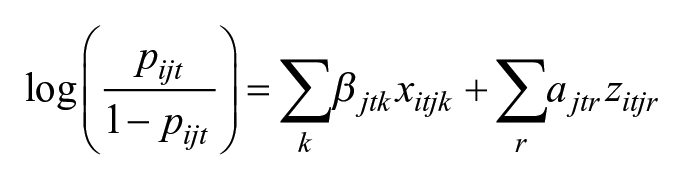


Where x is the data matrix containing the demographic variables: race, sex, age, and education. At level 2, I include the percent black population, region, and percent Republican voters in the most recent presidential election. z is a vector of two- and three-way interactions between race, gender, age, state, region, and year (Shirley and Gelman 2015). 9 Finally, I include a continuous linear variable for the year as well as a quadratic year term. 10 All coefficients are allowed to randomly vary at the second level to increase efficiency and to relax the assumption of zero correlation between coefficients and random intercepts.
For each of the six survey item variables, I first fit a three-level model, with respondents nested in states and states nested in regions. I then use the coefficients to predict response patterns from demographic data, providing a separate estimate of state-level response frequencies for each of the six survey items, one for the state black population and one for the state white population, in each year the survey question was administered. I assess the external validity of the MRP measures below.
Latent Variable Measurement
MRP provides the predicted state-level response rates to six survey items related to punitiveness for 50 states. The next step is to measure the latent punitiveness variable for each race. I use the dyad ratio algorithm developed by Stimson (1999) for measuring latent public opinion, which has been successfully applied in prior research to analyze public opinion on criminal justice topics (Baumgartner et al. 2008; Enns 2014, 2016; Enns and Koch 2013; Nicholson-Crotty, Peterson, and Ramirez 2009; Ramirez 2013). The dyad ratio method utilizes marginal survey response rates to measure latent public opinion. Each indicator is standardized by calculating the ratio of each survey item to their final (or first) point of measurement. These “dyad ratios” all vary on the same scale, and thus they can be averaged across the state-specific time-series. Weights are assigned to each observation using a recursive smoothing algorithm that carries information forward and backward from prior and posterior years, assigning greater weight to years where a larger number of respondents were sampled.
The key advantage of the dyad ratio algorithm over conventional factor analysis is that the dyad ratio method assumes uneven temporal coverage. National surveys are administered inconsistently, so sample size varies between surveys, years, and questions. The dyad ratio method utilizes recursive smoothing to provide weighted measurements of public opinion in years where surveys have inconsistent coverage by assigning greater weights to surveys and survey questions with larger samples. This method is more efficient than factor analysis, as it uses information contained in time trends and survey response rates. Recent assessments show the dyad ratio approach generally outperforms alternative public opinion measurement strategies in time-series and pooled time-series data (Enns and Koch 2013; Stimson 2018). 11
I use the dyad ratio method to construct latent variable measurements of punitive policy support among black and white populations at the state level. The final measures range between 0 and 100 and can be interpreted as the weighted scale average of response rates for the punitiveness survey items. A one percentage-point increase in each measure indicates greater support for punitive crime policy among the black or white population.
Validity Checks
I assess the reliability of the final punitiveness measures using standard strategies for latent variable analysis. The percent variance explained in the survey items by the final measure is the most common metric of reliability, where values greater than 80 percent are considered evidence of excellent fit (Stimson 2018). On average, the final punitiveness measures explain roughly 86 percent of the variation in the six survey items, where the least reliable time-series explains 77 percent variance in the survey items.
I evaluate external validity by first comparing my estimates to national, state-level, over-time, and individual-level measures of punitive sentiment provided in prior studies, and then comparing the MRP estimates to state polling data. Consistent with prior studies (Anderson et al. 2017; Ramirez 2013; Shi et al. 2020), punitive policy support among the black and white publics exhibit similar over-time trends, rising in the 1970s and 1980s before ultimately declining after 1990 (see Figure 2). The over-time patterns are also consistent with Enns’s (2014) reports of national punitive policy support, where punitiveness peaks in the mid-1980s and 1990s before declining. Also consistent with prior research (Peffley and Hurwitz 2007, 2010), white public punitiveness is roughly 15 percentage points higher than black public punitiveness, on average. These results replicate the state-level measures of Shirley and Gelman (2015), the national measures of Ramirez (2013), and the individual-level measures of Anderson and colleagues (2017), each of which report a mean 20 to 25 percentage-point difference in support for various dimensions of punitive policy between black and white populations over the period of mass incarceration. The greater temporal variation in black populations’ punitive policy support is also consistent with Anderson and colleagues’ (2017) findings on period-specific racial differences in death penalty support, where punitiveness exhibits greater year-to-year variation for black respondents than for white respondents.
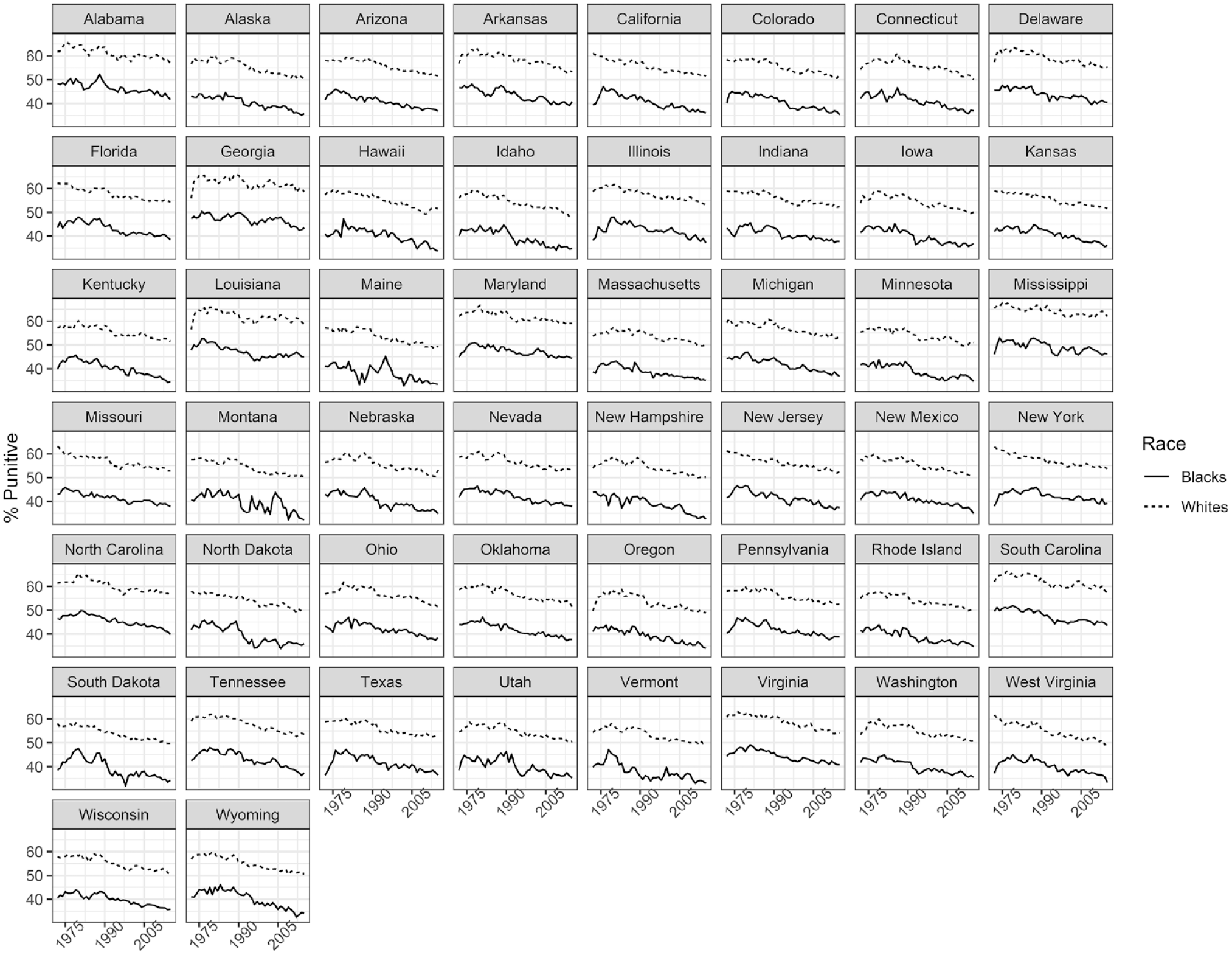
Black and White Public Punitiveness over Time, 1971 to 2016
The next step is to compare MRP estimates to state polling measures in years where state polls are available. Current benchmarks suggest correlations above .7 and mean absolute differences below 6 percent indicate high external validity (Lax and Phillips 2009b; Warshaw and Rodden 2012). Comparisons of 24 state polls administered in nine states between 1974 and 2009 to MRP estimates show measures are strongly consistent, with a correlation of .78 and a mean absolute difference of 4.6 percent (see Figure S1 in the online supplement). Further sensitivity analyses show the estimates are robust to survey error and undersampling of black respondents (Figure S2, online supplement). These results indicate that the constructed measures have high external validity, as they are consistent with measures reported in prior individual, state-level, and national research, and with state polling data. I now introduce the state sentencing policy dataset, analytic strategy, and remaining independent variables.
Sentencing Policy Adoption
The dependent variable is states’ adoption of punitive sentencing policy. The goal of the current research is to characterize the omnibus changes to criminal sentencing law during mass incarceration. In total, I consider 17 dimensions of sentencing law. These include determinate sentencing laws; mandatory minimum drug, sex, and violent offense laws; three-strike laws; 12 presumptive sentencing guidelines; statutory presumptive sentencing laws; and voluntary sentencing guidelines, each of which have been linked to mass incarceration in prior studies (Alexander 2010; Harmon 2013; Raphael and Stoll 2009, 2013; Savelsberg 1992; Spelman 2009; Stemen et al. 2006; Tonry 2009). 13 Definitions and details of each policy are provided in Table 1.
The primary data source is Stemen and colleagues’ (2006) report on sentencing policy (1975 to 2002), which is to-date the most comprehensive data on state sentencing laws. Stemen and colleagues’ (2006) data were supplemented with timing data from prior published research and legislative databases. Supplementary data sources include Harmon’s (2013) article on fixed sentencing laws (2003 to 2008), Anderson’s (2016) article on sexual assault laws (2003 to 2012), the National Conference of Sentencing Legislature’s (NCSL) Significant State Sentencing and Corrections Legislation documentation (2007 to 2009), and the state legislative database operated by the NCSL and Pew Charitable Trust (2010 to 2012). Data on many newly adopted mandatory minimum sentencing laws—primarily sex offender laws (see Anderson 2016; Gottschalk 2014)—were not available from any of these sources for 2003 to 2006. For these years, I identified new mandatory sentencing laws by reviewing each individual state legislature for all bills related to sentencing. 14
In total, I consider 230 sentencing policy adoptions of 17 dimensions of sentencing law between 1975 and 2012. 15 This observation period aligns with mass incarceration—the incarceration rate began to increase in 1973 and stagnated in 2008—and it broadly conforms to prior research identifying the mid-1970s as a turning point in U.S. sentencing law (Raphael and Stoll 2013; Tonry 2009, 2013). Because Stemen and colleagues’ (2006) original data collection only provides timing data on sentencing adoption in three-year windows, adoptions are recorded as having occurred by the end of each respective three-year time period. The analysis thus uses 12 time periods, each of which encompasses approximately a three-year window. 16
My analysis is one of policy change; thus, I use a time-to-adoption hazard analysis. Because I consider multiple dimensions of sentencing law, I utilize a pooled event history analysis (e.g., Boehmke and Skinner 2012; Boushey 2016). The pooled event history model treats the state-policy-year as the unit of analysis. All state-policies are combined into a pooled dataset, where each state appears 17 times for each policy and 12 times for each time period, yielding up to 204 (17 × 12 = 204) possible observations for each state. The value of the dependent variable is equal to 1 in each state-policy-year when a focal sentencing law is adopted, and equal to 0 otherwise. Once a state adopts a sentencing law, the state-policy exits the dataset, although the state remains at risk of adopting other sentencing laws. 17 If a state adopted a focal policy before 1975, the state-policy is left-truncated and omitted from analysis.18, 19 Of the 850 total state-policies (17 × 50 = 850), 117 are left-truncated (12 percent), leaving 733 state-policies in the risk set. 20 State-policies not adopted by 2012 are right-censored.
The final long-formatted survival dataset includes 7,738 observations reflecting the time to adoption for each state-policy. I use a discrete time frailty model; thus, the model is estimated as a multilevel logistic regression with a state-level random intercept. The discrete time model is appropriate because the timing to adoption is a coarse measurement (three-year window). All models include a linear and quadratic term for the time period. 21
Data
I measure minority group composition using the percent black population (see Blalock 1967; Kent and Jacobs 2005; Stults and Baumer 2007). My expectation is that minority group size, rather than change in minority group size, will be important for explaining sentencing policy adoption. I represent the change in minority group size using the first difference in the percent black population
I measure race-specific homicide victimization as the white and black homicide victimization rate per 100,000 white or black population using data from the incidence-level Supplemental Homicide Reports (SHR). SHR data on homicide victimization are available beginning in 1976. The measures are constructed from the Centers for Disease Control mortality files in 1975. To account for whether the effects of race-specific homicide victimization are a result of interracial violence, I also control for the black-on-white homicide rate per 100,000 white population (Liska et al. 1982; Stolzenberg, D’Alessio, and Eitle 2004). The measure is constructed using SHR data and is missing for the year 1975. I discuss missing data below. I control for the violent crime rate per 100,000 population, as violent crimes tend to be reliably reported. The violent crime rate is correlated with the property crime rate at .82, indicating that little additional insight is gained from controlling for both property and violent crime. 24
I use several measures to account for bottom-up and top-down political factors. To account for public support for conservative politics (Beckett 1997; Jacobs and Carmichael 2002), I include percent Republican voters in the most recent presidential election. To account for political ideology, I control for Stimson’s (1999) measure of liberal “policy mood” using the state-level measure constructed by Enns and Koch (2013). The measure ranges between 0 and 100, reflecting the percentage of a state’s population who support New Deal-type policies, that is, policies related to greater governmental controls and social welfare spending (approve of unions, greater spending on healthcare, greater spending helping the poor, more laws promoting racial equality). The coefficient should be inversely related to sentencing law adoption. 25 I also control for top-down Republican Party influence. I include an indicator measure for whether a state has a Republican governor. I also include a measure for Republican influence in the state legislature equal to the proportion of Republican seats in the state senate plus the proportion of Republican seats in the state house of representatives.
In addition to crime and political variables, I control for labor market conditions using the unemployment rate (see Rusche and Kirchheimer 1939; Spritzer 1975; Sutton 2004; Western 2006). I further control for the number of sentencing laws adopted prior to the onset of risk (pre-1975) to account for inertia in the state hazard rates. Finally, I include regional dummy variables to control for regional heterogeneity and a vector of 16 policy dummy variables to eliminate heterogeneity in the policy-specific hazard rates. Because event history models are estimated on long-formatted data, I present descriptive statistics for the pooled dataset formatted for survival analysis (see Table 2).
Descriptive Statistics for Event History Data (N = 7,738)
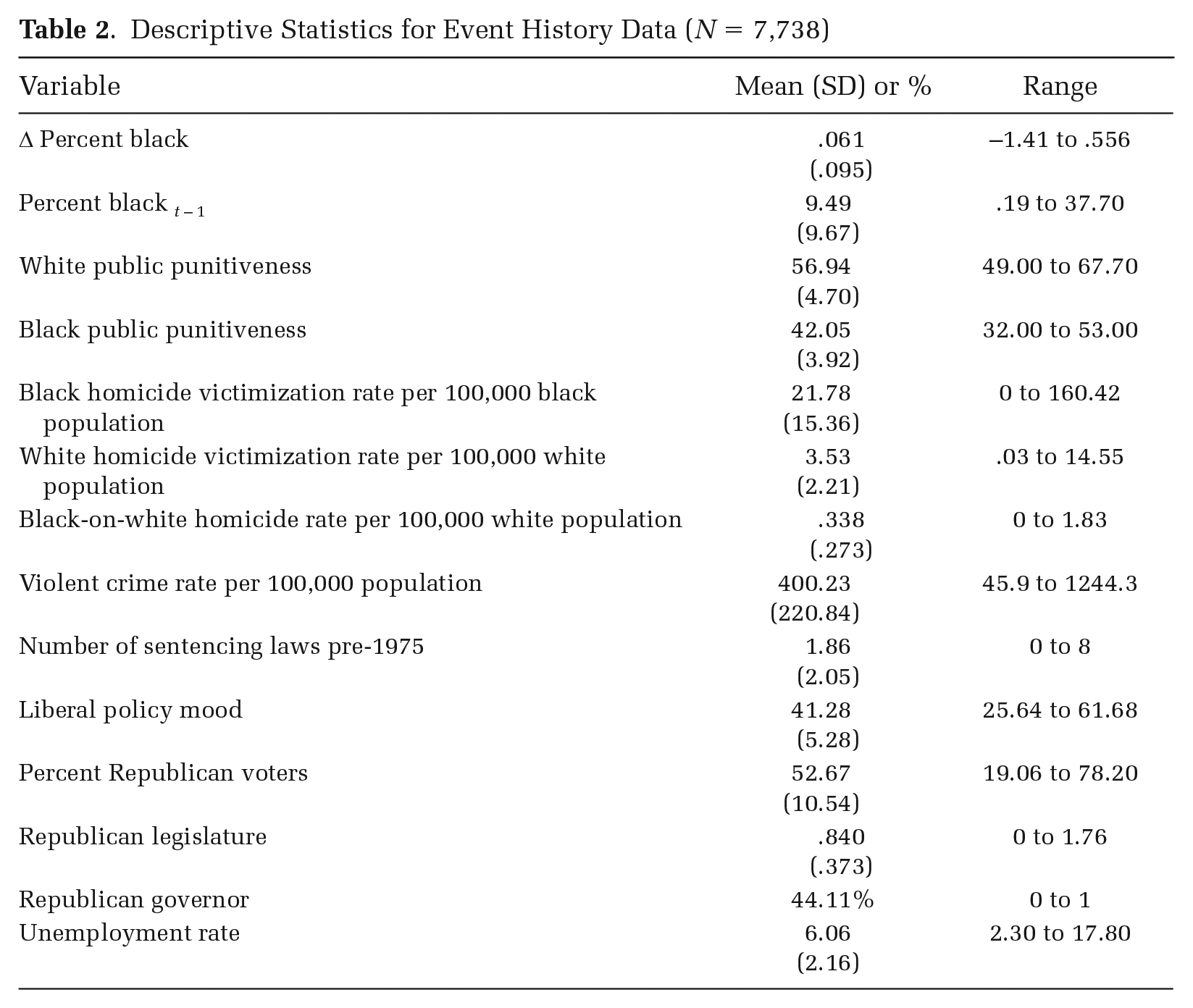
Missing data were present in 12.7 percent of state-years. I imputed missing data using Honaker and King’s (2010) bootstrap estimation maximization method for pooled time-series data. The method is favored over standard multiple imputation because it accounts for time trending and nesting structure in addition to correlations between variables. Event history models were fitted to 10 imputed datasets and estimates were pooled for final presentation.
To conduct my analysis, I first assess whether threat or crime rates better explain sentencing policy adoption. I then control for race-specific punitiveness to evaluate whether punitive policy support among white populations has stronger effects on sentencing policies than punitive policy support among black populations. To assess indirect effects, I use the KHB method for mediation analysis in logit models (Karlson, Holm, and Breen 2012). Although coefficients cannot be compared directly between nonlinear probability models, the KHB method corrects for rescaling, making coefficient comparisons possible.
Results
I begin by describing the geospatial and temporal distribution of sentencing policy adoption. The most frequent adopters instituted nine new sentencing laws during the observation period, and several states did not introduce any of the measured dimensions of sentencing policy (see Figure 3). Consistent with expectations, Rust Belt and Southern states were the most likely to toughen their sentencing policies; these states have relatively large black populations. Northeastern and Midwestern Plains states were among the least frequent adopters. Figure 4 illustrates the dense temporal clustering of sentencing law adoption. The number of new sentencing laws steadily rose throughout the mid-1970s and early 1990s, but few new sentencing laws were adopted after 1995. In fact, only 15 new sentencing policies were adopted after 1999. Figure 4 also shows a close over-time association between the number of new sentencing policies and the mean white public punitiveness measure (r = .81). By comparison, the correlation between the mean black public punitiveness measure and the number of new sentencing policies is noticeably smaller, although also strong (r = .62). 26
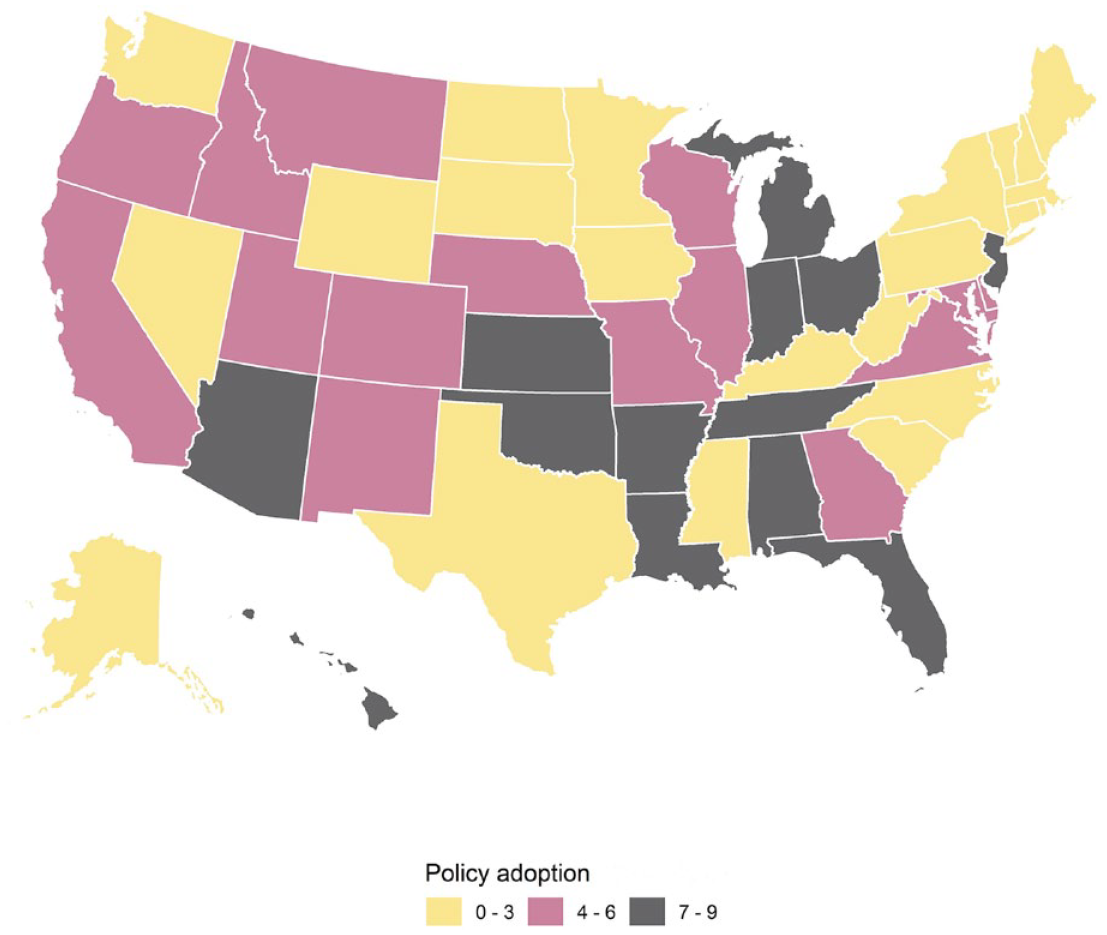
Number of Sentencing Policy Adoptions in Each State, 1975 to 2012
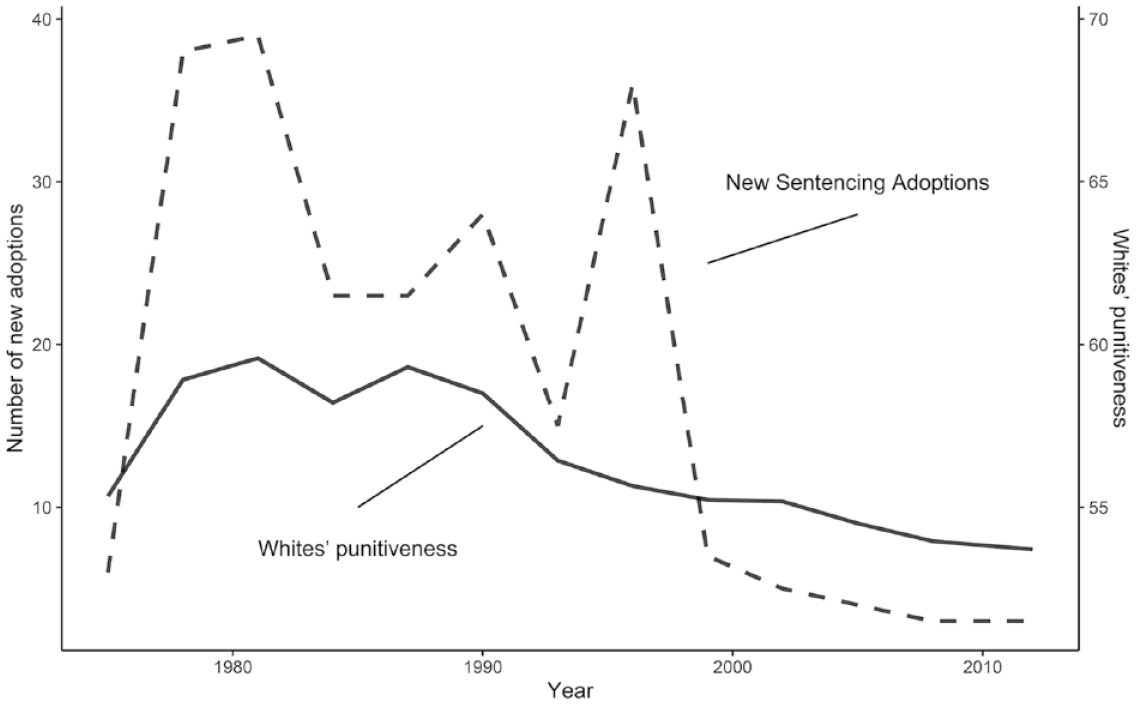
Number of Sentencing Policies and Mean White Public Punitiveness, 1975 to 2012
Bivariate analyses show a close over-time association between both punitiveness measures and sentencing policy changes, although a stronger correlation for white public punitiveness. The next step is to formally test the threat explanation for sentencing law adoption. Table 3 presents results from pooled event history models. Model 1 is a baseline model with full control variables. States that had a greater number of sentencing laws prior to 1975 are more frequent adopters during the observation period. Republican Party presence in state legislatures also increases the hazard of policy adoption. Consistent with instrumental response explanations, the violent crime rate is positively related to policy adoption. In line with threat expectations, the lagged percent black population coefficient is positive, indicating states with large black populations were quicker to adopt punitive sentencing laws. However, the change in percent black population is insignificant, as are both measures of race-specific homicide victimization.
Discrete Time Frailty Models of Sentencing Law Adoption in 50 States, 1975 to 2012 (N = 7,738)
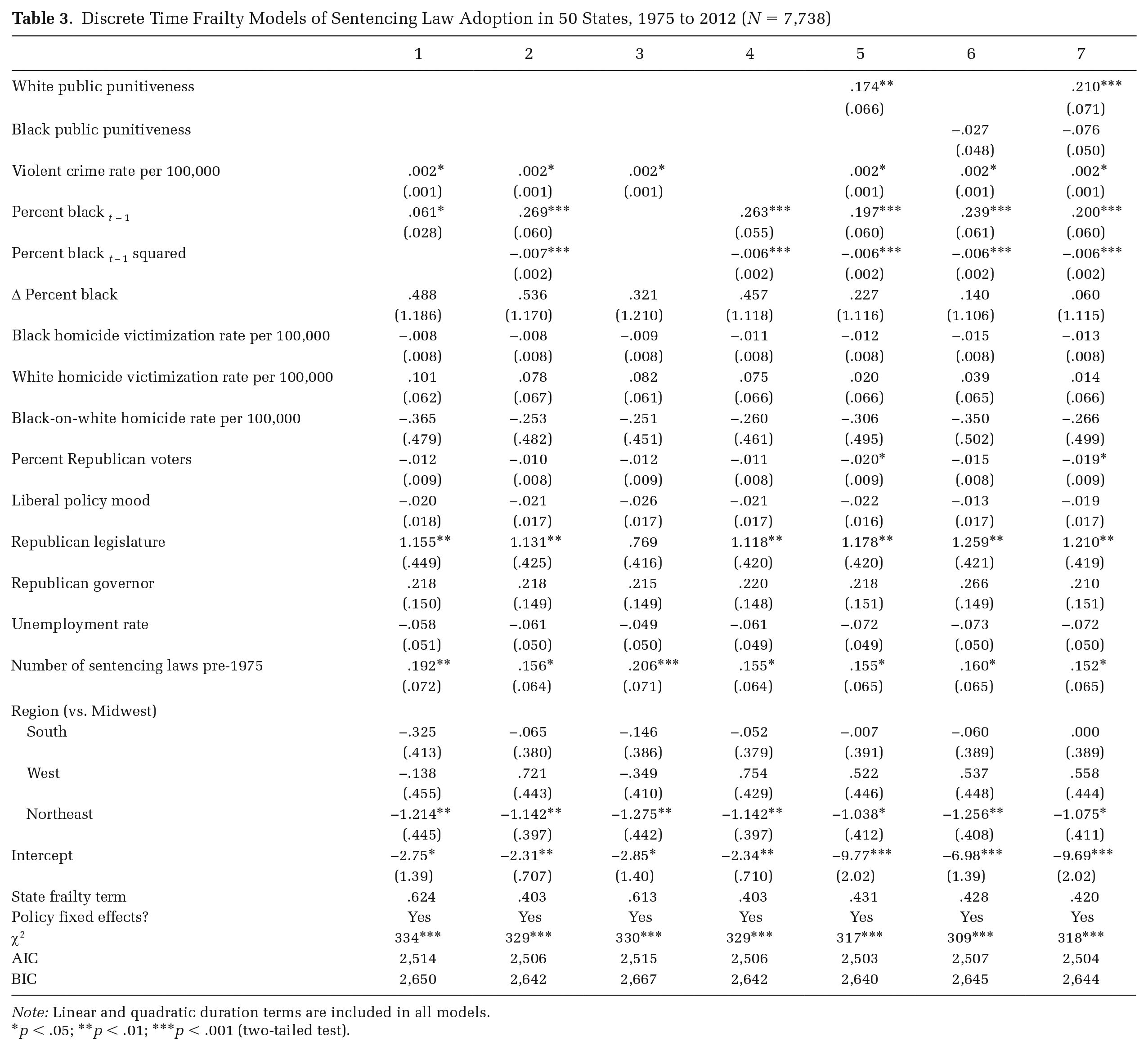
Note: Linear and quadratic duration terms are included in all models.
p < .05; **p < .01; ***p < .001 (two-tailed test).
Model 2 accounts for the nonlinear threat functional form by including a quadratic term for the lagged percent black population. The linear term is positive, and the quadratic term is negative, indicating a nonlinear threat relationship where the size of the black population increases the hazard of sentencing policy adoption until a threshold, where the relationship inverts. The improvements in information criteria (AIC and BIC) indicate the nonlinear threat function is more informative than the linear specification. This functional form is consistent with the hypothesized threat relationship, showing that sentencing law adoption varies nonlinearly as a threat function. Also consistent with expectations, the change in black population size remains insignificant, indicating sentencing policy adoption was a response to large, rather than growing, minority groups.
To assess the predictive power of threat explanations compared to instrumental response explanations, Models 3 and 4 exclude the lagged percent black population terms and violent crime rate, respectively. Consistent with expectations, comparisons of AIC and BIC reveal Model 4 is the better fitting model, indicating that the nonlinear threat relationship is more informative than the violent crime rate for predicting sentencing policy adoption. These results demonstrate that minority group size, rather than crime trends, is a better predictor of sentencing law adoption.
Threat theory argues that sentencing laws are adopted in response to majority groups’ policy preferences, as white populations selectively deploy criminal sentencing law to enforce competitive advantage. Model 5 includes the measure of white public punitive sentiment. In line with expectations, a 1 percent increase in white public punitive policy support correlates with a 20 percent (exp(.186) = 1.20) increase in the hazard ratio of sentencing policy adoption. Also consistent with expectations, controlling for white public punitive policy support attenuates the size of the linear coefficient for the percent black population coefficient by roughly 18 percent. Model 6 excludes white public punitive policy support and includes black public punitive policy support. Consistent with expectations, the black public punitive policy support coefficient is insignificant. Excluding white public punitive policy support returns the percent black population coefficients to approximately their original size. This result suggests it is white public policy opinion—rather than black public policy opinion or public support for punitive crime policy more generally—that contributed to sentencing policy adoption.
To formally assess this explanation, Model 7 presents a fully specified model controlling for both black and white public punitive policy support. The linear and quadratic terms for the percent black population are again attenuated. The coefficient for white public punitiveness is positive and significant, but black public punitiveness is insignificant. A test of the equality of coefficients reveals a significant difference between the effects of white and black public punitive policy support (βdiff = .281, p < .01). Furthermore, Model 5 is the best fitting model, indicating that little new information is gained by controlling for black public punitiveness. Consistent with expectations, these findings show that sentencing policy changes during mass incarceration were a response to desire for tougher crime policy among the white, rather than black, population.
The next step is to consider reverse causation. Much like white public punitiveness can contribute to sentencing law adoption, the adoption of crime legislation may cause the white public to become more punitive. Sensitivity analyses in the online supplement (see Figure S3) consider the possibility of reverse causation using one- and two-year lags and leads for white public punitiveness. If the lags are significant, it suggests white public punitiveness is causally prior to policy adoption. If the leads are significant, it is likely because of reverse causation. Results are robust for both lag structures, but white public punitiveness is insignificant for both leads. These findings provide additional evidence that it is white public punitiveness contributing to sentencing policy adoption, rather than sentencing policy changes increasing white public punitiveness.
To facilitate interpretation of effect sizes, I report the change in conditional probability of sentencing policy adoption when the percent black population and white public punitiveness shift by one standard deviation above or below their respective means (Figure 5). When the percent black population is held at its mean, the probability of sentencing policy adoption is .16. However, a one standard deviation (9 percentage point) increase in the percent black population correlates with a .44 increase in the probability of sentencing policy adoption. Based on model estimates, a state with 18 percent black population has a 60 percent chance of adopting a new sentencing policy in a given year. By contrast, a state with 1 percent black population has a 3 percent chance. Turning to white public punitive policy support, a one standard deviation increase above the mean increases the probability of adoption by .16, or a 65 percent chance a state will adopt a sentencing policy in a given year when 61.4 percent of the white population supports punitive crime policy. Strikingly, a one standard deviation decrease below the white-punitiveness mean lowers the probability a state will adopt a sentencing policy to .005. Based on model estimates, a state where 52 percent or fewer of the white population supports tough crime policy has less than a 1 percent chance of adopting a sentencing policy in a given year. These results indicate that minority group size and white public punitive opinion both have large effects on sentencing policy adoption.
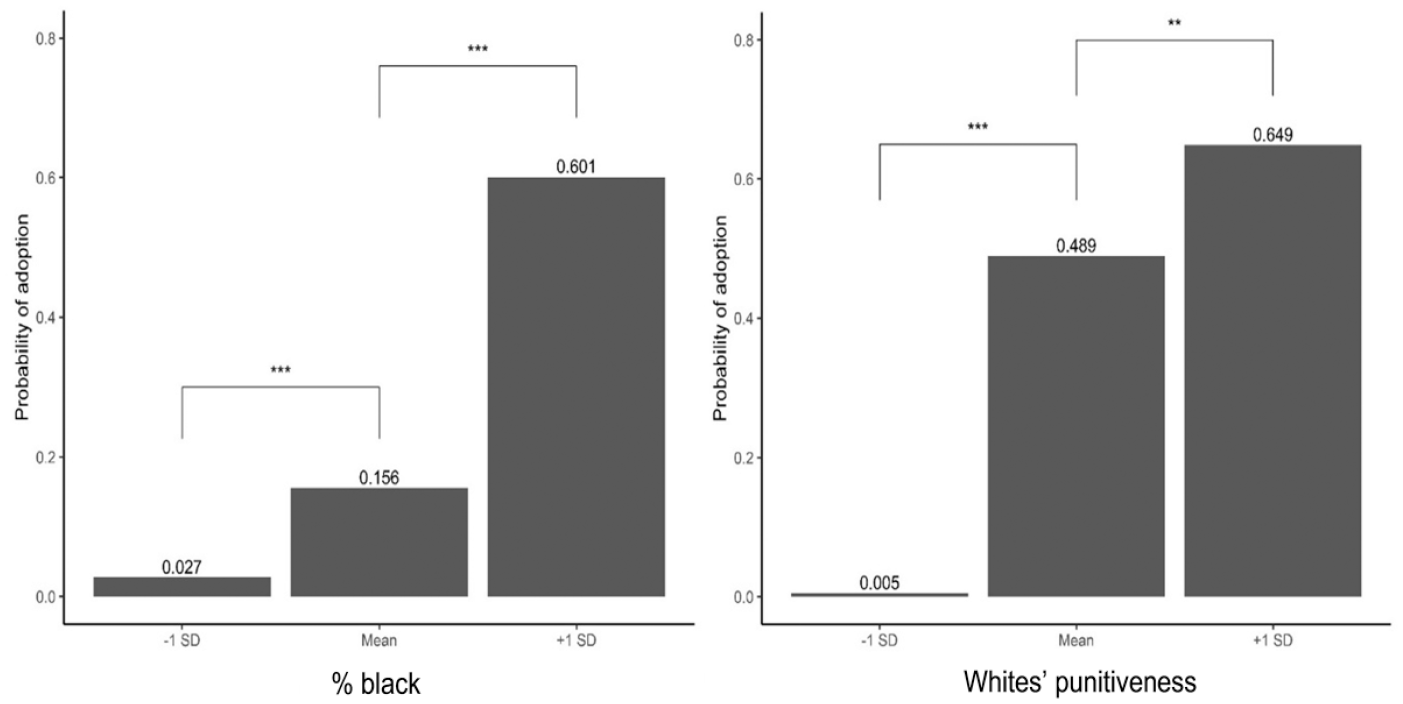
Probability of Sentencing Policy Adoption for a One Standard Deviation Change in Lagged Percent Black and White Public Punitiveness
Results from pooled event history models support the threat explanation for sentencing policy adoption, revealing that sentencing laws are adopted more frequently in states with large black populations and punitive white populations; the results show little support for the idea that race-specific homicide victimization contributed to sentencing policy. However, even insignificant coefficients can have significant indirect effects if they yield a sizable change in a mediating variable (Mackinnon 2008). I now formally test indirect effects using the KHB method (Breen, Karlson, and Holm 2013; Karlson et al. 2012). The KHB method calculates the difference in coefficients and its standard error by using the ratio of coefficients to quantify rescaling between models. The method is appealing because it provides a causal interpretation under the assumption of no omitted variables. Although the assumption of no omitted variables is untestable, this property is desirable for evaluating indirect pathways in observational research settings where randomization is impossible, such as analyses of state histories.
Table 4 presents results from mediation analysis. Consistent with expectations, white public punitiveness mediates roughly 26 percent of the effect of the percent black population linear term, and the indirect effect of black public punitiveness is insignificant. Figure 6 plots these relationships using conditional probabilities. 27 On average, white public punitiveness explains 43 percent of the conditional probability of policy adoption attributable to the percent black population (p < .001). 28 In contrast, the conditional probability of sentencing policy adoption declines, on average, by a mere 2 percent after accounting for black public punitiveness (p > .1). Consistent with expectations, these findings demonstrate that white public punitiveness mediates the effect of black population size, whereas black public punitiveness does not.
Mediation Analyses Using KHB Method (N = 7,738)
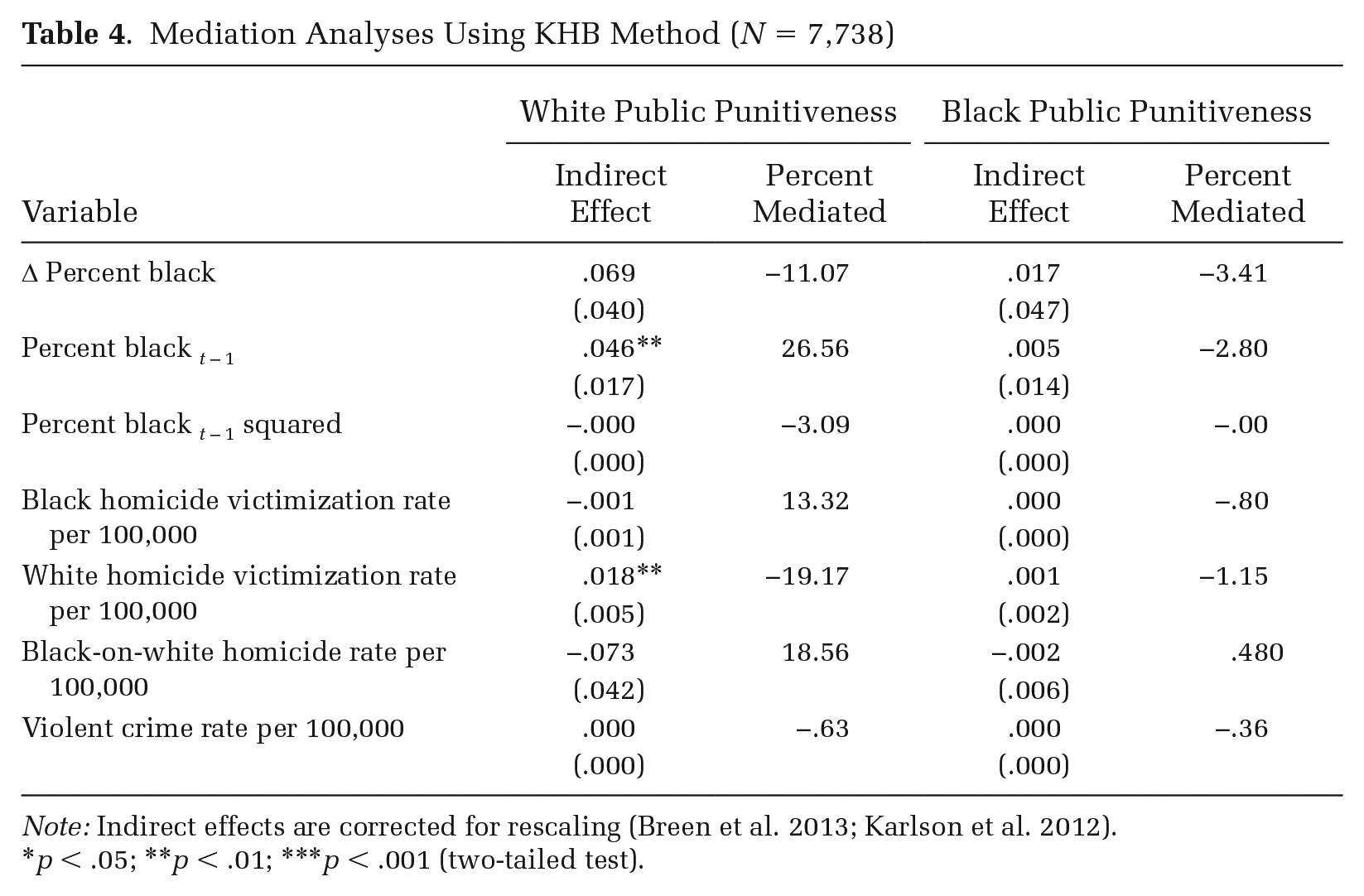
Note: Indirect effects are corrected for rescaling (Breen et al. 2013; Karlson et al. 2012).
p < .05; **p < .01; ***p < .001 (two-tailed test).
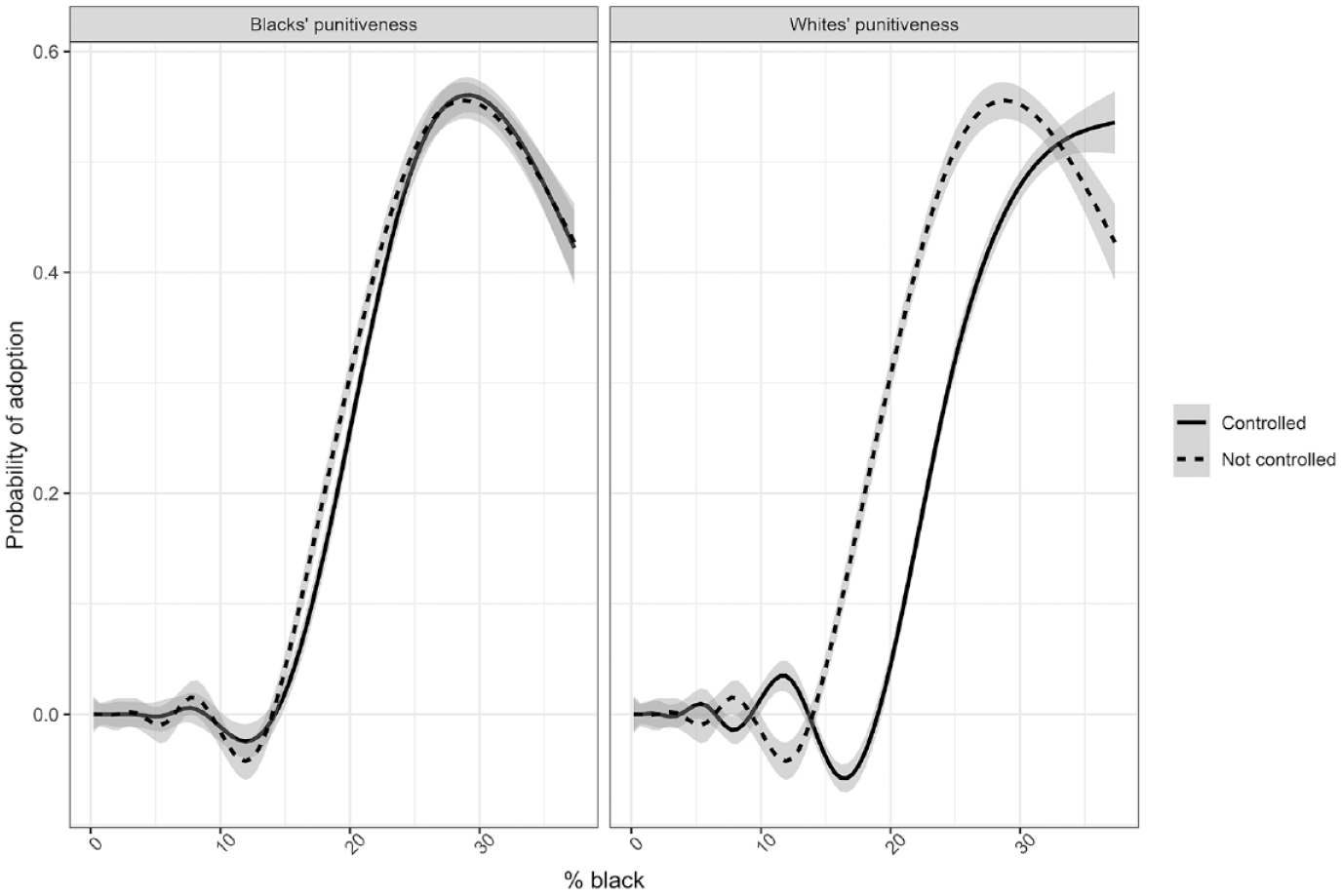
Conditional Probability of Sentencing Law Adoption before and after Controlling for Punitive Policy Support
Turning to the remaining variables, the indirect effect is insignificant for every independent variable when treating black public punitiveness as the mediator. This result is consistent with Table 3, where black public punitiveness is insignificant. In contrast, the white homicide victimization rate has a significant indirect effect of .014 by increasing white public punitiveness. This means each additional white homicide victimization per 100,000 population indirectly increases the hazard of sentencing policy adoption by 1.4 percent (exp(.014) = 1.014) by increasing white public support for punitive crime policy. A similar relationship does not exist for black homicide victimization and black public punitiveness, nor for the black-on-white homicide rate. Also of note is that the indirect effect of violent crime rates is insignificant. This finding is consistent with recent evidence that violent crime rates have little influence over public concern with crime (Shi et al. 2020). This result indicates instrumental responses to crime rates are, in part, race-specific: white victimization rates indirectly contribute to sentencing policy because sentencing policies are uniquely responsive to white public policy opinion, whereas there is no significant indirect effect for either the violent crime rate or black victimization rate.
In summary, findings support the threat explanation for sentencing law adoption. Sentencing law varied in response to white, but not black, public punitive policy support, and white, but not black, public punitive policy support mediates the effect of black population size on sentencing policy adoption. Results also provide support for instrumental response and race-specific instrumental response explanations, but comparisons of information criteria and mediation analyses indicate that the direct and indirect effects are considerably smaller than threat. Collectively, these findings lend strong support to the threat explanation of sentencing law adoption and corroborate key claims of racial threat theory.
Discussion
How do majority racial groups structure criminal law? Extensive research has been conducted on the effects of threat, but limitations of data and analysis have hampered inquiries into the core assumptions and claims of racial threat theory. By leveraging methodological advancements in MRP and compiling unique data on state sentencing policy adoption, this study sought to address this omission by drawing attention to the influential role of white public policy interests in the adoption of new criminal sentencing law. Results from pooled event history models and mediation analyses support several primary conclusions.
First, white populations are able to implement new criminal laws through bottom-up political processes, where their mass support for punitive crime policy contributes to the adoption of sentencing law. In contrast, black public policy interest—although exhibiting comparable over-time trajectories to white public policy opinion—has a negligible effect on sentencing law adoption. These findings support a key racial threat tenet: criminal sentencing law is shaped by white public policy preferences. Although threat theory assumes white populations can selectively deploy criminal law to protect their social interests, few studies have evaluated whether this is true, and recent research has argued that punitiveness among the black population may have been equally influential for the punitive turn in U.S. politics (Foreman 2017; Fortner 2015). These findings indicate that minority racial groups’ political power is suppressed when white populations mobilize in support of new criminal laws that restrict minority groups’ capacity to compete with dominant racial groups.
Second, sentencing laws were adopted in nonlinear response to black population size. Although threat is often cited as an explanation for variation in social control, it has been challenged in the context of mass incarceration on both theoretical and empirical grounds (King and Light 2019; Spelman 2009). Findings illustrate that threat has a large and positive effect on sentencing laws, larger even than crime rates. Because past research has identified the substantial effect of sentencing laws on prison expansion and racial disparity in criminal court outcomes (Alexander 2010; Raphael and Stoll 2009; Tonry 2009; Ulmer et al. 2016), these findings suggest much of the effect of threat on mass incarceration and racial disparity in criminal courts is indirect, acting through punitive sentencing law. Consistent with Behrens and colleagues (2003), these results suggest minority group composition is most likely to lead states to adopt new restrictive criminal laws in periods when the legal infrastructure historically used to enforce racial order is dismantled.
Third, findings identify white public punitive policy support as a threat mechanism. A characterizing feature of the “theoretical fog” over threat theory is a poor understanding of why minority group size contributes to social control (Feldmeyer and Cochran 2019). Findings reveal that the relationship between minority group size and sentencing policy adoption can be partly explained by increases in white public punitive policy support, whereas the same is not true of black public punitive policy support. Consistent with Stults and Baumer (2007), these findings reveal that majority racial groups’ policy opinion is one mechanism through which minority group size motivates the adoption of new criminal sentencing law.
Fourth, findings provide insight to race-specific instrumental responses. Although threat and instrumental response explanations are not inconsistent, they are typically regarded as distinct hypotheses. Findings illustrate that, because sentencing law is uniquely responsive to white public policy opinion, white homicide victimization indirectly increases the hazard of crime policy adoption, whereas black homicide victimization does not. These findings illustrate that a portion of instrumental responses to criminal offending is race-specific, where criminal law is more reactive to criminal offenses that victimize members of dominant racial groups.
The results in this study carry implications for understanding the rise of racial disparity in mass incarceration. Muller (2012) traces much of the historical growth of racial disparity in incarceration rates prior to mass incarceration to the Northward Migration of formerly enslaved black populations. In contrast, findings reveal that punitive sentencing laws, which have been implicated in racial disparity in punishment during mass incarceration (Alexander 2010; Tonry and Melewski 2008; Ulmer et al. 2016), were adopted in response to large, rather than growing, black populations in a period when the dissolution of Jim Crow laws threatened white racial dominance. These sentencing laws not only affected patterns in punishment at the time of adoption, but they shaped legacies of racial inequality for decades to come (Tonry 2013). These findings make clear that “static” and “dynamic” variants of threat theory should not be considered in isolation. Rather, exogenous threats, such as Civil Rights progress and emancipation (Behrens et al. 2003), can amplify the threat posed by a relatively stable demographic minority and lead to changes in legal infrastructure that influence trajectories of criminal punishment.
These findings further elucidate how dominant groups deploy criminal law to maintain competitive advantage. The most common approach in racial threat research has been to focus on the behaviors of criminal justice actors, such as arrest rates (Kent and Jacobs 2005; Liska and Chamlin 1984), police militarization (Ramey and Steidley 2019), and criminal sentencing (King et al. 2010; Ulmer and Johnson 2004). An implicit assumption in this research design is that criminal justice actors are motivated by perceptions of threat and use their authority to maintain the racial status quo. Scholars have recently expressed discomfort with this reasoning, pointing to uncharitable assumptions about criminal justice actors’ motivations and empirical ambiguities as key limitations in the state of threat research (Feldmeyer and Cochran 2019; King and Light 2019; Ulmer et al. 2016). The results in this study provide an alternative explanation for how threat operates to enforce racial hierarchy. In the historical context of mass incarceration, racial threat drove white populations to rally in support of tougher criminal laws that disproportionately and adversely affected black populations. These results align with the findings of Andrews and Seguin (2015) and suggest much of the effect of threat on discriminatory legal practices is bottom-up—demanded by mass mobilization among dominant groups, rather than ensured by the “uncoordinated individual actions” of “gatekeepers of discrimination” (Blalock 1967:160).
Although the results here present evidence of bottom-up threat processes, it is prudent to emphasize that reciprocal relationships likely exist. Much research documents that political action can shape the desires of the public (Beckett 1997; Flores 2017, 2018). Although ample evidence demonstrates that the public also influences political behavior (Enns 2016; King, Schneer, and White 2017; Page and Shapiro 1992), racial composition is unlikely to be the only source of threat. Indeed, in first detailing the causes of group threat, Blumer (1958) drew substantial attention to demagoguery and other forms of opinion leadership that forge senses of collective racial identity. In the current study, sensitivity analyses and controls for Republican leadership suggest the effects of threat processes are robust to such possibilities. Nevertheless, future research must consider the role of opinion leaders in amplifying perceptions of threat and translating such threats into crime policy (see Weaver 2007).
Another consideration is the role of Latinos. In the current study, the influx of Latinos to the United States caught wind in the 1990s, meaning Latino threat followed, rather than preceded, many of the sentencing changes that enabled mass incarceration. However, the rapid growth of the Latino population since 1990 implies that Latinos cannot be overlooked in contemporary threat processes. Prior research suggests ethnicity is germane for understanding the prevalence of arrest and perceived security (Feldmeyer and Cochran 2019), but we know much less about the effect of ethnic threat on social policy. As contemporary political debates center on exclusionary immigration practices, such as border walls, travel bans, and detention centers, it is necessary to assess the role of ethnic threat in constructing and drawing public support for exclusionary legal policy.
These results provide insight to how and why minority group size influences sentencing law, but it is unclear exactly what types of threat are most important for changes in criminal statutes. Blalock’s (1967) original reasoning pointed to economic and political competition, and other accounts emphasize criminal (Liska 1992) and cultural (Barth 1969) threats. Yet, we know little about the types of threat most likely to inspire policy change or the kinds of threat most likely to be inspired by minority groups. What is needed in further research is operationalization of different types of threat. Although it is useful to examine distinct minority group contexts and social control outcomes to assess the veracity of threat expectations across empirical settings, we gain little theoretical insight by showing that minority group composition influences social control in some studies but not others. We must unpack why these associations exist. Only by distinguishing between threat pathways, types of threat, and their influence on criminal, legal, and other political outcomes, can we identify exactly how threat operates to affect race relations and what are the most common sources of threat across social environments.
Finally, this study illustrates how MRP can be used to evaluate the effects of public opinion. MRP is a promising tool for measuring public opinion at subnational levels. Although MRP tends to provide conservative estimates of state differences in opinion, this is a small price to pay to measure historical attitudes, as it is impossible to travel backward in time and collect state polling data for many historical sociological questions of interest. The ability of MRP to mine national surveys for subnational opinion is thus a powerful utility that allows sociologists to “rediscover” public opinion (Manza and Brooks 2012), and it holds the potential to reinvigorate sociological inquiry into public opinion as a determinant of political action.
In summary, this study sought to evaluate threat assumptions in an empirical analysis of one defining feature of mass incarceration: states’ adoption of punitive sentencing law. Results illustrate that states adopted sentencing laws in direct and indirect response to white public punitive policy support and the size of the black population. Findings also illustrate that black public punitive policy support had little influence. These results support key tenets of racial threat theory and identify punitive policy support among dominant racial groups as a threat mechanism.
Supplemental Material
Duxbury_online_supplement_ – Supplemental material for Who Controls Criminal Law? Racial Threat and the Adoption of State Sentencing Law, 1975 to 2012
Supplemental material, Duxbury_online_supplement_ for Who Controls Criminal Law? Racial Threat and the Adoption of State Sentencing Law, 1975 to 2012 by Scott W. Duxbury in American Sociological Review
Footnotes
Acknowledgements
I am indebted to Ryan King, Dana Haynie, David Melamed, Dave Ramey, Tate Steidley, and the attendants of the American Society of Criminology Annual Meeting for helpful feedback on prior versions of this paper.
Data
Some of the data used in this analysis are derived from Sensitive Data Files of the General Social Survey, obtained under special contractual arrangements designed to protect the anonymity of respondents. These data are not available from the authors. Persons interested in obtaining GSS Sensitive Data Files should contact the GSS at  .
.
Notes
References
Supplementary Material
Please find the following supplemental material available below.
For Open Access articles published under a Creative Commons License, all supplemental material carries the same license as the article it is associated with.
For non-Open Access articles published, all supplemental material carries a non-exclusive license, and permission requests for re-use of supplemental material or any part of supplemental material shall be sent directly to the copyright owner as specified in the copyright notice associated with the article.
