







Abstract
In this article, we examine wage negotiations as a specific instance of claims-making, predicting that the capacity to make a claim is first a function of the position, rather than the person, and that lower-status actors—women, migrants, fixed-term, part-time, and unskilled workers—are all more likely to be in positions where negotiation is not possible. At the same time, subordinate-status actors may be less likely to make claims even where negotiation is possible, and when they do make wage claims they may receive lower or no returns to negotiation. Analyses of wage negotiations by more than 2,400 German employees largely confirm these theoretical expectations, although the patterns of opportunity, agency, and economic returns vary by categorical status. All low-status actors are more likely to be in jobs where negotiation is not possible. Women, people in lower-class jobs, and people with temporary contracts are less likely to negotiate even when given the opportunity. Regarding returns, agency in wage claims does not seem to improve the wages of women, migrants, or working-class individuals. The advice to “lean-in” will not substantially lower wage inequalities for everyone, although men who lean in do benefit relative to men who do not.
Women have been advised to promote themselves more aggressively or effectively to narrow the gender wage gap. This explanation of the gender pay gap is taken so seriously as to lead to legislation. Since 2018 in Germany, the setting for our study, workers have had the right to ask the average pay of a person of a different gender with the same job at their workplace. The goal of this legislation is to provide women with information to inform negotiations and close the pay gap. In the United States, the Massachusetts Equal Pay Act was updated in 2018 to forbid employers from banning employees from discussing their wages and from asking new hires what their wage was in their last job. Similar to the German legislation, the goal of these changes was to make sure women are not disadvantaged in negotiations because of ignorance of co-workers’ earnings or penalized for past failures to negotiate effectively.
Our position is that these efforts may not be particularly efficacious. Due to the gendered nature of interactions, men and women may not have the same chances to make claims on organizational resources, and even when they do, they may not feel equally empowered to make a claim. Moreover, when they do make a claim, they may not receive the same rewards. We also suggest these claims-making disadvantages are likely to generalize to other subordinate-status groups, including citizenship, race, and organizational class locations. We therefore assume wage negotiations are likely to activate intersecting status dynamics that advantage the already advantaged and further disadvantage subordinate groups.
According to human capital theory, employer–employee negotiations lead to wages equivalent to productive contributions under the assumption that competitive labor markets ensure neither party is more powerful in the exchange relationship. In a more sociological approach, relational inequality theory (RIT) conceptualizes wage negotiations as a specific instance of claims-making over organizational resources (Avent-Holt and Tomaskovic-Devey 2014). A key distinction is that RIT assumes power to make claims reflects organizational practices and interactional power. In RIT, agentic claims-making in workplaces is the sociological alternative to labor market models that locate wage-setting causally in the invisible hand of the market and asocial self-interested behavior. RIT stresses the role of categorical distinctions in installing structural and interactional power resources, such that the claims-making power emanates from relationships among positions and status groups, rather than individual skills or proclivities.
Using a large random sample of German employees, we examine the opportunity to make a wage claim, agency in claims-making, and the resulting economic returns to agentic claims. We generalize the claims-making process beyond gender to encompass multiple categorical distinctions that potentially affect actors’ claims-making capacity. We see the capacity and propensity to make a claim as first a function of the job rather than the person, and that categorically disadvantaged actors—women, migrants, fixed-term employees, part-time employees, and unskilled workers—are all more likely to be in positions where negotiation is not possible (opportunity). At the same time, these actors may be less likely to make claims even when in a job where negotiation is possible because of lower levels of interactional power (agency). Finally, even if subordinate-status actors make claims, their claim may be treated less seriously or even as an affront, yielding lower or no wage benefits (returns).
This article makes three fundamental contributions. It is the first to comprehensively examine the opportunity, agency, and returns of wage negotiations across multiple status groups. Most of the negotiations literature tends to assume employees can negotiate and then explores if, how, and with what consequences, without examining whether and where negotiation is even possible. Second, most studies that examine the propensity to negotiate use an individualistic conception of the actor. In contrast, our study moves the discussion of negotiations away from a focus on individual initiative to an understanding of claims-making as conditioned by actors’ structural location and their interactional resources. Finally, we directly operationalize both the RIT claims-making mechanism and its theoretical argument that categorical status distinctions vary in their relational salience and interactional consequences. Thus, we provide a broad sociological perspective on wage negotiations and a large-scale generalizable research design. Empirically, most studies focusing on categorical differences investigate gender inequality only; with our broader focus on other characteristics, we provide new empirical evidence for multiple subordinate-status categories.
Wage Negotiations
Literatures on wage negotiations exist in economics, labor relations, management, and psychology, but sociology has been largely absent from this discussion. There is considerable overlap in findings, if not method, so we summarize the literature across disciplines, with an emphasis on organizational or relational contexts and specifically how it informs conceptualizations of negotiation opportunity, agency, and returns. The dominant methods in past research are small-group experiments and occupationally homogenous organizational case studies, with few large-scale cross-workplace analyses.
Regarding opportunity, when negotiations are replaced by formalized pay systems, as in the public sector or collective bargaining via unions, the probability of being in a job where negotiation is possible declines (Brenzel, Gartner, and Schnabel 2014; Hall and Krueger 2012). Negotiations are also less likely to be successful when firms pursue a low-cost production strategy (Nauta and Sanders 2000). This suggests that the opportunity to negotiate may be less likely in low-skill and marginalized jobs, as well as in low-road workplaces. Negotiation is also more likely when the rules of the game are formalized and transparent (Meiners and Boster 2012). It is not clear from this framing if formalization increases opportunity or agency, although both paths seem reasonable.
Regarding agency and returns, studies consistently find that women are less likely than men to negotiate for pay or pay raises, and when women do negotiate, they receive lower rewards (Dittrich, Knabe, and Leipold 2014; Kang, Xiu, and Roline 2015; Kugler et al. 2018; Mazei et al. 2015; Thompson-Stacy and Pogue 1996; Wade 2001). In general, this literature emphasizes that women who negotiate, particularly if they negotiate for themselves, violate gendered interactional norms, for which they are penalized (Pradel, Bowles, and McGinn 2006). In contrast, women who negotiate for others at their organization or for their family do not violate gendered expectations and are more likely to be successful (Bowles and Babcock 2012; Johnson 2016; Mazei et al. 2015; Wade 2001).
Studies also find no or abated gender effects on negotiation outcomes when women are in the superordinate negotiating position (Dittrich et al. 2014; Stevens, Bavetta, and Gist 1993), have been coached to negotiate (Kugler et al. 2018), or have been exposed to messages that counter gender stereotypes (O’Shea and Bush 2002). Other explanations for the lower payoff to women’s negotiations is that they are likely to expect and to ask for a lower wage then men (Dittrich et al. 2014; Fallik 2016; Merikull and Motsmees 2017). Seidel, Polzer, and Stewart (2000) suggest these gender differences are not produced by women’s behavior so much as by men’s higher probability of attempting to dominate other actors in negotiation situations.
A consistent finding in the literature is that successful negotiations are dependent on having good and longer-term relationships with supervisors (Ariño et al. 2014; Granqvist and Regnér 2008; Mazei et al. 2015; Meiners and Boster 2012; Miller and Johnson 1999). There is also some evidence that teams are more effective in negotiations (Chartier and Abele 2017). Research shows that racial (Seidel et al. 2000) and gender (Belliveau 2005) disadvantages in salary negotiations are moderated by having more network connections within a firm. We imagine these results are due to enhanced solidarity and better information about what claims are effective in the local organizational context. Conversely, social isolation from co-workers may be detrimental to negotiation success.
When managers negotiate, they tend to receive higher returns than other workers (Granqvist and Regnér 2008). Research further suggests high-status or powerful actors are more likely to pursue self-interested organizational behaviors (Chang, Chow, and Woolley 2017), behave unethically in negotiations (Kennedy and Anderson 2017), and get away with extreme negotiation tactics (Schweinsberg et al. 2012). Interactional strategies based on deception are more likely to yield favorable negotiation outcomes (DeRue et al. 2009), and there is evidence that men, like other high-status actors, are more likely than women to lie to receive a monetary benefit (Dreber and Johannesson 2008). Negotiations in which the lower-status actor expresses anger are more likely to lead to supervisory retribution (Wang, Northcraft, and Van Kleef 2012). Given this pattern of high-status actors taking advantage of their relative power, and low-status actors being punished for negotiating, we expect that even when given the chance, low-status actors will negotiate less frequently and less effectively. Of course, this will be more likely when the status distinction is highly salient.
Only one study (Artz, Goodall, and Oswald 2018) has used general population data to examine the negotiation process, examining both opportunity and agency. Focusing on gender in their Australian sample, Artz and colleagues estimate the opportunity to negotiate at 39 percent of jobs, with a 15-percentage-point gender gap (men: 48 percent; women: 33 percent). This is lower than the 60 percent overall opportunity to negotiate that we find in Germany, but with a similar gender gap, which in Germany is 13 percentage points (men: 66 percent; women 53 percent). For asking for a raise, they find a 9-percentage-point gender gap, favoring men (75 versus 66 percent). This is similar to our estimate of a 9-percentage-point gap between men (84 percent) and women (75 percent) in having negotiated pay, given the opportunity. Artz and colleagues (2018) do not examine pay levels directly, but rather self-reports of success in negotiation, and they find that women report less success.
In summary, the literature on negotiations tends to highlight the role of individual motives and personality, the quality of reputation and supervisory relationships, and the “respect” actors enjoy (Brett and Thompson 2016; Ott et al. 2016). Other status categories have been somewhat neglected, but the literature offers compelling evidence of gender differences in multiple countries in both the propensity to negotiate and to attain a desired outcome from negotiations. Both gender socialization and interactional interpretations around gender norms are available in the literature. The literature also documents high-status actors’ propensity to take advantage of opportunities to make claims on resources. In our study, we elaborate on these perspectives and look at multiple potentially salient status distinctions.
The negotiations literature also suggests a set of factors that might influence negotiations and mediate claims-making processes. At the organizational level, these include public-sector workplaces, collective bargaining, pay transparency, and high-road employment practices. At the interactional level, they include cooperative work groups and relationships with managers and co-workers. We treat these organizational and interactional characteristics as potential predictors of negotiation opportunity, agency, and returns, but relative to our research design they are more interesting as potential mediators between status categories and negotiation dynamics.
Conceptualizing Negotiation As Claims-Making
Relational inequality theory (RIT) provides an integrated conceptualization of the process by which organizational inequalities are produced (Tilly 1999; Tomaskovic-Devey and Avent-Holt 2019). In the RIT model, closure and exploitation are the two dominant inequality-installing mechanisms, and claims-making is the interactional process through which closure and exploitation unfold. Closure refers to exclusion from organizational resources, most often conceptualized as jobs and promotions. Exploitation refers to the extraction of resources from a less powerful actor to the benefit of a more powerful actor. RIT stresses the facilitating role of categorical distinctions and linked status hierarchies as legitimating closure and exploitation of lower-status actors by higher-status actors. In the context of negotiations, an example of closure might be jobs where some actors are not permitted to negotiate. An example of exploitation would be lower starting salaries or raises due to either a failure to negotiate or a lower return from negotiation. Thus, closure would prevent negotiation by less powerful actors, whereas exploitation would limit or preclude the economic benefits of their claims.
In the RIT framework, the institutional context and specific organizational practices are important for the salience of status distinctions and their contribution to inequality dynamics. We focus on multiple status distinctions—gender, migration background, fixed-term contracts, part-time employment, and occupational class. Class, contract, and part-time employment are all tied to jobs and should be particularly salient in the opportunity to negotiate. Class and gender status distinctions should be generally salient in interactions, and so more powerful at the stages of negotiation agency and returns.
The central interactional mechanism identified in RIT is claims-making over organizational resources. In the RIT model, claims can be made collectively or individually. An example of a collective claim is union-based wage bargains. An example of an individual claim is wage negotiations at the moment of hire or within an employment spell. We examine both.
Claims-making in RIT is conceptualized within the negotiated order perspective in sociological social psychology, which describes people as acting within the constraints of social structure and available cultural tools, but also as active agents in dynamic relational fields (Fine 1984, 2010; Fine and Hallett 2014; Goffman 1983; Hallett 2007). For our actions to be intelligible to each other, we consider other actors’ power resources as well as the implicit rules and procedural expectations of those around us, as our local audiences will hold us accountable for proper behavior (Goffman 1959; West and Zimmerman 1987). From this point of view, it seems plausible that negotiations initiated by lower-status actors may be more likely to generate failed interactions, and not merely short-term rejection but long-term reputational damage. That is, claims-making is riskier for low-status actors, and the tools that enable claims-making and determine their outcomes are unequally distributed across status groups.
In RIT, the division of labor is the basic relational architecture in workplaces. Positions in the division of labor are dynamically structured around skill, authority, and status distinctions and often have formal rights and duties attached to them. Culturally salient status distinctions, when they reinforce power inequalities at the job level, can cement (Tilly 1999) or exaggerate (Reskin 1988) status inequalities in production roles. Importantly, this interactional process is locally negotiated via actors’ relative power to make claims. Thus, positions in the division of labor are not static but enacted in relational spaces defined by the division of labor, attributes of jobs and workplaces, and locally salient status characteristics such as gender or race (Acker 2006; Ray 2019).
Most prior RIT research has focused on the intersection of categorical status distinctions and the closure and exploitation mechanisms (for a review, see Tomaskovic-Devey and Avent-Holt 2019). Only one article has directly examined the claims-making mechanism within the RIT framework. Luekemann and Abendroth (2018) focus on gendered claims-making, operationalizing claims-making as discussing career prospects with supervisors. They find men with children are more likely, and women with children less likely, to enter such discussions. As in our analyses, most of these differences are mediated by job characteristics and class position.
The aspects of the negotiations literature that focus on dyadic power and organizational context are very much consistent with RIT’s approach to claims-making. One of the key insights in relational inequality theory is the conceptualization of the claims-making process. Claims can be made but must also be accepted or legitimated to yield access to resources. Importantly, claims can be silenced, either interactionally or organizationally. Many employees will be precluded from making claims at all, either because negotiation is ruled out a priori or because the interactional setting so strongly discourages negotiation that it is perceived to be impossible. To make claims above one’s station is to invite embarrassment and ridicule, perhaps even retribution (Schwalbe and Shay 2014). This means subordinate-status actors will often avoid making claims they believe others will see as outside the norm for a person of their status in that interactional context. Claims can also be silenced when there is no interactional space to make a claim at all. This would happen if the employee in question was denied the opportunity to negotiate by organizational rules or practices. Except for Artz and colleagues (2018), the prior negotiations literature assumes actors can make claims. As we will see, this is not always the case: in over 40 percent of jobs in our German sample, negotiation is not possible. Thus, based on relational inequality theory, we expect the following:
Hypothesis 1: Opportunity: subordinate-status actors will be less likely to have jobs where negotiation over salary is possible.
Hypothesis 2: Agency: subordinate-status actors, when in a job that permits negotiation, will be less likely to exercise that option.
Hypothesis 3: Returns: subordinate-status actors who do negotiate will receive lower returns to their claims than their superordinate alters.
These hypotheses are generic, ignoring the salience of status categories. In RIT, the salience of categories is expected to vary with institutional and organizational contexts. In the next section, we review our expectations for the salience of the observed status characteristics in the German context.
Status Categories In The German Context
In the post-World-War II era, West Germany had strong unions that represented most workers. Unions usually bargained for industry-wide agreements that determined major aspects of work (e.g., employment security and wages) for all workers, not just union members. In such collective agreements, wages are predominantly set on workers’ formal level of education or vocational training, as well as seniority. In the 1990s, with high unemployment rates, increasing federal debt after German Reunification, and employers calling for more flexible employment schemes, the deregulation of the German labor market began. The collective employment relationship eroded, particularly in the private sector, and was replaced by more flexible employer–employee relationships.
Deregulation also led to a declining number of workers represented by unions (Avdagic and Crouch 2015). In Germany, the overall share of workers organized in unions decreased from about 32 percent in 1990 to about 18 percent in 2013 (Visser 2016). This decline of union power led to a significant decrease in collective wage agreements: in 1990, about 85 percent of all workers in Germany were covered under a collective wage agreement; by 2013, this number had dropped to about 58 percent (Schäfer and Gottschall 2015). Accordingly, wage-setting in Germany is increasingly organized at the workplace level, meaning workers are increasingly permitted to individually negotiate their wages with their employer. Thus, Germany has seen a decline in collective claims-making at the organizational or sector level. We still expect negotiations are more likely to be collective rather than individualized in public-sector and unionized contexts; therefore, we expect both opportunity and agency to be less common in the presence of a collective bargaining agreement and in the public sector.
Hypothesis 4: For jobs with collective bargaining agreements and in the public sector, we expect less opportunity to negotiate, and, where possible, less active negotiation.
The traditional male-breadwinner model is still dominant in Germany, and as a result, women are much more likely than men to work part-time, take parental leave, or care for relatives (Lott and Klenner 2018). Furthermore, the German labor market is highly gender segregated, and this segregation in male- and female-dominated occupations often functions to legitimate wage distributions (Auspurg, Hinz, and Sauer 2017; Liebig, Sauer, and Schupp 2012; Valet 2018). Gender, of course, is a master status in nearly all contexts: we are held accountable for gendered behavior (West and Zimmerman 1987) and people develop strong gendered identities (Ridgeway 2011). Due to this combination of widespread workplace inequalities in Germany and the importance of gender as a status distinction across contexts, gendered negotiation effects on agency and returns should be quite strong. This is a key finding from the negotiations literature. To the extent that gender is also associated with the opportunity to negotiate, this will reflect job characteristics, most likely associated with gender-segregated employment, but also possibly with interactional moments where women are given the opportunity to negotiate less often than men, even in the same job.
In 2017, approximately 19.3 million people with a migration background lived in Germany. This corresponds to about 23.6 percent of the population. People with a migration background not only differ by their ethnic and cultural roots, but also sometimes by their legal status—for example, whether they have permission to work or whether their educational degrees acquired abroad are recognized in Germany. Among individuals with a migration background, the majority work in blue-collar jobs and in the lower service-sector (Geißler 2014:287). Migration status is strongly tied to class location in the labor market, but net of class, prior research shows low pay gaps with native-born workers (Melzer et al. 2018). This literature suggests migrants’ lower opportunity to negotiate will primarily reflect sorting into working-class jobs, rather than an interactional subordination. Citizenship and migrant status are, of course, salient aspects of individual identity, and so may still influence agency and returns.
In Germany, a growing number of employment relationships are now established on a fixed-term contract or part-time basis. Both types of positions create subordinate-status groups at the organizational level, and both likely lack opportunities to negotiate as a function of lower organizational citizenship rights.
Fixed-term contracts in Germany are substantially regulated. With a few exceptions, employing workers on a fixed-term contract for more than two years is not allowed. Therefore, fixed-term contracts are often used as an extension of the probationary period and are subsequently converted into permanent contracts. In this case, initial fixed-term employment is usually not associated with long-term earnings deficits (Boockmann and Hagen 2008; McGinnity, Mertens, and Gundert 2005). This leads us to expect fixed-term status is likely a weak status characteristic in the claims-making process and is likely associated only with the basic closure process around opportunities to negotiate.
Part-time status is strongly gendered in Germany (Trappe, Pollmann-Schult, and Schmitt 2015). This suggests the higher and more general salience of gender will drive active claims-making processes. To the extent that part-time status influences the activation or returns to claims, it could easily be confined to men, where part-time status is a stronger signal of subordination. Part-time status, like fixed-term contracts, is likely most influential at the level of opportunity to make a claim at all, with weaker effects on agency and returns.
Finally, the German occupational class system is strongly tied to a class-stratified educational system, which in turn is linked to family class stratification (Blossfeld 1987). As a result, Germany tends to have lower intergenerational class mobility compared to other countries (DiPrete 2002). Occupational class positions have obvious implications for the opportunity to negotiate. Jobs with less power in local divisions of labor are less likely to be ceded the power to negotiate earnings. At the same time, social class, especially in class systems with high correspondence between family of origin, educational sorting, and occupational placement, will likely generate identities and large status distinctions in interactions. Germany has seen rapid increases in earnings inequalities (Tomaskovic-Devey and Melzer 2020), a pattern consistent with strengthening class identities, especially among the poor and the rich (Andersen and Curtis 2014). Thus, like gender, occupational class is likely to be highly salient at the positional opportunity, interactional agency, and returns levels.
In summary, all these categorical distinctions—gender, migration background, fixed-term contracts, part-time employment, and occupational class—could influence whether workers have jobs that provide the opportunity to negotiate, if workers take advantage of the opportunity to negotiate when present, and the extent to which wage negotiations translate into higher earnings. Hypotheses 1 to 3 do not formally distinguish between different status characteristics as claims-making resources, but we see gender and occupational class as more institutionally and interactionally salient, and so more likely to have effects on all three dimensions of the negotiation process—opportunity, agency, and returns. At the organizational level, we expect that if collective claims are common and an organization is part of the public sector, there will be fewer opportunities for individual negotiation and less potential for agency (Hypothesis 4).
Data, Measures, And Analytic Setup
To investigate our hypotheses, we use data from the second wave of the German employee survey “Legitimation of Inequality over the Life-Span” (LINOS-2) conducted in 2017 (Adriaans et al. 2019). The first wave of the LINOS panel was started in winter 2012/2013. Survey participants were sampled from all employees registered at the German Federal Employment Agency. This includes persons who were subject to social security contributions as of December 31, 2011, meaning the sampling population excludes the self-employed, elite civil servants (“Beamte”) in the public sector (but includes the majority of state-sector employees “Angestellte”), and marginally employed persons who do not pay social security contributions. Three different survey modes were used: with interviewers in computer-assisted face-to-face interviews, without interviewer with paper and pencil sent via postal mail, and an online mode where respondents were invited via email. Distinct stratified samples were drawn for the face-to-face and for the mail/web modes. In total, 4,731 respondents participated in the first wave (1,010 in face-to-face interviews).
Our measures of interest were queried in greater detail in the second wave, so we use data from 2017. The target population of the second wave were all first-wave respondents who provided formal panel consent (N = 3,607), which is mandatory when using official data; if a respondent does not provide consent, the record is deleted. During the 2017 fieldwork, 2,741 of eligible respondents could be re-contacted and convinced to participate once again in the survey. Thus, the response rate for the second wave calculated on AAPOR standards was 79.1 percent. During the four years between the two waves, some respondents had considerable changes in their work situation, including transitions to self-employment, unemployment, or other reasons for not participating in the labor market anymore. Because we are only interested in employees and workers who answered the question on whether they negotiated their wages, our final analytic sample consists of 2,409 respondents. 1
Dependent Variables
To test our hypotheses, we use three dependent variables. Our first measure, opportunity to negotiate, provides an indicator for whether employees work in a job where it is possible to negotiate (coded 1) or not (coded 0). This was established by the question, “Do you generally have the option to negotiate your salary or at least parts of your salary?” Of the 2,409 respondents, 59 percent reported having the opportunity to negotiate. For a 2013 Australian general population sample, Artz and colleagues (2018) report that 39 percent of respondents held jobs where negotiation was possible. Thus, the opportunity to negotiate is considerably more widespread in Germany. However, we cannot tell how much respondents’ answers reflect formal prohibitions or their perceptions of the opportunity to negotiate.
Our second dependent variable, agency in negotiation, measures whether workers with the opportunity to negotiate were agentic. The question was “Did you negotiate your salary or at least part of your salary when you were hired or at a later time ever since?” Possible answers were 1 ( = “yes, when I was hired”), 2 ( = “yes, after I was hired”), or 3 ( = “no”). We combined categories 1 and 2, reflecting whether respondents negotiated at all. Of the 1,413 respondents who reported having the opportunity to negotiate, 79 percent reported that they indeed negotiated their wages. Artz and colleagues (2018) estimated that in Australia, 70 percent of workers with the opportunity attempted to negotiate, suggesting agentic claims-making in Australia and Germany are more similar than the opportunity to negotiate.
Finally, to assess if the opportunity to negotiate and agentic wage negotiations produce economic returns, we investigate logged gross hourly wages as our third dependent variable.
Independent Variables
We distinguish three sets of independent variables. The first set captures key indicators for whether employees can be considered categorically lower-status actors, potentially having less bargaining power. The second and third sets consist of variables stemming from relational inequality theory and the negotiations literature that might affect the opportunity to negotiate and the chances of negotiation success.
Categorical status
We observe five measures of potential status subordination: gender, migrant status, fixed-term contract, part-time employment, and occupational class. In our sample, we have about equal shares of male and female employees, and about 16 percent of respondents have a migrant background. 2 Fixed-term contracts signal limited job security and thus less bargaining power; 16 percent of respondents are employed on a fixed-term contract.
Part-time employment is not necessarily related to limited job security, at least in the German labor market, where women in male-breadwinner families often take part-time work. But part-time employment certainly entails limited career opportunities. In our sample, 29 percent of respondents worked part-time and 71 percent worked full-time. The share of part-time workers is highly skewed between men and women: about 10 percent of men and 47 percent of women worked part-time, and about 85 percent of all part-time workers were women.
Occupational class is also a possible source of bargaining power, as low-skilled workers could be replaced more easily than higher-skilled employees, and status hierarchies favor higher-class employees. To capture occupational class, we draw on the four-class version of the EGP scale (Erikson and Goldthorpe 1992), which distinguishes the higher-grade service-class (22 percent) from lower-grade service-class (55 percent), skilled manual (11 percent), and unskilled manual (12 percent) workers.
Organizational measures
The negotiations literature suggests a set of potentially salient organizational practices that might encourage the tendency to make claims and successful claims-making. The first measure captures whether an organization operates in the public or private sector. The public sector in Germany has standardized pay practices coupled with a strong union representation and collective wage agreements. Therefore, the opportunity for wage negotiations should be significantly lower in the public sector compared to the less regulated private sector. In our sample, about 22 percent of respondents work in public-sector jobs. Industry-wide wage agreements also leave little room for individual bargaining. About 56 percent of our respondents reported that at least part of their wages were set by collective bargaining.
The negotiations literature suggests claims are more likely to be successful in the presence of formal rules. Formal rules in the workplace are measured by answers to this item: “At my workplace there are many rules and instructions I have to follow carefully.” It ranges on a scale from 1 (“does not apply at all”) to 7 (“applies completely”), with a mean of 5.24 and a standard deviation of 1.77. In contrast, organizations that discourage employees from sharing information about earnings may reduce the space for and effectiveness of negotiations. Employers might attempt to limit information and thus weaken claim efficacy by setting up confidentiality agreements. We observe such agreements limiting wage transparency imposed on about 29 percent of employees, substantially higher than recent reports of 18 percent for the United States (Rosenfeld 2017).
According to the negotiations literature, high-road, low-exploitation employers are more likely to permit and accept claims. We use two measures to get at high-road employment. The existence of an internal labor market signifies whether companies have a career system binding employees to the company and signaling a deeper set of long-term social relationships. This is established by the question, “Job vacancies are always filled with people who are already working for the company. External applicants are only considered for the position if no suitable candidate is available from within the organization.” The scale ranges from 1 (“does not apply at all”) to 7 (“applies completely”), with a mean of 4.04 and a standard deviation of 2.15. Finally, 58 percent of respondents report employer investment in training, which signals employers’ long-term commitment to the relationship with their employees.
Interpersonal relations
The negotiations literature points to relational explanations of when negotiations succeed and fail. In particular, it points to knowing co-workers’ salaries and whether actors have supportive social networks in the workplace. Knowledge of others’ earnings is based on the question, “Are you familiar with your colleagues’ salaries?”; 46 percent of respondents answered yes. Supportive social networks is measured by several indicators. Respect of supervisor is measured with the statement, “I receive the respect I deserve from my superior” on a seven-point scale ranging from 1 (“does not apply at all”) to 7 (“applies completely”), and with a mean of 4.66 and a standard deviation of 1.72. Respect of co-workers is measured on the same seven-point scale, with a mean of 5.21 and a standard deviation of 1.43. The concept of a collaborative team is measured with two questions asking if respondents work in a team, and if they can count on the help of others to fulfil working tasks. This variable is coded into three categories: not in team (14 percent), dysfunctional team (12 percent), and functional team (74 percent).
Control Variables
We control for age, education, and tenure in all models. On average, respondents are 41.64 years old with a standard deviation of 11.50. Education is measured by years of education, with a mean of 14.64 years and a standard deviation of 3.05. Tenure reflects how long employees have been with the current employer. On average, respondents’ employment tenure is 9.36 years with a standard deviation of 9.44. Table 1 provides summary statistics for all dependent, independent, and control variables.
Summary Statistics
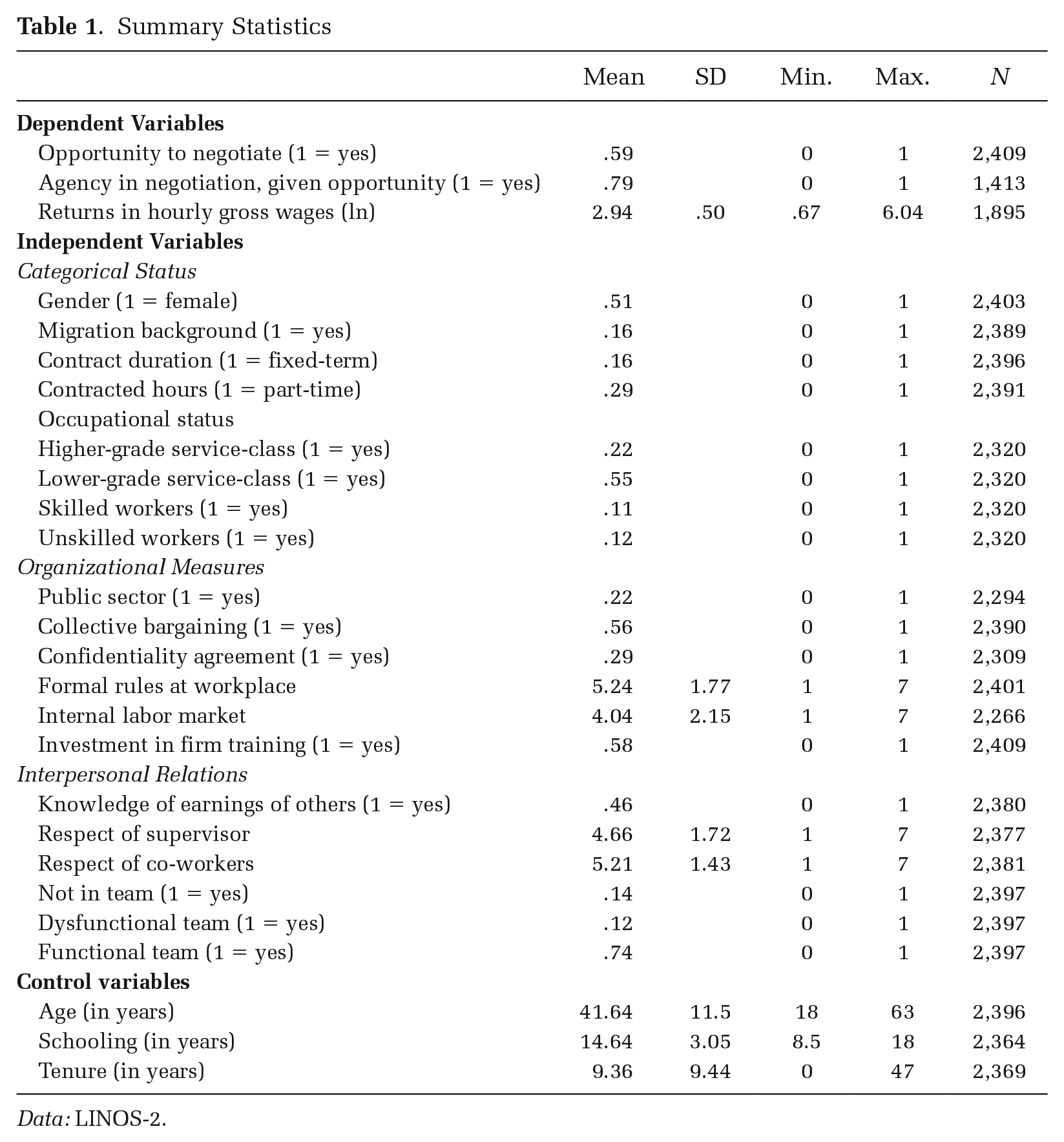
Data: LINOS-2.
Analytic Strategy
Our analyses proceed in three steps. For the analysis of opportunity to negotiate, we build the models stepwise by first including gender and migration background and controls in Model 1, the other categorical status variables enter in Model 2, the organizational variables in Model 3, and finally the relational variables in Model 4. A second set of models analyzing agency focuses only on respondents who have the opportunity to negotiate and regresses whether they indeed negotiated on the same independent and control variables as in the first set. Finally, our third analysis quantifies if the opportunity to negotiate and wage negotiations are related to higher earnings for the different subordinate-status groups.
For ease of interpretation of the effects and following recent suggestions in the literature (Breen, Karlson, and Holm 2018), we estimate linear probability models (LPM). Results are similar with logistic regression models. Because we see the organizational and relational variables identified in the negotiations literature as potential contexts and channels for status effects on negotiation, we compute formal mediation models. Mediation models estimate the portion of a total effect mediated by a set of covariates. We used Stata’s sem command with a full-information maximum likelihood estimator for these mediation analyses. For each status characteristic, we estimate the portion of total effects mediated by other status characteristics, organizational variables, and relational variables. Alternative mediation analysis strategies after logistic regressions using the khb method (Breen, Karlson, and Holm 2013) led to similar results.
To investigate differences in logged hourly wages between employees who negotiated and those who did not or could not, we estimated an extended linear regression model. This approach fits a linear regression model using a maximum-likelihood estimator that accommodates nonrandom treatment assignment (in our case, the exogenous treatment assignment was negotiation yes/no/not possible). 3 In these models, we include all measures of subordinate status (female, migration background, fixed-term contract, part-time, EGP class), the organizational variables, and the control variables. All metric variables are centered to obtain a meaningful intercept. 4
We apply multiple imputation methods to handle missing values of covariates. We use the multiple imputation and then delete (MID) approach (von Hippel 2007). All variables, including the dependent variables opportunity to negotiate and agency in negotiation, are used to predict missing values. Then the imputed values of the dependent variables are deleted, as they add only noise to the data. We use the chained equation method to impute missing values of multiple variables iteratively. For continuous variables, we use predictive mean matching (PMM, Little 1988). This method combines the linear regression approach and the nearest-neighbor imputation method. In a first step, the standard linear regression is used for the linear predictions, and in a second step, these predictions are used as distance measures to create a set of nearest neighbors consisting of the complete values. The algorithm then draws a randomly imputed value from this set. By drawing from the observed data, PMM preserves the distribution of the observed values in the missing part of the data, which makes it more robust than the fully parametric linear regression approach (StataCorp 2015:245). We follow Morris, White, and Royston’s (2014) suggestion and specify 10 nearest neighbors as potential candidates, creating 10 imputation datasets. Analyses with listwise deletion samples largely resemble the analysis with MI samples. All estimates and mediation patterns are similar.
Results
Table 2 provides a descriptive overview of the share of respondents with the opportunity to negotiate and the share of those who negotiated given the opportunity. These shares are displayed for each of the five status distinctions. The values indicate that all lower-status categories were less likely to have the opportunity to negotiate and, if they had the opportunity, they were less likely to do so. For example, 66 percent of all men were in jobs where they had the opportunity to negotiate, compared to only 53 percent of women. Of the employees who could negotiate, 84 percent of men did so, compared to only 75 percent of women. Pearson χ²-tests of independence show that in all five of our status measures, the subordinate-status group has a significantly lower opportunity to negotiate than does the respective high-status group. Among employees who negotiated, the differences are somewhat smaller, but the pattern that subordinate-status groups are less likely to make claims even when claims are structurally possible remains. Yet, we detect statistically significant differences only for gender, temporary contracts, and occupational class. These descriptive analyses suggest a more pronounced effect of structure (the opportunity to negotiate) over agency (the propensity to negotiate if negotiation is possible). They also suggest that gender, employment contract, and class are more consequential in the contemporary German context than are migrant background or part-time status for claims-making agency.
Bivariate Relationships between Categorical Status Characteristics, Opportunity to Negotiate, and Agency in Negotiation
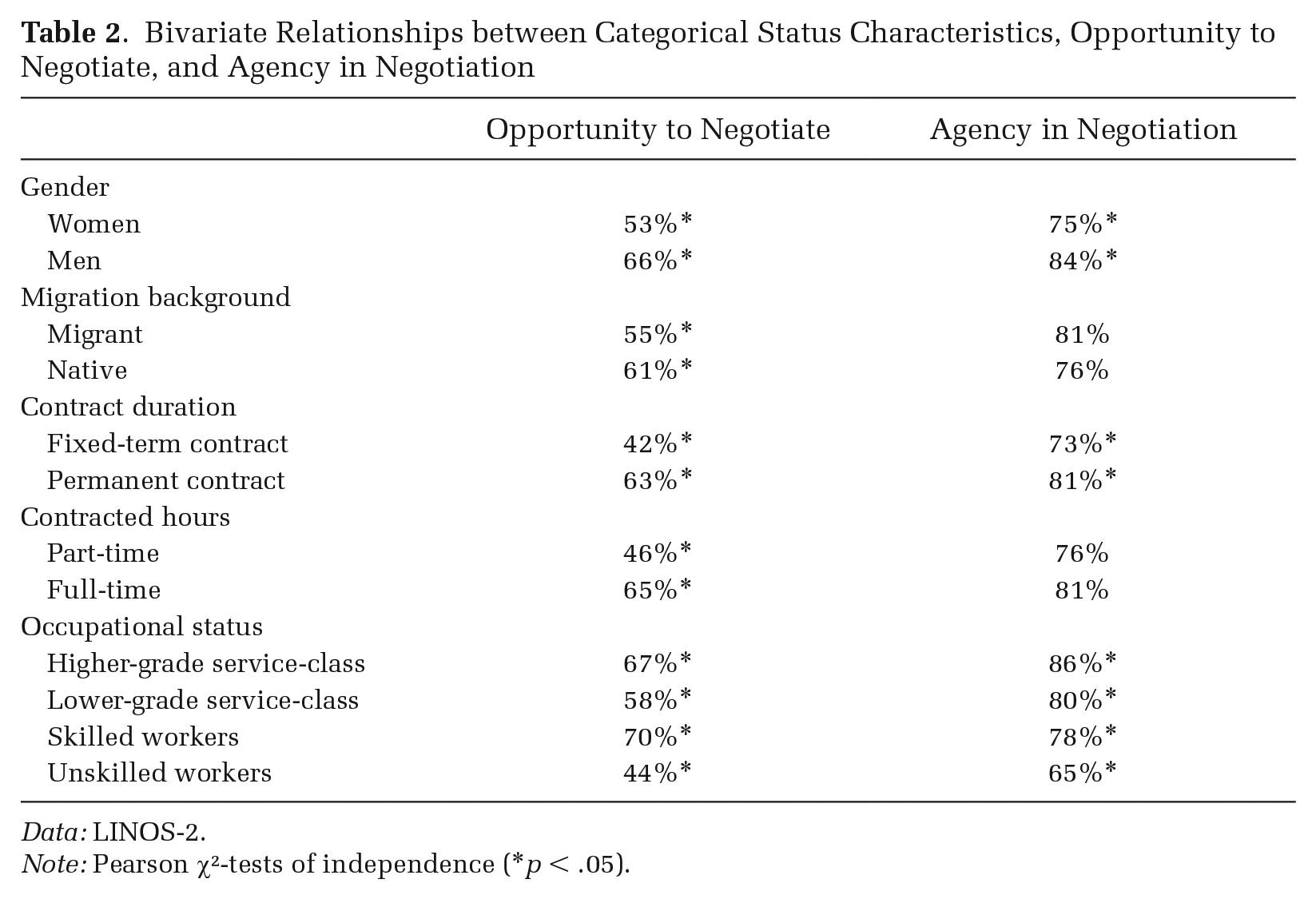
Data: LINOS-2.
Note: Pearson χ²-tests of independence (*p < .05).
Opportunity
We present results of the regression models graphically. In Figure 1, we test our first hypothesis that low-status groups are less likely to be in jobs where negotiation is possible (for the full regression table, see Table S1 in the online supplement). Model 1 includes gender and migration background, along with the control variables age, education, and tenure. Women and employees with a migration background show a lower probability to have the opportunity to negotiate than do men and non-migrants.
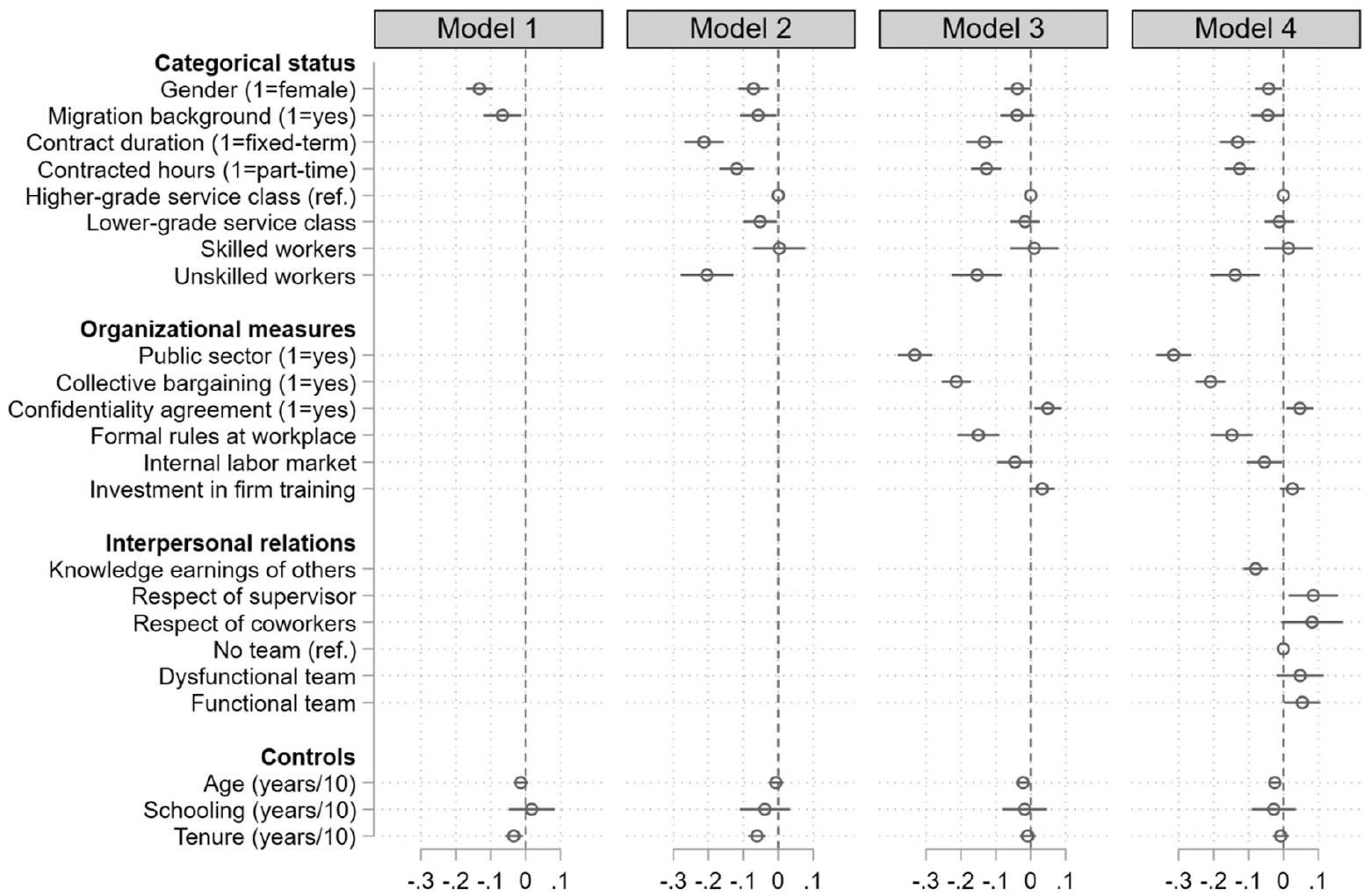
The Influence of Categorical Status, Organizational Measures, and Interpersonal Relations on the Opportunity to Negotiate One’s Own Earnings
In Model 2, controlling for age, education, and tenure, all five indicators of subordinate categorical status show negative and significant effects. Women, people with migration backgrounds, fixed-term workers, part-time workers, low-skilled manual workers, and lower-service-class employees all have lower probabilities of having the opportunity to negotiate net of other status characteristics and individual controls.
Comparing the class variables, we see that skilled manual workers have about the same probability to be in jobs where negotiation is possible as do high-grade service workers (e.g., managers and professionals). However, the probabilities are significantly lower among workers in more subordinate jobs within the white-collar and blue-collar classes.
The effect of categorical subordination on the opportunity to negotiate is most pronounced for fixed-term contracts (Ffixed-term = female = 15.33, p < .001; Ffixed-term = migrant = 15.11, p < .001; Ffixed-term = part-time = 5.26, p = .0219; Ffixed-term = lower-service-class = 17.90, p < .001) and low-skill manual jobs (Funskilled worker = female = 8.88, p = .003; Funskilled worker = migrant = 9.19, p = .003; Funskilled worker = part-time = 3.06, p = .080; Funskilled worker = lower-service-class = 19.38, p < .001), and both show similar effect sizes (Ffixed-term = unskilled worker = .03, p = .864).
Thus, all five subordinate-status groups are more likely to be in jobs that lack the opportunity to negotiate, supporting Hypothesis 1. This opportunity exclusion is most pronounced for positions that are formally weakest in workplace divisions of labor.
Model 3 includes the set of organizational variables that might affect the opportunity to negotiate. As expected, workers in the public sector are significantly less likely to have the opportunity to negotiate. The opportunity to negotiate is also significantly lower if at least part of one’s wage is set in collective bargaining. Both results are consistent with Hypothesis 4.
More formal rules in the workplace make it less likely employees have the opportunity to negotiate. We suspect organizations with formal rules are also more likely to have standardized pay practices, precluding the need to negotiate pay. In contrast, the opportunity to negotiate is higher in companies with confidentiality agreements, meaning a company policy prohibits employees from discussing their wages. Where negotiation is possible, employers try to reduce access to wage information.
Contrary to evidence from previous studies, we do not find the assumed effects of high-road employers on permitting claims. Controlling for status characteristics and other organizational measures, neither the existence of an internal labor market nor investments in firm training seem to make a significant difference for whether employees have the opportunity to negotiate. 5
Model 4 includes the relational variables, for which we mostly had expectations regarding the success of wage negotiations, but not for having the possibilities to negotiate. Yet, we observe some significant effects here. Knowledge about co-workers’ earnings is associated with a lower probability of working in a job where negotiation is possible. This makes intuitive sense, as knowledge of others’ earnings should be related to the transparency produced by collective bargaining, the public sector, and more formalized workplaces. Consistent with the negotiations literature, the opportunity to negotiate is more likely with good supervisor relations and a functional team setting.
Comparing the effects of the five indicators of subordinate-status characteristics between Model 1 and Model 4 suggests the effects of subordinate-status differences on the opportunity to negotiate are partly mediated by organizational context and interpersonal relations. To explore this further, we estimated mediation models disentangling the degree to which subordinate status directly and indirectly affects the opportunity to negotiate. Table 3 shows the decomposition of the total effect into the direct effect and the indirect effects in percentages. Gender and migration background precede the other measures of subordinate status, so we can additionally report indirect effects for gender and migration background via class, contract, and part-time status.
Direct and Indirect Effects of Subordinate Status on the Opportunity to Negotiate in Percentages of the Total Effect

Data: LINOS-2.
Note: Direct and indirect effects calculated by the delta method (Sobel 1987).
p < .05; **p < .01; ***p < .001 (two-tailed t-tests).
Turning to gender, less than a third of the total effect is direct (31.5 percent). Consequently, more than two thirds of the gender effect is mediated, 44 percent by positional characteristics. This makes sense, as women are more likely than men to work in fixed-term and part-time jobs and often have a lower occupational class location. About 25 percent of the total gender effect is mediated by organizational measures; mediation through interpersonal relations does not contribute to the total effect.
For employees with a migration background, the largest share of the total effect goes back to the direct effect. However, the main effect does not reach statistical significance at the .05 level (see Figure 1 and Table S1 in the online supplement). Mediations via the other measures also do not reach statistical significance.
Regarding contract duration (fixed-term versus permanent), over half of the total effect is direct, and about 39 percent is mediated by the organizational measures. For part-time employment and occupational status (on unskilled blue-collar work), the total effects are mostly direct. Only interpersonal relations mediate part of the total effect of occupational status. However, as Figure 1 clearly shows, workers in low-skilled manual jobs are the most consistently excluded from the opportunity to negotiate.
The decomposition of the total effects suggests that although much of the literature focuses on gender differences in negotiation, the process, at least in Germany, is present for subordinate categories more generally.
We also explored whether being subordinate status in more than one category exacerbates negotiation deficits. Many women work part-time but only a few men do so. We checked for an interaction effect and found an interesting relationship: the negative effect of part-time on the opportunity to negotiate is less pronounced for women than for men. Figure 2 shows the predicted probabilities to have the opportunity to negotiate for men and women in part-time and full-time employment (based on the regression analyses reported in Table S2 in the online supplement). Accordingly, whereas men who work full-time are more often in jobs where they have the opportunity to negotiate compared to women who work full-time (F = 14.76, p < .001), men and women who work part-time show no differences in probabilities (F = .18, p = .668).
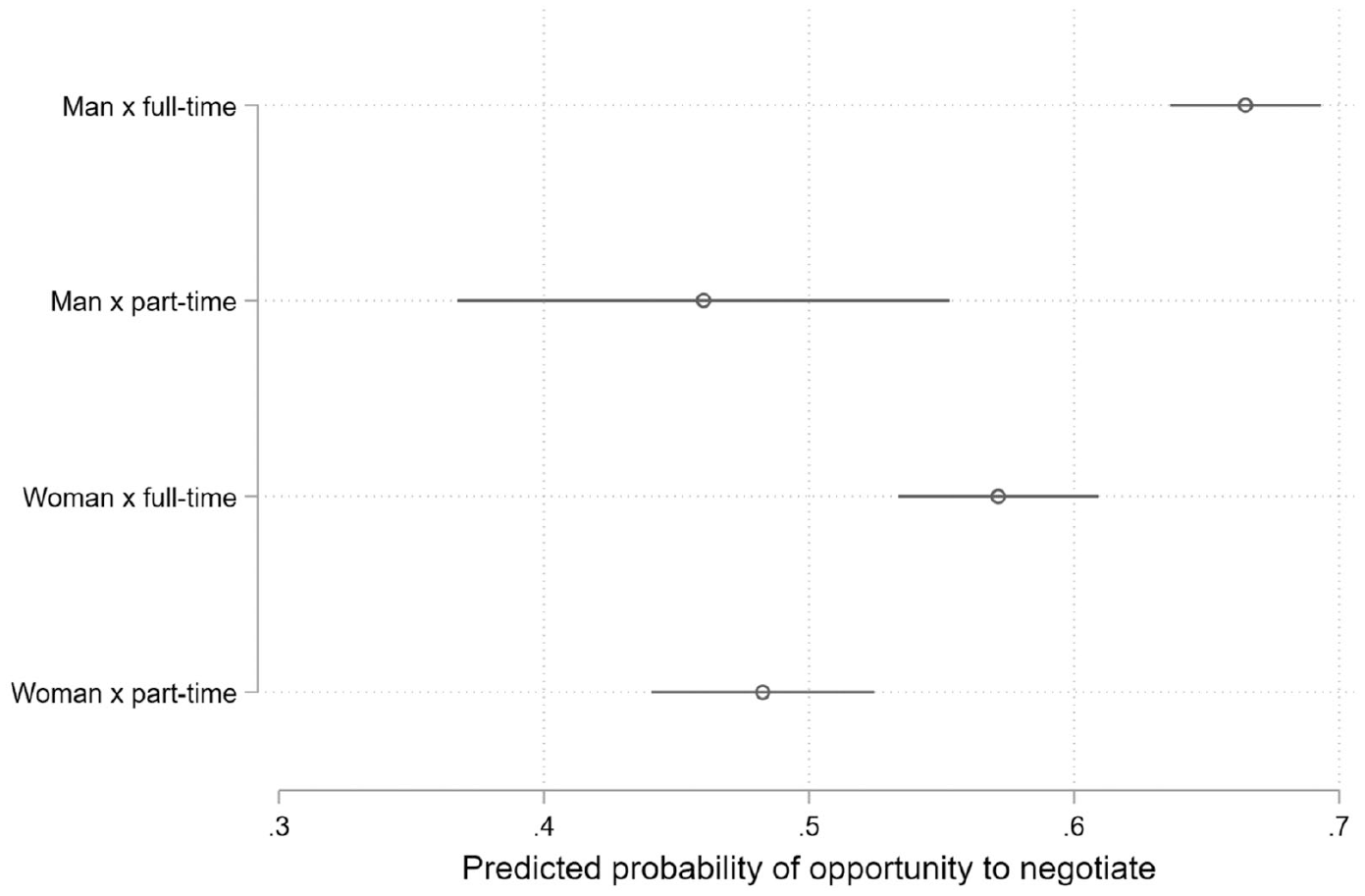
Predicted Probabilities of Opportunity to Negotiate
Overall, these results suggest the capacity to make a claim is closely linked to the position and not so much to the individual. Lower-status actors are all more likely to be in jobs where negotiation is not possible.
Agency
Our second hypothesis states that even when subordinate-status employees have the opportunity to negotiate, they are less likely to exercise this option. To test this hypothesis, we focus on the subset of respondents who can negotiate (N = 1,413) and investigate if they did so. The modeling is again stepwise; Figure 3 shows the respective coefficients and standard errors (see also Table S3 in the online supplement). In Model 1, we first introduce gender and migration background. The analysis reveals that female employees are less likely to negotiate their earnings compared to male employees. We find no differences between migrants and non-migrants. In Model 2, among the subordinate-status groups, we see significant effects for women, fixed-term contracts, and unskilled workers. As in Model 1, and in line with prior literature, we find that women who have the opportunity to negotiate are less likely than men to do so. The effect for fixed-term contracts suggests that given the opportunity, employees with fixed-term contracts are less likely to negotiate than are employees with permanent contracts. Unskilled workers are less likely to negotiate their earnings than are high-skilled manual workers (F = 4.66, p = .031), higher-grade service-class employees (F = 16.09, p < .001), and lower-grade service-class employees (F = 11.85, p < .001). These results are largely in line with Hypothesis 2.
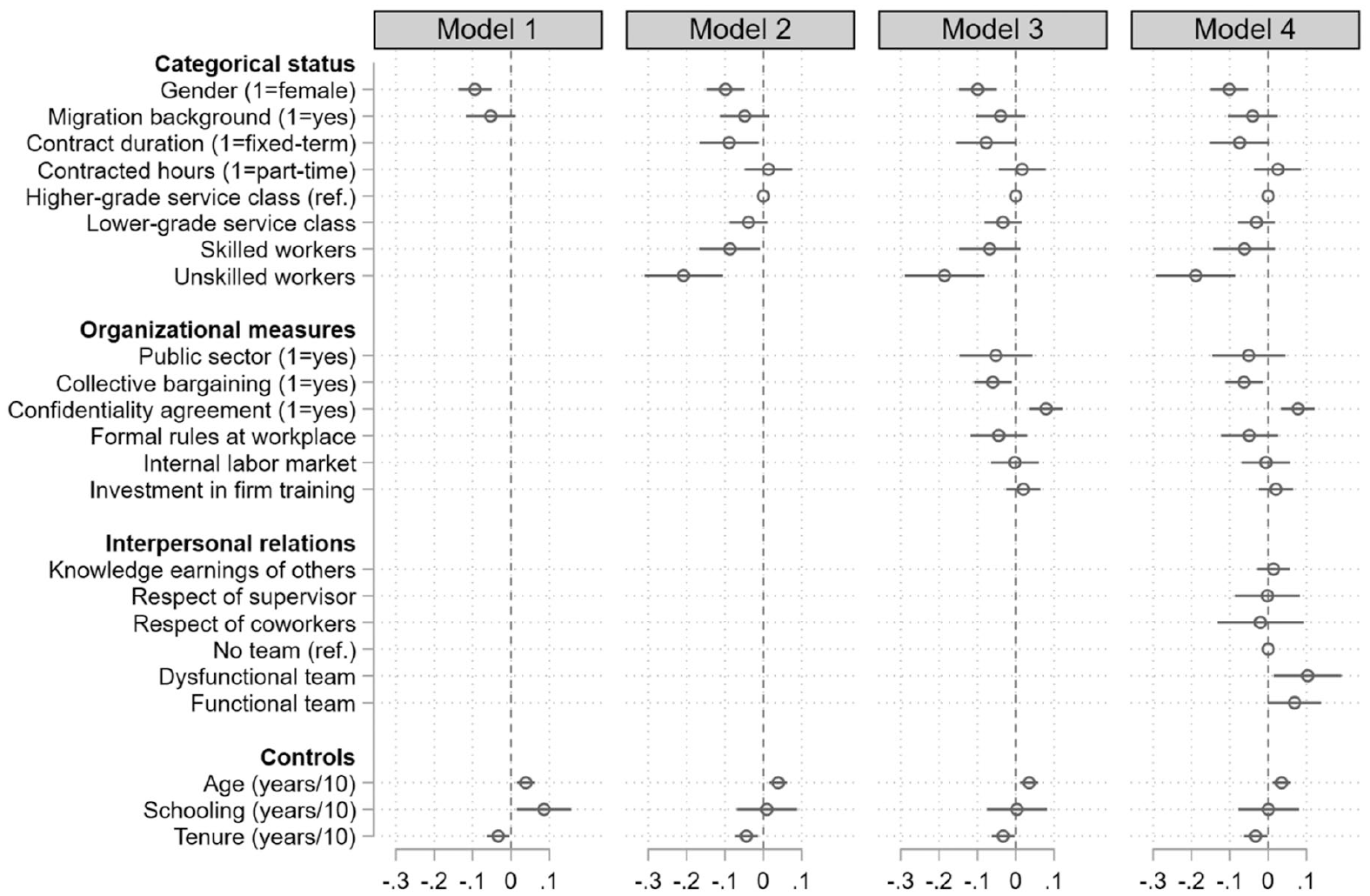
The Influence of Categorical Status, Organizational Measures, and Interpersonal Relations on the Probability of Agency in Negotiating One’s Own Earnings
Yet, these agency results do not hold for part-time employment and migrant status. Neither main effect is significant. Formal tests show the effect of part-time employment is significantly smaller compared to gender (F = 5.34, p = .021), temporary contract (F = 3.93, p = .048), and unskilled work (F = 12.02, p < .001). Thus, in comparison, part-time work is not as consequential an interactional barrier in the contemporary German context. The pattern is less clear for migration background (Fmigrant = female = 1.47, p = .225; Fmigrant = fixed-term = .63, p = .430; Fmigrant = unskilled worker = 6.29, p = .012), but the absence of a main effect leads us to conclude that the categorical distinction between migrant and native is not a strong influence on agency in negotiation.
The inclusion of the organizational variables in Model 3 shows that employees are less likely to take advantage of their opportunity to negotiate if wages are set in collective bargaining. We see the opposite for employees who work in companies with a confidentiality agreement. All other organizational variables show no meaningful effects.
Given the prior literature, it is somewhat surprising that employees in high-road firms are not more likely to negotiate. Even more surprising, inclusion of the relational variables in Model 4 does not add much information. Only working in a dysfunctional team, which we see as likely to produce dissatisfaction with the current job, increases the probability that employees will negotiate. All other relational variables are not significant. This is surprising, as these are the key variables in many studies in the literature on negotiations. As this literature mostly comprises student experiments and firm-level case studies, our results call the generalizability of prior results into question. We explored potential interactions between our focal status categories and the relational variables as to whether respondents actively negotiate. This exercise generated some significant interactions, but without any clear pattern (for full results, see Figure S2 in the online supplement).
Contrary to the analysis of the opportunity to negotiate, the comparison of effects of subordinate-status groups across models via mediation analysis gives no indication that the effects of subordinate characteristics are substantially mediated by either the organizational or interactional variables (results not shown). To check if results are sensitive to the inclusion of public-sector employees, we restricted an analysis to private-sector employees (see Figure S1 in the online supplement); this analysis reveals no differences from the patterns reported here.
Returns
Finally, we focus on the question of who benefits from wage negotiations. For this, we use an extended linear regression model, comparing the logged hourly pay of employees who negotiated with the pay of those who could negotiate but did not and those who could not negotiate.
Figure 4 displays the results of the extended linear regression models (shown in more detail in Table S4 in the online supplement). In the first panel of Figure 4, we see how gender and negotiation affect logged hourly wages. We can extract two types of information from this figure. First, we can compare the logged hourly wages of women and men for each negotiation status. Male employees have higher hourly wages than do female employees—whether they negotiated, did not negotiate, or when negotiation was not possible (for the formal test statistics, see Table S4). Second—and more important for our research question—we can compare the negotiation benefits for male and female employees. If we only look at male employees, we see that men who negotiate have significantly higher earnings than their counterparts who did not (χ² = 13.00; p < .001) or could not (χ² = 30.62; p < .001) negotiate. Among women, we find no differences between workers who negotiated and those who did not (χ² = 1.32; p = .251) or could not (χ² = .65; p = .420) negotiate. Returns to claims-making only pay off for men.
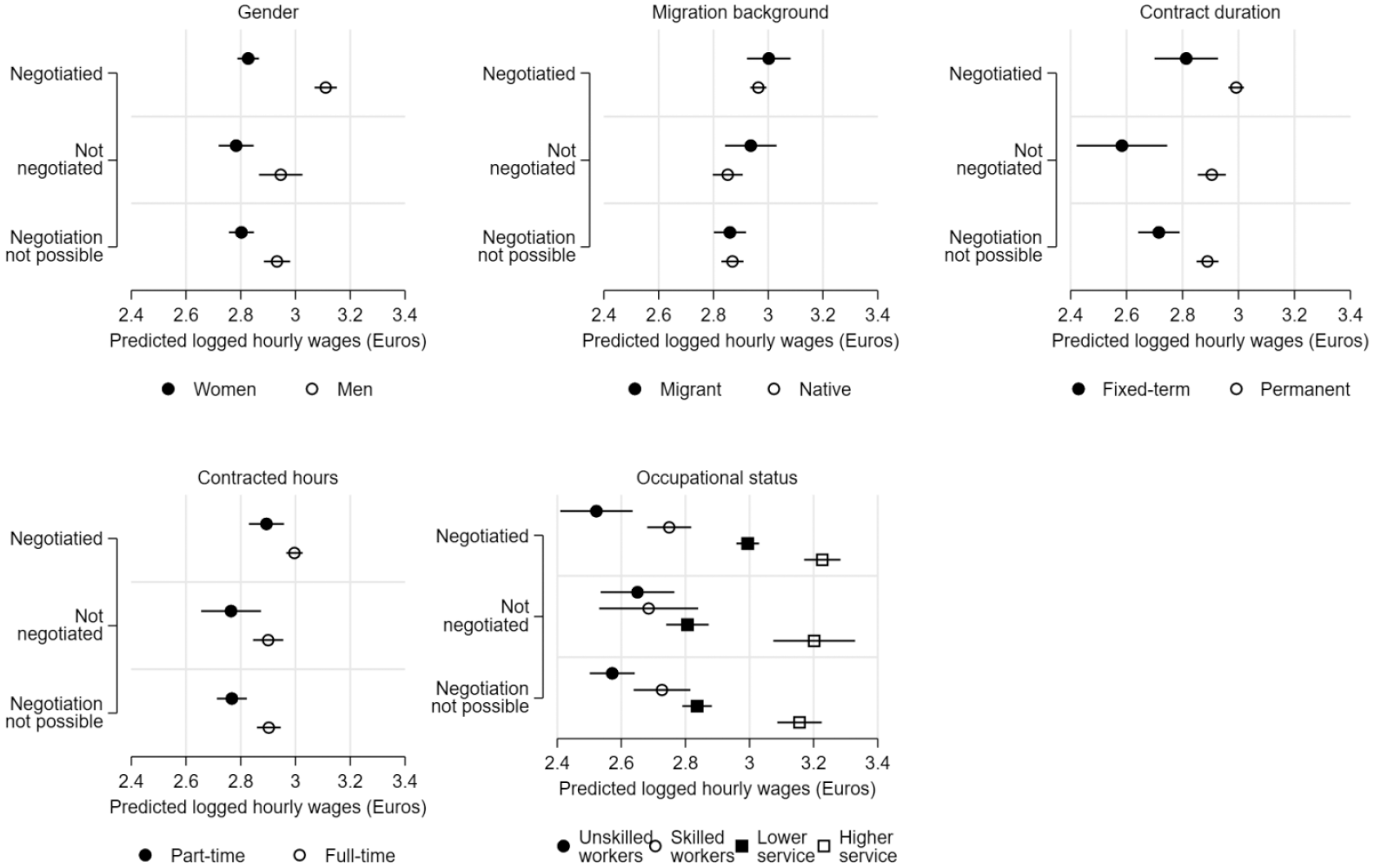
Predicted Logged Hourly Wages (in Euros) by Categorical Status
The second panel in Figure 4 displays the results in the same fashion for migration background. We find no meaningful differences in logged hourly wages between migrants and non-migrants in any of the three negotiation conditions (see Table S4). Among native-born employees, wages are higher if they negotiated (χ² = 12.35; p < .001), but we find no negotiation benefits for migrants (χ² = 1.09; p = .297). Yet, the relative benefits for native-born workers who negotiated compared to migrants who negotiated are not statistically significant (χ² = .43; p = .510).
The third panel in Figure 4 shows results for contract duration. For permanent contracts, we see that employees who negotiated earn more than those who did not (χ² = 8.87; p = .003) or could not (χ² = 17.39; p < .001) negotiate. Fixed-term employees who negotiated also earn more than fixed-term employees who did not negotiate (χ² = 5.20; p = .023). That there was no difference between fixed-term employees who did negotiate and those who could not (χ² = 2.00; p = .157) probably reflects their higher representation in unionized manual occupations. We see positive returns to wage claims for both fixed-term and permanent contracts.
The fourth panel in Figure 4 reports results for part-time versus full-time employees. The hourly earnings of part-time employees across all negotiation states are lower than those of full-time employees. Yet, compared to workers who did not negotiate, negotiation paid-off for both full-time (χ² = 8.90;p = .003) and part-time (χ² = 4.01; p = .045) employees. The relative benefits of negotiation did not differ between part-time and full-time employees (χ² = .21; p = .645). Positive returns to wage claims occur for both full- and part-time employees.
Finally, only lower-service-class employees earned more if they took advantage of the opportunity to negotiate (χ² = 23.00;p < .001). For higher-service-class (χ² = .13; p = .720), skilled (χ² = .56; p = .456), and unskilled (χ² = 2.41; p = .121) workers, we detect no wage benefits of negotiation.
In summary, we find that superordinate-status employees generally earn more than subordinate-status employees, and negotiation mostly paid-off for superordinate-status employees. The one exception was higher service classes, where claims did not yield higher average earnings. Formal tests of the relative benefits of wage negotiation revealed statistically significant larger negotiation benefits only for men compared to women. This pattern is largely in line with the literature on gendered benefits of wage negotiations.
Discussion
Our core idea was that the capacity to make a claim is at least partially a function of the job, rather than the person, and lower-status actors—women, migrants, fixed-term employees, part-time employees, and low-skilled workers—are all more likely to be in jobs where negotiation is not possible. At the same time, we expected these actors to be less agentic, reflecting lower levels of interactional power. Finally, we theorized that even if subordinate-status actors make claims, those claims are treated less seriously, and so negotiations yield lower wage benefits.
Our analyses proceeded in three steps. First, the analysis of the opportunity to negotiate showed that all subordinate groups were indeed less likely to work in jobs where wage claims are possible—even net of education, age, and tenure. This was particularly the case for employees with fixed-term contracts and those in low-skilled jobs, but it was also true for migrants, part-time employees, and women. For women and people with a migration background, opportunities to negotiate were at least partially mediated by the organizational context. Interestingly, after controlling for other subordinate-status characteristics, gender differences diminish considerably, indicating it is not simply gender per se that drives gender differences, but that women are often in jobs with limited opportunity to negotiate, due to class, contract, or part-time reasons. We found a weaker version of this pattern for migrants. The opportunity to make a claim is closely linked to a job’s characteristics, and less so to individual status characteristics. We found working in public-sector jobs or jobs with collective bargaining via unionization to be structural alternatives to individual claims-making.
Second, our analysis of agency in negotiation investigated if subordinate-status employees who have the opportunity to negotiate were less likely to do so. In line with much of the previous literature, we found a meaningful and consistent gender effect. Women are less likely than men to negotiate, even when they have the opportunity. Being employed on a fixed-term contract and being in low-skilled working-class positions were also associated with lower probabilities to exercise agency. In contrast to the first set of analyses, we do not find any meaningful mediation of the organizational context on agency. Interpersonal relations that are described as crucial in the negotiations literature show no meaningful effects on agency, nor do they mediate status effects. Employees with access to collective claims-making via unions or formalization of work practices were less likely to take advantage of the opportunity to negotiate.
Finally, we investigated whether negotiation leads to equal returns for all groups, and we found this is not the case. Our analyses of returns to negotiations show that compared to other women, migrants, and working-class individuals, making wage claims produces no wage gains. We take this pattern to provide an explanation as to why women and low-skilled workers are less likely to negotiate even if they are structurally able to do so. We do find wage gains for part-time and temporary contract workers who negotiate, and they are of similar magnitude to full-time and permanent-contract workers.
Inconsistent with our theoretical reasoning, we do not observe higher wages for upper-service-class workers who negotiate relative to those who do not. This may reflect the weakness of our cross-sectional models, and it may also be driven by unobserved heterogeneity at the workplace or person level. We suspect, however, that it reflects unobserved relational processes. Prior research shows that white-collar workers are more likely to be given job offers via informal networks (McDonald, Benton, and Warner 2012). It may simply be the case that professional and managerial workers in the upper-service-class are more likely to receive satisfactory initial offers, and so are less likely to need to be agentic. In the RIT framing, the claim was not silenced, but rather preempted by an unsolicited gift to high-status employees.
There are some limitations to our analyses. First, our opportunity measure is from the employee, not employer, point of view, and so may reflect, in part, subordinate-status actors underestimating the room for agency. However, because opportunity is more strongly tied to aspects of positions than of people, we believe this is not a large source of bias in the measure.
Second, our analysis of returns to negotiation would be more compelling if we had enough data to observe change within workplaces or compare people who negotiate within the same workplace. Because we do not observe wage negotiations in the same workplace, but rather across a national economy, some of the differences in negotiation opportunity, agency, and returns may reflect differences in the negotiation process between organizations. However, prior literature based on organizational case studies also finds no or lower economic returns to negotiations for women, which is comforting in this regard. Ideally, multilevel data including many employees with different status characteristics for each workplace could reveal more insights on how organizational regimes prevent or encourage subordinate employees from negotiating.
Third, our focus on wage negotiations only informs the claims-making process after hiring and job assignment. Discrimination, either in refusal to hire or in job assignments, no doubt occurs as well (see the extended discussion on claims-making as discrimination in hiring in Tomaskovic-Devey and Avent-Holt [2019]). There certainly is evidence of such discrimination in the German context for immigrants (Luthra 2013; Thijssen et al. 2019), women (Kübler, Schmid, and Stüber 2018), mothers (Hipp 2020), and some religious groups (Di Stasio et al. 2019). Applying for a job is a claim on a position, and such claims-making likely reflects the cultural content of status distinctions as much, or perhaps even more, than status-based interactional power. In our study, all subordinate-status characteristics examined are associated with being in a job where negotiation is not possible. Because we controlled for human capital attributes, initial sorting into jobs where negotiation is not possible may reflect discrimination at the point of hire.
Another limitation of this study is that our results describe contemporary German wage negotiations, and the degree to which the patterns are the same elsewhere is unknown. We expect the ability to negotiate is tied to the status characteristics of jobs and workers in other contexts. Whether or not status groups are empowered to take advantage of the opportunity to negotiate and have their claims satisfied may certainly vary with national and organizational context. The claims-making mechanism as described in the RIT framework is quite general but, theoretically, RIT predicts that the salience of categorical distinctions will reflect different national histories, bargaining practices, and legal frameworks. We investigated the usual suspects in terms of status characteristics, but other status characteristics, such as temporal precarity (Storer, Schneider, and Harknett 2020) or age discrimination (Roscigno et al. 2007), are likely locally salient in some contexts.
Moreover, RIT stresses the importance of organizational practices for claims-making processes. Likewise, the negotiations literature identifies organizational practices (e.g., formalization) and relationships (e.g., with supervisors and cohesive work groups) as conditioning the success of claims-making. We did not find support for the effect of practices or relationships to initiate negotiations, although they did condition the ability to negotiate at all.
Conclusion
This article comprehensively examined the opportunity, agency, and returns of wage negotiations across multiple status categories. It moved the discussion of negotiations away from a focus on individual initiative and tendencies to an understanding of claims-making as conditioned by actors’ structural location and their interactional resources. We examined negotiation within the framework of relational inequality theory. Because claims-making is the fundamental interactional mechanism proposed in relational inequality theory, this last contribution is important for the development of social theory on organizational inequality processes.
Almost half of German workers do not experience negotiation as possible. Relative to the negotiations literature, this suggests the opportunity to negotiate may be as important as agency and deserves more attention than it has received. Relative to standard human capital theory, this simple fact suggests that for many workers, wage bargaining is not a real possibility. This basic finding also points to the importance of organizational structure and practices—an emphasis of RIT—in the wage-setting process. That all subordinate categories have a lower opportunity to make claims, even when controlling for education, age, tenure, and other categories, is clear evidence that categorical subordination leads to fewer claims. In these cases, we think it is reasonable to think of claims as being silenced, either explicitly in firm practices or implicitly in the interactional context.
Again, relative to the negotiations literature, we do not find that the organizational and interactional contexts described in that literature influence the probability to negotiate, given the opportunity. The opportunity to negotiate, a neglected topic in this literature, is much lower in public-sector and unionized jobs. It is also marginally lower in more formalized workplaces. Taking advantage of the opportunity to negotiate is associated only with employer prohibitions on discussing wages. We suspect the prohibition of transparency is an attempt by employers to increase their relational power during wage negotiations. That the quality of team, co-worker, and manager relationships does not significantly predict agency is the more puzzling result. We do not see this as a strong refutation of the negotiations literature, in that our research design does not allow us to compare agency or returns for people who share the same organizational context.
Our findings for gender are broadly consistent with previous negotiations research. Here our major contribution relative to the negotiations literature is to theorize and confirm that class position in occupational divisions of labor operates quite similarly to gender. We do not think this is a surprising finding, as occupational class has long been understood in terms of interactional autonomy, authority relationships (Wright 1997), and class differences in agency (Kohn and Schooler 1969). The absence of this insight in the negotiations literature most likely reflects the use of class-homogenous case studies and experimental methods rather than population surveys. Class and gender affect opportunity, agency, and returns similarly. An exciting new line of research would be to see if there are organizational or interactional contexts that equalize agency and returns to negotiation between women and men, or even more dramatically across classes.
Our analysis of negotiations as claims-making is also a fundamental contribution to relational inequality theory. Only one prior article has examined this aspect of the theory (Luekemann and Abendroth 2018), and its measure of claims-making was simply discussing career options with a supervisor. That article is important in that it confirms the prediction of relational inequality theory that claims vary as a function of the intersection of categorical inequalities and organizational practices.
We also show that the negotiations process can be understood in terms of the two other fundamental mechanisms in RIT, closure and exploitation. Closure can exclude subordinate-status actors from the opportunity to negotiate, silencing potential claims. When claims are made, some subordinate-status claims, in this case by women or lower-class workers, may lead to no wage gains, suggesting an exploitation mechanism. The self-silencing associated with gender, class, and fixed-term contracts suggests the importance of a simultaneously agentic and relational conceptualization of claims-making.
We also demonstrate that categorical inequalities are structurally ubiquitous at the level of opportunity, but the agency and ratification of claims are not. For gender and class, we observe fewer claims by subordinate-status actors even when claims-making was possible, and no economic returns for those brave enough to try. The lack of status effects for other characteristics is consistent with the maxim of relational inequality theory that categories matter, but which categories matter depends on local context. Where a status is more salient, such as undocumented immigrants in the United States (see Muñoz 2008), claims may be more likely to be silenced or denied. Even within a country, which status distinctions operate more powerfully likely varies as a function of workplace policies and practices (Tomaskovic-Devey et al. 2009). Of course, the actual claims-making process will always be intersectional: the relational power of claims-making is always made by real people, who simultaneously inhabit and react to multiple status characteristics in their organizational contexts.
Prior research on organizational inequalities stresses the importance of transparency and accountability for reducing status-based inequities (Castilla 2015; Kalev, Dobbin, and Kelly 2006). Public policies to increase transparency in wage negotiations, as well as our finding that many employers in Germany discourage transparency, are consistent with this injunction. We doubt, however, that on its own, negotiation transparency can be an efficacious solution. Individual negotiations are inequality-installing mechanisms, favoring people already advantaged in the claims-making process. Germany is experiencing a rapid rise in class inequality (Tomaskovic-Devey and Melzer 2020). It seems reasonable to suppose this is being produced, at least in part, by declining collective claims via unionization and rising class biases in negotiation outcomes.
If negotiations are to endure as a wage-setting mechanism, accountability is required to reduce categorical inequalities. In the case of pay negotiations, this would require post-hoc evaluations of pay disparities. That a wage is negotiated should not be treated as legitimate unless the outcome is uncorrelated with gender or other status characteristics. Collective claims based on notions of solidarity are certainly preferable to individual claims based on categorical distinctions.
Our findings suggest that at least in Germany, the advice to women to “lean in” is unlikely to reduce the wage gap, and women’s reluctance to make claims is thus quite reasonable when seen from an interactional perspective. The results for class are similarly dramatic: working-class individuals who “lean in” gain nothing. If claims by subordinate-status groups tend to be rejected, attempts to “lean in” by these individuals could lead to not only the embarrassment of failure, but perhaps also longer-term resentment toward and strained relationships with supervisors. Failed negotiations may also signal to other women and class-subordinate employees that making a claim on resources, not just pay but conceivably tools, training, and even routine respect in interactions, is futile, and perhaps dangerous. The route to more gender and class equality in outcomes is not through individual negotiation, but through collective mobilization.
Supplemental Material
sj-pdf-1-asr-10.1177_00031224211038507 – Supplemental material for Categorical Distinctions and Claims-Making: Opportunity, Agency, and Returns from Wage Negotiations
Supplemental material, sj-pdf-1-asr-10.1177_00031224211038507 for Categorical Distinctions and Claims-Making: Opportunity, Agency, and Returns from Wage Negotiations by Carsten Sauer, Peter Valet, Safi Shams and Donald Tomaskovic-Devey in American Sociological Review
Footnotes
Acknowledgements
We thank the ASR editors and three anonymous reviewers, as well as Stefan Liebig, Matt Mendoza, Vincent Roscigno, Ofer Sharone, Laurel Smith-Doerr, and multiple participants in Paul Starr’s Princeton graduate seminar for thoughtful comments on this article. An earlier version was presented at the 2019 American Sociological Association meeting.

Notes
References
Supplementary Material
Please find the following supplemental material available below.
For Open Access articles published under a Creative Commons License, all supplemental material carries the same license as the article it is associated with.
For non-Open Access articles published, all supplemental material carries a non-exclusive license, and permission requests for re-use of supplemental material or any part of supplemental material shall be sent directly to the copyright owner as specified in the copyright notice associated with the article.
