







Abstract
The two main axes of inequality in the U.S. labor market—occupation and workplace—have increasingly consolidated. In 1999, the largest share of employment at high-paying workplaces was blue-collar production workers, but by 2017 it was managers and professionals. As such, workers benefiting from a high-paying workplace are increasingly those who already benefit from membership in a high-paying occupation. Drawing on occupation-by-workplace data, we show that up to two-thirds of the rise in wage inequality since 1999 can be accounted for not by occupation or workplace inequality alone, but by this increased consolidation. Consolidation is not primarily due to outsourcing or to occupations shifting across a fixed set of workplaces. Instead, consolidation has resulted from new bases of workplace pay premiums. Workplace premiums associated with teams of professionals have increased, while premiums for previously high-paid blue-collar workers have been cut. Yet the largest source of consolidation is bifurcation in the social sector, whereby some previously low-paying but high-professional share workplaces, like hospitals and schools, have deskilled their jobs, while others have raised pay. Broadly, the results demonstrate an understudied way that organizations affect wage inequality: not by directly increasing variability in workplace or occupation premiums, but by consolidating these two sources of inequality.
U.S. wage inequality has risen persistently since the 1980s. Research explaining this trend increasingly emphasizes two causal explanations. First, because inequality has increased between occupations and skill levels (Goldin and Katz 2008; Mouw and Kalleberg 2010), researchers have pointed to rising returns to education and to occupational closure—that is, barriers to entry like occupational licensing—as drivers of inequality (Acemoglu and Autor 2011; Weeden 2002). Second, because inequality has risen between rather than within workplaces (Barth et al. 2016), researchers have attributed inequality to rising average pay at top firms with market dominance or high pay practices (Tomaskovic-Devey and Avent-Holt 2019).
What unites these prominent explanations for wage inequality is a focus on inequality between groups. They each assume that increasing inequality is due to increasing pay-offs by occupation, skill level, or workplace. Indeed, this assumption underlies most general theories of inequality, whether they emphasize inequality due to classes or occupations; whether by firm performance or between segmented product markets (Mouw and Kalleberg 2010; Weeden and Grusky 2012; Wodtke 2016). In this article, we propose an alternative theory of rising inequality. We focus not on inequality between groups, but instead on the consolidation of distinct sources of advantage—that is, the extent of correlation between multiple sources of inequality. Building on an old idea in macrostructural sociology, we demonstrate that overall inequality is exacerbated as distinct axes of inequality align (Blau 1977).
Specifically, we argue that recent increases in wage inequality are mainly accounted for by increased correlation between occupation pay premiums and workplace pay premiums. 1 High-paying workplaces once employed low-premium occupations in circumstances ranging from unionized manufacturing assembly jobs to maintenance and food service positions at large corporate headquarters. Moreover, many members of high-paying occupations—like doctors, teachers, and psychiatrists—used to work in low-paying service workplaces. In this article, we show that these cases of offsetting mismatch between occupation and workplace premiums have become rarer. Over time, the workers benefiting from employment at a high-paying workplace are increasingly those who already benefit from membership in a high-paying occupation. We call the ensuing correlation between different sources of advantage consolidated inequality.
This argument extends recent research linking earnings inequality to positive worker–employer sorting (Song et al. 2018) and to the increased prevalence of occupationally homogeneous employers (Handwerker 2020). In our analysis, we find that up to two-thirds of the rise in wage inequality since 1999 is accounted for by a growing correlation between occupation pay premiums and workplace pay premiums. It is the consolidation of inequality, rather than rising variance in pay premiums associated with occupation or with workplace alone, that explains rising inequality. Moreover, this trend is not just due to entry and exit of workplaces. Changing strategic decisions about job composition and pay rates shift workplaces’ occupational composition and pay premiums over time. Consolidating advantage is thus an understudied way that organizations affect inequality. For example, consider a previously low-premium mental health clinic that raises pay for its largely professional employees. This raise could be applied equally to its employees and diminish both within-workplace inequality and overall inequality in workplace premiums (as a low-paying clinic moves up toward standard compensation levels). But the raise could nonetheless exacerbate overall inequality by allocating more workplace premium benefits to professional employees, who are already advantaged by occupation premiums. Even absent changes in within-workplace inequality, organizations exacerbate inequality when their pay-setting and job-composition decisions heighten the correlation between occupation and workplace premiums.
This descriptive characterization of rising inequality does not explain why occupational and workplace advantages have consolidated. In a second step, we explore several organizational and labor market changes that could explain rising consolidation. The expansion of both low- and high-paid service firms—fast food alongside finance—has polarized employment opportunities and supplanted more skill-diverse manufacturing employment (Kalleberg 2011). Beyond industry composition changes, occupations can shift across workplaces. For example, outsourcing has shifted low-paid occupations like janitors and food service workers out of employment in high-paying firms (Weil 2014).
Other research emphasizes changing sources of workplace premiums (Cappelli 1999; Davis 2016; VanHeuvelen 2018). For example, in the past, unions bolstered workplace premiums for some workers in lower-paid manual occupations (Sørensen 2000). At the other side of the occupation distribution, many professionals employed in health, education, and social-service organizations were underpaid due to penalties associated with gender, meaningful work, and professional identity (England, Budig, and Folbre 2002; Reich 2014). As these consolidation-reducing union premiums and identity penalties have declined, the rise of superstar firms has meant increased pay at workplaces that employ highly paid teams of managers and professionals (Autor et al. 2020; Lazear 2019). Here, consolidation is due to neither industry composition changes nor a reshuffling of occupations across high- and low-paying workplaces. Instead, the sources of workplace pay premiums have changed in ways that affect their joint distribution with occupation pay premiums.
In the analysis that follows, we first document that consolidated inequality helps explain rising inequality, and then we evaluate each of these potential sources of consolidation. Occupation-by-workplace Occupational Employment Statistics (OES) microdata allow us to estimate the first two-way occupation and workplace fixed-effects model on U.S. data. With this model, we distinguish rising inequality due to workplace, occupation, or residual components from rising inequality due to the covariance of workplace and occupation. Next, to determine why consolidated inequality is increasing, we cannot directly observe ultimate causes like technological change or deunionization. Instead, we take advantage of the large sample and repeat respondents in the OES to study a panel of workplaces that appear at the beginning and end of the period. We use this panel to construct descriptive counterfactuals that capture different types of organizational changes that can drive consolidation. For example, we estimate how much less the correlation between workplace and occupation premiums would have increased if workplace premiums had not increased at establishments that employed managers and professionals at high wages.
Our findings amend prior research on inequality. Recent rising inequality is not mainly due to heightened pay-offs to occupation-wide skill (Liu and Grusky 2013) or to rising inequality between workplace pay premiums (Barth et al. 2016). It is also not mainly due to residual or within-job inequality (Tilly 1998; Western and Bloome 2009). Instead, organizations have consolidated occupation and workplace inequalities. Our attempt to explain this trend revives a classic question in the sociology of wage-setting: under what conditions does workplace context, over and above occupational skill, affect pay? Building on prior research, we show how workplace sources of premiums for blue-collar workers and penalties for pink-collar service organizations have been supplanted by higher pay for already-highly-paid teams of managers and professionals. The net result is that it is primarily professionals and managers, not blue-collar workers, who now benefit from high workplace premiums. In 1999, blue-collar production jobs were the most common occupation in high-premium workplaces, but in 2017, managers and professionals were the most common, at 40 percent of high-premium workplace employment.
Wage Inequality, Pay Premiums, and Consolidation
Rising wage inequality is often attributed to rising returns to skill or to variation in pay across profitable and struggling workplaces. In this section, we argue that prior research on inequality has neglected the shifting extent of correlation between these two sources of pay premiums. We then specify several potential channels through which occupation and workplace inequality could consolidate.
Since at least 2000, occupations have accounted for an increasing share of total wage inequality (Mouw and Kalleberg 2010). Skill-biased technological change raises demand for skill, and without a concomitant increase in supply of college graduates, returns to education have grown (Goldin and Katz 2008). Sociologists emphasize that in addition to demand for broad skill groups, specific occupational communities can organize barriers to entry that protect the interest of their “micro-class” (Weeden 2002; Weeden and Grusky 2012). Together, these market and institutional theories predict that occupational pay premiums contribute to wage inequality.
At the same time as inequality between occupations increased, inequality between workplaces also rose (Barth et al. 2016; Tomaskovic-Devey et al. 2020). Employers with product market power and high profits may face collective pressure from workers to share economic rents in the form of pay premiums, particularly in a context of strong labor unions (Cobb 2016; Dencker and Fang 2016). Other employers pay efficiency wages, above those of competitors, to increase productivity or maintain teams of high-productivity workers (Kremer 1993; Krueger and Summers 1988). Beyond profit-sharing, workplace premiums and penalties can also be driven by non-wage compensating differentials (Sorkin 2018). For example, if one workplace offers below-average pay but an inspiring social mission, it might still be able to recruit workers (Burbano 2016; Hedblom, Hickman, and List 2019). Each of these different forces—bargaining over organizational surplus, efficiency wages, and compensating differentials—manifest in unequal pay premiums across different workplaces.
This prior inequality research demonstrates that both occupation and workplace affect workers’ pay. But research on each of these sources of advantage often neglects the other. Little theory addresses the shifting degree of overlap between skill- and closure-driven occupation premiums and the profit-sharing or compensating differentials that hold in particular workplaces. 2 Indeed, research on rising inequality largely neglects the insight from macrostructural sociology that overall inequality increases when different dimensions of status advantage are correlated (Blau 1977). The idea of consolidated social structure has been used to study organizations and networks, but not earnings inequality (Brashears, Genkin, and Suh 2017; Centola 2015). As such, we ask whether the consolidation of two sources of inequality, rather than increased variance in workplace or occupation premiums alone, accounts for rising U.S. labor market inequality.
If high-premium workplaces employ mainly managers and professionals, as in finance or consulting, inequality will be higher than if high-premium workplaces employ mainly production and maintenance workers, as in large manufacturing firms in the mid-twentieth century, like the Ford Motor Company (Raff and Summers 1987). In the latter case, workplace premiums, arising from efficiency wages or from union bargaining power, can actually reduce overall inequality, as relatively low-skill occupations benefit. Figure 1 provides schematic examples of how inequality increasing through consolidation works differently than inequality increasing due to changes in underlying occupation or workplace pay premiums. In the first example, an increase in the pay-off to skill raises occupation premiums for high-skilled workers in both high-paying firms (a software engineer at a profitable technology company) and low-paying firms (a child psychologist at a low-paying school). In the second example, occupation premiums stay constant but become increasingly correlated with workplace premiums. In this consolidation example, a previously high-paid, low-skill manufacturing worker faces a decrease in workplace premiums and the child psychologist enjoys an increase in pay due to an increased workplace premium. These examples illustrate how it is not only the extent and variance of workplace premiums that matters for inequality, but their distribution across workers in different occupations. In Part A.1 of the online supplement, we simulate how consolidated inequality can exacerbate overall inequality, even absent increases in the underlying variance of workplace or occupation premiums.
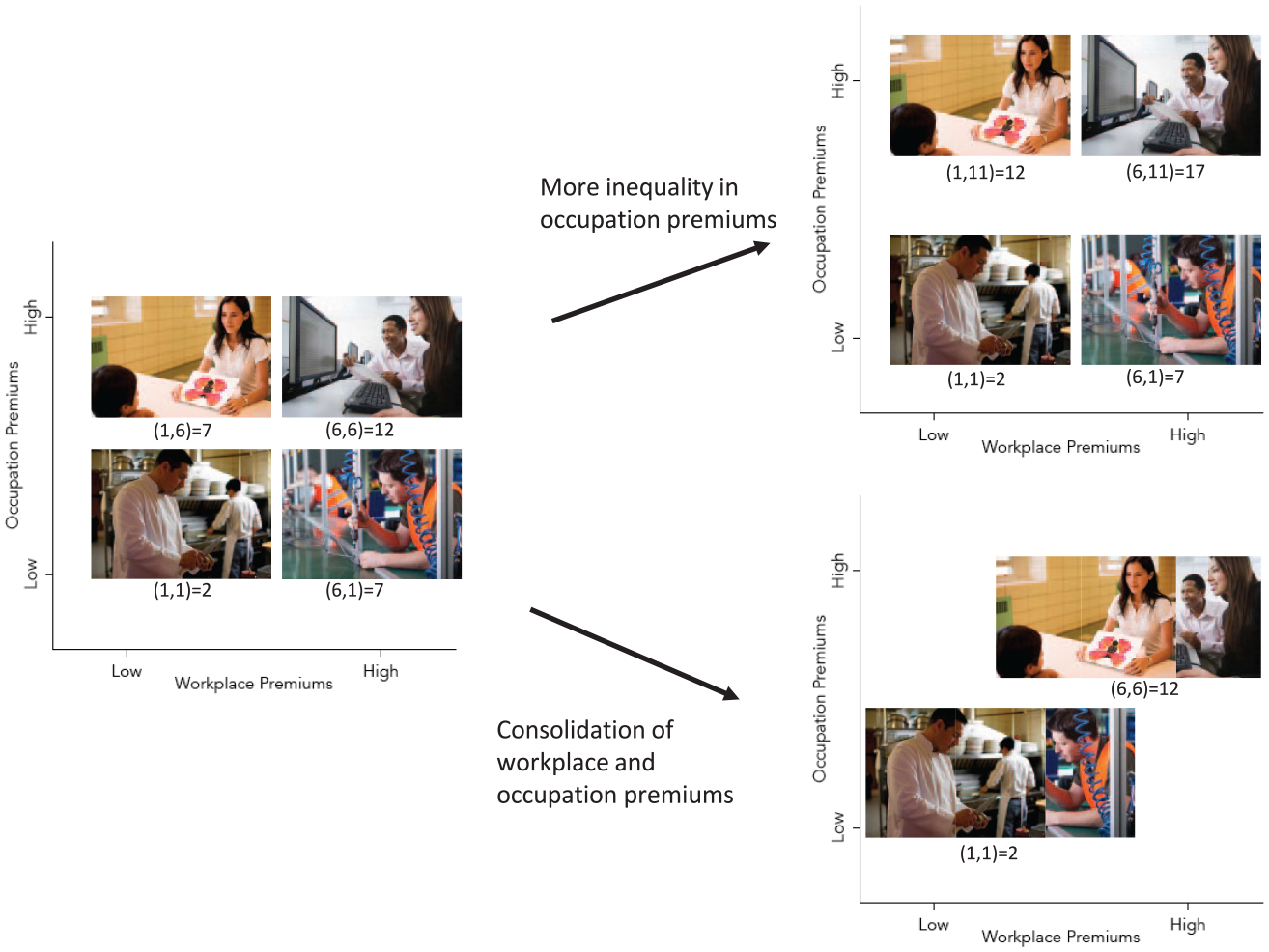
Contrasting Channels of Increased Inequality
Put generally, consolidation increases when more workers are employed in jobs that match premiums: that is, when low-occupation workers are employed at low-premium workplaces or when high-occupation workers are employed at workplaces with high workplace premiums. In contrast, inequality deconsolidates when more workers are employed in mismatched, or off-diagonal, jobs. As noted earlier, these off-diagonal jobs range from high-paying, often-unionized employers of blue-collar workers to low-paying social-service entities employing high-skilled professionals. Likewise, food service and janitorial workers at high-paying corporate headquarters combine high workplace premiums with low occupation premiums. Depending on whether they match or mismatch with occupation premiums, workplace premiums can either offset or exacerbate occupation-based advantages.
Industry Composition, Outsourcing, or New Sources of Premiums?
The contribution of workplace and occupation premiums to inequality thus hinges on their joint relationship. However, an increase in occupation and workplace correlation can come from several distinct types of changes. In addition to distinguishing consolidated advantage from inequality in occupation or workplace premiums, we also ask what drives recent consolidation: industry composition changes and the growth of a polarized service sector; shifting occupations across workplaces; or changing sources of workplace premiums.
Growth of a Polarized Service Sector
The rise of the service sector has meant a polarization of employment opportunities (Kalleberg 2011). Growth in personal services, retail, and restaurant sectors increases employment at establishments with low workplace premiums and low average occupation composition. At the other end of the labor market, high-end services harbor many managerial and professional jobs in high-premium workplaces. The expansion of the finance industry in the wake of deregulation is the most prominent example (Krippner 2011). In these processes, employment shares increase in jobs like the low-paid cook and the high-paid software engineers in Figure 1. When employment grows in these matched low- and high-wage sectors, inequality consolidation increases.
Shifting Occupations across Workplaces
Beyond changes in employment shares by industry, existing workplaces have also become more occupationally homogeneous (Handwerker 2020; Sørensen and Sorenson 2007; Tomaskovic-Devey and Melzer 2020). Companies face pressure to focus on their core competencies, leading them to shed unrelated business lines (Davis, Diekmann, and Tinsley 1994). For example, many corporate headquarters, dominated by managerial and professional employees, have eliminated IT and basic human resources processing jobs (Weil 2014). The result is that high-workplace-premium establishments have increasingly shed technical and clerical employment, while maintaining executives and professionals. Similarly, high-paying firms have contracted out service jobs like janitors, food service, and security guards (Goldschmidt and Schmieder 2017; Ochsenfeld 2018). In these processes, existing workplaces change their occupational structure by excluding peripheral occupations. When rising skill segregation increases occupation-premium by workplace-premium matching, this trend can contribute to consolidated inequality.
At the same time, technological change has led to occupational upgrading in many high-paying production workplaces (Caroli and Van Reenen 2001; Fernandez 2001). If high-workplace-premium establishments that were previously composed of low- and middle-premium occupations (e.g., the manufacturing worker in Figure 1) increasingly shift to hiring engineers and programmers, then consolidation occurs as these workplaces move up in the occupation distribution. In this case, the underlying tasks performed in certain high-paying workplaces have changed. Even absent any outsourcing or contracting, the share of high-premium occupations benefiting from high-premium workplaces could increase.
Together, these occupational change processes all involve shifting occupations across workplaces, whether by carving out low-premium occupations from high-paying workplaces or by upskilling and replacing them with higher-end occupations.
Changed Sources of Workplace Pay Premiums
Just as certain occupations can be removed from workplaces with high pay premiums, high pay can be cut at workplaces with certain types of workers. Specifically, high-paying jobs for workers in low- and middle-premium occupations—those that previously offset consolidated inequality—have faced wage cuts. Previously, blue-collar workers in manufacturing, mining, utilities, and transportation were often able to extract above-market pay. But amid anti-worker policy changes, deunionization, and economic globalization, many of these employers cut their workplace pay premiums. Deregulation and the collapse of union density and wages in interstate trucking provides the starkest example (Viscelli 2016). A combination of policy changes (Alderson and Nielsen 2002; Hacker and Pierson 2010), shifting market power (Wilmers 2018), and employer anti-union campaigns (Bronfenbrenner 2009; Kochan, Katz, and McKersie 1994) eroded the collective bargaining regime that undergirded premiums for blue-collar workers. This confluence of negative pressures has led researchers to generalize about widespread destruction of economic rents for workers in these sectors (Sørensen 2000).
Group-based bargaining is not the only source of off-diagonal, mismatched jobs. Previous research also finds occupational polarization within the “caring economy” (Dwyer 2013). There are two broad explanations for this within-industry polarization. First, barriers to female employment locked high-skill women in low-paying schools, hospitals, and social-service agencies (Duffy 2011; England et al. 2002). Second, when managers and professionals work in low-paid sectors, some sacrifice pay for social impact (Besley and Ghatak 2018). Both of these sources of pay penalties have eroded in recent years. Women have entered male-dominated occupations and firms (Stainback and Tomaskovic-Devey 2012). Likewise, a new emphasis on cost control, monitoring, and rationalization has challenged old logics of care provision and social purpose in healthcare, education, and nonprofits more broadly (Hwang and Powell 2009; Mehta 2013; Reich 2014). Insofar as these changes mean employers can no longer employ cheap, but highly skilled, professionals and managers, it drives bifurcation in the social sector. Some cost-minimizing employers reorganize operations to reduce reliance on expensive professional employees (Galperin 2020). Others will retain those employees but be forced to increase pay premiums to levels consistent with other sectors. The net result of the decline in ascriptive penalties (Busch 2017) and bifurcation in the social sector will be consolidated inequality.
Although these collective action and ascriptive workplace pay differences have declined, pay premiums for top teams of managers and professionals have increased. These “superstar” teams have enjoyed substantial productivity and pay increases over the past two decades (Davis 2016; Lazear 2019; Song et al. 2018). Theorists have attributed these productivity increases to technological change that boosts returns to collaboration in high-skilled teams (Kremer 1993). Moreover, as product markets have grown more integrated, some star firms succeed and pay their workers more than their laggard competitors do (Autor et al. 2020; Dunne et al. 2004). In these theories, firm-based wage premiums result from distinctively productive combinations of highly skilled employees.
However, rising pay for groups of high-skill workers need not stem from high productivity (Weeden and Grusky 2014). For example, one study found that pay-setting in finance depends on hold-up bargaining by key employees (Godechot 2016). Likewise, high pay could reflect not human capital but social capital, consistent with organizational research on team performance (Reagans and Zuckerman 2001). Regardless of the specific reasons for high pay among top professional firms, note that this channel remains distinct from a pure increase in average pay for professional and managerial occupations, which would be reflected in increased inequality in occupation premiums, not in consolidation. For example, insofar as technological change increases overall demand for managers and professionals, this would increase the pay-off to workers in those occupations in general. Instead, the process hypothesized here means that a specific subset of high-occupation workers, employed in high-premium workplaces, have reaped increasing pay over and above the average for their occupation.
Whereas industry composition changes and shifting occupations imply that the sources of workplace premiums are roughly constant over time, the decline of bargaining power, declining identity-related penalties, and the rise of top teams all imply that the very sources of workplace premiums have changed. Determining which of these trends accounts for consolidated advantage is critical to understanding the nature of recent increases in inequality. But, before operationalizing these potential sources of consolidation, we first discuss our data and assess the overall contribution of occupation and workplace consolidation to rising inequality.
Data
We analyze restricted-use microdata from 1999 to 2017 from the Occupational Employment Statistics Survey (OES), collected by the Bureau of Labor Statistics (BLS). The OES is fielded to provide official annual estimates of occupational wages and employment levels (BLS 2008). The OES surveys around 400,000 establishments per year, sampled from the population of private- and public-sector workplaces (70 percent response rate). The survey is administered to employers, managers, and human resource managers. Each respondent is asked to report all occupations employed in their establishment and to indicate the number of employees in each occupation who receive pay in each of 12 pay intervals. The data include no information about individual worker characteristics beyond pay, occupation, and establishment information. The OES is thus useful for studying occupation- and workplace-related pay changes, but we cannot adjust for individual characteristics like education, race, or gender. This data limitation means the occupation and workplace premiums we estimate should be interpreted as broadly summarizing pay effects due to skill, education, and other characteristics correlated with occupation and workplace. We consider this limitation further in the Robustness Tests section.
Despite the lack of worker-level characteristics, we proceed with analysis because the OES is the only source of U.S. wage data that includes both workplace and occupation data. Prior research on occupation premiums has focused on household surveys of workers, which include no workplace information beyond industry and firm size (Mouw and Kalleberg 2010). Research on workplace premiums has drawn on administrative data, which, in the United States, include no occupation identifiers (Barth et al. 2016; Song et al. 2018). These data limitations have prevented simultaneous analysis of trends in occupation and workplace premiums, and by extension have narrowed theory away from considering consolidated inequality. We obtained access to the OES via a data-sharing agreement that made the authors of this article temporary agents of the BLS. While we cannot share these source data publicly, we post the code used in the analysis at https://osf.io/9h35p/.
In the main analysis, we exclude public-sector employers to focus on dynamics in the private sector. The main trends and results are similar when we include public-sector employers (see Figure A.2 and Table A.3 in the online supplement). We also exclude imputed observations, following prior research on inequality trends. We discuss the OES sampling procedure, imputation, and weighting in more detail in Part A.2 of the online supplement. Table A.1 in the supplement summarizes key features of the OES sample that we use in our analysis.
Versions of this survey on occupational employment have been fielded since 1971. But, wage data have only been collected since 1996. Moreover, the first few years of pay data collection used different intervals and different occupation categories (Spletzer and Handwerker 2014). To avoid these changes, we start our analysis with the 1999 survey. This also allows us to use a relatively consistent set of five-digit Standard Occupation Codes (SOC) throughout the analysis.
The OES records wages as a total of base rate pay and supplementary pay, including cost-of-living allowances, tips, production bonuses, incentive pay, piece rates, and commissions. It excludes several types of nonstandard bonuses, like holiday bonuses and stock grants, along with all non-wage benefits and perquisites. Respondents can enter information based on hourly wages or on full-time equivalent annual salary. To reduce respondent burden, the OES survey form collects wage data in 12 pay ranges (see a detail of the OES in Figure A.3 in the online supplement). These range intervals are spaced around .23 log points apart and are adjusted three times during the period we study (see Figure A.4 in the online supplement). To derive single wage values for each observation, we assign midpoints from the bounds of the first 11 intervals, and the conditional expectation of a Pareto distribution for the top code interval. The interval filter in the OES could affect both the estimated overall variance of wages and the decomposition of variance into component parts. Nonetheless, prior research using the OES shows its level and trend in wage variance is similar to that recorded by the Current Population Survey (CPS) (Spletzer and Handwerker 2014). In the Robustness Tests section and Part A.4 of the online supplement, we conduct supplementary analyses with continuous wage employer–employee data from 17 European countries to assess the effect that intervalizing wage data has on wage variance decompositions. We find that estimates from continuous and interval-filtered wage data are remarkably similar.
In Part A.5 of the online supplement, we compare basic one-way variance decomposition results in the OES to those found in other U.S. data. Both between-workplace inequality and between-occupation inequality are increasing in the OES, as they are in the Current Population Survey (for occupation) and the Social Security Administration and Longitudinal Employer-Households Dynamics data (for workplace). In the next section, we ask whether these descriptive trends, showing rising inequality between workplaces and between occupations, persist after controlling for workplace and occupation simultaneously. This simultaneous analysis of workplace and occupation allows us to assess their degree of consolidation.
Inequality Trends by Workplace and by Occupation
In this section, we present our first set of findings, which decompose rising inequality into components due to occupation and workplace premiums and to their consolidation. We use the unique availability of both occupation and workplace codes in the OES to fit a two-way fixed-effects model including both occupation and workplace. We model log earnings lnyj,t of a job j consisting of occupation o located at workplace w at time t as follows:

Here,
After estimating this two-way fixed-effects regression model (Correia 2017), we can decompose the variance in log-earnings in year t as

where variance components include those due to variance in occupation premiums
Figure 2 shows the main results from these models. In the one-way models, both between-workplace and between-occupation variance increase over time (see Figure A.8 in the online supplement), but in the two-way model neither has much net increase over the period. Variance in occupation premiums increases initially and then decreases, and variance in establishment premiums follows the opposite pattern. The residual variance component, a combination of workplace-specific occupation premiums and within-job inequality, does not change over time. Instead, it is the covariance of occupation and workplace premiums that increases sharply from 1999 to 2017. The increase in covariance accounts for almost two-thirds of the total growth in inequality, whereas the small increases in variance in workplace premiums and occupation premiums account for only about 7 and 29 percent, respectively. Figure 3 shows this increase in covariance is due to a rise in correlation between workplace fixed effects and occupation fixed effects, which doubles from .16 to .31 between 1999 and 2017. Workplace and occupation have become increasingly consolidated. 3
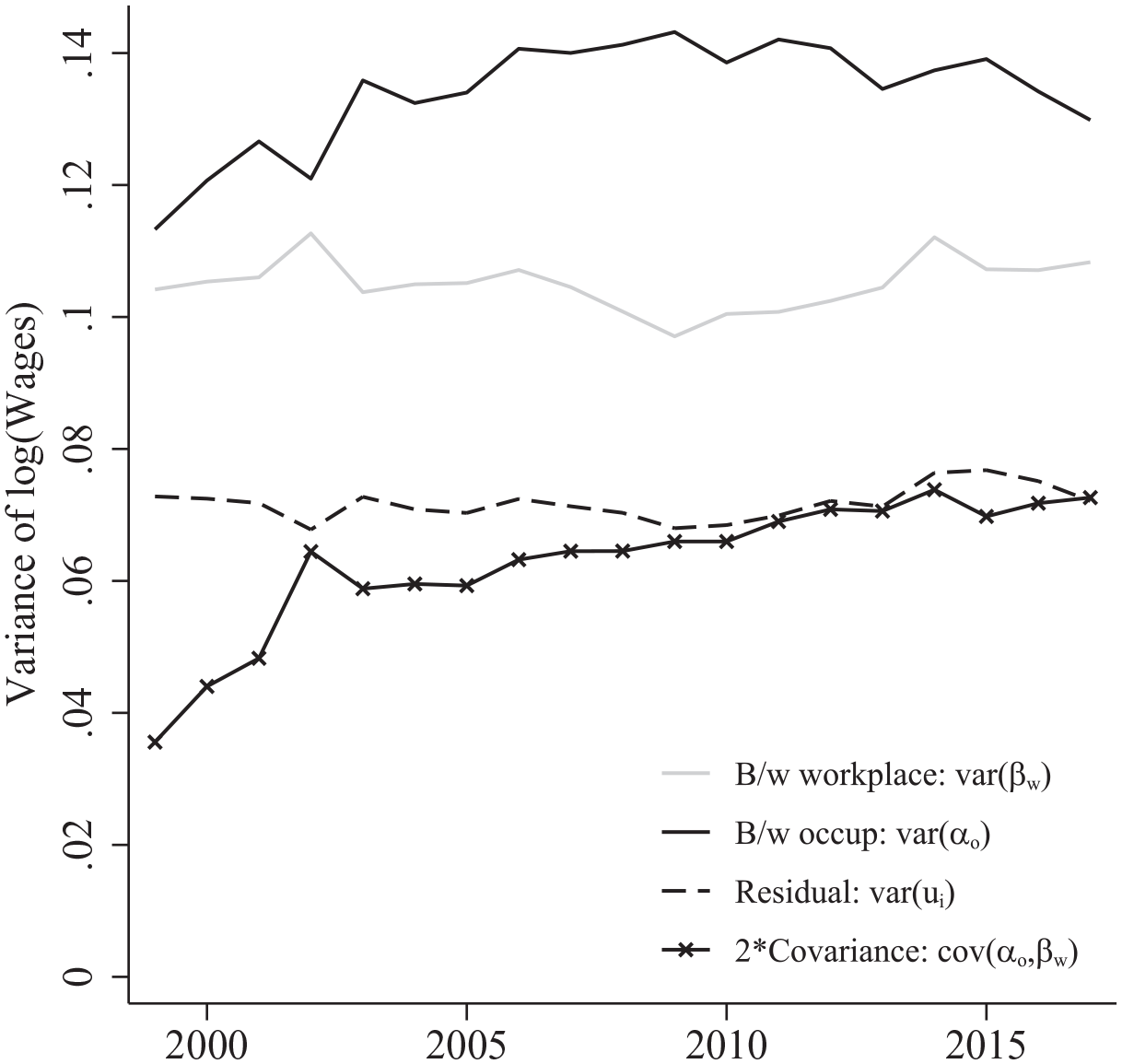
Two-Way Occupation and Workplace Decomposition of Inequality, 1999 to 2017
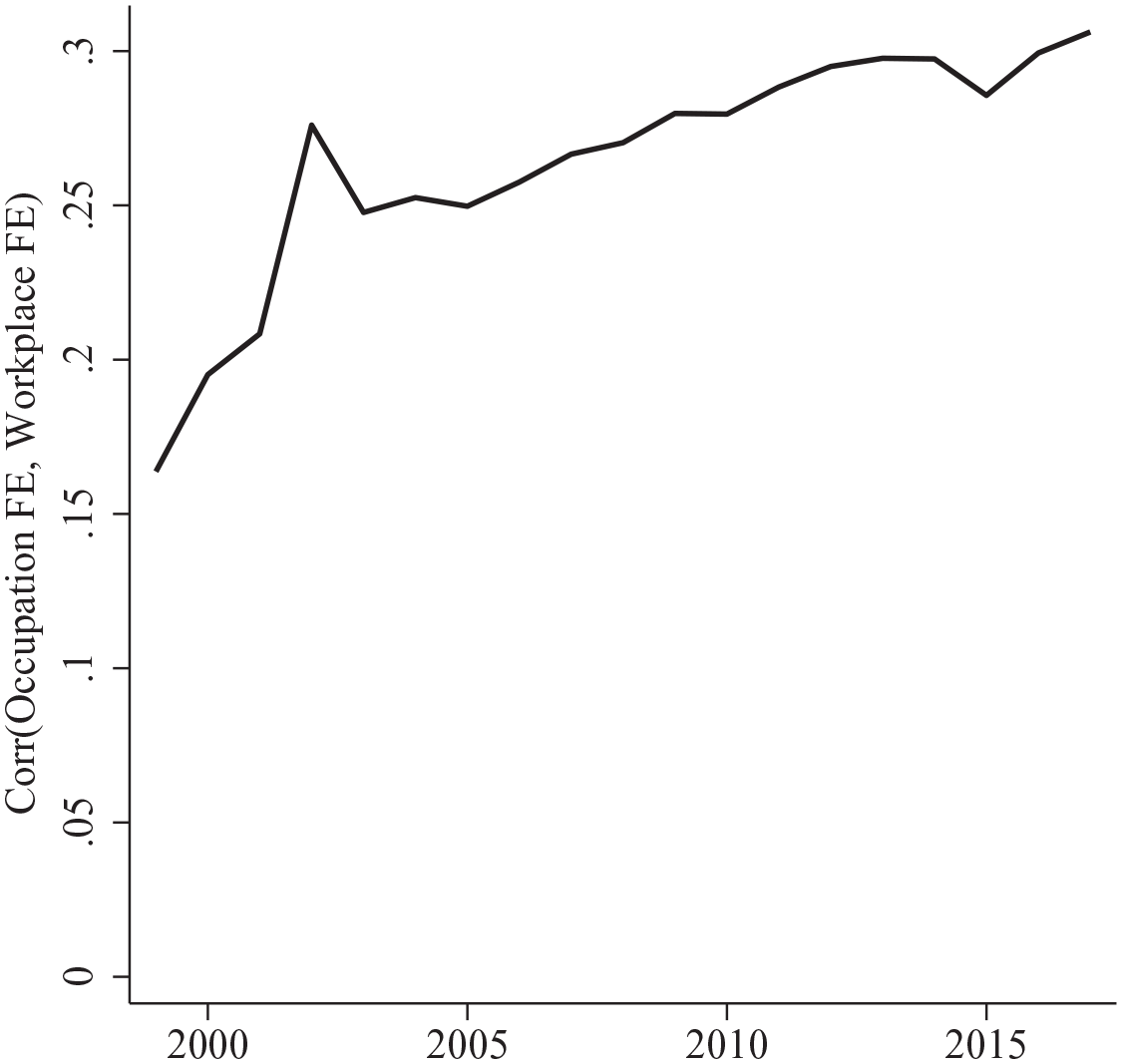
Correlation of Occupation and Workplace Fixed Effects, 1999 to 2017
The two-way variance decomposition demonstrates that the largest driver of rising wage inequality since 1999 is increased covariance between occupation and workplace fixed effects. In other words, the majority of increased wage inequality since 1999 occurs because high-wage workplaces are more likely to employ people in high-wage occupations, and low-wage workplaces are more likely to employ people in low-wage occupations. There are fewer workers in the kinds of off-diagonal jobs discussed earlier, like lower-occupation-premium workers in unionized, high-pay workplaces and higher-skill social-services professionals in gender-segregated and low-paying workplaces. Figure 4 illustrates this trend using the four occupational groups defined in Acemoglu and Autor (2011). Managerial or professional occupations and service occupations, shown in black, have both expanded in the past two decades. However, most of the new managerial and professional jobs have been located in high-premium workplaces (those with premiums in the top third). At the same time, high-premium workplaces employ relatively fewer production, clerical, and technical occupations than they did at the start of the period.
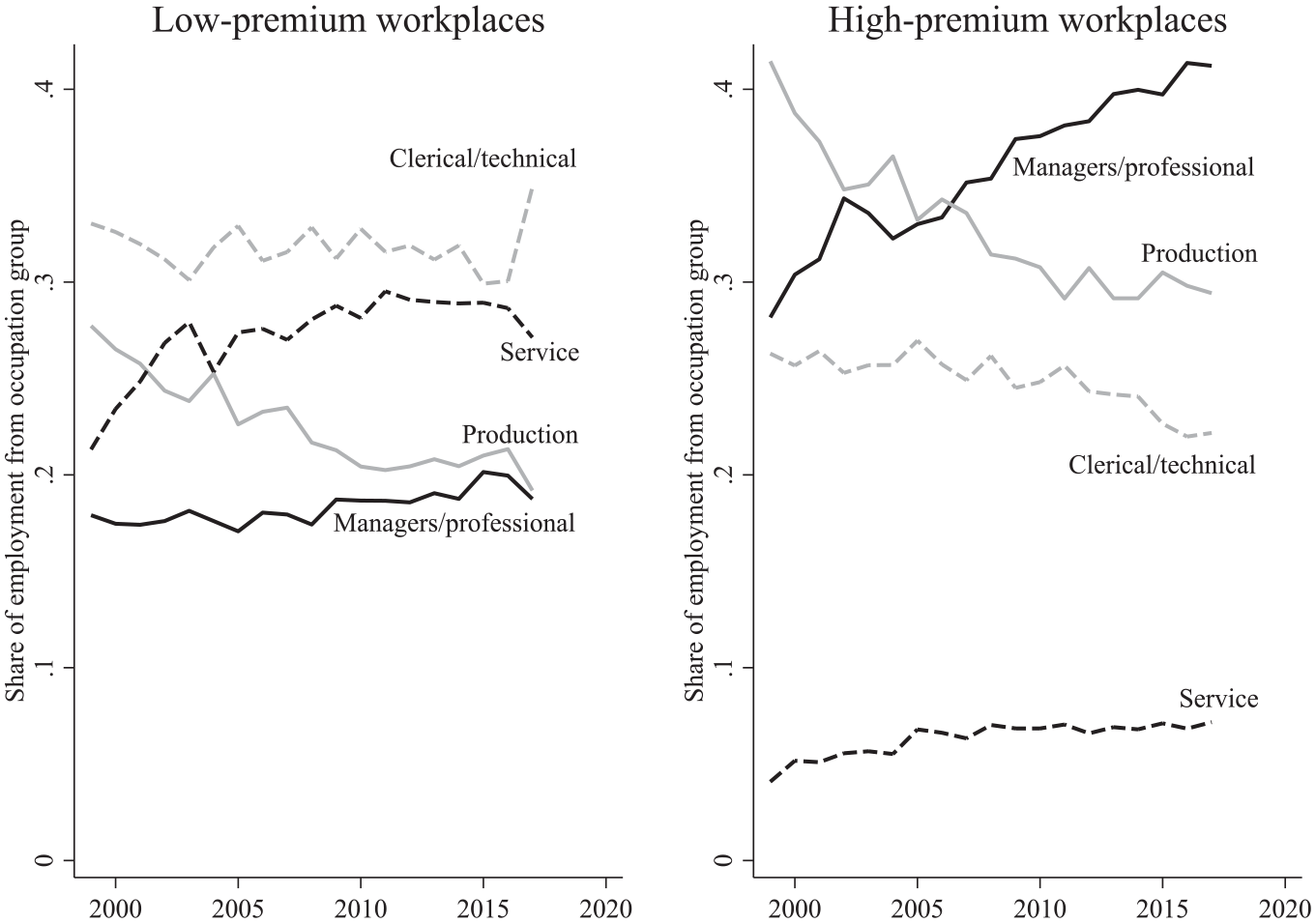
Managerial and Professional Jobs Dominate High-Premium Workplaces
The result is that high-premium establishments are increasingly dominated by managerial and professional employment—already more likely highly paid—and middle-premium occupations make up a smaller share of these workplaces than they used to. Indeed, in 1999, blue-collar production workers were the most common occupations at high-premium workplaces. By 2017, managers and professionals accounted for 40 percent of employment at high-premium workplaces, and production workers had dropped to 30 percent. These changes concentrate high-paid occupations in high-paying workplaces, consolidating inequality. Note, however, that this cross-sectional decomposition reveals little about why consolidated inequality increased during this period. The following section introduces methods to address this question.
Methods to Decompose Inequality Consolidation
So what drives this consolidation between occupation and workplace pay premiums, the core source of recent rises in U.S. wage inequality? To tease apart the sources of change in consolidation, we follow a cohort of establishments that appear in the OES at the beginning and the end of our data. 4 We then ask about the effect on consolidated inequality of various types of workplaces restructuring their occupational composition, growing or shrinking their total employment, or changing their workplace premiums. Using counterfactual analyses that fix particular changes for specific groups of establishments, we isolate the key drivers of consolidated inequality. In the following section, we operationalize specific substantive sources of consolidation, but first we introduce the general approach and descriptive findings here.
Specifically, we decompose the correlation between the workplace premium β
w
and the employment-weighted average
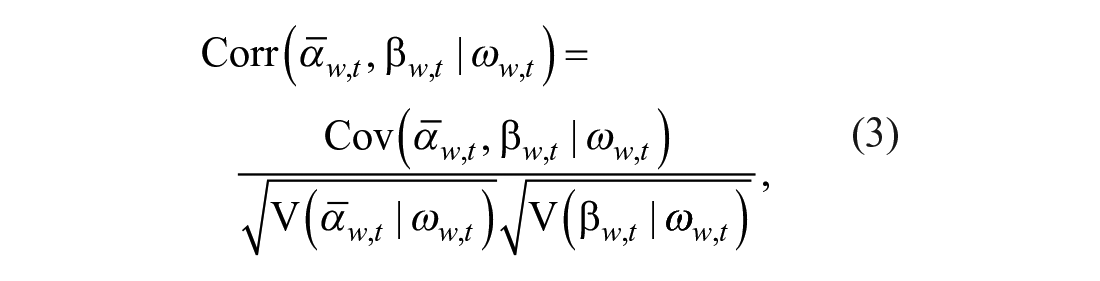
where the normalized weight ω
w,t
, used to calculate the covariance and variance terms, is proportional to the product of the sampling weight of workplace w and the total employment at w.
6
We calculate this correlation for the same set of workplaces at the beginning and end of the period, as t = 0 or t = 1. This equation illustrates how changes in correlation can come from three sources: the mix of occupations within workplaces, captured by
In addition to this decomposition of types of changes, we divide workplaces into different groups according to their starting level of occupation and workplace premiums. We define starting groups of workplaces by crossing three categories from each of the workplace premiums and average occupation premiums. The crossed tertiles define sets of workplaces that track substantive differences in industry and occupation composition. For the cell lowest in workplace pay premiums and in average occupation premiums, the most common industries are accommodation, food service, and retail. These workplaces employ cooks, food service workers, and sales clerks. In contrast, establishments with low average occupation premiums and high workplace premiums commonly employ production, transportation, and administrative support workers. These establishments are typically in manufacturing, warehousing, and transportation industries. Among high-occupation-premium establishments, those with low workplace premiums are predominantly healthcare and social services, professional and technical services, and education. These establishments employ managerial and professional employees like doctors, social workers, and teachers. However, they pay relatively little. In contrast, workplaces in the high-occupation and high-workplace premium cell are in professional and technical industries, healthcare, and finance.
This design allows us to obtain counterfactual correlation trends by reevaluating Equation 3 after fixing within-workplace occupation averages, workplace fixed effects, or workplace weights at their period-0 levels for some subset of establishments. For example, if the highest-paying third of establishments had retained their period-0 workplace fixed effects, then the counterfactual correlation at period 1 is
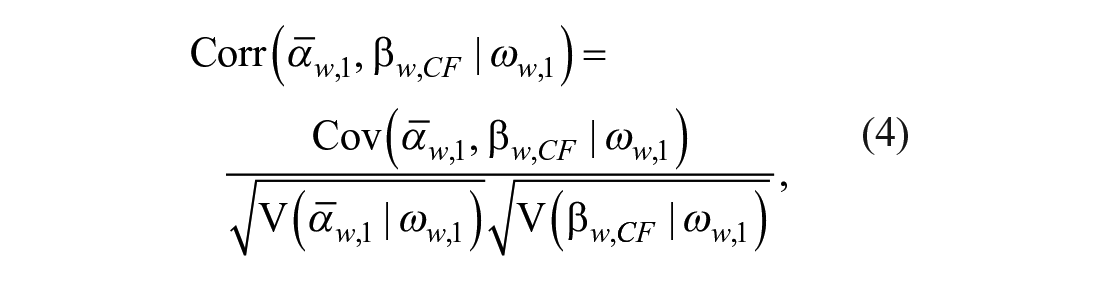
where the counterfactual workplace fixed effects,
Sources of Consolidated Inequality
Possible explanations for inequality consolidation fall into three main groups: compositional polarization of low- and high-end service industries; shifting occupational compositions of certain workplaces; and changes in workplace pay practices within industries. In the framework of Equation 3, these primarily affect correlation through establishment size (ωw,t), establishment occupational composition (reflected in
Broad Channels of Consolidation
Figure 5, panel A, shows how fixing changes in workplace premiums or average occupational premiums, within a given occupation and workplace tertile, affects the overall correlation trend. Within each cell, the top (bottom) number indicates the change in the correlation trend if no establishments in that cell had increased (decreased) their average occupational composition. The left (right) number indicates the counterfactual change if no establishments had reduced (increased) their workplace premiums. Panel B shows how preventing establishments in that cell from growing (top) or shrinking (bottom) would affect the total change in correlation. These counterfactuals allow us to locate the effect of these changes in different parts of the joint distribution of workplaces and occupations. For example, premium changes in workplaces with low establishment premiums and high occupational averages (top left of panel A) are important. If we prevent these establishments from increasing workplace premiums or from decreasing average occupational premiums, we reduce the total correlation increase of .103 by .022 and .023, respectively.
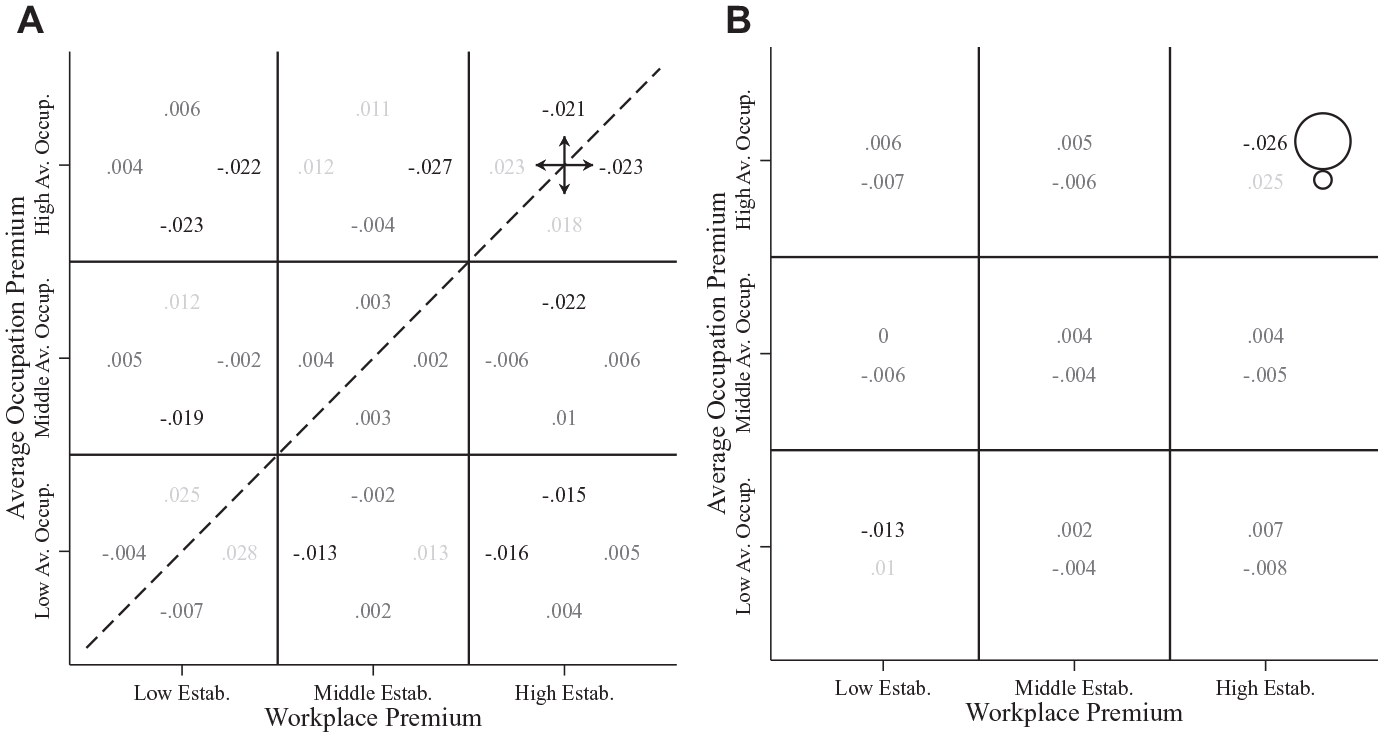
Panel Correlation Descriptive Counterfactuals
Some key changes also occur in the top-right cell, which contains workplaces that begin in the highest third of workplace premiums and the highest third of average occupation premiums. By counterfactually blocking workplaces in this cell from increasing their establishment premiums, we reduce the total correlation growth by .023 points. Finally, establishments with low and medium occupation averages and high workplace premiums (the off-diagonal bottom-left cell) are also influential. Preventing high-workplace-premium and low-occupation establishments from reducing workplace premiums decreases correlation growth by .016 points.
In addition to fixing workplace and occupation premiums, we can also restrict changes in employment across establishments. Each cell of panel B in Figure 5 shows how preventing establishments in that cell from growing (above) or shrinking (below) would affect the total change in correlation. Again, the top-right cell is important: keeping establishments in this cell from growing limits the total increase in correlation by .026. Preventing establishments in the bottom-left cell—those with low establishment premiums and low occupational averages—from growing restrains the increase in total correlation by .013. These two counterfactuals indicate that, as on-diagonal, matching premium workplaces grew in size, they contributed to the growth in total correlation.
More broadly, Figure 5 reveals important patterns in the influence of different changes over the correlation trend. Correlation increases as workplaces move away from mismatched areas—like low workplace premiums coupled with high average occupation premiums—and toward the dashed diagonal line running from the lower-left to the upper-right of the figure. Changes in occupation (workplace) premiums are influential when their workplace (occupation) premium is already extreme. This follows from our multiplicative correlation measure of inequality consolidation: a change multiplied by an extreme value will be magnified, whereas one paired with a value near the mean will be muted. Substantively, this means changes in the corner regions are important. For establishments with occupation premiums near the mean, but high or low workplace premiums, changes in occupation composition will be influential. For establishments with middling workplace premiums, but extreme occupational compositions, changes in workplace premiums become particularly influential.
Specific Channels of Consolidation
The counterfactuals in Figure 5 reveal the broad patterns of workplace premium and occupational reorganization driving consolidated inequality, but they are limited. First, they are difficult to interpret without knowing exactly which industries and which occupations are changing. Second, they only fix channels of correlation within one occupation–workplace cell at a time. Some theories of consolidated inequality imply multiple simultaneous changes. For example, in outsourcing, low-premium workplaces in catering, building services, and security increase their share of low-skilled occupations while high-premium workplaces reduce their employment of such workers. So, we next test the specific channels of inequality consolidation theorized above. Table 1 summarizes the operationalization of these specific channels, which we discuss in turn.
Operationalizing Channels of Consolidation between Workplace and Occupation Premiums
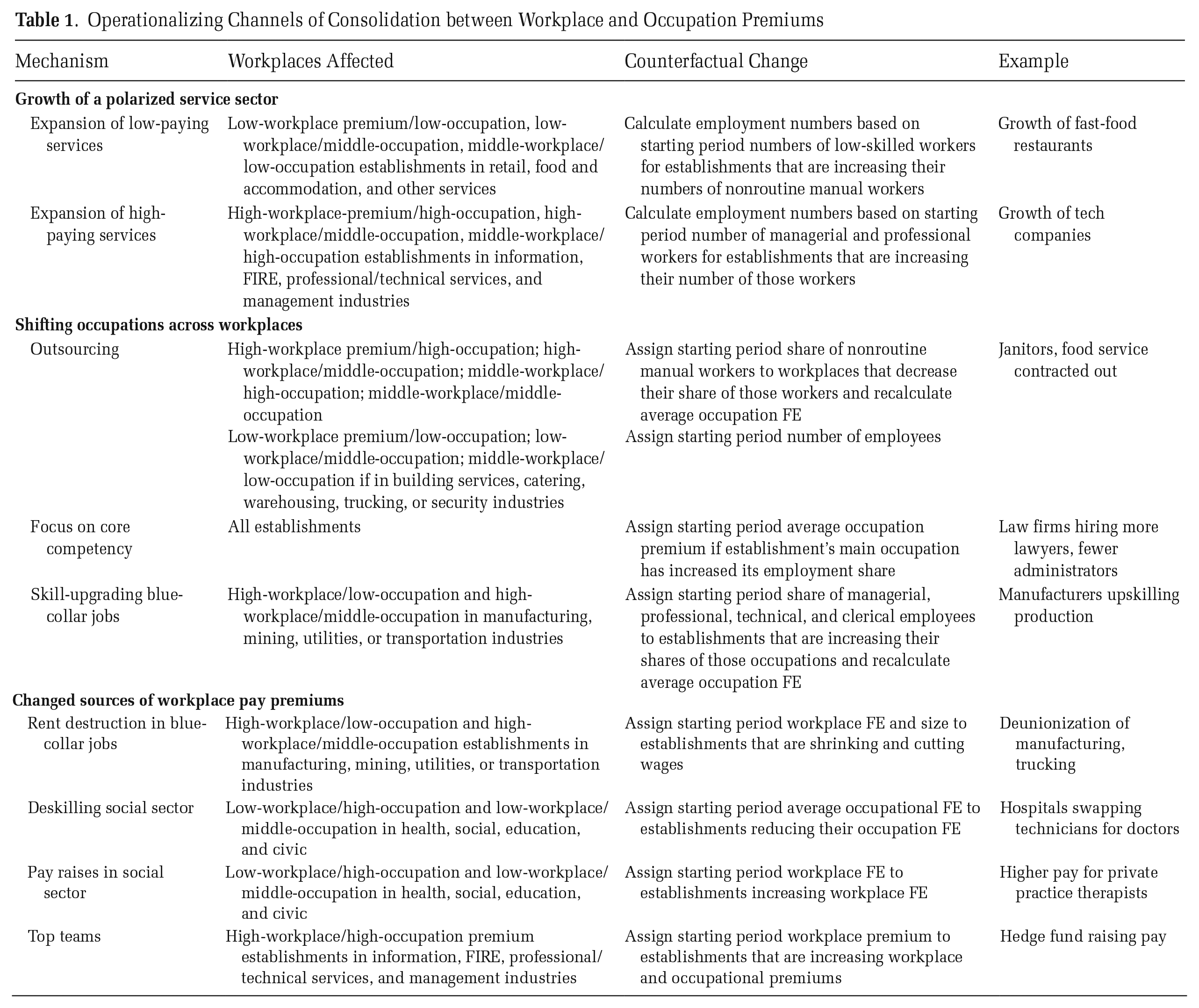
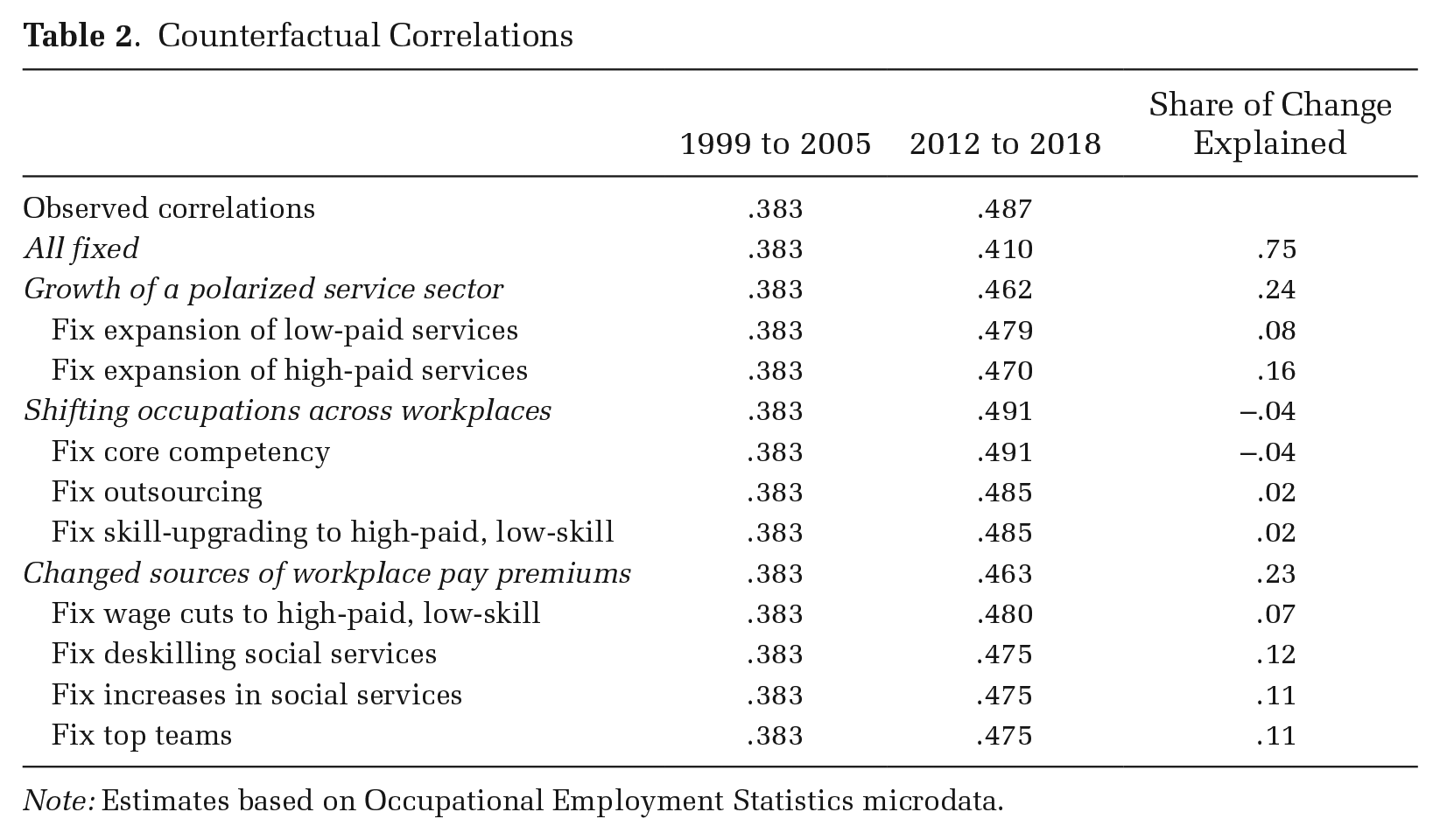
Table 2 shows counterfactual correlation trends in the establishment panel observations, in which each of these key, specific channels of consolidation are blocked. The panel sample starts with a correlation between workplace premiums and workplace-level average occupation premiums of .38 in the first period (1999 to 2005) and increases to .49 by the second period (2012 to 2017). This increase is comparable to that observed in the full sample, averaging across the beginning and ending periods. Fixing all of the proposed explanations accounts for around 75 percent of the .10 increase in correlation. As expected, these processes together account for the bulk of the consolidated inequality trend. But which processes matter most?
Counterfactual Correlations
Note: Estimates based on Occupational Employment Statistics microdata.
Industry Composition and Growth of a Polarized Service Sector
First, we consider shifting industry composition. We operationalize the expansion of service establishments by fixing workplace sizes (Kalleberg 2011). On the low-wage side, this means robust job-growth sectors that combine low workplace premiums with high shares of low-occupation-premium workers. On the high-pay side, the expansion of high-end services has generated more high-workplace-premium professional jobs. Firms in finance, technology, information, and professional services have all expanded. Both of these trends in industrial composition have increased the number of jobs at firms with similar occupational premiums and workplace premiums, whether at the bottom or top of the earnings distribution. To calculate a counterfactual correlation in which there was no growth in low-paid services, we reweight poorly-paying food, accommodation, retail, and service-sector workplaces to reflect the number of nonroutine manual workers employed in the starting period. Similarly, we reweight well-paying workplaces in the information, FIRE, professional services, and management sectors to restrain their employment from increasing due to rising numbers of managerial and professional employees.
Table 2 indicates that fixing the low-skill employment growth in low-paying establishments in retail, food, and personal services industries accounts for 8 percent of increased correlation. Fixing high-skill employment growth of managers and professionals at high-occupation-premium and high-workplace-premium establishments in information, FIRE, professional and technical services, and management reduces correlation by 16 percent. Together, the rise of these high- and low-paying services account for around a quarter of the increase in correlation during this period. Note that it is primarily the expansion of the high-end service establishments that contributes to rising correlation. This is consistent with the broad decomposition results reported earlier.
Shifting Occupations across Workplaces
Second, the uneven employment growth involved in the expansion of polarized services would affect workplaces or industries uniformly, but inequality consolidation may also stem from changing occupational composition within workplaces. In Equation 3, changes in workplace occupational composition affect the average occupation premium,
Alongside outsourcing, there has also been a broader strategic shift toward firms’ core competencies, over and above the outsourcing of low-skill workers (Davis et al. 1994; Weil 2014). For example, a law firm hiring more lawyers and fewer administrators or payroll managers could also contribute to inequality consolidation. To capture this shift toward organizational specialization, we counterfactually retain each establishment’s average occupational premium from the first period if that establishment’s modal occupation increases in share. Results in Table 2 show that fixing average occupation premiums for these workplaces actually offsets slightly the increase in correlation. This result indicates that the general shift toward workplace occupational homogeneity documented previously (Handwerker 2020) does not necessarily also increase the correlation between workplace and occupation premiums. For example, if a high-paying workplace that employs mainly low-premium occupations moves toward occupational homogeneity by reducing managerial and professional employees, specialization actually reduces correlation between occupation and workplace premiums.
Beyond outsourcing and a focus on core competencies, many high-paying employers of low-skill workers have upskilled their production jobs (Caroli and Van Reenen 2001; Fernandez 2001). This form of “upskilling” can be counterfactually fixed by keeping the fraction of white-collar managerial, professional, technical, and clerical employees in high-workplace-premium establishments in the manufacturing, mining, utilities, and transportation sectors. As with outsourcing and core competencies, little of the correlation increase is accounted for by fixing the low-occupation-premium and high-workplace-premium establishments that are upskilling by shifting toward more technicians, professionals, and managers. These changes represent an important trend in their industries, but they have little effect on the overall trend toward consolidated inequality.
Changed Sources of Workplace Pay Premiums
Finally, aside from differential employment growth and shifting occupational composition across high- and low-paying workplaces, the bases for workplace pay premiums can change (Cappelli 1999; Davis 2016; Sørensen 2000). First, consider blue-collar employers in the manufacturing, mining, utilities, and transportation sectors that start the period with high workplace premiums and low- or middle-occupation premiums. If these establishments reduce their workplace pay premiums, then consolidated inequality will increase. These beleaguered workplaces could include unionized heavy industry facing increased international competition, or airlines forced by new, non-union competitors to lower labor costs. To simulate a counterfactual without such blue-collar rent destruction, we retain the first-period workplace premiums and sizes for high-workplace-premium establishments in the manufacturing, mining, utilities, and transportation sectors that shrink and cut wages. Table 2 shows that workplace premium cuts at these workplaces account for 7 percent of the increase in consolidated inequality during this period.
Second, we adjust for social-services bifurcation, which reduces the share of low-workplace-premium jobs for high-occupation workers. To estimate a counterfactual correlation in which social-sector deskilling did not occur, we assign the starting-period occupational average to low-premium establishments in the health, social, educational, and civic industries. To counterfactually restrain the development of the highly-paid part of the social sector, we assign the starting-period workplace premium to workplaces whose premiums increase.
On the up-market side of social-services bifurcation, we fix workplace premiums for the subset of these establishments that are increasing their employment of managers and professionals. Insofar as these up-market workplaces increase pay premiums for their increasingly well-paid occupational mixes, this drives consolidated inequality. Indeed, fixing the pay changes at these workplaces accounts for 11 percent of the increase over this period, rivaling the effect of rising pay at top team high-workplace-premium and high-occupation-premium establishments.
The down-market side of bifurcation involves lowering average occupation composition. These workplaces may substitute teacher aides for teachers, nursing assistants for nurses and doctors, and mental health workers for psychiatrists. We fix the occupation premiums associated with these relatively low-paying workplaces that are reducing their average occupation premiums. Table 2 shows that this reduced average occupation premiums channel alone explains 12 percent of the change.
Finally, as workplace pay premiums increase at establishments that start with high-workplace pay premiums and high shares of high-premium occupations, consolidated inequality increases. We fix the growing pay-offs to top teams in the information, FIRE, professional, and managerial sectors by retaining the starting-period workplace premium for high-workplace- and occupation-premium establishments whose workplace and average occupational premiums increase. In other words, for workplaces that start the period with both high workplace premiums and high shares of managerial and professional employees, we prevent workplace premiums from rising further. The counterfactual shows these rising premiums at the top account for around 10 percent of the change during the period.
Taken together, these descriptive counterfactuals suggest changing bases of workplace pay premiums have contributed to inequality consolidation. The decline of collective premiums for blue-collar workers and collective penalties for service-sector professionals has occurred amid rising workplace premiums for some teams of professionals and managers. Consistent with the latter, the most important composition change comes from the employment expansion of high-premium and high-occupation workplaces. In contrast, shifting occupations across workplaces explains relatively little of the inequality consolidation trend.
Robustness Tests
In additional analyses, we consider a series of potential objections to our core set of findings: (1) correlation between occupation and workplace premiums is increasing; (2) this rising correlation contributes to rising wage inequality; and (3) specific organizational mechanisms that drive rising correlation account for increased consolidated inequality. We summarize the tests here but provide more detail in the online supplement.
Robustness of Trend in Consolidation
As discussed earlier, the OES data provide a unique opportunity to study the joint U.S. occupation and workplace distributions. However, the OES data contain only intervaled, not continuous, wage information. We assess the robustness of the increasing trend in correlation using these intervaled data in several ways.
First, as outlined in Part A.3 of the online supplement, we try alternative approaches to identifying the midpoints of the intervaled wage data. In the main results presented earlier, the outcome variable consists of midpoints of the logged bounds for the first 11 intervals, and the conditional expectation of a Pareto distribution in the top interval. We test the robustness of the main results, first, by using a quantity estimated by the BLS to capture the average wage within each interval in a given state and industry. Second, we fit a left-truncated normal distribution across all 12 wage intervals for each year, and create an outcome equal to the conditional mean of the distribution within each interval. The resulting correlation trends are very close to that estimated from the midpoint-Pareto approach.
Next, to compare these midpoint-based results to estimates based on continuous wage information, we draw on additional data beyond the OES. First, we use European linked employer–employee data from the Structure of Earnings Survey (SES) data (discussed in more detail in Part A.4 of the online supplement). By imposing an interval filter on those data, and identifying midpoints with the strategies noted above, we can compare correlation trends derived from intervaled and continuous versions of the same data. Estimated correlations between occupation premiums and workplace premiums are strikingly similar between the intervaled and continuous estimates. Second, we use three U.S. household surveys of workers to estimate the correlation between occupation premiums and premiums attributed to industry by state groups. These household surveys include continuous wage and earnings information, but they do not include workplace information. Even substituting workplace for the industry by state groups, all three survey sources show increased correlation with occupation premiums over time. Together, these results from alternative data sources increase our confidence that, despite the survey’s quirks, the OES trend results are reliable.
Finally, the OES displays a very sharp increase in inequality (and covariance) between 1999 and 2003. During this period there was a change in how the OES coded managers (Abraham and Spletzer 2010) and potentially other undocumented changes. If we exclude these early years, and just consider the contribution of rising covariance to the inequality trend from 2004 to 2017, the increase in inequality was smaller and noisier. However, the increase in correlation holds steady during this later period, and the portion of inequality explained by rising covariance is very similar to the full period, at between two thirds and four fifths. Starting in 2002, as in Handwerker (2020), gives an initial sharp decline in covariance (from the 2002 peak) but a subsequently similar trend of increased covariance that accounts for between a third and a half of the increase in inequality.
Robustness of Consolidation as an Explanation for Increased Wage Inequality
These tests raise confidence that the correlation between occupation and workplace premiums is rising. But does that trend account for increasing wage inequality during this period?
The main limitation of the OES data is that they include no information on observable worker characteristics. This means we cannot distinguish our estimated occupation and workplace premiums (and their correlation) from shifting worker composition. On the occupation side, this primarily affects our interpretation of the premiums: clearly, the premium we attribute to managers relative to production workers includes the compositional fact that managers tend to be more experienced and more highly educated than production workers. On the workplace side, unmeasured worker composition is more concerning. What looks like increased positive matching between occupations and workplaces may just be a reshuffling of workers with the highest human capital in each occupation into the same workplaces. Note that this process is similar to that hypothesized in the top teams theory tested earlier: our argument does not presuppose that workplace premiums are unrelated to worker composition. Nonetheless, the strongest version of this objection—that individual worker characteristics account for an apparent workplace premium—would make our interpretation of wage premiums as “workplace” premiums misleading.
Unfortunately, no U.S. data include both occupation and workplace information along with observable worker characteristics. As such, we turn again to the European SES data, described in Part A.4 of the online supplement. Using these data, we compare two models. The first fits occupation and workplace fixed effects, as in our main analysis of the OES data. The second model adds controls for educational attainment, age, and gender. Table A.2 in the online supplement compares the resulting covariance between occupation and workplace premiums with and without controls for observable characteristics. The differences in the covariance trends with and without controls are very small. None of the 16 countries have more than a .01 log-point difference in covariance between the baseline and observable controls models. However, the vast majority of these countries see much smaller changes in covariance than we observe in the U.S. data—consistent with smaller increases in wage inequality in Europe during this period. The countries with the largest increases in covariance are also the countries with estimates most affected by the observable controls. Cyprus has a very similar covariance trajectory to the United States (from .02 to .05; United States .03 to .06), and adding controls for observables reduces covariance growth by 15 percent. Other countries with covariance increases, like Hungary, Lithuania, and Bulgaria, see covariance growth reduced by 10 to 40 percent. Based on these estimates, we think a lower bound for the U.S. covariance contribution is 35 percent of increased inequality explained. This lower bound is substantially lower than the two-thirds estimate given in our main analysis, but it remains a substantial portion of rising inequality.
Another objection to our analysis is that we focus on occupation pay premiums and workplace pay premiums without distinguishing between workplace and industry or broad skill groups and micro-classes. Different theories of workplace and occupation premiums begin from these broader or narrower categories. Further partitioning variance trends in pay premiums allows us to check whether offsetting changes at higher and lower levels of analysis mask important shifts in inequality. We separate the workplace fixed effect, β
w,t
, into an industry average—defined at the two-digit NAICS level for each year t—and a workplace residual term. Similarly, we aggregate the occupations into four broad skill groups each year and average the occupation fixed effects, αo,t, within each group.
7
This procedure allows us to decompose the variance in occupation premiums
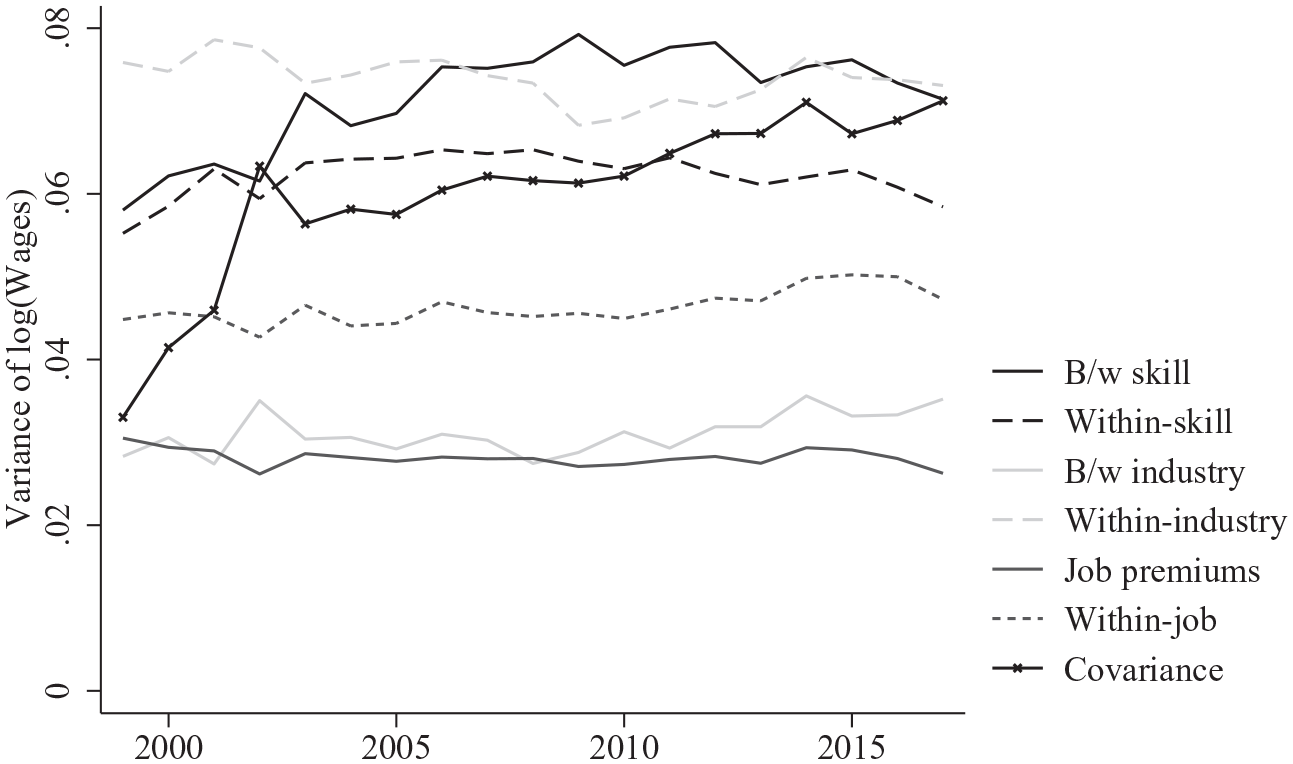
Detailed Decomposition of Inequality, 1999 to 2017
Figure 6 shows that the largest share of variance occurs between workplace premiums within two-digit NAICS industry; the variance between sectors is half the size. Yet, both of these components hardly increase over time. Occupation, on the other hand, exhibits the reverse trend: the four broad skill groups explain more of earnings variance than do the residual occupation premiums. The between-skill component increases from 2000 to 2010, but it decreases afterward. The within-skill-group variability in detailed occupation premiums is smaller and exhibits little rise in inequality, contrary to theories of inequality focused on idiosyncratic occupational institutions (Weeden 2002). Thus, even decomposing variance across these detailed categories, the rising covariance between occupation and workplace premiums stands out as the key driver of recent increases in wage inequality.
Finally, we study between-group pay premiums and their covariance, but a substantial line of research focuses on residual within-organization inequality, defined by shifting distribution of resources across work groups or job titles within a workplace or by within-job inequality (Baron and Bielby 1980; Tilly 1998; Wilmers 2020). To address these theories, we divide the residual component of the two-way fixed-effects model into within-job (occupation by workplace) and job-specific premiums. Figure 6 shows that neither within-job variance nor the idiosyncratic variation in occupations across workplaces (job premiums) account for a substantial portion of increased inequality during this period. Job premiums actually diminish during this period. Job premiums include, for example, idiosyncratic higher pay for a manager who exploits his production workers by paying them less than is typical for their occupation. Within-job inequality actually increases slightly during this period, perhaps consistent with the rising prevalence of merit-based and individualized pay systems (Lemieux, MacLeod, and Parent 2009). However, within-job inequality accounts for less than a tenth of the total rise in inequality during this period. This result challenges approaches that attribute rising overall inequality to increased residual inequality among workers in the same job or among workers in the same workplace.
Robustness of Mechanisms of Consolidated Inequality
Finally, we consider objections to the mechanisms we identify as drivers of consolidated inequality. In the panel analysis we focus on organizational changes to occupation composition, workplace pay premiums, and employment levels among establishments that exist throughout the period of analysis. This approach follows from our general theory that organizational changes are driving up correlation. However, it is possible that correlation has increased due to shifting patterns of workplace composition via entry and exit. For example, new entrants could be less matched between occupation and workplace premiums, and new entrants have been declining during this period (Decker et al. 2016). Such a pattern would parallel recent findings that workplaces have grown increasingly racially segregated due to the formation of newer, more racially homogeneous workplaces (Ferguson and Koning 2018). Yet Panel A of Figure A.10 in the online supplement shows that correlation grows very similarly among workplaces newly entering the OES and workplaces that reappear multiple times. The rise in correlation, therefore, is not due only to entering and exiting establishments. Of course, it is still possible that establishment turnover plays some supplementary role in the trend. We discuss this possibility further in the next section.
Another issue in the main analysis is that we fix channels of consolidated inequality as if each channel is independent and causally unrelated to other sources of consolidation. However, shifts in supply and demand within labor markets are often interdependent. Our most novel source of inequality consolidation—reduced managerial and professional employees in low-paying workplaces in the social-services sector—is particularly vulnerable to this kind of interdependent effect. If high-workplace-premium employers are growing, upskilling, or raising pay for workers in high-pay-premium occupations, this increased demand may siphon those workers out of low-workplace-premium employers. In this case, low-workplace-premium employers in the social sector would still be observed to reduce their average occupation premiums, substituting lower-occupation-premium jobs for increasingly expensive professional and managerial workers. However, these off-diagonal changes would only be a conduit, and not an originator of consolidated inequality.
To test this alternative explanation, we set up a descriptive regression model predicting reductions in occupation premiums in the social-services sector among establishments that begin the period with low workplace premiums and high average occupation premiums. Table A.4 in the online supplement displays the results. Model 1 shows that the establishments more likely to reduce occupation composition begin with both higher shares of high-paid occupations and larger workplace fixed effects. They are also smaller and growing during the period. As such, these workplaces are not simply losing business and routinizing as a last cost-cutting resort prior to bankruptcy. This downward shift in occupational composition occurs among growing establishments. Finally, Model 3 assesses whether these dynamics are driven by changes in the cell of high-workplace-pay premium and high-occupation-pay premium establishments competing for employees with the low-paying workplaces modeled here. To do so, we define variables measuring the average change in occupation premiums, workplace premiums, and employment levels among the high-workplace- and occupation-premium establishments in the same commuting zones as low-pay social-sector establishments. The results show, contrary to the possibility proposed above, that increasing pay, upskilling, and growth in the high-paid segment of the labor market make reductions in occupation composition less likely, if anything. This result provides more evidence that bifurcation in the off-diagonal, social-services sector of the labor market is an independent contributor to consolidated inequality.
In Part A.8 of the online supplement, we consider additional issues with the panel counterfactual analysis—industry representativeness, the shift in unit of analysis from job to establishment, a rapid correlation increase in the early period, and industry and commuting zone effects—and we show that a reweighting exercise on industry and skill level in the repeated cross-sectional data gives comparable results to the analogous portion of the panel analysis.
Discussion
We find that an increasing correlation between occupation and workplace premiums accounts for two-thirds of the increase in wage inequality since 1999. This result clarifies prior research on worker sorting across firms (Song et al. 2018). Increased assortative matching is not just worker-ability sorting occurring within occupation categories. Instead, the increasing correlation between workplace and worker is reflected in shifts in occupation composition and workplace wage premiums across establishments.
We then identify a series of organizational changes that could drive increased consolidation between potentially independent bases of pay premiums. Using descriptive counterfactuals and comparing a panel of establishments present in both the early 2000s and late 2010s, we find evidence that the sources of workplace pay premiums have changed over time. Low-workplace-premium, high-occupation-composition social-sector establishments are either shifting to low-paid jobs or maintaining large shares of high-premium occupations and increasing their establishment pay premiums. The result is a bifurcation that reduces the number of middle-wage, high-occupation, and low-paying jobs. Rising pay for top teams and expansion of high-paying services also explain substantial portions of the rise in correlation. Pay cuts by employers of previously highly-paid blue-collar workers play a supplementary role. In contrast, the occupational composition changes associated with shifting to core competencies, outsourcing, and upskilling of blue-collar work explain little of the increased correlation.
We also uncover several general dynamics of consolidated labor market inequality. Much analysis of wage dynamics focuses on industries in which occupation and workplace premiums match—for example, expansion of low-paying service jobs, which harbor low workplace and low occupation premiums, or increasing pay at high-workplace-premium professional services firms. But subtler organizational dynamics reducing shares of off-diagonal, mismatched jobs have also consolidated workplace and occupation-based inequalities. When low-workplace-premium health-services organizations corporatize (Reich 2014), they may lose the job amenity and meaning that previously allowed them to attract high-premium professionals despite low pay. Similarly, wage cuts at high-workplace-premium, but blue-collar, jobs in manufacturing and transportation can follow from deunionization, deregulation, or intensified product market competition. Both of these changes increase consolidated inequality.
We also find that, in studying panel changes in the correlation between wage premiums, the pay premium changes most influential on the overall trend are those that occur alongside already-extreme values. For example, consider establishments with workplace premiums near the mean that employ mainly high-occupation workers. For these establishments, decreases in the workplace premium will do more to offset consolidated inequality than will a similar-magnitude deskilling of the occupational composition of the workplace. The workplace premium change is leveraged up by the starting occupation composition of the establishment. Considering the inequality-increasing channel of correlation between distinct bases of pay premiums thus draws attention to types of jobs and organizational changes that have not been central to prior inequality research.
These contributions should, however, be interpreted in the context of limitations imposed by our data. First, the top-codes in the OES prevent analysis of inequality at the very top of the distribution. Nonetheless, despite recent interest in top earners, our data do capture the vast bulk of workers and earnings. Second, we do not analyze pre-1999 OES data, to avoid large changes in occupation categories and wage interval design prior to that year (discussed in Part A.2 of the online supplement). The recency of our data prevents comparison with a period in which correlation did not increase. As such, it is difficult to distinguish establishment age from period and cohort in our panel analysis. If establishments shift occupational composition and workplace wage premiums as they age, and do so nonlinearly across the establishment life course, this could affect the interpretation of our panel decomposition. For example, if low-paying establishments increasingly routinize and replace high-skill employees as they age, we might wrongly attribute off-diagonal age-based occupation composition reductions to changes between the beginning and end of the period. The similarity in correlation trends between the panel and non-panel OES samples mitigates our concern about this (discussed in Part A.8 of the online supplement). Still, future research should explore other data sources, including industry case studies, that allow age and period effects to be distinguished.
Third, we focus our investigation of channels of consolidated inequality on organizational changes. This approach is borne out in our data: the correlation increase among stayer establishments is nearly identical to the trend in the full sample of establishments. Given the low rate of establishment entry and exit during this period, and the striking within-organization changes we observe, our focus on organizational changes is well-justified. However, the OES does not allow direct analysis of establishment entry and exit. We cannot distinguish in the data between establishments that exit the survey sample and establishments that exit the economy entirely. Future research with alternative data sources should consider how establishment turnover could offset or exacerbate the core dynamics observed among stayer establishments.
A final limitation of the project is that we do not observe individual workers in the data, so we cannot adjust our wage models for individual characteristics like race, gender, age, or education. Prior research finds that these characteristics are correlated with both occupation and workplace premiums, but that both occupation and workplace matter for earnings even when controlling for these characteristics (Barth et al. 2016; Mouw and Kalleberg 2010). We interpret our results as descriptive of trends, rather than pinning down precise estimates of occupation and workplace pay premiums. Moreover, in robustness tests with European linked employer–employee data, we find that increases in occupation and workplace covariance persist with controls for observable characteristics. Unfortunately, no alternative U.S. data source includes annual workplace, occupation, and individual worker characteristics.
Conclusions
When organizations match or mismatch occupational composition and workplace pay premiums, they consolidate or offset two systems of inequality. A privatizing, low-paying mental health clinic may substitute lower-paid social workers for psychologists (Abbott 1988). An assembly job, low in the ranking of occupation or skill, can either be similarly low in the workplace premium ranking, at a low-paying supplier, or benefit from employment at a large, unionized corporation, with pay premiums even for low-level employees (Wilmers 2018). As workers are increasingly employed in jobs matching high or low premiums across workplace and occupation, fewer workers are in jobs defined by mismatched and offsetting premiums. It is this consolidated inequality, rather than rising variance in pay premiums associated with occupation or with workplace alone, that is the dominant source of rising inequality over the past two decades.
By extension, we find that shifting pay-offs to skill, as measured by occupation premiums, do not account for much of the recent rise in inequality. This is consistent with the recent slowdown of rising demand for skill seen in other data (Autor 2017) and with null effects of new occupational licensing on wages (Redbird 2017). But likewise, standard theories of organizational influence on wage inequality are insufficient to account for the recent rise in inequality. These theories have focused on the relative autonomy from labor market prices of within-workplace levels of inequality (Tilly 1998). The results here demonstrate that within-job inequality and idiosyncratic workplace premiums for a given occupation play little part in recent increases in overall earnings inequality. Organizations’ allocation of pay across levels in an organization chart, or the extent of inequality among better- or worse-compensated co-workers in the same position, are minor factors in the overall inequality trends studied here. Instead, organizations matter as the nexus in which workplace pay premiums are linked to different occupations. Organizations either consolidate or disorder inequalities.
These results challenge researchers studying trends in earnings inequality to consider consolidated inequality. Much research on aggregate trends in wage inequality focuses on a single hypothesized structure of inequality, without attending to the shifting correlation between structures. More analogous to the problem studied here is research on assortative mating. Healthier and better-educated individuals marry others like them, consolidating health and education inequalities at the household level (Maralani and Portier 2021); and marriage between high-earners aggregates labor earnings into more unequal household income distributions (Western, Percheski, and Bloome 2008). Just as households aggregate individual labor earnings into household-level income inequality, organizations aggregate occupation and workplace premiums into overall wage inequality. Bringing lessons from other stratification research areas to the study of wage inequality could be a promising extension of the approach introduced here.
Note that consolidated advantage is related, but distinct, from two prominent claims in prior sociological research. First, theorists of intersectionality and overlapping categorical inequality argue that attaining different types of advantage actually increases the pay-off of each (Cho, Crenshaw, and McCall 2013; Tilly 1998). For our argument, sources of inequality need only be additive, not multiplicative. Of course, future research could consider whether, for example, managers and professionals receive a larger wage boost from working in a high-workplace-premium establishment than do lower-premium-occupation workers at the same establishment. But, our argument does not presuppose this and instead emphasizes that additive consolidation per se can be an important contributor to inequality. Second, theories of cumulative advantage emphasize the temporal alignment of different types of advantage: initial advantages are rewarded and compound over time (DiPrete and Eirich 2006). We emphasize instead that inequality is a function of the synchronic alignment of distinct structures of inequality. Even absent cumulative advantage, consolidated advantage can exacerbate overall inequality.
The analysis justifies renewed attention to organizational theories that account for shifting occupational composition and changing wage rates. Organizational researchers who study occupational composition point out sources of stickiness—like job interdependence and imprinting (Beckman and Burton 2008; Hasan, Ferguson, and Koning 2015)—that may be unevenly distributed across the population of workplaces. Likewise, establishments can target high or low wage levels relative to their labor market competitors (Bewley 1999). Our findings suggest these problems of occupational composition and relative pay-setting should be theorized together. However, at the establishment level, there is no one-size-fits-all process that will reliably erode consolidated inequality. Instead, inequality effects of changing occupational composition or workplace premiums hinge on the current position of an organization within the broader distribution of occupation and workplace. Future research could thus ask, for example, under what conditions organizations can maintain mismatched occupation and workplace premiums.
We see our analysis of consolidated inequality as a means to understand trends in economic inequality, not ascriptive inequality. However, the low-paying occupations that are increasingly siloed into low-premium workplaces may be the same occupations with an overrepresentation of women and racial minorities (Kmec 2003; Mandel 2013). Studies of occupational or workplace segregation often investigate the unequal distribution, by race or gender, of workers along a single dimension of inequality—say, workplace or occupation—at a time. But workplace and occupation consolidation can compound sorting across each. Moreover, the increasing consolidation of organizations and occupations means race- or gender-based occupational tracking within workplaces, long an important process of racial inequality (Sundstrom 1994; Wingfield and Alston 2014), may now account for less of the total inequality by race and gender. Attention to racial and gender inequalities within the workplace (Acker 1990) should thus be supplemented by more attention to inequalities between workplaces (Ferguson and Koning 2018; Petersen and Morgan 1995).
Beyond inequality per se, the degree of consolidation in the labor market could affect opportunity, mobility, and the sequence of careers. If an economy harbors only a single pathway to affluence—one that goes through certain schools, occupations, and firms—we expect heightened economic exclusion and insecurity. When multiple independent sources of advantage crosscut, failure in one dimension may be offset by success in another. Multiple types of capital—cultural, symbolic, or material—can undergird countervailing groups of elites (Bourdieu 1984; Milner 1994). For example, when status and political power adheres to both age and wealth, rather than wealth alone, laws are more friendly to the poor (Zhang 2017). These are old ideas in sociological theory. Given the changes in job structure and pay established in this article, these issues are increasingly relevant to understanding inequality dynamics.
Supplemental Material
sj-pdf-1-asr-10.1177_00031224211049205 – Supplemental material for Consolidated Advantage: New Organizational Dynamics of Wage Inequality
Supplemental material, sj-pdf-1-asr-10.1177_00031224211049205 for Consolidated Advantage: New Organizational Dynamics of Wage Inequality by Nathan Wilmers and Clem Aeppli in American Sociological Review
Footnotes
Acknowledgements
This research was conducted with restricted access to Bureau of Labor Statistics (BLS) data. The views expressed here do not necessarily reflect the views of the BLS or the U.S. government. Thank you for helpful advice from Erin Kelly, Siwei Cheng, Alex Kentikelenis, Sasha Killewald, Carly Knight, Maxim Massenkoff, Paul Osterman, Ray Reagans, Chris Winship, Alix Winter, LT Zhang, Ezra Zuckerman, and participants at the IWER seminar, HBS Nerdlab seminar, Berkeley Haas MORS Macro colloquium, Cornell CSES seminar, Michigan Ross Strategy seminar, Wharton Management seminar, MaxPo “Firms, Sectors and States” seminar, ASA “New Sources of Inequality” panel, Equitable Growth “Firms and Inequality” panel, and the RC28 conference. Thanks also to the staff of the Bureau of Labor Statistics, and especially Michael Soloy, Jessica Helfand, Michael LoBue, and Erin Good, for critical assistance with explaining the data and facilitating access.
Funding
This research was funded by the Washington Center for Equitable Growth, MIT Sloan School of Management, the Harvard Inequality and Social Policy Program, and the National Science Foundations Doctoral Dissertation Improvement Grant No. SES-1702914.

Notes
References
Supplementary Material
Please find the following supplemental material available below.
For Open Access articles published under a Creative Commons License, all supplemental material carries the same license as the article it is associated with.
For non-Open Access articles published, all supplemental material carries a non-exclusive license, and permission requests for re-use of supplemental material or any part of supplemental material shall be sent directly to the copyright owner as specified in the copyright notice associated with the article.
