







Abstract
Building on Max Weber’s observation that the state’s reliance on formal tools leads to governance for some and dehumanization for others, we investigate administrative standards as a social mechanism of stratification that sorts people into categories and allocates symbolic and financial resources. Specifically, we examine how at a time of increased family diversity, the state’s use of family standards at the end-of-life discounts certain people as kin. Based on ethnographic and documentary data about government’s implementation of family standards to identify next-of-kin and task them with the disposition of dead bodies, we find that the use of family standards leads to three outcomes: a formal fit between standard and family forms; a formal misfit between who is designated next-of-kin and who is willing to handle disposition, leading to bodies going unclaimed; and a formal refit, where people not officially designated as next-of-kin overcome formal barriers to disposition. Our analysis offers a conceptual framework to examine how administrative standards include and exclude people from social groups. These bureaucratic tools produce a standard-specific governable life for some, and a diverse range of oppositional effects varying from non-recognition to opportunism for the non-standardized.
Family scholars have observed the proliferation of diverse kinship forms beyond the traditional nuclear family of two-parent households (e.g., Furstenberg 2020; Furstenberg et al. 2020). Divorce, remarriage, cohabitation, and single parenthood give rise to fluid, blended kinship arrangements that evolve over the life-course. In addition, family ties are supplanted or accompanied by intimate friendship ties, the “families we choose” (Weston 1991), where life’s intimates are no longer related by marriage, adoption, or blood ties. These alternative kin networks have taken on much of the support and reproduction functions traditionally associated with families (Seltzer 2019). At the same time, the deviation from tradition that makes these diverse kinship configurations novel may render them ineligible for recognition when the state enters lives to assess the bureaucratic legitimacy of a relationship. What happens, for instance, when a loved one dies and there is no clear person designated to claim the deceased? Who will count as family in the eyes of the state? We investigate this question in the context of body disposition, a task normatively and legally allocated to a family member designated as next-of-kin. We ask whether alternative family and friend configurations matter when government officials implement administrative standards to compel next-of-kin to claim.
Drawing from Max Weber’s distinction between formal and substantive rationality, we examine what is at stake in the encounter between informal, individualized social life and formal, administrative standards. Weber ([1914] 1978, [1930] 2002, 1946) argued that the modern Western state depended on formal rationality––a system of impersonal and indiscriminate rules, laws, and regulations––for governance (see also Foucault 1991; Mann 1993; Porter 1996; Scott 1998; Stinchcombe 2001; Tilly 1990). The superiority of uniform rules rendering subjects visible and classifiable works as a safeguard against political interference, favoritism, and moral biases, and such impersonal objectivity allows for efficiency, uniformity, and complexity based on technical expertise. Yet, Weber also highlighted the perpetual tension between formal rationality and the substantive rationality of ends, values, and beliefs. He argued that formal rationality often leads to substantive irrationality when the bureaucratic rule-bound machineries dehumanize individual freedom and dignity. Other scholars point out the loss of individuality for the standardized, the violence done to the world of those falling outside the standard, and the discretionary decisions required by frontline government workers to make formalisms work (Foucault 1991; Ritzer 2000; Star 1991, [1994] 2015; Thévenot 2009). In the end, Weber remained ambivalent about the moral tradeoff of formal rationality but emphasized that, in practice, the depersonalization and objectification inherent in formalities will privilege one group’s values and interests over another’s (Brubaker 1984).
The moral tradeoff of standardization––a necessary evil or a price too high to pay (Espeland and Stevens 1998)––is not intrinsic to standards but depends on the interaction between the specificity of the administrative standard, the implementation process, and the actions available to the parties affected by standardization. These parties may be able to appropriate bureaucratic standards to make them fit various ends in spite of obstinate formalisms (Timmermans and Epstein 2010). Unlike Weber’s ([1914] 1978:988) assertion that the government official is only “a small cog in a ceaselessly moving mechanism,” state workers navigate the encounter between informal life and formal standards with rule discretion and workarounds (Atkinson 1978; Lipsky 2010; Perrow 1984). Social movements may also assert collective pressure to change standards (Epstein 2007).
In the context of body disposition, the implementation of the bureaucratic family standard turns on whether the state will recognize a diversity of family forms (finding the most appropriate person for disposition) or instead only legitimize officially designated relatives regardless of the quality of the relationship with the deceased (tasking the legally authorized person with the responsibility). We show that the family standard used by government officials produces three kinds of outcomes: (1) A formal fit between the standard and the family configuration. Here, the standard either maps on existing family dynamics or the kin adjusts to the standard requirements, ignoring some of its individuality for the task at hand. (2) A formal misfit where the governmental family standard does not connect with the social reality of the kin network. (3) And in exceptional circumstances, the misfit between kin life and family standard offers an opportunity to reclaim kinship, a formal refit.
Our contributions to the social science literature are fourfold. First, we render visible administrative standards as ubiquitous, under-the-radar social mechanisms (Gross 2009) of stratification with the power to exclude or include people. In their review article on standardization, Timmermans and Epstein (2010:84) recognized that “standardization can be viewed as a soft form of stratification,” and they encouraged attention to the social consequences of using standards to sort and value people. At the foundation of any social stratification system is a process of differentiating based on a mixture of ascribed and achieved characteristics and allocation of different resources to these social categories (Massey 2007; Tilly 1998). Compared to laws that encourage, for instance, racial segregation, or market forces that perpetuate gender-based wage differentials, standards—due to their voluntary character encouraging compliance (Brunsson and Jacobsson 2000)—are less rigid, less obvious instruments of stratification. However, when the state relies on institutionalized standards to separate people and imbues the classification with both symbolic and monetary capital, administrative standards reify boundaries between the worthy and unworthy (Lamont and Molnar 2002). We argue that these stratifying effects cannot be assumed from the written standard but need to be examined in light of bureaucrats’ discretion and the pushback of those subjected to standardization.
Second, similar to how Epstein (2007) showed that the emergence of the standard clinical research subject not just limited but inevitably biased scientific knowledge production, our research addresses how the bureaucratic enshrining of kinship configurations privileges a conception of family that will officially exclude some and include others, exactly at critical life-course events such as birth, marriage, and death. One of our main contributions is to link sociology of the family scholarship with literature on the state to examine how specific state rules privilege family configurations, a theme implicitly hovering over the family literature (e.g., Stacey 1998) but rarely directly examined, and to explain a recalcitrant barrier to changing family conceptions. Individuals may consider themselves kin in all kinds of creative ways, but if the state does not recognize them as parents, spouses, or next-of-kin, the potential of living a family life will be curtailed. Similarly, by assuming harmony where estrangement has withered family ties, the gap between families as lived and as imagined by the state produces misfits (Conti 2015). Our approach turns the “Standard North American Family” (Smith 1993) from a fait accompli into a work-in-progress, reinforced and challenged at countless points where the state exerts cultural authority to articulate family for governance purposes.
A third contribution engages the standardization literature by expanding the likely outcomes of standardization, with special attention to those deemed nonstandard. Weber set the binary consequences of standardization as bureaucratic efficiency or dehumanization, arguing that these outcomes depend on whether the standard is viewed from the perspective of the included and powerful or the excluded and marginalized. Our research demonstrates a third possible outcome: refitting. This occurs when those charged with implementing standards or subjected to standardization manage to turn exclusion into inclusion. Scholars have documented that standards may be ignored, contested, and resisted, and any social order due to standardization remains fragile (Timmermans and Epstein 2010); refitting occurs within the parameters of the standard to obtain a result the standard did not anticipate. Refits remain a rare outcome of standardization but may be highly meaningful for those who manage to subvert the standard’s intent.
Fourth, our analysis spells out a common social process of linking individual biographies to state institutions through standards, thus going beyond the family to encompass other social groupings. Administrative standards defining social inclusion-exclusion criteria are ubiquitous: they affect housing, migration, debt collection, welfare, healthcare, insurance, ethnic and tribal membership, and taxation—basically every area of life subject to formal governance. At each contact point, a tradeoff between uniformity of rules and individual idiosyncrasy will be made, and the form this compromise takes indicates the social and individual cost and opportunity of standardization. By examining the potential for fits, misfits, and refits in action, we offer a conceptual framework for exploring the countervailing frictions that shape collective life, leading to governance for some, dehumanization for others, and redemption for still others. Importantly, an examination of recurrent tradeoffs may contribute to patterns of durable gender, race, and class social inequities through administrative standards (Tilly 1998).
Standardizing the Family
We define state bureaucratic or administrative standards as the formal, state-initiated rules used to construct uniformities across time and space. Such standards affect natural and social processes, set individual and collective parameters for governance, depend on expert knowledge, and are bureaucratically institutionalized. What sets government standards apart from other formalisms, such as business rules, is that they carry the weight of the state’s regulatory and legal powers.
For Weber ([1914] 1978, [1930] 2002, 1946), state administrative standards embedded and objectified the formal rationality that facilitated the establishment of modern Western capitalist states, reflecting a world increasingly shaped by experts, bureaucrats, and industrialists. In the administrative sphere, formal rationality encapsulated bureaucratic jurisdiction, the distribution of tasks, the duties associated with positions, and abstract procedures for carrying out, evaluating, and calculating these duties. Formal rationality generated a distinct ethos of impersonality that, devoid of favoritism and grounded in universalist, technical expertise, produced machine-like efficiency. The counterpart of this rationality was increased dehumanization, because the bureaucracy’s formal orientation toward efficiency did not always match citizens’ substantive ends. Societal clashes about goals and values remained intense and irreconcilable: one person’s rationality could become another community’s irrationality. Impersonal formal rules are not value-neutral; in practice, they tend to protect the interests of already privileged groups (Brubaker 1984). Weber thus diagnosed a central tension of administrative standards: how to reconcile economy and efficiency of formal rationality for some with the cost of inaccuracy, dehumanization, and a devaluation of substantive rationality for others.
Influenced by Weber, scholars have explored how statecraft and governance depend on the state’s ability to render subjects and populations legible to the state’s functionaries through standardized categorizations and procedures (Bowker and Star 1999; Porter 1996; Scott 1998; Tilly 1990). Something as simple as differentiating subjects with last names may initially facilitate taxation (Scott 1998), but state officials can then leverage these classifications to count, assess, and manage populations in a variety of ways, precisely because these standards are embedded in state-created institutions (Foucault 1991). A last name may link a person to citizenship, residency, education, health status, and employment. State standards create abstract categories in such ways that people do not have to reconstruct the reasoning behind them with every application, and they allow commensuration of heterogenous entities (Espeland and Stevens 1998).
When formalisms such as administrative standards work well, they allow for classifying, counting, assessing, surveilling, and governing populations. Stinchcombe (2001), for instance, notes how the embeddedness of formalisms allows appeal courts to decide whether a case meets a precedent based on the reasons accepted by other courts, and thus does not require revisiting the actual issue being judged. Standards proliferate through specialized state and NGO standard-setting organizations (Gulbrandsen 2008).
As a mechanism of social authority, administrative standards compel individuals to comply or else risk exclusion from governance. Beyond the immediate effect of facilitating task-specific governance, standards also embody cultural authority (Epstein and Timmermans 2021; Starr 1982). By extracting substantive aspects of social life and making those aspects administratively actionable, standards define what is deemed real––they are “recipes for reality” (Busch 2011). Take suicide determination as an example. In spite of relatives’ protests, administrative standards define what officially constitutes suicide and which deaths qualify (Timmermans 2005). Subverting suicide standards is costly not just because standards are embedded in agencies as diverse as law enforcement, life insurance, and vital records, but also because use of the official definition circumscribes a phenomenon’s cultural parameters (Lampland and Star 2009).
The state’s administrative standards inevitably bump up against experienced life (Stinchcombe 2001). Standards are riddled with inaccuracies, omissions, faulty aggregations, fraud, and political distortion. Government officials may try to reconcile a standard’s obstinance with its intent (Atkinson 1978; Lipsky 2010). The work of making administrative standards function is largely invisible, delegated to officials and, increasingly, to algorithms. State officials on the frontlines may not only require tacit and discretionary work to make the standard function as intended, but they may also develop “work-arounds” to subvert, challenge, or improve standardized categories (Gasser 1986; Star and Ruhleder 1996). This articulation work (Strauss 1988) tinkers with criteria to make the standard fit the task at hand and helps maintain a sense of uniformity across situations (Star and Strauss 1999). A work-around still changes the experience of living in a world with standards: it requires knowledge, agency, discretionary space, and is time and resource intensive.
Government standards’ cultural authority is more difficult to resist or change because the state attempts to create a population that closely matches its administrative grid. Governments work hard to homogenize populations, impose common languages and religions, codify legal systems, and create uniform market conditions (Epstein 2007; Tilly 1990). Similar to how Latour (1988) observed that for Pasteur’s scientific insights to work, the outside world needed to take on characteristics of a laboratory, state officials strive to shape a people that fit their techniques of surveillance and management by insisting on treating people according to its categorizations. Categories that proved useful in one setting may no longer capture the reality of the new areas where they are extended. At the same time, attempts to standardize run into the ethnomethodological dilemma of rule specification: no standard is able to capture the full spectrum of lived variation (Heritage 1984), and too rigid standardization becomes counterproductive. Ideally, a standard leaves a margin of interpretive flexibility that serves its multiple users (de Laet and Mol 2000; Star and Griesemer 1989) and is set on a trajectory of continuous improvement (Stinchcombe 2001).
No matter how much government officials soften a standard’s impersonal edges, some dehumanization is bound to occur because the standard has solidified certain values (Thévenot 2009). Star (1991) argued for privileging the voices of those excluded from the standard because they carry the dehumanization burden. Individuals excluded from the standard not only suffer the social consequences of invisibility in a bureaucratic mindset, but they are also saddled with the difficult task of fixing the standard’s errors. Formal misfits are likely to occur at institutional edges where two or more categories of human belonging become standardized (Espeland and Stevens 1998).
This literature suggests the balance between uniformity and dehumanization depends on the standard’s scope, substantive content, and institutionalization; the margin of interpretive flexibility workers have in tinkering with the standard; and the freedom those subjected to the standard have to make it fit their biographies and social memberships. It is in the process of implementation that each administrative standard’s social opportunities and costs will be revealed, especially for those who do not fit the standard. Here, we are particularly interested in how standards stratify people through inclusion and exclusion and through the allocation of symbolic and material resources. The power of government standards does not necessarily consist of perpetuating equities along traditional divides (e.g., race, class, gender, education)—although they do that too—but they may produce their own categories of inclusion and exclusion, similar to the way that Fourcade and Healy (2013) view “classification situations” in the market economy as an invidious but consequential way of sorting and scoring people based on behavioral consumption patterns.
One recurring subject of state standardization is the family: who state officials count as family matters throughout the life-course, but especially at key demographic transition points. Legal scholars have argued that one way the state preserves the traditional nuclear family is through family law, by distributing rights and obligations in a categorical manner based on ascribed roles (Huntington 2014).
For most of U.S. history, the dominant legal family consisted of a husband and wife in their first marriage raising biological children in a shared household, albeit with critical exclusions (e.g., slaves could not form family units [Patterson 2018]). The resulting “Standard North American Family” (Smith 1993) was a consequence of the countervailing foundational forces of Biblical traditionalism, which treated marriage as “natural” and morally superior, and liberal individualism, which granted classes of individuals (notably women and children) greater freedom and increased their individual autonomy and self-determination (Hamilton 2006). In this way, marriage sorted people into economic and political hierarchies (Coontz 2004).
In recent decades, family scholars have challenged the empirical underpinning of a standard family, noting dramatic changes in household composition as evidence of the demographic undoing of traditional ties and the rising complexity of family life, as well as the failure of the standard to capture alternative kinship structures of often marginalized, non-hetero, and non-White populations (Braithwaite et al. 2010; Furstenberg et al. 2020; Meyer and Carlson 2014; Muraco 2006; Nelson 2013; Powell et al. 2016; Stack 1975; Weston 1991). A number of structural changes prompt these challenges. Households composed of legally married heterosexual couples with children halved between 1970 and 2012 (Vespa, Lewis, and Kreisder 2013). At the same time, the numbers of single- and stepparent, same-sex, and adoptive families have continued to rise (Powell et al. 2016). Artificial reproductive technologies and diverse living arrangements further expand the possibilities for constructing alternative family forms (Furstenberg et al. 2020). Transformations abound in households without children, too. Cohabitation has become more common (Sassler and Lichter 2020), especially among adults age 50 and over (Carr and Utz 2020). Kinlessness, extended life expectancy, and “gray divorce” mean more Americans live alone than ever before in history (Carr 2019; Margolis and Verdery 2017). Many contemporary Americans thus live and grow up in a variety of households that do not conform to one or more dimensions of the standard family (Powell et al. 2016).
As families become more complex, governments face potential policy gaps between what may be officially recognized as kinship and how individuals actually organize their social lives (Meyer and Carlson 2014). The disposition of human remains presents one such challenge when the lived family in all its variants meets a standardized legal version. The “Rights of Sepulchre,” a centuries-old rule of the Common Law, established the right to choose and control the burial, cremation, or other final disposition of a dead human body. In the United States, this right rests with the next-of-kin, which is defined as a mentally competent adult legally designated based on the closeness to the deceased, unless the public interest in the form of public health, safety, or welfare takes precedence. If families do not step up, state officials must dispose of an unclaimed body, most often in a pauper’s grave. The state and families thus have a strong interest in claiming bodies.
Building on these literatures, we argue that many unclaimed deaths are the outcome of formal misfits between the family as standardized and naturalized by the state and the increasing variety of social relationships that people consider as family, regardless of official recognition. A formal misfit occurs in spite of the articulation work of state officials to make people fit the standardized family: some kin will feel too burdened to fulfill expected family obligations, and others will remain unrecognized and irrelevant from an administrative perspective. In some rare but deeply meaningful circumstances, the standardized family allows wayward or long-ignored relatives to claim a much-desired family status that eluded them, or a non-kin to step in as surrogate family. Standardization and the work to make standards fit necessarily reduces the complexity of real life to keep it comprehensible and tractable, but it also produces a diverse range of oppositional effects, from harm of non-recognition for individuals who fall outside the standard to opened opportunities for others able to make the standard refit their situation.
Methods
To study the implementation process of standards, we needed to be able to follow disposition cases as they unfolded from beginning to end and examine who is contacted, who is designated as next-of-kin, how that person is compelled to claim, and how a person can resist claiming. Therefore, we used a combination of ethnographic and documentary records. We obtained IRB approval for this project from UCLA North Campus IRB. All names are pseudonyms.
Our study took place in Los Angeles County, an area comprising 10 million residents and with about 64,500 annual deaths. 1 Depending on whether a death warranted a forensic investigation, records of the unclaimed are spread over various county agencies: the two most important agencies are the Los Angeles County Office of Decedent Affairs and the Medical Examiner-Coroner office. We focus here on the Medical Examiner-Coroner office’s handling of deceased, because its staff administer a thorough investigation of all unclaimed deaths. We conducted interviews in the Office of Decedent Affairs and realized the staff outsource notifications to the Medical Examiner or a third agency, the Public Administrator. That third office, where we also conducted ethnographic observations, follows similar procedures and standards as the Medical Examiner-Coroner.
In 2017, the Los Angeles Medical Examiner-Coroner’s office was contacted in about 19,000 deaths. They took jurisdiction of more than 9,204 deaths. Of these bodies, 655 went unclaimed and were sent for county cremation; an additional 156 veterans were unclaimed but received an indigent burial at a national cemetery (veterans receive burial benefits, otherwise these individuals would also have been cremated). 2 Therefore, of the deaths investigated, 8.8 percent went unclaimed. The cremains were held for three years and, if still unclaimed at the end of the third year, buried in a single common grave with all unclaimed decedents who died the same year. About 1,600 cremains were put in the pauper’s grave yearly, with 40 percent coming from the Medical Examiner-Coroner’s office.
In the Medical Examiner-Coroner’s office, we conducted ethnographic observations over an eight-month period during 2017. We mostly observed the Notification unit, where we sat next to the staff as they worked through case files, followed leads, constructed genealogies using various databases, and called to notify relatives. We took detailed notes of these activities and asked clarification questions. We went on several scene investigations of deaths that the dispatcher considered possible candidates for going unclaimed (i.e., deaths with no known relatives at the time of dispatch). We rode-along with the scene investigators and took notes of the entire investigation, up through their return to the Medical Examiner-Coroner’s office.
While waiting for these ride-alongs, we accessed the Medical Examiner-Coroner’s death investigation records. We read the files of 300 consecutive cases of unclaimed deceased in 2016 to understand the death investigation and the extent to which the Notification staff attempted to contact relatives. The staff kept written records of every such attempt. From the files, we coded reasons mentioned for going unclaimed and for details on next-of-kin. Next, we selected the first week of July 2016 and compared the death investigations of all 12 deceased that went unclaimed with the other 169 death investigations that week. This gave us insight into whether the death investigations of deceased going unclaimed differed from other death investigations. We also interviewed 23 death investigators and other staff in the Medical Examiner-Coroner about their experiences investigating suspicious deaths. The interviews lasted about an hour and covered the staff member’s career path, experience with unclaimed investigations, and reflections on the emotional valence of the job. To get at the perspective of family members, we selected a number of cases and, after obtaining contact information from publicly available resources, contacted relatives and neighbors for their reflections on the death and decisions regarding disposition. In total, we interviewed an additional 116 relatives and other stakeholders.
Every county and state has a system for identifying and notifying relatives, but there is little uniformity across jurisdictions, except for the legal pressure to conduct “due diligence” to contact relatives prior to body disposition. We can therefore not generalize across jurisdictions, map the variation in standard implementation, or present an average disposition process. Instead, our analytical goals are to capture the common concerns intrinsic to standardization that lead to a range of oppositional effects. Within our site, we compare how the staff search and interpret different points of information about the deceased in ways that may lead to people going unclaimed. Focusing on Medical Examiner-Coroner’s staff strengthens this methodological aim, because the task of notifying next-of-kin and nudging them to claim allows detailed between-case ethnographic comparison. These close ethnographic observations also reveal a limited set of possible outcomes and common bureaucratic constraints and opportunities for discretion that offer an analytic template for examining standard implementation in other settings.
We analyzed this diverse data from an abductive analysis perspective (Tavory and Timmermans 2014; Timmermans and Tavory 2012). Abductive analysis aims to develop theoretical insights based on surprising findings in light of existing literatures. As reflected in our literature review, we initially approached the data using scholarship on standardization, death and dying, and family sociology. Conducting open and focused coding of our observations in light of these literatures, we were struck by how unclaimed deaths emerged as a misfit between the official family standard and the variety of family forms people lived, and how little discretion staff exhibited in solving this misfit. We examined the variation in our observations based on how staff contacted potential next-of-kin and determined that they located the correct person, and the ways they aimed to compel this next-of-kin to claim the deceased. We wrote memos that specified who fit and did not fit the family standard. In developing our argument, we settled on key empirical cases that capture the salient analytical dimensions and compared the remaining observations for variation along the dimensions we distinguished in our rounds of coding. This alerted us to analytically important outlier cases where relatives managed to claim the body in spite of being formally excluded, leading to the development of a third result of standard implementation, the refit. The resulting analysis deepened our understanding of how formal standards make relatives count in the body disposition process.
Analysis
Investigation and Identification
Death scene investigator James Leuven arrived at the I-10 underpass on Sawtelle Avenue in West Los Angeles to investigate the death of a man, likely homeless, found on the parking lot of a small construction company. James walked up to the dead man’s body, covered with a white sheet. He asked one of the police officers already on the scene when the deceased was last seen alive. They did not know but tasked the business owner to look over his security videos to find out. An officer pointed to a trash bag lying close by and said the dead man’s ID was in there. His name was Michel Delon.
The owner walked out and told James it was a sad day. Michel had come by for the last five years and the workers were fond of him. The owner let him sleep on-site and gave him food, but he did not know much about Michel’s comings and goings or about his health. The owner told James the deceased was intelligent. He spoke French, Hebrew, Spanish, and English. He had been in and out of jail and the hospital (Lara-Millán 2021). James asked the owner if he knew whether Michel had any family. There was no family but there may be a brother in France, the owner explained. Do you know if he was married or had children? The owner said he did not. James wrote the case number on a business card and handed it to the owner, asking him to call if he remembered anything more about the decedent.
James examined the body. As he conducted his investigation, the Medical Examiner-Coroner’s van arrived to transport Michel to their facility. James looked in the trash bag and found a piece of paper with a social security number, Michel’s name, and some other numbers. The police must have run him in their database. Fingerprints from the Los Angeles Sheriff Department later in the day confirmed the identification.
With the proliferation of government surveillance and collated databases (Brayne 2017), few people dying in the County of Los Angeles remain John or Jane Doe. In 2017, only 18 of the 9,204 cases that came to the attention of the Medical Examiner-Coroner were left unidentified. 3 After identifying bodies and assigning a cause of death, it falls on the Medical Examiner-Coroner’s staff to notify the legal next-of-kin of the death and ask them to claim the body.
The Legal Next-of-Kin Administrative Standard
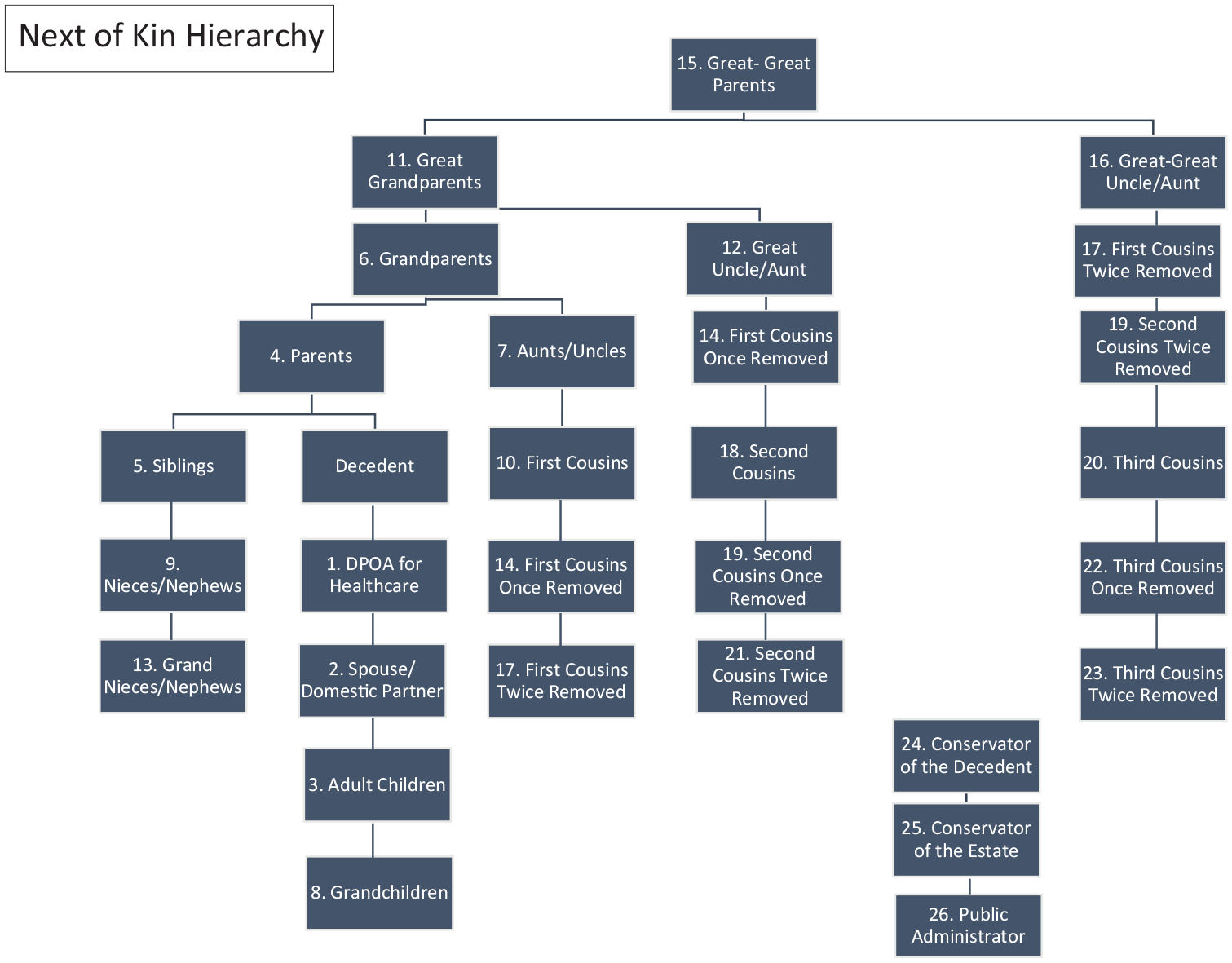
The administrative standard of who qualifies as next-of-kin was easy to find in the Medical Examiner-Coroner’s office. A chart hung in the cubicles of Notifications unit staff (see Figure 1), including Isabella and Grace, lead investigators tasked with exercising “due diligence” to locate and notify relatives. 4 When scene investigators, like James, ran into barriers, they transferred the case to Notifications.
Next-of-Kin Hierarchy
The next-of-kin administrative standard is an abstracted family tree that hierarchically ranks the decedent’s kinship ties. The most important decision-maker, consistent with the assent of personal autonomy in decision-making (Beauchamp and Childress 1979), is the person designated by the decedent to have durable power of attorney (DPOA) in healthcare, or the authorization to act on behalf of the decedent in all financial affairs, including disposition. Few people have designated such a person. Second in line is a spouse or registered domestic partner, 5 followed by adult children. But then, rather than moving on to grandchildren, the hierarchy reverses up vertically to parents, then to siblings, before moving back up to grandparents, aunts and uncles, and only then to grandchildren, nieces and nephews, and horizontally to first, second, and third cousins.
Several aspects of this next-of-kin administrative standard stand out. First, the hierarchy reinforces the ties of the nuclear family, privileging blood, adoption, or marriage at the expense of the quality of the relationship. In this sense, nominal designations have been transformed into an ordinal valuation, a difference of kind becomes a difference of worth (Boltanski and Thévenot 2006; Fourcade 2016; Tilly 1998). Second, the hierarchy presumes a straightforward cascading from lower to higher numbered boxes until a next-of-kin is located. The standard reifies a chain of responsibility based on “proximity” to the deceased. The assumption is that closer family ties result in a willingness (and obligation) to take care of disposition, and that the interests of close relatives take precedence over more remote family members. Third, the family standard makes two critical assumptions: (1) that the next-of-kin is willing to claim, and (2) the next-of-kin is able to make disposition arrangements. With the considerable expense of burials and even “low-cost” cremations, claiming is likely also a money issue.
The administrative standard constrained who qualifies as next-of-kin by valuing some ties over others, but the standard required bureaucratic discretion to make it workable for the task of body disposition. The standard set a goal to find the officially designated next-of-kin but did not specify, for instance, the extent to which the staff should go to compel that person to claim the body, how far the staff should go up the hierarchy to meet the due diligence requirement, or what to do when multiple people (e.g., divorced parents) qualified as next-of-kin but disagreed over how to handle disposition. The actual stratification effect of the government standard in how it categorizes and ranks family ties becomes apparent as staff work to make the standard fit the task at hand.
Back at his desk, under the sign “Friends don’t let friends decompose,” James started the search for next-of-kin by checking one of the phones found in Michel Delon’s pocket. There was a number for “wifey,” but a man answered and said he had had this number for at least seven years. Another number was disconnected. James left a voice message on a third. The other phone had no SIM card. The chances of James finding the next-of-kin were not looking good; a homeless man, possibly foreign, with no known contacts.
Locating Next-of-Kin
The Notification staff began the process of locating the next-of-kin with the evidence the scene investigator retrieved at the place of death. Isabella picked up a folder and checked who called in the death, hoping it was a nearby relative or close friend. For transients like Michel, there was one less clue. Isabella reviewed the property records and the case summary to gather clues about possible relatives. Then the database work began.
Staff use any information they can find about a decedent to help them locate possible next-of-kin. In looking for relatives of a man who died in a nursing home, Grace followed the branches of a family tree up and down. She ran an Accurint search, an aggregated database of personal information from public and non-public records owned by Lexis-Nexis that law enforcement uses to link a name to addresses where the person lived and to possible relatives. Notification staff had to be creative and anticipate data entry mistakes: they changed the birthdate to a range of years, dropped a middle initial, or searched for a last name and a birth state. Unusual names were a blessing, common names provided too many potential false leads. Many people also aimed to be unfindable. Isabella told us, “What I learned is a lot of people have AKAs [Also Known As].” We sat next to her at the computer and looked at a file of a woman with about 40 such aliases, small variants of six similar names. Her arrest record was pages long. “She has been busy,” Isabella commented. An Accurint search may come up empty for relatives but find associates. “Associates,” Grace explained, “are people who have [a] shared address but with different last names. So sometimes these are going to be sisters who have married and have different last names.”
When the search produced a name, the staff called that person. These interactions revealed how implementation of the administrative standard renders inclusion and exclusion criteria stringent. The staff’s first question was about the respondent’s relationship to the deceased and, depending on the contact’s answer, the staff mined for additional information about next-of-kin. An ex-wife may be a fount of knowledge about family ties and may still deeply care about the deceased, but divorce rendered her ineligible to claim. Instead, staff used these insights to move on to finding the legal next-of-kin. Some people, like friends or partners, were by definition not eligible as next-of-kin, even if they felt close to or lived with the decedent; staff would not even ask them whether they were willing to make funeral arrangements. Staff compliance with the standard’s privileging of official ties rather than the quality of the relationship may thus lead to deceased going unclaimed.
As the search continues and staff go up the hierarchy of family relationships, they moderate their efforts to contact relatives. Staff may call presumed siblings to notify them of a death, but they were more likely to mail certified letters to third cousins because they assumed relatives up the hierarchy were less likely to claim. From a genealogical perspective, a person is rarely without next-of-kin, because one can keep tracing the family tree until a living relative of some kind is found, but in reality, the staff often decided they had done sufficient due diligence when they had inquired about immediate relatives. 6 Of 300 coroner cases we systematically examined, 51 went unclaimed because no relative could be found—but this was a relative as defined by the staff’s implementation of the standard. We talked to a man who considered himself the deceased’s brother because they had grown up together and were raised by the same woman (the man’s mother). However, because the men were technically cousins, the man was not notified. The man had no idea his brother/cousin was dead, so he was unable to make arrangements. The staff’s compliance with the standard—which privileged official ties rather than qualitative dimensions of a relationship—rendered the men’s relationship invisible in the eyes of the state and led to a decedent going unclaimed. Rather than sorting relatives into next-of-kin or others according to the family standard, staff assess who is likely to claim based on proximity to the deceased, de facto preemptively excluding some potential next-of-kin.
A couple days after James turned the file over to Notifications, he got a lucky break. A friend heard that Michel had died and alerted Michel’s brother-in-law in France. The brother-in-law sent several emails to James, asking what happened. James explained that Michel collapsed in a construction yard where he lived after befriending the owner. His death appeared natural. James transitioned from notifying the relatives about the death to asking if they wanted to claim the body. He asked the brother-in-law whether the deceased was married or had children; if not, Michel’s sister qualified as next-of-kin and could make burial arrangements.
Formal Fits
Many relatives were eager to retrieve their loved one’s body from the Medical Examiner-Coroner in order to organize a funeral. In a phone call to a deceased’s mother, Isabella moved smoothly from explaining the circumstances of the death to instructions for claiming the body. Isabella said the cause of death was pending toxicology, which can take up to five months: “Not to worry, but he is ready to be released. Are you going to make arrangements?” When the mother agreed, Isabella looked over her screen and added: “The mortuary can pick him up today.”
The mother’s affirmative answer to Isabella’s question reflected the mundane way a formal fit was created between the administrative family standard and the deceased’s family. The standard did its intended work of offloading the human remains to the next-of-kin. In a small but significant way, and repeated thousands of times, the state, through the work of countless government officials, supported and confirmed a particular family conception. However, as we will show, this does not necessarily mean that the state’s hierarchy of kinship matched a family’s reality: families may suppress their individuality to fit the state’s categories. In some situations, there may be discord among relatives over who should be next-of-kin. The Medical Examiner-Coroner’s staff declined to mediate in such family conflicts, requesting relatives to figure it out among themselves. If relatives did not come to a consensus, the body would go unclaimed and receive a county cremation due to “family refusing to act.”
Formal Misfits
Nearly one in ten bodies that pass through the LA Medical Examiner-Coroner’s office will go unclaimed. Captain Dave Lohan, who supervised the Notification staff and scene investigators, explained: “Whether you call it, ‘I can’t afford it,’ or ‘abandoned,’ or ‘unclaimed,’ the situation is that the family has failed to act.” According to California State law, if the family does not retrieve the body after 30 days, it is considered abandoned and the Medical Examiner-Coroner’s office can legally start the disposition process. It was in the office’s interest to ensure relatives claimed bodies, because county disposition took money out of a strained budget and taxed an already understaffed office. Falling behind meant the crypt, a cavernous cooled space with metal racks stacking four to six bodies high in long rows for a total capacity of 400 bodies, would overflow and could negatively affect the office’s accreditation.
The misfit between relationships during life and the legal family standard often determines what happens after death. In the following sections, we examine categories of real-life family relationships that do not fit the official next-of-kin hierarchy.
Estrangement
“I think the vast majority of the situations [when people go unclaimed] are that these people are estranged,” Captain Lohan told us. “They have had no contact with their loved one either by choice or necessity for many years.” In estrangement, a core assumption of the state’s family standard, that proximity to the deceased equates with a willingness to take responsibility for disposition, is misguided. Proximity instead reflects abuse, neglect, or losing touch. Asking a relative to take on the financial and emotional burden of disposition clashes with the painful reality of the family tie. Instead, from the next-of-kin’s perspective, letting the decedent go unclaimed may seem a more fitting end.
Severed family ties rarely come out of nowhere; they are the final straw in a hay bale of difficult relationships. The coroner files contained many summary accounts of estrangements: Relationships fell apart when the decedent switched to crack cocaine. A wife “is very angry with him [the decedent] because he was violent.” A brother who had not been in touch with a decedent in 39 years stated bitterly that he has “scars all over his body from his brother beating him.” In a different situation, a brother told Grace, “they were raised around alcohol. He himself started drinking at 13 and the decedent started about 10. Prior to leaving Oklahoma, he stole their sister’s car.” An ex recalled resentfully that “his [the decedent’s] daughter tried to visit him in prison, but he declined to see her.” When a daughter was reached, she noted she “was about to put call restrictions on decedent.” Each statement offered a small fragment explanation; the reason for the call did not invite elaborations. Still, in these snippets, we see how relatives justified not taking care of final arrangements. Estrangement called into question the normative expectation that people should mourn their relatives.
Estranged relatives may no longer consider themselves family. A Syrian woman lived in the back unit of her deceased brother’s duplex. When she passed away, her sister-in-law refused to claim her. She found the deceased “eccentric” and said the woman’s “real family” was in Syria. The family abroad had no resources nor interest in claiming, and the woman went unclaimed.
In a number of cases, people expressed relief or even joy that their tormentor passed away. Frank Morgan suffered a heart attack and was comatose. The doctor called his sister Laila as the Super Bowl was about to start and told her Frank had passed. Laila shouted, “Woohoo!” She told the doctor she did not care that Frank had died and she definitely did not want his body. A social worker from the hospital soon called and told Laila that their other brother also did not want the body. “Flush Frank’s ashes down the toilet with the other turds,” he had said. Laila could not have agreed more. She spent the next 52 minutes of our interview listing the many grievances she had against Frank, including drug dealing, stealing, assault, and elderly abuse.
Long-time estrangement also played a role in Michel Delon’s case. The brother-in-law wrote to James that Michel had abruptly left France in 1972 and they did not know anything about his life after that. When his father died and the inheritance needed to be settled, the family petitioned the court to declare Michel dead in absentia in 1992, which became final 10 years later. The brother-in-law added that they did not have the funds to repatriate his body, but they wanted to receive a death certificate. With the family expressing no interest in making arrangements for the body, Michel became unclaimed and his body went for county cremation one month later. The state’s family standard assumed proximity would lead to responsibility, but in Michel’s case, these ties were nonexistent for so long that he had been socially dead to his relatives for decades (Borgstrom 2017). Because of the singular focus on next-of-kin, state officials did not even consider asking Michel’s friends, or the business owner who had known Michel for years and had grown fond of him, to take care of funeral arrangements.
In cases of estrangement from next-of-kin, the death disposition process ran into an artificial endpoint. Claiming someone assumed that those left behind cared and would want to organize a funeral to celebrate a life and provide relatives with a sense of closure (Berns 2011). Yet, some relatives expressed that the indignity of being disposed in a pauper grave was an appropriate end for the person who made their life difficult or who disappeared decades ago. Here, like the ritualistic desecration of a corpse during ethnic or drug violence (De León 2015; Gregory 2016), being abandoned at death by next-of-kin may send a symbolic message of desired dehumanization and social banishment stretched into the afterlife. The ties only exist on paper, in legal documents and databases; in life, they long withered.
Messy ties
In other situations, the deceased had too many ties, too many potential next-of-kin, which led to formal misfits. The deceased may have had ties that defy easy categorization, or secrets from their past may come to light during the death investigation. Divorce, remarriage, cohabitation, and stepchildren have changed how people live, scrambling the boxes on the next-of-kin family standard—at least in theory. In practice, staff in the Medical Examiner-Coroner, Office of Decedent Affairs, and Public Administrator did not try to assess a most appropriate fit based on lived ties but zoomed in on the legal next-of-kin.
Jim Allen, for example, was born in Topeka, Kansas, on May 13, 1953, and passed away on September 17, 2011, in Rosemead, California. Jim had two adult stepdaughters from his marriage to Barbara, who predeceased him. Shortly after Jim died, his stepdaughter Carla flew to Los Angeles and withdrew funds from her stepfather’s bank accounts. Carla said it was money that belonged to her late mother. According to the Public Administrator, Carla was not entitled to the money and the bank never should have permitted her to withdraw the funds. The legal next-of-kin would be Jim’s biological children, Crystine and Matt, two children from previous relationships, with whom he had little, if any, contact. Carla certified in probate documents that she was “unaware of Jim’s 2 illegitimate children.” She tried unsuccessfully to prove that she and her sister were Jim’s real heirs. Further complicating the case, Jim’s aunt was willing to arrange the funeral, but she did not have legal standing and was reluctant to contact her biological niece and nephew, whom she had not seen in decades. The two “secret” biological children were the next-of-kin but, as was clear in court records, they did not know their father and did not wish to make burial arrangements on their own.
Jim’s death shows how complex social ties have become (see also Connidis 2020) and why this complexity complicates the death process. People may have too many ties or not the right formal ones to be activated for the intended aim. The state’s standard of family is both categorically individualistic, in the sense that it focuses on one person as next-of-kin, and categorically collective, in the sense that multiple people may populate the category (e.g., children, siblings, aunts). Everyone within a certain category is equal in the eyes of the state’s standard (e.g., Crystine and Matt); others are excluded by virtue of being nonstandard family (e.g., Carla and her sister). Demographic changes in family dissolution and reformation render it more likely that disconnects occur between who has the interests of the deceased at heart and who was legally designated next-of-kin.
Money and resources
Besides the normative assumption that relatives are willing to bury their loved ones, the state presumes relatives have the financial resources to take care of funeral arrangements. This assumption is sometimes unwarranted and can lead to formal misfits. Nationwide, in 2019, the average cost of a funeral was $7,600. 7 The median household income in Los Angeles that year was $65,700. 8 An unexpected funeral constituted a major expense for most households.
Even when next-of-kin told us that burying bodies was unimportant, either because they did not value pomp and circumstance or the dead did not know what happened to them so why bother, financial concerns were often close behind. Jeff Siver justified letting his mother, Renee, go unclaimed based on costs. Sitting on a creaky bench on his front porch, Jeff explained that Renee worked at a gas station until she got lung cancer and needed hospice. She died in Jeff’s house on July 8, 2014, at the age of 75. “I was sleeping when she passed away,” he said. They knew Renee’s cancer was terminal, but Jeff said his mother did not have money to make pre-arrangements. A body cannot linger, so it fell on others to sort out what to do. “The guy that was here, the nurse, he called the Neptune Society,” Jeff said. “The next thing you know, they’re telling me I gotta pay a $2,300 bill and I’m like, ‘You know what, I know a place that would have done it for like $900.’ And they said, ‘Well no, we already have her.’ And I was tempted to go, ‘Well then just keep her. She’s dead. She ain’t gonna know the difference.’” They did not keep her, but neither did Jeff pick up his mom. She went unclaimed and ended up in county disposition.
Other people used the county’s process as the cheapest option for cremation. They deliberately let their relatives go unclaimed and then later retrieved the ashes at a relative bargain of $385. When we asked Olive if she knew her brother Dwight had been cremated by the county, she said yes and that she had Dwight’s ashes inside her house. She did the paperwork with the county about a year after his death. Explaining that our project involved trying to understand how families became disconnected, Olive was adamant: “We weren’t disconnected.” She said she talked regularly with Dwight and knew what was going on in his life. Asked why she let Dwight’s body be handled by the county, Olive had a simple answer. Everyone else in their family had taken care of burial plans, including Olive who had purchased a double crypt, “but he [Dwight] never did.” He wanted to be cremated and did not have any money, so Olive let the county do it.
The state’s family standard assumes the next-of-kin is able to pay for the funeral, but bureaucrats do not check relatives’ financial resources or provide financial assistance. This differs from other countries where the government provides monetary support for indigent deaths (Woodthorpe 2017) and from the federal funeral benefits for U.S. veterans and pandemic victims. Money is never just money though (Zelizer 2011), and money for a funeral often becomes a litmus test of the strength and quality of family ties. The question facing next-of-kin, wealthy and poor, was whether the deceased was worth the cost of disposition.
Formal Refits
Government bureaucrats have some margin of discretion in how they apply standards when they encounter misfits, and those excluded from the standard can also exercise agency when confronted with standards that do not fit their lives. Either party must work within the standard to subvert its logic and refit what would otherwise have been a mismatch between the standard and lived preference. In the case of going unclaimed, this means a person officially excluded as next-of-kin is allowed to take charge of funeral arrangements. To deviate from the standard takes time and resources. In the context of unclaimed disposition, it has a low success rate, because the next-of-kin standard imposes stringent inclusion/exclusion criteria.
Staff’s discretion
State officials can deploy discretion in two distinct ways to avoid misfits: they can compel a reluctant next-of-kin to step up, or they can explore ways for a non-next-of-kin relative or acquaintance to take charge of the funeral. Neither option was widely used.
By California State law, next-of-kin can be prosecuted for not claiming, a misdemeanor punishable by one-year imprisonment in county jail and/or a fine of $10,000. 9 The Medical Examiner-Coroner’s office, however, did not allocate the resources or time to enforce this requirement. Their focus was on getting bodies out of the crypt to make room for tomorrow’s dead.
When next-of-kin realized the office’s hands were tied, they could take advantage of their privileged position in the family standard to block the staff’s attempts to compel them to claim. The Medical Examiner-Coroner’s office had the body in their facility and would have to dispose of it, with or without relatives’ cooperation. Relatives either administratively or passively refused to take care of the body. In the administrative mode, they signed a form to relinquish their right to dispose of the body. Next-of-kin also stymied the office’s efforts by making promises, running out the clock, or declining to respond to phone calls or letters. After waiting months for a reply, the file was forwarded to Captain Lohan, who made a last attempt to coax relatives to take responsibility. If that failed, the lack of contact constituted a sufficient reason to send the body for county disposition.
Next-of-kin also exploited the fact that the Medical Examiner-Coroner’s staff did not verify indigency. Like the case of Olive who let the county cremate her brother Dwight and then retrieved the ashes afterward, some relatives relied on the county for cheap cremation. The staff assumed these people did not have the financial resources at the time of death. The Medical Examiner-Coroner’s staff did not have access to relatives’ financial information, but they googled addresses and could look up the value of their houses and find information about their jobs. The office could have pursued legal means to recuperate triple the cost 10 through civil action, but Captain Lohan said it was not worth it: “I’m not gonna spend a dollar chasing after a dime I might not get. At the end of the day, I can cremate that body for $160 or I can pay [the Notification staff] overtime investigator wages to chase that family and rattle our saber at them. . . . The time it would take for them to prove or disprove their indigency, 30 days is gone and I need the space.”
State laws also allowed for a court petition, called an ex parte, that gave non-next-of-kin, like friends and unregistered partners, the right to dispose of the body. 11 The form could be filed after all notices required by law had been made and next-of-kin had been given sufficient time to claim. However, the Notification staff did not advertise the ex parte route. It only came up if non-next-of-kin initiated the conversation by expressing interest in claiming.
In 300 files of unclaimed bodies we reviewed in the coroner’s office, friends filed an ex parte only twice, and even then the legal move did not lead to a body being claimed. Sherry Reed, a 50-year-old Black woman, died in a hospital. Her fiancé, Cyrill Holmes, told the Notification staff that Sherry was estranged from her two adult daughters and he wanted to claim the body. Through extensive database sleuthing, Notification staff located someone who thought Sherry could be the sister he never knew. The county workers asked the potential brother whether he was willing to pick a mortuary, but a couple days later he had second thoughts and questioned whether he was even related to Sherry. Cyrill successfully filed an ex parte petition, but indicated he did not want to make funeral arrangements until he was sure about what caused Sherry’s death. A week later he called back to say that he lacked the funds and requested county disposition.
Friends and relatives who fell outside the next-of-kin hierarchy feared legal retribution if they tried to sidestep the family’s right to disposition, underscoring how the standard may lead to anticipatory exclusion. In one instance, members of a church signaled they wanted to provide funeral services for a member who died without family, but they backed down when Grace located remote next-of-kin. The church members feared legal contestation for going against the next-of-kin, even though the next-of-kin did not express a desire for final arrangements. It is difficult to find out how many people take care of distant relatives or friends, but based on the Notification staff’s experience, probably not many.
Theoretically, the staff could have exercised discretion by loosening standards of who was able to claim, but this did not happen due to the liability risks of releasing a body to the wrong person. As in medical settings, a “moral” story (Bury 2001) served as a warning: the Medical Examiner-Coroner’s staff had once released a body to the deceased’s cousin who claimed to be next-of-kin; the deceased’s estranged wife—who would have been next-of-kin—lived abroad and was upset about being bypassed. A foreign embassy contacted the office on behalf of the wife and the case necessitated involvement of senior county officials.
Without encouraging non-next-of-kin to claim or providing financial resources for a funeral, staff workarounds for the legal standard are limited. Relatives unwilling to claim can subvert the standard by not responding, and non-next-of-kin willing to claim face a cumbersome process. Formal misfits were rarely challenged, and more often than not the body went unclaimed.
Non-next-of-kin’s resistance
In exceptional circumstances, some non-next-of-kin took the initiative to step up and claim the deceased even though they were not legally obligated, or they used the legal standard to assert their place as decision-maker, even if they were not legally recognized. These reclaimers transcended the constraints of the legal standard to repair or assert family ties postmortem.
Grace pulled a card with a green-blue abstract painting from a clip on the wall of her cubicle. It was a thank-you note from a daughter. An Asian female body was found unresponsive March 1, 2017, at the bottom of an apartment stairwell. Police officers recognized her as a local transient. Fingerprints and body x-rays identified her as Da-Som Pitino.
Grace received the file. Checking Pitino’s last known addresses from several decades ago in Accurint, she located a husband, Walter R. Pitino, now deceased, who married Da-Som S. Mun in 1978, a week after their daughter Daria was born. Grace wrote excitedly “Possible daughter!” in the case notes. She called Daria who confirmed the decedent was her biological mother. Her parents divorced and her mother developed mental health issues, exacerbated by an abusive home situation. Da-Som lost custody of her two daughters and was hospitalized in a state mental hospital. Daria was placed in foster care when she was 10 and then legally adopted and had no further contact with her mother. The adoption rendered Daria ineligible as next-of-kin. Because her biological mother had no other known relatives, the body seemed destined for county disposition. However, Daria obtained a court order and hired a mortuary to bury Da-Som. The thank-you note pinned at Grace’s wall explained: “The information you sent is helping me fill in the story a bit more and I am gaining some closure as a result. Thank you again for the important work you do and for the empathy and kindness with which you do it.” In rare circumstances, some relatives went beyond the call of duty and claimed the person, even if they were not officially next-of-kin.
In other cases, people outside the next-of-kin hierarchy standard took on the role of relatives as social activists. Every Wednesday, rain or shine, a group of motorcycle-riding veterans and their supporters, who call themselves Veterans Without Family, gathered at Riverside National Cemetery to bury unclaimed veterans. The bodies arrived via transport van from the LA Medical Examiner-Coroner’s office as part of a program for indigent veterans. Those who attended the Riverside ceremony were strangers to the deceased, but they saw themselves as surrogate family, even taking on the motto: “We are their family.” The program was started by a former Medical Examiner-Coroner staff member who used his deep knowledge of the standards implemented in the office to refit a creative legal path involving a combination of state and federal statutes. Veterans Without Families organized burials of more than 150 unclaimed veterans each year, but they did not pay for the burials because every honorably discharged veteran has the right of burial in a national cemetery. 12 Instead, the group took on the role of surrogate relatives to draw awareness to society’s neglect of veterans and express solidarity with their veteran “brothers and sisters,” who were often estranged from their biological families. This group, far from official next-of-kin, marshaled the disposition process to “do” family (and politics).
Such collective reclaiming not only surrounded otherwise unclaimed veterans with surrogate grieving relatives, but these burials further challenged the administrative family standard by suggesting a new box of “volunteers” as legitimate kin in the next-of-kin hierarchy. Besides veterans, other volunteer groups buried special categories of unclaimed people (e.g., babies, immigrants) as surrogate families. In each instance, they required official approval from local government officials and thus refitted the administrative standard.
Discussion
Administrative standards form an out-of-sight social mechanism of stratification with the power to exclude or include and allocate resources to certain people at key life-course events in highly consequential ways. When people’s circumstances and characteristics match the standard, governance in all its regulatory manifestations is possible. Yet, standardization is not just a consequence of the standard’s content; formalisms are themselves embedded in an informal social life of making administrative standards work for the task at hand. We can sharpen this point by comparing the next-of-kin hierarchy as deployed in body disposition with similar family standards used at the end-of-life. In spite of similarities, these family hierarchies have different stratifying effects.
For comparison, we characterize family standard implementation on whether the inclusion-exclusion criteria lead to misfits or allow for discretion to refit (see Table 1). When terminal patients are no longer able to make decisions about their level of care, they may appoint a proxy decision-maker through an advance directive. In spite of national legislation encouraging advance directives, only about 20 to 30 percent of patients have such documents (Yadav et al. 2017). For individuals lacking documentation, each U.S. state allows for a relative to step in as a surrogate decision-maker. Thirty-five U.S. states have established a surrogate hierarchy that includes spouse, child, and parent; eight states allow for a partner or common-law spouse to be the decision-maker (DeMartino et al. 2017). These standards give greater voice to non-relatives, but the underlying valuation of the nuclear family and the hierarchy of relatives are similar to the standard used in body disposition.
Family Administrative Standards at the End-of-Life
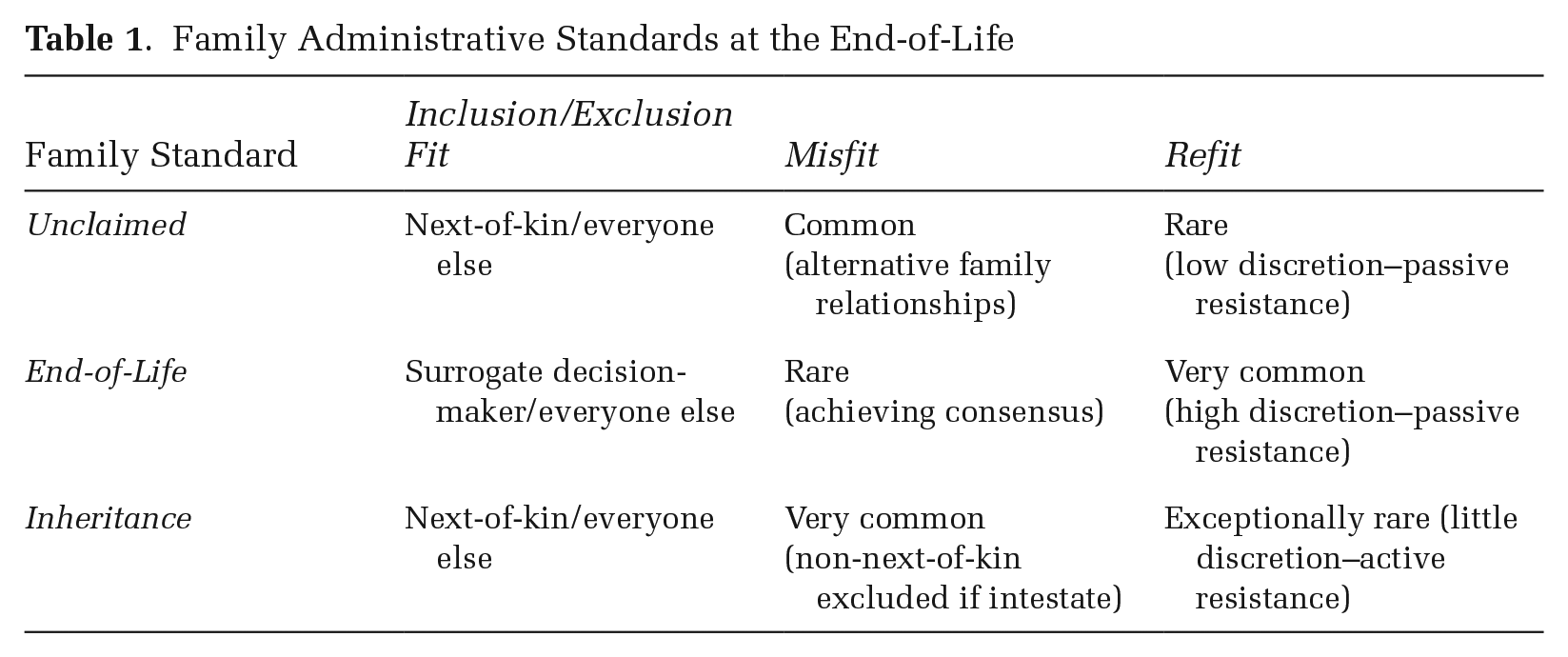
Ethnographic research on end-of-lifedecision-making, however, shows the implementation of this family standard is not focused on empowering a single decision-maker. Instead, the goal is to favor the professionally preferred decision, in spite of the family’s preferences. Medical staff rarely consult relatives when care providers want to continue treatments, and they may even ignore the patient’s advance directives (Brinkman-Stoppelenburg, Rietjens, and van der Heide 2014). Only when they consider withholding or withdrawing care do healthcare providers solicit a surrogate decision. In those situations, the medical team first irons out internal dissent to present a unified professional perspective to the relatives (Anspach 1993). Medical staff may check that the legally designated surrogate decision-maker is involved in the decision, but the staff do not leave the decision to a single person, and instead aim to reach a consensus among all relatives involved (Heimer and Staffen 1998; Kaufman 2005; Livne 2019). Thus, in practice, this family standard is regularly subverted when healthcare providers either ignore the standard or use their discretion to defer to a group of relatives instead of the designated single decision-maker. The family unit tends to resist passively by failing to reach a consensus.
Where the implementation of surrogate decision-maker standards shows more flexibility than the disposition of human remains, inheritance law demonstrates more rigidity in reifying the nuclear family. Prior to the 1960s, inheritance laws were based on assumptions of lifetime marriages, cohesive intergenerational ties, and the priority of keeping (farm) property within the bloodline (Hill 1995). An assessment of legal changes in the United States, Germany, and France notes the abolition of the firstborn rights of inheritance and expanded rights for spouses and “illegitimate” children (Beckert 2008). About 80 to 95 percent of decedents leave their estates to their children in equal measure (Dunn and Phillips 1997), which some observers take as evidence of the solidity of the family institution in spite of the growing diversity of family forms (Gilding 2010). An alternative explanation, however, is that inheritance law, as an instance of government standardization, helps shape this outcome.
Indeed, for people dying without a will (intestate), or even with a will in some cases, the state provides legal protections for close relatives such as spouses and children. When a decedent dies intestate, in most U.S. states, the decedent’s closest relatives as defined by blood, adoption, or marriage inherit, even if they abandoned, maltreated, or physically abused the decedent or never knew the decedent. Cavers (1934) refers to such beneficiaries as “laughing heirs,” because these distant relatives laugh all the way to the bank. Blended or extended family members or non-relatives who were long-term caregivers for the deceased do not receive recognition under intestate succession statutes. Even if these “unnatural” (Foster 2001:208) recipients of the estate are recognized in a will, case-law shows their inheritance is regularly contested and overturned in favor of next-of-kin. In this context, state officials exert little discretion in refitting a non-next-of-kin; to contest the chain of inheritance requires active resistance by filing a lawsuit.
Similar family standards privileging a historically specific conception of the nuclear family (Coontz 2016) can be dulled, as in the case of obtaining family consensus during surrogate decision-making, or they can be sharpened by case laws overriding the wishes of the deceased in inheritance law. This creates different hierarchies of who counts, with far-reaching consequences: the inclusiveness of the surrogate decision-makers may lead to decision paralysis, whereas rigid inheritance proceedings may pit relatives against each other and foment estrangement. The specificity of both the standard and the process of implementation thus matters for standard-guided stratification.
On a different note, following Weber, social scientists have highlighted the suffering experienced by those whose lives do not fit a standard (Ritzer 2000; Star 1991; Thévenot 2009). Some of the remote relatives and non-kin excluded from the claiming process suffer in ways Weber predicted: their individuality and freedom of choosing the kin life that suited them no longer count. Their misfit experiences mark the collateral damage of standardization.
However, for some kin, the misfit is not a source of suffering but correctly captures their deeply conflictual family experience. Not all families are supportive and loving (Offer and Fischer 2018); they can be abusive, exploitative, and dangerous spaces, leading members to dissolve a relationship (Carr et al. 2015). Reasons for estrangement vary, making it difficult to know exactly how many adults are estranged (Fingerman, Huo, and Birditt 2020), but “overt cutoffs” between family members (Agllias 2011) appear to be widespread, perhaps as much as divorce (Conti 2015). However, unlike divorce, which absolves legal ties (Connidis 2020), estrangement is driven more by changes to interaction than by formal intervention. In cases of unrecoverable estrangement, not claiming a body allows relatives to have the final say on unhappy relationships.
In cases where a lack of financial resources stands in the way of claiming, the next-of-kin reveals priorities: whether their choice was a smart financial move to resist corporate mortuaries or a way to take advantage of a default government process does not negate that it is a deliberate decision that, as our data show, often carries few expressions of regret. Finally, the remote relatives or non-kin who refit their situation to the government standard reinforce their family ideal in spite of administrative deviation. Instead of thinking of the counterpart of standardization as singular (i.e., suffering due to misfits), we observe a varied range of unintended consequences of standardization.
Government bureaucrats’ cultural authority to define families at the end-of-life also spills over into contemporary dying. First, government officials impose a new set of criteria differentiating bad from good deaths: going unclaimed with hundreds of other cremains of indigent dead in a pauper’s mass grave stands in marked contrast to the individualized funeral of a claimed decedent (far more lauded in contemporary U.S. society). Second, by singling out a next-of-kin based on proximity and ignoring the quality of close relationships, the government offers an official verdict of not only who is grievable (Butler 2010), but also how disposition should factor in the grieving process (Woodthorpe and Rumble 2016). Third, with chosen families erased from the historical record, future genealogists will be stymied trying to map the decedent’s social network. This obliteration may confirm that the social world was as the state imagined it.
Conclusions
With institutionalized inclusion and exclusion criteria, government standards form a social mechanism for stratifying people. The result of standard implementation is an almost seamless incorporation of people as citizens in governance projects when lives fit the standard (Gong 2019). Administrative standards reify individual and collective characteristics as worthy of symbolic and financial capital. In the family realm, they normalize particular social ties and distribute rights and responsibilities. Government standards exude social and cultural authority: they prescribe courses of actions people have to take and constitute the cultural parameters of family relationships for formal purposes. Misfits result in lives disrupted by bureaucratic structures and rendered socially invisible, requiring extensive repair work to realign with standards. Refits end up reinserting themselves into an administrative system that risked marginalizing them. Every administrative standard then slices subjects’ relationships into valued and devalued categories.
The state, through its government officials, exerts cultural authority by specifying a normative, legitimated—in our case—family standard that hierarchically ranks relatives on their presumed willingness and obligation to bury a person. The resulting stratification effects, however, depend on how the standard is implemented. The standard’s scope, substantive content, and institutionalization; the margin of interpretive flexibility government workers have in tinkering with the standard; and the freedom those subjected to the standard have to make it fit their biographies and social memberships will affect whether the standard’s dehumanization can be countered.
More generally, the government makes and remakes the family in innumerable ways: in rules for who gets to marry and divorce, who may adopt, what constitutes paternity, who counts as a dependent for taxation, who qualifies as a household member in the census, or which family forms matter for welfare benefits. The moral tradeoff of family standardization is striking in migration proceedings, where the U.S. government separates and reunites kin units based on family ties. The consequence is doubt about some family ties, a mismatch between the administrative understanding of family and the culturally specific understandings of kin networks of immigrants, and a situation where people who used to qualify as relatives no longer do and are at risk for deportation (Menjívar and Abrego 2016; Villalón 2010). Family is only one target of administrative standardization. In the migration context, bureaucratic standards, for instance, also define health, age (Bialas forthcoming), and trauma (Fassin and d’Halluin 2005), with each of these standards having the potential to exclude some people from attaining citizenship (Lakhani and Timmermans 2014) and producing legal violence as one outcome of a range of oppositional effects (Menjívar and Abrego 2012). These standards may inadvertently discourage the familial responsibility they aim to foster, as is apparent in our study where both relatives and the state stand to benefit when families claim but some people are excluded.
Administrative standards, in addition to stratifying and making up people (Hacking 1986), also stratify lives at critical junctures: people who have been living on their own terms may still see their life choices ignored. A focus on administrative family standards as social mechanisms of stratification thus offers a counternarrative to a romanticized celebration of family diversity. Claims that marriage as an organizing principle of social life “has already been overthrown” (Coontz 2004:977) are exaggerated when viewed in the context of body disposition, where marriage functions as a primary sorting mechanism of who is sanctioned to claim, followed by birth lineage. If at turning points of the life-course, “alternative” families do not count legally and administratively, their ability to fulfill support and reproductive functions will be compromised. We showed that living outside the standard is both a source of suffering and an opportunity to refit, but for most people—as the systematic devaluation of gay partners as family decision-makers at the height of the HIV-AIDS crisis showed (Wahlert and Fiester 2013)—the resulting exclusion is likely dehumanization. Yet, people staying married to maintain health insurance (Sohn 2015), or divorcing while still living as a married couple to qualify for welfare benefits, show that refitting may occur widely (Bitler et al. 2004). At the same time, our research also indicates the widespread prevalence of estrangement in families by birth, adoption, or marriage, a development overlooked by focusing solely on divorce statistics.
We noted that standards stratify based on standard-specific criteria, and those criteria do not always coincide with demographic divisions. Yet, patterned across multiple instances, the state’s family standards may reinforce racial and heterosexual biases if they systematically fail to recognize, for example, Black and gay family formations (Moore 2011). Inheritance law renders non-traditional kin relationships invisible, and because such forms of kinship are more common among minorities, it consolidates racial wealth inequities (Bloome 2014; Oliver and Shapiro 2006). Another way standards may be used to reinforce existing discrimination is by targeting some people more than others: people receiving welfare benefits, for instance, are subject to stringent qualification standards (Watkins-Hayes 2009). Class and social capital also greatly matter in the ability to go to court and assert or contest legal claims (Neitz 2013). The desire for uniformity with standardized tools may generate structural biases (Benjamin 2019).
Incremental changes to create multiple standards or update a standard, such as the legal recognition of domestic partners as part of the family, may alter the official family configuration and validate these forms of kin, but such initiatives do not address the inherent dilemma of making standards fit an evolving set of social configurations. They may replicate the issue of standardization at the level of the social group, a form of niche standardization (Epstein 2007), and the resulting stratification will be different, but the social tradeoffs around standardization remain. Yet, the variety of valued family configurations at different stages of the end-of-life shows the inclusion-exclusion tradeoff is not inevitable and can be rebalanced. Government officials can counter some of the negative effects of standardization if the substantive ends prevail over the formal rationality of applying an administrative standard. Besides greater interpretive flexibility, we may need a process of continuous improvement of the standard to meet substantive goals (Stinchcombe 2001). Individual and collective forms of refitting to change standards point to a way forward and offer an opportunity to redress institutionalized inequities.
Footnotes
Acknowledgements
We thank Ulrike Bialas, Omar Lizardo, Heeju Sohn, and Iddo Tavory for helpful comments on this article. We also thank the editors and three anonymous reviewers.
