







Abstract
The literature on development has long highlighted the role of international trade and developmental states as key factors in explaining divergent processes of economic development. A country’s position in the world economy and its state’s capacity to promote industrialization are seen as fundamental to understanding its development path. Yet, these approaches are often inadequate for explaining the actual contours of industrial and economic growth across the Global South. In this study, an in-depth case study of Brazil reveals the limits of the mainstream approaches and illustrates the centrality of the underlying agrarian economy for understanding the country’s development path. Archival and quantitative data show that both the timing and location of industrialization in Brazil are better explained by the agrarian dynamics that unfolded in the country in the twentieth century. This has broader implications for understanding development processes throughout the Global South.
Why are some societies more developed than others? 1 What explains why some have advanced so much more than others in terms of industrialization and economic growth? These questions are central to debates in development sociology, and have broad implications for a range of issues in comparative-historical, political, and global sociology. Why and how processes of economic and social change have progressed in some places more than others is central to understanding a multitude of contemporary social issues around the world. Yet, scholars have struggled to provide convincing answers, and there is a growing realization that the mainstream approaches are inadequate (Kiely 1995; Portes 2015; Schrank 2015).
Among the dominant approaches are those that point to international trade and a country’s position in the world economy as the primary explanatory variables (Gereffi and Korzeniewicz 1994; Wallerstein 1979). How countries are inserted into globalproduction—as primary commodity exporters, labor-intensive manufacturing centers, or high-tech capital-intensive economies—is seen as a key factor for explaining their divergent outcomes. Countries on the lower end of the scale have major barriers to moving up the ladder of production and are drained of resources through mechanisms like declining terms of trade, global commodity chains, and differential profit rates (Arrighi, Silver, and Brewer 2003; Selwyn 2014). As a result, strong state intervention and planning are needed to overcome these barriers and facilitate the development process.
Another popular approach focuses on the state’s capacity to do this, and how some developmental states have been more successful than others at fostering industrialization (Amsden 1989; Evans, Rueschemeyer, and Skocpol 2002). Where institutions are strong and states have the capacity to impose discipline on capital, they tend to be more successful in facilitating investment and engendering industrial growth (Evans 1995; Itzigsohn 2000). In contrast, where states are weak and institutional capacity is lacking, private investment tends to be directed toward consumption and rent-seeking, and the investments needed for industrial development seldom materialize. This has led to much research in recent years on the sources of state capacity, and the differences in state–capital relations throughout the developing world (Chibber 2003; Davis 2004; Maggor 2021).
These approaches provide important insights about the conditions of late development. Yet, they are often inadequate for explaining the empirical reality across the Global South. Throughout the developing world, there are vast differences in terms of levels and timing of industrialization that cannot be accounted for by variations in international trade or state institutions. Societies with similar positions in the world economy and comparable state structures often diverge dramatically in terms of their industrial and economic growth.
For example, Brazil is said to have an “intermediate” developmental state that is comparable to India’s in terms of its capacity and effectiveness (Evans 1995). Both countries also have similar positions in the world economy as primary exporters with large manufacturing sectors. Yet, Brazil has nearly twice India’s economic output (GDP) per capita, and it is nearly three times more industrialized in terms of manufacturing output per capita. 2 In fact, in terms of industrialization, India is more comparable to neighboring Pakistan, a country with a “conspicuously weak state” (Paul 2014), and India has lower manufacturing per capita than the Dominican Republic, a country described as having a “predatory repressive state” (Itzigsohn 2000). 3 Meanwhile, Brazil is surpassed in manufacturing per capita by both Argentina and Mexico, countries described as having “low-capacity” states (Davis 2004). 4 Clearly, the empirical differences between these countries are not adequately explained through an analysis of their developmental states or positions in the world economy.
In addition, large regional divergences within countries cannot be accounted for by the mainstream approaches. Southeast Brazil, for example, is the most industrialized region in Latin America, with among the highest living standards in the developing world. Yet, northeast Brazil is among the least industrialized and has the “highest concentration of poverty in the Western Hemisphere” (Pereira 1999:1). These distinct outcomes occurred under the auspices of the same developmental state and virtually identical positions in the world economy. Both northeast and southeast Brazil began as primary exporters—the Northeast of sugar and cotton, and the Southeast of sugar and coffee. Both were slave-based plantation economies, highly dependent on world markets, and subject to similar terms of trade and international financial flows. Yet, in the twentieth century, the Southeast underwent rapid industrialization and economic transformation, whereas the Northeast remained mired in poverty and economic dependency.
Brazil’s position in the global economy cannot account for these regional divergences. Nor can the capacity of its developmental state. In the first decades of the twentieth century, industrial growth exploded in the southeast part of the country, long before any developmental state or meaningful industrial policy existed. Meanwhile, in the northeast region, little industrialization took place, despite major efforts by the state to promote it there in the second half of the century. In other words, other factors must be taken into account to understand why industrialization occurred when and where it did, not only in Brazil but throughout the developing world.
In this study, I argue that a key element often overlooked by mainstream theory is the underlying agrarian context. Through an in-depth case study of Brazil, I show that its development path can be better understood through an analysis of the agrarian dynamics that unfolded in the country over the course of the twentieth century. In southeast Brazil, agriculture underwent a major transformation from low-productivity plantations to capital-intensive commercial farming. This removed many of the previous barriers to industrialization by fueling rapid productivity growth and strong industry–agriculture linkages. In northeast Brazil, similar changes to the rural economy did not occur. Low-productivity plantation agriculture persisted throughout the twentieth century, and this inhibited the industrialization process by preventing improvements for the rural masses and limiting industry–agriculture linkages. The result was an undiversified economy highly dependent on primary goods. 5
I support my argument with two forms of within-case variation: (1) a comparison of rural and industrial development in the northeast and southeast regions; and (2) an over-time comparison of Brazilian industrialization and its take-off in the early twentieth century. When industrialization was still in its infancy across Latin America, southeast Brazil emerged as one of the most industrialized places in the developing world. Mainstream approaches cannot provide an adequate explanation for this, nor can they explain why industrialization failed to occur in other parts of the country. In contrast, an analysis of agrarian dynamics explains not only why industrialization concentrated in southeast Brazil, but also why it failed to occur in other regions like the Northeast. Such an analysis also provides a better account for the timing and intensity of industrial growth in the early twentieth century.
The rest of the article is organized as follows. I first review the debate on the role of agriculture in development, both throughout history and in today’s developing world. I then show that the industrialization process in Brazil was underpinned by the transformation of agriculture in the southeast region of the country. This is based on data compiled from the National Archives of Brazil and the Public Archives of the State of São Paulo, including annual reports and agricultural and industrial census data. I next show how the same changes failed to occur in northeast Brazil, cutting short its industrialization process. I conclude by discussing the implications for understanding divergent development in other parts of the world.
Agriculture and Industrialization
Scholars have long seen agriculture as playing an important role in industrialization. Marx (1976:911) famously pointed to an “agricultural revolution” in the English countryside that helped create the conditions for the Industrial Revolution. In other countries, scholars have pointed to similar changes that fueled industrial growth early in the development process (Hayami and Ruttan 1985; Senghaas 1985; Shin 1998). Rising productivity in agriculture can affect industry in a number of ways through inter-sectoral linkages; by supplying surplus labor to industry, generating financial flows to finance industry, or driving the growth of internal markets for manufactured goods (Johnson and Mellor 1961). Some scholars have even suggested that a country’s industrial sector will be “a function of agricultural productivity” (Lewis 1978) and “the size of the industrial sector depends directly on agricultural productivity” (Senghaas 1985:47).
However, there is much debate on this issue, and many question the role of agriculture in industrialization. Among economists, much of the debate revolves around the causal direction between agriculture and industry (Gollin 2010). Some scholars point to the strong correlation between a country’s agricultural productivity and its level of industrialization (see Table 1), while others argue that industrial growth spurs agricultural productivity, not the other way around (Dercon 2009). Indeed, agricultural productivity can increase in a variety of ways, such as when surplus labor in the countryside is soaked up by growing industries, or new inputs from industry raise the efficiency of rural producers. Huang (2016) argues that rapid productivity growth in China in recent years has been driven by farmers producing higher value crops for growing urban markets, without major changes in the conditions or methods of production. Despite over 50 years of research, economists have not reached a consensus about the direction of causation between agriculture and industry.
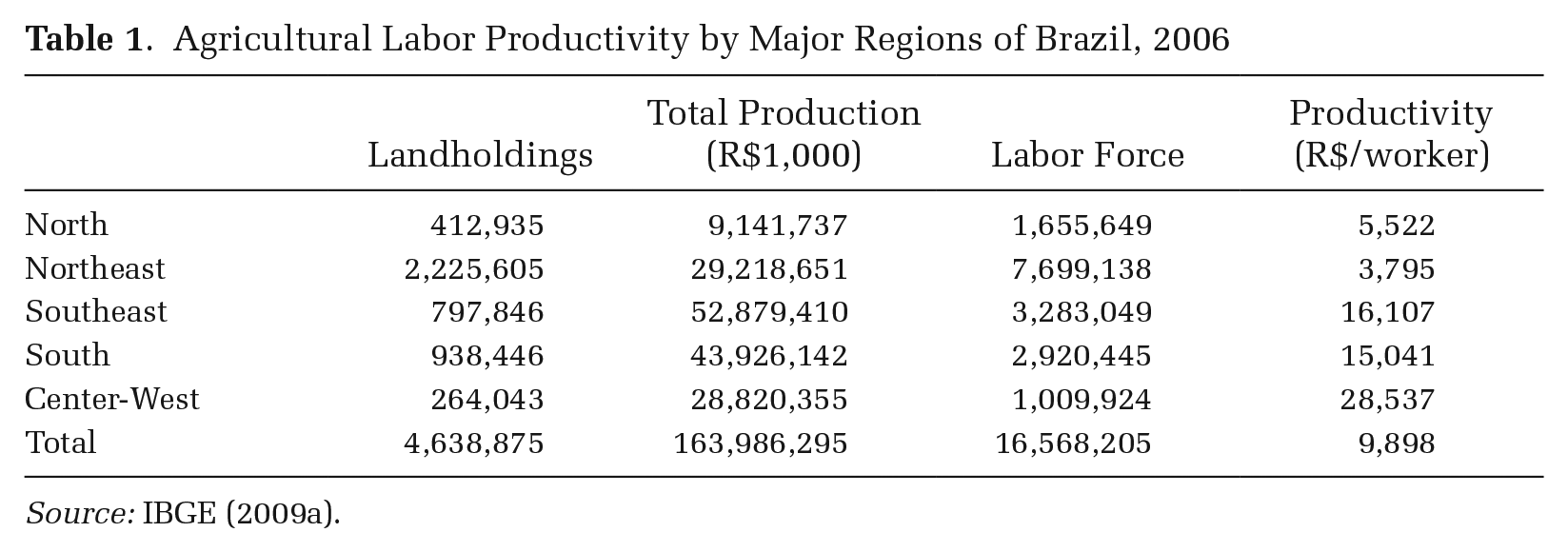
Agricultural Labor Productivity by Major Regions of Brazil, 2006
Source: IBGE (2009a).
Among historians, the debate has revolved around the Great Divergence between Europe and Asia and the role of agriculture in creating this divide. For years, the standard view held that England’s long-standing advantage in productivity and living standards fueled the Industrial Revolution and set it apart from much of the rest of the world (Brenner 1985; Wrigley 1985). However, more recent studies challenge this view, arguing that other parts of the world, like China, were relatively on par with England in terms of agricultural productivity (Allen 2009; Pomeranz 2000). 6 This has led some to argue that factors other than agriculture were more important for industrialization, such as surpluses derived from colonies and cheaper access to resources (Pomeranz 2000). Others point to a strong entrepreneurial elite and the state’s capacity to channel investment as factors that separated England and Japan from non-industrializers like China (Hung 2008).
This is in line with much of the developmental state literature. Amsden (1989), for example, argues that South Korea’s industrialization was driven more by strong state institutions than any preceding agricultural revolution. Others have made similar arguments with respect to Japan, Taiwan, and the USSR (Allen 2003; Evans 1995; Johnson 1982). Strong states can promote agricultural and industrial growth in a variety of ways, including by providing subsidies and protections, managing state-owned firms, controlling exchange rates and prices, and via land policy and education. When states have the capacity to enforce policy and exercise discipline over the private sector, they can be a driving force behind processes of late industrialization.
However, as Portes (2015) notes, arguments about the role of state institutions also have a risk of tautology. This is because the quality and importance of a country’s institutions can be retroactively inferred from that country’s overall development experience. Countries that are more successful in their development are often seen as having had superior institutions, whereas those that fail are seen as more deficient, regardless of the actual role of the state in the development process. In many cases, strong states played a central role in promoting industrialization and spurring growth (Evans et al. 2002). But their capacity to do so can be greatly affected by underlying dynamics of the domestic economy and the constraints this creates for state action (Chibber 2003). This raises the question if a certain kind of state is really the key to success, or if underlying processes of economic development allowed some states to be more successful than others.
This is especially the case when it comes to agricultural transformation. In South Korea, for example, scholars have shown that key changes in agriculture resulted in rapid productivity growth decades before the birth of its developmental state (Shin 1998). These changes were crucial to the postwar industrialization process of the 1960s and 1970s that is so often credited to its state institutions (Kang and Ramachandran 1999). Likewise, in Japan, rapid growth in agricultural labor productivity began as early as the 1880s, growing by 160 percent between 1880 and 1930 (Hayami and Ruttan 1985:328). This fueled an early industrialization process a half century before the major successes of its developmental state (Ohkawa and Rosovsky 1960).
In the developed world, successful industrialization has nearly always been accompanied by agricultural transformation. As Senghaas (1985:52, emphasis in original) notes, “nowhere has industrial development reached the state of self-sustaining growth unless an increase in agricultural productivity preceded or accompanied industrialization.” Across Europe, there was “a clear correlation between agricultural modernization and successful industrialization, or else between the lack of agricultural modernization and the failure of industrialization” (Senghaas 1985:47). Likewise, in the United States, Canada, and Australia, rapid increases in agricultural productivity were crucial for fueling the industrialization process (Grigg 1992).
In England, evidence of a preceding agricultural transformation is also quite strong. Revisionists question the role of agriculture, but they do not deny that agricultural labor productivity nearly doubled in the century before 1750, breaking decisively from the rest of Europe and reversing the long-term trend of the medieval period (Allen 2009:528). Arguments that England and China were similarly positioned before the Industrial Revolution ignore the striking differences between their rural economies. Whereas England experienced over a century of rising labor productivity, rising income per capita, increased use of labor-saving technology, and ever-increasing farm sizes, China experienced the exact opposite: a long-term decline in labor productivity, falling real income, continual downgrading of farm tools, and ever-decreasing farm sizes (Brenner and Isett 2002). By the nineteenth century, average farm size in England was 130 times larger than China, and 64 percent of the population had moved out of agriculture, compared to only 5 percent in China (Brenner and Isett 2002).
These kinds of distinct agrarian dynamics have separated industrializers from non-industrializers in case after case throughout history and around the world. Where there have been systematic gains in agricultural labor productivity, processes of industrial growth have generally followed. However, where labor productivity has stalled, industrial growth has tended to do the same, cutting short the development process. Strong states can play an important role in channeling surpluses toward productive investments, but they cannot channel what does not exist, and states are often constrained by the broader economic context in which they operate. For this reason, the distinct paths of agrarian change can be central to understanding divergent processes of economic development.
Along these lines, a growing body of literature focuses on the underlying social and economic changes that have led to agricultural transformations around the world (Isett and Miller 2017; Lafrance and Post 2019; Wood 2002). A common thread in these studies is the role of rural property relations—the specific relationships between rural producers and their land—in creating incentives and constraints for producers in the countryside. Depending on the position of producers vis-à-vis their productive assets, rural property relations can greatly affect larger patterns of investment and technical change in agriculture to make them more (or less) conducive to economic development.
For example, where access to the land becomes mediated by market mechanisms like mortgages and leases, producers are often compelled by market forces to maximize productivity by engaging in commercial production and channeling investment into improvements. This can lead to processes of capital accumulation and rapid growth in agricultural labor productivity. Brenner (1985) argues that the first such shift in rural property relations occurred when landlords in England evicted the peasantry from their traditional landholdings and turned to new forms of tenancy. Peasants were increasingly compelled to pay market rents for the land, and thus they had to shift from subsistence production to market sales and maximize output. A similar transition occurred in the United States in the nineteenth century when frontier land was increasingly acquired through mortgages and other market mechanisms (Post 2011). The changing relationship between rural producers and the land compelled farmers to specialize for the market and adopt improvements that would maximize productivity.
However, where these changes did not occur, the larger patterns of investment and technical change have often been less conducive to economic development. Where producers have direct, non-market access to the land, they tend to prioritize self-sufficiency and minimize risk, channeling investment away from farm improvements into savings or consumption. This often leads to slower processes of capital accumulation and technical change, and lower rates of productivity growth. Smallholder peasants tend to prioritize their own subsistence by planting food crops instead of higher value cash crops, and large landowners use their land as a store of wealth or source of rents that can be channeled into other activities (Deininger and Feder 2001). In this context, improvements in productivity tend to occur only sporadically, and growth is less sustained over the long term.
This type of low-investment, low-intensity production persisted across large parts of Europe in the nineteenth century and is still prevalent throughout much of the developing world today (World Bank 2007). In many developing countries, historical processes of land acquisition have been characterized by non-market mechanisms like land grants and informal occupation, hindering the development of market relations (Binswanger,Deininger, and Feder 1995). Market forces have been slow to penetrate the rural sector in terms of well-functioning land, credit, and insurance markets, and only a small percentage of agricultural land is under rental agreements or mortgages (Deininger and Feder 2001). Direct, non-market access to the land is common, and most rural producers are engaged in subsistence production, selling only a portion of their production on the market and avoiding the risks involved with more capital-intensive agriculture (World Bank 2007). This means competitive forces seldom function as they do in the developed world, by weeding out uncompetitive farms and consolidating land among the most productive farmers (Carlson 2018).
In other words, the differences in how rural property relations have evolved in different parts of the world is an important variable in divergent development. By influencing the larger patterns of agricultural productivity, rural property relations can greatly affect the role of agriculture in driving industrialization. This is true regardless of a country’s particular developmental state or position in the world economy. Across the Global South, countries with the lowest levels of labor productivity in agriculture are also those with the lowest levels of industrialization, with a strong relationship between the two variables (see Figure 1). Higher levels of productivity are associated with progressively higher levels of industrialization. 7
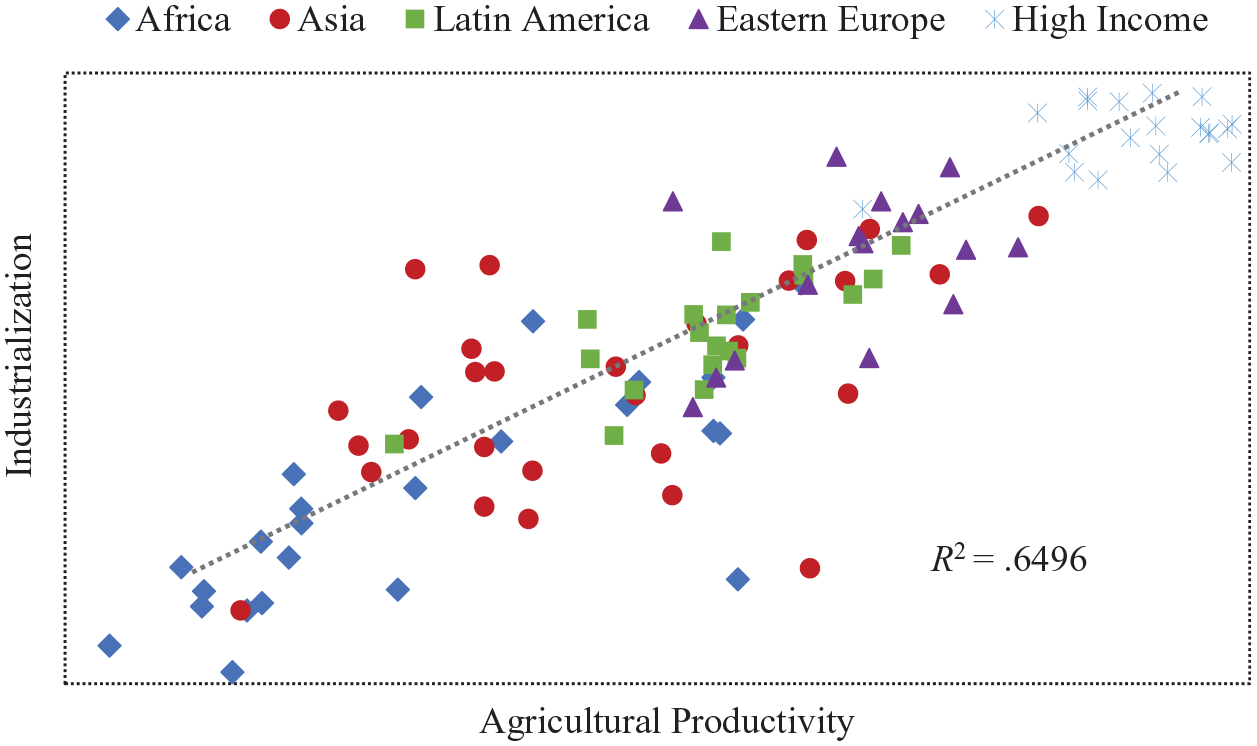
Agricultural Labor Productivity and Industrialization in 110 Countries
Brazil is an ideal case for illustrating this relationship, as it has very distinct agrarian contexts from one region of the country to the next, with widely divergent development outcomes. These divergences occurred within the confines of a single nation-state, with nearly identical state institutions and positions in the world economy. Thus, the primary variables from mainstream theory are largely controlled for, with little difference in terms of the developmental state or international trade from one region of the country to the next. This suggests the concentration of industrial growth in the southeast part of the country was not due to changes in the international context or state institutions, but rather to important changes in the rural economy.
The Agrarian Roots of Development in Southeast Brazil
Before the twentieth century, Brazil experienced only limited economic development. For nearly 400 years, the economy was based on the export of primary goods like sugar, rubber, gold, and coffee. These commodities experienced periodic booms and busts, but their production seldom involved processes of capital accumulation or technical change, and the methods used in production changed very little over long periods of time. 8 This caused slow growth in labor productivity, only minimal increases in per capita income, and weak stimulus for domestic industry. 9 By the end of the nineteenth century, Brazil was still an agricultural economy, with only a small middle class and an anemic manufacturing sector.
All of this would change in the first half of the twentieth century. In only a few decades, Brazil underwent a profound transformation, converting from an agricultural backwater on the margins of the world economy to an industrial powerhouse and one of the world’s largest economies. This was a product of the rapid economic and industrial growth that concentrated in the southeastern state of São Paulo from the early 1900s. Beginning as a simple coffee exporter, by the 1940s, São Paulo had the largest agglomeration of manufacturing capacity in Latin America (Dean 1969). By the 1980s, the state alone had a larger economy than most Latin American countries (only Mexico’s was larger), and it accounted for about 50 percent of all Brazilian industry (IBGE 2017).
This remarkable transformation is not easily explained by the mainstream approaches in development. Much like the rest of Latin America, São Paulo began as a primary exporter, highly dependent on the production of primary commodities and their sale in world markets. Yet, this did not prevent the region from industrializing and diversifying its economy away from primary goods over the course of the twentieth century. Nor did state institutions, policies, or planning play a major role. State intervention was quite limited in the first decades of the twentieth century, with deliberate industrial policy not emerging until several decades later (Schneider 2015; Suzigan 2000).
Some scholars argue that São Paulo’s industrial takeoff was due to “adverse shocks” like World War I and the Great Depression, which interrupted imports of manufactured goods and gave space to domestic production (Suzigan 2000:25). Others argue it had to do with the lucrative coffee economy and the boom in agricultural exports that created a concentration of wealth and investment in the southeast region of the country (Cano 1990; Dean 1969; Silva 1976). However, industrial growth was already increasing rapidly a decade before World War I and would continue throughout the 1920s (see Figure 2). Moreover, the coffee sector was in crisis in the first decade of the twentieth century when industrial growth took off, making it an unlikely catalyst (Font 2010:97). 10 Other countries in the region that experienced commodity booms, including other coffee producers like Colombia and Venezuela, did not experience anything like São Paulo’s industrial growth.
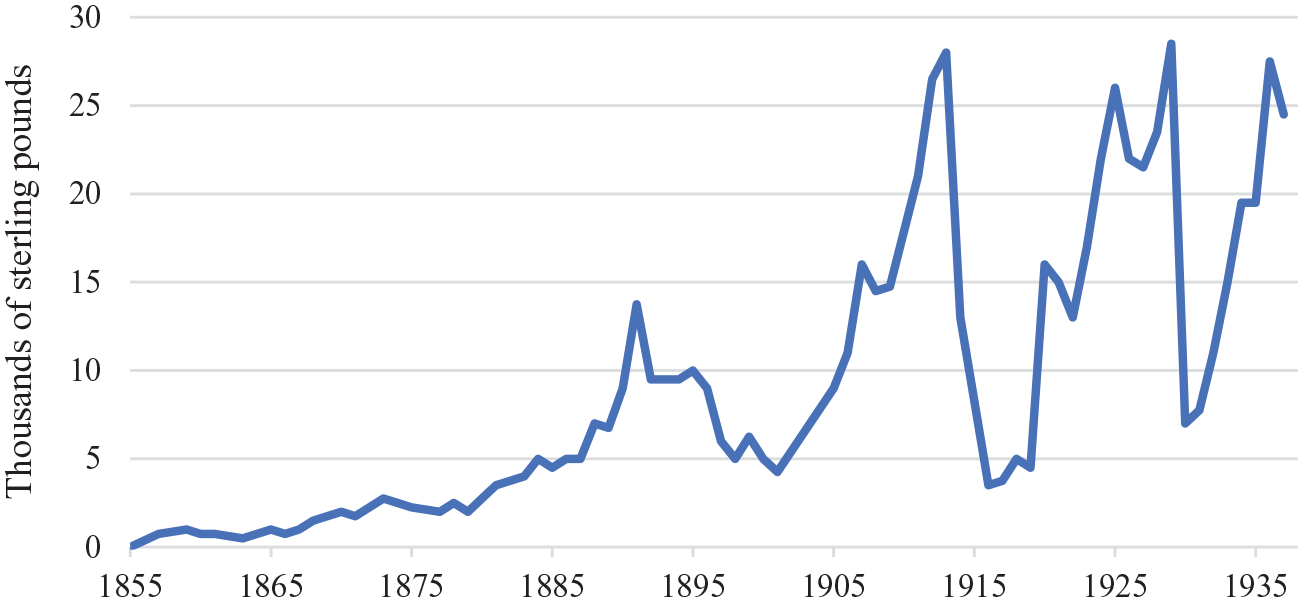
Manufacturing Investment in Brazil, 1855 to 1935
A more plausible explanation for both the timing and location of industrialization can be found in the changing agrarian context in southeast Brazil. Although São Paulo began as a plantation economy much like the rest of Brazil, in the first decades of the twentieth century, an “alternative agrarian economy” was emerging along the western frontier (Font 2010). Made up of small and medium-sized farmers engaged in commercial agriculture, this alternative economy came to dominate large regions of the state and eventually eclipsed the traditional plantation agriculture that had long predominated there. A central feature of this new rural economy was a new relationship between producers and the land—new rural property relations—that created a distinct productive logic in agriculture.
Rural Property Relations
In the nineteenth century, São Paulo’s coffee economy was similar to other plantation economies in Latin America. As production transitioned away from slave labor in the second half of the century, few other changes were made in the productive process, and little was done to maintain the productivity of the land (Dean 1969). Government reports from the 1890s lamented the “very low yields,” “carelessness in the treatment of coffee groves,” and “unscrupulous selection of [coffee] varieties” (EAC 1891:35). Land was used year after year “without receiving one atom of manure” and the technology and methods of production were still “in exactly the same conditions as before the abolition of slavery” (IAESPC 1892:206). 11
With much of the land initially granted to elites or grabbed up by wealthy landowners, most coffee planters maintained a relationship to the land that did not depend on maximizing its productivity. Their wealth and income from other businesses and landholdings around the state shielded them from the need to invest in improvements or increase output. There was an “extreme love of uncultivated lands” among landowners who “own thousands of hectares” but used them only for cattle grazing and hunting (Levi 1974:166). In the 1890s, state officials noted that more than half of the prime coffee land in São Paulo was not being utilized, due to “the vast landholdings bought in part as objects of speculation, in part as reserves for the future” (IEASPC 1893:279). Many planters were “mere owners of plantations” who “spend the income from them,” but “not having any interest in agriculture, they live with their family far from their farms and dedicate themselves to politics and other sterile things” (IEASPC 1892:206–07).
This would continue relatively unchanged until the first decades of the twentieth century. As coffee production expanded into new areas of the state, a new kind of agriculture began to emerge along the frontier. With the decline of the slave trade, plantation owners were experimenting with new sources of labor and sought to encourage immigration to meet their needs (Dean 1976). Planters and the state began to subsidize immigration from Europe and, together with the availability of open land on the western frontier, this led to large-scale immigration. By the 1880s, millions of people from Europe, Japan, and other parts of Brazil were flooding into São Paulo in search of land and other opportunities. By the turn of the century, a new class of farmers was beginning to take hold across western São Paulo. 12
Initially, the emergence of this new class did not threaten the interests of the coffee elite. Coffee planters needed laborers, and immigrants could meet that need. Moreover, elites understood that to attract immigrants, there would have to be a possibility for them to acquire land of their own in São Paulo (Dean 1971). Otherwise, they would go elsewhere or return to their home countries (SAESP 1895:35). Therefore, state officials and planters saw the colonization of open areas with immigrant smallholders as necessary to maintain the flow of laborers into the state (SAESP 1906:167). Successive waves of immigrants arrived to work on the coffee plantations, and after saving money, they headed west to purchase land of their own. 13 This created the need for the state to continually subsidize immigration to replace the workers who moved off the plantations each year.
This process created a new dynamic of land dealings and market relations in the countryside. The continual flow of immigrants into the state and the growing demand for land led to a “fantastic jump” in land prices on the frontier (Silva 1976:72). 14 Agricultural land became a valuable commodity to be sold on a piecemeal basis, and large landowners began to “foresee the good results” that could be had by “dividing their land into plots” and selling it to incoming settlers (SAESP 1907:157). The valorization of land also led a number of private interests to get involved in the colonization business. Dozens of Brazilian and foreign-owned companies began buying up tracts of land along the frontier, dividing them into plots, and selling them at market prices. Sales were typically done through five- or ten-year mortgages, and prices reflected location, resources, and land quality. 15
The property relations that emerged out of this were fundamentally distinct from those of the old plantation economy. Whereas before land ownership was dominated by large landowners who were under little pressure to invest in improvements or maximize productivity, this new class of farmers was under considerable pressure to do so. Paying market prices for the land, mortgaged over a number of years, and with no other sources of income to rely on, the new settlers were compelled to produce a certain level of income from their land to ensure their economic survival. Farmers could no longer minimize risk by prioritizing subsistence or channeling investment out of agriculture. Instead, they would have to specialize production for the market and maximize productivity by continually investing in agricultural improvements.
This change in productive logic was noted by several contemporary observers. “[F]rom these small farms . . . come the best farmers” wrote one journalist, as they had a “willingness to use the best methods” and “all the modern processes of fertilization” (Caldeira 1928a:252, 278, 248). Another journalist observed small farmers “follow[ing] an intensive and logically rational system in the truest sense,” with all plant varieties being “carefully selected” and the “most modern instruments and methods” used with “rigorous diligence and maximum care” (Silveira 1915:199). Whereas before landowners had been slow to adopt improvements and new technology, there was now “from all parts . . . demonstrations of the desire to carry out innovations” (Caldeira 1928a:205).
The new farmers also used their land much more effectively than did the old coffee elite. Where the plantations left large areas of land unused and uncultivated, the new farmers “[knew] how to take advantage of the totality of their land . . . [and did] not have even a square foot that is not covered with excellent crops” (Caldeira 1928a:264). By the 1920s, the agricultural minister reported that many areas that were once “uncultivated and abandoned” had now been transformed into “gardens of coffee trees” and were “true centers of progress and wealth” (SAESP 1923:126, 1930:228). Small farmers “are what generate wealth the fastest,” he declared, criticizing uncultivated land on the old plantations as “dead capital” (SAESP 1930:228).
Data from the 1934 agricultural census confirm that the new farmers were utilizing their land more effectively than the traditional landowning class. Immigrant-owned farms were superior not only in terms of crop yields, but also in percent of land cultivated and per unit farm value. On average, immigrant farms were nearly 40 percent more valuable per unit of land area than Brazilian-owned farms, and they cultivated nearly 60 percent more of their land (Estado de São Paulo 1936). Some scholars have suggested this may have been due to cultural factors, like greater entrepreneurial spirit among immigrants that made them more industrious than Brazilian farmers (Deutsch 1994; Lambert 1967). However, this is contradicted by the fact that the largest immigrant farms were actually less productive than their Brazilian counterparts. The large differences in favor of immigrant farms are only found among farms of 50 hectares or less.
This supports the idea that the greater productivity was due to the distinct property relations among this new class of farmers. Given the high land prices, the new landowners would have felt significant pressure to concentrate on cash crops and channel investment into maximizing output. Numerous farms on the frontier are described as “specialized in coffee planting” or “almost exclusively dedicated to coffee cultivation” (Caldeira 1928b:176, 1928a:252). Most of the new farmers were “humble foreigners, coming here with scarce resources” and with “no other concern above that of their farming” (Caldeira 1928b:128, 1928a:232). With little else to depend on, they “threw themselves into the whirlwind of agrarian life, expending energy and investing resources” (Caldeira 1928b:189). “[S]eeking to economize as much as possible [their] excellent land,” they used “all the modern improvements” like fertilizers, rain shelters, and improved planting techniques, and were “conscious of the advantages of good equipment” like “plows, harrows, and other agricultural implements” (Caldeira 1928b:140, 109).
This new kind of capital-intensive agriculture soon spread throughout São Paulo and into the surrounding regions. By the 1920s, immigrants owned 40 percent of the coffee farms in São Paulo and 30 percent of the coffee trees (SAESP 1923:122). By the 1930s, this increased to 48 percent of coffee farms and 42 percent of coffee trees(Holloway 1980:160). In 1934, “as much coffee production was in the hands of the immigrants with small and medium-sized farms as was retained by the native elite” (Holloway 1980:161). And this does not include second-generation immigrants who would have been counted as Brazilian in the data. Nor does it include Brazilian farmers from other parts of the country who were also flooding into São Paulo to acquire land.
Similar processes were soon underway in neighboring states like Paraná and Mato Grosso. As the railroad networks extended out to the south and west, they opened access to vast new areas, and masses of small farmers “marched alongside . . . clearing new farms, and cultivating the land” (Vilas Boas 1937:22). Various colonization companies began operating across the borders, transforming large areas of these states into vast centers of commercial agriculture. Census data show the total number and land area of farms of 100 hectares or less increased dramatically in São Paulo, Paraná, and Mato Grosso in the first half of the century, and this process would continue throughout southeastern Brazil for much of the twentieth century (IBGE 1966). Many of the old plantations in the traditional coffee zones were also subdivided and sold off to small farmers to meet the high demand for land. 16
As the new class of farmers eclipsed the traditional plantations, coffee elites began to feel their influence decline. New socioeconomic groups in the countryside and in the cities gave the state increasing autonomy from the demands of the old elite, and by the 1920s, coffee planters began to protest their waning position in state politics (Font 1987). As a result, political struggle greatly intensified in the 1920s, eventually erupting into violence as the old elite attempted to restore their hegemony. This culminated in the armed insurrection of 1930, and subsequent revolts in 1932 and 1935. However, by this time the larger social and economic changes of the previous decades could not be reversed, and the coffee elites would never regain their dominance in the state or federal governments (Burns 1993:352).
The changes in rural property relations resulted in a major transformation of agriculture in the first decades of the twentieth century. Large areas that were once dominated by traditional coffee plantations, extensive grazing, and uncultivated land were now characterized by an endless patchwork of intensive commercial farmers. This transformation would lead to major gains in agricultural productivity, a central factor in the rapid industrial growth that began shortly thereafter.
Industrialization
After little growth in the nineteenth century, manufacturing took off in Brazil at the beginning of the twentieth century. As shown in Figure 2, the first spike in investment was in the 1890s, with the largest increases not occurring until after 1900. From 1907 to 1920, the total value of industrial production more than quadrupled, and rapid growth would continue into the 1920s and 1930s. This was due, in large part, to the massive industrial growth occurring in the state of São Paulo. Over 30 percent of all new manufacturing firms founded between 1900 and 1920 were in São Paulo, and industrial production in the state increased nearly ten-fold between 1907 and 1920 (MAIC 1927).
Why did industrial growth increase so rapidly at this time? And why was it so concentrated in São Paulo? Changes in the agricultural sector must have played a central role. New rural property relations along the frontier were creating a new logic of production among rural producers, and this generated rapid productivity growth. Labor productivity in agriculture grew considerably in the first decades of the twentieth century, increasing at nearly 4 percent per year between 1900 and 1920 (see Figure 3). By the 1930s, it had reached more than twice the national average, and more than three times the productivity of the northern regions.
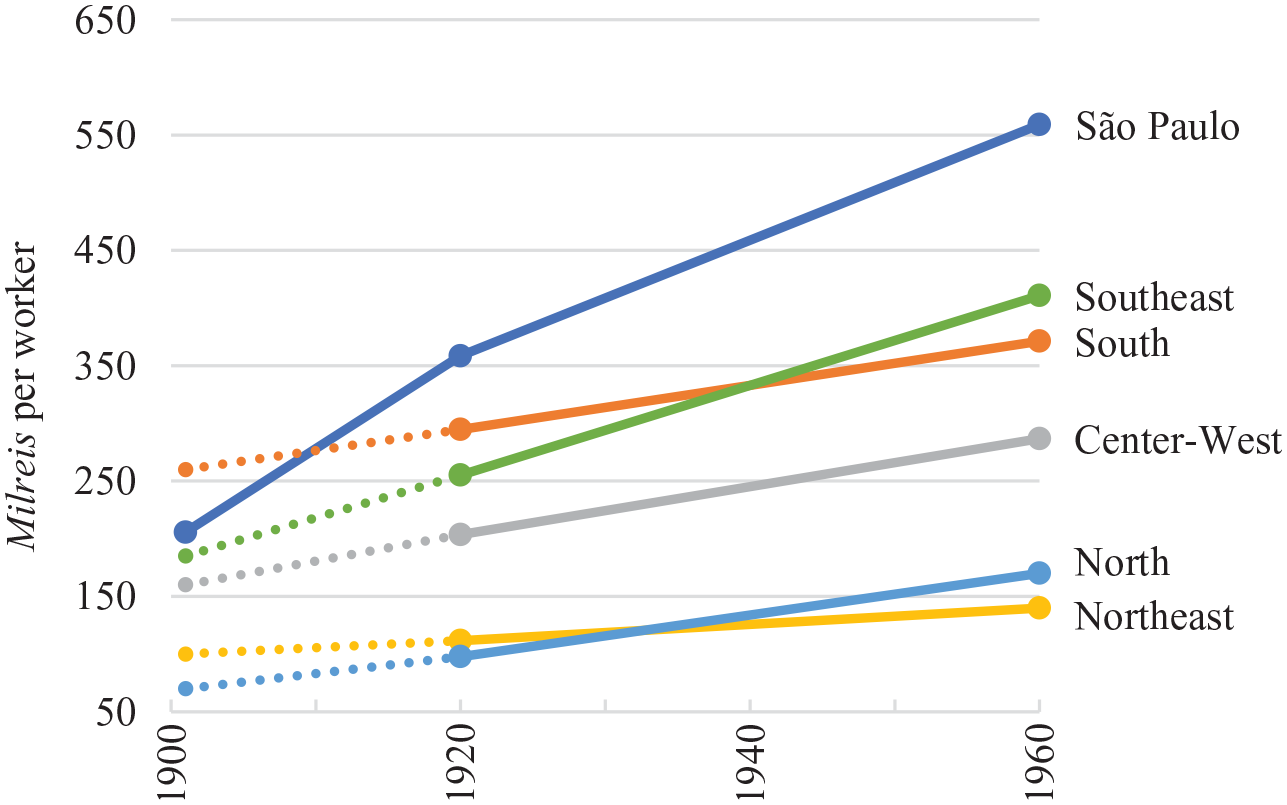
Labor Productivity in Agriculture for Major Regions of Brazil, 1900 to 1960
In other regions of the country, productivity growth was stagnant. Although there are no data prior to 1920, from 1920 to 1960 labor productivity in the Northeast grew by only about 25 percent, or .5 percent per year. In the southernmost states, it grew almost equally as slow, and in the western and northernmost regions growth was slightly faster at about 1 to 1.5 percent per year. All of these rates were far inferior to São Paulo, which grew by nearly 3 percent per year over the whole period. By 1960, São Paulo had nearly three times the national average.
This explains why industrial growth concentrated in and around the state of São Paulo. As the only region with rapidly growing agricultural productivity, it stimulated industrialization by increasing the size of internal markets for manufactured goods, by generating forward and backward linkages to various industries, and by increasing government revenues to be invested in other sectors of the economy. There is evidence that all of these were occurring as a result of the changes in São Paulo’s agricultural sector.
In terms of expanding internal markets, the new class of farmers was the primary source of growing demand. With millions headed to frontier zones to establish farms, the majority of the population growth was in the new rural zones. 17 Between 1900 and 1920, the state’s total population more than doubled, growing by about 2.3 million people (Holloway 1980:67). But very little of this growth occurred in the cities or in the traditional coffee zones. During the same period, the city of São Paulo saw its population grow by only about 340,000, and the total number of laborers on the coffee plantations grew by only 100,000 (Font 2010). Thus, the vast majority of growth was among the new class of farmers on the frontier. By 1920, agriculture was still the primary occupation of over 60 percent of the state’s population.
Rising output and productivity among this large segment of the population resulted in increased income and spending, leading to rising demand for consumer goods. As one observer noted, “the existence of so many small farms . . . results in a great benefit: the greater quantity of landowners, all bearers of wealth, bring to the urban centers their quota of efficient cooperation for the development of the town” (Caldeira 1928b:202). In many towns, “all the activity . . . including its good health and economic development [was] due to the thousands of small landowners” (Vilas Boas 1937:59). The difference was notable from more traditional regions of the state, as there was a greater “division of the wealth” and “more individual interests than [in areas with] large landholdings” (Vilas Boas 1937:60). The “influence of the small farmers” was so great that it “amazes not only Paulistas who are accustomed to booms of this sort, but any foreigner who might come to see the evolution [of these towns]” (Vilas Boas 1937:15).
Data from the 1920 industrial census show the sectors with the fastest growth during this period were those producing goods consumed by the new class of farmers, such as clothing, shoes, food, and construction materials. In 1907, there were only 9 shoe factories, 28 cloth factories, and 57 beverage manufacturers in São Paulo; by 1920, this had increased to over 500 shoe factories, 112 cloth factories, and 230 beverage factories (MAIC 1927). Of the 1,267 food industries in 1920, 80 percent were founded after 1905, and over 70 percent of the 696 ceramics factories were founded after 1910 (MAIC 1927). Other consumer goods that saw major increases were soap, candles, glass, cigars, wagons, and paint.
Industrial growth was also spurred by forward and backward linkages to the rural sector. Farmers’ increased output led to investment in new industries, including “machines for processing rice and coffee, brick factories . . . and, notably, machines for farming” (Vilas Boas 1937:102). In one frontier town “the increasing intensity of cotton cultivation . . . led a group of capitalists to become interested in setting up a cotton mill,” and in another town there were already “more than ten cotton mills, including a number of cotton gins” (Vilas Boas 1937:61). The capital invested in farm-related sectors like grain mills, vegetable oils, fertilizers, and leather tanning more than tripled between 1907 and 1920, and it more than doubled in sectors such as cotton spinning, lard production, wagon building, and butter and cheese production (MAIC 1927). Many of the earliest foundries and machine factories were also founded along the frontier to supply local industries and agriculture with repairs and replacement parts (Marson 2015).
Finally, there were also fiscal benefits associated with more productive agriculture. State and municipal taxes paid by farmers were transferred to other sectors through public investments, and this stimulated growth outside of agriculture. In frontier zones, “[t]he division of land has benefits in taxation and in overall production . . . both in monetary terms and in terms of the diversity of production” (Vilas Boas 1937:48). The increased output of thousands of new farmers meant “the municipal revenues increase[d]” and local governments had greater resources to invest in “renovations to the city,” including things like “water supply and sewage systems” and other infrastructure (Vilas Boas 1937:62). Where before there were “beat up roads, full of potholes” and everything was “left to abandon, without maintenance,” there were now “modernized highways,” “improved streets,” and new schools (Vilas Boas 1937:132–33). To contemporary observers, it was clear that “small farmers undoubtedly bring progress to a city much faster than the latifundios” (Vilas Boas 1937:14). 18
Census data show that industrial growth concentrated in parts of the country where agricultural productivity was growing. As shown in Figure 4, there was a strong relationship between labor productivity in agriculture and industrialization among Brazilian states. In 1920, states with the highest productivity were also becoming the most industrialized, in terms of manufacturing output per capita and investment per capita. The most industrialized states were São Paulo and Rio Grande do Sul, both of which had considerable sectors of the new farmer class. The states at the bottom of the scale in both manufacturing and agriculture were from the north and northeast regions of the country, where large-scale plantation agriculture continued to prevail (see Figure 4).
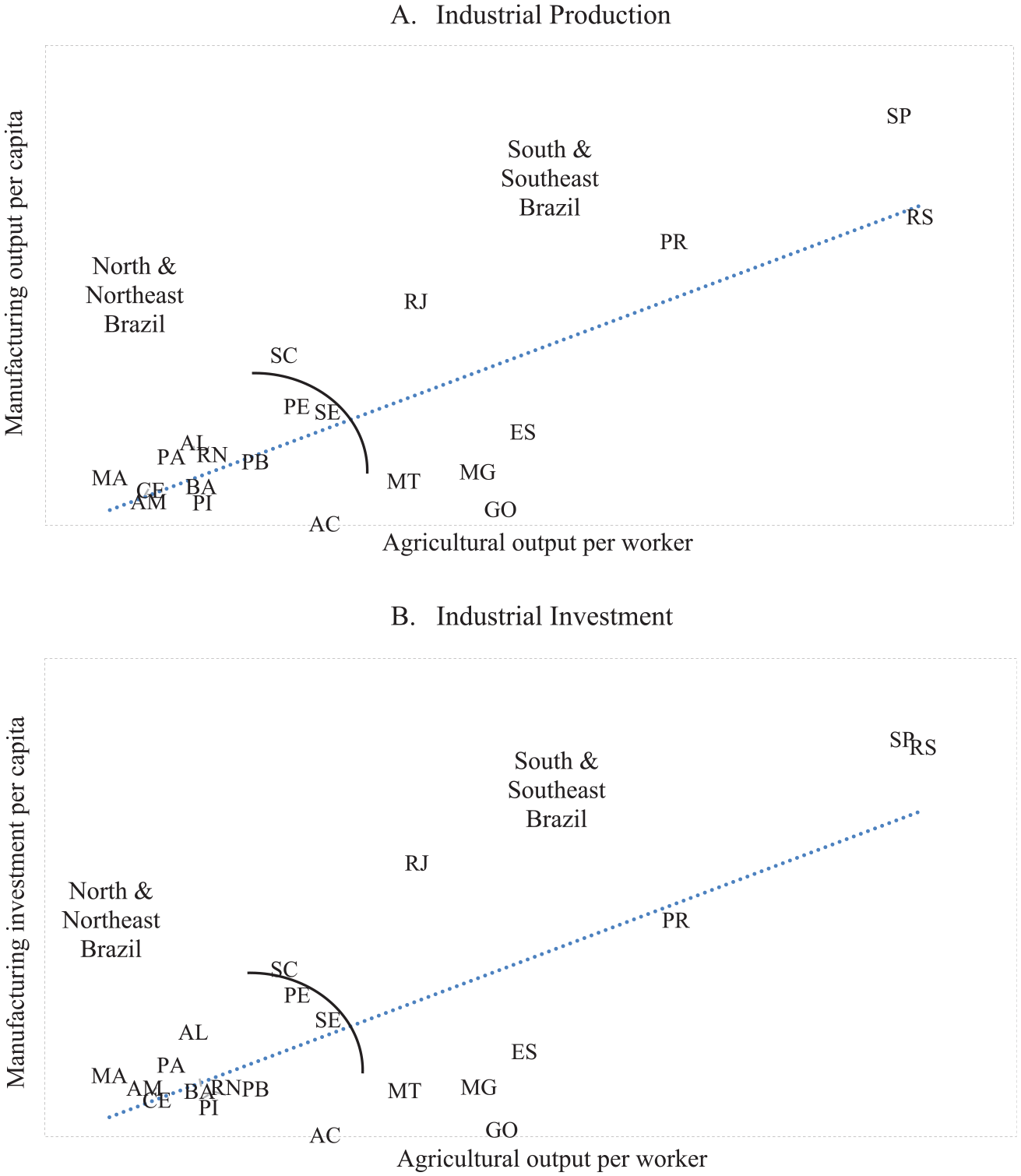
Agricultural Labor Productivity and Per Capita Industrialization in Brazilian States, 1920
This can be explained by the fact that industrial investment tends to concentrate in areas where there are larger markets for manufactured goods (Davis and Weinstein 2003; Krugman 1980). Where agricultural productivity was higher, there was greater demand for both producer and consumer goods, as farmers not only enjoyed higher incomes, but also invested more in farm inputs and improvements. Census data confirm that by 1920, farm investment and mechanization were considerably higher in São Paulo than in the rest of the country, with more than three times the value of improvements per hectare and more than four times as much machinery per hectare (MAIC 1924). Industries were more likely to locate near these centers of demand, both to achieve economies of scale in production and to minimize the costs of transporting production to market. Industries that relied on inputs from agriculture or other industries also tended to locate near their major suppliers.
São Paulo’s higher level of agricultural labor productivity and growing population gave it the largest market for manufactured goods, and it would continue to pull away from the rest of the country over the course of the twentieth century. By the 1930s, industrial investment shifted toward the production of intermediate and capital goods like cement, iron, chemicals, and equipment. In the 1940s and 1950s, major steel plants and hydroelectric power plants were built, and the range of consumer and capital goods greatly expanded, including automobiles, auto parts, petrochemicals, machines, and processed foods. By this time, São Paulo had become not only the largest industrial center in Latin America, but probably the largest anywhere in the developing world.
Rapid growth continued in the second half of the century. By 1960, São Paulo accounted for over 50 percent of the country’s industrial output, up from just 16 percent in 1907 (Rattner 1972:36). By the 1980s, industry made up more than one-third of Brazil’s gross domestic product, and manufacturing exports surpassed the value of primary good exports for the first time in history, representing a profound transformation of the country’s economy. This was partially reversed after 1980, when the country experienced a period of deindustrialization, but São Paulo still had the second largest manufacturing sector in the Western Hemisphere, second only to the United States.
Brazil’s developmental state played only a secondary role in facilitating this transformation. The basic mechanisms of industrial policy, like targeted tariffs and import controls, did not begin until the 1930s, and larger interventions, like state-owned firms, development banks, and state-led planning, did not emerge until the 1940s and 1950s (Schneider 2015; Suzigan 2000). By this time, a profound economic transformation had already occurred in São Paulo. Brazil’s developmental state did achieve many successes, but most of these took place in the second half of the twentieth century, by which time the Southeast was already a major industrial center (Evans 1995; Schneider 2015). In fact, the large industrial base that existed by this time probably made state intervention more successful, as there were greater resources to invest and greater private-sector support for the state to coordinate investments and resolve market failures. In other words, many of the successes of Brazil’s developmental state were greatly facilitated by the underlying economic processes already underway from the early-twentieth century.
This is not to say the state did not play any role in the early changes. As noted earlier, state policies were geared toward securing immigrant labor for the coffee sector, and by subsidizing immigration, the state helped facilitate new property relations in the countryside. State agencies also played a role in improving working conditions on coffee plantations, allowing immigrant workers to have greater social mobility and to eventually become independent landowners. Growing tax revenues were also invested into infrastructure and supports for the coffee sector, which aided the development process in various ways. Yet, the intention behind these policies was not to promote agricultural or industrial transformation. Rather, state policy was geared toward maintaining the basic conditions needed by the coffee economy. The new agrarian economy and subsequent industrial growth were largely unintended byproducts.
Moreover, although the Brazilian state is often credited with facilitating the country’s industrialization, it was largely unsuccessful at doing this in other regions of the country. In the highly populated northeast region, the state made considerable efforts to promote development in the second half of the century. In 1959, a government agency (SUDENE) was founded with the sole purpose of stimulating growth and promoting industrialization in the Northeast. Tax breaks and other subsidies encouraged industries from the southern regions to relocate to the region. Yet, these efforts had only limited effects, and the northern parts of the country experienced considerably less economic diversification. In the next section, I analyze the Northeast’s distinct development path and show that the specific rural property relations that developed there are fundamental for understanding its relative underdevelopment.
The Agrarian Roots of Underdevelopment in Northeast Brazil
At the beginning of the twentieth century, northeast Brazil was not far behind the rest of the country in terms of its economic development. With a population of 7 million, it was the second largest region in the country, only slightly behind the Southeast with 8 million people (IBGE 2009b). About two-fifths of the country’s population lived in the Northeast, and it accounted for about one-fifth of all industrial production (MAIC 1927). The cultivation of cotton made it an early center of textile and clothing production, and many of the nation’s first cotton mills were established there in the late-nineteenth century.
However, regional disparities became more acute in the twentieth century. While the Southeast transformed into the largest industrial center in Latin America, the Northeast experienced little economic diversification and remained highly dependent on agricultural exports. By 1940, its share of industrial production had declined to just 12 percent, and in the 1960s it reached as low as 6 percent (IBGE 2009b). By the end of the century, the Northeast had about 50 million people, compared to 70 million in the Southeast, but it had only one-sixth the manufacturing output of the Southeast, and only one-third the income per capita (IBGE 2009b). Poverty, infant mortality, and life expectancy were all considerably worse in the Northeast, despite millions of people fleeing south in the second half of the century.
The major explanations for the region’s underdevelopment focus on its climate, unfavorable trade relationships, and deficiencies in human capital (Barros 2011). Much of the Northeast is not well-suited for cultivation and stricken by periodic droughts and floods. In addition, the region has long been integrated into the world economy as a primary exporter, exporting sugar and importing high-priced manufactures from abroad and other regions of the country. Lower levels of education, a less skilled workforce, and a higher proportion of the lowest social strata are also seen as factors affecting its development.
However, these should be seen more as consequences rather than causes of the region’s underdevelopment. With limited industrialization and diversification of the economy in the twentieth century, it is logical there would be a higher proportion of unskilled labor and less social mobility in this region. Lower per capita income has led to worse education outcomes, as reduced tax revenues leave fewer resources to invest, and lower social and cultural capital are passed from one generation to the next. With few economic opportunities, it is no wonder a majority of the region’s poor remained trapped at the bottom of the social hierarchy, with little choice but to migrate to more developed regions of the country.
Meanwhile, many of the climate-related problems could have been resolved with greater investment and technology. Many places that receive less annual rainfall than Brazil’s Northeast, such as Israel and California, have managed to develop highly productive agriculture with the use of irrigation and dryland crops. Yet, landowners in the Northeast have long resisted adopting these improvements, despite considerable efforts by the state to promote them. Even in areas more conducive to cultivation, a general lack of investment has stunted agricultural development. Some of the poorest regions in the Northeast have excellent conditions for cultivation, yet they are even poorer than those with large arid areas, thus contradicting climate or geography as the explanation. 19
The region’s position in the world economy is also not an adequate explanation for its lack of development. As noted earlier, both northeast and southeast Brazil began as agricultural economies, highly dependent on primary exports and imported manufactures. Yet the southeast’s development over the course of the twentieth century greatly changed its position in the global hierarchy. By the second half of the century, manufacturing exceeded primary goods exports, and the region occupied a higher position in the division of labor as a high-tech industrial center.
In other words, to understand why the Northeast did not follow the same path as the Southeast requires an analysis of its failure to industrialize. As we have seen, industrialization concentrated in regions with higher agricultural productivity. Yet, productivity growth in the Northeast was very slow in the twentieth century. This was due to the underlying agrarian economy that persisted relatively unchanged throughout this period. A history of land appropriation by elites, characterized by a lack of market relations, led to low rates of investment in agriculture, resulting in lackluster industrialization.
Land Appropriation
Unlike southeast Brazil, the Northeast did not experience a major transformation in the rural sector in the twentieth century. Large plantations remained dominant along the coast, and subsistence-based smallholders and extensive grazing covered the landscape further inland. The primary forms of land settlement and occupation did not change much from the nineteenth century: wealthy elites concentrated an ever-greater amount of land in their hands, and smallholder farming saw only limited development. The methods and technology used in production changed very slowly over the years, leading to slow growth in labor productivity.
The primary catalysts behind rural transformation in the Southeast were absent in the Northeast. There was no rapidly expanding agricultural frontier, and therefore no labor scarcities. Most of the best land in these states had long been grabbed up by sugar planters and cattle ranchers, and local population growth was more than sufficient to supply their labor needs (Andrade 1961; Eisenberg 1974). This meant there was little reason to bring in immigrant labor after the end of slavery, or for immigrants to head to the Northeast in search of land in the early-twentieth century. In fact, the Northeast had long supplied excess laborers to the southern regions of the country, and this continued throughout the twentieth century.
Therefore, while waves of immigrants spurred a transformation of agriculture in the Southeast, in the Northeast the rural sector underwent relatively little change in the twentieth century. Perhaps the most important change was the transition from the rudimentary sugar mills (engenhos) of colonial times to the more modern steam-driven mills (usinas) in the first decades of the century. This change in technology, bankrolled by government grants and subsidies for large landowners, led to a new process of land appropriation (Eisenberg 1974; Santos-Gareis 2003). With the capacity to process more cane, the usinas had an interest in acquiring more land, and therefore began absorbing the many smaller plantations around them. Over time, this led to massive productive units in which each usina controlled tens of thousands of hectares surrounding their mill, and the smaller engenhos slowly disappeared.
As a result, land concentration in the hands of elites continually worsened in the first half of the century. Large farms expanded their control over more and more land, and small farms were constantly squeezed. There are no reliable statistics from the early decades, but from 1940 to 1960, large farms of over 500 hectares increased their percentage of total land area from 34 to 47 percent, and average farm size increased from 1,000 hectares to 1,400 hectares (IBGE 1950, 1966). Farms of under 100 hectares more than doubled in number while maintaining the same percentage of land area (23 percent). This meant the average plot size decreased from 16 hectares to 11 hectares between 1940 and 1960, and on farms under 10 hectares it decreased from about 4 hectares to under 3 hectares (IBGE 1950, 1966).
This process generated considerable resistance from the peasantry, and class conflict came to a head in the 1960s. Popular pressure for agrarian reform reached a critical point with the growth of Peasant Leagues and the election of leftist state governors (Pereira 1997). However, any hopes for land reform or changes to elite control in the countryside were dashed in 1964, when a military coup ousted the leftist leaders and brutally repressed popular movements. A military dictatorship rolled back land reform legislation, and the land structure went largely unchanged for the rest of the century. Unlike in the Southeast, where plantation agriculture was replaced by a dynamic sector of smaller commercial farms, in the Northeast the large plantations solidified their control in the twentieth century, and this greatly affected the rural productive logic.
Rural Productive Logic
The lack of any significant reforms meant the underlying relationships between landowners and the land also went largely unchanged. The transition to the usinas at the beginning of the century created a new wave of land transactions, but this was led by wealthy elites who did not depend on improving efficiency or the productivity of the land. Most usina owners were descendants of colonial landholding families, with considerable wealth and businesses in the cities (Andrade 1989; Moura 1998). This allowed them to engage in market opportunities by buying and selling land and investing in various businesses, but they were seldom subject to market imperatives that would force them to maintain a competitive level of output. 20 This was true not only in the sugar zone, but also with other activities, like the extensive cattle grazing in the interior (Bicalho and Hoefle 1990).
Large landowners in the Northeast continued to use their land much like the old plantations in the Southeast, channeling investment away from productivity and leaving the land under low-productivity activities. State officials in the first half of the century continually criticized the usinas for having “terribly low yields” and being “still 50 years in the past” (De Carli 1942:61). “[L]ong-term investment for the purpose of increasing long-term profits” was uncommon, and most landowners “prefer to use surplus funds for non-productive purposes . . . not need[ing] to worry about long term-profits” (James 1953:102). According to one official, “nothing changed, the planting was the worst possible, the methods were very traditional. . . . No one thought seriously about returning to the soil any of what the exploitation during generations had taken from it” (De Carli 1942:61).
This same basic logic continued in the second half of the century. There were some improvements in crop varieties and methods, but by the 1960s average yields in the sugar sector were still around 35 tons per hectare, little better than 50 years before. 21 In São Paulo, yields were nearly twice as high, and in other sugar-producing countries they reached four or five times as high. Throughout the 1960s and 1970s, state officials repeatedly urged landowners to invest in irrigation, improved varieties, and mechanization. Studies showed that doing so could double or triple yields and greatly increase their profits. 22 However, landowners resisted doing so, arguing that adopting the improvements would require “unnecessary expenses.” 23 By the end of the century, most usinas still did not use widespread irrigation or mechanization, and yields continued to be much lower than in other parts of the world (CGEE 2008). Large landowners continued to use much of their land as “low-risk, low-income investment” and diverted profits to “other more lucrative investments like urban and rural land speculation” (Bicalho and Hoefle 1989:43).
Smallholders also experienced little modernization during this time. Unlike in the Southeast, small holdings in the Northeast were generally appropriated outside of market mechanisms, with their owners either squatting on unused land or purchasing it without legal title (Rodrigues and Rollo 2000:11). With no influx of immigrants in search of land, large landowners in the Northeast saw little benefit to dividing up and selling off their land, and land markets were slow to develop. When land was purchased on the market, it was seldom done on credit, as small holdings were not accepted as collateral on loans (Rodrigues and Rollo 2000:23). This resulted in limited development of commercial agriculture, as there was little to push smallholders to specialize for the market or maximize productivity. Instead, they minimized risk by engaging in subsistence production, with little investment in new methods or technology.
At the end of the twentieth century, small farmers in the Northeast were described as “very cautious, often not wanting to take out new loans, and, as a result, do not make new investments in productive improvements” (Rodrigues and Rollo 2000:23–32). Instead of maximizing productivity, “many small producers opt for crops with low production costs that require a lower level of investment and less risk” (Rodrigues and Rollo 2000:23–32). Most small farmers in the Northeast have still not adopted mechanization, fertilization, or irrigation, and they are characterized by a “low level of technology” with “minimal investment” in their production methods (Almeida et al. 2006).
All of this translated to significantly lower levels of productivity in the Northeast. As shown in Table 1, total output per worker in 2006 was less than one-fourth that of the Southeast, and less than one-seventh that of the Center-West. Although it had nearly half the farms and agricultural workers in the country, the Northeast produced only about 17 percent of the total agricultural output. In contrast, the Center-West became an agricultural powerhouse in the second half of the century, as São Paulo’s dynamic frontier continued westward. 24
Low productivity agriculture made the northern regions of the country less conducive for industrial growth. The persistence of the plantations and the squeezing of smallholders left the majority of the population with little disposable income (GTDN 1967:50). Low productivity translated to lower income for rural workers and higher food costs for urban workers, thus negatively affecting the size of consumer markets (GTDN 1967:59). This provided less incentive for industries to locate in this region: though labor was cheaper, the primary consumer markets were far away in the southern regions of the country. As one government report concluded, “the weakest point for industries in the Northeast resides in the region’s agriculture” (GTDN 1967:60).
Whereas industrial growth was surging in the Southeast, the Northeast saw only modest growth. Although it was an early center of textile and clothing production, by 1920 the Northeast was surpassed by the rapid growth in São Paulo. In 1907, there were 45 textile factories in the Northeast compared to only 28 in the state of São Paulo. By 1920, 84 new textile factories opened in São Paulo compared to only 5 in the Northeast (MAIC 1927). Other sectors that once held a lead were also quickly surpassed, including cotton milling, shoes, and cigars. Between 1920 and 1940, the total number of new industrial firms created in São Paulo surpassed 10,000, while in the Northeast it was only about half that number (IBGE 1950). The region’s industrial base also remained heavily concentrated in basic sectors like textiles and food processing, with almost no investment in more advanced capital goods sectors.
In the second half of the century, the federal government made several interventions to address the problem. The development agency SUDENE was formed to channel investment into the region, and federal tax incentives were adopted to encourage industries to locate there. The state also made a number of interventions in agriculture, building dams for irrigation and subsidizing improvements in technology in an attempt to raise productivity (Pereira 1999). The economic successes of the southern regions of the country made the regional disparities increasingly stark. But they also provided the federal state with greater resources to tackle the development problems of the northern regions.
By the 1970s, a number of industries began to relocate to the Northeast, and there was considerable growth in sectors like construction, soft drinks, food, clothing, and other consumer goods (Diniz and Basques 2004:27). Taking advantage of the tax benefits, firms from the southern regions of the country opened branches in the Northeast to supply the local market. However, due to relatively weak demand, many industries could not achieve economies of scale and were uncompetitive against “imports” from the Southeast (Diniz and Basques 2004:39). For more advanced capital-intensive industries, there were still insufficient incentives to relocate to the region, as the distance from consumer markets is a crucial factor for these kinds of activities. By the end of the century, the industrial sector remained limited to consumer and intermediate goods industries, often dependent on state subsidies for their survival (Brandão 2004).
Today, the Northeast is still vastly less industrialized than the rest of the country. As the second most populous region, it makes up only about 10 percent of all manufacturing output and has only one-sixth the production of the Southeast region. In per capita terms, it is less than one-fourth as industrialized as the South and Southeast and has only one-third the national output per capita (see Table 2). In recent years, there has been important industrial growth with the development of shipbuilding, petrochemicals, and automobiles, but beyond the principal metropolitan areas the economy remains largely undiversified. Primary goods like wood, fruit, sugar, and minerals still make up around 80 percent of the region’s exports, and capital-intensive manufactures account for only about 5 percent (IBGE 2009b). Thus, the region is still largely dependent on primary exports, with most manufactures still “imported” from the southern regions of the country.
Manufacturing Value Added (MVA) by Regions of Brazil, 2012
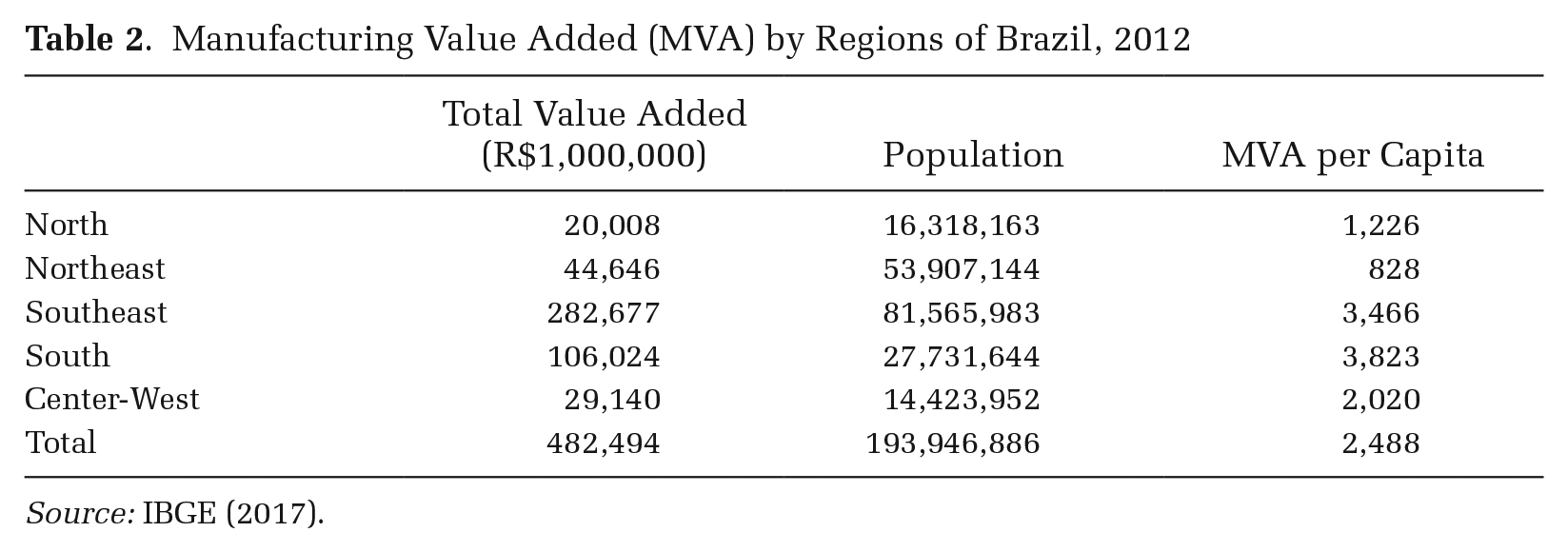
Source: IBGE (2017).
The Northeast was largely unable to escape its subordinate position in the global economy in the twentieth century. This was not due to effects of international trade or the draining away of resources to wealthier regions (although these had an impact), nor was it due to certain state institutions or state–capital relations that failed to facilitate industrial growth. The underlying reason was the low-productivity agricultural sector, a product of the specific rural property relations and logic of production that developed here historically. This limited industry–agriculture linkages and restricted the growth of consumer markets, thus greatly undermining the possibilities for industrialization.
Conclusions
The Brazilian case demonstrates the importance of agrarian dynamics in understanding divergent processes of economic development. The variations in the rural economy are central to explaining not only why industrialization advanced so far in one part of the country, but also why it failed to occur in less developed regions like the Northeast. Important differences in the rural property relations from one region to the next led to distinct productive logics and investment patterns in agriculture, and this greatly affected economic and industrial growth. The changing rural dynamics also explain the timing of industrialization at the beginning of the twentieth century, and why so little industrial growth occurred before that point.
What are the implications of this for understanding development processes in other parts of the world? It seems clear that agrarian dynamics can explain much that cannot be accounted for by the mainstream approaches. This includes not only regional divergences within countries, as in the case of Brazil, but also larger development differences throughout the developing world. Across Latin America, industrialization has been much more robust in countries that have higher agricultural productivity, such as Argentina and Chile, and more limited in countries with lower productivity, such as Colombia and Peru. Indeed, areas of the developing world with the lowest productivity in agriculture are also among the lowest in terms of manufacturing per capita (see Figure 1).
These divergences are not well-explained by the global economy or developmental state approaches. As shown in the case of Brazil, the constraints of the global economy cannot account for why some places, like southeast Brazil, managed to industrialize and move up the ladder of global production, while others, like northeast Brazil, remained trapped at the bottom. Indeed, a country’s position in the division of labor can be explained as much as a result of its development path as its cause, as successful industrialization reduces dependence on primary exports and improves a country’s position in the world economy. Why some countries have been more successful at this than others cannot be adequately explained by global economic forces and the constraints of international trade. Rather, it requires a deeper analysis of the economic and social relations in each place.
The developmental state approach takes an important step in this direction. Yet, it is still inadequate in many respects. Though scholars have demonstrated the importance of strong state intervention in many late developers, this is not adequate for understanding the wide range of distinct outcomes across the Global South. As noted earlier, there are numerous examples of countries with “weak” states, such as Pakistan or Argentina, that are nearly as industrialized or more industrialized than countries considered to have stronger developmental states, like Brazil or India. There are also large differences between countries with similar state structures, and between regions of the same country. These kinds of empirical details cannot be adequately explained through an analysis of state institutions and their developmental capacity.
In many cases, an analysis of the agrarian context can provide an important piece of the puzzle. Where capital-intensive commercial farming has reached a higher level of development, agricultural productivity tends to be higher, and this creates a greater stimulus for industrial growth and economic diversification. Where this kind of agriculture has been more limited, the state’s efforts to spur industrial growth are greatly hindered. This would explain why a country like Argentina, with more developed commercial agriculture and high agricultural productivity, has among the highest manufacturing output per capita in the developing world. It also can explain why a country like India, which has very limited development of commercial agriculture and low agricultural productivity, has far lower manufacturing per capita, despite a more capable developmental state.
Finally, an agrarian perspective can open greater avenues for addressing many of the problems related to underdevelopment in the Global South. Where other approaches see developing countries as trapped at the bottom of the global economy (Selwyn 2014) or “locked in place” due to intractable state–capital relations (Chibber 2003), an agrarian approach can offer more concrete solutions for promoting economic development. By understanding how rural property relations shape investment patterns and technical change in agriculture, developing countries can make reforms geared toward altering the property relations in the countryside and facilitating a shift in rural productive strategies. Of course, this will depend on having a certain level of state capacity and autonomy from rural elites, but by transforming the incentives for rural producers through land reform combined with market mechanisms, it can spur rapid productivity growth and stimulate larger changes across the broader economy. In other words, greater attention to the internal dynamics of rural society can provide not only a better understanding of divergent development, but also more viable solutions.
