






Abstract
This article draws on in-depth interviews with 50 U.S. servicewomen to advance sociological understandings of gender, femininity, and harassment. Recognizing that women are targeted with harassment throughout their military careers, I analyze specific episodes of harassment to examine organizational and interactional meanings and the power dynamics embedded in these instances. This article explains why servicemen escalate harassment toward women who are pregnant or who enter heterosexual relationships. In a militarized context that already denigrates femininity, I argue that men impose gendered and sexualized meanings on women’s life-course events to limit women’s organizational inclusion. These events, such as pregnancy and engagement or marriage to a heterosexual partner, serve as “femininity anchors” that tether women to femininity within a hyper-masculine environment. Femininity anchors present serious interactional and individual consequences for women as they attempt to navigate the gendered terrain of the U.S. military. Aside from eliciting moments of elevated sexual and nonsexual harassment, femininity anchors restrict women’s acceptance as real servicemembers and negatively affect their military careers. In highlighting the negative treatment women receive due to femininity anchors, I demonstrate how the specific ways gender is embedded in an organization shapes patterns of harassment and exclusion.
Military sexual assault and harassment have long made headlines in U.S. news reports. From the 1991 Navy Tailhook sexual assaults to the sexual harassment and murder of Vanessa Guillén in April 2020, every U.S. military branch has been implicated in issues of harassment. A recent Department of Defense (2020) report showed an increase in estimated sexual assault and sexual harassment incidence from 2016, indicating the military’s ongoing issues with sexual abuse. Much of the research in this area takes the broad approach of cataloging various forms of harassment and demonstrating that military sexual abuse frequencies are high (Bostock and Daley 2007; Harris, McDonald, and Sparks 2018; Sadler et al. 2003; Settles, Buchanan, and Colar 2012; Turchik and Wilson 2010). My research instead focuses on the interconnected processes of harassment at the organizational and interpersonal levels.
I focus on the puzzle of how sexual abuse remains highly prevalent in an organization that has long-standing and evolving policies, prevention strategies, and education programs that address sexual violence as well as victim services and legal assistance. What processes and mechanisms sustain sexual violence vulnerability, and what institutional and interpersonal factors contribute to harassment? How do organizational values and meanings around gender, masculinity, and femininity shape harassment and broader workplace experiences? I answer these questions and advance the literature by analyzing moments where servicewomen described elevated harassment, and centered these experiences as the unit of analysis. Episodes of elevated harassment are rich data points that uncover organizational and interactional gendered meanings and dynamics, and emphasize the ways organizational culture facilitates harassment. I find that flashpoints of harassment occurred when women’s relationships with men were revealed to other servicemembers and when women were pregnant. I argue that heterosexual dating, engagement, and pregnancy operate as “femininity anchors” that tether women to emphasized femininity (Connell 1987). These “femininity anchors” weigh down women’s careers and can lead to sexual and nonsexual harassment 1 from other servicemembers.
Prior research has examined how women display gender to navigate masculine organizational contexts, how women engage in “gender maneuvering” (Schippers 2002), and how men respond to women’s gender performances in the workplace and other organizational contexts (Cohn 2000; Ezzell 2009; King 2016; Prokos and Padavic 2002; Rabe-Hemp 2009; Sasson-Levy 2003; Silva 2008; Yoder and Berendsen 2003). This research typically explores how women navigate masculinity and masculine organizational contexts, leaving femininity under-theorized (Schippers 2007). Especially underdeveloped in the empirical literature are specific processes of feminization in organizations. In this article, I use interviews with 50 servicewomen to examine how masculinity and femininity operate in the military context. I show how a hyper-masculine and femmephobic (Hoskin 2017) organizational context creates localized meanings for masculinity and femininity that shape harassment vulnerability. In doing so, I outline a feminization process that explains when and why incidents of workplace harassment escalate.
I build on previous scholarship showing that gender is embedded in organizational policies, practices, processes, and interactions (Acker 1990; Britton 1997; Martin 2004; Risman 2004). Research on gender and organizations has found that women in masculine occupations are often portrayed as outsiders and that they develop interactional strategies to attempt inclusion. In the military, women may try to cultivate a military identity and portray themselves as appropriate servicemembers, a difficult task because the ideal servicemember is associated with “warrior masculinity,” a form of Connell’s hegemonic masculinity (Barrett 1996; Basham 2009; Bonnes 2020; Hale 2008, 2012; Hinojosa 2010; Steidl and Brookshire 2018). I suggest that in this hypermasculine context, displays and associations with femininity are denigrated in ways that shape sexual harassment vulnerability. Despite being rewarded and celebrated in other contexts, emphasized femininity (Connell 1987) is met with disdain in the military. I find that servicewomen tied to this identity are victims of interactional consequences and increased harassment, complicating prior understandings of this concept.
Specifically, I show that in the hyper-masculine military space, associations with femininity are denigrated as a way for servicemen to enact their own masculinity. In doing so, I provide an empirical example of the relational components of hegemonic masculinity as they unfold in harassment. Servicemembers attach gendered meanings to life-course events like heterosexual relationships and pregnancy in a way that tethers women to emphasized femininity. I demonstrate how men engage in increased objectification and sexual harassment of women when it is revealed women are in relationships with men. Heterosexual women often benefit from heterosexual privilege, but in the military context, heterosexuality attaches women to the stigma of femininity, and servicemen respond by sexually objectifying and harassing them.
I also find that women experience elevated or more frequent nonsexual harassment during pregnancy. Examples of nonsexual harassment include sexist comments, comments denigrating the pregnancy, pressure to terminate the pregnancy, and bureaucratic harassment (Bonnes 2017) in the form of preventing women from accessing policies designed to accommodate pregnancy. I argue that pregnancy anchors women to emphasized femininity, and men respond with increased nonsexual harassment in an effort to polarize notions of the ideal mother versus the ideal worker (Byron and Roscigno 2014; Glass and Fodor 2011; Ridgeway and Correll 2004).
Previous scholarship has focused on how women navigate masculine workplaces through gender identity work. Specifically, women try to display and embody masculinity and downplay femininity in attempts to gain inclusion (Crowley and Sandhoff 2017; Rabe-Hemp 2009; Sasson-Levy 2003; Schippers 2007; Silva 2008; Steidl and Brookshire 2018). Research on identity work finds that individuals with social and organizational power, usually men, also have power in interactional settings and can confirm or deny the gender identity work of those with less power (Cast 2003; Stets and Burke 2005). Men might confirm women’s masculine identity work and grant them status as “honorary men” (Höpfl 2003; Kanter 1977; King 2016; Miller and Brunson 2000), deny their masculinity identity work, or reframe their masculinity displays as feminine and cast women into “pariah femininities” (Schippers 2007).
I extend this scholarship by identifying femininity anchors as a form of feminization that occurs despite gender identity work. Even if women are downplaying femininity or invoking masculinity, men’s perceptions of women’s relationships with men and their pregnancies tie women to femininity. I show how the interplay of these individual, organizational, and interactional factors further reveal the scope of men’s power in the gender order: servicemen’s interpretations of women’s heterosexual relationships and pregnancies matter more than women’s gender identity work or their own interpretations of these events. Overall, femininity anchors tether women to emphasized femininity despite their gender identity work, invite sexual and nonsexual harassment, weigh down women’s careers, and impede women’s inclusion in the military organizational culture.
Masculinity and Femininity
Research on gender and the military has identified “warrior masculinity” as a dominant military identity (Barrett 1996; Bonnes 2020; Enloe 2000; Hale 2008, 2012; Hinojosa 2010). Warrior masculinity is related to Connell’s (1987, 1995, 2005) concept of “hegemonic masculinity.” Premised on the idea that hegemonic masculinity is created and maintained in interaction, Connell (2005) defines it as a set of behaviors, practices, and processes that privileges a specific kind of masculinity in a given context, and legitimates unequal gender relations between men and women. Hegemonic masculinity is constructed in relation to all femininities and non-hegemonic masculinities to reveal a gendered hierarchy (Connell 1987, 2005; Connell and Messerschmidt 2005; Messerschmidt 2018; Pyke 1996).
In conceptualizing hegemonic masculinity, Connell (1987) outlined the concept of emphasized femininity, understood as forms and displays of femininity that complement and are compliant with hegemonic masculinity (see also Connell and Messerschmidt 2005; Messerschmidt 2018). In accommodating the interests of men in a given context, emphasized femininity helps legitimate the unequal gender order and the subordination of women to men. Emphasized femininity often aligns with the ideal version of womanhood in a given context and is the version of femininity women are expected to perform, revealing a hierarchy of femininities (Collins 2004; Hoskin 2017; Schippers 2007). Emphasized femininity (or what Hoskin [2017] calls “patriarchal femininity”) is not static: it usually converges with existing power structures such as race and class, thereby privileging heterosexual, able-bodied, White, affluent ciswomen (Collins 2004; Hoskin 2017). When women embody emphasized femininity, they usually receive interactional benefits (e.g., status, popularity, or protection from harassment) for acquiescing to men’s dominance and the existing gender order (Collins 2004; Hamilton et al. 2019; Hoskin 2017; Schippers 2007). When women embody masculinity or forms of femininity that deviate from emphasized femininity, they are often punished through harassment, discrimination, ostracization, or violence (Collins 2004; Hoskin 2017, 2019, 2020; Schippers 2007).
Hoskin (2017, 2019) argues that “femmephobia,” or the systemic devaluation of femininity, maintains the unequal gender order by imposing and policing boundaries around femininity and “proper womanhood.” Femininity that does not complement hegemonic masculinity is challenged, reprimanded, and contained by a variety of interactional strategies, such as coercive language and feminizing insults and jokes (Hoskin 2019). Schippers (2007) argues that when women enact masculinity, they question the unequal gender order and threaten men’s exclusive access to hegemonic practices and benefits. Therefore, women who invoke characteristics associated with hegemonic masculinity are cast into “pariah femininities,” and their masculinity displays are feminized to maintain men’s dominance over women (Schippers 2007). For example, when women display aggression, they might be labeled “bitches”; when women express interest in sex, they might be labeled “sluts”; and when they express sexual desire for women, they might be labeled “dykes” (Archer 2012; Schippers 2007). It is well established that women who embody pariah femininities suffer consequences, such as ostracization, harassment, and abuse, that reinforce the subordination of femininity to masculinity. In this article, I show how the organizational devaluation of femininity also produces consequences for women who embody what would be considered “proper womanhood” in many other contexts, that is, “emphasized femininity.”
The Military Context
Hegemonic masculinity and emphasized femininity are not fixed concepts; rather, they are based on social location and context (Connell 2005; Messerschmidt 2018). The military has been conceptualized as a gendered institution (Acker 1990) that devalues associations with femininity and encourages a “warrior masculinity,” which rewards servicemembers who display aggression, control, dominance, physical strength, and violence (Bayard de Volo and Hall 2015; Bonnes 2020; Callahan 2009; Enloe 2000; Hale 2008; Higate 2002; Hinojosa 2010). Due to femmephobia, associations with femininity are often used to insult or humiliate men and women (Hoskin 2019). For example, in military training, servicemembers direct feminine insults at men who cannot keep up physically, labeling them “girls” or “pussies” to challenge their masculinity (Barrett 1996; Bayard de Volo and Hall 2015). The derogatory use of feminine terms for men who underachieve both affirms the masculinity of those who perform well and maintains the subordination of femininity to masculinity (Barrett 1996; Hoskin 2019).
In traditionally masculine settings, men might derive some of their identity through the notion that the work they do is masculine and thus different from and better than women’s work (Bayard de Volo and Hall 2015; Schrock and Schwalbe 2009). When women enter traditionally masculine spaces, some men respond by increasing their displays of masculinity (Prokos and Padavic 2002). Men might point out flaws of women in the workplace, show disdain for femininity, and make claims that women do not belong to accentuate perceived differences between men and women and to reassert the space as masculine (Ainsworth, Batty, and Burch 2014; Bayard de Volo and Hall 2015). This can explain why the integration of women into the military has historically been met with resistance, including claims that women will weaken the military (Bayard de Volo and Hall 2015; Winslow and Dunn 2002). For instance, the last all-men class in the Air Force Academy (Class of 1979) call themselves the “LCWB” or the “Last Class with Balls” (Bayard de Volo and Hall 2015). The LCWB moniker demonstrates pride in an all-men class that is seen as more masculine, and therefore better than the mixed-sex classes that would follow. Women’s presence in the military, and now in combat occupational specialties, challenges the idea of the “masculine warrior” (Hale 2012; Martin and Jurik 2007; Prokos and Padavic 2002; Woodward and Winter 2004). This article looks at episodes of elevated harassment to further untangle the gendered meanings and gendered power dynamics in the military context.
Sexuality and Masculinity
Sexuality is an important component of how men construct masculinity and manage their gender identities. Men “do heterosexuality” in a variety of ways, such as using overtly sexual language, having and bragging about sex with women, and by sexually objectifying women (Archer 2012; Hennen 2001; Sasson-Levy 2003). Men also construct masculinity through homophobia (Allsep 2013; Banner 2012; Connell 1995; Denissen and Saguy 2014; Pascoe 2005). For example, in an examination of “gendered homophobia” among high school boys, Pascoe (2005:337) argues that “fag” is a “generic insult for incompetence” but is used especially when boys display behaviors not associated with masculinity. By labeling other men “gay” and thus weak, feminine, and powerless, men distance themselves from the label to construct their own masculinity (Pascoe 2005). Similarly, men use heteronormativity to assert masculinity by posturing against their women colleagues in women-dominated organizations (Dellinger 2004) or to neutralize the threat of women in traditionally masculine spaces (Denissen and Saguy 2014). Denissen and Saguy (2014) find that men working in building trades direct homophobic comments to both gay and straight women co-workers. They argue that tradesmen label their co-workers lesbians to question their status as women and maintain the idea that their work is still inherently masculine. Portraying lesbians as not real women reinforces men’s dominance in the workspace by classifying job-related success as masculine. Not only does this conflate sexuality and gender, but it devalues both homosexuality and femininity.
Heterosexuality is usually a compulsory marker of hegemonic masculinity (Connell 1995; Denissen and Saguy 2014; Pascoe 2005) and emphasized femininity (Hoskin 2019), as gender hegemony and sexual hegemony are mutually dependent (Butler 1990; Collins 2000; Ken and Helmuth 2021; Messerschmidt 2018; Schilt and Westbrook 2009; Schippers 2007). Even though women are subordinated to men in the gender order, they can receive some benefits, such as status and power over other women, by complying with hegemonic masculinity through heterosexuality (Collins 2000; Hamilton et al. 2019). Previous scholarship shows harassment is often used to punish femininities that deviate from complementing hegemonic masculinity, suggesting women who comply are protected from this treatment (Hamilton 2007; Hoskin 2019, 2020; Payne 2010; Schippers 2007; Stone and Gorga 2014). However, I show that in an organizational space where femininity is significantly devalued, women are penalized for displaying heterosexuality, because this marker of emphasized femininity tethers them to the stigma associated with femininity in a hyper-masculine space.
Women, Work, and Organizations Dominated by Men
Previous scholarship demonstrates that organizations are not gender-neutral: gender is entrenched in organizational practices and interactions (Acker 1990; Martin 2004; Risman 2004). Femininity and workplace competency are often constructed in opposition to one another, and women in masculine occupations are frequently ostracized (Byron and Roscigno 2014; Denissen and Saguy 2014; Ridgeway 1997; Ridgeway and Correll 2004). For example, pregnant women can be targets of workplace ostracization and discrimination due to gendered notions of productivity that suggest pregnant employees and mothers are antithetical to the “ideal worker” expectation (Byron and Roscigno 2014; Glass and Fodor 2011; Ridgeway and Correll 2004). Gendered organization scholarship highlights how workplace inequality is perpetrated at the structural level (i.e., in hiring, evaluation, compensation, firing, and access to organizational power) and the interactional level (Martin 2004; Ridgeway 1997; Risman 2004). My research builds on this literature by showing how moments of elevated harassment reveal organizational, interactional, and individual gender dynamics. I highlight episodes of harassment and extend Hoskin’s (2017, 2019, 2020) concept of “femmephobia” to the organizational level by showing how femininity anchors can trigger femmephobic responses.
Gendered workplace assumptions are amplified in workplaces dominated by men, and women respond to these dynamics in a variety of ways. Some women in masculine spaces identify with the dominant group and engage in “defensive othering,” which reinforces dominant groups’ values and status (Ezzell 2009; Sasson-Levy 2003; Schwalbe et al. 2000). For example, Ezzell (2009) notes that some women rugby players invoke men’s stereotypes and label their teammates “butch lesbians” in an attempt to distance themselves from this stigmatized identity. However, by invoking the stereotype against other women, they reproduce these perceptions. Some women in masculine occupations emphasize feminine clothing or props to compensate for their perceived gender transgression, a phenomenon known as the “feminine apologetic” (Cohn 2000; Rabe-Hemp 2009; Silva 2008; Yoder and Berendsen 2003). Silva (2008) found that some women in an ROTC program expressed femininity by emphasizing a caretaker role in their units, to balance out their association with a masculine organization. Silva (2008) also found that men appreciated women cadets who displayed traditional femininity because it allowed them to affirm their own masculinity. My research reveals the opposite: when servicewomen are anchored to emphasized femininity by life-course events like heterosexual relationships and pregnancy, they are at an elevated risk of ostracization.
Research on gender identity and gender performance among servicewomen has found that because the ideal servicemember is associated with masculinity, women emphasize masculinity and suppress or denigrate femininity in their talk and embodiment to better fit into the military space (Basham 2009; Crowley and Sandhoff 2017; Sasson-Levy 2003; Steidl and Brookshire 2018). The effectiveness of women’s gender strategies depends on if these displays are validated. Identity theorists argue that power in the social structure means power to control social interactions, including resisting or confirming the identity work of others (Cast 2003; Stets and Burke 2005). In many contexts, upper-class, White, heterosexual men have the power to confirm, deny, or redefine the gender or sexuality of others. With this, men can cast women into pariah femininities (Schippers 2007) or simply deny their masculinity identity work. Alternatively, men can treat women as “honorary men” (Höpfl 2003; Kanter 1977; King 2016; Miller and Brunson 2000) by confirming their masculinity displays. King (2016) found that in the military workplace, honorary man status was often given to women who embodied masculinity in physical appearance and displays (i.e., short hair, no makeup, sitting with one ankle over the knee).
In this article, I show that servicewomen may be doing masculinity in ways typically validated by men, but men interpret servicewomen’s heterosexual relationships and pregnant bodies as signaling and displaying emphasized femininity, which firmly anchors them to this identity. The concept of femininity anchors is an inverse of Anderson’s (2002) “masculinity insurance,” where gay men can escape homosexual stigma if they perform another aspect of hegemonic masculinity exceptionally well. Although an emphasized feminine identity brings status in the outside world, it is a direct affront to the hyper-masculine military space, because women who display femininity can no longer be seen as bodies doing masculinity. Therefore, femininity anchors disrupt the integration of women in masculine spaces because men’s interpretations of women’s heterosexual relationships and pregnancies take precedence over women’s gender identity work.
Methods
This analysis draws on semi-structured, in-depth interviews with 50 U.S. servicewomen conducted from 2014 to 2019. One-on-one interviews allow for in-depth and complex analysis of responses from participants (Rubin and Rubin 2012). Interviews enable scholars to explore how people understand, respond to, and process their experiences, as well as the strategies they take in social situations (Esterberg 2002). In-depth interviews are recommended for examining sensitive issues, such as sexual harassment, as well as learning about what is important to the individuals being studied (Rubin and Rubin 2012). Therefore, this method is ideal for unpacking servicewomen’s experiences with harassment.
Gaining access to the U.S. military and its members is difficult. Some military buildings can be considered “quasi-public settings” (Lofland et al. 2006), but access to most areas is restricted to those with permission to be on a base or training area. With limited access to military spaces, my best method for data collection was interviews with servicewomen. I recruited participants using convenience sampling; women were referred to the study by email, listservs, and social media. One benefit of convenience sampling was that I avoided formally engaging with the military hierarchy and bureaucratic structures, which could have complicated my ability to protect participants’ anonymity. At first, three initial contacts served as key informants and gatekeepers and introduced me to their networks of servicemembers. I ceased snowball sampling from these networks because the 20 participants recruited this way were demographically similar (mostly White Marine Corps officers), and I wanted to include participants from theoretically important groups (Glaser and Strauss 1967).
I sought participants across military branches, across ranks (officers and enlisted servicewomen), and from different classes and races (see Table 1 for sample demographics). The sample includes 31 enlisted women and 19 officers in the Air Force (13), Army (11), Marine Corps (21), and Navy (5). At the time of their interview, 25 women were active duty, four were in the reserves, and 21 were out of the military. Among women who were out of the military, most had been active duty within five years of the interview. The sample was designed to engage servicewomen’s military experiences that reflect current military policies, issues, and practices. The early 2000s to 2010s brought many policy changes that shape servicewomen’s lives and careers. For example, the sexual assault prevention and response program was developed in 2005, which started a decades-long process of targeted military sexual assault education and prevention, and Don’t Ask Don’t Tell was repealed in 2010, which formally ended the policy that prevented gay servicemembers from openly discussing their sexuality at risk of being discharged. During this decade, women were officially deployed into combat situations through military programs designed to circumvent the combat exclusion policy (which was repealed in 2013).
Self-Reported Demographics
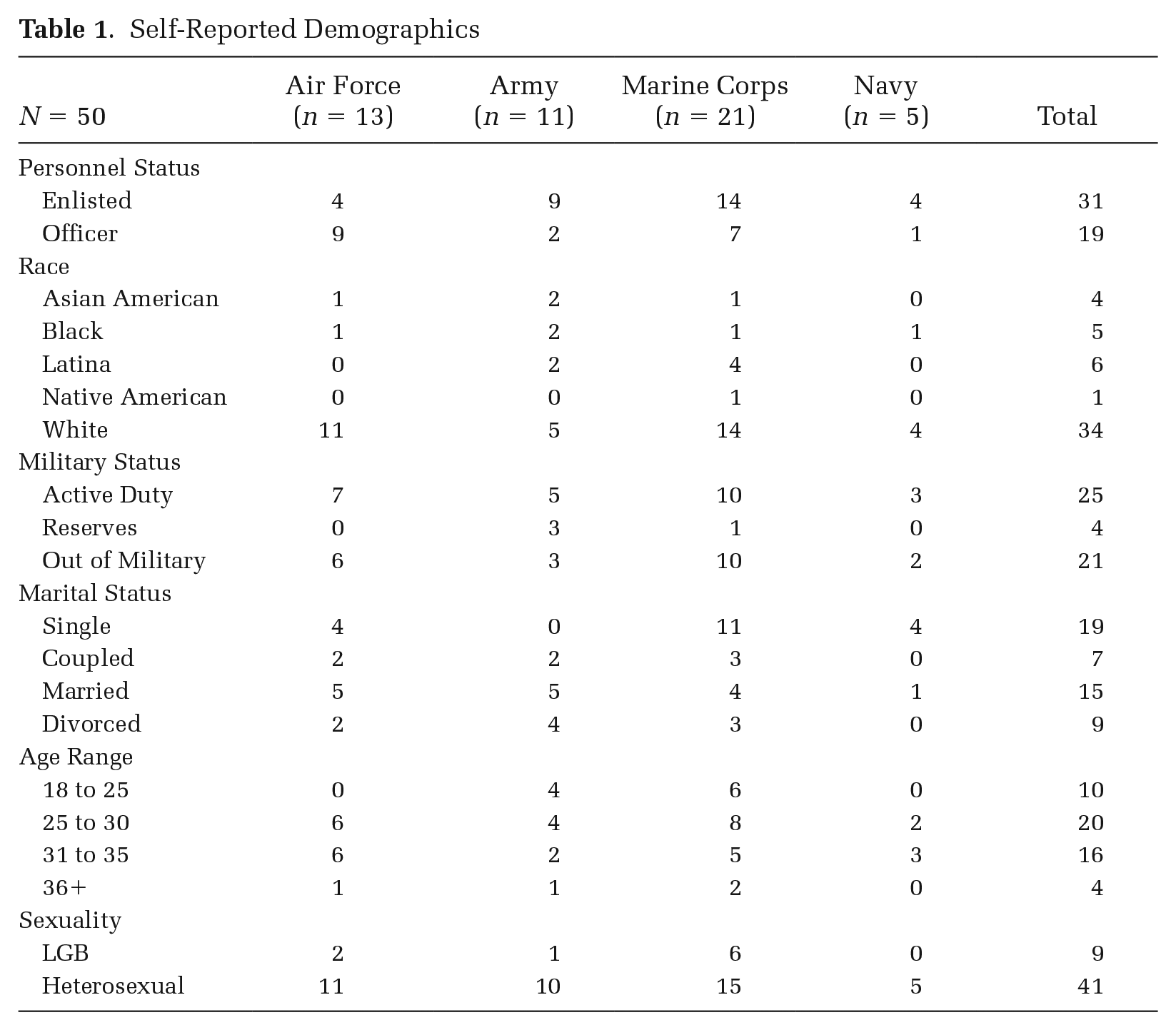
The study was designed to seek variation in rank, race, military branch, and sexuality. To ensure confidentiality when recruiting online, I reached out to participants by direct message or asked participants to contact me directly to participate. Participants signed a consent form before the interview, and I assured them they could stop participating at any time. In addition to excluding specific location and base names in my research, I use pseudonyms and remove identifying information to protect participant anonymity. I continued to collect data until I reached theoretical saturation, where I heard the same experiences and stories across multiple interviews (Glaser and Strauss 1967; Lofland et al. 2006). For the themes that inform this analysis, women told similar stories across branches and ranks; nuances based on race are included in the analysis.
Being a military outsider presented research challenges and advantages. I had to overcome the distrust that some servicemembers have of civilians (Woodward and Jenkings 2011). To compensate for a lack of shared knowledge based on military experience and to build rapport, I used military jargon often. This strategy established that I was familiar with the military and discouraged participants from explaining acronyms or routine military processes. I used the role of “acceptable incompetent” (Lofland et al. 2006:29) to ask questions about assumptions that may be taken for granted among military insiders. For example, participants could not respond to questions about basic training or deployments by saying “you know how it is” or other similar replies that avoided specificity. My outsider status ensured that military roles and ranks did not influence participation, data collection, or responses (Higate and Cameron 2006).
All interviews were conducted on the phone (N = 29), or in-person (N = 21) and audio-recorded. Participants were given a choice of phone or in-person interview to enhance their comfort, which is especially important when an interview might engage sensitive subjects such as harassment (Schwerdtfeger 2009). Interviews ranged from 45 to 205 minutes. My interview guide was open-ended and allowed servicewomen to share their experiences in their own words (Fine et al. 2000; Strauss and Corbin 1998). I asked broad questions and then follow-up questions as needed, treating interviews more like “guided conversations” (Fontana and Frey 1994; Rubin and Rubin 2012). I asked questions that encouraged vividness in participants’ descriptions (Rubin and Rubin 2012), such as why they joined the military, their transition to military life, and their most memorable service experiences.
Using “constructivist grounded theory” (Charmaz 2000), I analyzed data to understand participants’ meanings about their experiences. Transcripts were hand-coded and searched line-by-line to identify patterns (Emerson, Fretz, and Shaw 1995). I then wrote analytic memos based on these patterns to develop themes for analysis (Charmaz 2000; Lofland et al. 2006). Participants often discussed harassment during the interviews. I asked follow-up questions about harassment, but I did not specifically ask women to describe their worst moments of harassment or elevated harassment. I noted participant descriptions of elevated harassment during the coding process. When women used phrases like “worse,” “particularly bad,” “really bad,” “the most terrible,” “extreme,” “severe,” “increased,” or “escalated” to describe a harassment episode, I coded it as elevated harassment. I also considered an experience or episode to be elevated harassment if participants explained it as an increase in the severity or frequency of harassment.
After identifying elevated harassment, I applied focused coding to further unpack these experiences, and I noticed that elevated harassment was often coupled with life events such as engagement, marriage, and pregnancy. After re-reading the data and exploring negative cases, I narrowed the analysis, finding that instances of women’s relationships with men resulted in elevated harassment. Women who discussed relationships with women did not describe them in the context of harassment episodes. I also explored how women described other women’s heterosexual relationships and pregnancies to understand the gendered and organizational meanings surrounding these events.
Heterosexuality as a Femininity Anchor
Heterosexuality and Elevated Sexual Harassment
Most of the servicewomen I spoke with (N = 47 out of 50) discussed harassment (sexual, gender, and bureaucratic) during their military careers (see Table 2). Of these 47 women, 27 used expressions where they identified increased or elevated harassment during their service. More than half of these women (59 percent) experienced elevated sexual harassment that was related to an event like dating a man, engagement to a man, or marriage to a man (see Table 3).
Types of Harassment Experiences (n = 47)
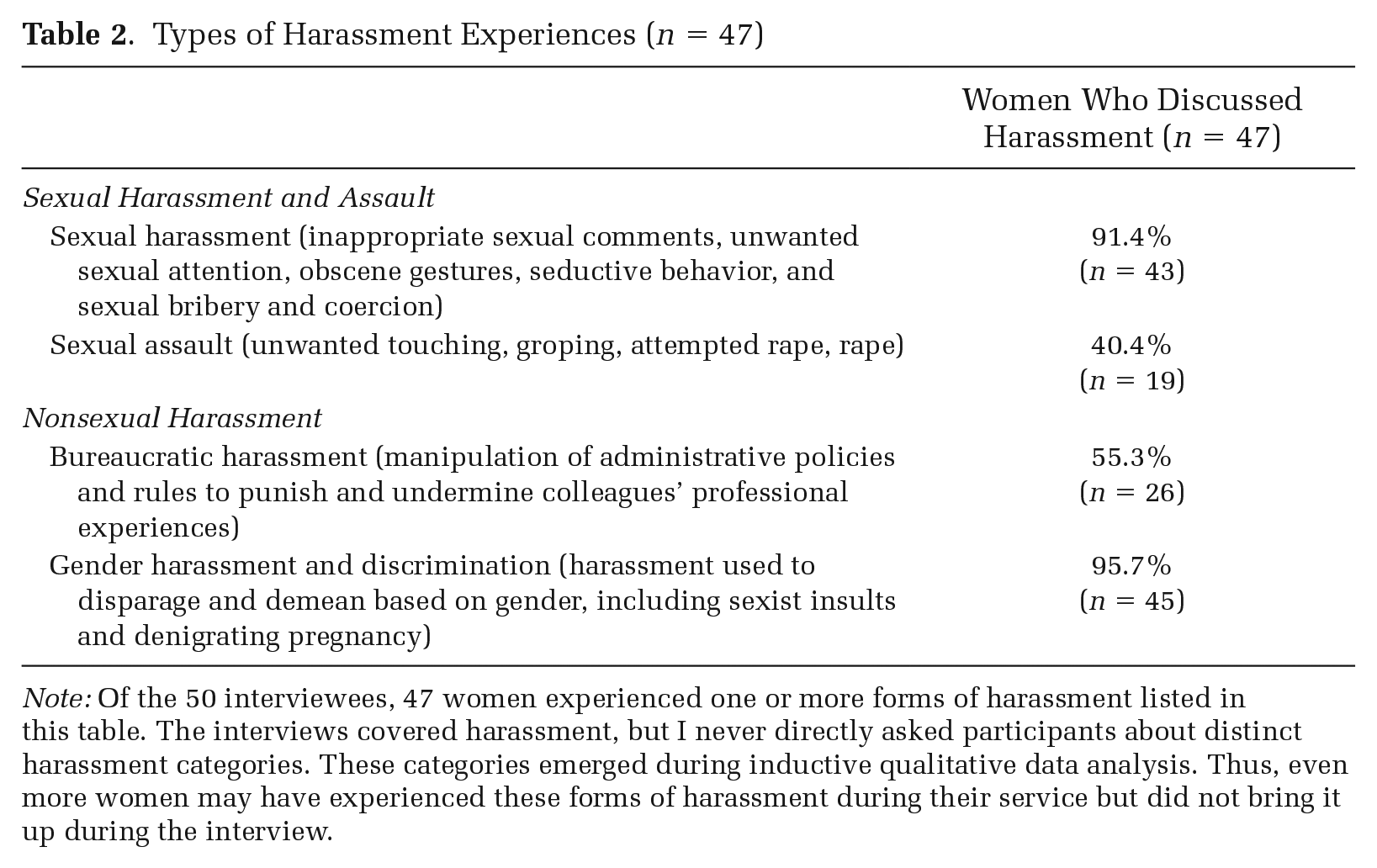
Note: Of the 50 interviewees, 47 women experienced one or more forms of harassment listed in this table. The interviews covered harassment, but I never directly asked participants about distinct harassment categories. These categories emerged during inductive qualitative data analysis. Thus, even more women may have experienced these forms of harassment during their service but did not bring it up during the interview.
Elevated Harassment during Heterosexual Relationships and Pregnancy
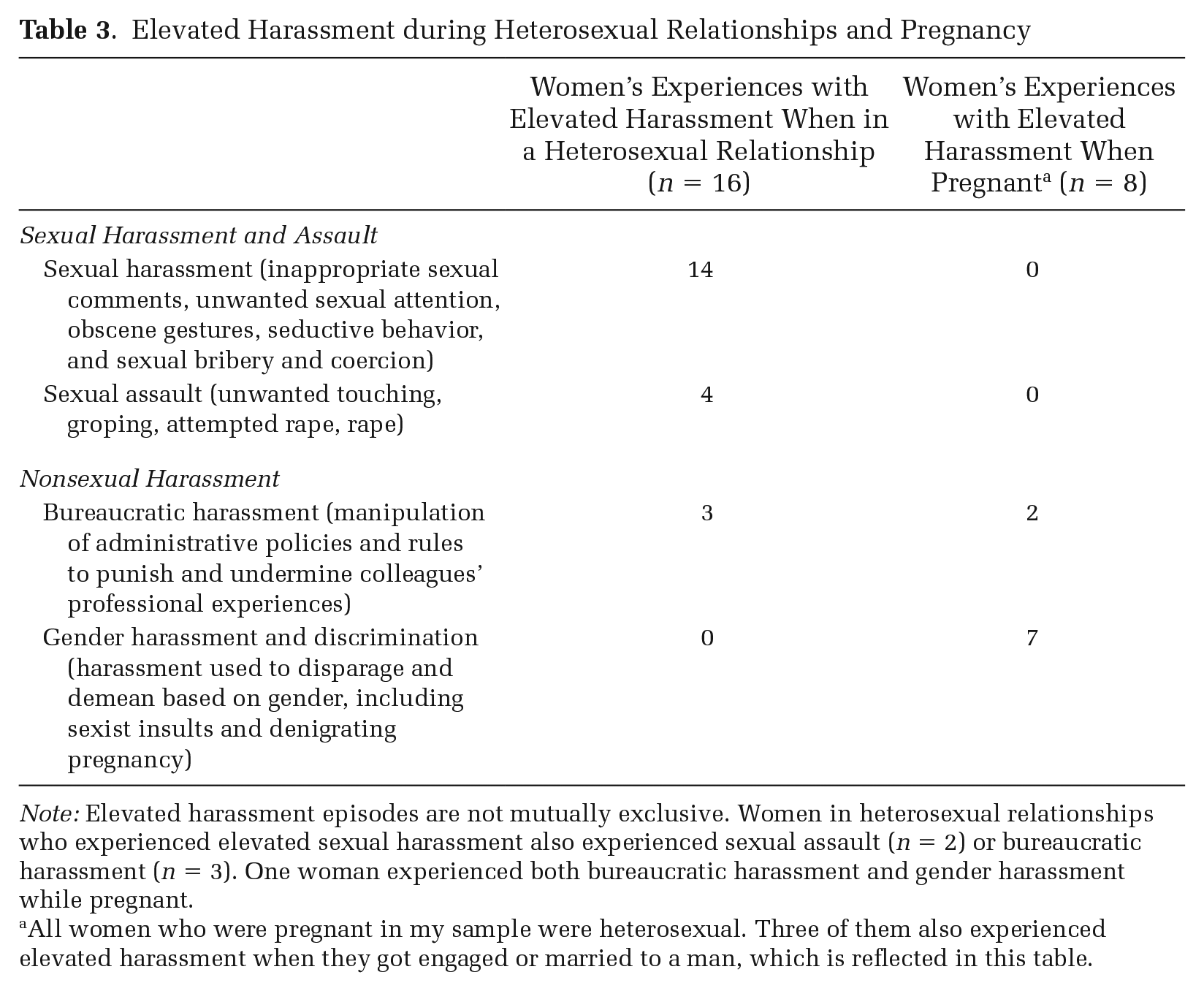
Note: Elevated harassment episodes are not mutually exclusive. Women in heterosexual relationships who experienced elevated sexual harassment also experienced sexual assault (n = 2) or bureaucratic harassment (n = 3). One woman experienced both bureaucratic harassment and gender harassment while pregnant.
All women who were pregnant in my sample were heterosexual. Three of them also experienced elevated harassment when they got engaged or married to a man, which is reflected in this table.
In other words, a number of women discussed incidents of elevated harassment that they experienced because of gendered and sexualized meanings around women’s intimate heterosexual relationships. For example, Maura (Air Force, enlisted, White) described how a non-commissioned officer (NCO) directed sexist comments toward her throughout her time in the unit. He engaged in gender harassment by treating her differently from men in the unit and by assigning her secretarial and traditionally feminine tasks that were not part of her official job description. Maura recalled that the harassment shifted to bureaucratic harassment (Bonnes 2017) and sexual harassment after she became engaged to a serviceman. She connected her NCO giving her a negative performance evaluation to her engagement: His voice would change when speaking to me; it would go up a bit and was mocking-like. There were also . . . like, many little comments he made. And then I got engaged and the EPRs [Enlisted Performance Reports] he gave me were damning. I hadn’t done anything but excellent work. I worked over 40 hours a week. It was the sort of things I got assigned to. . . . Like he would say, “I need you to go to the base liquor store for our picnic next week.” Things you don’t ask a military person to do. There were other enlisted people who didn’t outrank me and never got handed any of those jobs. But they were all male. The attitude he had and the damning EPR . . . he gave me scores that were one off from what I needed to be promoted. It would take me forever to make rank at that point with those scores. He was mad at me because I was leaving and marrying an officer and he saw me as a traitor for marrying an officer as an enlisted . . . you know, and he was an enlisted.
Although Maura knew her NCO was sexist, she was shocked when, after she got engaged to an officer, he extended his reach and used his power within the military to damage her career and to harass her through the bureaucratic system. Because of the low EPR, she was not eligible for her next promotion, which kept her at a lower pay grade. Maura noted that he sexually harassed her by berating her choice of intimate partner and discussing her sex life in front of other servicemembers. Maura used the word “traitor,” which suggests he communicated feeling betrayed by her relationship choice: “He thought he was like protecting me or something.” Justifying this behavior by claiming he was protecting her from being exploited by a superior officer indicates he did not see her as agentic in navigating her own intimate and sexual relationships. He viewed her as a sexual object being acted on by others. Importantly, the military tries to prevent exploitative power dynamics by disallowing servicemembers from dating outside of their rank. When couples violate this mandate, only the higher-ranking servicemember can be charged with “fraternization.” If Maura’s NCO truly wanted to protect her from what he saw as an exploitative relationship, he could have reported Maura’s fiancée (the higher-ranking servicemember) for fraternization. Instead, he chose to harass Maura verbally and give her a negative evaluation.
Similarly, Lyla (Navy, enlisted, White) experienced an increase in severity of sexual harassment from one commander after she got engaged: Because I wouldn’t have sex with—I called him—the darling of the command. . . . Because I wouldn’t have sex with [Name] or play around with [Name], it was very difficult for me at work. And I can remember, I was out in the . . . we had a section party. . . . His family was there . . . wife and kids, and everybody else brought their family. And I think probably my fiancé was. . . . He wasn’t there with me. Anyway. [Name] took his clothes off. And I was in the water. I could tread water; I could swim pretty well. But I didn’t know what was in the water. So, I was kinda nervous out there. It was dark. It was dusk. And he was standing in the water with his trunks off. And basically, blocking my ability to go back onto the beach.
Lyla’s commander made sexual comments and propositioned her for sex at multiple points during her career. However, after she got engaged his behavior increased in severity and moved from sexual comments to actions. She continued: “So I just had to stay out there, and tread water and I kept hoping that somebody on the shore would call for him to come back, or his wife would need him or something. . . . That somebody would see what was going on. Eventually, he got tired of trying to cajole me back on the shore.” Although he relented and stopped pursuing Lyla in the water, he approached her later that day and asked her to walk with him alone in the woods. Lyla declined because she assumed he would sexually assault her: Things weren’t going so well for me at work. And things weren’t going so well for me at work, in part, because I had met and fallen in love with an Air Force guy. And so, there were only 90 Navy people on the base. And so, for me to pick an Air Force guy was something. And then because of that I . . . was sexually harassed.
Lyla shared that after her relationship became known in the unit, servicemen who had not previously targeted her made comments about her sex life, denigrated her choice of intimate partner, and one propositioned her for sex. That is, after her heterosexual relationship was revealed, she became objectified and then harassed by more men in her unit. Maura’s and Lyla’s experiences show how servicemen feel authorized to police women’s personal and intimate lives. These men claim harassment is justified because the servicewomen are with men who are outsiders in some way (not enlisted, not a sailor). However, their negative actions are directed toward women who are their peers and subordinates, with the effect of making women feel like outsiders.
Women who dated servicemen of their same rank, unit, and branch were also the targets of elevated harassment or assault. Janet (Army, enlisted, Asian American) was sexually assaulted by a military peer shortly after she started dating another soldier. She initially described her attacker as a friend, but clarified that she was closer to his wife (who was not a servicemember). She was staying at the couple’s house and her colleague walked into the room: And basically, he just like propositions me for sex. And I was like, “No” a million times, “no.” I was like, “I’ve got a boyfriend, you’ve got a wife, I’m friends with her. There’s a baby in the bed.” There’s a million reasons that this is not going to happen. “No.” So he was just kind of like, “Okay.” And he left and walked out of the room, and it was kind of not a big deal. I don’t know how much time passed because I fell back to sleep. And he came back into the room, and he was wearing a t-shirt. Just a t-shirt. . . . And the first thing that he did was he grabbed my hand and put it on his erect penis. . . . So, I took my hand away, and then he put his hand into my underwear. And so, I pulled his hand back out of my underwear and I didn’t want to wake up the baby. Yeah, I didn’t want him to like wake up and see some man standing over him with an erect penis. Yeah, I just didn’t want that to happen. So, while I’m talking to him, like pleading with him to please just leave, he’s like touching my breasts.
Eventually, the baby woke up and the soldier stopped assaulting her and “booked it out of the room probably before his wife got in there.” Janet shared that this soldier had never harassed her nor expressed sexual interest in her prior to the assault, which occurred shortly after she started dating her boyfriend.
Rosa-Maria (Marine Corps, enlisted, Latina) described a similar situation when she started dating a man of her same rank in her unit, meaning no military rules prohibited their relationship. Soon after they started dating, her boyfriend was sent away for a two-month training. The day her boyfriend left, their NCO, who knew about the relationship, sexually assaulted Rosa-Maria:
This NCO cornered me and grabbed and kissed me. I was completely caught off guard. I mean it was right in front of his home, with his wife inside. The rest of the platoon was heading inside. I must have been talking to my ex [her boyfriend at the time] on the phone and that is why I was outside and got caught up in that.
Did the NCO harass you prior to this moment?
No. I had no issues with him. Like I said I was completely caught off guard. Other guys, yes; never had an issue with this one until that night. I feel like . . . the way it happened that he was waiting for my boyfriend to be away or something. It was weird.
Rosa-Maria described at least four instances of sexual assault during her four-year military career. When she explained her worst moment with sexual abuse, it was the incident outlined above. Rosa-Maria was “caught off guard” because this man had not harassed her prior to this moment, and she believed her NCO was angry about her relationship or punishing her for talking to her boyfriend outside the party. Hart (2021) argues that individuals navigate unwanted sexual attention and strategize ways to minimize sexual harassment in the workplace by being vigilant and monitoring interactions with potentially problematic people. Rosa-Maria had categorized several other men as sexually dangerous, but she had considered her NCO a safe person to interact with until she got into a relationship with another serviceman. When assessing the landscape at work for sexual danger, servicewomen may be surprised by the shifting and elevated harassment that occurs when their relationships with men are revealed.
In contrast to these experiences, Rita (Marine Corps, enlisted, Latina) explained how servicemembers reacted when she started dating a woman in her unit: “They were surprised because we were such good friends. Well, even we were surprised because we were such good friends. But they were happy for us.” Rita explained that the biggest obstacle related to her relationship and work was that her wife was planning on becoming an officer and she would remain enlisted, inviting a potential violation of the military’s fraternization policy. They circumvented this issue by getting married before Rita’s wife applied to be an officer. Yet, unlike in Maura’s case where she was enlisted and engaged to an officer, servicemembers did not use the potential power imbalance in Rita’s case to justify harassment against her, highlighting the centrality of sexuality in meanings imposed on servicewomen’s relationships. The lesbian women in my sample were also harassed throughout their military careers and some were sexually assaulted, but they did not report elevated harassment when their relationships, engagements, and marriages to women were revealed to other servicemembers. 2 In contrast, 32 percent of the heterosexual women in my sample described heightened harassment when they started dating, got engaged to, or married men.
Heterosexual relationships create flashpoints of harassment because servicemen attach feminized meanings to these life-course events, and the presence of femininity is a threat to the gender order in hyper-masculine contexts. Butler (1990) theorizes that heterosexuality creates and sustains the gender binary by emphasizing an attraction based on difference, that is, masculinity versus femininity. In the military context, expressing sexual desire for men is interpreted as feminine and unacceptable. Collins (2000:87) argues that the dominant gender ideology suggests a “woman’s true worth should occur through heterosexual marriage.” In this way, gender and sexuality are mutually dependent: through heterosexual relationships, women are assumed to be feminine, anchored to emphasized femininity, and thus perceived as sexual objects unfit for the military (Butler 1990; Collins 2000; Ken and Helmuth 2021; Messerschmidt 2018; Schippers 2007).
The military is often portrayed as a brotherhood (Archer 2012), and the presence of femininity is disruptive and threatening to this idea. For servicewomen who are trying to demonstrate military masculinity, relationships with men shatter the illusion that they are, or could be, “honorary men” (Kanter 1977; King 2016; Miller and Brunson 2000). In a competitive environment where servicemembers are seeking to project masculinity, and one means of establishing masculinity is through heterosexual conquest of women, servicewomen’s heterosexual relationships may also be a reminder to servicemen of their own failure to sexually conquer them (Archer 2012; Hennen 2001; Higate 2007; Sasson-Levy 2003). Intensifying harassment against these servicewomen would be a way for servicemen to reassert their own masculinity. Against the intrusion of femininity, men use sexual objectification and harassment to re-establish the gender order and regulate the gendered boundaries of inclusion in the military workplace.
The Military as a Femmephobic Organization
The military’s interactional culture sends messages that promote masculinity and devalue femininity. Many servicewomen accept that displaying femininity results in harassment. Melanie explained, “You couldn’t be true feminine, I guess, maybe . . . because then you’d get harassed more.” This sentiment related to traditionally feminine displays such as wearing makeup, but it can be extended to other actions that servicemembers perceive as feminine. That is, women can be anchored to femininity even if they are engaging in masculine identity work and downplaying femininity because of how others interpret their heterosexuality. For example, Lisa (Air Force, officer, White) stated: Okay, so there was one time I was sitting outside my barracks with this guy and talking and not. . . . And then this female senior leader saw and she came up to me and she started berating me and yelling at me and like, “People are going to think you’re a slut.”
The speculation that a woman and a man talking indicates a sexual relationship reveals how sensitive the military environment is to heterosexual relationships. Lisa’s officer did not directly call her a “slut” but aggressively warned her that others would label her as such if she continued to interact with men one-on-one in public. Gendered and feminine meanings are placed on perceptions of women’s heterosexuality and policed by all servicemembers.
Similarly, Vivian (Marine Corps, officer, White) described how other servicemembers spoke about a woman who was removed from Officer Candidate School (OCS) for talking to a man (who was also in OCS) in a car: I recall one of the other females saying: “She didn’t want to be a Marine she wanted to marry a Marine.” But the perception was that she wasn’t one of us or that . . . she wasn’t like us. To risk your career, and I think anyone who risks their job and life dreams just to have sex probably had some promiscuity issues or issues with sex in general.
Both the woman and the man Vivian spoke about were kicked out of OCS after the incident. Even though these individuals had only been caught talking, it was assumed they had a sexual relationship. OCS has strict rules about women and men speaking to one another while in training, spending time with one another, and, according to Vivian, “even looking at one another.” These rules are based on the assumption that heterosexual encounters might be distractions in the military workplace. In this case, even though the behavior and consequence were the same for both parties, the reactions of other servicewomen had gendered implications. Vivian told me that even though her colleagues thought the serviceman was “dumb” and had made “a stupid mistake,” he was not portrayed as an outsider to the Marine Corps. This incident shows that despite the military’s strict romance rules, heterosexual interactions are considered normal for servicemen but problematic for servicewomen.
Melanie (Army, enlisted, White) reflected on the “problem” of women displayingheterosexuality when discussing servicemen who pressure women for dates: Yes, I think, you know, some of the instances where the guys come onto the girls, and it’s unfortunate because there are so many women who just want to go to work and do their job and serve their country, but there are those few out there who are there to serve the men they work with.
Melanie’s complaint about servicewomen who date servicemen came up in a conversation about her toxic work climate: “I’m just like overwhelmed. You can’t go into a dining facility without getting stared down. You can’t walk around the gym without getting stared down. It’s like I don’t want to go out because I don’t want to feel like a piece of meat.” While describing an over-sexualized workplace where men pressure women for sex and dates, she blamed some women for responding to their advances (which, as a display of emphasized femininity, would be seen as compliant with hegemonic masculinity in many contexts). This type of response legitimates the unequal gender order present in the military’s femmephobic organizational culture. Melanie’s comments also demonstrate how slut discourse (Armstrong et al. 2014) is a part of military masculinity.
The “slut label” is an example of a pariah femininity (Schippers 2007), where women perform an aspect of hegemonic masculinity and it is perceived negatively. Slut discourse is commonly understood as a way men and women hold women accountable for violating expectations of sexuality and femininity (Armstrong et al. 2014; Payne 2010). In certain contexts, like college campuses, women can avoid stigma and escape the “slut label” when they enter monogamous relationships with men (Armstrong et al. 2014), as doing so shows an acquiescence to hegemonic masculinity and displays emphasized femininity. However, in the military context, the slut label is used in response to the presence of emphasized femininity. For example, when Melanie discussed women who date servicemen, she portrayed them as different from women who “just want to go to work and do their job and serve their country,” thereby casting them as military outsiders. As a discursive practice, the “slut label” allows servicemembers to control the boundaries of military inclusion and prop up a hyper-masculine culture that facilitates harassment and abuse.
Not only are women who marry servicemen portrayed as disingenuous servicemembers, but their relationships and marriages are seen as duplicitous. Women who marry servicemen (especially women who do so and then subsequently leave the military) are viewed as problematic because other servicemembers retroactively define their motives for joining the military as centered around men and marriage—the “wrong,” “feminine,” reasons to join. When women date or marry servicemen, it is often used against them as evidence they did not choose the military for the right reasons, and as proof they cannot succeed in the military, thereby legitimating men’s power and dominance in the organization.
Pregnancy as a Femininity Anchor
Pregnancy and Elevated Gender Harassment
Eight out of the nine (89 percent) women who were pregnant during their service described elevated moments of nonsexual harassment that were directly related to their pregnancies (see Table 3). This includes having their pregnancies mentioned in disparaging ways to portray them as poor servicemembers, being told to terminate their pregnancies, or being prevented from accessing policies aimed to assist pregnant and postpartum women. Women explained that pregnancy in general, and their pregnancies in particular, were viewed as detrimental to military work. Many interviewees, even those who had never been pregnant, explained there is a perception that women intentionally get pregnant to avoid military obligations. Rebecca shared a common phrase she heard throughout her service: “If the Marine Corps wanted you to have a baby, they would have issued you one.” She mused that “pregnancy and harassment seem to go hand-in-hand in the military, especially the Marine Corps.” Although this joke pokes fun at the strict organizational discipline of the Marine Corps, the point is that servicewomen are not supposed to get pregnant.
Military policies exempt pregnant women from annual testing and deployments, require them to take leave after birth, and advise that postpartum women do not have to meet the same physical fitness standards as others in the unit. These accommodations are necessary and important protections, but they are also public markers of pregnant and postpartum women’s altered status within military units. Rather than seeing these accommodations as necessary for the health and success of pregnant servicewomen, some see them as allowing women to evade institutional obligations. These perceptions lead men to elevate gender and bureaucratic harassment against pregnant women, sending the message that pregnant women are organizational outsiders.
For example, Rebecca (Marine Corps, enlisted, White) described instances of increased nonsexual harassment, from multiple perpetrators, when she was pregnant in the Marine Corps. She stated, “The pregnancy did not go over well.” Rebecca worked an overnight shift at an armory, and despite being tired due to her pregnancy, she never asked to change this demanding schedule. Like many servicewomen, Rebecca already felt out of place in her male-dominated unit. After her pregnancy, she said that servicemen enhanced their efforts to ostracize her, and they often directly invoked the pregnancy to question her work abilities: They were faster at loader magazines than I was. . . . It always seemed like I got new rounds and the new rounds, they stick together whereas if you have used rounds, they just go in real fast. I don’t know if they were setting me up or not, that would be speculation. . . . They had a speed loader, I didn’t. Anyway, they left without me. And the sergeant for the other crew said: “Just because you’re pregnant and just because you’re female doesn’t give you an excuse to be late.” I said I wasn’t late. I was told to be here at 11 and I got here at 11. I don’t know what was said. I’m sure something was said. It was just that feeling like you’re not fitting in. And then when I got pregnant it felt like that even more so.
Rebecca also described what she said was her worst military experience, which occurred during her second pregnancy. This time she worked day shifts because she had an accommodating commander: So, I stayed behind which was not usually the case, I was usually with a male marine on my crew, and this time I was by myself. It would have been around lunchtime. So, they all left, and I had an M16 sitting at the picnic table, which wasn’t unusual. . . . I was facing down the road so I can see oncoming cars. . . . I had the newspaper out; I’m eating my lunch. It’s a hot day. . . . All of a sudden, I feel something in the middle of my back and “don’t move.” And my heart is just racing and I’m absolutely sweating. . . . I want to say he said to me “let this be a lesson to you.” And I’m thinking I’m either going to be raped or something bad is going to happen to me. . . . When he said: “don’t move,” I put my hand down next to me and my rifle wasn’t there anymore. It was gone, it was . . . in my back. And I stood up, he must have told me to stand up. He came around the side of me and slammed my rifle down. The buttstock down. And he just was standing there, I don’t remember the words he said to me. But he gave me my rifle back. And he just stood there. He wanted me to give him the greeting of the day and salute him. And so, I did. That was probably the worst thing that happened to me in the Marine Corps. I thought for sure I was dead. That rifle was loaded. I know it was loaded because I’m the one that loaded it.
When Rebecca described this incident, she said, “I don’t know if it was the pregnancy. I just know this was the worst moment of my Marine Corps experience. I thought I was going to be raped or die. He wanted to teach me some sort of lesson.” The lesson could have been about proper weapon care or staying attentive, but Rebecca interpreted this as a gendered experience that produced gendered fears. A serviceman saw a visibly pregnant, junior-ranking servicewoman sitting alone for lunch and decided to sneak up on her, steal her gun, and threaten her with a loaded weapon. She recognized she was vulnerable to sexual violence or even death at this moment. She later remarked that this pregnancy “caused a lot of trouble” and invited jealousy from those in her unit who desired day shifts. Her new schedule could have been perceived as preferential treatment, rather than a necessary accommodation for her pregnancy.
Like Rebecca, most of the women who were pregnant during their service stated that their most extreme memories of harassment occurred during pregnancy and postpartum periods. Black, Latina, and White servicewomen all described episodes of elevated harassment when they were pregnant. However, there were racialized differences in how pregnancy harassment manifested. Only the two pregnant Black women in my sample were explicitly told to terminate their pregnancies. For example, Kay (Navy, enlisted, Black) believed a Navy doctor told her to have an abortion to protect the career of her boyfriend (who she mentioned was also Black): I got pregnant and he [her boyfriend] was going places. He was like the golden boy at the school. Everybody liked him. He had it in his mind he wanted to apply to go to the Naval Academy, and he was working on getting his application together to go. But we were like in love . . . puppy love or whatever. And I remember going to the doctor on base and telling him I was pregnant. And he’s like well, “you shouldn’t have the baby” . . . you should terminate the pregnancy. And I was like what? And he was like “yeah, you could terminate the pregnancy.” You know, “I can arrange that.” He said that my boyfriend, he was going to the Naval Academy. He said something like, “If you do this, you’ll hinder him. He can’t have any dependents.”
Kay was advised to terminate her pregnancy based on a doctor’s perception of her boyfriend’s potential military career. She was not sure if the doctor even knew her boyfriend directly, simply telling me that “everybody knew him” and there was a collective investment in him getting into the Naval Academy. The doctor’s advice suggests Kay’s career, life, and future were viewed as an obstacle to the unit’s mission of advancing one serviceman’s career. Kay’s experience speaks to broader patterns of institutional control of Black fertility, particularly the perception that the fertility of unmarried Black women is dangerous and needs to be controlled (Collins 2000; Davis 1981).
The specific ways servicemen harass women reveal a hierarchy of femininities based on race. Kay was seen as a threat to the institution for distracting her boyfriend from his military career and was advised to terminate her pregnancy. Here, the combination of negative views of pregnancy in general, and Black women’s fertility specifically, created a response where a military health professional advocated for abortion. Pressuring Black women to get an abortion can be understood as an attempt to control their fertility and ensure they will remain in service to the military as deployable members. Whereas pregnancy for White women triggers episodes of harassment targeting their inclusion in the military space, pregnancy for Black women also triggers harassment that targets their bodies and their ability to reproduce. This demonstrates how racist assumptions can be embedded in femininity anchors.
Pregnancy and Elevated Bureaucratic Harassment
Individuals in an institutional culture that denigrates femininity may interpret policies designed to support pregnant people as proof of their outsider status rather than as necessary accommodations. For example, pregnant servicewomen are exempt from deployment. Deployment is an important marker of military insiderness and an expression of self-sacrifice for the organization (Shields, Kuhl, and Westwood 2017). Servicemembers train to deploy, plan to deploy, and can be separated from the military if they cannot deploy. Servicemembers who cannot deploy often fall into the following categories: physically unfit, mentally unfit, or pregnant, all of which are seen as problematic. Margaret (Marine Corps, enlisted, White) expressed this sentiment, saying, “Being in the Marine Corps and not deploying is like training for the Olympics and never playing.” Andrea (Marine Corps, officer, White) stated, “We’re 6 percent women and if you become pregnant, there’s a stigma to that which sucks but it’s there.” Karen (Marine Corps, enlisted, White) described the stereotype that women intentionally get pregnant to avoid deployment: And it’s [pregnancy] seen as a way to scam out of deployments where you can’t get in trouble. Absolutely. Oh, you’re pregnant. We can’t do anything about it. Like you don’t have to do deployment. You don’t have to go to war. You don’t have to do the hard shit. You don’t have to go someplace that’s unfavorable. . . . Clearly, you didn’t want to deploy, or obviously, you can’t hack it.
In juxtaposing pregnancy with markers of military masculinity, such as war and “hard shit,” Karen shows how pregnancy is linked to perceptions of femininity. In the military context, pregnancy is viewed in opposition to the hard-working, self-sacrificing servicemembers who are prepared to give up everything, including their own life, for the institution. Pregnant women are perceived as prioritizing something or someone else over the military and their military peers. They are portrayed as using their femininity and sexuality to escape institutional obligations in ways men cannot.
Pregnant women are not only exempt from deployments, but also from annual fitness testing, which contributes to the assumption they are antithetical to the “ideal worker” (Acker 1990; Byron and Roscigno 2014; Glass and Fodor 2011; McFarlane 2021; Ridgeway and Correll 2004). Even pregnant women in units not set to deploy are viewed as problematic, because they have frequent medical appointments and are given modified schedules and requirements. In a context where servicemembers report not seeking medical attention because they do not want to let their units down, individuals who use institutional services are viewed with distrust and portrayed as selfish (Cogan, Haines, and Devore 2021). Nadine (Marine Corps, enlisted, White) noted, “If the female Marine has more than one child? I’ll just say, you won’t be well-liked, and the common assumption is female Marines only get pregnant to get out of things.”
Military policy allows pregnant and postpartum women to opt out of physical testing and fitness requirements, but servicewomen shared stories of men manipulating the bureaucracy to restrict their access to these benefits (see Table 3). Joanna (Army, officer, Latina) discussed a man in her unit who often disparaged her postpartum body and attempted to establish a paper trail against her, claiming she was overweight even though she recently gave birth: I need to have a pregnancy profile in place. So, a pregnancy profile involves having an Army doctor signing an Army piece of paper saying that I had a baby. What the hell is wrong with our regular doctor saying this? Well, I guess the Army doctor is special [laughing], so they want me to take time out of my civilian day . . . not paying me . . . and have me go to an Army doctor . . . so that they don’t have to have me take a PT [physical training/test] for six months after I give birth. But since there’s no pregnancy profile in place, I am now subject to these regulations. And I am like, “Well, are you going to send me to the doctor?” And he said, “No.” Well then, fucking fine! So, then he put an administrative flag on me to say that I am a fat soldier.
Accessing pregnancy and postpartum accommodations requires frequent administrative requests and interactions with the military’s bureaucratic system. Amid an environment where pregnancy is viewed negatively, servicemembers may use their discretion and power in the military bureaucracy to create administrative barriers that impede access to these supportive policies. Such a context makes pregnant and postpartum women particularly vulnerable to bureaucratic harassment. Men may even use the mere existence of these policies as a reason to ostracize women. For example, Meredith (Army, enlisted, White) described how the men in her unit accommodated her pregnancy in the ways the military required them to (i.e., a lighter workload, less physical activity) but retaliated against her in other ways: So, I got pregnant and of course they’re liable for lots of things, so God forbid I pick up a single chair. But then they went and made me go clean the bathrooms for the company which were in a big old warehouse. So, I did clean for a little bit up until I just couldn’t stand the smell anymore, but they would make me do weird things like that.
Meredith believed she was switched to bathroom duty as punishment for her required pregnancy accommodations, precisely because pregnant people often have increased sensitivity to odors. Even after she made it clear that cleaning the bathroom induced nausea and made her feel faint, she was still required to do it.
The perception that women use pregnancy maliciously and in ways that men cannot, coupled with the fact that pregnancy is visible, and men read pregnant bodies as feminine, makes pregnancy a critical femininity anchor for servicewomen. Taber (2011) argues that women in the military try to be as masculine as possible and conceal any embodied differences between themselves and servicemen. This is difficult, if not impossible, during pregnancy. Aside from women’s pregnant bodies being a physical and visible reminder of their difference from servicemen, the way servicewomen must modify their work during and after pregnancy marks them as failing to comply with institutional obligations and the prevailing hegemonic masculinity. Pregnant women are thus anchored to emphasized femininity and perceived as outsiders. Servicemen respond with harassment to regulate and control women’s bodies (like pressuring Kay to have an abortion) and to negatively affect women’s work lives (like threatening Rebecca with a loaded gun or placing Meredith on bathroom duty while pregnant). Servicemen may also view the presence of pregnant women in the military as eroding its status as a masculine workplace (Hale 2012; Martin and Jurik 2007; Prokos and Padavic 2002; Woodward and Winter 2004) and respond with gender harassment to re-affirm the military workplace as masculine, with no place for emphasized femininity. Bureaucratic harassment is often used to force women out of the military (Bonnes 2017), preserving men’s power and dominance in the military space. All these actions reproduce gender hegemony, where men enact power and invulnerability through nonsexual harassment.
Discussion and Conclusions
This research examines why sexual abuse persists in an organization that has adopted policies, programs, and strategies to both prevent sexual violence and to assist victims. What institutional-, interactional-, and individual-level mechanisms create sexual violence vulnerability and facilitate harassment? Are these processes gendered? My findings suggest that hypermasculine organizational contexts encourage sexual harassment and that localized meanings around masculinity and femininity take precedence over broader gender meanings and values. I show that organizational and interactional devaluation of femininity helps predict when, and explain why, sexual harassment might escalate. In doing so, I outline a feminization process that likely occurs in many organizations and hinders anti-harassment efforts.
My research shows that servicewomen are anchored to femininity based on the feminized meanings that other servicemembers place on their life-course events. Femininity anchors are part of a feminization process that occurs despite gender identity work, and the theoretical concept builds on other related concepts such as hegemonic masculinity, emphasized femininity, and pariah femininities (Connell 1987; Messerschmidt 2018; Schippers 2007). The military is a femmephobic organization, where military training actively denigrates women and femininity (Bayard de Volo and Hall 2015; Hoskin 2019, 2020). These values shape how servicemembers gain power within the institution (Barrett 1996; Hale 2008; Hinojosa 2010; Sasson-Levy 2003), and women specifically try to gain power in the military through masculine identity work, embodying masculinity, and distancing themselves from femininity (Crowley and Sandhoff 2017; King 2016; Sasson-Levy 2003).
However, the effectiveness of these strategies is limited: women who embody masculinity threaten the gender order and are often cast into pariah femininities (Schippers 2007). This article shows how constructions of hegemonic masculinity denigrate femininity and conflate sexuality with gender in ways that create elevated levels of harassment in response to women’s heterosexuality. Women receive benefits and privileges from heterosexuality in most contexts due to heterosexual domination (Collins 2004; Hamilton et al. 2019), but the concept of femininity anchors demonstrates how heterosexuality can also elevate women’s risk of harassment in spaces dominated by men. I show that in spaces dominated by hegemonic masculinity, threats to the masculine self and context incite responses that re-establish the gender order. In femmephobic spaces, any association with femininity invites denigration, even if that femininity bolsters the existing gender order more broadly, which creates unique constraints for servicewomen. The military is an extreme example of a hyper-masculine environment, but similar gender dynamics and the existence of femininity anchors may be present in other organizations dominated by men, such as construction, corrections, policing, and technology.
Organizational and interactional authority structures enable individuals in positions of power to confirm or deny the identity work of others (Cast 2003), to treat women as “honorary men” (King 2016), and to recode women’s masculinity displays as stigmatized and feminine (Schippers 2007). My data show that people with social and organizational power can also place femininized meanings on life-course events. Regardless of whether women are performing masculinity or expressing a noncompliant femininity, they may be anchored to emphasized femininity based on how individuals interpret their heterosexual relationships and pregnancies. Even if men had previously placed a woman in the “honorary man” category, heterosexual relationships and pregnancies anchor them to emphasized femininity and dissolve this status. Femininity anchors thus help preserve the gender binary and the gender order by constraining the meanings of gender identity work. In spaces like the U.S. military where femininity is particularly denigrated, femininity anchors tether women to stigmatized identities, thereby elevating their vulnerability to harassment and weighing down their careers. In this context, femininity anchors operate as a tool of exclusion and othering. However, in contexts where emphasized femininity is valued, femininity anchors may bring interactional benefits to individual women while still upholding the gender order (Hamilton et al. 2019).
The two types of femininity anchors that emerged from my data resulted in different forms of harassment. The women in my sample who experienced elevated harassment as related to their heterosexual relationships, described experiences of sexual harassment and assault. In contrast, women who were pregnant during their military service experienced elevated nonsexual harassment, including gender and bureaucratic harassment. When women are anchored to emphasized femininity through heterosexual relationships, servicemen view them as sexual objects rather than servicemembers. Servicemen increase sexual harassment in these moments to enact their own masculinity, to regain masculinity they perceive as threatened when women are intimate with other men, to deny women’s status as honorary men, and to affirm the workplace as masculine. When women are anchored to emphasized femininity through pregnancy, servicemen use gender harassment to create a work environment hostile to pregnant women, thereby cementing their status as outsiders and suggesting they are incompatible with the military. Servicemen also restrict pregnant women’s participation in the military through bureaucratic harassment by manipulating policies and evaluation processes to portray them as poor servicemembers. These evaluations stay on women’s service records and can be used to force them out of the military, preserving men’s power and dominance in the organization (Bonnes 2017). Each act of harassment enables men to practice hegemonic masculinity: men are enacting invulnerability and aggression and women are victimized by it, thus reinforcing men’s power over women.
In this article, I examined how hegemonic masculinity is constructed in the military context and analyzed moments of harassment as an active manifestation of this dominance. My research shows how focusing on specific episodes of harassment, rather than the aggregate existence or frequency of harassment, can reveal interactional and organizational meanings that are both gendered and sexualized. This type of analysis can deepen our understanding of how harassment persists in an organization despite decades of targeted prevention and education efforts. Harassment is a pervasive part of servicewoman’s military experiences, affecting 47 of the 50 women I interviewed. Most women experienced multiple incidents and several forms of harassment throughout their military careers. Of these women, 27 pinpointed moments of elevated harassment without being asked to do so. In focusing on these moments of heightened harassment, I uncovered a feminization process that unfolds in interaction and reveals institutional power dynamics and organizational meanings around femininity, masculinity, and gender. Episodes of elevated harassment are rich data points that can uncover key facets of inequality, organizational values, and meanings around gender that affect women’s ability to be accepted in workplaces dominated by men. This type of analysis helps disentangle the relationship between organizational, interactional, and individual levels of harassment and inequality, which is imperative for developing precise strategies to address and alleviate these issues.
Future Research and Policy Implications
This study has important limitations and elicits new questions that could be addressed in future research. First, I only spoke with women in the military. Almost all these women experienced harassment during their time in the military. They all witnessed gender inequality, and some admitted to participating in gender inequality by denigrating women in general or contributing to rumors about individual servicewomen. Given the pervasiveness of harassment in the military, interviewing servicemen about these issues would reveal new and important information about gender, power, and inequality in this space. Speaking with servicemen about what I have identified as femininity anchors could further reveal the gendered meanings behind women’s life-course events and why men react to them with elevated harassment.
It is important to note that the military is also a raced institution (Ray 2019; Wingfield and Alston 2014; Wingfield and Chavez 2020). Although I interviewed Asian American, Black, Indigenous, and Latina women for this study and explored moments of racialized harassment these women experienced, I did not explicitly examine the military as a raced institution. The military is 70.7 percent White, but among top officer positions (pay grades O7–O10), 81.8 percent of the Army, 91.1 percent of the Navy, 88.2 percent of the Marine Corps, and 91.6 percent of the Air Force are White (Department of Defense 2017). My findings reveal how gender intersects with race to produce inequality, but future research should explore how intersections of race and gender are embedded in organizational values, training, and practices, and how racism shapes identity construction. Future research should also examine how femininity anchors contribute to our understanding of femininity hierarchies that reveal inequalities related to race and class (Collins 2000; Hamilton et al. 2019).
Future research should also explore if the concept of femininity anchors can be applied to other life-course events. Additionally, the strength and boundaries of femininity anchors should be examined to discern if harassment can be mitigated by specific gender or sexuality work at the interactional level. Some women in my sample tried to mitigate harassment and avoid the slut label by doing gender and sexuality in ways they thought men would appreciate. For example, Margaret stated, “My friend used to refer to me as the biggest misogynist he’d ever met in his entire life. Because I pretty much was.” Similar to women in masculine occupations like corrections (Burdett, Gouliquer, and Poulin 2018), Margaret viewed her participation in denigrating and objectifying women as a pathway to acceptance among servicemen. However, these strategies did not protect her from harassment, and she ended up leaving the military shortly after she got pregnant. Future research should explore strategies that are rewarded by those with organizational and social power to see if these remain salient even in situations where femininity anchors are present. Future research could also explore if women can lessen the damage caused by femininity anchors by downplaying heterosexual romances, positioning themselves as sexual subjects, or positioning their partners as sexual objects.
In my sample, only heterosexual women were pregnant during their service, but pregnant LGBT servicemembers would also likely experience elevated harassment due to gendered assumptions about the pregnant body in the military context. Similarly, it was not simply women being in a heterosexual relationship that resulted in harassment, but servicemen becoming aware of their relationships and imposing gendered meanings on them. If servicemen perceive a woman to be intimately involved with a man (regardless of her sexuality), she is still likely to be anchored to emphasized femininity and harassed.
The concept of femininity anchors can be extended beyond the military context, especially because such anchors are less fluid than dress, discursive practices, and other gender identity work. For example, previous research shows that pregnancy and motherhood discrimination are common in the workplace (Byron and Roscigno 2014; Glass and Fodor 2011; Ridgeway and Correll 2004; Taber 2011). Pregnant women and mothers report unfair termination, negative evaluations, less pay, lack of family-friendly workplace policies, and lack of paid maternity leave. The concept of femininity anchors can explain why pregnancy triggers enhanced harassment and discrimination: pregnant bodies anchor women to emphasized femininity, an identity seen as incompatible with masculine constructions of the “ideal worker” (Byron and Roscigno 2014; Glass and Fodor 2011; Ridgeway and Correll 2004).
Sexual and nonsexual harassment are major social problems that shape and constrain workplace experiences. This issue is intensified in organizations dominated by men where harassment is used to limit women’s full participation in the gendered workplace. While navigating a workplace with persistent harassment, moments of elevated harassment further interrupted servicewomen’s daily lives, affected their careers, and created additional stress around life-course events like pregnancy, engagement, and marriage to men. Pervasive and elevated harassment ultimately forced many women in my study to leave the military altogether. Research focusing on harassment at the individual level highlights the harm caused by workplace harassment; the labor required to manage and anticipate harassment; the career, economic, emotional, psychological, and social consequences of harassment; and the difficulty and repercussions of reporting harassment (Hart 2019, 2021; McLaughlin, Uggen, and Blackstone 2017; Pershing 2006; Silva 2008). The concept of femininity anchors explains how emphasized femininity, which is celebrated and rewarded in many contexts, is met with increased harassment in the military due to the prevalence of femmephobia (Hoskin 2017) at the organizational level. This suggests little can be done to reduce workplace harassment in the military without addressing the underlying gendered organizational context, especially because these localized meanings of gender take precedence over broader societal understandings of masculinity and femininity.
Unfortunately, most policy responses to military sexual violence focus on the individual level, leaving in place an organizational context that sustains women’s vulnerability to harassment. In recent years, the U.S. military has developed numerous policies and programs to address sexual harassment. These organizational policies often target individual victims and perpetrators by creating reporting streams and systems of punishment related to sexual abuse. These responses ignore the active role the military as an organization has in creating and facilitating harassment. Individual-level responses largely overlook the gendered values, processes, and practices that contribute to inequality at the organizational level.
In January 2022, President Biden signed an Executive Order requiring the Department of Defense to codify sexual harassment as part of the Uniform Code of Military Justice. The Executive Order signals severe punishments for inappropriate conduct, but punitive measures will not alter deeply embedded organizational norms. Rather, the military should adopt policies and guidelines that actively build a positive and inclusive command climate, normalize pregnancy dispensations, and promote a more fluid image of what constitutes an ideal servicemember. Identifying the life-course events that anchor women to emphasized femininity and provoke harassment can also create points for heightened accountability, where the military could focus extra protection for women. Without interventions designed to challenge the organizational context, the military will continue to be an institution that denigrates femininity, encourages men to harass, and makes women vulnerable to sexual assault, sexual harassment, and nonsexual harassment.
Footnotes
Acknowledgements
I thank the servicewomen who participated in my study for trusting me with their stories. I am grateful to Sanyu Mojola and Kate Tierney for their thoughtful comments on drafts of this manuscript. I appreciate the editors and anonymous reviewers for their helpful suggestions throughout the review process. A special thank you to my partner, Andrew Stinson, who read and gave feedback on multiple drafts of this paper and took the time to discuss these ideas with me at length. Finally, thank you to Leidy, Lindsay, Deirdre, and other caregivers for ensuring my children were safe and happy while I revised this manuscript.
Funding
This work was supported by funding from the American Society of Criminology’s Division on Women and Crime’s Larry J. Siegel Fellowship.
