







Abstract
How does higher education shape the Black-White earnings gap? It may help close the gap if Black youth benefit more from attending and completing college than do White youth. On the other hand, Black college-goers are less likely to complete college relative to White students, and this disparity in degree completion helps reproduce racial inequality. In this study, we use a novel causal decomposition and a debiased machine learning method to isolate, quantify, and explain the equalizing and stratifying roles of college. Analyzing data from the NLSY97, we find that a bachelor’s degree has a strong equalizing effect on earnings among men (albeit not among women); yet, at the population level, this equalizing effect is partly offset by unequal likelihoods of bachelor’s completion between Black and White students. Moreover, a bachelor’s degree narrows the male Black-White earnings gap not by reducing the influence of class background and pre-college academic ability, but by lessening the “unexplained” penalty of being Black in the labor market. To illuminate the policy implications of our findings, we estimate counterfactual earnings gaps under a series of stylized educational interventions. We find that interventions that both boost rates of college attendance and bachelor’s completion and close racial disparities in these transitions can substantially reduce the Black-White earnings gap.
The disparity between Black and White Americans in economic status is one of the most glaring and unrelenting forms of inequality in the United States. Despite a substantial drop in the mid-twentieth century, the Black-White gap in earnings has persisted during the post-civil rights era. In 1970, median annual earnings among Black men were 59 percent those of White men; by 2014, this ratio had worsened to 50 percent (Bayer and Charles 2018). 1 Moreover, as shown in a recent study that leverages linked administrative data across two generations, no more than half of the male Black-White gap in individual income can be attributed to racial differences in parental income, parental education, and other markers of socioeconomic background (Chetty, Hendren, et al. 2020).
To explain the persistence of racial inequality over time, social scientists have proposed an array of accounts that highlight the roles of various micro-, meso-, and macro-level factors, including racial disparities in parental wealth (e.g., Conley 2010; Oliver and Shapiro 2006), family structure and stability (e.g., Bloome 2014; McLanahan and Sandefur 1994; Moynihan 1965), school quality and skill formation (e.g., Dobbie and Fryer 2011; Jencks and Phillips 1998), structural changes in the economy (e.g., Manduca 2018; Wilson 1987, 1996), race- and class-based residential segregation (e.g., Massey and Denton 1993; Pattillo 2013; Reardon and Bischoff 2011), labor market discrimination (e.g., Bertrand and Mullainathan 2004; Kirschenman and Neckerman 1991; Pager, Western, and Bonikowski 2009), and the racialized penal system (e.g., Pettit and Western 2004; Western 2006). In this article, we focus on the role of higher education—an institution widely perceived as a ticket to economic advancement for disadvantaged youth—in shaping racial inequality. Specifically, we examine whether higher education mitigates, maintains, or magnifies the Black-White earnings gap, and how.
We highlight two mechanisms through which the postsecondary system may affect the Black-White earnings gap: educational returns and educational inequality (Bloome, Dyer, and Zhou 2018). First, given the substantial economic returns associated with a college degree (Autor 2014), higher education may serve as an engine of upward mobility for low-income African American youth. Several studies suggest the economic payoff to a college education for students from disadvantaged backgrounds is as large as, if not larger than, that for their more advantaged peers (e.g., Attewell et al. 2007; Brand and Xie 2010; Maurin and McNally 2008; Zimmerman 2014). For example, Brand and Xie (2010) found that young people who are least likely to receive a bachelor’s degree—typically students from minority and low-income backgrounds—appear to benefit the most from it. From this perspective, an expansion in higher education, especially one that induces more African American youth into college, would have the potential to reduce the Black-White earnings gap.
On the other hand, as long recognized by stratification scholars, education is also a vehicle of social reproduction (Blau and Duncan 1967; Boudon 1974; Stevens, Armstrong, and Arum 2008). Even among individuals who have “made it to college,” the postsecondary system reflects and reinforces preexisting inequalities, as minority and low-income students often attend lower-quality institutions and, partly because of this, graduate at lower rates relative to their more privileged peers (Bowen, Chingos, and McPherson 2009; Ciocca Eller and DiPrete 2018). Thus, to the extent that the economic payoff to a college education stems mostly from the attainment of a bachelor’s degree (rather than merely attending college), unequal rates of degree completion may serve to maintain, if not magnify, racial inequality in earnings. From this perspective, policies that focus exclusively on closing gaps in college enrollment (but not in degree completion) may be an insufficient, or even counterproductive, strategy to combat the Black-White earnings gap.
To date, few studies have considered how educational returns and educational inequality jointly shape racial earnings inequality. In fact, studies that highlight the equalizing potential of higher education typically treat college attendance or completion as an independent variable and investigate whether the economic returns to college differ across variously defined subpopulations (e.g., Attewell et al. 2007), whereas studies that foreground the stratifying role of higher education typically regard the completion of a bachelor’s degree (henceforth, bachelor’s completion) as a dependent variable and examine how it relates to a student’s race, class background, and academic preparation (e.g., Bowen et al. 2009). Consequently, it remains unclear how different forces associated with higher education combine to shape the Black-White earnings gap. This study represents our attempt to address this puzzle.
Integrating data from the National Longitudinal Survey of Youth, 1997 (NLSY97), the Department of Education’s Integrated Postsecondary Education Data System (IPEDS), and the Opportunity Insights project (Chetty, Friedman, et al. 2020), we investigate how the effect of attending a four-year college on earnings differs between African American and non-Hispanic White populations, and, crucially, the sources of the observed effect heterogeneity. Given the above discussion, we would expect that racial differences in the total effect of college attendance are driven by at least two competing forces: (1) Black students may benefit more from the experience of attending college and from completing a bachelor’s degree than do their White peers; and (2) given college attendance, Black students are less likely to complete a bachelor’s degree relative to their White peers, due to their disadvantages in financial resources, academic preparation, college quality, and other factors.
To understand how these competing forces combine to shape the Black-White earnings gap, we use a novel causal decomposition that partitions the average effect of attending a four-year college on earnings into four distinct components: (a) the direct effect of college attendance (short of a bachelor’s degree) on earnings, (b) the likelihood of bachelor’s completion given college attendance, (c) the net effect of bachelor’s completion on earnings, and (d) the covariance between bachelor’s completion and its net effect on earnings. This decomposition can be understood through Figure 1: arrows (a), (b), and (c) correspond to the first three components described above, and the last component reflects the interaction effect of arrows (b) and (c). If, as the above discussion suggests, African American youth benefit more from attending and completing college but are less likely to complete a bachelor’s degree given attendance compared with White youth, then components (a) and (c) will be equalizing (i.e., stronger for African American than for White students) but component (b) will be stratifying (i.e., weaker for African American than for White students). Thus, such a decomposition allows us to isolate and quantify the equalizing and stratifying roles of college. To make our estimates causally plausible and statistically robust, we adjust for a rich set of individual-, family-, and school-level characteristics that may affect a person’s selection into and out of college, use a debiased machine learning approach to estimate all quantities of interest, and conduct a sensitivity analysis to assess the robustness of our findings to unobserved confounding.
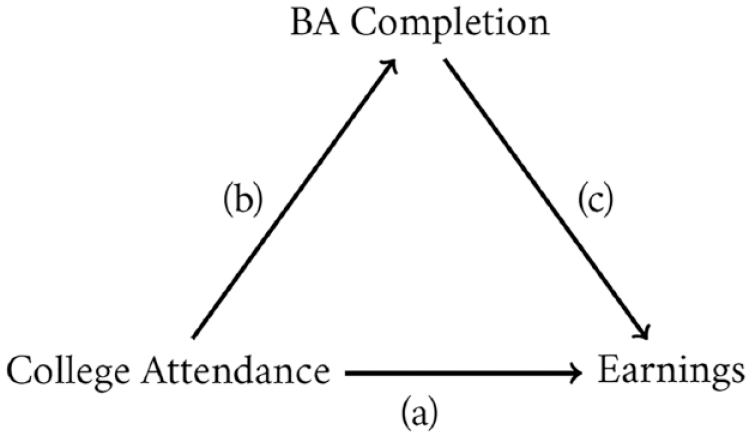
The Effects of College on Earnings in a Causal Diagram
In addition to assessing the causal effects of attending and completing a four-year college, we construct a set of potential Black-White earnings gaps at different levels of education, including high school graduate, 2 college dropout/stopout, and college graduate. These potential earnings gaps can be interpreted as the levels of inequality that would arise within a random sample of Black and White Americans if their educational status was fixed at a given level (Lundberg 2022). We then examine the extent to which these potential earnings gaps can be explained by racial differences in parental income and pre-college academic ability. By doing so, we illuminate the ways higher education attenuates or amplifies Black disadvantage: specifically, whether it modifies Black disadvantage by adjusting the influence of pre-college class and academic backgrounds, or by adjusting the part of inequality that cannot be explained by racial differences in class and academic backgrounds—a part more likely driven by labor market factors such as employer discrimination and job access. Similarly, we construct a set of potential and observed Black-White gaps in bachelor’s completion rate and examine the extent to which they can be explained by racial differences in parental income, pre-college academic ability, and college characteristics.
Our empirical analyses yield several key findings. First, we find an equalizing role of higher education among men, but not among women. In particular, the net effect of a bachelor’s degree on earnings is much larger for Black men than for White men, but it is similar between Black and White women. At the population level, however, this equalizing effect for men is partly offset by unequal likelihoods of bachelor’s completion between Black and White students, leading to a modest and statistically insignificant racial difference in the total effect of college attendance.
Second, because Black men benefit much more from completing college than do White men, the potential earnings gap is substantially lower among college graduates than among high-school graduates and college dropouts/stopouts. This educational gradient in the male Black-White earnings gap is almost entirely due to the educational gradient in the amount of “residual inequality,” that is, the part of inequality that cannot be explained by racial differences in pre-college class and academic backgrounds. In fact, Black-White differences in parental income and pre-college ability translate into a similar amount of earnings inequality at different levels of education. This amount accounts for the bulk of the racial earnings gap among men with a bachelor’s degree, but it constitutes only about 30 percent of the earnings gap among less-educated men. Thus, a college degree narrows the male Black-White earnings gap chiefly by mitigating the “unexplained” penalty of being Black in the labor market, rather than by reducing the influence of class background and pre-college cognitive ability.
Finally, the equalizing effect of a bachelor’s degree (for men) and the stratifying force associated with unequal likelihoods of bachelor’s completion (for both men and women) bear on educational policies aimed at combating the Black-White earnings gap. They suggest that a blanket expansion in college enrollment is unlikely to significantly reduce the Black-White earnings gap, but an across-the-board increase or a leveling in bachelor’s attainment rate may help. To illuminate the potential effects of different policies, we estimate counterfactual Black-White earnings gaps under a series of stylized educational interventions, including race-neutral and race-conscious expansions in college attendance or bachelor’s completion. Our estimates suggest that interventions that both boost rates of college attendance and bachelor’s completion and close racial disparities in these transitions can substantially reduce the Black-White earnings gap.
College as an Equalizer
We characterize college as an equalizer if the causal effect of attending or completing college on earnings is greater among African American than among White populations. We now outline several potential mechanisms that may contribute to such an effect heterogeneity. Although it is beyond the scope of this study to test each of the following mechanisms, they highlight several racialized obstacles to economic advancement that higher education, or at least a bachelor’s degree, may help African American youth circumvent.
First, a bachelor’s degree may help alleviate employer discrimination against Black workers. In signaling models of education (Spence 1973; Weiss 1995), educational attainment is not only a proxy for human capital but also a signal for a worker’s expected productivity, as gauged by the average productivity among workers with the same level of education. In a recent refinement of these models, Arcidiacono, Bayer, and Hizmo (2010) argue that a bachelor’s degree in fact allows workers to directly reveal their idiosyncratic abilities, not just the average ability of a college graduate, to potential employers. Because college graduates typically include grades, majors, and college(s) attended in their résumés, their ability can be accurately and immediately observed in the labor market, which reduces employers’ incentives for statistical discrimination (see also Lang and Manove 2011). By contrast, such information is often lacking among individuals with only a high school education. As a result, in the “high school labor market,” employers have stronger incentives to discriminate, statistically or otherwise, on the basis of race. This is compounded by the fact that a large fraction of low-wage jobs in the contemporary U.S. labor market are located in the retail and service industries, where employers tend to place a heavy emphasis on “soft skills,” such as motivation, work ethic, and the ability to interact with co-workers and customers. Compared with White and Hispanic workers, Black workers, especially young Black men, are often perceived as lacking in such skills (Moss and Tilly 1996). As shown in several interview and audit studies (e.g., Kirschenman and Neckerman 1991; Pager et al. 2009; Waldinger 1993), racial projections with regard to soft skills constitute a formidable barrier to employment for less-educated Black men. Thus, to the extent that employer incentives to use racial cues are stronger in the hiring and promotion of non-college-educated workers, a bachelor’s degree should narrow the Black-White earnings gap through a reduction in labor market discrimination.
To be sure, the above arguments do not imply an absence of racial discrimination against highly educated African Americans. Using data from the National Survey of College Graduates, Black and colleagues (2006) found that only a small portion of the Black-White wage gap among college graduates can be explained by racial differences in premarket factors such as college major and type of degree. In an audit study, Gaddis (2015:1451) provides direct evidence of discrimination by showing that even a bachelor’s degree from an elite university does not equalize callback rates between Black and White job applicants, and, in fact, “black candidates only do as well as white candidates from less selective universities.” Nonetheless, these studies do not contradict the possibility that labor market discrimination may be reduced, albeit not eliminated, among college graduates.
Higher education may also narrow the Black-White earnings gap through its heterogeneous effects on neighborhood attainment. It is well documented that African Americans are far more likely than White individuals to reside in economically distressed communities with few employment opportunities (Massey and Denton 1993; Wilson 1987, 1996), limited access to and return on job referral networks (Mouw 2002; Pedulla and Pager 2019; Royster 2003; Smith 2005, 2007), and low levels of social organization (Sampson 2012; Sampson and Wilson 1995). Moreover, Black children who grow up in poor neighborhoods are more likely to stay in poor neighborhoods as adults than are similarly situated White children (Sharkey 2008, 2013). The economic and social isolation of poor Black neighborhoods has long been considered a contributor to the employment gap between Black and White Americans (e.g., Hellerstein, Neumark, and McInerney 2008; Holzer 1991; Ihlanfeldt and Sjoquist 1998; Jencks and Mayer 1990; Kain 1968; Mouw 2000). Yet, attending and completing college often entails relocation and may be a particularly important channel for Black youth to move out of disadvantaged neighborhoods. In fact, several studies suggest an equalizing effect of higher education on neighborhood poverty (Adelman et al. 2001; Crowder and South 2005; South and Crowder 1997; Swisher, Kuhl, and Chavez 2013). For example, analyzing data from the National Longitudinal Study of Adolescent Health, Swisher and colleagues (2013:1399) found that for young adults in the early 2000s, both college attendance and completion of a four-year degree were “associated with decreases in neighborhood poverty, with blacks receiving a stronger return from educational attainments than whites.” In this regard, given the influence of neighborhood poverty on job access, job information networks, and social norms of employment, higher education should help attenuate the Black-White gap in employment and earnings.
In addition, by facilitating neighborhood mobility and a strong attachment to school and work, higher education will likely reduce young adults’ exposure to and involvement in illegal activities, thus lowering the risk of arrest and incarceration (Lochner and Moretti 2004). As shown in Pettit and Western (2004), the risk of incarceration among young men is highly stratified by race, education, and, importantly, their interaction. The likelihood of incarceration does not differ markedly between college-educated Black and White men, but it is exceedingly high among Black men without a college education. This interaction is consequential given the large and far-reaching effect of incarceration on a person’s life chances (Reich and Prins 2020; Wakefield and Uggen 2010; Western 2002, 2006). A spell of prison time not only precludes opportunities for regular employment in the short run, but also undermines the employment prospects of ex-convicts after their release, due to the stigma of crime, the erosion of human capital, and the disruption of social and family ties, among other factors. Thus, considering the interaction effect of race and education on the risk of incarceration and the deleterious effects of incarceration on employment, higher education may alleviate earnings inequality among men by narrowing the Black-White gap in the risk of incarceration.
Empirical Work on Educational Variations in Racial Earnings Inequality
A number of empirical studies have documented a negative association between the level of education and the Black-White earnings gap among men (Arcidiacono et al. 2010; Bjerk 2007; Johnson and Neal 1998; Lang and Manove 2011; Neal and Johnson 1996; Sakamoto, Tamborini, and Kim 2018). Using data from the National Longitudinal Survey of Youth, 1979 cohort (NLSY79), Johnson and Neal (1998) report that in terms of both wages and working hours, the college premium is greater among Black men than among White men. Relatedly, Bjerk (2007) found that after adjusting for cognitive ability, the Black-White wage gap is more pronounced in blue-collar occupations than in white-collar occupations. More recently, using data from the U.S. Social Security Administration linked to the Survey of Income and Program Participation, Sakamoto and colleagues (2018) found that in terms of lifetime earnings, Black men are more disadvantaged at lower levels of education, and this educational gradient in the Black-White earnings gap cannot be explained by demographic characteristics, work disability, or measures of academic achievement (see also Cheng et al. 2019).
Empirical evidence is relatively scant on educational variations in racial earnings inequality among women. Neal (2004) found that the Black-White wage gap among working women is somewhat smaller among college graduates than among those with lower levels of education. Yet, as Neal points out, the wage gap among working women suffers from selection bias due to racial differences in patterns of female labor supply: whereas the rate of overall labor force participation is similar between Black and White women, Black women who do not work are disproportionately less educated than their White counterparts, leading to an underestimate of the Black-White gap in potential wages. In this study, we do not restrict our analysis to workers. Given the gender and racial differences in patterns of labor supply, we conduct all of our analyses separately for men and for women and discuss gender differences when they appear. More importantly, for both men and women, we provide a more systematic assessment of the causal effects of college on racial earnings inequality by isolating the effects of college attendance and bachelor’s completion, by adjusting for a rich set of pre-college and postsecondary characteristics that may shape a person’s selection into and out of college, and by using a debiased machine learning approach that makes efficient use of such high-dimensional data.
College as a Stratifier
Alongside its equalizing roles discussed above, the postsecondary system also maintains and reproduces racial inequality. The stratifying role of higher education is reflected in the fact that given college attendance, Black students are much less likely to complete a bachelor’s degree relative to their White peers. Among students who started at a four-year college in 2010, for example, 64 percent of White students graduated with a bachelor’s degree within six years, compared with only 40 percent of Black students (Jeffrey 2020; see also Snyder, De Brey, and Dillow 2019). The Black-White disparity in college graduation rates has barely changed over the past several decades (Voss, Hout, and George 2022), and, as documented by previous research, it is shaped by a range of factors, including Black students’ disadvantages in financial resources, academic preparation, college quality, and the psychologically harmful consequences of negative racial stereotypes that Black students regularly face in academic life.
First, the Black-White gap in bachelor’s completion partly stems from racial disparities in financial resources. It is well documented that the probability of college graduation is highly stratified by family income. In the NLSY97 cohort, for example, college-goers in the top quartile of the family income distribution are more than twice as likely to graduate by age 25 relative to those in the bottom quartile (Bailey and Dynarski 2011). Moreover, only a small portion of the gap in college graduation rates between high- and low-income students can be explained by their differences in academic preparation and university attended (Bowen et al. 2009:40–41), which suggests financial resources play a more direct role in shaping a student’s persistence in college than one might expect (Dwyer, McCloud, and Hodson 2012). As shown in a number of qualitative studies (e.g., Armstrong and Hamilton 2013; Jack 2019; Lee 2016; Stuber 2009, 2011), students of different economic backgrounds who attend even the same college tend to find themselves on divergent trajectories of campus life. With abundant financial resources, students from more affluent families are often freed from the need to work and thus can fully engage in academic and extracurricular activities, both of which facilitate persistence (Braxton, Hirschy, and McClendon 1997; Tinto 1994). By contrast, students from low-income backgrounds often have to juggle school, work, and family responsibilities, which hurts academic performance and elevates the risk of dropping out. Given that Black college-goers disproportionately come from low-income families, income-based inequality in college persistence has likely contributed to the Black-White gap in bachelor’s completion.
The Black disadvantage in bachelor’s completion is also a result of racial differences in academic preparation. Measures of pre-college academic achievement, such as high school GPA and test scores, are strongly predictive of graduation. For example, Bowen and colleagues (2009:115) found that “one standard deviation in high school grades is associated with increases in graduation rates of 10–20 percentage points,” a relationship that is statistically significant in all but one of the 52 public universities in their study. Given the well-documented disparity between Black and White students in pre-college academic performance (e.g., Jencks and Phillips 1998; Neal 2006), we would expect academic preparation to play a significant role in producing the Black-White gap in graduation rates. A recent study by Ciocca Eller and DiPrete (2018) lends credence to this view. Applying a regression-based decomposition to data from the Education Longitudinal Study of 2002, the authors found that among various types of pre-college resources, skills, and experiences, academic performance is the strongest contributor to the Black-White disparity in college dropout, explaining nearly half of the total gap.
The Black-White gap in bachelor’s completion may also result from racial disparities in college quality. Culling data from several longitudinal studies conducted by the National Center for Educational Statistics, Reardon, Baker, and Klasik (2012:2) report that “the probability of enrolling in a highly selective college is five times greater for White students than for Black students,” and, even after adjusting for family income, “white students are two to three times as likely as black students to gain admission to highly selective colleges.” These disparities are largely driven by race and class differentials in academic preparation. In fact, relative to White students, Black students with comparable class backgrounds and academic qualifications are more likely to attend the nation’s most selective colleges and universities, thanks in part to affirmative action policies practiced by those institutions (Ciocca Eller and DiPrete 2018; Conwell and Quadlin 2022; Grodsky 2007). Other work, however, shows that relative to White students, Black students are also more likely to “undermatch,” that is, to enroll in a college that is less selective than the kind of colleges they would likely have been accepted to given their academic records (e.g., Bowen et al. 2009). Regardless of its sources, the Black-White inequality in college selectivity is consequential because, as shown repeatedly in previous scholarship, attending a more selective college has an independent and sizable effect on the likelihood of bachelor’s completion, and this effect appears even greater for Black students than for their White peers (Alon and Tienda 2005; Bowen et al. 2009; Melguizo 2008; Small and Winship 2007). Thus, racial disparities in college selectivity, and in college quality more generally, may have widened the Black-White gap in graduation rates.
In addition to racial differences in financial resources, academic preparation, and college quality, previous scholarship also highlights the role of psychological processes in the academic achievement of Black students. The theory of stereotype threat (Steele 1988, 1992; Steele and Aronson 1995), in particular, holds that Black students underperform academically partly because of an unconscious fear of confirming negative societal stereotypes about the mental ability of African Americans. The prospects of being stereotyped, and of failing to disconfirm such negative stereotypes, constitute a psychological threat that directly undermines test performance. In the long term, to reduce anxiety and stress, Black students may disidentify with academic achievement as a metric of self-worth, and thus disengage from schoolwork. The predictions of stereotype threat theory pertaining to test performance have been confirmed in a series of laboratory studies (Steele and Aronson 1995). Furthermore, analyzing survey data from a large sample of students in 28 selective colleges and universities, Massey and colleagues (2003) found that Black and Hispanic students who doubted their abilities and were self-conscious about teachers’ views earned significantly lower grades and failed courses much more frequently relative to other minority students. In a follow-up study, Charles and colleagues (2009) corroborated this finding by showing that a sizable portion of the Black-White GPA gap in these colleges can be explained by indicators of stereotype threat. Thus, given the effect of college grades on the risk of dropping out, psychological factors associated with racial stereotypes may have contributed to the Black-White gap in graduation rates.
Analytic Strategy
To elucidate how the equalizing and stratifying roles of higher education combine to shape the Black-White earnings gap, we use a novel framework that draws on the language and logic of causal mediation analysis, for studying the effects of higher education on earnings. By treating bachelor’s completion as a mediator that transmits the effect of college attendance on earnings, it partitions the total effect of attending a four-year college into a direct effect of college attendance (short of a bachelor’s degree) and an indirect effect via a bachelor’s degree. The latter component is sometimes referred to as the “continuation value” of college attendance (Heckman, Humphries, and Veramendi 2018), and it is governed by a person’s likelihood of bachelor’s completion given college attendance as well as the net effect of bachelor’s completion on earnings. Specifically, for individual i, let Ai denote a binary indicator of attending a four-year college, Mi a binary indicator of bachelor’s completion, and Yi labor market earnings. In addition, using the potential outcomes notation, let Mi(a) denote individual i’s potential status of bachelor’s completion if their college attendance status was set to a, and let Yi(a,m) denote individual i’s potential earnings if their college attendance status was set to a and bachelor’s completion status set to m. The total effect (TE) of college attendance on earnings can be written as
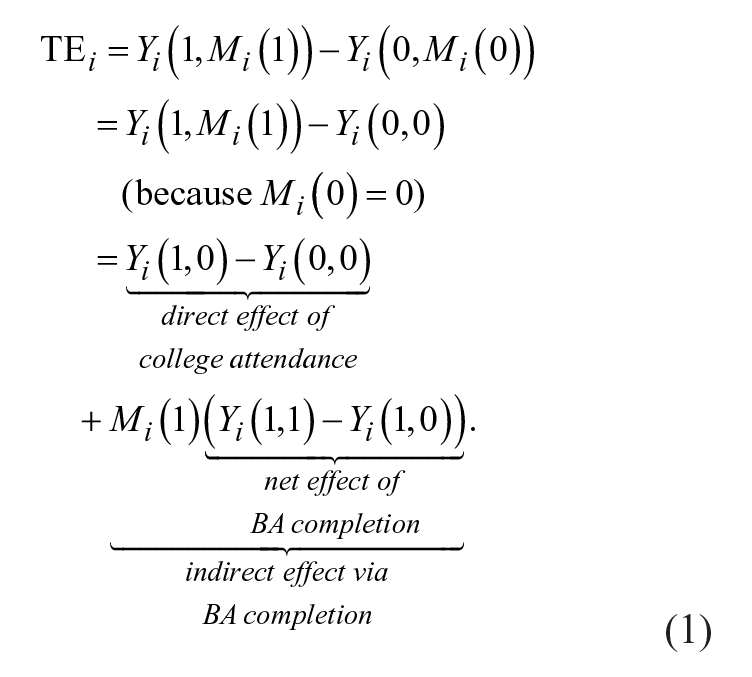
Thus, for individual i, the total effect of college attendance is governed by three components: the direct effect of college attendance (Yi(1,0) − Yi(0,0)), whether the person would complete a bachelor’s degree given college attendance (Mi(1)), and the net effect of bachelor’s completion (Yi(1,1)−Yi(1,0)). The product of the latter two components constitutes the indirect effect of college via bachelor’s completion.
To see how the direct and indirect effects of college differ by race, and how racial differences differ by gender, we focus on the conditional mean of TEi in each subpopulation defined by gender and race, denoted by G. In light of Equation 1 and the fact that

Thus, for group g,
The above decomposition enables us to isolate and quantify the equalizing and stratifying roles of higher education discussed previously. Specifically, our preceding arguments suggest that a bachelor’s degree may play an equalizing role through a reduction in employer discrimination, and a college education in general may play an equalizing role through its heterogeneous effects on neighborhood disadvantage and incarceration risk. In this regard, both
Equalizing and Stratifying Roles of Higher Education
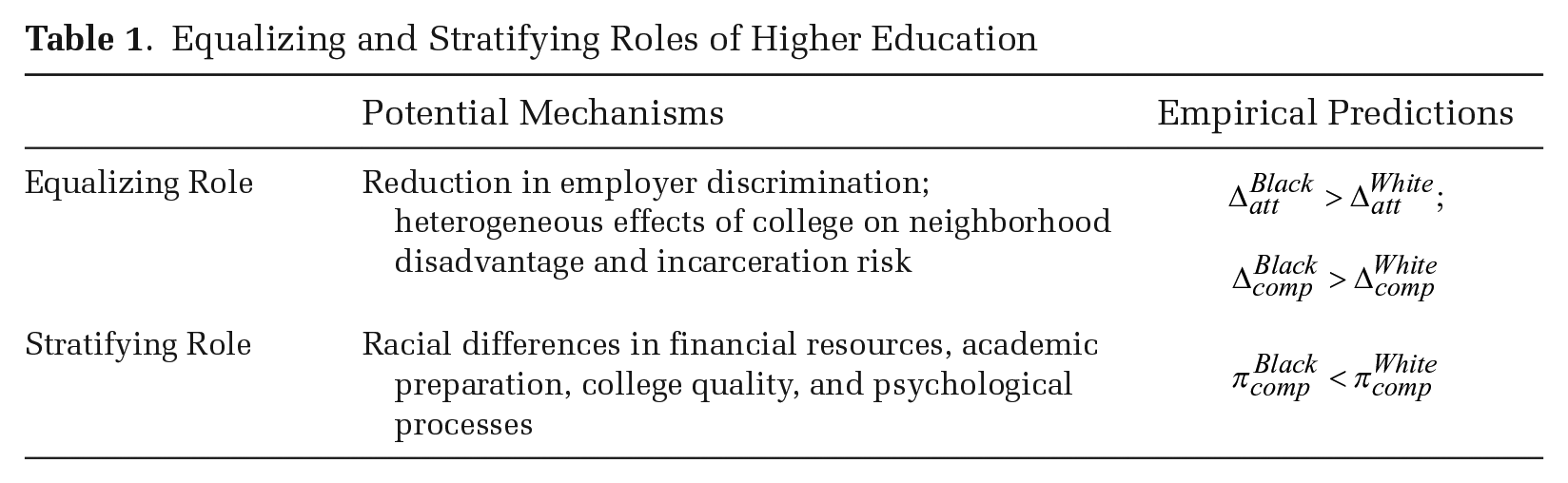
The covariance component
Capitalizing on a rich set of individual-, family-, and school-level characteristics that may affect a person’s selection into and out of college, all components in Equation 2 can be identified under the assumption of sequential ignorability (Robins 1997). Specifically, if we use X to denote a set of background characteristics that may confound the causal effects of college attendance and bachelor’s completion on earnings, and Z to denote a set of postsecondary characteristics that may confound the causal effect of bachelor’s completion on earnings, such as college quality and college GPA, the sequential ignorability assumption states that (a) conditional on background characteristics (X), no unobserved confounding exists for the effect of college attendance on college completion status and earnings; and (b) among college-goers, conditional on background characteristics (X) and postsecondary characteristics (Z), no unobserved confounding exists for the effect of bachelor’s completion on earnings. The sequential ignorability assumption is satisfied in Figure 2, which contains a directed acyclic graph (DAG) depicting a set of hypothesized causal relationships between the variables defined previously. 3 Note that the postsecondary characteristics (Z) are defined only among college-goers (A = 1). Potential values of these variables for non-college-goers are not required to identify and estimate our causal effects of interest.
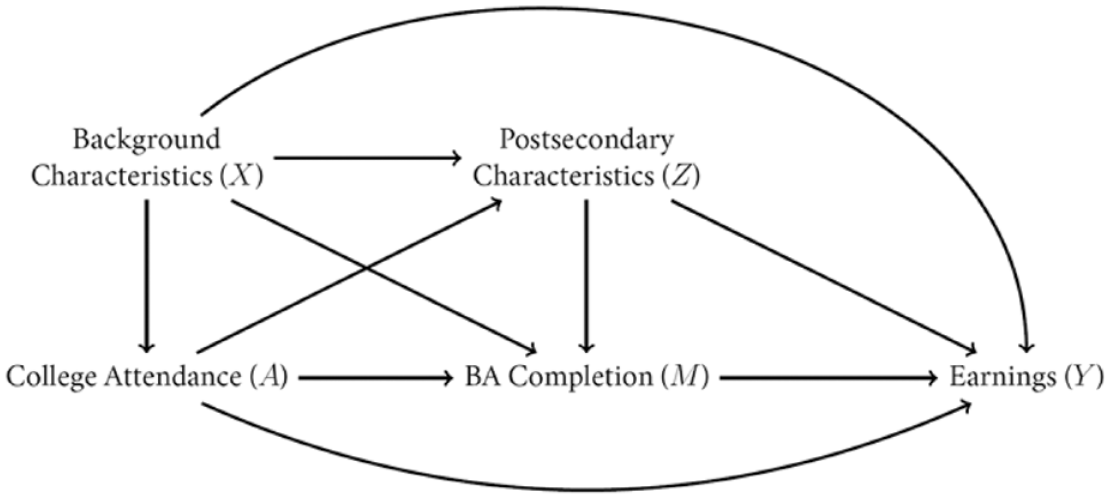
Hypothesized Causal Relationships in a Direct Acyclic Graph
To be sure, our assumption that the postsecondary characteristics (Z) are causally intermediate between attendance and completion is a simplification of real-world processes governing students’ college-going behavior. For example, a student’s decision to attend a four-year college may be affected by potential postsecondary characteristics, such as the availability of a scholarship that can defray the costs of college. If such a scholarship also affects the student’s bachelor’s completion status or earnings, we view it as an unobserved pre-college confounder. To assess the robustness of our results to this and other types of unobserved confounding, we conduct a sensitivity analysis that investigates the direction and magnitude of potential bias when either condition (a) or (b) breaks down (for more details, see Part H of the online supplement).
Under sequential ignorability, both the total effect of college and its direct and indirect components shown in Equation 2 are nonparametrically identified, that is, expressed in terms of observed data without any functional form assumption. The identification formulas of these quantities are given in Part A of the online supplement. A variety of methods, such as g-computation (Robins 1997) and marginal structural models (MSMs; Robins, Hernan, and Brumback 2000), could be used to evaluate these formulas. In this study, we estimate all quantities of interest using a debiased machine learning (DML) approach (Chernozhukov et al. 2018; Semenova and Chernozhukov 2021). In this approach, for each of our target parameters (i.e., the components in Equation 2), we construct aNeyman-orthogonal signal, which is a function of observed data for each unit. For example, our Neyman-orthogonal signal of the average potential earnings under non-college-attendance (E[Y(0,0)]) for individual i is
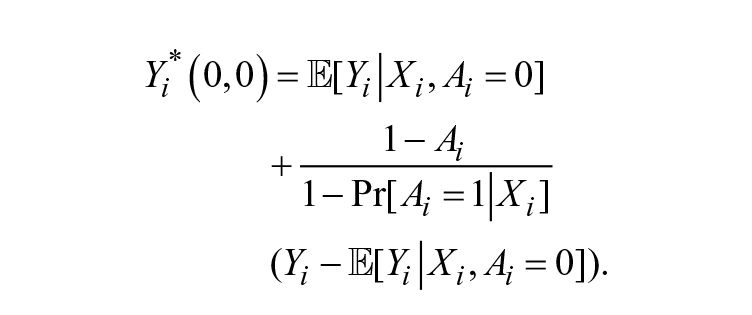
Such signals satisfy several properties. First, their (conditional) expectations areequal to those of the corresponding potential outcomes; for example,
DML is particularly attractive in our context, in which the rich sets of background characteristics (X) and postsecondary characteristics (Z) (see the next section) make it unrealistic for us to correctly specify parametric models for college attendance and college completion, which would be required to justify conventional methods such as MSMs. By leveraging machine learning methods to fit the models for college attendance, college completion, and earnings, the DML approach is highly robust to model misspecification. In this study, we fit each of the requisite models using a super learner (van der Laan, Polley, and Hubbard 2007) composed of Lasso and random forests (Hastie, Tibshirani, and Friedman 2009; for an introduction to various machine learning methods from a social science perspective, see Athey and Imbens 2019; Molina and Garip 2019). 5 Through the use of Neyman-orthogonal signals and cross-fitting, the DML estimators avoid the regularization and overfitting biases that often afflict machine learning estimators of statistical parameters (for a demonstration of these biases, see Chernozhukov et al. 2018). Finally, as we will see below, our estimates of the Neyman-orthogonal signals can serve as dependent variables in a variety of regression models, allowing us to better understand the contributing factors to racial differences in college returns and in bachelor’s completion. The implementation and rationale of the DML approach in our context are described in greater detail in Part A of the online supplement.
Besides assessing how the causal effects of college attendance and bachelor’s completion differ by race, we construct a set of Black-White gaps in potential earnings, that is, E[Yi(a, m)|Black men] – E[Yi(a, m)|White men] and E[Yi(a, m)|Black women] – E[Yi(a, m)|White women] for different values of a and m. Such quantities have been called “gap-closing estimands” (Lundberg 2022; see also Jackson and VanderWeele 2018), which can be interpreted as earnings gaps that would arise within a random sample of Black and White individuals if their educational status was fixed at a given level. 6 Unlike the observed Black-White earnings gaps conditional on educational status, these quantities are adjusted for selection processes, thus reflecting the causal effects of higher education on earnings inequality.
We then examine the sources of racial differences in college returns (if any) and in completion rates. First, we assess the extent to which the potential earnings gaps can be (statistically) explained by Black-White differences in family economic background and pre-college academic ability, and how the explanatory power of these factors varies by education. In other words, we evaluate quantities of the form E[Yi(a, m)|Black men, W] – E[Yi(a, m)|White men, W] to see how much of the potential earnings gaps can be attributed to factor W. Specifically, we fit and compare three regression models for the (estimated) Neyman-orthogonal signal of each of the potential outcomes (i.e., Yi(0,0), Yi(1,0), and Yi(1,1)): a model controlling only for race, a model controlling for race and parental income, and a model that controls additionally for pre-college academic ability, which is measured by the respondent’s percentile score on the Armed Services Vocational Aptitude Battery (ASVAB). 7 This procedure is justified by the fact that the conditional means of the signals are equal to the conditional means of the corresponding potential outcomes, as noted earlier.
Second, we assess the degree to which the Black-White gap in bachelor’s completion can be explained by parental income, academic preparation, and college quality. Toward this goal, we fit and compare three regression models for the (estimated)Neyman-orthogonal signal of potential bachelor’s completion status given college attendance (i.e., Mi(1)): a model controlling only for race, a model controlling for race and parental income, and a model that controls additionally for the ASVAB score. In addition, to assess whether college quality plays an independent role in shaping the Black-White gap in graduation rates, we fit a series of additional models for Mi(1) only among college-goers, controlling successively for race, parental income, the ASVAB score, and measures of college quality.
Data and Measures
The primary data source for this study is the National Longitudinal Survey of Youth, 1997 cohort (NLSY97). The NLSY97 began with a nationally representative sample of 8,984 men and women age 12 to 17 in 1997. These individuals were interviewed annually through 2011 and biennially thereafter. As will be discussed later, we also leverage the NLSY Geocode data and data from the IPEDS and the Opportunity Insights project (Chetty, Friedman, et al. 2020) to construct a set of college-level characteristics. We limit our analytic sample to White, Black, and Hispanic respondents who had completed at least a high-school diploma or GED by age 22 (n = 7,117) and who had valid earnings information at ages 30 to 33 (n = 6,126). Although our focus is on the Black-White earnings gap, including Hispanic respondents in our analyses offers a comparative lens for us to interpret the degree and patterns of Black disadvantage.
Previous studies on economic returns to college often use data from the NLSY79 (e.g., Brand and Xie 2010; Carneiro et al. 2011). Compared with the NLSY79, the NLSY97 traces the educational and labor market experience of a much younger cohort, making findings from this study more pertinent to current and future cohorts of U.S. youth. However, because members of the NLSY97 cohort are still relatively young, we can evaluate the economic payoff to higher education only up to their early 30s. Some previous research suggests the Black-White earnings gap widens over the life course, especially among the highly educated (Tomaskovic-Devey, Thomas, and Johnson 2005). To explore how our findings vary across cohorts and over the life course, we conduct a supplementary analysis with data from the NLSY79 cohort, drawing on respondents’ earnings measured at different ages. Results from this analysis are reported and discussed in Part F of the online supplement.
We construct five sets of variables, each corresponding to a node in Figure 2: college attendance (A), bachelor’s completion (M), earnings (Y), pre-college characteristics (X), and postsecondary characteristics (Z). Specifically, college attendance (A) denotes whether the respondent had attended a four-year college by age 22, and bachelor’s completion (M) denotes whether the respondent had received a bachelor’s degree by age 29. Respondents are coded as a college-goer (i.e., A = 1) if they had either attended a four-year college by age 22 or received a bachelor’s degree by age 29, and as a high school graduate otherwise (i.e., A = 0). Among college-goers, respondents are coded as a college graduate (i.e., M = 1) if they had received a bachelor’s degree by age 29, and as a college dropout/stopout (i.e., M = 0) otherwise. 8 By our definition of college attendance, respondents who had not attended a four-year college by age 22 or received a bachelor’s degree by age 29 are coded as high school graduates, whether or not they ever attended a two-year college or attended a four-year college only after age 22. To assess the robustness of our findings, we conducted parallel analyses using a range of alternative definitions of college attendance and bachelor’s completion. The results, reported in Parts C and D of the online supplement, are similar across different specifications.
Earnings are defined as the average of annual earnings, which include incomes from wages, salaries, farms, and other businesses, at ages 30 to 33 (inflation-adjusted to 2019 dollars). To account for the right skewness of earnings, most existing studies on the Black-White earnings gap use log earnings as the dependent variable and exclude individuals with zero earnings (e.g., Johnson and Neal 1998). Because employment rates are highly unequal between Black and White men (due to racial disparities in unemployment, labor force nonparticipation, and incarceration), excluding individuals with zero earnings will likely distort our results on the degree and patterns of racial inequality (Bayer and Charles 2018; Western and Pettit 2005). Instead, we include all individuals in our analyses but add 1,000 (in 2019 dollars) to the respondent’s average annual earnings before taking the log transformation. To assess the sensitivity of our findings to this earnings measure, we conducted a series of parallel analyses using alternative adjustments for the log transformation as well as the percentile rank transformation. As shown in Part E of the online supplement, the degree of the Black-White earnings gap in terms of log points varies according to the constant we add to earnings before taking the log transformation, especially among less-educated men. Nonetheless, our findings about the equalizing role of bachelor’s completion are highly consistent across alternative measures of earnings.
To adjust for selection processes that may confound the causal effects of college attendance and bachelor’s completion on earnings (i.e., the A-Y and M-Y relationships), we include a broad array of background characteristics (X) in our models for college attendance, bachelor’s completion, and earnings. They include basic demographic variables (gender, race, ethnicity, age in 1997), socioeconomic background (parental education, parental income, parental assets, co-residence with both biological parents, presence of a paternal figure, rural residence, southern residence), ability and behavior (percentile score on the ASVAB test, high school GPA, an index of substance use [ranging from 0 to 3], an index of delinquency [ranging from 0 to 10], whether the respondent had any children by age 18), and peer- and school-level characteristics (college expectation among peers and three dummy variables denoting whether the respondent ever had property stolen at school, was ever threatened at school, and was ever in a fight at school). Parental education is measured using mother’s years of schooling; when mother’s years of schooling is unavailable, it is measured using father’s years of schooling. Parental income is measured as the average annual parental income from 1997 to 2001. Both parental income and parental assets are inflation-adjusted to 2019 dollars.
To adjust for selection processes that may confound the causal effect of bachelor’s completion on earnings among college-goers (i.e., the M-Y relationship), we include a battery of postsecondary characteristics (Z), in addition to the background characteristics (X), in our models for bachelor’s completion and earnings. They include college type, college quality, field of study, college GPA, and the amounts of student loans. In each survey wave of the NLSY97, respondents were asked to report the names of the colleges in which they were currently or most recently enrolled (if any). Because many respondents attended more than one college, we focus on the college in which the respondent had been enrolled for the longest time by age 29. College type is a trichotomous variable denoting whether the college is a public institution, a private not-for-profit institution, or a for-profit institution. We use a multidimensional measure of college quality that reflects not only admission selectivity but also graduation rate and the college’s record of helping low-income students move up the economic ladder. To gauge college selectivity, we use three dummy variables to denote whether the college is one of the “most competitive,” “highly competitive,” or “very competitive” colleges in Barron’s Profile of American Colleges 2000. To measure graduation rate, we use the percentage of students graduating within six years measured in 2002, which is available from the IPEDS database. In addition to college selectivity and graduation rate, we extract from the database of the Opportunity Insights project a measure of “upward mobility rate,” that is, the percentage of students who reach the top quintile of the income distribution among those with parents in the bottom quintile of the income distribution.
In each survey wave, respondents who were currently or recently enrolled in college were also asked to report their major field of study. We use a dummy variable to denote whether the field of study in which the respondent had majored for the longest time by age 29 is a STEM field. College GPA is measured using the respondent’s cumulative GPA from the Post-Secondary Transcript Study (PSTRAN). Finally, we include two variables representing the total amounts of loans the respondent had taken from family and friends and from other sources (including the federal government) to pay for college by age 29. In our analytic sample, some components of the background characteristics (X) and postsecondary characteristics (Z) contain a small fraction of missing values. They are handled by multivariate imputation via chained equations, with 10 imputed datasets. The standard errors of our parameter estimates are adjusted for multiple imputation using Rubin’s (1987) method.
Table 2 reports the group-specific means in all variables by gender and race. In the first two panels, we see that Black respondents lag far behind White respondents in both educational and labor market outcomes. The degree of Black-White disparity in educational outcomes is similar between men and women (on the probability scale). Compared with White men, Black men are 15 percentage points less likely to have attended a four-year college by age 22, and 17 percentage points less likely to have obtained a bachelor’s degree by age 29. The corresponding differences are 13 and 18 percentage points for women. The Black-White gap in earnings, by contrast, is much greater among men than among women. In terms of log earnings, the Black-White gap is .87 among men but only .21 among women. To shed light on the sources of the gender difference, we also report group-specific means in hourly wage and hours worked per year, which suggest the male Black-White gap in earnings is partly driven by a deficit of Black men in labor force attachment. On average, Black men in our sample worked 1,725 hours per year, nearly 300 hours fewer than did White men. By contrast, Black women in our sample worked 1,600 hours per year, slightly more than White women.
Group-Specific Means in Educational Outcomes, Labor Market Outcomes, Background Characteristics, and Postsecondary Characteristics
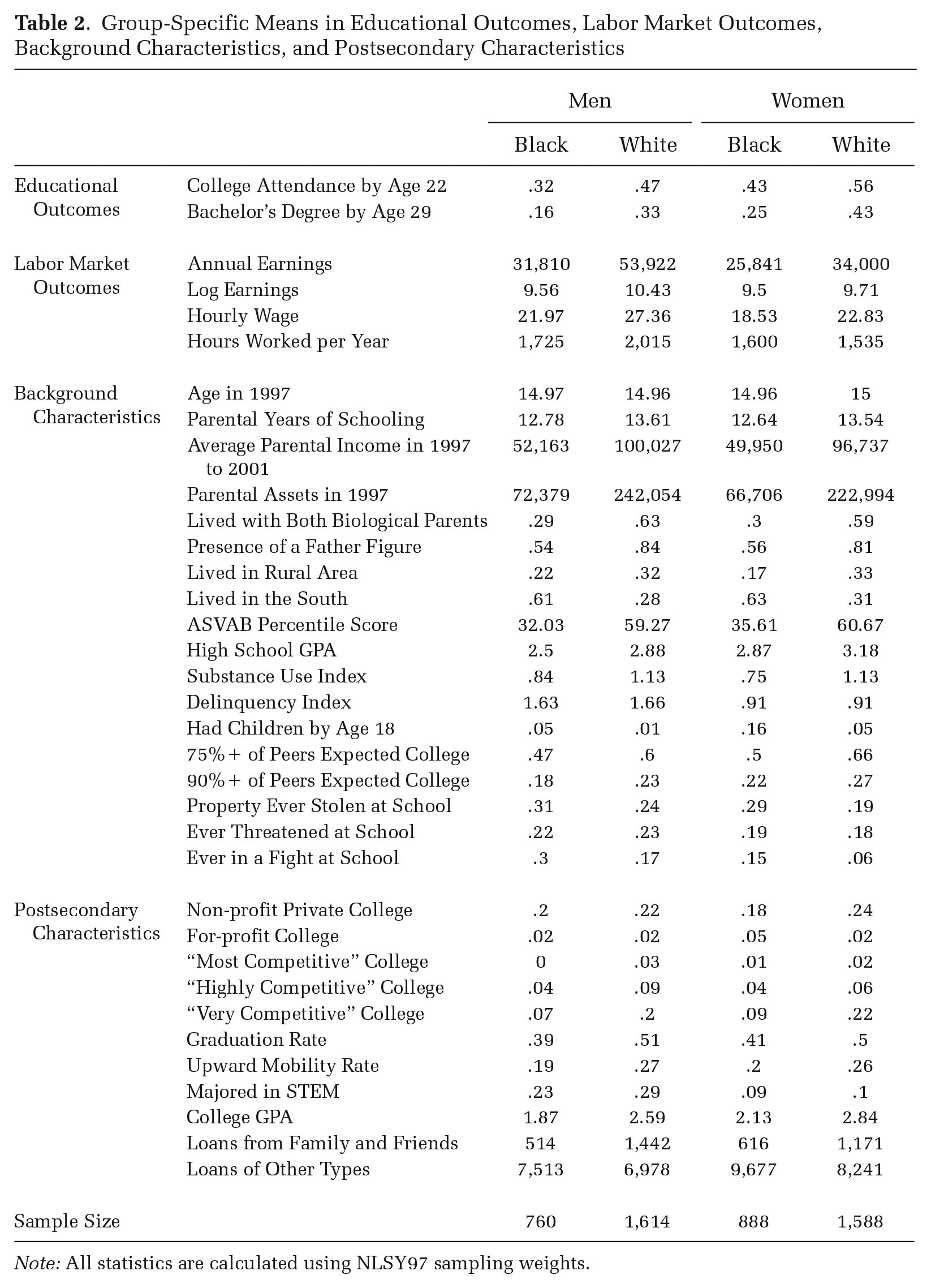
Note: All statistics are calculated using NLSY97 sampling weights.
In the third panel of Table 2, we see large Black-White disparities in socioeconomic background, family structure, and academic achievement. For example, the average parental income among Black respondents is about 52,000 (in 2019 dollars), roughly half that of White respondents, and the average value of parental assets among Black respondents is only about 30 percent as much as that among White respondents. Compared with White adolescents, Black adolescents were also much less likely to live with both biological parents in 1997, much less likely to have a father figure in the household in 1997, and far more likely to have had children by age 18. In the realm of academic achievement, Black respondents in our sample scored substantially lower on the ASVAB test and had poorer high school GPAs relative to their White peers. Similar Black-White disparities are evident in contextual characteristics, such as college expectations among peers and the school environment.
The last panel of Table 2 shows that even among respondents who attended a four-year college, Black students trail their White peers in postsecondary characteristics such as college quality and college GPA. For both men and women, Black college-goers are less likely than their White counterparts to have attended a most competitive, highly competitive, or very competitive college. Moreover, the colleges that Black students attend tend to have lower graduation rates and lower upward mobility rates, that is, poorer records of lifting low-income students onto the upper rungs of the economic ladder. In addition, Black students, on average, have a lower college GPA relative to their White peers, which may have contributed to the Black-White gap in bachelor’s completion. Among men, Black college-goers are also less likely to have majored in a STEM field. Compared with White students, Black students also tend to have taken more loans from sources other than family and friends.
Results
Observed Black-White Earnings Gaps by Education
Before evaluating the causal effects of college attendance and bachelor’s completion, we first describe how the observed Black-White earnings gap varies by education. Table 3 presents average log earnings by gender, race, and education, along with gender-specific Black-White gaps in log earnings, for the full sample and for different educational groups. The first column reproduces the fourth row of Table 2, showing that overall, the Black-White earnings gap is much more pronounced among men than among women. The next four columns show how the average log earnings and the Black-White gap vary across educational groups. Gender differences are substantial, not only in the magnitude of the racial earnings gap but also in the way it varies by education. At each level of education, the racial earnings gap is larger among men than among women. Moreover, the magnitude of the earnings gap differs more sharply between college graduates and the less educated among men than among women. Among men, the earnings gap in log earnings is −.870 among high school graduates, −.770 among college dropouts/stopouts, but only −.200 among college graduates. By contrast, the Black-White gap among women is similar across educational groups: −.033 among high school graduates, −.046 among college dropouts/stopouts, and .040 among college graduates. None of the within-group earnings gaps for women are statistically distinguishable from zero at the p < .05 level.
Black-White Gaps in Observed Log Earnings, Overall and by Level of Education
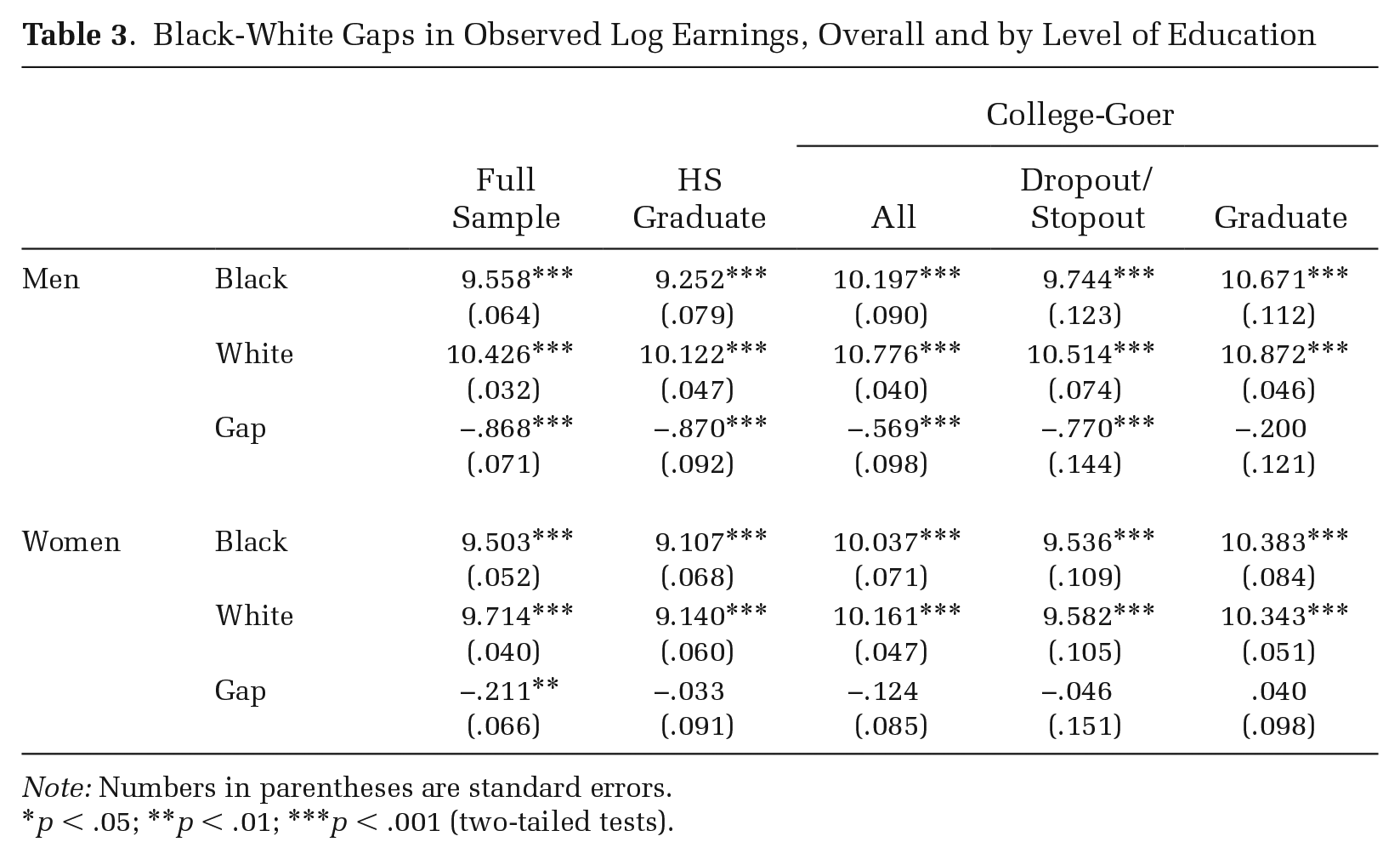
Note: Numbers in parentheses are standard errors.
p < .05; **p < .01; ***p < .001 (two-tailed tests).
Table 3 also shows that, in each gender-race group, college graduates earn much more than individuals with lower levels of education. Among Black men, for example, college graduates have average log earnings of 10.671, .927 above that of college dropouts/stopouts, and 1.419 above that of high school graduates. The corresponding educational differences among White men are considerably smaller, at .358 and .750 log points. The steeper gradient associated with a bachelor’s degree among Black men leads to a reduction of the racial earnings gap among college graduates, as noted earlier. Such educational gradients, however, should not be interpreted as the causal effects of higher education on earnings. A wide range of pre-college and postsecondary characteristics, such as socioeconomic background, academic preparation, and college GPA, may affect a person’s selection into and out of college. Without adjusting for such selection processes, the educational gradients reported in Table 3 are biased estimates of the causal effects of college attendance and bachelor’s completion. Moreover, because selection effects may differ by race, the racial differences in these educational gradients do not necessarily reflect racial differences in the economic payoff to college. Next, we turn to our estimates of the causal effects of attending a four-year college, their direct and indirect components, and the implications of these estimates for the Black-White earnings gap.
Total, Direct, and Indirect Effects of College on Earnings
Using the DML method described previously, we estimate the total effect of attending a four-year college on log earnings,
Decomposition of the Total Effect of College on Log Earnings by Gender and Race
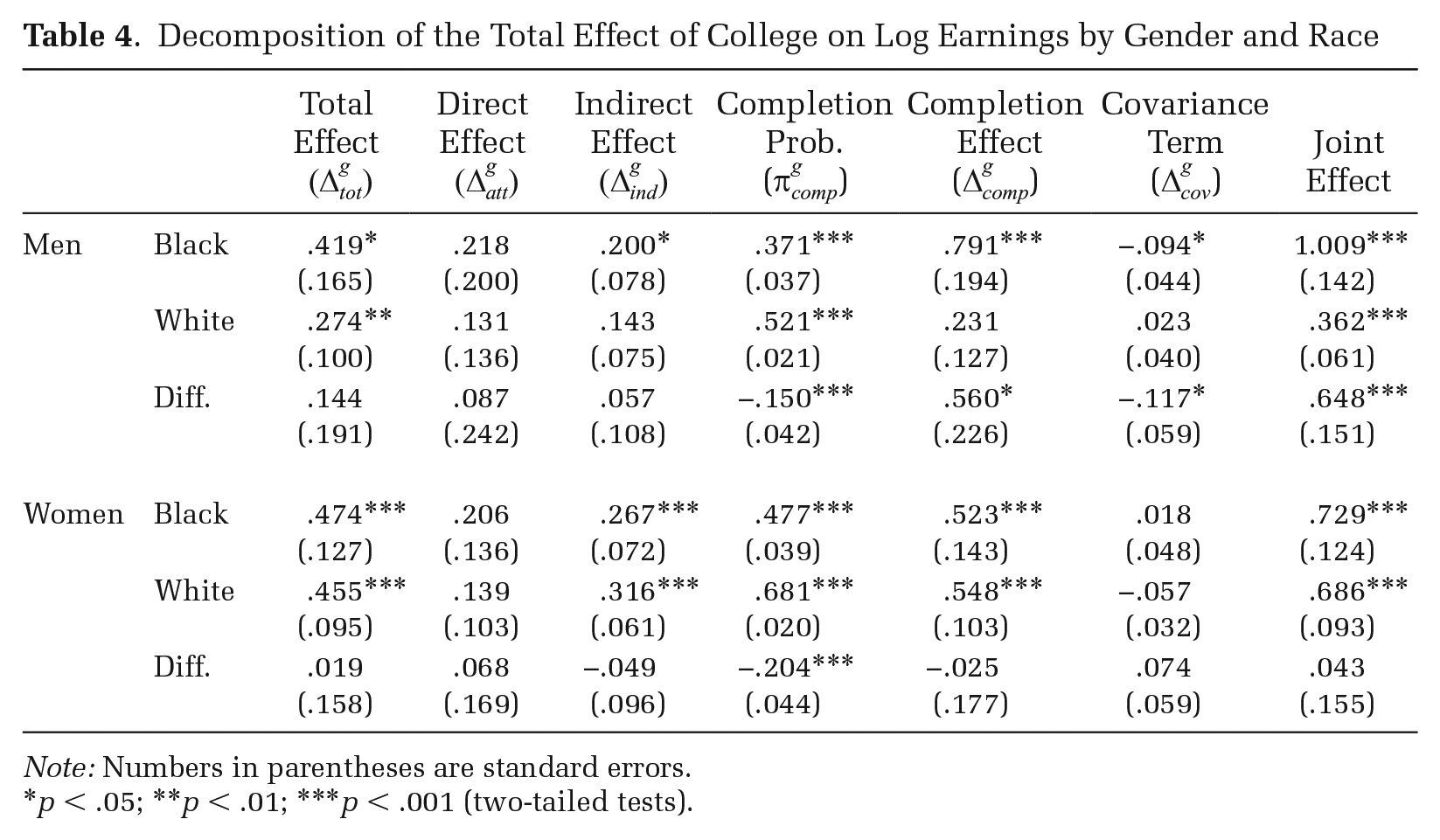
Note: Numbers in parentheses are standard errors.
p < .05; **p < .01; ***p < .001 (two-tailed tests).
The indirect effect of college (
We have seen that among men, the net effect of bachelor’s completion is equalizing, that is, larger among Black men than among White men. It is worth asking how this equalizing force would shape the Black-White earnings gap without the stratifying forces associated with racial inequality in degree completion (
To see the implications of the racial differences
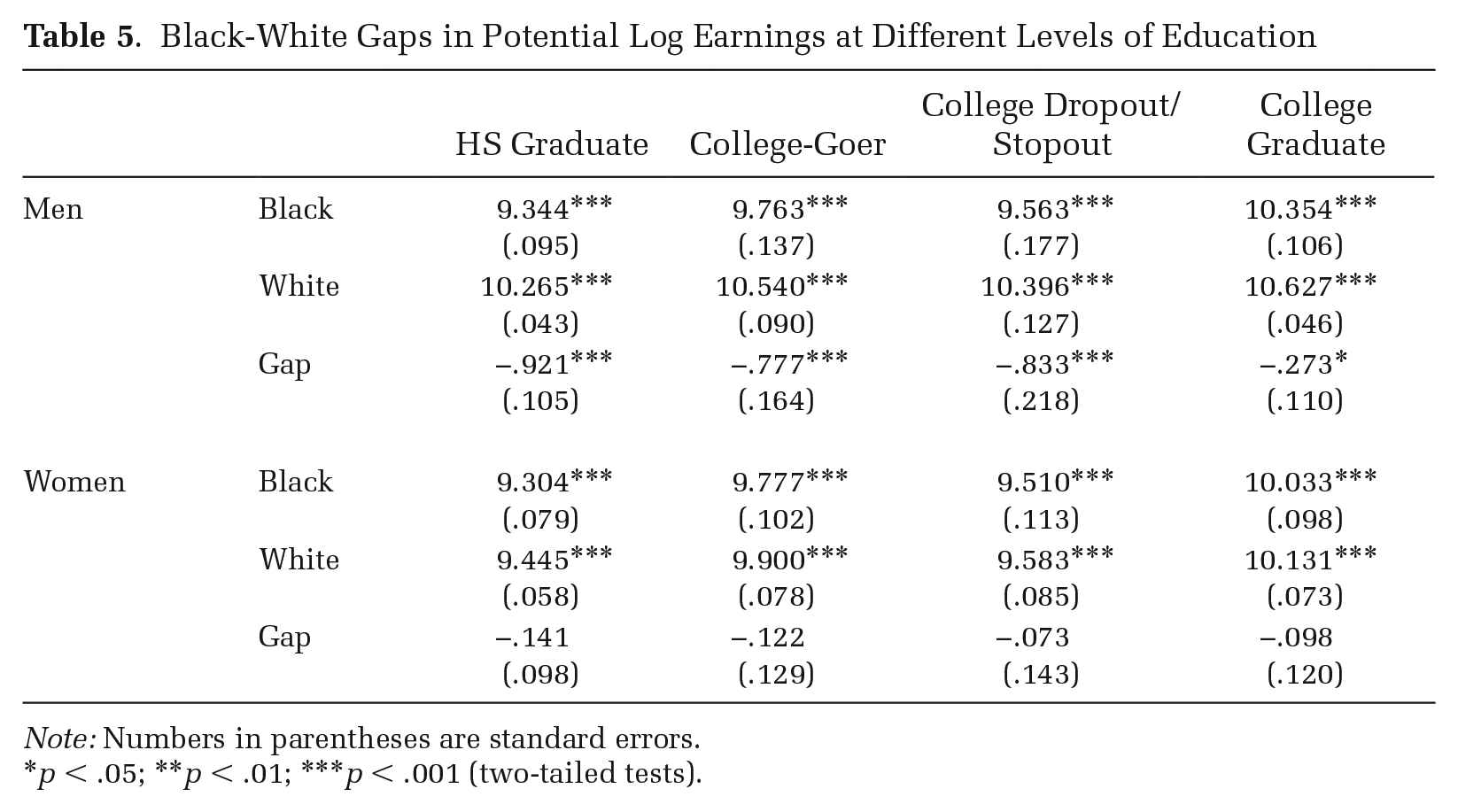
Black-White Gaps in Potential Log Earnings at Different Levels of Education
Note: Numbers in parentheses are standard errors.
p < .05; **p < .01; ***p < .001 (two-tailed tests).
The results for women are shown in the lower panels of Tables 4 and 5. In contrast to the case for men, we find little evidence of an equalizing effect of bachelor’scompletion—the estimated effect of bachelor’s completion is .523 for Black women and .548 for White women. Yet, substantial racial inequality exists in the likelihood of bachelor’s completion. Given college attendance, the probability of college completion is .477 among Black women, compared with .681 among White women. On the other hand, both the direct effect of college attendance and the covariance component seem to be equalizing—larger for Black women than for White women (although the differences fall short of reaching conventional levels of statistical significance). As a result of these countervailing forces, the estimated total effect of college attendance on earnings is similar between Black and White women (.474 versus .455 log points).
The lower panel of Table 5 shows the implications of these estimates for the female Black-White earnings gap. For a random sample of Black and White women, the racial gap in log earnings would be −.141 if none attended college and −.122 if everyone attended college (regardless of completion status). The gap would be slightly narrower if the stratifying force associated with
In summary, the above results broadly, but not fully, support our hypotheses regarding the dual roles of college summarized in Table 1. Inequality in college completion is present for both men and women (
Understanding the Equalizing Effect of a Bachelor’s Degree
We now conduct a set of additional analyses to better understand the equalizing effect of a bachelor’s degree among men. Our earlier discussion suggests higher education may serve as a “direct equalizer” by helping African American youth circumvent several racialized barriers to economic advancement, such as employer discrimination, neighborhood poverty, and incarceration. On the other hand, given that race is correlated with class background and pre-college academic ability, the equalizing effect of a college degree among men may also reflect a weakened influence of these factors among college graduates. If this is true, a bachelor’s degree may be called an “indirect equalizer,” as it reduces racial inequality through reducing inequality by class background and pre-college ability. To assess the relative importance of these two mechanisms, we fit and compare three linear models for the (estimated) Neyman-orthogonal signal of each of the potential outcomes (i.e., Yi(0,0), Yi(1,0), and Yi(1,1)): a model controlling only for race, a model controlling for race and the percentile rank of parental income, and a model controlling additionally for pre-college academic ability, as measured by the respondent’s ASVAB percentile score. By comparing the coefficients of race across these models, we can assess the extent to which the Black-White gaps in potential earnings are explained by class background and pre-college academic ability, and, more importantly, whether the reduced gap at the college graduate level is due to a reduced influence of class and academic backgrounds.
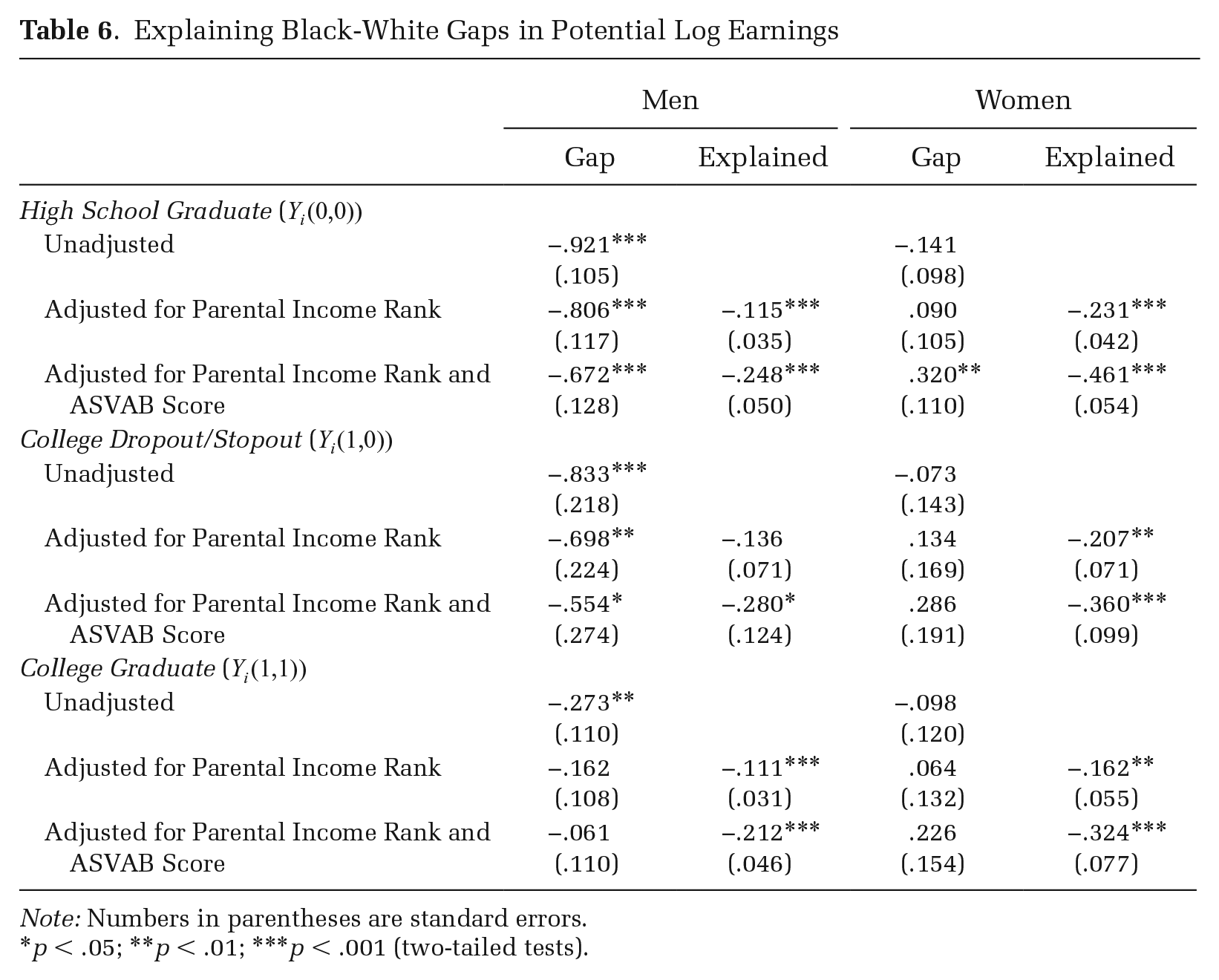
The results are summarized in Table 6; the upper, middle, and lower panels correspond to the Black-White gaps in potential log earnings at the levels of high school graduate, college dropout/stopout, and college graduate, respectively. In each panel, we report both the baseline (unadjusted) earnings gap and how it changes after we adjust for parental income and the ASVAB score. The columns titled “explained” show the differences between the unadjusted and adjusted gaps, capturing the explanatory power of parental income and the ASVAB score. Several patterns are noteworthy.
Explaining Black-White Gaps in Potential Log Earnings
Note: Numbers in parentheses are standard errors.
p < .05; **p < .01; ***p < .001 (two-tailed tests).
First, for men, a bachelor’s degree is associated with a much smaller Black-White earnings gap, and this educational difference persists after we control for parental income and the ASVAB score. In fact, the explanatory power of parental income and the ASVAB score does not vary much by education. At different levels of education, racial differences in parental income translate into a similar amount of the Black-White gap in potential earnings: .115 for high school graduates, .136 for college dropouts/stopouts, and .111 for college graduates. After adjusting for parental income, racial differences in the ASVAB score explain a similar amount of the remaining gap at all levels of education. In combination, parental income and the ASVAB score explain away .21 to .28 log points of the potential earnings gap between Black and White men. This amount accounts for the bulk of the earnings gap for men with a bachelor’s degree (.212/.273 = 77.7 percent), but it constitutes only about 30 percent of the earnings gap for less-educated men (.248/.921 = 26.9 percent for high school graduates; .280/.833 = 33.6 percent for college dropouts/stopouts). Hence, after adjusting for parental income and the ASVAB score, the “residual” earnings gap between Black and White men is .672 log points for high school graduates, .554 log points for college dropouts/stopouts, but only .061 for bachelor’s holders. 9 Thus, while racial differences in pre-college class and academic backgrounds are a primary contributor to the Black-White earnings gap among college graduates, they explain only a small fraction of the earnings gaps among less-educated men. This finding suggests a bachelor’s degree is more of a “direct equalizer” than an “indirect equalizer”: it narrows the male Black-White earnings gap not by reducing inequality induced by racial differences in class background and pre-college ability, but by lessening the “residual inequality”—a part of inequality more likely driven by labor market factors, such as employer discrimination and job access.
Compared with men, the Black-White earnings gap among women is much smaller and does not vary as much by education. For women, the influence of parental income and the ASVAB score appears to be slightly greater at lower levels of education. At a given level of education, racial differences in these pre-college characteristics translate into about .32 to .46 log points of the potential earnings gap. In contrast to men, this amount can explain away the female Black-White gap in potential earnings at all levels of education. In fact, after adjusting for parental income and the ASVAB score, Black women with only a high school diploma are expected to earn significantly more than their White counterparts.
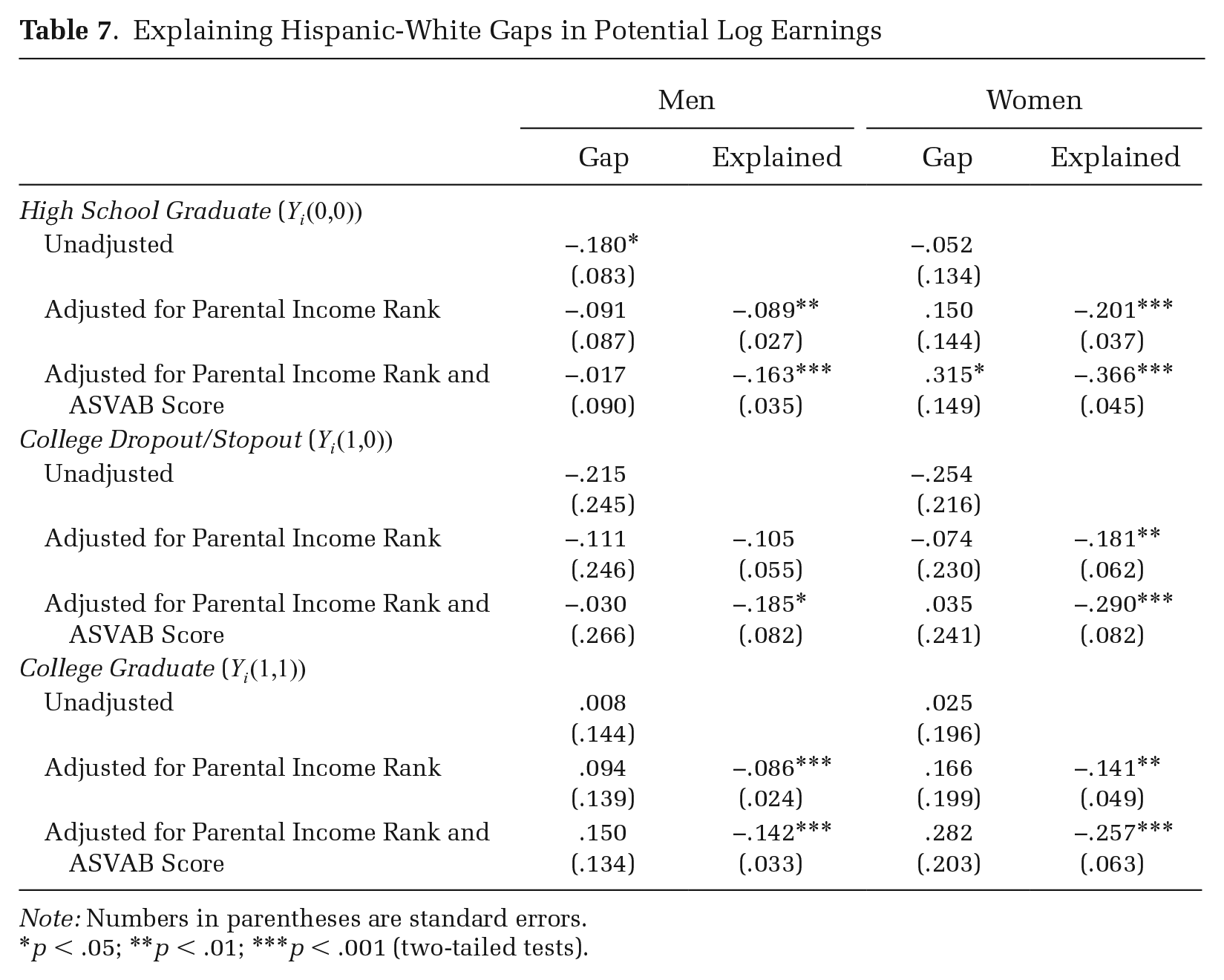
To put the above findings in perspective, we now turn to parallel results for Hispanic men and women (see Table 7). Overall, the Hispanic-White earnings gap is smaller than the Black-White earnings gap at almost all levels of education, especially among men. Furthermore, unlike the Black-White earnings gap, the Hispanic-White earnings gap can be largely explained by group differences in parental income and the ASVAB score at all levels of education for both men and women. At the high school level, for example, the estimated residual gap between Hispanic and White men is only .017 log points, compared with the .672-log-point-gap that separates Black and White men. In summary, our results in Tables 6 and 7 suggest that group differences in pre-college resources and skills are the primary driver of the Hispanic-White earnings gap, the Black-White earnings gap among women, and the Black-White earnings gap among men with a bachelor’s degree. Yet, they account for only a small fraction of the massive economic disadvantage faced by less-educated Black men.
Explaining Hispanic-White Gaps in Potential Log Earnings
Note: Numbers in parentheses are standard errors.
p < .05; **p < .01; ***p < .001 (two-tailed tests).
Understanding the Black-White Gap in Bachelor’s Completion
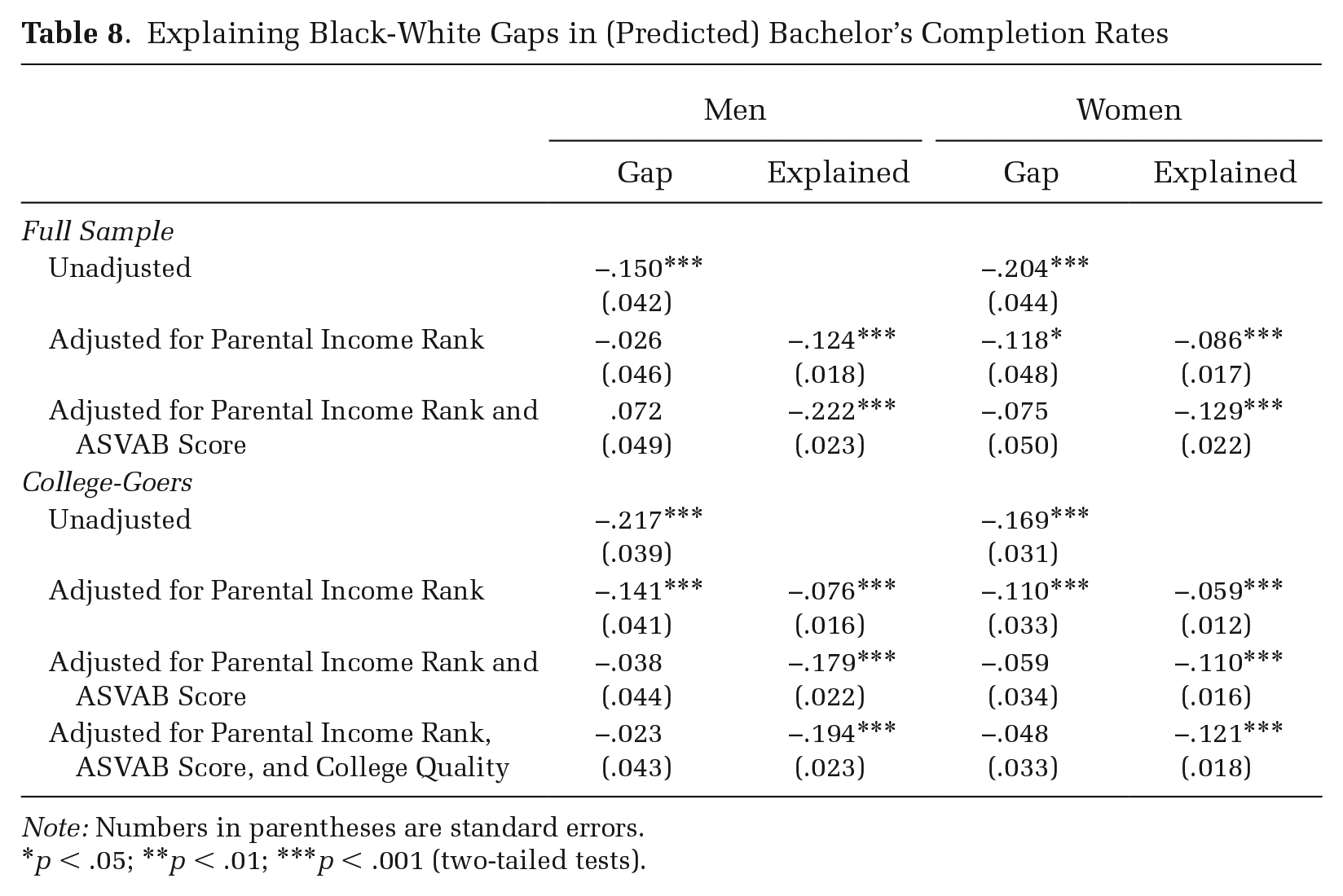
The stratifying role of college is mainly a result of the Black-White disparity in the likelihood of bachelor’s completion given attendance. This disparity, as noted earlier, is shaped by a variety of factors, such as racial differences in class background, pre-college academic ability, and college quality. To assess the relative importance of these factors in shaping the Black-White gap in bachelor’s completion, we first fit and compare three linear models for the (estimated) Neyman-orthogonal signal of potential bachelor’s completion status given college attendance (i.e., Mi(1)): a model that controls only for race, a model controlling for race and parental income rank, and a model that controls additionally for the ASVAB score. Because Mi(0) = 0 by definition, Mi(1) can be viewed as the causal effect of college attendance on bachelor’s attainment for individual i. Thus, these models illuminate why the causal effect of college attendance on bachelor’s attainment is larger among White than among Black respondents—specifically, the degree to which it can be attributed to racial differences in class background and pre-college academic ability. The results are shown in the upper panel of Table 8. First, we see that the bulk of the Black-White gap in bachelor’s completion probability among men can be explained by racial differences in parental income. Moreover, after adjusting for the ASVAB score, Black men exhibit a modest, albeit statistically insignificant, advantage over White men in the likelihood of bachelor’s completion. Among women, the estimated influence of parental income and the ASVAB score is somewhat weaker. Yet, these two factors still account for about two thirds of the female Black-White gap in bachelor’s completion (.129/.204 = 63.2 percent).
Explaining Black-White Gaps in (Predicted) Bachelor’s Completion Rates
Note: Numbers in parentheses are standard errors.
p < .05; **p < .01; ***p < .001 (two-tailed tests).
The above analysis pertains to potential college completion status (given college attendance), that is, Mi(1), for all respondents in our sample. This population-level analysis aligns with our decomposition of the total college effect (Equation 2), but it leaves open the question of whether racial differences in college quality contribute independently to the Black-White completion gap among actual college-goers. To address this question, we fit a series of linear regressions only among college-goers, which models the observed bachelor’s completion status (Mi) as a function of parental income, the ASVAB score, and all indicators of college quality defined in the Data and Measures section. 10 Results from this analysis, shown in the lower panel of Table 8, are broadly similar to those based on the full sample. For both men and women, parental income and the ASVAB score can explain most of the Black-White completion gap. Comparing the last two models, we see that after accounting for racial differences in pre-college class and academic backgrounds, college quality has little independent explanatory power for the Black-White completion gap. This finding echoes previous studies showing that racial gaps in college quality are fully explained or reversed after differences in class and academic backgrounds are taken into account (e.g., Conwell and Quadlin 2022). In summary, the Black-White gap in bachelor’s completion is primarily a result of racial disparities in resources and skills formed before college entry.
Policy Implications
We now zoom in on the policy implications of the equalizing and stratifying roles of higher education. As discussed earlier, the equalizing effect of a bachelor’s degree is partly offset by the Black-White disparity in college completion, resulting in a modest difference between Black and White men and a similarity between Black and White women in the total effect of college attendance. This finding suggests a blanket expansion in college enrollment is unlikely to significantly reduce the Black-White earnings gap. As shown in Table 5, for a random sample of Black and White youth, even if everyone attended college, earnings inequality would decline only slightly. On the other hand, given the strong equalizing effect of a bachelor’s degree among men, an increase in bachelor’s attainment rate may help reduce the male Black-White earnings gap. Thus, one might suppose that higher-education policies aimed at reducing racial inequality should focus on increasing bachelor’s completion rates (i.e., graduation rates), especially among Black men. However, bachelor’s attainment rate is the product of college attendance rate and bachelor’s completion rate. Given the current rate of four-year college attendance among Black men (see Table 2), an increase in bachelor’s completion rate may not substantially change the bachelor’s attainment rate in this demographic. From this perspective, both college attendance rate and bachelor’s completion rate should be increased to meaningfully boost the proportion of college graduates among Black men. Finally, to the extent that neither college attendance rate nor bachelor’s completion rate will reach a point near 100 percent (at least not in the foreseeable future), part of the Black-White earnings gap will continue to reflect racial disparities in college attendance and completion. Therefore, to reduce racial earnings inequality, higher-education policies should also strive to close the Black-White gaps in college attendance and bachelor’s completion.
To obtain a more concrete idea of the potential effects of different policies, we now conduct a thought experiment to predict the counterfactual Black-White earnings gaps under a set of stylized educational interventions. Specifically, we consider three types of hypothetical interventions: expansion, redistribution, and expansion + redistribution. By expansion, we mean a hypothetical intervention that multiplies everyone’s odds of attending/completing college (given their observed characteristics) by a constant such that the overall college attendance/completion rate reaches a prespecified target r. By redistribution, we mean a hypothetical intervention that multiplies a person’s odds of attending/completing college by a race-specific constant to reach racial parity in college attendance/completion while keeping the overall college attendance/completion rate unchanged. Finally, by expansion + redistribution, we mean a hypothetical intervention that multiplies a person’s odds of attending/completing college by a race-specific constant such that the college attendance/completion rate reaches a prespecified target r for each racial group. Here, we define these interventions in terms of a proportional increase in everyone’s odds of attending/completing college (instead of, for example, an additive/proportional increase on the probability scale) so that it preserves the odds ratio of attending/completing college between individuals, or, in the case of redistribution and expansion + redistribution, between individuals within the same racial group (Kennedy 2019).
Each of the above interventions can be envisioned for college attendance, bachelor’s completion, or both, resulting in nine counterfactuals. For each gender-race group g, we estimate its counterfactual average earnings using the following weighting estimator:
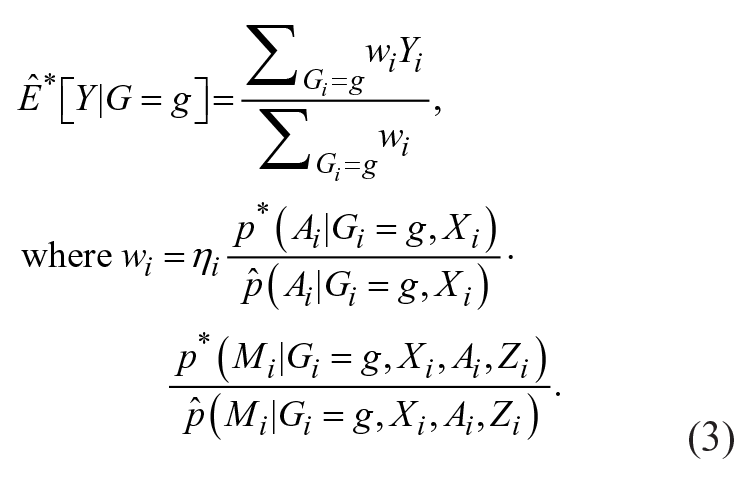
In Equation 3, η
i
is the NLSY97 sampling weight, p(·) and p*(·) represent factual and counterfactual probabilities of attending/completing college, and the ratio
Counterfactual Black-White Earnings Gaps under Stylized Educational Interventions
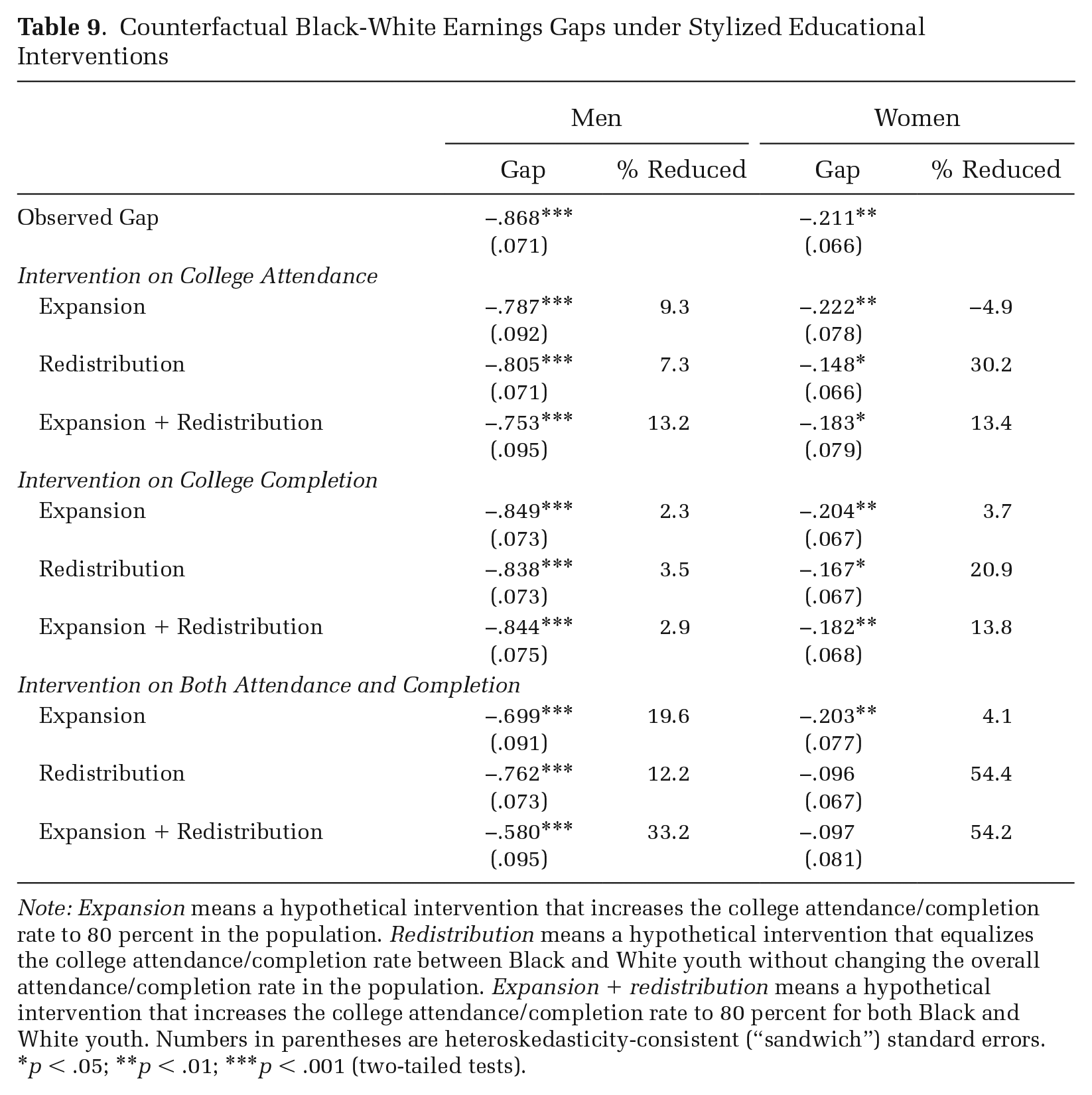
Note: Expansion means a hypothetical intervention that increases the college attendance/completion rate to 80 percent in the population. Redistribution means a hypothetical intervention that equalizes the college attendance/completion rate between Black and White youth without changing the overall attendance/completion rate in the population. Expansion + redistribution means a hypothetical intervention that increases the college attendance/completion rate to 80 percent for both Black and White youth. Numbers in parentheses are heteroskedasticity-consistent (“sandwich”) standard errors.
p < .05; **p < .01; ***p < .001 (two-tailed tests).
The first row of Table 9 reproduces the observed earnings gaps shown in Table 3. In the first panel, we see that a blanket expansion in college attendance would slightly reduce the Black-White earnings gap among men but not among women, as expected. A redistribution in college attendance (without expansion) would reduce the earnings gap by about .06 log points for both men and women, although this amount constitutes a 30.2 percent reduction for women but only 7.3 percent for men. If expansion and redistribution were combined so that the college attendance rate reached 80 percent for all gender-race groups, the Black-White earnings gap would be reduced by about 13 percent for both men and women. In the second panel, we see that interventions at the college completion stage would have limited effects on the Black-White earnings gap, especially for men. This is partly because the current four-year-college attendance rate among Black men is so low that even an increase in bachelor’s completion rate to 80 percent would not substantially alter the educational distribution of this group.
The last panel in Table 9 shows the counterfactual earnings gaps that would result if the three types of interventions were envisioned at both the attendance and completion stages. An across-the-board increase in both college attendance and bachelor’s completion would reduce the male earnings gap by about 20 percent while leaving the female earnings gap virtually unchanged. These estimates echo our earlier finding that a bachelor’s degree is an equalizer among men but not among women. On the other hand, a redistribution in both college attendance rate and bachelor’s completion rate (without expansion) would reduce the earnings gap much more among women than among men (in percentage terms). The gender difference in the effects of expansion versus redistribution reveals the different roles of education in shaping the male and female Black-White earnings gaps. Among men, education moderates inequality, as a higher level of education, especially a bachelor’s degree, leads to a smaller racial earnings gap. Among women, education mediates inequality, as a significant part of the overall earnings gap can be removed by eliminating racial inequality in educational attainment. Thus, expansion is more effective at reducing inequality among men but redistribution is more effective at reducing inequality among women. Considering that education also mediates inequality among men, expansion + redistribution should be more effective than expansion alone at reducing the male earnings gap. This is confirmed in the last row of Table 9: if expansion + redistribution was imposed at both stages so that the college attendance rate reached 80 percent for both Black and White youth with a high school diploma or equivalent, and the bachelor’s completion rate reached 80 percent for both Black and White college-goers, the overall Black-White earnings gap would be reduced by about a third for men and a half for women.
Conclusions
Writing at the climax of the civil rights movement, Duncan (1968:102) reasoned that if we could eliminate educational and labor market discrimination against African Americans, the Black-White gap in economic status would “tend to disappear of its own accord.” Today, more than half a century past Duncan’s writing, it is disturbingly clear that the gap has shown no signs of disappearance, and, by some indicators, widened (Bayer and Charles 2018). Whereas existing literature has largely focused on forces that maintain and reinforce racial inequality, such as residential segregation and mass incarceration, this study investigates how higher education shapes the Black-White earnings gap. In particular, we highlight the postsecondary system as both an equalizer and a stratifier. Using a novel causal decomposition, a DML estimation method, and data from the NLSY97, we dissected the total effect of attending a four-year college on earnings into several direct and indirect components. By examining how each of these components differs by race and its correlates, we isolated the equalizing and stratifying roles of higher education and illuminated their sources.
We find that among men, a bachelor’s degree has a strong equalizing effect on earnings, although at the population level, it is partly offset by unequal likelihoods of bachelor’s completion and differential patterns of selection. This finding contrasts with recent research on the role of college graduation in the context of intergenerational income mobility, in which the benefit of a bachelor’s degree is found to be comparable between students from low- and high-income backgrounds (e.g., Fiel 2020; Zhou 2019; but see Karlson 2019). Thus, our study contributes to the debate on whether a college degree serves as a “great equalizer”: in the context of racial inequality, it still does, albeit only for men.
Why does a college degree reduce the earnings gap between Black and White men but not inequality on other dimensions? Through regression analyses for potential earnings at different levels of education, we find that a bachelor’s degree narrows the male Black-White earnings gap primarily by mitigating the “unexplained” penalty of being African American in the labor market, rather than by reducing the influence of class background and pre-college academic ability. This finding reconciles the seemingly inconsistent roles of a bachelor’s degree in the contexts of racial inequality versus intergenerational income mobility. It also helps explain why the equalizing effect of a bachelor’s degree is restricted to men: for Black and White women, after pre-college class and academic backgrounds are taken into account, there is little residual earnings gap regardless of the level of education, as shown in Table 6.
The above finding prompts the question of how a bachelor’s degree narrows the “unexplained” inequality for men. Multiple processes may be at work. First, as Arcidiacono and colleagues (2010) argue, a bachelor’s degree allows job-seekers to reveal their idiosyncratic abilities in the labor market through information such as grades, majors, and college(s) attended, which may reduce employers’ incentives for statistical discrimination. Moreover, given such information, employers should also have less leeway to engage in taste-based discrimination. Relatedly, to the extent that a bachelor’s degree is often associated with positive traits such as “hard-working,” it may help young Black men counteract negative stereotypes, such as being “unreliable,” “scary,” or “lacking in work ethic,” that they would otherwise suffer (Kirschenman and Neckerman 1991; Moss and Tilly 1996). Second, if young Black men are disproportionately handicapped by neighborhood poverty—which is often associated with limited job opportunities, low return on job referral networks, and a lack of social norms of employment—then a bachelor’s degree may narrow the Black-White earnings gap by helping Black men circumvent disadvantaged neighborhoods (Swisher et al. 2013). Finally, given less-educated Black men’s disproportionate risk of incarceration and the deleterious effects of incarceration on employment and earnings, a bachelor’s degree might also narrow the Black-White earnings gap by reducing racial disparities in incarceration. To be sure, our current analyses do not speak to the relative importance of these processes, and we leave a systematic assessment of them for future research.
To illuminate the policy implications of the equalizing and stratifying roles of higher education, we considered a series of stylized educational interventions and evaluated the corresponding Black-White earnings gaps under these hypothetical scenarios. Results from this counterfactual analysis suggest that a blanket expansion in college enrollment would not significantly reduce the Black-White earnings gap; nor would an across-the-board increase in college graduation rates. If these two expansionary interventions were combined, the Black-White earnings gap could be considerably reduced for men but not for women. To substantially reduce the Black-White earnings gap for both men and women, higher-education policies should strive to promote both college attendance and bachelor’s completion rates as well as close racial disparities in these transitions. Closing racial disparities in these transitions, however, does not necessarily entail race-conscious interventions (as assumed in our counterfactual analysis)—if we consider that racial disparities in both college attendance and bachelor’s completion are largely attributable to racial differences in class background and academic preparation (Ciocca Eller and DiPrete 2018; see also Table 8). Thus, racial disparities in these transitions could also be reduced by race-blind interventions that weaken the influence of class and academic backgrounds on college attendance and degree completion. Such interventions could include personalized outreach efforts that provide counseling and application assistance (Bettinger et al. 2012; Hoxby and Turner 2013); need-based federal, state, and institutional grants (Alon 2011; Goldrick-Rab et al. 2016); and structured academic and social support during college (Tinto 2012). Finally, to the extent that job access and employer discrimination play an outsized role in producing racial inequality among men without a college degree, we expect that labor market interventions, such as targeted job creation programs and stricter enforcement of antidiscrimination laws, will be most effective at the lower end of the labor market.
In addition to its substantive contributions and policy implications, this study used a new methodological framework for analyzing the effect of higher education on earnings. Unlike the conventional practice of dichotomizing postsecondary attainment into “college-goers” versus “high school graduates” (e.g., Carneiro et al. 2011) or “college graduates” versus “non-graduates” (Brand and Xie 2010), this framework treats bachelor’s completion as a mediator that transmits the effect of college attendance on earnings, leading to a causal decomposition that neatly isolates the equalizing and stratifying roles of college. Moreover, to reduce potential model misspecification bias while preserving statistical efficiency, we used a DML approach to estimate all quantities of interest. Compared with direct applying machine learning algorithms to conventional estimators of causal effects (e.g., propensity score matching), the DML approach provides more robust and efficient estimates along with theoretically valid standard errors.
Our decomposition approach maps more closely than the dichotomous approach onto the sequential process by which people make educational transitions (Mare 1980), but it is still an abstraction of the complex and differentiated system of higher education in the United States. First, by treating both college attendance and bachelor’s completion as binary variables, we left open the questions of how horizontal stratification by college quality shapes racial earnings inequality, and whether the equalizing and stratifying roles of higher education vary in importance across different types of institutions. The dichotomization of the attendance and completion variables is partly dictated by our data, as the moderate-sized sample of the NLSY97 does not contain enough Black men and women in different types of colleges for a fine-grained analysis. Considering that Black college students tend to attend less selective institutions relative to their White peers, and that the value of a bachelor’s degree may increase with college selectivity, the equalizing effect of bachelor’s completion we found among men may be an underestimate of the equalizing effect of a bachelor’s degree from colleges with similar levels of selectivity. To test such hypotheses, future research could consider jointly modeling the causal effects of college attendance, college selectivity/quality, and bachelor’s completion, and the ways they vary by race and its correlates.
Second, this study focused on the role of four-year institutions, leaving open the question of how the two-year sector of the U.S. postsecondary system shapes the Black-White earnings gap. Future research could adapt our causal diagram and the associated effect decomposition to unpack the economic payoff to attending a two-year college, which comprises not only a direct effect of attendance and an indirect effect via potential attainment of an associate’s degree, but also an indirect effect via potential transfer to a four-year institution and the associated prospect of attaining a bachelor’s degree. Given that two-year colleges currently enroll more than a third of all undergraduate students, and that nearly half of all students completing a bachelor’s degree have some experience within a two-year institution (Ma and Baum 2016), we consider the relationships between two-year college attendance, educational attainment, and racial economic inequality an important avenue for future research. Finally, this study focused on the gross effect of bachelor’s completion, conflating the direct effect of a bachelor’s degree and its “continuation value,” that is, its effect on earnings via the possibility it creates for attaining even higher levels of education, such as a master’s or doctorate degree. Given the increasing prevalence of graduate education, more research is needed to investigate how the pursuit and attainment of advanced degrees shape economic inequality (Pyne and Grodsky 2020; Torche 2018).
Apart from being adapted to study the effects of two-year colleges and other educational transitions, the causal decomposition introduced in this study could also be applied to other domains of inquiry that involve sequential and “state-dependent” mechanisms (DiPrete and Eirich 2006; Heckman and Borjas 1980). For example, in studies of internal labor markets, it could be used to study how early promotions affect career outcomes via the opportunity they create for subsequent promotions to higher levels (e.g., Rosenbaum 1979). In the context of network effects, it could be used to analyze how network access shapes racial inequality in job-search outcomes via racial differences in potential network mobilization given network access (e.g., Pedulla and Pager 2019). Moreover, when studying the socioeconomic consequences of different forms of criminal justice involvement (e.g., Maroto and Sykes 2020), it could be leveraged to isolate the direct effect of conviction from its indirect effect via imprisonment. Given the prevalence of state dependency in social phenomena, we believe our methodological framework and its variants can find fruitful applications in future research.
Supplemental Material
sj-pdf-1-asr-10.1177_00031224221141887 – Supplemental material for Higher Education and the Black-White Earnings Gap
Supplemental material, sj-pdf-1-asr-10.1177_00031224221141887 for Higher Education and the Black-White Earnings Gap by Xiang Zhou and Guanghui Pan in American Sociological Review
Footnotes
Acknowledgements
Earlier versions of this paper were presented at the 2021 Annual Meeting of the American Sociological Association, the 2021 Spring Meeting of Research Committee 28 of the International Sociological Association, and the 2022 Annual Meeting of the Population Association of America. The authors benefitted from the comments of Jennie Brand, Richard Breen, Christina Ciocca Eller, Aleksei Opacic, Geoffrey Wodtke, the editors and reviewers at ASR, and seminar participants at the University of Chicago, University of Wisconsin-Madison, Columbia University, Harvard University, and the Pennsylvania State University.

Notes
References
Supplementary Material
Please find the following supplemental material available below.
For Open Access articles published under a Creative Commons License, all supplemental material carries the same license as the article it is associated with.
For non-Open Access articles published, all supplemental material carries a non-exclusive license, and permission requests for re-use of supplemental material or any part of supplemental material shall be sent directly to the copyright owner as specified in the copyright notice associated with the article.
